Sailor Moon

The manga Sailor Moon is the series that demonstrated, once and for all, that American girls will read about super-heroes with great enthusiasm. It features a young-looking aggressively typical school girl named Bunny. But then, one day, Bunny meets a talking cat, who turns her into… a super-hero Princess! With long hair! Nifty jewelr! Lots of deferential friends, and a handsome, dashing, mysterious true love! And, of course, she gets to keep the talking cat.

Needless to say, this abject wish fulfillment went over quite well with the target demographic; Sailor Moon manga and anime were huge in Japan, and were one of the early big manga successes in the U.S. as well. Thanks to its influence, Marvel and DC quickly leaped at the chance to reach the heretofore untapped female audience. Marvel released a Spider Girl title where the protagonist improbably turns out to be a Princess and seeks for magical jewels with companions like Grasshopper Girl and Ladybug Girl, while DC devoted its entire Minx line to sugary SF adventures in the Sailor Moon vein.

Or, you know, possibly it didn’t happen quite that way. But be that as it may…as somebody whose been incessantly blogging about at least one female super-hero, I’ve been thinking that I should read Sailor Moon for awhile. I finally managed to get to it this week, and….

Well, I wish I could say that I liked it. Obviously, it’s not intended for middle-aged guys, so my disapprobation isn’t all that surprising. Still, just because something is aimed at teen girls doesn’t mean I’ll hate it. I appreciated the naked wish fulfillment in Twilight. I adore the sugary glop that is contemporary R&B. I even enjoyed, with reservations, the manga series Cardcaptor Sakura, which is a fairly naked Sailor Moon rip-off.

Sailor Moon itself though, or at least the three volumes I managed to get through, is just not very good. In the first place, Naoko Tekeuchi’s art just doesn’t do a whole lot for me. It’s not horrible, or anything…the drawing is certainly more consistent than is often the case in American comics, and while the cartoony stylization can be a little cloying, it’s at least done professionally. Her pages, though, can get really cluttered and messy.
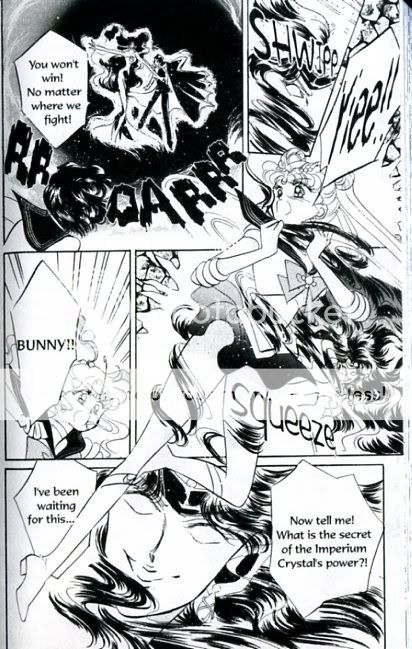
Clamp’s work for Cardcaptor Sakura, as a comparison, is a lot better.
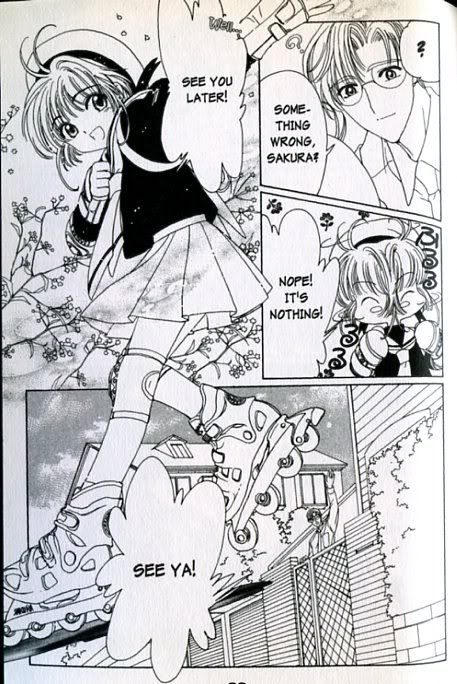
As with Sailor Moon, Clamp breaks panel borders and works with different size images all jammed into one space. But they balance that by not using extraneous background detail; by using lovely, controlled patterns (the tree branches with blossoms are especially nice), and by using the panel breaks to move you thorough the story (you follow the girl’s body down to oversized legs and into the next panel of the narrative.) It’s just much more deftly done; the difference between artists with an aesthetic sense and one without.

The wriitng in Sailor Moon is similarly muddled. Bunny, or Sailor Moon, couldn’t be a much more generic or less interesting character. She’s really more a collection of traits than a person; we learn she likes video games and sleeping, that she’s terrible at school, and that she whines a lot…but cutely (at least in theory.) Her personality, as such, never takes shape beyond these not-especially-appealing tidbits — and, moreover, even these vague delineations are quickly abandoned. By the third volume, we learn that Bunny is actually Princess Serenity reincarnated (or something), and her returning memories more or less obliterate the Bunny we (barely) knew. This would be, perhaps, an improvement, except that Serenity’s only character trait seems to be mooning after her crush object, Prince Endymion.

As for the narrative itself…it’s really less a plot than a series of disconnected cliches, drawn about equally from video games and mid-drawer fantasy. There’s an eldritch evil, there’s a crystal that needs to be protected, there’s an ever escalating series of helpful sailor scouts who must be awakened, each with their own sailor power; there are battles which inevitably end in victory…etc. etc. etc. There’s some vaguely kinky mind-control too, but it’s hard to much care as fractured scene after fractured scene rushes by. Is Endymion in thrall to the evil overlord forever? I’ll never find out, since I can’t stand to read the fourth volume…but, still, I’m guessing not.

So yeah; not good — though it could be worse, certainly. There are certainly appealing moments; the gratuitously cute totem cat, for example, is in fact cute. Sailor Moon’s battle cry (“On behalf of the moon, you’re punished!”) is charmingly corny; the sort of thing you could imagine a little girl actually yelling in battle. And, though the plot is an incoherent mess, it’s a welcoming, open incoherent mess. American super-hero comics are often involuted and incomprehensible because they draw on a mass of useless continuity trivia that’s (A) stupid and (B) of no interest to anyone who hasn’t read American super-hero comics for the last twenty years. Sailor Moon, on the other hand, makes no sense not because it’s insular, but because it’s so extraneous. Sailor Moon has no background…even from volume to volume, anyone can pretty much start anywhere on any page and you’ll be as at home as you would be anywhere else. You’ve got cute girls fighting evil; you’ve got crushes; you’ve got nifty special effects; you’ve got cute cat; you’ve got gratuitous wish fulfillment. That’s it. There’s really nothing else going on — not character, not plot, not themes, nothing. In some sense, I wonder if that’s part of the reason for the series’ success. If you’re a girl, it might be easy to imagine yourself as Sailor Moon, since Sailor Moon is barely there. It might be easy to imagine your own adventures, since the adventures on offer barely exist either.

Sailor Moon gets the pander right, and given that, additional specificity might well get in the way. The books, in short, remind me a little of McDonald’s — they aren’t good in the usual sense, but you have to admire the way they identify a need and fill it with maximum efficiency and minimal frills.
Comics in the Park

As a parent, I spend a fair bit of time in parks talking to other parents while we all rather desperately try to ignore our offspring. These conversations often start out with “so what do you do when you are not herding rugrats?” And, since at least one of the things I do is write about comics, I sometimes end up talking to strangers about funnybooks.

I had two such conversations this week, both of which were pretty entertaining. The first was with a woman from Columbia, who’d also spent some time living in Mexico. She told me that Wonder Woman in Spanish is “Mujer Maravilla”, which is pretty great. She was also interested to know what I thought of the Hernandez Bros. — she said she had trouble reading their stuff because she found it so sad (I think she was talking particularly about the Palomar books.) Maybe most interesting, she told me that there was hardly any native comics industry in Columbia. Instead, what comics there were were all Spanish translations of American super-hero comics. When I asked her if there were any imported Spanish-language comics from Mexico, she said, emphatically, no — which surprised me.

The second conversation was with an English documentary filmmaker; we’ll call him D. D. had once been very interested in comics, but hadn’t followed them in a long time. He explained that when he was a kid in London, he used to buy 2000 A.D. regularly, often shopping at the great London sci-fi and comics store Forbidden Planet. Anyway, one day when he was 13 or so, D. was in the store when a couple his age walked in. The girl was stunning; D said he looked at her and knew that this was it; a girl like this was what he wanted out of life.

Meanwhile, the guy who actually was with the girl walked over to a wall of comics, spread his arms, and said, half-joking-but-not-really, “Here it is! This is my life.” D. was watching the girl’s face while her boyfriend made this declaration — and that was it. D. walked out of the comics store and never went back.

Bound to Blog: Wonder Woman #17

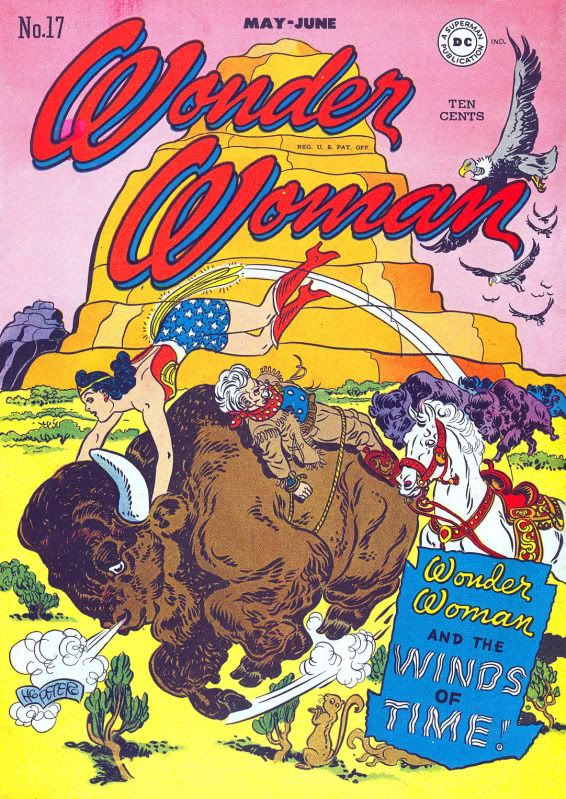
Marston and Peter’s Wonder Woman 16 may have been the best of the run so far, both in terms of the unusually ominous story and the adventurous art. #17 starts out well, with a marvelous cover.

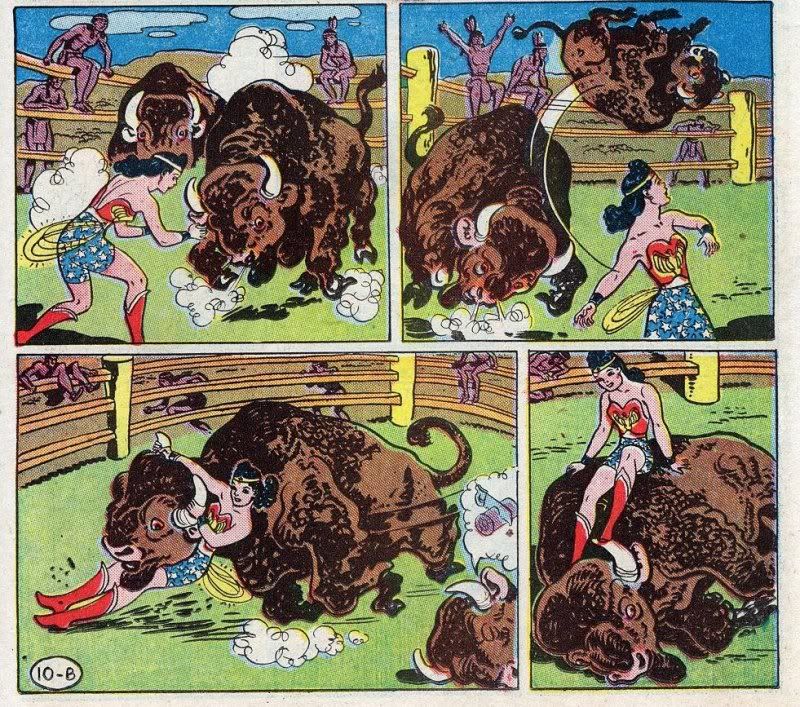
Peter uses almost all of his favorite tricks here: the bison is out of scale, so WW looks almost like a doll, and even the horse seems bizarrely tiny. The motion lines are incredibly dynamic…in part because the circle is split up, I think. He also uses some of his scribbly linework for the bison’s breath…and that little cue cartoony squirrel is hard to resist. Plus, it looks like we’re going to get WW in the wild west, which sounds like it has potential. The last time travel episode, with evolving gorillas and dinosaurs and Steve turning into a cave man, was pretty great, so I was optimistic that a second might work as well.

Unfortunately, after that cover, the issue itself is pretty much…eh. Part of the problem is that the entire plot is built around a scientist Lana, her love for the no-good Carl, and WW and the Holiday girls’ efforts to cure her of same. Lana’s confusion is such that it causes her to whip up time winds which cause all and sundry to fall back into the past and relive former lives in roman and colonial times…but even such full-bore nuttiness can’t disguise the fact that this is a pretty staid man-done-her-wrong plot. Marston’s fetishes are kept mostly under wraps (as it were); Lana triumphs simply by getting rid of the bad guy in her life, not by teaching him the joys of bondage and loving submission. The feminism is less conflicted, but also a good bit duller. Or maybe the problem is just that pure, naive Lana is not a particularly sparkling protagonist; whether as modern scientist, Roman maiden, or pioneer daughter, her trust in her blandly evil boyfriend and love for her blandly gruff father are equally uninvolving. You can see why Marston didn’t care enough about her to even bother tying her up.

As is often the case in this series, as Marston goes, so goes Peter; the artist doesn’t seem nearly as inspired as in his last couple of outings. Still, there are a couple of moments. The duo does some more experimenting with wordless action sequences, and again the effect is lovely:

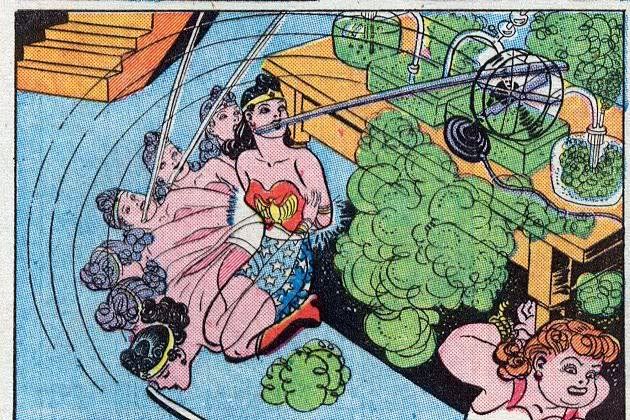
This is an interesting moment too.

Wonder Woman is using a pole to pick up a fan so the blades can cut the ropes tying Etta. I’m not sure the sequence entirely works; it’s hard to figure out whether WW is supposed to be moving up or down in that first panel, and the way the image is cropped, cutting off the end of the pole and the bottom two-thirds of Etta, seems awkward. But, again, I like the experiment with wordlessness, and the use of mutliple, Flash-like images of WW to convey motion is intriguing. Again, I wonder if this is something we’ll see more of in future issues. (I know we’ll see more of bound WW manipulating objects with her teeth — Marston lives for that.)

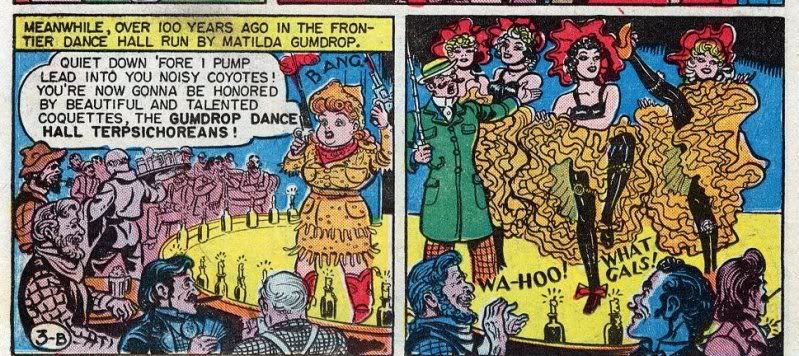
Going into the past also allows Etta to fully embrace her butchness:

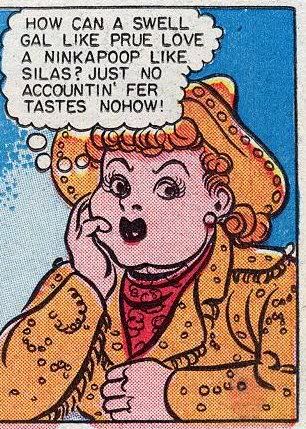
Yep; in a past life, Etta was a gun-toting madam…er, that is, cantina owner. I like this intimation of jealousy as well:

Peter also makes Etta rather handsome there. The borderline men’s attire suits her. (More evidence that Marston doesn’t necessarily see women in drag as evil.

And…yeah, I think that’s really about all I’ve got to say here. You can tell the issue wasn’t firing on all cylinders because I’m not having to stifle the impulse to reproduce every single page. Peter’s art is still worth looking at, but there’s little evidence here of the breath-taking double page layouts that made last issue so stunning. But that’s the way it goes sometimes. We’ll see hope for better on the next one….

Music For Middle-Brow Snobs: Discopolis

This week’s download, with lots of krautrocky electro bleepery:

1. Artur Rubinstein — Chopin Mazurka #15, Op.24/2 CT 65 (Chopin: The 51 Mazurkas)
2. Sun Dawei — Crawling State (Anthology of Chinese Experimental Music)
3. Nara — Dream a Little Dream (Anthology of Chinese Experimental Music)
4. Kraftwerk — Metropolis (The Man-Machine)
5. Yellow Magic Orchestra — Technopolis (Solid State Survivor)
6. The Two Tons — I Depend on You (Horse Meat Disco)
7. Aavikko — Computopia (Nov0 Atlantis)
8. The Juan Maclean — A New Bot (The Future Will Come)
9. Legion of Two — It Really Does Take Time (Riffs)
10. Raekwon — Baggin Crack (Only Built 4 Cuban Linx II)
11. Raekwon — Surgical Gloves (Only Built 4 Cuban Linx II)
12. Raekwon featuring Jadakiss and Styles P (Only Built 4 Cuban Linx II)
13. Gene Page— Blacula (The Stalkwalk) (Blacula)

Download: Discopolis.

Last week’s download, if you missed it, is here

Utilitarian Review 9/18/09

Goodbye

As folks have seen, the biggest and saddest news on the Hooded Utilitarian this week is the departure of Tom Crippen. Tom came onto the blog almost exactly a year ago, though it feels like he’s been here forever. He’s been a tireless blogger, about everything from comics to politics to Star Trek. While he’s been here, his lovely, thoughtful, and often mean-spirited (and I mean that in the best way) prose has really defined the Hooded Utilitarian.

If you haven’t read much of Tom’s work, I’d urge you to look back through the archives; there’s just tons of wonderful material. Some of my favorites:

-his description of an imaginary Sandman collaboration between Neil Gaiman and Jack Kirby.

-his paean to his days as a Marvel Comics collector

— his contributions to the Helter Skelter roundtable, both in his own posts and in comments.

—his attempts to understand Oliphant

-and maybe the gem of gems, his description of Michael Corleone as a Mary Sue. It’s one of the pieces of writing that made me feel like starting the blog was worth it.

Almost all of Tom’s posts, with the exception of a few at the beginning, can be found here. You can also read him semi-regularly in the Comics Journal, where he writes a stellar column called “The Post-Post-Human Review about super-hero comics. I believe he’s got a long essay on Alan Moore and Watchmen coming up there, which I’m eager to see.

I hope we’ll see Tom occasionally in comments still, and I really hope he finds more outlets for his writing, either online or in print. In any case, I feel very lucky to have had him here for as long as we did, both as a co-blogger and a friend.

On the Hooded Utilitarian

This week was devoted to our roundtable on Sandman. Some of us were disappointed, others still loved it, and lots of folks weighed in in comments.

There was also a long post on the inkdestroyedmybrush site in response which is worth checking out.

Utilitarians Everywhere

Vom Marlowe reviews Killer Unicorns over on her LiveJournal page.

Kristy Valenti catches me in an embarrassing error over at comixology. It’s like the Dave Johnson thing all over again…except this time, I really do kind of care.

I have a short review of Jennifer’s Body at the Chicago Reader.

An essay at Splice Today in praise of lousy art.

On the contrary, if any contemporary figure attains to Bataille’s ideal of pure sacrifice it is one particular kind of artist—that is, the failed artist. Note that by “failed” here, I do not mean the artist who has missed commercial success, but has underground cred or aesthetic bonafides, or who is discovered and lionized after his death. On the contrary. When I say, “failed” I mean “failed.” I mean an artist who profligately, copiously, obsessively works on creating objects that are, literally—by everyone and forever—unwanted. Creators of tuneless songs who never achieve dissonance; of ugly canvases too self-conscious to be outsider art; of doggerel verse too banal for even the high school literary magazine-in them, the excess of the universe is annihilated. Genius, love, life—they are exchanged for neither lucre, nor cred, nor beauty, but are instead simply thrown away. Failed art is permanently wasted, and it is therefore sacred.

I have a review of Observatory’s Dark Folke. It got kind of chopped down for space, so I thought I’d reprint the full version here:

The Observatory
Dark Folke
Self-released

Though this Singapore band may have placed the word “folk” on their album, that doesn’t really capture their sound. Certainly, there are elements of freak folk here; “A Shuffler in the Mud” has sparse lovely harmonies and a gentle acoustic sway that wouldn’t be out of place on a Devandra Banhardt album. Other tracks, like “Lowdown,” though, trip merrily etherwards, heading for the brainy, drony psychedlia of Ghost. For that matter, “Decarn” is almost heavy enough at points to qualify as metal, locking into a head-thrashing trudge while keyboards burble overhead and somebody shrieks from the pits of Hades for a couple of bars before handing it over again to the gentle-voiced harmonizers.

The album feels like a delicate arrangement of shifting textures drawn upon and then erased from a black canvas. Omicron, for example, starts with an acoustic guitar strum that is allowed to fade almost completely; then there’s a second strum, also followed by silence, and then a percussive keyboard figure takes over, building with other instruments and vocals, until again it fades almost to silence…and we go back to acoustic guitar. The track is built around changes in direction, but it’s not the busy post-modern bricolage of the Boredoms. Rather, it’s modernist, fetishizing space and silence. If The Observatory doesn’t adore Webern, I will cease staring at the hardbound liner notes, graced by Jason Bartlett’s Pus-head meets Virginia Lee Burton line-drawings, and eat the whole package instead.

Other Links

Alan David Doane reviews the abstract comics anthology and searches for Sentinels in my contribution. His son finds them.

Comics creator Dewayne Slightweight performs an amazing rendition of Were You There When They Crucified My Lord.

Morpheus Strip: Dream Lovers

This is the first in a roundtable on Neil Gaiman’s Sandman series. Suat, Tom, Vom Marlowe, and Kinukitty will be along later in the week with their takes on the series as well. (Update: And you can now read the complete roundtable)
______________________

I loved Sandman back when it came out in the late 80s/early 90s, and I’ve probably read the whole thing through at least a couple of times. However, it’s been a while…partially out of nervousness. I strongly suspected that the epic wouldn’t hold up on rereading.

And…yeah. It doesn’t exactly hold up. I reread the entirety of “Fables and Reflections” and skimmed through a couple of the other books (“A Game of You” and “The Kindly Ones” especially, I think.) Part of it is the art, which bounces around inconsistently and is often just not especially good. There are undoubtedly some very nice walk-ons — Bryan Talbot’s creepy take on the giant, cadaverous Persephone was memorable, and, as Suat recently pointed out, the P. Craig Russell “Ramadan” story is pretty spectacular. But then you’ve got atrocious efforts by folks like Kent Williams.

No wonder he looks startled; he appears to be improbably made out of rock. Maybe he’s related to the Thing?

Aside from the inconsistencies in the art, though, the real problem is that my former enthusiasm for Gaiman’s writing has dimmed a lot. I can still appreciate his cleverness and the care of construction…but after a while, both of those virtues are pushed so enthusiastically and unilaterally that they start to feel oppressive. After a while you start to almost want to plead — please, somebody, anybody, could you just once say something that doesn’t come back a panel, or a page, or several issues down the road with an ironically profound or profoundly ironic twist? Could we have a story end without a smug little O’Henry meets dumbed-down Borges twist? Could everybody just for a fucking second stop talking?

The thing that crystallized my irritation with the series was Nuala. She was a fairy with a glamor that made her appear as a beautiful woman, but in actuality she was kind of a dumpy elvish little thing. The fairy gave her as a gift to Dream for some reason or other (maybe to try to get him to give them the key to hell? I can’t remember exactly.) Anyway, she fell in unrequited love with dream, and ends up nervously and apologetically causing his downfall. She’s a sad, sweet character. I liked her.

But as I was sort of skimming over her story again it occurred to me that, while her unrequited love is certainly poignant, it’s also weirdly unmotivated. That is, we certainly do feel her pain and sadness to some extent…but we never really get much of a sense of her love. What about him appeals to her? Does she think he’s beautiful? Is it his (on again off again) kindness to her? His power? There don’t have to be individual or even clear answers to these questions, obviously, but they’re never even asked, much less answered. For Gaiman, Nuala’s love is an almost magical fact; it drops onto her and possesses her, and that’s all we ever really need to know about it.

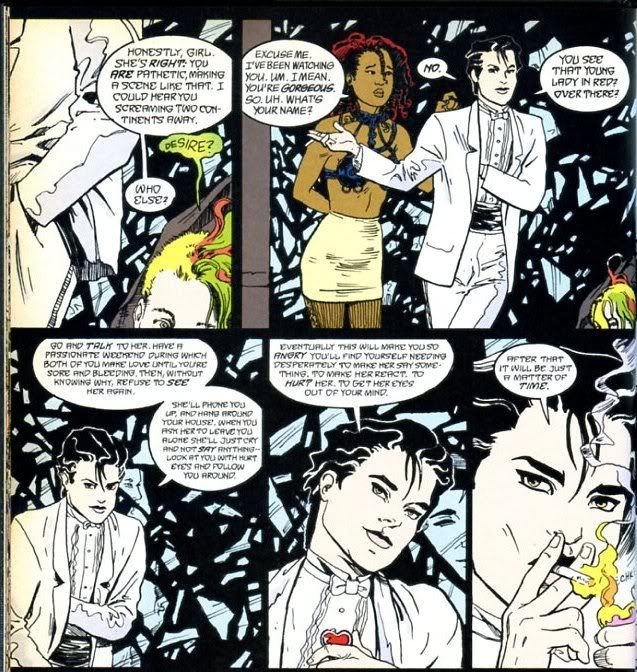
And that’s how love functions throughout the story. Gaiman almost never, that I can remember, actually bothers to show love as a functional, or even dysfunctional, relationship between two people. Instead, it’s just another plot device, a story element to push the action…or, more accurately, the words. In “A Game of You” the cuckoo casts a love spell by talking; in “Brief Lives” Desire does more or less the same thing.

That seems to be how Gaiman sees love; a verbal whammy that comes out of nowhere to make a clever point or set up a clever scene, rather than as an actual relationship which is maybe worth exploring in its own right. Destruction accuses Orpheus of loving the idea of Eurydice more than the actual person…but is that really Orpheus’ failing? Or is it Gaiman’s? Certainly, Gaiman never shows the couple in a tender moment — Eurydice gets more time with a Satyr in the narrative than she does with her supposed love. And the big love affair of the book, between Dream and Thessally, occurs almost entirely off-screen..ostensibly because doing it that way is clever and surprising, but maybe actually because Gaiman has no idea how to deal with an actual love affair and is scared shitless to try. Certainly, the hints of the romance we get sound deeply unconvincing — when they’re in love they walk about idyllically among the bowers prattling sweet nothings, making some of Dream’s attendants uncomfortable; when theyr’e out of love it rains a lot because Dream is throwing a tantrum. Gaiman is clear that these are cliches, and he’s making fun of them because they’re cliches…but that doesn’t change the fact that he doesn’t seem able to deal with love in anything but cliches.

There’s actually an analogy here with another, more recent tween phenomena: Twilight. In both, there’s a lot of darkness and angst, which gives an exciting frisson of danger even as it distracts from the things that an actual adolescent might really find dangerous or threatening. In Twilight, the danger of vampires and blood and werewolves and melodrama all stands in for, and obscures, the looming, oncoming reality of adult relationships and sexuality. In Sandman, similarly, the pretension and the cleverness and the angsty melodrama seems, at some points, like a magician’s trick; the left hand is bobbing and weaving and throwing out fireworks so that you don’t notice (except with a kind of unacknowledged satisfaction perhaps) that there’s not much at stake in the right.

Though that all sounds kind of harsh, I’m actually not against this kind of tween repression categorically; in the Twilight series ( which I’ve mentioned liking before) I think the sustained effort to avoid looking at the obvious ends up energizing the series; it’s both winning and squicky, a kind of pop sublime. In Sandman I’m not sure it works so well. On the one hand, Gaiman is in some sense obviously a better writer than Stephanie Meyer. Though, as I said, the cleverness is irritating, it is, nonetheless, often actually clever, and he does manage to come up with some genuinely creepy twists (the treacherous stuffed toys in “A Game of You”) as well as some moving ones (Nuala’s story for example, as I mentioned above.) Meyer is not as bad as she’s sometimes claimed to be, but I doubt she could have pulled off either of those things.

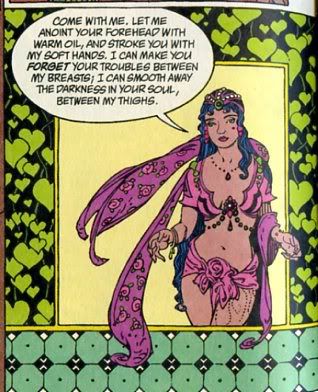
On the other hand…Sandman is way more pretentious than Twilight…and the distance between the pretensions and the delivery is sometimes painful. For instance, there’s this panel:

Ah, those harem maidens…so exotic! So poetic! So unaccountably possessed of the sweaty metaphorical unease of a randy 13-year old trying to look impressively sophisticated!

It’s significant too, I think, that the so-thoughtfully entreated king declines the request. In Twilight, the heroine and hero eventually do, in fact, after much deferral (and marriage) have sex. This is in itself problematic; the whole tension of the series rests on the balance between safety and desire which is more or less vitiated when everybody gets what they desire and ends up safe. Gaiman is more canny; Dream, elaborately and with much fanfare, refuses to alter the structure of the series. Rather than change he decides to kill himself. Gaiman makes the “change” in question specifically about responsibility; Dream is not willing to give up his duties as ruler of dream, and so his only way out is death. But one has to wonder — is it really his (quite amorphous) duties that are at stake? Or is it something else? His ex-lover and Nuala more or less engineer his final downfall, his realm is torn apart by the furies, a rampaging feminine archetype — and the way they taunt him at the end is borderline sensual. “We are destroying the dreaming. Can you not feel it?” “Yes I can.” But then interrupts the foreplay, and Dream scurries off into oblivion, leaving one more fraught relationship we don’t get to really explore. Like a cadaverous Peter Pan, he never grows up, never has to stay with Wendy, and never gets out of the dream.

_______________

Update: Suat’s post is now up.

Update: Vom Marlowe and Tom weigh in.

Update: And Kinukitty finishes up.

Music For Middle-Brow Snobs: Sister Nepenthe

Here’s this week’s download. It’s more on the rock end of things:

1. T. Rex — The Slider (The Slider)
2. The Stooges — Little Doll (The Stooges)
3. Jesus and Mary Chain — Gimme Hell (Automatic)
4. The Stars — Double Sider (Perfect Place to Hide Away)
5. Cosmic Invention — Help Your Satori Mind (Help Your Satori Mind)
6. Necromandus — Nighjar (Downer Rock Genocide)
7. Saint Vitus — Dying Inside (Born to Lose)
8. Rolling Stone — Sister Morphine (Sticky Fingers)
9. Damon and Naomi — Beautiful Close Double (The Earth is Blue)
10. The 5th Dimension — Dreams-Pax-Nepenthe (Magic Garden)
11. The Observatory — Decarn (Dark Folke)

Download: Sister Nepenthe

And if you missed it, here’s last week’s download, featuring Chopin, Beyonce, Ol’ Dirty Bastard and others.