Wily Ourobourus

I’ve got a review of the newish Xasthur album up at metropulse. The first paragraph is one of the better things I’ve written for them, in my opinion anyway:

For centuries, scholars believed that metalness was a straight continuum, with bands like Slayer at the top end and performers like, oh, say, Debussy at the bottom. In recent years, though, researchers have discovered that the truth is somewhat different. Beyond St. Vitus, beyond Celtic Frost, out where the black dooms drone, we now know metal curves, and like a wily ourobourous, takes its tail in its teeth only to discover it’s chomping on the smiling visage of Danny Elfman.

Juno

Just saw this movie (about a 16-year-old named Juno who gets pregnant and puts the baby up for adoption, if you missed the hype.) It’s not bad; the dialogue is snappy, and the star (Ellen Page) is appealing — she refers to her the effect of her very pregnant presence at school as that of a “cautionary whale” for example. And there are lots of nice moments — at the hospital when she’s about to give birth, for example, Juno begs her step-mom to get her a spinal tap to offset the labor pains. Her step mom (Alison Janey) calls out exasperatedly for a nurse, and in doing so refers to Juno as “my daughter.” It’s a nice moment, emphasizing the movie’s insistence that parenthood is more about love and commitment than it is about biology.

Overall though…I guess the basic problem can be summed up as sit-com quirkiness. Indeed, the movie is insistently, almost desperately quirky; everyone is always spouting pithy one-liners and engaging in telling, charming idiosyncracies (Juno’s boyfriend pops orange breath mints, for example; Juno’s step-mom loves dogs, etc. etc.) But if you look a little closer, those idiosyncracies are mostly deployed in the interest of covering up fairly banal insights and familiar characters. The working class, clueless, but loving dad; the slightly nerdy boyfriend; the teasing dependable best friend…where have I seen this all before?

Worst of all is the adoptive yuppy couple. Vanessa [Jennifer Garner] is uptight and wants a baby. That’s pretty much all there is to her; she’s the quintessential modern woman, striving for the one thing all her success has denied her…motherhood. Over the course of the movie she becomes more sympathetic…but never because she acts or behaves differently, really. Her quest for motherhood is just seen as more and more sincere and worthwhile as we go along. Indeed, you never learn anything about her except that she wants a baby. She never gets any quirky lines, never is blessed with quirky habits; never seems anything but completely uptight. Part of the problem is Jennifer Garner, who is about as responsive as a stick…but the script gives her little to do in any case.

Even worse is Jason Bateman as Mark. Like Garner, Bateman is a dull fish, playing uptight and suburban as unexpressive and flat. He’s also a caricature in any case; a formerly cool musician (he opened for the Melvins!) who now writes advertising jingles, he initially seems kind of cool, and then pitiful and icky as he makes a semi-pass at Juno. Again…where have we seen this before, I wonder? Guys who like rock music must be stunted men-children afraid of grown-up commitment. Also, they want kids less than women do. Who knew?

And then, at the end, we learn it’s all not really a story about giving up your baby for adoption so much as it’s a story about finding your true love. We’re in a John Hughes movie after all. It’s good to know that, even though the man himself is gone, his spirit lives on.

Bound to Blog: Wonder Woman #16

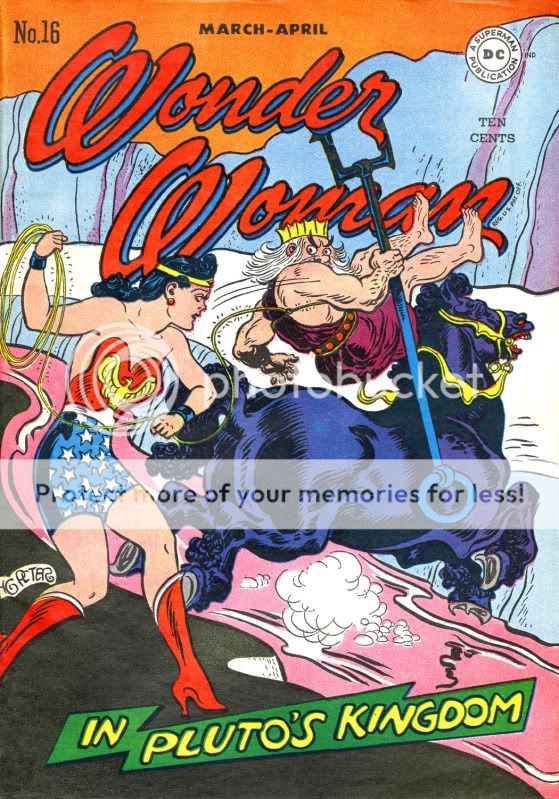
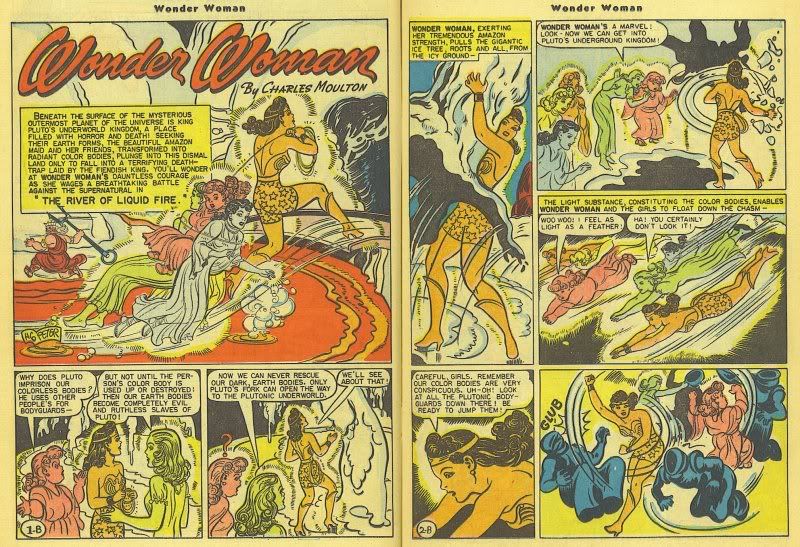
This is really an amazing issue. As I intimated in the last post, Marston and Peter seem to be getting more and more adroit at integrating layout and narrative, and there are some absolutely stunning spreads in this issue.
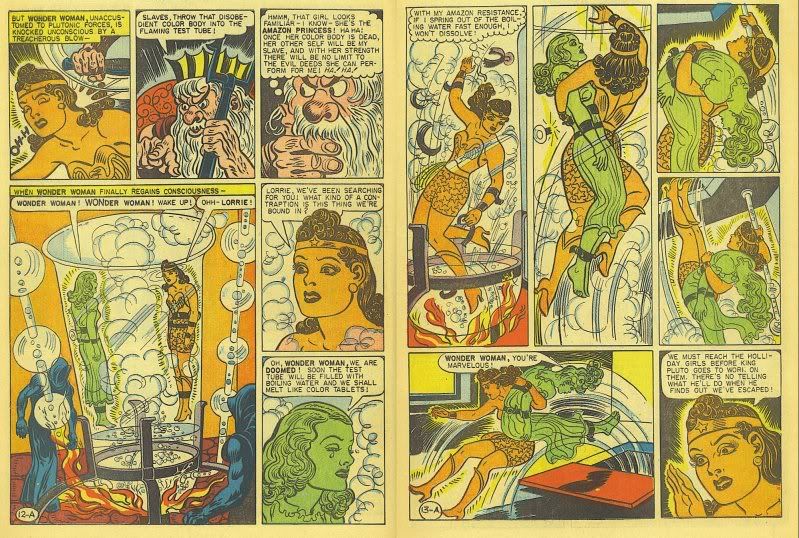
The color here is amazing, and the diaphanous, ghostly bodies really show off Peter’s supple lines. There’s a great contrast, too, between the airy grace of the female figures and the caricatured, cartoony old man (that’s the evil Pluto) at the top of the first page. Peter has also loosened up his layouts again, using bigger and fewer panels, and dividing them up in more varied ways than has been his wont up till now. Also notice in the upper right of the second page, there’s actually a wordless action sequence. I think that’s the first one in the series, and it’s really a joy to see Peter working without all those cumbersome text boxes for once. There’s another wordless sequence later in the comic; hopefully we’ll see more of it in later issues as well.

Also, so many great details here. The weird test tube with those evil black figures lurking around it, all against that gorgeous orange background…Peter’s use of motion lines is lovely as always….and the movement of the green girl in WW’s arms is perfectly done; she looks entirely limp and yet rigid a the same time, with her stylized hair and gown flowing out behind WW.

I think this one may even be better:
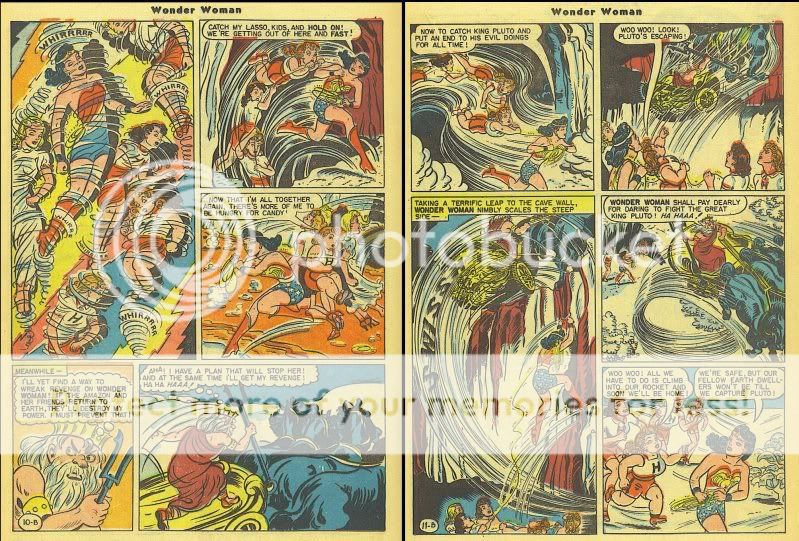
Again, the motion lines become an intense design element; it’s almost like you’re looking at rapids with all the racing, turbulent patterns going every which way and yet still managing to form a coherent whole. The upper left panel, with WW and the Holiday girls spinning semi-conscious in cocoons against that weird abstract colored background is especially fine — and, of course, with its hints of helplessness and semi-involuntary transformation, intentionally fetishized.

If Peter has outdone himself, Marston also turns in a fine story, somewhat more ominous and dark than usual In traversing the planets and the Greek gods, he’s inevitably come to Pluto, and so he gets to retell the Persephone rape legend
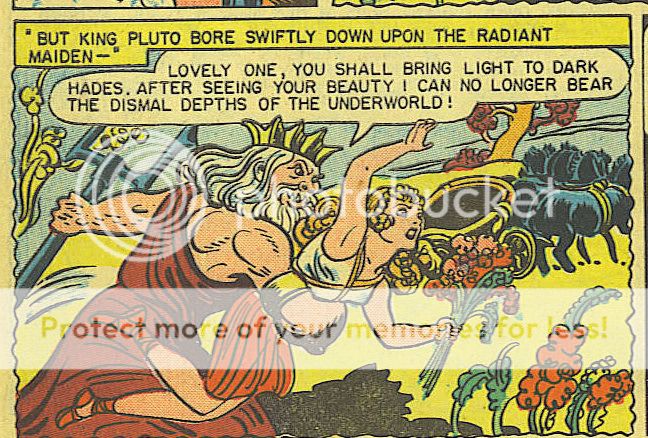
and replay it using one of the Holiday girls as the unfortunate Persephone.
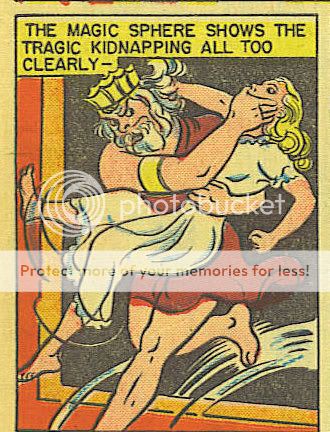
This is preceded by a suggestive sequence:
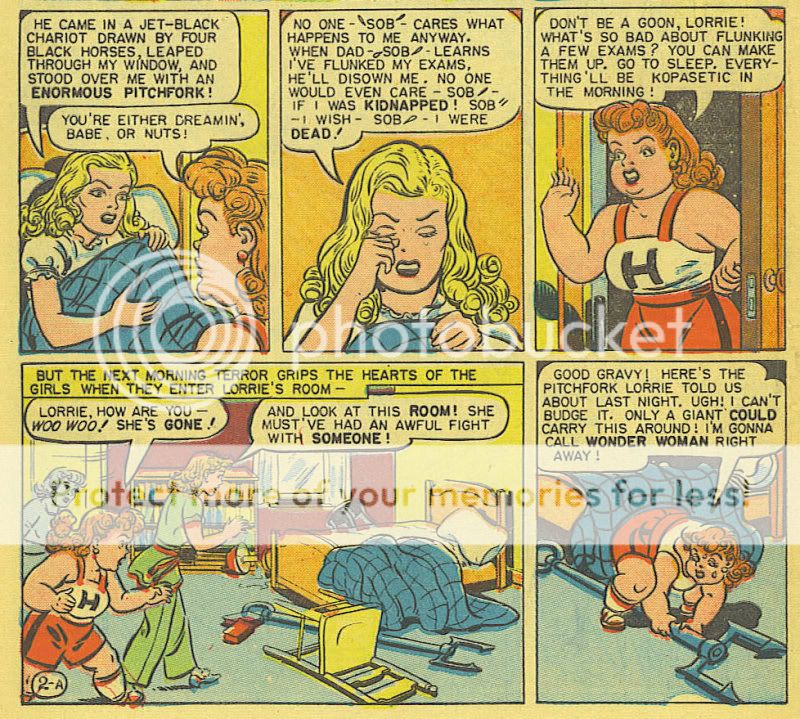
You have the threatened rape, the disbelief of the other girls…and then the tearful evocation of fatherly displeasure, followed by the actual rape, complete with discarded phallic accoutrement. We’re treading around issues of incest and abuse, with Pluto taking the part of rapist/ogre/father.

That would explain in part, too, some of the more ominous submerged themes in the issue. When they get to the planet Pluto, for example, the Holiday girls and WW are confronted by black, groping hands. The hands hold them while they are split apart into spiritual light bodies and physical black bodies.
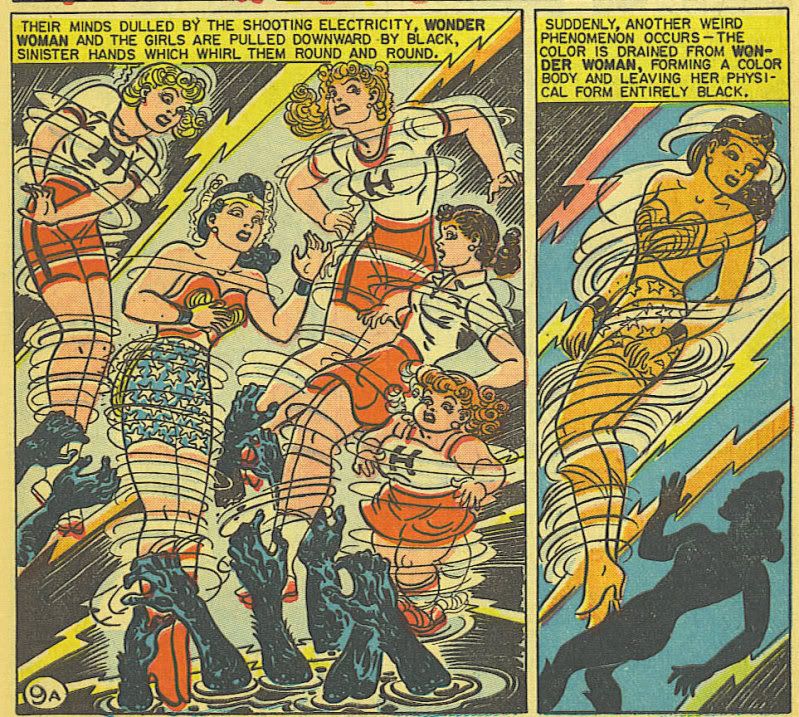
So bifurcated, the girls are held under Pluto’s thrall:
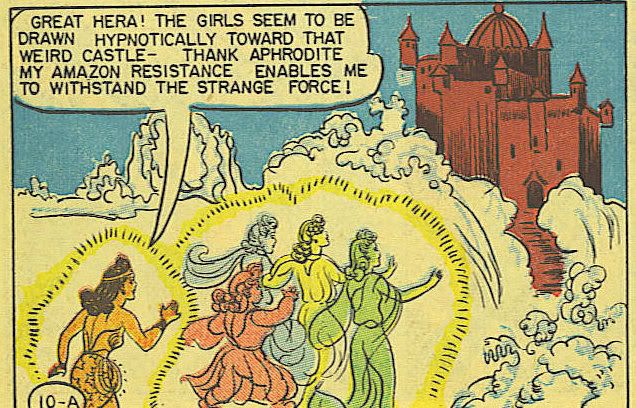
What happens at that point is a little unclear, but if I understand right, Pluto uses the light bodies as decorations in his castle while the dark bodies becomes his hollow, robed servants. In any case, the separated forms are definitely in his service, and easier to destroy than whole selves.

Thematically, the evil black hands, the split between beautiful beloved colorful spirits and despised hollow black drones, the narrative quest to reunite the two — it all seems like it’s dealing with sexual trauma, and the subsequent sense of estrangement from, and loathing of, the self. It’s mixed in, too, with Marston’s odd theories about the power of colors (theories I don’t pretend to entirely understand), and with his usual male/female binaries (the spiritual forms actually seem more female than the abandoned physical, blackened shells — which makes sense since masculine/feminine is more archetype than physical reality for Marston.) The result is a narrative that veers vertiginously between (literally) colorful fantasy and a disturbing darkness, with a sense that love can slide from one into the other at a moment’s notice. For instance, look at these successive pages:
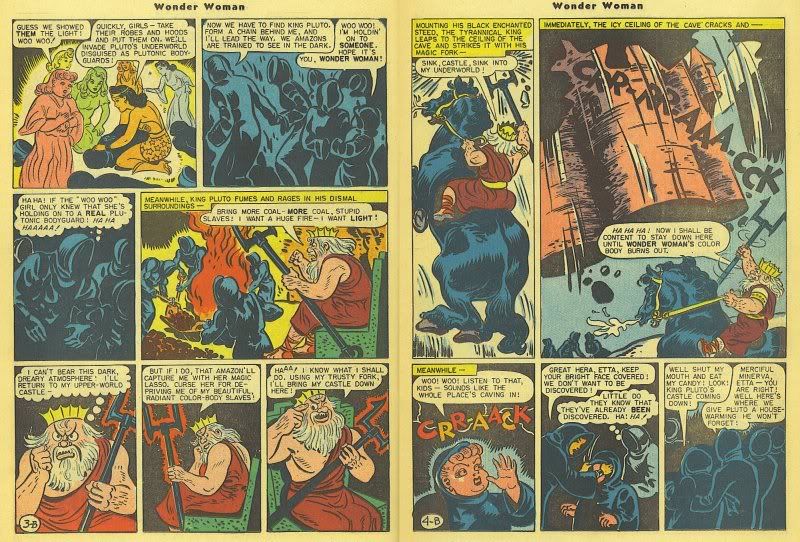
The color palette kind of tells you everything you need to know, almost without even reading it.

There’s another telling sequence late in the book I think. Pluto comes to steal Steve away. The story spends an unusual amount of time not on Steve’s reaction, but on his secretary’s:
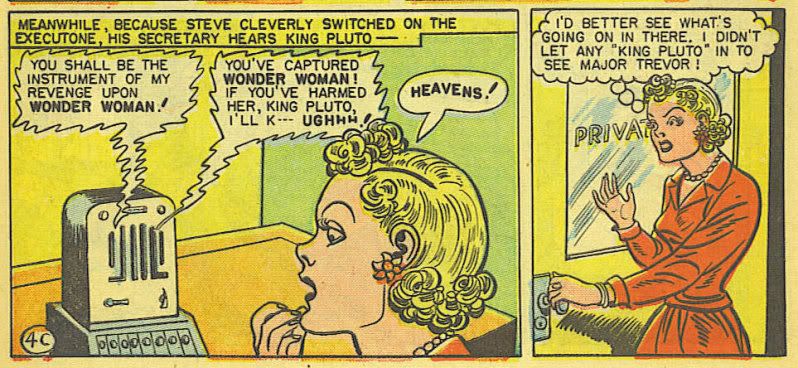
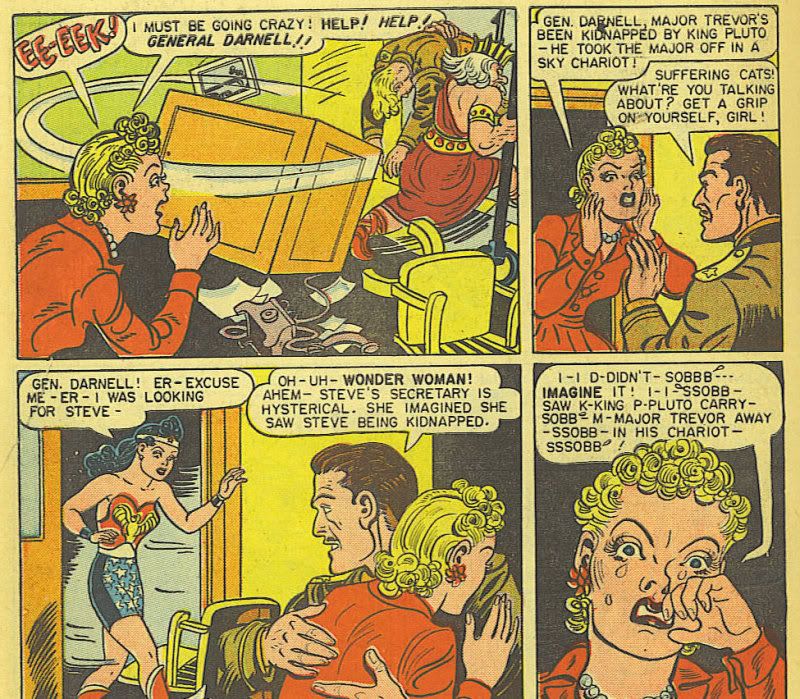
Narratively, there isn’t a need for all this; why do we care about the secretary’s reaction, after all? And why is she quite so thoroughly freaked out? (I mean, yes, I’d be freaked out too, but in terms of the stuff that happens on a regular basis in this comic, this is pretty small beer.) I think the answer to both questions, maybe, is that this is important, and she’s freaked out, because it’s a primal scene…and more importantly, a primal scene as site of abuse. It’s not just a kidnapping; it’s a rape, and a rape linked to childhood abuse and perversion (it’s a male on male intergenerational rape, after all.) The secretary, in effect, is necessary because you need not only the rape, but *the witness to the rape*; not only the (child) abuse but the traumatized child-adult.

Given Marston’s usual ways, I think it’s valid to wonder if he’s fetishizing father/daughter rape. There’s probably a touch of that in a scene like this:
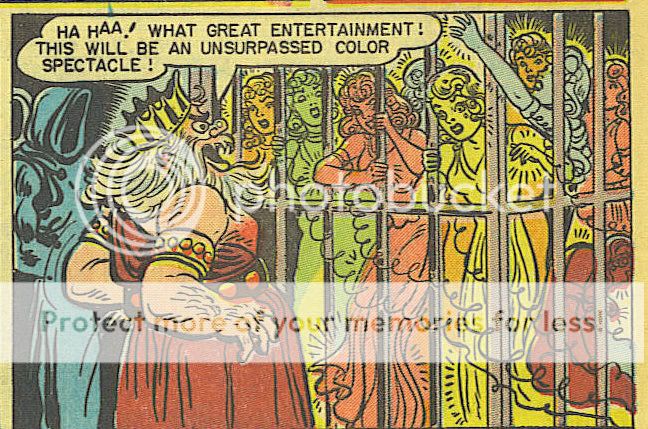
At the same time….I think I’d argue that this sort of scenario (submerged rape themes, submerged incest themes) probably has a fair amount of appeal for girls as well as for dirty old men…especially when the girls are as clearly the heroes, the older men are as clearly the villains, and the incest/rape is as sublimated as is the case here. Relationships between fathers and daughters — or, perhaps more to the point, between patriarchy and daughters — are definitely fraught. The patriarchal power is desirable and exciting, and yet (and because) it’s forbidden for girls. Marston’s providing a way around that; he’s saying that you can be like Wonder Woman, and keep hold of the danger and the excitement and the sex without having to split against yourself and become a patriarchal thrall/ornament. There’s a sense, in other words, in which I think Marston’s fetishization of feminism is appealing not only to men, but to women as well, since women, like men, are invested in both sex and power relations as desirable commodities.

Which isn’t to say that it’s not a tricky and uncomfortable issue. Freud started thinking about female incest and rape fantasies in the context of his own female patients, most of whom were the daughters of his colleagues. They all claimed they’d been raped by their fathers. Freud was like, well, of course, their fathers didn’t rape them, because they’re my friends, so…women must have incest fantasies. Which is bullshit; I have little if any doubt that his patients were in fact raped by their fathers. And yet…at the same time that they do actually get raped and abused, by their fathers and others,…many women also do have actual rape fantasies, and fetishized relationships with (sometimes abusive) father figures. Marston’s story here seems to be about acknowledging and enjoying those fantasies (or even those realities) in order…I don’t know, maybe not to transcend them, but to not let them cripple you. In this context, it’s interesting that for Marston the reintegration is actually sexualized as well:
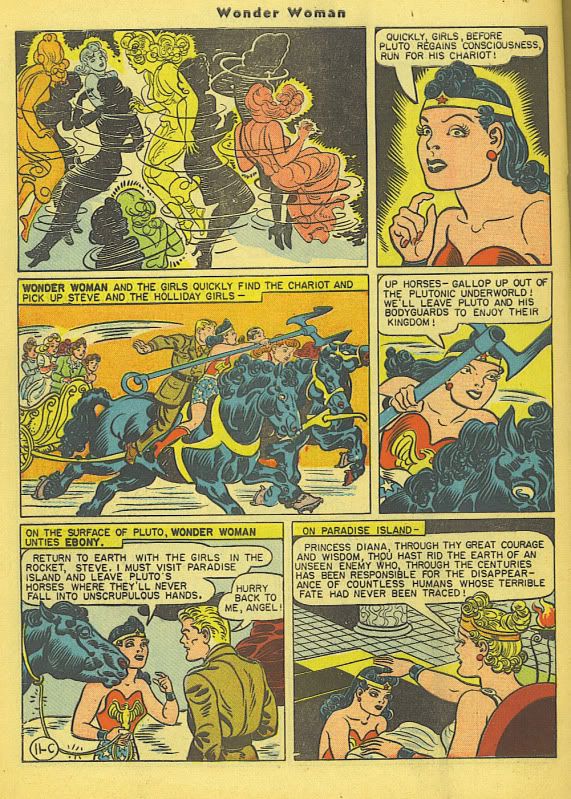
I said above the Marston seemed to be sexualizing the helplessness of the transformation…but on second thought, I wonder. Maybe it’s the duality itself that he finds sexy; the image of women as both spirit and flesh, sexual and ethereal, merging into one? Instead of breaking women apart into virgin and whore and fetishizing the severed bits, Marston is excited by the integration; the fact that women can be both and neither and more than the sum of their parts. Pluto is misguided not only in his morals, but in his aesthetics and his cheesecake; women are most beautiful when they’re whole, not when their cut into bits and used as catspaws of the patriarchy.

And, of course, at the finish, WW is riding a stallion and clutching the uber-phallus/triton, vanquishing the evil father and taking his place…and then kneeling in loving submission before the over-mother, who promises that rape has been vanquished…at least until you turn back to the first page to read it again.

Living Hand to Brain

Inspired by Suat and some comments on his post, I surfed over to Thought Balloonists, and poked around a bit. The article Suat referenced on Dash Shaw by Charles Hatfield was certainly thoughtful and well argued, but did little to dispel my generalized indifference towards everything I’ve heard about Shaw and his comics. There was a lovely essay by Craig Fischer on Steve Ditko though. Basically, Fischer argued that in Ditko, illustration of hands carry much of the emotive power. Fischer then suggests that this focus on hands rather than on a more diffused expressiveness or sensuality is linked to Ditko’s deep discomfort with sexuality and, indeed, (especially later in his career) with emotion in general. Fischer then concludes that Ditko may have suffered some sort of abuse, which may be the cause of his repression.

As I said, it’s an interesting argument overall. I’m no Ditko expert myself, but the discussion of the use of hands (inspired in part by comments by Bill Randall, it looks like) and the repression in Ditko’s art seems pretty spot on. I think it’s really dicey to try to use that to extrapolate information about Ditko’s past trauma, or lack thereof. Mostly because, as Fischer notes in comments, people are really surprising and unpredictable. People can be repressed or uncomfortable with certain kinds of material for all sorts of reasons, some of them pretty counterintuitive. Knowing pretty much nothing about Ditko’s biography, I can say, you know, maybe Ditko was beaten as a kid and so feels uncomfortable with sex. Maybe Ditko’s gay and repressed and so feels uncomfortable with sex. Maybe he had a religious background and so felt uncomfortable with sex. Or, you know, maybe he’s just uncomfortable using sex in his work for reasons that connect to a lot of things, but not to any one clear explanation. Works of art can sometimes work like puzzles that you can fit together and solve, but people aren’t like that. It seemed to me that Fischer’s essay was in some ways an effort to forgive Ditko’s schematic view of humanity by turning Ditko into a schematic himself.

Bound to Blog: Wonder Woman #15

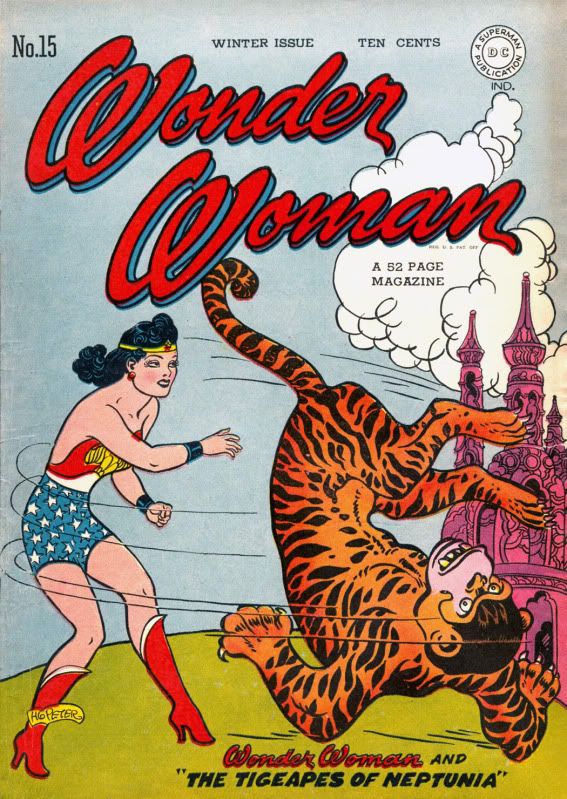
As I said earlier in the week, Wonder Woman #14 was okay but not great. For this one, though, Marston and Peter are back to form, with a tale that starts right out with preposterous and just snowballs from there. You know you’re in for a ride when the coverpage features a tigeape….

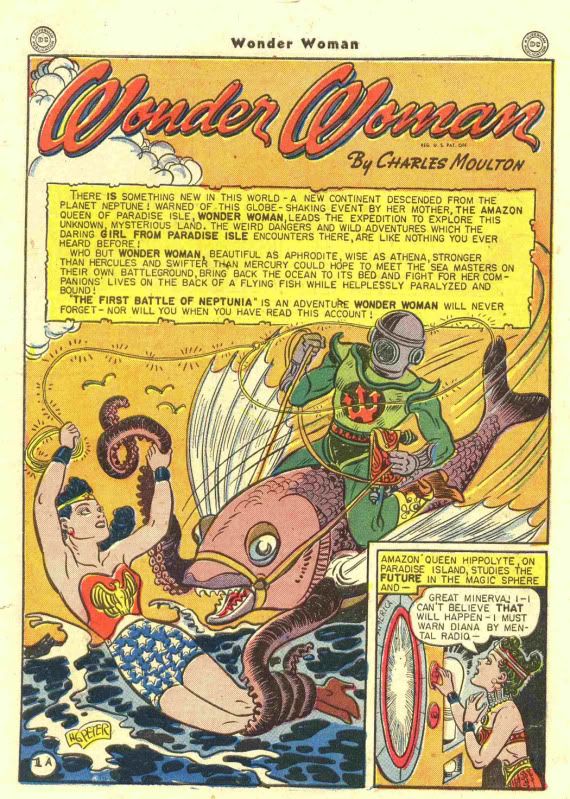
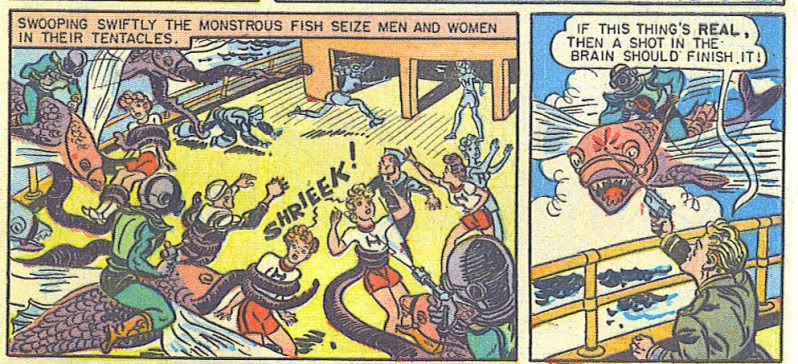
And the splashpage features a flying fish with octopus tentacles being ridden by a knight.

So anyway, the story begins with a giant chunk of the planet Neptune falling to earth as a new continent. You’d think that such an apocalyptic event, probably heralding the end of life on earth as we know it, might be the basis for the entire comic that follows…but, nah, not really. Continents hitting the planet just cause a few buildings to shake; not a big deal really. Instead, the really cool adventure happens when we go to visit that new continent and discover that..well, see for yourself:

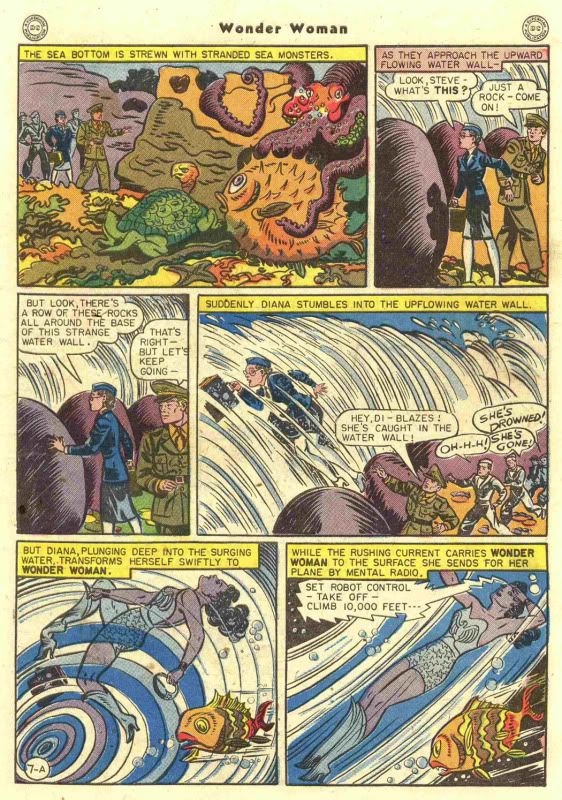
And furthermore:

You have to adore the way Diana looks all hunched up and startled when she falls into the water…and also the fish swimming by her as she changes to WW…and the purply swirls. Underwater scenes just really bring out some of Peter’s best work, I think because of the chance to do all the swirling patterns and lines…and the undersea creatures of course. What a perfectly beautiful page.

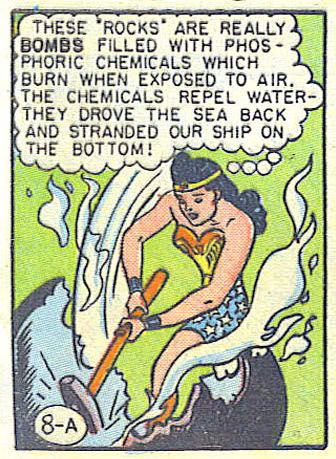
You’re probably wondering why on earth the ocean water has parted and formed giant walls. Have no fear, all is explained:

There are tons of pseudoscientific explanations just like that throughout this issue, and every one is a keeper. Where does Marston get this stuff? The man’s a genius, I tell you.

Anyway, no sooner has WW gotten the ship back afloat than the crew (including the Holiday Girls, who, as always, have come along on the dangerous military mission) are attacked by those octoflyingfish we saw on the splash page

WW and crew defeat the flying fish, which are controlled, as it turns out, by good looking guys from Neptune.

This is a lovely page, I think, by the by; I think it’s partially the color palette that gets me; all those oranges and yellow oranges. But I also like the way that it’s sparse but balanced. And, of course, the toothy flying fish floating off to the side at the bottom are pretty hysterical.

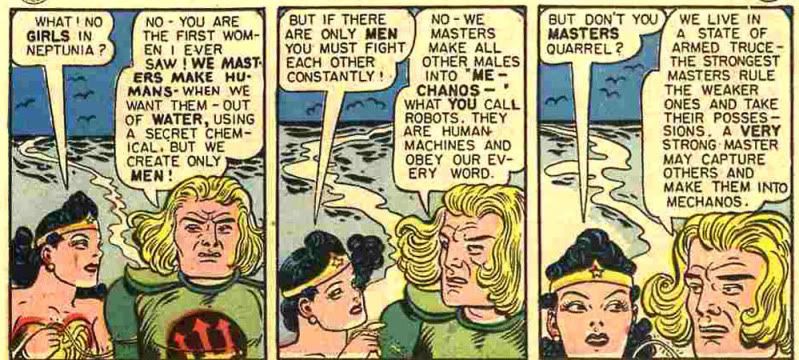
WW and company take the Neptunians back to their home continent (strangely undamaged by its trip through space,) and while chitchatting they discover why it is that the Neptunians are so mean and unpleasant:

I like the way Marston just has WW state flat out that men will just fight, fight, fight if there aren’t women around. And the Neptunian doesn’t even really contradict her; he just explains that there’s no war because most of the men are turned into robots. It’s moments like this that you realize that Marston never did have a moments doubt; there was never an instant where he thought, “You know, almost no one agrees with me…maybe it’s just not true that women should rule over men.” This was a guy who was very secure in his worldview.

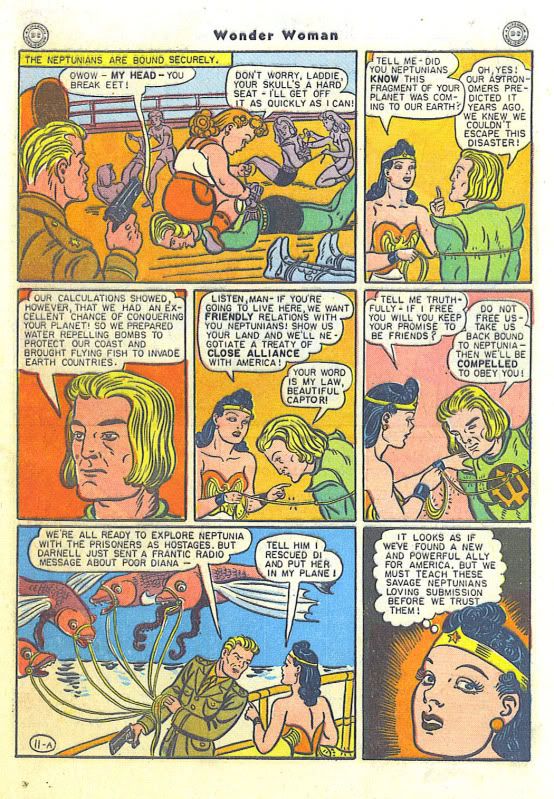
Here’s another stellar page:

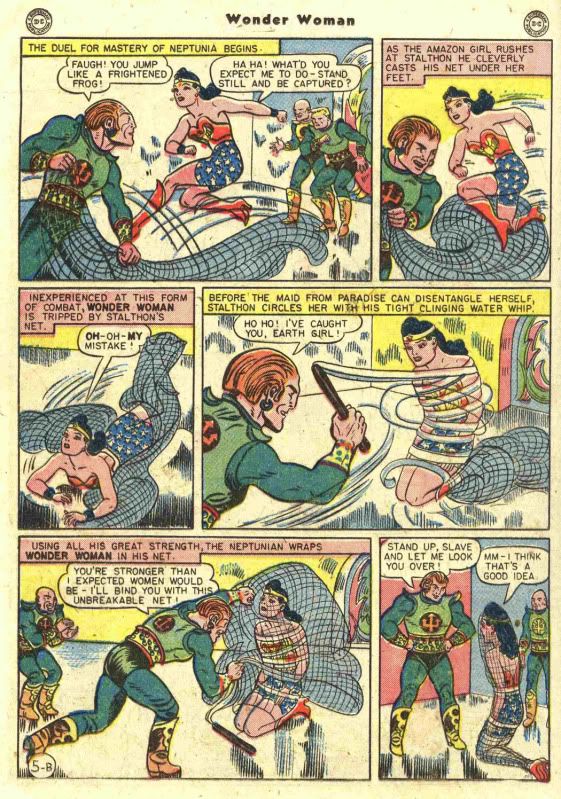
Again, there isn’t any one thing or panel in this page that leaps out at you, but it works as a lovely whole, with lots of active lines and a unified, pleasing color palette. The filigree in the background, much of it obscured by the word balloons, lends a subtle, baroque feel to the whole image. It’s pages like this that make me want to compare Peter to Winsor McCay; he’s not as explicit about it, but he really does, like McCay, seem to see the page as an aesthetic unit, and work with it as such. It’s not something that is done very often or very well, especially not in super-hero comics of this era.

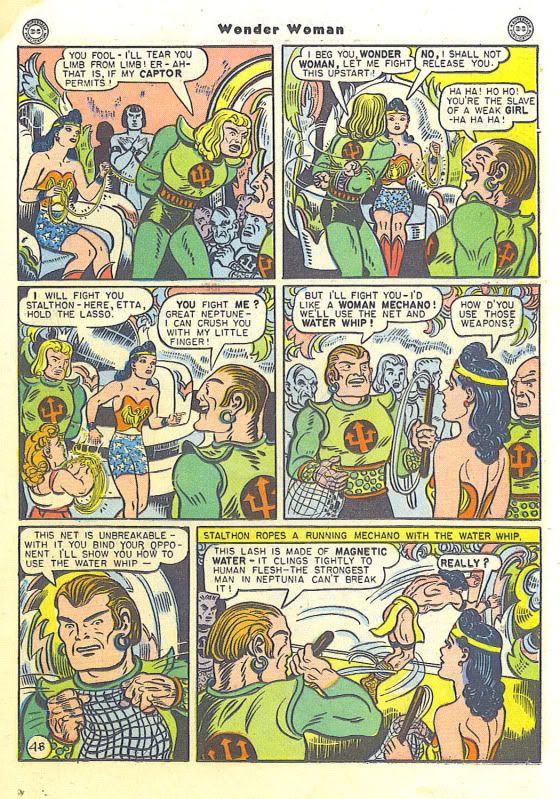
Here’s another, maybe clearer example;

The net there is used as a design element; the mesh pattern flowing through the different panels gives a dynamic sense of movement and unity to the page. The spiraling and shifting pattern is emphasized by the simple tiered layout — which itself has a nice rhythm (long, short, short, long, long short.) I think Les Daniels said at some point that Peter had trouble with page design early in the WW run. If that was ever true (and I think there is something to it) it’s certainly not the case by this point.

All right; repressing the urge to just post every single page of this book now…they’re all pretty much amazing….repressing, repressing…okay, more or less successful. Let’s move on to another awesome pseudo-science explanation:

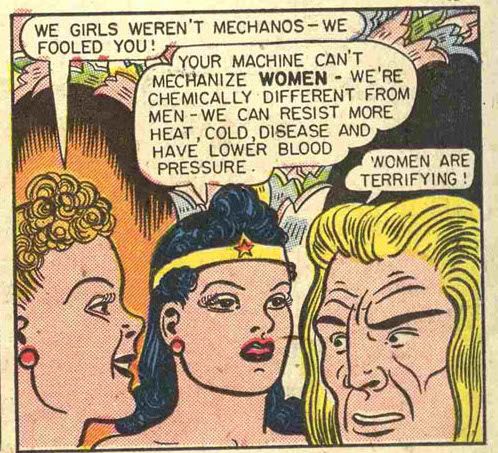
They turn men into machines by robbing them of salt, because salt is what gives you flavor, doncha know. But the best part is…it doesn’t work on women. And why not? Witness:

Again I ask…why isn’t DC taking these panels and printing them as posters, damn it?

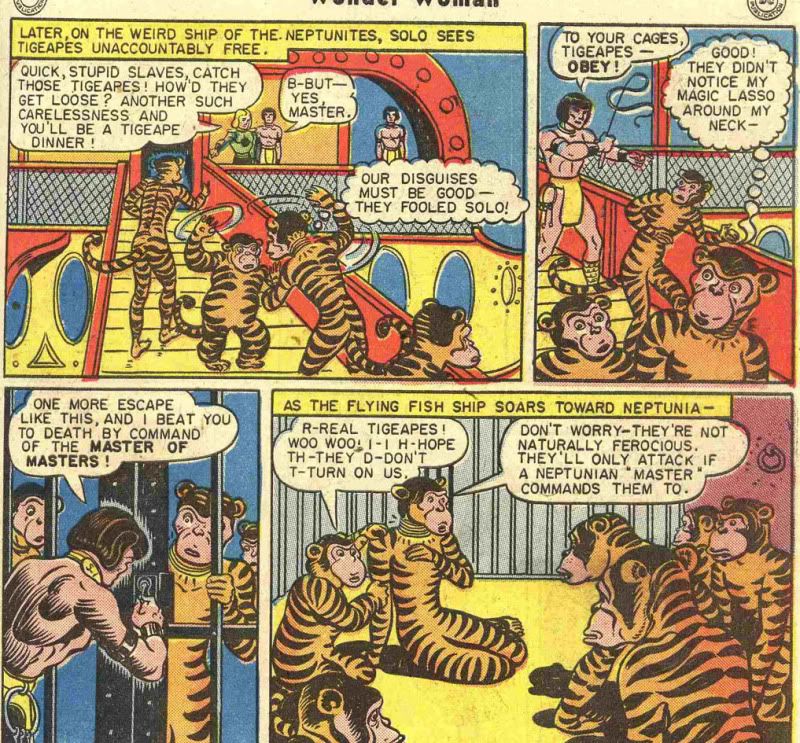
The Neptunians are so terrified of women now that they make a pact with the U.S. offering to become a vassal state if the Americans will guarantee that no women can come onto the Neptunian continent. The U.S. agrees…and so to keep tabs on the devilish Neptunians, WW is forced…to wear drag. Of a sort. I’d wondered before if Marston ever provided examples of good-girl cross-dressing (he has several of his villainesses cross dress.) This issue has the closest we’ve gotten so far, as WW and the Holiday girls dress up as at least nominally male tigapes.

Not really conclusive, but maybe another datapoint to suggest that Marston didn’t seem to see cross-gender dressing as particularly or innately evil. And it’s certainly more evidence for the fact that he just found dressing up in general hot; the Tigeape costumes were first donned during a sorority hazing ritual, which is one of Marston’s favorite things. (HIs academic research involved sorority hazing rituals, so of course his interest was strictly scholarly. Of course.)

Also, add “furry” to Marston’s impressive list of kinks. Of course, furries weren’t even invented when WW was penned…but he Marston was a pioneer in this, as in many things….

The comic ends happily ever after when the Neptunians plot is foiled and the island is given over to women to govern.

If only our actual political leaders were that docile. Go forth, WW, and teach unto Dick Cheney the loving submission. Barack Obama too, just as long as I don’t have to read the slash.