My review of jazzy folk-country band Horse’s Ha over at Metropulse.
Author Archives: Noah Berlatsky
How Much Does Mediafire Suck?
So I’ve gotten feedback that the downloads work more or less okay…but that the site has lots of popups and is generally annoying to work with. Is that other folks’ experience as well? And how irritating is it overall?
I’m wondering if I need to upgrade to a pay account, which I think will eliminate that nonsense…but I’d like a little more feedback before I do that, if possible.
Ooku: The Inner Chamber
Somewhat uncharacteristically, I’m actually reading a book that’s up to the minute. There are a bunch of reviews of Fumi Yoshinaga’s highly acclaimed Ooku out at the moment. One I looked at today is by Kate Dacey
I’ll be honest: I’m not quite sold on Ooku yet. For all its dramatic and socio-political ambitions, volume one isn’t nearly as daring or weird or pointed as it might have been. If anything, it reminds me of a BBC miniseries: it’s tasteful, meticulously researched, and a little too high-minded to be truly compelling.
That got me thinking…you know, I really don’t have anything at all against BBC miniseries. Cutely homely, talented actors performing fairly well-written scripts — I’m cool with that. Sure it’s middlebrow — but everything middlebrow isn’t bad.
More to the point, I’ve actually seen the weirder, more daring, pulpier, louder, and splashier version of Ooku. It’s called Y: The Last Man, and it’s really not all that good.
To back up for a minute, for those not already familiar with the plot: Ooku is basically a costume drama set in an alternate past. Sometime in the 1600s or so, a plague in Japan killed most of the men. Now, in the 18th century, women hold most positions of power and authority, and the few remaining men are second-class citiziens, carefully protected (and commodified) for their seed.
Y: The Last Man also, of course, featured a plague that killed men — but it was (over) orchestrated for maximum drama. Not just most, but all of the guys (except one) died, and it all happened simultaneously. The narrative then centered around women trying, somewhat efficaciously, to fill male roles in the face of a sudden, devastating apocalypse. And, of course, there was spy nonsense and relentless action and everybody shooting each other — all the flash Dacey is missing in Ooku.
There’s no doubt that Ooku is really quiet — which is actually what I like most about it. Rather than big, macro-level statements about Men and Women and How the World Has Changed, Ooku focuses on the small details. Most of the story follows Mizuno, a son of an impoverished samurai family. Mizuno is in love with a childhood neighbor named O-Nobu, but he can’t marry her, both because he’s too poor and because he’s too valuable: as a fertile man, he is basically his family’s chief asset, and they need to sell him off to a wealthy wife. Desperate to avoid marriage, he gives himself in service to the Ooku — the male seraglio of the female shogun. The bulk of the narrative is given over to his rise through the ranks of the Ooku, culminating in a final, bittersweet denoument.
Again, for me, the best part about how Yoshinaga handles this tale is how subtle she is. In Y: The Last Man, Brian K. Vaughn put up a big flashing light every time he touched on gender (look! supermodels collecting garbage! woo hoo!) Yoshinaga messes with gender expectations too…but she also suggests that, even in this new world, there are gender realities which are going to be slow to change. The result is not so much an earthquake as a series of tremors; the furniture shifts, and a couple of things break, but you have to look twice to see just what has happened.
For example, as I’ve mentioned, men are treated as sexual chattel in a way that’s analogous to the treatment of women. In some cases, we learn, men are actually sold to women as prostitutes — though this is more about women’s desire for children than it is about (pure) sexual pleasure. Moreover, while some men clearly do feel degraded by this set up, there are other options too; Mizuno, for example, actually gives himself for free to women because he feels sorry for their childlessness, and..presumably…because he enjoys it as well. Similarly, in the inner chamber seraglio itself, the men are, on the one hand, feminized (they are all obsessed with clothes and gossip and with being chosen by the shogun.) But, on the other hand, they still behave like men in a lot of ways — they participate in staged swordfights, for example…and (as happens not infrequently in all male communities like prison) they initiate newcomers through rape.
Mizuno himself is also very thoughtfully portrayed. A boisterous and open-hearted man’s man, in many ways, he’s also achingly naive and vulnerable; after fighting off the would-be rapists, for example, Yoshinaga shows his stern face collapse into exhaustion and despair. (“”Forsooth, O-Nobu,” he tells himself, “I have brought myself to a most terrible place indeed.”) Yoshinaga plays deftly with different kinds of knowledge, innocence, and insularity. On the one hand, Mizuno is shocked again and again by the ways of the Ooku — particularly by the homosexuality, which is, understandably, very rare in a world with almost no men. But, on the other hand, Mizuno, hailing from the cosmopolitan center of Edo, is actually much more stylish and fashionable than his new peers — there’s a great line (and kudos to the translator) where he calls one of the seraglio a “palace bumpkin” for not recognizing that gray kimono’s are in fashion.
We’re presented, in other words, with a clash between two worlds slightly different than each other, and each also different from our own. It’s a quiet tour-de-force, anchored by a trope that’s familiar in any context: true love. Again, there’s a parallel with Y: The Last Man. In Y, the main character Yorick spends the whole series racing about the world trying to find his girlfriend; true love is essentially a MacGuffin. In Yoshinaga, on the other hand, it’s not space but the much more unyielding wall of cultural reality that separates the lovers, and there isn’t anywhere in particular to run. Mizuno’s certainty that he will never be with O-Nobu colors the whole story with a deep melancholy. His agonized final lament (“‘Twas only through your kimono that e’er I felt the warmth of your body — ’tis not enough to take to a cold grave”) is unbearably painful and sensual at once — as, for that matter, is his night with the shogun herself. And yes, the twist ending made me cry — not that that’s the hardest thing to do, necessarily, but still.
Unfortunately, Mizuno exits the story at the end of this volume, and it looks like the rest of the series will focus on the shogun, Yoshimune, a character everybody else seems to love but who left me flat for the most part. Basically, she seems too good to be true; a lustful, miserly overlord with a heart of gold. It’s kind of fun seeing that stereotype cross-gendered…but only kind of, and I could weary of her quickly if she becomes more central. But whatever happens with the rest of the series, this first volume is pretty much perfect.
____________________________________
Extra Bonus Self-Referential Hooded Link Section:
My review of Yoshinaga’s Antique Bakery is here.
For more bishonen men forced into compromising positions with each other, do read Kinukitty’s column Gluey Tart: Adventures in Manporn.
And apropos of nothing except my own efforts at self-promotion — I’ve just started posting downloadable music mixes every week. The latest is called The Devil Always Shits In the Same Graves and includes gospel field recordings, Belgian psych drone, and Ukrainian black metal. So there’s that.
Update: Changed to reflect the fact that mulligans are not MacGuffins, no matter how much I might wish it were so.
Update 2: Kate Dacey clarifies her position in comments.
Then There Were Three
Miriam is sadly going to need to take an extended leave from the blog to deal with real life things. I think she will make an announcement herself — but she may well be too swamped to do even that for a bit. In either case, it’s been great having her here, and we’ll miss her posts. Hopefully she’ll be able to crawl out from under and come back to us in the not too distant future.
Music For Middle-Brow Snobs: The Devil Always Shits In The Same Graves
Well, the test run seemed to work, so I’m going to start doing these downloads every week. This time round we start with some gospel field recordings, move into psych dronishness, and end with pop.
Dock Reed — Low Down Death Right Easy
Andy Mosely, Hogman Maxey — I Know I Got Religion
Mary Pinckney — Been In The Storm So Long
Della Daniels And Ester Mae Smith — Move Upstairs
Muddy Waters — She’s Alright
Silvester Anfang — The Devil Always Shits in the Same Graves, Pt. 1
Drudkh — Where Horizons End
Damon and Naomi — Translucent Carriages
Beasties Boys — Something’s Got to Give
Anjulie — I Want the World to Know
Mary Wells and Marvin Gaye — What’s the Matter With You Baby
Empowered #2
I talked in a couple of posts about my enthusiasm for the first volume of Adam Warren’s Empowered.
I still enjoyed the second volume; Adam Warren’s manga-fetish art remains sexy; the gags are still funny (a 2nd-rate supervillain called the king of time who can’t actually control time, so instead hits people with clocks is a highlight); the characterization is still thoughtful and charming. Nonetheless, there are a couple of ominous trends. In particular, Warren keeps trying to explain stuff that really would maybe be better left unexplained. For instance, there’s a sequence where Empowered explains that her suit rips so easily, robbing her of her powers, because of her own lack of self-confidence; it’s a metaphor for her frayed ego, y’see.
Similarly, Warren seems to have a really unfortunate weakness for tragic backstories. Emp, we learn, had a dad who died of a brain tumor; Emp’s friend Ninjette has issues involving her childhood rejection by her ninja clan; Emp’s friend Thugboy also seems to be hiding some sort of tragic past which looks to be leading nowhere good. Part of what was delightful in the first volume was way Warren balanced treating the characters as gag punchlines and treating them as human beings. As the run goes on, he seems to be tipping more towards serious interpersonal drama, which would be okay if he was willing to actually take the time to do characterization rather than using the personal trauma shortcut.
I’m definitely still planning to get all of these, and I have hopes that things will improve again. But if this is the road we’re going down, I fear #1 may end up being my favorite of the series.
Privacy Is The Old Porn
A while back I read (via Andrew Sullivan) about the Erin Andrews video. For those who aren’t up-to-the-minute on internet memes, Andrews is an attractive ESPN sportscaster who was illicitly filmed semi-nude in her hotel room via a hidden camera. The video went viral, there was much excitement and hand-wringing and hypocritical panting of various sorts by various news outlets. Jennie Yabroff at Newsweek had a pretty thoughtful comment about the brou-ha-ha in which she said:
Andrews has a nice body, but so do lots of other naked women you can find on the Internet, and in much higher-resolution pictures. In the video, she appears to be getting ready to go out: brushing her hair, looking in the mirror. It’s not super-racy stuff. The quality of the video is so poor, it’s hard to tell Andrews’s identity. In fact, the tape has been online for months, and generated interest only when ESPN’s lawyers confirmed Andrews’s identity as the woman in the hotel room.
Obviously, the fact that Andrews is a celebrity has a lot to do with it. The fact that we’ve seen her face before somehow makes her body more interesting. And certainly, the fascination with naked celebrities is nothing new. Playboy understood that when it put Marilyn Monroe on the cover of its inaugural issue. But it’s doubtful Andrews would have caused such a stir had she posed for the magazine. What’s really provocative about the Andrews tape, what makes it good copy for Fox et al. is not that she’s naked, but that she thinks she’s alone.
Privacy, it seems, is the new nudity (my italics) This is why, when Jennifer Aniston poses topless for the cover of GQ no one does more than shrug, but when paparazzi catch her sunbathing topless, it’s tabloid fodder for weeks. Same with Britney Spears. Same with Janet Jackson. It’s not so much a desire to see nudity as it is to see candor, to see what the person looks like when she’s unaware she’s being watched.
I think Yabroff is pretty spot on in her analysis for the most part. But she’s wrong when she says that privacy is the new nudity. Privacy and porn have been linked for a really long time. In fact, in her book about pornography, Hard Core, Linda Williams essentially argues that the whole point of pornography, the impetus behind it, is as much knowledge as lust. Why does so much porn look like a clinical gynecological exam? Clinical isn’t really especially sexy; if the point was prurience, surely you could find a more appealing way to do it.
Williams argues that the reason for the gynecology is that porn is obsessed, essentially, with obliterating privacy; with making visible women’s interiors, both literally and figuratively. There’s an essentially sadistic desire to know and possess the women’s private self; to consume or fill that private space, so that the woman is entirely obliterated by the observer. That’s the kink; to have everything visible, accessible, and controllable. The violation, of self and of privacy, is always part of the thrill.
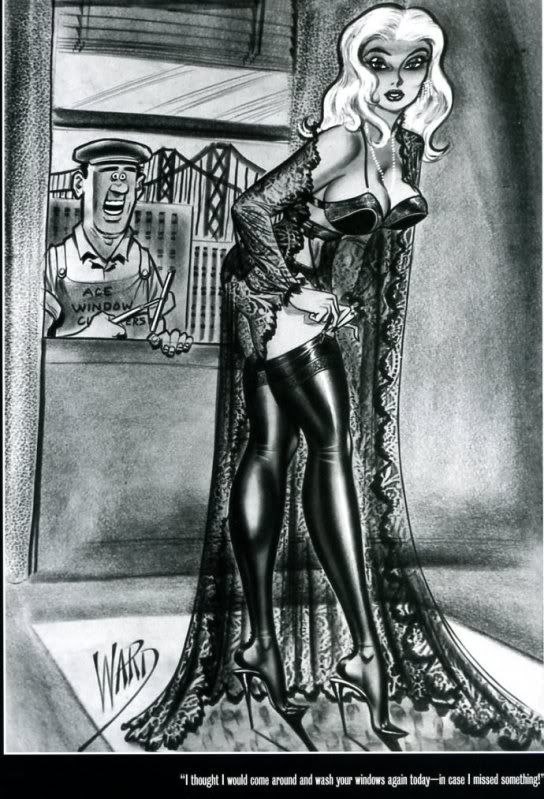
As just one example of the long-established fetishization of privacy, take the work of Bill Ward. Ward was a fifties pin-up cartoonist, a contemporary of Jack Cole and Dan DeCarlo. Ward was extremely prolific, but among of his most famous schticks (according to editor and scholar Alex Chun) were the telephone girls. Here are a couple of examples, from Chun’s The Glamour Girls of Bill Ward.

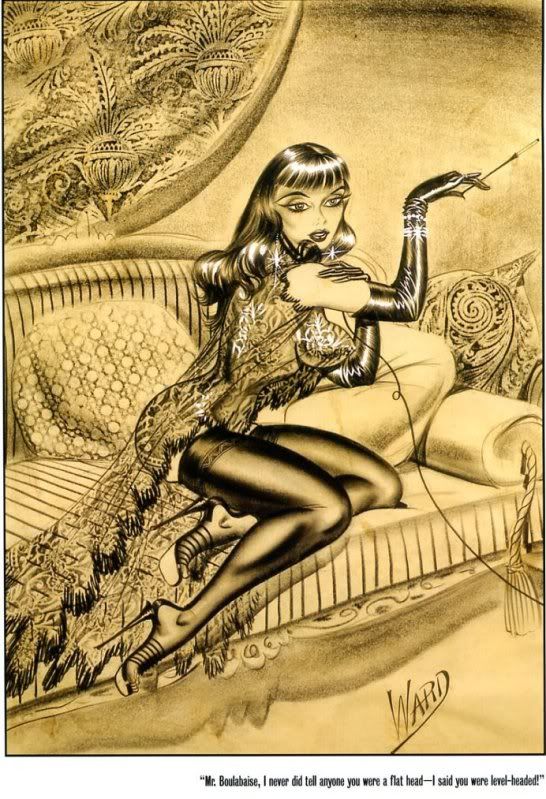
As you can see, it’s a pretty simple idea: luscious, top-heavy girls lounge about the room in lingerie, delivering their gag line into a phone. The scenario is built around a winking violation of privacy; the girls, safe in their rooms, think they are unseen by their interlocutors and therefore are free to cavort in lacy underthings. The viewer is like the camera in Erin Andrews hotel room; they get to see What Women Get Up To When They Believe They Are Unobserved. (Though, obviously, Ward’s fantasy women get up to more exotic shenanigans, at least in terms of attire, than Ms. Andrews did.)
One of the odd things about the fetishization of privacy in Ward’s drawings is how entirely undifferentiated it is. You get to be a secret voyeur in the boudoir of bevies of bodacious beauties — and dang if all those bevies are bodacious and beautiful in just about exactly the same way. Alone and uninhibited, they all wear garters and stockings and ridiculous heels, lace and filigree and fetishy nothings. There’s a similarity here to traditional porn movies, where, as Williams says, the obsession is with revealing the hidden insides of women — and what that means, functionally, is the same ritual shots of genitalia over and over. The point of the fetish is not just to reveal the private self, but to reduce that self to a series of easily recognizable tropes; you want to both know everything about the individual and have that knowledge be utterly banal. Again, this is pretty much textbook sadism, with individuals compulsively and repetitively turned into interchangeable, collectible objects — the denial, and indeed, the defilement of personality functioning in itself as the fetish.
I don’t actually mean to say that I hate Ward’s work or anything. He’s a talented artist, and he’s certainly nowhere near as sadistic as, say, Tabico, a pornographer whose work I admire excessively. Still, when I compare him to DeCarlo or Jack Cole, I have to say I do find his work kind of numbing…and even a little disturbing. DeCarlo’s women always have definite personality. For Cole, on the other hand, personality always seems to be beside the point — he’s really much more interested in surface voluptuousness than in pretending that his confections have, or are meant to have, actual brains, which is maybe why he so often doesn’t even bother to show you his women’s eyes. For Ward, though, personality matters — it’s just the same frozen personality over and over and over. His women’s eyes often look weirdly painted on; it’s like an endless procession of mannequins, all dressed in the same more or less fetishy style, all with the same overblown proportions. Probably the effect wouldn’t be so stultifying if you saw just one or two of the cartoons in those old Humorama magazines as they were originally run, but when you see them all together in a collection, it does become a little oppressive. Eliminating privacy goes a long way towards eliminating difference; if you systematically obliterate mystery, all that you’re left with is the homogenous and mundane. That’s why so much porn is so aggressively boring and why, though I can admire Ward’s skill, looking at his drawings gets wearisome very quickly.