Sequential Samurai Attack

I’ve been looking through a Dover collection of Utagawa Kuniyoshi’s samurai prints. Kuniyoshi was one of the last great classic Japanese printmakers; he worked during the1800s. This book, 101 Great Samurai Prints, includes two series. The first, “Heroic Biographies from the ‘Tale of Grand Pacification'” depicts samurai involved in the battles for the unification of Japan in the 1500s. It’s a very pulpy series — a lot of the pleasure comes from “holy shit!” moments of preposterous battles, grotesque toughness, and so forth.

Here for example, is a samurai hiding among corpses to surprise his enemies:

kuniyoshi samurai

And here a samurai fights a wild boar:

kuniyoshi samurai

This samurai is squeezing the life out of three opponents:

kuniyoshi samurai

And this one is my favorite I think; it’s an underwater battle (notice the fish.)

kuniyoshi samurai

The second series included in the book is “The Faithful Samurai,” which is a very famous revenge narrative. It’s very different in tone from the other series. Stylistically, it’s much less aggressive; the situations are less outlandish, and even the clothing is less elaborately patterned and individualized; all of the samurai here pretty much wear some variation on a black and white robe (though there’s still plenty of patterns besides the robe; it’s really only less elaborate in comparison to the first series.)

In addition, while the Pacification series above goes for jaw-dropping set pieces, this series is more focused on, of all things, humor. Most of the climactic fight scene takes place inside a residence, and Kuniyoshi appears to have just thought this was hysterical. Many of the scenes show samurai struggling to defeat common household objects, like kindling wood:

kuniyoshi samurai

Alternately, we see samurai hiding behind kimonos:

kuniyoshi samurai

or chatting with the household dog:

kuniyoshi samurai

Even the outdoor scenes are mined for slapstick. Here’s a samurai being assaulted by a pine tree:

kuniyoshi samurai

These series were executed about the same time (in the 1840s), so the issue here isn’t a change in taste. And obviously they’re similar in content. Kuniyoshi just decided to treat them differently…which suggests that each of these series was expected to be seen as a whole, with individual themes and ideas.

It also struck me looking through these that the relationship between narrative and image here is a little odd. These series both work off of well known legends. A more familiar western way to handle a retelling would be to have someone write out a version of the story, and then have the illustrations come out of the text, illustrating the story. Here, though, at least as far as I understand it, the text here isn’t a retelling of the story. Rather, the words tell about particular incidents, or give background on the individual samurais. The illustrations can be of particular incidents, but they don’t necessarily have to be, and even when they are, they’re not necessarily in context (the fight with the pine branch, for example, didn’t happen during the famous raid; it was an incident from the history of the samurai, or an anecdote he liked to tell.) Each series then doesn’t so much help tell or illustrate a story as it creates a particular take on a legend; narrative gilds the picture, rather than vice versa. It’s historical painting…except, since it’s a series, there is some sense of sequence, or at least of multiple views of the same incident. It’s not comics, but it does integrate stories and multiple images in a way that maybe points to something that you could see turning into comics. It’s clear enough, anyway, why comics found such a receptive audience in Japan; there have obviously been popular, aesthetically validated picture narratives over there for some time.

Lady Snowblood: Love Song of Vengeance

I just saw this 1974 film. It’s a sequel to the first Lady Snowblood film, which I haven’t seen, and it’s very different from the comic book version. The comic, as I noted, has Lady Snowblood willing to do anything to anybody to further her vengeance — and there was a nationalist subtext as well, with a loathing of degeneracy and western decadence which felt really fascist.

This, though, has a much more comfortable and familiar morality. Anarchist heroes joining together with the poor to fight the power — it doesn’t get more bourgeois than that. Even the exploitation here is sedate; the one sex scene is between a married couple, for goodness sake. Lady Snowblood splits her time between regretting her past acts of violence and perpetrating carnage on behalf of the downtrodden.

There are certainly some good scenes — Snowblood’s method of fighting is to just sort of walk slowly forward, as dozens of guards launch themselves at her and are dispatched one by one, and that’s entertaining to watch. But overall, and though I hate to say it, the fascist, gratuitous, morally despicable comic is probably better than this right-minded movie. Sometimes the devil does have better tunes.

I do hope to see the original Lady Snowblood movie at some point…though I think netflix doesn’t have it, so it may take a while.

Update: No, scratch that. They do have Lady Snowblood. Why’d I see this one first rather than the original? Got me….

Bound to Blog: Wonder Woman #12

We took a bit of a hiatus from the Marston/WW blogging there. My apologies; hopefully we’ll get back on track with out once a week posting, and push on through until the end of the run (which is #28…so 3 more months if I keep to the once a week schedule.)

Anyway, one of the things I tried to do with my time off was read Marston’s academic treatise, The Emotions of Normal People, from 1928. I have to admit I only got a handful of pages in. Marston is an entertaining writer, and you can see it even when he’s trying to be boring and academic…but, well, overall, it’s still kind of boring and academic. I thought this anecdote was nicely revealing though:

I can still remember vividly the fear I once experienced as a child, when threatened, on my way to school, by a half-witted boy with an air-gun. I had been taught by my father never to fight; so I ran home in an agony of fear. My mother told me, “Go straight by F____. Don’t attack him unless he shoots at you, but if he does, then go after him.” I was an obedient child and followed orders explicitly. I marched up to F_____ and his gun with my face set and my stomach sick with dread. F_____ did not shoot. I have known, ever since that well-remembered occasion, that fear does not give strength in times of stress. Part of the strength with which I faced F_____’s air-gun came from my own underlying dominance, newly released from artificial control. But most of it belonged to my mother, and she was able to use it in my behalf because I submitted to her. Dominance and submissions are the “normal”, strength-giving emotions, not “rage” and “fear”.

It’s all so Freudian you just can’t stand it. Though on the surface this may be a conflict between Marston and the “half-witted boy”, you don’t have to go too far into the subtext to see it as a conflict between paternal authority (it’s his father who forbade him to fight) and maternal dominance. It’s also telling, in terms of Marston’s general view of the world, that violence here is definitely gendered, but that gendering doesn’t break down quite the way you would expect. On the one hand, the half-wit boy has the gun (very phallic) and it’s the father who lays down the arbitrary law, which is universally applicable and not to be altered no matter the circumstances. Still, it is the Dad who is the pacifist, and the Mom who is willing to continence violence…albeit tailored to individual circumstances, and administered with love. And, of course, the whole point here is that fear and (typically male-identified) rage are less effective and powerful than submission to love. The phallic gun is no match for the mother’s will.

It’s fun, too, that Marston has apparently written a whole book here to demonstate, scientifically, once and for all, that everyone else is wrong, and his kink is normal, normal, normal. Speicfically, it’s a “normal emotion,” which is how he gets to call his book “Emotions of Everyday People,” rather than, say, “The Pleasures of Dominance and Submission: A Field Guide.”

Marston is, as always, easy to make fun – but there are also some interesting ideas here, I think. Dominance and submission maybe are a lot more common and important as motivating forces than we generally think about. People are certainly influenced by hierarchies and affection more or less constantly. Freud relates those to subconscious motivators, but it would be possible to think of them too as more natural, or above-board emotions. You can see too why Marston was occasionally accused of fascism by the advisors/censors in the editorial offices; strength through giving up your will to a higher authority must have sounded ominously familiar in the 1940s (though, of course, Hitler wasn’t a mother, which was probably an important distinction for Marston.)

(As a parenthetical aside to the parenthetical, I was just skimming some writing by medieval theologian Meister Eckhart (why? Never mind why.) Anyway, he was arguing that obedience was virtue; more important than love or humility or charity or anything else. The argument was basically that obedience brings you closest to God, since through obedience to a superior you most thoroughly abnegate self, and when self goes, God comes in. The best use of free will is to destroy your own will.

I can’t say I find that especially convincing – it seems to be deliberately abrogating moral choice in a way that seems pretty problematic from most moral standpoints, including Christ’s as far as I understand it. I actually have more sympathy for Marston’s position, which at least argues that obedience has to involve love and presumably some level of trust. Obedience in and of itself, to any random hierarchy, just doesn’t seem like a virtue, much less the virtue. But I’m a liberal secularist steeped in modernity, so I guess that’s what I would say.)

Anyway, on to WW #12, where we’ve got WW, not for the first time, seizing control of a suggestively shaped missile:
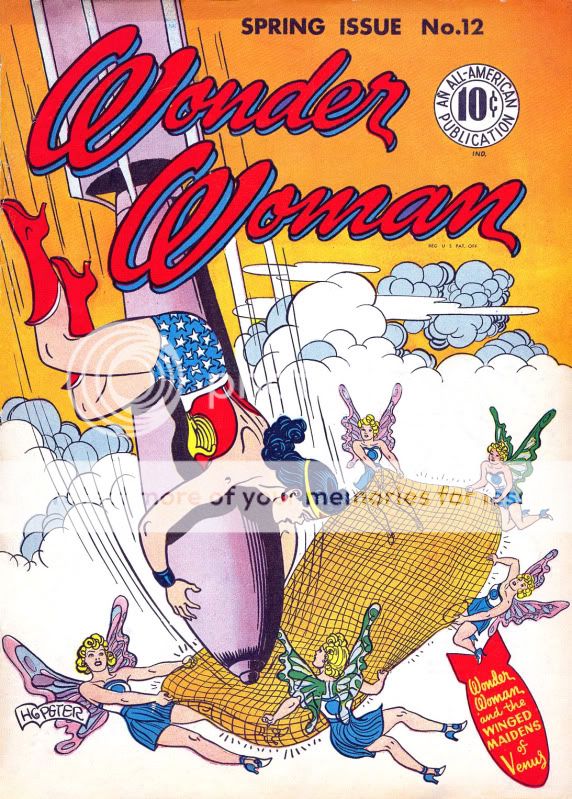
marston wonder woman

I believe this is the first WW issue written after the end of the war. Marston’s not quite ready to dispense with the military plots, though; this story is all about the evil European munitions manufacturers and their glamorous women spies who are plotting to cause yet another war for fun and profit.
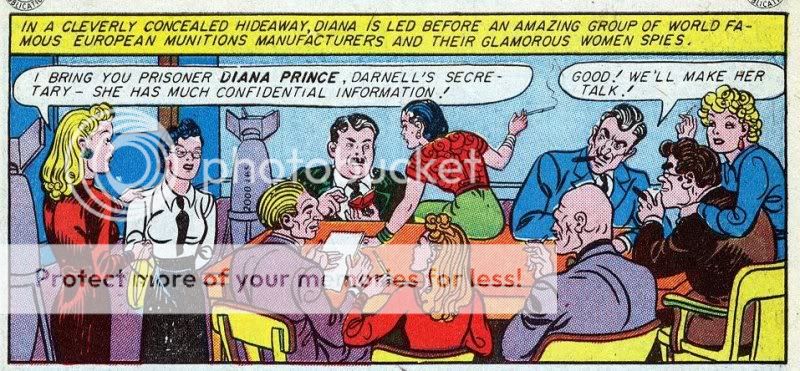
marston wonder woman

I kind of feel bad for the European arms manufacturers, actually. I mean, they just helped win WW II; if they were ever going to enjoy any popularity, you’d think this would be the moment. But no, as soon as the wars done, Marston is blaming them for everything. Still, I guess I should be glad that Marston hasn’t gone right back to blaming the Jews.

In any case, as it turns out, the European munitions manufacturers are little more effective than that half-wit boy with the gun. Even Diana Prince can take them out:
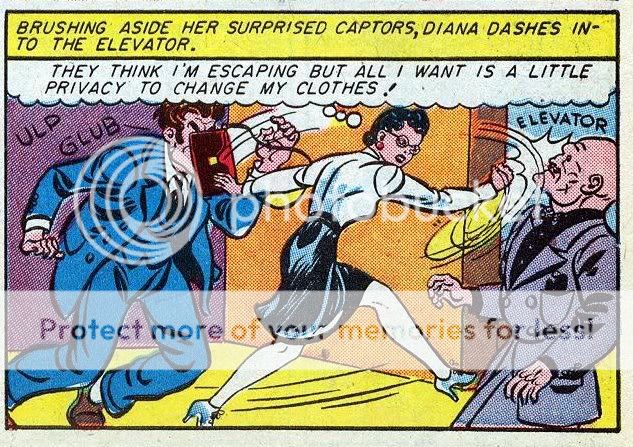
marston wonder woman

So inevitably they’re defeated and taken for treatment…not to Paradise Island, but to another matriarchal, peace –and-dominance loving society (Marston’s got a million of them.) This one’s on Venus. You can tell the Venusians from the Amazons because the Venusians have wings, which Harry Peter seems more or less born to draw.
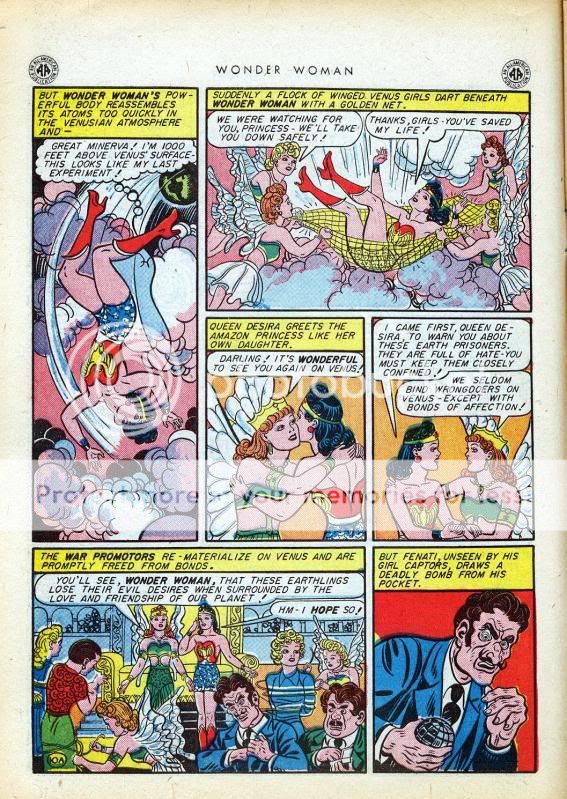
marston wonder woman

As you see at the end there, the Queen of Venus is promising to transform the evil munitions men and their glamorous girlfriends into good, loving law-abiding citizens. And though there are a couple of blips (as you see in the last panel) she does have some success, primarily because of the power of magnetic gold, which makes you happy to be captive.
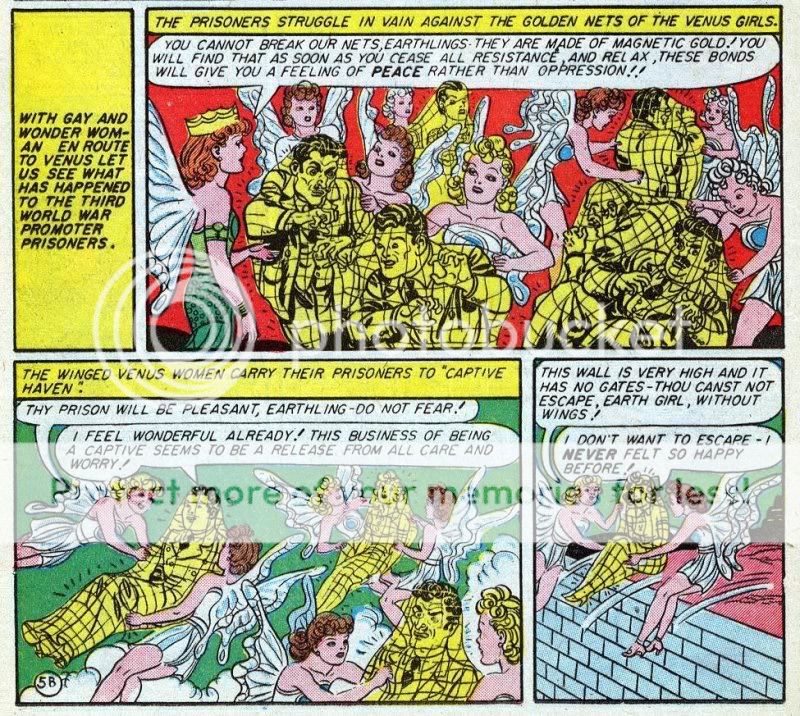
marston wonder woman

Any similarities to the golden magical lasso are presumably intentional; I think Marston believed that the color yellow encouraged feelings of submission. Anyway, this is also where we first have the Venus Girdle, the belt made of magnetic gold which makes people happy with their captivity:
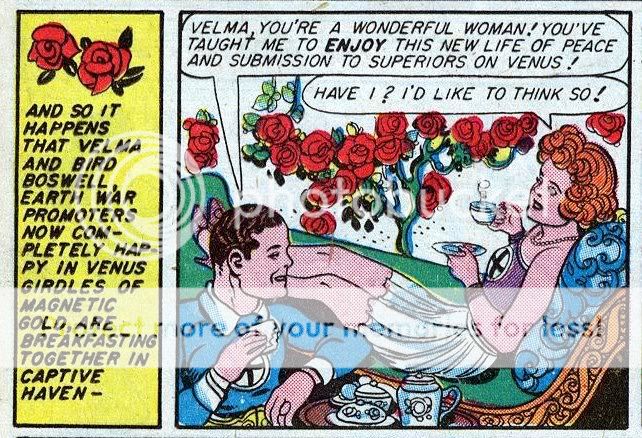
marston wonder woman

Marston’s paradises are so Edwardian and upper-class.

The thing here is that the men are all perfectly happy with their captivity; they all want to wear Venus Girdles all the time. It’s only Velma, one of the glamorous girlfriends, who has the gumption to figure out a way to break the spell, following the letter of the law (a patriarchal move, incidentally) in order to break free.
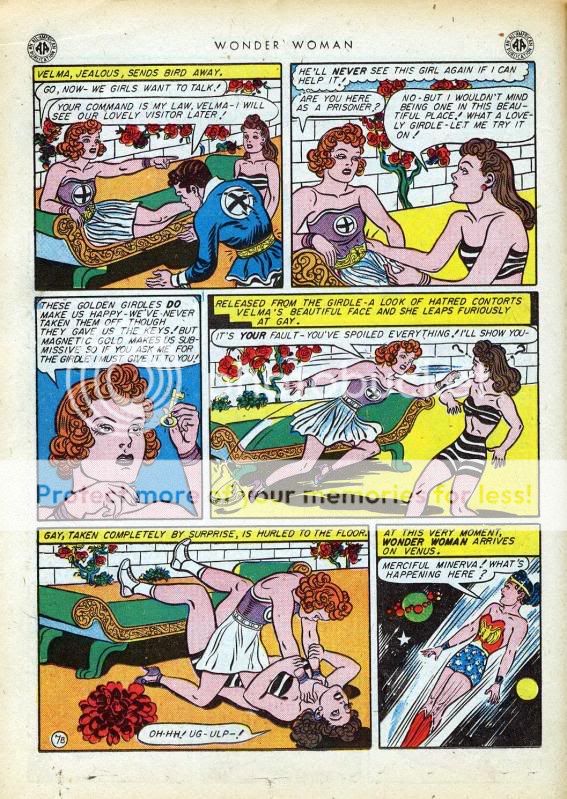
marston wonder woman

Later Velma, in pursuit of a nefarious plan, actually places the girdle on herself, and then summons the willpower to break free despite the post-coital spell.
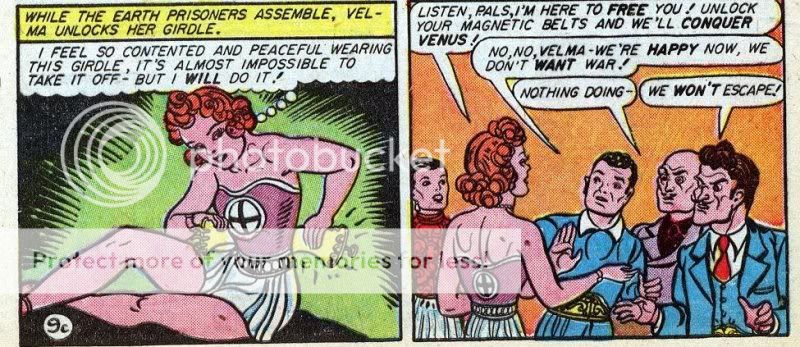
marston wonder woman

Velma has to hold the men at gunpoint in order to get them to rid themselves of their girdles.

I’ve probably said this before, but I think this shows why it was that Marston so often resorted to female villains. Men in his world just don’t have that much gumption. It’s really hard to imagine any male in Marston’s world, from Steve to Ares, throwing off the matriarchal power of the girdle. Men, like young Marston, want to submit their will to a more powerful feminine control. Only another woman like Velma can resist Venus – and offer men the opportunity to be controlled by her will.

Of course, Velma is eventually captured and renounces her evil ways…which seems kind of too bad, since she was pretty fun to root for. But no fear; I’m sure they’ll be an evil villainess to root for in an upcoming issue.

Nothing much else to say about this issue…except that Harry Peter just keeps getting better and better, damn it The effects with the ray that transport everyone to Venus are thoroughly weird and lovely, for example:
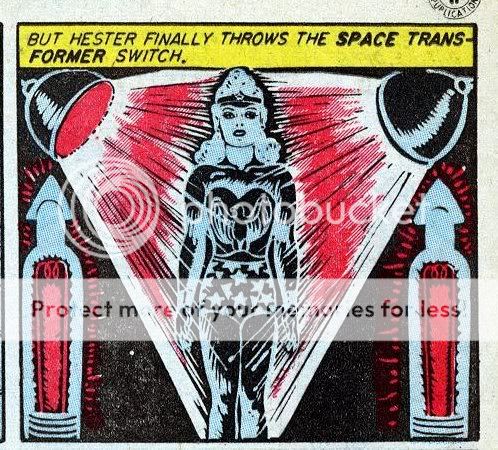
marston wonder woman

as is this visit from the ghostly Queen of Venus:
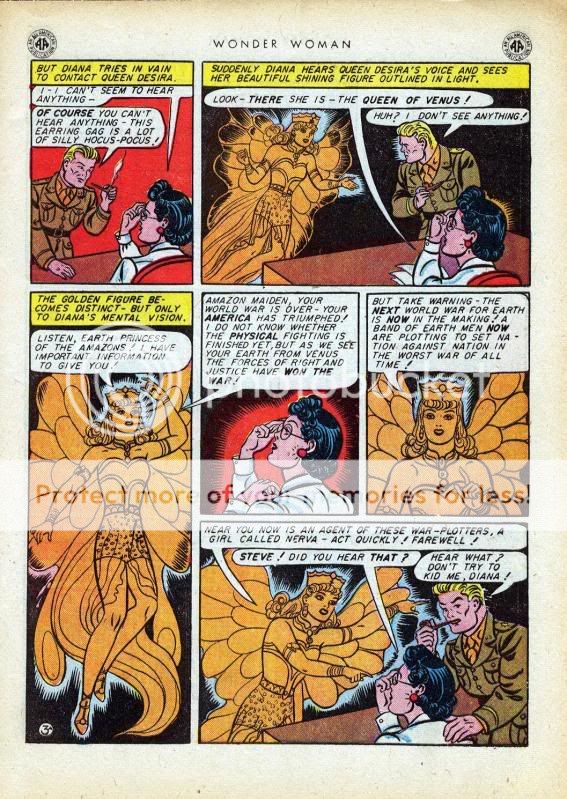
marston wonder woman

Peter is also experimenting very effectively with some more complicated page layouts. I think this is the first time I’ve seen him use the kind of narrow tiny panel he does in the middle here:
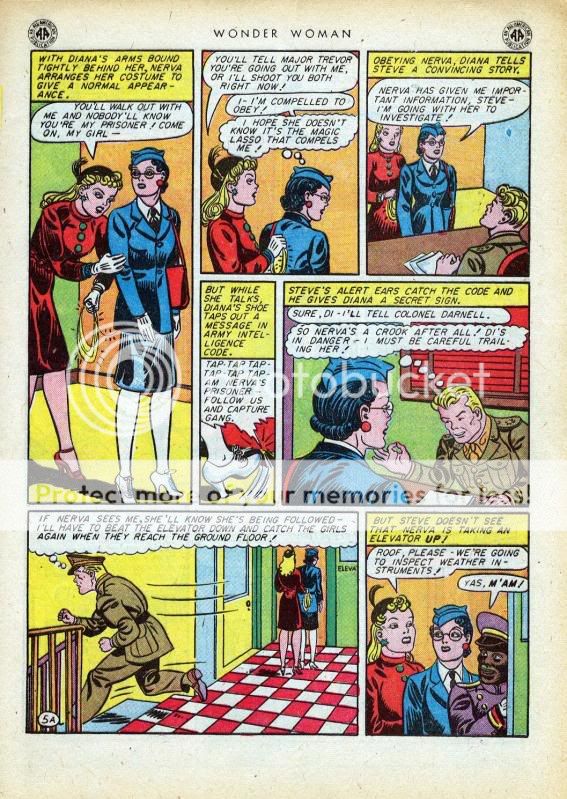
marston wonder woman

and I know I’ve never seen him use that odd jagged panel before:
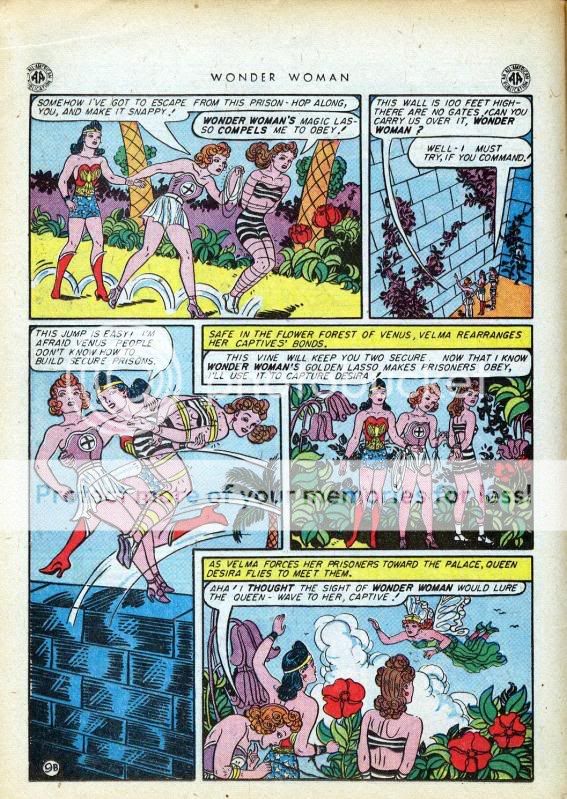
marston wonder woman

And then there’s this weird, sensuous ghost whispering sweet nothing in WW’s ear:
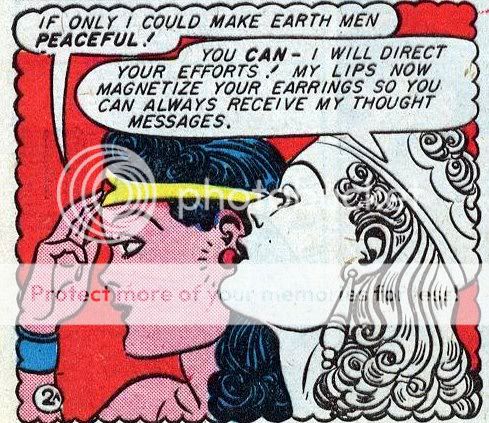
marston wonder woman

I think my favorite panel, though, is this one:
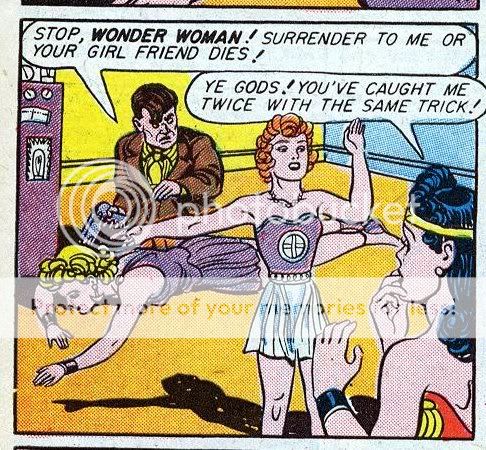
marston wonder woman

The perspective is so scattershot that it actually looks like Paula is floating in mid-air; like it’s some magician’s trick that Velma is demonstrating, with WW standing there thinking, “How on earth did she manage that!” The shadow adds to the effect too; it’s weird and doofy, and completely works with Marston’s themes of control and magic. I really wish there were still mainstream artists like this around. Darwyn Cooke is cool and all, but this is the shit.

Partially Congealed Pundit: Why We Can’t Do Lots of Things

This short short story is from 2001, 2002 or thereabouts. Bonus points to anyone who can figure out where I stole the good professor from (using google doesn’t count.)
_____________________

Why We Can’t Do Lots of Things at Once

Professor Challenger lives in the future. Because of all the time machines there are dinosaurs everywhere. Luckily most people are robots and when they are stomped they just drink oil from the kitchen faucets which make oil and then they get full size again after they drink enough like bicycle tires. Being stepped on is bad though because robots are very clean and dinosaurs are dirty. Professor Challenger has a solution! Small trained supersmart octopuses in your shoes. They just stay there until you are dirty and then they come out and clean you off with brushes. But the robots say the octopuses are illogical and they won’t put them in their shoes. They would rather use vacuum cleaners. Professor Challenger swears revenge! He kidnaps robots and sends them to the past where there are no vacuum cleaners. The octopuses in the past offer to help, but of course the robots don’t trust them. Instead they marry monkeys. If they’d only married octopuses we would have lots of arms and would be able to do lots of things at once!

Super Wonder Frontier (OOCWVG)

This is the latest in a series of posts about post-Marston iterations of Wonder Woman. For those of you waiting for me to continue my blogging through the original Wonder Woman series; my apologies for the delay. I promise I will get back to it next week.
________________________________

I dumped on Darwyn Cooke’s mediocre New Frontier yesterday, and I’ll stand by that. I do like his art, though; nice color palette, and he combines the cartoony TV show style with a tactile realism that’s really charming. I like the way Superman and Flash’s costumes are a little baggy, for example.

I also quite like his Wonder Woman drawings. He very cleverly finds lots of excuses to get her out of the swimsuit, and he also draws her in a zaftig cheesecake pin-up style that’s hard to resist. This panel is positively luscious.

Darwyn Cooke Wonder Woman

Cooke’s obviously quite plugged into Marston’s lesbian fantasy dreaming there, with tongue all the way in cheek (if that is the metaphor I want.) His characterization of WW is fairly enjoyable too; there’s one sequence where he has her free a bunch of Vietnamese women from their captors, allows them to butcher the villains, and then leads them in celebration. It’s true that this is a rather tasteless effort to gin up meaningfulness by piggybacking on Important World Tragedy –but if you can get past that, you have to admit that it’s a pretty entertaining twist on Marston’s bondage fetish. I also enjoyed seeing WW all bloodthirsty and cheerful about it, rather than earnest and dour as she is so often portrayed. Instead, it’s Superman who has to be all boring; he’s the stuffed shirt appalled at the butchery, while WW gets to be the loose canon (“I’m over here winning the hearts and minds of the disenfranchised,” she tells him confidentially).

There is a problem, though. WW does get to be the wise free spirit, a la Wolverine. But she gets to be so only in relation to that stuffed-shirt, Superman. WW hardly has a scene in the whole comic that doesn’t also feature Superman, and her function is essentially to serve as a muse for his conflict/self-actualization. Yes, she is supposed to have come to some sort of understanding about American policy herself, I guess…but Cooke cuts her off, literally in mid-sentence, before she can articulate it. But that’s okay, because her own thinking isn’t really all that important. She’s beautiful and smart and thoughtful and adventurous and daring…and all of that is in the service of getting Superman to realize that he’s the symbolic icon of wonderfulness who must lead America to greatness. That scene in south asia is thematically staged for Superman’s benefit. So, I think, is the lesbian daydream in the image above. We see WW and her Amazon sisters frolicking…and then one of them gasps “It’s a man!” and we see Superman fly in, and Diana tells him “Come fly with me, Kal,” and if that isn’t enough of a come on, she then goes on to tell him how wonderful his values are. Yay! Later she gives him a kiss and that inspires him to assume the leadership role that he’s fated for because he’s…Superman!

This is hardly the first time this has happened, of course. In these massive crossover alternate universe things, WW is always getting relegated to the helpmate/soulmate/lead you to your destiny role in support of Superman and/or Batman. It happens in DKII, and seems to more or less be a theme in Kingdom Come as well (I’ve only skimmed that.) Darwyn Cooke uses it himself in other stories. League of One is kind of the exception which proves the rule; there, WW takes up all the oxygen, and everyone else (especially Superman) is just a nonentity revolving around her psychodrama. Basically, it just seems very hard for people to figure out a way to have Supes and WW exist in the same space without treating one of them as an appendage.

Which makes sense, since, basically, they’re the same character. I mean, of course, all superheroes are based on Superman to some degree, but Wonder Woman was deliberately designed not just to riff on the superhero idea, but to actually function, narratively and psychologically the way Superman does. Marston said this himself; he was basically creating a female Superman. Now, making Superman female meant a number of very specific things to Marston (more bondage for example), and WW is different than Superman in a lot of ways. But she’s the same in that her point is really to be a paragon; the quintessence of heroism. She’s not like the Flash who’s just superfast, or Batman who’s just smart and resourceful, or even Green Lantern, who has a defined power. She’s everything to everybody. She’s superfast, she’s got superstrength, she’s superwise, and she’s just the best at everything she does. That’s the character; that’s what her stories are about.

So when you put her in a story with Superman…well, one of them has to lose focus. If it was Marston, of course, that one would be Superman, and it would be all about how men, even superman, have to submit to women, and love their submission, and so forth. But, alas, Marston’s dead, and what we get instead is the much more conventional idea that women (even wonder women) are mostly there to serve as supportive figures in male psychodrama.

It’s too bad, too, because, as I said, I think Cooke likes the character, and has some good ideas for her, and overall could probably write a decent story about her if he wasn’t so desperate to use her to shore up Superman’s ego (or Batman’s, I guess.) I shudder to read Trinity, though. I can see that being quite, quite bad.

Update: Richard points out in comments that Darwyn Cooke did not, in fact, have anything to do with the Trinity series. So maybe I should check it out after all. Or, then again, probably not.

Tales Designed To

My review of Michael Kupperman’s Tales Designed to Thrizzle collection is up at the Chicago Reader:

The lurch from comic-book supervillain cliche to boob-tube homage nicely encapsulates Kupperman’s methods and influences. While alt-comics creators try to cadge some credibility by putting on literary airs and their mainstream peers pray for a movie deal, Kupperman has other burgers to flip. On the one hand, he’s steeped in the conventions of comics past—barmy sales pitches (“Men! Is your penis a urine-leaking, chronically unreliable threat to your mental well-being?”), breathless pulp-adventure titles (I Bothered a Big Fish!), and doofy superheroes (e.g., Underpants-on-His-Head Man). But his essential rhythms seem to be borrowed from another medium entirely. The way he turns narratives into advertisements, ends stories with some wacko randomly barging through a window, and abruptly drops gags only to pick them up and drop them again suggests that Kupperman takes his cues from the surreality of the small screen—especially Monty Python’s Flying Circus and its animated heirs on the Cartoon Network.

If that’s just not quite enough of my prose, the Reader has also HTMLified some of my older essays (earlier available only as PDFs). There’s one about James Loewen’s Sundown Towns and one about Adam Hochschild’s Bury the Chains now available.