
Kids Comics Roundtable: Ask Not What You Can Do For Your Inner-Brat

2352_400x600John F. Kennedy was an irresponsible warmongering douchebag, who proved objectively that he was more immature and reckless than Khruschev, which is saying something. Fuck him, and fuck the relentless nostalgia for his thoroughly pedestrian cold-war intellect and administration.

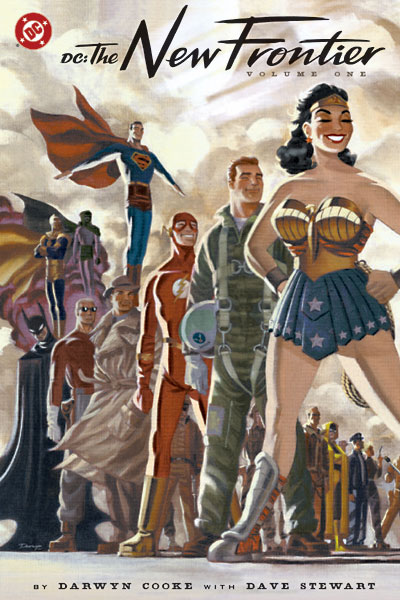
And, hey, while we’re at it, fuck Darwyn Cooke’s overrated, tedious cold-war nostalgia exercise, “New Frontier.” I own this because a friend went to a comics store, and she was looking for a comic for her five-year old. And Darwyn Cooke’s art is pretty and cartoony, right, so she said, um, maybe this? And the comic store owner said, “Hey, this would be great! Gratuitous death, lots and lots of characters most of whom aren’t even properly introduced, incomprehensible plot largely composed of fan scruff, apocalyptic imagery at the end — your kid’ll love it!” So,anyway, my friend looked at it a bit more closely when she got home and cursed the comics store owner and gave it to me.

And I read it because I’m the core demographic, right? I even know who the Challengers of the Unknown are, and I sort of know who the Losers are because they got killed off right at the beginning of Crisis on Infinite Earths just like they get killed off right at the beginning of this. And I know that super-heroes were black-listed in the 50s because it happened in Watchman and in Wild Cards and in Dark Knight, except that wasn’t in the 50s I guess, and also in Golden Age which was an Elseworlds series I never read, but some critic said that New Frontier is like a total revamp of the Elseworlds concept, like you’ll never look at Elseworlds the same again. This time you’ll look at it with the new, fresh, innocent eyes of an Alzheimer afflicted vulture hungrily eying its own decaying scrotum. Oh, wait, that is in fact how you looked at it before. But, no, this is different, see because there’s a timeline, so that Darwyn Cooke introduces each character exactly when they appeared in real life. So, like, the Flash first appeared in 1956, so that’s when he shows up in the comic! And the Martian Manhunter first appeared in…well, whenever he first appeared…and that’s when he shows up too! It’s like going back into the past and pretending that the kids who read the comics back then were as mature and smart as the aging, paunchy, con-goers of today!

I also liked that Cooke chose to make the central character Hal Jordan, who is a young, strapping fighter pilot with daddy issues. Even though he joined the army he doesn’t like to kill, but that doesn’t make him a pacifist, no, no, no…it just means he knows the Korean War is wrong, though he never explains why, exactly, because that doesn’t matter…what matters is that he totally proves his bravery and comes of age and fills his daddy’s shoes and does it while being only slightly more bland than Tom Cruise. And, hey, there’s Batman being all hyper-competent and grim and the Flash running and thinking about Iris just like in Crisis on Infinite Earths and Superman giving a noble speech and J’ohnn J’ohnnz discovering the innate goodness of humanity buried deep in the psyche of some random special-ops asshole, who has a heart of gold, causing you to say, hey look! There’s gold in that there asshole! I guess you’ve just got to keep digging. And there’s also gold in some asshole called Flagg, who gets killed along with his requisite attendant supportive female. And there are a billion cameo appearances by a billion unexplained DC walk-ons, because the best part of fan-fic isn’t exploring relationships or putting your own twist on a character, but just making a checklist so that you can say, ayup, I mentioned every single one of those characters, by gosh. Oh yeah, and there’s a villain called the Center, who is an eldritch evil disguised as a community youth building. So, hey, what more do you want? The doofy, unpretentious heroes of your grandpappy’s youth have been transmuted into the doofy, pretentious heroes of your own middle-age. Sing hosannas and whip out the Eisners; everything young is senescent again.

______________

You can see the rest of this roundtable on kids comics here.

Update: And more on New Frontier here.

Kids Comics Roundtable: You Do So Like Green Eggs and Ham

Cerucee just posted about her difficulty figuring out what books kids will like. She notes:

as a selfish adult reader, what I’m constantly looking for is glimmers of adulthood in those books–complex plotting, elegant art, darkness, sophistication–and I get excited when I see them, so excited that I sometimes forget that what makes a book a good grown-up book isn’t necessarily right in a kids’ book. The first service of children’s comics is not adult readers like me, but to children.

That’s a reasonable enough stance, certainly…but it’s not one I share. I mean, I’m happy enough to tell other adults what they should read and why; I don’t know why it should be different for children. I don’t always agree with my son about what’s worthwhile, but I don’t always agree with my wife, either. (Steve Earle…blech.)

The truth is, I think a lot of the things Cerusee points to: complex plotting, elegant art, darkness, sophistication — can easily be things that kids like too — especially if you’re talking young adults. Many of the great young adult series, in fact, are extremely dark and complicated. Tolkein, C.S. Lewis, Ursula K. Le Guin, Madeleine L’Engle…and for that matter Dokebi Bride, which I was just rereading. They’re all aimed at tweens, or even younger, I’m pretty sure. The Harry Potter books, for that matter, are quite complicated and plenty dark.

Obviously, when you’re dealing with 5 year olds (as I am) you don’t want anything too scary. But still, I think there’s often quite a bit of overlap in taste…and I guess, moreover, I don’t see why I shouldn’t have an opinion. The point of children’s literature isn’t solely to entertain children. I have to read the stuff, after all; that makes me part of the intended audience, surely. The best products for children often keep in mind that there’s an adult audience as well — not too many kdis are going to get Alistair Cookie, but it’s thrown in on Sesame Street because they know that there are a lot of folks out there who *will* get it. And lord knows, if you’re home with the kid all day, it’s not selfish — or, at least, it’s very reasonably selfish — to want to be able to interact with the entertainment without being hideously bored or irritated.

Besides, it’s not like all adults hate all kids books. I like a lot of what my son does — Sesame Street is great, obviously (though he’s a little beyond that now.) So were the Teletubbies, actually — pretty visuals, tripped out plots, what’s not to like? And of course there’s Peanuts, which is probably about the best comic ever, for kids or adults. And there’s Dr. Seuss and Pee Wee’s Playhouse, and on and on.

Cerusee says she tends to like adult books for their adult qualities. There are definitely things that kids aren’t going to like that much — explicit sex, explicit gore, complicated dialogue that references stuff they don’t know about. But the things that are fun in children’s literature are often things adults can and often do like too…imaginative goofiness, slapstick, fart jokes, cute animals, pretty art, entertaining wordplay. In short, I don’t think there is or has to be an aesthetic barrier between children’s comics and adult comics. Let there be commerce between them, as some adult said.

Kids Comics Roundtable: Get Away, Fuzzy

A year and a half ago, I wrote a review of a Get Fuzzy anthology for the Comics Journal. Somehow, though, it got lost in the ether that is email, and so it never got published. Thus rejected, it has come here to the blog to find a home.

______________________________________
I’m Ready For My Movie Contract
Darby Conley
Andrews McMeel Publishing
128 pages/B&W
$10.95/softcover
978-0-7407-6922-1

Darby Conley’s Get Fuzzy is, as the strip itself mentions several times, an almost indecently faithful Garfield clone. As in Garfield, there’s a mean, domineering cat (Bucky); a dumb, sweet dog (Satchel); and a nerdy, vaguely artsy owner (Rob.) And also as in Garfield, the animals are sentient, but not quite adult — sort of a cross between pets and small children. Rob even carries Bucky around in a Baby Bjorn.

There are a couple of differences from Jim Davis’ franchise. First, Bucky’s a Siamese, which (for a Siamese owner such as myself) is automatic bonus points. And, perhaps more importantly, Conley has dispensed with most of the ossified Garfield gags. Bucky isn’t fat, he doesn’t care about Mondays, and he doesn’t eat lasagna. Instead, he yearns to consume monkeys, engages in credit card fraud, and is terrified of beavers. Or, as he puts it, “They curse all that is good! They curse all that is wholesome! I tell you, beavers are evil!”

The double entendre makes that a good bit funnier than it’s meant to be, of course. Similarly, the high point of the book is a misprinted sequence in which Satchel mouths an empty speech bubble, Rob says, “On the same monkey,” and then we get a close up of some sort of bizarre test pattern with an Indian chief’s head in the middle. The nicest thing about these bloopers is that they’re really not all that far removed from the spirit of the strip as a whole. Conley must have done a lot of weed at some point; Satchel and Bucky’s confused almost-clever-but-then-totally-boneheaded patter is quintessential stoner humor. “Rob: T. rexes don’t even exist anymore!” “Bucky: Exactly. Therefore, a beaver is a million-billion times more dangerous than a T-rex.” Satchel: “You just blew my mind.” I mean, that could almost be lifted from A Scanner Darkly.

Conley’s art is pretty decent for the comics page — he has serious troubles with perspective, and I find his grayscale effects irritating, but his character designs are cute and winning rather than Dilbert or Pearls Before Swine-ugly. He’s helped somewhat by the fact that he rarely attempts physical or slapstick humor — instead, the jokes are mostly bad puns and zoned-out verbal goofiness. In his heart, I think Conley really is more fourth-rate Peanuts than second-rate Garfield. And yes, that’s a compliment.
________________________________

So as I said, this was written at the end of 2007 or thereabouts. Since then, my son went through a very intense Get Fuzzy phase. This involved reading our three Get Fuzzy collections over and over (and over) again. At the same time, he was obsessed with Garfield, which we read over and over. We also got to hear the strips repeated back to us without any context or description (so you get a strip which sounds something like: “I’m going to steal Jon’s chicken. Hey where did that vine come from! Isn’t that funny!”)

So a couple of points here. First, after this intense exposure, I think that I was right that Get Fuzzy is not really a knock-off of Garfield — and maybe wrong that it is a knock-off of Peanuts. In its running gags and its rhythms, its really maybe closer to Bloom County in a lot of ways. (Which is fine with me; I like Bloom County. But it’s important to make these distinctions.)

Second, reading these strips aloud (and other comics) has really, really made me appreciate story books. Not that I have anything against comic strips qua comic strips…or, okay, maybe I do, but that’s not the point I’m making here. The point I am making here is that reading comics aloud kind of sucks. When I read a regular story book, I’m often able to pretty much zone out; I can just read along without paying much attention to what I’m doing because…well, it’s a narrative, it only goes one direction, you don’t really have to think about it that hard. Getting downtime like this is really crucial when you’re a parent, and I greatly appreciate it.

With comics, it’s a lot harder to do that. You have to pay more attention to where the text goes in the first place, and in the second you have to make sure the small child is following along, since he’s got to be able to figure out who says what. Admittedly, after the millionth repetition, he pretty much knows who’s saying what…but after the millionth repetition you’re ready to go insane anyway, so the benefit is not as great as it might seem.

On the plus side, though, comics seem to be really good for teaching reading. The constant interplay between text and pictures, and the aforementioned need to follow which text goes where, has really helped my kid parse a lot of words. The first word that he read out of context without any prompting from me, in fact, was “Garfield” (we were in the car and he said, “That sign says Garfield!” I said, what? and started looking around for an advertising poster — but he was actually reading the street sign for Gafield Boulevard, which we were driving on.) He also taught himself to read sound effects like “Crash!” and “Zip!” because he sees them so often on the page.

So…less restful, but better reading comprehension. A few minutes of peace vs. a lifetime of learning. Yep, I’d make the same decision; a few minutes of peace, every time. But if I have to be irritated, I guess it’s good that he’s learning to read. Because then he can go off with a book by himself eventually and leave me alone.

________________________

And here’s the first post in the roundtable.

Cerusee’s follow-up post is here.

Kids Comics Roundtable: Mini-Marvels

Everyone knows that what kids these days crave is a heaping helping of continuity in-jokes. Obscure, off-hand references to Bendis-birthed secret societies, Gwen Stacy’s death, or multi-hued Hulks — lord knows, five year olds love that kind of stuff, right?

The answer, oddly enough is — yeah, they do, at least in this case. Chris Giarrusso’s Mini-Marvels volumes prove that an inventive artist can make even the worst ideas work. Where most other Marvel all ages titles (the Marvel Adventures books or Franklin Richards) studiously avoid the continuity quagmire, Giarrusso and his collaborators happily frolic in the quaggiest bits. Uatu pops up for a gratuitous single-panel gag (“Wha? Me change a diaper? Dude I don’t even want to watch!” See, that’s funny because Uatu is called the watcher, and he spends all his time watching so…oh, never mind.) A whole short story is devoted to the fact that Thor was replaced with a clone (which is funny I think because there was a Thor-clone in the Civil Wars mini-series?) And so forth. Mini-Marvels is, in a lot of ways, the great grandnephew of Fred Hembeck. It’s affectionate, insider parody, delighting in meta-geek mockery of geekishness. It’s a kid-friendly version of Marvel Zombies — just another example of the self-cannibalizing decadence that has consumed the super-hero genre.

Except, as it turns out, when you make your decadence kid-friendly, it kind of stops looking like decadence. Super-hero zombies are a mannered affectation for the jaded palate. Super-heroes as big-headed, manga-looking kids though — that makes the characters more accessible, not less. I mean, awww, look, little Venom has a single square tooth sticking out of his mouth! That’s just adorable.

I think mini-Venom is probably my son’s favorite character in the book, as it happens, and he really highlights Giarrusso’s talent for finding the Marvel heroes and villains core appeal, cutting out the icky bits, and serving up an all ages version that is superior to the original in almost every way. Giarrusso’s Venom isn’t a slavering, violent, scary monster for teens and up. Rather, he’s a slavering, largely harmless monster who keeps repeating “I want to eat your brains!” Over and over. And let me tell you, my son loved it. Half a day and all he said was “I want to eat your brains!”

But despite its bad influence, I still like Mini-Marvels. I like the way Giarrusso and his collaborators are able to take a single goofy fan-scruff notion (“Why doesn’t Iron Man make suits of armor for all the Avengers?) and spin them out into absurdly escalating nonsense (Spider-Man’s armor doesn’t have jet boots, because, Iron Man explains, spiders can’t fly. But, Spider-Man points out, in some irritation, people can’t fly either. “They do when they’re wearing one of my suits of armor!” Iron Man replies.) I like how the books mix in simple, intuitive plots (Wolverine goes to buy a box of cereal) with the multi-part Civil War parody/tributes. I like that Reed Richards’ hair is still greying even though he’s, like 10, and I like the fact that there’s an extra-bonus Avenger named Elephant Steve and that Peter Parker wears his costume all the time, even at breakfast in his house, but that Aunt May still doesn’t realize that he’s Spider-Man. And most of all I like that though all of this stuff is based on what is presumably a life-long obsession with Marvel continuity, you don’t actually have to know anything about the continuity itself to find it funny. Hawkeye climbing a magic beanstalk and finding Galactus at the top of it is amusing whether or not you know who Galactus is; Elephant Steve is funny even if you don’t know he’s not really supposed to be an Avenger. Giarrusso has done the seemingly impossible; he’s created an alternate world where initiates and newcomers alike can appreciate the Byzantine monstrosity that is the Marvel Universe. In fact, if you didn’t know better, reading these books might even convince you that super-heroes were created for kids in the first place.

__________________

This is the first post in a roundtable on kids comics, which will be running throughout this week. second post here.

Don’t Let the Pigeon Shrink the Panels

We’re going to have a roundtable next week on kids comics (featuring a special guest post by the multi-talented Brigid Alverson if all goes well.) To get you in the mood I thought I’d reprint this effort from Culture 11. So here goes.
_________________________

For lots of small children, “funny” equals slapstick — and by that standard, the funnies just aren’t all that funny anymore. Kinetic pratfalls, fisticuffs, explosions, characters bouncing about like demented sugared-up toddlers — to draw those things you space which just doesn’t exist anymore on the funnies page. The full-page nuttiness of strips like the Katzenjammer Kids or Popeye are, of course, long, long, gone. But even the four-panel efforts of my youth have shrunk and dwindled. If you get three tiny panels on a daily, you’re pretty darn lucky — and that means that physicality has been mostly replaced by verbal humor and the occasional static silly drawing. Strips like Dilbert (or even the online Achewood) are almost completely paralyzed; clip-art friezes whose inert perfection is unsullied by motion line or sound effect.

Not to despair, though. Non-sedentary funnies still exist. They’ve just hopped, scurried, and rolled off newsprint, and into the children’s section of your local bookstore. Little, little ones can find cartoon hippos and penguins and moose cavorting with the requisite flurry through any number of Sandra Boynton books — most especially the appropriately named Hippos Go Berserk! And for slightly older kids, there’s Mo Willems, whose Elephant &Piggie series is one of our households all-time favorites…possibly edged out by Willems’ series of Pigeon books.

Part of what makes Willems’ books so enjoyable is that his background is not in the funnies, but in television — he wrote for Sesame Street, and was involved in a number of Nickelodeon animated series. Obviously, animation and comic strips have a long history together, but over the years they’ve largely gone their separate ways. Animation has retained its commitment to wacky physical hijinks and the funnies pages — well, as we said, not so much.

This isn’t to say that Willems’ stories are violent. On the contrary, even by children’s publishing standards, these are extraordinarily gentle books. The plots involve straightforward, resolutely unfrightening conflicts; in “There Is a Bird on Your Head!” Elephant Gerald must deal with a bird building a nest on his head; in “I Am Invited to a Party!” Piggie gets a party invitation, and she must figure out (with Gerald’s help) what she should wear. Even something like Don’t Let the Pigeon Drive the Bus!, the title of which at least suggests the possibility of car chases and crashes, in the event involves nothing more hair-raising than a small bird throwing a tantrum.

It is quite a tantrum, though. The pigeon really, really wants to drive the bus. After begging and pleading with the reader to give him a chance (“My cousin Herb drives a bus almost every day!” “How ‘bout I give you five bucks?”) the insistent bird has a full-page fit, hopping up and down, shouting to the sky, and flipping over onto its back in an explosion of motion lines that culminates with it’s head turned around three-hundred sixty degrees, it’s eye inflamed and bulging red, and it’s wings flapping in a multiplied blur, shedding feathers like drops of sweat.

Though Willems simple character outlines and neutral backgrounds are obviously derived from animation, the grainy quality of his chalky lines, their feeling of dashed-off imperfection, gives the drawings a tactile oomph. That sense of contained movement on a static surface, of personality within the line, is one of the great joys of comic-strip cartooning, and Willems’ mastery of it is, I think, part of the reason his books have been so popular with both kids and parents. For instance, in the Elephant & Piggie book, Today I Will Fly!, Piggie is determined to get herself airborne. Willems illustrates her hapless hopping with energetic thick dotted lines, which trace her tergiversations from right to left across the layout, then back from left to right on the next page — and ultimately, through a short hop and uuuuuuup in a flying leap onto poor Gerald’s much-colonized head. Those dashes are, literally, a physical delight: my son likes nothing more than to trace every single one of them with his finger. If I forget and turn the page before he gets a chance to do so, I’ve got something very like a pigeon tantrum on my hands.

Willems makes use of his luxurious space not only in terms of elbow-room on the page, but also in terms of story length. These narratives may not be especially extended, but compared to a daily comic strip, they might as well be novels. With that extra room, Willems reinjects visual cartooning with some of the rhythms of animation. His narratives have the spiraling escalating silliness of good vaudeville. In I Am Invited to a Party! Gerard and Piggie decide first that the party must be fancy dress…then that it must be a pool party…then that it must be a costume party…until at the end Piggie is wearing an evening dress with flippers and a snorkel and a giant cowboy hat. Each costume change is preceded by the same schtick, as Gerald proclaims, “We must be ready! I know parties!” (To which Piggie responds, “He knows parties!” ) The repetition and variation is like a sublime schematic of how humor works. It also makes it easy to anticipate and then memorize the dialogue, which is exactly what four and five-year-olds want from their reading experience.

Ultimately, though, perhaps the greatest advantage Willems has over his newsprint peers is not space, but time. Between Elephant &Piggie, the Pigeon series, and other projects, Willems seems to be churning out somewhere between four and five books a year. That’s quite a pace — but it’s nothing compared to the brutal grind of a daily strip. The truth is, given all the constrictions placed on them, it’s no wonder that the funnies have had to abandon many of the medium’s traditional resources. Perhaps, as newspapers complete their death spiral and content is forced online, the funnies will rediscover some of the possibilities they’ve lost — though goodness knows strips like PvP certainly don’t give one much hope. In the meantime, if I start hankering for more cartoony goodness, I won’t have to look too far. Writing this article has alerted me to the fact that Willems has yet another Elephant & Piggie book out: Are You Ready to Play Outside? As Gerald might say, “We must have it!”
______________________

As a kind of update, we did get “Are You Ready to Play Outside?”, which is maybe the best of the series. It certainly has one of the stand out lines: “I am not a happy pig!” It’s amazing the number of situations for which that quote is the ideal. — indeed, perhaps the only — appropriate response.

That Other Yazawa Title

My column over at Comixology is about romance and Ai Yazawa’s pre-Nana series, Paradise Kiss. Here’s a quote:

The romance genre, is not, in other words, a fantasy of female disempowerment, but of female empowerment. Which isn’t to say that it’s necessarily empowering. In fact, the insistence that women can save men from themselves is, overall, fairly depressing. Why on earth would you want to save Richard Gere in the first place? I mean, fuck him…and no, adamantly not literally.

And yet, the romance genre can’t get enough of him and his ilk. From Jane Eyre and the moody, violent Rochester to Maggie Gyllenhaal and the utterly emotionally inaccessible James Spader in the film Secretary, the excitement of romance is all wrapped up in the magical power of masochism. Yes, this guy is an abusive shithead…but that very abuse makes the relationship all the more rewarding when I tame him through the power of my redeeming love! No pain, no gain…or, to paraphrase another fairytale, no magic kiss without the frog.

God and Mammon

This essay first ran in Culture 11.
___________________

The title of Michelle Williams’ forthcoming R&B album is Unexpected— though judging from the first video, there isn’t actually all that much to be surprised about. As an entirely rote processed beat bangs away, Williams repeats the title “We Break the Dawn” over and over while wearing a short, tight dress and slinking around with a posse of yummy and shirtless male dancers. Oh, and there are lots of jump cuts. I guess that would have been novel thirty years ago.

So the title’s just a case of the usual marketing hype? Well, not exactly. “Unexpected,” refers, not to content, but to career trajectory. Williams became famous when she joined Destiny’s Child in 2000. As a member of the hugely popular R&B act, she wore preposterous dresses and sang about bumping, grinding, sex, and dissing those men while throngs of cheering fans stared at Beyoncé’s cleavage. Then Williams turned around and released her solo debut “Heart to Yours” in 2002 — a very fine contemporary gospel album, complete with guest appearances by Shirley Caesar and Mary Mary. After another solo gospel outing, and one more Destiny’s Child release, “Unexpected” is, finally, her solo R&B debut.

Country singers do this sort of thing all the time, of course. Throughout his career, Johnny Cash would pray to Jesus in one track and murder his woman in the next, and hardly anyone batted an eye. But in the world of black music, shuttling between sacred and secular as Williams has done is a lot less common and a lot more fraught. For African-American audiences living in a segregated America, the gospel/pop line was about more than just faith. It was about loyalty to your people — about whether you were going to stay true to your oppressed community, or kowtow to the ofays who were, often quite literally, trying to kill you.

Changing your musical style wasn’t just an unfortunate marketing decision; it was an exercise in betrayal, sin, and damnation. As such, black audiences and artists took it very seriously indeed. In the early 50s, the gospel star Sister Rosetta Tharpe lost much of her fan base when she started performing in secular clubs — even though she was still singing Christian music. Then there’s Sam Cooke, who started his career as the gospel superstar lead singer for the Soul Stirrers. In the late 50s, he moved to secular music and never looked back — though “A Change Is Gonna Come” had gospel tinges, Cooke’s pop music rarely, if ever, touched on his faith.

Contemporary R&B follows in his footsteps. Virtually every R&B artist shouts out to God first thing in his or her liner notes, but that spirituality is kept tightly under wraps on the albums themselves. Even performers that do express their faith more explicitly do so with a certain care. At the conclusion of her 2005 album “My Story,” for example, Na’sha thanks her God while defensively dismissing those who told her it would be bad for her career to do so. Similarly, on their breakthrough “The Writings on the Wall,” Destiny’s Child sings “Amazing Grace” — but only at the very end of the album. Faith is fine, apparently, as long as you save it for the last track.

This nervous tension between private faith and public salaciousness can have unfortunate repercussions. Several African-American stars have been so torn by the perceived conflict between their faith and their music that they abandoned the latter. At the height of his popularity in 1957, for example, Little Richard turned to God and renounced rock and roll, tragically scuppering his career. In less extreme cases, the intensity of the sacred/secular binary can result in a painfully intense refusal to notice what one is doing — a kind of aphasiac hypocrisy. Item A here is Destiny’s Child single “Nasty Girl” in which the super-group famous for its plunging necklines, ascending hemlines, and borderline-hooker-wear upbraided their peers for dressing like sluts. “Nasty put some clothes on,” they harmonized, “You make it hard…for girls like myself who respect themselves/And have dignity….” Translation: I’m out here in my underwear, but it’s classier underwear than yours.

So the firewall between God and mammon has undeniably wreaked a certain amount of personal and aesthetic damage. But overall, it’s effect has been predominantly positive. White musical forms have had much looser definitions of selling-out, but that hasn’t allowed them to dispense with authenticity. On the contrary, the fact that nobody really knows who is real, or why, has resulted in music which is compulsively, and often rather idiotically, conservative. Country music gets slicker and slicker as it fetishizes an eternal rural past,; rock gets older and older as it fetishizes an eternal Baby Boomer moment of youthful rebellion.

There are certainly black musicians who are mired in nostalgia (and yes, I’m talking about you, Wynton.) Overall, though, African-American music is relentlessly forward-looking. Jazz, rock and roll, funk, disco, hip hop…the zeitgeist moves and you stay with it. Keeping it real, when it’s an issue, tends to be about being cool, or tough, or funky, not about being true to the past.

And a big part of the reason for that is, precisely, that for these artists, there is no past. You don’t explore your roots — you rip them off for gimmicks, and jack them for beats. Little Richard used gospel vocal techniques he learned from the amazing Marion Williams, but he couldn’t be Marion Williams, or even really reference her without some dire consequences. For him to look backwards was not to be validated, but to be turned into a pillar of salt.

If Richard had been able to look behind him, it’s doubtful he could have transformed music the way that he did. Similarly, if Destiny’s Child were more invested in their Christianity, they probably couldn’t have embraced the hip hop delivery and serious bitchiness which allowed them to create some of the most ravishing and influential pop music sounds of the last decade. Beyoncé brings the gospel fire on tracks like “Say My Name,” but — like Ray Charles, Aretha, and many others before her — it’s the way she ruthlessly subverts her religion for secular ends which paid dividends, both literal and aesthetic.

To be rootless is to have no fallback position; it’s a dangerous, exciting, and potentially very creative place to be. That’s not to say that every crass commercial move is going to be great art — Michelle Williams’ new album, alas, looks very much like a dud. But it is to suggest that, as has long been the case, if you want to bet on the future, you should place your money with the sell-outs.