Patriarchy in You

stendhal-syndrome-2

 
According to Andrew Cooper, you can read the Stendahl Syndrome as a winking parody of critical fears of horror movies. In the film, Detective Anna Manni (Asia Argento) is violently raped by a serial predator. The rapist manages to capture her because she suffers from Stendahl Syndrome—a psychological condition which causes her to be overcome, and even experience hallucinations, when viewing art. Anna, then, is the incredibly overly receptive viewer of critics’ nightmares; her whole view of reality is transformed by aesthetic experience. Little wonder, then, that the rape/revenge plot of the film she is in leads her to perdition. Morally censorious critics imagine that watching films causes violence; Anna, the overly sensitive viewer, observes her rapist and becomes him. She does manage to take her revenge, but after doing so, she becomes psychotic herself. Through the power of art, the detective changes to the murderer. End of joke.

There’s another, less ironic way to take the film, though. Most rape/revenge films are narratively linear, and set. You start out with a healthy, unmarked woman; she is abused, suffers, strikes back, and destroys her tormenter.

The Stendahl Syndrome scrambles this—not with the rather obvious chronological trickery of Irreversible, but through more subtly letting the emotional and narrative components of the story shift out of true. Anna begins to experience trauma when she goes to an art gallery, before she is raped. And rather than a singular event, the rape is reenacted; first by Anna, who begins to dress as a man, and then molests her boyfriend, and then by the rapist, who attacks other women, and then re-kidnaps Anna. Finally, Anna murders the rapist in revenge—but that doesn’t end the story. Instead, the narrative grinds on, with the rapist apparently back from the dead—until it turns out it’s not the rapist, but Anna herself who is murdering her own lovers and friends. The rapist is inside her, she says; being violated, and then enacting violence herself, has turned her into him. She becomes the abusive patriarch who assaulted her.

Psycho, and Hitchcock in general, seem like an obvious touchstone here; as in Hitchcock’s films, the movie world seems to gleefully conspire against the beautiful protagonist, creating switchback complications to destroy and humiliate her. But unlike in Hitchcock, the film affect is always, firmly with Anna, which means the complications don’t seem like trickery, but like grotesque unfairness. The movie even says, just about outright, that it is rigged against Anna; it is art itself which disorients her and traumatizes her before the rapist can.

Again, Anna’s susceptibility to art could be a meta-comment that art doesn’t actually work like this; a painting doesn’t make you hallucinate, a film doesn’t make you a murderer. But the antipathy of art within the film could also be an acknowledgement of the antipathy of the film itself—and, metaphorically, of the antipathy of the world outside the film.

Sexual violence and patriarchy aren’t neatly contained in a narrative of (provisional) redemption. Instead, they leak out everywhere. Anna is traumatized before she is traumatized; her rapist continues to haunt her not only after the rape, but after his death. The violence to her is not only real, but symbolic—and is so overwhelming that she can’t even separate the violence from her self. Her relationship to her own sexuality, and her own violence, is inseparable from what has been done to her—and what has been done to her isn’t just the rape, but the vision in which the rape occurs, which precedes it and enables it.

One of many false climaxes in The Stendahl Syndrome occurs during Anna’s second rape. She has been tied down to a bed, and the rapist, having finished his work, leaves to amuse himself in some other way before coming back to finish her. There’s graffitti on the walls of the chamber, and her syndrome kicks in, causing her to hallucinate. Her powerful thrashing allows her to free herself. She kills her attacker when he returns in an extremely satisfying scene. Art serves as inspiration for empowerment — the message of many revenge films which seek to uplift, whether Fury Road or Ex Machina.

But Anna can’t get out of the film. Once she has tied herself to the tropes of suspense and violence and patriarchy, she can’t undo the knots. If Stendahl Syndrome is a parody of the idea that aesthetics can corrupt, it’s also a parody of the idea that aesthetics can save and liberate. Instead, in the Stendahl Syndrome, art and life collaborate together to create a hierarchy from which there is no escape, a dream of violence that doesn’t end.


Love to Hate/Hate to Love

This ran at Madeloud way back when.
______
 

Amanda_Leigh

 
Mandy Moore
Amanda Leigh
[Storefront]

Two Stars

Listen To: “Everblue,” “Song About Home,” “Merrimack River (Reprise)”

I was swept away by the first rapturous chords of Mandy Moore’s last album Wild Hope — and I’ve been more or less bitterly falling out of love with it ever since. I can’t resist those folk-pop tunes under the layers and layers of pristine production and the slightly hoarse vocals — but, gah, the remorselessly earnest phrasing…the self-help lyrics…and, for that matter, the saccharine folk-pop tunes under the layers and layers of pristine production. It’s like drifting off to sea in a romantic coracle with your one true love and then becoming desperately seasick and barfing over the side. And then you realize your true love is actually a rotting zombie mannequin — but jeez, she doesn’t look so bad, does she? And then, hey, it’s time to vomit over the side again. And then back to the not unpleasing zombie mannequin. And so on and on, over and over again. Oh god, make it stop.

Moore’s latest, Amanda Leigh, does nothing to free me from my painful and embarrassing dilemma. The album does head for a slightly different neck of the pop sugarscape : Moore has said she was inspired in part by Paul McCartney’s Ram, and as that would indicate, the languorous washes are leavened with a good bit more pep and fuss. But the basic algorithm remains the same: seduce, sucker punch, repeat — and not in a good way. “Song About Home” is a fine, jazzy Joni Mitchell impersonation; “Love to Love Me Back” on the other hand, demonstrates with a numbing finality that even mixing in Joni Mitchell can’t redeem crappy country radio tropes. “Merrimack River” is a pretty enough melody with an importunate and irritating waltz tempo; “Merrimack River (Reprise)”, though, resets the tune from guitar to piano and strings, adds some minor tunings and for a minute or so you’ve got a nice collision between Debussy and a carnival. “I Could Break Your Heart Any Day of the Week” is another absolutely egregious country radio clunker. “Those calendar girls, they got nothing on me!” Moore throbs, with a calculated spunk that she really seems to be clueless enough to have mistaken for sexy. The song is complete and utter crap…except for an odd dissonant bridge about 1:40 in, where the anthemic cheer shakes, stutters, and almost dissolves into something Syd Barrett could recognize. If only it would last…but no, our five seconds are up and we’re back to the shiny, happy people shit.

Amanda Leigh, in other words, is a fickle flirt. Avoid her siren song altogether and listen to something you can trust, like Linda Perhacs or, hell, Pat Benatar. But…if I have to pledge my troth to one track on this album, I guess it would be “Everblue,” an aching dirge soaked in amorphous longing and regret. Moore’s singing is her finest on the album. From the moment she comes in a perfect half-beat early, she emphasizes her breathing, and the heavy in-out seems to slow the pace even more, until even nonsense doggerel like “I have felt the ground, I’ve seen the seeds /Out of which grew golden wings” seems weighted down with meaningful melancholy.

Of course, some genius sprinkled in additional sighing wind effects, which are both dumb in their own right and tread dangerously close to self-parody. It’s probably just as well, though. If too much of my faith were restored, I might be tempted to buy her next album. No good could come of that.

Xasthur and the Circle of Metal

This ran on Metropulse, way, way back.
_______________________
 

images

 
For centuries, scholars believed that metalness was a straight continuum, with bands like Slayer at the top end and performers like, oh, say…Debussy at the bottom. In recent years, though, researchers have discovered that the truth is somewhat different. Beyond St. Vitus, beyond Celtic Frost, out where the black dooms drone, we now know metal curves, and Stephen O’Mally, like a wily ourobourous, takes his tail in his teeth only to discover he’s chomping on the smiling visage of Danny Elfman.

Xasthur’s new album doesn’t sound like Danny Elfman at all, really. But on it, one-man-band Malefic maybe takes a step or two around the circle in that direction that I wish he hadn’t. At his spiky, buzzing best — as on 2002’s Nocturnal Poisoning — Malefic was right in the soul of black, with static and keyboards and shrieking vocals and drums all fusing in a single hissing howl of knives and hate. Xasthur was fierce, brutal, and unrelenting.

And then, on All Reflections Drained, Malefic relents. Oh sure, he breathes out something approaching his trademark evil at the beginning of “Inner Sanctum Surveillance,” or in the middle of “Masquerade of Incisions.” But for the most part, the album just backs off everything a bit — the buzz, the static the shrieks — and all of a sudden we’re listening to a soundtrack for the apocalypse rather than experiencing the apocalypse itself.

What’s even worse is that slowly, horribly, as you listen it becomes clear that Xasthur was always just an inch away from …restful. And…pleasant. Like Jesu, or…Sigur Ros. And, don’t get me wrong, I like Jesu and Sigur Ros. But I liked the old Xasthur more.

Utilitarian Review 10/3/15

meet_the_feebles_05_stor

Wonder Woman News

Nell Minow interviewed me at HuffPost about Wonder Woman and bondage.

On HU

Featured Archive Post: James Romberger on Sammy Harkham.

Robert Stanley Martin with on sale dates for comics in early 1948.

Me on Foxy Brown, The Descent, rape, revenge, and race.

Chris Gavaler on the problems with superhero marriages.

Kim O’Connor on why Ta-Nehisi Coates’ Black Panther won’t save comics.

Me on Gaspar Noe’s Irreversible, moral structure, and immoral style.

Me enthusing about Nirvana’s Freak Puke.
 
Utilitarians Everywhere

At the New Republic I argued that liberals shouldn’t frame contraception as an anti-poverty measure.

At Playboy I wrote about how xkcd is awesome.

At Vice I wrote about the new Muppets and Meet the Feebles, and how viscerally disturbing muppet sex is.

At Quartz I asked, what would “Foucault” say about “first-person” essays.

At Splice Today

—I wrote about how everyone is wrong about Trump. Yes. Even you.

—I argued that the internet doesn’t care about harassment.
 
Other Links

Elizabeth Bruenig on why many unwed American teen girls want to have children.

Heidi MacDonald on harassment in the comics industry.

Ijeoma Oluo on women of color and the struggle for reproductive rights.

Less Real Than Nirvana, Thank Goodness

large_melvins-troubadour

This originally ran on Splice Today.
________

I’m one of those people who didn’t hear about the Melvins until after Nirvana had explained that they were the shit. As a result, the two bands are linked in my head. Kurt Cobain shot himself a good long time ago, and I overplayed his albums so thoroughly that I can’t even listen to them now. Still, when I think about the Melvin’s, I can’t help but get a little nostalgic for that other band I loved back there in the 90s when I was loving the same thing as everybody else.

None of which is really fair to the Melvins, who were always a much more creative outfit than Nirvana — as Cobain would be the first to acknowledge, I think. It’s also misleading since the Melvins were around well before Nirvana, and have persisted long after. The band was formed in 1983, which means that they’re almost three decades old now.

The Melvins’ latest, Freak Puke, doesn’t exactly break new ground for them — but it also doesn’t sound anything like a nostalgia act. Partially that’s because the Melvins were never big enough that theirmoves became a cliché. Their early albums are amazing, but they don’t show up on best of lists, which means that the band doesn’t have to fight their back catalogue the way indie giants like Sonic Youth or REM have had to. Partially, too, the Melvins have managed to avoid musical calcification because they always had more than one schtick. On Freak Puke, for example, they’re less full-on-doom-sludge, less avant-experimental-weirdness, and more dirty grungy rawk. Indeed, Freak Puke hearkens back to their one major label effort, 1993’s fantastic Houdini.

The main reason that the album doesn’t sound dated, though, is simply because it kicks ass. Longtime members guitarist Buzz Osborne and drummer Dale Crover and sometime bassist Trevor Dunn have put together an amazingly thick sludge of testicle-cleansing hooks. But while the Melvins are definitely riding in on the same brontosaurus as Sabbath or Aersosmith, they still manage to get that Saurian to stumble about to some bizarre bop heads. “Worm Farm Waltz” is Charlie Parker getting buried in cement — until the abstract, spacy bridge, which sounds like the Sun Ra orchestra if the Sun Ra orchestra had employed Dale Crover on drums. And yeah, I tried to think of another metaphor there, but the fact is, that nobody sounds like Dale Crover. Even John Bonham doesn’t pulverize the skins like he does.

Anyway, that’s basically the album; track after track mining the unexpectedly fertile ground between dirty 70s classic rock and avant jazz. “Mr. Rip Off,” the opening track, starts with quiet bowed bass and spooky chalk board squeaks before staggering seamlessly into a distorted trudge, as if Webern was always meant to play arenas. “Let Me Roll It,” on the other hand, is totally, gloriously sold out kitsch — the kind of trashy, self-parodic testosterone swagger that Gene Simmons lived for, complete with stoopid half-failed double entendres. “You gave me something that I understand/you gave me lovin’ in the palm of my hand!” Buzz Osborne bellows while Crover smashes a beat that’s just about two times too slow. When they declaim “Let me roll it to you,” it’s like watching the Hulk dressed as Vegas Elvis thrusting his crotch while he pushes a square boulder towards the massed groupies.

All of which suggests that the Melvins are the band Nirvana might have been if Nirvana was the sort of band that could name itself “The Melvins”. Kurt Cobain certainly had an irreverent sense of humor…but it was irreverent, not absurdist. When Nirvana moved away from its core pop-punk-metal remit, it did so by covering Leadbelly or singing about how Jesus didn’t want them for his sunbeam — a different take on angst and realness, in other words, but still angst, and still realness.

The Melvins, in contrast, were always already sold out —punks who spent all their time pretending to be doom metal or glam rock or some sort of jazz weirdos. They’re a gimmicky band — the cover of Houdini, with its adorable cartoon two-headed puppy, is a nice summation. But being true to your gimmicks can be its own kind of integrity. Thirty years on and you can still hear the Melvins giggling like fifteen year olds when they put “puke” in their title or end their album with a thoroughly annoying beeping sound-effect loop. Grunge came and grunge went, but the Melvins remain, still quietly making the best loud music on the planet.

Every Thing In Its Place

primary_irvbl-thumb-500x221-16923

 
Gaspar Noe’s Irreversible is one of those unusual rape/revenge films that has garnered more critical praise than condemnation. Roger Ebert, who typically is not a fan of exploitation sexual violence, gave the film four stars and actually called it “moral—at a structural level.”

What Ebert is referring to is the film’s high concept. Rather than the usual chronological treatment of rape/revenge—where the rape happens, precipitating vengeful violence—Irreversible turns things around. The film is presented in reverse chronological order; the last scene happens first, and the first scene last. Thus, you see the violent, bloody, confused (and as you later learn, mistaken) revenge first, scrolling backward through the exceedingly violent and horrible rape, and ending with a blissful morning as the loving protagonists awake, unaware of what the day holds in store.

The typical read on this seems to be that the film’s reversal undoes the immorality of the rape/revenge structure. Rape/revenge posits that violence is the natural, necessary response to sexual violence. Irreversible refutes that, by showing the horror of the murder first, without justification, and then the horror of the rape, which still occurs despite (inept) vengeance having been doled out. In fact, the vengeance seems to call the rape into being, as if violence echoes backwards, rather than forwards, in time.

There’s certainly a deliberate stance against violent retribution in Irreversible. The avenging boyfriend Marcus (Vincent Cassel) is presented (in the first structural half of the film at least) as a drugged up out of control idiot; he’s explicitly sneered at for imagining himself as a “B-movie hero.” And of course, he (and more effectively his friend Pierre (Albert Dupontel)) beat and perhaps kill the wrong dude.

But the claim that this is somehow pushing against rape/revenge tropes seems insufficiently attentive to the genre. It isn’t unusual for rape/revenge films to question the effectiveness of violence. It’s de rigeur. A Virgin Spring (1960), one of the genre’s founding texts, has the revenger kill an innocent child and then shout at God for his cruelty; there is no question of the vengeance being justified or beneficial. Deliverance, another important film in the genre’s development, uses the mistaken revenge trick itself, tied to a critique of machismo similar to Irreversible‘s. I Spit On Your Grave presents Jennifer as destroyed by her vengeance as much as by her rape; Ms. 45 presents its protagonist as a deranged killer, who has to be put down by another woman with a knife to the back for the good of everyone. Stendahl Syndrome has the revenge lead to further, helpless violence. And so forth. There are less ambivalent rape revenge films (like the sequence in Foxy Brown, for example) but based on the history of rape/revenge, you hardly need to run the plot in reverse to show that revenge isn’t especially fulfilling.

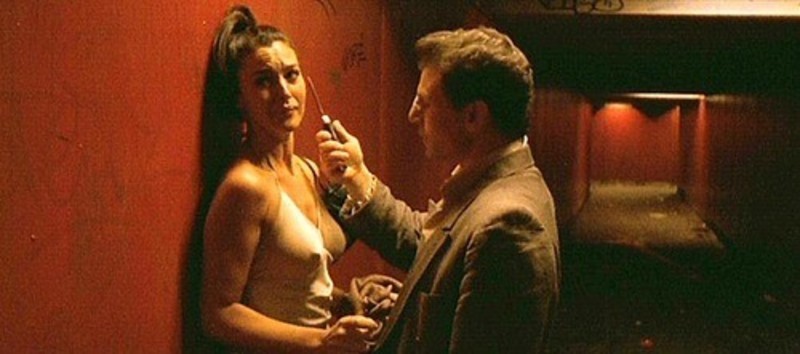
If the plot trick isn’t needed to tack on a moral (as Ebert suggests), then what precisely is it doing? Well, one thing it does is to foreground that this is not exploitation, but art cinema. The wildly lurching cinematography does the same, as does the insistently structureless and repetitive dialogue. In one sequence — which is as painful in its way as the rape— Pierre, who used to date Alex (Monica Bellucci), asks her over and over, as they catch a train, if she and Marcus orgasm during sex, and why she and he had less sexual success as a couple. It is an excruciating, endless discussion—made all the more gruesome when Alex explains to Pierre that his sexual problem is selflessness. He pays too much attention to his partner’s pleasure, she insists. Shortly before this, of course, we saw a rapist assault her. Hah hah, the film says. You think you like it when men don’t pay attention to your pleasure? You just wait.

Is that really what the film intends to be saying? Is it actually mocking Alex about her coming rape? It’s difficult to say—but this sort of intentional irony comes up again and again throughout the second structural half of the film. Alex tells Marcus that no one owns her, for example, which again seems like an ironized reference to her earlier/subsequent violation. And then there’s the moment where Marcus jokingly tells her he wants to fuck her ass, echoing the anal rape we saw half an hour before.

The reversal of time doesn’t so much add a moral dimension, then, as it allows the filmmakers to show their cleverness—not least through the manipulation of, and mocking of the characters who enact their trauma first as tragedy, then as farce. Breaking up the narrative also fractures the masochistic identification; usually in rape/revenge, you learn who the protagonist is, and then identify with her as she is raped. But in Irreversible, you meet Alex only with the rape, like her rapist (who is a complete stranger to her.) The fragmentation gives you a sense of control and power; you start off confused, perhaps, but soon you know more than the characters do; you are in a position of superiority. You are the director, the God, the one in control. The filmmakers call the ending into being, and then imposes it on the characters. Nor is it an accident that the ending/beginning is set in a gay BDSM club called the Rectum. The filmmakers couldn’t state much more clearly that they’re investment is sadistic.

The sadism most directly inflects, and infects, the critique of machismo. Again, Marcus is specifically upbraided for his obsession with the revenge narrative, and for his need to avenge “his” woman, rather than going to the hospital to be with her.

But how does the film criticize his machismo? By mocking his manliness. Through the first structural half of the film Marcus wanders around asking people to direct him to the Rectum, and desperately denying that he is gay. In the Rectum, itself, he is almost anally raped. The sexual assault on him then (via reverse chronology) foreshadows Alex’s anal rape at the hands of a gay man. More, Alex’s anal rape becomes Marcus’ fantasy/nightmare; she is a stand in for him and his terrorized masculinity. It’s significant too that the rapist’s previous victim is a trans woman; we see a glimpse of her penis as Marcus and Pierre interrogate her about the rapist’s whereabouts. That’s the only penis shown in the film, revealed like a secret key. The woman is the man, the man is the woman. Are Marcus and Pierre being chastised for their investment in machismo? Or is the film an elaborate sneer at them for being too effete?

Again, the ur-text here is Deliverance, which both critiqued urban dreams of machismo and set up elaborate humiliations to demonstrate that those urbanites were in fact sissy-boys. Noé has undoubtedly seen Deliverance, and he’s probably also read Carol Clover, whose Men, Women, and Chainsaws argues that in rape/revenge narratives, male viewers are encouraged to identify with the female victims, often via intertextual reference to Deliverance. The central rape in Irreversible, in which a gay man beats a trans woman, then anally rapes a cis woman while cursing her out for her wealth, in this context comes across as a deliberate, smug wink to theory heads.

In my discussion of Virgin Spring, I argued that Bergman’s art cinema profundities about faith and God, as expressed by Max Von Sydow, effectively erased the experience of the woman whose rape was the ostensible center of the story. Of course, a contemporary French art filmmaker isn’t going to present a disquisition on faith—but still, Noé’s film parallels Bergman’s in a number of respects. Most notably, they both foreground film style. And in doing so, they both perform different kinds of aesthetic masculine swagger in a way that resonates uncomfortably with the phallic content of their films.

In Noé’s case, the reverse chronology, the hand-held camera jerking, and the various portentous declarations about time (including a preposterous, clumsy reference to 2001) all tie the filmmaker, and the film, to the main character’s masculine panic—a panic triggered perhaps by Alex’s revelation (at the end/beginning) that she’s pregnant. The irony of the title is that time and generation are not set. Noé manipulates them, demonstrating his power as he illustrates the powerlessness, and cluelessness, of his characters. The words “Time destroys everything” appear at the beginning/end and end/beginning, a vaunting koan. For who, here, is master of time but Noé,the avant-garde daddy, whose moral structure knows all?

Rape, Revenge, and Race

foxy+brown

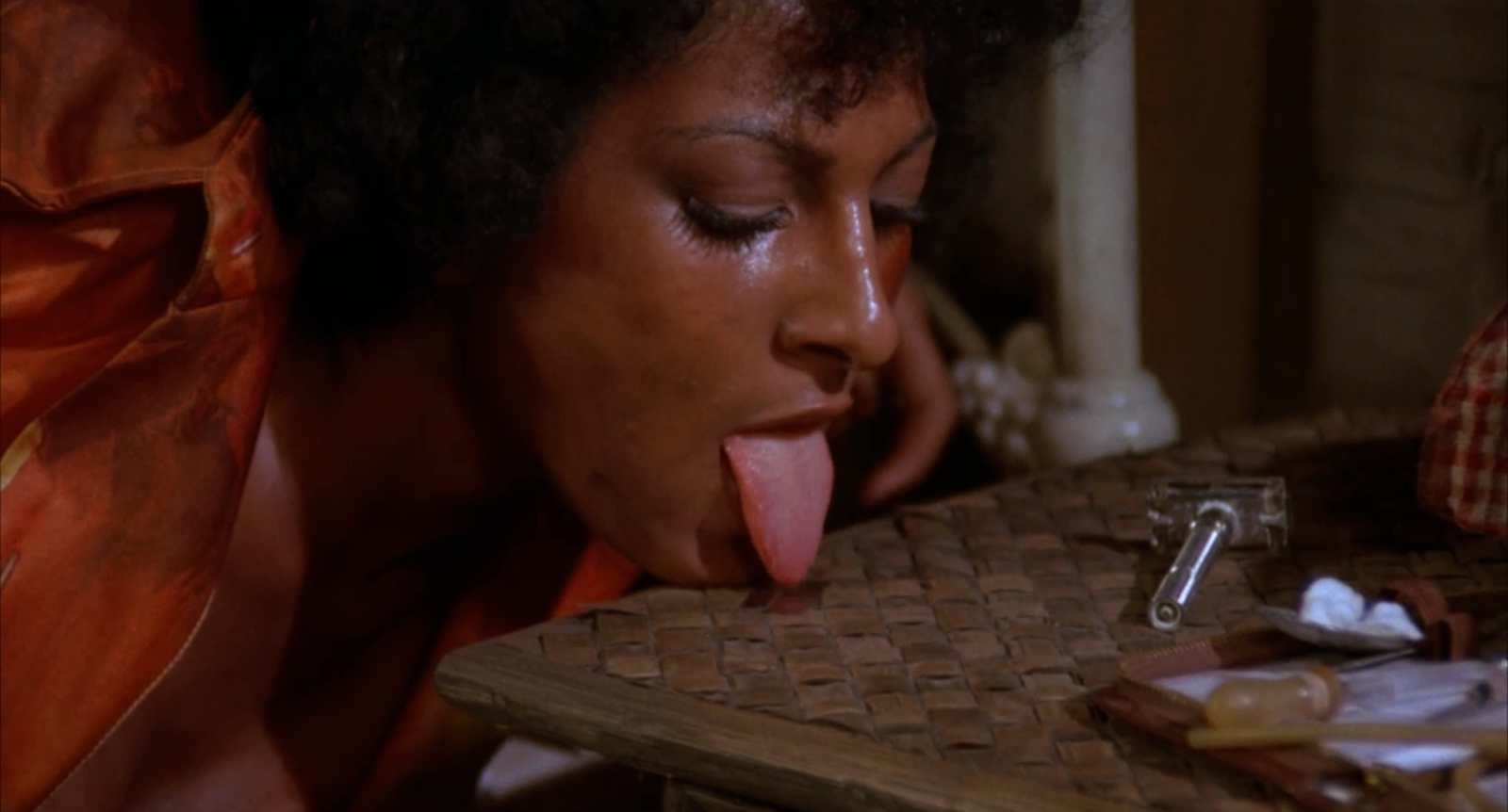
Foxy Brown acquires a razor on her way to her revenge.

Jack Hill loved to interpolate other exploitation genres in his exploitation films. So while the 1974 blaxploitation classic Foxy Brown isn’t exactly a rape/revenge, it does have a rape/revenge set piece tucked away in the middle. Foxy Brown (Pam Grier) is caught by the evil drug pushers, and sent out to the Ranch. There, two beefy, chuckling white trash hillbillies hook her on heroin and rape her repeatedly—until (of course) she frees herself and inflicts a terrible revenge involving coat hangers, gasoline, and charred corpses.

Hill’s rape/revenge riff — like many a rape/revenge riff—is indebted to deliverance. The white trash rapists in the context of a blaxploitation film take on additional relevance, as they spit racial epithets and even use a whip on Foxy, nodding to slavery and the history of sexual violence against black women. In Deliverance, poor whites are presented as a debased, violent, but also victimized racial other, locked in conflict with effete urban gentrifiers. Foxy Brown deliberately reminds viewers that rural whites and urban whites aren’t always at each other throats, but have often made common cause against people who look like Pam Grier.

The Deliverance reference isn’t just about race, though. It’s also about gender. In Men, Women, and Chainsaws, Carol Clover points out that the male rape in Deliverance serves as a prototype for many of the female rapes in exploitation cinema. That means that male viewers are not (or not just) supposed to identify with the male rapists; they’re supposed to identify (as they do in Deliverance) with the person being raped. In Foxy Brown, the imagined viewer is certainly mainly black. The Deliverance reference inscribes that viewer as not just black women, but black men as well, both of whom are encouraged to identify with Foxy as she is violated, and then takes violent revenge.

There are other indications in the film that rape in the film is about violation of black men, as well as violation of black women. In particular, the fate of the lead dope pusher Steve (Peter Brown) at the conclusion of the film is a collaborative male/female endeavor. Foxy allies herself with a black anti-drug, neighborhood watch coalition, and together they kill Steve’s bodyguards and capture Steve himself. The men hold Steve, and pull off his pants. Then they look to Foxy for the final order, and their leader castrates him. Finally, Foxy puts his genitals in a pickle jar and takes them to show his girlfriend, the evil Kathleen Wall (Kathryn Loder). Rape/revenge stereotypically uses castration as the recompense for rape—but in this case, that castration functions both as revenge for the sexual violence against Foxy, and as revenge for the way the heroin dealers have exploited the black community as a whole (and black men in particular.)

Even though the rape/revenge sequence only takes up 10-15 minutes in a 90 minute film, then, it is structurally and thematically central. First, it presents heroin pushing and sexual violence as parallel crimes, both used by white men (and white women) to humiliate and torture black people. Second, in doing so, and through the reference to Deliverance, it solidifies Foxy Brown’s position as a point of identification for black men as well as black women, both in her rape and in her revenge.

As Claire Henry points out, Foxy Brown, and other blaxploitation films, often aren’t included as part of the rape/revenge canon. Henry argues that this is because white society (and white critics) do not see black women’s rapes as important, or worthy of attention. Stephane Dunn notes, though, that the rape/revenge in Foxy Brown is in many ways downplayed; Foxy shows no ill-effects from sexual violence, nor for that matter from her forced heroin injections. Rape serves as a metaphor for white violence against blacks, but the specificity of the individual trauma of rape is lost — as well as the specificity of the historical sexual violence unleashed against black women.

The rape/revenge genre, then, focuses on white women, and has trouble thinking about the intersection of race and rape. Blaxploitation focuses on racial exploitation — and has trouble thinking about the intersection of race and rape. Foxy Brown doesn’t so much resolve the dialectic as illustrate it. Hill includes a rape/revenge skit in the middle of a blaxploitation revenge feature, and showing how the two parallel each other, but never, quite, manages to bring the two together into a whole that honors and sympathizes with black women’s historical, and ongoing, experience of sexual violence.
_____

One possible exception to the above is Talia Lugacy’s The Descent (2007). One of the few rape/revenge films with a female director, it also is unusual in featuring a woman of color; Rosario Dawson plays Maya, the lead.

As often happens with rape/revenge films, The Descent gets a worse rep than it deserves. This critic for example attacks it in part because he doesn’t understand why she refuses to go to the police (maybe women of color don’t share your faith in the cops, maybe?) and because the rape scene is insufficiently explicit (how can we care about sexual violence unless it’s really spectacular and gross?)

But while The Descent isn’t a disaster, it can’t be said to be a success, either. The film does confront race head on. Jared, the rapist football player jerk, uses racist insults as he date rapes Maya. More, his frat-boy persona and indeed the whole college milieu is figured as white; the best part of the film is the way that it functions as a kind of sickening send up of Dead Poets Society and the typical John Hughes rom com. Jared brags about seizing the day and takes Maya out to see the stars and keeps pushing at her and pushing at her boundaries, just the way you’re supposed to do, and isn’t that cute that he’s such a swoony deep romantic John Cusack lead— and then, whoops, it turns out that swoony deep romantic lead is in fact an awful priviliged racist raping shit.

The revenge part of the film seems to have racial overtones as well, though the handling of them is less sure. In reaction to the rape, Maya starts to take risks; she frequents a club where the clientele is black, Hispanic, and queer. Mya’s non-white identity becomes a kind of alternative to the square, college life with its hypocrisy and violence.

The solidarity in the face of oppression is never expressed unambituously as it is in Foxy Brown, though; instead of framing resistance to white supremacy as politics, it ends up being presented as titillating lifestyle choice, complete with BDSM games and foot fetishism. It’s not clear, either, what we’re to make of Maya in this setting. Has the rape degraded her and damaged her by pushing her into this more interracial milieu? Has the rape opened her up to sexual and communal possibilities (as she suggests at the end)? Neither of these seems like a very thoughtful takeaway, and, perhaps realizing as much, the film vacillates between them in confusion. As in Foxy Brown, rape/revenge doesn’t seem quite able to tie together its themes of sexual and racial violence. In these films not all women are white, and not all men are black, but while women of color exist, at least as far as rape/revenge has managed so far, their outlines remain blurry.