Best Writer No One Has Ever Heard Of

This is part of a roundtable on The Best Band No One Has Ever Heard Of. The index to the roundtable is here.
___________

Discussing obscure bands that time forgot is a longstanding tradition. Unearthing obscure writers is maybe less so — perhaps just because musicians have a larger audience in the first place, so obscurities aren’t as obscure? Or maybe because the DIY, primitivist tradition in music is relatively well-established; even zine culture seems more associated with punk rock than with any sort of literature.

But be that as it may, I thought I’d see if anyone wanted to weigh in on best writers no one has ever heard of. I’ll kick it off by pointing to a couple of my favorite unknowns. Here’s an appreciation of the unpublished teen diarist Virginia May Garcia. And another of the great online erotic horror writer Tabico.

So who’s your vote for best writer no one has heard of? Let us know in comments, if you’re so moved.
 

virginiamaygarcia

Virginia May Garcia

Utilitarian Review 11/1/14

On HU

Featured Archive Post: Sarah Shoker praises Ariel and mermaid lust.

On how the media cares about fascism, but not really black metal.

We started our roundtable on the Best Band No One Has Ever Heard Of. (The index is here.

Betsy Phillips on Sleepy John Estes and making a place.

Sean Michael Robinson on the album that never was from psych garage The Music Machine.

Ben Saunders on the prog-punk of the Cardiacs.

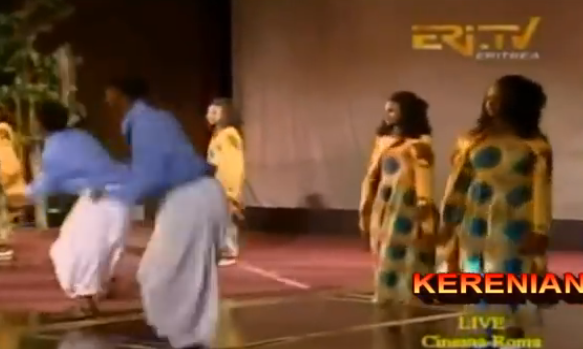
Rahawa Haile on the music of Eritrea.

Chris Gavaler on New Zealand pop.
 
Utilitarians Everywhere

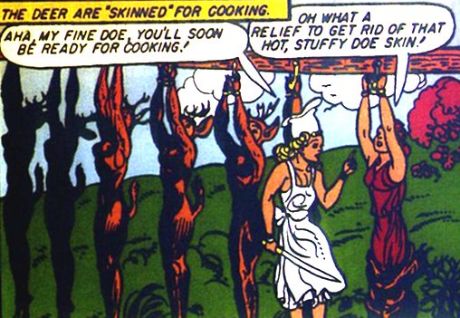
I was on the Frame on KPCC talking about my book on Wonder Woman, bondage, and feminism.

I was on WHYY with Brianna Wu and Chris Grant of Polygon talking about Gamergate.

At the Atlantic I wrote about Percy Jackson, kids’ lit, and letting children be human now.

At Splice Today I wrote about:

— Billy Joel never recording another album, yay!

— Flash, Sleepy Hollow, and the medicore Golden Age of Television.

At the Chicago Reader, a short review of the lovely Italian dreampop band Be Forest.
 
Other Links

Tim Hanley on Afterlife With Archie.

Alexis Coe on how her book about murder in Memphis gave her bad dreams.

Ta-Nehisi Coates on Charles Barkley and the plague of unintelligent blacks.

Lori Adorable on escorts and hard limits.

Alex Buchet reprints a conversation between Frederic Wertham and Alfred Hitchcock.

Sharon Marcus on street harassment.
 

Screen Shot 2014-10-31 at 3.30.09 PM

Index To The Best Band No One Has Ever Heard Of

aa6214

Welcome to the HU roundtable on The Best Band No One Has Ever Heard Of. For the next couple of weeks we’ll be running posts from HU guests and regulars on bands, singers, or musicians who are neglected, forgotten, obscure, underrated, or some combination of all of those.

The index below is alphabetical by musician covered, and will be updated as the roundtable goes along. Feel free to tell us about other best bands no one has ever heard of in comments.
_______

Introduction: Best Music You’ve Never Heard Of — Noah Berlatsky

Pamela Bowden — Noah Berlatsky

Wilmer Broadnax — Noah Berlatsky

Cardiacs — Ben Saunders

Betty Carter — Jordannah Elizabeth

EGOIST — A.Y. Daring

Music of Eritrea — Rahawa Haile

Sleepy John Estes — Betsy Phillips (and a follow up post here.)

Jane Jensen — Kinukitty

The Music Machine — Sean Michael Robinson

Natural Snow Buildings — Dana Schechter

Music of New Zealand — Chris Gavaler

Esther Mae “Mama” Scott — Paige McGinley

Norma Tanega — Quinn Miller

Thoughts of Ionesco — Chris R. Morgan

Thumb of the Maid — Osvaldo Oyola

Windham Hell; Virgin Black — Otrebor

Conclusion: The Best Roundtable No One Has Ever Heard Of — Noah Berlatsky
 
Addendums

Best Writer No One Has Ever Heard Of

Best Artist No One Has Ever Heard Of


Fascism and Black Metal

large_rsz_norwegian-black-metal-dark-throne-tags-death-norway-direct-link-64939

 
This piece originally appeared on Splice Today.
___________

If you know one thing about black metal, it’s probably that some performers are racist shitheads who burn churches. Jessica Hopper recently published yet another article retailing the various unpleasantnesses committed by Varg Vikernes of Burzum. She did vary the formula a little, though, by acknowledging that not all black metal performers are Nazis. Instead, she argued that all black metal performers have to deal with the fact that the music is originally, inevitably, associated with unpleasant ideologies.

“The genre’s reluctant fans can be divided into a few apologias. There are those who go for the sheepish “but it’s so good I can’t help it” (the artist is creepy, his work divine). And others subscribe to the fantasy that if you don’t cosign the artist’s belief, their platform, their perversion, if you don’t understand what they are singing about, if the song isn’t explicitly promoting an agenda, though the artist may be, that you are less of a participant. Another common excuse is that the lyrics are unintelligible (or not in English, so they don’t “count”), and they are listening to black metal just for the heavy atmospherics.”

As a casual fan of black metal myself, I don’t think I necessarily make any of these apologies. And that’s for the simple reason that there are just tons of black metal acts that aren’t any more ideologically noxious than any other music on my hard drive, and less ideologically noxious than some. Porter Wagoner singing murder ballad after murder ballad about how cool he is for shooting his cheating woman or Janis Joplin signing off on blackface iconography for her album cover seem significantly more dicey to me than listening to Katharsis theatrically shrieking about witches and satan.

It’s true that black metal is focused on evil and death and genocide. But being interested in those things doesn’t have to mean you’re a Nazi. It could mean that you’re Gorecki — whose droning ambience isn’t all that far removed from black metal’s aesthetics, as it happens. And if it sounds crazy to think that Gorecki’s explicitly anti-Holocaust message could find purchase in black metal, I would direct your attention to Pyha, an explicitly pacifist artist whose music sounds like tortured metal emitting a long, sustained groan of lament.

Pyha, a Korean who made his sole album when he was 14 years old, is obviously an oddball. But there are lots of oddballs in black metal. Another of my favorite performers, Botanist, plays hammered dulcimer and preaches plant supremacy and fealty to the forest. The band Frost Like Ashes is part of a small but non-negligible group of Christian unblack metal artists, who tend to sound exactly like black metal except that instead of talking about blood and the pit, they talk about blood and the cross, or about blood and the evils of abortion. And then there are folks like Enslaved who just like to pretend they’re Vikings. Or performers like the black/doom outfit Gallhammer who are dedicated to the proposition that Japanese women can make a noise as terrifying and evil as any Scandinavian dude.

There are also bands like Drudkh who (as the album title Blood in Our Wells indicates) are in fact anti-Semitic assholes. But the reason black metal is defined by anti-Semitic assholery isn’t because all black metal musicians are anti-Semitic, or even that there’s a preponderance of anti-Semitic facists in black metal. It’s because black metal isn’t all that popular, but anti-Semitic assholery makes a good story. Hopper argues that black metal fans have to face especially difficult questions about their music and aesthetic preferences. But it’s not black metal that’s obsessed with fascism; it’s Hopper and buzzfeed and mainstream venues in general. I tried to pitch a piece about how black metal isn’t fascist to a number of largish mainstream outlets. One editor said what I presume the rest of the editors were thinking: this is too niche. Or, translated, an article about how black metal isn’t fascist isn’t something anybody cares about. It’s the fascism our readers want to hear about; without that, you’ve got nothing.

Which isn’t to say that Hopper’s article is terrible, or that the issues she raises are completely irrelevant. How do listeners’ ethics interact with their aesthetics? Why do people like to pretend to be evil? Why are they fascinated by genocide? Those are all interesting questions. But they aren’t all the same question. Using black metal to treat them as such is more about demographics and hit counts than it is about looking for answers.

Utilitarian Review 10/25/14

On HU

Featured Archive Post: Shonté Daniels on cosplaying and race.

Paul Mullins with drawings of guys, dogs, and cars for the gay utopia.

Me on how British abolitionism was used in favor of racist imperialism.

Adrian Bonenberger on how Lovecraft influenced his war memoir.

Chris Gavaler on Ghost Rider and selling your soul to your corporate overlords.

Josselin Moneyron on forthcoming classic manga from Breakdown Press, including work by Maki.

Me on Philip Sandifer’s critical history of Wonder Woman, and WW and the male gaze.

Me on Hunger Games, Ann Halam’s lovely Dr. Franklin’s Island, and the best music you’ve never heard. (A sideways introduction to our upcoming roundtable on the Best Band You’ve Never Heard Of.)

 
Utilitarians Everywhere

At the Atlantic:

— I reviewed Jill Lepore’s Wonder Woman book.

—I talked about how gamergate is mirroring comics history (Sarkessian= Groth, sort of.)

—I talk about Annie Lennox and how sex and feminism is for white women.

At Pacific Standard I wrote about why men don’t read romance novels.

At Reason I talked to sex workers and experts to see if the U.S. should adopt Canada’s C36 bill on prostitution.

At Splice Today I argued that the GOP opposes Obamacare because Obama.
 
Other Links

Mistress Matisse on Seattle’s End Demand campaign against johns.

Mariame Kaba on Ferguson, justice, and applauding black death.

Dear Author on why pseudonyms are necessary.

Sara Benincasa on feeling unwelcome in games.
 

wonderwomandeertied

The Best Music You’ve Never Heard

This is a sideways introduction to our roundtable on The Best Band You’ve Never Heard Of, which will begin next week. An index to the roundtable is here.
________________
 

Dr._Franklin's_Island

 
The Hunger Games is a best-selling book that pretty clearly always intended, or at least wanted, to be a best-selling book. Katniss has become a recognizable one-word brand, like Beyoncé or Rihanna — and that iconic fame in our world simply mirrors her celebrity status in the world of the book. The Hunger Games can be seen in some ways as a satire of reality TV and the rapacious culture of fame, but the emphasis on viewing and spectacle also seems like a kind of dream, or wish — Suzanne Collins imagines everyone watching Katniss as a self-fulfilling prophecy. Everyone will watch Katniss; she is, and was always meant to be, a rock star.

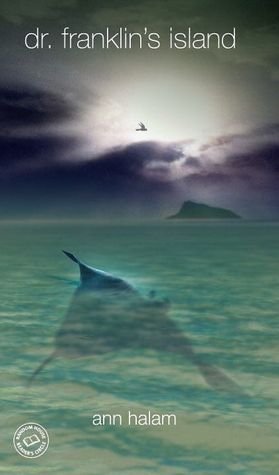
“Dr. Franklin’s Island,” by Ann Halam (Gwyneth Jones) on the other hand, is an unknown YA book that seems like it always intended to be unknown. The novel is told from the point of view of Semi, a shy science nerd who’s won a trip to a research facility accompanied by other science nerds and a couple of television personalities. Semi finds the pospect of interacting with all the other kids, much less being televised, terrifying — and in response to her wish, the plane crashes in the middle of the sea, and everyone dies except her, a cool girl named Miranda, and a cranky, unpleasant boy named Arnie.

The three have some amazing adventures; the island is controlled by mad scientist Dr. Franklin, who injects them with animal DNA and transforms them into superhero animal people. But this isn’t a superhero story where the hero saves the world and everyone cheers. Instead, the action of the story is all almost completely private. One of the loveliest passages in the book, and in some sense the most spectacular, occurs after Semi is transformed into a manta ray.

I was floating in water. It was over me, under me, all around me. It was the air that I breahted. I wasn’t frightened. I still felt good, and delighted with my new body. Sunlight was warming my back, and that felt very nice. I glided up toward the shimmering liquid light, until I was breaking the surface and looked around.

Katniss’ big moment is triumphing on TV; Semi’s is just the sensation of being in her body; of swimming within the prose, quiet, unobserved, inward turned.

Shortly after this, Semi sees her friend Miranda, transformed into a bird, and then realizes that the two can’t speak to each other. The isolation is terrifying…but

Next thing I knew, everything was white. It was like being inside a cloud: like being surrounded by the dazzling, soft, white cloud-country you sometimes see from a plane window. I saw Miranda, standing with her back to me. I knew it was Miranda at once, Miranda the way I remembered her from the beach.

From the isolation of the water, Semi goes to a no-space. This turns out to be a kind of imaginary meeting place enabled by telepathy — but it also could be read as reading; the white cloud-country is the blank of the page, and the connection between Semi and Miranda is the private, quite connection you have when you have with Semi when you read the book. Rather than a hero who competes and wins and gains the adoration and pity of crowds, Halam’s book leads her shy character through a series of escalating isolations — from island, to manta ray, to cloud telepathy. There are adventures and dangers and friendship, but none of it is acted out in public; it’s all a secret. The world never finds out what happens to Dr. Franklin, or hears about his experiments; the kids manage to change back to human, and have the ability to resume their animal forms, but they’re (understandably) afraid of being experimented on, and never tell anyone. This is the last passage in the book.

I know that we can transform again. I believe it will happen, some way, somehow. I think about breathing water and swimming through the music of the ocean. I think about having a skeleton of supple cartilage instead of brittle bone. I think about feeling my whole body as one soaring, gliding, sweeping wing. I know that Miranda will never forget being able to fly. I dream of another planet, with an ocean of heavy air, where I can swim and she can fly, where we can be the marvelous creatures that we became; and be free, together, withno bars between us. I wonder if it exists, somewhere, out there….

An uninhabited island isn’t enough; Semi wants to go away to a whole different planet, where she and Miranda can change and be together, alone. In part, this seems like a gracefully hyperbolic extension of the closet; a gay utopia of sensuous transformation where the atmosphere is different enough that unnameable love is possible. But it’s also a dream of invisibility — to be lost, in a different form. It’s even a kind of invisibility within invisibility; this isn’t something that “really happens” in the novel — it’s a wish, a coda, outside the narrative, a fantasy within the science-fiction, imagined within imagination, both buried under and outside the story. It is displaced; a vision without a viewer.

The pleasure of The Hunger Games seems like it is in large part, and is meant to be in large part, the pleasure of participating in a pop culture phenomena; it’s about watching with everyone, and being part of the everyone through watching. Dr. Franklin’s Island instead enjoys being somewhere, and something, unseen. While everyone else is talking about Katniss, Semi swims on her own page, through music no one has heard.

Gazing At Wonder Woman

I belatedly read Philip Sandifer’s A Golden Thread: An Unauthorized Critical History of Wonder Woman earlier this week. As the title says, this is a blow by blow reading of basically every Wonder Woman comic-book iteration from Marston all the way on up through Azzarello. It’s similar in focus to Tim Hanley’s Wonder Woman Unbound — though Hanley lets his focus drift a bit more, talking about other female superheroes, talking in depth about the matriarchal theories held by Gloria Steinem’s circle, and generally trying to position Wonder Woman as an important cultural force, or at least a center of interest. Sandifer is more committed to close readings of the comics (and the occasional related media property).

In some ways, then, Sandifer’s book has the same problem as Hanley’s only more so; that problem being, it’s not entirely clear why anyone would want to do close readings of all Wonder Woman comics from the primordial ooze to the present, given that (a) they were mostly horrible, and (b) they weren’t at all popular. Why does anyone want to analyze the ways in which this particular unread piece of pulp detritus is mediocre? Why would anyone but hard core fans want to read it? It seems like Sandifer has consigned himself to a misty, bleak pop purgatory, following that golden thread into a bland, milk-covered bog.

Given that he’s in that bog, though, there’s something heroic about Sandifer’s determination to wade through it. The entire history of Wonder Woman comics doesn’t really deserve a decent chronicler, but Sandifer nevertheless determines to provide it with one. His writing throughout is elegant and entertaining and even, almost impossibly, passionate. His respectful, fair, and blistering denunciation of Gloria Steinem’s blinkered take on Wonder Woman, feminism, and (not least) trans people is a highlight, but it’s got lots of company, such as the brilliant discussion of Harry Peter’s art, tracing it to Victorian pornography and Beardsley. His readings hardly ever dovetail with mine; he thinks the I Ching era was exciting and ambitious; I think it was largely dreck; he thinks Greg Rucka brilliantly incorporated Wonder Woman’s history of bondage imagery into the Hiketeia; I think Greg Rucka is a humorless, pompous ass; he thinks Marston was an interesting creator but not a genius, etc. etc. But Sandifer always makes a stimulating case, and if I think his Greg Rucka is a lot smarter and more sensitive to the character’s hsitory than the real Greg Rucka — well, that just means I got to read and enjoy that Wonder Woman story Phil Sandifer wrote. If DC was smart (which they are not), they’d hire Sandifer to write their Wonder Woman comics for them.

Anyway, I thought I’d just quickly talk about one of Sandifer’s discussions which I found intriguing. In his analysis of the Lynda Carter Wonder Woman series, he references Laura Mulvey, and notes that her ideas about the gaze seem to work uncomfortably well; Carter, he says, is consistently framed by a male gaze. For instance,”Shots in which the camera tracks the eye movements of male characters looking at Lynda Carter (whether as Wonder Woman or Diana Prince) are exceedingly common. Scenes where Diana and Steve talk in his office are routinely shot with the cameras positioned behind Steve’s desk.” Sandifer goes on:

Of course, Wonder Woman has always been overtly sexualized. Marston’s conception of her as a figure to which men would willingly submit is still based on the external idolization of women by men. But there’s an intrinsic difference between the sexualization of an ink drawing and the sexualization of an actual human being. Carnal desires projected on a page of ink necessarily exist entirely within the realm of imagination. The sexualization of Lynda Carter has an actual person as the object of desire.

Sandifer adds that Lynda Carter herself found the sexualization and objectification unpleasant; in a 1980 interview she said “I hate men looking at me and thinking what they think. And I know what they think. They write and tell me.”

Sandifer draws a distinction between Mulvey’s gaze and sexualization in comic books on the grounds that in film (or television) a real person there’s a real person being gazed at.

I think that’s an interesting take on Mulvey’s theory…but it’s not exactly the theory itself, at least as I understand it. Mulvey’s ethical argument against narrative cinema is not against the sexualization of people, but rather against the way that gender roles are inscribed through the power of the camera placement. I’m sure Mulvey would feel that Lynda Carter’s discomfort emphasizes and extends the criticism she was making…but the criticism doesn’t rely on that alone. Rather, Mulvey’s point was that narrative cinema inscribes men as the looker/doer, and women as the fetishized object of the gaze on whom the male looks/does. Narrative film is denigrated not because it makes individual actresses uncomfortable, but because it seduces its viewers to acquiesce in stereotypical and sexist gender roles.

And I would say that this is something that comics can do as well.
 

SPIDERWOMAN001Manara-06299-600x853

 
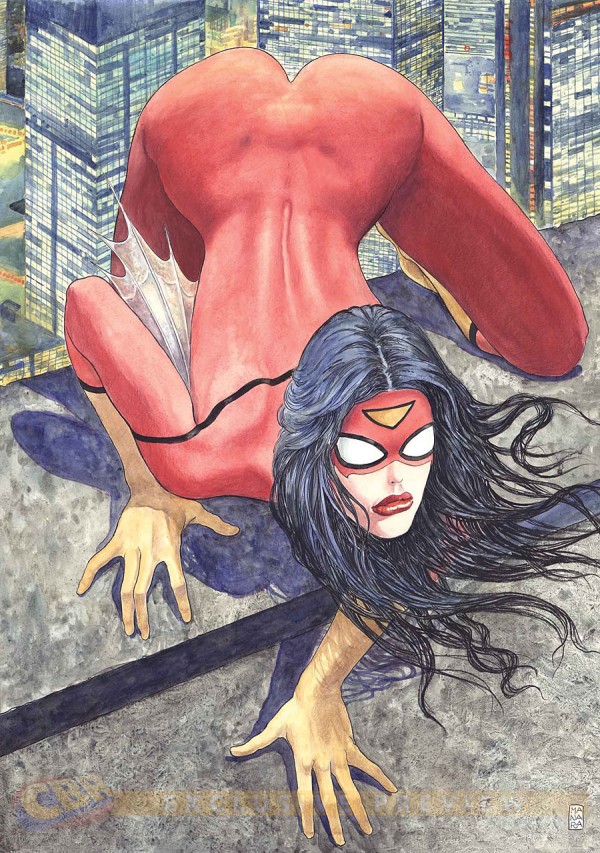
This is a rather obvious example — but still instructive, I think. The pose here is deliberately designed to draw attention to the rear, and especially to what people in those neighboring buildings might possibly see, but which you can’t. The cover encourages you to mentally take Spider-Woman and turn her. There is no narrative, per se, but there remains the sadistic association of viewer (figured here pretty clearly as male) with action performed on a woman, who is frozen and fetishized, her individual body parts (the rear, the invisible crotch) presented as consumables.

And for an example featuring Wonder Woman, how about:
 

Wonder_Woman_Vol_1_219

 
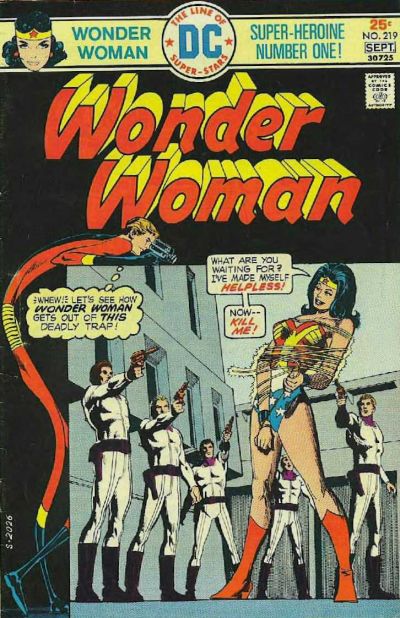
That’s a cover (Update: by Dick Giordano) to a comic by Martin Pasko and Curt Swan. Sandifer argues that the comic itself is intentionally and effectively feminist — which may well be. The cover, though, seems like a textbook example of Mulvey’s theories. The Elongated Man, that virtual double-entendre, looks at Wonder Woman through a video camera while a circle of men point their phalluses, er, guns at her. Tied up, Wonder Woman coos with a come-hither tilt, asking to be “killed”, her hand hovering over her crotch. The heroine is immobilized by and for the male gaze, begging for action that is figured, not especially subtly, as sexualized violence. And note especially that the reader is specifically positioned with, and encouraged to identify with, the male with the camera; we are supposed to watch with Elongated Man, the good guy who stares at the willing, supplicant woman.
 
The bondage there is of course a holdover, and perhaps a nod, to Marston.
 

wwupanel4ww13

 
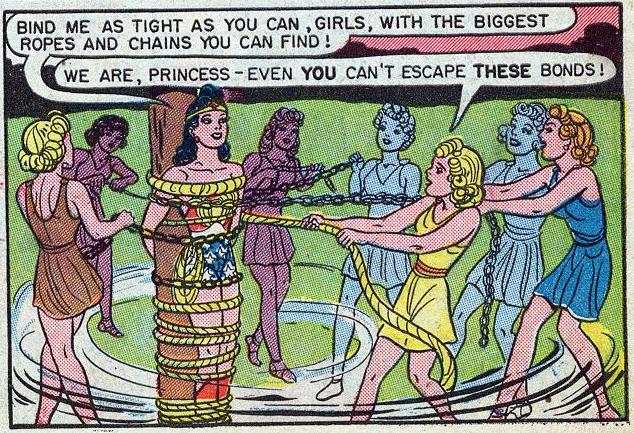
Marston just about never fits that easily into Mulvey’s formulation, though. In this panel, for example, there is no man gazing; women are the actors, whooshing about with Peter’s energetic motion lines. But more than that, the motion, or the narrative, is not linear; the Amazons can be seen either as a group in motion, or as one replicating individual racing around the pole, a rushing frozen sequence of bodies with Wonder Woman at the fulcrum. The narrative is frozen in fetishistic contemplation of women…but it’s also a rush of motion, a narrative that doesn’t go anywhere, or need to go anywhere. The (male or female) viewer, is frozen giddily like Wonder Woman, watching without motion a motion that goes nowhere. Mulvey argues that women “connote something that the look continually circles around but disavows: her lack of a penis, implying castration and hence unpleasure.” But the circle here doesn’t disavow the lack of a penis; rather it glories in it, as the still observer is merged with the still, bound woman in a game of delightful submission to disempowerment. Mulvey argues that narrative cinema is about denying male castration; Marston’s gaze, on the contrary, embraces it as an exciting option for children of every gender.
________

Sandifer’s A Golden Thread is available here.

And, as you probably know, you can preorder my Wonder Woman book and read more about the joys of castration here.