The Good, The Bad, and the Fascist

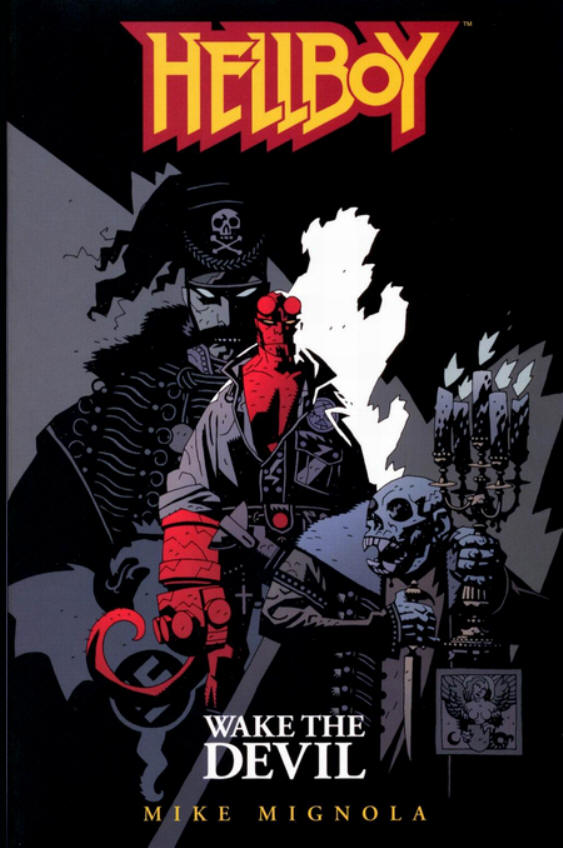
COMIC_hellboy_wake_the_devil

 
Lots of folks have told me to read Mike Mignola, most recently Craig Fischer. So when I saw the second volume, “Wake the Devil”, at the library the other day I figured I’d give it a shot.

And the verdict is…eh. Either the hype is way out of proportion, or “Wake the Devil” isn’t the thing to read. For whatever reason, though, and however you look at it, volume 2 of Hellboy is a thoroughly mediocre piece of genre nothing. Characterization barely exists, while the plot mostly involves various monstrous super villains making ominous portentous speeches and then getting their slimy butts kicked as Hellboy cracks wise and talks tough. If you think Lee/Kirby were geniuses of pulp construction — then, yeah, this still wouldn’t be especially good.

For that matter, Rick Riordan’s Percy Jackson series, which is somewhat similar in its reliance on mythological baddies and in its video-game one big-boss-battle-after-another structure, is significantly wittier and more inventive — and, for that matter, more viscerally suspenseful. Riordan’s characters are kids; they’ve got great powers, but they’re not always sure how to use them, and when they fight monsters they’re scared. In Lost Hero, there’s a scene where one of the kids, Leo, has to rescue his friends from a bunch of cyclops, and finally lets loose with the fire powers he’s been afraid of, and he blasts them.
 

He pointed one finger in the air and summoned all his will. He’d never tried to do anything so focused and intense—but he shot a bolog of white-hot falmes at the chain suspending the enging block above the Cyclops’s head—aiming for the link that looked weaker than the rest.

The flames died. Nothing happened. Ma Gasket laughed. “An impressive try, son of Hephaestus. It’s been many centuries since I saw a fire user. You’ll make a spicy appetizer!”

The chian snapped — that single link heated beyond its tolerancepoint—and the engine block fell, deadly and silent.

“I don’t think so,” Leo said.

Ma Gasket didn’t even have time to look up.

Smash! No more Cyclops—just a pile of dust under a five-ton block.

I wouldn’t make any claims for that as great literature, but it’s exhilarating and awesome and fun, with a nice Looney Tunes timing, and you care because he was at risk and you’re rooting for him and then he triumphs.

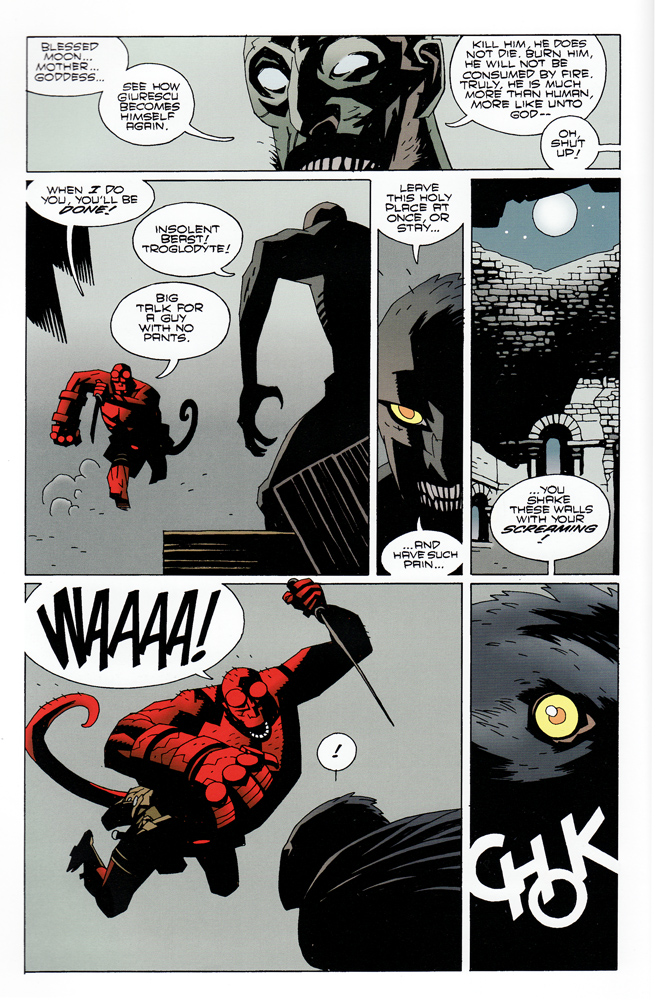
But Hellboy is the impassive undefeatable gunslinger from the beginning. He never seems to doubt his ability to win, and the comic never doubts it either. He just blasts one baddy after another, be they vampire, lamia, or whatever. You never feel exhilarated or impressed, or even interested. The comic is one long crescendo, without any build-up or melody. It starts off irritating, and by the end you just wish it would shut the fuck up. Even the gratuitous deaths of some minor extra side-protagonists can’t elicit much more than a shrug. Some action movie cannon-fodder got offed. Might as well have killed a storm trooper. Ho-hum.

The utter lack of emotional resonance means that the good guys and bad guys become virtually interchangeable. It’s true that the bad guys are clearly labeled as Nazis — but even so, it wasn’t clear why I should root against them. They didn’t actually seem to care about Jews or racial purity from anything that they said; they just wanted to destroy the world. And halfway through, I wanted to destroy Mignola’s world too. If a dragon from the deep rose up and swallowed Hellboy and the earth as well, leaving the second half of the volume just big, blank, black pages, I would have said, hey, the story’s over, I don’t have to read anymore, cool. I’d even enjoy seeing Hellboy have his boasting and wisecracking shoved up his infernal and impassive ass-crack. It’s true that most of the villains were boring and stock too, but their constant defeat did lend them a kind of pathos. The one sad guy who reanimates his friend as a head in a jar only to have them both killed shortly thereafter; Rasputin (yes that Rasputin) whining to his mama at the end because Hellboy beat him again — I mean, I don’t want to read any more about either of them, really. They’re no rat creatures. They just have slightly more personality than Hellboy. It’s not a high bar, but better to clear it than not.
 

INT_HELLBOY_WHITE

Bad guy boasts. Hellboy boasts. Bad guy gets stomped. Repeat.

 
The clumsiness and the lack of inspiration in “Wake the Devil” does lead to a kind of brute, Neanderthal genre insight, though. The comic really isn’t about anything but good guys and bad guys hitting each other, those “good guys” and “bad guys” designated by arbitrary fiat. One side is good, the side you root for, which wins. The other is bad, the side you root against, which loses. That’s the algorithm — the ideologies (destroy the world! bathe in blood! whatever!) barely register as anything but an overheated garble of rhetoric. The cops stomp their hellboots on that whining, sneering face for all eternity — and who cares what the face tries to say before the boot comes down? Behold the Superman as anti-fascist fascism — the devil who beats the devil.

Worst Movie of the Year

So I was just thinking about this and, though I do really hate Her, and though I saw plenty of other crappy movies too, I’m pretty sure that Olympus Has Fallen is the worst movie I saw in 2013.

For that matter, Olympus Has Fallen is I think one of the worst movies I’ve ever seen, period. Not worse than Schindler’s List, but possibly worse than Amistad. Having trouble thinking of other competition that isn’t Spielberg, but I think that’s just because I saw Amistad and Lincoln back to back and it scarred me.

Anyway what about you folks? What was the worst movie of 2013?
 

OHF_03976.NEF

Utilitarian Review 1/25/14

On HU

Featured Archive Post: Darryl Ayo on Before Watchmen and the children’s crusade.

I wrote about how guys in romance are hotter than the girls, and often richer too.

Lee Relvas on being a working-class artist.

James Romberger looks at Douglas Fairbanks’ The Mark of Zorro (and makes a storyboard for the film.)

Sarah Shoker on feminism, the Little Mermaid, and Frozen.

Samantha Meier with her first column on women underground cartoonists, looking at women’s comics anthologies.

Frank Bramlett with this week’s PPP post, asking how do comics artists use speech balloons?

Chris Gavaler on why superheroes should be in the academy (plus a syllabus.)
 
Utilitarians Everywhere

At the Atlantic I argue that 1984 is a romance and Julia is a MPDG.

At Salon I’ve got a song for each month of the year.

At the Center for Digital Ethics I talk about the ethics of quoting from social media.

At the Dissolve I review:

Old Goats, a crappy senior citizen buddy movie.

Mercedes Sosa, a lovely doc about the radical singer.

At Splice Today I talk about:

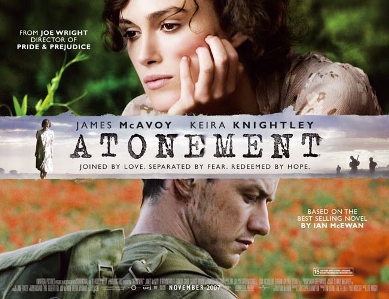
how to be anti-war a film needs to not be a war film (looking at Full Metal Jacket and Atonement.)

Armond White and why 12 Years as Slave as torture porn isn’t a bad thing.

Other Links

Michael Carson talks about Lone Survivor and the ironic kitsch of war movies.

Andreas Stoehr is completely wrong about Her, but his review is still lovely.

Osvaldo Oyola on Ms. Marvel and revisionist feminist history.

Christina Kahrl on how Grantland screwed up in outing a trans woman.

Grace takes down Dinesh D’Souza with Gifs.

Sarah Kendzior with a great piece about academic publishing.

Raymond Cummings provides a public service message from Barack Obama.

Molli Desi Devadasi on problems with the sex work rescue industry.
 

Atonement_UK_poster

The Running Superhero

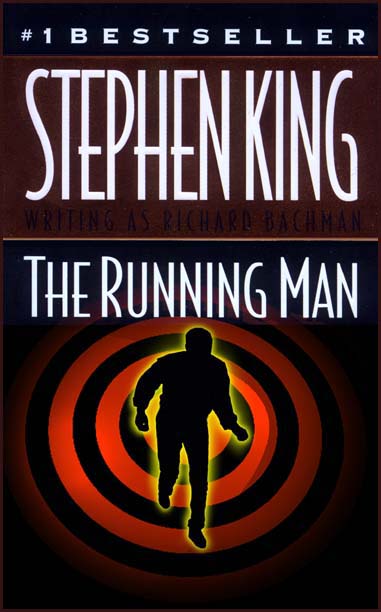
stephen-king-the-running-manA few weeks back I reposted an essay on superhero and fascism. Somewhat to my surprise, it generated more than 150 comments, mostly from folks skeptical about my thesis.

That thesis was, to recap quickly, that superhero narratives are about fascism. That isn’t to say that superheroes are always fascist. On the contrary, there are a lot of superhero stories, like Alan Moore’s Swamp Thing, or Grant Morrison’s Animal Man, or the Marston/Peter Wonder Woman, or Watchmen, which consciously work against the superhero-as-fascist trope, offering some combination of parody and critique. Those parodies and critiques go back to the beginning of the genre, just about. And, for that matter, Superman himself is a response to fascism, a kind of New Deal mirror image of the Nietzschean Nazi Superman, both embodiment and critique.

With that in mind, it’s maybe interesting to look at fascism in light of another typical male action hero narrative that is not a superhero story. In particular, Stephen King’s Running Man.

Running Man is a dystopic near-future reality show adventure from way back in 1982, long before Battle Royal or the Hunger Games (or the reality television craze, for that matter.) The story is set in 2025, and our hero, Ben Richards, is part of the mass of impoverished peons living in environmentally degraded inner cities. He’s out of work; his little girl is deathly ill with pneumonia, his wife turns tricks to try to get her crappy, black market medicine. In desperation, Richards decides to compete on one of the deadly reality television shows where proles are paid to get abused and killed for the entertainment of the masses. Richards ends up on the highest rated show, the Running Man, where he essentially becomes a fugitive, with the entire apparatus of the state hunting him down for a mass audience.

In a lot of ways, Richards is not unlike Batman or Daredevil, or any of a number of scrappy, ground level low-power superheroes. He’s extremely resourceful, cunning, and deadly, a master of both disguise and improvised violence. The scene where he rigs an explosion in the basement of the YMCA, killing at least five cops before making his escape through a sewer pipe, is reminiscent of Rorschach’s deadly fight with police involving kitchen products and a spear gun. (I wouldn’t be surprised if Moore had read The Running Man, though I doubt it was a direct influence.)

The surface similarities, though, just emphasize the differences. Rorschach fights the cops because his fight against crime is illegal — but he never actually tries to, or thinks about, fighting the cops because the system is corrupt. Superheroes fight bad guys; cops may be collateral damage, but the enemy is the criminals, not the state. The one hero who does launch an attack on the powers that be is Veidt — and in so doing, he demonstrates that he’s a (ironized, complicated, but still) super-villain.

In The Running Man, on the other hand, the state is the bad guy. Whereas in Watchmen, or in any random Bat-or Spider-title, the proliferating evidence of evil and corruption are low level street punks and thugs, in the Running Man the minions are the cops, who glower and lurk around every page, fat, dumb, menacing and dangerous, the toughest street gang around. The dastardly supervillains with their fiendish plots are the guys in suits, the executives and government manipulators who have let industrial by-products turn the air into a carcinogen and then refuse to distribute filters to the poor. Rorschach, or Batman, or Spider-man, fight for decency and justice, but in Richards’ world, decency and justice are just a ruse or brutality. “If you’re so decent,” as Richards says to a woman he kidnaps, “how come you have six thousand New Dollars to buy this fancy car while my little girl dies of the flu?”

You could argue that Richards is not a superhero because he doesn’t have superpowers or a costume or a secret identity. But all of those aspects of superherodom are really more or less optiona. What really makes Richards not a superhero is that he’s neither a fascist nor really troping against fascism. Heroes in this world don’t have the power. The guys with the power are villains.

Just to be clear, I’m not saying that The Running Man, by virtue of separating power and goodness, is more moral than superhero narratives. In the midst of our perpetual recession, The Running Man does seem almost eerily relevant, but that doesn’t necessarily make Richards, or the novel, especially admirable. Just for starters, the book treats the injustice it documents as a crisis of masculinity; poverty has emasculated Richards, and the violence he perpetrates during the game is an extended demonstration that he’s retrieved his bits. In one particularly unpleasant scene, he undergoes psychological testing by a woman in improbably revealing clothing, and demonstrates what a bad ass he is by leering at her and then patting her rear. When she tearfully tells him he’ll get in trouble, he responds that she’ll lose her job if she reports him. Why she would isn’t very clear, but such logical hurdles are less important than making sure Richards can assert his manliness through the tried and true method of sexual harassment.

And if garden-variety misogyny isn’t enough for you, there’s the book’s denoument, in which Rogers flies a plane into the giant skyscraper housing the government bureaucracy that controls the games. King wrote this 20 years before 9/11, but looking back now from that vantage, it seems like an eerily precognitive endorsement of the attacks. Marginalized people with nothing to lose destroy the towering symbol of their oppression. It feels a lot less celebratory when you’ve had a chance to actually count the dead.

As this suggests, Running Man is as violent, or more violent, than most supehero narratives — but the violence is the violence of revolution, not law and order. Richards isn’t a glorified cop; he’s a glorified criminal. And not one of those patented superhero mistaken-for-a-criminal-but-still-fighting-for-order kind of things, a la Miller’s Daredevil or Dark Knight.

There is actually a moment towards the end of the book where Richards thinks about becoming a cop. He’s been so successful at the game that the powers that be offer to make him the chief Hunter; the head of the evil bastards who track down the running men. He’d be an uber-cop — or,if you will, a superhero. Maybe, then, Running Man is a kind of superhero narrative after all, at least in the sense that fascism, or superheroism, trail Richards like a shadow, both inescapable oppressor and dark double.

Utilitarian Review 1/18/14

On HU

Feature Archive Post: James Romberger on late Jack Kirby.

I talk about romance, patriarchy, and Jennifer Cruise’s Welcome to Temptation.

I talk about smugness and climate scientists.

Craig Fischer on women in B.P.R.D.

Osvaldo Oyola on interpretation, dream, and Matt Kindt’s Mind MGMT

Chris Gavaler on lit fic, genre, and teaching writing.

Roy T. Cook for PPP looks at art changes in the Invisibles from floppy to trade, and asks whether, or how much, the comic is changed.

Erica Friedman on zombies and gender in Attack on Titan.

Utilitarians Everywhere

At the Atlantic I talk about slavery films, Oscars, and white saviors.

At Salon I list 24 great movie soundtracks, from R.D. Burman to Carl Stalling to Outkast to Miles Davis.

At Splice Today I am skeptical that Andrew Sullivan will trasform the media.

Other Links

Nicky Smith kicks the odious Her.

Julia Serano talks about dating and politics.

A thoughtful defens of Armond White.

Sarah Kessler with a great piece on Girls and work.
 

girls15_wide-42312aaff70bb1cd81218524b88bcfe6948d7569-s4-c85

Romance and Male Fantasies

I watched Love Actually recently, and was reminded yet again that in romcoms, and just in Hollywood in general, the women are almost always more attractive than the guys. There are lots of couples floating around the film, and some of them are more or less balanced in age/attractivness…but then there’s homely cute aging Hugh Grant with the blindingly hot Martine McCutcheon (who of course has to endure constant jokes about her weight) and the homely cute aging Alan Rickman at whom the much younger and exponentially hotter Heike Makatsch keeps throwing herself. The Woody Allen dynamic of dweebish guy with sizzling younger woman is a Hollywood staple (and is only made more uncomfortable by the allegations about Allen’s real-life abuse of a 7-year-old.) But the reverse — dweebish woman with sizzling guy — hardly ever happens.

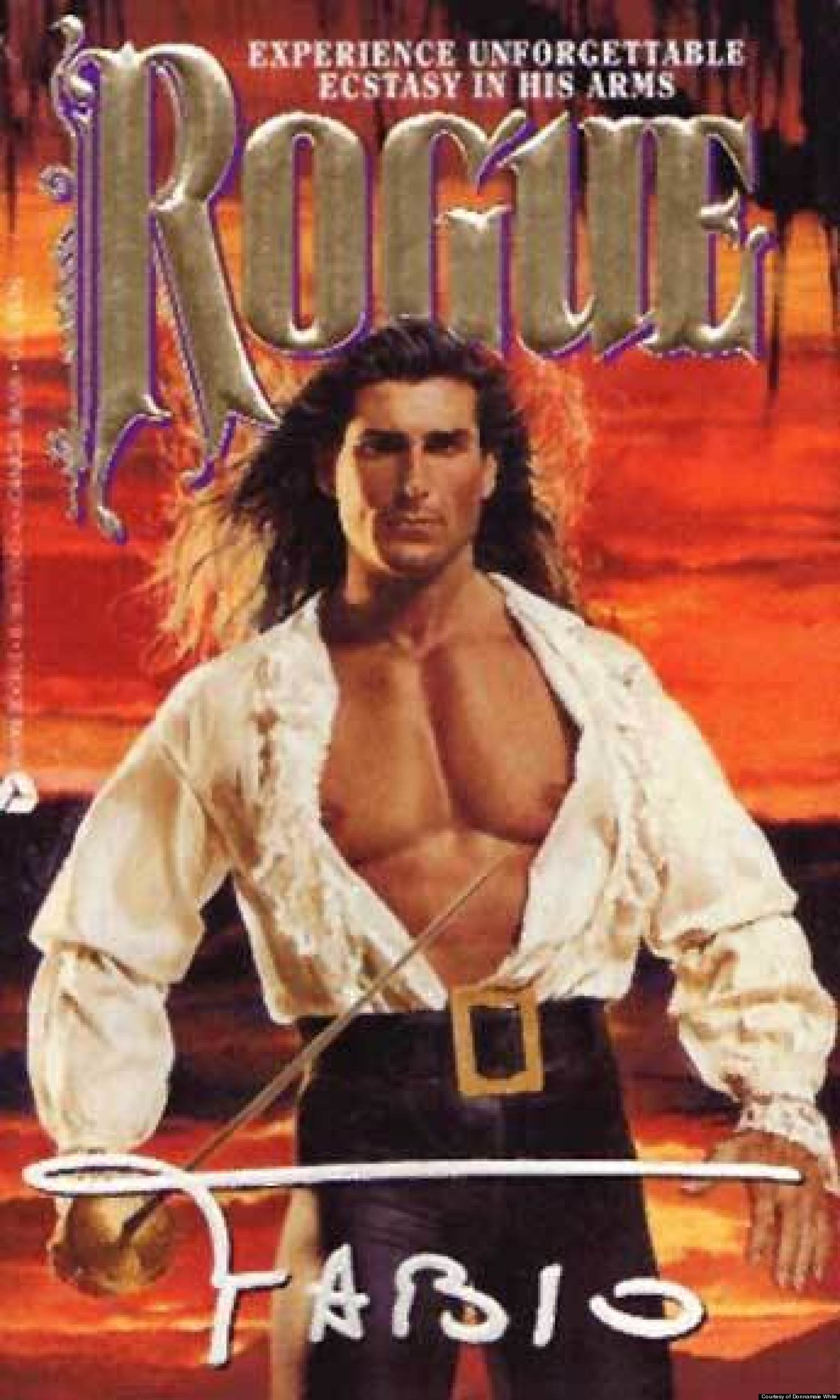
o-FABIO-BIRTHDAY-facebookOr at least, it hardly ever happens on film. I’ve read a bunch of romance novels recently, and there the tropes are pretty consistently reversed. At least in the dozen or so books I’ve read, there is not a single instance of the character actor guy getting the incredible babe in the end. Instead, both men and women tend to be described as ravishingly attractive (and, in the case of men, as having impressive genital equipment. Size, in romance novels at least, does in fact matter.)

Or, if both are not ravishing, then the one who is not is, consistently, the woman. In Jennier Crusie’s “Bet Me”, the Adonis-like Cal passes over the perfect, slim, Cynthie in favor of the decidedly not-thin Min, who is described in her initial appearance as being “dressed like a nun with an MBA.” In Cecelia Grant’s “A Gentleman Undone,” the novel proper begins with the words, “Three of the courtesans were beautiful. His eye lingered, naturally, on the fourth” — that fourth being our heroine. In Judith Ivory’s “Black Silk,” the most notable physical characteristic of the protagonist is her irregular teeth — which the hero finds “Oddly” but “strongly feminine.” Here, as elsewhere, the men see past the women’s imperfections — or, indeed, the men are attracted by the imperfections.

Obviously, this particular narrative difference has to have something to do with differing demographics. Romance novels are aimed overwhelmingly at women, so you get fantasies in which normal, non-Hollywood-hot women date perfect male specimens who can see the beauty not just in their personalities, but in their deviations from tyrannical beauty standards. The only surprise is that Hollywood doesn’t tap into this pretty simple fantasy more often — an indication, perhaps, that having films directed and produced almost entirely by men does in fact have a noticeable effect on the content of even films supposedly targeted at a mixed audience (like “Love Actually”).

So (het) men prefer fantasies in which schlubby men get hot women, and (het) women prefer fantasies in which schlubby women get hot guys. That seems predictable enough. But what’s maybe a little surprising is that, in other respects, the genders’ ideal fantasy is congruent. Or at least, both Hollywood and romance fiction seem to agree that the ideal romantic pairing is one in which the guy is substantially richer and more powerful than the woman.

The magnitude of the difference here can vary a good bit. The reductio ad absurdum is Twilight, with the fabulously wealthy and superpowered vampire sweeping the simple high school student out of the prom and into eternal life. But the meme hold up to one degree or another both in “Love Actually” (where Hugh Grant gets to crush on his secretary, Alan Rickman, as noted above, is flirting with his secretary, and one of the other characters falls in love with his maid) and in the romance novels I’ve looked at. As I mentioned last week, in Jennier Crusie’s Welcome to Temptation, the heroine is a struggling filmmaker while the hero is the town mayor. In Pam Rosenthal’s “Almost a Gentleman” the hero is a cross-dressing man of fashion, but the hero is a powerful, wealthy lord with extensive property. Cecelia Grant’s guy in “A Gentleman Undone” is not rich…but her heroine is a a courtesan whose status is precarious enough that the guy seems relatively well off. Beverly Jenkins’ Indigo goes the full-bore 50 Shades route; the heroine is an ex-slave barely maintaining herself in the middle-class, while the hero, a New Orleans freeman, has apparently limitless wealth and resources.

Again, the fantasy here isn’t hard to parse; if you can marry for true love and fabulous wealth, why settle for just marrying for true love? The guy having wealth and power is also a useful narrative convenience; it’s a lot easier to have a happy ending if someone can wave his checkbook at the finale and make most of the problems disappear. Really, what’s odd is that romantic fantasies for men don’t take this practical approach as well. Why don’t all those guys making Hollywood movies ever have their homely guys fall for some woman who is not only young and beautiful, but incredibly wealthy as well?

But that’s not how it works. In their fantasies, women imagine handsome, powerful men, while, in their fantasies, guys imagine men who are powerful, if not always quite so handsome. Everybody seems to agree, though, that powerful guys are more romantic.

That agreement is an agreement to, or about, patriarchy. Men=power; power=manliness. As I suggested in my piece about Crusie’s Welcome to Temptation last week, a good part of the rush, or allure, of these het romance novels, at least, seems to be not just the love story, but the way the love story turns into a story about women becoming powerful through men; you pick up the phallus to pick up the phallus. That’s a story about women’s empowerment, certainly, but it’s also, or along with that, a story about women endorsing power as defined in pretty straightforward patriarchal ways. Romance is good at giving women what they want. But to the extent that what they want is both men and power, it seems to have trouble in not conflating the two.

Why Is Everyone Else So Stupid?

This ran a while back on Splice Today.
__________

There is nothing quite so sad as a sad technocrat. The technocrats know what is best for all of us. They know how to bring that “best” about. They have charts and science and graphs—oh, the poignant, unlooked-at graphs! But though they know all, though they see all, though they can save the world, none will heed them. Though they cry out in the language of science, their wisdom is mocked and their efficiencies sneered at. The world, they know, will die, all because the fools would not listen!

It’s a familiar story, reiterated once again in this endless and wretchedly self-vaunting post by Ajit Varki and Danny Brower, experts who, together, have the proportionate prose style of a flaccid guppy.

But we are not here for the prose style, but for the insight and the wisdom. Varki and Brower have gotten up upon the soapbox to tell you that global warming is a real problem, and that those who do not treat it as such are deluded fools. The emotional climax of the piece comes when the authors reminisce about a 2007 conference they attended in which “some of the oldest and best-known American societies that focus on the value of knowledge” came together to insist that “in order for democracy to succeed, it must be based on real knowledge of the facts of the world around us.” The conference attendees even wrote books about it.  And yet, the authors lament, despite the clear directive from important knowledge societies, people still just kept on being people, believing in dietary supplements and natural cures and all that nonsense. “Why is it,” they wail, “that so many humans are attracted to these illogical doctrines?”

In answer, the two spout completely unproven theories about humans’ need for illusions in the face of mortality. They also promise that we can achieve a “complete recognition of reality,” but only if we are as knowledgeable and thoughtful as Richard Dawkins, who, they fail to mention, is kind of an ignorant xenophobic shithead.

Also worth noting is that, in the course of their discussion of climate change, they claim that as one effect of global warming, “it is plausible that we could… tip the planet into an ice age.” Which sounds like it can’t be true, and, in fact, appears to be untrue. If you’re going to lambast the rest of the world for not being as smart as you are, the least you could do, you’d think, would be to get the science right.

I understand why Varki and Brower are frustrated. Global warming and environmental degradation are real and dangerous problems, and we need to confront them. Our political institutions have been very reluctant to do this, and a not insubstantial minority of people has actively denied that anything is wrong. The obvious conclusion is that those people are dumb, and that our political institutions are ineffectual.

And you know what? People really are often dumb, and democratic politics is a grim slog against the rampant imbecility of the majority. I don’t deny that.

The problem is, when you say “people” are dumb, that’s not just that guy over there drooling. It’s everybody. Everybody is dumb in some ways, sometimes. If you’re not denying global warming, you’re seriously suggesting that human gullibility should be repealed because you attended some stupid conference. If you’re not burbling about the dangers of vaccinations, you’re burbling about the coming ice age.

Knowledge is great, vital and useful. Reason is a powerful tool, and can help us get out of nearly as many messes as it gets us into. But there’s nothing smart, or reasonable, about talking to your fellow citizens as if they’re idiots, and there’s nothing particularly reality-based about condescending to your fellow human beings as if you think you are gods. Varki and Brower want to convince their readers that global warming is a serious problem. But all they really manage to do is to show that technocracy can be a kind of idolatry, and that being impressed with your own overwhelming knowledge is a sure way to make yourself sound like a fool.