The X-Men: Establishment Lackeys

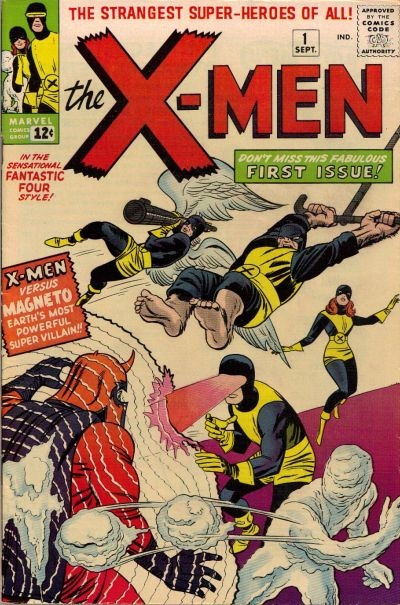
x-men-1-comic-cover-pic-1

 
Earlier this week Orion Martin wrote a post in which he argued that the X-Men essentially appropriate the experience of the marginalized for the white and middle-class. The X-Men consistently presents itself as a comic about the excluded and discriminated against, but under the guise of preaching tolerance, it actually (as as Neil Shyminsky argues) erases difference. The only marginalization that matters is being a mutant, and every adolescent white boy is a mutant; ergo, adolescent white boys are as oppressed (hell, more oppressed) than anybody. Let us, then, pay attention to their angst exclusively.

Anyway, I thought I’d test Orion and Shyminsky’s arguments against the original X-Men comic; that’s X-Men #1 by Stan Lee and Jack Kirby from way, way back in 1963. I’d remembered it as being an awful comic, and it is that; one of those Lee/Kirby efforts where proponents of Kirby would be well served by attributing as much of the writing to Stan as possible (and as much of the art too, for that matter; this is not within a mortar shot of being Kirby’s best work.)

Part of why the comic is so crappy is that it matches up with Orion’s thesis so perfectly that it’s painful. We first see the X-Men (Cyclops, Beast, Ice-Man, and Angel) in a palatial, exclusive private school. The first few pages are all cheerful boys’ school high jinks, enlivened only by the student’s obsequious deference to, and competition for the approval of, Xavier. It’s an unbroken collage of fusty preppiness and ostentatious privilege — underlined when Angel mentions off-hand that he’s a representative of “Homo Superior.” Is he referring to his wings or his class status? It’s not clear.

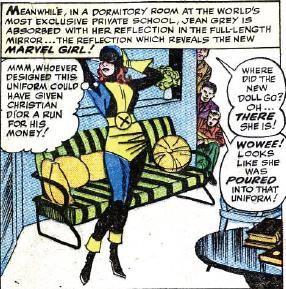
Be that as it may, the plot grinds on, and we hear that a new student is coming: “a most attractive young lady!” as Xavier tells his all-male students, before even communicating her name. Said male students then cluster around the window looking out, making various lewd observations (“A Redhead! Look at that face…and the rest of her!”) We are, in short, insistently positioned with the guys; we and they sexualize her before we even see her. When the X-Men do finally meet the new recruit, they spit out various stale and uncomfortable pick up lines, culminating in Beast trying to kiss her. Thus the first effort at portraying difference in the X-Men comic, the first introduction of someone who is not like the others, results in objectification followed quickly by sexual harassment. (Jean does use her telekinesis to put Beast in his place…but then refers to him sympathetically as “poor dear,” just so we know she’s not really angry or freaked out at having her fellow students trying to fondle her within ten minutes of arriving at her new school.)
 

UX1_MarvelGirl

>Yet more leering at Jean.

 
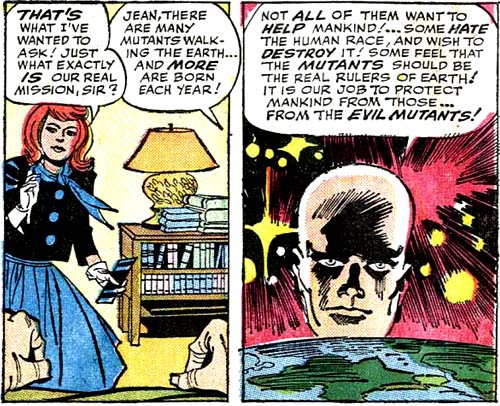
Somewhere in the middle of this edifying display of gender politics, Xavier gives with a quick speech about how normal humans fear mutants (“the human race is not yet ready to accept those with extra powers!”) and so he’s set up his luxurious refuge, where X-boys can leer at X-girls undisturbed by outside interference. He adds, though, that they have a mission to “protect mankind…from the evil mutants!”
 

ProfessorX_3

Shyminsky points out that the X-Men basically spend all their time attacking other mutants who aren’t sufficiently assimilated; their work is to further marginalize their brothers in the name of a justice of the privileged which is never questioned. That certainly fits this story, where Magneto’s plot involves attacking a US military base and disabling armaments and missiles. Again, the year here is 1963, deep in the cold war. Actual marginalized people at the time and earlier (like, say Paul Robeson or Woody Guthrie) were able to figure out that U.S. military power was used in less than noble ways around the globe, from Cuba to Indonesia to Africa. You’d think that a self-declared Homo Superior with experience of oppression like Magneto might be able to articulate that. But, of course, he doesn’t; he’s just an evil villain whose evilness serves deliberately to emphasize the justness and general awesomeness of the U.S. military.

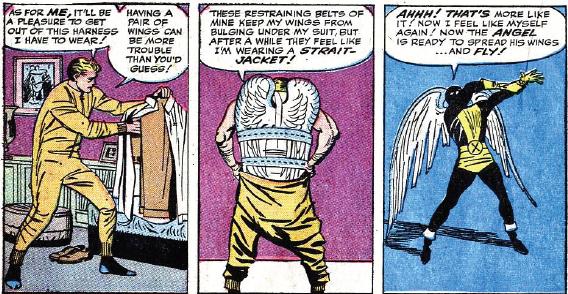
As for the X-Men’s marginalization…it seems easily doffed. The military guys aren’t scared of them, but welcome their help. The most uncomfortable scene of difference we get is a three panel sequence in which Angel changes out of his street clothes, revealing that he trusses his wings up behind him to keep them out of sight. “After a while they feel like I’m wearing a straight jacket!” he says. But no one ever questions why he has to bother to tie up his wings, or make himself so uncomfortable for the convenience of people who (supposedly) hate him. In fact, the sequence seem much less interested in Angel’s discomfort than in the ingenuity of the disguise.
 

UX1_Angel

 
Shyminsky notes that this fascination with, and eager embrace of, assimilation can be linked to the biography of Stanley Lieber and Jacob Kurtzberg, who changed their named to Stan Lee and Jack Kirby in order to be taken, like Angel, for normal humans. There’s a poignance there, perhaps, in Angel’s discomfort — Lieber and Kurtzberg’s new names may have pinched them a little at times too. But they nonetheless persevered in tightening that truss, which, in this comic at least, consisted not merely of new names, but of what can only be called a servile, deeply dishonorable acquiescence in hierarchical norms, casual misogyny, and imperialist fantasies. I hated this comic already, but as a Jew reading it as a parable of Jewish assimilation, it makes me actually nauseous. James Baldwin says that black people hate Jews (when they do hate Jews) not because they’re Jews, but because they’re white, and this seems like a fairly withering illustration of what he was talking about; a sad account of how my people (not all my people always, of course, but some of my people too often) kick those further down the food chain in a craven effort to look like, act like, and be the ones in charge. Xavier isn’t Martin Luther King; he’s a neo-con, and/or Michael Bloomberg, so charmed by whiteness that he devotes his existence to telepathic racial profiling.

So, yeah; this is not just a badly written comic, but an actively evil one. Other X-Men stories may be better — and indeed, they’d almost have to be. But at its inception, the title was a stupid, craven, explicitly sexist and implicitly racist piece of shit.
Adventure, Small As Life

Hobbit1

This appeared on Splice Today a while back.
______

Old Took’s great-grand-uncle Bullroarer… was so huge (for a hobbit) that he could ride a horse. He charged the ranks of the goblins of Mount Gram in the Battle of the Green Fields, and knocked their king Golfimbul’s head clean off with a wooden club. It sailed a hundred yards through the air and went down a rabbit-hole, and in this way the battle was won and the game of Golf invented at the same moment.

That’s one of my favorite bits from The Hobbit. It’s also, perhaps, the passage that pushes most insistently against Tolkien’s reputation as it’s developed. Tolkien is generally lauded for his careful, monumental world-building—for his intricate languages and his sweeping sense of history. And yet, here he is, with deliberate whimsy, knocking (driving?) his reader out of Middle-Earth and back to just-plain-England for the sake of a silly and utterly gratuitous joke. I suppose it’s possible that the elves and dragons play golf in Middle-Earth, but whether or not, it’s an incongruous idea, which makes tends to make the milieu unravel, rather than weaving it together. Putting hobbits and golf together is the act of a storyteller who has his eye on effects other than consistency.

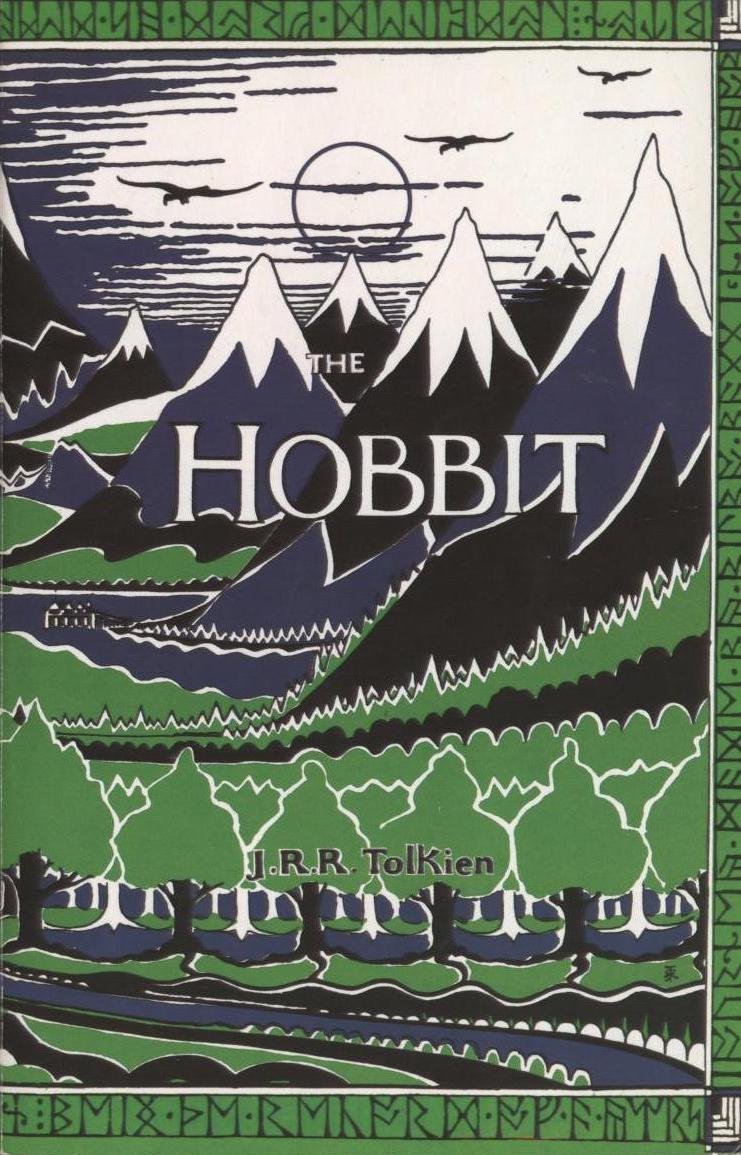
Those effects are, broadly, those not of epic fantasy, but of children’s literature. It can be hard to remember after reading the very serious, very dark Lord of the Rings, and even harder after watching the definitely-for-adults movies, but the fact is that The Hobbit is for kids. There is certainly a lot of danger and tension, and I’ve no doubt it’s given many a six-to-eight-year-olds some serious nightmares. But be that as it may, the fact remains that in its approach to character, and to its own world, it is in some ways much closer to something like Doctor Doolittle or Alice in Wonderland than it is to Tolkien’s more sober trilogy. For example, when Bilbo is trying to distract giant spiders and lead them away from his companions, he sings a taunting song that is essentially a children’s rhyme. After he’s done, Tolkien writes:

They made for his noise far quicker than he had expected. They were frightfully angry. Quite apart from the stones no spider has ever liked being called Attercop, and Tomnoddy of course is insulting to anybody.

Again, this isn’t world-building, or even logic, exactly. It’s silliness for the sake of silliness, where motivations and narrative are subordinated to the joyful clip-thunk of language. The monstrous Shelob that Frodo fights is a terrible monster, gross and inhuman. But the spiders Bilbo battles act like children, driven to madness by schoolyard taunts. And the pleasure of The Hobbit is, in no small part, that shuffling of kids’ perspective and adult perspective; the way the adventure shifts from larger than life to smaller than life in a blink, so that you feel that, in this universe, children (or hobbits) really can conquer the great, grand world, or, alternately, that the great, grand world really can be child-like.

I love The Lord of the Rings too, movies as well as books. But it’s too bad that critics, readers, and writers of fantasy these days are much more comfortable with the modes of the later Tolkien than with his earlier, lighter prelude. Harry Potter, for example, largely abandoned its Roald-Dahlesque nonsense impulses in favor of supposedly more sophisticated good vs. evil bombast. Twilight, The Hunger Games, Game of Thrones and His Dark Materials all might have LOTR somewhere in their heritage, but certainly none of them have The Hobbit. There are series that still hark back to fantasy’s children’s literature roots, like How To Train Your Dragon, but they don’t seem to have the same impact, or to be taken as seriously as cultural touchstones.

This is a shame in part because the children’s literature tradition is so vibrant; there simply aren’t many fantasy stories, in any mode, better than Alice in Wonderland or Peter Pan—or The Hobbit and Narnia, for that matter. But it’s also unfortunate because those children’s stories are decidedly more sophisticated than the adult epics with their grim quests and bloodshed and high seriousness. No matter how intricate the world you build, that world still isn’t the world. A story that acknowledges its own nonsense is, to that degree, more true, and more knowing, than one that doesn’t. Golf is, after all, more real than beheading goblins, no matter how grim and epic you make the latter.

Utilitarian Review 12/14/13

51E412989WL

 
On HU

Featured Archive Post: Sharon Marcus on liking Wonder Woman the comic but not Wonder Woman the character.

Fleetwood Mac for the old and boring.

A short story about a kangaroo who changed the world, with illustrations by my son.

Chris Gavaler provides free script advice to DC on a Wonder Woman movie.

Osvaldo Oyola on double-consciousness and what Black Lightning could have been.

Me on Black Lightning in Chains in the not very good Batman and the Outsiders run in the 1980s.

Qiana Whitted with a PPP post on the connection between anthropomorphism and race in Krazy Kat.

Michael Arthur on the good, the sweaty,and the cute at Midwest Furfest.
 
Utilitarians Everywhere

At Salon I have a list of metal tracks for non-metal heads. I think I’m going to be doing music lists over there weekly for a while, so check in every Saturday, as they say.

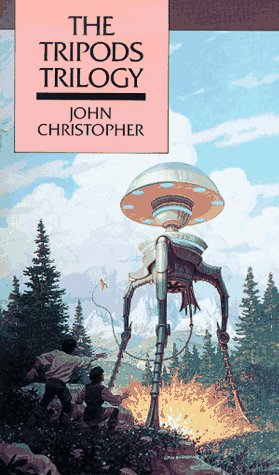
At Wired I talk about the Tripods series, and YA hero as failure.

At the Dissolve I review Nuclear Nation, a film about nuclear refugees in Japan.

At Splice Today I write about:

— how superhero narratives are about fascism, which doesn’t necessarily mean that superheroes are fascist.

—how America’s incarceration boom is over, and no one will be punished for it.
 
Other Links

James Romberger interviews Paul Kirchner.

Noah Gittell on that crappy Walt Disney movie.

Why it’s worth caring about women on a bank note.

Kevin Drum on our educational apartheid.

The Regency Romance as Horror

I wrote a bit back about Cecelia Grant’s novel A Lady Awakened. As I said, I loved it all the way up until the last fifth or so, when everything got resolved happily, causing me to be deeply depressed.

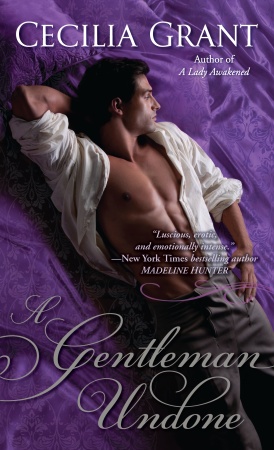
cover_2After taking some time to get over my disappointment though, I girded my bits, and read the next two novels in the series: “A Gentleman Undone” and “A Woman Entangled.” Neither was really quite up to A Lady Awakened…until the end, when both were (not coincidentally) less disappointing.

The main difference between books 2 and 3 and book 1 is that 1 is more ambitious. In the first place, the lovers face much more serious difficulties Martha in book 1 has just lost her abusive husband, and needs a child and heir if she is to keep her place, so she hires her neighbor, Mirkwood, to sleep with her. Her husband abused her as well — the book is in many ways a long, painful ode to the powerlessness of women in that age. Moreover, while books 2 and 3 mostly stick to working for the happiness of their couples, book 1 spreads out to include the entire countryside, and the farmers and families for whom, as landowners, Martha and Mirkwood are responsible.

The ambition in book 1 is definitely part of its energy; book 3, deals with two bland social climbers who are pallid nonentities both compared to the courageous, broken, determined Martha, and the social milieu of drawing rooms and society barely registered compared to the multi-class social world of the first book, complete with importunate pig. But ultimately, book 1 buckles beneath its own sweep. I can believe that those two pallid nonentities in book 3 could get together and make each other happy; why shouldn’t they? I can believe that the wounded soldier and the fallen woman in book 2 could heal each other — a little more of a stretch, but not impossible. But that circumstances should fit together to not only extricate Martha from her own predicament, but that Martha and Mirkwood’s love should be so perfect as to spread peace and happiness throughout the hinterlands…it’s just not credible. Romantic love is not the solution to all social ills; two people, no matter how worthy, having good sex and meaningful conversation just is not going to feed the hungry nor (as book 1 suggests) abolish rape and violence.

This is one way, perhaps, in which a fantasy YA romance like Twilight, or The Host or for that matter, Tabico’s insect-sex apocalypse, have an advantage over the regency. the realism of the regency requires some grounding in probabilities; the gestures at social realism interfere with the sweeping fanciful dreams. Fantasy or sci-fi, though, mark their fantasies more clearly as fantasies. Love can save the world — provided it’s vampire love, or love with larva. I also appreciate the horror elements in both Twilight and Adaptation; the sense that, if the personal and sexual were to become social, the social would have to change in ways which would be not just beautiful, but traumatic. The revolution requires blood, of one form or another, or at least a transformation more thoroughgoing, and more potentially disturbing, than just marrying that nice landowner next door.

Though maybe, on the other hand, there is something uncanny and disturbing about regency’s, after all. The end of book 1 (A Lady Awakened), where problems fall away and everyone starts to have their personalities scooped out to be replaced with a sickly sweet happiness; that’s not utterly different form Invasion of the Body Snatchers. Or the way that, certainly by book 3, you know as soon as their introduced who is going to end up with whom, so that the rest of the novel becomes disturbingly like watching watching lifeless mannikins speak and walk and perform like human beings — there’s an uncanny valley charge there as well. If horror can often be read against itself to provide a happy ending for the monster, perhaps romance, too, can be seen not as a triumph of love, but as a beakly mocking, knowing patomime of despair.

Black Lightning in Chains

Yesterday, Osvaldo Oyala posted an essay about the DC character Black Lightning, focusing particularly on how the characters’ two series (written by Tony Isabella) failed to address issues of race. Along these lines, Osvaldo wondered how race was handled when Black Lightning appeared in the team book, Batman and the Outsiders, during the 1980s.

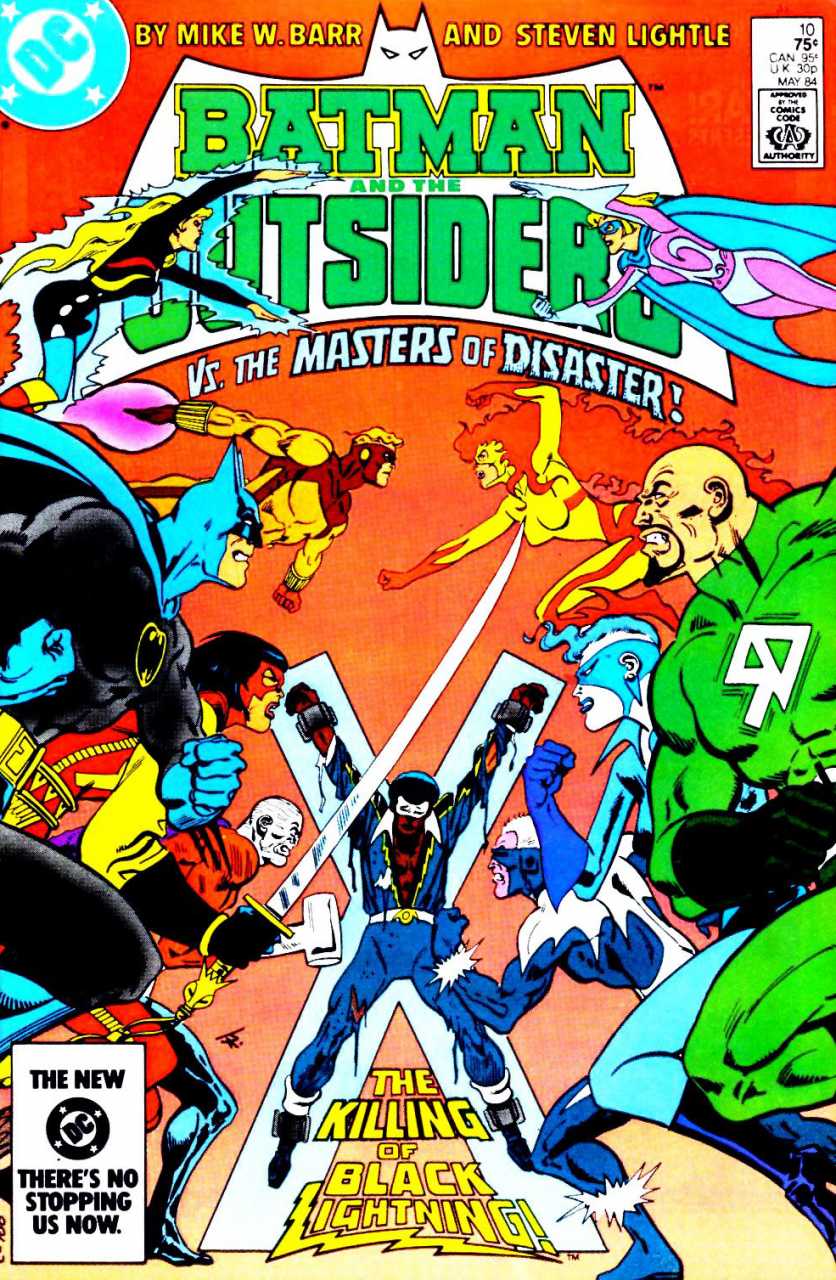
I read those comics when they came out, and my memory was that race was barely mentioned, much less dealt with. I thought I’d double-check, though, and so I went ahead and reread Batman and the Outsiders #10, by Mike W. Barr and Steven Lightle titled…The Execution of Black Lightning!
 

2755095-10

 
There’s black lightning, dead center, manacled to a structure which evokes a cross, clothes torn. It’s hard to avoid the evocation of slavery, and the link between African-American suffering and Christ. And yet, all those other characters on the cover do manage, somehow, to avoid it; the charged history of blackness in America hangs there suspended, while various costumed clowns square off for their tiresome Manichean good white guys vs. bad white guys battle, burying trauma under the high-pitched shuffle of silly costumes.

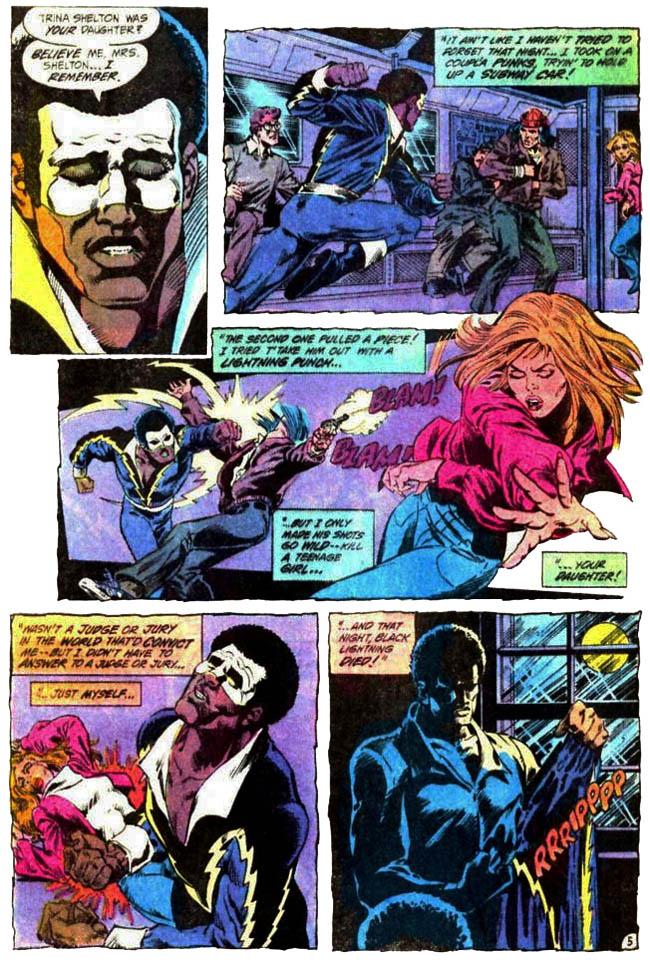
That’s fairly typical of how the comic as a whole works. Black Lightning’s blackness functions as an almost but not conscious theme, instantly and insistently deferred and repressed. The plot of the comic (such as it is) involves Lightning’s own traumatic tragic backstory — while he was fighting soem robbers on a subway car, a bullet went astray and killed a teenage girl named Trina nearby. Lightning blamed himself, and the trauma caused him to have trouble with his lightning powers, and to quite superheroing, until Batman convinced him to join the Outsiders (and helped him recover his lightning abilities). Trina’s mom, though, remained embittered, and so (as you will) she hired a team of supervillains to kill BL.
 

BlackLightning13

 
Again, race here flutters about, shooed away before it can quite settle. This was the 1980s, before the crack epidemic, but still, I think death by stray gunshot would be legible as a problem that particularly plagued gang-ridden minority communities. You have a black superhero, then, dealing with a violence and a trauma that is particularly associated with black communities.

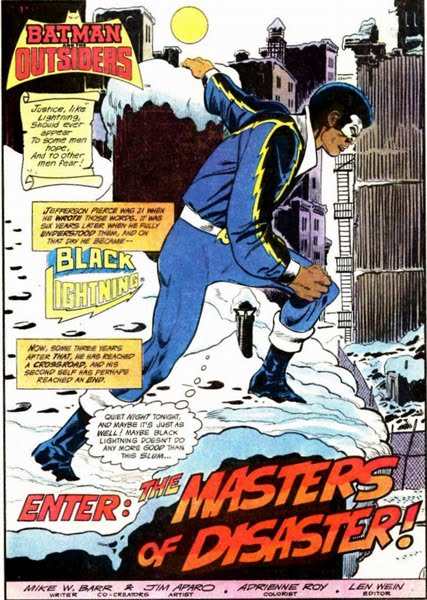
And yet, the racial, and for that matter the class, connotations of the storyline are insistently disavowed. The girl killed by the thugs is white; her parents are presented as thoroughly middle class (with enough money to hire assassins, even.) Although BL was, as Osvaldo notes, originally presented as a hero particularly committed to inner-city and poor neighborhoods, he never appears to connect his particular, individual trauma to the trauma of those communities. Or, when he does, as in a couple page sequence in the previous issue, it seems designed specifically to replace the community with some guy in tights who can be taken out of them.
 

out9-1

 
“Maybe Black Lightning doesn’t do any more good than this slum.” And that’s as much of a meditation as we get on race; inner-cities as throwaway metaphor for Black Lightning’s inner angst.

Similarly, the plot arc — a black man accused by middle-class white folks, chained and (almost) executed without trial — has pretty obvious parallels with African-American historical experiences of lynching. But neither creators nor characters seem to notice. The iconography (as on the cover) just sits there, as if daring the reader to make a connection. Black Lightning functions here not to present black characters or black experiences, but to studiously deny both. History and iconography are accessed simply to be denied; it’s an object lesson in how tokenism can be used not to grant visibility, but to more completely erase. The comic is almost a dare; how much African-American history can we pretend has nothing to do with African-Americans? The answer being, essentially, all of it.

In that sense the bulk of the Outsiders comics that don’t focus on BL are actually something of a relief. For the most part, he’s just another one in the crowd of superfolk, disinguishable by his costume and powers but not by anything else. In the black and white reprint volume I’ve got, even his skin color doesn’t set him apart. There’s only that Afro and the occasional more or less random lurch into dialect to remind you that the race-blindness here isn’t egalitarian, but simple, determined ignorance. They may claim they’re saving him, but none of those heroes on the cover is willing to look over at the black guy on the cross.

The Kangaroo Who Changed the World

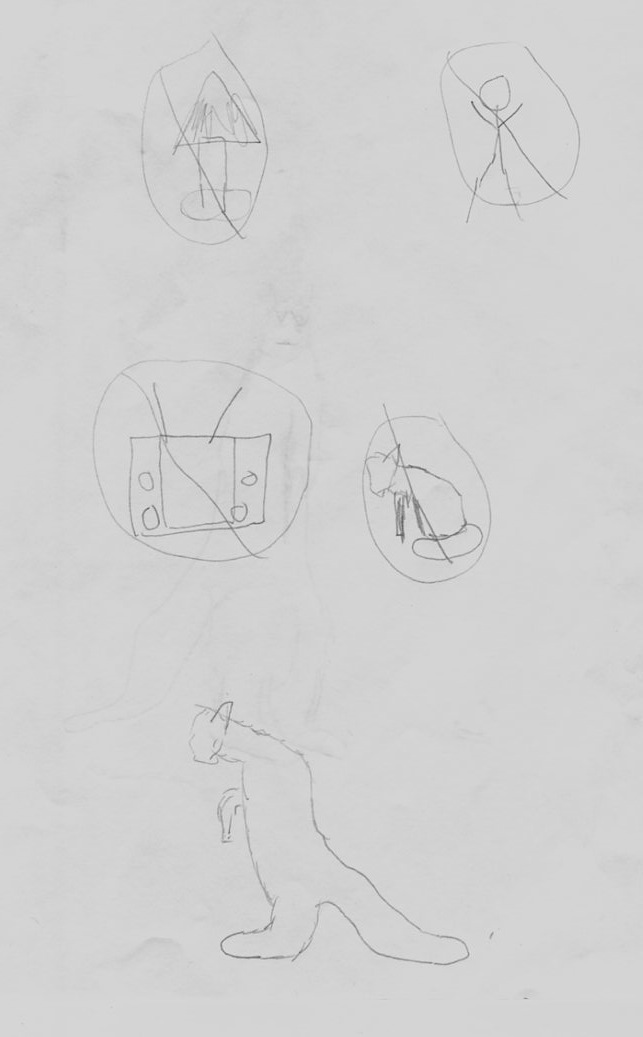
Long, long ago, before you were born, there were no people. There were no lamps. There was no television. There weren’t even cats!

Kangaroos ruled the earth!
 

kangaroo001

 
This was the Ice Age. The kangaroos had especially thick, shaggy fur, so they weren’t too cold. But life was hard, because everything had to be made of ice. They had to make their chairs out of ice. They had to make their watches out of ice. They even had to make their mittens out of ice. And mittens made out of ice are not very warm.

When everything is made out of ice, there is not much to do. So mostly the kangaroos played golf. When their ice golf clubs shattered, they sat down right where they were and made new ones. Between playing golf and making golf clubs, they kept busy.
 

kangaroo002

 
Only one kangaroo was dissatisfied. Molly did not like golf. Molly liked to read. But you can’t make a book out of ice. So she was sad.

One day, she reared up on her big kangaroo feet and she said, “I am SICK of ice! I am SICK of golf! I am going to go change the world RIGHT NOW!”
 

kangaroo003

 
Her parents scratched their heads and twiddled their whiskers. “Are you sure?” they said.

“YES!” Molly said.

So her father packed her an ice bag full of ice to take with her, and her mother gave her her very best golf club, and they both hugged her and tried not to ask her again if she was sure because they knew that would annoy her.

So Molly went outside and lifted one foot up and then the other foot up and then she looked way up and then she jumped to the sun.
 

kangaroo004

 
The sun was surprised. She didn’t have many visitors at this time of year. But she’d always been taught to be polite.

“Hello, Molly,” she said, trying not to melt Molly’s mother’s best golf club. “What can I do for you?”

Molly put her paws on her hips. “It is time to change the world!” she said. “I need you to start getting hotter and melt all that ice RIGHT NOW!”

The sun thought a bit. “I’m sorry, Molly,” she said. “I like watching golf. No changing the world today.” She smiled. Then she blew up, which was her way of saying, “Come back next Thursday, or possibly not at all.”

Molly drifted back to earth. She felt a little discouraged.

Down, down, down…wham! She landed on the golf course on her right ear. It hurt.
 

kangaroo005

 
She got up and went back to mom and dad. “The sun was polite and yet also kind of mean,” she said. “My ice melted and my ice bag melted and my golf club melted and I landed on my right ear. It still hurts. Also I don’t think I changed the world.”

Her father kissed her ear and her mom gave her an ice cookie. They went outside and there was a big hole where Molly had landed on her ear,

And in the hole were cats! They came out and purred and rubbed against the kangaroos, because rubbing against the ice was uncomfortable.
 

kangaroo006

 
“Huh,” said Molly, as a cat licked her ear. “I guess I changed the world a little bit. That’s not so bad.”

Maybe, she thought, she’d try again next Thursday.
_____
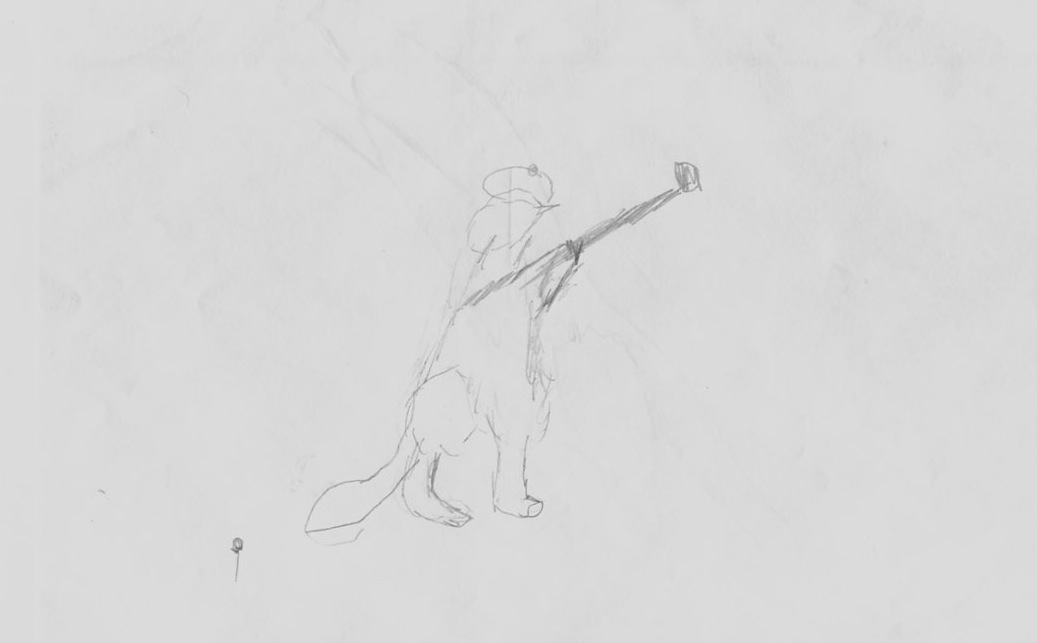
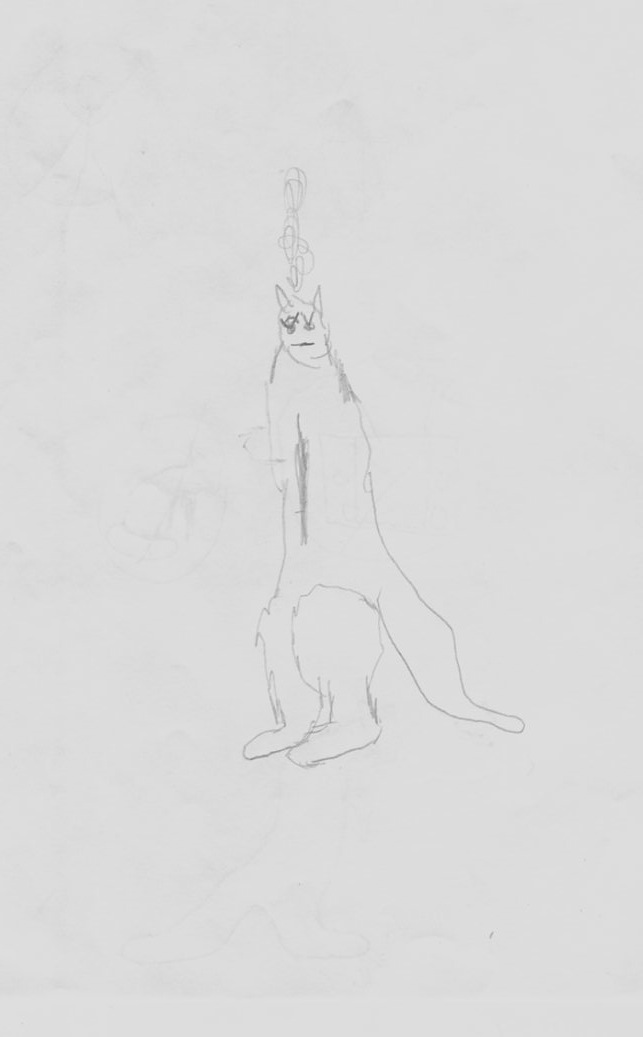
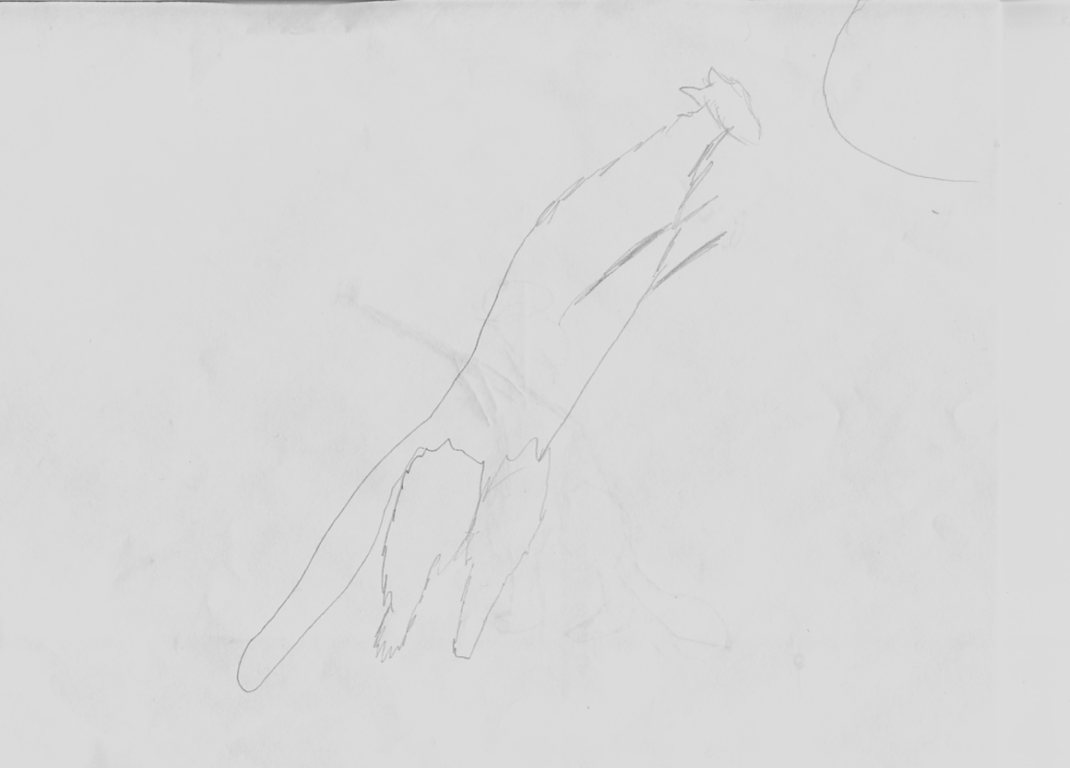
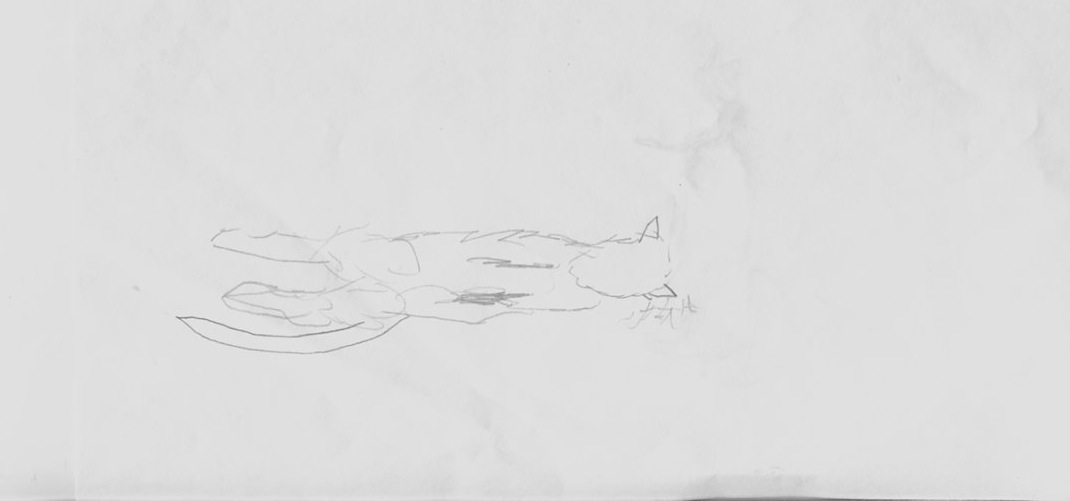
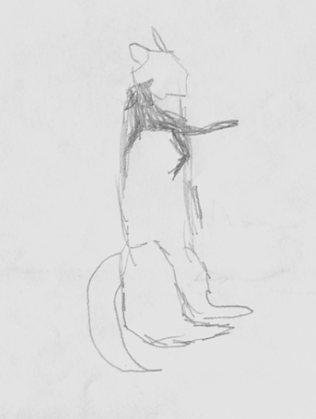
I wrote this in hopes that a children’s book publisher might take it, but the agent I talked to said it was too weird and never write her again. My 10-year-old liked it though, and drew pictures for it (in very light pencil for some reason, which is why the scans are not so great.) His drawings were published earlier this week at The Book of Imaginary Beasts, which was edited by HU writer subdee.

Utilitarian Review 12/7/13

On HU

Featured Archvie Post: Eric Berlatsky on Maus and reality.

Voices from the Archive: Jason Thompson on Orientalism.

Me on abortion and violence.

Mahendra Singh on the limitatons of drafting in Maus.

Me on Maus and Marketing.

Chris Gavaler on an evil Christian comic parenting guide.

Frank Bramlett with the week’s PencilPanelPage post on linguistics and sound effects in Krazy Kat.

Pam Rosenthal on Jo Baker’s Longbourn, Pride and Prejudice through the eyes of servants, and the genre of romance.

Utilitarians Everywhere

At Salon I did a list of 19 cross genre covers.

At the Atlantic I wrote:

—about how Ted Rall got tripped up by comics’ history of racist iconography

—that Wonder Woman shouldn’t be a sidekick in Zack Snyder’s stupid new movie.

At Splice Today I wrote about:

—how Andrew Sullivan can’t stop making the Iraq war about himself.

—Joey Baron, Bill Frisell and avant jazz as dead end.

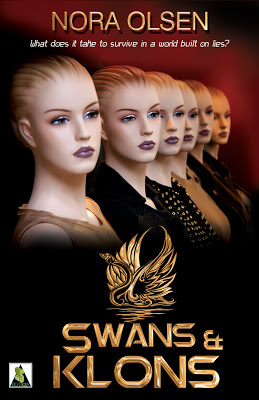
At Slate I told everyone to read Nora Olsen’s wonderful Swans and Klons.

Other Links

Paul Rosenberg on how the GOP knows nothing about food stamps (my cousin, David Simon, is cited!)

Kathryn Funkhouser on how people will pay to see female superheroes.
 

Swans+&+Klons+300+DPI