Jog on Late Ditko

Jog had a great comment on Jacob Canfield’s recent Ditko post, so I thought I’d highlight it. It’s below:

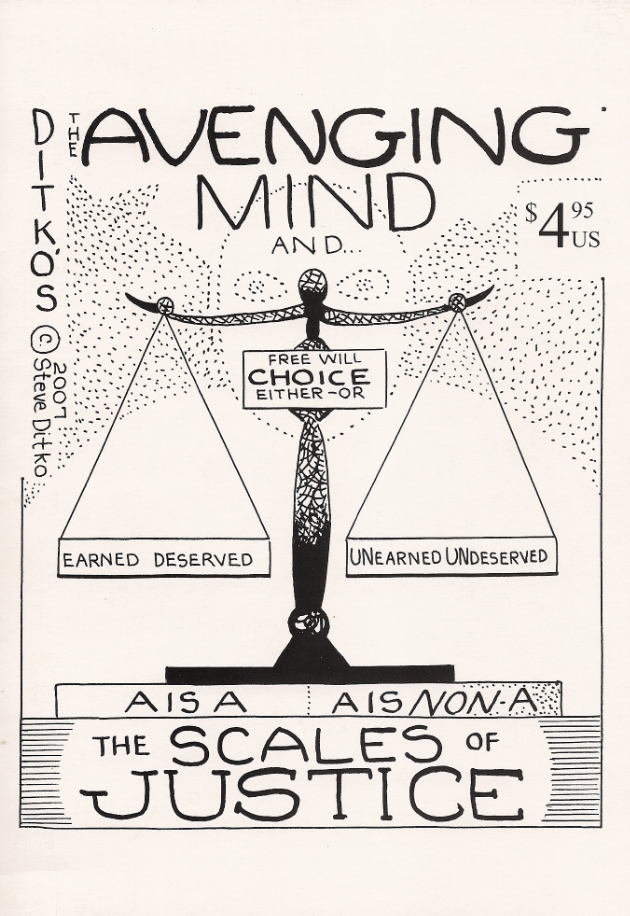
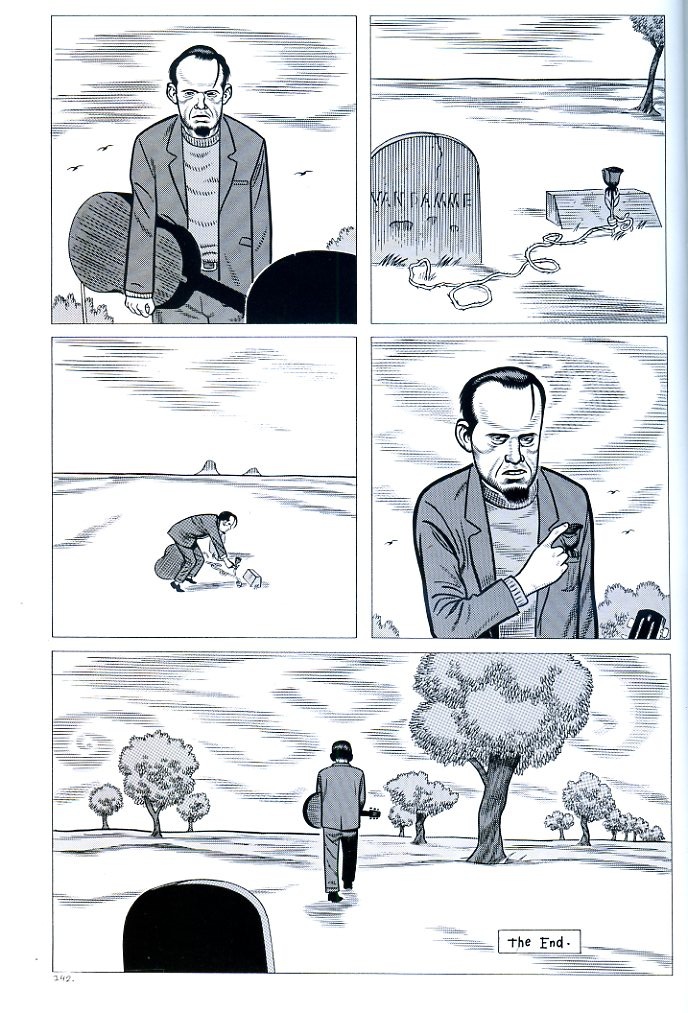
I enjoyed this, although I must confess some amusement with your identification of Ditko’s “worrying and depressing trend” – if anything, Ditko has eased up since the ’70s, when he was making polemical comics about (in one instance) a kidnapped doctor heroically refusing medical care to a Che-like revolutionary before striding away into the sunrise as milquetoast, compromise-prone bystanders are torn to shreds by crossfire: a fitting end for their kind! Also, the final panel is occupied almost entirely by a large word balloon. I’ve really come to prefer his abridged style of… dialogue (which makes no effort to accurately copy speech patterns, instead functioning as graphic flourish that ‘works’ to impart basic motivation; this strikes me as an effort to evade the clutter he rails against in the Public Service Package, which has to be understood in the context of an industry that used to lean very very heavily on words reiterating the content of pictures).

The Public Service Package is a weird book in general, in that Ditko adopts a burn-it-all attitude that allows for remarkably little satiric grounding; when *everyone’s* a moron (I’d question whether Ditko even likes the good old days all that much), it’s difficult to discern the advocacy behind the lampoon… and Ditko is ALL about advocacy. I don’t think Jack T. Chick comparisons are out of line; I’ve made them myself, several times. The trick is, to Ditko, MAN is GOD, and hell is less a tangible place than the state of surrendering one’s self to the neuroses and guilt relentlessly promoted by the fallen world which we inhabit. Mr. A. passes judgment, yes, but you’re not supposed to worship him: you were not made in His image, but you can make yourself INTO him.

(By far the most Jack T. Chick story of Ditko’s is in his & Snyder’s recent Mr. A. reprint book, wherein a convicted thug struggles to reform his life, effectively putting Mr. A. into the role of a tough-talking preacher ministering to the city… except, there’s no God. Ditko uses religious devices as prompts for self-betterment, and query whether there’s any substantive difference…)

Another good Ditko comparison is the movie critic Armond White, who sometimes errs on the side of assuming the reader has been following his (often counter-intuitive) arguments for months and months, resorting to a shorthand of self-reference that baffles new and curious readers. I don’t actually think Ditko is nearly so bad — that Earth cartoon you’ve posted seems clear enough to me; as you indicate elsewhere, Ditko spells out what he means in plain fragments, i.e. that the Earth is troubled by excessive regulation, though it probably helps to have previously read some his opinions on property rights, which abhor basically any restriction on use — insofar as his art tends to be compelling enough that understanding rapidly accumulates.

That said, I do think you misunderstand Ditko’s point about gender representation. It’s not that women don’t have a place in comics, it’s that lobbying for gender-based representation is a sop to abstract, collectivist concepts that demean the observable solidity of the individual human’s experience. It’s not an atypically right-wing view: individual excellence providing a cure-all to systemic injustices. Indeed, if you’re nonetheless trampled by the system, it doesn’t matter, because material gain and social standing are irrelevant in the face of Ideals, of self-satisfaction: not so different from Christian suffering in the hopes of a paradise to come, though with Ditko ‘paradise’ is in knowing you’ll never have to remember anything because you’ve never told a lie…


environmentalist-688x1024

Utilitarian Review 7/13/13

On Hu
Featured Archive Post: Richard Cooke on Finder: Voice and gender.

Bert Stabler on the new Pixies video and race.

Peter Sattler on Dan Clowes’ agonized relationship with comics.

Me on Finder:Voice, power, knowledge, and penises.

Michael Arthur on furries, nostalgia, and the mainstream media.

Chris Gavaler says “I Am Tonto.

Jacob Canfield on how late Ditko is worse than Jack Chick.

Ng Suat Tong on Utsubora and the dangers of artsy erotica.
 
Utilitarians Everywhere
 
Other Links

At the Good Men Project I talk about how misogyny hurts men.

At the Atlantic I talk about racism, sexism, and the Pixies new video.

At Splice I write about:

Joy Stecher and Kate Brislin’s great version of Our Town.

How work for hire is not spiritual debasement.
 
Other Links
Jog writes about late Ditko.

 Mind

Crotch Dance

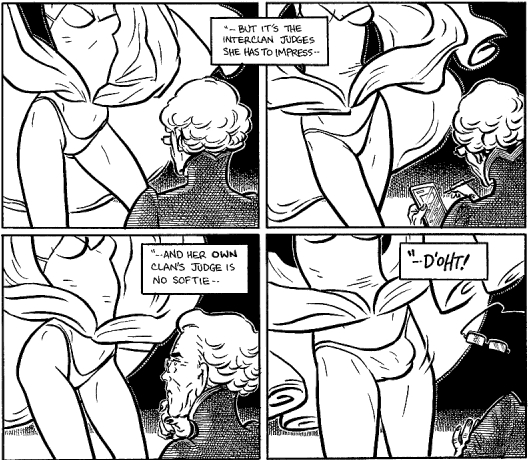
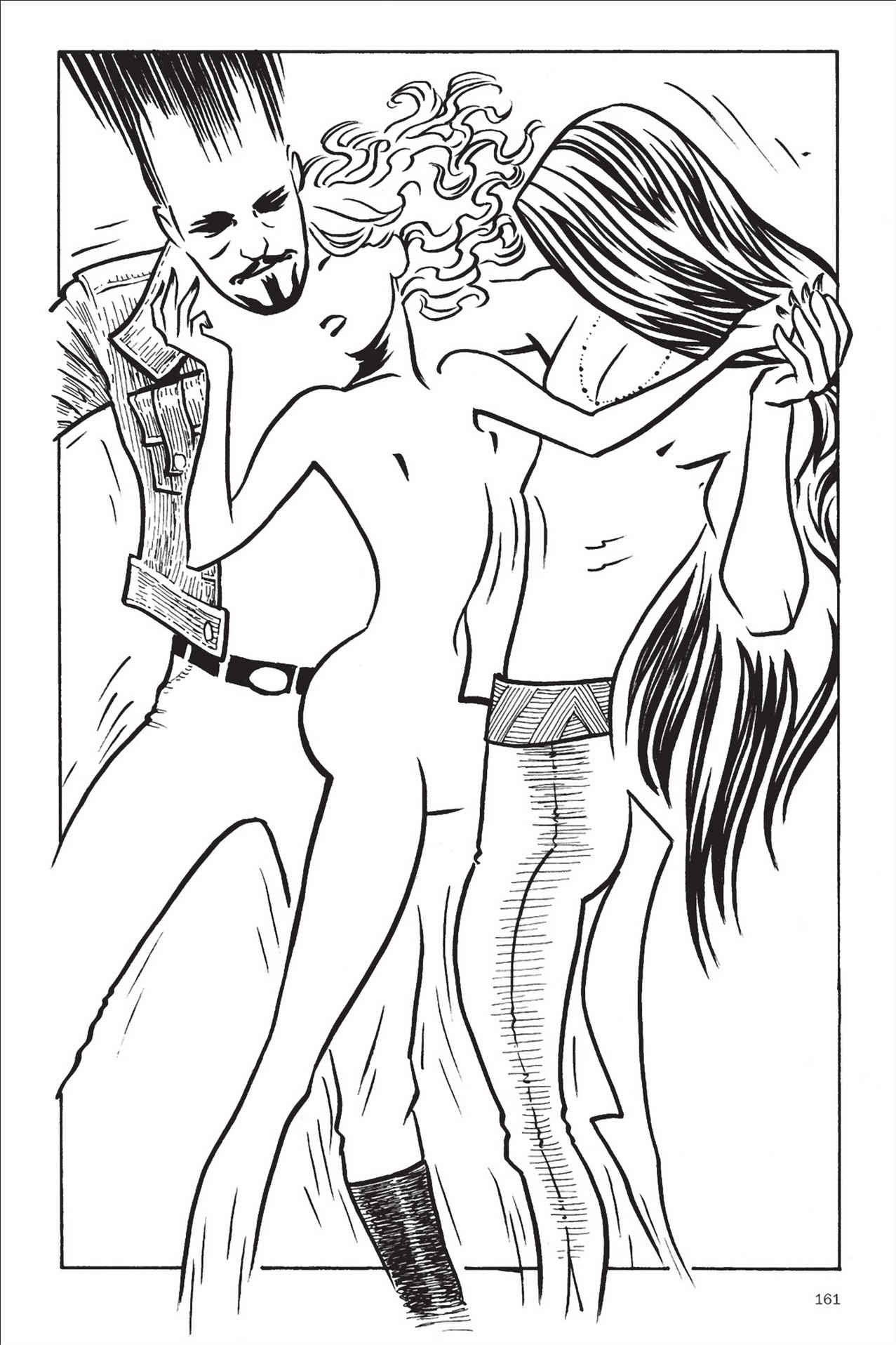
Carla Speed McNeil’s Finder:Voice starts with a beauty pageant — specifically, the Llaverac Clan Conformation Competition, as the text box/announcer tells us. The announcer goes on to explain that the girls are being judged to see if they fit the physical specifications of the Llaverac clan. The candidate being inspected (Jin St. John, we’re told) gets up close to the judges, thrusting her crotch in the face of one elderly woman, which is apparently in accord with contest traditions. Then, suddenly, a bulge appears in her panties. The elderly female judge recoils, and the announcer snickers, “I guess that’s why they call them ball gowns.”
 

9781595826510two


Obviously, Jin has a penis — or, you know, maybe not quite so obviously. I read the first volume of Finder a while back, and so had at least a vague memory that Llavarec gender isn’t always quite what it looks like, but still, I have to admit that I was not at first exactly sure what I was looking at in those images above. McNeil does provide some additional clues in the next pages for the slow of mind…which, as one of the slow of mind who sort of but maybe not quite got the dick joke, I appreciated.

Again, my confusion around the dick is a sign that I’m a little dense. But it’s also, I think, thematized by the comic. The Finder series is broadly cyberpunk, and one of the characteristics of cyberpunk is disorientation — a far future setting where social realities, and even physical characteristics, are so different from ours that it’s difficult to get your bearings. McNeil provides some notes at the back which help a bit…but even those end up often emphasizing the extent to which the world on view here is a mystery. “Can’t remember for the life of me which clan the dude in the suite represents,” is a not atypical author’s note — suggesting that even McNeil herself is not the master of, but rather a bemused tourist within, the world she has created.

In Epistemology of the Closet, Eve Sedgwick argues that realist fiction is built around the manipulation of knowledge and lack of knowledge to create a kind of unspoken blackmail. The writer writes as if she knows everything in the world she has created, and the reader then pretends that she follows along, and knows everything as well. The reward for acquiescing to the author’s mastery is a sense of mastery for oneself — to acknowledge knowledge is to be the knower. There’s a complicity; a doubled pretense of knowingness.Sedgwick links this to the lines of force and knowledge around the closet, where what you know (i.e., who is gay) and what you don’t know (i.e., who is gay) become a matter of threat, mastery, power, and self-definition.

McNeil’s diffident stance towards her own work in her notes (emphasized again in a recent Facebook comment where she says ” I really had no idea what I was doing as a writer when I first began [Finder]”) seems like a rejection of Sedgwick’s formulation — a refusal of the pact of knowingness between writer and reader. And I think it is a rejection to some degree…though maybe, also, an investigation, or elaboration. Finder:Voice, in this reading, is deliberately about knowledge, about narrative, about the closet, and about the way people negotiate all those things, or try to.

The book’s protagonist, Rachel, is a Llaverac (and how do you pronounce that, anyway?) entered in the beauty pageant/conformation contest. Despite the fact that her father is not a Llaverac, she seems to be doing well, and seems like she has a chance to win, or at least make the cut to be accepted into Llaverac clan, with resulting honor, wealth, power, and the opportunity to share those things with her family. Before the final competition, though, she is robbed, and loses her hereditary clan ring — which means she’ll be disqualified unless she can get it back. The bulk of the story is devoted to her search for Jaegar, Rachel’s mother’s boyfriend, on whom Rachel has a longstanding crush, and who is an expert at finding lost items.

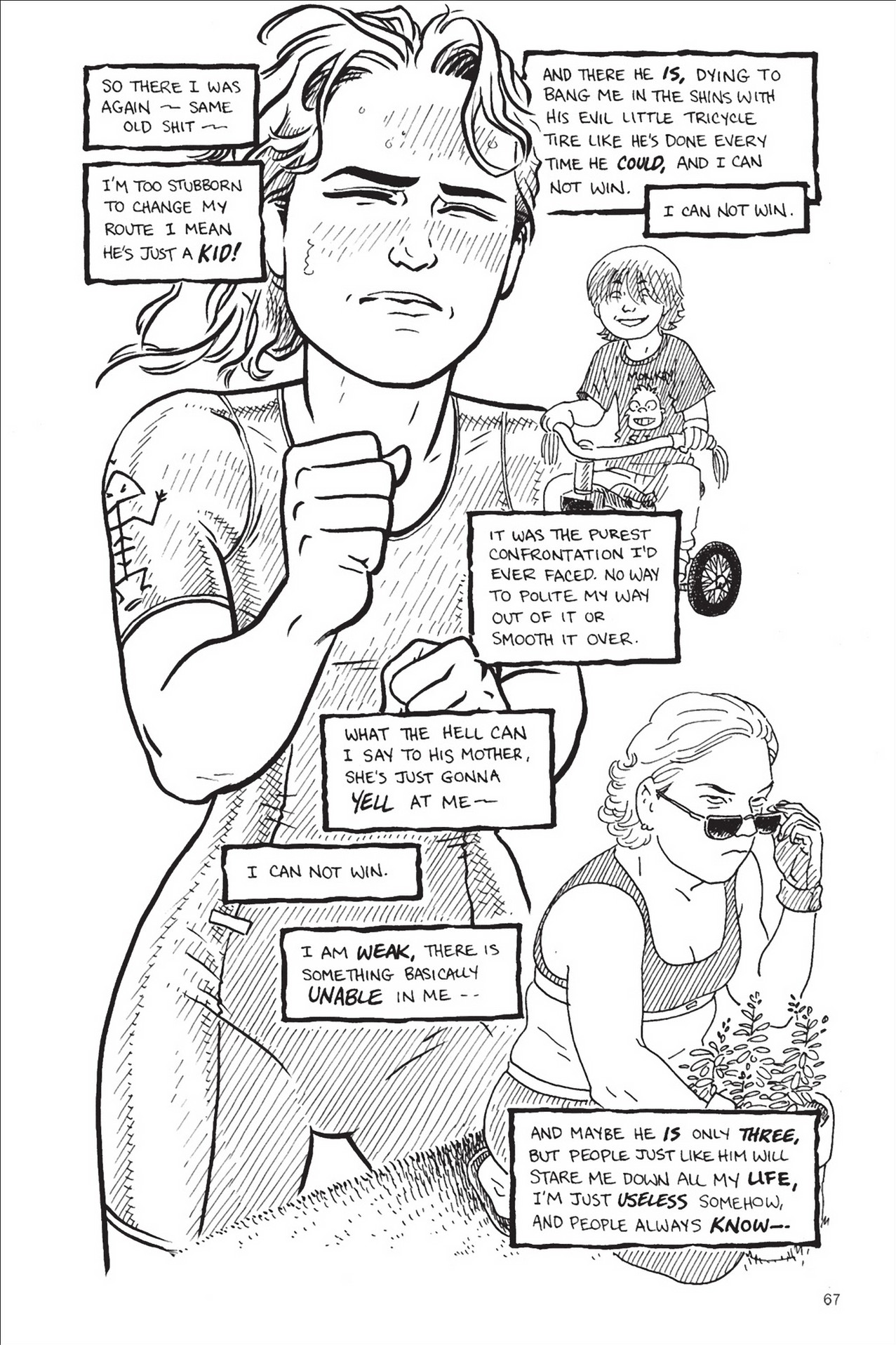
In his essay about Finder:Voice, Richard Cook points out that Jaeger functions in the Finder series in general as a hyperbolic lodestone of masculine competence and cool. The search for him, then, is in part a search for the penis or phallus. Rachel wants him in no small part because she wants to be him. She sees herself as incompetent; or as she puts it “I am weak, there is something basically unable in me.” Jaegar represents for Rachel not only her knight in shining armor, but her wish to become that knight. Part of her wants the ball gown — but part of wanting the ball gown is the hope that wearing it will mean she gets balls.
 

066
 
0671

 
Wanting the phallus seems, at least, fairly uncomplicated — who doesn’t want power? And yet, the bulk of Voice is dedicated to demonstrating that balls are elusive, and that even when you find them it’s not always exactly clear what you have, or how to use it. In fact, you could almost see the book as a series of more or less false or confusing revelations about genitals. There’s Jin’s suddenly visible penis at the book’s beginning, of course. Then Rachel’s mom Emma tells her that her non-Llaverac dad is not her real dad; instead she’s the daughter of a Llaverac, Lord Rodzhina.

Rachel tries to get help from Rodzhina, but he refuses her because he thinks she’s incompetent (no balls.) Then, Rachel tries to get her sister Lynn to help her find the lost ring; when Lynne refuses, Rachel tells everyone who will listen that Lynn has a penis — only to have them laugh at her, because, yeah, they already knew that.

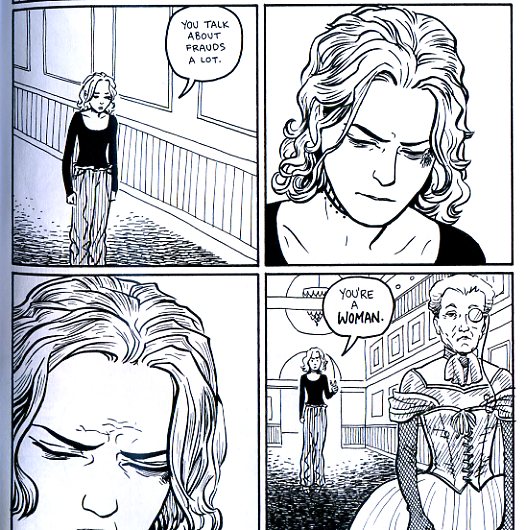
Finally at the end of the book, Rachel is allowed into the competition after she blackmails Rodzhina by threatening to reveal that he is not a man at all (which means, tangentially, that he is not her father.) He’s often helped get girls through the competition by claiming they were his illegitimate children — but he hasn’t actually fathered any children since he’s a woman, and having this made public would therefore cause him embarrassment and difficulties.
 

mcneil_rod

 
Rachel repeatedly fails, then, when she tries to manipulate knowledge about the penis. She only succeeds when she has knowledge about where the penis isn’t. This is mirrored in her search for the-penis-that-is-Jaegar; it’s only when she gives up on finding him that she manages to make progress.
 

160

 
Said progress involves stumbling into a drunken orgy with a bunch of Ascians (a marginalized ethnic group, to which Jaegar belongs) and having them hand over an alternate ring — not hers, but someone else’s. She succeeds, then, by basically losing all knowledge of everything, even (especially?) her body — she blacks out, and doesn’t even seem to be entirely sure whether she had sex or not (at the end of the comic she’s wondering worriedly what she’ll do if she misses her next period.)

So…I don’t think Rachel’s choices are exactly supposed to be normative. This isn’t necessarily a celebration of zen and the art of being fucked senseless (and/or dickless). Rather, it seems like it’s a meditation on the way that gender and knowledge wrap around each other — and on the way that following those wrappings around is a big part of what it means to grow up, or to survive growing up. Rachel succeeds in the beauty pageant — succeeds at becoming a woman — by using tactics traditionally associated with women. These include (as Richard Cook says), gossip, and (as Richard doesn’t quite say) trading on her body in order to gain allies and power and knowledge. (At the end of the book she says, ‘all my life i wanted to be able to do things, fix things, make things happen, without feeling like a conniving whore” — but of course her victory at the end, which gives her power and the ability to do things and fix things, arguably comes about because she’s been a very accomplished conniving whore.) Yet Rachel also succeeds, again, by recognizing where the penis isn’t — and by figuring out that the people who claim to have power over her are as phallusless as she is. And, in turn, understanding that maybe means she’s not so phallusless; she gets to put her finger through that ring, after all.

Lord Rod (which is an interesting name) gives Rachel a speech about fake books, and about how a truly accurate, undetectable fake can be more valuable than the real thing. Judith Butler, in her discussions of gender, says something similar — there is no original of gender, she contends, so copies of gender which show their copiedness, like drag, are more valuable, or truer than the “real” thing.

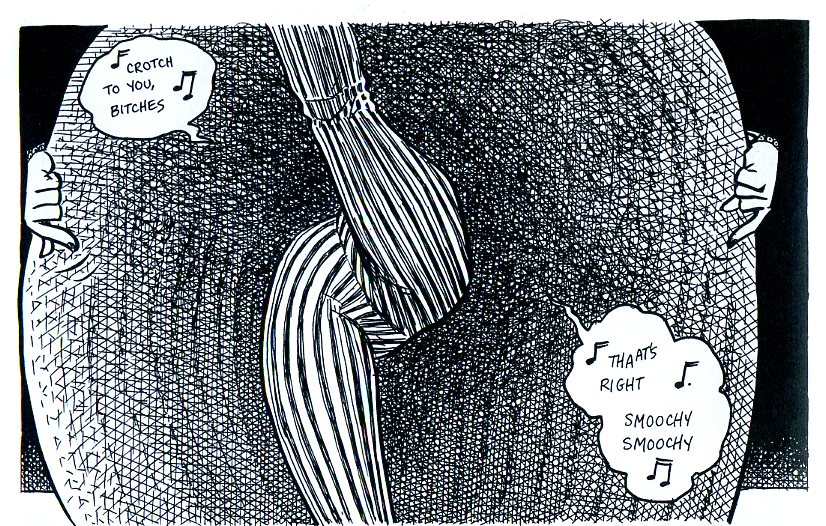
Rod is himself in doubled drag — a woman who looks like a woman disguised as a man who looks like a woman. And what about Rachel? Is she a woman pretending to be a woman? Is she faking having a phallus or faking not having one? And is she more valuable as a fake or as the real thing? If there’s an answer here, it seems like it’s neither that the phallus is truth nor that the phallus is false nor that there is no phallus, but some indeterminate, situational amalgam of all those things. Do we know Rod has no penis? Do we know Rachel has none? Only because McNeil tells us so. Drawings are what we say they are; their gender is made of knowledge, not bodies. Like ours, maybe, though it’s hard to know for sure. Once the story starts and the future turns to past, how can you tell the dancer from the dance?
 
mcneil_dance

Peter Sattler on Clowes Agonistes

Peter Sattler wrote a great comment about Dan Clowes’ Wilson and the oppressive weight of comics. So I thought I’d reprint it below.

I had never thought much about linking gender and comics per se in Clowes’ work, but you make a strong case, especially for Velvet Glove.

Over the years, I have only presented a few papers that touch on Clowes, usually in the context of broader claims. But I tend to agree with you that his work goes out of its way to thematize the artist’s and/or the story’s struggle against comics themselves – against a form that, as Clowes presents it, seems unable to encompass interior states, unable to escape its own theatricality and artificiality, unable to circumvent its own closed system of beginnings and endings, set-ups and punch-lines. Clowes dramatizes his contest with these limits, transforming that contest into the content of his graphic novels.

Take Wilson, for example. The sense of connection, of understanding, of interiority, of history that the Clowes’ characters – mainly, Wilson – repeatedly say that they want are always thwarted by the protagonist’s unwillingness to stop talking, by his demand that other people – especially women – shut up. It would be easy to see this as a feature of Clowes’ misanthropic creation: a man too horrifically self-involved to see his own villainy. But on the page itself, this solipsism is most visibly as a series of qualities endemic to comics: the obscuring and endless series of word balloons; the need to keep talking, running an externalized and insuperable inner monologue; the infantilizing and ironizing iconography; the truncated and isolating nature of the comics page itself (and few long-form cartoonists seems as wedded to the idea of comics as a collection of discrete pages as Clowes).

Indeed, it is the rigid nature of the page – imposing its own unavoidable sense of beginnings and endings – that most circumscribes Wilson’s exploration of human connection and meaning. At least in this volume, no matter what one says or sees, the ultimate reality is that any particular page must come to an end, must toss the reader back outside the work, and must, to some extent, deflate anything that might count as narrative. No matter what one encounters in the middle of the strip, it must always end when the page and its panels run out. For Wilson, this means ending with a joke. But in Clowes’ world, the deflationary punch-line and the structure of the Sunday funnies are just shorthand for the fragmented, one-page-at-a-time and one-damn-page-after-another nature of comics overall.

In Wilson, it is comics that keeps you talking, and it is comics – at least as Clowes represents them – that shuts you up. The form of comics lends its stamp to the structures of your thought (“Insert ass-rape joke here”) and to, it seems, how Clowes can represent — or not represent — thinking. (At last year’s conference at the University of Chicago, Clowes told the audience that he now tends to experience his own life in one-page segments.) I’m not trying to say that Clowes hates comics, of course; he clearly loves them. But as much as anything, he seems to be infatuated with the conflict that he has with the medium – with its history (or you argue, Noah) and with its historically inflected structure.

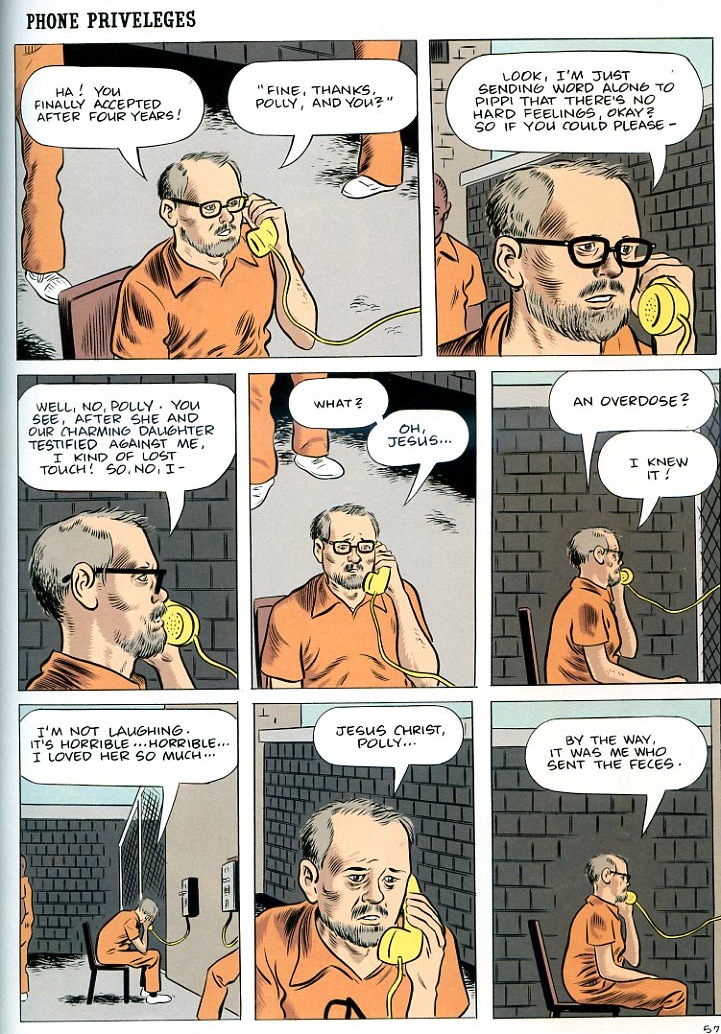
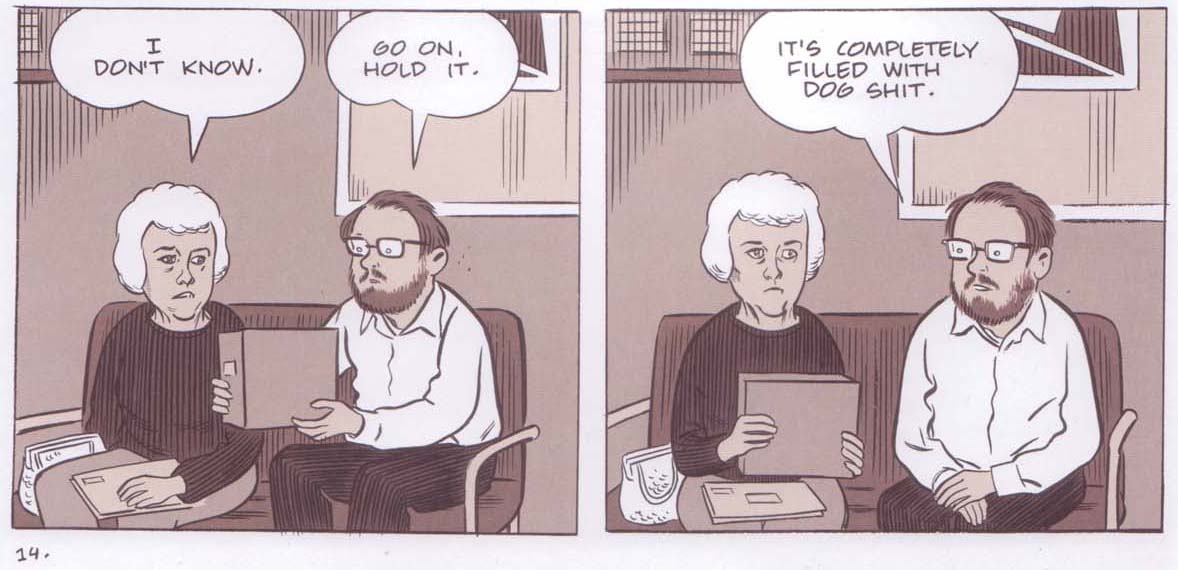
The most common last-panel punch-lines in Wilson involve excrement, and three different times those joke involves shit that is boxed and mailed. Perhaps that is the ultimately stand in for what comics can give you. That final delivery always comes, promising a special message. But it always comes out as dog poop.


wilson-graphic-novel-book-cover-01

Utilitarian Review 7/6/13

On HU

Featured Archive Post Anja Flower on queerness and the uses of yaoi.

Nicolas Labarre reviews Blood Feast in 5 panels.

Me on W.W. Denslow’s beginning chapter illustrations for the Wizard of Oz.

Me on gender and comics in Dan Clowes’ Wilson and Like a Velvet Glove.

Ng Suat Tong on Graham Chaffee’s Good Dog.

James Romberger on gender and film in Godard’s Contempt.

Chuck Berry for the 4th of July.

Chris Gavaler on World War Z, stay at home dads, and Muslim zombies.
 
Utilitarians Everywhere

I write about changes in fatherhood and the rising number of single dads at the Atlantic.

I wrote about confronting trafficking without arguing that all prostitutes are trafficked at the Goodmen Project.

At Splice Today I wrote about

People’s coverage of a transgender girl and the bedrock reality of gender.

Chicago Public Radio’s awful, eugenics-like marketing campaign.
 
Other Links

Kim Thompson on being an elitist comics critic.

On the Baffler’s new editor.

Abigail Rine on how he’s not sleeping through the night yet.

Ta-Nehisi Coates on manhood among the ruins.

Genevieve Valentine on harassment at cons and other places.

Amy Julia Becker on reading and disability.

Mary McCarthy on Internet trolls.
 

Baflr22_CovrG130311.2_26rgb-2_220_318

Don’t Tell Tchaikovsky The News

This first appeared on Splice Today way back when. It seemed like a nice piece to run for the 4th. Who’s America if not Chuck Berry?
______________________

imagesBlues and folk musicians soldier on forever, keeping the tradition alive. Rock musicians soldier on forever, turning into lumbering saurian parodies of themselves. Somewhere in the middle are rock and rollers, whose latter-day work is neither exactly respected nor exactly despised. Rather, for the most part, it’s just ignored.

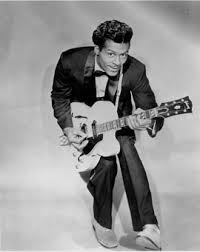
Which is why it’s so weird to realize that, unlike Elvis or Buddy Holly or Johnny Cash or Sam Cooke, Chuck Berry is still alive and still touring. He hasn’t recorded a studio album in more than 30 years, and hasn’t even had a live album in 8, but at 84 years old and counting, he still goes out there playing the same half-century old hits. Not a tradition or a parody, he’s no longer got a mass audience, exactly, but he’s still what he always was: Chuck Berry, performer.

It’s maybe fitting, then, that Berry’s last great artistic effort wasn’t a hit but a personal testament. His 1987 autobiography was, according to the man himself, “raw in form, rare in feat, but real in fact. No ghost but no guilt or gimmicks, just me,” and you can hear the truth in the rock of the phrase and the roll of the alliteration. Berry says he’s only read six hardbacks in his life, and that the dozens of paperbacks he’s paged through were “only for the stimulation”. Yet his love of language comes through on every page. Open at random and you find:

“Opportunity and temptation were anywhere you let them be. New ideas, ideals, and eye dolls were there to be held.”

“We were ‘short hairs and busted’ […] and were told if we wantd to kick back our ‘dime,’ we’d have to keep our mind off the streets, our hands off ‘ourselves,’ drink plenty of cool water, and walk slow.”

“Nine handsome young southern gentlemen were lined beneath the wing of the DC 3, elegantly welcoming me to Mississippi. I felt like the stately son of Stonewall Jackson, but it lasted only four minutes.”

There’s no doubt about it; that’s the same man whose lyrics included motorvatin’, coffee-colored cadillacs, and bobby soxers wiggling like whimsical fish.

While the voice is unmistakably Berry’s, though, it wouldn’t be quite right to say that the lack of a ghostwriter makes the book more honest. Even in the 3 minute medium of rock and roll songs, Berry’s quick wit tended to undercut a surface directness with a sly ambiguity. Those bobby soxers wiggling like whimsical fish — is Berry admiring them? Making fun of them? Lusting after them? The brown-eyed handsome man doesn’t just have brown eyes, surely; and why did Marie’s mom tear up that happy home in Memphis, TN anyway? Performers like Little Richard or Bo Diddley had lyrics which were exuberantly clever, but Berry was perhaps unique among the early rock and rollers in how he used words to dance around what he had to say. In the autobiography he notes that he rarely used songs to express love…but the broader truth is that, unlike almost all his peers, he rarely used songs to express any direct emotion. In a music pitched in some sense at kids, he always maintained a very adult distance.

The adultness and the distance are both fully visible in the autobiography. Berry can be remarkably frank; the book sometimes reads like a meticulous chronicle of every time he ever had an erection. Fellatio, cunnilingus, lesbianism, and condom use all make an appearance with just enough dissemblance to keep the book from out and out porn. He also talks openly about his fascination with white woman, discussing his obsession as a young boy with a white nurse and noting, “My mother’s nurse had a profound effect on the state of my fantasies and settled into the nature of my libido. I’ll tell you more later.”

And he does tell more later…sort of. There are numerous stories of sexual encounters with white women, from millionaires to hippies to prostitutes to French reporters. But how his philandering affected his relationship with his long suffering wife, or even his own emotional life, is skimmed over. His most important relationship with a white woman, his longtime association with his secretary Francine, is given a separate chapter which seems designed to hint at everything and confirm nothing. Berry actually includes a large section written by Francine, in which she praises him in phrases that sure sound like the endearments of a lover. But Berry never admits to sleeping with her, and certainly never lets slip what his wife thought about her husband and his devoted secretary jetting off to tropical vacations together while she stayed home to mind the kids. Nor do we learn how his relationships with either his wife or his secretary was affected by his abortive sexual dalliance with a 14-year old — a dalliance which he insists was never consummated, but which nonetheless landed him in prison on dubious-but-not-nearly-dubious-enough charges under the Mann act.

So it goes with most of the major themes of the book. Racism shadows his childhood, his relationships with white women, and his performing career, but it’s place in his psyche is more alluded to (as a source of fear or triumph or irritation) than elucidated. His consuming obsession with money is evident throughout, culminating in tax fraud committed, he says, because he wanted to get his bank balance to $1 million — but the closest he gets to actually explaining his attitude to his fortune are a few pithy, clearly misleading phrases about how he would play even if there were no profit in it. As for his songwriting, as Robert Christgau notes in an old review of the autobiography: “you get a funny feeling from this book: either music comes so naturally to the man that he gives it nary a thought, or he just plain gives it nary a thought.” (http://www.robertchristgau.com/xg/bkrev/berry-87.php)

It’s possible Berry doesn’t think about music — or possible, anyway, that he hasn’t thought about it in a long time. His style was set fairly early on, and while he mentions the Beatles and the Stones and some others, it’s clear he admires them, to the extent he does, for their fame and professional accomplishments, not because he cares a lick for their music. It’s the performers he heard in his youth — Muddy Waters to Nat King Cole — that he’s passionate about. If he was inspired by any musician after 1960 or so, you sure can’t tell it from this book.

Indeed, and as is the case for many celebrity bios, the material here about his childhood is the most vivid and the most powerful, from his joyful memories of squabbling over the piano with his siblings, to the queasy discussion of being forced to kiss the feet of a white woman on a golf course, to the even queasier account of a disastrous road trip turned hapless crime spree which landed him in juvenile detention on a ten year sentence. In this early section, you can see the connections between libido, race, music, ambition, and language which created a performer eager and able to conquer the world.

In adulthood, those connections get blurry — rubbed out, finessed, erased. A ghost writer might have gotten Berry to tell more, or at least to more directly refuse to talk about the stuff he doesn’t want to talk about. But if there’s not necessarily an honesty in the telling, there’s at least an honesty in the obfuscation. Berry’s about what he won’t tell you as much as about what he will. So when he goes out on stage and repeats the lyrics he wrote decades ago, you have to feel it’s not because he’s slacking off, but because he figures he already said what he had to say.

Comics Aren’t Just For Kids Anymore, Mom

This is something of a follow up to my review of Dan Clowes show at the MCA which ran in the Chicago Reader last week.
_______________________

Dan Clowes published Like a Velvet Glove Cast in Iron as a collection in 1993; he published Wilson in 2010. The first is a surreal, dream-like pulp grotesque; the second is an exercise in the quotidian mundanity of literary fiction. Yet, despite their separation in time and genre, the two books have a major plot strand in common. That plot strand consists of two parts. (1) A man searches for his wife who has sunk into sexual debasement. (2) She dies.
 

clowes022

 
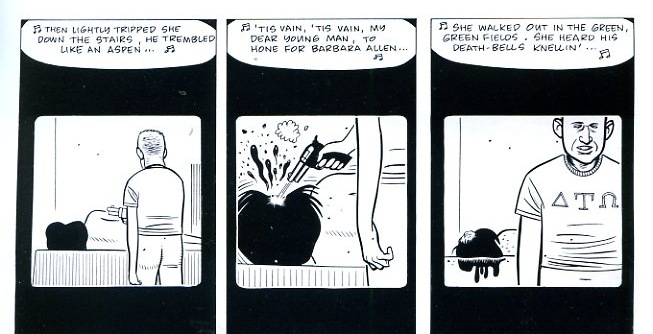
In both comics, also, the women’s stories are simultaneously the center of the narrative and marginal to the psychodrama of the husbands. In Velvet Glove, Barbara Allen’s death happens in a blink-and-you’ll miss it off there on the panel edge joke, and is “retold” through a filmed showing for Clay Loudermilk’s benefit.
 

clowes015

 
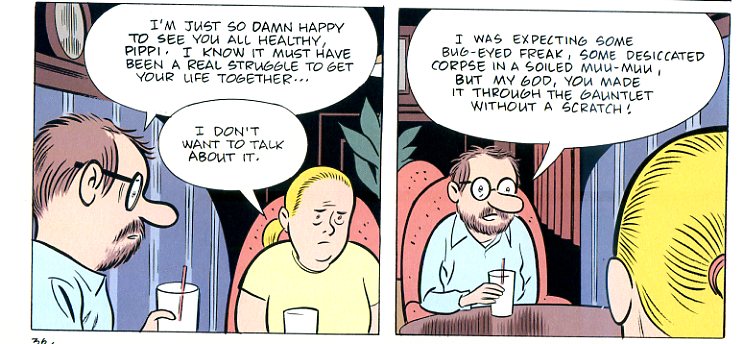
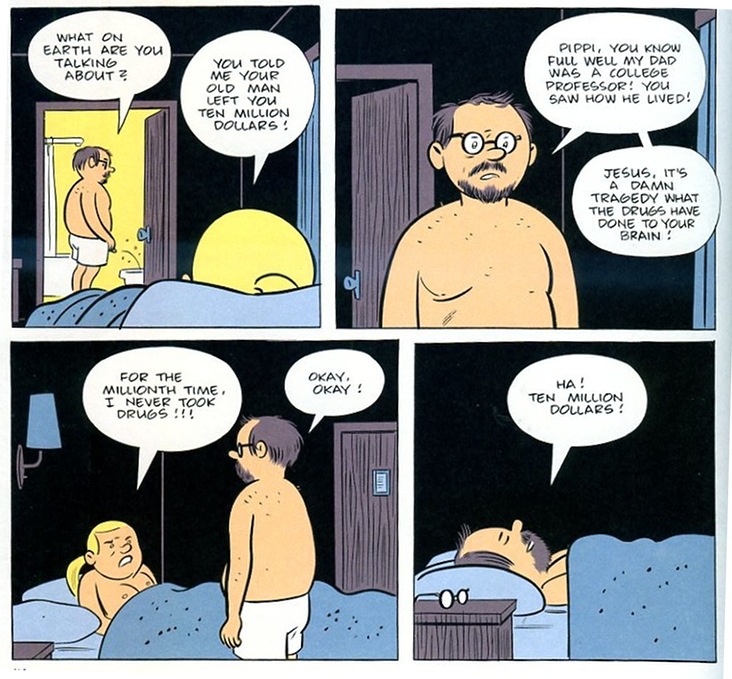
In Wilson, Pippi’s death occurs completely off-panel, narrated to Wilson over the phone as he sits in prison. Both deaths are carefully, deliberately degrading. Barbara is shot in the head during a pornographic fetish film; Pippi dies of a drug overdose. The anti-climactic awfulness of their passings is both a joke and a validation, underlining the nonsensical, adult viciousness of Velvet Glove and the banal, adult viciousness of Wilson. As in a gangsta rap song, or in one of the country death songs that both the names “Barbara Allen” and “Loudermilk” reference, coolness and a kind of manliness or maturity is conveyed through the killing of women, and, through the studied casualness of that killing.
 

clowes016

 
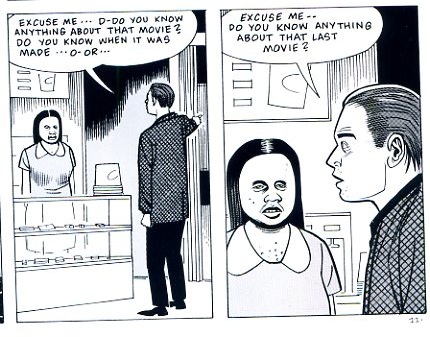
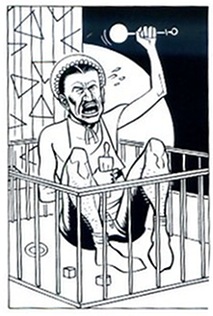
That maturity is in fact what is at issue is made quite clear in both books, albeit in different ways. In Velvet Glove, the search for Barbara Allen is tied repeatedly to the obsessive search for pop culture collectibles…and thereby to the comics medium. Clay Loudermilk discovers Barbara in the opening pages of the comic performing in a violent, bizarre cult fetish film — a provocative, unique bit of alternaculture which stands in for and references Like a Velvet Glove itself. Loudermilk’s shocked need-to-know following the exhibit is diegetically because his wife was in the film, but for alternative comics fans it also has to reference the awakened passion of the collector.
 

clowes017

 
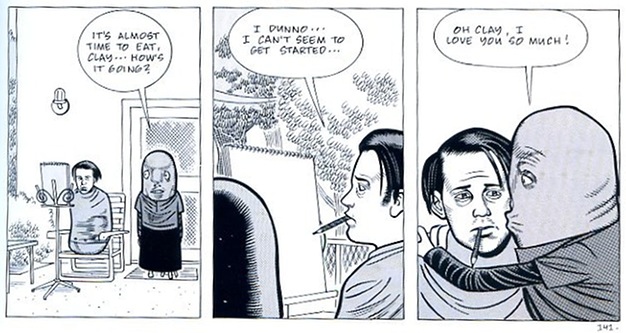
This is only underlined when the search for Barbara becomes obscurely enmeshed with an iconic cartoon character, Mr. Jones, who appeared in old-time advertisements and is improbably tattooed on Clay’s foot — as if his search for obscurities has become a mark of personal identification, so that he has become his own infantile obsessions. When he shakes Mr. Jones, it is not to transcend him, but to embody him. His arms and legs (and Mr. Jones tattoo) are torn off by a steroidal, adolescent-power-fantasy of an antagonist, and Clay becomes a swaddled stump, cared for and fussed over like a baby.

In Wilson, the connection between women, comics, and childhood is routed (as is just about everything in Wilson) through Charles Schulz’ Peanuts. The non-funny gag strips substitute glib profanity and gallow’s humor for Schulz’s bizarre aphasiac non-sequitors and odd tangents, but the model is still clear enough. Pippi, then, is a grown up little red-haired girl; Wilson a grown-up Charlie Brown who, of course, hasn’t really grown up. The shifting styles veer back and forth between cartoonish/neotenous and more realistic, so that Wilson exists in a constantly vacillating iconic no-man’s land between kids’ fodder and serious fiction.

In both works, then, comics, cartooning, childishness, and women function as a knot of meaning, loathing, and desire. Clowes is a very self-aware cartoonist; I don’t think it’s an accident that the initial fetish film Loudermilk sees includes an image of a grown man dressed as a baby and crying.
 

clowes018

 
Similarly, I’m sure the Freudian connotations of arrested development and desperate, childish bid for control are entirely intentional when Wilson sends his in-laws a giant box of dog shit. Both books present their protagonists as infantile, or in danger of, or tempted by, infantilization. Both books in turn, link their own medium of comics to that same infantilization. The narratives then become engines for demonstrating and reveling their own childishness, while simultaneously disavowing it.
 

Wilson-14a

 
Both the reveling and the disavowal are accomplished in no small part by making comics women, and then killing them. As Clowes is I’m sure well-aware, a fetish is technically a displaced symbol of the mother. Barbara as collectible, then, functions as a doubly referring, vacillating system, feminizing comics and comicizing femininity. Again, the final image of Clay, armless and legless, trying to draw on a pad with a pencil in his teeth while his monstrous fish girlfriend declares her love, fits neatly here.
 

clowes019

 
It’s a masochistic, self-pitying vision of comics artist as child — distanced both through its own adult violence and through its vision of the femininity as monstrous. Similarly, Barbara’s brutal death is commanded by a young girl who spins out the stories that are used in the fetish film. The comic, then, is, Clowes tells us, under the control of a feminine infant — whose whims result in very adult violence and femicide. The narrative’s grown-upness is guaranteed by the fact that it makes sexualized violence out of a child’s story.

In Wilson, Clowes actually self-reflexively acknowledges the comics own investment in female degradation. Wilson insists that Pippi, after leaving him, ended up on the streets, in a life of prostitution and drug use. She keeps telling him that much of this is not true, but he either doesn’t believe her, or doesn’t want to listen to her.
 

clowes020

 
In the terms of the narrative, Wilson wants Pippi to have fallen apart after she left him because he wants her to have made the wrong decision. But the comic itself seems to have its own motivations. Yet, despite all her denials, Pippi does in fact die of a drug overdose. Clowes, like Wilson, it seems, just can’t quite resist the idea of Pippi, or Barbara, humiliated and dead. And no wonder; violence, sex, perversion, death — everything that separates Clowes from Charles Schulz, or from the infantilized medium of comics, is neatly summarized in the image of a woman’s corpse. If, Bloomian poets must kill their fathers to replace them, Clowes suggests that serious comics creators must kill their mothers to escape them. Genius comes out of her grave.
 

clowes021