Dorothy and the Wizard in Letters

This first appeared on Comixology.
________________
 

oz001


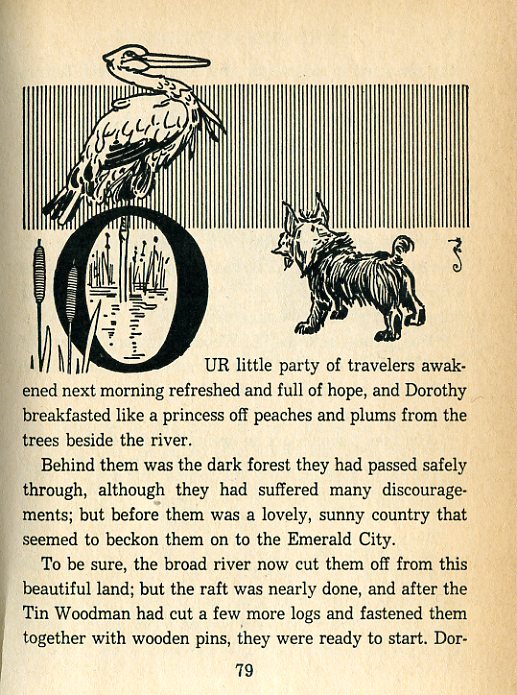
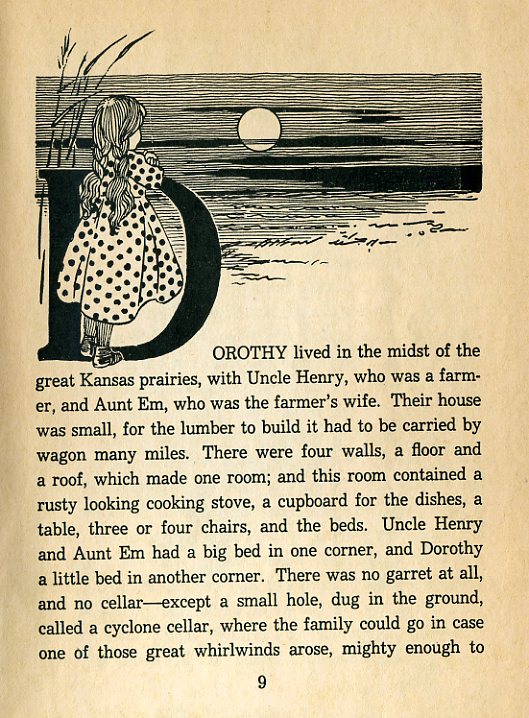
That’s the first page of the first chapter of The Wizard of Oz, written (of course) by L. Frank Baum, and illustrated by W.W. (William Wallace) Denslow. As you can see, Dorothy is leaning on the first letter of her own name, standing beside a Kansas wheat stalk. She stares into a mysterious fairie twilight…and not coincidentally, also seems to be staring into the book itself, with its own mysterious fairie treasures. Dorothy is about to enter the story, and she’s also the story itself; she’s an image and a name. You can’t show her without showing the start of the book.

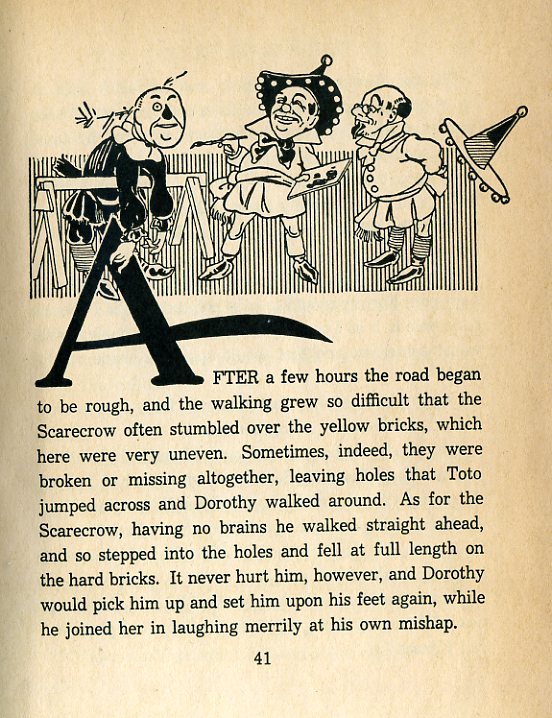
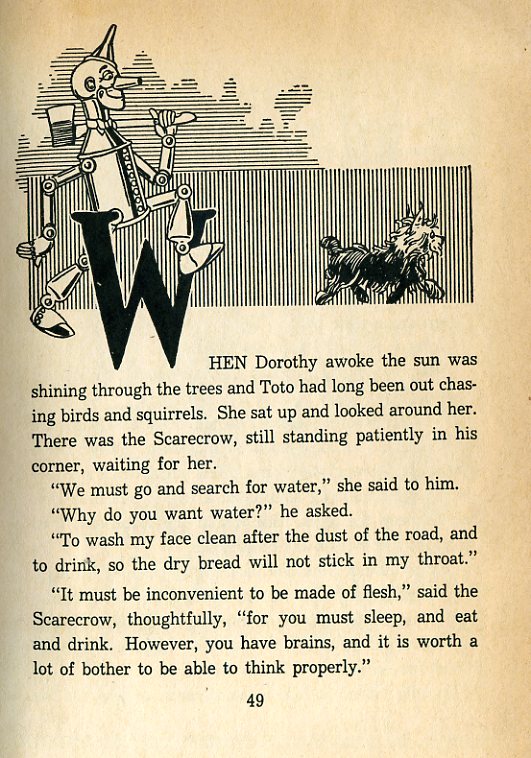
Denslow used illustrations like this, incorporating a letter into his picture at the beginning of each chapter.
oz002

oz003

oz004

oz005

 
In some sense, these are just flourishes; you don’t need the illustrations to follow the story, as you would in many comics. Yet, the intertwining of words and images fits Baum’s story unusually well. Rereading The Wizard of Oz in comparison with, say, The Hobbit or a more recent series like Patricia Wrede’s The Enchanted Forest, it’s striking how shallow Baum’s narrative is. Not that it’s not delightful or even moving — it’s both of those things. But Oz, the world itself, seems about an inch deep. You get the sense that Baum has thought only a sentence or so ahead of his protagonists, if that. The yellow brick road doesn’t so much lead Dorothy through the narrative as it skips rather desperately ahead of her. Ummm…creatures with bear bodies and tiger heads…and then, ur, flying monkeys, and…a city of china people! And next…creatures that shoot their heads like cannon balls! And the queen of the mice! Each section seems to come into being in the nick of time, just before Dorothy can put her foot down upon it.

Partially for that reason, one of my favorite passages in the book is when Dorothy and her companions are in the poppy field. Dorothy and Toto fall asleep. The Tin Woodman and the Scarecrow can carry them, but the lion is too heavy, so they urge him to run ahead and get out of the field. So he “aroused himself and bounded forward as fast as he could go. In a moment he was out of sight” — running ahead of the story, and so vanishing into the poppies and dreams.

Literally, as it turns out. The others find the Lion

lying fast asleep among the poppies. The flowers had been too strong for the huge beast and he had given up, at last, and fallen only a short distance from the end of the poppybed, where the sweet rass spread in beautiful green fields before them.

“We can do nothing for him,” said the Tin Woodman sadly; “for he is much too heavy to lift. We must leave him here to sleep on forever, and perhaps he will dream that he has found courage at last.”
 

oz006

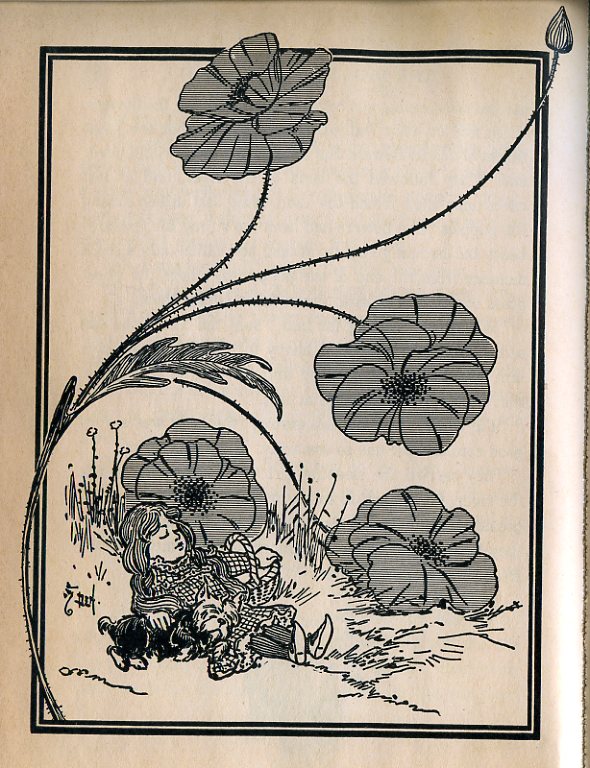
On the next page, there’s this striking illustration, showing Dorothy and Toto asleep and the giant, deadly poppies twining around them and breaking out of the panel borders. The poppies seem to be trying to reach and intermingle with the text on the facing page, as if to suggest the words are in Dorothy’s dreams and vice versa.

In that context, it’s worth noting too that the Tin Woodman’s hope for the Lion — “perhaps he will dream that he has found courage at last” — is exactly what happens. The wizard is revealed as a humbug…which is to say, he’s a storyteller.
 

oz007

 
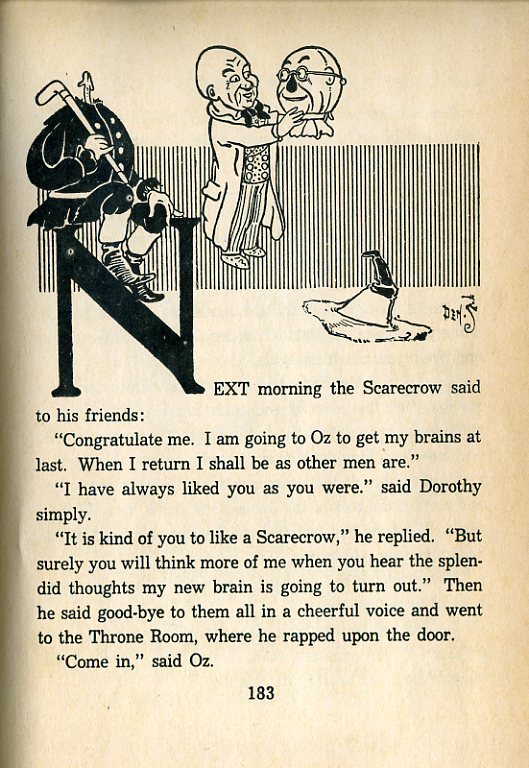
The Scarecrow’s body rests on the letter “N” while the wizard takes the head to stuff it with brains — or, more precisely, with the word “brains.” The text is what surrounds the scarecrow and what’s going inside him, just as the Lion gets not courage, but a dream of courage. Which is, as it turns out, the same thing.

In his 1971 book The World Viewed, critic and philosopher Stanley Cavell argued that for the film version of The Wizard of Oz:

The unmasking of the Wizard is a declaration of the point of the movie’s artifice. He is unmasked not by removing something from him but by removing him from a sort of television or movie stage, in which he has been projecting and manipulating his image. His behavior changes; he no longer can, but also no longer has to maintain his image, and he demonstrates that the magic of artifice in fulfilling or threatening our wishes is no stronger than, and in the end must bow to, the magic of reality….

Whether or not this is the case for the film, it seems much less clear-cut in the book. Oz is revealed as a story teller, but he doesn’t stop telling stories, and those stories don’t stop being real. In fact, he seems a better wizard once he’s been exposed, not because he’s more real, but because — what with dispensing brains, hearts and courage — his humbug is more convincing. How can you tell the magic of artifice from the magic of reality anyway? How can you separate what you say from what you see?
oz008

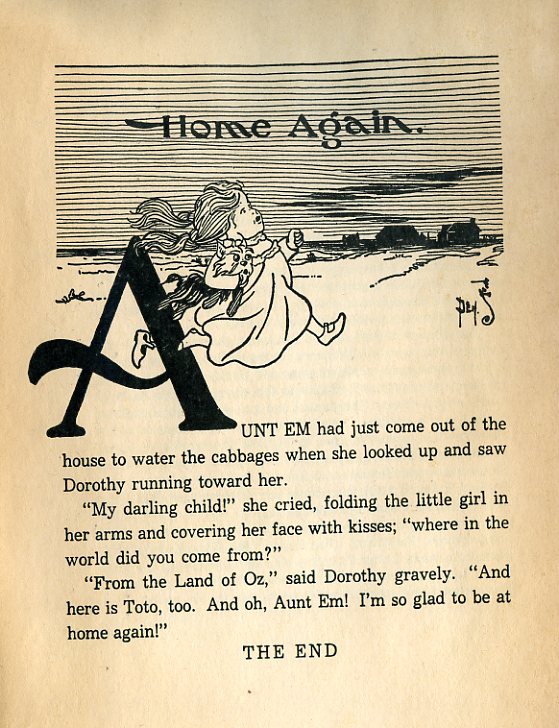
That’s the last page of the book. Dorothy has skipped across the desert back to Kansas with her magic silver shoes, and they fall behind her. You can see one of them has fallen off already; it’s dropped in the “A”. Except…when I first looked at this drawing, I thought the shoe was Dorothy’s foot; it took me a moment to realize that it had gotten detached. Which seems apropos. Dorothy’s still in the text, even after all these years. The home she comes back to isn’t any more real than the words “Home Again” which float like a sign-post above the twilit Kansas sky. Which is to say, both aren’t real, and are.
Utilitarian Review 6/28/13

rsz_nate_001
 
News

The lovely and talented Patrick Carland is joining us as a regular blogger. Welcome aboard Patrick!
 
On HU

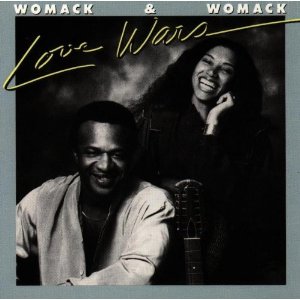
I talk about the smaller-than-life soul of Womack and Womack.

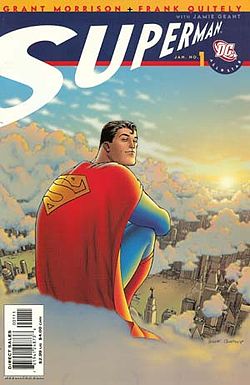
Voices from the Archive: Marc Singer on morality in All-Star Superman.

Jones, One of the Jones Boys explains why all the superpowers have to be dull.

Chris Gavaler on Man of Steel, eugenics, and why do DC films have to be so dour anyway?

I did an extended analysis of the father’s day card my son made me. Because it’s my blog, damn it.

Subdee on Saint Young Men and divinities as boho slackers.

Patrick Carland on the Hunger Games, Battle Royale, and neoliberalism putting children to the scythe.
 
Utilitarians Everywhere

I wrote about:

The Dan Clowes show at the Chicago MCA for the Chicago Reader.

Being a man trapped by the male gaze for the Good Men Project.

A doc about a gay couple and their 8 weddings for the Atlantic.

And for Splice Today:

The Scorpions’ first album was fucking awesome.

Why reading doesn’t make you more human.

Edward Snowden, Russia, and thuggish bullies.
 
Other Links

Tom Spurgeon with a magnificent, endless, amazing obituary for Kim Thompson.

Janet Potter on the Ladydrawers show in Chicago.

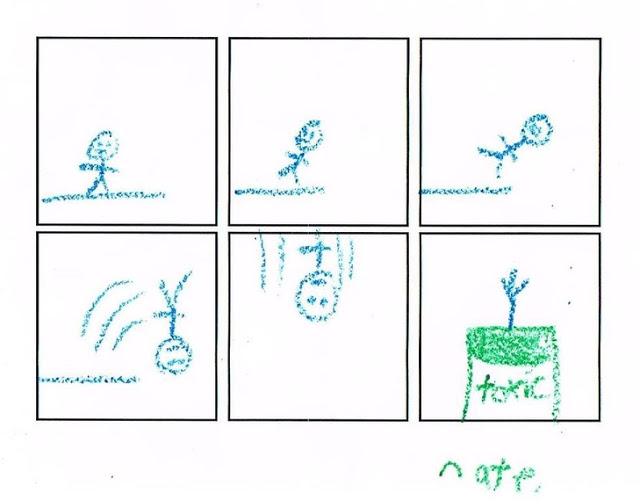
Jeffry O. Gustafson analyzes a kid’s comic about some stick figure falling into a vat of toxic waste.

Ben Schwartz with a sweet tribute to Kim Thompson.

Jonathan Bernstein on Wendy Davis and why talking fillibusters are still a bad idea in the Senate.

My Nine-Year-Old Could Draw That…Hey He Did!

cats012


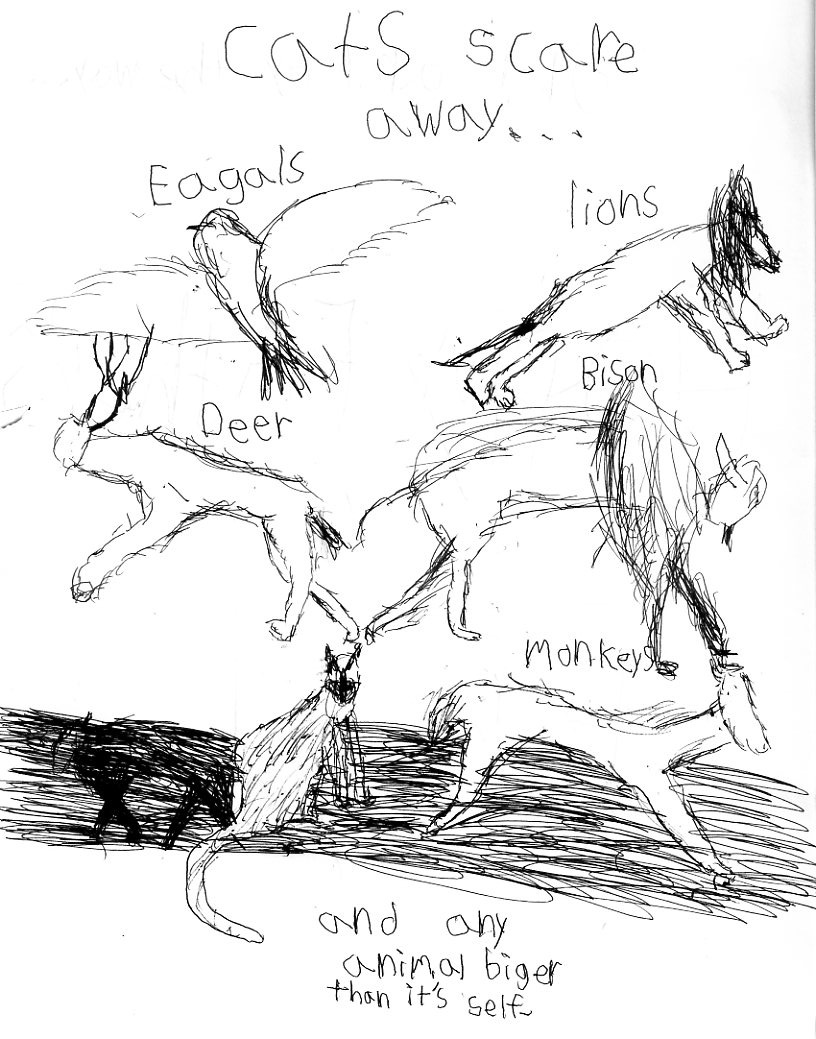
That’s the amazing father’s day car my son drew for me. In case you can’t quite follow, it says [w/idiosyncratic spelling corrected], “Cats scare away….eagles, lions, deer, bison, monkeys, and any animal bigger than itself.”

One of the fun things about the card if you’re a comics fan is the way that it both does and doesn’t read as a comic — or maybe the way it just scrambles comics and related genres, like advertising and birthday cards and children’s books, indiscriminately. You could put panel borders around each of those animals, and, indeed, since the page is structured like a grid it almost asks you to do that. But, at the same time, the space is all one space — which doesn’t so much make it not a comic as point to the way that in comics, even when divided by grids, the space can all be one space, the images you look at separately are actually right there next to each other. The eagals are getting tied up on the deer horns; you just don’t see it that way, usually, because the codes tell you not to see it that way. That’s maybe emphasized too by that weird band at the bottom, which reads as a kind of grassy floor (which would mean that not just the eagle, but the lion, deer and bison are floating in the air) and also as an erasure, marks on the surface of the page.

I like the weird rhythm of the images too. On the top two layers, the animals are arranged back to back almost heraldically; the eagle (who of course is on top so it can fly away) and the deer racing off to the left, the lion and the bison racing off the right. On the bottom, though, the Siamese cat on the bottom left is turned to the right, so it has to turn its head away demurely in order to avoid staring at the monkey butt. The cat’s also in the wrong place narratively; any competent comics artist would presumably put it either at the top or at the bottom right, either beginning or ending the “story,” since it’s the most important element. Placing it where it is is weird and disruptive; it’s like it’s not anchored to the text, but has wandered out of place. Which, of course, fits very nicely with the narrative, in which the cat is in fact a disruption, causing all around it to scatter in a regular excess of chaotic scribbles. (I like that shadow animal at the bottom too, scratched out by the scribbles at the bottom, as if the cat was going the other way, fit in its place, until it turned around, causing all the other animals to flee.)

Also, check that insouciant tail looped at the bottom. It’s like a little semi-circle warning to any animal bigger than itself.

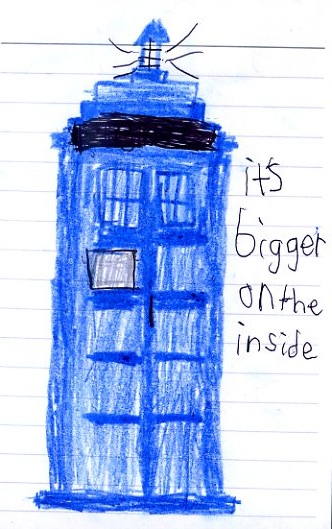
And hey, here’s another one.
 

cats013

That’s the Tardis, obviously. Which I understand is bigger on the inside.

Again, I think what I enjoy about this one is the way it ties comics to other stuff that is obviously like comics, but maybe doesn’t always get thought of next to comics all the time. This is a scrappy little alternacomics scribbly picture of a mega-property. (Which is the sort of thing that happens (a little disguised) in Axe Cop comics, now that I think of it….) But the image/picture juxtaposition is less alternacomics, more icon and advertising slogan. I don’t know…there’s just something about seeing this obviously hand-made, personal image of reproducible corporate bric-a-brac that seems to get at how comics often function. They’re the intimate face of the behemoth; low tech corporate crack, which looks innocent enough on the outside (even pretty adorable in this case), but is, as the boy says, bigger on the inside.

Probably all to the good to be plugged in though; you’ve got the culture you’ve got, and it’s best to figure out the workings early on. You want to be able to make those bigger insides run.

Voices From the Archive: Marc Singer on the Morality of All-Star Superman

A while back I expressed skepticism about All-Star Superman; Marc Singer replied with a long and eloquent defense, which I’m reprinting here. His comment is below.

Thanks for the link and the comments, Noah.

Your point about ideals without content is well taken, but the call for placing superheroes in “some sort of coherent moral framework,” particularly the point about superheroes skirting “political or social engagement,” seems a little musty, a bad leftover (or hangover?) from the eighties. Comics have been doing that for twenty years, and they usually reach the same tired conclusions about fascism (Animal Man being one of the rare exceptions). It’s to Morrison’s credit that All Star Superman largely avoids that well-worn path. With the exception of Luthor, he avoids talking about crime and justice; maybe one or two other criminals appear in the series and they hold absolutely no importance. Decoupling the superhero comic from these serious, meaningful discussions of law and order, most of which end up with a guy in a costume hitting another guy in a costume anyway, is probably one of the freshest moves Morrison makes.

That isn’t to say he avoids the other issues you raise. Issue #9 tackles that hoary old idea, the fascist (or at least cultural imperialist) superman, and finds him wanting. But what superhero comic in the last two decades hasn’t tackled it? This is one of the reasons I was left so cold by the issue, until subsequent ones made it clear that the comic was doing another job as well, motivating Superman to increase his commitment to a different set of ideals.

What are they? As seen in the last four issues in particular: compassion (even for his rivals or enemies), forgiveness (ditto), progress (particularly through scientific research), responsibility for others’ well being, curiosity, creativity, and a commitment to put these other ideals into action. These aren’t tied to any political ideology, but they absolutely are ethical stances (and some of them, like Superman’s commitment to building a better future through scientific progress, imply certain political ideologies, at least in our current cultural moment).

No, this is not a party platform and it doesn’t offer the kind of explicit political engagement you call for. I’m not sure that a Superman comic needs to, for some of the very reasons you list. Superman is a long-lived character with a cultural meaning much larger than any one political ideology (even the two-fisted New Deal liberalism he started out with). Tying him down to a single politics would be both difficult and reductive, especially given the premise Morrison has chosen for his project–synthesizing all prior versions of the character into a seamless whole.

Superman now stands for a kind of general, free-floating concept of decency and inspiration, as seen by all those Obama comparisons I linked to in the previous post (and the many, many more I did not link to). It’s not tied to ideology, but to idealism–Obama’s fans see him as a good guy, as one of the most openly moral figures in liberal politics in decades, as someone who inspires their own hope, so they post a photograph or a video that explicitly compares him to Superman. QED. Superman has become one of the first figures our culture calls to mind when we thinks of these traits. (The other being Jesus, and Morrison does not shy away from Christian references and narrative structures any more than Obama or the Daily Show shy away from manger jokes.) Morrison did not invent this trait, obviously, but he knows the character comes with it and he’s chosen to make it the centerpiece of his comic, building his ethical argument where the character already stands.

The line about having to invent Superman ourselves was a too-cute reference to something that happens in issue #10, which attempts to supply the tradition you say he’s lacking. I have to agree with Nick–I think your post would have been written very differently had you read the last half of the series, especially the last four issues, where all this plays out. Which is not to say you would have liked it, but you would find it hard to say the comic doesn’t articulate any ideals or place anything at stake. Any vagueness in my review is mine, not Morrison’s. But then, an eloquent apologist would say that. :)

Actually, that may be the biggest error in your post–I don’t see myself as an apologist, eloquent or otherwise, because I don’t see All Star Superman as having anything to apologize for.

250px-All_Star_Superman_Cover

Smaller Than Life Soul

This first ran on Splice Today.
______________

04

 
“Love wars, no more love wars,” the chorus sings at the beginning of Womack & Womack ‘s 1983 debut. Explicit appeals to non-violence are notably rare in American popular culture, but if they make sense on any album, it’s this one. Cecil Womack (Bobby’s brother) and his wife Linda (Sam Cooke’s daughter) make R&B music not just for the middle-aged, but for the middle-aged with no mid-life crisis, thank you. Neither quite soul nor quite funk, Love Wars sits somewhere between the two, the songs blending one into another in a mélange of repetitive but not-too-urgent vocals and repetitive-but-not-too-urgent hooks, expressing easy relationship tension and easy relationship bliss in equally measured doses. When Linda declares, “Baby I’m Scared of You,” she doesn’t sound all that scared; when Cecil declares he can “really turn your lovin’ on,” he doesn’t necessarily sound like he needs to do so — a point emphasized by Linda’s (moderately) sassy response, “I can’t understand that baby.”

I’m sure for some folks, that all sounds dreadful — but for me, the self-effacing low key approach is definitely a feature, not a bug. For fairly obvious commercial reasons, pop and soul have always found it easier to do sweeping hyperbole than understatement; everybody likes melodrama, after all, with its big lows and big highs. If you’ve been unlucky in love, then you’re going to drown in your own tears and/or declare with stentorian vigor that you will survive.

But if Ray and Gloria are out there loving and losing with hearts out on their sleeve and up a flag-pole and blaring from loud-speakers, the Womacks are here to tell you that relationship drama can be quiet and boring too. “I got my do’s/and I got my don’t’s/you ain’t for real and I’m sure I won’t/a woman’s got to play it safe,” Linda sings in “Catch and Don’t Look Back,” explaining why she’s not falling for a player’s line. The whole song is about how nothing is happening. The music struts along, the funk undergirding a sweet, almost wistful melody, and you can almost miss the emotional center, where she mentions off-hand that she’s been burned before. There’s no catharsis; it’s not even clear whether we’re supposed to be happy or sad for her. Is she smarter and stronger or just damaged? The groove shrugs its shoulders like Linda musing, “oh, I’m hip to that.”

Cecil provides the same kind of smaller-than-life lament from the guy’s perspective. What other performers would compare a failed relationship, not to a knock-out, but to a “T.K.O.”? His light, raspy vocals drift over the slow-boiling backing, fitting the half-hearted aimlessness of the lyrics. “I think I better let her go,” he muses, before spiraling up into a falsetto yodel that bizarrely imitates one of those 80s smooth sax solos, as if the ambivalence of his predicament has actually physically transmuted him into soulless cheese.

I wouldn’t say that the low-stakes approach always works for the Womacks. Turning Mick Jagger’s exhausted dead-end “Angie” into a softly lilting chat between mildly discomfited lovers probably wasn’t such a great idea, for example. But then there’s the album closer, “Good Times,” a declaration of mutual love that includes the hilariously mild praise, “you’re not as bad as you make out to be.” The real message, though is in the harmonizing; Linda starts the song off with a series of “la-la-las,” and as she winds down, Cecil comes in with a stuttering counterpoint. It’s lovely and awkward and right. Passion and world-shattering love are appealing, of course, but I think for most of us middle-aged folks, the ideal is probably closer to what Womack and Womack offer here: a vision of two as one gracefully bumbling whole.

Utilitarian Review 6/21/13

News

As most folks probably know, Kim Thompson, co-publisher of Fantagraphics, died this week. I had my first ever troll battle with Kim; he showed up in my inbox after my piece on In the Shadow of No Towers came out to tell me I was rash and foolish and an idiot. It was actually a really fun conversation; he was extremely gracious while telling me what a fool I was. It’s a treasured memory.

I don’t feel like I knew him well enough, or was familiar enough with his legacy, to write a full obit, but…I did just want to say that I always felt lucky when he came by to comment on HU, often to tell me again that I was an idiot. He was a friendly acquaintance rather than a friend, but like lots and lots of folks who he met, briefly or otherwise, online or elsewhere, I’ll miss him.

For a better sense of what Kim meant to comics, a nice place to start is with Chris Mautner’s discussion over at Robot 6.
 
On HU

Featured Archive Post: Ted Rall: Not Mean, Just Dumb.

I argue that you should get rid of comments threads if you’re not going to moderate them.

Chris Gavaler on Joe Shuster’s drawings of rape and torture.

Jog on how After Earth has that thoughtful take on violence all the critics are bemoaning the lack of in Man of Steel and everything else.

Patrick Carland on what to remember and what to forget about Ralph Bakshi.

Owen Alldritt on the alternating charm and irritation of One Piece.

Richard Cook on Bioshock Infinite, violence, and video games’ crappy aesthetics. There’s an interesting comment thread too.

I wrote the best post ever on the Internet if you want it to be.
 
Utilitarians Everywhere

At the Atlantic I talk about Nancy Friday, sexual violence, and sexual fantasy.

At Splice Today I wrote about:

The liberal dilemma in giving taxes to Obama.

The Bechdel Test and Emily Dickinson.

how misogyny leads to sexism against men.

 
Other Links

Inebriated Spook on Daft Punk.

Jason Thompson on Peepo Choo.

Dodai Stewart on Miley Cyrus appropriating black people.
 
220px-Random_Access_Memories

The Best Post Ever on the Internet If You Want It To Be

Thanks to the internets and the wonder of ever-increasing connectivity and what not, everyone can listen to the band that is the best all the time. This means that no one is listening to any of the other bands because they suck. Kanye and Beyonce and Kanye and Beyonce and also, maybe Metallica, I guess, on constant rotation, with Mick Jagger gagging, “Start me up!” as his ancient bony bits spurt ever new shiny new quality product.

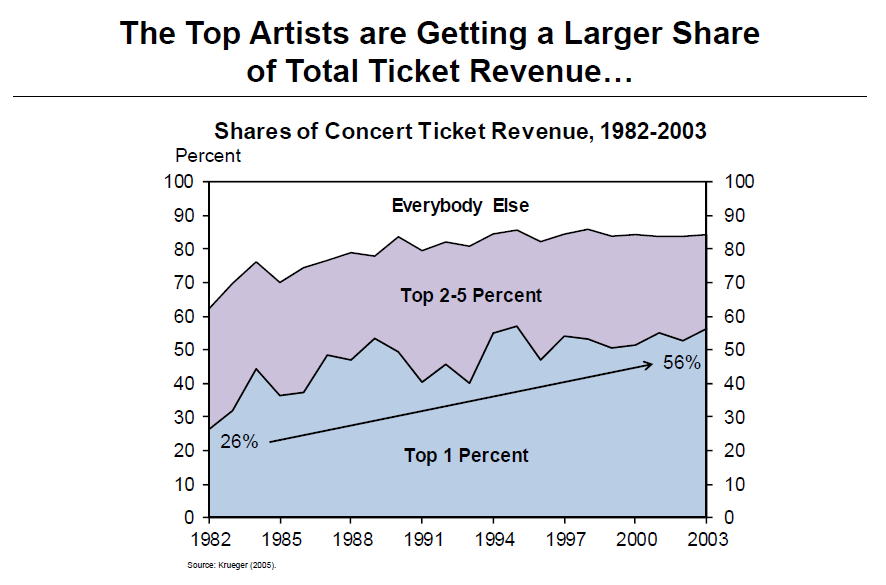
Anyway, here’s a graph, showing that the most popular graphs are getting ever more of the clicks.

Krueger-ShareofRevenue

See? Just looking at that graph makes you hipper and more content-optimized.

But…does it? Just because it is the graph that all the wonks are looking at until other graphs turn green with envy and their trend lines droop with despair — does that mean that it is really the best of all possible graphs?

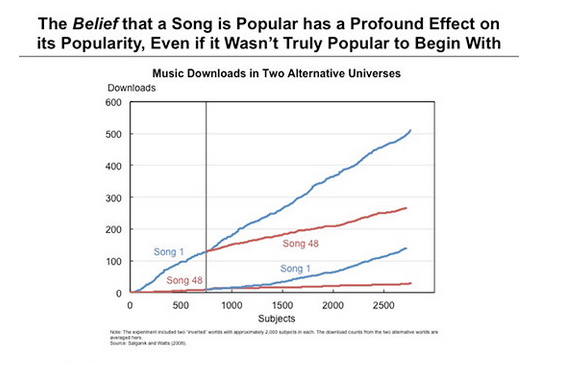
The answer is, shockingly, no. People look at the graph they look at just because that is the graph people look at. It doesn’t have anything to do with the quality of the graph, or the freshness of Mick Jagger’s spurting. Here is a graph showing that that 1 Elvis fans is right only in the sense that he or she has correctly identified the website where the 49 million other Elvis fans hang out.
 

Krueger-popularity

 
In short, I could be Andrew Sullivan if I’d just supported the Iraq war at the right time.

Neil Irwin, whose graphs I stole, quotes Alan Krueger who is an economist and therefore has succeeded entirely by merit explaining that he is shocked (in a low-key way that won’t damage his brand) to learn that art is not about quality despite the sterling example of Tom Petty.

“In addition to talent, arbitrary factors can lead to success or failure, like whether another band happens to release a more popular song than your band at the same time,” said Krueger. “The difference between a Sugar Man, a Dylan and a Post Break Tragedy depends a lot more on luck than is commonly acknowledged.”

Mathematically, Dylan’s Dylan not because he’s great but because a bunch of people stochastically tuned in and everyone else dropped on after. We’re all just basically sheep slipping on the hillside and bathing our sheep ears in giant wads of everyone else’s sheep shit.

Or that’s one interpretation. Another possibility, though, is that we’re not quite as dumb as those sheep — or, perhaps, those sheep aren’t as dumb as we are. Or, at least, when we are together with the sheep, we revel in the earthy sheep power of bathing in shit together. We may be sliding down that hill, but it’s by choice.

This is somewhere in the vicinity of what Paul Lauter argues in his essay “Class, Caste, and Canon” (1981/87). Lauter starts his essay by talking about one time he was sitting listening to a feminist literary crit collective, as you end up doing sometimes when you’re a lefty literary critic, and they started to analyze a poem by Adrienne Rich, because all feminist literary crit collectives analyze poems by Adrienne Rich, and/or by Beyonce, depending. Lauter assures us that he likes Adrienne Rich (and/or Beyonce), but, he says, why always this thing? Why always the standard of meritocratic excellence and formal beauty? Why not instead follow in the well-worn boots of the working class, and embrace art that speaks to communal enthusiasms and needs and desires? Working class art, he says, is valuable because of its use [his italics] in the lives of the proletariat. Art is not to loose anarchy or Yeats, but to bind us together so we can overcome and love one another right now. It’s the song, not the singer.

These days, of course, the proletariat is exponentially less likely to be listening to Roll Jordan Roll than to be watching American Idol or the Voice where hopefully they’re not singing Roll, Jordan, Roll. But whose to say that the change is for the worse? After all, if the point of art is the community that it fosters, then it seems like any community will do. What does it matter if you’re singing authentic volk songs or reading Adrienne Rich or watching Mad Men with a billion friends on Twitter? The point is the use as communal totem. People aren’t confused when they choose the most popular graph as the best graph. On the contrary, they’ve got it just right. Art makes a culture a culture, and it does that by being the culture you take as your culture. Who can buck the trend when the trend is the trend?

There are sub-trends of course, and subcultures, whether built around Dr. Who or Foucault or Richard Linklater or (as Lauter would presumably have it) work songs and sea shanties. The polite fiction is that we enter communities of culture because of what we like, but that’s just a way of inserting ourselves into the algorithm whereby our art sells our community back to us as ourselves. “Quality” is a ghost that haunts our skulls; a mirage we worship like a mirror. The Internet’s just given us a bigger frame on which to be somebody, too.