Shut Up

This first ran on Splice Today.
______________

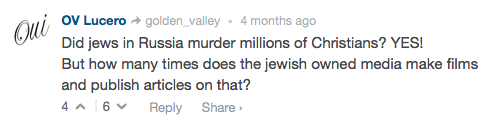
Comments sections can be sewers. Anybody who’s been on the web knows this, of course. But there’s an extra special rush of bile when it happens to the comments section on something you’ve written. I think the low point for me was this review I wrote recently about the documentary Hitler’s Children. The film focused on how the descendents of Nazis like Hermann and Goering have tried to cope with their ancestors’ atrocities. Many of the comments were thoughtful and positive. Some, though, were flat out anti-Semitic.
Picture 1

Again, that was unusually vile. But if you look at any mainstream site, you’ll see it isn’t off the scales. People in comments are regularly rude, insulting, inflammatory, racist, sexist, homophobic, and just generally cruel and vicious. In many cases, it’s clear that they have little if any interest in commenting on the article in question. Rather, they want to get upon their hobbyhorse and spew their own particular brand of hate in a venue where they can be assured of readers and visibility. Set up an anti-Semitic blog in a corner of the interwebs, and no one will hear you Sieg Heil. Spew your hate in the comments of an Atlantic article or a Slate article, though, and you’re assured of a good number of eyeballs passing over your invective.

So why do mainstream sites have comments at all? There are a lot of reasons, probably. Comments can be useful in catching errors — a boon in an age when even the big media outlets can’t afford to hire proofreaders or fact checkers. In addition,, comments are vital for that much-hyped web-buzz word “community”. And, of course, comments are good for clicks. An active, controversial comments thread can be its own draw, resulting in more links, more pageviews, and more advertising dollars.

Sites aren’t merely plagued by their trolls, then — they are actively in collaboration with them, in many ways. Trolls can make an article more popular — or at least more viewed. And, in return, for goosing the stats, the trolls get a chance to talk to a larger audience than they could find on their own. Everybody wins!

Of course, there remain some open questions. While trolls may increase hits in some instances, they also drive some readers away, and reflect poorly on the site as a whole. In addition, it seems like sites should have some ethical duty to pay attention to the messages being promoted under their names. In the US, at least, websites cannot generally be sued or prosecuted for the statements of commenters. But still, editors at large sites carefully vet the topics and language of the people who write for them. They do this because they want to preserve their brand, and also because, presumably, they have some professional pride in what is published on their watch. And yet, often no such care is exercised when it comes to the comments sections — where any moron with a grudge can say whatever inflammatory thing he or she wants, and have it distributed far and wide by the most reputable names in journalism.

Some sites have seen this as a problem, and taken steps to try to address it. The New York Times has a team of comment moderators who have to approve every comment posted. Ta-Nehisi Coates carefully polices the comments on his blog at the Atlantic — and as a result his comments section is widely regarded as one of the most civil and productive on the web.

The NYT and TNC are exceptions, though. Most large sites try, instead, to get by with shortcuts. Some sites have tried to use software to filter out obscenity, or else have asked users to register using Facebook accounts to cut down on anonymity (though the truth is that anonymity in itself isn’t really the problem. Otherwise, editors or moderators simply moderate on a catch-as-catch-can basis, perhaps deleting some of the worst comments (as in my article on the Holocaust)…or not, as time and energy permit.

I can completely understand why sites don’t want to moderate comments. I’m a very hands on moderator at my own site here — and it requires a lot of time and effort, even though our traffic is a rounding error compared to someplace like the Washington Post. The media industry has enormous cash flow problems and business model difficulties as it is. The last thing they want to do is hire multiple full time staffers to read through their comments.

Still, there are other alternatives. The cheapest of these, and probably the best, is simply to get rid of comments altogether. If you can’t afford to deal with them, it seems like the best thing to do is shut them down. This is what Andrew Sullivan does at his site. It’s also been the path taken by Tom Spurgeon at the Comics Reporter. Spurgeon will occasionally print selected correspondence from readers, and Sullivan often prints what amount to curated comments threads on individual topics of interest. They both, in other words, are interested in, and respond to, reader feedback. They just don’t use comments threads to do it.

I’m sure comments threads won’t ever disappear. People are always going to enjoy chatting about articles they’ve read, and as long as there’s a demand for that, someone will provide a venue. But surely we could start moving to a place where open comments was an option to be chosen, rather than the always-selected default. It seems to me that many sites would benefit from at least considering whether the comments are worth the trolls.

Utilitarian Review 6/14/13

News

So I’m musing about future roundtables. Any interest in comics and fashion? In a roundtable on Michael DeForge? Any other ideas? Let me know in comments….

On HU

William Leung kicks Darwyn Cooke one more time.

Me on why Matthew Houk is not Johnny Cash, and should shut up.

Jacob Canfield on Moebius and consistency of backgrounds.

Chris Gavaler on why Americans need James Bond.

Kailyn Kent on comics vs. the deskillers.

Me on how homosexuality makes Watchmen more real. Plus! Beyonce and Andrea Dworkin.

Vom Marlowe creates a comic with neither words nor images.
 
Utilitarians Everywhere

At the Chicago Reader I talk about how country music sells whiteness to white people.

At the Atlantic I

suggest that maybe it’s okay not to try to maintain desire in your marriage.

talk about how writers write to talk.

At Splice Today I talk about the Kelly Rowland/Camera Obscura mash-up that wasn’t.

 
Other Links

If you think comics is sexist, you should see gaming.

Nice takedown of analytic philsophy and Steven Hawking.

Mark Waid with a heartfelt rant against Man of Steel.

Kate Clancy on not being immune to sexual harassment.
 

Beyonce

Homosexuality Will Make Your Comic Real

In her 2002 essay Comparative Sapphism (recently made available for download, my friend and colleague Sharon Marcus contrasts the place of lesbianism within 19th century French literature and 19th century English literature. In simplest terms, that difference is one of presence and absence.French writers include lesbian themes, characters, and plots; English ones, by and large don’t. As Sharon demonstrates with a fair amount of hilarity, this posed a problem for English reviewers of French books, who somehow had to talk about lesbianism without talking about lesbianism — resulting in the spectacle of intelligent cultured reviewers demonstrating at great length that they knew the thing they would not talk about, and/or didn’t know the thing they would.

What’s most interesting about this division, as Sharon says, is that it ultimately isn’t about attitudes towards lesbianism. It’s true that the English back then didn’t like lesbians…but the French back then didn’t like lesbians either. Everyone on either side of the channel was united in a happy cross-channel amity of homophobia. So, if they hated and hated alike, why did the French write about lesbians and the British didn’t? Not because the first liked gay people — but rather because the first liked realism.

Since French sapphism was fully compatible with anti-lesbian sentiment, and since Victorian England easily rivaled its neighbor across the Channel in its homophobia, we cannot explain the divergence between British and French literature solely in terms of the two nations’ different attitudes to homosexuality. Rather, any explanation of their sapphic differences must also compare the two nations’ aesthetic tendencies. Such a comparison suggests that there would have been more lesbianism in the British novel if there had been more realism and that British critics would have been more capable of commenting on French sapphism had they not been such thoroughgoing idealists.

In other words, the French saw portrayals of lesbianism as part of the seamy, ugly, realist underbelly of life — and they wanted to show that seamy underbelly because they thought realism was cool and worthwhile. The British also saw lesbianism as part of the seamy underbelly of life — but since they were idealists, they felt that literature should gloss over such underbellies in the interest of setting a higher tone and generally leading us onto virtue.

One interesting point here is that everybody — French and British — appears to agree not just on the ickiness of lesbianism, but on its realism. Which means, it seems like, that the French might discuss lesbianism not merely because they are comfortable with realism, but as a way to underline, or validate, their realism. That is, lesbianism in French literature serves the same purpose that grime and “fuck” and drug dealing and people dying serve in The Wire. It’s the traumatic, ugly sign of the traumatic, ugly real.

Nor were the French the last to use queerness in this way. Watchmen, Alan Moore and Dave Gibbons 1980s exercise in superhero realism, does much the same thing.

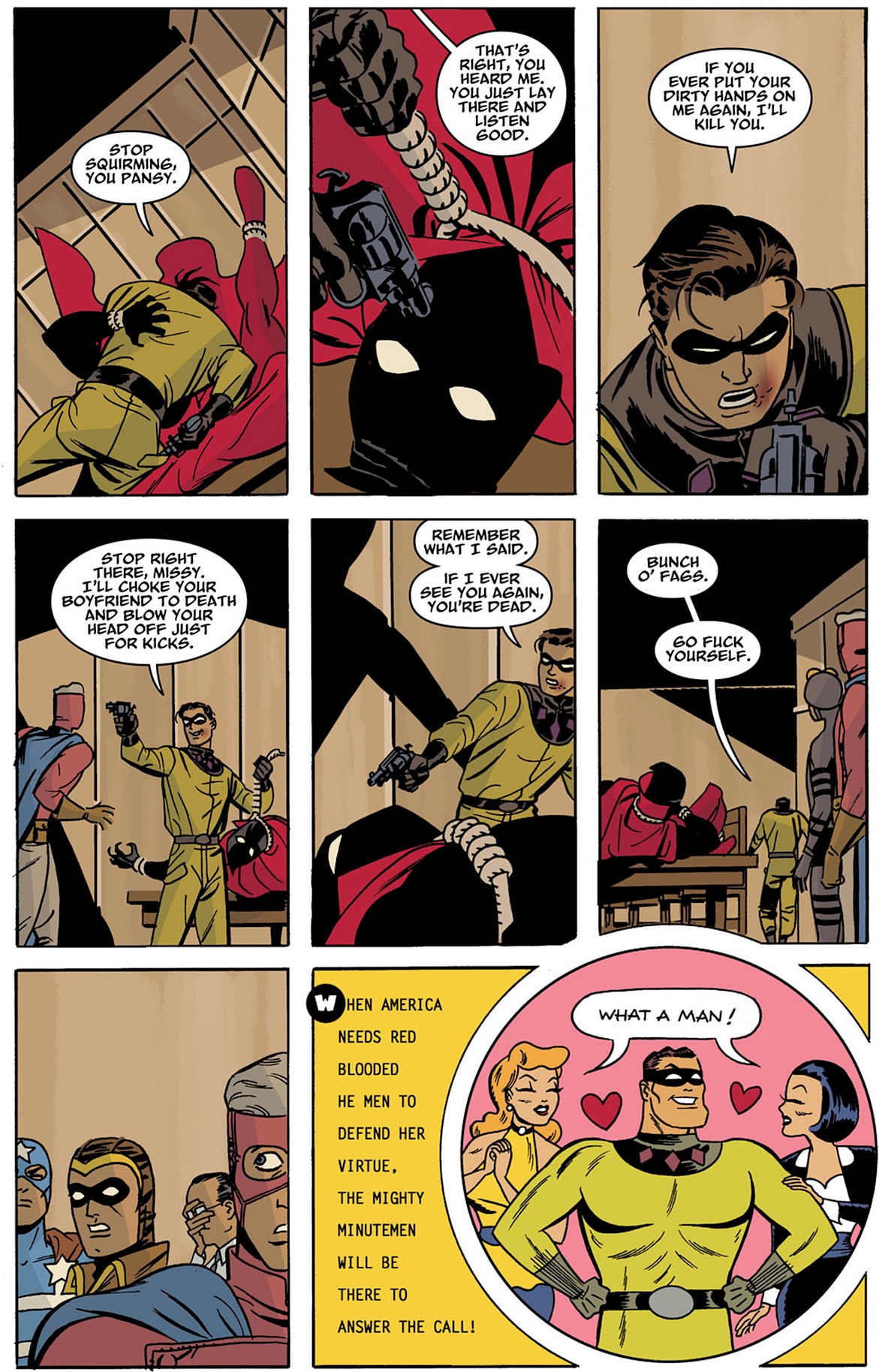
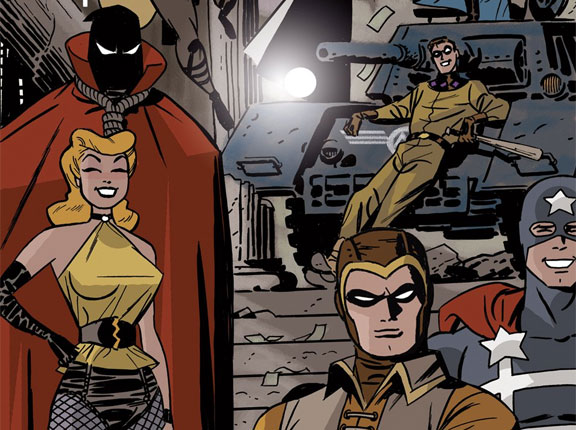
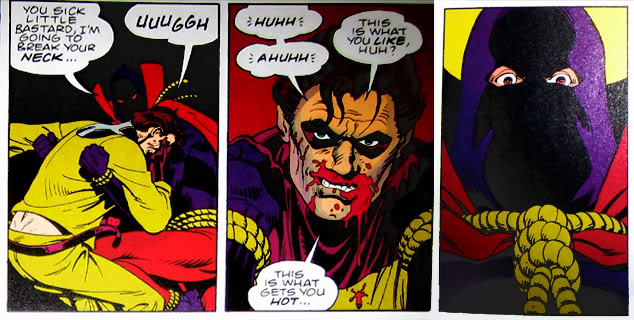
This isn’t to say that Watchmen is homophobic; on the contrary, Alan Moore in particular is, and has long been, very consciously and ideologically queer positive. But it’s undeniably the case that Watchmen‘s goal is, in part, to imagine what superheroes would be like if they were grimy and seamy and nasty and real. And part of the way it imagines superheroes as being grimy and seamy and nasty and real is by imagining them as sexual — particularly as perversely sexual, which often means queer. Indeed, the first superhero, who inspired all the others, is Hooded Justice, a gay man who gets off on beating up bad guys. Thus, the founding baseline reality of superheroics is not clean manly altrusim, but queer masculine sadism.
 

WatchmenHoodedJustice


Incipient buttcrack, bloody nose, homosexuality. You don’t get much more real than that.

The hints of homophobia in Moore/Gibbons, then, seem like they’re tied not (or not only) to unexamined stereotype, as my brother Eric suggests. Rather, they’re a function of the book’s realist genre tropes.

Which perhaps explains why Darwyn Cooke, infinitely dumber than Moore and Gibbons, ended up, in his Before Watchmen work, with such a virulent homophobia. William Leung in that linked article suggests that the homophobia is part of Cooke’s retrograde nostalgic conservatissm — which is probably true to some extent. But it’s probably more directly tied to Cooke’s effort to match or exceed Moore/Gibbons’ realism. Portraying gay characters as seamy and despicable is a means of showing ones’ unflinching grasp of truth. In this case, again, realism does not allow for the portrayal of homosexuals so much as (homophobic) portrayals of homosexuals creates realism.
 

B6.Eddie-beats-HJ

In the discussion of superhero comics, generally allegations of retrograde political content go hand in hand with allegations of escapism. Superhero comics are “adolescent power fantasies,” which is to say that they’re both unrealistic and mired in violence and hierarchy. The link between realism and homophobia, both past and present, though, suggests that when you take the opposite of adolescent power fantasies, you get adult disempowerment realities. And the groups disempowered often turn out (in keeping with realism) to be those which have traditionally been marginalized and disempowered in the first place.

In that context, I thought it might be interesting to look briefly at this image that was following me around on Pepsi billboards in San Francisco when I was there last week.

Beyonce

Obviously that’s Beyonce. Less obviously it’s basically a comic — the character images are repeated in a single space to suggest time passing or movement. And, perhaps, least obviously, it’s fairly deliberately referencing queerness. Beyonce often looks like a female impersonator, but the aggressively blond hair and the exaggerated flirty facial expressions here turn this image into a quintessence of camp. Also, note the position of her hands; one hovering around crotch level on her double, the others behind the butt. Gender, sexuality, and identity are all labile, and the lability is the source of the picture’s excitement and energy, as well as of its deliberate and related un-realism. Rather than queerness being the revealed and seamy underbelly of truth, in this image it’s a winking fantasy of multiplying, sexy masquerade and empowerment.

The entanglement of homophobia and realism may help to explain in part why gay culture — faced with tropes defining homosexuality as a sordid ugly truth — has often gravitated to artificiality, camp, and the empowerment of self-created surfaces. None of which is to say, of course, that realism must be always and everywhere homophobic. As an example, I give you…Andrea Dworkin in overalls.
 

Picture 1

 
Hooded Justice and Beyonce just wish they were that ugly, solid, real, and awesome.
 

No, You Are Not as Cool As Johnny Cash

This first appeared on Splice Today.
__________

Picture 2

“Some say love is a burning thing/that it makes a fiery ring,” Matthew Houk warbles at the beginning of his latest single, “Song for Zula.” His voice catches and the music surges and shimmers as he earnestly confides, “But I know love as a fading thing/just as fickle as a feather in a stream.”

Houk is, of course, referencing the classic Johnny Cash track “Ring of Fire.” That song is a straight ahead, hit-radio ode to the painfulness of passion — performed with Cash’s trademark trundling beat, it delivers its simple message in two minutes and a half, and then gets out. Houk, on the other hand, offers a six-minute tour de force of searingly honest vacillation — a towering work of genius rising up from Cash’s simple blueprint.

Or at least I think that’s what I’m supposed to get out of “Song for Zula”. A less charitable reading might instead see the track as a bloated, shapeless, default-hippie self-mythologizing mess.

In ostentatiously complicating Cash, Houk can perhaps be seen as offering an alternative to Cash’s baritone working-man plain-speaking masculinity. For Cash, love is fire; for Houk, it’s one thing and then another; he is a sensitive new age guy, and his feelings cannot be contained in your three minute song. The end result, though, is not so much to suggest that Houk is deep as to suggest that “sensitive new age guy” is just a euphemism for “narcissistic windbag.” The droning, fourth-drawer Neil Young imitation backing plods on as Houk praises his own sterling, uncontainable romanticism. ” My feet are gold. My heart is white/And we race out on the desert plains all night.” There’s something about a cage, something about how he’s a killer, something about being free and not being free and it’s all transcendent and lyrical. What is more romantic than to see the romantic admit that his romantic heart is afraid of romance?

In contrast, Cash’s “Ring of Fire” doesn’t come off as romantic at all. Instead, it’s stolidly hokey. The famous Mexican horn flourish makes it sound less like he’s falling into a ring of fire than like he’s unaccountably wandered into a bullfight. His phrasing, always rugged at the best of times, sounds particularly tongue-tied here. The first word, “Love,” is almost off-key; the repeated, “ring of fire/ring of fire/ring of fire” at the fade is so weirdly clunky it sounds like the record is skipping.

The only part of the Cash record that comes across as even vaguely professional is the backing by the Carter Family sisters — June, Anita, and Helen. Their mountain harmonies are mixed low…but not low enough to erase their incongruity.

That incongruity, though, is actually kind of appropriate. “Ring of Fire” was written by June Carter about the experience of falling in love with Johnny Cash — which, as she said on more than one occasion, was a scary thing to do, what with the massive pill addiction and the out of control rockstar antics.

The lyrics may sound simple, then, but the circumstances give them a complicated, and even perverse, double meaning. Cash is singing a song about falling in love with himself; he’s ventriloquizing his soon-to-be-wife talking about him, even as that soon to be wife sings in the background a song that, for most listeners, reads as being about Johnny Cash falling in love with her. Identity and gender stumble clumsily against each other, and/or melt seamlessly into one another — love is, in several senses, not being able to tell the difference. “The taste of love is sweet,” Cash intones, but whose love? Which love? Part of the sweetness, perhaps, is that awkwardness — the simple rush of falling down, down, down, and not being sure who is falling towards who.

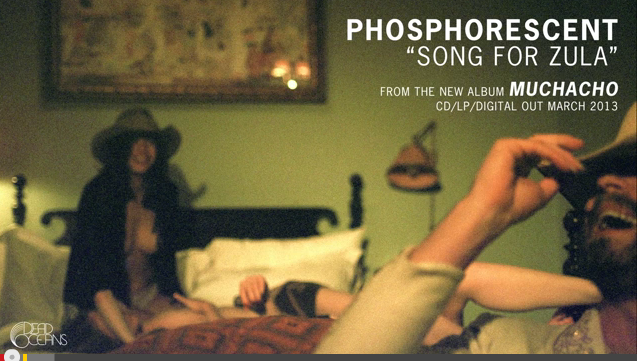
In “Song for Zula”, on the other hand, there isn’t really any other who to stumble against. Maybe that’s why the Youtube promo image for the song shows some random woman with her face blurred out and her breasts almost spilling out of her jacket sitting on a hotel bed while another women with her face obscured lies beside her and some ill-shaven alterna-bro laughs heartily in the foreground. The would-be expansive, would-be introspective balladeering is, it turns out, just a soundtrack for banal soft-core. For Houk, the problem with “Ring of Fire” is not so much the metaphor as the topic. Sensitive geniuses don’t fall in love, apparently — at least not with other people.

William Leung Kicks Darwyn Cooke’s Before Watchmen One More Time

Prodded by a comment from Eric Berlatsky, William Leung added some thoughts to his extended takedown of Darwyn Cooke’s Before Watchmen. I thought I’d reprint William’s further thoughts here, so they’re below.

I respect Eric’s opinion and appreciate that Cooke probably meant well. But as a critic I can only judge on the evidence before me. To say that Cooke has depicted the entire Minutemen as fallible/negative is contrary to the evidence. Cooke has set up a very clear moral dichotomy in his book:

Ursula = Virgin Mary with a sexy lesbian twist
Hollis = good cop / boy scout / “everyman” narrator
Byron = absent-minded nerdy genius / best buddy of Hollis
Bill = nice country lad with old-fashioned values / drink-buddies of Eddie and Hollis
Eddie = tough street kid / rough diamond / macho badass
Sally = sexy vixen / show girl with a heart of gold

Nelson = prissy, shallow, manipulative, vainglorious, incompetent fag
HJ = violent, sadistic, murderous, sick-minded aggressive fag

One can also go through some of the “positives” that Cooke has presented in his moral dichotomy:

Hollis and Byron are best buddies (friendship is good)
Hollis is in love with Ursula (romantic love is good; unrequited love is sad)
Hollis/Ursula/Byron work together to fight pedophilia (genuine crime fighting is good).
Hollis later becomes “dear uncle” to Sally’s daughter (family is good).
Hollis, Eddie and Bill are drink buddies (friendship is good)
Eddie and Sally are in love. They aren’t close to Ursula, but come to respect what she does (romantic love/respect is good).

None of the “positives” involves HJ/CM. Hollis, Eddie, Sally, Bill have at various points expressed strong disapproval of HJ/CM. Byron is too nice to speak up, but he has had to suppress his genius to follow Nelson’s bullying, incompetent leadership. The saintly Ursula doesn’t speak ill of others, but she also quits Minutemen out of disgust, and harbors suspicions that HJ is a pedophile. That makes it very hard not to say that HJ/CM aren’t pitted on the opposite side of “good”. HJ/CM do not have any meaningful bonding scenes with ANYONE (even Larry and Sally got one in Book 2). They are either bossing people around, killing people, bungling operations, falsely boasting about their achievements in public, having violent disgusting sex, leading teammates to their deaths (Bluecoat and Scout), wallowing in self-pity, self-defeatingly blowing up their property, and being beaten/killed in a humiliating way. And that’s about it.

In Moore, we at least have glimpses of their humanity. Nelson, while a bit of a fool and push-over, seems idealistic, polite and kind (he is concerned about Byron’s health at the reunion party in Book IX). HJ has a violent, nasty side, but he has done some genuine crime-fighting (foiling a bank robbery; preventing a rape (not just Sally’s); note also the panel where he sensibly douses Eddie’s youthful enthusiasm to fight in Europe where the “action” is). In Cooke, I can’t find one scene that isn’t either downright negative or suggestively negative. Even after looking hard, I can’t find one redeeming quality to these characters. Not one. If anyone who has read “Minutemen” can present contrary evidence on this point, I’m happy to listen and reconsider my argument.

I don’t understand the point about the cover-up. The cover-up happens specifically in Moore’s story, not Cooke’s. In “Watchmen”, Larry is responsible for the cover-up: “Schexnayder had persuaded Sally not to press charge against the Comedian for the good of the group’s image, and she complied” (II.32). In Cooke, HJ/CM seem to run the show (Metropolis had “convened” the meeting), but more importantly, there is no need for a “cover-up” because the rape may not even have been a rape! Note how Cooke introduced the scene: “Apparently, Hooded Justice intervened BEFORE it went too far.” In Moore, things had ALREADY gone too far – there is the visual evidence of Sally being punched, kicked, pinned to the ground, and on the verge of being penetrated. I don’t accept that Cooke is “assuming” that we already know what happened – I’m saying that he has set out to portray a different version of what happens. In Cooke, there is no witness to the incident apart from HJ, and the only visual evidence is the bruises on Eddie’s face, so it is open to interpretation that HJ assaulted Eddie over a minor infraction! And the only relevant “cover-up” that is mentioned is the one put there by Cooke in Book 1, involving HJ/CM’s cover-up of the bungled firecracker factory operation. It is this particular “cover-up” that infuriated Eddie into challenging the judges on this “kangaroo court”. Eddie is saying: how dare those fucking corrupt, hypocritical fags judge me when all I did was make a clumsy pass at Sally? Cooke then validates this outrage by showing Eddie defeat and expose HJ/CM in the one page scene cited in the essay. This version of the truth is supported later in the reconciliation scene, where Sally didn’t react angrily to Eddie’s sudden appearance at Ursula’s grave because they merely had a “misunderstanding”. This completely rewrites the canon version of events: “I shouted at him”; “I tried to be angry.”

Re Laurie’s biology – yes, Laurie says that she will wear a mask and carry a gun and that is a reference to her father. But look at the trajectory that her character has gone through in the original – it happens after she has confronted the truth about her parentage, let off some steam about it, processed it, come to understand that holding onto hate isn’t the way to live (witnessing an entire city being decimated tends to put things into perspective), made an effort to patch things up with her mum, and prepared to move on. At that stage, she is ready to acknowledge her biology and forgive her father. It is a conscious, informed decision by a mature, independent woman – a far cry from being some sexy young chic subconsciously acting out her daddy’s blood-lust in some oh-so-cute parallel fight scenes!


darwyncookeartbeforewatchmenmain

Utilitarian Review 6/8/13

On HU

Featured Archive Post on the dreadfulness of Darwyn Cooke’s New Frontier.

Eric Berlatsky on how Darwyn Cooke’s Before Watchmen may be just slightly better than that.

John Hennings on how country music got more racist.

Alex Buchet on some oddities of Uderzo and Jacobs.

RM Rhodes with a guide to what to see if you’re a comics fan in Brussels.

Isaac Butler on the boring beauty of Upstream Color.

Chris Gavaler on the Hollywood superhero and 9/11.

Me with a brief NSFW survey of porn comics through history.
 
Utilitarians Everywhere

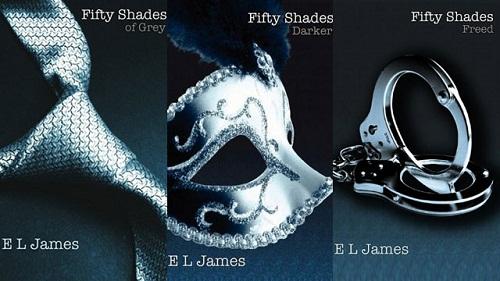
I contributed to a roundtalbe on 50 Shades of Grey over at Public Books.

At the Atlantic I talk about how Hollywood puts icons ahead of people.

At Splice Today I write about:

Male fantasies and feminism.

How freelancing eats the soul.
 
Other Links

Jon Reiner on the modern writing school paradox.

Kelly Sue Deconnick on comics and sexism. (Edited because I was confused on the initial description.)

The city of Chicago sucks.
 

fifty-shades-of-grey-trilogy

Sequential Splortch

I wrote this some years back for a sex toy website. I don’t think they ever published it…so I thought I’d finally run it here.
______________

“You think they [comic books] are mostly about floppy-eared bunnies, attractive little mice and chipmunks? Go take a look.”
—cover flap of Frederic Wertham’s Seduction of the Innocent

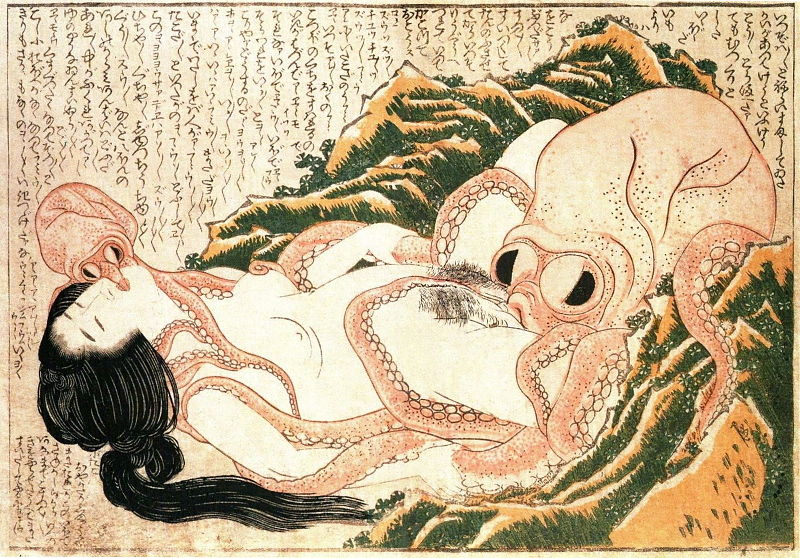
Erotic comics first surfaced in the dim dawn of pre-history among cave-dwelling ungulate-fetishists who, in animistic rituals, drew upon the stone walls choice mammoths with whom they wished to have congress. Some time thereafter, in the early 1800s, the Japanese developed…SHUNGA! Which is pretty much what it sounds like.

Perhaps the most famous shunga illustration is Hokusai’s The Dream of the Fisherman’s Wife, which, coincidentally, also features a rape-by-mammoth. Ha ha. No, of course it doesn’t. It actually features a rape-by-octopi.
 

800px-Tako_to_ama_retouched

 
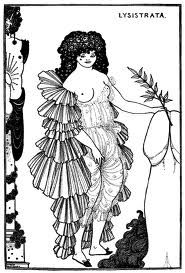
Lascivious, decadent Europeans, inspired by such hot-and-heavy Japanese print-making, erected sophisticated fantastic visions of their own. Here, for example, turn-of-the-century Brit Aubrey Beardsley makes a subtle phallic reference.

images

Can We Get More Animation Down There, Please?

If you studied the pictures above very closely, you probably need to stop and take a deep breath. If you examined them somewhat more cursorily, you probably noticed that they’re not actually comics — just influential genital progenitors, as it were. Comics as we know them coalesced as a form in the early 1900s. At first, of course, they were mostly aimed at kids, so sexual content tended to be muted. Winsor McCay drew the occasional picture of a woman in bed with a warthog, but that was about as racy as it got.

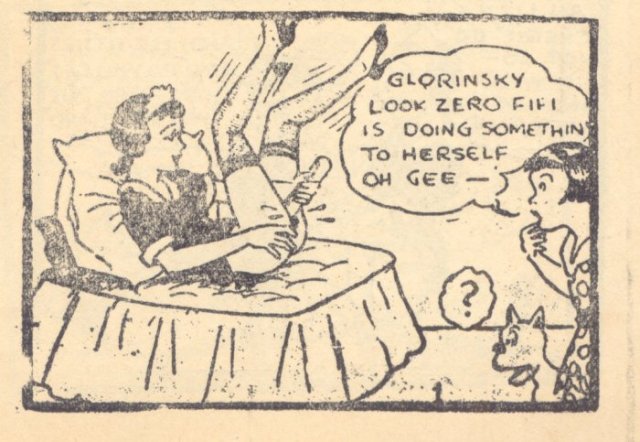
No form can escape filth forever, though. By the 1920s, cutesy childhood icons were frolicking like hardened whores across the pages of crude 4″ x 6″ pamphlets known as Tijuana Bibles. Violating propriety and copyright with equal vigor, these eight-page narratives featured such familiar faces as Popeye, Dick Tracy, Flash Gordon and the eternally underage Little Orphan Annie demonstrating the use of heretofore unillustrated appendages.

Little_Annie_Rooney_and_Zero-1

Tijuana Bibles were most popular during the Great Depression, when most people were too poor to afford orgasms. During the late 50s, though, men’s magazines began to publish real photographic evidence that anatomy existed, stimulating the poor Tijuana Bibles right out of existence.

Balling with Gags

Luckily, the girly mags were a fickle bunch; photos may have been their true love, but they inevitably had a passel of mistresses on the side. These included gag cartoons. From Eldon Didini to Jack Cole (of Plastic Man fame) to Dan DeCarlo (of Archie fame), some of the biggest names in comicdom set their work atop clever captions like “The job is yours, Miss Bigelow, providing you fit just as well on my partner’s lap!” and “Two aphrodisiacs please!” Not that anyone was looking at the captions, exactly.

The pinnacle of men’s magazine cartooning is generally considered to be Little Annie Fanny, a strip cartoon which ran sporadically in Playboy from 1962 to 1988. Written by Mad-magazine alum Harvey Kurtzman and lavishly painted by Will Elder the titular character (in various senses) was an empty-headed naif who kept stumbling into preposterous situations, upon pop cultural tropes ripe for satire, and out of her clothes. Mostly that last one.

Under Where?

Men’s magazine illustrations were aimed at a broad, mainstream audience, and so were fairly tame by earlier illustrational standards; visible penises were a no no, much less octopus rape. With the late sixties underground comix movement, though, more idiosyncratic perversions became available from a head-shop near you. S. Clay Wilson’s raunchy fornicating bikers, satyrs, and pirates led the way, but even more influential was R. Crumb, whose comics indulged his fetish for large, powerful women and their hindquarters.

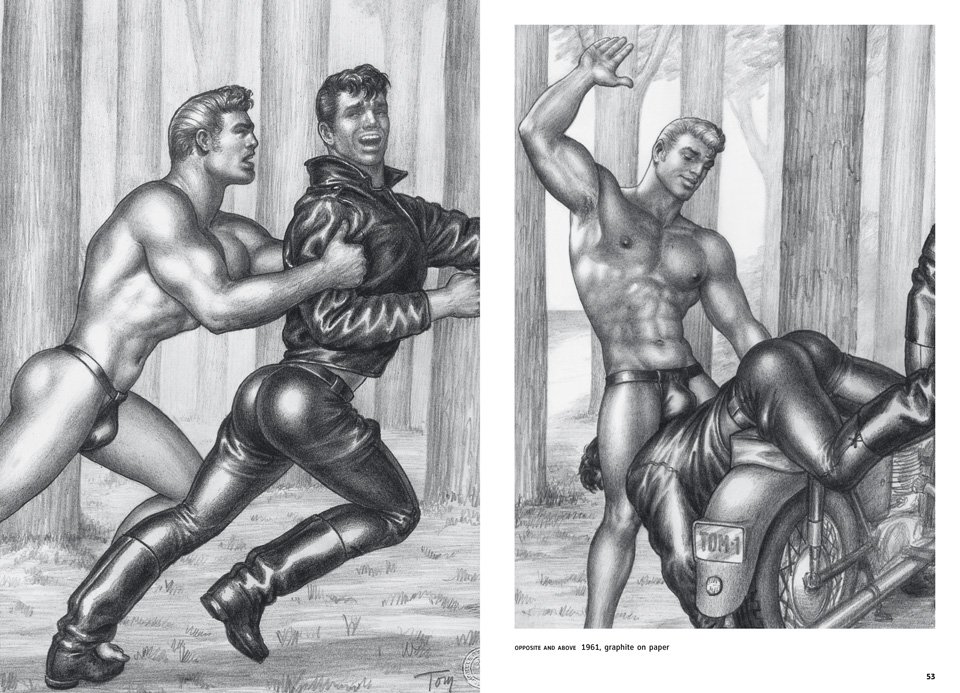
In Europe, one of the most influential underground cartoonists was Touko Laaksonen, better known as Tom of Finland. His well-endowed, pumped-up, and frequently pumping leather-clad, uniform-sporting men were hugely popular through the 60s and 70s, and remain widely recognized and (ahem) utilized today. Laaksonen was even an important influence on the visual style of the Village People. Eat your heart out, Jack Kirby.

page_rc_25_tom_of_finland_comic_ii_03_1111301228_id_523439

The undergrounds opened the way for independent comics in general, and for more sexual and personal material in particular. At the extreme is Johnny Ryan, whose supremely and surreally filthy comics have at various points featured disembodied invisible anuses, severed butt-cracks, quarts of Dracula piss, and sex with midget Hitler. Much more literal is David Heatley’s “My Sexual History” which, like the title says, is a chronicle of every sexual encounter the author has ever had. Other autobio creators, from Jeff Brown, to Julie Doucet, to (my favorite) Ariel Schrag, have also chronicled their sexual lives in detail that veers between the arousing and the more-information-than-I-really-want-to-know-thanks.

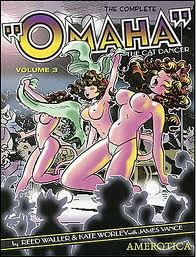
One of the most acclaimed independent adult titles is Reed Waller and Kate Worley’s 80s series, Omaha the Cat Dancer, a sexually explicit soap-opera with funny animals (the title character is actually a feline…more or less.) Equally idiosyncratic is Alan Moore and Melinda Gebbie’s 2006 Lost Girls, which features Wendy from Peter Pan, Dorothy from The Wizard of Oz and Alice from Alice in Wonderland musing on matters philosophical while engaging in a marathon of sexual trysts.
 

images

 
Porn actually played a vital part in the survival of one of the most respected independent comics publishers. Fantagraphics — whose catalog includes Dan Clowes and Los Bros Hernandez — was poised to go out of business in the early 90s. It was saved in part by the launch of its adult-oriented Eros line. It’s kind of funny to think that there would be no Chris Ware as we know him without concupiscence and gushing bodily fluids (though that’s true for all of us, I suppose.)

Foreign Trollops

Influential European comics with sexual themes began to appear in the early 1960s. Guido Crepax’s character Valentina started her erotic run in the Italian comics magazine Linus in 1963; Crepax would go on to work on graphic adaptations of porn classics like Histoire d’O and Justine.

Another Italian, Milo Manera, is perhaps Crepax’s most famous heir. Both artists have had work appear in Heavy Metal, an American offshoot of the early 70s French magazine Métal Hurlant. Heavy Metal’s Europulp-fantasy-smut remains a touchstone in American comics, from Frank Thorne’s Lann to Michael Manning’s ongoing fetish, gender-bending, humidly romantic, paranoid cyberpunk opus In A Metal Web.

The real top in recent foreign-on-American porn, though, has been Japan. Manga, or Japanese comic books have penetrated…er…pushed their way into…um…stickily saturated? Anyway, they’re very popular in America, and porn manga is no exception. For those who want to be taken seriously by your local otaku, Japanese porn is usually referred to as hentai. Hentai can refer to any number of fetishes, some of which (giant breasts) are fairly mainstream, others of which (girls-with-penises, tentacle rape, or sex with underage-appearing girls, known as lolicon) are less so.

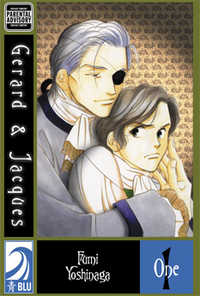
From a western perspective the most unusual hentai genre,is probably yaoi. Yaoi depicts homosexual relationships between beautiful men, but it is created by and marketed mostly to women. In contrast to gay porn for gay men, yaoi tends to feature complex characters and intricate relationships — it is, in other words, a romance with lots of gay sex added. Pundits often like to claim that girls like yaoi because identifying with boys is more distant and somehow safer. Probably the real appeal is more straightforward (ahem) — if you like to look at pictures of hot guys having sex, surely two is better than one? In any case, yaoi has proved quite popular with het- (and not-so-het) female readers in the U.S. Among the most popular titles featuring boy-romance are Maki Murikami’s Gravitation and Sanami Matoh’s Fake. More consistently explicit fare includes Youka Nitta’s Embracing Love and Fumi Yoshinaga’s Gerard and Jacques.

cover

In the Future, There Will Be Only Virtual Sex

Paper publishing is currently in the middle of a death-spiral, and porn comics have certainly taken a hit as well. Yes, a wide array continue to be available for all tastes, from furry-friendly-fare like Richard Moore’s Short Strokes to trans fetish fare like Roberto Baldazzini’s Bayba: The 110 BJ’s and Christian Zanier’s Banana Games to always-popular vampire erotica like Frans Mensink’s Kristina Queen of Vampires . But it seems likely that in the near future most explicitly pornographic comics will be online — like current Indian semi-sensation Savita Bhabi series. Dirty drawings never die…they just digitize.