La Maggie La Superhero


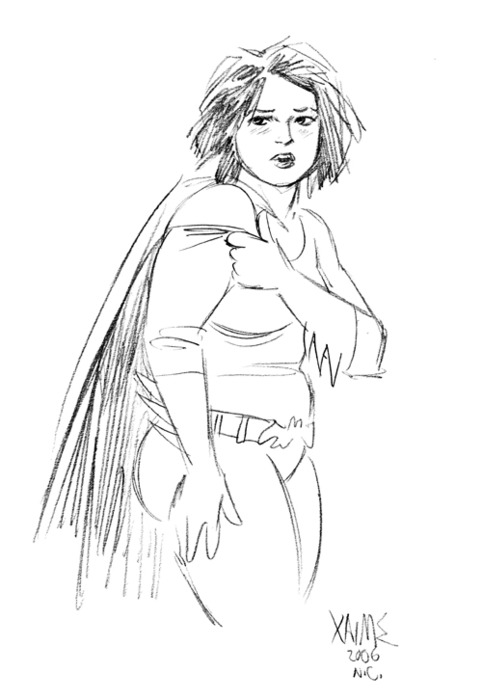
(Convention sketch by Jaime Hernandez from Batgirl, Heck Yeah!)

Despite being one of my favorite comics artists, I’ve always found it hard to write about Jaime Hernandez’s work. I have managed to take both a micro (one page)[1] and a macro (the whole Locas series) approach, so this time I thought I’d try to address a single story. But as I read and thought about it, I again found it difficult to address a single story without moving out to the series as a whole. Thus, I offer these thoughts that came from reading “La Maggie La Loca” and “Gold Diggers of 1969” as found in Love & Rockets v.2 n.20 (Summer 2007)[2].

“La Maggie” originally appeared in the New York Times Sunday Magazine as a weekly serial (the second of their “Funny Pages” comics). It is hard to imagine how a new reader would approach this story. Hernandez drops in information for the new reader, but also leaves much unexplained (who is this “Hopey” on the phone who is mentioned so casually then never heard from again). He seems to be attempting to reach both the new and the long time reader (appropriate for the context), but I wonder how effective, in the end, this can be. Does, as the story progresses, Maggie’s inability to communicate with Rena or the fact of her 40th birthday and the corresponding feelings of aging and failure mean anything to someone who hasn’t been following the character’s life story as found in the rest of the series? As a standalone story, the emotions seem a little unearned without the stories that precede it (which can be both a strength and weakness throughout the series).

As I thought about the new reader and how one would fill in the details for him/her, it brought me back to oft-repeated comments about trying to explain a single superhero comic to someone, and how there is so often such a built up accretion of material that the story (a single issue of a comic book) cannot be appreciated as a individual narrative (for example, I think here of the Chris Claremont written Uncanny X-men stories that were one of the first comics series I read as a kid). This made me realize that despite its longstanding place as a key “alternative” comic to the “mainstream,”[3] Hernandez’s work shares so many components with those mainstream superhero books, perhaps more than it shares with the modern “graphic novel,” placing the Locas stories in middle ground between the two. In one of my previous posts on Locas I wrote: “For someone who is so clearly influenced by and still interested in superheroes, his work is a kind of diametric opposite to the ageless superheroes.” But now I find myself rethinking that statement from my 2008 self. There are many ways Locas is the opposite of the superhero genre, but the two also share a number of elements.

Perhaps this is an obvious revelation, as Hernandez has never totally left behind superheroes. Since its science fiction origins, the series has made use of superheroes in varying diegetic levels (sometimes as part of world of the characters, sometimes as part of those character’s reading material (we know Maggie and Ray both read comics)). As recently as Love & Rockets: New Stories issues 1 and 2 (coincidentally, the comics that immediately followed the revised version of “La Maggie”), Hernandez featured a superhero story (a recent low point of the series). Even disregarding said superhero appearances, the connections are numerous once I started in that direction.

On thinking it, I realized how much the Locas stories probably do fill a similar place for me as superhero comics do for a lot of comics readers. In his post last week, Noah noted “the years and years of investment in the characters, by both the author and his readers.” The reader of Locas, especially the longtime reader, is invested in the characters, much in the same way a longtime reader of a superhero comic is invested in the character(s). And not just the character, but the diegetic world itself, the world that is just this side of the real world (a little further away for the superhero comics, though not by much when taking Locas as a whole). As so many of the recent reviews and comments on “Love Bunglers” have shown, readers have an emotional investment with the characters (especially Maggie, the protagonist).

This connection (and others below) are, admittedly, as much about serialized narrative, as they are about superheroes as a genre, but in comics this type of narrative is more associated with superheroes than any other genre (at least in the present day). In these narratives there is no overarching theme/plot (unlike a traditional novel) beyond the lives of the protagonists. The (seemingly) endless serialized narrative can be found in comics since fairly early on in the history of comic strips (Gasoline Alley to name one), but has since become the province of the “mainstream.” While the comic strips were a daily serialization, made of small pieces strung together, work like superhero comics and Locas are series of longer, slightly more independent stories. Similar to many superhero comics, Locas’ serialization tends to be short narratives with the occasional, multi-part, “to be continued” limited series mixed in. Locas has even had one spin-off series, Whoa Nellie, not unlike a mini-series spin-off from a superhero series.

We can also posit “guest stars” in Locas. The appearance of Rena and Tse Tse in “La Maggie” acts much like a guest appearance in a superhero comic: a character from some previous story returns, offering the “in the know” reader an extra level of engagement with the story. This sense of the reader’s experience with the world of the narrative is an important part of superhero comics and is a primary factor in Locas (again, Noah, did some of the work for me in addressing this issue, though I am more positive on it than he).

Locas even has a few of its own “origin stories.” A case in point (and one I just noticed this time around) is the “Gold Diggers of 1969” strip that runs below “La Maggie” in Love & Rockets v.2 n.20. While the story, drawn in Hernandez’s Dennis the Menace/Little Archie style, shows a very young Maggie as she meets elements of the adult world she doesn’t yet understand (like hiding from bill collectors), the experienced re-reader discovers that the story also contains the birth of Maggie’s brother Calvin, who features so prominently in Love & Rockets: New Stories no.3 and no.4 (2010-2011). The work tends to encourage rereading as a way to better extract the clues from the latter stories as the world and characters are built up.

When we take this road, it’s not hard to see Maggie as the superhero (she is the real protagonist of the series) with a few sidekicks over the years (Hopey early on, Ray, and even, shortly, like the Robin that just didn’t stick, Viviane). Like many superhero protagonists, we have seen her past revisited and rewritten. Hernandez doesn’t explicitly change Maggie’s past, but he does return to the past quite frequently (which Marc just addressed yesterday), adding in narrative information. “Gold Diggers of 1969” does that with another element of Maggie’s childhood, including the birth of Calvin. Further in the past, the story about Maggie’s marriage rewrote/added to elements of the characters’ past as a way to build on the present.

From an industrial standpoint there are also certain similarities of production. Love & Rockets has had a few relaunches (volume 2 and now “New Stories”), with format changes and new number ones. There were even the years of retitling (Penny Century in Locas’ case). Collections of softcovers and hardcovers and deluxe hardcovers and new softcovers are also not dissimilar to the way superhero comics are published. These are pretty much just part of the industry, an increasing (over the course of Locas) shift between the “direct market” and the (non-comic) bookstore market.

Of course, there are also many ways that Locas differs from the superhero genre, foremost being the lack of emphasis on violence and crime as well as the way time works. In Locas time exists both for the world and the characters. Superheroes never really age, time never really moves forward for them, despite the world they exist in changing with the times. Maggie and her world do move forward, characters change and age, as evidenced again in “La Maggie” where the narrative revolves (in retrospect) around Maggie’s 40th birthday (do superheroes ever have birthdays?). This changes the way the reader interacts with the characters. Superheroes are essentially static, and reading them is revisiting endless static variations of the character. The reader of Locas is always faced with the changes of time, the past in the present and the present in the past. Hernandez explicitly pushes this point throughout the series, taking, to stick with our story of focus, as an example the way he reprinted “La Maggie” with a strip beneath it featuring Maggie as a child. The recent “Browntown”/”Love Bunglers”/”Return for Me” stories also push this point with heavy use of analepses in the narrative (again see Marc’s post from yesterday)[4] .

And while superhero comics (for the most part) tend to have changing creators working on a corporate property, Locas is just one artist who owns his characters and stories. Though, Hernandez never seems to remain completely static, if the reader is not seeing an actual change of writer or artist, the long time reader does become attuned to Hernandez’s stylistic evolution and narrative experiments. Which also brings us back to “La Maggie.”

“La Maggie” differs from other Locas stories in a few immediately obvious and other not so obvious ways. It is, as far as I am aware, the first page-by-page serialization in the series. Reading this in a collection, this is most noticeable in elements of the page layout–the colored caption that starts each page as well as the signature that ends each page–but also in the narrative structure. The page as a narrative unit and the repetition of broader narrative moments in the text.

Less obviously different, is the use of narration. In many decades of stories, Hernandez uses narration only in specific contexts. The primary one is through the character Ray Dominguez. Ray’s stories tend to be narration heavy. The reader learns a lot about Ray through his first person narration. This creates a rather different relationship with the character for the readers. Ray tends to be more transparent as a character (we know what’s he thinking and feeling), which is a change from both Maggie and Hopey who remain more opaque. We have to infer their feelings and thoughts based on their actions, spoken words, and the way Hernandez visualizes the stories. The narration in “La Maggie” doesn’t totally break from this tradition, as it reads like a letter to a friend rather than an internal monologue (as Ray’s narration does), and, in that way, it recalls the first time Maggie met Rena in the first story from Love & Rockets v. 1. Like many other aspects of this story, it seems to be another callback for the long time reader, because as far as I can find (skimming all the collections) there’s only one other, very short, story where Maggie narrates (“Angelitas” from v.1 n.45) (In the comments below, Marc Sobel corrected me, noting that “Angelitas” is actually narrated by Maggie’s sister, Esther. Some poor skimming on my part.). So in a way it is another mark of the continuity of the series, and the calls back to the past.

So, having made this comparison, what can I draw from it? As I noted above, by looking at Locas as a superhero, a.k.a. “mainstream”, we see how this bastion of the “alternative” comic is not all that different from the mainstream in many ways. The stories in volume 1 of Love & Rockets especially go through a process of evolution, starting from the “mainstream” and moving into the “alternative,” as Hernandez (mostly) leaves behind the sci-fi/superhero elements that are so prominent in the beginning. What is interesting to consider is how much the “alternative” has moved past this model into a place where Locas can’t go: the stand-alone lengthy narrative (a true “graphic novel” if that term weren’t such a misnomer in most its usage). The literary graphic novel that has risen in the decades since Love & Rockets started has become a whole other type of comic, leaving Locas as an anomaly in many ways, standing beside the superhero comics as one of the last (along with Archie[5]) of the endless comic book serializations[6].

(Addendum: This essay came as a surprise to me when I sat down to rightwrite about Locas, so I’m sure it is rife with propositions that should have been thought through much more thoroughly and carefully, but thus is the way of writing with a deadline.)

_____________

The index to the Locas Stories roundtable is here.

_____________

[1] Also some here and here.
[2] The former, but not the latter, is also found in The Art of Jaime Hernandez by Todd Hignite (Abrams, 2010). I’ll refer to the former as “La Maggie” from here on in to save space.
[3] I have to put these in quotes, because I find the terms so annoying, despite being hard to avoid.
[4] It’s nice how some of the previous roundtable participants are helping me save time by addressing some of the parts I didn’t fill out as I drafted this post.
[5] Archie might on the surface be a better comparison than superheroes. I’m having trouble coming up with any other examples. All the big serialized narratives from the 80’s-90’s that I recall are now completed or gone, and most/all of the completed ones were more directly novelistic than Locas is.
[6] I say “comic book” because I’m not knowledgable enough on the mainstream/popular side of manga/bande dessinee/etc. to comment on the existent of these types of narratives. I think some parallels might be made with bd album series that are, in a way, the bd version of superheroes (ie long running popular genre serializations).
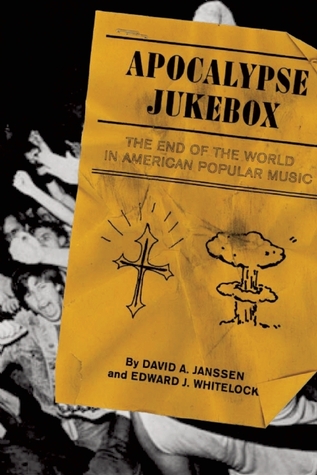

Rock The Apocalypse

A version of this ran on Madeloud.
___________________

The central thesis of David Janssen and Edward Whitelock’s book Apocalypse Jukebox: The End of the World in American Popular Music is sound — there is a lot of American popular music that deals with the end times. Unfortunately, the vast majority of apocalyptic music at this point in history falls under the rubric of “metal”, a genre in which Janssen and Whitelock have no interest. Instead, the two of them are standard issue rock critics, which means that their canon is comprised of the usual holy trinity: roots rock, punk, and a couple random token black guys.

What this all means is that the Jukebox in the book’s title is probably more important than the Apocalypse. Rock’s canon, and its criticism have never really gotten out of the sixties and fifties — for Greil Marcus and all his bastard heirs, the real music still comes on 45s, or at least sounds like it wants to. For all their claims to revolution and/or apocalypse, roots rock and its criticism are both very much nostalgia exercises, compulsively referring back to…well, to their roots, in blues, country, and whatever other authentic volk music is handy.

The contradiction here is that those volk musics were, in fact, obsessed with future Armageddon, as Jannsen and Whitelock clearly demonstrate in the early, and best, part of the book. From bluegrass duo the Louvin Brothers harmonizing about retribution for sins, to the Spirit of Memphis Quartet calling the Lord on an atomic telephone, to rockabilly bombshell Wanda Jackson comparing herself to the annihilation of Hiroshima in “Fujiyama Mama”, American music demonstrated a communal fascination with Armageddon.

That “communal” bit is key. Individuals die all the time, but civilization goes on — except in the apocalyptic vision, where everybody dies, all at once, and the community itself is destroyed. Apocalypse, then, is in some ways an ultimate vision of togetherness and group identity. Whitelock and Janssen express some surprise that “Fujiyama Mama” was a bigger hit in Japan than in America — but of course it was. The song is talking about Japan, after all. Why wouldn’t the Japanese community embrace it?

Apocalypse, then, serves as a kind of social glue, a common ideology. In bluegrass, the saints will be separated from the sinners; in metal, abject nothingness, variously defined, will consume the world. Organized around apocalypse, both of these forms put a high premium on adherence to strict formal structures — dedication to a shared communal aesthetic vision. As Jello Biafra noted, no high school gym; teacher ever had as much success in getting kids to dress alike as metal does. Everybody dies together, so everybody lives together. Nobody stands out.

And in rock? Well, that’s the rub, isn’t it. There is no shared vision in the kind of critically acclaimed rock that Whitelock and Janssen are discussing. On the contrary, the whole point of the genius rockstar is a hyper-cultivated, hyper-marketed, endlessly fetishized individuality. The artists that Janssen and Whitehead have chosen to analyze are deliberately unalike — they use apocalypse in different, individualized ways. For Leonard Cohen, the apocalypse is a metaphor for his divorce; for Green Day it’s a metaphor for adolescence; for Devo, it’s a metaphor, contradictorily, for deindividuation and conformity. Regular folks may all go out the same when the fire comes, but each genius has a different end.

Whatever there other eccentricities, though, the daring individualists that Whitelock and Janssen love do share one trait in common: ambivalence. They’re all complex…or, if you prefer (and in the case of Michael Stipe, literally) inarticulate. Apocalyptic songs tend to celebrate the great simplification of the end — God will set your fields on fire, the traditional bluegrass lyrics insist; trying is not enough, roars Khanate. There’s not a whole lot of wiggle room there. But for Whitelock and Janssen, the apocalypse is yet another excuse to validate, not self-obliterating finality, but self-absorbed complexity. Dylan may insist that you have to serve somebody, but his burnt-out Beat poet doggerel mush ensures that, from song to song, it’s almost impossible to tell who — or, as the authors rhapsodize, Dylan’s audience keeps “bumping into mirrors on all sides.” Arthur Lee enjoys “playing with cacophony,” multi-tracking his voice singing different lyrics simultaneously in order to create a sense of “unreliability” and ambiguity. Devo both embraced and satirized pop success. R.E.M., through the power of refusing to enunciate, both did and did not make sense. They’re all having their Armageddon and maintaining their ironic distance from it too.

Which is to say that, as I read through this book, I started to suspect that for most of these performers, and, indeed, for the authors, the apocalypse was not so much a matter of belief as of self-dramatization. Like Samuel Jackson in Pulp Fiction, what the apocalyptic rhetoric means is less important than the fact that it is “some cold-blooded shit.” It’s a way of demonstrating rootsy bona-fides, much like boasting about your sexual prowess, or bragging about shooting your woman. The apocalypse is turned from a negation of self into a validation of it. The vision of a (supposedly) more authentic community is reified as part of some individual genius’ ambivalent contradictions. The go-to figure here is, of course, Harry Smith, whose “social music” volume of the Anthology of American Folk Music collected examples of 20s and 30s performers like Blind Willie Johnson warning of the coming end.

For critics like Janssen and Whitelock, however, those warnings become not literal calls to clean up your act, but secret subcultural testaments to Smith’s genius. They rhapsodize about Smith’s “sequencing” and about his decision to give no information about the race of the musicians he is appropriating — eclipsing their communal identity with his own liberal, proto-hippie, idealistic individualism. Smith’s final message, according to the authors, is “This is an imperfect world we have created, let us not uncreate it.” They limn this as apocalyptic — but surely it’s precisely the opposite. Celebrating imperfection, claiming that “we” have made the world — that’s not eschatological. It’s humanist.

At the end of the book, the authors more or less admit that humanism is where their sympathies lie. Working off of feminist writers like Lee Quinby, they highlight the cruelty and exclusionary nature of apocalyptic thinking, and praise Sleater Kinney for, refusing to “do ‘no future’ punk.”

It’s fair enough to point out apocalypse’s downside, certainly…but humanism has its problems as well. Specifically, to put your faith in the human (or in your rockstar heroes) is the definition of worshipping idols (and, indeed, the authors point out that poor John Coltrane has had a Christian church established in his name.) The human isn’t divine; to pretend that it is, you have to steal mojo from somewhere — a communal past, say — and then pretend that that theft is an act of generosity or continuity, betraying the faith you claim to espouse. A personal apocalypse isn’t an apocalypse at all; it’s blasphemy. If rock is the devil’s music, as Janssen and Whitelock ambivalently claim, it is not because it embraces apocalypse, but because it doesn’t.

Punk Rock Girls

Since we’re doing a Jaime roundtable, I thought I’d break out some old punk reviews for the intermission. This Shonen Knife first appeared on Madeloud, the Forever review I think was pubished in Bitch Magazine.
___________________
 
Shonen Knife, Free Time

I haven’t heard any of Shonen Knife’s albums since 1998’s sublimely silly Happy Hour. Honestly, I wasn’t even aware that they were still a going concern. So when I picked up their latest, I was excited, but a little nervous as well. They’ve replaced their founding bassist, they’re a decade past their heydey — Lollipops and Fish Eyes forbid, but…is it possible that they suck now? Could their cuteness have curdled?

I needn’t have worried. Shonen Knife’s formula has stayed the same: Ramonesesque three-chord songs backing adorably dada lyrics about food, animals, or any other topic as long as it is treated as if it were a food or an animal. It’s simple, it’s unpretentious, and — even if the indie scene has moved on to other things — it works every bit as well in 2010 as it did in the 90s. The most characteristic outing here is undoubtedly “Capybara,” an insanely catchy tune about…well, you know. “South American animal/always biting grass….roly-poly body shape/swimming very well.” Sing it in a winsome female voice with a Japanese accent, shifting into a Beatles-y psych chorus to announce “Sleeping, biting, all the time/Sleeping, snoring, all the night” — it’s so comforting. In fact, the only way it could possibly be improved is with a techno version sung in Japanese — which is thoughtfully included as a bonus track.

“Comforting” pretty much defines Shonen Knife’s whole aesthetic. Greil Marcus and a million sad aging morons may point to the Clash and mumble incoherently about fighting the power, but in Japan they know that punk is music to shake your toddler to. “Rock N Roll Cake” isn’t about keeping the faith — it’s a recipe for woolgathering. (“Rock cake/ I want to sleep inside it…Roll cake/I can have funny dreams.”)

Even a song like “Economic Crisis” is not a call to arms but a cheerful ditty. And “Perfect Freedom” isn’t about the allure of Dionysiac abandon, but is instead a thoughtful, cautionary note from your mildly dotty aunt. “An…archy in the UK/it might be a mistake.”

“Love Song” though, is my absolute favorite. The band nods to girl group garage with a tune that adds some sway to the rock as they sing about how they don’t really like love songs, but everyone likes to listen to them. “Maybe I have a strange mind,” they muse, and then, in half parody, half capitulation, they start trotting out the clichés. “I want you, ooooo/ I need you, oooo/ such phrases/embarrass me.” The completely disarming sincerity of the distanced disavowal sung in those little girl voices just about breaks my heart. There are another six albums that Shonen Knife released over the last 12 years, and I’m thinking I’m going to have to go back and get them all.
_______________
 
Forever, Forever

According to their press materials, Forever was conceived in a van. While travelling as part of Me and My Arrow, Shenna Corbridge (vocals), Jen Nigg (bass and vocals), and Joel Lopez (drums) got the opportunity to go on another tour instantly. Their bass player didn’t want to…so the remaining three just picked up a fourth (guitarist Jael Navas), formed a new band and went anyway.

Forever certainly sounds like it’s the brainchild of a bunch of folks who want the road to go on…well, forever. The music is enthusiastic, unpretentious, professional pop-punk that hits all the genre expectations — fast (but not too fast) tempos; catchy, familiar hooks; raw (but not too raw) production; vocals with a tinge (though just a tinge) of cowpunk swing.

Live, I bet they’re fabulous; enthusiastic, as happy to play in front of 2 people as in front of 300, in love with the true-believers thrashing away in the audience. On record, though, it’s hard to see the point. Not that there’s anything wrong with Forever, just as there was nothing wrong with the first million bands that sounded exactly like them. The only real variation on the 15-minute record is “Who’s Haunting Me?” which picks up speed enough to verge on hardcore. It’s hardly earth-shattering, but when you’ve been in the van this long, any change in scenery is worth pointing out.

Listen To If: You’re a Very, Very Old Punk or a Very, Very New One
Listen To While: Jogging Short Distances
 

Utilitarian Review 3/17/12

On HU

Our featured archive post this week was Franklin Einspruch’s illustrated version of Wallace Steve’s poem “Of Mere Being.

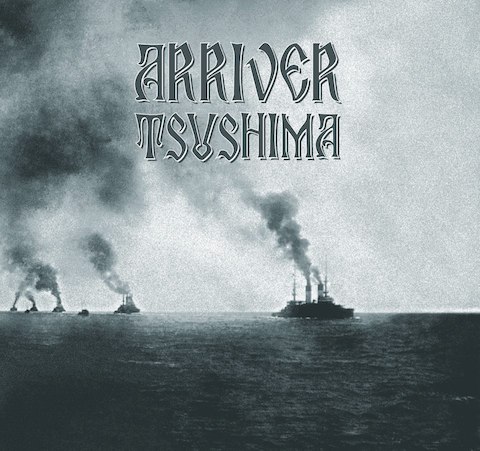
Albert Stabler on the metal vs. punk, Arriver’s Tsushima, and Russian military disasters.

Nate Atkinson on how he kept Moebius in his living room.

Matthias Wivel on death in Moebius’ last works.

And we finished the week up with the beginning of our Jaime Hernandez Roundtable. Deb Aoki talked about her experience as a Jaime-loving punk rocker in Hawaii; I talked about nostalgia in Jaime’s work; and Jones, One of the Jones Boys explained how you should like Jaime because he said so. The index to all post is here.

The roundtable will continue through all of next week with contributions by regular Utilitarians and guests.
 
Utilitarians Everywhere

At the Atlantic, I reviewed Nicholas Cage’s dreadful new movie Seeking Justice, and talked about revenge narratives.

At Splice I sneered at Rush Limbaugh and Bill Maher.
 
Other Links

Matthias Wivel on the Hermetic Garage.

If you buy Before Watchmen, Alan Moore hates you, God bless him.

Ken Parille on why male supeheroes don’t show any skin.

Smart Bitches make fun of the nipples in romance novels.
 

50 Million Jaime Fans Can’t Be Wrong


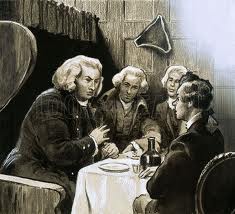
BOSWELL: Why, Sir, it is bruited through all London that Garrick holds the pictorial efforts of our Mr Hernandez in the utmost esteem.

JOHNSON: Garrick, Sir, can go fuck himself.

***

Sometimes people disagree — NEWS FLASH, right? People disagree about politics, science, religion, sports, the weather, what it’s got in its pocketses…and sometimes they disagree about art. Indeed, as you may have noticed, people around here sometimes politely disagree with other people about art.

So what should you do when you disagree with someone about a work of art? I don’t mean “should you call them fanboys?” or “should you call them vaginas?” or “how can you best persuade them that, on reflection, everything you say is correct and everything they say is STUPID?“; forget about what you should do to the person you disagree with. I’m asking how you should treat your own opinion when you find someone who holds a different opinion.

My question isn’t how you should treat the reasons, evidence, arguments, etc. that they might put forward to bolster their opinion. Leave all that aside, too, and just consider the basic fact that they disagree with you. Is that fact, by itself, important enough that it should make you change your mind, if only a little?

Since the mid-2000s, this question has become a hot topic in epistemology — the philosophy of knowledge. Broadly speaking, there are two answers to the question:

(1) Resolution

and (2) Conciliation.

According to the resolute view, disagreement ain’t shit — you don’t have to do anything when you find someone who disagrees with you. You’re perfectly entitled to maintain your own belief exactly as strongly as you did before you learned that somebody disagreed with you; in other words, you can stand resolute. According to the conciliatory view, by contrast, disagreement is shit — it should make a difference to your belief. Exactly what difference, and how much, is up for grabs among philosophers who hold the conciliatory view; but they are united in believing that disagreement should make you at least a little less confident than you were before. (Stick with me; we’ll get to talking about comics eventually)

Here’s one way to think about what conciliation means. Picture all your thoughts as a big list of sentences written in your mental notepad. They might include:

2+2=4

The Earth revolves around the Sun

Caesar crossed the Rubicon

Barack Obama will win the 2012 US election

The moon is made of green cheese

2+2=5

and so on.

Some of these things you believe, and some you disbelieve. You believe some really, really strongly — like 2+2=4 — some less strongly — like, perhaps, the belief about Barack Obama; and similarly for the sentences you disbelieve. So now imagine that next to each sentence is a number between 0 and 1. 0 means “I think it’s definitely false”, 1 means “I think it’s definitely true”, and values in-between correspond to varying degrees of confidence. Now the list might look like this:

[1] 2+2=4

[0.999999] The Earth revolves around the Sun

[0.9995] Caesar crossed the Rubicon

[0.6] Barack Obama will win the 2012 US election

[0.0001] The moon is made of green cheese

[0] 2+2=5

On this picture, people disagree when they assign different numbers, or credences, to the same sentence. So maybe in my mental notepad, the sentence about Barack Obama has the number 0.6 next to it, whereas in Noah’s notepad it has the number 0.8 next to it. This would mean that I am less confident than Noah that Obama will be re-elected.

What conciliatory views say, in essence, is that when Noah and I discover our disagreement, we should revise our credences towards one another. Noah should be less confident about Obama’s chances, and I should be more — OTHER THINGS BEING EQUAL. (We’ll get back to this caveat shortly).

Another name some people sometimes give to the conciliatory view is the Correct View. And by “some people”, I mean “me”, and by “sometimes”, I mean “right now”. I call it the Correct View for the simple reason that it is the correct view.

The basic motivation for holding the Correct View is this: when you find someone disagreeing with you, and you have no reason to think you’re in an epistemically better situation than they are — i.e. you’re not any smarter, or more informed, or less drunk, etc. — then you really don’t have any reason to think you’re more likely to be correct than they are. So the mere fact that someone like you has gone through the same process of reasoning and come to a different conclusion, that fact just by itself is some evidence that you might be wrong. It may be very weak evidence, and you may not have to “adjust your credence” — i.e. become more or less confident — very much, but it is some evidence, and you should adjust your credence to some extent. (As I said, just how much is up for grabs)

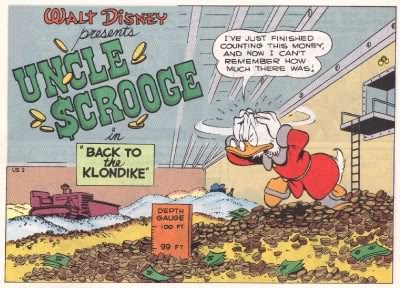
Here’s a hypothetical example: suppose Gilbert and Jaime are sitting at the table, trying to add up their joint profits from the most recent issue of Love and Rockets. (I told you we’d come back to comics)

Now, further suppose they go through their calculations separately, but using the same information and each using his own electronic calculator. And, finally, suppose that, at the end of all this, each brother arrives at a different total. Before they share their results with one another, each brother is fairly confident in his own calculation. But what happens when they share their results and realise that they disagree? According to the Correct View, each brother should become somewhat less confident in his own calculation.

And since, by definition, the Correct View is correct, this is just what they should do.

It’s important to remember that OTHER THINGS should be EQUAL when deciding how to react to disagreement. If Jaime knows that he is better at maths than Gilbert, then Jaime should not take Gilbert’s result as seriously, and hence should not reduce his own confidence as much (if at all); and vice versa. Similarly if Gilbert knows that Jaime’s calculator is broken; or Jaime knows that Gilbert forgot to count all the money; or Gilbert knows that Jaime wasn’t really paying attention; or…

The point being that you shouldn’t react to all disagreements in the same way. You should revise your confidence, down or up, only when you find that you disagree with someone who is in at least as good (roughly) an epistemic position as you — someone who is your epistemic peer. That’s why you don’t have to start believing that the end is nigh whenever you pass a religious fanatic on the street, or that global warming is a hoax when you watch Fox News, and so on — because these views arise from people in worse epistemic positions than you (or the proxies from whom you ultimately derive your opinions).

If you’ve followed me so far, you can probably see where this is going. As with opinions in general, I submit, so with opinions about art. In short: if you think a particular work of art is a piece of shit, but lots and lots of your epistemic peers think it’s the bees’ knees, you should seriously consider the possibility that you’re wrong. And maybe you should do this even if they can’t point to any convincing evidence in their favour.

Actually, this aesthetic conciliatory view follows from the Correct View only if we make a few extra assumptions. First, we have to assume that aesthetic sentences express propositions — or, to put it in English, that a sentence like “The Love Bunglers is one of the greatest comics of all time” is actually trying to describe how things are, rather than merely giving voice to your tastes. The former is like saying “I hurt my foot” or “I like ice cream”; the latter is like saying “Ow — my foot!” or “Ice cream — yum!” The former can be true or false, and even debated, but the latter cannot.

The second assumption is that the propositions expressed by aesthetic sentences are not entirely individualistic — that their truth does not depend solely on your reactions during the act of experiencing the art. If “The Love Bunglers is one of the greatest comics of all time” was merely a statement of how you felt about it, then, again, there’d be no room for disagreement. One person — let’s call him “Jeet” — could assert it, another — let’s call him “Noah” — deny it, and both could be speaking truly; just as one could truly say “I like ice cream” and the other “I don’t like ice cream”.

In other words, whatever makes some aesthetic opinions true and others false, it had better not be something that is entirely peculiar to whoever holds them.

Here’s one way aesthetic truth could depend on facts outside the individual: maybe the sentence “The Love Bunglers is one of the greatest comics of all time” is true only if The Love Bunglers properly reflects the Metaphysical Form of Beauty, which exists outside time and space, and doesn’t depend at all on what we humans think about beauty, trapped as we are in Plato’s cave.

Or, since that’s patently preposterous, maybe not.

Here’s a picture of aesthetic truth that is slightly more plausible. You have a set of preferences, values, likes and dislikes when it comes to art — let’s call them your tastes. Tastes are not permanently fixed, but they are usually stable over the short- to medium- term: if you like horror films today, then you’ll probably like them tomorrow. They can be very narrow or very broad: you might like films that are satires; and you might also like films that feature a combination of bicycles, conga lines, and references to Dante — in which case, have I got a film for you… And, crucially, although tastes vary from person to person, they are not entirely unique to each individual; you can share, to a greater or lesser extent, your preferences with other people. When you share your tastes with other people, we can say that you belong to an aesthetic community with those people; since you probably won’t share your tastes exactly with anyone else, you’re probably part of many different, partially overlapping communities.

This, for instance, is considered a thing of great beauty in some communities:

Aesthetic claims, in this picture, are made true by (1) the properties of the artwork in question and (2) the appropriate aesthetic community. The community sets the standards for judging the artwork, and the artwork itself either meets or fails to meet those standards. Which community is appropriate depends, basically, on who is considering the claim. So, in some communities, the sentence “Alex Ross is a great cartoonist” is true; in others, it’s false.

When a critic makes an aesthetic claim, then, it doesn’t make sense to ask whether it is true-full-stop (“true-period” for our benighted Yankee cousins). What must be asked, rather, is whether it is true given the standards of the appropriate aesthetic community. The advantage of this picture is that aesthetic claims turn out to be relative, but not solipsistic; their truth can meaningfully be debated between members of any particular community.

So, let’s go back to the issue of disagreement, with these two assumptions granted, namely: (1) aesthetic sentences can be true or false; and (2) their truth or falsity depends on more than just individual taste. As we saw, how you respond to disagreement depends on whether your disagreer (so to speak) is your epistemic peer. How you respond to aesthetic disagreement further depends on whether your disagreer is your aesthetic peer.

That means that, when you’re confronted with aesthetic disagreement, you need to ask yourself two questions. First, is my disagreer in a better position than me to appreciate the artwork, a worse position, or a roughly similar one? If the answer is “worse”, then you can safely ignore them; alternatively, you can publicly call them out in a blog post.

What sort of thing would determine your relative position to judge the artwork? Any number of things, including (but not limited to): who’s more familiar with the artist’s other work; who’s more familiar with other examples of the same genre; who knows more about the particular techniques involved; who’s wasted more years on a fine arts major; who can cite more passages of Lacan; etc. etc.

Anyway, if you decide that your disagreer is at least no worse off than you from an epistemic perspective — in terms of knowledge, expertise, intelligence, etc. — you can then move to the second question, viz. Is my disagreer addressing what I think is the appropriate community? Naturally, the answer to this depends on what you think the appropriate community is — and, equally naturally, this is a vexed and contentious decision.

Many online folks who talk about comics restrict themselves (knowingly or not) to addressing a very small aesthetic community. And if you don’t care about that community, then you can just ignore their proclamations about, say, the greatest cartoonists of all time.

Breathe a sigh of relief — I just validated your life choices.

More interesting are cases where you and your disagreer see yourself as sharing membership in at least one community. That’s where disagreement bites – – you’re now disagreeing about how the artwork in question (say, “The Love Bunglers”) lives up to, or falls short, of your shared tastes. And you can point to this or that feature in support of your opinion.

But — and here’s where we draw it all back together — if the Correct View is correct —

and it is, by definition

— then you should consider changing your mind even without being shown the opposing “evidence”. Because the fact that a member of the relevant aesthetic community has had one reaction to an artwork, and formed a particular view about it, that fact itself is evidence that your own view is mistaken. It’s evidence that, in fact, the artwork has a different relation to the community’s standards than the one you think: that it’s the bee’s knees, rather than a piece of shit. Or the other way around.

So, in conclusion:

Jaime rules, just because we said so.

Also:

DON’T JUDGE MY LIFESTYLE

—————————————
The Locas Roundtable index is here.

When You And I Were Young, Maggie

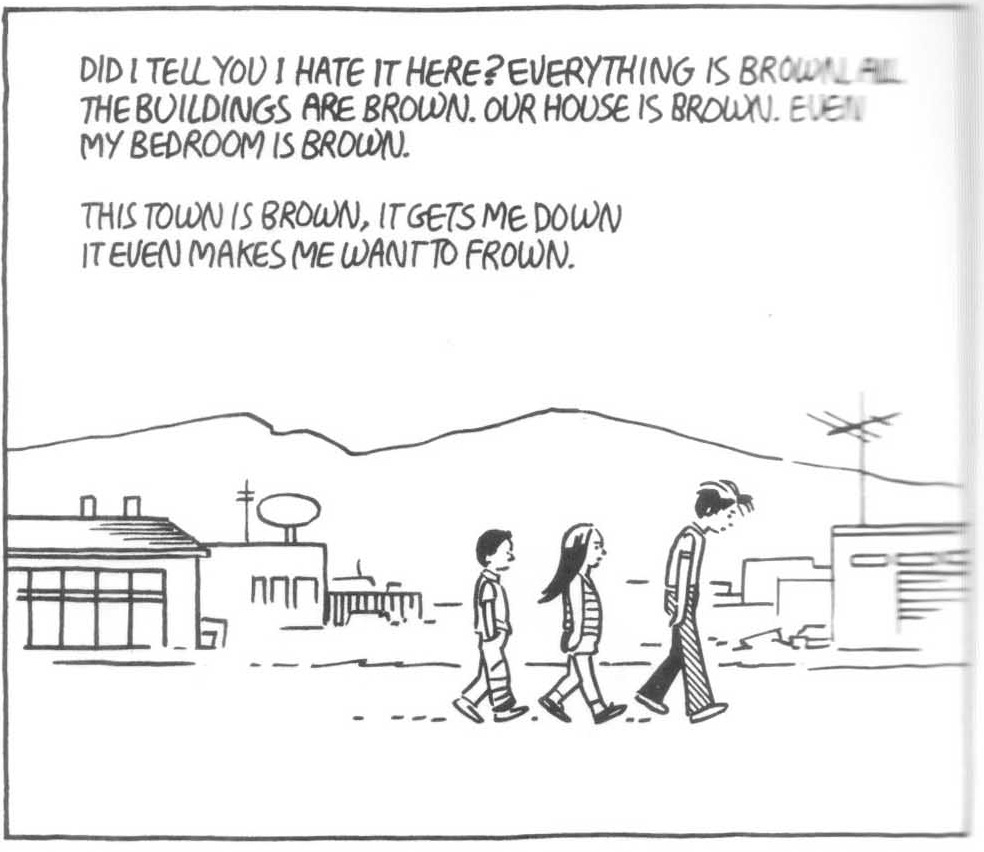
Jaime Hernandez’s “Browntown” has been lauded by everyone from Tom Spurgeon to Jeet Heer, the later of whom states that it is “arguably one of the best comics stories ever”.

It’s a bit of a let-down, then, to actually read the thing and discover a decent but by no means revelatory, piece of program fiction. All the hallmarks are there: the precocious child narrator as guarantor of authenticity; the ethnic milieu as guarantor of authenticity; the sordidness as guarantor of authenticity and the trauma as guarantor of authenticity. Poignant ironies fall upon the narrative with a sodden regularity, till the only landscape that can be seen is the wet, heavy drifts of meaning.

For what it is, “Browntown” isn’t terrible. Jaime’s precocious child narrator is endearing

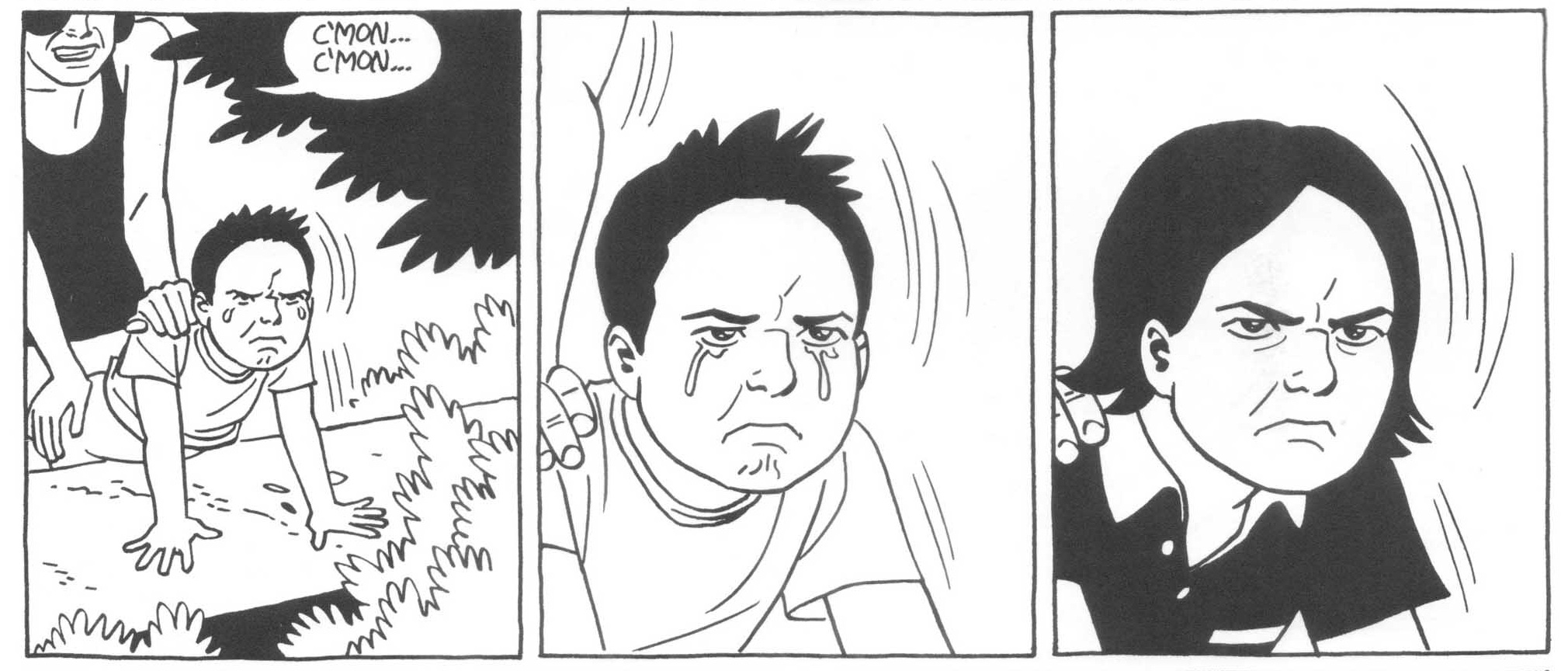
his ethnic milieu is surprisingly uninsistent and unforced; his traumas are doled out with a disarming lightness — as when Calvin’s years of abuse are limned in the space between panels:

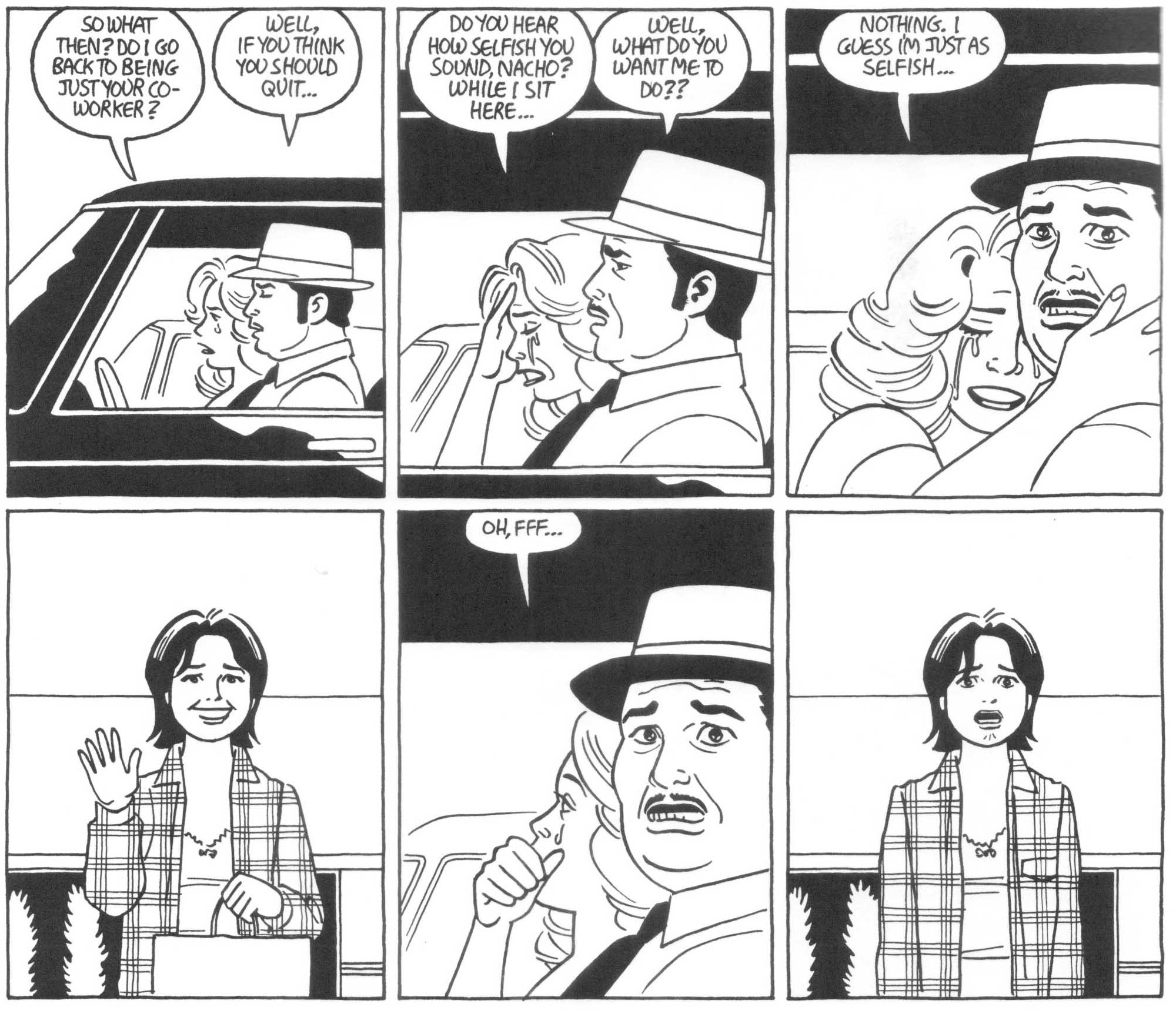
But still; there’s nothing particularly brilliant here, either in the use of language, or in the drawing, or in the use of the comics medium. In this sequence, for example, Jaime uses a series of verbal and visual clichés to present the end of an affair.

“Nothing, I guess I’m just selfish,” she says, as the stylized tears pour down. The camera moves closer, and then we’ve got a shot/reverse/shot. Entirely competent story-telling, sure. Masterpiece by one of the genre’s greatest creators? For goodness’ sake, why?
_________________________________________________

I read a fair bit of the Locas stories for this post — Death of Speedy, The Education of Hopey Glass, The Love Bunglers, bits and pieces of other stories, including Wig Wam Bam. I haven’t exactly grown more fond of Jaime’s work, but I think I have a better sense of what I’m supposed to like about it.

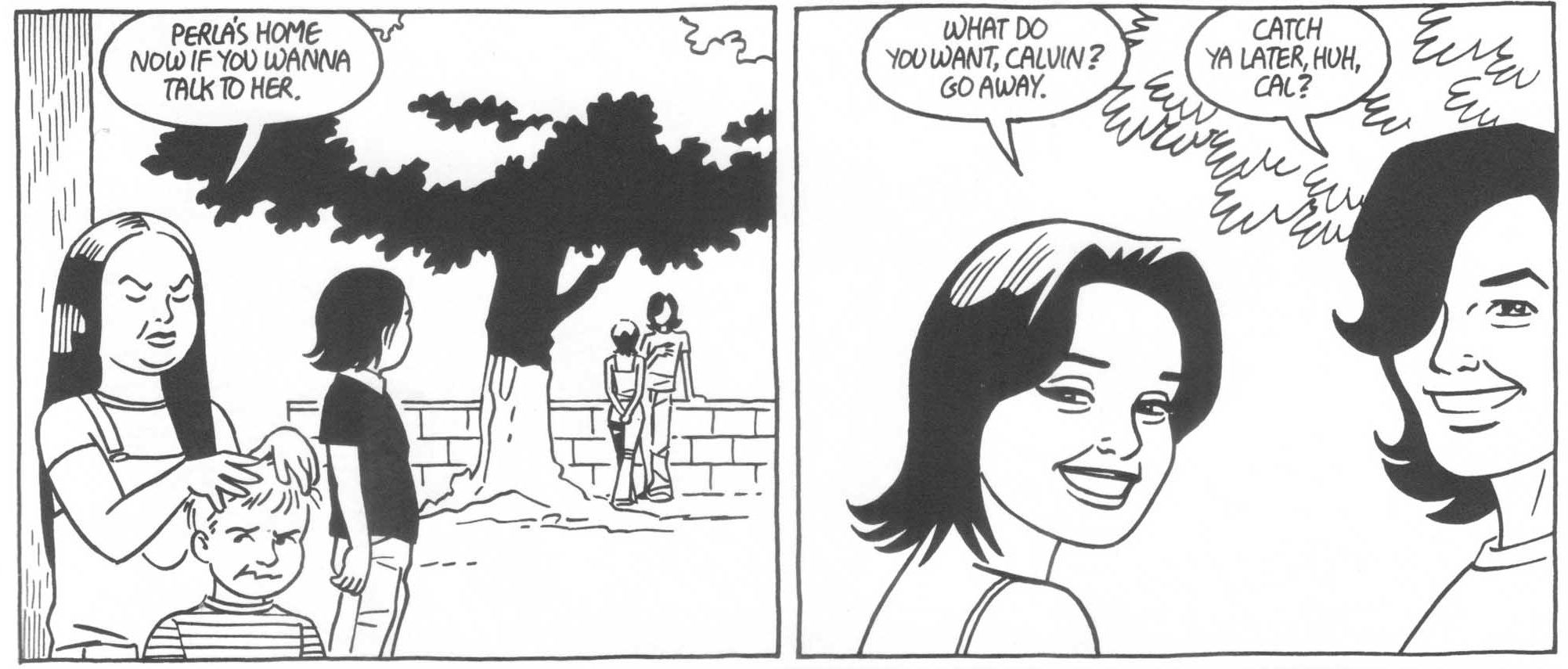
Which would be nostalgia. The difference between “Browntown” and an anonymous short story in a lit magazine isn’t Jaime’s skill, or his handling of plot or theme or character — none of which, as far as I can tell, rise above the pedestrian. Rather, “Browntown” is different not because of what’s in it, but because of what’s outside it: the years and years of investment in the characters, by both the author and his readers. Here, for example:

You see Maggie from a distance, and then in close up. It’s not an especially interesting or involving visual sequence…except that this is the first time in the story that Maggie appears as an adolescent, thirteen years old and post-puberty. For those who have followed Jaime’s work (or even just read the first installment of the Love Bunglers that precedes this piece in Love and Rockets 3), that face is finally, recognizably, the Maggie we know (or one of the Maggies we know). As a result, there’s a charge there of recognition and delight. It’s analogous, perhaps, to Lacan’s description of the mirror stage:

This event can take place… from the age of six months, and its repetition has often made me reflect upon the startling spectacle of the infant in front of the mirror. Unable as yet to walk, or even to stand up, and held tightly as he is by some support, human or artificial…he nevertheless overcomes, in a flutter of jubilant activity, the obstructions of his support and, fixing his attitude in a slightly leaning-forward position, in order to hold it in his gaze, brings back an instantaneous aspect of the image….

We have only to understand the mirror stage as an identification , in the full sense that analysis gives to the term: namely, the transformation that takes place in the subject when he assumes an image – whose predestination to this phase-effect is sufficiently indicated by the use, in analytic theory, of the ancient term imago.

This jubilant assumption of his specular image by the child at the infans stage, still sunk in his motor incapacity and nursling dependence, would seem to exhibit in an exemplary situation the symbolic matrix in which the I is precipitated in a primordial form, before it is objectified in the dialectic of identification with the other, and before language restores to it, in the universal, its function as subject.

As always, Lacan is a fair piece from being comprehensible here…but in general outline, the point is that the child sees its image in the mirror — an image which is whole and coherent. The child identifies itself with this image, and so jubilantly experiences, or sees itself, as coherent and whole.

In her book Reading Lacan, Jane Gallop points out that the jubilation and excitement of the mirror stage is based upon temporal dislocation:

…in the mirror stage, the infant who has not yet mastered the upright posture and who is supported by either another person or some prosthetic device will, upon seeing herself in the mirror, “jubilantly assume” the upright position. She thus finds in the mirror image “already there,” a mastery that she will actually learn only later. The jubilation, the enthusiasm, is tied to the temporal dialectic by which she appears already to be what she will only later become.

Thus, there is a rush of pleasure in seeing the woman Maggie in the adolescent Maggie; the future image charges the past.

But the mirror stage is not just about recognizing the future in the present. It’s also about creating the past. Gallop explains that before the mirror stage, the self is incoherent; an unintegrated blob of body parts and non-specific polymorphous pleasures. But, Gallop continues, this is an illusion; the self cannot be an unintegrated blob before the mirror stage, because it is the mirror stage that creates the self. Thus:

The mirror stage would seem to come after “the body in bits and pieces” and organize them into unified image. But actually, that violently unorganized image only comes after the mirror stage so as to represent what came before.

The mirror stage, then, provides an image not just of the future, but of the past. The subject “assumes an image” not just of what she will be, but of what she was; the coherent image of the self is not just an aspiration, but a history. When Lacan says:

This jubilant assumption of his specular image by the child at the infans stage, still sunk in his motor incapacity and nursling dependence, would seem to exhibit in an exemplary situation the symbolic matrix in which the I is precipitated in a primordial form…

the specular image that is assumed is precisely the infans stage, and the I that is precipitated is precisely the primordial form. The jubilation is not just in seeing a future coherent self, but in seeing a past self that is coherent with both the present and future.

Or to put it another way, the attraction of nostalgia is not the idealization of the past, but simply the idea of the past — and of the future. It’s the romance of self-identity. Hence, nostalgia in the Locas stories isn’t a function of actual time (a reader who has in truth read for decades) so much as it is a projection of imagined history. How many times has Jaime drawn Maggie (or Perla, or Margaret, or…)? All of those images are a part of a self, snapshots of a connected chain of bodies linked from infancy to middle-age to (presumably) death. As Frank Santoro says in his piece about the Love Bunglers:

Something extraordinary happened when I read his stories in the new issue of Love and Rockets: New Stories no. 4. What happened was that I recalled the memory of reading “Death of Speedy” – when it was first published in 1988 – when I read the new issue now in 2011. Jaime directly references the story (with only two panels) in a beautiful two page spread in the new issue. So what happened was twenty three years of my own life folded together into one moment. Twenty three years in the life of Maggie and Ray folded together. The memory loop short circuited me. I put the book down and wept.

The power of the Locas stories, what makes them special, is not any one story, or instant, or image, but the knowledge of the whole — not in the sense that each part contributes to a greater thematic unity, but in the sense that simply knowing there’s a whole is itself a delight. You can read the Locas stories and know Maggie, not as you know a friend but as an infant knows that image in the mirror — as aspiration, as self, as miracle.
_______________________

And, of course, as illusion. The reflection in the mirror, the coherent past and present I, is a misrecognition — it’s not a true self. Jaime’s use of Maggie as nostalgic trope, then, functions as a deceptive, perpetuated childishness; a naïve acceptance of the image as the real. Consider Tom Spurgeon’s take on “The Death of Speedy”:

Hernandez’s evocation of that fragile period between school and adulthood, that extended moment where every single lustful entanglement, unwise friendship, afternoon spent drinking outside, nighttime spent cruising are acts of life-affirming rebellion, is as lovely and generous and kind as anything ever depicted in the comics form.

That could almost be a description of “American Graffitti”, another much-lauded right-of-passage cultural artifact noted for its compelling, yearning encapsulation of time. I would agree that this is a major characteristic of Jaime’s work…but whereas for Tom that’s the reason Jaime’s a favorite creator, for me it’s the reason that he isn’t. Hopey’s nightmare hippie girl schtick; the shapeless but coincidence-laden narratives; the sex, the violence, the rock and roll — it all seems at times to blur into that single repeated punk rock mantra, “That was so real, man. That was so real, man. That was….”

But while I don’t necessarily need to read any more of Jaime’s work ever, I do think that there are times when the nostalgia in his stories becomes not just a symptom but a theme. For example, looking again at that image of the suddenly post-pubescent Maggie from “Browntown”.

As I said, this is a moment of recognition. But whose recognition? The panel is from the perspective of Calvin, who is both Maggie’s little brother and the sexual victim of the boy Maggie is talking up. While readers see suddenly the grown-up Maggie they know and love, Calvin is seeing, perhaps for the first time, a grown-up Maggie who he does not know, and who he fears and resents as a potential sexual rival. The reader’s image of Maggie — the shock of her newfound adulthood — lets us see her, to some extent, as Calvin sees her (and, indeed, allows Jaime to subtly tell us how Calvin sees her). At the same time, looking through Calvin’s eyes inflects and darkens Maggie’s new adulthood; the overlapping perspectives capture not just the excitement of growing up, but its dangers and sadness as well. The mirror image is also a primal scene, the discovery of self also a loss of innocence. What Gallop says of Lacan might also be said of Jaime:

When Adam and Eve eat from the tree of knowledge, they anticipate mastery. But what they actually gain is a horrified recognition of their nakeness. This resembles the movement by which the infant, having assumed by anticipation a totalized, mastered body, then retroactively perceives his inadequacy (his “nakedness”). Lacan [or Jaime?] has written another version of the tragedy of Adam and Eve.

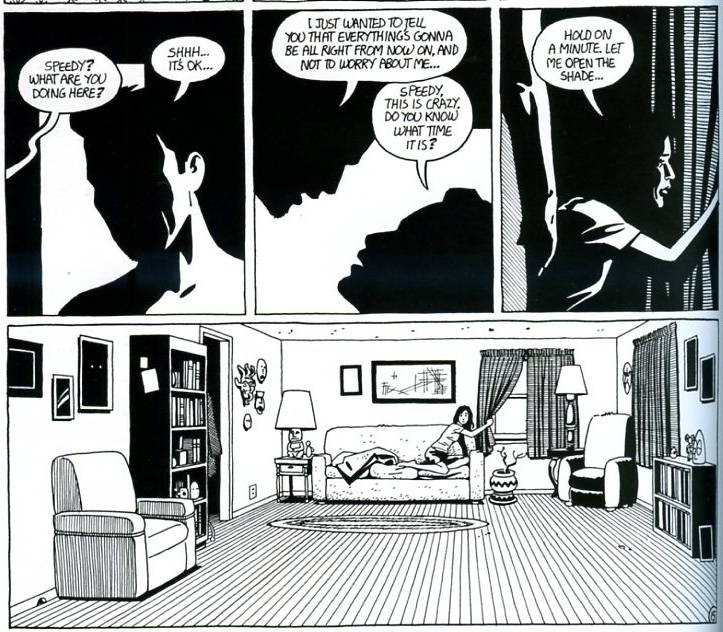
Another example of the way nostalgia is thematized is in the ghost scenes in “The Death of Speedy.”

On the one hand, this, like the entirety of the derivative “West-Side Story” plot, is fairly standard issue melodrama. But in the context of Jaime’s oeuvre, there’s something (eerily?) fitting about Speedy’s disappearance into a darkened silhouette, a kind of icon of himself. Speedy’s a projection, a specter given meaning only by his past. But that’s not just true for Speedy — it’s true for everyone in the Locas stories, who appear and then disappear and then reappear further up or down the timeline. A ghost is a kind of distillation of nostalgia, a memory that walks. At moments like this in Jaime’s work, the compulsive authenticity claims become almost transparent, as everyone and everything turns into its own after-image. We cannot see the present without seeing the past and the future, which means that we don’t ever see anything but an illusion, an image of coherence.

This is perhaps one way to read the conclusion of The Love Bunglers. Many people have read it as a happy ending for Maggie and Ray; the final triumph of romance after many trials. Thus, Dan Nadel:

In the end we flash forward some unspecified amount of years: Ray survives and he and Maggie are in love and Jaime signs the last panel with a heart.

And maybe Dan’s right. But it’s also certainly the case that that ending is only reflection; it’s what we want to see in the mirror.

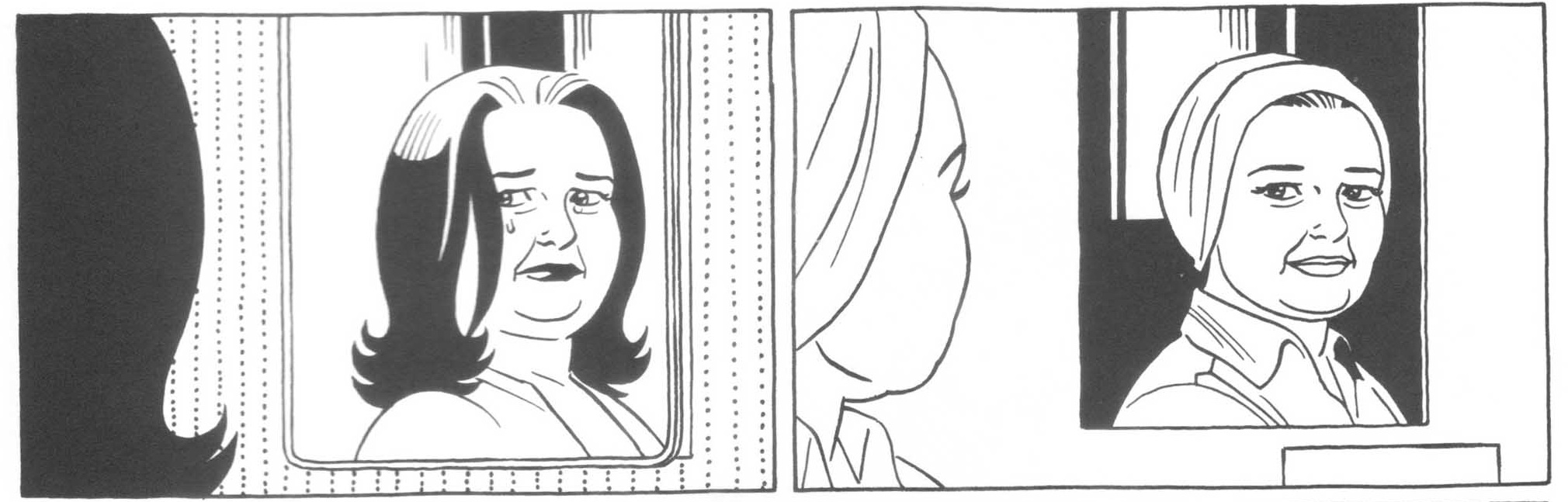
Two Maggies side-by-side look in two mirrors at two Maggies. We see doubles doubled, the Maggies we love seeing the Maggies we love. This is the way cartooning works; one image calls forth another and another, the characters become themselves through sequence and repetition. As Dan Nadel says, “It just works. They’re real.”

But at the same time as it solidifies Maggie, the doubling of the mirror stage also disincorporates her. The second Maggie in the mirror…doesn’t she look younger than the first? Is time passing, or is the mirror image just an image — the future Maggie that present Maggie needs to see in order to make the past Maggie cohere? If the happy-ending Maggie looking in the mirror is just a dream to retroactively solidify the grieving Maggie, perhaps the grieving Maggie looking in the mirror is herself a dream, an image to confirm the tragedy. And so it goes; Calvin’s unlikely assault is an image there to give weight and shape to his childhood trauma; Maggie kisses Viv and is rejected by her to give weight and shape to their past — or and simultaneously the past gives weight to the future, and on and on, image on image, through the never-ending jubilant shocks of misrecognition.
__________________

Jaime’s oeuvre, I think, can be seen as a mirrored engine; turn the crank and nostalgia is infinitely reflected. It’s an impressive delivery system. As with the Siegel/Shuster Superman, or the Twilight books, I can see the appeal, even if, for me, there’s something more than a little off-putting about the efficiency of the mechanism.

__________
The index to the Locas Roundtable is here.

Tsushima

Even if rock’s triumphal-film-score concept-album crescendos are generally dedicated to narrating combat of the mythic mock medieval variety, rather than documented events, heroic ballads set against sweeping historical vistas have made a few appearances in rock-opera prog, such as Triumvirat’s Spartacus, and in the occasional power metal suite, like Iced Earth’s The Glorious Burden. But despite not knowing more than a few erratically memorable examples, I doubt that any prog or power “history album” quite compares to Arriver’s long-awaited epic, Tsushima.

Primarily from the viewpoint of the defeated Russian Admiral Rozhestvensky, the album tells the story of the Battle of Tsushima, a landmark 1905 naval encounter in the Russo-Japanese War. Wikipedia describes it as a turning point in modern warfare, as it was the first battle in which wireless electronic communication played a central role and the last in which one fleet surrendered to another. The album opens with “Winter Palace War Council,” a mournful accordion overture interrupted by a vicious staccato assault, in which, although “The Dowager Empress warned us/ Eastern entanglements shall fail,” the vocals growl defiantly states, “We will all die, but we will never surrender!” After balefully adopting the voice of Japan’s victorious Admiral Togo, in the menacing trudge “Togo, Son of a Samurai,” the story resumes in the Russian perspective with “Dogger Bank,” a high-speed stuttering Deicide-esque dirge conjuring the shadow of defeat to the distant conflict in the North Sea. “Our anchorage will be refused in every neutral port of call/ You may turn your backs on us,” the guttural snarl testifies, “but we alone are standing tall!”

In the album’s centerpiece, “Around the Cape,” a fierce, lumbering riff accompanies the background of total collapse, the defeated Russian fleet at Port Arthur and peasant revolts at the Tsar’s palace: “Crocodile hunting and French whores,” shouts the disembodied chorus in the face of their annihilation, “they only serve to slowly weaken our resolve.” A brief, precisely shifting thrash piece, “Dark Clouds Above the Fleet,” evokes mechanized perfection while prophesying the inevitable end: “Misery is all we know/ No solace found in place of sorrow/ Ignore your orders, lashing follows.’ In reverberating harmonic chords, and some actual Russian-language re-enactment, “Singapore” describes Rozhestvensky’s Ahab-like hubris in the face of the looming conflict. A massive swaggering rocker chopped into odd sections by tempo shifts, percussive artillery, bewildering time switches, and ornate finger-picking figures, “Tsushima Trilogy” churns like huge icy waves; in the suite’s last section “The Boiling Sea,” the Admiral exhorts his men to “never lower the flag,” until the battle ends in a whiteout of seasick feedback and the gasping sputter of a dying engine. The devastation is summarized in bleak harmonies over a rumbling funeral march in “Quadrology:” “21 vessels sunk by dawn/ 4000 Russian sailors drowned/ The Tsar’s last armada is lost and with it the war.”

While many loud rock bands deliver arrangements founded on the alternation of chugging riffs and blasts of fury, with Arriver the shifts are more elegant than startling, with dramatic grandeur favored over shock and awe. More classical than fanatical, their chords never simply evoke Satanic massacre or chivalric soundtrack. The uncomfortable relationship between punk and metal is foregrounded with a band such as Arriver– their sophisticated long-form arrangements don’t fail to sound like the French black metal band Deathspell Omega, but without any hint of histrionic horror or the perversion of nature. Or I might think of the melodic arpeggios, whiplash tempo changes, and layered chords of Between the Buried and Me, or the furious mathiness of Converge or Dillinger Escape Plan, but not of those bands’ crisply gated production values, which seem to only make use of death metal tropes in the service of reinventing angsty Gothy industrial music. Arriver’s old-school chops may even occasionally be reminiscent of Vader, but the former’s symphonic nuance is incompatible with the latter’s straight-ahead brutality. Arriver’s warm, tactile sound, both in performance and production, is most comparable with more melancholy exponents of the ‘90s post-hardcore indie-rock spectrum, like Bitch Magnet, …And You Will Know Us By the Trail of Dead, or Unwound. But, putting the sound aside, the music is convincingly metal.

Merely an agglomeration of tropes, there is no nugget that makes metal metal. But metal fans might concur that, as stridently humorless as metal may be, its lack of irony keeps it blissfully free of sincerity. Metal is not personal but completely internal, not interpersonal but utterly public, magical rather than political, and thus always, in its way, religious. The nature of history as a diverse collectivity of experiences may seem more suited to punk. Still, Tsushima rides the fence admirably, in its unselfconscious apprehension of a totality whose only unifying element is anguish, becoming perhaps less of a “history album” and more of a “war album.”

Simone Weil’s essay on the Iliad presents war not as a transcendent individual experience, but an unstoppable gluttonous inertia of force before which conquerors and victims are equally powerless. Weil defines “force” as “that x that turns anybody who is subjected to it into a thing.” “A man stands disarmed and naked with a spear pointing at him;” she says, “this person becomes a corpse before anybody or anything touches him.” As in Weil’s description of the Homeric epic, the chief tone of Tsushima is bitterness. “The dissonance introduced in the overture, “The Winter Palace,”introduces a dread that lingers throughout the action of the musical narrative”, grimly relating episodes in the admiral’s reflections upon the battle, before, during, and after, with the delusional yet fatalistic determination of Custer at Little Big Horn. “The cold brutality of the deeds of war is left undisguised;” rhapsodizes Weil, “neither victors nor vanquished are admired, scorned, or hated.” On a more modest scale, the same sentiment could be applied to Tsushima.

Glory in struggle, a subtext of all loud white music, is subtly tweaked in the fearful feedback, deformed rhythms, and ominous harmonies that counterpoint Tsushima’s thrashy gallops, surgical barrages, and martial marches, somehow mingling the mournful solemnity of patriotic Russian choral anthems with Fugazi’s insurgent insouciance to create a result that is neither reverent nor skeptical. Almost a straight-faced echo of the miniature Stonehenge proffered by Spinal Tap, the mightiest works and most sublime cataclysms of man are seen in their true ephemeral puniness. Rather than a bestowal of posthumous heroic laurels, the abject defeat of arrogant power seems to be the moral of the story, summed up in the chant that closes the album: “Day by day, like links in a chain, darkness spreads at the edge of the empire.” The torch of triumph and the flame of the fallen warrior must dispel in smoke for any hope to stay kindled.
_____________
Arriver’s website with info about the album is here.