Romance and Convention

The battle against conventionality is, perhaps, always a losing proposition. If you lose, you lose. If you win, on the other hand, you simply become a new orthodoxy… which is perhaps even worse.

As a case in point, consider E.M. Forster’s “A Room With a View.” Published in 1908, the book belabors frozen Victorian pieties with a will. The moral center of the novel, Mr. Emerson, is a working-class atheist who refuses to let his child be baptised — with a pagan enthusiasm he extols the virtues of passion and truth and love, while around him clergymen waffle and bluster and cover over pure emotion with the dead scum of starched collars and gospel cant. Lucy, our heroine, is a typical, uninteresting girl whose great soul is revealed only through the incongruous enthusiasm with which she attacks Beethoven and Schumann at the piano. Art and true passion go together, which is why there are no artists who have fucked up their love lives. In any case, Lucy does not fuck up hers, and against the wishes of her family and friends and the whole of society, she takes the hand of Mr. Emerson’s son, George, and has “a feeling that in gaining the man she loved, she would gain something for the whole world.” Life, after all, is a struggle between the truth of individual passion and the conservative constriction of tradition — in being true to her heart, Lucy strikes a blow for all hearts everywhere, and brings merit into the world.

And, indeed, Lucy does change everything — or, at least, she’s part of a change in everything. Who now would argue against marriage for love, even to a middle-manager? Certainly not the creators of *The African Queen*, the Bogart/Hepburn vehicle filmed forty years after *A Room With a View.*
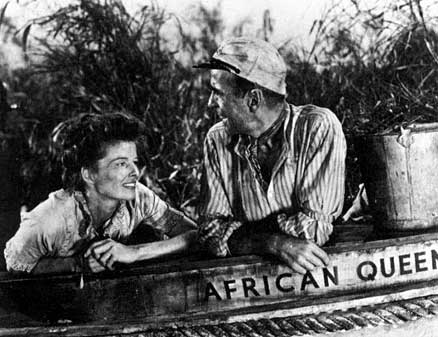
*African Queen* is set far, far from England, in German East Africa at the opening of World War I. Still, there are similarities. In *African Queen*, as in Forster, parsons don’t come off so well; Samuel Sayer (Robert Morley) is onscreen just long enough to show that he’s a blustering, envious, intellectual nonentity, capable of pathos only because of the utter failure of his life. His mousy sister, Rose (Hepburn) quickly shows she’s worth ten of him — not by playing the piano, but by the improbable enthusiasm with which she guides a boat through the rapids. That boat belongs to Charlie Allnut (Bogart), on whom Rose’s passion quickly alights, in despite (of course) of religious strictures and all hidebound convention.

Such is the eternal triumph of romance over convention. Except…well, if the triumph has reached the point where it’s eternal, isn’t it a convention itself? Our heroine’s unexpected depths — whether it’s the intensity of her Beethoven, or her love of boating, or (as in Pretty Woman) her love of opera or (as in Twilight) her vampiric superpowers — surely, at some point, those unexpected depths cease to be quite so unexpected and become a rather tiresome trope? When does individual passion become a claustrophobic expectation in itself?

In The African Queen, certainly, the romance between Rose and Charlie seems rooted in social expectations. Through the early part of the film, the most notable thing about the relationship between Hepburn and Bogart is the almost preternatural lack of chemistry. Both are certainly likable, but there’s nothing in their body language that suggests intimacy or even interest. And, indeed, why should there be interest? Rose and Charlie are likable, but as romantic partners they both leave a lot to be desired. Charlie is a drunk and a layabout. Rose is almost frighteningly repressed — so much so that she urges Charlie to sail his boat downstream to kill a bunch of Germans basically on the grounds that she’s bored.(Rose doesn’t even know what World War I is about when she concocts her plan.)

Of course, Rose’s love is supposed to redeem Charlie’s seedier side, and the attack on the Germans is meant to be heroic rather than pointlessly bloodthirsty. But the “supposed to” ends up sounding awfully, uncomfortably loud. The scene post-coitus where Rose struggles to figure out how to address Mr. Allnut, whose name she doesn’t even know, is cute, and Hepburn, with a mixture of embarrassment and affection, sells it. Still it ends up being perhaps a bit more revealing than the filmmakers intended. These two people don’t know each other; they don’t have much of anything in common. A relationship between them is probably, from any even vaguely realistic perspective, going to turn to shit as soon as Charlie finds the wherewithal to get his hands on a fairly constant supply of liquor. Given all that, why do they have to get together again?

Of course, they have to get together because they’re the stars and it’s a romance and that’s what happens in a romance. That’s genre and if you don’t like the genre, you probably shouldn’t be in the theater. But at the same time, it’s hard not to see the African Queen and feel like it, and many more like it, have pretty much done for poor Forster. Unsuitability in African Queen is now a feature, not a bug, as far as convention is concerned. The clergy are barely a joke; passion is so thoroughly awesome that it needs to be externalized by blowing up boatloads of Germans. In this context, Lucy isn’t following her heart so much as her genre predestination. If Forster really wanted her to show her unique individuality, he would have had her join a nunnery…or, perhaps even more shockingly, marry the supercilious Cecil and have it turn out he wasn’t such a bad egg after all. As it is, *A Room With a View* ends up feeling like a lengthy sermon preached to the converted…and, for that matter, to the conventional.
Best Online Comics Criticism 2012 – 1st Quarter Nominations

(Honoring online comics criticism written or published in 2012. A call for nominations and submissions.)

Regular readers of The Hooded Utilitarian will remember a semi-annual event celebrating the best online comics criticism. Last year’s survey sank like the Titanic due to sheer lethargy on the part of all involved, most notably myself. For those of us who find it hard to get out of bed for the latest and best comics criticism, allow me to commiserate.

On previous occasions, I would ask the various judges to select quarterly nominations from which the entire group would vote at the end of the calendar year. This proved useful in the sense that it brought in nominations on topics and from sites peripheral to my usual areas of interest, but also limiting in that it was dependent on the variable submissions of the judges for that year. Even worse, when busy lives came to the fore, there were no nominations to be had. Clearly, reading comics criticism can be a tiresome business.

In order to facilitate matters, I’ve decided to take over the nomination process myself and also open it to the HU readership (which I presume is wide enough in its taste). Web editors should feel free to submit work from their own sites. I will screen these recommendations and select those which I feel are the best fit for the list. There will be no automatic inclusions based on these public submissions. Only articles published online for the first time between January 2012 and December 2012 will be considered. I have not selected any articles from the HU site for obvious reasons but invite HU readers (not contributors) to send in their recommendations.

If all goes well, we might actually have a nomination list to vote on at the end of the year. At that point, a small group of jurors will be invited to read the long list of nominees and select the eventual winners.

The following list consists of articles of note and others which I personally find uninteresting but which have attracted considerable notice online.  The object of this listing is to be inclusive without excessively compromising quality.

(1)  Robert Boyd on Kramers Ergot #8 and the Art School Generation.

(2)  Gio Claival on the art and comics of Dino Buzzati.

(3)  Craig Fischer on Jiro Taniguchi’s The Walking Man.

(4)  Edward Gauvin on David B.’s The Littlest Pirate King.

(5)  Bill Kartalopoulos on Joost Swarte’s Is That All There Is.

(6)  China Mieville on Tintin and censorship. I feel compelled to list this here to forestall any complaints of its lack of citation. Mieville’s piece is certainly criticism (about Tintin, racism, and censorship); a breezy, informative and well written article for newbies but of slightly less worth to the average person informed about such matters. In a famine, even the local burger joint looks like haute cuisine.

(7)  Amy Poodle on Superhero Horror.

(8)  Daisy Rockwell on Craig Thompson’s Habibi. (Full version available at her blog). I have reservations about recommending this review. Lord knows my feelings about Habibi. A truly remarkable review would find a way to make a strong case for the intellectual strength and positive aesthetic value of Habibi. I have yet to read such an article online.

(9)  Khursten Santos – The Tale of Three Tezuka Ladies.

(10)  Matt Seneca on Guido Crepax’s Valentina.

“There’s a fundamental problem underlying all erotic work done in the comics medium, one even more difficult to get past than the lack of audible sound and visible motion bedeviling the action-oriented material that dominates the form’s American market. How does one create art that reproduces a physical sensation created by bodily contact without being able to reach out and touch one’s audience? It’s the same problem that faces makers of pornography in any medium, but in comics it’s especially difficult.”

Even though the initial premise as stated in the opening paragraph is entirely false — if the difficulties faced by comics pornography were so dire, where would that place the reams of exalted illustrated smut over the centuries — this remains Seneca’s best piece so far this year. The usual Seneca traits of overwhelming love and earnest exaggeration (in this instance Crepax is compared favorably to Herriman, Joyce, and Picasso) are all on display but here sharpened by his obsession with Crepax’s Valentina.

(11)  Kelly Thompson (She Has No Head! – No, It’s Not Equal). I’ve put this here because it seems to have found a place in a lot of people’s hearts, not least HU’s own dictator for life. This is a creditable article on that age old issue of women in costumes but somewhat tiresome if one has spent more than a few months reading superhero criticism — the absolute nadir of that cesspit known as comics criticism. If I was judging criticism on the basis of moral virtue, this would probably get top marks but it has little to add to the current thinking about superheroes.

(12)  Kristy Valenti on Frank Miller’s Ronin.


(13)  At The Comics Grid:

Kathleen Dunley on Ben Katchor and What’s Left Behind.

Nicholas Labarre on Art and Illusion in Blutch’s Mitchum.

Peter Wilkins on Pluto: Robots and Aesthetic Experience


(14)  And at  TCJ.com:

R. C. Harvey – Johnny Hart to Appear B.C.

Jeet Heer on Gahan Wilson’s Nuts.

Ryan Holmberg on Guns and Butter.

Jog on Franz Kafka’s The Trial: A Graphic Novel.

Bob Levin on Yiddishkeit: Jewish Vernacular & the New Land.

Seth on his work on The Collected Doug Wright.

Matthias Wivel on Donald Duck: Lost in the Andes.


This list is limited by time and my own personal taste and habits. As such, I would encourage HU readers to submit their own recommednations in the comments section of this post.  Alternatively I can be reached at suattong at gmail dot com. The lack of manga criticism in this list is particularly telling and I would be grateful to receive potential nominations in this area — reviews or essays which go beyond mere text-image summary or even textural history and which place a work into the context of real world experience and broader aesthetics, writing which pries open the hidden depths of a work

*          *          *

If the quality of the criticism which an artform attracts provides a glimpse at its health, then surveying the landscape of comics criticism can only be a a sobering experience. The patient while not exactly pallid looks distinctly moribund; sitting idly on the couch shoveling down crisps while shouting epithets at the latest pamphlets.

One is not so much concerned by the proliferation of sites obsessed with the marketing and economics of comics, nor the innumerable sites devoted to the idolization of cartoonists .  These will always be with us and may in fact be signs of a healthy fanbase. Rather it is the stagnation of sites and writers devoted to the serious consideration of comics that should be of concern.

This may be best symbolized by the resurrection of TCJ.com – a site which is finally making an earnest attempt to emulate its illustrious print predecessor. The steady flow of interviews, reviews, and long form essays has seen the masses flocking back to the once fallen giant. This is both comforting to its old adherents and yet a standing rebuke suggesting how little has changed in comics criticism since its emergence into adolescence in the 80s and 90s.

The implication here is that the comics world is so bereft of writers of quality and of a pioneering spirit that there remains little room on the internet for more than a few sites of “serious” comics criticism, and even less that offer an alternative narrative less beholden to fandom. The hope that the internet would lead to a surge of self-publishing and hence sites consistently promulgating quality reviews and essays on comics was nothing but a pipedream. If anything, what we have is consolidation and  a return to the mean. The Comics Comics project now subsumed to the new TCJ.com. The Panelists dead and now absorbed by the same. Even Sean T. Collins, Jog, Chris Mautner, Ken Parile, and Tucker Stone are now writing a significant proportion of their long form criticism for the site. Robin McConnell of Inkstuds hosts occasional critical discussions with the usual suspects listed above. The writers of The Comics Grid continue their quiet, scholarly course. There are few other umbrella organizations of note in North America as far as serious comics criticism is concerned.

This is certainly no fault of Dan Nadel and Tim Hodler who have crafted a site which has attracted the best talents to its shores. In a field where money is of secondary concern, it is the prestige, professionalism, community, and readership (the numbers and quality) which count the most. Both Nadel and Hodler should be commended for their dedication to preserving the legacy of the print Journal (with all the longstanding deficiences intact I should add).

The one bright spot in this age of digital publication is that The Comics Journal no longer holds a monopoly on the best long form reviews available on any particular comic. This situation is certainly preferable to the one in the late 80s and  90s when The Comics Journal was virtually the only game in town. That position has since been displaced by a host of blogs and newspaper websites. Think of any of the marquee comics of the past year and one will be pleasantly surprised to find that the Journal no longer holds “exclusive rights” to serious and informed discussion of those books.

What is missing however is any concentration of this talent to rival a single website like TCJ.com. Without this, and despite the efforts of a dedicated pool of link bloggers, many of these articles will remain unread and unloved. More significantly, it suggests a level of homogeneity seldom seen in other artforms (at least at this end of the spectrum). That no other site or community of critics has come close to challenging TCJ.com in attracting writers of note is a testament to the lack of depth (in numbers and intellectual concerns), diversity, and vision of purveyors of criticism; a problem exacerbated by a shrinking or stagnant comics readership.


Utilitarian Review 3/31/12

On HU

Most of this week was devoted to our ongoing Locas Roundtable, with posts by Robert Stanley Martin, Jenny Gonzalez-Blitz, Jason Michelitch, and Corey Creekmur. We should have one more post on Monday to finish up.

Also a punk rock download mix.

And I did a post on fashion, sexuality, and superheroes.
 
Utilitarians Everywhere

At Splice I have a post on death metal and bluegrass.

And also at Splice, a post on Lee Ranaldo’s crappy new album.
 
Other Links

Mahendra Singh on Moebius’ inking.

Christopher Priest with some really high quality sneering at contemporary sci-fi.

David Brothers on Trayvon Martin.

Craig Fischer on Taniguchi.
 

Seeing and Being Seen

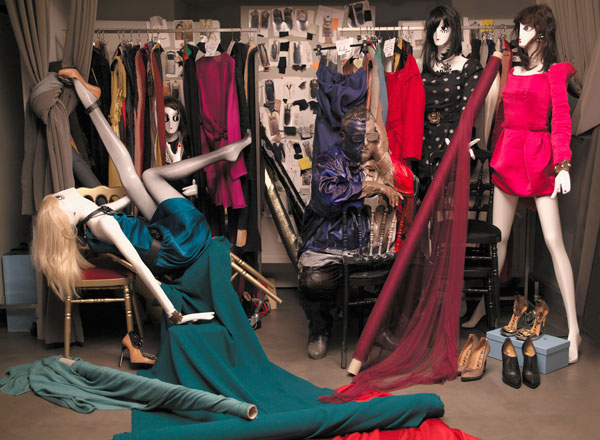
In the March Harper’s Bazaar, there was a spread by Chinese artist Liu Bolin. Bolin usually paints himself to blend into backgrounds, making a “powerful commentary on the individual and society,” as the Harper’s blurb says.

However, for the Harper’s spread, Liu painted, not himself, but other people. Specifically, he painted designers standing against their clothes and fabrics.


Angela Misoni, by Liu Bolin

In this context, the vanishing figures become less about the way individuals are overwhelmed by society, and more about the fashion industries obsession with visibility and identity. Fashion is a world in which you look obsessively, fetishistically, at (generally coded) straight female models, and in which you don’t look — as obsessively? as fetishistically? at (not all, but disproportionately gay and male) designers.


Alber Elbaz by Liu Bolin

The guy painted above, for example, is Alber Elbaz. Bolin shows him fading into his own dresses, while mannequin’s cavort visibly around him. The Women here are seen, but what’s seen isn’t really them — or maybe it’s truer to say that all they are is what is seen; they’re defined by surface. Elbaz, on the other hand, is no surface; his truth is the dresses, but you can’t see him there. Fashion, then, is a collaboration between those defined by appearance and those whose appearance is erased. Bolin’s pictures make that tension and its frisson more clear — the way in which fashion is both hiding in plain sight and appearing though unseen. The designers insist that they enjoy being behind the scenes (“All I try to do is be invisible,” says Elbaz), but they clearly are having fun, too, taking center stage in their own work for once. The point, perhaps, isn’t so much to hide or to be seen as it is to have some control over the look that defines you — as desired, as other, as absent. Or as Elbez says, “I think it’s a choice: to make clothes to make women visible or to be a star and to always be visible. I always preferred to be on the other side of the street and disappear.”


Jean Paul Gaultier by Liu Bolin

Looking at this series made me think again about Ken Parille’s recent piece over at tcj.com. Ken argues that the fully-costumed male body in comic books is a sign of repressed same-sex desire. Or as Ken says:

One explanation for the male cover-up—as for all cover-ups—is that there’s something to hide. Just as the mandatory Burka expresses fears about female bodies and male desire, the superhero costume reflects similar sexual anxieties. We often think of the mainstream superhero comic as a “power fantasy” without acknowledging its sexual dimension: it’s an erotic power fantasy. Perhaps some readers would be willing to admit that heroic tales are fantasies: “I would like to have the super power a superman has.” They might be less inclined to admit that these stories are heterosexual male domination fantasies: “I would like to have the power to control hot females” (yet to admit this would be to acknowledge that these comics’ chivalric code is a sham). Most readers would find it far too scary to recognize that these comics may be homoerotic fantasies: “Watching male bodies in close contact in the male-centric DCMV turns me on.” The hidden body is an unconscious emblem of forbidden same-sex desire.

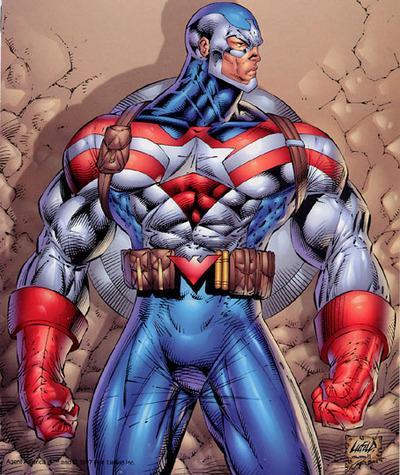
I don’t have any doubt that idealized, fetishized male superhero bodies are objects of same-sex male desire. But…is it really the case that the more covered male body is less open to same-sex desire? Surely the full-body latex look is itself thoroughly fetishized? Would the Liefield drawing before really be any more sexualized if it had a boob window?

I wonder if the full-body coverage for (most) superheroes, then, might have less to do with disavowing a homosocial investment which couldn’t really be much more obvious anyway, and more to do with seeing and being seen.

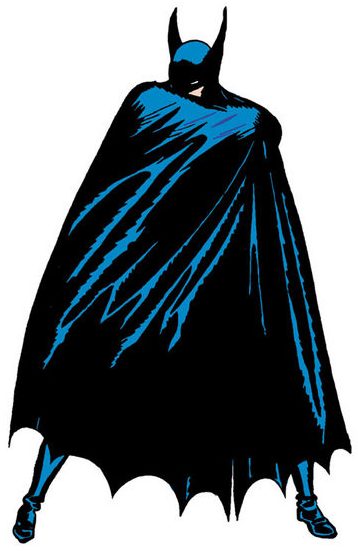
Or, to put it another way, the issue is not that men are resisting desiring men, but rather that the kind of men that men imagine themselves desiring in comics are men who are covered. Why, after all, do supeheroes wear costumes in the first place? They wear them, as Elbaz says, to be invisible — or to be someone else. Bruce Wayne doesn’t want to be Bruce Wayne, the wounded child. He wants to be someone bigger, more powerful, more mysterious — a sexy-cool daddy behind what Ken aptly calls the “bat-burka.”

It’s interesting in this context to note that the few male superheroes that do show a lot of skin tend not to really be wearing costumes. Prince Namor, for example, isn’t really a supehero; he’s not dressed up to fight crime and/or hide from his childhood trauma. Similarly, the hypersexualized, phallicly-named Hulk comes busting out of his clothes whether he will or no. These characters are not deploying the power and mastery of clothes; they are not diegetically wearing a hood to control how they look. The characters were never playing with seeing and being seen to begin with; therefore, they might as well let it all hang out (for the delight, presumably, of readers of all genders.)

Fashion and costumes isn’t just about who is sexy and who is not; it’s about who is seen and how and in what way. Superhero men are sexualized — but unlike superhero women, they are sexualized in ways which figures them as covered lookers rather than as exposed lookees. I don’t think that’s because comic-book readers are afraid to own their sexual fantasies; rather, I think it’s a sign of what their sexual fantasies are and how they work. Visibility and invisibility are not just symptoms of desire; they are aspects of desire itself.

Music For Middle-Brow Snobs: Hinkley Had a Vision

In the spirit of our Jaime roundtable, a punk rock mix. Download Hinkley Had a Vision.
 
1. Capybara — Shonen Knife
2. Another Genius Idea From Our Government — Erase Errata
3. Marmoset — Rapeman
4. Human Fly — The Cramps
5. Down on the Street — The Stooges
6. Tight Black Plants — The Plasmatics
7. Neanderthal Dike — Tribe 8
8. Hate Breeders — The Misfits
9. It’s Halloween — The Shaggs
10. Radio G. String — Bow Wow Wow
11. Pretty Vacant — Sex Pistols
12. New Breed — Pussy Galore
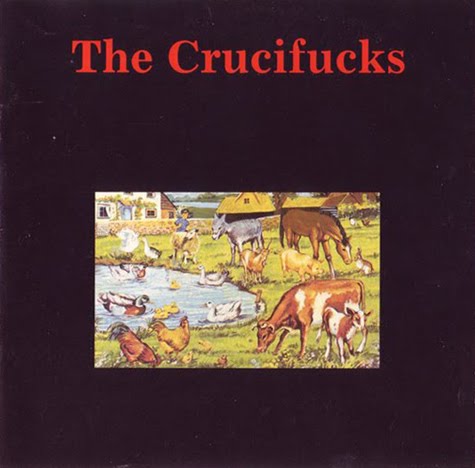
13. Hinkley Had a Vision — The Crucifucks
14. Institutionalized — Suicidal Tendencies
15. Life Sentence — Dead Kennedys
16. Screaming at a Wall — Minor Threat
17. Who Am I — D.R.I.
18. Radiation Sickness — Repulsion
19. White Riot — The Clash
20. The KKK Took My Baby Away — Ramones
21. Too Bad on Your Birthday — Joan Jett and the Blackhearts
22. Political Song for Michael Jackson to Sing — Minutemen
23. Thank You — Swans
24. Hot Topic — Le Tigre

Utilitarian Review 3/24/12

On HU

In our Featured Archive post this week, Caroline Small explained why Jaime Hernandez is (unfortunately) not like a soap opera.

I reviewed albums by two punk rock girl bands: Shonen Knife and Forever.

I reviewed a book about rock and the apocalypse and argued that rock realy is the devil’s music.

Most of this week was devoted to our ongoing Jaime Hernandez roundtable. This week we had posts by Marc Sobel, Derik Badman, James Romberger, and Richard Cook. You can see an index for the whole ongoing roundtable here.

And finally Monika Bartyzel explained why Buffy the Vampire Slayer’s Xander Harris is a sexist ass.
 
Utilitarians Everywhere

At Splice Today, I talk about trying and failing to vote for Romney in Illinois.
 
Other Links

Eli Zaretsky on Obama and the limits of reason.

A nice post on Chet Baker.

On defiling Corto Maltese.

Robert Stanley Martin and Tom Spurgeon talk about Watchmen, canons, and Calvin and Hobbes here and again here. As a bonus, Tom explains in some detail why he despises HU in general and me in particular.
 

Love and Rockets and Lesbians

News Flash: straight men love lesbians. We love them in movies, television, magazines, games … pretty much any medium you can name. But comics fandom is in a league of its own. The Japanese have an entire genre dedicated to girls who love girls.  In the U.S., Jaime Hernandez built an enviable career by writing about lesbians, and he’s hardly the only male creator to find success through Sapphic appreciation. Lesbian (and female bi-sexual) characters may not be necessary to win accolades and commercial success, but they’ve never hurt a writer’s chances.

Before someone accuses me of being glib, I’ll acknowledge that Locas is indeed more thoughtful than lesbian porn. I won’t elaborate on the merits of Locas, as I’m sure the other roundtable contributors will discuss it in detail. Suffice to say, it’s about much more than sex. And Hernandez  obviously cares about Maggie and Hopey for reasons besides prurience. But the prurience is always there, lurking in the background.

There are plenty of theories explaining why straight men love lesbians, but I suspect much of the appeal has to do with voyeurism. Lesbianism is a rejection of the male presence. Stories about lesbians allow men to gaze upon a “hidden” world of women, and by gazing upon it they shape it to their desires. The pleasure comes not simply from observing women, but from observing women in an environment that excludes men. This phenomenon is obvious in mainstream lesbian porn (that is, porn created for men), because the physical attributes of the women and the manner of the sex are intended for a straight male audience. However, voyeuristic pleasure does not require explicit sex. The appeal is not simply in the women being attractive, but that they are attracted to each other, and that attraction both reflects and enhances straight male desire.

For a writer, there are additional pleasures in creation and control. In Locas, Hernandez created an universe centered on women. The women fuck and fight and do crazy things, often in the absence of any man, yet Hernandez controls everything: their personalities, histories, clothing, bodies. Maggie and Hopey are shaped by Hernandez, and they embody his desires and fantasies. Their mutual attraction is his attraction, whether to each of them or to the two of them together.

On a related note, the limited number of male characters in Locas has occasionally been treated as a failing in Hernandez’s writing. But that complaint misses the point. The lack of male characters is not a bug, but a feature. A more frequent presence of men would alter the nature of the story, because it could no longer be a world primarily of women. Stories about men with women have their own appeal, of course, but that appeal is fundamentally different from the voyeuristic appeal of lesbianism.

Is it impossible for a straight man to write about lesbians in a completely non-exploitative manner? Maybe, but that doesn’t mean the outcome would be superior art. As I suggested above, even an exploitative work can have artistic merit (and there are treatments of lesbianism far more exploitative than Locas). And LGBT readers are often the most enthusiastic fans of lesbian stories by male creators (see Jaime Hernandez, Terry Moore, Joss Whedon, etc., etc.), at least when those creators treat their characters with a modicum of respect.

But I’m left wondering how Locas  would be different if it had been written by a lesbian. And how would the identity of the creator affect the critical reaction in the tiny world of comics? Would a lesbian creator be given the same acclaim for Locas as Hernandez, or would she be pigeon-holed as an LGBT creator writing for a queer market? Do male comic readers give a damn about lesbians when they’re created by lesbians?

__________
The index to the Locas Roundtable is here.