Jon? What Are You Doing Back There?

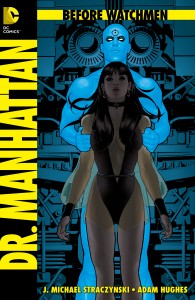
I’m not the first to have noticed this,, but I happened to see Adam Hughes promo cover for Before Watchmen and….

Given Jon’s usual free-swinging ways, the position of his hands, and Laurie’s distracted expression, it’s hard to escape the suspicion that we’re being treated to a scene from the action here.

Charitably, one could consider this a friendly Lost Girls tribute. Less charitably, one could surmise that it’s a smug thumb (or something) in the eye to Alan Moore, telling him right out what DC and its new creators plan to do to his characters. Least charitably, it points simply to the usual level of utter mainstream comics cluelessness. DC’s disinterest in women is apparently so extreme that they can’t even be bothered to look at their flaccid cheesecake before they slap it up there on their marketing campaign for all the world to see.

The Sadomasochistic Protestant

In Umberto Eco’s The Mysterious Flame of Queen Loana, Yambo, the brain damaged protagonist, trawls his childhood home at Solaro finding an attic of dusty, mildewed memories — magazines, newspaper clippings, knick knacks, and comics. The eponymous comic strip for which Eco’s novel is named has sadly dimmed with time, now clearly seen as nothing more than a faded talisman and one of the “most insipid” tales “ever conceived by the human brain.” Yet age has not withered his attraction to Alex Raymond’s most famous strip…

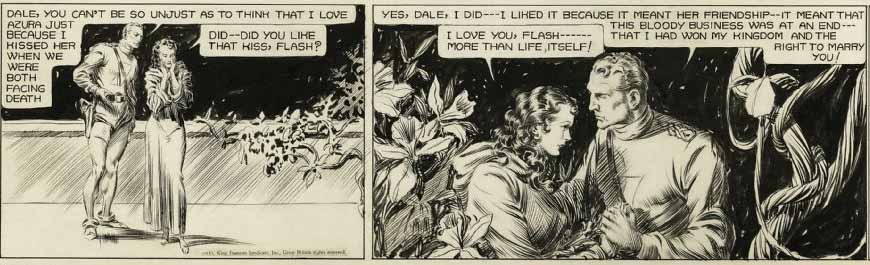
Flash Gordon Sunday 1935 (from the collection of Rob Pistella)

…the memory of its hero lodging itself into his dying dream towards the close of the novel, informing every childhood reminiscence and fleeting recollection; this final immersion retaining the wild discursions of a child’s mind now uncomfortably snared to the adult penchant for structure, nonsense, and logic.

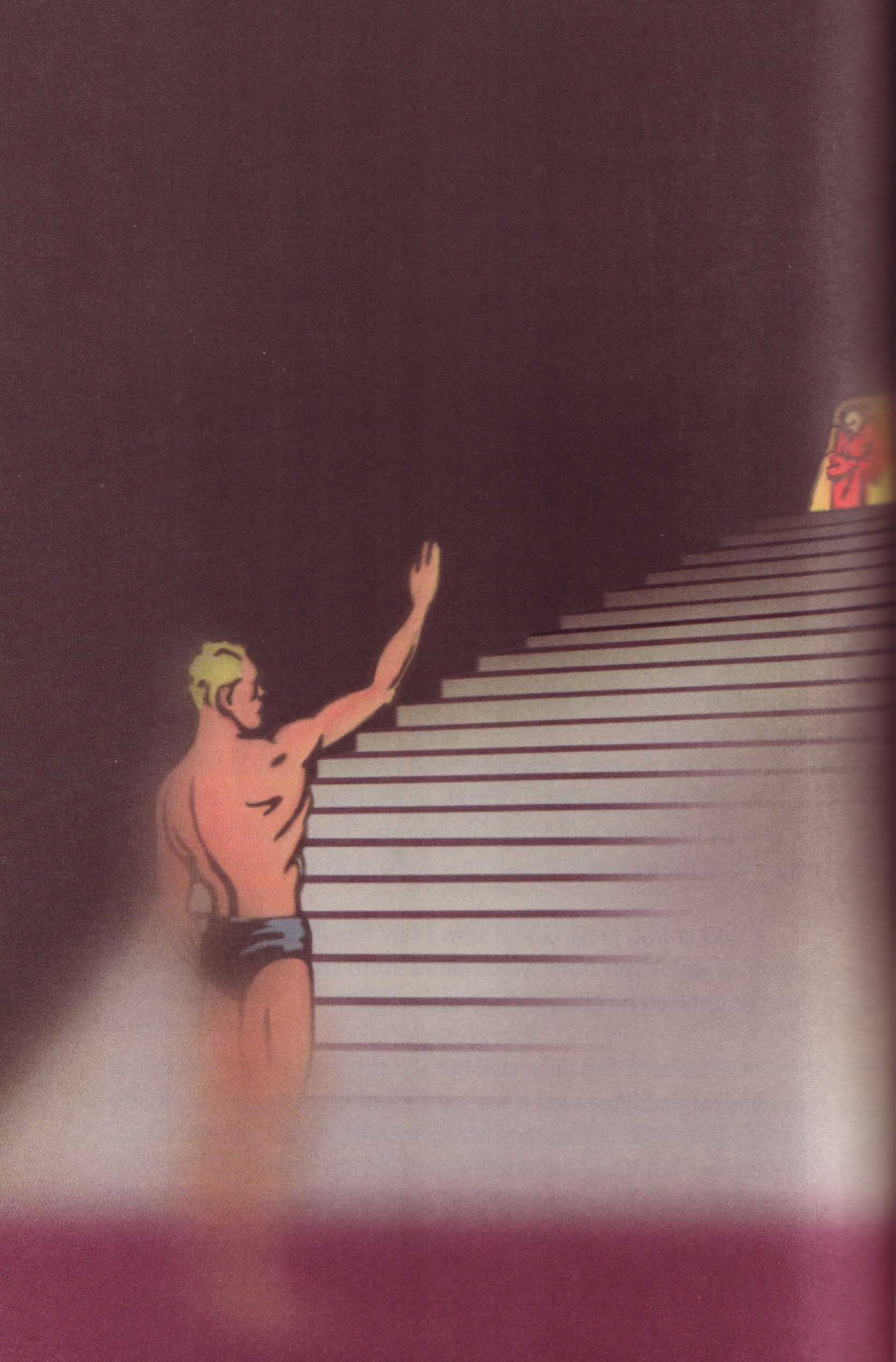
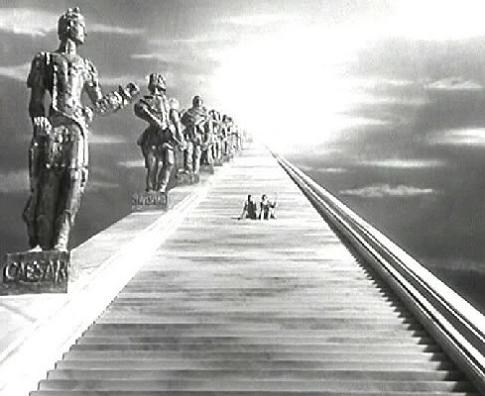
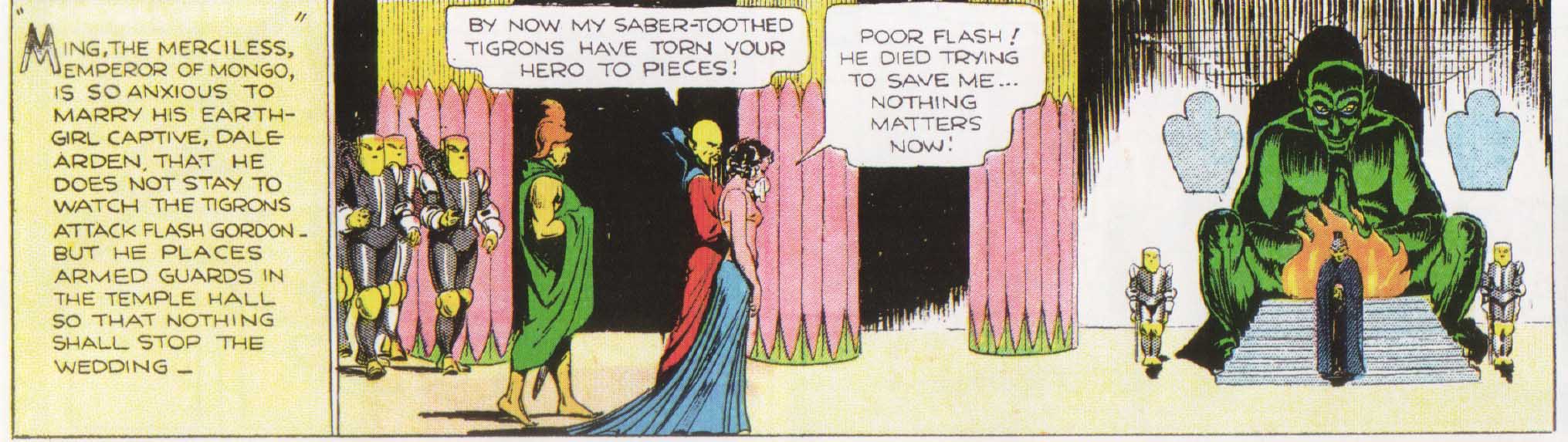
There is the nefarious Ming, the sense of camaraderie among our intrepid adventurers, the grand staircase leading to heaven like something out of Powell and Pressburger’s A Matter of Life and Death

___

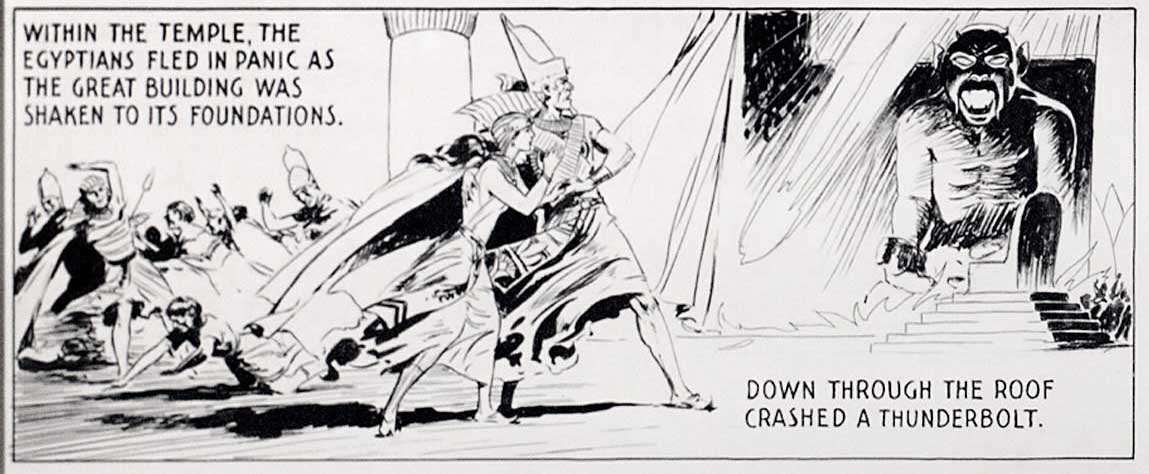
…or, perhaps, Hal Foster’s Egyptian sequence from Tarzan which is referenced throughout Raymond’s early years on the strip — the same obeisance to that dark god of masculine virility and white supremacy.


Tarzan 6-26-1933, Hal Foster


Flash Gordon 6-10-1934, Alex Raymond


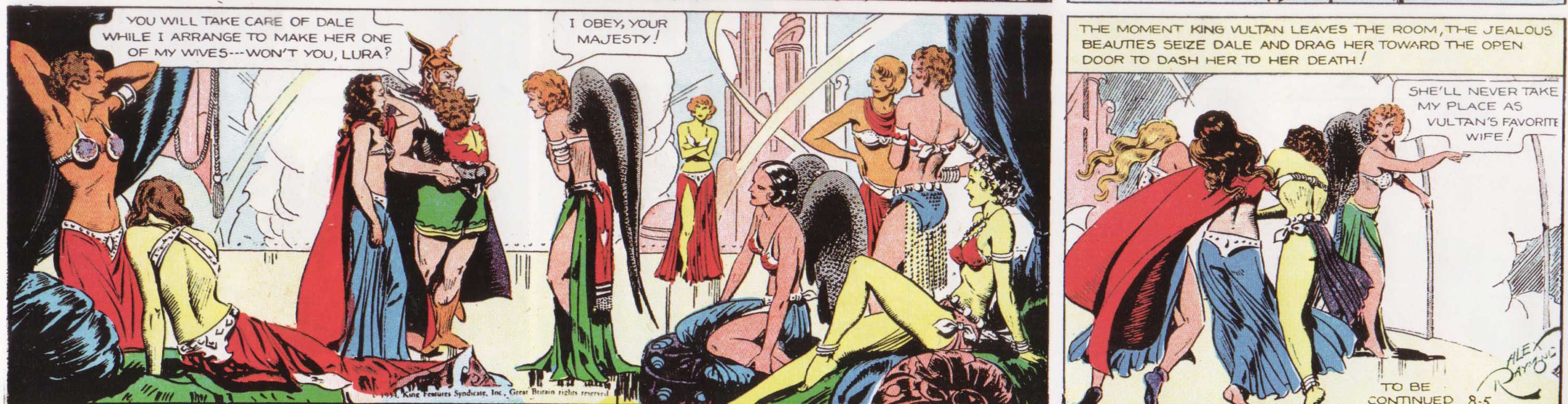
And, of course, there are the fantasias on the female form in which Raymond immersed himself once his skills and reputation allowed for it. This world of scantily clad women with welcoming bosoms and teardrop asses. That vision of the cold, domineering princess ready to do every form of evil in the name of jealousy, but who is redeemed by her willingness to melt in the arms of her “true” love. These figures coyly praised by Al Williamson in his introduction to the first volume of the Kitchen Sink reprinting of Flash Gordon and ignored altogether by Bruce Canwell (in an article found in the recent IDW reprint) in favor of the contributions of co-writer Donald Wynkoop Moore and a few apologies for the lackadasical scripting on the strip. The latter’s decision not altogether unexpected I should add, the topic in question being tiresome, obvious, and puerile.

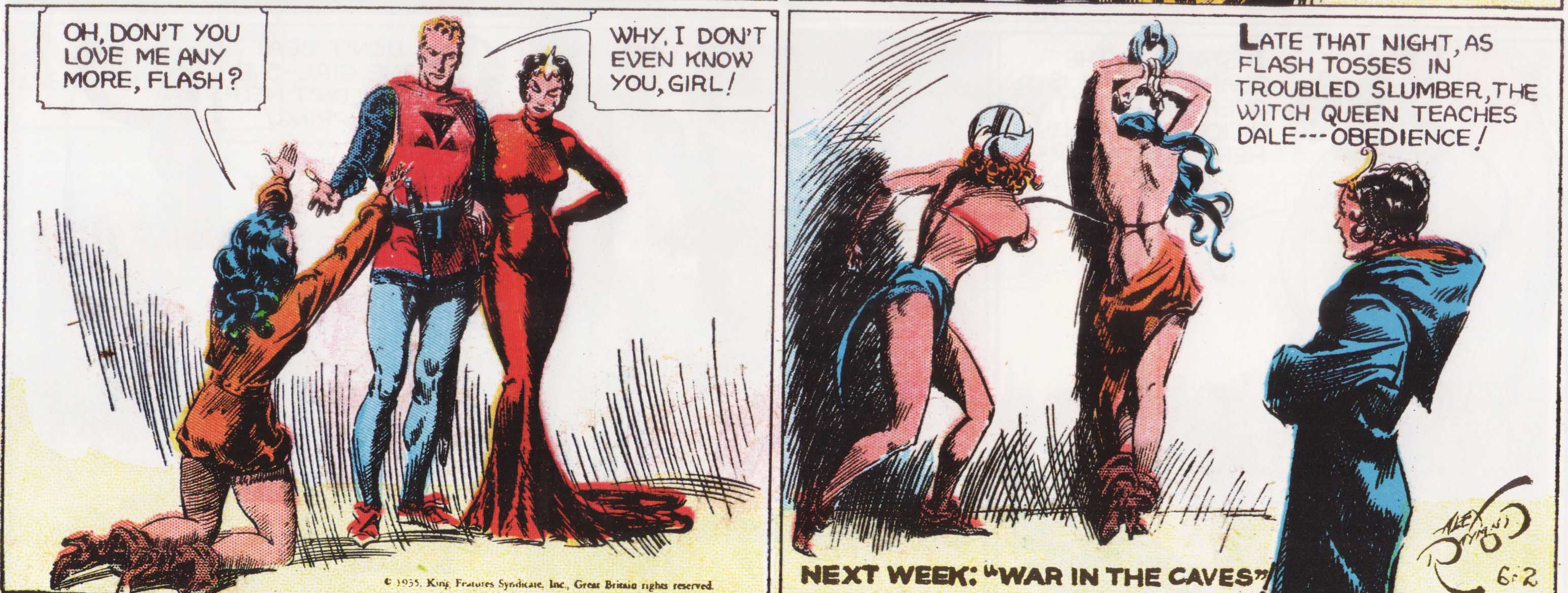
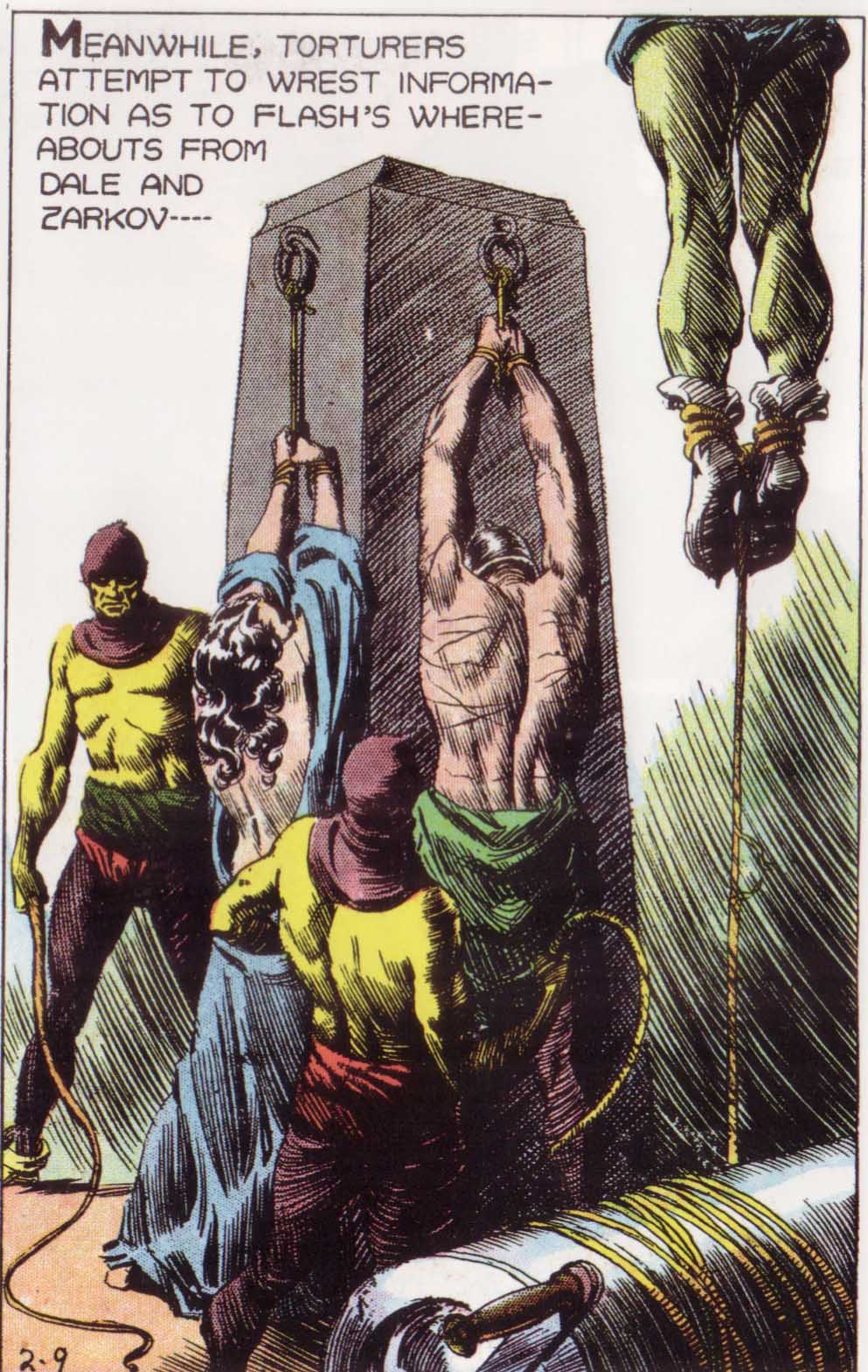
The Sunday (of June 2nd 1935) in which Dale pleads desperately for recognition from the brain-washed Flash before being ill used by her tormentors is perhaps the most glorious representation of Raymond’s barefaced fixations.

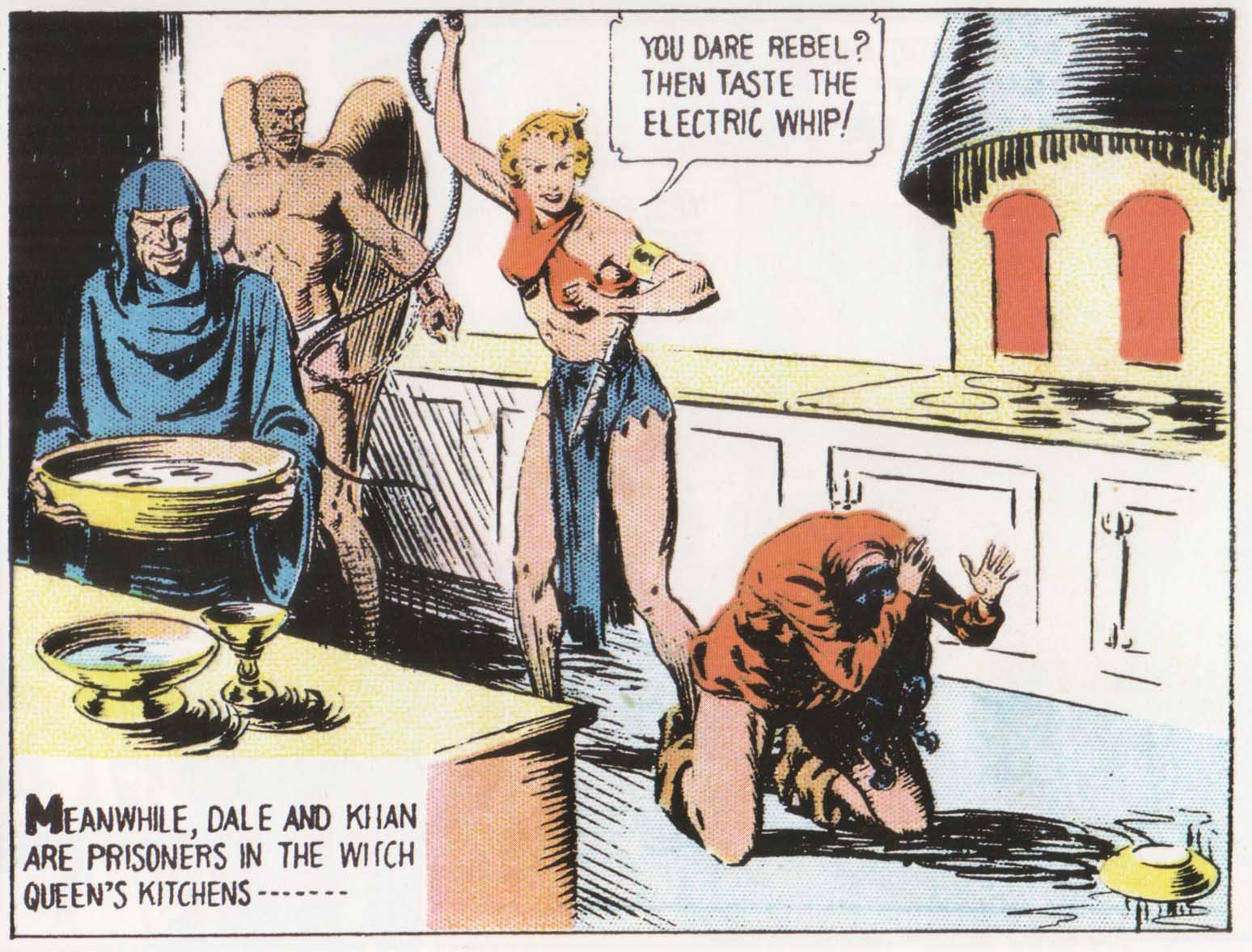
One can only imagine the sweat trickling down the heroine’s immaculate body as she holds herself taut in anticipation of the reader’s gaze, delighting in her exquisite torture. Raymond allows not one inch of readerly terror. There is only delight in this display of the draughtsman’s pleasure in pain. There are also the cat fights which take on the fervor of lesbian mud wrestling, the depraved domesticity…

…the conjoined torment at the pole of blissful brutality.

There can be little doubt that Raymond’s Flash Gordon is a textbook example of that perverse quality (and sexuality) which is marked by the way “in which violence, aggression, and pain become vehicles for other things — for staging dramas of suspense, supplication, abandon, and relief that enhance or substitute for sexual acts…its way of not ending in coitus, its lack of subordination to a genital goal of discharge or end-please.” (Linda Williams)

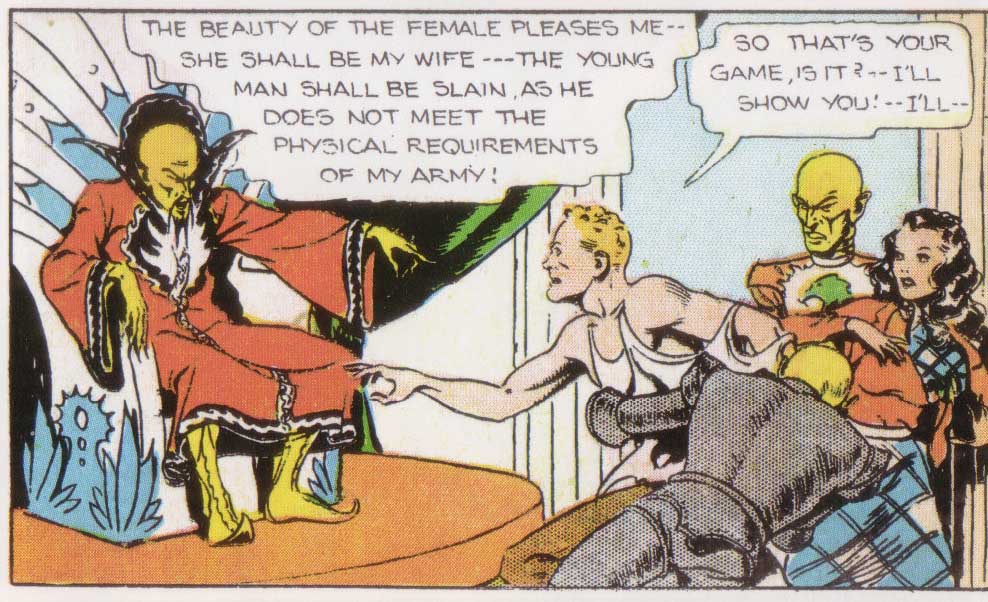
And so it is in Yambo’s (and presumably Eco’s) meditation on his childhood comics where “neither the femme fatales nor the satanic males (think of Ming with Dale Arden) ever sought to ravish, rape, imprison in their harems, or know carnally the objects of their lust. They always sought to marry them.  Protestant hypocrisy of American origin, or an excess of bashfulness imposed on the Italian translators by a Catholic government waging a demographic battle?”


Perhaps we should add to this not only the desire to marry and possess in the most virtuous of traditions but also the desire to whip and demand submission. Quite unforgotten by the producers of the film adaptation as evidenced by that fan favorite, the whipping of Aura, and certainly well appreciated by Eco in his jaunt through Raymond’s strip — yet elided here because of that tone of innocent nostalgia which must persist. Whatever may be the case, one might see in Yambo’s comment either a call for a certain logical consistency to aid the suspension of disbelief or mere misogynistic nattering.

I think it would be fair to say that we are inundated with these images from the realm of pain on a far more regular basis than the average reader of the Sunday funnies in the 30s.  Presumably, we are living in a more enlightened age. Indeed, we find Linda Williams enumerating the various approaches towards these perversions towards the mid-section of her chapter on “Power, Pleasure, Perversion”, recounting everything from Laura Mulvey’s vision of such products as “avenues of escape for phallically threatened male viewers”; to Gaylyn Studlar’s suggestion that “cinematic visual pleasure is not sadistic but rather masochistic” partaking of the “pre-oeidipal pleasures of merger and fusion rather than oedipal issues of separation and individuation”; and hence to her own extension of the ideas of Mary Ann Doane where…

“…a female spectator” confronted with such scenarios “may not identify with this woman as pure, passive vicitim, for…in these scenarios…the tortured woman has arranged to play the role of suffering woman, to put on a show of suffering the better to enjoy her pleasure.”

What is clear though is that the comics have held fast to that old time religion of Protestant decorum. Undoubtedly, lapsing into indiscretions on occasion before being flogged back into submission.

Where once Marston and Peter dreamt of strong women trussed and bound up [1], we now merely have strength and role models.  Where once curvaceous women and brawny men surrendered themselves to the whipping pole  we now have Dilbert and the faithful PrinceVal. And who is to say this is not the better course, the cartoon strip fading into irrelevance but not falling into impurity, like St. Anthony assailed by demons and rushing into the warm, ascetic glow of the desert.

 *          *          *

[1] From Bound to Blog #3, Noah Berlatsky

“And, hey, you know what? Good for Marston, really. False consciousness arguments are pretty dreary, not to mention condescending…I think it’s generally worth acknowledging that when people acquiesce in oppression or discrimination, they generally have some motivation that can’t be reduced outright to stupidity. It’s not wrong to want someone to take care of you…though obviously you’d want to be careful about the person. Marston’s feminist diagnosis isn’t coherent — it’s a contradictory mess of false consciousness, legitimate emotional goals, fetishization, and pro-lesbian radicalism. That doesn’t make it precisely wrong, though.”


Superthing

This essay first appeared on Comixology.
_________________________

When Craig Yoe first saw the pulp fetish pamphlet Nights of Horror, he instantly gasped, “Oh, my God, Joe Shuster!”

That expression of shock has a couple of levels to it, I think. First, of course, there’s the simple surprise of discovering unknown work by a seminal cartoonist. Artist Shuster and writer Jerry Siegel created the hugely successful Superman for National Comics in 1938. A decade and much legal wrangling later, though, Siegel and Shuster had lost the rights to their character, and were no longer welcome at the company which had been largely built on their creation. That much of the story is well known — but pretty much nobody was aware that the down-and-out Shuster had illustrated a low-budget porn title like Nights of Horror. In fact, given Shuster’s declining eyesight, some historians weren’t even sure that Shuster could see at all by the mid-1950s when Nights of Horror was produced.

The amazement expressed by Yoe and by other comics professionals he quotes in Secret Identity: The Fetish Art of Superman’s Co-Creator Joe Shuster isn’t simply because the work was unknown, however. It’s because of the type of work it is, and the type of artist Shuster is supposed to be. Stan Lee, with his usual talent for dispensing middle-brow wisdom, pithily sums things up in the introduction. “Whereas everything about the stories and artwork of Superman was positive and uplifting, the pages of Nights of Horror…cater to the basest of man’s character and morals.”

So there you have it. Superman is good. Nights of Horror is evil. How, oh how, can we reconcile the two? Lee does it, characteristically, by genuflecting in the direction of tragic irony: Shuster loved the noble and good, but became “so disillusioned and desperate” that he debased his talents and turned to the dark side. Yoe himself isn’t that prudish, but he too sees a contrast. Superman was too perfect, Yoe argues. The discovery that Shuster had a less savory aspect, therefore, makes him, Yoe says, “someone we, with our own flaws can relate too.” Stan the Man looks on with distaste and Yoe looks on with avuncular amusement, but both agree on the central narrative, viz., it was a big step (whether down or sideways) from drawing Superman to drawing fetish art.

But was it? Not everyone thought so. Anti-comics crusader and psychologist Frederic Wertham for example, hated Superman and fetish pulp more or less equally, and for more or less the same reasons. Wertham believed that Superman encouraged “fantasies of sadistic joy in seeing other people punished.” The hyper-masculine, uniformed supermen were a sexualized, godless fantasy of force; a dream of limitless empowerment. Yoe quotes Wertham in the later’s famous screed, Seduction of the Innocent: “We established the basic ingredients of the most numerous and widely read comic books: violence, sadism, and cruelty; the superman philosophy, an offshoot of Nietzsche’s superman, who said, ‘When you go to women, don’t forget the whip.'”

As it happened, Wertham is on record condemning not only comic-book fetishism in general, but Nights of Horror specifically. The psychologist linked the fetish pamphlets to a series of brutal murders and assaults by a gang of young pseudo-Nazis in New York in 1954. As with super-hero comics, Wertham attacked Nights of Horror for its perversion, its sadism, and its general bad influence. Eventually, his testimony helped get Nights of Horror confiscated and destroyed by the state, in a decision upheld 5-4 by the Supreme Court.

Again, Yoe provides all of this information — but he doesn’t quite connect the dots. Perhaps he thinks too highly of Superman, or perhaps he’s simply unwilling or unable to credit rampant Comstockery. Nonetheless, the fact remains: in Wertham’s analysis, if not in his censorious conclusions, the crusading prude was definitely onto something. Whether it’s superheroes or fetish porn, pulp is pulp. And what pulp is made of, in large part is sadistic and masochistic fantasies. It’s not an accident that one of the earliest successful Batman villains, the Monk, was a vampire hypnotist who controlled the wills of his female victims. Nor is it coincidence that the incredibly popular early Wonder Woman stories featured elaborately bound beauties in just about every other panel. And as for Superman…well, how about this:

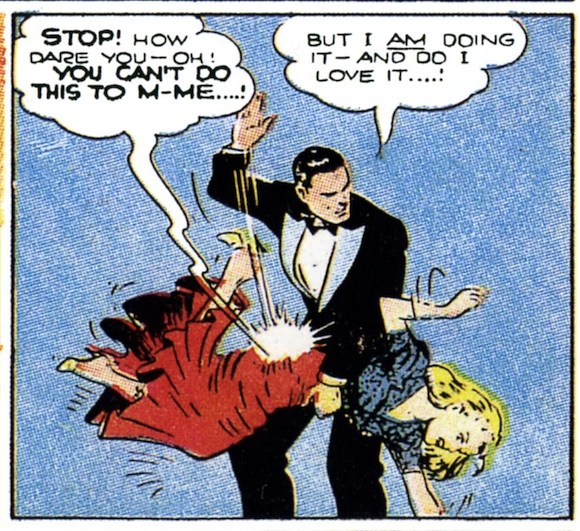
That’s a panel from the Superman newspaper strip which Siegel and Shuster worked on in the early ‘40s. It took me about a minute to find it by flipping at random through my volume of Superman: Sunday Classics.

So Shuster was into kink, then? Yoe does manage to uncover some evidence that the artist had an eye for chorus girls and the female form. But while that’s interesting, it’s not really the main issue. The point here isn’t that this or that creator had a personal thing for spanking or sadism or masochism. Rather, the point is that as a genre superhero comics simply aren’t that far removed from the kind of pulp fetish porn that Shuster retailed in Nights of Horror. Read through Yoe’s plot synopses of the sixteen plus issues that Shuster illustrated and you’ll get a definite feeling of déjà vu. Damsels in distress, evil hooligans, manly private dicks, and fiendish torture devices — didn’t Shuster illustrate all of this somewhere before? You’ve even got a fair number of men getting shown up just like that milquetoast Clark Kent…though, admittedly, Kent’s humiliation didn’t usually involve a French maid.

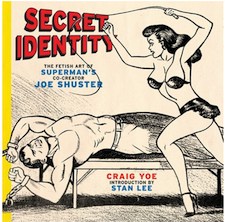
The consistency, though, goes beyond the simple details of the plot or the occasional oversexed Jimmy Olsen look alike. Both Nights of Horror and Superman have Shuster’s trademark, rough and ready stiff poses, forthright compositions, and linework-because-we-need-some-linework. It’s not slick, but it does have a kind of charming mass-market anonymity. The dominatrix on the cover of Secret Identity for example; Shuster drew her breast so it looks like a detachable sack draped over her shoulder. It’s as if he just chucked her together piecemeal for the pose, and plans to disassemble her as soon as you turn the page.

And then there are the picture frames on the walls of some of the dens of iniquity drawn in Nights of Horror — picture frames in which Shuster has neglected to place any actual pictures. Yoe suggests that these vacant blank squares evoke the emptiness and cruelty of the bleak pulp world. Really, though, it seems to me likely that Shuster didn’t draw pictures for the frames hanging in the background because…this is porn. Who’s looking at the damn pictures on the wall? Shuster isn’t creating art; he’s creating a delivery system.

This ability to focus on the main bit and ignore the frills was the genius of Superman too, of course. You want a power fantasy? Okay; we’ll give you a power fantasy. Super strength! Invulnerability! Constantly humiliating the girl you desire! What could be better than that, huh? Shuster knew a thing or two about catering to his audience’s desires. That he’d pander is not surprising — though the blatant obviousness of his vision still has the power to startle.

Utilitarian Review 2/11/12

On HU

In our Featured Archive post, P.M. Newton argues that the Wire pulls its punches when it comes to police corruption.

Jones, One of the Jones Boys, looks at Before Watchmen and asks of Alan Moore who lifts from the lifters?

I talk about why How To Train Your Dragon is better than Harry Potter.

Erica Friedman interviewed Marguerite Dabaie, creator of Hookah Girl.

A smooth 70s soul downloadable mix.

Sean Michael Robinson interviwed Gerhard about craft at great length.

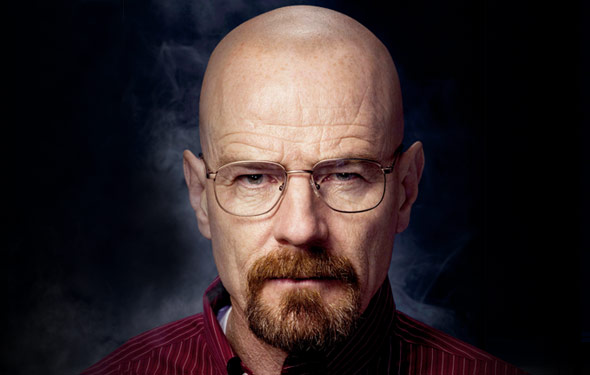
I talked about morality and entertainment in Flannery O’Connor and Breaking Bad.

Kailyn Kent on Adam Hines’ Duncan the Wonder Dog.
 
Utilitarians Everywhere

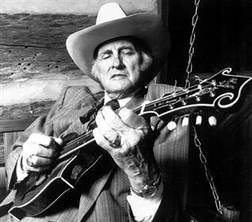
At the Atlantic I discuss Bill Monroe’s pop legacy. Watch people flip out in comments when I express glancing dislike of Bela Fleck.

At Splice Today I discuss my skepticism about the economic recovery.

At Splice I describe the unpleasant sensation of rooting for Santorum.

At Splice I talk Joni Mitchell vs. Kate Bush.
 
Other Links

Alan David Doane on Before Watchmen: scab comics for scab readers.

Cheryl Lynn on listening to black creators, not black characters.

J. Caleb Mozzocco on the mediocrity of the creators on Before Watchmen.

Johnny Ryan on cartoonists vs. radical Islam.

Mahendra Singh is involved in this poetry and comics event next week in New York.

Qiana Whitted on Toni Morrison and how to draw comics characters without giving away their race.

Alex Massie wonders how much better off we might all be if the U.S. hadn’t elected three psychopaths in a row to the presidency.

And late-breaking plug; Marguerite Van Cook is participating in a play/performance extravaganza in Brooklyn, if you’re thereabouts.
 

Monster Fun

“Breaking Bad” is usually discussed in terms of its moral vision, and its unflinching depiction of Walter White’s decent into evil. Chuck Klosterman’s is probably the best-known encapsulation of the argument.

Breaking Bad is not a situation in which the characters’ morality is static or contradictory or colored by the time frame; instead, it suggests that morality is continually a personal choice. When the show began, that didn’t seem to be the case: It seemed like this was going to be the story of a man (Walter White, portrayed by Bryan Cranston) forced to become a criminal because he was dying of cancer. That’s the elevator pitch. But that’s completely unrelated to what the show has become. The central question on Breaking Bad is this: What makes a man “bad” — his actions, his motives, or his conscious decision to be a bad person? Judging from the trajectory of its first three seasons, Breaking Bad creator Vince Gilligan believes the answer is option No. 3. So what we see in Breaking Bad is a person who started as one type of human and decides to become something different. And because this is television — because we were introduced to this man in a way that made him impossible to dislike, and because we experience TV through whichever character we understand the most — the audience is placed in the curious position of continuing to root for an individual who’s no longer good.

Admittedly, I’m only through season 1 at the moment. But still, I see the trajectory Klosterman is talking about; Walt kills and sells meth and blows people up, and we still root for him.

Klosterman suggests that we root for evil because the show starts us off by sympathizing with Walt. I think that rather misses the point of the genre conventions though. You don’t root for a bad ass despite the fact that he’s a bad ass. You root for him because he’s a bad ass. Rorschach is cool not despite the fact that he shoots a policeman in the chest with a grappling gun, but because he does so. Similarly, when Walt shaves his head, goes into the drug dealers den, and uses his chemical no-how to create a huge explosion and intimidate the heavies — we don’t root for him despite that. We root for him because of it.

The first season of Breaking Bad isn’t coy about this dynamic. On the contrary, it presents good Walt, his good family, and his good milieu as hopelessly square, hypocritical, and ridiculous. Walt’s wife, Skyler, comes across as a moralistic busybody, snooping around after Walt and freaking out over his (supposed) pot use. Hank, Walt’s brother-in-law the DEA agent, is equally ridiculous, trying to scare Walt’s son straight in a painfully embarrassing scene in which he burbles anti-drug war bullshit while callously bullying the random druggies passing by. Walt himself is an ineffectual high-school teacher and a wimpish nonentity, sclubbing along in Hank’s shadow, boring his students, and generally epitomizing castrated middle-class suburban white lameness.

Until, that is, he embraces the dark side. After learning he has cancer and deciding to cook meth to support his family after he’s gone, Walt suddenly starts to become tough, sexy, powerful — a character who demands admiration rather than contempt. He defends his crippled son from bullies; he destroys the car of an insufferable cell-phone yakking stock trader; he faces down drug-dealers; he even starts subtly bullying Hank rather than the other way around. He changes from a colorless nothing to a dark hero — and who, given those options, wouldn’t root for the dark hero, not only because he’s a hero, but because he’s dark?

“Breaking Bad” does show the downsides of White’s choices as well. By stealing from the school science supplies for his meth cooking, he ends up drawing the police down on the saintly Hispanic janitor. The scriptwriters also take care to make a drug-dealer intelligent and thoughtful so we’ll sympathize with him when Walter has to kill him. Yet, the very effort to drive these moral lessons home can’t help but to contradictorily glamorize them. Walt is making Big Decisions with Big Consequences; he moves in a world of Drama and Tragedy. Who wouldn’t rather be Hamlet than Guildenstern?

As a contrast, consider Flannery O’Connor’s collection Everything That Rises Must Converge. All of these stories are about regular people — people like Walter — choosing between good and evil. But in O’Connor’s world, there’s nothing particularly exciting or sexy about going bad. Instead, sin is a small, stupid, sordid business, made up mostly of ingratitude, egotism, stupidity, and willful blindness. It’s not becoming the best damn meth-maker in the county — it’s sneering and taunting your mother as she has a stroke. It’s not killing a sympathetic drug dealer; it’s accidentally strangling your quite unsympathetic 10 year old granddaughter to death because she doesn’t behave enough like you. In O’Connor’s stories, sin makes you smaller than life, not bigger.

This isn’t to say that O’Connor’s stories are definitively better than “Breaking Bad.” Her range is limited — parent and child don’t get along; viciousness is exchanged; an epiphany is achieved just too late to forestall the tragic twist ending. The first time you read it, it can seem like a revelation. By the end of a book, though, it’s become wearisome; the boring scold repeating the same damn harangue for the sixth or seventh run through. At this point I’d probably rather watch another season of Breaking Bad than slog through another collection of the same damn stories by O’Connor.

Which is maybe the point. Evil in O’Connor is boring, which, by definition, prevents it from being interesting. In “Breaking Bad”, on the other hand, evil has the adrenaline rush of its genre conventions — it gives Walter purpose, direction, and emotional heft. “Breaking Bad” feels good, which probably tells you less about evil than it does about entertainment.

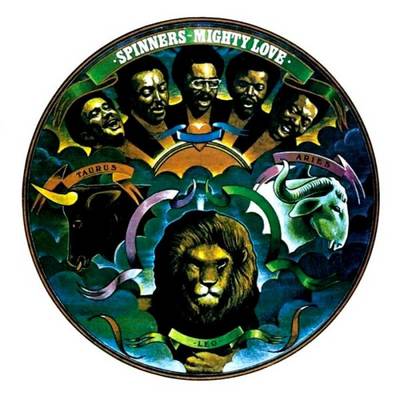
Music For Middle-Brow Snobs —Mighty Love

A smooth 70s soul mix. Download Mighty Love.

1. All Day Music — War
2. Girls — The Moments
3. One Man’s Junk — Billy Paul
4. Don’t Let Him Take Your Love From Me — The Temptations
5. Strung Out Over You — Dells
6. Homely Girl — Chi-Lites
7. Cowboys to Girls — The Intruders
8. You’re Right as Rain — The Stylistics
9. Stringin’ Me Along — Blue Magic
10. Face It Girl It’s Over — Delfonic
11. The Worst That Could Happen — 5th Dimension
12. Time to Get Down — O’Jays
13. Mighty Love — The Spinners
14. Seven Years — The Impressions
15. Satisfaction — Smokey Robinson and the Miracles
16. Love (Your Pain Goes Deep) — Frankie Beverly and the Butlers
17. Wake Up Everybody — Harold Melvin and the Blue Notes

Interview with Independent Comic Artist Marguerite Dabaie

A number of years ago, I had the pleasure of speaking to a group of young artists at the Museum of Comics and Cartoon Art. It was spectacular evening, and I’ve made a point of keeping in touch with several of the talented young people I met there. A few years later, at the annual MoCCA event, I ran into one of those young artists, Marguerite Dabaie. She handed me a self-published comic about transvestites during the Weimar Republic. I was instantly hooked by her personal style of story-telling that communicated emotion, without beating you with it.

A few years later,  when I ran into Margot again, she had just published the first volume of her book Hookah Girl and Other True Stories. I read the first volume and have since been giving it away to people as an example of a voice that needs to be heard and a talent that needs to be enjoyed by as many readers as possible. I am quite literally in the habit of buying her book to give it away. One of those gifts gained Margot a short write-up by Brigid Alverson on Robot 6.  Brigid writes:

[Hookah Girl]  a memoir of growing up as a Palestinian Christian, within the immigrant community in the U.S., as well as a meditation on all the contradictions and labels that come with that identity. Dabaie starts the first volume with a set of paper dolls that embody each of those stereotypes‹Muslim girl in full hijab, suicide bomber with vest full of explosives, I-Dream-of-Jeannie seductress, starving artist. The stories touch on things that are familiar to immigrants in general — scary relatives, peculiar customs, native foods — but there is also an interesting comic about Leila Khaled that presents her as an interestingly complex individual. This book left me wanting to see more, and I hope there is a full-length graphic novel in the works. If there isn’t, there should be.

Today it’s my pleasure to introduce you all to Margot and her work.


Erica: Let’s start with the obligatory introduction.

Margot: I grew up out in San Francisco, dabbled in drawing for a long time, and decided to move to NYC in order to strike a match under my butt.

For the past couple of years, I’ve been working at a museum while attending graduate school (for illustration). I also freelance and teach art- and comic-related workshops. It’s a busy time for me right now, very productive, and I like it that way!


E: What was your motivation for The Hookah Girl and Other True Stories?

Two different threads led to the creation of The Hookah Girl: One is that I got a lot of “you should make a comic about this” comments from people who heard some of the stories that I ended up putting in the books. Tom Hart and Leela Corman were especially assertive about this, which I appreciate now.

The second thread stems more with my aggravation towards how Arabs are generally portrayed in the media and the public perception of them. I was very good at not paying much attention to the bad rap, and managed to just completely tune it out for a really long time. But then, 9/11 happened and it became impossible for me to ignore it. I had friends telling me to not let on that I was Palestinian so that I wouldn’t be discriminated against, and I think that really hit home. Of course, my friends meant well, but it was difficult to swallow that I now lived in a place—In the US, no less!—where some people gave a crap that my father was born in Ramallah. I had my own little “Arab Spring” throughout the years and one of the results is my comic.

I’ve nicknamed The Hookah Girl “Arab 101” because I ended up writing with a non-Arab audience in mind. I wanted to highlight that, while my family and some of their practices are not “western” and may be distinct, they are not any more or less distinct than any other family. The positives and negatives are not all that different from any variety of cultures, and they just are. I get the greatest thrill when someone comes up to me and tells me that my grandmother reminds them of their French grandmother, or Nigerian uncle, or Korean mother. This is exactly the kind of reaction I wanted—that we all have a Teta in our lives.


E: How has the reaction to Hookah Girl been? As a person of Jewish descent, it’s been hard for me to watch the vilification of everything Arab in some of the media. Like, haven’t we learned anything in 2000 years, seriously? I can’t imagine that you haven’t gotten at least some negative feedback.

M: The comic has been received fairly well. I have had some unfortunate instances where people did not agree with the political implications behind calling oneself a Palestinian (because just using the “P” word can be a political act) and dismissed it for that alone. I’ve also had people admonish the work because I mention some negative aspects—namely, my father’s sexist tendencies and my exploration of Leila Khaled, a 1960s terrorist. The positives outweigh the negatives, though, and I absolutely feel like making the comic has been worth it. The connection I have achieved with people is the whole point, really!


E: Well, for what its worth, it totally connected with me. You’re very outspoken about what you think, which I just love. What is the  one panel you’ve done that best expresses yourself? 
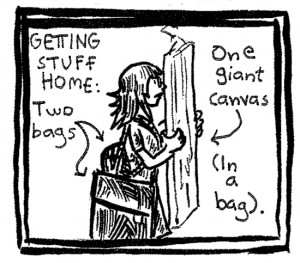
E: Hahah, I can totally see you like that.   Who are your artistic influences, comic or otherwise?

M: Firstly, I’m really influenced by “folk” art. I especially love work that is flat and very graphic—patterns on textiles, tapestries, manuscripts on vellum, murals, and the like.

Some of the artists who I actively look at are Rembrandt, Pierre-Paul Prud’hon, Lorraine Fox (I can thank Murray Tinkelman for introducing me to her work!), Trina Schart-Hyman, J. C. Leyendecker, and Yoshitaka Amano.

In regards to comic influences, I’ve felt strong connections to Naji al-Ali and lots of older manga—especially anything made by CLAMP in the 1990s (RG Veda takes the cake), Masamune Shirow, and Rumiko Takahashi.


E: The manga influences really show in your story-telling style. You write a webcomic “He Also Has Drills For Hands,” where did you get that name? Tell us about the comic.

M: I originally started writing HAHDFH as a self-imposed exercise. I felt like my work was getting too precious and I wanted to publicly make a large body of work. So, I chose to leave the strip’s subject matter totally open (a lot of them deal with funny little everyday occurrences, but I still have my occasional Really Random Strip) and I draw them in a small sketchbook that’s really portable, so I can draw them while I’m out running around and doing my thing. They’re a lot of fun to make and when I started out, I was drawing one a day. Unfortunately, I haven’t been able to keep that schedule up—grad school does that to you—so they’ve been knocked down to three strips a week.

The title alludes to one of my really early strips in which I talk about my childhood crushes. One of them is a robot named Crash Man who is a character from the video game Mega Man 2. The title was a line in the strip, because Crash Man does, indeed, have drills for hands! My kid self managed to look past the drills.

E: We’ve reached the obligatory “What are you working on right now?” question.  So, what are you working on?

M: I’m currently in the research/very, very preliminary sketching phase for a historical-fictional graphic novel. It’ll take place in 7th-century Sogdiana, which was in modern-day Uzbekistan.


E: We talked about this a bit at New York Comic Con. It sounds pretty fantastic. 

M: It will be chock-full of Silk-Road goodness. I’m going to put up a website about this project soon!


E: I know I’m looking forward to reading it. Margot, thanks so much for your time today!

M: Thank you!

I hope you’ll all check Margot’s work out at Margoyle.net – and let me know what you think here.