Utilitarian Review 1/21/12

On HU

I talked about artists in their work in 24, Fanny Hill, Yuichi Yokoyama, and more.

Russ Maheras reviewed Dale’s Comic Fanzine Price Guide.

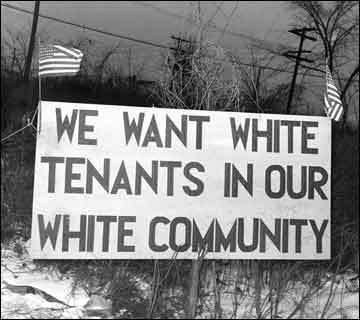
I reviewed James Loewen’s book about northern segregation Sundown Towns.

Caroline Small talked about the Cold War, Soviet anti-racist propaganda, and the Civil Rights movement.

Sean Michael Robinson argued with his grandmother about magicians and architects.

I posted a download mix of country weepers.

I talked about R. Crumb’s love/hate relationship with blackface and the blues.

And Vom Marlowe praised the BBC show New Tricks.
 
Utilitarians Everywhere

At the Atlantic I reviewed Beneath the Blindfold, a new documentary that looks at the effects of torture on those who survive it.

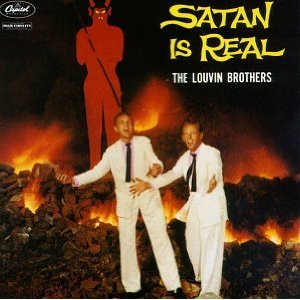
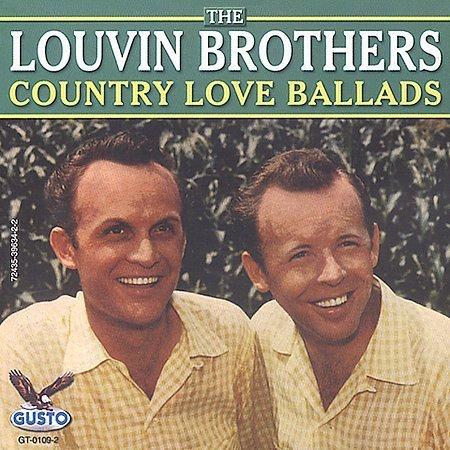
At Splice Today I reviewed the autobiography of Charlie Louvin, part of the great country duet the Louvin Brothers.
 
Other Links

Conor Fridedersdorfer talks about Obama’s crappy civil liberty record.

I’m actually glad I watched this: New Tricks (BBC)

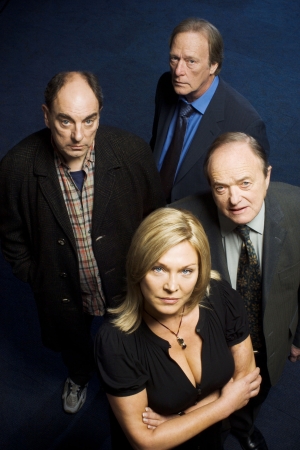
picture of the cast

As longterm readers of HU know, I refuse to pay for cable and generally rely on Amazon and Netflix instead.  This sometimes results in rather unfortunate viewing experiences, but this time, I was caught up, rapt, watching episode after episode, grumbling fiercely when the disk arrived a day later than expected and ordering whole seasons on Amazon with reckless abandon.

But why, you might ask, has this show seized the (ultra picky) Vom by the heart and held on?

Because it is good.  Really, really good.

The premise of the show is this: An up and coming cop named Sandra Pullman is put in charge of a small squad (called UCOS) of retired ex-coppers.  They take on old and unsolved cases, working for the police but coloring a little outside the lines.

There’s Sandra, who has given up her life to be a copper, a beautiful woman in a man’s world where they expect her to serve the coffee and get patted on the butt.  She’s very alone.  I love Sandra like burning.  She is also a very dominant woman–in the pilot, there’s a small brawl and you get to see Sandra punch several people out.  She’s stuck heading this team because she’d been on a big case and then screwed up publicly.  The brass reassigned her in a kind of lose-lose way–if she screwed up again, no big deal, you’re fired.  If she succeeded, they could take the credit for a new, exciting initiative.  The political machinations inside the police force (and in other aspects of life) is a major theme of the show. Sandra uses modern police methods (DNA testing, forensics, modern procedures) and has a very honorable, rule-following nature, as well as being tough and no-nonsense.  She is my very favorite.  She also happens to be smoking hot, which is a bonus.  My goodness she looks good when she glares.  *insert happy little VM sigh here*

There are three retired ex-coppers
There’s Gerry, who loves good food, gambling, and the pleasures of the earth.  He has three ex-wives and many daughters–he’s a bit of a chauvinist and most of the force assume he’s bent as a corkscrew, but he has more morals than most people, even if he sometimes screws up.  A bit Yohji-ish at times, if Yohji was paunchy and balding slightly.  He’s still friends with all his ex-wives and they all have dinner together, visit him in flocks at his bedside when he’s in hospital, and generally make his life….interesting.  When his loved ones get ill, he cooks at them.  (I can totally relate to this, as I have a strong urge to make casseroles, pies, or soup at people.)

There’s Brian Lane, who is neurotic as a shaved weasel and probably has more brainpower than the average building full of supercomputers.  He reminds me a little of the Pookster, actually.  He’s twitchy and sensitive, very smart, and kind of crazy.  But he is also the empathetic of them and has a way with witnesses that sometimes makes me cry.  He’s so gentle and kind, it’s hard to watch.  He can be tough, too, but he feels very deeply.  He is a recovering alcoholic and is deeply devoted to his wife, Esther, who takes good care of him, and to his dogs, first Scruffy and then Scampi.

Finally, there’s Jack Halford, who is Sandra’s old boss.  He’s the hard hitting Sam Vimes-ish character.  Brilliant at understanding how people work, he can get results when everyone else fails.  He knows people from way back and he’s quite tough.  He worked in internal affairs, investigating bent coppers for a while.  One his mottos from the pilot is: do you want to get results or do you want to look nice.  Jack is also a drinker and is deeply devoted to his dead wife.  He spends a certain amount of time sitting at her grave (in their back garden) drinking and talking to her.  She (silently) often provides the insights he needs.

All three of the ex-coppers are cynical bastards and I love them for it.  They’re Very Nearly Criminals quite frequently.  They lie, cheat, and make shit up.  They gamble (Gerry), drink like a fish (Jack), and act crazy (Brian).  One of the recurring in-jokes on the show is that they all record their conversations on secret tape recorders, which is against the law.  But only if you’re police, they like to gleefully point out.

It drives Sandra nuts.  They drive Sandra nuts.

But their encyclopedic knowledge of the criminals active in London and environs over the past decades, combined with their sneaky minds, gives them the ability to solve cases that have been dead and buried for thirty years.

The show is like any mystery TV series–one case per episode, but unlike some of the lesser shows, it continues to develop characters and themes over the course of the series, and also unlike American TV most of the time, criminals or others policemen or family members continue to show up from time to time, as appropriate.  Over several seasons, the mystery of who hurt Jack’s wife is solved, although the mystery of what happened to the man Brian Lane was watching on his last active case for the police never is.  Some of the mysteries do not end happily–the criminals get away, or the cops have their hands tied by procedure.

What’s so wonderful is that both sides of them, the modern tough Sandra and the cynical old men, learn from each other.  They care for each other, each others’ families (what’s left of them after being coppers drives people apart), and they create their own little family.

The mysteries themselves are generally clever and unexpected.  Since it’s a British show, the seasons are quite short, but there are eight seasons so far and they’ve begun working on a ninth.  Highly recommended.

Crumbface

We’ve had several posts on race this week, so I figured I’d finish up by reprinting this piece from Comixology. I think it’s one of Jeet Heer’s least favorite things I’ve written, if that’s any incentive.
__________________________

As cartoonists go, Robert Crumb is quite, quite famous. Still, there’s cartoonist famous and then there’s rock star famous. Which is to say that for all his notoriety and the cultural currency of “Keep on Truckin'”, the Crumb image that has been seen by most people is probably still his iconic 1968 Cheap Thrills album cover for Big Brother and the Holding Company featuring Janis Joplin.
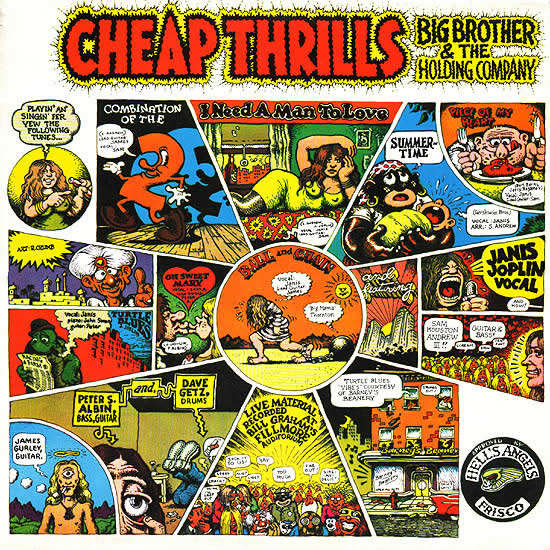
It’s somewhat unfortunate that this is one of Crumb’s defining images. Not that it’s bad. On the contrary, the inventive layout, with images radiating out from a central circle is pleasingly energetic, and the drawing, as always with Crumb, is great. Plus, cute turtle! The only thing is….

Well, it’s kind of racist.

Crumb’s oeuvre not infrequently delves into reprehensible blackface iconography. Sometimes, (as in his Angel McSpade strips) he seems to be trying, at least to some extent, to critique or mock the imagery. In the upper right of the Cheap Thrills drawing, though, he seems to use blackface simply because (a) that’s how Crumb draws black people when he’s drawing cartoons, and (b) racist iconography = funny!

The racist image in question is an illustration of Joplin’s cover version of the famous Gershwin tune from “Porgy and Bess.” The song itself, written by a Jew to capture the sound of African-American spirituals using elements from Ukrainian folk tunes, is one of America’s great cultural mish-mashes. Though its lyrics evoke the happy darky stereotype (“Summertime, and the living is easy…”) its mournful, heartfelt tune suggests a barely suppressed sadness — a weight of hardship hidden for the sake of love beneath a lullaby. My favorite take on the song is probably Sarah Vaughn’s effortlessly heartbreaking rendition. In comparison, Joplin’s hoarse bombastic reading sounds strained and clueless. The rendition is bad enough that it even becomes borderline offensive: almost the very minstrelization of black experience that Gershwin, through a kind of miracle, managed to avoid.

In that sense, Crumb’s image for the song could almost be seen as parody; a vicious sneer at Joplin’s blackface pretensions, caricaturing her as both a wannabe black mammy and as the whining white entitled brat looking to the exploited other for entirely undeserved comfort. As I said, it could almost be seen as that — if Crumb hadn’t thrown in another entirely gratuitous blackface caricature in the bottom center panel, just to show that, you know, he really is exactly that much of a shithead.

Given the grossness of the Cheap Thrills cover, it’s interesting that Crumb has, in the intervening years, gained a reputation as a particularly thoughtful interpreter of the black musical experience. His passion for 1920s-30s blues and jazz records is well known, and he’s done some cover art for blues releases. He’s also written comics focusing on blues history, perhaps the most lauded of which is “Patton” from 1984, a 12-page illustrated biography of legendary delta bluesman Charlie Patton.

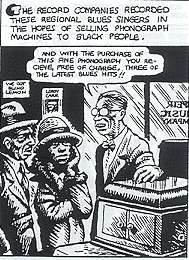
“Patton” absolutely eschews blackface caricature. Indeed, it more or less eschews cartooning, opting instead for a more realist style which seems to draw from photo-reference for its portraits of Patton, Son House, Robert Johnson, and others. Walk-on characters, though, are also portrayed as individuals. A black man and woman contemplating buying a phonograph, for example, are humorous not because they’re exaggerated, but because they aren’t; their faces are fixed in ambivalent desire and nervousness as they try to determine whether this, right here, is going to break the bank.
At the same time — it wouldn’t be quite right to say that Crumb dispenses with caricature. He just uses it more subtly. Some of his drawings of women in the strip are impossibly mobile, curving rubberlike to accentuate the more interesting bits:
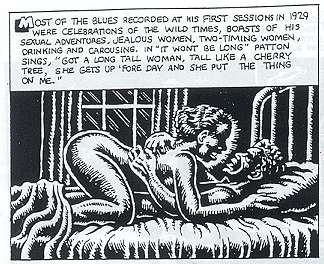
Crumb’s fascination with the female form is no particular surprise given his oeuvre. Here, though, it’s subsumed within a grander project of fetishization aimed at Patton himself. Crumb’s recounting of the bluesman’s life is matter-of-fact, but there’s little doubt that not just Patton’s musical genius but his shiftless, earthy, sex-and-violence drenched life is a huge source of attraction for the cartoonist. You can see it in the enthusiasm with which Crumb’s pen limns the posterior in that picture above, as well as in the gratuitously R-rated fight scene below:
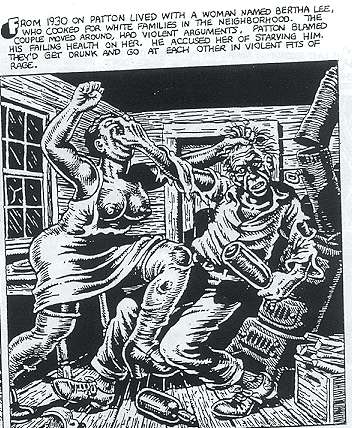
But I think Crumb’s fascination also comes out in subtler moments. There’s this passage for instance:

“The tin-pan alley blues barely touched the remote rural black people of the Delta region, where the real down-to-earth blues continued to evolve as an intense and eloquent expression of their lives.”

That statement may or may not be entirely true (the back and forth between rural and urban was arguably not quite as hard and fast as Crumb makes it out to be.) But the important point is that Crumb is making a distinction between Ma Rainey and Charlie Patton — and Patton is the one who is intense, who is eloquent, and who is “real”. In his appreciation of the form, then, Crumb has bypassed not only Janis Joplin but even Sarah Vaughn and her compatriots to arrive, at last, at the genuinely authentic expression of the blues.

In “Patton”, appreciation is not passive contemplation; it’s more like passion or desire. Crumb, for example, shows two consecutive panels of men appreciating the playing of seminal bluesman Henry Sloan. First Charley Patton looks at Sloan with an intense, almost needy fascination; then W. C. Handy looks at Sloan with a glance that holds more surprise, but no less yearning.
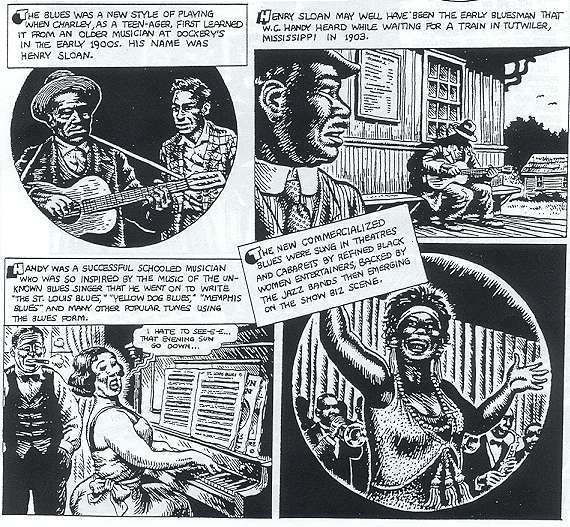
These meaningful stares are complemented a couple of pages later by this panel:
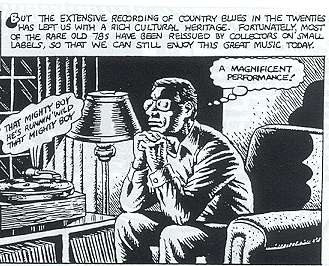
This doesn’t seem to quite be Crumb — his self-caricatures are generally instantly recognizable. But, at the same time, it clearly is Crumb; the white connoisseur who appreciates the “rich cultural heritage” of those African-Americans who (according to Crumb in the next panel) see the “old blues” as “too vivid a reminder…of an oppressive ‘Uncle Tom’ past they’d rather forget about.” Only the white listener can appreciate the lower-class, un-PC genius of the blues, undistracted by a history of oppression which regrettably (if understandably) blinds the music’s most direct heirs.

Of course, as we’ve seen, Crumb himself is responsible for at least one of the most widely disseminated modern examples of vicious Uncle Tom iconography in existence. Given that, it seems fair to wonder whether he isn’t protesting a bit too much here. Are black folks really disdainful of the blues because the music is not as uplifting as gangsta rap? Do they really see blues songs about violence, sex, and drinking as somehow Uncle Tomish? Or, you know, is the music just really old pop culture, and therefore not of particular interest to most people, as is generally the case with very old pop culture?

Perhaps the real question is not why black people don’t love the blues enough, but why Crumb loves it so much. After all, what is he getting from this story of authentic black people carousing and fighting and making great timeless art which only he and a select few like him understand?

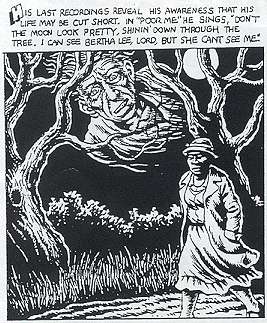
It’s not really that difficult a question, obviously. White American culture (and not just American), from Gershwin to Joplin to Vanilla Ice and Madonna (to say nothing of Elvis) has long been obsessed with adopting, miming, parodying, and exploiting black culture. Because they have been oppressed and marginalized, blacks have taken on a kind of totemic value; they and their culture are the ultimate expression of resistance to the man, of purity and heart in the face of a monolithic culture of indifference. Being black is being cool — and through his love of old blues, Crumb can be blacker than Janis Joplin, blacker than Bessie Smith, blacker than non-blues-listening African-Americans — blacker, in other words, than black. On the last page of the story, we see a ghostly Charlie Patton floating above his girlfriend Bertha Lee — and you have to wonder if that’s how Crumb sees himself, an intangible, unseen observer, both watching and inhabiting the long-dead African-Americans he animates and desires. We haven’t, after all, come that far from Cheap Thrills; it’s just that, instead of drawing blackface, Crumb has — circuitously and with less painful racist connotations, but nonetheless — donned it himself.
____________
Karen Green had a thoughtful comment at Comixology.

In fairness, Noah, the two gratuitously naked and/or nubile women you show in the Patton comic would likely have been gratuitously naked and/or nubile even if they were white woman. As a woman, I’m well aware of how Crumb prefers to depict us!

There’s no excusing the Cheap Thrills cover, however.

I think you’ve touched on something quite insightful, though, in concentrating on WHY Crumb loves the blues–especially to the extent that he loves it. There is clearly the love of the arcane, the elevation of self into a particularly rarefied aficionado. (And I would wager there are just as many African-Americans pursuing that arcane love of the blues as there are whites.) But there’s also a possibility that a man who grew up seeing himself as marginalized and miserable–regardless of how easy his life was in comparison to former slaves–might find something kindred in that music.

That possible sense of kinship is what makes the Cheap Thrills cover all the more distasteful. Like Al Jolson in blackface gleefully reading the Yiddish paper The Forvert in the film “Wonder Bar,” it’s as if Crumb has embraced that black experience but still wants to prove that he exists apart from it–a particularly unpleasant wink at the audience.

And I responded:

I’d agree that it’s hard to tease Crumb’s misogyny out from his racism. My point here isn’t that he’s racist rather than misogynist, but that his fetishization of women bleeds over and inflects his fetishization of Patton. (Through his emphasis on Patton’s sexuality, through the use of significant glances sexualizing the blues, etc.) I think you could argue that it goes the other way as well, though (that is, the fetishization of blackness as earthiness inflects his misogyny.)

Art doesn’t belong to anyone; there’s absolutely nothing wrong with white people being into blues. There is, as you say, though, something unpleasant in the way Crumb seems to want to set himself up as more in tune with “authentic” blackness than some black people — especially given his really unfortunate history with racist caricature.

_________
This is a belated entry in our roundtable on R. Crumb and Race.

Music For Middle-Brow Snobs: My Heart Was Trampled on the Street

A country weepers mix. Download My Heart Was Trampled on the Street.

1. Twenty Years and Two Husband Ago — Lee Ann Womack
2. The Chill of An Early Fall — George Strait
3. Promises — Randy Travis
4. That’s the Way Love Goes — Lefty Frizzell
5. I Never Go Around Mirros — Willie Nelson
6. Half AS Much — Patsy Cline
7. I Don’t Hear You — Buck Owens
8. It’s All In My Mind — George Jones
9. These Two — Tammy Wynette
10. You Don’t Have Far to Go — Merle Haggard
11. The Richest Fool Alive — Patty Loveless
12. My Heart Was Trampled on the Street — The Louvin Brothers
13. Heartbreak Avenue — Don Gibson
14. That’s What Lonesome Is — Jean Shepard
15. A World So Full of Love — Faron Young
16. The Little Things — Dolly Parton
17. The Long Black Limousine — Wynn Stewart
18. I Just Can’t Let You Say Goodbye — Porter Wagoner
19. It Won’t Be Long (And I’ll Be Hating You) — Johnny Paycheck
20. Fifteen Years Ago — Conway Twitty

Freedom is a Strong Seed, Planted in a Great Need

1963 was an eventful year for the Civil Rights Movement: MLK wrote the Letter from Birmingham Jail in April, in the city that erupted in riots a few weeks later following the integration of the University of Alabama. Medgar Evers’ murder occurred in June, the same month President Kennedy delivered a televised speech calling for civil rights reform. King delivered the I Have a Dream speech during the March on Washington in August. And in September, Birmingham erupted in riots again after the deaths of four young girls at the Sixteenth Street Baptist Church.

It’s also the year the state of Maryland passed a bill prohibiting discrimination in public services. Living in Maryland in 2012, in the most affluent predominantly African-American county in the United States, it’s difficult to imagine that less than a decade before I was born, African-Americans in this very county, then much more homogeneously white, were unable to get a haircut at the downtown barbershop or eat at roadside restaurants.

Maryland’s bill wasn’t all that different from other similar ones – except for the involvement of the United States Office of Special Protocol Services, a division of the State Department charged with solving the problems faced by non-white diplomats as a result of systematic race discrimination in the US. The Office got involved in something that on the surface looked like an internal State of Maryland matter because foreign diplomats, particularly African diplomats, driving US Highway 40 between the United Nations in New York and their embassies in DC or the US Federal Government faced discrimination which violated their legitimate expectations as diplomats and generated terrible press in their home countries. By 1963, the State Department saw race discrimination as a threat to their global diplomatic agenda and a liability in positioning American-style democracy as the moral counterweight to Soviet communism.

The Soviets viewed it as an American weakness as well. State radio in the USSR devoted extensive propaganda output to the tumult of the Civil Rights movement. During the Birmingham riots, the USIA reported that the Soviets dedicated 1/5 of their total broadcast time to coverage of events in Alabama. They also continued to use race against the US in narrative propaganda; 1963 marked Soyuzmultfilm’s release of the animated Mister Twister, based on the much-loved poem by Samuel Marshak that tells the story of an American business man who is overwhelmed, angered, and eventually transformed by his experience in a racially integrated society during a visit to Leningrad.

Marshak was an exceptional translator of English-language literature and wrote children’s books in part because they allowed him to avoid the ideological demands and problematic realities of Soviet realpolitik in favor of less ambiguous moral terrain. For reasons I don’t know, Marshak was designated an Enemy of the State during his tenure as head of the Children’s Section of the State Publishing house; apocrypha has it that he escaped the purges only because Stalin himself was so fond of Mister Twister’s story. Doris Lessing wrote about Marshak’s dilemma in her autobiography:

The nicest result of the visit to the Soviet Union was that I became a friend of Samuel Marshak, one of the prominent Soviet writers, a winner of the Stalin Prize for Literature. He was a poet, translated Burns and Shakespeare, wrote children’s stories. At that time writers unable to write what they wanted, because of the persecutions of serious literature, chose to do translating work: this is why the standard of Russian translation was so high…I do not see how any writer could have a worse fate than Samuel Marshak’s. To be a peasant boy with genius – or even talent – at that time was to be seen as the inheritor of a glorious future. To be Gorky’s protégé was to be accepted by the most famous writer in Russia. Gorky steadily fought Lenin over the inhumanity of his policies, procuring the release of hundreds of political prisoners, and then he fought Stalin too: it would have been easy for Marshak to feel allied with the good side of the Revolution, because it was then still possible to think there was one. Slowly he was absorbed into the structure of oppression, but hardly knew it was happening. By the time he knew he was trapped, it was too late. Easy to say, for people who have never lived with the experience of political terror, ‘He should have opted out.” How? He would have been sent to die in the Gulag, like dozens of other writers. ‘I never wrote what I should have written,’ he said.

Although the film of Mister Twister was made in 1963, the poem was written thirty years earlier, in 1933. That same year, one of the earliest uses of moralistic anti-racist ideology in anti-imperialist propaganda, “Black and White”, gave an antebellum flavor to its documentation of Jim Crow racism. The film was directed by perhaps the most important Soviet animator, Ivan Ivanov-Vano, who collaborated with Shostakovich and Stravinsky and who taught at the Gerasimov Institute of Cinematography from 1939 until his death in 1987.

Ivanov-Vano’s film trafficks in the iconography of racism, the caricatures of Picaninny and Brute, and yet manages to convey great pathos, much more than is generally associated with caricatured representations. There is no comedy here; only the violence of those representations, removed from the historical context that created them and stripped bare of all ambivalence. For Western viewers today, the insistence of the representation’s moral starkness undermines their conventional signification and allows the aesthetic merits of the film to come to the foreground. For Soviet viewers in the 1930s, that moral starkness played directly into the hands of a good/evil propagandistic ideology that obscured as much as it revealed. Although the ending of Black and White is more didactically Communist than Mister Twister, that doubling suggests that the same tension between realpolitik and the morality of Marxist ideology likely informed the creation of this work. Perhaps it inspired Marshak’s poem.

Soviet propaganda targeting American racism was not limited to animation — there were live action movies such as the 1936 film The Circus, about an interracial couple fleeing prejudice, and a great deal of non-fiction and journalistic propaganda as well. The linking of racism with imperialism was immensely effective among non-white groups worldwide, particularly in African nations. At least as early as the Truman administration, US leaders saw policy positions in support of civil rights as a necessary component of efforts to contain the spread of communism. In 1962, the United States Information Agency hired the documentarian George Stevens, Jr. to head its motion picture operations. Stevens hired filmmakers such as Charles Guggenheim, Leo Seltzer and James Blue to create films for the USIA, intended to counterbalance the skilled and artistically powerful Soviet propaganda machine. In 1963-4, Blue directed a behind-the-scenes documentary about the March on Washington, capturing the groundswell of enthusiasm and conviction that animated the event.

http://www.youtube.com/watch?v=jidABYf_nLU

The film, which was unavailable for viewing in the United States until 1990, unsurprisingly generated high-level controversy at the time of its release. Although intended to depict the Civil Rights movement as an exemplar of the positive functioning of democracy and the power of the first amendment rights to speech and assembly, diplomats within the USIA worried that it showed too much of the fomenting dissent and actually supported the Communists’ message. A number of Congresspeople objected to the romanticization of the protest (as well as to the depiction of interracial mixing). Eventually an introduction was added to make explicit the film’s message that peaceful assembly and the right to petition the government for redress are the mechanisms by which democracy expands freedom. Although emphasizing the message in some ways diminishes the impact resulting from James Blue’s more subtle presentation and makes the film more overtly propagandistic, there is another sense in which it adds a layer to the message: the director of the USIA, Carl Rowan, who presents the introduction, was one of the first African-American officers in the US Navy and was the very first African-American to serve on the National Security Council.

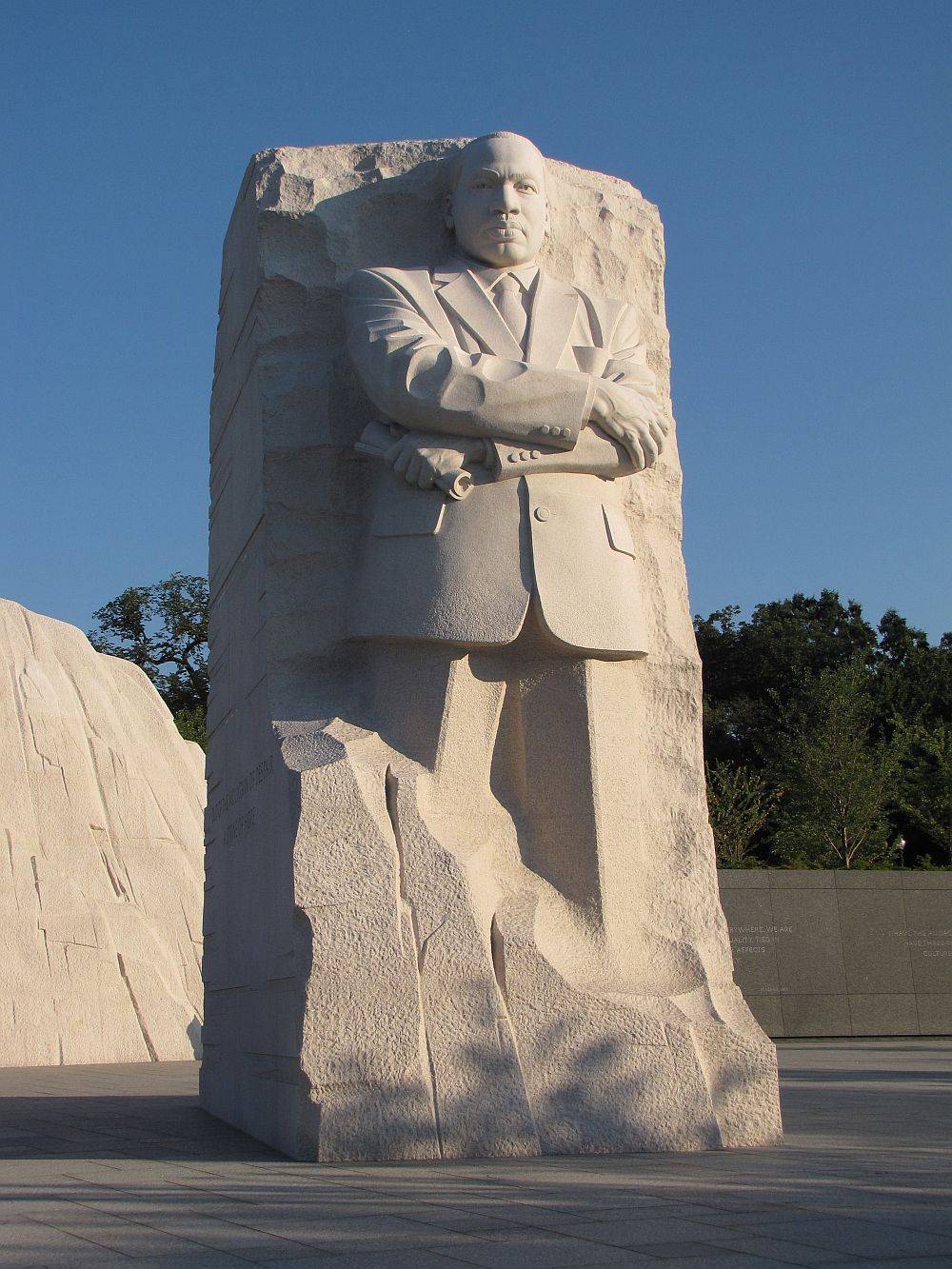
I have mixed feelings about the vaguely Socialist Realist aesthetic of the new Martin Luther King memorial downtown – colossal statues of famous men are broadly associated in my mind with oppressed people tearing those statues down. But I’m going to begin thinking of it as signifying the role that Cold War geopolitics played in bringing about at least one vitally important success of the Civil Rights era. In the same year that James Blue’s film was released to the world, the American Congress passed the Civil Rights Act. There were many people in the American government who supported that legislation because it was the right thing to do, but odds are there were others who supported it for pragmatic reasons of national interest. Thank God that the needs of our foreign policy aligned so well at that critical moment with the needs of our citizens at home.

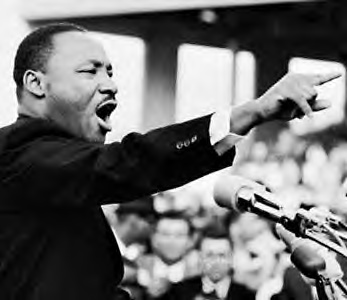
Happy Belated Birthday, Dr King.


Democracy will not come
Today, this year
Nor ever
Through compromise and fear.

I have as much right
As the other fellow has
To stand
On my two feet
And own the land.

I tire so of hearing people say,
Let things take their course.
Tomorrow is another day.
I do not need my freedom when I’m dead.
I cannot live on tomorrow’s bread.

Freedom
Is a strong seed
Planted
In a great need.

I live here, too.
I want freedom
Just as you.

–Langston Hughes, “Democracy”

Sundown Towns

As a belated acknowledgement of Martin Luther King day, I thought I’d reprint this piece. It first appeared in (I think) 2007 in The Chicago Reader.
______________

A couple years ago the city’s One Book, One Chicago program encouraged Chicagoans to read Harper Lee’s To Kill a Mockingbird. Those that did encountered a familiar portrait of American racism, which, as we all know, was a problem mostly in the south, mostly in the past, and mostly perpetrated by poor, uneducated white folk. The novel’s hero, Atticus Finch, is a respected white attorney in a small Georgia town who defends a black man falsely accused of rape. At the end we’re assured that most people are pretty nice once you get to know them, and left with a vague sense that the world will keep on getting more and more enlightened as long as high school students continue to read high-minded novels like this one.

As a corrective to this lyrical vision of race relations, the city should consider endorsing Sundown Towns, a new study by James Loewen, author of the best-selling Lies My Teacher Told Me, that methodically upends many of white America’s preconceived notions about race.

Sundown towns were incorporated areas that banned African-Americans from living in them, or even from staying overnight. Often, a sundown town would hang a sign or signs at the city limits declaring, “Nigger, Don’t Let the Sun Go Down on You in ________.” African-Americans who were on the city streets after dark might be harassed, beaten, or worse. Even black people on public transportation weren’t safe: whites in Pana, Illinois, are reported to have fired gunshots at African-American Pullman porters as trains passed through town.

Sundown towns aren’t exactly unknown in popular culture; William Burroughs, Maya Angelou, and Tennessee Williams all mention them. But Loewen’s book is the first systematic exploration of the phenomenon, and while the existence of such towns isn’t a shock, virtually everything else he’s found out might be. Sundown towns, he discovered, were located mostly in the west and midwest, not the south. They came into being relatively recently, mostly between 1890 and 1930, but some as late as the 1950s–and Loewen was able to confirm the existence of towns that threatened African-Americans after dark as recently as 2002. Anna, Illinois, population 5,136, is likely still a sundown town, says Loewen. It reported just 89 African-Americans in the 2000 census, most of them probably residents of the state mental hospital. Elwood, Indiana, which has zero African-American residents, an annual Klan parade, and a vicious reputation, almost surely is.

The biggest revelation of Loewen’s book, however, is not the location or continued existence of sundown towns, but their number. When he started his research he thought he would find about 50 towns in the U.S. with a history of sundown practices. But after conducting on-site interviews, he was able to confirm the existence of 145 in Illinois alone. Based on census data and statistical analysis (all carefully detailed in the book) Loewen believes that by 1970, when such towns were most common, there were more than 470 in Illinois. This means that a majority of towns in Illinois may well have been sundown towns. Statistics like these eventually led Loewen to the broader conclusion that when a state, a suburb, or a neighborhood is all white, then it is probably all white on purpose.

At first, this may seem ludicrous. When Loewen asked white interview subjects about small, all-white towns nearby, they would often suggest that African-Americans didn’t live in them because nobody in their right mind would want to live in them. Moreover, the association of African-Americans with cities is so strong that black people take it for granted as well; when I saw Aaron McGruder speak a couple years ago he scoffed at the idea of a black person living in the WB’s Smallville.

Yet Loewen shows conclusively that the historic concentration of African-Americans in cities was a matter of discrimination, not choice. Before 1890 blacks were not particularly urbanized. Shortly thereafter, however, during a period historians refer to as the nadir of American race relations, racism in the United States became much more vicious. The Klan made a triumphant nationwide resurgence; segregation and disenfranchisement solidified in the south. In the north blacks and other minorities, like the Chinese, were forced out of rural areas and small towns. The result was a phenomenon Loewen calls the Great Retreat, in which African-Americans fled to the cities and wound up concentrated in ghettos. This process was well under way when the better-known Great Migration of the teens and 20s spurred the unprecedented resettlement of blacks from the south to the north.

Sundown towns were generally restricted to the north and west, but sundown suburbs were a well-documented nationwide phenomenon. Redlining, steering, and restrictive covenants were standard in communities like the Levittowns of the 50s. Though they’re now less prevalent, not to mention illegal, such practices are still employed surreptitiously; Loewen reports incidents of steering in suburban Harrisburg, Pennsylvania, as recent as 2002. Violence against black home owners and their children has also been persistent, probably peaking during the 1980s.

The relative dearth of blacks in the suburbs–especially the wealthier ones–is often attributed to class. Statistically, blacks are poorer than whites. But Loewen argues that their exclusion from the suburbs is one of the causes of their relative poverty, not one of the effects. Until 1968 the Federal Housing Authority refused to underwrite homes built in communities that included African-Americans. Thus, African-Americans were excluded after World War II from what Loewen credits as “Americans’ surest route to wealth accumulation, federally subsidized home ownership.”

Black poverty isn’t usually blamed on the policies of white suburban home owners; instead, professors and pundits point to the excesses of the welfare system, or the failures of the welfare system, or the enduring impact of slavery on the black family, or what have you. All these explanations focus on how African-Americans live. Loewen’s book suggests, however, that if you want to understand racism in this society you must look at how, and especially where, African-Americans do not live. It isn’t what black people do but what whites do to exclude them that results in inequality. Whites won’t warehouse kids in crappy schools if the kids being warehoused are their own, they don’t want to fund massive police crackdowns if they themselves are likely to be caught in the dragnet, they don’t want to ignore fundamental flood preparedness if their homes are likely to be inundated.

Loewen does discuss some ways African-Americans can change discriminatory policies–by buying homes in mostly white communities, for example, or by supporting legislation to give federal fair-housing policies some teeth. Overall, though, Sundown Towns is not especially empowering: in Loewen’s narrative African-Americans tend to figure as victims rather than heroes.

This is largely a function of his topic. In many ways the history of racism in the north is less hopeful than that of the south. Twice the south has been the site of utopian social experiments, during Reconstruction and the civil rights era. Neither movement was wholly successful, but during both periods African-Americans were able to make important social changes because of their connections to white society. After the Civil War, African-American links with white Republicans, both north and south, gave them a voice in southern government. The Montgomery Bus Boycott was effective because African-American dollars were important to white business owners.

In the north, however, connections between black and white communities were, as Loewen reports, deliberately severed. It’s no accident that Martin Luther King Jr. encountered a harsher reception in Chicago than in Atlanta. Nor is it an accident that black leaders in the north tended to be isolationist. James Baldwin’s famous question, “Do I really want to be integrated into a burning house?,” could only have been asked by a northerner.

Loewen points out that whites who live in sundown towns see no African-Americans and thus tend to believe they have no race problems. Similarly, the north itself, where whites and blacks have historically been more separate, has long been able to convince itself that racism is somebody else’s sin. But 50 years after the Brown decision, separate is still not equal. Illinois was the land of Lincoln, it was a supporter of the Union, and it’s now the home of the nation’s only African-American senator. But it’s also heir to a brutal and ongoing tradition of racism and segregation. All our problems wouldn’t be solved if every person in Chicago read this book, of course. But it wouldn’t be a bad place to start.

Ghost World

Creators haunt their creations, more as ghosts than as intentions.

For example, in 24 there are no ghosts and no intentions. The creators are rigidly outside the action, which runs blithely away under its own power, like a watch dropped in a field. The clock counting down is the guarantor of autonomy, the uninterrupted, self-contained material of narrative. Every time Jack Bauer is given fifteen minutes to reach the drop off point, you can hear the gentle high-concept whisper of the argument from design erasing itself. Cliff-hangers, hackneyed betrayals, and feebly ironic reversals — the gears grind to assure you that the only god lubricating the machine is the absence of a god. Bauer never meets his maker, because the main thing the maker has made is his own unmaking. The ticking time bomb blows the roof firmly onto the world.

Fanny Hill’s world, on the other hand, is laced with holes:

A spirit of curiosity, far from sudden, since I do not know when I was without it, prompted me, without any particular suspicion, or other drift or view, to see what they were, and examine their persons and behaviour. The partition of our rooms was one of those moveable ones that, when taken down, serv’d occasionally to lay them into one, for the conveniency of a large company; and now, my nicest search could not shew me the shadow of a peep-hole, a circumstance which probably had not escap’d the review of the parties on the other side, whom much it stood upon not to be deceived in it; but at length I observed a paper patch of the same colour as the wainscot, which I took to conceal some flaw: but then it was so high, that I was obliged to stand upon a chair to reach it, which I did as softly as possibly, and, with a point of a bodkin, soon pierc’d it. And now, applying my eye close, I commanded the room perfectly, and could see my two young sparks romping and pulling one another about, entirely, to my imagination, in frolic and innocent play.

Who is observing the room to see whom in innocent play? What spirit (of curiosity?) possesses Fanny to look in each convenient flaw? Fanny is writing her epistles to a nameless madam, but there is always an echo in her voice; a sign that her person and behavior are observed and offered through some shadowed peep-hole. The imagined frolic is commanded, and the command is itself part of the pleasure.

D.H. Lawrence’s short story “The Border Line” is also porous. The outside seeps through the world’s borders.

The afternoon grew colder and colder. Philip shivered in bed under the great bolster.

“But it’s a murderous cold! It’s murdering me!” he said.

She did not mind it. She sat abstracted, remote from him, her spirit going out into the frozen evening. A very powerful flow seemed to envelop her in another reality. It was Alan calling to her, holding her. And the hold seemed to grow stronger every hour.

“The Border Line” is a story of a love triangle; Katherine Farquhar married Alan, “unyielding and haughty,” and then, after he died, she married Philip, who “caressed her senses and soothed her.” But Alan, manly and unyielding, is so manly and unyielding that even death doesn’t make him yield, and he comes back for Katherine, like a command or a vow that can’t be unspoken. Katherine is only too happy to become his again; Philip is a puny, soft thing, while Alan from beyond the grave is a dream of potency. The world cracks open, and into it Lawrence inserts his rigid avatar, flushed with power. but bitter cold.

Philip lifted feeble hands, and put them round Katherine’s neck, moaning faintly. Silent, bareheaded, Alan came over to the bed and loosened the sick man’s hands from his wife’s neck, and put them down on the sick man’s own breast.

Philip unfurled his lips and showed his teeth in a ghastly grin of death….But Alan drew her away, drew her to the other bed, in the silent passion of a husband come back from a very long journey.

Philip is dead. Katherine is drawn away into Alan’s arms,embraced by her dead lover and, symbolically, surely dead as well. Lawrence’s journey and story are done, and at the end of them is power and death, or power as death. Alan’s mastery, descending from on high, is so total that nothing can survive it.

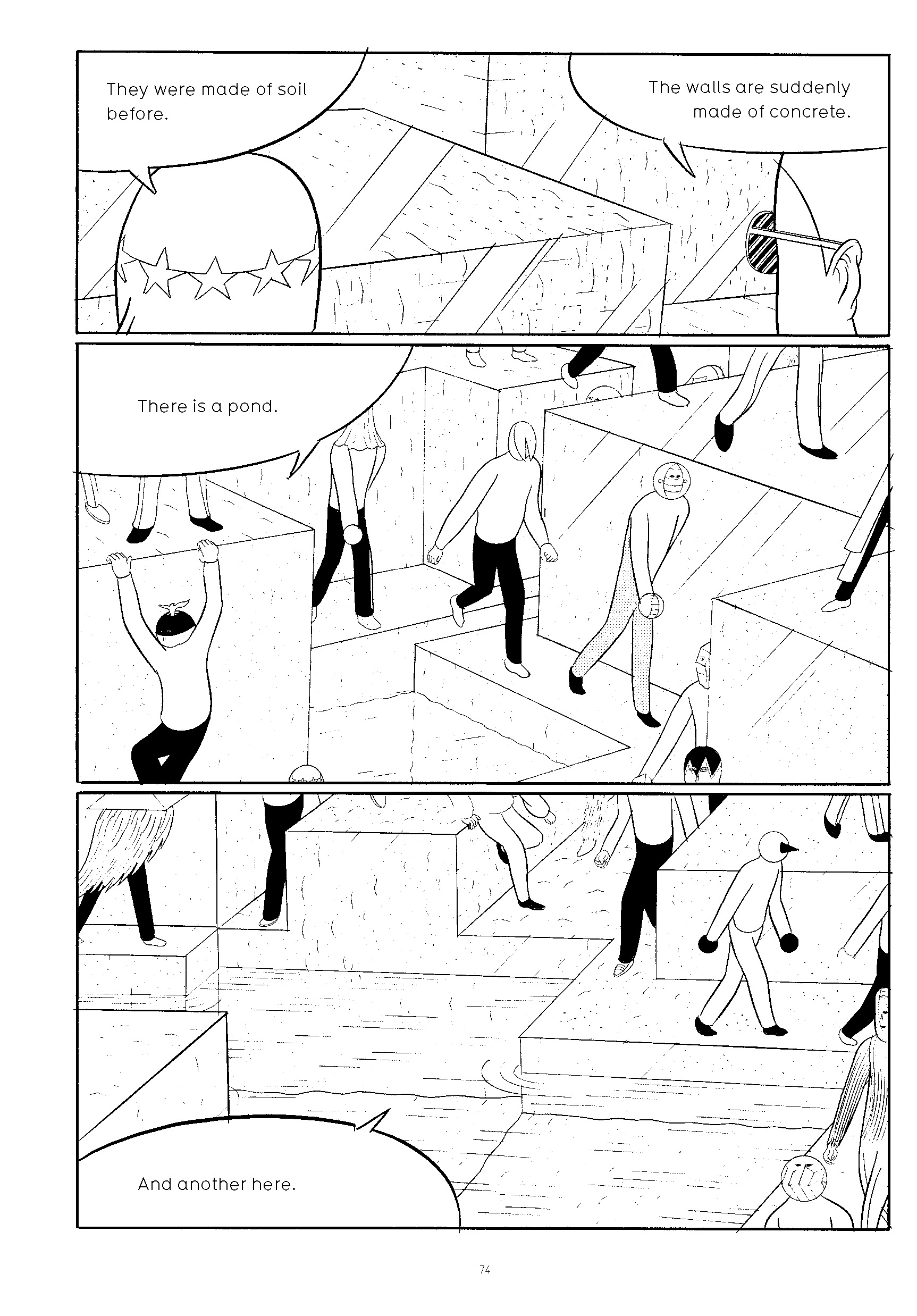
Yuichi Yokoyama’s Garden is not so much open to mastery as a mastery of openness. Inexplicably bizarre-looking characters wander through a seemingly endless landscape littered with the detritus of an ambiguous modernity. Rivers team with office furniture; two-tone mountains rise from the landscape; cameras project everyone’s face onto walls and waterfalls. The seemingly endless stream of people utter repetitive, unanswerable questions: “Why are these things floating in the river?” “Maybe there is someone inside?” “Perhaps it’s a fake city (a dummy)?” It’s “Waiting for Godot” as a combination of Disneyland and Flatland, a geometric theme park with opaque laws. The off-kilter panel shapes combine with the off-kilter views and unusual perspectives so that you, like the characters, often don’t know where you are. Instead of the lines turning into landscapes, the unreadable landscapes resolve back into lines, the mark of Yokoyama’s bewildering hands. The characters wander between his fingers, clockwork ants scrambling through clockwork digits. He’s too big to be seen, but that unassimilable presence is everywhere. We can’t know what he means because he’s the question of meaning itself.