Bound to Blog: Wonder Woman #26

As I’ve mentioned, the last few issues of the Marston/Peter run have been tough going. Marston was, at this point in the series, very unfortunately dead, and it seems likely that at least some of the scripts were being ghosted. In any case, quality fell off something fierce.

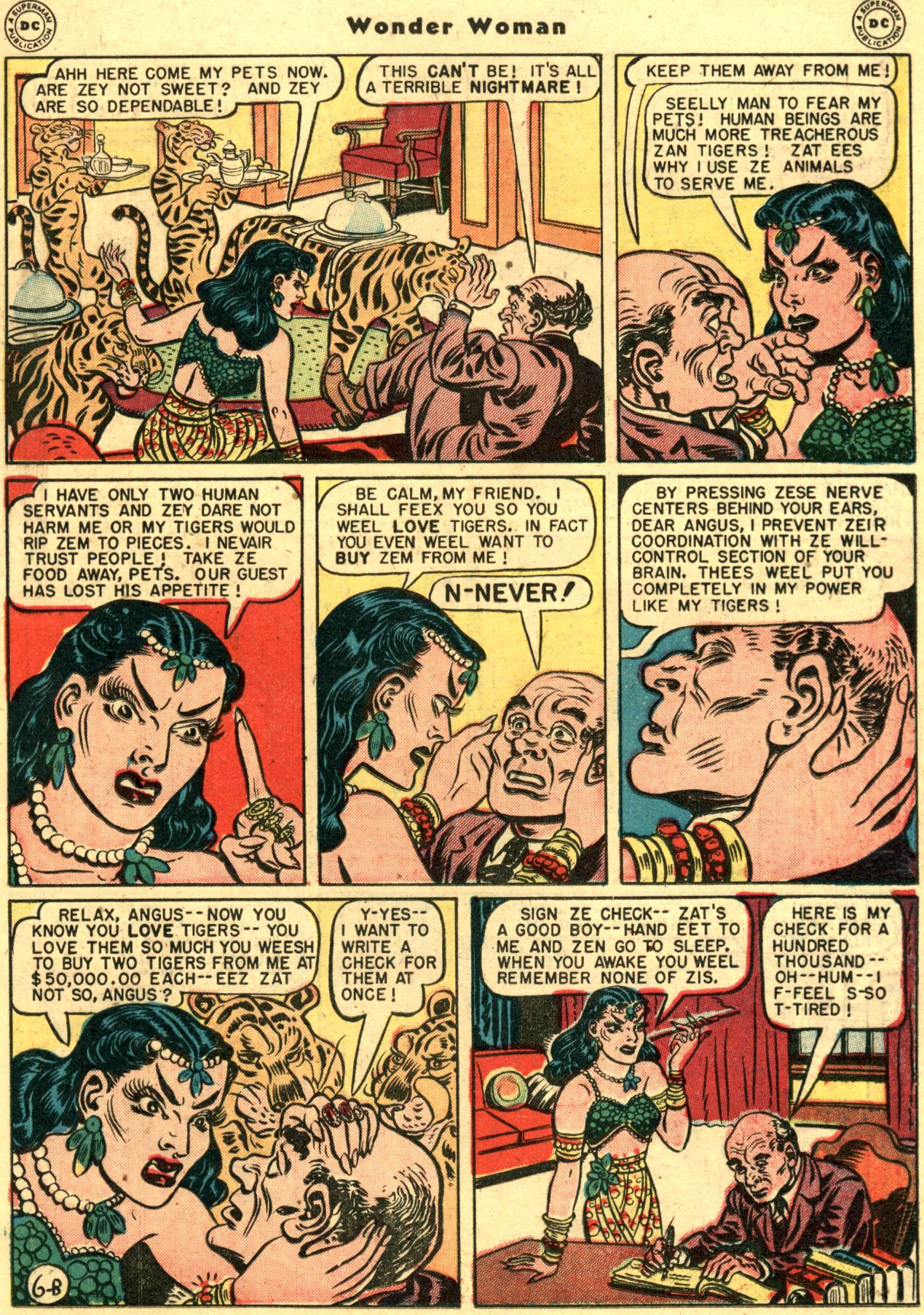
I’m pleased to say that things have picked up somewhat with #26, though. The stories are not especially ambitious, but they do seem to be written by Marston, in all his loopy, kinky glory. Giant women enslaving their menfolk?
 

Check. Insane tiger-lady using pressure points to control men’s wills?
 

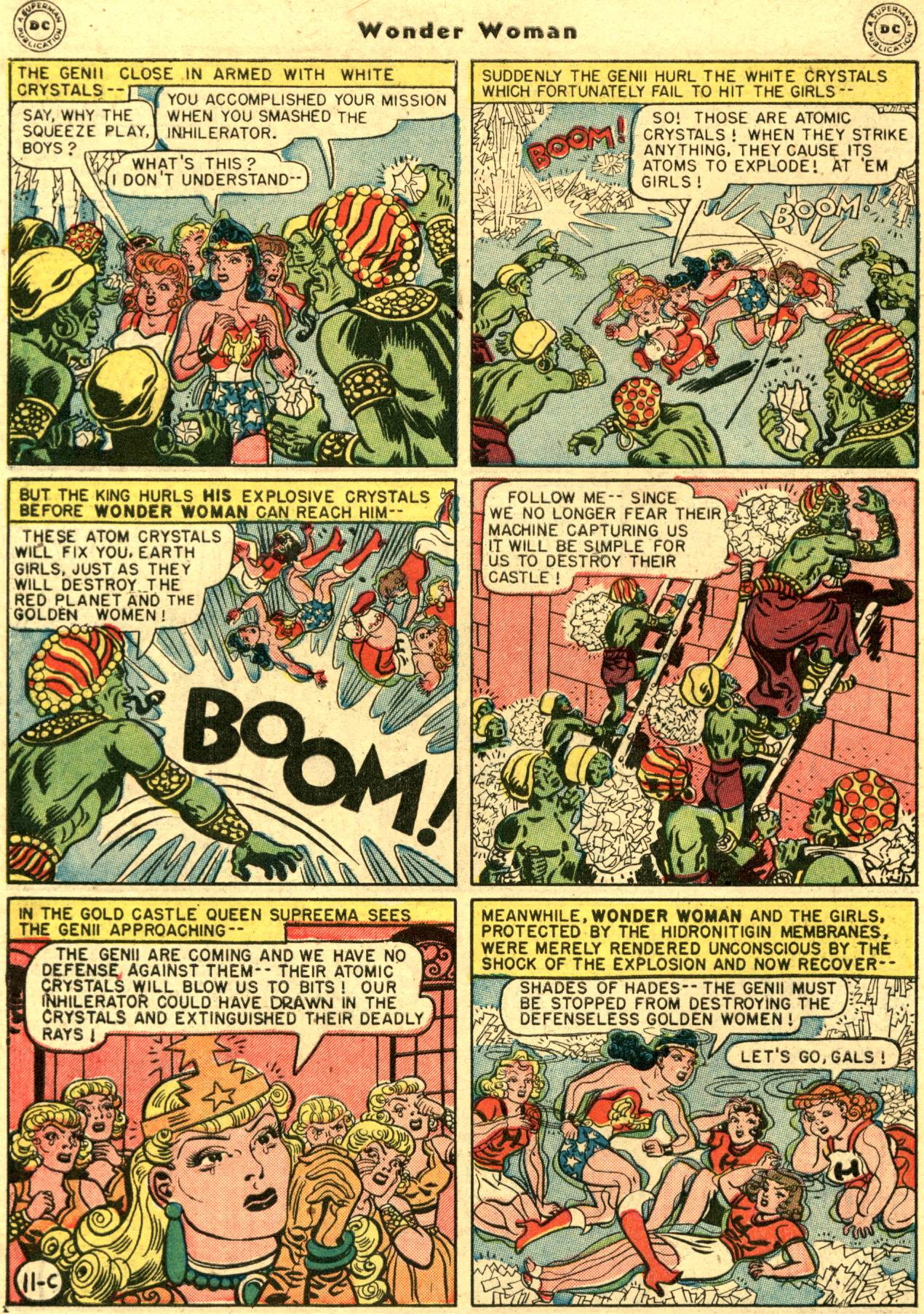
Yes. Evil treacherous green men attacking virtuous intergalactic golden policewomen?
 

Yay!
___________________

So since Marston’s in his bonds and all is right with the world, I thought I might try using issue #26 to see if I couldn’t address some of the questions Matthias raises in this post about Craig Thompson’s Habibi. Specifically, Matthias argued that critics need to address not only ideological issues, but also aesthetic ones — or, perhaps more accurately, that critics should address ideological issues through aesthetic ones.

Matthias approaches both issues of aesthetics and ideology in Thompson’s work through a metaphor of control. For Matthias, Thompson’s art is unsurprising, slick, and overly pat:

the line is rather mechanical, incapable of surprising us – every stroke is in its place, and we know where it is headed.

Matthias adds:

Everything is the same graceful brushstroke, as if that were the main point. The effect is strangely antiseptic in a work that concerns itself so intently with filth and pollution — its mountains of garbage seem designed to wow us more than anything else.

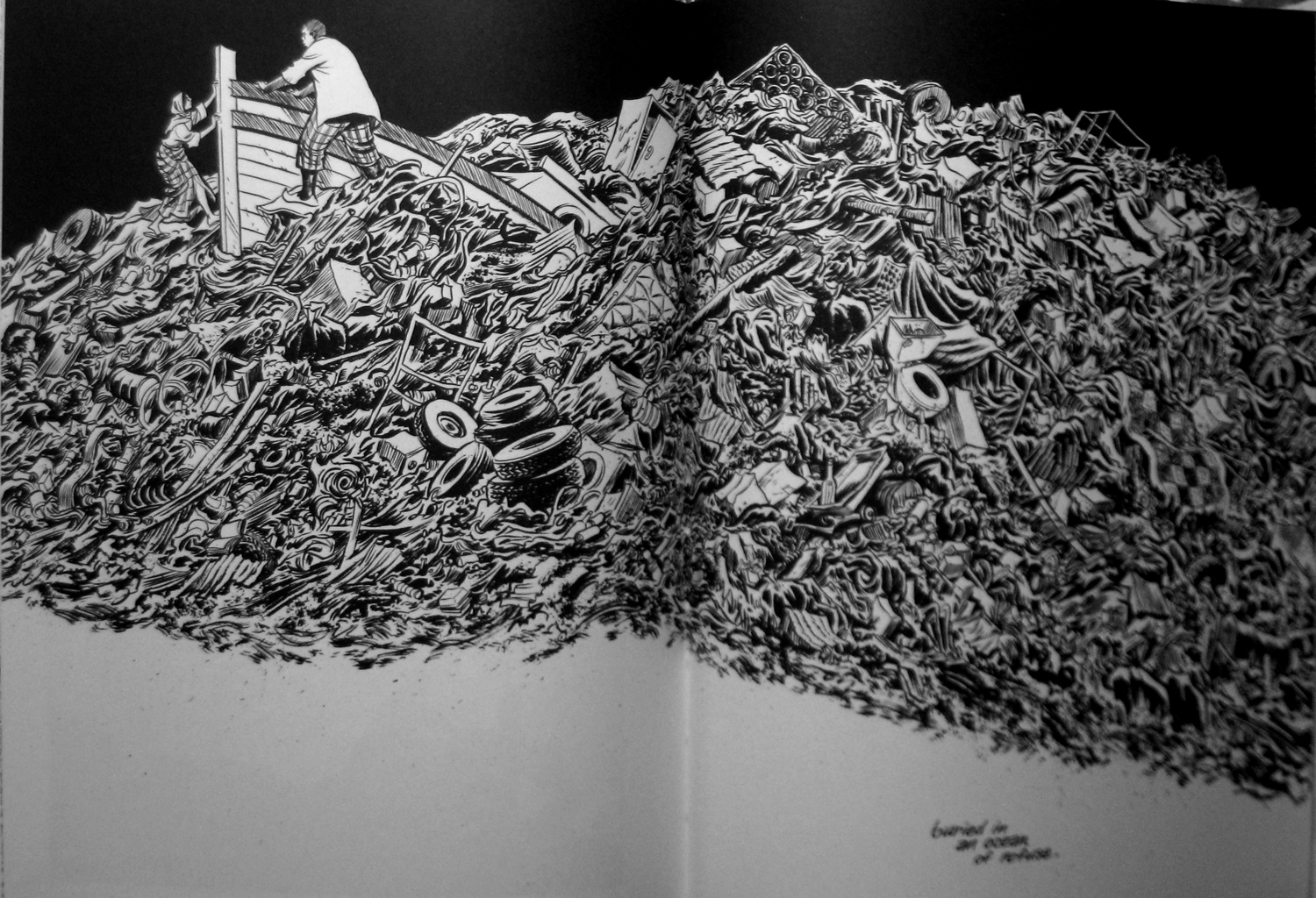
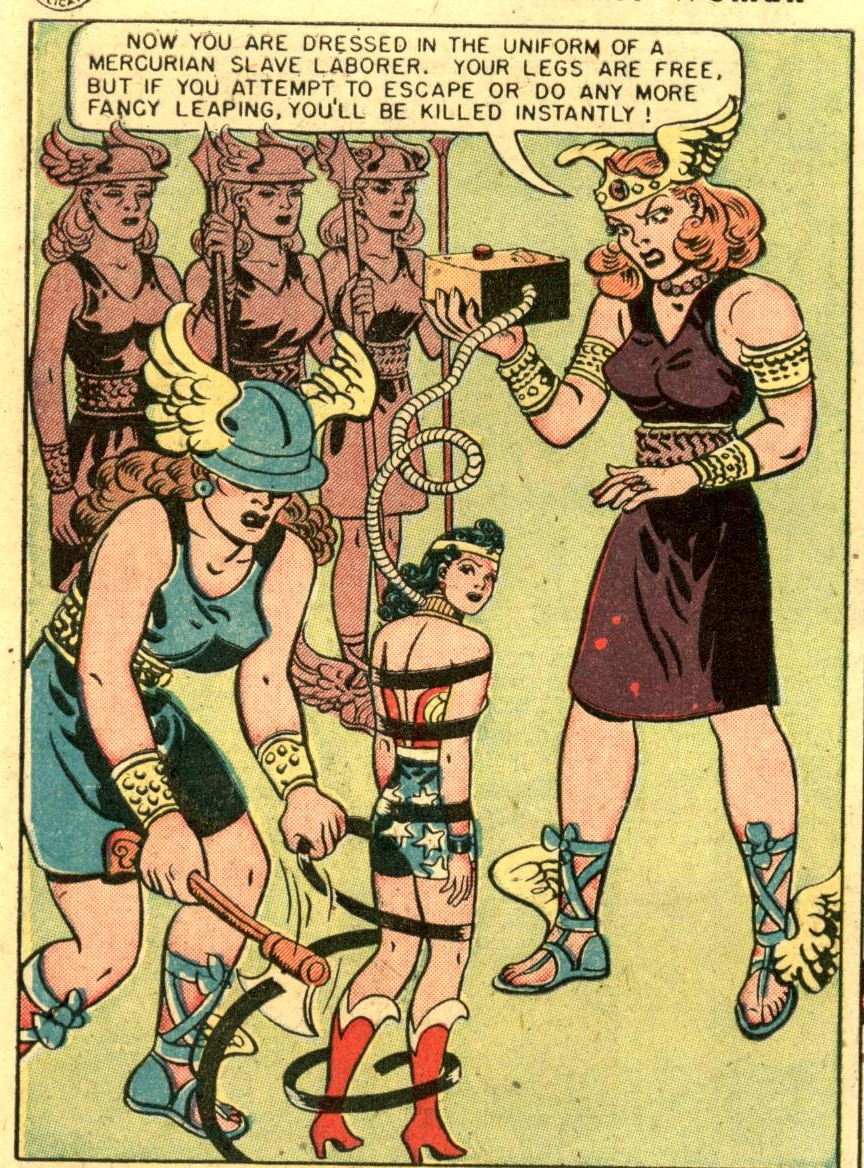
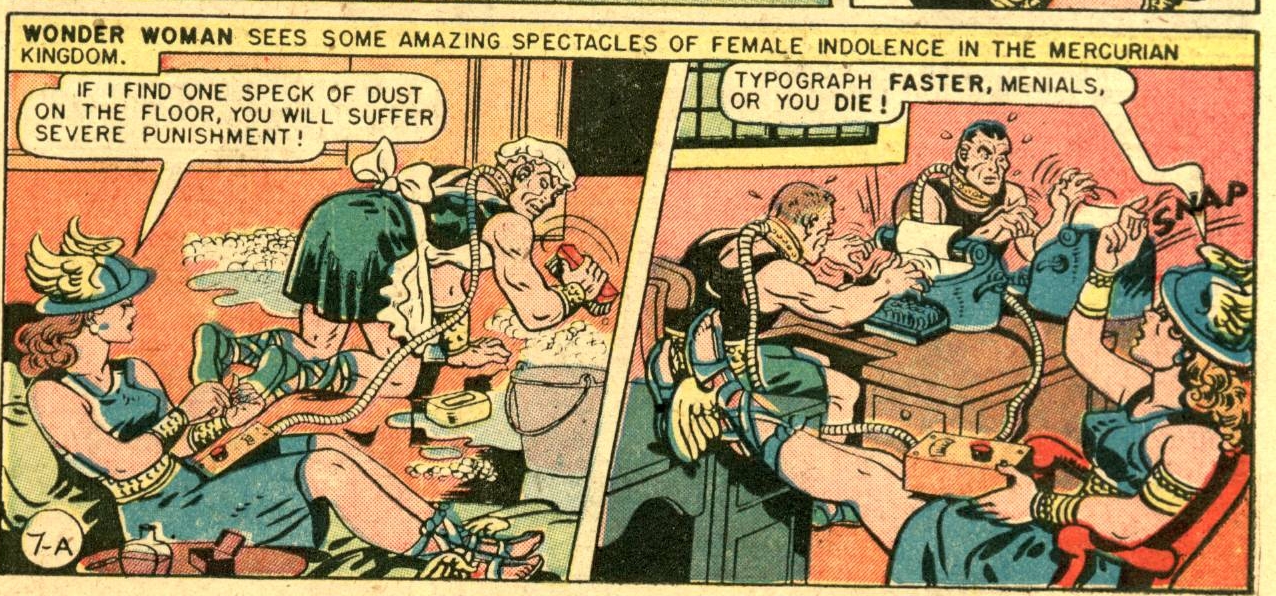
So above is Thompson’s mound of garbage. Let’s look, in contrast, at an image of Harry Peter’s from Wonder Woman #26.

To start with maybe the most obvious differences, Thompson’s mound of garbage is (as Matthias notes) much more carefully, and even classically composed than Peter’s scene of quasi-classically dressed women. Thompson makes careful use of negative space; the area in front of the garbage dump is blank, setting off the brick-a-brack. The grouping of man, woman, and boat is placed up to one side, isolating it dramatically. The arrangement comes across as painterly, or perhaps as dramatically awe-inspiring in the manner of Doré. The image seems frozen or posed; a dramatic landscape to be placed on a wall and (as Matthias says) admired.

Peter’s illustration is also stiff and still — the guards stand straight off to the side; Wonder Woman stands straight in the center, and the two giants also seem oddly rigid. However, the stiffness here isn’t painterly or dramatic; it’s awkward. The figures aren’t grouped to take advantage of negative space; instead, their just dropped against the disturbing pale green background. They end up looking like paper dolls; you almost want to get a scissors and cut them out. Where Thompson’s drawing seems elaborately finished, sufficient unto itself, Peter’s beckons you to take part — not least by presenting Wonder Woman herself as a puppet, literally manipulated by a cord attached to her neck.

These differences carry over to the use of line. As Matthias says, Thompson’s inking is so sure as to be almost diagrammatic, most noticeably in his calligraphy.

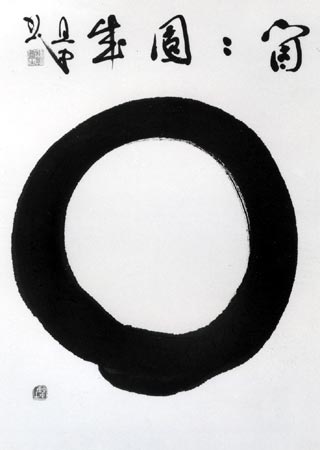
The image above is for the most part bilaterally symmetrical, and the repetition of shapes is careful and more than a little cold. This is miles away from the tradition of Japanese calligraphy, where imperfection — the sign of the writer’s hand — is such a central part of the aesthetic.

Zen Circle by Tanchu Tarayama

 
Peter is certainly capable of graceful lines (check out the eyebrows.)
 

But, as with the composition, he’s not afraid of awkwardness either. The clunky wire connecting the box to Wonder Woman’s neck manages to look so stiff and odd in part because Peter doesn’t keep the two lines forming it an even distance from each other; they bulge out and come together to make an organic metalness. Peter also uses inky blots and daubs almost at random. The patterns on the chief giant’s winged boots, for example, are so joyously messy that they almost fail to parse as feathers. Similarly, the motion lines by the ax are thick and juicy enough that the giant seems ready to grab them. If Thompson’s line is precise, creating a definite, calibrated world, Peter’s line is has a bulbous, erratic grace, which constantly threatening to pull his figures down into their constituent globs.
_________________

I (still!) haven’t read Habibi, so I’m tentative about making wide statements about how the linework might relate to Thompson’s narrative themes and vice versa. So I’ll piggy back on Matthias’ insights, and point out some possible connections that he doesn’t quite tease out. For example, this from Matthias is suggestive:

In Habibi, this unease is primarily located in the treatment of sexual anxiety and transgression, which borders on the obsessive and even the sadistic. It is almost as if Thompson enjoys torturing his characters, especially through sexual humiliation, in a way that suggests meaning beyond the narrative itself.

Matthias seems to see the obsessive sexual transgression as outside of, or opposed to the neatness of the surface…but in fact, I wonder if they’re not all of a piece. As anyone knows who has tried to read de Sade, sadism is really boring. It’s repetitive and obsessive and overly organized; counting whip strokes with the same kind of regular blandness with which Thompson makes pen strokes. Moreover, the very composedness of the junk pile, recalls Laura Mulvey’s comments about the pictorial autonomy of Hollywood cinema:

But the mass of mainstream film, and the conventions within which it has consciously evolved, portray a hermetically sealed world which unwinds magically, indifferent to the presence of the audience, producing for them a sense of separation and playing on their voyeuristic phantasy.

If Orientalism is a voyeuristic phantasy, Thompson’s self-sufficient style might be seen as a means to control and regiment that fantasy — a way to keep everything in its place.

Harry Peter’s art, on the other hand, is much less successful at creating an illusion of containment. Wonder Woman’s look over her shoulder seems deliberately to break the plane of the image just as the figures seem cut loose, floating in front of their own background. Power and hierarchy break apart into knowing glances and wiggling blobs; are these lines pretending to be women, or women pretending to be Peter’s? It all seems staged, not as an image for singular consumption, but as a dress up play in which each viewer and each line is invited to assist in limning each role. In its stiff, awkward way, Peter’s style embraces polymorphous perversion. His line encourages not (or not just) scopophilia, but a plethora of interrupted, indeterminate, pleasures of position and pretense. Aesthetically or ideologically, the line draws you in not as master, but as subject.
___________________
Update: The entire roundtable on Habibi and Orientalism is here.

Our Batmen, Ourselves

This first ran over at Comixology.
_________________________

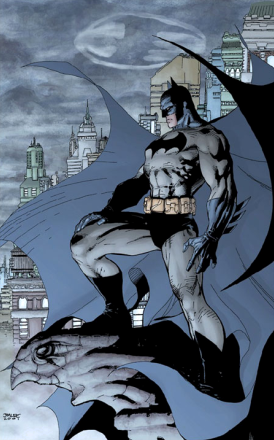
“Morrison’s reclaimed the gaudy, unsettling craziness of Silver Age Batman comics,” Douglas Wolk gushes. Wolk’s a smart guy; he’s not just gibbering enthusiastically here, but is actually ironically referencing the gibbering enthusiasm of Silver Age letter columns. The twist is that by building his abject shilling on the abject shilling of old, Wolk’s manages to posit his views as more considered, and therefore as actually even more naïve and nonsensical, than those of his forbears. His silver affectation is silver-er than real silver, in exactly the way the Batcave was foreshadowed by, and is therefore more real than, Plato’s cave.

As Wolk notes, the awesomest thing about Grant Morrison’s Batman and Robin is that Grant Morrison takes all the Batman mythology there’s ever been — Lazarus Pits, Red Hoods, — and turns it into somnolent cyberpunk hash for drooling continuity porn addicts. If you get a thrill down your spine when you hear Dick Grayson tell Damian Wayne never to underestimate Jason Todd, then your spine will rise right out of your esophagus and do an Adam-West-style bat-dance when resurrected clone-zombie-Batman burps out “Old Chum!” while shambling around Wayne Manor. What Morrison understands, through a Jungian intuitiveness born of years of intensively soldering corporate slogans onto the sacred flesh of his unnameables, is that crazy throw-off moments from the past gain weight and profundity by being repeatedly embalmed and disinterred. Every time Bob Haney hawked up a loogie, Grant Morrison was there, mouth open like a baby bird, ready to ingest, digest, and re-emit it for the sole purpose of waddling his sublimely stained Bat underoos over to the nearest university English Department for professional sterilization and veneration.

The second awesomest thing about Morrison’s Batman and Robin is the faux-Batmen. Morrison is obsessed with Batman and Robin replicants — an evil vigilante Batman and Robin; a British Batman and Robin, Batwoman and whoever her sidekick is, etc. etc. This obsession is actually even more mirrored because it imitates Morrison’s run on Batman, which also had lots of different Bat guys running around, from Man-Bats to the Club of Heroes to lots of clones created by Darkseid.

Or so I’ve been told. I didn’t read the Darkseid arc…which I think is actually the perfect critical stance. All these imitation Batmen deserve an imitation reader, a false fanboy imperfectly refracting and reinscribing the imperfect fanfic. My failure to do due diligence is actually an ironic metacomment on the failure of Morrison to write. a. goddamn. story. Instead, both he and I together are involved in a reproducible narrative meme; thematic material about people wearing masks and having their faces ripped off float off into the marketing ether, where its post-modern non-reference affixes itself to the non-identities of the nonentities who, through reading these comics, actually cancel their own (non) existences.

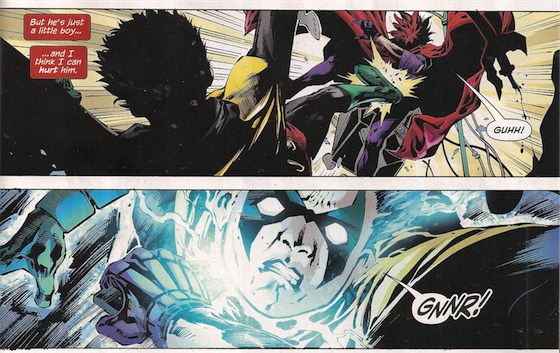
This sense that Morrison is deliberately talking into a void — or creating a void through his incessant talking — is only intensified by the brilliant decision to instruct the artists to derail the flow of action. For instance:

She “thinks” she can hurt him in twelfth-generation Frank-Miller-retread noir-thought-captions — and the utter exhaustion of the tired “trope” is given a humorous fillip by the fact that the confusing “arty” “angles” exist mainly to “distract” from the “main point”, which is that her “clever” “inner-plan” involves, “like,” “hitting” “him”. Robin’s “Gnnr!” subtly parodies artist Philip Tan’s use of an incompetent delivery system to contain stupid content; it is, in fact, the reader’s “Gnnr!”, a reflexive stimulous-response of simulated approbation as the Pavlovian Bat-joy-schtick is manipulated with crass incompetence to show that we are all just “little boys” abusing ourselves without even token help from our “evil doubles” to whom we have shelled out our $2.99.

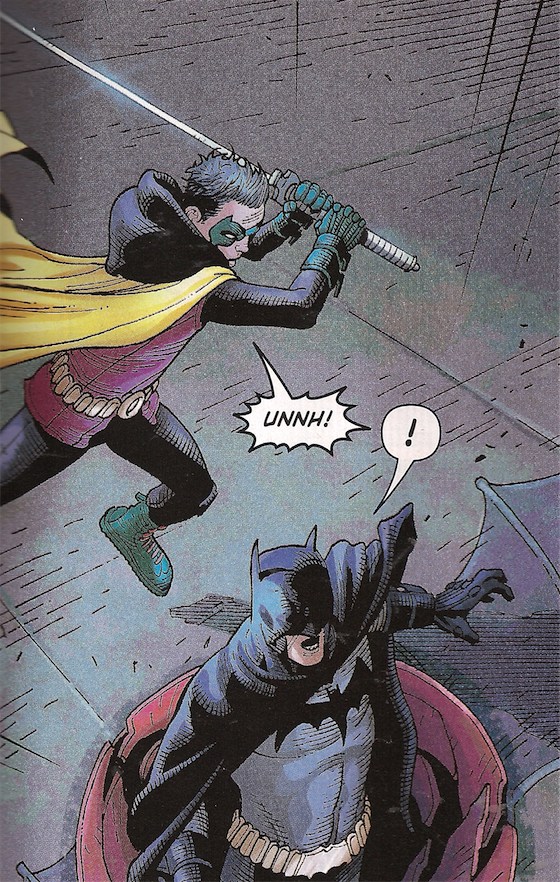
Or how about:

Through clever positioning, sparkling dialogue, and the indeterminacy of whatever that is on the floor, artist Andy Clarke makes it unclear for just a moment whether Robin has just hit Batman with a sword, or whether Batman is falling through the floor in the nick of time to escape Robin hitting him with the sword.

It’s true that these are small touches — but it’s this kind of careful attention to detail that most clearly reveals Morrison’s subliminal hermeneutics. Batman comics, like the Batmen themselves, proliferate and subdivide, with no purpose or meaning other than their own infinite iteration. Mainstream super-hero comics are, in this vision, the most perfect of all popular art forms, severed as they are from populace, art, and even form. Like a virus, these comics exist only to perpetuate themselves. Reading them is to hear nanogears grinding pointlessly in the cracks of the universe. Aren’t we all, really, lame, doddering, toothless parodies of corporate properties, wandering brainless through some clichéd post-everything landscape before sinking into our own unmourned and ludicrous tombs? Morrison’s Batman and Robin is a savage satire not only of mainstream comics per se, and not only of Morrison’s own previous work, but of human dignity itself. We wait, not for Godot, because we must existentially hope, but rather for Batman, because we are fucking stupid.

Tech Messiah

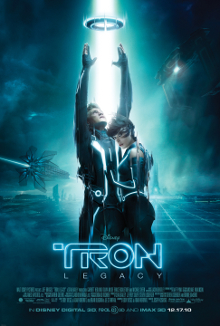
Tron Legacy
Directed by Joseph Kosinski
Starring…
Jeff Bridges
Garrett Hedlund
Olivia Wilde

I have a confession to make. I’ve never watched the original Tron from beginning to end. Sure, like everyone else I’ve seen bits and pieces on TV. I saw the part with the frisbee and the light cycles. And I remember it had David Warner, one of those great British actors who always appear in the shittiest movies. But I could never sit through the entire thing. It was boring, the special effects looked dated, and I just don’t care that much about the “infinite possibilities” of cyberspace. So why did I watch Tron Legacy? Because it was on Netflix streaming and I had nothing better to do. Spoilers below…

Tron was about a programmer named Kevin Flynn (Jeff Bridges) who accidentally transported himself into a computer-generated universe. Once there, he was forced to compete in gladiatorial games for the amusement of a race of sentient programs (a.k.a. humans in silly costumes). He eventually teamed up with the local Spartacus, the titular Tron, and together they overthrew the despotic government.

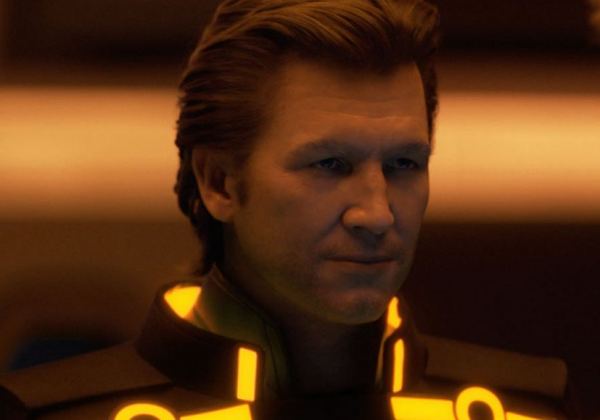
Tron Legacy picks things up just a few years later. Flynn’s divides his time between raising his son, Sam, and building a better world in his computer. To help him manage the latter task, Flynn creates a virtual doppelganger of himself named Clu (Jeff Bridges with digitally younger face). Everything seems to be going well until the digital universe spontaneously creates a new race of sentient programs, the isomorphic algorithms (ISOs). Flynn sees them as a miracle, but Clu considers them an aberration that will ruin his utopia. So Clu seizes control of the digital universe, kills nearly all the ISOs, and leaves Flynn stranded as a fugitive unable to return to his son.


Jeff Bridges as Clu

Flashforward several years. Sam (Garrett Hedlund) is a computer genius like his father, but he’s spoiled and directionless. While he inherited ownership of his father’s company, Encom, Sam would rather ride his cool Ducati than run a business. So he leaves it’s management to boring suits who rip off consumers with overpriced products. Of course Sam has major daddy issues, which leads him to investigate what happened to his father. One thing leads to another, and Sam is transported to the digital universe where he’s quickly arrested and forced to compete in the gladiatorial games (with updated special effects!). Sam is eventually rescued by Quorra (Olivia Wilde), the last surviving ISO who was raised by Flynn. Father and son are reunited again, there is much awkward bonding, and they team up to defeat Clu and escape the virtual universe.

Along the way, Flynn essentially gives Quorra to his son because she has some techno-fairy magical nonsense that will revolutionize everything and Sam has to bring her into the real world. Quorra is presumably content with being a tool that the Flynn boys will use to save mankind. I say “presumably” because the filmmakers care little about her motivations (beyond trite shit like wanting to see a sunrise). When Sam returns to the real world, he takes over management of Encom and vows to change the company. So were left with the warm feeling that Sam will use his billions of dollars and techno-magical girlfriend to fix our planet.


As popcorn entertainment, Tron Legacy is about average. The special effects are mostly well done, the soundtrack by Daft Punk is great, and attractive women in skin-tight outfits is never a bad thing. On the other hand, the film treats women as mere appendages to men, most of the characters are dull, the plot drags in the middle, and the visual design is lazy. Apparently the inside of a computer looks just like a modern city, but with superfluous running lights everywhere.

To the extent that Tron Legacy moves beyond popcorn and deals with actual ideas, it embraces one core idea above all others: social progress through technological progress. And no other character embodies this idea better than Quorra. She isn’t important as a person. She’s the embodiment for every technological innovation that will usher in the next golden age. She’s a personal computer, a smartphone, the Internet, an iPad, and a cappuccino machine all wrapped up in the body of Olivia Wilde. She will usher in a revolution! But what kind of revolution will it be?

It’s clearly not a Marxist or anarchist revolution. Hardly surprising, given that Disney isn’t in the habit of producing films that advocate the dissolution of mega-corporations like Disney. It isn’t a populist revolution, as the common folk hardly factor into the film. The closest thing to Joe Schmoe is the race of sentient programs in the digital universe, and they’re a decadent, slavish lot. It isn’t a New Agey, “back-to-nature” revolution either. Sam doesn’t give away his fortune or move to a commune. He starts and ends the movie as a billionaire.

But he’s the good kind of billionaire. Good billionaires don’t care about silly things like profitability or market share. They use their wealth (which they undoubtedly earned through hard work and intellect) to fix our world’s problems. And they occasionally beat up criminals too.

So the revolution that Quorra brings is not a revolution of wealth distribution or weath creation, but a “revolution” of wealth investment. The problem with the rich people at the beginning of the film isn’t that they’re rich, but that they only care about becoming slightly richer. Rich people should care about saving the world, preferably by inventing some new technology that fixes all our problems (including the problems created by the last new technology). The rest of us can just sit back and enjoy our gadgets, comfortable in the knowledge that our benevolent overlords and their techno-magic girlfriends have everything well in hand.

Utilitarian Review 12/24/11

We’re going to be off tomorrow and the 26th, because I am just that assimilated. Never fear though; we’ll be back on Tuesday with (hopefully!) Caro’s massive concluding post to our Godard roundtable.
 
On HU

I talk about sin, salvation and Celine Dion.

Warren Craghead drew a 120+ page shot-by-shot remake of Godard’s Breathless.

Matthias Wivel talks about the problems with ideological critique in reference to Habibi and HU. (Eddie Campbell responded on his blog, and Heidi responded at the Beat.

I put together a downloadable death metal music mix.

Robert Stanley Martin on the photography of Brassai.

I talk about Octavia Butler and feminist submission.

And Tom Crippen curated a gallery of Robert Binks’ holiday cards and other art.
 
Utilitarians Everywhere

At Splice Today, I talk about how I’d kind of consider voting for Ron Paul.

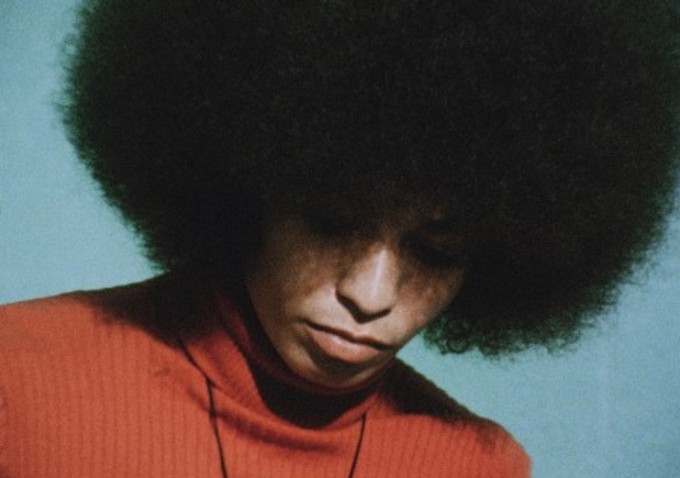
At the Atlantic I review the Black Power Mixtape, a DVD composed of Swedish footage of the black power movement.

Also at the Atlantic, I talk about Spielberg, Herge, and race.
 
Other Links

Tom Spurgeon interviews Tucker Stone.

Neal Pollack on his relationship with Christopher Hitchens.
 

Alien Submission

This is part of a series of posts on empowerment
__________________
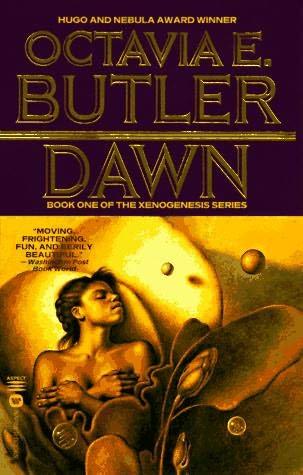
Lilith, the heroine of Octavia Butler’s novel Dawn, is about as thoroughly disempowered as a woman can plausibly be. When we meet her, she has just awoken after a nuclear holocaust to find herself a prisoner on (as we eventually learn) an alien spaceship. Her captives do not even initially provide her with clothes; when she refuses to speak to them, they simply ignore her until she goes insane (they fix her, luckily, so the book can go on). When she does finally meet a tentacled alien, she has a phobic reaction so severe that she can barely stand to be in the same room with it. The alien, though, refuses to leave, demanding that she accommodate herself to it with a blank insistence that smacks of both condescension and sadism.

Eventually, Lilith learns that the aliens (the Oankali) are capable of advanced genetic manipulation, and have rescued the few remaining earthlings in order to mate with them. Despite her protests, Lilith is trained to prepare other human beings to meet the Oankali. She does, and eventually, as a reward, the Oankali impregnate her without her consent. Nikanj, the creature who impregnated her, tells her that her words said she didn’t want a child, but her heart said something else; in short, it gave her a baby for her own good. Lillith is angry at first, but eventually she accepts that Nikanj was right; she really did want a child, just as it said. Over the course of the three book series, Lilith bears something like a dozen or more alien babies. Thus one of the names of the trilogy, Lilith’s Brood.

And if you thought that tale of being changed into a baby factory against your will was bad, just wait till the second book. In”Adulthood Rites,” the entire plot hinges on the evil of birth control. Furthermore, we learn that the so-called Human Contradiction is most fully embodied in males. Thus, effectively, men are more human than women. Dave Sim couldn’t have summarized misogyny any more clearly than that.

Butler isn’t a misogynist though. She’s a feminist. So what on earth (as it were) does she think she’s doing?

Things may become a little clearer if we go back and define the “human contradiction” that males appear to embody more fully than woman. This “human contradiction” is hierarchy and intelligence. According to Butler-via-the-Oankali, humans are an exceedingly intelligent species, but because they are hierarchical, their intelligence leads them inevitably to murder each other. Thus, the nuclear apocalypse is not an accident; it’s the inevitable effect of humanity’s genetic structure. Men are more human than women in that they are more hierarchical, and therefore more fully in tune with the inevitable human destiny of self-destruction. As Nikanj says to Lilith, “A male who’s Human enough to be born to a Human female could be a danger to us all.” Men, being men, are too human and too deadly.

In this context, Lilith’s disempowerment takes on a different inflection. After all, in this narrative, humans tried empowerment. They built powerful bombs and more powerful bombs, and finally they all killed each other. Clearly, it’s time to try something else.

The thing Lilith tries is adaptation — or, less charitably, submission. The Oankali choose to wake Lilith and work with her specifically because she is so adaptable. Butler never says this in so many words, but the implication is that because Lilith is a woman and an African-American — because she was marginal in terms of her culture on earth — she is more able to accept radical changes to that culture. She was also an anthropologist, accustomed to accepting and processing difference. Even given her background, though, Lilith has a remarkable talent for changing and adapting to those she meets. She is unique, in some sense, not because she stays true to herself, but because, like Bella in Twilight — or, indeed, like any mother — she is willing to be transformed by those she loves.

On the other hand, those who insist on staying true to themselves have a terrible time of it in Butler’s world. The Oankali, as I said, are genetic engineers. They are also the ultimate traders — and what they trade is their being. The Oankali travel from star to star, seeking other living creatures with whom to combine their genetic material. The perfect capitalists, they remain Oankali through constant change, losing their very genetic identity in the pleasurable rush of barter.

The pleasure is literal. The Oankali have three genders; male, female, and ooloi. The third, neuter sex combines genetic material from the other two, and from their trading partners, to produce a new life form. The male and female do not have intercourse; instead, the ooloi plugs directly into their nervous systems, and manipulates their genetic material….as well as their pleasure centers.

Nikanj focused on the intensity of their attraction, their union. It left Lilith no other sensation. It seemed, itself, to vanish. She sensed only Joseph, felt that he was aware only of her.

Now their delight in one another ignited and burned. They moved together, sustaining an impossible intensity, both of them timeless, perfectly matched, ablaze in sensation, lost in one another. They seemed to rush upward. A long time later, they seemed to drift down slowly, gradually, savoring a few more moments wholly together.

Afterwards, Joseph, Lilith and Nikanj’s male lover, interrogates Lilith.

“Why do you let them…touch you?”

“To have changes made. The strength, the fast healing — ”

He stopped in front of her, faced her. “Is that all?” he demanded.

She stared at him, seeing the accusation in his eyes, refusing to defend herself. “I liked it,” she said softly. “Didn’t you?”

As this quote mentions in passing, the Oankali actually did empower Lilith; by manipulating her genes, they gave her great strength, the ability to heal quickly, and very long life. She’s a superhero basically, like Buffy or Wonder Woman. But her main power is something she had originally — the ability to accept and submit, to difference and to pleasure.

It’s a power she has not least because she’s a woman. In her book Powers and Submissions, Christian feminist Sarah Coakley argues that Biblically it was women like Mary Magdalene who first saw the risen Christ, and that they had to convince men that what they had seen was true — a dynamic which Thomas Aquinas linked to women’s greater ability to love. Along those lines, male humans, as Joseph demonstrates, are as a group substantially more freaked out by sex with the Oankali than women are. Men who sleep with the Oankali feel that they’re being feminized. They need to be strong and autonomous — so much so that the ooloi who mate with men provide them with the mental illusion that they are able to move during interspecies sex, because they would be disturbed by the reality that the ooloi immobilize them to give them pleasure.

For Butler, then, the human (and especially male) desire for autonomy, dominance, and power is at best a whimsy to be indulged and at worst a deadly disease to be eradicated. There are echoes here of the philosophy of William Marston, the creator of Wonder Woman.

It seemed to me, from a psychological angle, that the comics’ worst offense was their blood-curdling masculinity. A male hero, at best, lacks the qualities of maternal love and tenderness which are as essential to a normal child as the breath of life. Suppose your child’s ideal becomes a superman who uses his extraordinary powers to help the weak. The most important ingredient in the human happiness recipe still is missing — love. It’s smart to be strong. It’s big to be generous. But it’s sissified, according to exclusively masculine rules, to be tender, loving, affectionate, and alluring. “Aw, that’s girl stuff!” snorts our young comics reader. “Who wants to be a girl? And that’s the point; not even girls want to girls so long as our feminine archetype lacks force, strength, power. Not wanting to be girls they don’t want to be tender, submissive, peaceloving, as good women are. Women’s strong qualities have become despised because of their weak ones. The obvious remedy is to create a feminine character with all the strength of a Superman plus all the allure of a good and beautiful woman.

The Oankali’s solution is a little different, but the diagnosis is similar. Men (and women too) must learn that violence and empowerment are less powerful than love, peace,and tenderness. The Oankali need to teach men (and women) to submit to love and the loss of self. If men (and women) do not learn the strength of selflessness and submission, they will be destroyed.

This is, in fact, precisely the choice that the aliens give human beings. If they are willing to adapt and submit, they can breed with the Oankali, and their children will be born with tentacles and travel through space. If they are not willing to adapt and submit, then they will have no children at all. The Oankali sterilize all those who refuse to take Oankali mates. The humans will live out exceedingly extended, sterile lifespans, and finally die off. At that point, the Oankali’s living ships will consume everything living on the earth as fuel and sustenance for the long space voyage, and the Oankali/human children will leave earth forever.

This seems excessively cruel; a brutal eugenic blackmail. But Butler explains repeatedly that the Oankali are not in fact trying to force humans to breed with them against their will. Rather, the Oankali sterilize humans because they know that if they don’t sterilize humans, humans will kill themselves off. The genetic contradiction, hierarchy and intelligence, is an inevitable death sentence. Allowing humans to breed means creating a messy, extended genocide rather than a quick, relatively painless one. The Oankali’s logic is, undoubtedly deliberately, the logic of abortion — babies who would be unhappy shouldn’t be born.

The Oankali eventually reverse their decision; Akin, Lilith’s first male Oankali/human son, convinces his people to let the humans breed true on Mars. The Oankali still believe that humans will destroy themselves, but Akin insists that they should be allowed to go on; to make their own choice about how they and their children will die if they cannot choose to live. Even if the imperial conquerors bring love, long life, and peace, the conquered should have the right to cling to their benighted folkways…on a reservation, since their home has been stripped for parts.

Butler’s perfectly aware of the bitter irony there, just as Lilith is aware of the bitterness of her own submission. Though she loves her alien family — her ooloi, her male husband, her female Oankali mate, her male Oankali mate, and her ever-increasing brood — she never fully reconciles to having (as she sees it, with some justification) betrayed humankind. Despite her adaptability, her submission still leaves her feeling co-opted, manipulated, and disempowered.

Though that’s not all she’s left feeling, obviously. Butler doesn’t denigrate empowerment; she clearly believes that women (and men too) should be able to make their own choices, even if those choices include embracing traditional family structures as the Mars colonists do. Lilith herself, for all her adaptability, is hardly weak. On the contrary, she’s intelligent, determined, courageous, and resourceful. Given the task of training other humans to return to a wild and primitive earth, she works hard to give her charges the skills they need without letting them revert to savagery. Similarly, she tries to balance the humans’ need for the Oankali in the short term with the ultimate imperative to escape. Lilith isn’t always, or even often, successful, but she’s always thinking, and in the face of an impossible situation she keeps her goals clearly before her, and works towards them to the best of her ability. It’s hard to know what more one could ask of a hero than that.

But though she acknowledges the importance of empowerment, Butler clearly also hopes for something beyond the hierarchical ideals of strength and autonomy and victory. Indeed, for Butler and for Lilith, one could argue that the courage comes out of the adaptability; that the power comes from the submission. Feminist theologian Sarah Coakley (mentioned above) seems to argue for this point as well, when she argues that from passive spiritual contemplation should come not just “Love, joy, peace” but also “personal empowerment, prophetic resistance, courage in the face of oppression, and the destruction of false idolatry.”

This is worked through by Butler perhaps most clearly in the final book in the series, Imago. The central character and narrator of this volume is Jodahs, Lilith’s first ooloi child. Jodahs has superstrength, superhearing, superhealing, and can shapeshift at will — but without love, it literally de-evolves and begins to disintegrate.

This is not, however, a weakness — love isn’t kryptonite. On the contrary, lovelessness causes death not because there’s something wrong with Jodahs, but because that’s how the world works. Without love, as Butler’s nuclear catastrophe suggests, you get a holocaust.

If lack of love is death, Jodahs’ beauty, its specialness, is precisely love and empathy; all its powers and abilities are linked to the fact that it is a creature made to minister to humans. Butler emphasizes repeatedly that Jodahs needs — indeed hungers after — the experience of healing others of their wounds and genetic defects. This healing is accomplished through sex; by giving pleasure. Thus, Jodahs must seduce, love, mate, and heal or else die.

Jodahs’ superpowers, then, are dependent on its being dependent. This is especially so since those powers come not from the aliens, but from humans — and particularly from human weakness. The Oankali wanted to mate with humans because humans get cancer; they were especially interested in Lilith because she had a strong genetic predisposition to the disease. It’s the rapid cell growth of cancer that taught the Oankali to heal and shape-change; it’s Lilith’s genetic weakness that gives her ooloi child its fantastic abilities. In both its life-threatening need for others and in the genetic basis of its abilities, Jodahs can be seen as an answer to the question posed by Coakley:

what…if true divine ’empowerment’ occurs most unimpededly in the context of a special form of human ‘vulnerability?’

Coakley asks this question specifically in the light of the Christ of Philippians 2.5-11,

who, though he was in the form of God, did not count equality with God a thing to be grasped, but emptied himself, taking the form of a servant, being born in the likeness of men. And being found in human form he humbled himself and became obedient unto death, even death on a cross. Therefore God has highly exalted him and bestowed on him the name which is above every other name, that at the name of Jesus every knee shall bow…

In this duality of power and weakness, humility and exaltation, there’s a pretty clear parallel with Butler’s miracle-working human/alien, superhero/dependent, not-man/not-woman, healthy/sick, biracial ooloi. Queerness and kenosis come together in an identity outside identity, a self-effacement through jouissance, the fruits of which are empowerment.

Towards the end of Imago. Jodahs, the narrator, overhears a conversation between its lover, Jesusa, and its mother, Lilith. Jesusa is trying to decide whether to become Jodahs’ life partner. So she asks Lilith how she ever reconciled herself to alien sex.

“I’m afraid. This is all so different… How did you ever…? I mean…with Nikanj…. How did you decide?

My mother said nothing at all.

“You didn’t have a choice, did you?”

“I did, oh, yes. I chose to live.”

“That’s no choice. That’s just going on, letting yourself be carried along by whatever happens.”

“You don’t know what you’re talking about,” my mother said.”

Choice, life, sex, and motherhood — it’s hard to believe that Butler isn’t deliberately glancing at the abortion debate here. I don’t think the message is “pro-life”, precisely — especially since the whole debate is in the context of genetically creating tentacled human hybrids through complicated five-way intercourse with aliens, which is not exactly a stance that the Pope would endorse. Still, Butler does seem to be taking a dig at the way that pro-choice can sometimes assume (as with various critiques of Bella) that a choice can only be a choice when it is an assertion of power, or individuality, or death. Lilith didn’t choose love, but she chose to submit to it. Because of that, Jesusa, almost despite herself, turns to Lilith for wisdom and strength. So, too, do the Oankali depend upon her to bear us towards the future.

Music for Middle-Brow Snobs: Final Death

This is the last death metal mix for a while, I promise. You can download Final Death here.

1. Dethroned Emperor — Celtic Frost
2. Where the Slime Live — Morbid Angel
3. Rotting Spiritual Embodiment — Incantation
4. Embalmed — Autopsy
5. Away From God — Immolation
6. Dying — Obituary
7. Jesus Wept — Suffocation
8. Christ Denied — Deicide
9. Sarcastic Existence — Sepultura
10. Into the Acid — Cancer
11. Revel in Flesh — Entombed
12. Excoriating Abdominal Emanation — Carcass
13. Erecshyrinol — Demilich
14. Graves of the Fathers — Cryptopsy

Let’s Talk About Nothing

This first appeared on Splice Today.
________________

In the primordial blogs and antediluvian websites where rock critics lurk and prey upon one another in an endless Darwinian struggle of tooth and snark, the steaming red meat of contention over the last few years has been rockism. Rockism is essentially a more or less deadly insult, directed at those critics (like, say, Jim Derogatis) who fetishize indie rock authenticity and gritty individuality and don’t like Mariah Carey because she includes ads from Elle in her CD packaging. Facing off against rockism are the adherents of popism (like, say, me) who embrace the fluid jouissance of transitory pleasures and guiltless booty-shaking, and don’t like Bruce Springsteen because everyone tells them they have to. Popists like to accuse rockists of being racist, sexist, uptight poseurs. Rockists like to accuse popists of being shallow, trend-following, tasteless poseurs.

For those who enjoy the spectacle of atavistic struggle, the rockist/popist survival-of-the-fittest donnybrook has actually generated a lot of entertaining copy, from Kalefa Sanneh’s Rap Against Rockism to Jody Rosen’s The Perils of Poptimism. My favorite broadside from the struggle, though, has to be Carl Wilson’s 2007 book, Let’s Talk About Love: A Journey to the End of Taste. Wilson, a blogger and critic for the Toronto Globe and Mail, doesn’t necessarily fit comfortably into either rockist or popist camps, but his book is clearly inspired by a popist aesthetic. His project is to redeem the woman who Simon Frith called “the most loathed superstar I can remember” — Celine Dion.

Wilson picks Celine not because he likes her and no one else does, but rather because he hates her — and, because, contra Frith, that makes Wilson unusual. Though I personally don’t know anyone who likes Celine, and though you may not either, the fact is that no one sells records the way Celine sells records. For Wilson, this is part of her fascination. Celine stinks of democracy — of “grannies, tux-wearers, overweight children, mobile-phone salesmen” as one critic put it in the Independent. Like most Canadians, liberals, and rock-critics, Wilson has an instinctive mistrust of elitism, and he can’t help feeling that his own hatred of Celine is less about her intrinsic worth than it is about placing himself above the drooling masses. This conviction is only strengthened as he goes out to interview actual Celine Dion fans. One of these is Sophoan Sorn, a Californian film-maker and former Vietnamese refugee, who Wilson says struck him as “one of the nicest people I’ve ever talked to.” Wilson goes on to say that, “Not only does [Sophoan’s taste] seem as valid as my own, utterly incompatible tastes, I like him so much that for a long moment his taste seems superior. What was the point of all that nasty, life-negating crap I like?”

It’s not quite so easy to utterly abandon one’s viewpoint, as Wilson finds. “You don’t know what an egotistical control freak your taste can be until you try to turn traitor,” he muses. He admits, with some regret, that he’ll never like Celine the way many of her fans do. But he does manage to find a way, if not to love her, then at least to rationalize her. He argues that critics too often act as if the point of music is to sit still and be aesthetically dissected. This works, he argues, for bands like Sonic Youth, but makes much less sense for an artist like Celine, who produces “lousy music to make aesthetic judgments to” but whose songs “might be excellent for having a first kiss, or burying your grandparents, or breaking down in tears.” He adds that aesthetic distinctions are necessary for enjoyment, but he argues that critics need more humility, and a willingness to admit that they are arguing from a subjective and culturally determined place. In short, Celine is useful for her audience in specific, practical ways — condemning her through absolute standards is elitist, potentially oppressive, and compromised.

Wilson’s argument for Celine, is, therefore, on its surface, a basic statement of enlightenment, utilitarian tolerance (Celine is useful, she hurts no one — who are we to criticize?) It’s also a particularly clear statement of how those values end up in a post-modern rejection of judgments in general as absolutist. Underneath this conscious clarity and fair-mindedness, though, the book has another, less fully spelled out agenda — one which surreptitiously gives the book much of its energy.

In the period where Wilson was researching and writing about Celine, his marriage had come apart. Wilson mentions this forthrightly enough, and even links it to his burgeoning, on-off appreciation of Celine. For example, when he saw Celine’s Vegas show, he says, part of the reason he was able to enjoy it was that “Celine helped me feel that big, dumb emotion on some gut level.” His personal turmoil allowed him to see the point of Celine’s blatant sentimentality.

That doesn’t seem to be the entire story, though. In recounting his trip to Vegas, during which he was lonely and miserable, Wilson mentions as part of his litany of discomfort with his surroundings: “I am entirely too shy to hire prostitutes.” That casual tie between self-definition and shame is not explored immediately…but later it becomes one of the important themes of the book. While listening to Celine’s Let’s Talk About Love alone in his room, Wilson is intensely embarrassed — as, presumably, he would have been had he hired that prostitute. He is afraid people will hear what he has in his room, and judge him for it. What follows is probably my favorite passage in the book:

Yes, it was vain not to want the neighbors to hear me playing Let’s Talk About Love….But the worst part was feeling ashamed to feel ashamed…. Try it yourself: Pick some music you find particularly unattractive and crank it up every day for a couple of weeks. Or go out for the evening wearing clothes you find ugly, and not in a funny way Before having a dinner date over, hang a painting from a Christian-art sale over your bed….Shame has a way of throwing you back upon your own existence, on the unbearable truth that you are identical with you, that you are your limits. Which immediately makes the self feel incomplete, unjustified, a chasm of lack. It’s the reverse of the sense of self-extension that having likes and dislikes usually provides. It is humbling.

Wilson, then, is arguing that part of the benefit of listening to Celine is a sense of shame. He presents this shame as enforcing the boundaries of the self; increasing his consciousness of who he is and can’t escape. But surely the experience is not just about enforcing boundaries, but about destroying them. Wilson’s book is about changing himself; he starts as someone who hates Celine, and becomes someone who doesn’t. There is a transformation, and that transformation involves shame, and, indeed, degradation. In Bataille’s formulation, Wilson is violating a taboo in order to obtain sacred experience; he is bathing in the filth of democracy in order to be changed.

Perhaps it’s only coincidence, but to me at least, the juxtaposition in the quote above of Celine, dating, and Christianity seems suggestive. I don’t think it’s fair to psychoanalyze; to say — “Well, Wilson’s interest in Celine is inspired by his desire to escape from his self in the wake of a failed marriage.” But I think it is fair to point out that Wilson has constructed the book in part as a story about revelation and healing. He needs to be somebody different, and part of the way he does that is by becoming a person who can appreciate Celine Dion.

Wilson’s book, then, turns out to not really be a polemic in the rockist/popist internecine war. Instead, it’s a statement of faith — though of faith in what isn’t entirely clear. Democracy, perhaps? Art? Celine herself? Perhaps, more abstractly in the transformative power of aesthetic choices? Terry Eagleton comments in Reason, Faith, and Revolution that “certain of our commitments are constitutive of who we are, we cannot alter them without what Christianity traditionally calls a conversion, which involves a lot more than just swapping one opinion for another.” Wilson seems to be almost inverting this, proposing, or hoping, that if we can but treat our opinions as constitutive of who we are, we can experience a conversion merely by changing them.

As I said, the emotional commitment and the yearning in Wilson’s book are what give it its power and, indeed, its beauty. The single most affecting scene in the narrative is when Wilson remembers his now ex-wife singing Buddy Holly to him at the beginning of their relationship: “Oh Boy,” featuring as both corny weakness of taste and sacrament. At the same time, though, it’s hard not to feel — in Wilson’s longing, his shame, and his tentative renewal — a thinness and almost a self-parody. At the end of the book, he rather lamely admits, for example, that the Beatles and Louis Armstrong are better than Celine Dion on the basis of the fact that those artists “appeal to people across taste divides” — as if no one hates the Beatles, right? He also confesses — with his tongue not nearly far enough in his cheek — that Celine’s continuing, unassailable uncoolness is what may “give him the heart to go on.” Thus, after 160 odd pages of intense thought and deliberation, Wilson is left with no basis for aesthetic judgments except the extremely dubious one of popular approval, and no grounding for his own spiritual health other than critical disapproval. He has journeyed to the end of taste, and there he has found only arid clichés and a vapid contrariness.

Or, to put it another way: the only way you can experience a sense of shame and guilt is to play Celine Dion loud enough for the neighbors to hear? I mean, really? Haven’t you ever, I don’t know, betrayed a friend? Insulted a loved one? Told an untruth? Wilson is thoughtful enough to realize that a sense of sin — of the worthlessness of the self — is necessary for conversion. But as a tolerant but definitive atheist, and as a rock critic, he seems able to conceive of that sin only in terms of relatively banal aesthetic faux pas.

Terry Eagleton notes that “It is culture, not religion, which is now for many men and women the heart of a heartless world.” Art, Eagleton argues, often functions as a kind of displaced theology. This aesthetic theology is spread variously among denominations, like rockism and popism, and these denominations espouse competing values, such as democracy or tolerance or authenticity. These differences in values certainly matter; our aesthetic choices are bound up with who we are, what we believe, who we love, and what we want to become. But such distinctions are also limited — a band may save your life, in some sense, but it isn’t going to save your soul, or the world. Celine may be good, or she may be bad, but she’s not the Cross. Beyond taste, there are only those things that will not accept the condescension of your aesthetic pronouncements. You can call that reality, or truth, or God, or, for those of us who are atheists, the absence of God. In any case, it judges you, not the other way around. To forget that is to start worshipping idols, which means that you are outsourcing your spiritual and emotional life to another sinner, and are living a lie. Liking or disliking Celine is not a moral issue. Wilson treats it as one, which is why his book has so much passion, love and heart — and why, despite all that, his journey can lead nowhere.