Caroline Small’s Godard roundtable continued this week. We should have a couple more posts (one of them at least of epic proportions), and we’ll finish up on Monday.
Some shapeless face speaking about robots,
And boredom quivering in the jowls of art
Flop like salmon in the brain cells of the heart.
Oh tragic face of fish, who knows not which was what’s.
In memory a flickering, a future passed like prunes
As detectives loomed and knitted new trench coats.
Grad school will keep you ever young, the careful notes
Ring like leaky bivalves in the analog spittoons.
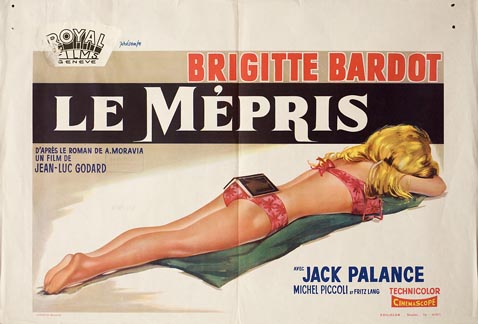
Contempt opens with a naked Brigitte Bardot asking her beaux Paul (diagetically) and you (extra-narratively) whether you like her butt. Specifically, she asks Paul ((Michel Piccoli) whether he can see various body parts in the (off-screen) mirror, and what he thinks of them. He is (as who wouldn’t be?) appreciative.
The scene is charmingly sexy. It’s also a tease, in more ways than one. Camille (that is, Bardot’s character) doesn’t ask what Paul thinks of her; she asks what he thinks of her image. Of course, we’re looking at the real Camille, not the image — except, of course, of course, we aren’t looking at the real Camille, because there is no real Camille — just an onscreen image of Bardot. The flirtation here, then, is not just Paul playing with Camille, but Godard playing with both of them, and with the idea of image and reality. The scene is less a love letter from a man to a woman than a love letter to the beautiful image of an ass.
The rest of Contempt is almost as self-reflexive as that opening scene. Paul, a theater-writer, is given the opportunity by the crass American producer Jerry (Jack Palance) to rewrite a script about the Odyssey by Fritz Lang (playing himself.) Paul is deeply ambivalent about working on the screenplay; Jerry is a bore, and Lang, who Paul deeply respects, doesn’t want the script changed. In the course of Paul’s vacillations, Jerry casually hits on Camille and Paul himself makes a half-hearted pass at Jerry’s translator/assistant. Somewhere in there, Camille decides she no longer loves Paul. In fact, she despises him.
In a review of the film a few weeks back, Robert Stanley Martin argued that Contempt is about the collapse of communication in a marriage. As Robert says:
Paul is essentially declaring himself a whore, and it’s clear that his seeing it as being for Camille’s benefit leads him to blame her for his situation. He doesn’t stand in the way of the producer’s efforts to come on to her, and he humiliates her further by letting his attention (and hands) wander to the producer’s pretty assistant in her presence. She drops every hint she can that she doesn’t want him to do this job. She even tells him how much happier she was when they didn’t have money and he was hacking out crime novels for a living. But she’s relying on rapport to tell him how she feels; telling him outright means their love isn’t strong enough to do the job. His resentments stand in the way.
That’s a basically naturalistic reading of the film — for it to work, you have to be willing to believe, at least provisionally, that Camille and Paul’s relationship is real. And, at least for me, that wasn’t really possible. A love that could vanish as suddenly and hopelessly as Camille’s love vamished — over the course of a few hours, as both Paul and Camille say — wasn’t really a love to begin with. It was just an image, or a trope.
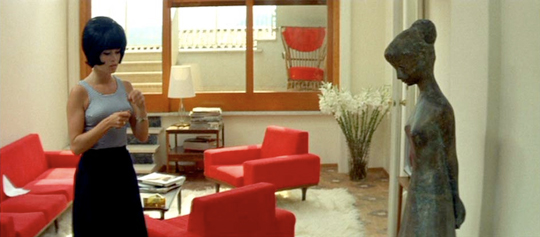
In fact, Camille’s contempt for Paul seems to be almost entirely a convenient reflection of his contempt for himself. No sooner does Paul accept a check from Jerry than he’s thrusting Camille into a sports car with the oleaginous producer. She’s less a wife than a masochistic fantasy; a dream of defilement. The delirious, endless scene in their apartment — in which the camera shoots the pair passing through doors and hallways or exchanging places in the bath, setting the table and clearing it without eating — has the too-vivid timelessness of a dream. Nothing gets said or understood not because communication between two people has failed, but because that apartment is a skull and there’s only one person in there. Perhaps that one person is Paul; perhaps (as is suggested when Bardot dons a black wig making her resemble the filmmaker’s wife Anna Karina) it’s Godard. But it’s not Camille.
Godard certainly thinks about the way that Camille is a thought. Throughout the film, both Jerry and Paul reimagine the story of the Odyssey in an effort to justify their own view of their relationship with Camille. Jerry speculates early on that Penelope was actually unfaithful to Odysseus; a not-very-subtle wish that Camille will be unfaithful to Paul. Later, Paul imagines that Odysseus stayed away from Ithaca for so long not because he couldn’t get back, but because he had marital troubles and didn’t want to come home. He also grabs a gun and talks briefly about Odysseus murdering Penelope’s suitors, clearly flirting with the idea of killing Jerry.
You could argue that the film is critiquing Jerry and Paul; that it’s undermining or ridiculing their efforts to make Camille their own narrative Pygmalion. Certainly there’s some of that going on; Paul, for example, actually drops that gun without realizing it and someone has to give it back to him — his gangsta dreams are profoundly ridiculous. But, at the same time…Jerry’s dreams do come true; Camille is unfaithful with him. And while Paul doesn’t kill his rival, the film — which is at least somewhat linked to Paul’s consciousness — is happy to do it for him. Jerry and Camille are killed in a gratuitously melodramatic, feebly ironic car crash after they tootle off together, finishing off Paul’s job and his relationship in a single bitterly masochistic ecstasy of revenge.
I was talking about this essay with Caro by email a little bit, and she argued that the unreality of Godard’s characters was not a weakness, but a meta-commentary. “The film is not…about lived reality, but filmed reality,” she said. “So the depiction is of the meaning of the depiction of woman on camera, of man on camera, not about men and women.” Clearly, there’s a lot of truth to that. We’re not supposed to look at Paul, or even at Godard, but at the film of Paul or of Godard. They aren’t asses, but images of asses. You are not meant to identify with them so much as you are meant to contemplate their assness.
But a contemplation of assness is not necessarily, or not only, the same as a critique of assness. Indeed, often, as with Bardot in the opening scene, the contemplation is a pleasure. From its opening shot of a camera on a dolly filming through its sudden interpolations of dramatic shots of statuary to the on-again, off-again dramatically swelling soundtrack to the avuncular presence of Fritz Lang, to that virtuoso dialogue in the apartment, Contempt is boisterously, seductively enamored with its own image. Godard certainly is aware that the woman-as-image, as projection of male sado-masochistic desires and fears, is itself an image. But that image-of-an-image is still irresistibly alluring. Bardot in a wig is a joke about the filmmaker turning Bardot into his wife — but that doesn’t change the fact that he’s turning Bardot into his wife. Camille dead in a convenient car crash is an ironic comment about male ego and filmic wish fulfillment — but the self-referential knowingness just fetishizes the self-reference on top of the wish fulfillment, savoring not the beauty of the dead woman, but the beauty of the reflection of the dead woman. However many lenses you look through, Camille is still a thing in his dream, and contempt is still a pleasure.
_____________
The index to the Godard roundtable is here.
As our reality was becoming increasingly mediated by images, where the representation of life was replacing life and human relations were displaced through commodities (compare Pierrot le fou’s famous dinner party scene in which the guests communicate through ad-speak to Guy Debord’s Society of the Spectacle), Godard radicalized his films in Brechtian fashion by subverting cinema’s conventions, calling attention to their mediating effects (albeit Debord and the Situationists weren’t fans): music pops up arbitrarily, dialogue doesn’t sync with the images, quotes (both visual and textual) are used in abundance but frequently have no logical connection to what little plot is involved, etc.
This prompted a series of interesting responses in comments, first by Craig Fischer:
I think you’re the first person to invoke the “B” word in your post–labeling Godard’s films “Brechtian”–and I’d agree that SYMPATHY’s separation of elements, etc. follow the techniques of Epic Theater. Personally, though, I’ve always had trouble with Brechtianism, because (a.) it presumes that the author (or auteur) can create a text that can effectively govern reader/audience reactions, and (b.) it assumes that escapism is a bad thing. What about the counter-argument, made by the great Hollywood director John Sullivan, that escapism is “all some people have? It isn’t much, but it’s better than nothing in this cockeyed caravan…”?
You’re making Brecht’s point for him. Of course, escapism is never “all some people have.” A choice to educate oneself (for example in critical theory, which is only as far as the nearest public library), or to be a creator rather than just a passive consumer, is always possible. But the entertainment industry would like people to believe that is all they have, so as to keep them coming back as obedient consumers. There is a clear connection between corporate interests, the promotion of escapism, and the definition of film as exclusively narrative, fictional and diegetic (therefore providing a story and a place to escape to). From this point of view, “Brechtianism” is exactly the corrective that is needed. Furthermore, if I’m not mistaken, Godard is influenced by Brecht from the very beginning; the jump-cuts in “A Bout de souffle” are already such a verfremdungseffekt, though later they get absorbed fully into narrative filmmaking, forcing Godard to push alienation further and further (especially in “Weekend” and “La Chinoise”–I haven’t gone back to read your review of the latter since reading this comment, but I’m not sure how one can enjoy it without being aware of exactly that intent–I mean, it’s pervasive!)
(I’d also like to point something out here–about how your comment seems to posit “escapism” and “Brechtianism” as the only two choices… But discussing that would take forever. Let’s just say I see it at least as a sliding scale, with many hybrid possibilities in the center, and also other approaches–Brakhage, say–that do not fit on the scale at all, though a Brechtian approach certainly could prime viewers for them.)
Your other “trouble with Brechtianism” is that “it presumes that the author (or auteur) can create a text that can effectively govern reader/audience reactions.” But isn’t that exactly what Hollywood does–indeed, isn’t that Godard’s main problem with the Hollywood institutional style? It’s just that Hollywood does this through emotional manipulation, counting on an (ideal) ideologically-blinded viewer, while Brecht (and again, I haven’t read him in decades, so I’m working from memory now) undertakes to educate the audience as to its own risk of being manipulated, and then refuses to manipulate it emotionally (for example, through catharsis, which, IIRC, was one of Brecht’s bugaboos), rather trying to educate it and therefore (hopefully) to help it judge rationally the presented ideas and narrative?
Well, that’s the theory, at least. In practice, as shown by Godard, verfremdungseffekts can clearly be used without a single-minded didactical purpose, can be used more “modernistically,” I guess you could put it, but, nevertheless, the Godard/Brecht notion involves a more aware cultural consumer, one who is conscious of the possibility of his or her own ideological manipulation–a much more positive scenario, I’d say, than the ideal consumer of Hollywood spectacle that Sullivan’s comment implies.
My mistrust of Brechtianism stems from Brecht’s assumption that much of the misery in life is a product of capitalist ideology. Brecht, like Marx, is at heart a utopian; if we offer the masses an alternative to mindless escapism, Brecht says, they can take steps towards liberation. The problem with this, however, is that sometimes life can be brutal in ways that have little to do with ideology. People die and shit happens regardless of the nature of the social order, and during those times escapism can be a balm. The examples that come to me are personal ones—how after my mother’s death I re-read old comics to escape into a nostalgic haze for a while—but I do think that SULLIVAN’S TRAVELS is a credible rebuttal to Brecht. Sometimes life sucks, and escapism helps.
In some ways, we’re on the same wavelength here: we both lament the overwhelming dominance of Hollywood escapism, and you’re right when you say that Brechtian aesthetics are a corrective. Given that Hollywood operates within a pathetically narrow narrative field, other types of films—Brakhage’s closed-eye abstractions, Bergman’s psychodramas, Antonioni’s languorous ennui, etc.—function as radical alternatives. I’d also agree that it’s a sliding scale between the extremes of Hollywood storytelling and Brechtianism, a point that Brecht himself acknowledges when he categorized his own plays into “culinary” Epic Theater (with enough old dramatic tropes to give pleasure to a mainstream audience) and Lehrstucke (much more experimental, and designed for already enlightened participants).
I’d disagree, though, that the Godard of BREATHLESS was Brechtian. The jump cuts and formal play in his earliest movies jolt the audience, but many of the pre-1965 Godard films don’t follow that jolt with any political content or point-of-view. There are plenty of exceptions—the Algerian War in LE PETIT SOLDAT, or the critique of consumer culture in A MARRIED WOMAN—but movies like BREATHLESS, A WOMAN IS A WOMAN and BANDE A PART give us Brechtian form but virtually no radical content. In his book A CERTAIN TENDENCY OF THE AMERICAN CINEMA, Robert Ray points out that plenty of late 1960s-early 1970s Hollywood films (BONNIE AND CLYDE, FIVE EASY PIECES) borrow flourishes of Godard’s style, but since the content (and the emphasis on narrative) doesn’t change very much, the result is a jazzier version of Hollywood business-as-usual. I’m reluctant to call a text “Brechtian” unless it has both radical form and content.
Also, I’m sorry I wasn’t clearer about my “trouble with Brechtianism.” I’m perfectly happy to extend my skepticism about texts controlling audience/spectator/reader response to ALL texts, Brechtian, Hollywood, and otherwise. I stick close to the Cultural Studies belief that a text generates a multiplicity of responses, only some of which were anticipated by the creator(s) of said text. That doesn’t mean that Brechtian movies can’t have a radical effect—just that I think our assumptions about their radicalism should be humble and skeptical until proven otherwise.
In her book INTERPRETING FILMS, Janet Staiger argues that films (and the historical moments in which films are watched and discussed) generate a plethora of reading strategies, though some of these are much more dominant than others. I relied on Staiger’s work in my dissertation, where I argued that US critics read Godard’s late 1960s and Dziga Vertov films in many different ways, though by far the dominant reading was to co-opt them into a conservative “Godard as auteur” paradigm. That’s happened here at HU too: the thread following John and Sandra’s post is a list of favorite directors formidable enough to make Andrew Sarris blush. But is there tension in claiming that Lynch, Bresson or Godard are “radical” while admitting them to the canon and labeling them “great artists”?
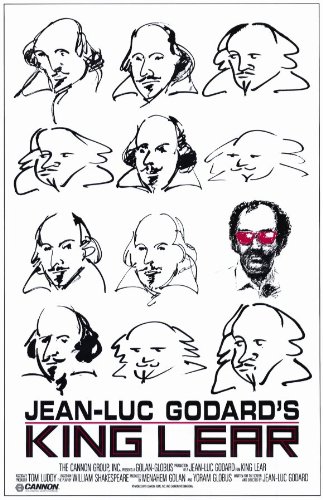
Caro asked me, as her go-to guy on things King Lear, to write up some thoughts for the Hoodlum Unitarian roundtable. I can therefore say with assurance that the key to understanding Godard’s 1987 King Lear, unlike most productions of the Shakespeare play, is Charles Bronson’s Death Wish 4: The Crackdown.
What, haven’t seen it? Fate has been kind enough to me that I can say the same. I’m thinking more about what it has in common with Bo Derek’s post-10 bomb Bolero, Superman IV: The Quest for Peace, the Raiders of the Lost Ark knock-off King Solomon’s Mines, and another movie I won’t even bother to name but whose Wikipedia plot summary begins: “A female aerobic instructor is possessed by an evil spirit of a fallen ninja…”
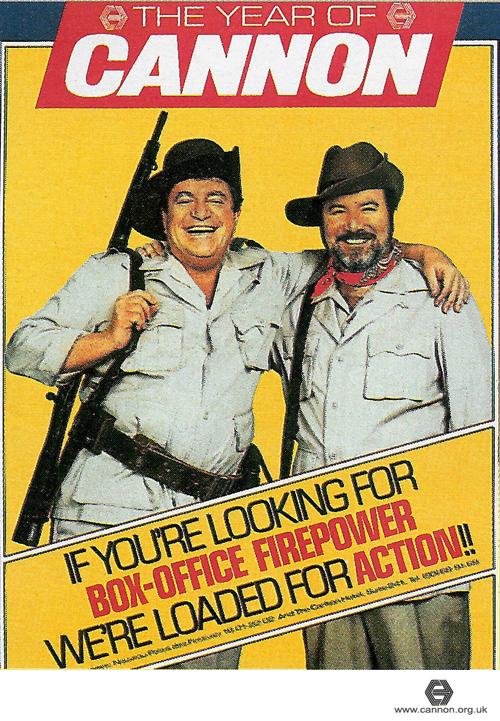
This collection of infinitesimally budgeted squeezings from tapped-out franchises all share a common source: the Cannon Film Group, in that period from 1979 to 1988 when it was owned by the Israeli duo Menachem Golam and Yoram Globus.
While Golam and Globus may have been schlockmeisters without peer, they were schlockmeisters with occasional cultural ambitions and/or pretensions. And near the end of their control of the Cannon Film Group, Jean-Luc Godard decided to take those ambitions for a joyride.
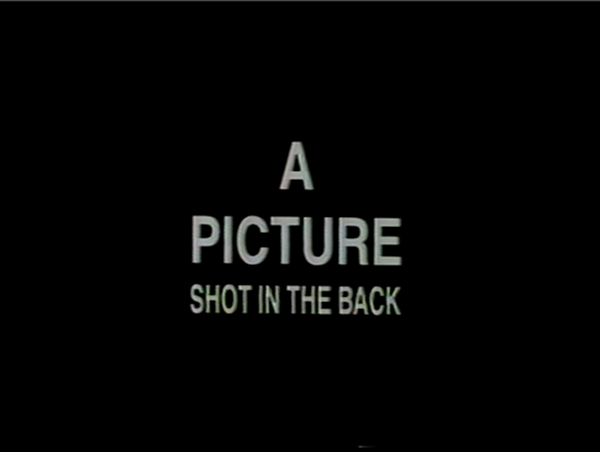
A Picture Shot in the Back
King Lear has, among all his other problems with the universe, a spotty film career.
At the moment, the text of King Lear is probably best known in Hollywood for being misquoted in a tattoo on Megan Fox’s back. (Lear Life Lesson: don’t get tattoos in parlors without internet access; the skin you save may be your own.) The first film version of King Lear predates sound, which means either Panto Lear or the world’s densest title cards. It was sixteen minutes long.
There have been some really good television productions — Laurence Olivier, Michael Hordern (my fave), Ian Holm, Ian McKellen, Orson Welles — but trips to the big screen have been rare. In my lifetime there’s been a Russian production under Grigori Kosintsev, and it’s inexplicable that I haven’t seen it; doubly inexplicable given that it’s got an original score by Dmitri Shostakovich. There’s the existential despair-fest of Peter Brook, milking every drop of downericity. Al Pacino has announced plans, and I’m pretty excited about it, but apparently now it is about as likely to get made as Atlas Shrugged: Part II.
And then there’s this thing.
Would you be surprised if I said that Godard’s take on King Lear was not exceptionally literal? That there’s probably more actual Lear in the 16-minute silent version?
Before the opening credits, there is a recording of a phone conversation.
Godard: “Well… uh…”
Either Golem or Globus: “Let me tell in short, two sentences, my main concern.”
Godard: “Yes, of course.”
Either Golem or Globus: “My main concern is the concern of the company and the prestige of Cannon Group. Cannon has announced for a year and a half [at this point the cheerful baroque accompaniment skids into the ditch, as of someone pulled the phonograph plug] Jean-Luc Godard’s movie, ‘King Lear.’ It is not believed by many that the movie will ever be done. We are losing confidence. We are losing our name. I, I must insist that this movie, as promised, which was already postponed so many times, will reach the Cannes festival. This is my main concern.”
An unidentified but lawyerly voice on the other end of the phone says: “Okay, Jean-Luc, why don’t you respond to that.”
The movie is his response.
The film proper begins, actually, with a line about Norman Mailer: “Mailer. Oh yes, that is a good way to begin.” The line is delivered by, naturally, Norman Mailer.
Mailer, uncredited, playing a Very Famous Writer, has decided that King Lear works better if stripped to its essence. And its essence, as the Very Famous Writer sees it, is a Mafia movie: Don Learo, Don Kenny, Don Gloucestro…
And then the movie starts over again: a different take of the same scene — Mailer and his daughter Kate, discussing his approach and then, for more context, reading the contract they signed with Godard. Intercut are a series of title cards, as the movie tries to decide what it’s name is. “King Lear: A Study.” “King Lear: A Clearing.” “King Lear: Fear and Loathing.” “A Film Shot in the Back.” The titles continue to pop up through out the movie, prematurely announcing THE END more than once.
Our main character turns out not to be Don Learo — although he does show up, played by Burgess Meredith, uncredited — but William Shakespare Junior the Fifth (Peter Sellars, uncredited, who would later clean up as a director of opera).
The situation in the world is dire, Shakespeare Jr. V explains in voice-over: “And suddenly it was the time of Chernobyl, and everything disappeared. Everything. And then after a while, everything came back. Electricity, houses, cars. Everything except culture — and meat. My task: to recapture what was lost. Starting with the works of my famous ancestor.”
Later we see him going through a forest with a butterfly net; he exultantly spots a reel of film in a pond. Cultural rescue to the rescue! By scribbling down bits of overheard conversation between Learo and his daughter Cordelia (Molly Ringwald!) he intends to recreate the text, or at least some text.
How to tell there are 30 minutes left in this movie
At this point it should be pretty clear that continuing with a plot summary is not that useful of an exercise. The movie is as fragmented as the scraps of Lear that waft through, sometimes by disembodied voices on the soundtrack, interrupted by the screeching of sea gulls.
This disjointed fragments-I-have-shored quality also gives it the freedom to swing wildly between two different modes.
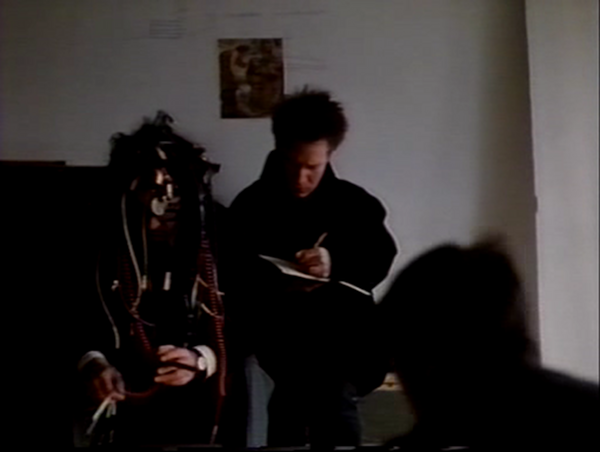
On one hand, there is ponderous lecturing on the meaning of cinema, given mostly by Professor Pluggy, from whom Shakespeare Jr. V seeks advice. He comes by his name honestly enough: he’s wearing spiralling patch cords as dreadlocks. It’s also, not coincidentally, Jean-Luc Godard. Perhaps he is reciting some classic work of film interpretation, but it drags on tediously, as if he’s intending to bore his audience intentionally.
Godard as Professor Pluggy
The other mode is a kind of improvisatory, vaudevillian jokiness. Here is Don Learo, over dinner, discussing Jewish gangsters Bugsy Seigel and Meyer Lansky: “Bugsy was a real killer. Not like this — uh, Richard Nixon.” In this vein, it’s not surprising that Woody Allen has a walk-on.
So how do you explain a movie like this? You have to use the Hebrew word freier — sucker. Golem and Globus, eager to do a prestige picture to mitigate their schlockmeisterhood, thought that underwriting a movie from Jean-Luc Godard was their fast lane to Cannes. They did not expect that they, themselves, would be the freiers.
The movie looks very much like a lark. Paid for by the Cannon Film Group.
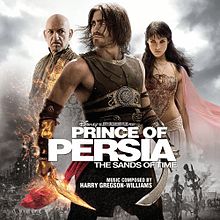
Prince of Persia: Sands of Time, the argument will go. It’s a derivative, malformed mess, with a plot that manages to be both preposterously ludicrous and tediously predictable. Jake Gyllenhaal is largely wasted as Prince Dastin, a role which requires him to alternate between looking raffishly earnest and earnestly raffish. Gemma Arteton as Princess Tamina does her best Princess Leia impersonation, and succeeds in demonstrating that she can be significantly less sexy than Carrie Fisher even while having a much larger chest. The super-special mystic knife appears to have been purchased from Toys R’Us, and a troop of dark riders have been shamelessly borrowed from the Lord of the Rings films. Except these Dark Riders aren’t called Nazgul. They’re called “Hashashins.” Which, in ancient Persian means, “Assassins who lisp.”
So, okay, it’s true — this is a big, dumb, Hollywood action-adventure vehicle with nothing in its head except things blowing up, swordfights, and pretty actors staring soulfully into each others eyes for a moment before more things blow up.
But you know what? I’m okay with that. Prince of Persia has no lofty ambitions and virtually no pretensions; it isn’t an ironically clever action movie, or a thoughtful action movie, or anything but a breezy summer stunt fest. And within those boundaries, it’s really surprisingly decent. Gyllenhaal has charisma to burn, and he leaps from battle to dashing close-up to battle with winning ease. He has no chemistry with Gemma Arteton, but then, they hardly have any love scenes. And really, even if she is more pert than smoldering, and has not a single line worth reciting — well, let’s just say I’ve been waiting to see more of her ever since her head-turning walk-on in Quantum of Solace. The sword fights are well choreographed, and many of the set pieces are entertaining and creative. One of the highlights is early in the film, when Dastin scales a wall using crossbow bolts fired just ahead of his ascent by his retainers.
Moreover, the writing is surprisingly good, in a workmanlike way. The opening scene explains Prince Dastin’s background (he’s a street urchin adopted by the king) in a burst of action-filled exposition that’s as professionally efficient an origin story as I think I’ve seen on film. The close relationship between the king (Ronald Pickup) and Dastin is only developed in a couple of scenes, but Gyllenhaal sells it; he looks genuinely stricken at his father’s death, and you feel throughout the film that he is motivated by the king’s memory. The dialogue for ostrich-racer, small time thug, and anti-tax activist Sheik Amar (Alfred Molina) is even witty. A heartfelt lament in which Amar declares his determination to keep a close watch on a suicidal ostrich lest she “do something stupid” is, for example, laugh-out-loud funny — and his feeling embrace of said suicidal ostrich is certainly the movie’s romantic high point.
I think my favorite part of the film, though, is the ending. [Warning! Spoilers follow!]
Prince of Persia’s denouement involves the mystical turning back of the clock practically to the film’s beginning, effectively erasing the entire action of the movie. Dastin foils the villain even before his plot can begin, and every meaningful emotional moment of the narrative is ruthlessly disappeared. The king doesn’t die. Dastin’s brothers, both of whom were murdered in his arms at a moment of reconciliation, don’t die either. The honorable black sidekick doesn’t inexplicably sacrifice his life for the stupid lighter-skinned peoples. Sheik Amar doesn’t bow to the remorseless logic of lovable rogues and show an inner nobility. The Princess doesn’t fall in love with Dastin, nor does she sacrifice herself for him and the world (though Dastin gets to court and marry her anyway). In short, nothing happens. You get the happy ending without any of the events leading to it.
Which seems perfectly reasonable. I mean, I liked the king; I don’t want him to get killed. The brothers were fun too; I don’t need to see them offed. And lord knows I really, really don’t want to see the honorable black sidekick do that thing that all the black sidekicks have to do. Why not just wipe it out? It’s all just a fluffy fantasy anyway. It kept me cheerfully entertained for two hours. It wasn’t real, it had nothing to say, it’s over and there are no consequences to speak of. Would that all Hollywood action movies were equally forthright.
This week was almost entirely devoted to our Godard roundtable, organized by Caroline Small. The index to all posts so far is here. The roundtable will continue through next week.