Life on Earth; Life on Bjork

I’m reprinting two related reviews; the first appeared on Madeloud; the second on Splice Today.
_______________________

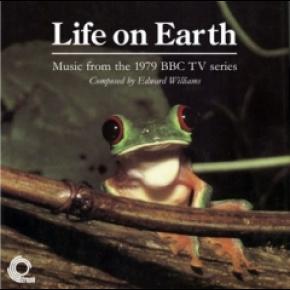
Edward Williams – Life on Earth: Music From the 1979 BBC TV Series

I actually cried when I missed an episode of the David Attenborough BBC mini-series Life on Earth.. I was in middle school at the time, and my family watched the show religiously every week, but I had a swim meet, and we’d just forgotten. Worse, it was the reptile episode. I loved reptiles.

It’s hard to believe I remember all that now, three decades later. I remember, too, that much as I loved the show, the end of each segment was thoroughly disturbing; you’d watch these wonderful, strange animals for an hour, learn about their habits and their lives, and then, at the end, David Attenborough would explain in his matter-of-fact, British voice, how man’s relentless expansion was inevitably going to kill them all.

And yeah, I remember the soundtrack too. Not the melodies or anything, but the broad outlines of the music; quiet, translucent, and fey; chamber music to contemplate extinction by. It’s bizarre how clearly the show comes back to me while listening to this newly released reissue of music from the series. The plangent woodwinds, the splashes of strings, the dischords that never resolve but just drift away — I can see the water dropping into the pond, or the butterfly coming out of its cocoon, or the hummingbird wings slowed down so that Attenborough could count the beats.

Obviously, I’m older at this point, and while the music seemed sui generis back then, it now fits into a recognizable context— which is to say, composer Edward Williams loves, loves, loves him some Debussy. But even so, there’s a strangeness and a humor here that’s hard to resist. The wonderfully named track “The Sex Life of Ferns” starts with a light percussive patter, as if all those spores are nervously shuffling their bits in anticipation; then, towards the end, there’s a lazily triumphant woodwind, and you can imagine various leafy greens rustling in a satisfied manner as the sun sinks low in the distance. “Big Mammals” has a slow, swaying lope with just a touch of Tarzan jungle drum, so you can almost see those big trunks swaying. And then there are the lovely albeit somewhat unfortunate Orientalisms on “Japanese Macaques.” It’s all so melancholically precious, or so preciously melancholy. I don’t know if Donovan ever saw Life on Earth, but if he did, he would have understood.

Perhaps my favorite track is the final one, taken from the last episode in the series, “Man.” I pretty much hated “Man” at the time; I wanted to see reptiles biting things and frogs jumping, and elephants trundling, so a bunch of people walking through cities was just not what I was parked on the couch for. Yet, despite my disinterest, Attenborough’s final words have remained with me for most of my life, and it was a jolt to hear his narration excerpted here. “The fact remains that man has an unprecedented control over the world and everything in it. And so, whether he likes it or not, what happens next is largely up to him.” The music for the finale is an odd duel between a inspiring fanfare and a mournful little solo violin theme. Eventually the fanfare seems to win out…but in the last second or two it trails off weirdly, as if embarrassed. It’s an appropriately uncanny moment. In this mini-series and album, life doesn’t so much dominate the planet as haunt it, passing across the surface of the earth like a shadow, or an oddly vivid memory.

_____________

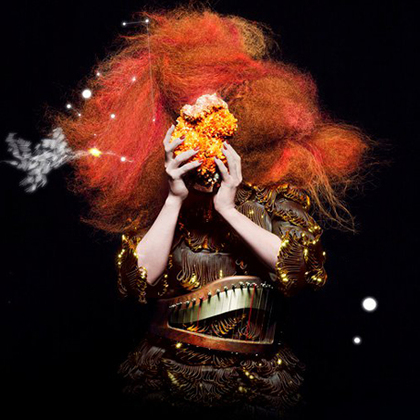
Bjork: Biophilia

Bjork is Bjork. Over the years she’s become one of those artists who is a genre unto herself. Though she’s got connections to the fey new folk movement and links to the fey end of New Age electronica and an affinity for other fey Icelandic post-rock romantics like Sigur Ros, the truth is that when you listen to any of them and Bjork, she becomes the meme and they become the iteration. Or, to put it another way, they all sound like Bjork more than Bjork sounds like them. You can compare her to whoever till your hair turns pixie polycolors, but Bjork is not post-rock folk electronica. She’s Bjork.

Which is why her latest effort, Biophilia, gave me a start. Not that it’s different from her past releases—if you’ve heard Vespertine(2001), or Medulla (2004), or Volta (2007), you’ve got a good idea what to expect from Biophilia. It’s just that all of a sudden, the Bjork sound didn’t sound like Bjork. It sounded like Edward Williams’ music for the David Attenborough mini-series Life on Earth.

What made me think of Williams’ quiet, Debussy-like score are no doubt Biophilia’s lyrics. You can get the gist from the song titles: “Moon,” “Crystalline” and “Solstice.” The album is post-rock folk electronica for the natural world. You listen to its plangent blips and murmurs and visualize plants opening or birds’ wings beating in motion so slow you can see each feather shudder. Nature, in Bjork and Williams, is figured as a series of disturbingly vivid tableau arranged for uncanny contemplation. At the beginning of “Hollow,” the echoey, arthymic keyboard sounds patter forward, then pause, then patter forward, then pause, like a small furry creature scuttling across the ground towards food. “Moon”‘s plucked lilt could be the background for a butterfly slowly coming out of its cocoon. “Thunderbolt” is even more explicit: “Staring at water’s edge/Cold frost on my twig/My mind in whirls/Wandering around desire/…Craving miracles.” Then at the end of the song, the electronics start burping like a series of frog calls. Suddenly Bjork isn’t Bjork. She’s library music for a nature special. How did that happen?

“Virus” seems like an attempt to explain the process. “Like a mushroom on a tree trunk/as the protein transmutates/as I knock on your skin/and I am in,” Bjork sings in her usual hoarse, soaring precious diva style as the music drips and clinks, water falling on chimes. Nature is both a smooth vision on the eye and an ominous visitor moving under the skin. Nothing is really itself. “My sweet adversary,” Bjork calls her lover/disease, as the distanced music and its surface prettiness turn her into an aestheticized transient shadow. If you watch nature, and nature is you, then you are both inside and outside, a ghost infection haunting yourself. At that point, you can hardly be surprised when you become something else, even if that something else is a 30-year-old BBC miniseries.

Or, for that matter, an up-to-the-minute pomo marketing endeavor. Biophilia is as detached from its identity as Bjork is from hers. It isn’t really an album so much as a nexus for related products, including a series of apps for every song and a range of multimedia live shows some of which, apparently, include National Geographic imagery. Still, as I lack the funds, the technology, and the interest to pursue the album through its metastasizing iterations, I’m happy that my brain has instead decided to attach the soundtrack to my own hazy memories of creepily perfect nature specials past. I hate to admit it, but Bjork as Bjork was beginning to get a little boring. Bjork as mushroom with David Attenborough narration, though, is a thought to cheer every phylum.

Utilitarian Review 11/19/11

On HU

In our Featured Archive post this week, James Romberger discusses the critique of Christianity in the work of artist David Wojnarowicz.”

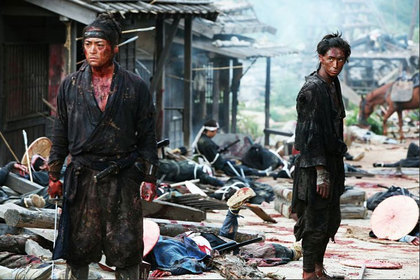
I talk about decadent viewers and decadent villains in 13 Assassins.

Sina Evil on Gay Ghetto comics.

I reviewed Marston/Peter Wonder Woman #25.

Robert Stanley Martin on Julian Barnes’ Sense of an Ending.

Nadim Damluji interviews Craig Thompson about Habibi and Orientalism.

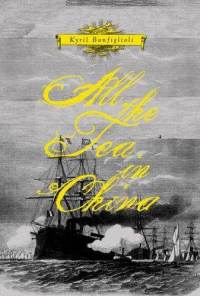
I compare Kyrli Bonfiglioli’s All the Tea in China to Peter Carey’s The True History of the Kelly Gang.

I talk about Bella, Katniss and (fear of?) femininity. (Caroline Small makes a special guest appearance.)

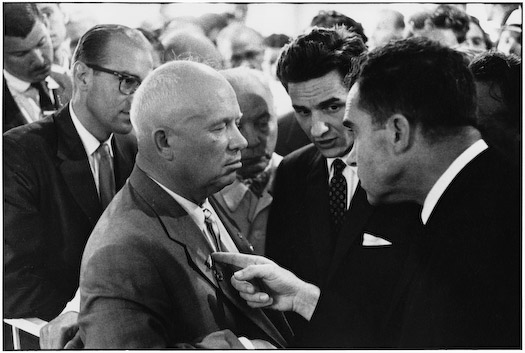
I explain why Obama is no Khruschev.
 
 
Utilitarians Everywhere

At the Atlantic, I had a post about Twilight and the Hunger Games.

At Splice Today I argue that Herman Cain’s campaign does not mean that ideology has trumped racism.

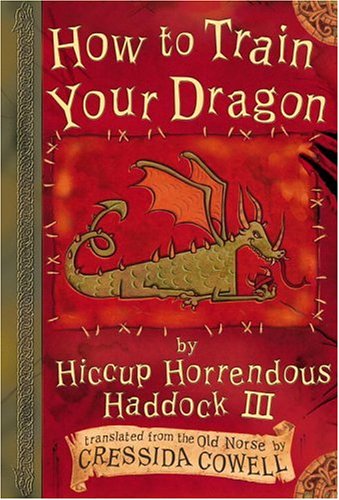
Also at Splice I talk about frame stories and narrative in How To Train Your Dragon. (Also why it’s better than Harry Potter.)
 
 
Other Links

Shanenon Garrity asks various folks (including me) what comics adaptations they would and would not like to see.

Ty Templeton’s blog is really entertaining.

Rod Dreher on empathy and justice in light of the Penn State scandal.

Tucker Stone with a long interview with Mark Waid.

Obama Is No Khrushchev

Prosecuting former administrations for crimes divides us from our friends, encourages our enemies, and distracts us from the pressing and difficult business of governance. As one high-ranking government official said of a liberal reformer bent on raking up the crimes of the past, “He’s just handing the sword to others, helping the tigers harm us.”

As the poetic idiom suggests, the high-ranking government official was not Dick Cheney — it was Chairman Mao. And the liberal reformer in question was not Glenn Greenwald; it was Khrushchev.

I recently read William Taubman’s massive biography Khrushchev: The Man and His Era, and the book was on my mind as I paged through Glenn Greenwald’s new volume With Liberty and Justice for Some: How the Law Is Used to Destroy Equality and Protect the Powerful. The parallels are fairly obvious. Greenwald argues that American elites have effectively and deliberately placed themselves above the law. Illegal activity by the wealthy or powerful — Nixon Watergate crimes; Reagan Iran-contra crimes; Bush-era illegal wiretapping and torture; Wall Street malfeasance which led to the financial collapse — is not so much ignored as deliberately sanctified. Democrats, Republicans, and the press corps all agree that prosecuting the powerful would be divisive and hurt America. Therefore, as Obama has often said, “we need to look forward as opposed to looking backwards.”

Mao, obviously, felt the same way about Stalin. So, for that matter, did many in the Soviet hierarchy. These people weren’t idiots; they had good reason not to want to expose the extent of Stalin’s crimes. Communism had many enemies, both internal and external. For those enemies open discussion of the hideous mass killings of the Stalin era would be a propaganda coup. Moreover, Stalin’s heirs were all implicated in his atrocities. Mao in China was, of course, wading through shoals of decaying bodies, and was using Stalin’s personality cult as a blueprint for his own. The Russian elite was more directly involved; all had, at Stalin’s behest, consigned innocent people to death; all had failed to speak out to protect the innocent. Khrushchev, who succeeded Stalin, had certainly signed death lists.

Yet, despite his own culpability, Khrushchev denounced his predecessor. Taubman in his biography calls this denunciation, delivered in a four hour speech, “the bravest and most reckless thing [Khrushchev] ever did.” It was certainly a braver thing, by many orders of magnitude, than any public act committed by Barack Obama, or by George W. Bush, or, for that matter by Clinton or even the sainted Reagan. We tend to think of Soviet rulers as absolute dictators who can govern with impunity, but the truth is that Khrushchev’s position at the top of the hierarchy was by no means entirely secure, and his decision to out Stalin’s crimes was a major political gamble. Taubman describes the reaction to Khrushchev’s speech, delivered in secret to the Twentieth Congress of the Soviet Communist Party in 1956.

Many in the audience were unreconstructed Stalinists; those who had denounced former colleagues and clambered over their corpses suddenly feared for their own heads. Others, who had secretly hated Stalin, couldn’t believe his successor was joining their ranks. As the KGB chief-to-be Vladimir Semichastny remembered it, the speech was at first met with “a deathly silence; you could hear a bug fly by.” When the noise started, it was a tense, muffled hum. Zakhar Glukhov, Khrushchev’s successor in Petrovo-Marinksky near Donetsk, felt “anxious and joyous at the same time” and marveled at how Khrushchev “could have brought himself to say such things before such an audience. ” Dimitri Goriunov, the chief editor of Komsomolskaya Pravda, took five nitroglycerin pills for a weak heart. “We didn’t look each other in the eye as we came down from the balcony,” recalled Aleksandr Yakovlev, then a minor functionary for the Central Committee Propaganda Department and later Gorbachev’s partner in perestroika, “whether from shame or shock or from the simple unexpectedness of it, I don’t know.” As the delegates left the hall, all Yakovlev heard them uttering was “Da-a, da-a, da-a” as if compressing all the intense, conflicting emotions they felt in the single, safe word, “yes.”

Of course, George W. Bush is not Stalin. Stalin caused the death of millions, and ordered I don’t know how many innocents tortured to death (thousands? tens of thousands?). Bush’s aggressive (and therefore, by international law, illegal) war in Iraq killed only in the low hundreds of thousands according to most estimates. Greenwald says the torture Bush authorized probably resulted in the deaths of at most 100 people. Similarly, the Obama administration and its Democratic allies have much less to lose by exposing their predecessors than did Stalin’s followers. As Greenwald points out, Democratic muckety-mucks like Nancy Pelosi and Jay Rockefeller were informed of Bush torture tactics and illegal wiretapping, which makes them complicit under the law. But they weren’t murderers like Khrushchev, and they haven’t just lived through a political bloodletting like the purges. If worse came to worse, they would only get jail time, not execution following a quick show trial.

These comparisons, though, do not necessarily redound to the credit of our political class. Khrushchev exposed Stalin-era crimes even though he had much more to lose by doing so than Obama has to lose in exposing Bush’s. Even in terms of national security, Khrushchev was in a significantly more precarious position. The U.S. has al-Qaeda to worry about; the Soviet Union had the U.S.— and, many, many other enemies, all much more credible as existential threats than Osama bin Laden could ever hope to be even in his most megalomaniacal wet dreams.

In fact, Khrushchev’s deStalinization damaged the Soviet Union in the short term, and arguably destroyed it in the long. The secret speech, which was at Khrushchev’s insistence duly publicized, sent shock waves through Soviet colonies in Eastern Europe. The Hungarian Revolution — which Khrushchev ruthlessly and bloodily crushed — was inspired in large part by the revelations of the true horror of Stalin’s reign. Khrushchev’s speech also alienated Mao, separating the USSR from one of its most important allies. Khrushchev’s anti-Stalinist rhetoric was used against him when he was forced from power in 1964, with one colleague declaring, “Instead of the Stalin cult, we have the cult of Khrushchev.” Even after Khrushchev himself was gone, his reforms continued to undermine the government and philosophy to which he had devoted his life. In the late 1980s, Khrushchev’s deStalinization became the blueprint for Gorbachev’s perestroika and glasnost, which ultimately caused the Soviet system itself to buckle.

So Obama and Mao aren’t wrong. Looking backwards can turn you into a pillar of salt. Exposing the crimes of the powerful really can delegitimize a government, and holding past rulers accountable really can have devastating consequences. To have faith in the rule of law, as Greenwald does and (vacillatingly, but nonetheless) as Khrushchev did, is to have faith in the system. It is to believe that democracy (or in Khrushchev’s case, socialism) is strong enough and vital enough to withstand the light of truth.

As it turned out, Soviet Communism wasn’t strong enough to withstand that light. Maybe our government isn’t either — in which case, the sooner we find that out, the better. Khrushchev’s deStalinization resulted in much misery for both himself and the country. But I don’t think anyone doubts it was the right thing to do.

Not that Khrushchev was a saint. On the contrary, he was a boorish, overbearing, often cruel man, with blood on his hands up to his elbows. But if we’re going to toss out the rule of law and model ourselves on tyrants, better him, by far, than Mao or Stalin.
__________________

This first ran on Splice Today.

Tween Horror

I had an article on the Atlantic a couple of days ago in which I talked about the Hunger Games and Twilight, comparing Bella and Katniss. I argue that Bella is in many ways stereotypically feminine (passive, focused on romance and motherhood) while Katniss is in many ways stereotypically masculine (competent, deadly, not focused on romance).

People have not been pleased with me. Specifically, Alyssa Rosenberg and Amber Taylor take me to task. Alyssa started out by calling me condescending and went on to say:

First, there’s something really profoundly weird and limited about this definition of femininity — and condescending in the piece’s sense that a totalizing devotion to motherhood, to relationships, to sex, to girliness is the only, or most worthy, definition of femininity. The second-wave feminists who produced Our Bodies, Ourselves may not have done the research into a groundbreaking medical text that changed the relationship between women and the medical establishment while wearing pretty dresses*, but that doesn’t mean that their work wasn’t deeply attuned to the feminine. Creating space for women’s voices in hip-hop, and suggesting that women have something specific to offer the form, may not be explicitly attuned to the state of romantic and sexual relationships, but that doesn’t mean it’s not an exploration and assertion of the feminine. Choosing to have a baby even if it means you have to be on bed rest or endanger your life might mean you’re devoted to motherhood, but it doesn’t actually make you more of a woman than casting off your cloak to duel the holy hell out of Bellatrix Lestrange or climbing into an exo-suit and doing battle for a little girl’s life — and by extension, the continued existence of the human race.

As is usually the case, Caroline Small is more eloquent than I am, so I’ll let her respond. This is a comment she left on the Atlantic site before Alyssa’s post went up, but I think it resonates.

The comments to this article are really pretty interesting. But pretty disheartening, really, too. A lot of popular feminism, which seems to be where some of the commenters are coming from, isn’t very attentive to the history of cultural gendering, where certain traits were indeed gendered “female” and certain “male”, and where the male traits were generally considered better and more worthwhile. Those preferences haven’t really gone away — the sets of traits and behaviors are still valued differently. They’re just more available to individual people of both genders now.

I’ve been seeing these “I’m glad I grew up with Buffy and not Bella” things too, so it’s not just Katniss. I sympathize; Bella doesn’t particularly appeal to me either. But it doesn’t take much insight to recognize that she aligns more closely with “traditional femininity” than Buffy and Katniss do.

Fortunately, there are lots of women today whose self-perception aligns with the masculine values, to the point that those women would never describe those traits as “masculine”. I think these comments reflect that. But being able to see them as non-gendered, or differently gendered, is something we have the luxury of doing because we were fortunate enough to have come up after feminism fought those hard battles, in an era where other people and society overall enforce those gendered norms on our individual bodies much, much less.

A lot of people seem to think that the point of feminism is making “masculine” behavior acceptable for women — or making no behavior unacceptable for women, that is, separating the behavior from the bodies of the people who perform the behavior and not judging women who prefer those historically masculine traits. And I agree that is one goal of feminism.

But feminism used to also be about recognizing the value and beauty of the way women historically did things, of women’s ways of knowing, of women’s unique experiences — of “femininity” as a counterweight to the excesses of “masculine” strength and authority and aggression. It used to be about valuing “femininity” as a place from which we could criticize and challenge the bad things in our world. A lot of the distaste for Bella is genuine distaste for the historically “feminine” categories and behaviors and values and aesthetics, but it’s generally expressed without even the slightest recognition of how problematic and limiting — and historically patriarchal — that attitude is.

So I’m hesitant that it’s a good thing to derogate traditional femininity, either in favor of traditional masculinity or even in favor of an individual woman’s right to behave however she pleases. A feminism that rejects the very notion that culture is gendered (in ways that have nothing to do with biology) is a feminism that’s amputated its best critique of power. It’s essentially co-opted by historically masculine cultural biases and preferences — including the ones for violence and strength. That’s tragic, if that’s where we are.

Part of the appeal of characters like Katniss is that they challenge conventional gender without completely eradicating it. Part of the appeal of characters like Bella is that they subvert conventional gender without really challenging it at all. I don’t much like either of them at a personal “do I want to hang out with these people” level — I’m with the person who prefers Hermione, although HP is almost as badly written as Twilight. But it strikes me that not being able — or willing — to think the difference is a problem.

Girl power is great — except when it moves beyond allowing people with female bodies to behave any way they like and becomes a new set of restrictive, normative, angry, prejudiced norms that bully people with female bodies into behaving a certain way. The widespread and almost-always knee-jerk “feminist” contempt for Bella, both in itself and in comparison with “tough” female characters like Katniss and Buffy, is a tremendous intellectual and social failure in that respect.

So I think it’s worth asking the defenders of Katniss — is there actually a feminist critique of the power structure that gets Katniss into the book’s defining life or death challenge, the kind of systematic feminist critique you get from, say, Joanna Russ or Erica Jong? I can be talked out of this position, but it doesn’t seem to me that there is. The same question could be asked of Buffy, and of any other girl power heroine. Twilight may actually have the edge on that one — there is a definite critique of the Volturi from Bella’s perspective that aligns nicely, yes, with Christian ideals, but also with traditionally feminine ones. (Although Bella is certainly no Alyx.)

Ignoring the seductiveness of those “masculine” characteristics, pretending their relationship to authority and strength and power and violence is transformed just because a woman engages in them — — that’s not feminist at all. And neither is perpetuating biases and prejudices against the historically gendered-feminine traits. A feminism that can’t make room for Bella is a feminism that’s going to have a lot of trouble getting purchase with women who like Bella, and that seems like a tremendous mistake to me.

To me it seems like Caroline has Alyssa pretty much dead to rights. Alyssa is basically insisting that the feminine be defined as, “anything that women do.” And that has been one goal of feminism. But another goal has been to champion those things traditionally associated with women. And you can’t champion those things if you feel it’s condescending to even suggest that they exist.

The difficulty with championing them if you refuse to admit they exist is perhaps best epitomized by another commenter on the Atlantic. This is Genevieve du Lac. Her comment has garnered 16 likes, so I don’t think she’s just speaking for herself here.

I’m really disgusted with these definitions of femininity and feminism. Why can’t a woman be competent and feminine at the same time? Femininity is not weak. And Bella is just retarded. The two neurons she’s got floating around in her cerebellum are drunk off too much estrogen… like most 16 year olds. So she’s got some feminine qualities – like following her feelings, etc. That does not make her the epitome of femininity.

I’d like to think a woman can be feminine and still be competent. I can wear my makeup and heels and take care of my hair just as well as I sky dive, shoot an arrow, shoot a pistol, finish my MBA, and have a career. Sheesh.

Like Alyssa, Genevieve wants the feminine to mean everything women do. But to get there, she has to call Bella “retarded” and sneer at her “estrogen.” Which, to me, seems like a problem.

Alyssa doesn’t lambast Bella in such offensive terms, of course, which I appreciate. But she is coming from at least a vaguely similar line of country.

And while those values are worth examining further, Twilight‘s also eminently critiqueable on narrative grounds, something Noah gives very little credence. Complexity is the stuff of genuinely compelling decision-making, as well as compelling storytelling. What’s troubling about Twilight is less the idea that Bella picks Edward and more the inevitability of their eventual union. Once Edward walks into Bella’s science class, she never really considers anything else, never gets presented with any other truly compelling options, she treats the humans in her life who are graduating and going off to their own adventures with dismissiveness and disinterest. Tough choices are fascinating. Defending the world’s kindest fate is rather dull.

And just as I’m bored by Bella’s certainty and dismissive attitudes towards people who set other priorities and take other paths, I don’t appreciate the idea that I don’t live up to Noah Berlatsky’s very particular standards of femininity, I’m doing it wrong. There may be effective arguments for a Christian focus on love rather than strength. But a strident and myopic lecture to women with a variety of priorities isn’t likely to be one of them.

Alyssa is arguing for narrative complexity — complexity involving action, politics, and suspense. She goes on to argue that the Hunger Games is interesting in part because it’s about how politics destroys families; how the public trumps the private and why that’s evil.

But…that’s not unique to the Hunger Games. It’s just how adventure stories work. You’re fighting for home and family; that’s the motivation, but it’s not the story. That’s why Amber Taylor is misleading when she says that Katniss’ actions are all about her family. Diagetically they are…but that isn’t what the books focus on. We hardly know Katniss’ sister, or her relationship to her; Pru really just exists as a kind of pure idol of goodness and innocence, a reason to keep fighting, like any number of pure-women-left-at-home in any number of adventure books. What Alyssa wants, and what adventure narratives want, isn’t the exploration of love and relationships…so they push those over to the side. And instead, you get violence and things blowing up.

I don’t have any problem with things blowing up in my entertainment. I don’t know that I seek that kind of thing out quite as much as my wife does, but I’m perfectly happy to go along for the ride. Enjoyable as those things-blowing-up are, though, I like other kinds of stories too. Such as, occasionally, romance. Which is what Twilight is.

As in most romances, narrative complexity, in terms of events and suspense, is not the point. You know Bella is going to get her guy, just like you know that Jane Austen’s heroines are going to end up happily married. That’s how romance works. People — often people known as “women” — read those books not because they’re idiots who don’t like complexity, but because they are interested in a different kind of complexity. Specifically, they’re interested in the ins and outs of love; not just whether people love each other, but how they do so; not who will live and who will die, but what will they say and how will they say it and how will their relationship develop?

For instance, there’s that scene in the Twilight series where Edward’s family is voting on whether to turn Bella into a vampire. Edward’s father votes yes, and his reason is that Edward has vowed to kill himself when Bella dies. For Edward’s father, his love for his son therefore means that Bella has to also live forever.

As a father, as a husband, as someone who has been thinking a lot recently about in-laws and what they mean for marriage and for love — I found, and find that scene really moving. And that’s where the suspense and surprise in Twilight comes from; from the explanation and exploration of love and intimacy, not just between Bella and Edward, but between Bella and Jacob, and Jacob and Edward, and Edward’s family — the entire cast of characters, in other words. It’s different than watching the nifty new way Katniss kills somebody, I’ll grant you. But it’s not worse. For me, anyway, I find it more compelling. Or, as Laura Blackwood says in a lovely recent essay, “The Twilight series challenges what I would call the “Buffy Summers Maxim”: that teen heroines be physically empowered, oftentimes at the expense of emotional clarity.”

None of which means that Katniss, or Alyssa, is “doing it wrong.” Even if the Hunger Games is (like Twilight) dreadfully written, I still like Katniss. I like watching her figure out how to kill people; I like her tomboyish competence; I like her butchness, I like her delight in dressing up, even if the series won’t really allow her to own it. I like the way she finds true love and family at the end. She’s not my favorite heroine in the world, and her whining (like Bella’s) gets pretty tedious, but overall, I enjoyed spending time with her. That’s why I went out of my way to say at the end of my essay at the Atlantic that Katniss and Bella aren’t opposed. As another writer notes here, it’s not an either/or choice. Lots of girls admire both characters. I think it’s possible to imagine that Twilight’s heroine and the Hunger Games’ heroine would find something in each other to love and admire as well.

Amber Taylor disagrees with me there, though:

The idea that there would be a fight is absurd, but the reason for peace is not that Bella and Katniss “might understand each other’s desires and each other’s strength” and walk away in mutual respect. Katniss wouldn’t fight Bella because Bella is not an autocratic totalitarian dictator. Bella threatens exactly nothing that Katniss values, and thus Katniss, a user of violence who is not inherently violent, would probably shrug. Katniss’s political consciousness and promotion of self-rule does not threaten Bella’s tiny microverse of loved ones and would likewise be a non-issue to Bella.

For Taylor, Katniss wouldn’t respect Bella. She’d just ignore her, because Bella is no threat. But I have to ask…if Bella “threatens exactly nothing” that Katniss or Taylor or Alyssa values, why then are so many writers so eager to attack her? If she’s not a danger, why call her a “retard” or deride her as dull or passive or sneer at her “tiny microverse of loved ones” — that thing that some of us of insufficient political consciousness refer to as our “family”? What, in other words, is so scary about Bella and the girls who love her? And could it, maybe, have something to do with our culture’s ambivalence about femininity?

I’ll let Sarah Blackwood have the last word.

Bella holds up a cracked mirror and shows us some things we don’t want to see. But she also reminds us that the imagination resists checklists of appropriate behavior. Teen girls resist checklists. The really interesting conversations start to happen when we stop circling the wagons against “bad examples” and “passivity” and start exploring not only what we want our heroines to be like, but why.

Bandits and Opium Sellers

Kyril Bonfiglioli’s All the Tea in China and Peter Carey’s True History of the Kelly Gang are both rollicking adventure stories set in the past when men were men and skullduggery was a rip-roaring adventure rather than disreputable thuggishness.

Bonfiglioli’s hero is Karli Van Cleef, a Dutch Jew who swashes and buckles his way across the eighteenth century, peddling opium, eating prodigiously, and driven about equally by lust for gold and standard issue lust. Carey’s hero is the well-known Australian outlaw Ned Kelly, who has a heart of gold, the soul of a poet, and is persecuted, persecuted (as Karli, who is fond of repetition, might put it.)

Both books are built around the boys’-adventure-generating possibilities of imperialism. Karli can try his fortune thanks to the British empire and its gleeful trade in dangerous drugs (after trying opium himself and being brought to his senses only by a coffee enema, Karli tells his boy that the next time he requests opium, the boy is to hire a burly man to beat him until he falls unconscious. “This will be both cheaper and better for my health.”) Ned, on the other hand, is an Irish subaltern, hounded by the English police into banditry, violence, and murder.

The main difference between the novels is tone — All The Tea in China is a light humor novel; Bonfilioli has often been compared to P.G. Wodehouse. The True History of the Kelly Gang, on the other hand, is a serious work; it won the Booker prize in 2001, and its narration (by Ned Kelly himself) is self-consciously naif-profound in high modernist style — as you can see from the first paragraph.

I lost my father at 12 yr. of age and know what it is to be raised on lies and silence my dear daughter you are presently too young to understand a word I write but this history is for you and will contian no single lie may I burn in Hell if I speak false.

I think the conventional wisdom is that a serious book should have a more, thoughtful, serious take on serious issues. Not in this case, though. Carey’s prose is as graceful as his head is empty. He takes his epigraph from Faulkner, but his heart is with RL Stevenson. You’d think a Big Literary Novel about Ned Kelly might try to puncture the sentimental Robin Hood image, but you’d be wrong. Carey’s Kelly is wartless; a confused kid who only wants to do right for his family and his mum, led astray by both and, ultimately, by poverty and oppression. A multiple murderer, he remains always innocent, that naif prose, so simple and yet so clear, simultaneously absolving and elevating — lack of punctuation as the blood of the lamb.

Karli’s narration, on the other hand, is not only correctly punctuated, but is unfailingly cosmopolitan and witty. Much of it is devoted to describing at length his viands:

There was also a dish of hot buttered parsnips; they were very good. I ate them all, for Mr J. declared they spoiled his appetites for the meats. Then Batsay brought in a dish of things called “Poor Knighs of Windsor”: these were pieces of bread and jam fried. They do not sound good but they are. Mr. Jorrock’s Stilton cheese was even better than Mr. Creed’s; he pretended that it was “so werry frisky that he had to hold it down on the table as I scooped, lest it walk away.

For Carey, experience is an ongoing trauma; for Bonfiglioli, it is an ongoing appetite. Similarly, Carey’s imperialism is a tragedy; Bonfiglioli’s is more in the nature of a joke, as when the native Dutchman quips that Ireland is “an island off the coast of England, just as England is an island off the coast of Holland.”

It’s not that Bonfiglioli downplays the cost of oppression, exactly. One of the more shocking moments in the book occurs when Karli’s faithful child servant is dragged away by a lion…and Karli’s girlfriend, Blanche, tries to comfort him by reassuring him that she’ll wash his linen. It’s not that she’s a cruel person; it’s just that the boy is lower class, and for her that means he’s not really a human being. In Carey, oppression often seems to be a function of direct sadism. That happens in Bonfiglioli as well — but more often, hierarchies are perpetuated by a combination of thoughtlessness and self-absorption.

Karli is actually affected by his servant’s death. He sees him as human…perhaps in part because he is himself socially marginal in certain ways. As a Dutchman and a Jew, he’s not on the bottom rung of the class ladder the way Ned Kelly is, but he’s not exactly on the top either. From his anomalous perspective, the Chinese aren’t any more mysterious than the British — both, in fact, seem motivated mostly by naked self-interest and duplicity. The British sell the Chinese opium; the Chinese trade for the opium with stores of fresh water which turn out to be contaminated and undrinkable. Everyone fucks over everyone else to the best of their ability — which doesn’t make imperialism okay so much as it makes the Chinese (and other subalterns) able to get back a little of their own.

Carey’s earnestness and sentimentality means that Ned Kelly is defined by his victimhood; all his evil misdeeds, all his violence, is essentially blamed on his wounds. He’s a creature of his persecution. Bonfiglioli’s humor and cynicism, on the other hand, allows him to present the oppressed as genuinely wicked and amoral in their own right — which is a great relief. Ned Kelly dies a little inside every time he performs a dastardly act; Karli, on the other hand, is full of good cheer when he lies to the ship’s Captain about his religion in order to be accepted for passage. Being a Jew doesn’t make him a victim; it makes him a money-grubbing, intellectual sneak; an exotic daredevil who will deflower your women with his circumcised bits.

Of course, the flip side of this is that Bonfiglioli does make imperialism seem like rollicking good fun. Opium selling is obviously bad — but there are so many opportunities for riches! Kelly and Kiril encapsulate, perhaps, the difficulty in writing about oppression. Carey makes Kelly’s oppression so dire and all-consuming that it robs him of freedom of will — even his act of rebellion seems like a dour imposition from his masters. On the other hand, Bonfiglioli makes turning the oppressors tools against them seem like such a blast that it validates the system itself. Even the satirical moments (like the boy’s fate) seem like ratifying larks. It would be a shame to not have servants if that meant we couldn’t have jokes about them dying by lion.

So…witty heartlessness? Or lugubrious pathos? The Booker has already chosen the second, so I will take the first, thanks.

Bound to Blog: Wonder Woman #25

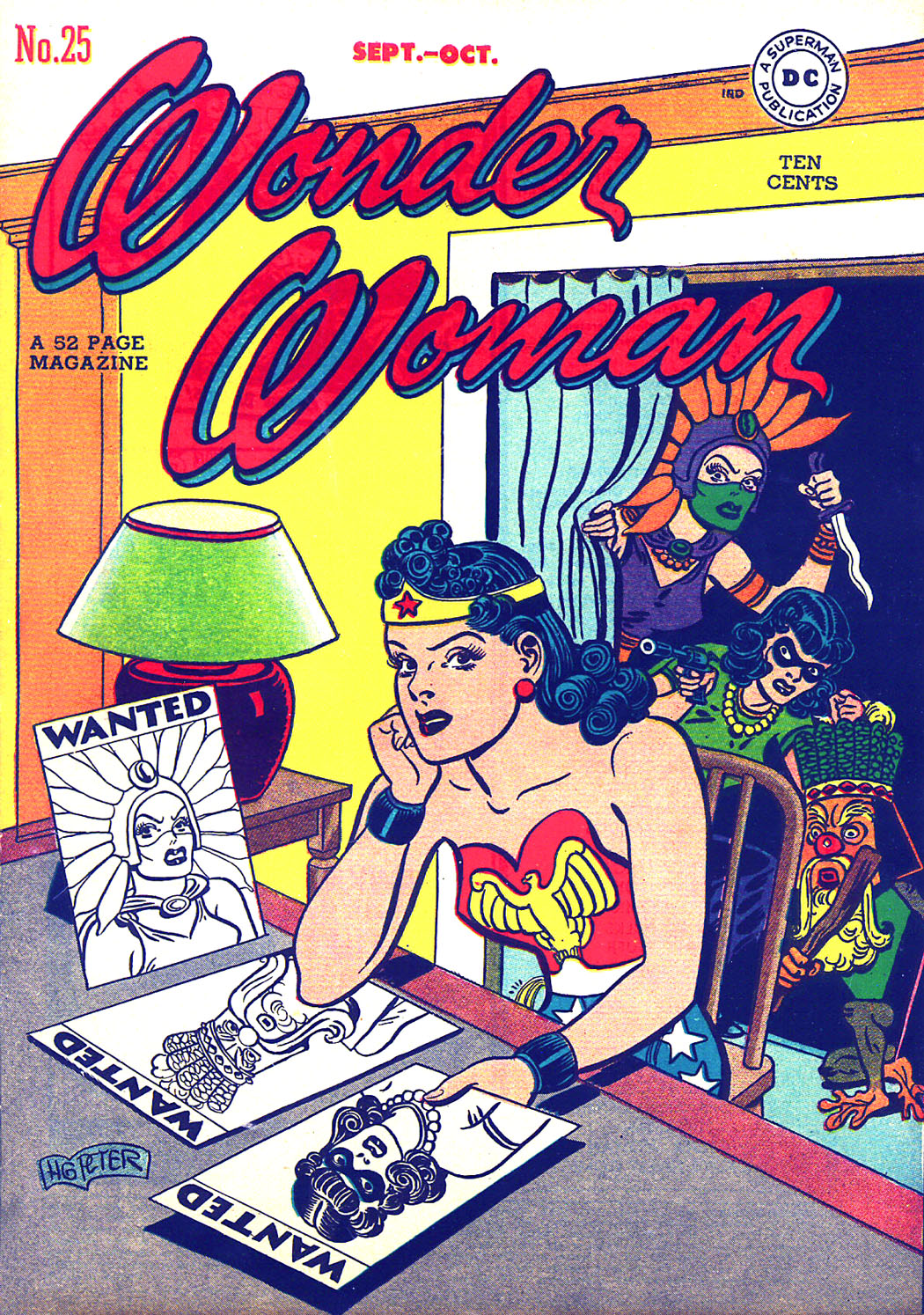
The Marston/Peter Wonder Woman #24 was mediocre enough that it’s taken me more than 6 months to pick up number 25. And…yeah.

Witness Harry Peter phoning it in. Wonder Woman sitting looking at mug shots, oblivious to the baddies behind…Marston didn’t approve that shit. In the first place, it’s boring. Wonder Woman doesn’t just sit there; she chases villains across bizarre cosmic bridges or battles Brobdinagian pirates. And, in addition, it makes WW look like a fool; the villains are tricking her.

Of course, Marston probably didn’t approve the cover; he was dead by the time this went to print. Peter’s doing the best he can…and the best he can includes drawing some delightfully expressive collar bones and some lovely black and white artwork on those mug shots. But it doesn’t include figuring out something to draw that would be fun and heroic and an inspiration to little girls and boys who wanted to be little girls everywhere. Figuring that out was, I suspect, Marston’s job. And no one else at DC, apparently, was up for it.

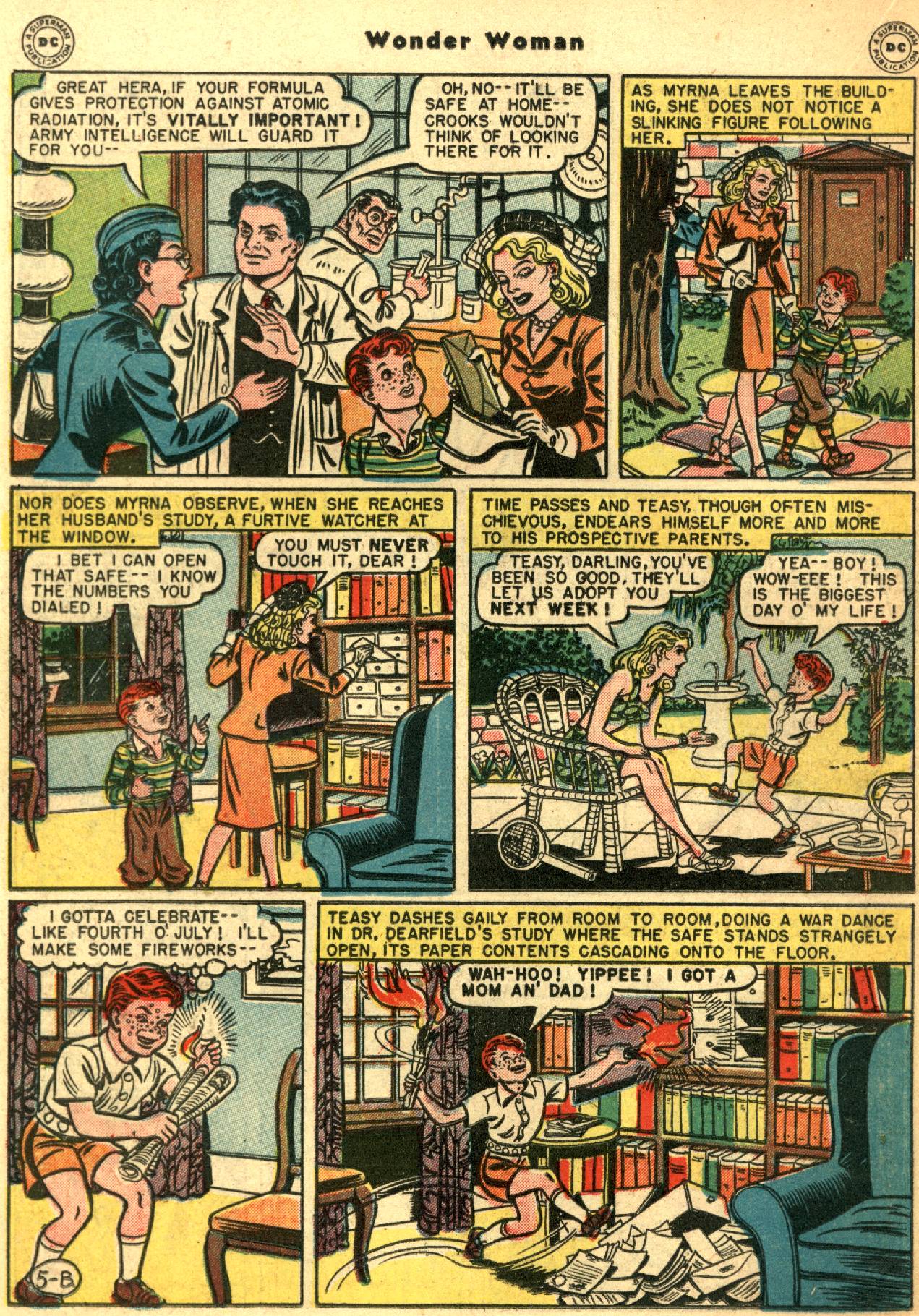
When I talked about issue 24 (and some of the earlier issues as well) I speculated that the stories weren’t by Marston (some possibilities include DC editor Sheldon Mayer and Marston’s assistant Joyce Murchinson.) I have some doubts about these as well. The second story especially…

is all about a mischievous little orphan boy named Teasy with a heart of gold and oh will he ever find a mother to call his own? Marston cared about mothers, of course, but he really didn’t care about orphan boys on the entirely reasonable grounds that they were not girls. It’s true that WW does get tied up by an evil villainess, which I’m sure Marston would have appreciated. But I’m convinced he would have found whole pages devoted to Teasy’s big adventure as tedious as I did (albeit perhaps for slightly different reasons.)

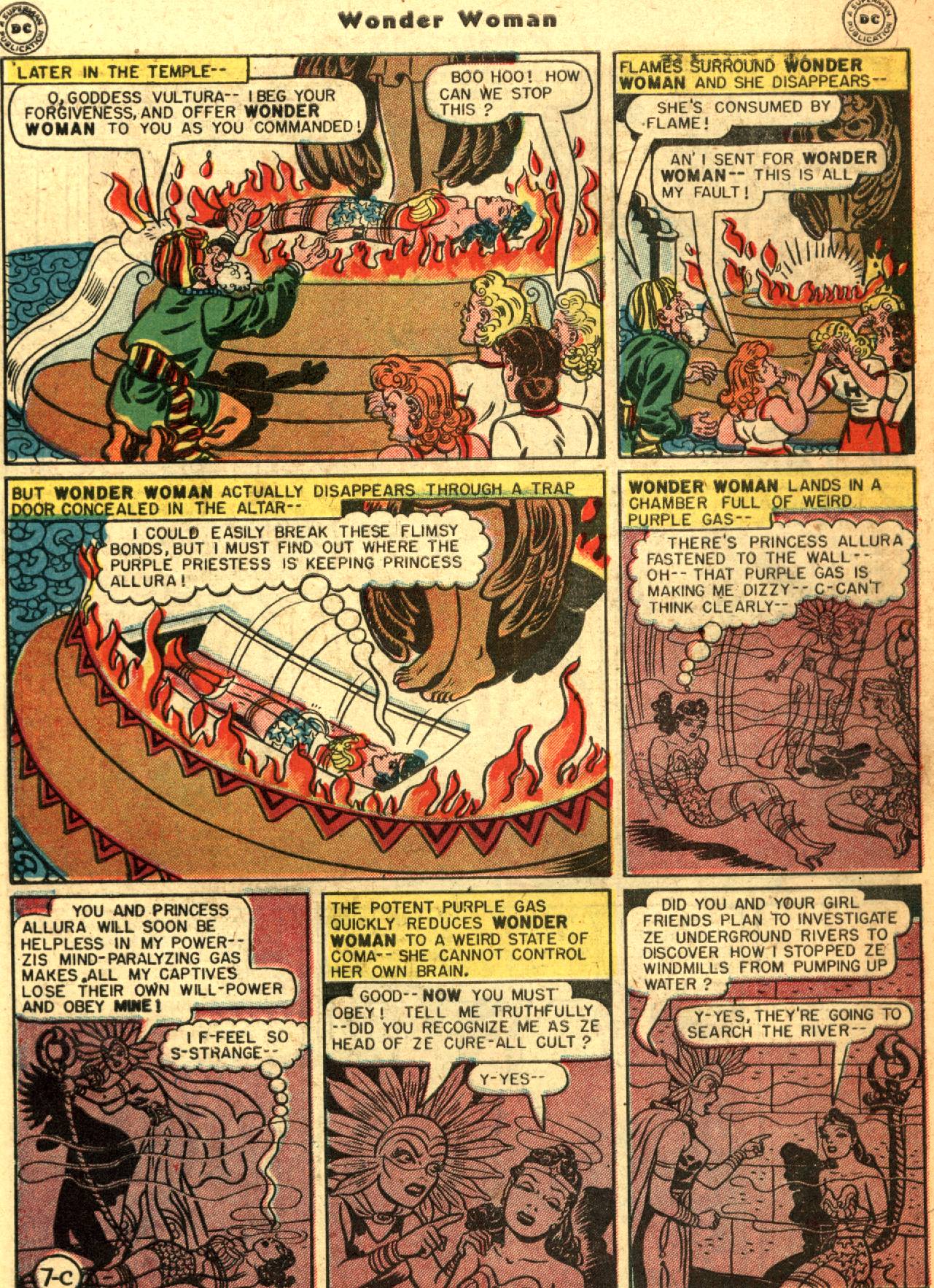
The other two stories seem like they might be Marston. The third features WW and the Holiday girls fighting a purple goddess who uses purple gas to control others’ wills.

Which…okay, that’s kinky. But the story as a whole doesn’t fit together; the first panels reference a backstory that we don’t get to see, as if part of the story has been left out. Moreover, at the end, the likable but not very effective indigenous male ruler…is still in charge. If this was by Marston, he must have been feeling awfully ill if he didn’t have it in him to establish a matriarchy at the story’s conclusion.

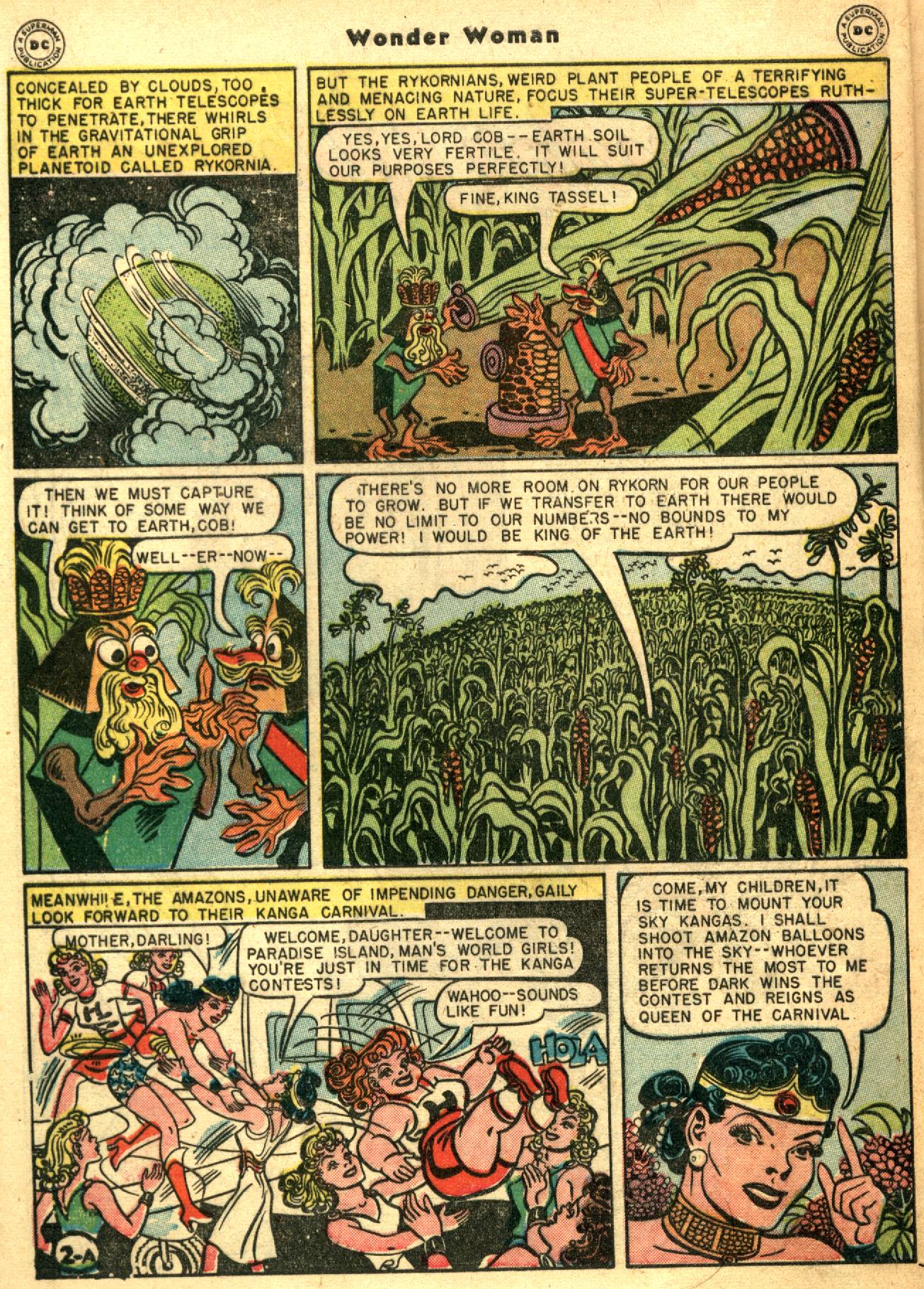
The first story is the one that is closest to having the old pizzazz:

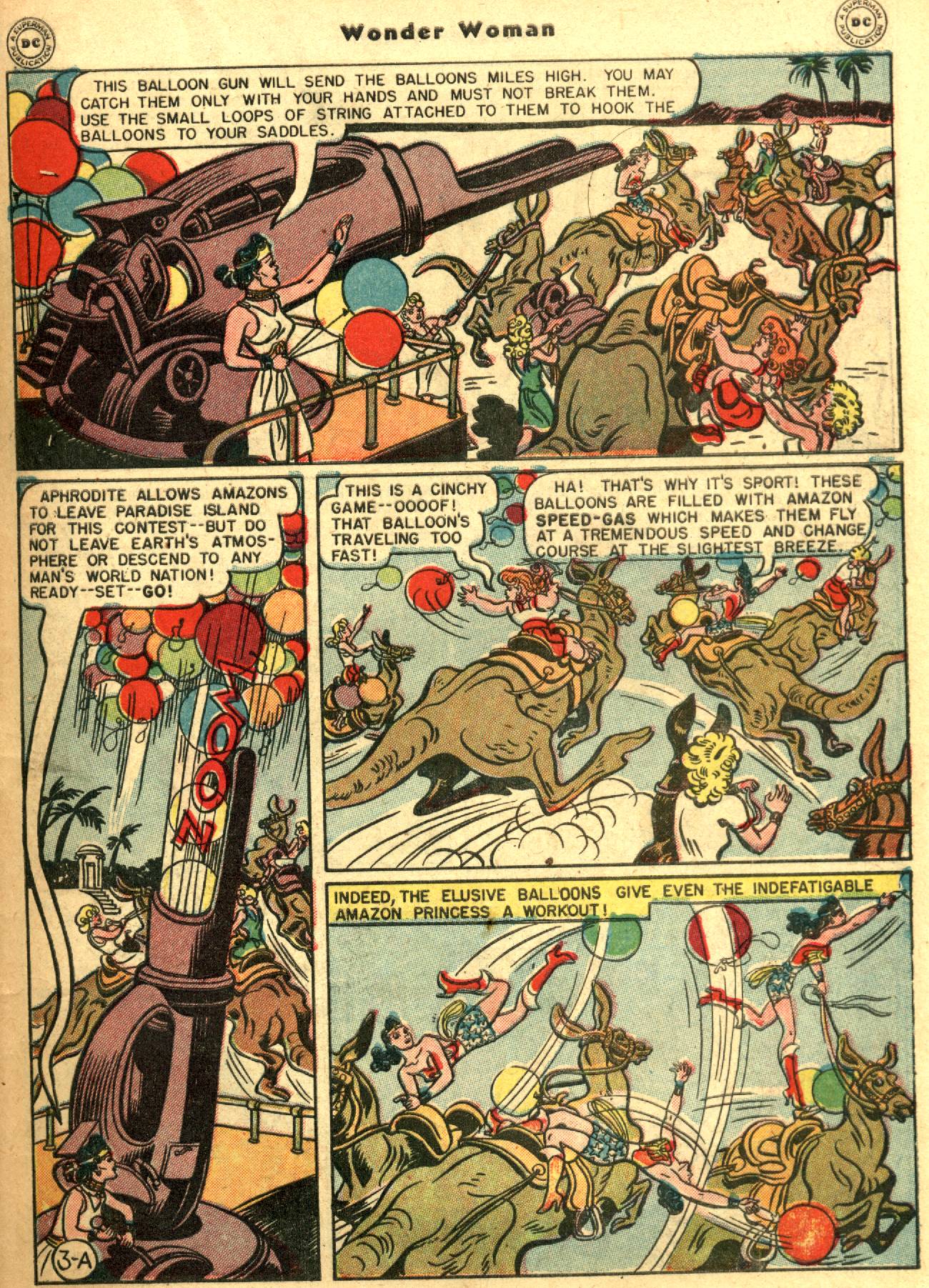
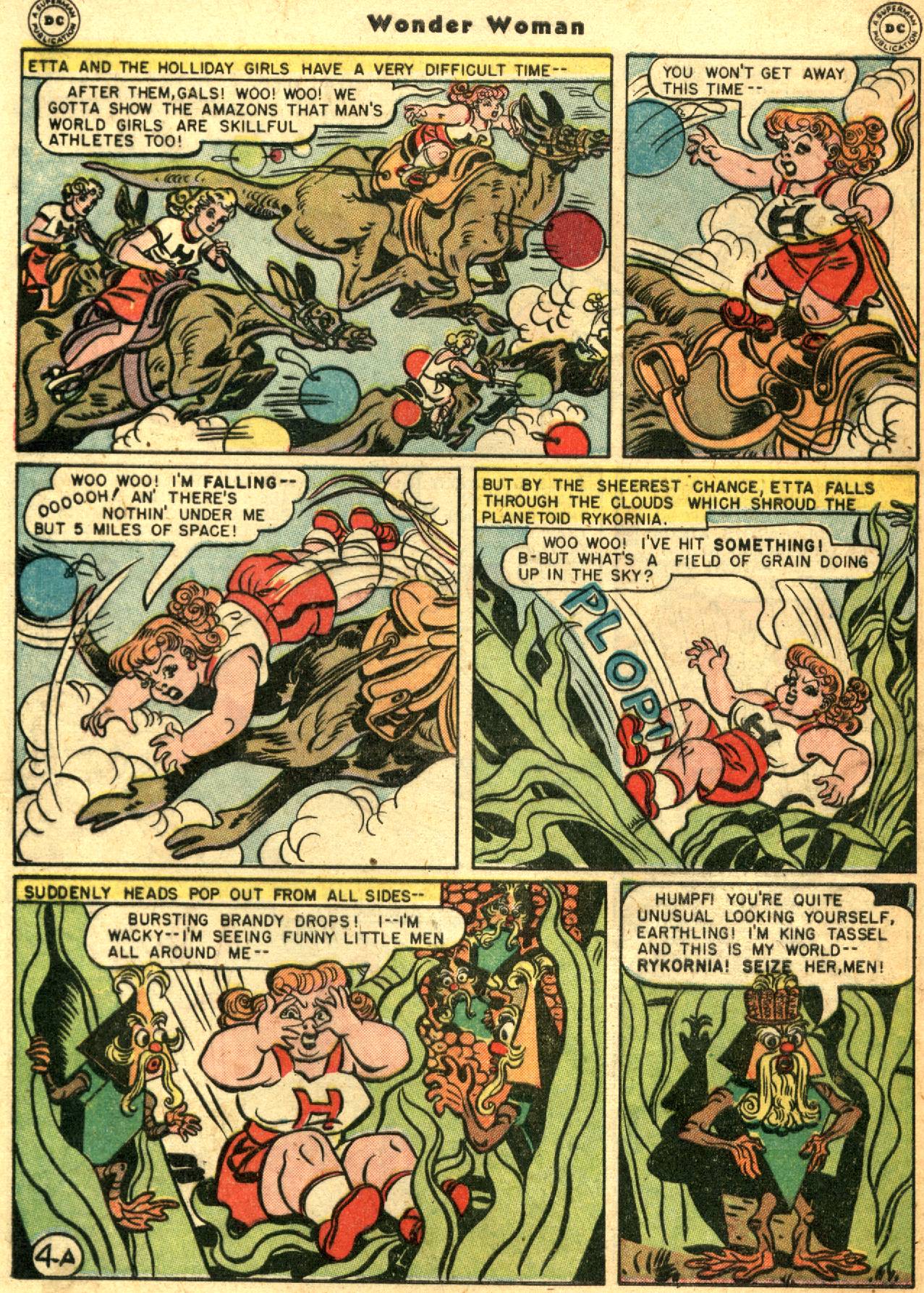
Yeah, you’ve got that right. That’s evil alien corn. Peter is thoroughly enjoying himself drawing both the cartoon corn men and the cornfields with all those lovely undulating ears. Plus…sky kangas chasing balloons!

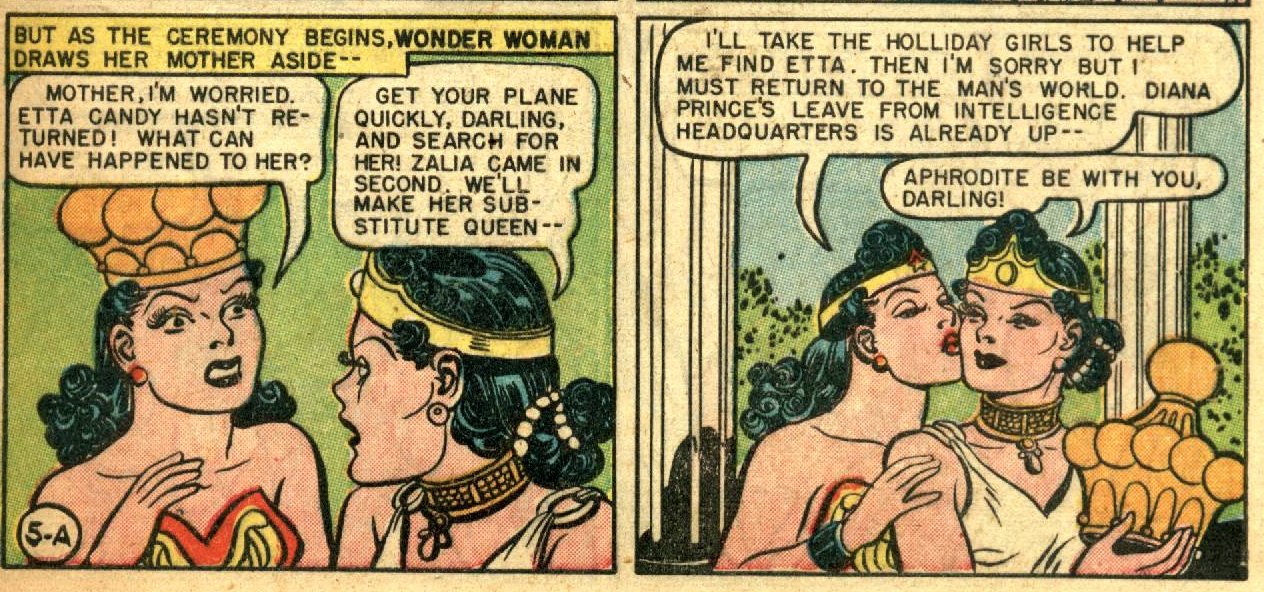
And there’s also some great gratuitous mother/daughter bonding:

WW wearing that giant obtrusive hat, then kissing her mother and handing over said hat as Hippolyta blesses her daughter in the name of the uber-matriarch — it’s just a nice encapsulation of Marston’s ideas about why women should rule. Power and love aren’t in competition. Instead, love is power — the point of the crown is not to wear it and rule, but to take it off and submit with a kiss.

Also…check out Hippolyta’s shoulders. That’s one tough mother!

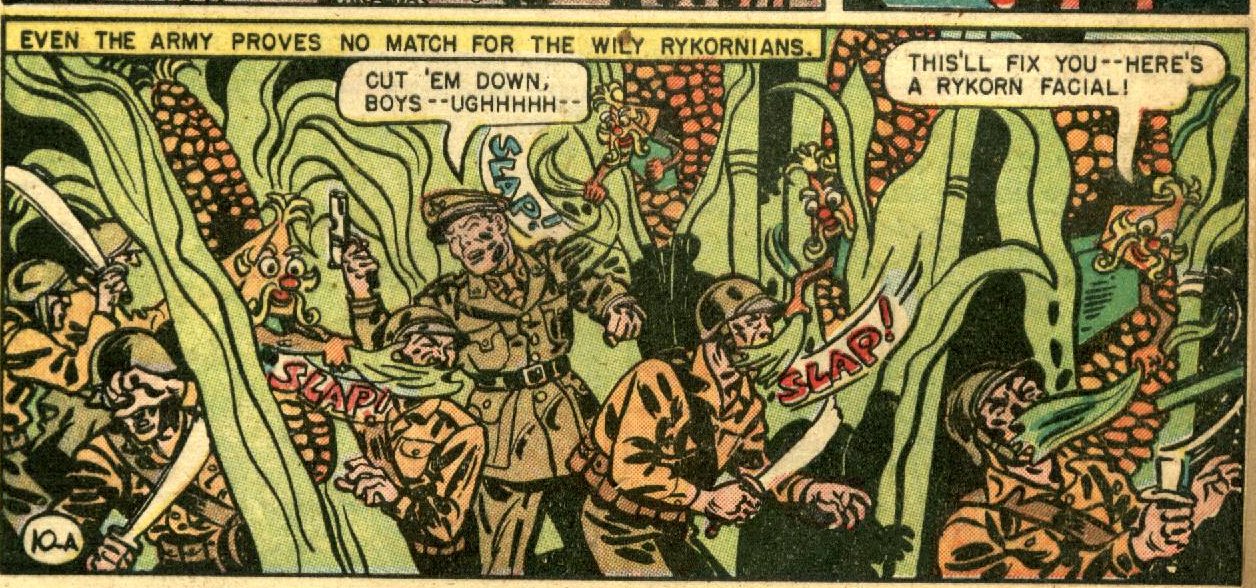
Despite moments like those, and despite the fun of fighting corn (with a giant corn harvester, naturally), the story still feels slight, though. The evil corn is fun, but it’s never really integrated into Marston’s obsessions the way the seal men were (for example.) The corn appears to be male (not to mention phallic) but there’s no contrasting female corn to be liberated. WW’s victory, then, ends up just being a vicotry; there’s no particular feminist message to it. Nor, despite the occasional inadvertent hilarious blooper:

are Marston’s fetishes much on display. Oh, sure, the Holiday girls get tied up…but as Marston scripts go, that barely registers. This isn’t a fever dream; it’s a cartoon goof. It’s funny and weird, but no more so than, say, a good classic Flash or Plastic Man story. And good Flash and Plastic Man stories are fine in their way, but I expect more from Marston/Peter.
______________

So we’ve got three more now. If 26 and 27 are similar to this one I may combine them…or maybe even combine them with 28 for a final post? The issue by issue thing just seems more and more superfluous. Marston’s creative oversight is clearly gone at this point. Without him at the helm, as six decades and innumerable creators have demonstrated, WW just isn’t all that interesting

13 Assassins

This first ran at Splice Today.
___________________


13 Assassins, directed by Takashi Miike, is a samurai movie dedicated to giving you what you expect in a samurai movie. Disturbing scenes of hari kari? Check. Old sparring partners reunited on opposite sides of an apocalyptic showdown? Check. Intense discussions of honor, honor, and also honor? Yes. Final endless battle scene between a very few and a whole bunch? Of course!

In addition, the film also has a truly dastardly villain: Lord Naritsugu Matsudaira (Gorô Inagaki). Naritsugu is brother to the shogun, and he uses his high standing to be extraordinarily unpleasant. How unpleasant you say? Well, of course, he rapes defenseless women. And then kills their husbands. While staying as a guest in the home of the guy’s father!

For most purposes, that would establish Naritsugu as a villainous villain and worth getting rid of. But! This movie is not sure that you are convinced, so it has him cut off a woman’s limbs and her tongue and then use her as a sex slave… and even that’s not enough. As a bonus, we get to watch him tie children up and make them watch their parents die before he shoots arrows into them.

The idea here, presumably, is to make Naritsugu’s crimes so heinous that eliminating him justifies virtually any amount of carnage. And diagetically, it works—cutting off an innocent girl’s legs and arms and tongue is pretty impressively vile even in the jaundiced post-Saw filmoverse. I was convinced that Naritsugu was a really bad guy, and that letting him get anywhere near the throne was a bad idea. If the shogun won’t act against his brother, somebody in authority should commission as many assassins as possible (sure, 13, if that’s all that’s available) to bring the bastard down. So good for the writers. They have achieved buy in.

Still, as the film rolled along towards its inevitable giant pile of stinking corpses, I couldn’t help but notice some… uncomfortable facts about our arch-nemesis. Specifically, Naritsugu isn’t a standard issue power-mad, scheming kind of villain. He doesn’t need to scheme for power, after all; he just needs to sit around and wait to inherit. He’s not Machiavellian. He just, as one character mentions, has a taste for “flesh.” He’s a dissipated sadist. He likes to hurt people because it gives him sensual pleasure.

As the film moves along, Naritsugu’s decadent sadist starts to drive the plot. Of course, as I’ve already noted, his evil nastiness sets the plot in motion in the first place. But at a couple of points he stops being merely the instigator of the carnage, and starts to actively push it along. His chief bodyguard, Hanbei Kitou (Masachika Ichimura), for example, urges Naritsugu to take the threat from the 13 assassins more seriously. But Naritsugu is having none of it… in part for reasons of honor, but mostly just because he thinks it would be fun to have a big battle. Do the “foolish” thing, he urges Hanbei, who looks as if he’s just been asked to swallow his elaborate hat.

Even in the final battle, Naritsugu behaves less like a man in danger and more like a man… well, like a man watching a movie. As his soldiers die around him, he declares the spectacle “magnificent”—which there’s no doubt it is, visually—and muses on how wonderful the days of war must have been before the shogun established the peace. He tells Hanbei, with an air of dreamy enthusiasm, that when he’s on the shogun’s council he’ll bring those days back. And when the fight is over and he finally realizes things may not turn out all that well, Naritsugu is still enthusiastic about the spectacle. “Of all the days of my life,” he declares to his conqueror as he bloodily expires, “this has been the most exciting.”

It’s hard to escape the conclusion that Naritsugu is more than just the villain of the piece. He’s also the audience surrogate. Like the audience, Naritsugu is deliciously entertained by blood, sadism, and death. Like the audience, Naritsugu anticipates and yearns for the apocalyptic final battle. Like the audience, he is swept away by the glorious reconstruction of the days of war. And, like them, he would like to see those days reenacted again and again.

Perhaps most importantly, Naritsugu is like the audience in enjoying the pageantry of honor while being utterly without honor himself. He is happy to deal death, but faced with death himself he screams and whines—which I presume is what most of my fellow audience members and I would do in his place.

I doubt Takashi Miike necessarily intended Naritsugu to be a portrait of his public—or of himself for that matter. It seems like it’s just an unavoidable structural serendipity. The audience of a war film wants to see war, and is, indeed, the reason the war is being staged. That aligns the viewers with the bad guys; the ones causing the trouble. It’s for our amusement that people get their limbs hacked off and the noble die terrible (but honorable!) deaths. All in make believe, of course. We’re not really as bad as Naritsugu. If we could bring back the age of war, we wouldn’t. Which is why, naturally, we are not fighting any wars at the moment.