Utilitarian Review 11/12/11

On HU

Featured archive post: Lilli Carré’s animation for a Wallace Stevens poem.

Dan Kois on Lynda Barry’s pedagogy.

Marguerite Van Cook talks about comic book crowd scenes and the Kantian sublime.

Caroline Small on comics, writing, and reading.

Joy DeLyria on reboots and retrogarde representations of women, looking especially at Star Trek and Nolan’s Batman.

I talk about natural creativity and wearing your mother’s skin.

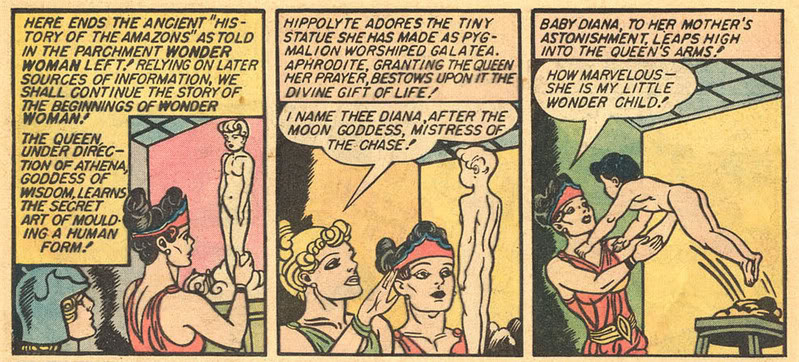
I talk briefly about Wonder Woman’s new origin. Extra fun: see me get slapped about in comments.

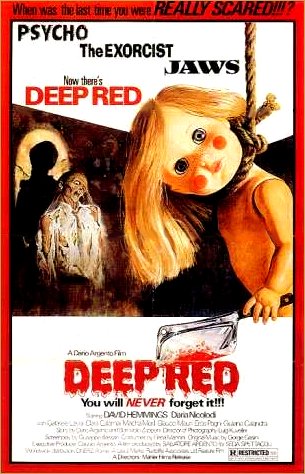
Richard Cook on Argento’s Deep Red.

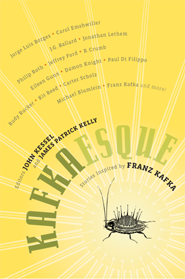
I review an anthology of stories in Kafka’s spirit which for that reason aren’t really in Kafka’s spirit.

Vom Marlowe talks about the ALA and rubber chickens.


Utilitarians Everywhere

At Splice Today I argue that Khruschev was more honorable and courageous than Obama.
 
 
Other Links

Laurie Penny talks about harrassment of women on the internet.

Why Andy Rooney is an idiot.

Goodbye to the Giant Squid.

Matthias Wivel on the crisis at L’Association.

Eric Berlatsky reviews the new anthology of Charles Schulz’s prose.

Anja Flower pointed me in the direction of this pretty great essay by Susan Stryker about Frankenstein and transgender people.

James Romberger interviews Gary Groth about the new Fanta collection of Barks comics.


The Celebrated Rubber Chickens of Dingo Dizmal and Ms. Olive Rootbeer

I am not sure how I came to this. It may be that I should blame the friend of mine who first told me about litho prints of poetry off Etsy. Or maybe I should blame the person who insisted I go into librarianship and thus installed in me a fondness for searching into strange nooks and corners, looking for bookshaped objects. Or maybe I should just blame Noah. Yes, let’s do that. It’s Noah’s fault that I am here today, writing to you about rubber chicken comic book art. Yes.

Ha. Let us blame Noah.

See, several years ago, I wandered off to ALA’s national conference. If you’ve never been to ALA before, it’s a bit strange. You get a wonking great conference hall and fill it with booths and stock the booths full of free books.  Not just any books, but beautiful, well-made interesting books that have been newly published or just won awards.  And then you tell a bunch of book-junkies librarians that they can enter.

It is not unlike those Christmas store shopping rampages on Black Friday where people want Cabbage Patch Dolls.

Except that all the shoppers have about three advanced degrees and pretty much everyone is wearing glasses and sensible shoes.

In any case.  So there I was, a young librarian on her first ALA National Conference, and I went into the exhibit hall with shining eyes and a hopeful heart.  I was certain that I’d be able to find something for work, perhaps learn about some new non-fic, but I was also hoping to find a few new comics.  The brochure that I clutched tightly to my chest mentioned that several comics publishers would be there.

I worked my way slowly through the exhibit hall (I had to detour around a whole block of booths where I suspect an award winner of being), being accidentally elbowed by cheerful women who had stacks of books so high they had to peer around them.

And then I got to the comics section.  Hurray, I thought, I have arrived!

Now let me be clear.  The purpose of all this free loot is not to make a lot of random booklovers happy, the purpose is to get samples into the hands of the people who have the power to acquire the goods.  Free books at ALA are the grease in the wheels of publishing capitalism.  Because librarians don’t just buy books, we talk about them, a lot, to everyone.  The biggest marketing tool for books is word of mouth, and that can’t happen unless some first person, somewhere, acquires a copy.

While I was at ALA, I saw not just marketing people in the publishing booths, but also big name editors.  See, the other thing that greases the wheels of capitalism is knowledge about consumer desires.  So an editor can talk to a circulations manager, who might tell her that the line for the latest Siamese Kitten book is two months long.  Or that right now, SciFi books are being culled for lack of readers.  Or whatever.

In between the passing around of ARCs, there’s a lot of questions.  Some booths had surveys, some did things more informally, but everywhere it was like a mutual explosion of book pimping and lit glee.

I quite enjoyed it.

Until I got to the comics section, where suddenly I was expected to actually pay for anything.  Want a brochure?  Pay.  Want a sample?  Pay.  Want a keychain?  Pay.  Mug?  Pay.  Pay pay pay.

And I know that this stuff ain’t cheap, but that really wasn’t the point.  I didn’t mind paying.  In fact, several times I did try to pay, but the booth folks wouldn’t look up from their internal conversations.  (The ones at Viz were very nice, though.  I had a very nice talk with them–they recommended a bunch of new manga to me, that I ended up either trying or buying, as well as giving me a few free ones to try.  And I note, by the way, that Viz?  Is still in business.  Ahem.)

I did eventually get a brochure for a comics collective thing, but the stuff inside didn’t give me enough information about whether I’d want to buy it or not.  And I’m sorry, but I’m not splashing out twenty or thirty bucks on a brand new work that’s never been reviewed and which may or may not be any good.  I want to, well, at least check it out from the library first.  See it online.  View it off youtube. See a sample chapter.

I finally staggered out of the exhibit hall with three free cloth bags full of free books.  Or maybe it was four bags.  I forget.

What I do remember, besides Chicago’s inexplicable habit of naming every restaurant with single-syllable words (Toast, Fresh, something else) was Noah’s complete lack of surprise at the horrible way that comics was marketed.  He even looked gloomily at the few small flyers I’d managed to get and said that they’d probably have only gotten Jeff Brown to do the covers (one of them had).

But before I left, he gave me a bunch of small-press comics, mostly published the old way with a xerox machine.

That’s not nearly as nice as some of the beautifully produced advanced readers copies I’d gotten off the big guys, but it was plenty to give me a taste and let me know whether I’d want the whole entree.

And that’s all I needed.  Of course I enjoyed having free books (who wouldn’t?), but what I really wanted was new-to-me joys that I wouldn’t have discovered any other way.  Or to read, and love, and tell others about them so that they could have a joyful new book-crush and go out and buy the second volume and the third and so on and so forth, spreading out the happiness like some kind of literary artistic oil spill.  Or virus.  Yeast bowl?  Whatever.  You know what I mean.

But the publishers of comics mostly did not want to give me such joy, either because it had never worked for them or because they liked having a teeny tiny market of books practically nobody buys, I’m not sure.

The thing is though that I still wanted new comics like that.  Wanted to find new comics the way I’d come across a strange but pretty funny kids book that I’d never have bought.  I’d done my own work in small press comics, helping tone a manga some friends did, but beyond getting lots of recs for big press stuff everyone was discussing, I didn’t meet a lot of small press comic makers who were doing things I really wanted to read.

I’ve been keeping a sharp eye out, though.  During some discussion of how people can find small-press comics, I poked around Etsy (because of the aforementioned friend who buys her litho’d small press poems there).

And I discovered The Celebrated Rubber Chickens of Dingo Dizmal and Ms. Olive Rootbeer. A Coloring Book.  2010.
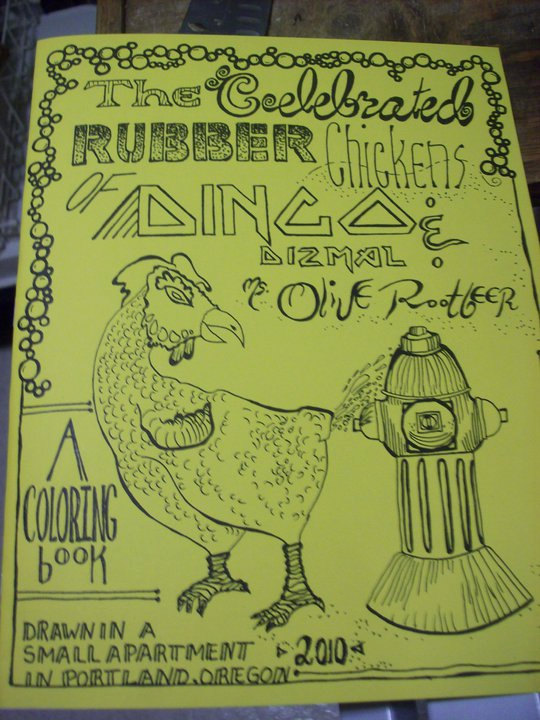
It’s only sixteen pages long, so I’m only showing the cover, but it is awesome.  Yes, yes, it is about rubber chickens.

But they are awesome rubber chickens.

I don’t remember the last time I read a comic book and actually laughed.  Usually, it’s either a tired joke told in a dull way that leaves behind a feeling of sadness and ennui or it’s actually a volume of Peanuts and I’ve read it before.

This comic is both irreverent (as you can see, the chicken is peeing on the fire hydrant) and charming.  There are some strange artistic statements, like the gladiator with the rubber chicken shield or the pilgrim-hatted (and turkey looking) rubber chickens in a boat at what might be Plymouth Rock (but if so is labeled with the wrong year).

The illustrations are well-done.  Linework varies beautifully, as a good coloring book should, with a nice balance between blocked in shapes and spaces where there’s more detail.

And because it’s a coloring book, it’s interactive.  I don’t just get to read the rubber chickens, I get to muck about with them.  (I have decided, by the way, that my rubber chickens will be purple and you cannot stop me.  Their waddlez may be orange or blue or magenta, I have not yet decided.) It’s so utterly different from the longboxophobia of comicdom that I’m used to that it’s a relief.

Some of the images, such as the snail of life rubber chicken, don’t have words.  Other images, such as the sad looking guy and the mummified rubber chicken do, “If “Ramontep fucks up the mummification of another one of the pharoh’s chickens  ….it was commanded he be entombed with it.  Being constantly watched and never trained didn’t help.”  [sic]

My favorite, of course, is the fronticepiece where two rubber chickens, ridden by paladins, joust.

The thing is, I have no idea who Dingo Dizmal is.  No clue about Ms. Olive Rootbeer.  I do not now nor have I ever owned a rubber chicken.  I’d never seen this artwork before I stumbled upon it.  I’ve got no ties to the artist or the publisher (which was probably Kinkos).  I’m not sure what terms I even entered into the Etsy search box, besides maybe ‘comic’ and even that might be in the sense of comedic.

And yet I found it and I bought it and I read it.

This is exactly what I’d hoped for from that ALA booth.  It took me several years to find, granted, but in the end, I managed it. New, funny, smart, well-inked.

The Rubber Chickens of Dingo Dizmal and Ms. Olive Rootbeer, a Coloring Book, is only four dollars, with two additional for shipping and handling.  I commend it to your attention.

And now I really must find where I put my crayons….

Unkafkaesque

This piece first ran on Splice Today.
__________________________

Kafka’s “A Hunger Artist” is about an artist/performer who starves himself for the amusement of the public. Alas, his artistry and dedication are unappreciated, and so he dwindles to nothing alone in a corner of a dirty cage.

The tale is the first selection in Kafkaesque, a new anthology of stories inspired by Kafka and edited by John Kessel and James Patrick Kelly. The choice to open with “A Hunger Artist” seems a deliberate tug at the well-read reader’s heart. Kafka, after all, may have thought he would vanish, but instead, here he is, more robust than ever, inspiring anthologies full of followers. Kafka now seems less like the hunger artist who died alone and unmourned in the straw, and more like the panther who replaces him as an exhibition, a personality so magnetic that “the spectators crowded around the cage, and did not ever want to move away.”

It’s a poignant irony—and as such, it’s very un-Kafkaesque. Kafka’s stories are certainly filled with irony, but those ironies aren’t sweet or comforting or triumphant. They’re baffling and , disappearing into themselves much as the hunger artist collapses into his skin. Kafka wasn’t sentimental, not so much because he looked at the world with cold dispassion as because his creations were so intensely narrow. It’s hard to be sentimental when everyone, even yourself, is just a thing in an ever-shrinking and dreamer-less dream.

Kafkaesque is then a contradiction in itself—it implies a communal experience where there is not even any identity. The stories in the volume most consistently betray Kafka’s spirit when they insist—helplessly, inevitably—that that spirit exists. Paul Di Filippo imagines Kafka as a superhero fighting crime in New York; Jonathan Lethem and Carl Scholz imagine him as a writer for Frank Capra in Hollywood; Philip Roth has him as an aging Hebrew school instructor; Tamar Yellin has him as a cute old man with a terrier in Wales; Carter Scholz (again) puts him in a hotel with Wallace Stevens and Charles Ives. It all has a bravura pomo smugness; Gregor Samsa awaking suddenly to find himself on This American Life. The point of each of these stories is that the author knows Kafka and can send him where the author wills. The point of Kafka’s stories were always the exact opposite.

The selections that don’t feature Kafka as a character often work better, but still encounter similar problems. Eileen Gun recasts “The Metamorphosis” in a corporate office… with a more upbeat ending. T. Coraghessan Boyle recasts The Trial in a service garage… with a more upbeat ending. Indeed, “The Hunger Artist” is alone in the collection in the sordid, insignificant manner in which it offs its protagonist. If anything’s Kafkaesque, it’s having your hero shot at the end “like a dog,” but nobody here has the stomach for it. Instead, the writers prefer more congenial strategies, whether ambivalent personal epiphany (Tamar Yellin, Michael Blumlein); ambivalent apocalypse (Theodora Goss.); or ambivalent anti-climactic domestic mundanity (Jeffrey Ford.)

The best stories, though, are the ones that not only don’t feature Kafka, but don’t even seem particularly inspired by him. J. G. Ballard’s “The Drowned Giant,” Borges’ “The Lottery in Babylon,” and Damon Knight’s “The Handler” are all sideways parables, but there is nothing in any of them that seems to especially demand Kafka as a predecessor. In fact, all seem closer to each other than any of them do to K.

Specifically, Kafka is obsessed with parables of the pains of failure and diminishment. Ballard, Borges, and Knight give us, instead, parables of the pains of success, or at least expansion. Knight’s effort is about a boisterous, beloved life-of-the-party who is actually (to everyone’s embarrassment) a suit worn by a diminutive, boring, sweaty square. Ballard tells about a giant swept up onto the beach whose body parts live on as Brobdinagian mementos spread throughout the city. And Borges’ “The Lottery in Babylon” is about how a mysterious company institutes a lottery which becomes so popular that eventually everyone and everything bows to its totalitarian regime of chance.

Kafka may be the one who was adjectivized, but Borges seems like the more influential writer, both in general and in this anthology specifically. Theodora Goss’ “The Rapid Advance of Sorrow” is self-consciously “magical” and profound in a way that’s much closer to bad Borges than to bad Kafka. It’s Borges’ daemon, not Kafka’s, which is responsible for all those Kafka’s of infinite alternate earths. And the proliferating parts of Ballard’s giant insistently echo the mysterious diffusions of Borges’ “Tlon, Uqbar, Orbis Tertius.”

Borges multiplies and insinuates and conquers, then, rather like the lottery he writes about. Not coincidentally, “The Lottery of Babylon” can be read as a metaphor for the sinister exhilaration of capitalism, Babylon’s “infinite game of chance”—with everything, even the omnipotent corporation, dissolving into a rage for randomness—seems like the perfect Libertarian wet dream.

Capitalism is totalizing and expansive; it crosses borders to turn everything into itself. Borges didn’t exactly approve, but he understood. So does Boyle, whose protagonist is trapped in the garage until he figures out that he has no choice but to buy a crappy car from the proprietor. So does Michael Blumlein, whose fashion designer finds odd inspiration in a giant wasp, a winged avatar of success that flies away at the last minute. Endings open out into irony or nothing, but they do open, in thrall to the lottery and its ominously friable possibilities.

Kafka didn’t see things that way. He wasn’t a world-builder or a world-solver, displaying his parables like coins for some secret slot machine. His stories have no possibilities, ominous or otherwise. As the Hunger Artist is dying, he explains that he only starved himself because he had no choice; he could never find what he wanted to eat. He’s a failed consumer, left out of the rat race not because he lost, but because he couldn’t figure out how to play. Nothing absurd or unexpected happened to him; his life just narrowed and narrowed until, off to the side of desire, it guttered out. No wonder everyone prefers the panther, which knows what it likes to eat and exudes the crude virility of wanting from behind its bars. It, not Kafka, paces through these pages. Kafka’s dead.

Deep Red

This is the second part of my discussion of Italian giallo films. The first part can be found here.
_______________________

Deep Red a.k.a. Profondo Rosso (1975)
Directed by Dario Argento

Movie reviews usually begin with a summary of the plot. Which is a problem in this case, because the plot of Deep Red makes no fucking sense. It begins in Rome at a conference sponsored by the European Congress on Parapsychology. It may sound far-fetched, but it’s every bit as scientific as phrenology or evolutionary psychology. The marquee attraction is a German psychic named Helga Ulmann (Macha Meril) who entertains the crowd by reading their minds. But someone in the crowd is a murderer, and Helga stupidly announces this to the audience even though she fails to identify the killer. And so the killer tracks Helga home and chops her but good with a cleaver.


The first person to discover the body is English pianist Marcus Daly (David Hemmings). Marcus decides to solve the murder all on his own because he apparently has nothing better to do, and pianists are naturally gifted as criminal investigators (and since this is a giallo, the police are worse than useless). Marcus is helped by a reporter, Gianna (Daria Nicolodi), but is warned to drop the matter by his friend Carlo (Gabriele Lavia). Marcus enlists the aid of a parapsychologist, Dr. Giordani (Glauco Mauri), and uncovers a clue to the killer’s identity by reading a book on urban legends. The book conveniently (and implausibly) identifies a house once owned by the killer, which leads to several more fortuitous discoveries, eventually revealing that the killer is none other than Carlo’s crazy-ass mother, Martha (Clara Calamai). Back when Carlo was a little boy, Martha murdered her husband when he threatened to send her to an asylum. Martha tries to cover her tracks, first by killing Helga, then by stalking Marcus and killing everyone that he drags into his investigation, including the author of the urban legends book and Dr. Giordani.

If I were to judge the film on its merits as a mystery, it would be a failure. No amount of gore can cover up a preposterous plot and mediocre acting. And yet I liked this movie.

About two-thirds of the way into the story, Carlo attempts to kill Marcus so his mother’s actions will never come to light. Carlo even accuses Marcus of being responsible for all the deaths. If only he had minded his own business, no one except the psychic would have died. It sounds like the standard villain monologue, blame the hero for everything, etc., etc. … except everything Carlo says is true. Martha is crazy, but she only killed to hide her identity and cover up the earlier murder of her husband. Psychic Helga was doomed, but Martha killed the other victims only after Marcus got them involved with his amateur sleuthing. Is the viewer supposed to agree with Carlo and condemn Marcus? Not likely. Carlo suffers his own violent death just a few minutes later, which illustrates the primary appeal of the film. Marcus is an idiot, but he’s an idiot who moves the plot forward. And the plot provides a simple framework for the death scenes.


While the entire film is visually attractive, the death scenes are labors of love by Argento. They’re gratuitous, elaborately staged, and almost dream-like. When Dr. Giordani is killed, he isn’t just stabbed. There’s a robotic (?) puppet charging at him, and a shot from the killer’s POV as she grabs Giordani, and a close up of his mouth being jammed into several sharp corners, then a close up shot of the gleaming knife that tracks it’s motion, followed by the actual stabbing. And this mayhem is accompanied by a funky rock soundtrack courtesy of Goblin. Carlo’s death scene is even crazier. While escaping from the police he wanders into the street just as a garbage truck approaches. Any other director would simply have the truck hit Carlo, but Argento allows Carlo to barely evade being hit only to get caught by a hook that for reasons unknown is hanging from the back of the truck. So poor Carlo is dragged through the streets, and the truck makes every turn as sharply as possible so that Carlo will careen into the curb. His physical destruction is capped by a car running over his head.

The death scenes feel disconnected from the slow-paced mystery that contains them, as if a completely different movie takes over when the point-of-view shifts from Marcus to Martha.* But then Marcus is a drearily sane character who inhabits a sub-par crime thriller, while Martha is this delightfully insane monster who thinks she’s in a slasher film. Marcus lives in a world of clues and motives, Martha lives in a world where the violence is obsessive, unlimited, and always viewed from the best angle. Her blood is too red to be real, but who cares? It’s better than real.

Friday the 13th, Prom Night, Terror Train, Scream – countless slasher films have followed in Deep Red’s trail, combining the violence of grindhouse horror with the “whodunnit” mystery plot. And like Deep Red, most slasher films fail as mysteries. The first Friday the 13th, for example, resembles a giallo murder mystery, including shooting the murders from the killer’s POV to hide her identity. but the film doesn’t even introduce the villain until the final act, and since all the other characters (minus the heroine) are dead by that point, there’s no mystery as to who the killer is. Even the half-way clever Terror Train, which at least has a red herring or two, suffers in comparison to traditional mysteries such as Murder on the Orient Express.

It shouldn’t be impossible to produce a decent mystery that also happens to have gory deaths, but why would a mystery writer bother with extreme violence? It adds nothing to the plot and more than likely will become a distraction. And from a commercial perspective, it will almost certainly drive away a portion of the target audience. In contrast, slasher filmmakers lack the subtlety and restraint that mystery requires. The adolescent love of gore, a desire to scare the audience (or at least startle them), and an inexperience with the mystery genre collectively produce barely coherent plots that string together a few gruesome murders.

But in the hands of Argento, at least those murders will look good.

.

_________________________

* Carlo’s death scene is the one exception, because no other character is present to observe his demise.

Only One Can Wear the Venus Girdle: Who’s Your Daddy?

Alyssa Rosenberg had a post yesterday about the Azzarello/Chiang Wonder Woman reboot. For those not in the know, the new (new!) WW is no longer a clay statue come to life; instead she’s the illegitimate daughter of Zeus. Alyssa expressed some skepticism:

Similarly, in their quest for specificity, I wonder if Azzarello and Chiang are reducing Wonder Woman a bit. Her original story may not be plausible, or gritty, but it is about an expression of female will and independence. Not everything needs to be grounded in social realism. Some things can just be mysterious and strange. It’s yet another reason we’re far too consumed with origin stories. Trying to come up with a psychologically plausible explanation for the divine, or near-so, is a bit of a contradiction in terms.

Several commenters though were more positive about the Azzarello/Chiang version. Joe Pettinati, for example, said:

I think this origin story sounds way better and I disagree with your assertion about trying to come up with a psychological explanation for the divine. All Greek myths, including Zeus, are about putting human faces to divine phenomena in our world. Even Wonder Woman’s original origin story (which I confess I’ve never heard) speaks about the human desire for children, presumably when natural methods are not an option. The problem I have with that origin story is that it says a lot more about Aphrodite and Hippolyta then it does about Wonder Woman. Okay, this woman is brought to life, but why does she become a super hero?

Of course, I’m in Marston/Peter’s corner:

The original Marston/Peter Wonder Woman origin story is beautiful and weird and kind of makes me tear up. I compared it to the Winter’s Tale in that link, and I’ll stand by that. And I think your argument about a psychological explanation for the divine is right on the money; Marston and Peter had a divine that was actually mysterious and powerful, not just a bunch of ultra superhumans running around bashing each other.

I haven’t read the Azzarello/Chiang issues. They’re both competent creators, and I suspect they can tell a decent pulp adventure story. But the Marston/Peter WW was one of the great artistic achievements of comics, IMO. And it was ideologically committed to feminism — in the case of the origin story, specifically to the idea of the power of female creation and mother/daughter bonds — in a way that is very, very rare, in comics or in other art forms or anywhere.

Oh…and to Joe, who asks why WW becomes a superhero. She becomes a superhero basically because she’s strong and curious and courageous and wants to help people. Marston didn’t feel that you needed a tragic or sordid backstory to make you a hero. He thought strength comes out of being loved and happy, not out of being wounded. More power to him.

I just wanted to add…the Azzarello/Chiang version is of course an improvement…if you’re demographic is mostly adult men. If that’s the case, the illegitimate-daughter-of-Zeus is clearly superior; it’s got sex, conflict, and the possibility of lots of gratuitous angsting. On the other hand, if your audience is 8-10 year old girls and boys, an origin all about who slept with whom and strained family dynamics is probably going to have less appeal. Instead, you probably want something with room for magic and courage and adventure and love and giant kangaroos.

Myself, I am old, old, and in my second childhood, so I’m all for the magic and love and giant kangaroos…though angsting and sex and strained family dynamics can be okay too, in their place. Why exactly you would want talented creators like Azzarello and Chiang to take the magic and love and kangaroos of the 8 year olds and turn them into the sex and angst and family dynamics for the thirty year olds is, of course, an open question. I’ve discussed some answers elsewhere, and won’t repeat it here except to note that Marston/Peter’s Wonder Woman was by far the most popular iteration of the character, and to express my doubts that Azzarello/Chiang’s version will change that, whatever it’s other successes.

Update: The argument in the last part of this post is shredded, torn apart, and stomped upon by commenters. The Percy Jackson series and the Prydain chronicles are cited as painfully telling counter-examples.

Mamaskin

I published this in Poor Mojo’s Almanac a while back. I was thinking about it again in the context of our ongoing discussion of comics, reading, Lynda Barry, and pedagogy (parts of said conversation being here and here and here. Anyway, I thought I’d reprint it, and then talk a little about how I wrote it and (generalizing wildly) about how people create.
_____________________

Once upon a time there was a beautiful girl named Lorna, who lived with her mother in a house in the woods. Lorna was so beautiful that everyone who saw her fell in love with her. This was a nuisance; she couldn’t go to the stream to get a drink of water without getting twenty marriage proposals, and it was hard to feed the hens when the lawn was covered with young men kneeling and weeping. Lorna got so fed up that she didn’t even want to leave the house, and when she did leave it she’d have to put a bag over her head, which made it hard to see. Her mother, who was old and wrinkled and had an odd sense of humor, would giggle when she saw Lorna walking around and bumping into things. But she did love her daughter, and she knew this sort of thing wouldn’t do for the long term. So she told Lorna, “When I die, and you must seek your fortune, take my skin and wear it to disguise your beauty.”

Eventually, Lorna’s mother died. Lorna did as she’d been told; she took her mother’s skin, clothed herself in it, and went off to seek her fortune. She enjoyed walking through the fields without a bag over her head and without having to dodge love-sick suitors, even though having to wear her mother’s skin was a little icky. Finally, after a long trek, Lorna reached a large castle. She knocked and the Prince who owned the castle came to the door. As it happened, he needed someone to watch his geese. Lorna took the job.

Lorna moved into a little hut near the castle. She might have lived happily ever after there tending the geese, except that her mother’s skin didn’t fit exactly right. During the day it was okay, but at night when she was trying to sleep it pinched and itched, and she discovered that if she wanted any sleep at all she had to remove it. So she put it at the foot of her bed. And in the morning the geese would poke their heads into her hut, and see her sleeping in her natural form. Then they’d fly into the air singing, “Honk! Lorna’s prettier than you think! Honk! Honk!”

One day the Prince happened to be up early wandering out in the fields. He heard the geese honking about Lorna, and he was curious. So he walked over to Lorna’s hut and saw her through the window just as she was about to put on her mother’s skin. “Oh, drat!” said Lorna. “Does this mean you’re going to fall in love with me now?” And of course it did. But the Prince was fairly handsome himself, and, to tell the truth, Lorna was tired of geese and of dead skin. So she married him, and after a while, as she got older, she grew less pretty, and started to look rather like her mother even without the skin. Eventually only the prince and the geese and her children loved her, and all the young men fell in love with somebody else. Which was perfectly all right with her.
__________________

So…like I said, I wrote this a while back. It was originally supposed to be part of a Composition and Grammar textbook I was working on for high school students taking courses by correspondence. I was doing a unit on narrative and was having students do writing based on fairy tales. I would give them a bare bones outline of the fairy tale plot (one or two sentences), and then tell them to expand the story (into three or four paragraphs). I provided several examples of expanded narratives, and the story above was one such. (I think we didn’t use it because my boss at the time felt the whole mother’s skin thing was too creepy…and maybe she had a point.)

Anyway. Thinking about writing this, and the exercise it was a part of, made me think of this comment by Dan Kois about Lynda Barry’s pedagogy:

As I mention in passing in the article, Lynda makes the case in her class that narrative structure — that is, one major component of the craft of storytelling — is a natural muscle that most humans have. The example she gives is the way you tell a story depending on whether you have one minute to tell it or ten minutes to tell it; she points out that it’s a natural tendency to construct the details of a story in a manner appropriate for the space that one has to fill.

The exercise I was doing — asking students to expand a fairy tale — is basically an exercise that Barry says is unnecessary, if I understand Dan correctly. Barry’s saying that people naturally know how to tell a story in the time (or space) allotted. It’s not an issue of craft (that is, learned ability) because it’s natural, like falling in a lake. If you have ten minutes to tell a story, you tell it in ten minutes. Simple as that.

So were all my efforts superfluous? I didn’t think so then…and now that I have a son, and am subjected to his narrative efforts all the time, I’m even less convinced. If you listen to small kids tell stories, the thing you notice is that they don’t know how to do it. There was a horrible period there, for example, where my son was obsessed with Garfield. He wanted the strips read to him all the time (which was bad enough), but he also wanted to explain and relay the strips to others. And he just couldn’t do it. He could see the strip in his mind, and he generally got the words right, but he couldn’t figure out what needed to be told when and how to a person who hadn’t seen the strip. The narrative would start and stutter and stop and go back again, and miss the joke and then he’d start over and you just wanted to claw your eyes out and curse the name of Garfield forevermore.

My son’s much, much better at narrative now…but it’s not because he got in touch with his natural essence. It’s because he’s read a lot more, and listened to people talk a lot more, and has internalized (some of) the rules and codes for creating stories. And it really is often “rules and codes” — he and his friends tell stories to each other, and they are obsessive about breaking their stories into chapters…and almost as obsessive about repeating the same story in the same way as it was originally told to them. And…my son actually explained to me at length at one point how he was going to write the back cover blurb for his book. Which maybe means he’s being corrupted by corporate culture, but as a doting father, I prefer to believe that his command of point-of-purchase advertising is instead a sign of increased narrative mastery.

Be that as it may…I think my version of the “Mamaskin” story itself also suggests that narrative is less a natural reflex than an acquired skill. Specifically, the story is put together from other stories. The basic plot, as I said, is taken from a folk tale. My retelling is also informed, obviously, by my generalized knowledge of folk tales, and of folk tale adaptations. Specifically, it’s probably more than a little touched by Patricia Wrede’s YA feminist Enchanted Forest series, with the smart, capable Princess Cimorene, who starts young but as the series goes along gets older and wiser.

The end of the my story, though, comes from here:

He, the one they recognised, no longer thought–his mind being so occupied–that love might still exist. With all that was happening at the time it’s understandable that the only thing they would tell of later was what he did, the incredible action he performed, which no one had seen before: the gesture of supplication, in which he threw himself down before them, imploring them not to show love. Alarmed by this and shaking they raised him to his feet. They interpreted his
impulsive behaviour in their own way, while at the same time forgiving him. He must have found it indescribably liberating to find that they’d all misunderstood him, despite his desperately explicit manner.

It was likely they’d let him stay. As the days passed he came to see more clearly that the love they were so vain about and which they secretly encouraged in one another did not affect him. He almost had to smile at the trouble they took and it became obvious that their concern for him could not amount to much.

What did they know about who he was? He was now so terribly difficult to love, and he felt there was only the One who was capable of it. But He was not yet willing.

That’s the conclusion of Rilke’s The Notebooks of Malte Laurids Brigge, and one of my favorite passages in all of literature. And since I liked it so much, I stole it, which is more or less what writers do. (I also was thinking of this line from slightly earlier in Rilke’s narrative: ” The simple love of his sheep didn’t affect him; like light falling through clouds, it was scattered all about him and shimmered softly upon the meadows.” I love that.)

I’m not denying that there’s a personal element in my version of “Mamaskin” as well. Like Lorna (and lots of other people), I found marriage rather a relief. But I’d argue that (like Lorna’s again) the relief is itself a narrative one. When you’re in the story of romance, you’re in the story of romance; getting out of that is figuring a way to tell a different tale, which is closely related to living a different life.

Barry’s certainly right, then, that narrative is natural in the sense that it’s tied up with and into human lives. But the thing is that human lives aren’t very natural; we’re weird alien things, narratives grafted onto dyring animals. Figuring out what to do with this narrative that’s in us isn’t something you find naturally the way a bee locates a flower. It’s something you acquire like a baby learns to speak. That is, with a certain amount of struggle and tears, and with varying proficiency depending on numerous factors, including the quality of your teachers. Speech is a technology and a craft, and so, surely, is writing. And, as is generally the case with a craft, you get better at it by imitating models, practicing, and sometimes taking advice. There’s not any particular magic to it, except maybe the magic of not having any magic except the skins our parents have left us.

Caroline Small on Comics and Writing (again!)

Caro keeps writing these massive comments that I hate to see buried in the threads. So I thought I’d highlight this one too. (I’d urge people to click over to the thread also, though. James Romberger, Robert Stanley Martin, Jeet Heer, and others also have many interesting thoughts.)
____________

Gracious! I couldn’t participate yesterday or Friday and it’s going to take me awhile to really catch up, but I think I need to jump into the James/Robert kerfuffle here because I think James’ real target is probably me. So I’ll try to clarify.

For me it is a question not of giving precedence in the creative process to one person or another, or even to one skillset or another, but just of teasing out all the different “crafts” that go into making a really extraordinary comic. The importance of visual craft is certainly indisputable. I mean no dismissal of it. But I think the craft of manipulating narrative is also very important, and — depending on the conception of the work — the craft of manipulating prose may also be important.

So the question for me isn’t which is more important, because I think that there is no right answer to that — creators can make choices about whether to try and balance them or let one be dominant on a case-by-case basis. That’s part of the craft of creating any work, choosing which elements to emphasize at which point.

But I also do think it is the case that, de facto, right now, advanced visual craft is consistently and significantly much more important to people in art comics — both creators and fans — than advanced narrative craft, even though some creators dismiss both. At the level of skill, James, as you rightly point out here and many other places, it is extremely difficult to find someone who is really gifted at both visual creation and narrative manipulation. The conditions for getting highly skilled at visual craft are more accessible to cartoonists than the conditions for getting highly skilled at narrative craft.

We’ve discussed this before: there are so many inputs to that — education, culture, aesthetic preference, history of the art forms — it’s just really rare that people are first-rate at both. Although I can make arguments for people here and there, I really can’t come up with anybody working right now other than Eddie Campbell who I think sails easily over my bar, except possibly Dan Clowes, who still isn’t quite in Campbell’s league narratively.

Given that difficulty of finding people who are good at both, and given the pressures of a commercial work environment, I think it’s logical that there aren’t many (any?) mainstream collaborations that have the seamlessness, the balance between the different craft inputs, of a tremendous literary/art comic like “Fate of the Artist.” I do understand what Gary and Brunetti are getting at with the notion that a single creator can integrate the disparate crafts in a way that’s very difficult for collaborators. A really seamless artistic collaboration probably requires a meaningful level of intimacy and honesty that seems likely hard to get in a really commercial environment.

I do understand the struggle here over who can and should get credit — without that intimacy and honesty, the more aggressive personality is probably going to be in the lead. But I think credit is a red herring when talking about issues of approach, because who gets credit would depend on how the approach played out in the specific work. Credit is specific; approach is general. I don’t think any particular imbalance is an inherent property of collaboration — look at John and Sondra of Metaphrog. I don’t have the sense that one of them is more “in charge” than the other. I think they are true collaborators. But that’s not going to be the case with all collaborators. They, like a lot of bands, get around the issue by giving themselves a collective name and emphasizing the group work.

I think it’s essential, therefore, that we bracket questions of credit and the relative importance of individual contributors when we think about the value and risks of collaboration in general. I think we need to look at the actual effects of the Gary/Brunetti approach in practice, not just the romance of it as an ideal goal: what so often happens in single-creator comics is that the elements of “architecture” typically associated with writing, the manipulation of narrative and the rudiments of fiction that Barth calls “craft”, get short shrift — often relative even to film and mainstream fiction, but especially relative to the types of narrative manipulation you see in the most ambitious prose writing.

This is partly because, I think, many cartoonists simply aren’t aware of how craft-intensive the manipulation of narrative is, or they think, like Dan says for Lynda Barry, that narrative is and should be something we do “naturally.”

Up to a point, the notion that human beings are storytelling creatures is true, with some caveats to what “natural” means, but narrative-minded Western humans have been stylizing that “natural” ability for at least a few hundred years now, so it’s a pretty aggressive choice to reject everything they’ve done out of hand. Not that you were defending that stance, James, but to privilege “naif” writing is to be extremely aggressively anti-writing, at least in the sense of what “writing” means to most people who spend a lot of time reading prose fiction.

I think Barry’s anti-Craft stance is much, much, much more harshly against writing than Robert’s is against visual art. I find it really hard not to get very personally offended at it, and the only reason I can avoid it is because it seems to have a psychological source rather than a political one. She feels excluded by formal writing, and so her response is to construct a pedagogy that excludes formal writing right back. That’s not personal against me. But I just don’t agree that either group needs to exclude the other, and I think she’s wrong to approach it that way.

This quote is a good place to expand on that point:

ask her about how she wrote CRUDDY and she’ll tell you a tale of years of woe stemming from reading book after book on story structure and novel-writing, which ended only when she threw it all away and painted the novel in ten months with a brush.

I’d be curious to hear Dan’s response to Noah’s form/content point, but my problem with this ties back into the Dickey book and the tangent with Charles about reading speed – you don’t develop intuition about story structure and novel-writing by reading how-to books. You develop intuition about story structure and novel writing by reading thousands of novels. How-to books just help make you more conscious of things you already know about and have experienced through tens of thousands of hours of reading prose books. Those how-to books resonate and make sense not because they show you something new, but because they articulate intuitions you already have as a reader. If you don’t have those intuitions already developed through that relationship with reading, those books won’t make sense. They won’t tie back into anything “natural” and they’ll feel horrifically artificial, like they are talking to someone completely different from you.

And if you don’t have that intuition, it’s going to be very hard to manipulate narratives and write in ways that speak intimately and in compelling ways to the people who have read thousands of novels. Those people SHOULD BE an audience for “literary” comics. But we often are not, because there is such widespread contempt for the writing we love among the comics community. It is a fierce exclusion, and one that feels very deeply personal. And it is a completely unnecessary exclusion — and I think often a completely UNINTENTIONAL exclusion, born of psychology and lack of experience and interest rather than actual dislike.

So although I want to qualify again that as a way of getting at inner process, Barry’s pedagogy sounds extraordinary, what I find so terribly off-putting about it, at least as presented here, is her seeming inability to see past the limitations of her own, “naif” or “brut” discourse to recognize how her pedagogy and its goals could work with rather than against more craft-intensive approaches to writing and more stylized approaches to narrative, how it could be welcoming to prose readers rather than exclusive of them.

There is no reason why comics cannot have both a brut, naif tradition and a full-range of more stylized traditions in narrative — the exact same way it draws from both naif and stylized traditions from visual art. There are brut visual traditions as well as artists who are as skilled as the best classical illustrators and painters, and comics welcomes them all.

But for writers, if you are interested in more stylized narratives, or in more academic ways of talking about and thinking about narrative, you are consistently marginalized — forced to defend your perspective against charges that it’s “anti-visual” or anti-artist, and, more aggressively, told you are insensitive to the history of comics or just plain uninformed. That type of assertion, like Barry’s “anti-Craft” language, are not “approaches” to making art when they are stated so baldly and with the intent to derrogate or exclude other approaches. At that point, they are just ways of policing the discourse community. And a strictly policed discourse community is not a fecund environment for great art — ask any anti-academic Modernist.

What I’d like to see is a more engaged recognition from within comics of the extent to which these ways of thinking about comics are schools or whatever that can co-exist and even overlap and inform each other. The “anti-Craft” approach Barry and others take is a school of cartooning and should be treated as such (someone mentioned James Kochalka’s term “cute brut” to me.) There is an “art school cartooning” that allows for naif narrative but requires more ambitious visual craft. I’m sure there are several more approaches that already exist within comics praxis, and there are definitely a number of approaches that hypothetically are possible but really do not exist within comics praxis.

If comics praxis is to expand to include the widest possible range of discourse communities in its scope — something which absolutely MUST HAPPEN before it can truly and accurately be considered a medium (rather than a genre) in praxis rather than in potential — comics practitioners, including critics, have to be able to talk about competing approaches as competing approaches, without bullying each other over the various ways that one approach excludes elements of the others. That’s the point of approaches — they select certain aspects to privilege and push aside others. But they do not do so universally — more comics like Eddie Campbell’s won’t mean there are fewer comics like Lynda Barry’s or Ariel Schrag’s or Seth’s. It will just mean the discourse communities who can find affinities with comics and make investments in comics will be bigger and more diverse, and that’s better for every cartoonist, no matter what his or her approach.