
Utilitarian Review 1/22/11

On HU

Kinukitty was underwhelmed by much yaoi.

Sean Michael Robinson discussed Manga! Manga! and interviewed its writer, Frederik Schodt.

Ng Suat Tong introduced the awards for the Best Online Comics Criticism.

The final list of Best Online Comics Criticism.

Bill Randall, one of the judges of the Best Online Comics Criticism, discussed the list and his choices.

I talked about two of my favorite pieces of comics criticism from last year.

Vom Marlowe discussed the use of ink in Kouga’s Loveless.

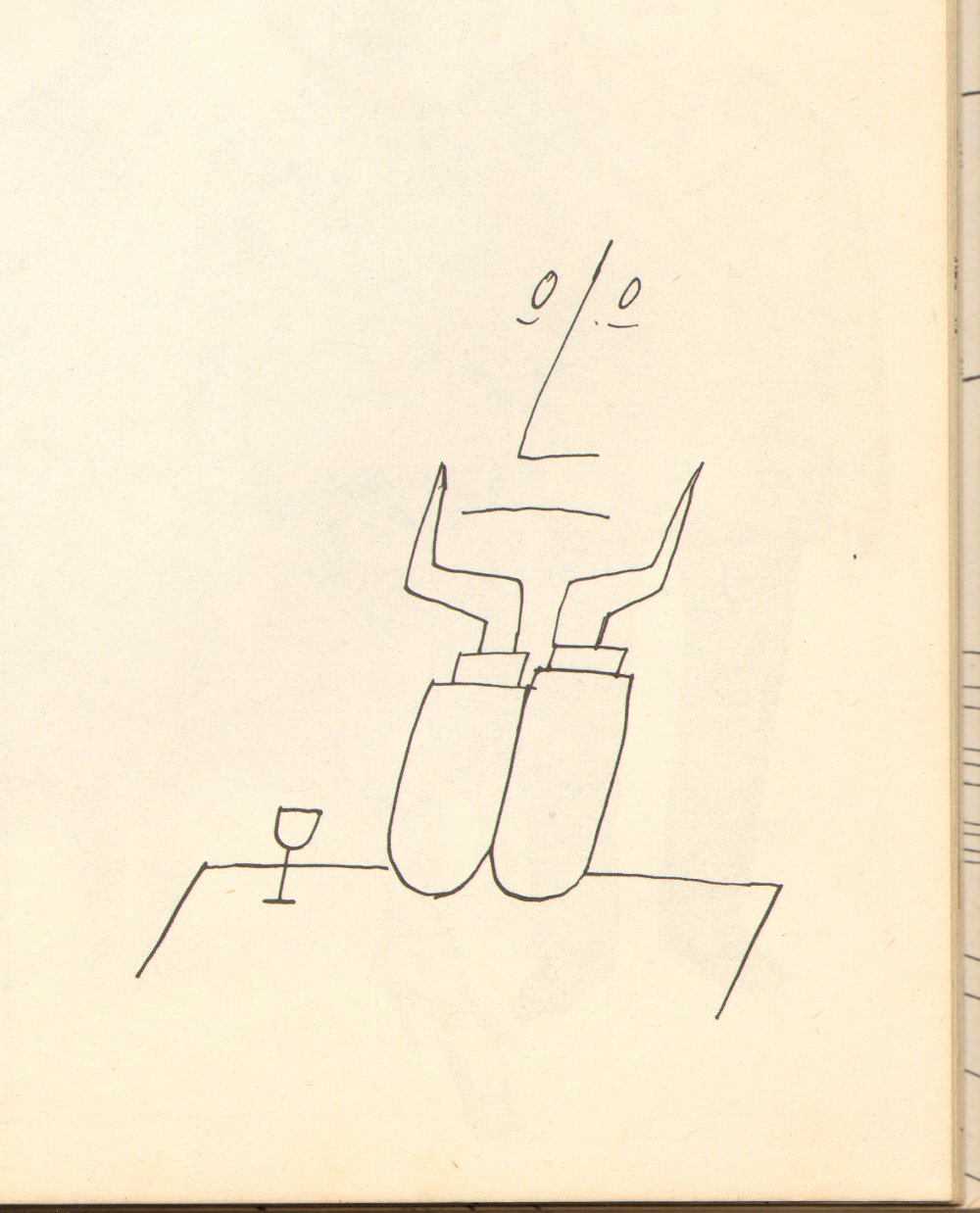
Caroline Small talked about sequence (or the lack thereof) in Saul Steinberg’s Passport.

Alex Buchet looked at the influence of editorial and panel cartoons on the English language.

Utilitarians Everywhere

At Splice Today I explain why Michael Chabon is not necessarily more thoughtful than Barack Obama.

This, indeed, seems to be the cause of part of Chabon’s dyspepsia. Artists, especially successful artists like Chabon, receive such fulsome praise that I think they can occasionally mistake themselves for priests. Which is maybe why he felt qualified to proclaim with such certainty that heaven isn’t real and that death is just absence. To suggest otherwise is a stylistic error—rectifiable only by transforming the clumsy words of the President through the magical gifts of a real writer.

Also at Splice, I discuss the Meads of Asphodel’s anti-Christian Broadway black metal.

I do have a hideous attraction/repulsion for show tunes, and I think it makes sense to think of them as the music of the Antichrist. Especially if the show tunes are written by Andrew Lloyd Weber. And I dare anyone to listen to the second half of the song “Addicted to Christ” without having major Jesus Christ Superstar flashbacks. There’s a lonely horn that wanted to be jazz but had its soul stolen by music theater, and then a choral refugee starts singing like a chipper thespian—“Who is God? I am God? Are you God? But what God? I’m no God, it’s my God.” Soon enough we’ve got contrapuntal voices reciting bitter lyrics in an uplifting back and forth (First cheerful voice: “God hates you all!” Cheerful choral response: “Circumcise!”) And after not too long, again like Lloyd Weber, we launch into some classic rocky concept-album strut. Even the end, with a more traditional metal vocalist and a heavier roar, still has the busy crescendos and prog-rock shifts that strongly suggest Vegas.

Other Links

Sean T. Collins argues that Dirk Deppey’s column ran out of gas at the end, and that tcj.com is an embarrassment. It’s a thoughtful piece; if you scroll down you can see me doing some arguing in comments.

This made me want to try those old Rachel Pollack Doom Patrol issues again.
I liked Ariel Schrag’s column on Patricia Highsmith.

In praise of Saul Steinberg

(Please click on all images — they’re much easier to see in the big versions.)

Over at The Panelists, in the comments to Derik’s really terrific post on Blaise Larmee’s Magic Forest, I’ve been harassing Charles Hatfield a bit about the theoretical status of “sequence” in comics studies. For me, the importance of sequence is always overstated in a way that I think limits what the term “comics” can be appropriately applied to and, even worse, emphasizes one subset of elements within comics – the sequential, narrative ones – at the expense of the metaphorical and structural aspects I find more interesting.

Continue reading

Loveless Ink

This is an exploration of how Kouga’s inks and composition show character and mood in the first volume of Loveless.  The art style shifts with point of view and interactions, building into a powerful visual language.

I have mixed feelings about Loveless. It’s a hot mess in a lot of ways. The story contains horrible child abuse of various kinds, including some that is institutionalized and some that is family, various reprehensible relationships, some seriously broken people, a couple of sociopaths, BDSM themes (both consensual and not), dubious portayals of motives of people who ought to be villains but might not be, amnesia, innapropriate information about sexuality, and some of the most heartbreaking and beautiful characters I’ve ever read.

All this in a cat boy story about preteens.  Oh, manga.
Continue reading

Best Online Comics Criticism 2010: Kibbitzing

I had no involvement in the selection of this year’s Best Online Comics Criticism. And I don’t plan to talk directly about the list here. Except to point out that it is fatally flawed. Because I’m not on it, damn it.

I did think I’d take this opportunity, though, to talk about two of my own favorite pieces of comics criticism from last year.

Continue reading

Bill Randall’s List: Best Online Comics Criticism 2010

Critic and one-time HU writer Bill Randall was one of the judges for this year’s Best Online Comics Criticism. He asked to run his essay about the selection process here — and we’re very pleased to have him back under the Hood, however briefly.
__________________________

by Bill Randall

How did he know?

Real critics are as pure as new snow, with eyes of a child yet minds learned like the eldest philosopher. They castrate their creativity to write from the place of total mental stillness. Able to see through all walls of personal agenda. They use their pen of young lamb to judge what’s best not for themselves, but for all humanity. Such is the powerful power, the terrible responsibility of the true critic.

I have fasted for three centuries, nailed myself upside down to the Tree of Woe, drained my body of every ounce of blood and replaced it with the freshest plastic-bottled spring water. …I am ready to speak of comics with the furiously unpoliticized gaze of the Real Critic.

Spot on, B.C., as I’ve spent a meditative month staring down Phyllis Hodgson’s 1944 critical text of Þe Clowde of Vnknowyng, in þe whiche a soule is onyd wiþ God, by the unknown author of the Cloud of Unknowing, good for inspiration and revelation as I selected my Best Comics Criticism 2010 votes. Prophetic, you prophet! as I like you and all true critics strive ascetic to write apophatic– kenotic– apocatastatic words, good for instruction and reflection, more sacred than the sacred texts of “Maggots,” “If’n Oof,” and “Þe Book of Priue Counseling.” Words of Groth in red, and remember the worst a comics critic can do is hurt some feelings. It’s not like we excommunicate, move product, make reputations, or stand at the kitchen gallery door with Hans Ulrich Obrist and his flaming sword. I can’t even resurrect the dead, may my essay on Kamimura Kazuo burn in hellfire for all eternity while A Drifting Life glows transfigured on your bookshelf.

Continue reading

Best Online Comics Criticism 2010: The Final List

For an introduction to this voting exercise, please see the article posted yesterday. The jurors were Derik Badman, Melinda Beasi, Johanna Draper Carlson, Shaenon K. Garrity, Tim Hodler, Chris Mautner and Bill Randall. They have been encouraged to post their personal choices (with accompanying remarks) on their own websites.


SIX VOTES

(1) Jason ThompsonThe Other Love that Dare Not Speak Its Name (and other articles)

The jurors agreed to consolidate their votes into a single article. Other articles by Thompson which received interest were his pieces on Morality in Action ComicsCeres: Celestial Legend and Happy Mania. His articles appear regularly at Anime News Network where his column “House of 1000 Manga” is published weekly. At least one of the jurors considers him the best writer on manga today. Voice your assent (or dissent for that matter) here.


FIVE VOTES

(1)  Katherine Dacey on Ayako

Dacey is a mainstay of the manga blogosphere. Once again, the jurors decided to consolidate their votes into a single piece. The other article which received favorable attention was Dacey’s review of  Sexy Voice and Robo & Harriet the Spy. Let her know which one you prefer.

(2)  Joe McCullochEssay on Thought Balloons (The Problem with American Vampires is that Just Don’t Think”)

This is Jog’s second year on this list. The bulk of Jog’s writing is for the web and this appears to be both a conscious decision and a sign of the times. Now writing at Comics Comics, his output has slowed if compared to his days at Jog the Blog. This article was a strong early contender for the final list. Other articles of note in 2010 include his review of Alan Moore’s Neonomicon and his survey of the “comics” of Peter Greenaway. There can be little doubt that he is one of the most popular writers on comics working today.


FOUR VOTES

(1)   Craig Fischer on David Mazzucchelli (Born Again Again).

Fischer is an Associate Professor of English at Appalachian State University. He also writes frequently about comics and film for academic venues. Does this mean he was slumming when he decided to write this piece on Mazzucchelli’s Asterios Polyp for this blog? Perish the thought!


THREE VOTES

(1)  David Bordwell on Hergé (Tintinopolis)

Judging by the frequency with which his blog is linked to by various comics bloggers, Bordwell would appear to be a favorite for his thoughts on film and criticism in general.

(2)  Dirk DeppeyThe Mirror of Male-Love Love

This is Deppey’s second time on the list. He got on the list last year for his editorial on Paul Levitz which would be more accurately labeled as industry commentary.  There’s no mistaking this year’s entry which may well be his most memorable article on comics in recent memory.

(3)  Ken Parille: Casper, Formalism, and the ‘Great’ Search Party

Parille is an Assistant Professor of English at East Carolina University and is considered by some to be the foremost expert on the comics of Dan Clowes. No one practices the art of comics close reading as assiduously as Parille. The vote was initially split between Parille’s Casper piece and his review of Charles Burns’ X’ed Out. My personal preference is for the “losing” piece which at this point in time appears to be one of the few substantial reviews of Burns’ comic out there.


LINKS

(1) Derik Badman’s personal choices

(2) Melinda Beasi on the list and her choices

(3) Johanna Draper Carlson on the list and her choices

(4) Shaenon Garrity on the list and her choices

(5) Tim Hodler on the list and his choices

(6) Chris Mautner on the list and his choices

(7) Bill Randall on the list and his choices


Best Online Comics Criticism 2010: Introduction and Runners-Up

It’s that time of the year again and here at HU we’re looking back on the year in online comics criticism.

The choices made by our panel of judges will be revealed tomorrow. Today, I’m taking a look at some of the reviews and essays which, for one reason or another, didn’t make the cut. I should add that this has no bearing on the actual quality of the articles in question. The important thing to remember is that the process was “democratic”. In other words, if you’re lucky you just might get Abraham Lincoln. If not, you might have to settle for George W. Bush (who was indeed loved and remains loved by many Americans).

The 7 articles which did make the final list represent a compromise arrived at by the imperfect tastes of 7 judges. The most interesting thing about such lists is how often they get it completely wrong, the bastard child of individual purity and the god damned evils of collective reasoning.

Continue reading