On Exhibit: The Vorticists’ “Mad Modernity”

Nasher Art Museum at Duke University
Durham, NC
Through January 11

Peggy Guggenheim Collection
Venice, Italy
25 January – 15 May 2011

Tate Britain
London, UK
Tuesday 14 June – Sunday 4 September 2011

“What is Vorticism? Well, like Futurism, and Imagisme, and Cubism, essentially it is nonsense. But it is more important than these other fantastic, artistic, and literary movements because it is their sure conclusion. It is important not because it is the latest, but because it is the last phase of the ridiculous rebellion which has given the world the “Portrait of a Nude Descending the Stairs” and the writings of Gertrude Stein. It is the reduction ad absurdum of mad modernity.”

When The New York Times published this dismissal of “modernity” in August of 1914, only a couple of months had passed since the Vorticists had published their manifesto in the first volume of their magazine Blast. Earlier that year, Dora Marsden had established her journal The Egoist, Vorticist leader Wyndham Lewis had broken with the Bloomsbury artists and established the Rebel Art Center, and the Vorticist poet laureate Ezra Pound had published his anthology “Des Imagistes.” “Mad Modernity” was in full swing (despite that little matter of an assassination).

On the same day that the Times “blasted” Vorticism, they also published a glowing review of a show of American art in Paris featuring work by the figurative painters Ernest Lawson, Bryson Burroughs, and Harry Lachman, as well as the sculptor Cecil Howard. From the vantage point of New York, then conservative and academic, all the European modernisms were madness — the same madness.

Throughout 1914, however, Pound and Lewis were at great pains to emphasize that Vorticism was not the same. In June, they publicly rejected Marinetti’s attempts to co-opt them as a sub-movement of Italian Futurism, despite having previously taken advantage of his high profile for a fundraiser for the Rebel Art Center. Blast 1 is littered with aggressive criticism and rejections of all the modernisms, in an effort to publicly situate Vorticism as a uniquely advanced synthesis. In the introduction to the excellent exhibition catalog for the exhibit reviewed here, Philip Rylands describes it as the “most advanced, the most sharply characterized of the London-based avant-gardes,” including the Bloomsbury movement that fostered Virginia Woolf.

This is even clear from the first time the term “Vorticist” appeared, in a 1914 advertisement for the upcoming Blast 1, printed in the literary magazine The Spectator:

The Manifesto of the Vorticists. The English Parallel Movement to Cubism and Expressionism. Imagism in poetry. Death blow to Impressionism and Futurism, and all the refuse of naïf science.

The Exhibit

The exhibit of Vorticist art currently on display at the Nasher Museum of Art at Duke University, curated by the Nasher in cooperation with the Guggenheim in New York, is the first exhibition of Vorticist art in the United States since Pound mounted his own exhibition at the Penguin Club in New York in 1917. For that reason alone, it is worth attending.

The exhibit is organized in five parts: A display of major works, including Gaudier-Brezska’s Hieratic Head of Ezra Pound (below), Wyndham Lewis’ The Crowd (right), and Jacob Epstein’s Torso in Metal from Rock Drill (below, third), begins the exhibit. That is followed by “re-creations” of the three exhibitions, including Pound’s at the Penguin, held between 1913 and 1917 when Vorticism was a current avant-garde, and a section devoted to the movement’s magazine Blast.


“Re-creation” is a strong word, as many of the originally exhibited artworks are lost – but the curators attempted to gather as many works from the original exhibitions as possible. Of particular note are the paintings by Helen Saunders, which were believed lost but turned up in boxes at Roosevelt University in Chicago, and the vortographs of photographer Alvin Langdon Coburn.

The impact of seeing all these works collected together – as opposed to the usual one-off buried in a room of “minor modernisms” – is significant. In this context, the aesthetic consistency among the movement’s practitioners, their debts to Jacob Epstein and to both Cubism and Futurist painting, and the inspiration they found in the urban landscapes of Northern English cities and English industrialism, all become readily visible.

The section focusing on Blast doesn’t make nearly the same impact. That section and the opening display of “major works” are both haunted by the spectres of literature and philosophy – particularly Pound, who coined the term Vorticism, and Wyndham Lewis, who was as much a novelist and essayist as a painter. Their mutual “friend” T.E. Hulme – in scare quotes because that friendship was characterized by competition and melodrama, which led to Hulme’s exclusion from Blast 1 – was almost singlehandledly responsible for Vorticism’s philosophical orientation, culled from his translation of Bergson and his friendship with the Expressionist philosopher Wilhelm Worringer. Add in Pound’s influential friendships with the feminist anarcho-individualist Marsden and the writer T.S. Eliot (who was also published in Blast), and it’s indisputable that Vorticism was as much a literary, philosophical, political, and social movement as it was a visual aesthetic one. (There was even Vorticist music, eventually.)

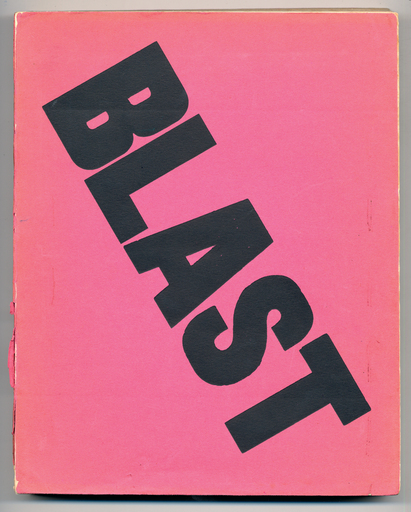
The Nasher exhibit emphasizes Blast as a material object, however, displaying original copies of both volumes in long cases, with framed original drawings for the magazine hanging above the cases. Although the physicality of this presentation gives a geeky thrill, Blast was never intended to be enclosed within a display case (to the exhibitors credit, a new facsimile edition of Blast 1 was developed just prior to the exhibit and is available in the gift shop or here).
There is no Vulgarity in Revolt

The manifestos of “mad modernism” depended on mechanical reproduction and fed off the vibrancy of their artistic activism. The avant-garde was here set against both aestheticism and academicism, as Lewis’ stated directly in Blast:

To make the rich of the community shed their education skin, to destroy politeness, standardization and academic, that is civilized, vision, is the task we have set ourselves.

To believe that it is necessary for or conducive to art to “improve” life, for instance, make architecture, dress, ornament, in “better taste,” is absurd.

The Latins are at present, for instance, in their ‘discovery’ of sport, their Futuristic gush over machines, aeroplanes, etc., the most romantic and sentimental ‘moderns’ to be found. It is only the second-rate people in France or Italy who are thorough revolutionaries. In England, on the other hand, there is no vulgarity in revolt. Or rather, there is no revolt, it is the normal state. … the nearest thing in England to a great traditional French artist is a great revolutionary English one.

The spirit in these quotes from the preface and manifesto, not to mention its influence on the experience of the visual art works and literature reproduced in the subsequent pages, is lost when the book is put in a case. Blast-as-exhibit can only suggest it; experiencing the historical materiality of the book can’t even begin to substitute for reading it – even in non-facsimile reproduction.

Likewise, the materiality of the traditional exhibit space doesn’t even evoke, let alone “recreate” the rebellious, radical spirit and context of the wartime exhibitions. The Penguin Club is a case in point: the Club had been founded shortly before the 1917 Vorticist Exhibition by Walter Kuhn, one of the progenitors of the Association of American Painters and Sculptors, who put on the influential 1913 Armory Show that introduced Duchamp, and Hopper, and Kandinsky, and the post-Impressionists – among many others – to American audiences. The club was a gathering place for modernist artists rebelling against the constraints of academic art, including Man Ray, Francis Picabia, and Joseph Stella. The club held exhibitions, put on costume parties and satirical theatrical productions, offered classes by its members to its members, and encouraged criticism, discussion, and debate. The sedate blue and cream walls of the exhibition don’t begin to capture the frenetic environs from which Vorticism emerged and in which it perpetuated itself. Mad Modernism indeed.

Which is to say – by all means you really must go to the exhibit if you are anywhere near Durham, Venice, or London. Read the wall tags, admire the materiality of the art, and marvel at the lost-but-now-am-found paintings. But be sure to flip through the facsimile edition of Blast and the superb exhibition catalog, too. Otherwise you’ll have seen Vorticist art, but missed what makes it Vorticist.
Utilitarian Review 12/10/10

On HU

Busy week this time out.

Erica Friedman started the week out with a post on fashion, fighting, literature and Hana No Asuka-gumi.

Alex Buchet began a massive series on comics contribution to language, looking at Tad, Rube Goldberg, and other early strip artists.

Richard Cook evaluated some hobbit questing tunes.

I explained why I don’t like Pauline Kael.

I reviewed Arie Kaplan’s From Krakow to Krypton about Jews in the comic book industry.

Jason Overby guest posted about the relationship between comics history and comics.

Caroline Small had a follow up comment to Jason’s post.

Sean Michael Robinson discussed the difficulties of marketing Mitsuru Adachi’s sports comics in America.

Alex Buchet continued his series on the effects of comics on language with examples from Popeye, Milt Gross, and more.

Next week we’ve got posts on comics, modernism, and time; Art Young, faith, and humor; Vorticist art, and more.

Utilitarians Everywhere

At Comixology I talk about the weirdness of the superhero Katana.

Female super-heroes can be many things: Amazon warrior, out-of-control telepath, deadly ninja assassin. But whether in swimsuit, bodysuit, fishnets or boob window, they’re almost always cheesecake.

There’s no particular mystery as to why this is. Super-hero comics are male genre literature. Guys like to look at cheesecake. QED. There are some exceptions to the rule — but they’re usually built around genre exceptions as well. For example, the Claremont/Byrne X-Men made some effort to appeal to YA girl readers through the character of Kitty Pryde. Thus, Kitty got to mostly wear civies, rather than the skintight and/or improbably cut-out costumes that were the lot of her distaff teammates. (Not that the internets are above a certain amount of Kitty Pryde cheesecake of course.)

At Splice Today I review a new video anthology of Sid and Marty Kroft’s children’s television shows.

For the Kroffts, childhood is often a suffocating sweetness, a threatening plenitude. In both H.R. Pufnstuf and Lidsville, a boy is trapped in a magical realm from which he spends almost all his time trying (and failing) to escape. The child’s plight is especially unsettling in Lidsville, where the boy in question isn’t really a child. Butch Patrick, who played the protagonist Mark, was 18 when he picked up the role and close to 20 by the time he finished. When he wanders through the magic world of sentient hats, tyrannical patriarchal magicians, and evil doppelgangers, therefore, it doesn’t come across as a child’s adorable game of make-believe. Instead, it looks disturbingly like a young man’s schizophrenic fugue.Jazmine Sullivan neo-soul album.

At Madeloud I review a mediocre techno comp.

Other Links

Karen Green has an interesting discussion of Frank Miller’s 300.

Michelle Smith and Melinda Beasi have a good discussion of the formal qualities of some wordless manga.

R. Fiore on why the Green Hornet movie will suck.

And sometimes commenter Jason Michelitch has his first Splice Today article up about the glory and the limitations of experimental film online.

Crossing Over- Mitsuru Adachi, Cross Game and the Problem of Genre

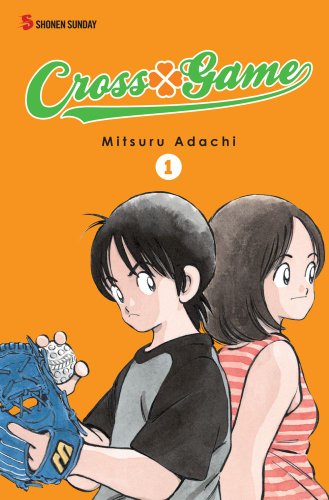
In October Viz released almost 600 pages of comics by one of my favorite cartoonists, Mitsuru Adachi, in the form of the first volume of Cross Game, a series from 2005. In honor of Adachi finally getting something else in print, and in the interest of hopefully furthering the recent discussion of genre, “Comics”, and “Art”, I’d like to share a few thoughts I had upon reading the volume.

But first, a quote! Yesterday on HU Jason Overby had a post up in which he had this to say about the changing face of comics history –

It brings up a good point about how arbitrary “comics history” is.  It’s easy to see that positive associations, as opposed to some more objective system of value, are what impel bloggers (critics?) to write about Kirby or King more than Toriyama or Baldessari.

This point applies even more so to creators who have never had their work officially represented in English, or have only had released a small, unrepresentative portion of their total output. What is the history of comics, when critical figures who influenced huge swaths of the work that is available have none of their own work available to an English-speaking audience?

This is the case for Mitsuru Adachi, a cartoonist who made his debut more than forty years ago and who, on a global level, rivals Rumiko Takahashi for popularity and acclaim.

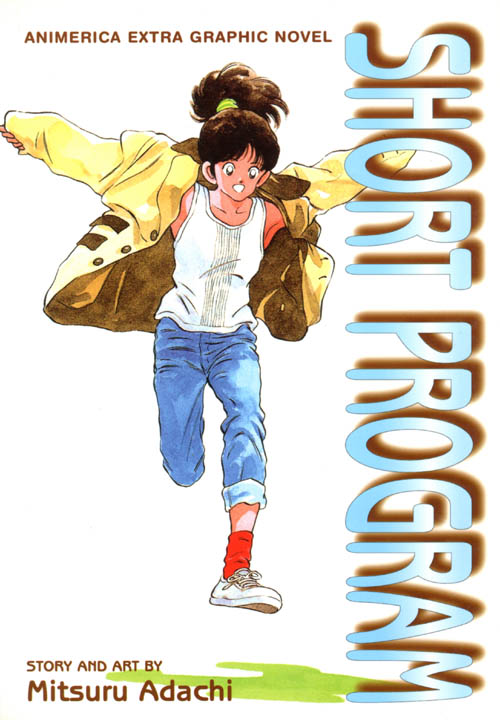
Although Adachi was fairly well-known among the anime and manga communities of the eighties and early nineties, thanks to fan translations of an anime adaptation of his first major manga series, Touch, he’s had a sparse history of official releases in English. His official English debut came in 1999 in the pages of Animerica Extra with Short Program, a series of short stories connected only by their generally melancholic tone, lively drawing, and gentle, deft characterization. The serialization in Animerica Extra continued for two years, generating enough material to be included in two collected volumes, one released in 2000, followed four years later by volume two. For a major creator known for his slow-spooling multi-volume stories, this was a strange state of affairs.

My best guess is that the Short Program releases were meant to test the waters and gauge the potential audience for Adachi in America. And although I personally think Adachi is one of the world’s greatest living cartoonists, it’s easy to see why Viz would be nervous about rolling out one of his major series. They are some of the same reasons that have prevented a wide swath of Japanese comics history from making its way into English.

For one, American anime fans still drive a large part of the market, as companies bank on the synergistic marketing opportunities available from manga series that also exist in other media. And although Adachi had two full-length anime adaptations in the eighties, the American anime fan culture has a very fickle relationship with surface style. In other words, any potential spin-offs (until the recent Cross Game anime adaptation) exist in a form that might seem outdated to the bulk of the anime fan community.

The second, and probably more significant point, is the matter of genre. All of Adachi’s major series (including Touch, Slow Step, H2, Katsu!, and the recently released Cross Game) could be most easily slotted in the category of “sports comics,” although I’ve seen the label “romantic comedy” attached to his comics as well. With the exception of some very popular young adult sports fiction in the fifties and sixties, there’s not a very long tradition of sports fiction in America, and certainly little to no tradition of sports comics. In the eyes of many marketing strategists, a general audience uses a genre label as an aid to enter the story, a convenient short hand that serves as a hook on which to hang the other elements of the story. How do you sell a piece of fiction that most easily fits into a genre that doesn’t exist for its target audience?

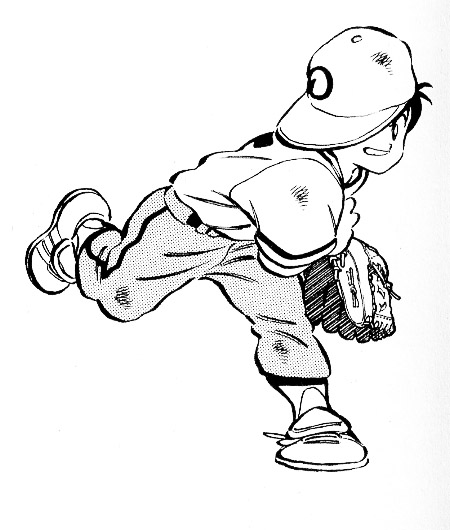
from Cross Game volume 1

Well, one way would be to try to create the market- to sell Adachi’s work to baseball fans.  As a former baseball fanatic myself, I think Viz could very well do so with that kind of strategy. But in trying to sell Adachi’s work to the comics market, and therefore to comics reviewers and critics as well, there’s an additional challenge- that for certain types of critics working within genres can carry a whole host of other negative connotations.

I find it very illuminating to observe the purposeful way that Vertical has marketed Osamu Tezuka’s work in the past few years. They’ve been very careful to package and design the books in ways that echo much of the aesthetic of English independent comics, including employing well-known designer Chip Kidd for many of the early books, and continuing the overtly modern and fragmentary designs with the more recent work by in-house Vertical designer Peter Mendelsund. Looking at the exterior of books like Dororo or Black Jack, would you have any idea that these series fit squarely within swordplay and medical drama genres?

However, like most excellent genre fiction, Dororo and Black Jack play with the genres involved rather than being subsumed by them. This is the case with the work of Adachi as well. Cross Game is “sports comics” in the sense that the characters at the heart of the story love baseball, and playing it becomes a focus for much of their activity. But saying that “Touch” or “Cross Game” are about baseball is like saying that “Les Miserable” is about prison and sweeping and street fighting.

The first three volumes of Cross Game came out in October in one 576 page package. And how are they pitching it? As a tie-in to the spin-off anime, and as a “poignant coming-of-age story,” which, as far as marketing pitches go, isn’t half bad, as both elements happen to be true. They’ve minimized the baseball references in the description and press releases, and have centered around the relationships at the heart of the story, as well as attempting to capitalize on Adachi’s Japanese fame and reputation.

from Cross Game

And it probably has a chance of succeeding. Cross Game itself, or at least the three volumes represented in the recent Viz release, has all of the elements associated with classic Adachi series- clear and confident drawing with very smooth, natural storytelling, slow-moving plots that suddenly veer into unexpected and unpredictable territory, breezy dialogue, and melancholic, sometimes unmotivated young characters whose decisions are often surprising but are never inexplicable.

And yet it may be too genre bound, and maybe too casual, to be taken seriously by many critics. Present in the series are several stylistic choices that could be disconcerting for an audience unaccustomed to them. These include Adachi himself appearing in throw-away panels to mock his own work, background characters pitching other Adachi series to the reader, and a tendency to occasionally veer into cliché. Fortunately these clichéd situations are usually minor detours from the main plot, and seem to be the result of the unrelenting workload of weekly serialization. (Another possibly undesirable byproduct of this pace is the sometimes workmanlike background artwork, which occasionally takes stylistic detours from the figures, which are always confidently delineated.)

Last week Noah generated some heated feedback when he suggested that the manga community engages in a lot more reviewing than criticism, and that books like a Drunken Dream which “despite its genre links, doesn’t fit easily into current marketing demographics,” will have a hard time going without some in-depth criticism to create context for the work. As I mentioned in the comments section, regardless of how you might feel about the “review” versus “criticism” premise, Hagio and Adachi might be in the same boat. They’re sitting on many of those same lines of division.

Well, Noah, I’d like to respond to your post by urging interested readers to BUY! a copy of Cross Game. And cross your fingers that, one day, Touch will be available in English.

And critics, wherever you are? Try to go easy on Mr. Adachi, won’t you? It is just a baseball comic, after all!

(Someone once told me that sarcasm doesn’t come across well in print.)

Comics>Cartooning

Because it kicks ass, I’m reprinting and highlighting Caro’s comment from this post.

To Darryl’s point: for me, “divorcing comics from its cultural history” isn’t about being embarrassed about comics’ history so much as it is recognizing that “comics history” is neither sufficient cultural context for already existing comics nor necessary cultural context for yet-to-be-created ones.

The idea that comics history is both necessary and sufficient — I could put in jargony terms and say that it feels like a caving in to historical determinism. But it’s really more that it gives me no way in.

What L. describes — she says that about creators, but I feel that as a critic too. On the whole, very few comics keep me awake at night the way literature and criticism and theory and Godard films and conceptual art do — not because those things are better than comics-history-inspired comics, but because those are the things I like, and they’re having a different conversation than comics has historically been having.

I pay attention because occasionally, a comic comes along that really intervenes in the stuff I care about (like Feuchtenberger, or the stuff Jason just linked to!) and on the occasions when that has happened, it’s been so extraordinarily worthwhile that it’s worth keeping an eye out.

But for many things, it’s hard for me to muster the enthusiasm to do a real piece of criticism, because the book just isn’t doing anything to keep me awake. No matter how cool the tricks with comics history gets, no matter how nuanced the conversation, it’s just never going to keep me awake, because I’m interested in DIFFERENT histories — pop art, experimental fiction, 20th century theories of language and representation, artistic constructions of subjectivity. I think it’s wrong to say that comics can’t become part of those histories, now, even though they’ve historically not been. (Or, to return to the jargon, how can we expect the dialectic to work without antithesis?)

I absolutely don’t mean that comics-history-inspired comics aren’t doing very interesting things with that history. I don’t mean they shouldn’t exist, or that they’re “less” in any way than other comics. It’s just that, for me, who has no history with comics, comics history can’t on its own provide a foundation for challenging, provocative, mind-changing art, so for comics to challenge me, provoke me, and change my mind, I need there to be SOME comics that deprioritize the specific history of comics in order to engage more actively with those other histories.

That’s why the strength of the term “divorce” feels right to me. Comics’ relationship to their own history often feels like a marriage where one partner’s potential is being really held back in order to protect or build up the ego of the other partner. And I like comics better than I like comics history, so I say “girlfriend, leave!” Comics > cartooning.

What’s “Clark Kent” in Yiddish?

This essay first ran on Splice Today.
_________________________

One of the smartest books I’ve ever read about ethnicity is James Loewen’s Mississippi Chinese. Like the title says, it’s an academic study of Chinese immigrants in Mississippi during the first half of the twentieth century. Specifically, it tries to explain why virtually all of them ended up working as shopkeepers in black neighborhoods. The answer turns out to have next to nothing to do with racial or ethnic predilections or talents, and everything to do with specific social factors. In other words, the Chinese didn’t run stores because they had some sort of gene which made them good salesmen. They ran stores in black neighborhoods because (a) the only way such stores could be economically feasible is if the shopkeeper lived above the shop, and because of racism white people wouldn’t live in black neighborhoods, and (b) African-Americans had difficulty being storekeepers themselves because they had strong community taboos against dunning their neighbors for debts. Thus, because of racism on the one hand and community solidarity created by oppression on the other, there was a particular space available for non-black, non-white immigrants — and the Chinese stepped into it.

I’ve long hoped to find a similar study which would explain why Jews were so dominant in the comic industry. I’d hoped Arie Kaplan’s From Krakow to Krypto would provide some answers — and it didn’t completely disappoint. Kaplan points out that because of prejudice, Jews were effectively barred from advertising illustration, newspaper cartooning — from every commercial artistic outlet, that is, except for comic books, which were considered to be such dreck that nobody cared who worked on them. In this, Kaplan suggests, comics were like Hollywood movies, or comedy, or music: entertainment occupations so low caste that the usual barriers to entry did not apply.

Bringing up music, though, points to a lacuna in the thesis. After all, there were other low caste folks in New York in the thirties, forties, and fifties when Jews were moving into the comics business. I’m pretty sure African-Americans weren’t welcomed with open arms into the world of commercial illustration; why then weren’t they, too, being funneled into the low-class funnybooks?

I can think of a couple of answers to this, but the most likely ones aren’t especially flattering to comic-bookdom.. Perhaps that’s why Kaplan avoids them; certainly, he seems determined to discuss race only when it’s possible to do so while patting the industry loudly on the back (Matt Baker and the Black Panther both make — shall we say, token appearances?) Similarly, though Kaplan’s book does touch on the exploitation comics creators faced, it doesn’t do much to put this in a specifically Jewish context. Did publishers take advantage of shared ethnicity to build trust and more effectively screw their underlings? How important were Jewish social networks to staffing these companies? How did that affect the way the companies were run?

Of course, just because the issues which interest me don’t interest Kaplan isn’t to say that the book is worthless. On the contrary, From Krakow to Krypton covers the history of Jews in American comics — which is more or less the entire history of American comics — with bright efficiency. In only 200 pages or so, Kaplan hits Golden Age superheroes, EC, the Silver Age at Marvel and DC, the undergrounds, and more — and even finds time to mention Michael Chabon way, way more often than necessary. No doubt experts in the field will find the tour cursory, but I learned lots of fun facts, whether big (I’d always thought Gardner Fox was responsible for updating the Flash…duh) or small (Clark Kent was based on Cary Grant! Buffy was based on Kitty Pryde! Neil Gaiman is Jewish!) In addition, the tome is lavishly and carefully illustrated. My favorite image is the adorable Jack Kirby drawing of the Thing in prayer shawl and yarmulke, but the Al Jaffee self-portrait with upside-down head is a close second. Certainly, with all the information and all the art, the book seems very reasonably priced at $25.00.

The main weakness is, inevitably, the boosterism. The constant reiteration of how great Jews and comics are and how far they’ve come had grown wearisome long, long before I reached the last page — and, indeed, long before I opened the volume. I do understand the impulse to cheer on the tribe, but the success of comics isn’t ultimately about culturally validating the Jews, or vice versa. If we want to understand Jews, or comics, or how the two relate to each other, at some point we’re going to need a history that is a little, or a lot, more ruthless.

Mistaking the Movies for the Trees

This essay first appeared on Splice Today.
____________________________

As a first time reader of Pauline Kael, I was surprised to discover that she’s boring as fuck.

Okay, to be fair, she’s sometimes slightly less boring than that. Going Steady, her third volume from 1968 and the one which I happened to get my hands on, has its share of zingers. I smiled when she noted acidly of Mel Brooks’ script for the producers: “That’s not screenwriting; it’s gagwriting.” I’m always up for seeing Norman Mailer ridiculed, and her pummeling of his Wild 90 as a lazy egoistic exercise in flab was satisfying on that account. And there are several entertaining anecdotes sprinkled throughout. Such as this one:

Once, in Berkeley, after a lecture by LeRoi Jones, as the audience got up to leave, I asked an elderly white couple next to me how they could applaud when Jones said that all whites should be killed. And the little gray-haired woman replied, “But that was just a metaphor. He’s a wonderful speaker.

Continue reading

Hobbit Tunes

If you’re going on the quest, best make sure you have the right quest music. Tolkien songs are always reliable for any quest involving lots of walking.

“The Road Goes Ever On” from The Hobbit
by J.R.R. Tolkien

Roads go ever ever on,
Over rock and under tree,
By caves where never sun has shone,
By streams that never find the sea;
Over snow by winter sown,
And through the merry flowers of June,
Over grass and over stone,
And under mountains in the moon.
Roads go ever ever on
Under cloud and under star,
Yet feet that wandering have gone
Turn at last to home afar.
Eyes that fire and sword have seen
And horror in the halls of stone
Look at last on meadows green
And trees and hills they long have known.

Or if you prefer, the version from The Lord of the Rings:

The Road goes ever on and on
Down from the door where it began.
Now far ahead the Road has gone,
And I must follow, if I can,
Pursuing it with eager feet,
Until it joins some larger way
Where many paths and errands meet.
And whither then? I cannot say.

Just one problem: what does the song actually sound like (and where can I download it?)

Option 1: Drinking song


Continue reading