Overthinking Things 12/5/10

Fashion, Fighting and Literature: Hana no Asuka-gumi

Sometimes, the power of a series is in the details. The subtle moments, the deft stroke of a brush or subtle camera-work,  the sound of a voice catching at just the right moment.

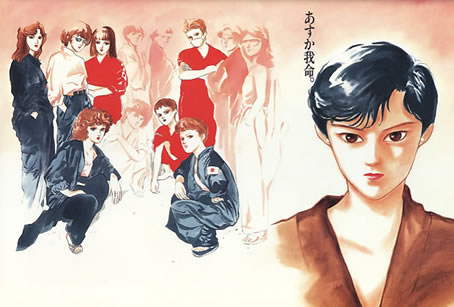
In Hana no Asuka-gumi, the power of the series is in the grand scheme, the wide-angle view of a world that, whether it truly exists or not, will never be seen by those unaware of its existence.

We all know that in every great city, in every country, there is an underworld organization that runs the illicit businesses humans require. But what if there was, behind even that, another world, an even more obscure world, of gangs and drugs and phone texting competitions and boy bands – a world that extends through middle and high schools country-wide?

In Hana no Asuka-gumi, Asuka is both part of and an outsider to a pervasive underground organization that runs all the girl gangs of Tokyo. “Gumi” here means gang, so the translation can be “Asuka of the Flowers Gang.” However, the “Hana no” is most often translated as “Magnficent” as in the “Hana no Nijuuyo-nen Gumi,” the “Magnificent 49ers” the name used to loosely identify the mothers of girls’ manga in Japan. It would not be out of the pale to translate the series “The Magnificent Asuka Gang.”
Continue reading

Utilitarian Review 12/4/10

On HU

We started this week with Domingos Isabelinho’s discussion of Aristophane’s The Zabime Sisters.

Stephanie Folse reviewed the first issue of Elfquest in preparation for rereading the entire series.

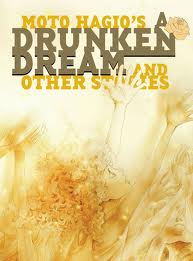
I argued that the manga blogosphere has done a poor job in reviewing Moto Hagio’s A Drunken Dream.

James Romberger talked about conflicts between Alex Toth and Joe Kubert which led to the loss of what may have been one of Toth’s major stories.

Vom Marlowe discussed how manga criticism works, why it works that way, and where to find it.

And finally I revealed the best superhero movie ever.

Utilitarians Everywhere

At the Chicago Reader, I review Nicki Minaj’s new album.

The fact that Minaj channels Helen Reddy with a straight face on a hip-hop album seems like a good indication that she’s lost her way in spectacular fashion. It’s easy to see this as a desperate and misguided effort to reach a mainstream audience—and it clearly is that. But at the same time, the album’s rudderlessness seems like part and parcel of Minaj’s persona. With a flow that hops from Barbie cuteness to Rasta declamation to a faux British accent to sped-up Tourette’s, Minaj has always been about spastic incoherence, and one of her most acclaimed performances is deliberately and gloriously bipolar. In her verse on Kanye West’s “Monster,” she switches back and forth between a flirtatious little-girl coo and a fierce, ranting growl, using the alternation to create an escalating momentum so massive it makes the other rappers on the track—Jay-Z and Rick Ross—sound positively precious.

Other Links

I mentioned the both of these in comments, but:

Melinda Beasi and Michelle Smith have a lovely discussion of Paradise Kiss here.

And Matt Seneca’s appreciation of Rob Liefield is great.

The Best Superhero Movie Ever

This originally appeared over at Splice Today.
______________________________

So what’s the best superhero movie of all time? Perhaps you love Dark Knight because Heath Ledger is dead now and Morgan Freeman taught us about the dangers of surveillance technology. Or you may love Spider-Man because it drips with pathos and daddy issues. Or maybe you like Robert Downey, Jr.’s charm in Iron Man, or, if you’re old school, Christopher Reeve’s charm in Superman. Or maybe you’re just cranky enough that when someone asks you “What’s the best superhero movie ever?” you answer with a waggish sneer, “There are no best superhero movies ever!”

Continue reading

The cycle of criticism

There has been a recent discussion of the nature of manga criticism and where it can be found (and if it can be found).  I have maintained that, yes, it does exist and can be found, whereas others have other views.  As part of that discussion, I want to explain part of the issues as I see them, in finding the criticism and where it happens and how, and decided that instead of cramming it into a comment (not doable), I would take the time and do as full an explanation as I can.
Continue reading

Criticizing the Critics: Moto Hagio’s A Drunken Dream

Over the last couple of months, I’ve written five lengthy posts about A Drunken Dream Fantagraphics’ collection of stories by the great shojo manga-ka Moto Hagio. I’ve spent so much time on this book for a number of reasons. Hagio is a central figure in the history of shojo, a genre in which I’m interested. Matt Thorn, the volume’s editor and translator, is one of the most important manga critics around,so anything he does is worth thinking about carefully. And, finally, this is meant to be the first in a series of reissues of classic shojo tales by Fantagraphics. That’s an exceedingly worthwhile project, and I wanted to draw attention to it.

To finish up my series, I thought I’d look briefly at what other critics have said about A Drunken Dream.

I certainly haven’t been alone in seeing this book as important. Deb Aoki at About.com gave it 4.5 stars and said it was “a long overdue glimpse into Hagio’s 40-year career. Melinda Beasi picked it as her book of the week, calling it gorgeous. David Welsh in a discussion of the best manga of the year similarly, if more somberly, commented that on best of the year lists, “Moto Hagio’s A Drunken Dream and Other Stories (Fantagraphics) didn’t seem to make much of an impression outside of dedicated manga readers, which is disappointing to me as a dedicated manga reader.”

So…many stars, pick of the week, should be on best of lists. Check, check…check! Sounds good! Long awaited collection by a manga master, critics love it — there must be a lot of juicy articles out there discussing why the book is so wonderful, right? Right?

Continue reading

Elfquest Re-read: Issue #1 and Youthful Fannishness

I was introduced to Elfquest about 1980 in Bobbie’s Books, the local used bookstore which doubled as Bryan, TX’s only comic store at the time. I wandered over to the wall racks holding comics near the register, and started poking through them.  I owned all of three comics at the time, purchased as some sort of three-pack from a local bookstore that had recently folded. There was one Disney comic, a forgettable superhero comic, and one science fiction horror comic sandwiched between them that weirded me the hell out. All I remember is one panel of some sort of bubbly goo, found on a distant planet by the protagonists. It unsettled me enough that I hid the comic underneath a pile of stuff in my room, and would occasionally pull it out to look at it when I’d screwed my courage up–I remember a distinct feeling of nausea when reading it. Why it was packaged with a Disney comic, I’ll never know.

Anyway, it’s a wonder that I was looking at the comics rack at all. I remember even then not really liking the mainstream superhero art styles of the 1970s (still don’t!). But the owner of the store noticed me, handed me Elfquest #1, and said, “You want to read this.”

Continue reading

Monthly Stumblings # 7: Aristophane [Boulon]

Les soeurs Zabîme (the Zabîme sisters) by Aristophane [Boulon]

Can you imagine yourself in Kupe’s lighthouse (that ideal comics library filled with books that don’t exist in Dylan Horrocks’ Hicksville)? I do sometimes, but, even if I wholeheartedly agree with Kupe’s point of view (which is: “The official history of comics is a history of frustration. Of unrealised potential. Of artists who never got the chance to do that magnum opus. Of stories that never got told – or else they were bowdlerized by small-minded editors…”) my particular lighthouse has a few books whose content does exist, but isn’t available. Books like Santiago “Chago” Armada’s Sa-lo-mon, or Rafael Fornés’ Sabino, or James Edgar’s and Tony Weare’s Shannon Gunfighter or Isepinal and the Apaches, or Héctor Germán Oesterheld’s and Francisco Solano López’s Amapola Negra (Black Poppy), or Martin Vaughn-James’ The Park

Cuban artists “Chago” Armada (left) and Samuel Feijóo (photo published in Signos # 32, 1984). The drawing is Armada’s.

Continue reading