Moto Hagio: “Iguana Girl”

I’m blogging my way through Fantagraphics’ Moto Hagio collection, “A Drunken Dream.” You can read the whole series of posts here.
_________________________________
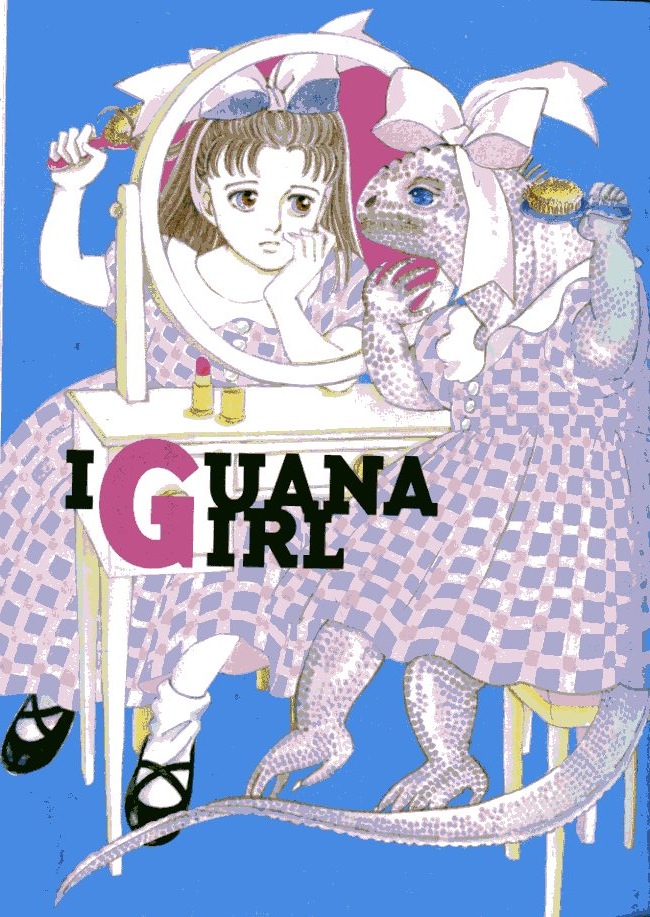
In reviews of Drunken Dream, “Iguana Girl” is generally pointed out as the highlight of the collection along with Hanshin: Half-God. The two stories are similar in a lot of ways; both involve sisters, one beautiful, dumb, and beloved, the other (our heroine) homely, smart, and despised. And both are engaged with ideas about self-image, femininity, gender, and identity.

Hanshin, as I said in my review, is more a poem than a story. It raises questions deliberately to leave them unanswered — the narrator’s self is ultimately her lack of self. The identity she finds is that she does not know who she is: herself, her congenital twin, or the space left between her and her sister when they are separated.

“Iguana Girl”, while using a more arresting gimmick than “Hanshin,” ends up being a more conventional (and to my mind a less interesting) story. The plot focuses on Rika, a child whose mother sees her as an iguana from the moment of her birth. Rika’s perceived ugliness makes her mother hate her; she much prefers her second daughter, the lovely (and rather dumb) Mami. Rika sees herself as an Iguana too, though everyone else sees her as a beautiful girl (and eventually as a beautiful young woman).

The problem here is the same one that dogs many of Hagio’s stories — a lack of characterization resulting in glibness.


Continue reading

Original Art: Human Nature

The differences between the worlds of comics and fine art would appear to be pretty obvious, but my recent reading of Sarah Thornton’s Seven Days in the Art World suggests that  these differences might be less than they would appear, the great leveler in this instance being human nature.

Taking in subjects like a high end contemporary art auction, self-absorbed art students at a “Crit” session, the strange world of Artforum magazine and a trip to Takashi Murakami’s studio, the entire experience of perusing Thornton’s book was not unlike reading about the decline of civilization (Western in this case but the values are universal); a kind of journal describing that surge of decadence which sometimes marks the end of empire.

Continue reading

Comics Journal Navel Gazing: A Short Comment

Caro recently highlighted an article by Craig Fischer at Transatlantica titled “Worlds within Worlds: Audiences, Jargon, and North American Comics Discourse”. I’ve decided to separate out this short comment on one particular section of Craig’s essay since it is only tangentially related to the bulk of Caro’s comments. The following comes from the middle of Craig’s taxonomy of comics writing called, “Essayists” (emphasis mine):

22    As a contributor to the Journal, my problem with Groth’s emphasis on evaluation is the absence of communal standards. In the editorial to Journal#100 (July 1985), Groth reprinted a commentary from the British fanzine BEM where Bernard Leak pointed out that despite the Journal’s commitment to excellence, “muscular standards-raising activity requires some kind of focus, some general agreement on what a good comic is; and there isn’t any such agreement, in the pages of the Journal or anywhere else” (Groth 12). Leak further argued that

“A general theory of comics, such as has been produced (in many conflicting forms, of course) for literary genres like novels and epics, is necessary before any dreams for the future can take on a definite shape and positive content. If someone doesn’t like any particular theory, he can supplement, modify or replace it; but until one appears all criticism of comics will be floating in the void, unsupported by anything more than a consensus of some readers’ uncontrolled intuitions. (12)”

Continue reading

New Tricks

Hello!  You may remember me from such insightful posts as Visual Languages of Manga and Comics and, er, well, just that one, really.  You shall all be subject to me on a regular basis for a while, as Noah has asked me to be a monthly columnist.  At the moment, I’m not sure what direction I’m going to go with this, but I’ll play it by ear.

This month, as I’ve just come back from a vacation to the UK and am still jet-lagged, I’m going to just blather on a bit about a current favorite TV show of mine and why I think one of the main characters is the most fantastic female character I’ve seen in a long, long time.

Continue reading

Monthly Stumblings # 6: Otto Dix

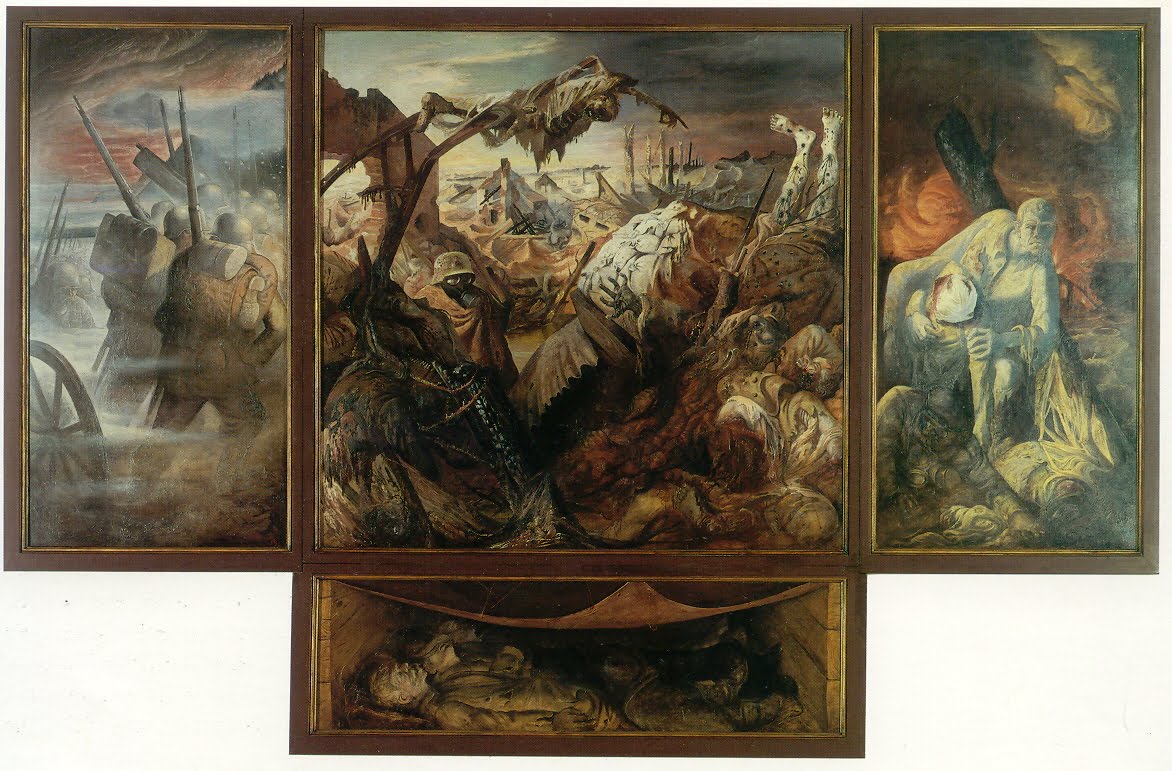
Der Krieg (the war) by Otto Dix

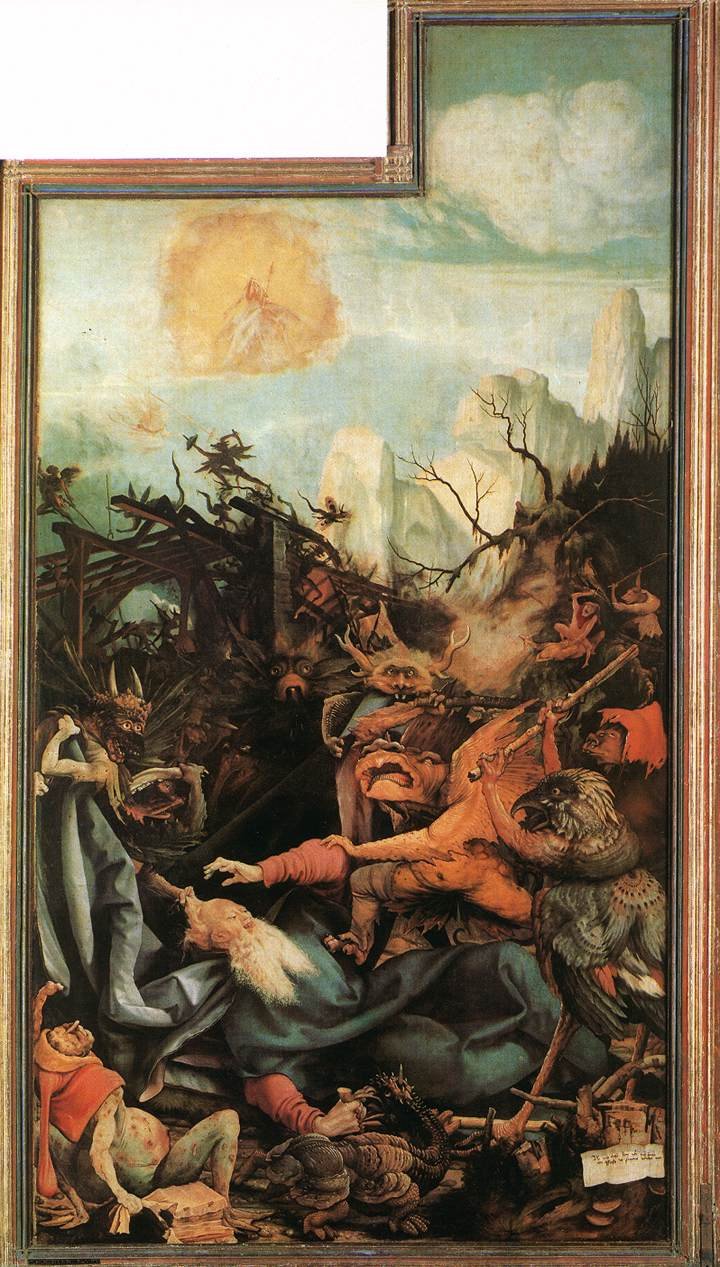
When I think about German Expressionism the Isenheim Altarpiece (1506 -1515) by Matthias Grünewald comes quickly to my mind. I know that it isn’t exactly an Expressionist painting (I’m aware of the anachronism), but all expressionism (and some Surrealism too: Max Ernst, for instance) is there already.

One of the topics explored by Matthias Grünewald in his altarpiece is ergotism, as we can see in the polyptych’s wing shown below:


It represents Saint Anthony being harassed by demons, but if you look closely on the lower left corner of the painting you will see a patient afflicted with Saint Anthony’s fire. This disease was caused by the ingestion of ergot infected rye and other cereals. Ergotism produces  seizures and hallucinations (hence the demons) as well as gangrene of the limbs and peeling. Ergotism also explains the strange look of Matthias Grünewald’s Christ in the aforementioned altarpiece. There was a spiritual connexion between the son of God’s suffering and the suffering of the diseased.

The depiction of human pain (often psychological pain instead of physical agony) isn’t the only theme explored by Expressionist painters (and it certainly isn’t this artistic movement’s monopoly), but it certainly is an important part of the aforementioned style. Otto Dix remembered Matthias Grünewald and the polyptich form (a tryptich with a predella: a gallery comic) when he painted Trench Warfare, 1929 – 1932, his own version of human suffering in WWI:

Continue reading

Utilitarian Review 10/23/10

On HU

Kinukitty reviewed the yaoi manga How to Seduce a Vampire.

Andrei Molotiu examined how it changes our view of comics to see original comics art in a gallery context. (This is the first in a new series edited by Derik Badman reprinting academic articles and essays.)

Richard Cook examined 80 years of Asians on mainstream comic book covers.

I talked about Moto Hagio’s short story Angel Mimic.

Vom Marlowe talks about the novel Blackout by Connie Willis.

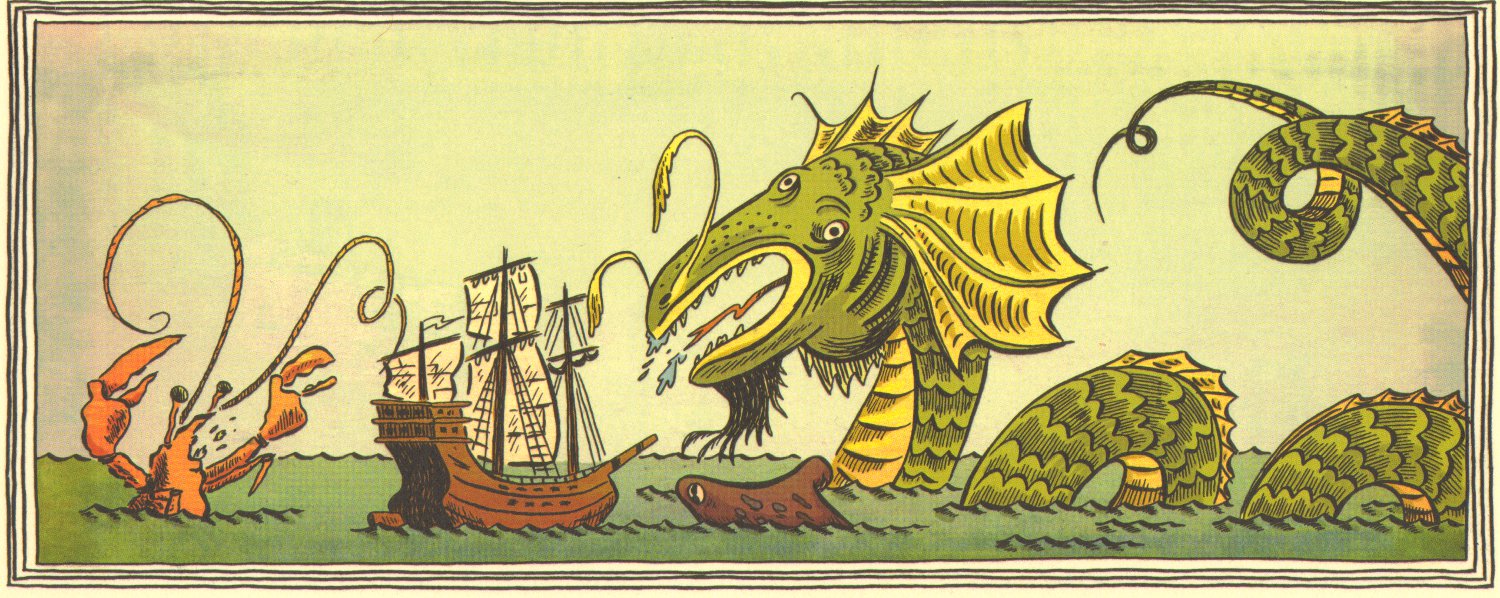
Caroline Small discusses Alexis Frederick Frost’s wordless minicomic Voyage.

Utilitarians Everywhere

At Madeloud I review doom metal band The Body’s album All the Waters of the Earth Turn to Blood.

Other Links
I quite like science blogger John Horgan.

This article, with Sesame Street appearances by Destiny’s Child, Stevie Wonder, and Paul Simon, is great.

Here Be Lovely Monsters: Alexis Frederick-Frost’s Voyage

A couple of categories dominate mini-comics at SPX: the quick-and-dirty ones with simple drawings and simple or no text, usually photocopied, and the visual-artifacts-with-really-nice-art ones, which are beautifully drawn and decently- to well-printed, but often with “stories” that are rarely more than journal entries or slice-of-the-mundane or just random patter – hat racks for the high-quality art.

Exceptions to the hat rack problem are most often found in wordless mini-comics. The best example in my stash is Alexis Frederick-Frost’s simple but gorgeous “Voyage.” (I originally didn’t think this comic had a prose name: it’s not on the comic and I didn’t immediately locate it on his blog; I’ve been calling it “The Here Be Monsters Mini-Comic.” I was a little disappointed to discover that it did have a title!)

Continue reading