Still not a comic, Blackout by Connie Willis

It’s been a long time since Connie Willis, author of To Say Nothing of the Dog, has come out with a book.  She’s been working on a book about World War II for years, and it is finally finally out.  It was so large that it had to be divided into two volumes, in fact.  Blackout was released in spring and the conclusion, All Clear was released this week.

Today I’ll be talking about Blackout.  This review contains some spoilers for Blackout, but (because the mysteries are fairly crucial ones), I have tried hard not to include any spoilers that go through to All Clear.  All spoilers (which are general and I hope minor) for Blackout are beneath the jump cut.  If you want to know whether you might enjoy Blackout and haven’t yet bought it, or if you bought it but kind of gave up because you became confused, bored, or puzzled, here’s what I loved:

Blackout is about war.  Not war in the trenches, which is ably covered elsewhere and which I hope (fervently) that I will never see, but a war at home.  It is about the civilian side of war, where everyone, in a sense, becomes a soldier.  It covers the Blitz in London and it covers the Evacuation of the children to the country, and it covers that most amazing of events the evacuation at Dunkirk, where the British Expeditionary Force was rescued by a lot of Sunday sailors and fishermen.  (If you don’t know about this, go find out.  It always makes me cry.)

Continue reading

Moto Hagio: “Angel Mimic”

I’m blogging my way through Fantagraphics’ Moto Hagio collection, “A Drunken Dream.” You can read the whole series of posts here.
_________________________________

Hanshin: Half-God and A Drunken Dream were both more plot hole than story; odd broken fairy tales with glimpses of trauma breaking through the prevailing aphasia. They’re unique, bizarre, and lovely.

“Angel Mimic” is, alas, much better constructed. There’s foreshadowing, thematic development, a final shock reveal — in short, all the elements of a traditional plot. As for what that plot is… Joe McCulloch over at Comics Comics has a good summary.

while a double-barreled blast of soap opera sees a suicidal girl hauled off death’s doorstep by a rough but handsome man who *gasp* turns out to be her new biology professor, resulting in detailed, evolution-themed educational segments (not unlike the learning bits in Golgo 13 or a Kazuo Koike manga) inevitably lashed to Our Heroine’s Dark Secret. “I wonder if humans will evolve into angels?” she muses, probably gauging the reader’s appetite for comics of this tone.

Joe’s a kinder man than I, so he doesn’t quite come out and say it, but — yeah, this is godawful. In her better stories, the fact that Hagio’s characters never for a second seem real gives her world an eerie air of unreality, like they’re pasteboard props erected to conceal an abyss. Here, though, more of the cracks are filled in, and Tsugiko ends up seeming less like a mask concealing wells of emotion and more like a hollow doll being pushed by rote towards the inevitable epiphany. There’s initial tension with the man who saves her — he wanders back into her life — they are thrown together by circumstance — they happen to meet her ex — they separate — they come back together — the secret is revealed — happy ending.

That secret (and hey, I’m going to spoil this crappy story now, so be alerted)….

Continue reading

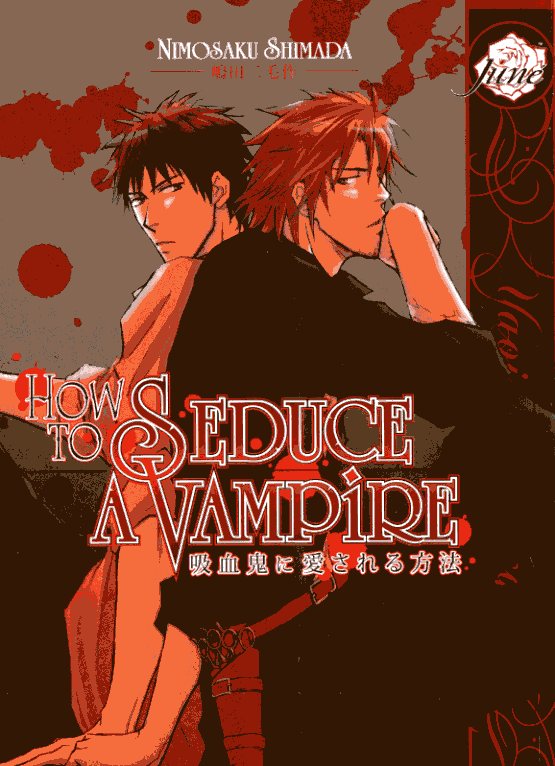
Gluey Tart: How to Seduce a Vampire

Nimosaku Shimada, 2010, Digital Manga/Oakla Publishing

Aaaaarrrrggggghhhhhhhhhhhhhhhh!

No, really. This is a disaster. It can’t be happening. I cannot go on. I cannot bear the pain. Etc., etc. Because I thought there was a second volume. I don’t know why I thought that – probably confused it with Portrait of a Vampire, which does have a second volume – not that I care. Damn it. I have finished How to Seduce a Vampire and I was secure in the knowledge that there was more waiting for me, BUT THERE ISN’T. There isn’t even anything else available by Nimosaku Shimada. I may take to my bed and pine. Pine desultorily, and gnash my teeth in sheer vexation. Then nap.

This book snuck right up on me. I was wary, because, you know, my heart’s done time. (I thought that was kind of clever. You see, “Heart’s Done Time” is an Aerosmith song, from Permanent Vacation, a not completely intolerable album that was the middle of the end for a band that used to be one of the best and became – what they became. Heavy sigh. Now I’m thoroughly depressed.) Anyway. I love me some vampires, and vampire stuff has never been hotter, but – to take liberties with the state motto of Alaska – the odds are good, but the goods mostly pretty much suck. Since it is too late to make a long story short, let us at least summarize succinctly by saying I am wary about vampire films, books, and manga. I expect to be disappointed, and I usually am.

Continue reading

Utilitarian Review 10/16/10

On HU

Matthias Wivel praises both pop and Popeye.

Sean Michael Robinson talks about his experiences making 24-hour comics.

Derik Badman has translated an article by French creator Fabrice Neaud about Aristophane’s Conte Domoniaque.

Ng Suat Tond discusses original art by Jaime Hernandez.

Vom Marlowe reviews Dungeons & Dragons #0.

Caroline Small discusses Frank Kermode, James Sturm, writing and reading.

And I started a thread to talk about what should and should not have been included in the Best American Comics 2010.

Also at HU, we’ve started using Read More cuts. I’m hoping this will make the blog a little easier to navigate. If you have thoughts on the change, please let me know in comments.

Utilitarians Everywhere

At The Chicago Reader I review the Neil Gaiman edited Best American Comics 2010.

Certainly there were loads of Sandman spin-offs. DC has, following Gaiman, shown some interest in fantasy-oriented series—the currently ongoing Fables for example—and independent titles like Gloomcookie and Courtney Crumrin followed a goth-oriented, female-friendly path. But these efforts were marginal. Overall, post-1990s, the mainstream comics industry first drifted and then scampered towards massive, complicated stories mostly of interest to a male, continuity-porn-obsessed fanbase. Gaiman moved on to writing novels (notably, sophisticated fantasies like Neverwhere and Coraline), and the formula he created was largely ignored. Instead of creating goth comics for girls, American companies chose to stick with insular cluelessness and let the Japanese have the female audience. Manga comics, especially those aimed at girls, exploded in popularity here. And that, in case you were wondering, is no doubt why the Twilight comic adaptation isn’t drawn by homegrown artists like Jill Thompson or P. Craig Russell or Ted Naifeh but by Korean illustrator Young Kim, in a manga style.

At his blog, Bert Stabler and I debate Funny Games, I Spit on Your Grave, horror and evil.

Bert: Everyone loves being blamed for their privilege, EXCEPT when it’s by someone who shares (and exceeds)that privilege. Basically, the beauty of Funny Games is that of a vulture feeding in the desert, not a cockfight. It’s not a guilty pleasure that excuses itself with self-awareness– it’s bloodthirsty pornography that reminds you that actors in pornography have actual lives.

At Splice Today I have an essay about Manny Farber and Paul Feyerabend and termites and Galileo. Unfortunately, they kind of chopped off my original ending, making me sound more sincere than I am. This is the original conclusion; imagine it’s there if you click over to read the essay.

Ultimately, Feyerabend concluded that his wish for a new insect view of the world was “just another example of intellectualistic conceit and folly.” Farber, too — in true termite-art fashion — disavowed his essay on termite art. Demanding an end to white elephants is a white elephant way to behave; ultimately termites to stay termites must eat themselves. What they leave behind them is, perhaps, a small space filled with meaning — the not-termite, trumpeting its victory.

At Comixology I write about Quentin Blake’s amazing children’s book, The Story of the Dancing Frog.

The picture of Gertrude picking up the frog is both moving and goofy. Gertrude is half in the water, her facial expression hard to read. The trees form an arch overhead, and her dress is pulled back by the water. It’s a ritual and sensual scene, like a rebirth or a wedding. The frog, on the other hand, is clearly not quite up to the role of Prince — it looks helpless and bizarrely cheerful with its googly eyes and gangly body, no more aware of the affection it’s inspired than an infant. Its obliviousness, though, only makes the moment more poignant. Without knowing it, it is both lost husband and child that never was, a lifeline that cannot possibly bear the weight put upon it.

And finally at Madeloud I have an article about musical guest stars on the 1960s Batman TV show.

Best American Kvetching 2010

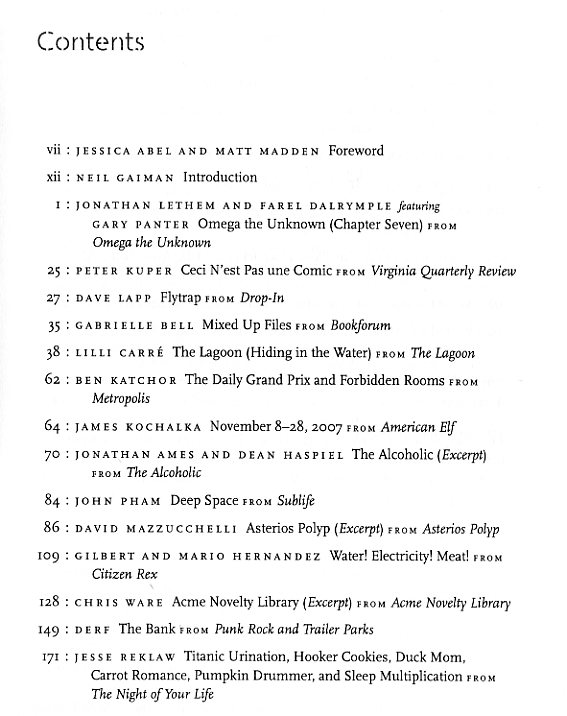
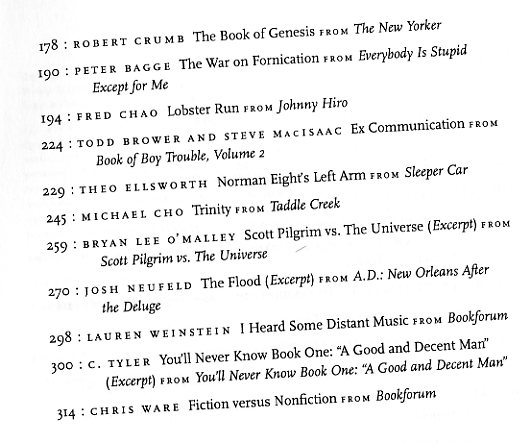
The Best American Comics 2010 edited by Neil Gaiman just came out a week or so ago. Here’s the table of contents:

My review of the book is here but I wondered…what do people think should have been included that wasn’t? And (since this blog abjures excessive positivity as bad for the soul) what do people think shouldn’t have been included that was? (Remember despite the title releases should actually be from 2009.)

I’ll kick it off — I think the worst piece in the book is probably Peter Kuper’s insipid anti-Bush boilerplate, “Ceci N’est Pas Une Comic. After that…um…Dave Lapp’s Flytrap with its mix of oleaginous condescension and crappy art is really bad…and the maudlin it-must-be-profound-because-it’s-about-9/11 excerpt from Jonathan Ames and Dean Haspiel’s The Alcoholic.

As for what I’d include: I definitely would have put in an excerpt from Johnny Ryan’s first issue of Prison Pit (which I reviewed here. ) I’d also have included an excerpt from one of Mo Willems children’s books, which are some of the most skillful comics around in whatever format (probably I’d have chosen something from the great Elephants Can’t Dance.) I’d definitely have chosen something from Kate Beaton too…and quite possibly from Garfield Minus Garfield.

The one piece in the book I agreed with down to my socks was the inclusion of an excerpt from Lilli Carre’s Lagoon, easily one of my favorite comics from last year. (I reviewed it here.)

So..use the comments to have at it. Feel free to include links to reviews of your own, too, if you’d like.

Frank Kermode: 1919-2010

I was thinking about Frank Kermode in the days before I learned, belatedly, from the eulogies printed in the London Review of Books, that he had died. I was trying to reconcile his opinion – oft shared by older college English professors during my undergraduate years – that reading was much more important than writing, with something James Sturm said at SPX: that to be psychologically healthy, you have to create as much media as you take in. Both seem intuitively wise, yet at odds, since nobody who read as much as Kermode could possibly write as much too and yet the breadth and seriousness of Kermode’s reading is surely the kernel of his writing and his contribution to literary study.

Kermode, like most male critics of his generation, tended to articulate a conservative response to the “politicization” of the humanities academy in the 1960s-70s and after. His values, he said, were those of the Enlightenment: disinterestedness, orderly thought, the search for wisdom and perspective. And yet his perspective, and his wisdom, were not all that divergent in their details from the insights of the early- to mid-century philosophy that informs so much of capital-T Theory. He wasn’t particularly conservative politically except in terms of academic politics, and his appreciation for Continental philosophy allowed him to read, and critique, the academic practice of Theory seriously when others of his generation could not. His own writing, especially 1990’s Poetry, Narrative, History deals with issues of narrative structure closely related to those of French narratology. 1965’s The Sense of an Ending prefigures social-science’s notion of a “risk society,” which has been treated frequently by Zizek .

But ever invested in the centrality of reading literature for sense, Kermode somewhat blames the academy’s politicization for society’s loss of sanity:

Continue reading