Facedown in the Mainstream: Dungeons & Dragons,#0

Rogers, Irvine, Di Vito, and Bergting.

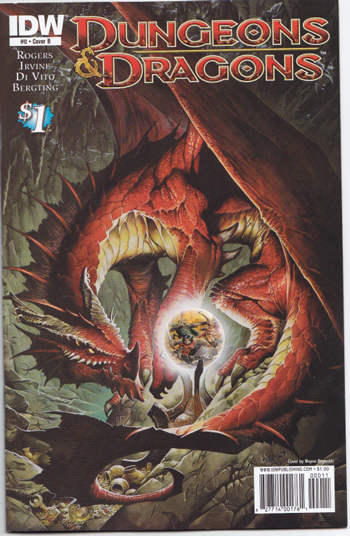
Years ago, when the Vom Marlowe was but a tot, she played D&D. And before anyone leaps down her throat, she would like to be very firm and forestall complaints from all and sundry gameboys. Yes, it was D&D. Not AD&D. Played from a skimpy pamphlet and some funny looking dice we had to mail order. So there.

Gaming creds out of the way (no, I still cannot remember what the devil Thaco is, thank you kindly), I shall move onto the actual comic.

This is not a good comic.  I shall admit this upfront.  It has a dragon on the cover (or at least on my cover, I understand there are several).  The human hero has shoulder muscles the size of a Toyota Prius, the colors are a tad murky, the ink is a bit thick, the plot is simple, and the jokes are silly.  And yet…  And yet…

I thoroughly enjoyed it.

Continue reading

Original Art: Love and Rockets

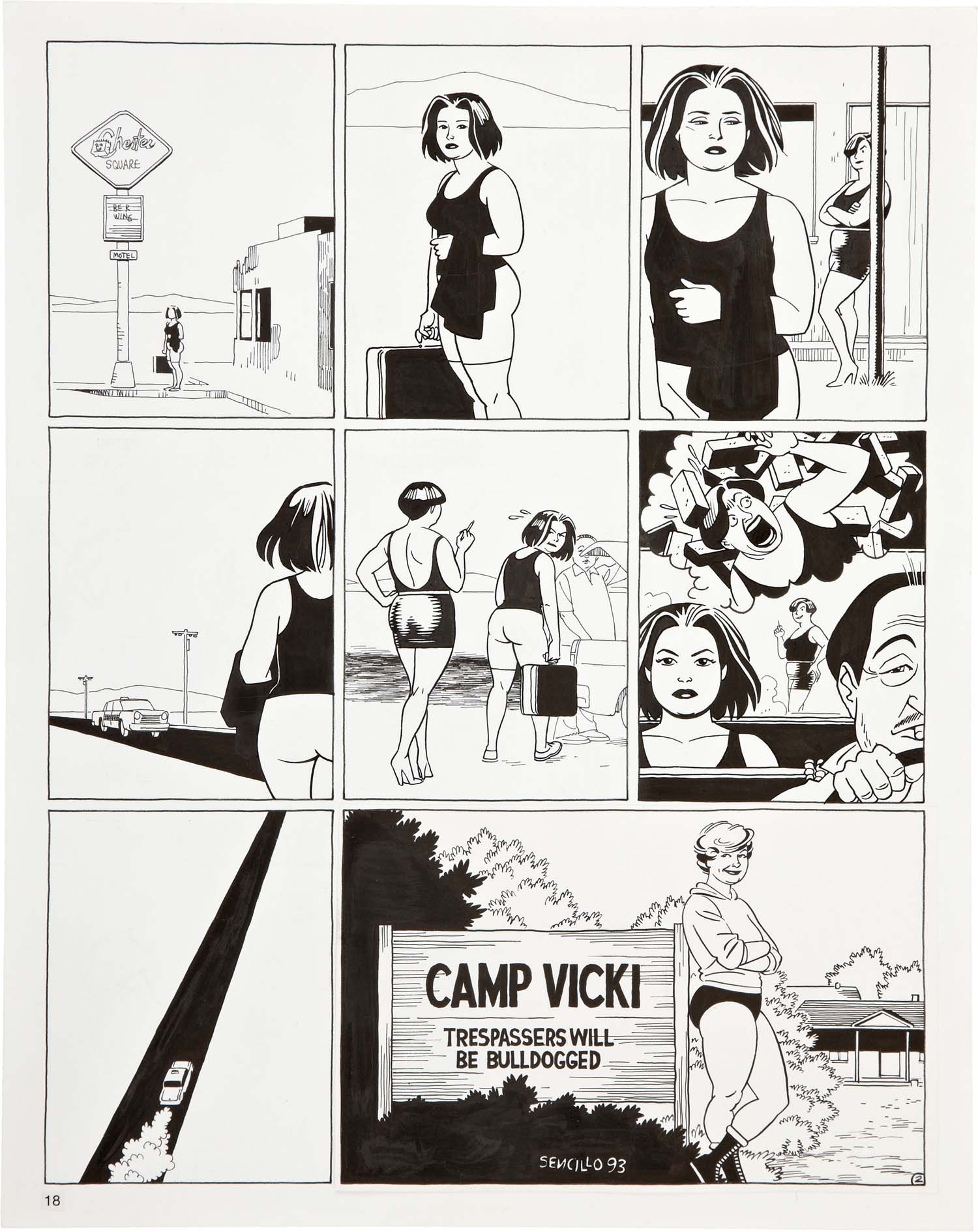
Some collectors will have noticed that Jaime Hernandez has been selling his original art via Heritage Auction Galleries since March this year. The general scarcity of Jaime’s original art is such that the prices achieved so far have sometimes been quite high with this handsome page from Chester Square (Love and Rockets #41, 1993) fetching $4780:

There is, however, much pleasure to be gained even from pieces of a more modest price. The following page from Love and Rockets #47 (1995, Chester Square) for example which cost a fraction of the page above:

Continue reading

Ceasing to Be- Improvisation and the 24 Hour Comic Experience

Last Saturday, at one o’clock in the afternoon, fifteen Seattle cartoonists packed into a sunlit room at the Phinney Ridge Community Center for a twenty-four hour annual ritual.  Burdened with snacks, lap boards and drawing supplies, everyone seemed a little unsure at first confronting the empty room.  But soon the mood changed as tables and chairs were pulled out and adjusted and windows and blinds were open to let in the last few hours of light.

For my part, I had built up quite a bit of excitement before the event.  I would be participating in a group organized by local cartoonist Henry Chamberlain, and consisting of several cartoonists and illustrators whose work I was familiar with, including Jennifer Daydreamer, Tom Dougherty, Eroyn Franklin, Marc Palm, and David Lasky, whose story “Minutiae” is the best 24 hour comic I’ve ever read.  So it was with much and excitement and a little trepidation that I began.

Continue reading

Utilitarian Review 10/9/10

On HU

This week started off with Erica Friedman talking about the Bechdel test and manga.

Alex Buchet wrote about fairy tales and silhouette art.

Ng Suat Tong reviewed Ma Li and Chen Uen’s popular Taiwan comic Abi Jian.

Richard Cook talked about gender in Final Fantasy XIII.

I discussed Alan Moore and the fans who hate him.

I talked about Moto Hagio’s short story Hanshin: Half-God.

And I reviewed Jim Collins’ Bring On the Books for Everybody.

Oh, and I think I’m going to stop with the music downloads. It’s been fun, but there’s not a ton of interest, and I spend too much time on the blog as it is!

Utilitarians Everywhere

At Splice Today I have an article encouraging gay teens to drop out of school.

Nonetheless, I find the message in the videos I’ve seen frustrating. Yes, it’s good for kids to know that things will improve. But high school isn’t a force of nature. It’s not a hurricane, or even acne. It’s not unavoidable. If high school is making your life miserable beyond all endurance—so miserable that you’re seriously considering killing yourself—then maybe you shouldn’t wait two or three years for your life to get better. Maybe you should just drop out.

Also at Splice Today I have an essay about the I Spit on Your Grave remake, feminism, the end of politics, and Funny Games.

The remake follows through on the group dynamics to some extent—the guys egg each other on; they bring Matthew along to lose his virginity, etc. But it abandons the effort to make the men appear like just folks. Ironically, the director Steven R. Monroe gives one of his characters a video camera, and we see some of the rape through the lens. This is an obvious effort to implicate the viewer, but in fact, this version of the story is much less accusatory than Zarchi’s original.

That’s because, instead of seeing the rape as a result of standard male group dynamics, Monroe tries hard to de-collectivize the guilt. In Zarchi’s version, the men were typical guys, and the rape, too, was therefore typical—a possibility for any man. In Monroe’s version, on the other hand, the rapists are individual monsters, a much less frightening idea.

At Madloud, I discuss 15 or so of the 15,000 covers of “Summertime.

This is fascinating, in a Hey! -that’s-Barry-Manilow-defecating-on-my-porch! kind of way. Philadelphia studio musicians turn Gershwin’s mournful lullaby into a giant lounge turd, complete with smooth-jazz intro and half-assed crappy disco cheese funk. For the full effect, imagine Paul Robeson dancing in a conga line with a white shirt open to his navel. Or, you know, don’t.

Other Links

Alex’s post reminded me of this awesome fairy tale resource.

I haven’t seen the Social Network, but the trailer looks terrible. I was pleased to see Jezebel buck the conventional wisdom and eviscerate it.

And this is several years old, but still an interesting article, on sexual harassment online.

Literature Will Eat Itself

An edited version of this essay first appeared in The Chicago Reader.
___________________________________________________

The last book but one I read was Jacque Derrida’s The Gift of Death, his late-career foray into deconstructionist theology.

To say that you recently finished reading a Derrida book for pleasure is obviously a fairly major throwdown (“Look at my brain!”) It’s also, though, somewhat uncomfortable — what sort of poseur reads Derrida for pleasure and then brags about it, anyway? In my case, the poseur-ness is only compounded by my motivations. I picked up the book because my brother (an English professor) had just mentioned his own Derrida reading, and I was feeling somewhat inadequate. Nor is this anxiety made any less shameful by the fact that the conversation with my brother occurred, not on the phone or in person, but in the comments section of my poncey comics blog. Said poncey comics blog being where I have most of my conversations with my brother these days. And yes, that’s embarrassing too.

Continue reading

Half-Drawn

I’m blogging my way through all the stories in A Drunken Dream, the collection of Moto Hagio’s stories out from Fantagraphics. You can see all posts about this collection here.
_______________________________________

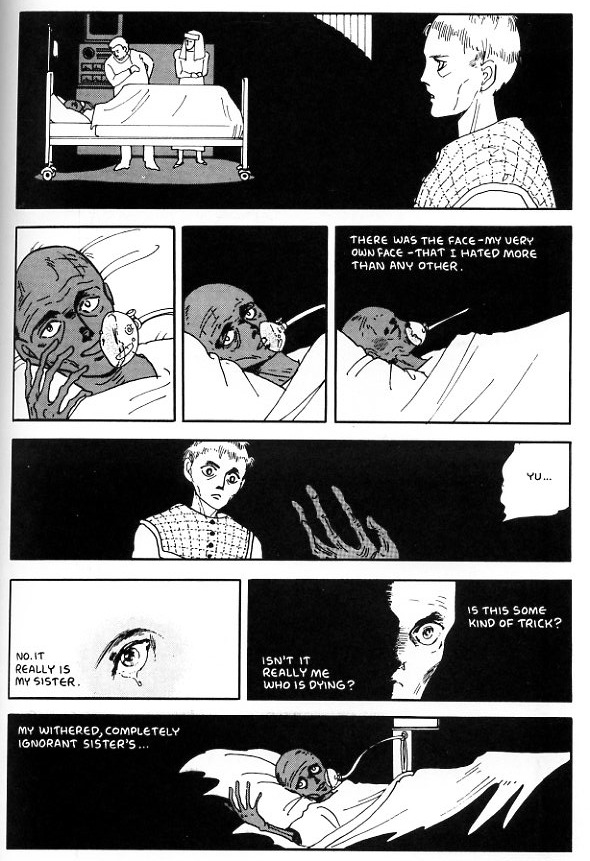
Moto Hagio’s “Hanshin: Half-God” is about Yudy and Yucy, conjoined twins. Yudy, who tells the story, is ugly, shrivelled, articulate, and competent; her twin sister, Yucy, is a beautiful, mute parasite, who sucks away both Yudy’s nutrients and the affection of parents, relatives, and passersby. Yudy has to help Yucy walk and bathe and perform even the simplest tasks; in return, the simple Yucy gives Yudy frequent fevers and bothers her while she tries to study genetics. Eventually, doctors decide that the twins will die if they are not separated; the only choice is to cut loose Yucy, who will die, allowing Yudy to live. Separated from her twin, Yudy grows into a normal young woman. The end.

Sort of. If that was the story, it would be a fairly straightforward, even banal feminist parable about casting off gender expectations in order to find your true self. Yucy, the delicate, helpless, beloved beauty, has to be destroyed before Yudy can grow up into a competent, independent woman. QED.

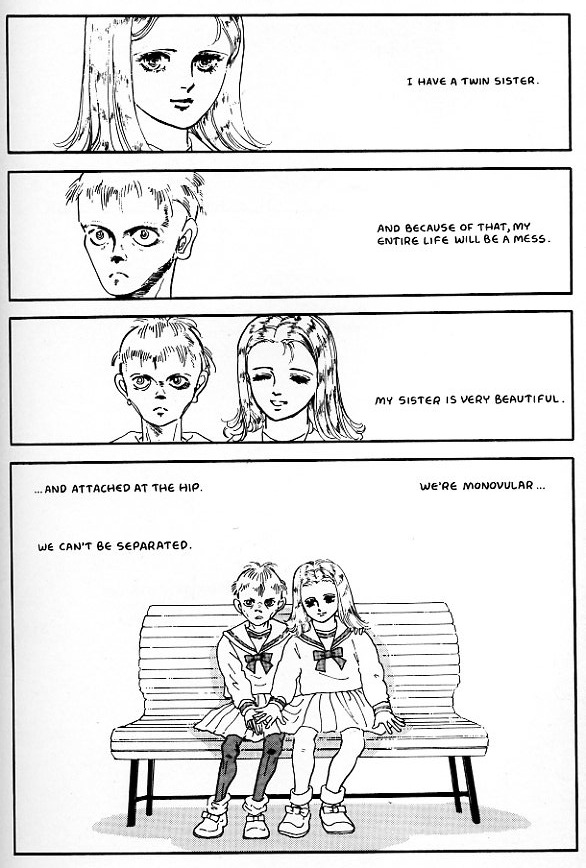
In this reading, Yudy and Yucy are different aspects of the same person…and there’s plenty of evidence for that in the art. For instance:

The first panel show Yucy off to the left against a blank background; then the second shows Yudy in the same position. In the third we see the two together…and only in the final panel on the page do we learn that they’re “attached at the hip.” The surprise reveal is, though, clearly rigged. If the two are attached, we shouldn’t be able to see them without each other. Particularly in the second panel, Yudy is placed so that we should see Yucy to her right — but all we see is blank space. The implication is that Yucy doesn’t exist except as metaphor…or perhaps, that Yudy doesn’t, since it’s Yucy we see first.

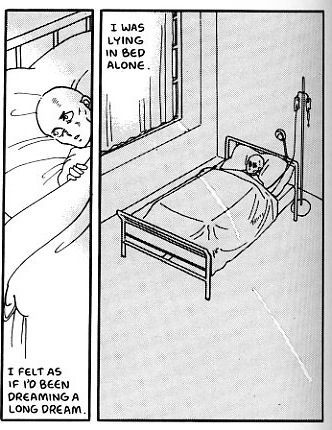
Again, just after the sisters have been separated, Hagio put in a tell.

“I felt as if I’d been dreaming a long dream.” The twin is just a fantasy; only when she is separated is Yudy living real life for the first time. The perfect girl she is supposed to be doesn’t exist.

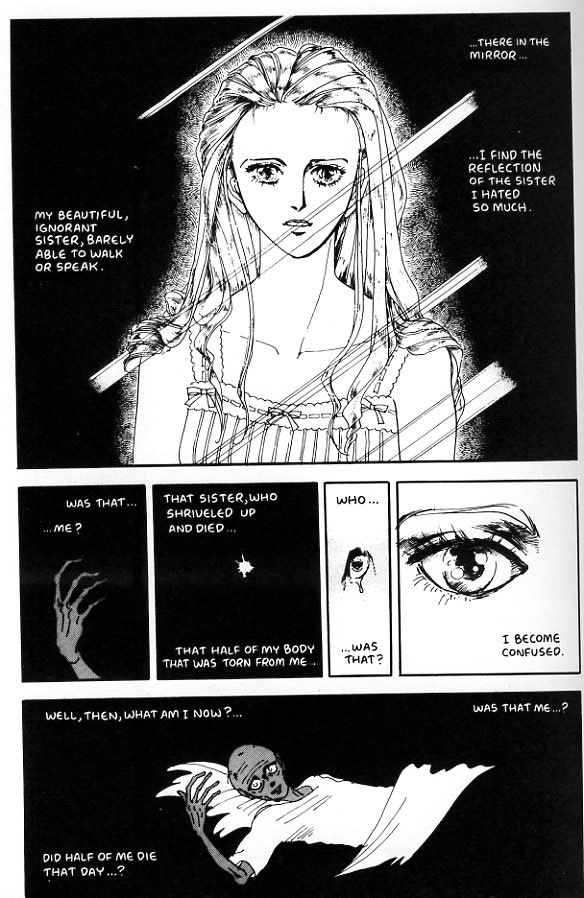
Except that she sort of does. Yucy doesn’t die immediately after being separated; instead she slowly wastes away. Yudy goes to visit her one last time, and is startled to see that her sister has turned into her own mirror image.

You could see this as still being about the escape from gender stereotypes — “Isn’t it really me who is dying? No it really is my sister.” Again, this could be a statement that the gender-normative self is not Yudy; that she has escaped other’s expectations. But the affect is off. Instead of joy or release, Yudy feels disorientation and grief. The self she has left behind is “really” a self; indeed, it now seems more like the real her than the her that has survived. As time goes on and she becomes healthier and healthier, Yudy begins to look like the sister who died, until finally she wonders which of them was killed:

The story is no longer about casting off an oppressive femininity. Instead, it’s about…what? Betraying the self perhaps…but how exactly? Has Yudy betrayed herself by turning into the femininity she thought she was rejecting? Or was the rejection of that femininity — which also encompasses childlike innocence — itself a betrayal? Or is it the loss of her pain which is a betrayal; leaving behind the helpless, shrivelled, wretched self to become a competent adult? If so, the bind seems double and unescapable; to grow up, one has to abandon one’s attractive weakness, but doing so is always a betrayal of that weakness. The child is not the adult, even moreso because the child is still there in your face. Or, perhaps, the conflict is not internal at all. Perhaps the bond that holds together Yudi and Yuci isn’t sisterhood or self, but love, and it’s the abandonment of that love for femininity which causes Yudi to both become more feminine…and to be haunted by the conviction that she has lost herself.

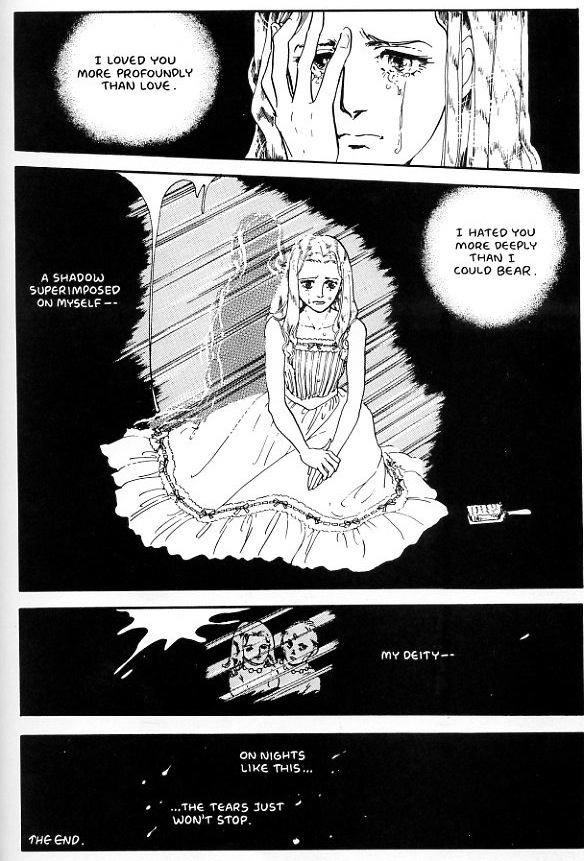
There isn’t any one “solution” to the story, of course. This is emphasized by the fact that there isn’t one Yudy, or even two, but many. In a recent post about doubles in comics, Caroline Small suggested that comics can do doubling in a way that is less “labored” than prose. I was skeptical about this — but Hagio’s story may have changed my mind. Because in “Hanshin,” the metaphorical uncertainty around Yudy and Yuci becomes an actual, concrete ambiguity. That is, when Yudy sees Yuci lying on the hospital bed, and wonders, “Is this me or is this my sister?”, the narrative insistence on ambiguous doubling actually obscures the concrete doubling — Hagio is, in this sequence, drawing the same person twice — or more accurately, six times.

Yudi and Yuci in Hanshin are just names, assigned as Hagio wishes to different iterations of the same body. In her confusion about who she is, Yudi is more, not less, aware of reality — she senses the arbitrariness of Hagio’s choices, the way that names and identities are linked, not as absolutes, but through arbitrary decisions.

We “know” that is Yudi, but if Hagio changes the words, it could just as easily be Yuci who grew up. Which raises the question…who is talking here? Is that Yudi? Yuki? Or is it Hagio herself? “I loved you more profoundly than love. I hated you more deeply than I could bear. A shadow superimposed on myself….My deity —” Whose shadow? Whose deity? If one is drawn as two and two as one, who is doing the drawing? The same person who did the killing? Is the deity the one who is there or the one who is not, and how can you tell the difference? To create your soul is to split your soul; a god who has always already left half of herself behind.

Dirty Hippies Who Don’t Read Batman


Fucking freak.

In case you missed it (as I did) Alan Moore gave a big interview a little bit ago to Bleeding Cool in which he talked about Watchmen and how he’s going to refuse to speak to various other of his collaborators because he’s a crank and, oh, incidentally, DC comics is run by what we would call disease-ridden rodents if doing so would not get us sued for defamation by capybaras with head colds.

As I said, I missed the interview, and didn’t actually read it in full until just now because, (a) I already knew that Alan Moore was a crank, and (b) I already knew that DC comics was a cess pit. So I felt I had the gist.

However, it turns out others saw some novelty there. Specifically, Tom Spurgeon has a really excellent discussion on his site.

So let me suggest that anyone that just throws their hands up and says “Oh, that Alan Moore is crazy” isn’t just operating from a dubious moral position, they don’t know their history. Forget 25 years of Watchmen shenanigans for a second. If I had had just the experience Alan Moore had with ABC, where I had this giant, multi-pronged project with a publisher not DC in part because they were not DC and then found out one day when I felt I was too far along to back out without screwing over all my friends that my projects were part of a big sale to DC, I would suspect that company of bugging my phone and poisoning my water. If I had had the subsequent experience of being promised certain protections from aspects of DC editorial and then that falling through in absolutely pathetic and super-aggravating fashion over the stupidest of nonsense, I wouldn’t trust them to keep their word on a single damn thing. And that’s just one set of experiences for Moore when it comes to DC. People get more worked up in many industries when someone bogarts their parking space or makes them turn down a paid-for week in Disney World than Moore does here about 25 years of systemic dickery.

Then, in response, T. Campbell argued that Alan Moore should be mocked.

I agree that throwing up our hands and saying “Alan Moore is crazy” does a disservice to Moore, and much more importantly, to the issues raised in his interview and the meta-issue of how a creative person should conduct himself in public. Unfortunately, that denies him the insanity defense, which could be a useful excuse when he airily dismisses both his old friends (ex-friends?) and every comics writer in the new generation, whose work he hasn’t read.

Your argument that other people are crankier with less justification seems a bit desperate. Other people are serial ax murderers; that doesn’t mean we need to set the bar of acceptable behavior low enough to make one-time-only murder okay. Yes, we have all had bad-tempered moments, but the reason comics people care about Moore’s behavior in the first place is that his talent and career have made him a role model. And when role models fail, we should pay attention, because what happened to them could happen to us.

No one’s even mentioned that Moore has also airily dismissed the entire medium of film, several times, but oh it turns out he really just meant all the films that are playing now, which he hasn’t seen, and please won’t you watch his new film project which gets it all right?

Campbell also says:

I’ve never entirely understood the comics community’s addiction to tales of corporate betrayal. When an boulder doesn’t fall on you immediately, but waits for a few minutes and then falls on you, is that a “betrayal?” Because it seems to me that corporations in general don’t have a set of values to betray. They like money. That’s all there is to it. They pursue ethical behavior when it is profitable for them to do so, and individuals at the company are sometimes moral people, but a company is about as moral as a boulder, because it is a group of people with sometimes-conflicting values and opinions brought together by common profit. The basic failure to understand this, the continued attempt to anthropomorphize companies as if they were individuals you could trust or talk to, strikes me as a common failing of the artistic imagination.

Tom Spurgeon supplies an able rebuttal, with which I pretty much agree. I wanted to point out a couple of things from a slightly different angle, though.

First of all, Campbell suggests that Alan Moore is crazy. His primary evidence for this is that Moore dismisses old friends, dimisses comics writers in the current generation whose work he hasn’t read, and dismisses today’s films without having seen many of them. This is not how a “creative person should conduct himself in public.”

One does wonder which creative persons Campbell is thinking about precisely. Not Kanye West or David Boreanaz, I take it — or even Lady Gaga, presumably. Really, is there anybody out there who expects creative people to be beacons of propriety? I thought the expectation was that, on the contrary, creative people would be unpredictable and sometimes not especially nice, what with the driving ambition and the money and the fame and all. Hasn’t Campbell ever seen Behind the Music?

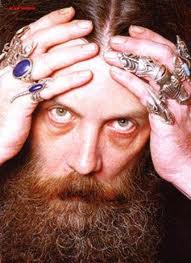
Anyway, while he’s no Varg Vikernes, it’s true that in his own small way Moore is a crank, and from all appearances a very difficult person to deal with. He believes he’s an actual wizard, for goodness sake. His habit of dropping friends is infamous, and he talks smack about his co-creators in public like he’s a rock star rather than a comic book writer. He lived in a polyamorous relationship for some time, and he writes underage pornography and even uses his real name while doing it. He’s a big, dirty hippie with a strong conviction of his own genius, and he’s a lot weirder than the average comics creator or fan. This is not news to even a small degree. In fact, I think it’s safe to say that Moore’s highly unusual career, including its very substantial achievements, probably has something to do with the fact that he comes at comics from an idiosyncratic perspective.

But — how idiosyncratic is it, really, to sneer at contemporary film without really being especially up on it? Or how weird is it to say, “comics today suck” without having read a ton of them? People do that sort of thing all the time. And there’s no reason not to, is there? If you disagree, you disagree, if you agree, you agree. He’s shooting the shit, the way most people do when they talk about art. What’s the harm?

Campbell actually explains the harm in a second post.

Bottom line: I don’t see how there is anything “reasonable” about dismissing large bodies of work, and indeed entire media, that one claims not to have consumed. I can’t help but see a parallel between that kind of closed-mindedness and the closed-mindedness that keeps many people from reading comics.

“The closed-mindedness that keeps many people from reading comics.” It’s the ultimate insidery comics insult. You’re one of *them*, Alan! One of those evil people who doesn’t want to read comics, who thinks we’re a bunch of juvenile morons who don’t know that underwear is worn on the inside! Traitor! Traitor! Traitor!

The main infraction, the “bottom line” that makes Moore not “rational” is the fact that he basically doesn’t give a shit about the stuff he’s supposed to give a shit about. He doesn’t want to read contemporary comics; he doesn’t want to go to the movies. He just wants to crankily complain about them. He’s dipped his toe in once or twice at some point, presumably, he discovered he didn’t like it, and, instead of gripping tighter and tighter in nostalgic ecstasy while searching, searching, searching for the one piece of gold amidst the variant covers, he just said “fuck it.” He’s (gasp!) not a fan. And we all know that if you’re not a fan, you must be insane. And also a bad person. QED.

What’s especially interesting about this is that Moore’s criticism of the comics industry’s practices and creativity is actually tied to fannishness as well. Moore basically argues that DC is screwing him over in substantial part because they’re not creative; they just want to keep recycling the same old properties rather than coming up with something new.

This recycling is, of course, at the center of the current mainstream comics industry. Moore has, more than anyone, shown that said recycling can actually be creative and exciting. But for all his magic, he’s never been able to convince fans of that old dictum, “it’s the singer, not the song.” The mainstream audience remains much more interested in the old moldering properties than it does in the creators who reanimate them. And mainstream companies remain much more interested in what to do next with Batman than they are with what to do next with Alan Moore.

This is why Campbell’s pragmatic ode to the unculpability of corporations rather elaborately misses the point. Tom Spurgeon points out that, “Both DC Comics and Drawn and Quarterly are companies, but one has a mixed record when it comes to how it exploits people and one has an exemplary record,” which is true, but even that’s not exactly the issue. Rather, the issue is that mainstream companies act the way they do because of their history and because of their relationship with their readers and their creators. The music industry is a bastion of nightmarish evil, but they wouldn’t have fucked over Alan Moore in the particular way DC fucked over Alan Moore because you don’t treat creative talent that way in the music industry. And you don’t treat creative talent that way because the creators are more important than any individual thing they create. Fans pay attention to the creators; they care about the creators, not the individual album or the character. Beyonce can make up an alter-ego named Sasha Fierce for one album, but no industry exec is coming along to say, you know, we’re going to take this character and have it record polkas whether you want us to or or not. They don’t do that because it would be fucking ridiculous, and fans wouldn’t stand for it. But DC does it to Alan Moore and fans not only eat it up, they sneer at the man himself when he dares to suggest that the folks they plan to get to write the polkas are soulless, talentless hacks. (Moore even seems to be dissing Grant Morrison! Sacrilege!)

Tom writes that, “I think a lot of this comes down to the fact that for whatever reason, Alan Moore didn’t conduct himself in a way that suited comics fans.” I think that’s right, and I think the reason it didn’t suit comics fans is pretty clear. Namely, it didn’t suit comics fans because Moore is declaring that he is not one of the club. Further, he is declaring that the club screwed him over. His work has been bastardized and his pocket picked precisely because of the insularity, backwardness, and lack of creativity of mainstream companies, mainstream creators, and mainstream fans.

And how do the fans reply to this accusation? By declaring — Fuck you, you dirty hippie, you don’t even read Batman, why should I care what you think? And, oh yeah, how dare you be paranoid or bitter, huh? If you can’t smile and cheer for the latest crossover, then just take your beard and your polyamory and go suck on a snake demon or something.

But, hey, leave those IPs behind when you leave, damn it. I need a Rorschach plush toy for Christmas.