Review: It Was the War of the Trenches

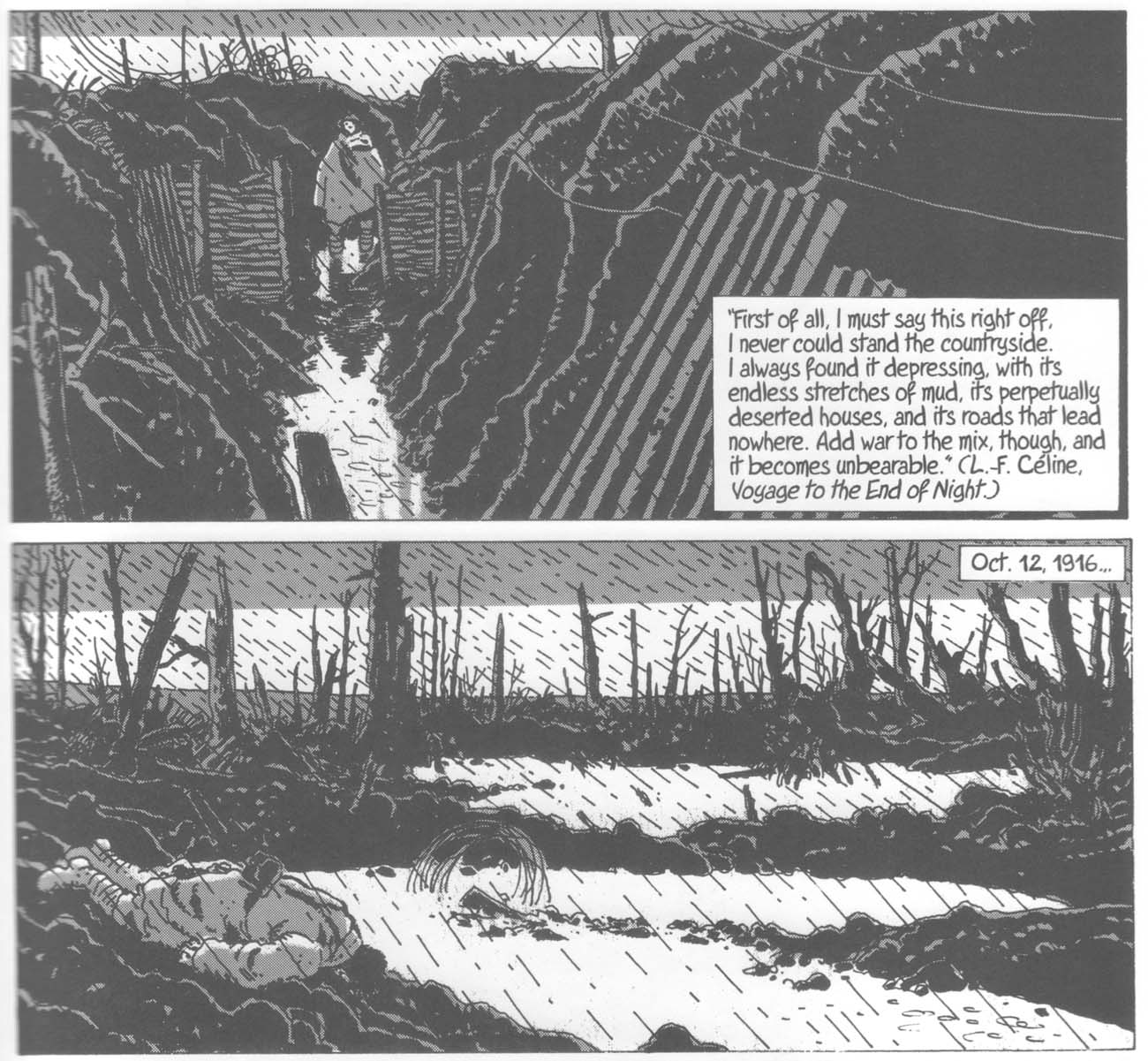
When two specks in the distance start shooting at Ferdinand Bardamu on the first page of Céline’s Journey to the End of the Night, he quickly comes to the unshakable conclusion that it is all a big mistake. His only viable option is to get out of that situation as soon as possible. The colonel overseeing his fate, a man with no use for fear, is deemed a “monster” and “worse than a dog”, but absolutely typical of the army as a whole:

“…I realized that there must be plenty of brave men like him in our army, and just as many no doubt in the army facing us. How many, I wondered. One or two million, say several million in all? The thought turned my fear to panic. With such people this infernal lunacy could go on forever….Why would they stop? Never had the world seemed so implacably doomed.”

Bardamu’s attitude is one of absolute revulsion for his commanding officers. The report that his sergeant has been blown up while going to meet a bread wagon is an occasion for celebration (“that makes one less stinker in the regiment!…In that respect you can’t deny it, the war seemed to serve a purpose now and then!”). The countryside? Even on the best of days “dreary” and godforsaken, “if to all that you add a war, it’s completely unbearable.”

Continue reading

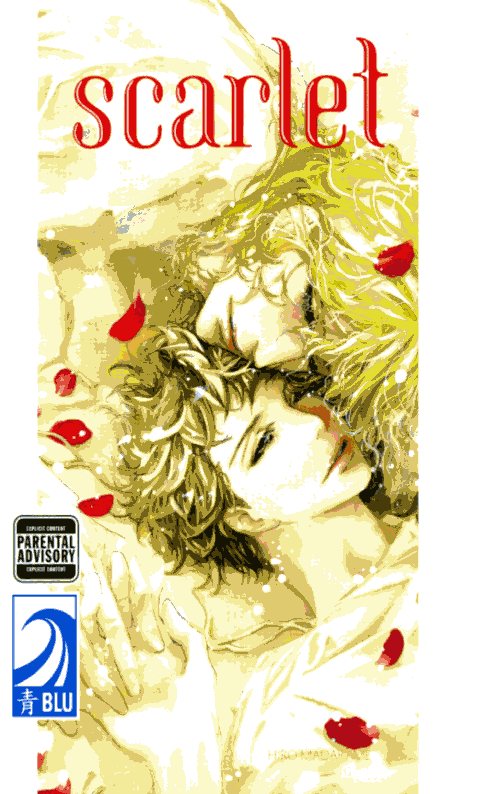
Gluey Tart: Scarlet

Hiro Madarame, 2010, BLU

Pretty! Pretty, pretty, pretty!

That is all.

No, of course it isn’t. You didn’t believe that, did you? Really.

There are a couple of multi-chapter stories in Scarlet, and they are – odd. I honestly don’t even know what I mean when I say a yaoi story is odd – I mean, they range from full-on crack to quasi-realistic depictions of human existence (leaning heavily toward the crack, of course). I suppose this one is an unexpected mixture of the two. Which makes it not only pretty but worth reading, as well.

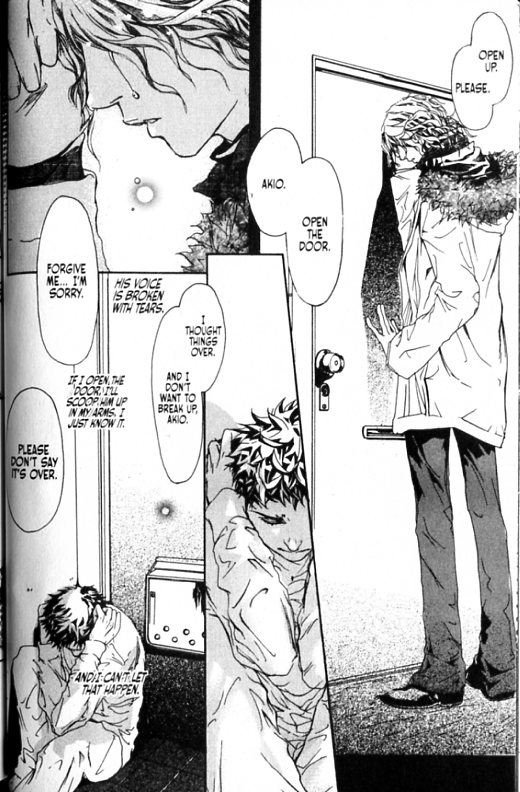
The first story arc, for which the book is named, kind of messed with me. It’s about Akio, who is a nice guy, and Ryo, who is not. But it’s not simple. Ryo looks like a beautiful, aloof womanizer, but he is in fact a shy, lonely mess. Well, he is beautiful, and certainly a cheat. But mostly a lonely mess. He starts following Akio like a puppy after Akio makes the only offer of friendship Ryo receives after moving to a new school. They become lovers, by Ryo goes out with any girl who approaches him. He has epically poor judgment and impulse control. He is also largely unable to take responsibility for himself, and he’s a big crybaby as well. One is left kind of wondering why Akio, who seems like a pretty normal, together guy, keeps putting up with this shit. Except that one might possibly remember what it’s like to be young and desperately in love.

Anyway, Ryo makes love to Akio and then leaves him hanging because some girl asks him out. The pattern repeats itself over and over, and Akio is pretty much OK with it. He obviously loves Ryo, and he understands that Ryo is fucked up, and that’s how it is.

Things more or less work out, until Ryo hooks up with Tae, who is one cold bitch by anybody’s standards. And a truly disturbing plot twist ensues. It’s more than hinted at on the first page of the manga, but I’ll just say there’s a bizarre and distasteful bit of violence, and the resolution, while played as a mostly happy ending, is perhaps even more disturbing for that. Because they wind up together, and Akio is, as I said, a nice guy, and Ryo is an unstable freak.

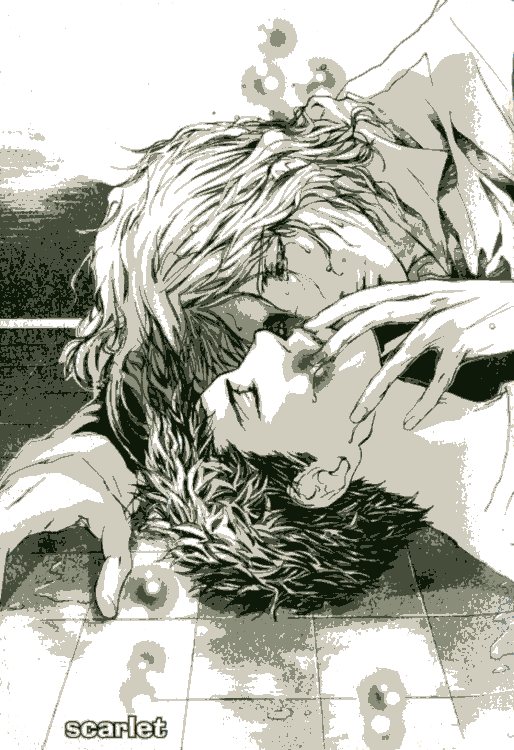
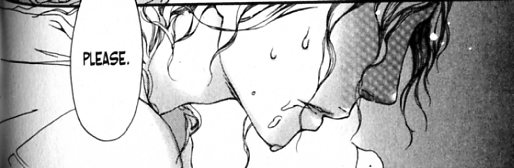
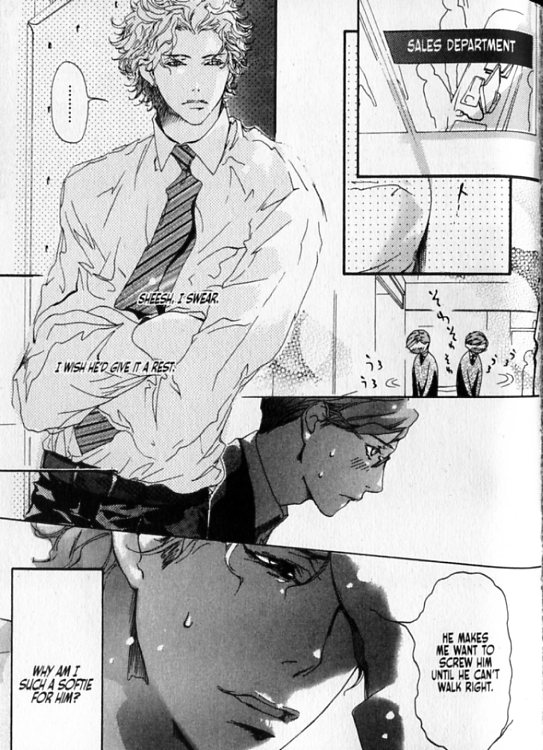
This all sounds unpleasant, and it is. But what intrigues me is that Madarame manages to also convey the love and the tenderness in this relationship. This story contains some really moving romantic bits. Some of the panels are breathtaking – beautiful lines, deftly physical poses, and very hot sex. Her kinetic style (did I really just write that? “Her kinetic style”? Good grief.) really conveys Ryo’s frantic clinging, and Akio’s helpless love for him. (There are also a lot of hyper-deformed panels – I mean, a lot a lot – which I’m not especially into, although I’d like it less if it didn’t fit so well with all the frenetic pushing and pulling throughout the story.)

The second story, “One Night Stand,” is much less worrisome, while retaining the troubled intimacy I liked so much in “Scarlet” (the story). Nobody appears to be mentally ill, for example. I don’t rule that out the way I do, say, a young-looking boy with big eyes and short shorts, but if the character does actually seems psychotic, that is, well, grueling. So I was ready for a break. The second story is all about repressed passion. A nondescript young salaryman, Harumi, watches a not-nondescript hottie in the elevator every day, working himself up into a (very quiet-looking) fervor. When he sees said hottie, whose name is Toki, in a gay club one night, he’s built up enough steam that he can’t help going after him. Toki is there on a dare, and Harumi isn’t wearing his glasses, and as everyone who’s ever seen Superman knows, people are completely unrecognizable when they have their glasses on. So Harumi assumes he’s safe; he’ll live his fantasy for one night, or try to, and go back to stalking Toki in the elevator with no one the wiser.

Um, sure. Whatever. Toki is interested and goes to a love hotel with Harumi, and some really nicely imagined and beautifully rendered sex ensues. It is lovely, gentle, and hot.

The next day, Harumi is shocked – shocked – that Toki recognizes him. Toki stays on the elevator past his floor, waiting for everyone to get off, and then says, “Good morning, Harumi.” Such small details, but the body language conveys the swirl of emotion they’re both feeling. Harumi tells Toki he must have him confused with someone else, and Toki says, “So that’s how it is. Sorry.” No! The agony! The longing! Oh, it’s delicious. Harumi wrestles with his disappointment and his need and his shyness after that moment, but he can’t get up the courage to change things. Until he sees Toki at the bar again one night, when all the bottled-up emotions come out and he makes a scene. Tender declarations and hot sex ensue. Very satisfying. There’s a short third chapter, an epilogue told from Toki’s point of view, which is less heaving with terrified lust and more, er, straightforward. Which is obviously the wrong word. But it’s a refreshing ending to a very cute story.

There’s another short sequence at the end, about a hot player who’s slowly and gracelessly coming to terms with having fallen hard for a dork. This appeals to me for obvious reasons.

Scarlet is a beautiful book. The cover is beautiful, the color splash page is beautiful, and the art is beautiful. I really hadn’t expected to like it; this was one of my “I’m so smitten by the cover I’m going to buy it anyway, even though I’ll hate myself in the morning” purchases. Sometimes those lapses in judgment work out after all.

Utilitarian Review 9/18/10

Submit to the Hooded Utilitarian!

As regular readers have probably noticed, HU has been taking tentative steps away from group-blogness and towards kind-of-sort-of-magazineness. I don’t think we’ll ever abandon having a regular roster of bloggers, but I do hope to continue to get more guest writers.

Which is where you come in. I would love to hear from new writers. If you have an idea for an article, please contact me at noahberlatsky at gmail. The best way to get a sense of what sorts of things we write about is to look back through the archives…but if you don’t see the kind of thing you want to write about there, don’t let that discourage you. We probably just haven’t gotten to it yet!

Also, this seems like a good time to announce that we are planning to debut several new columnists over the next couple of months.

Sean Michael Robinson, a cartoonist and art teacher (who you may remember from this article) will start with a new monthly column next week.

Stephanie Folse (aka Telophase), a former columnist for Tokyopop (and author of this article) will also be joining us as a monthly columnist starting in October.

Artist and critic Derik Badman will also be joining us. Derik is going to be organizing a feature where we reprint academic articles or (if we’re lucky) excerpts from academic books that focus on comics. We hope to run this feature once a month, if we can find willing academics (if you are such an academic, and would like to see an article of your reprinted on HU, please contact Derik Badman: first name . last name AT gmail dot com (no spaces, all lower-case)).

In addition, Domingos Isabelinho, Derik Badman and possibly Alex Buchet are working on some translations of French comic criticism, which we should be publishing over the next few months.

And we’ve also got several interesting guest posts lined up, as well as some roundtables and, of course, our regular bloggers will keep doing our thing. Thank you all for reading and commenting!

On to your regularly scheduled Utilitarian Review….

On HU

We started off the week with a long post by Matthias Wivel about the great mangaka Yoshiharu Tsuge.

Ng Suat Tong followed up with a post focusing on Tsuge’s manga Red Flowers.

Richard Cook discussed his experience at SPX.

Alex Buchet continued his series on comics and architecture, including a gallery and a half of examples.

Vom Marlowe discussed an anatomy book from ImagineFX.

I wrote about Alex Toth, minimalism, and realism, inspired by a post by Matt Seneca.

And death, sludge, doom, and some mud in your weekly music download.

Utilitarians Everywhere

At Splice Today I got paid to write poetry! Only five haikus, but still. This is the best one:

Drat. I have no pants.
The days are cold; the nights, cold.
Here I sit. Help me.

At Madeloud I reviewed the new album by the electronica outfit Dead Fader.

At the Chicago Reader I recommended an exhibit of Chinese Buddhist cave art at the Smart Museum.

Other Links

Robot 6 talked to Dirk Deppey about what he read last week.

Melinda Beasi continued the discussion of gender and shojo manga.

I enjoyed Tom Spurgeon’s review of the latest complete Peanuts volume.

And I thought Nicole Ruddick’s review of A Drunken Dream at Comics Comics raised some interesting issues.

Too Much Toth

During our ominously metastasizing roundtable on R. Crumb’s Genesis, one of the big questions that kept coming up was about whether you should compare comics to other things. Is it fair to set comics next to your meatloaf and say, “You know — comics. Not so tasty”? Is it okay to put them on the wall next to a crucified copy of Kierkegaard and then complain because your cloned angst-ridden philosopher is dripping blood all over a perfectly good Walt Kelly original, and you can’t appreciate the witty swamp patois because of the agonized ratiocinating?

In any case, I was thinking about these issues (more or less) while reading this piece by Matt Seneca. The post focuses on a single panel from Green Lantern #171, drawn by Alex Toth.

Cartooning is a white-knuckle walk down a tightrope with no end. The point of departure is illustrative drawing — the presentation of images from life, as observed in life. Plenty of artists never make it out of that realm, and as far as comics go there’s no reason why that has to be a problem. From Hal Foster to Jim Steranko, this medium has seen some fine realist artwork. But the realists ignore a fundamental challenge of the comics form: the creation of true picture-writing. Making the visuals simple and iconic enough that they carry instant meaning for the reader, with no contemplation required and no illustrative details slowing down the story. This hieroglyphic ideal is one of the more frequently stated goals of comics, I’d imagine because it separates the form from its two closest cousins, prose and illustration. Pictures that tell stories without words put comics outside the realm of the literary; and images used to inform rather than immerse fall beyond the illustrative.

But for all the hypothetical advantages of this “ideal” mode of comics, there’s an aspect of the medium it fails to consider: the sheer beauty of illustrative artwork. Charles Schulz and Jules Feiffer, to name the two artists who’ve perhaps gotten closest to a pure-iconographic realm of comics, read better, more smoothly, than pretty much any illustrative artist you care to name. However, I personally have always found something to be missing from the experience of their work as compared to that of Alex Toth, a devoted minimalist who nonetheless took pains to keep an inoculation level of illustrative information in his panels. All three of these artists searched relentlessly to strip excess pieces from their staging, excess lines from their rendering, excess detail from their shaping of forms. But where Feiffer typically dropped his backgrounds altogether, where Schulz indicated setting with sections of rigid fence post or bits of scrubby grass, and where both essentially drew everything with the same lineweight, Toth (along with the rest of his ilk, Mignola, Crane, Yokoyama) put just enough illustrative variation into devices like line and camera angles to give his version of iconographic minimalism the added verve of pretty pictures, of the visual world’s beauty.

Seneca goes on to argue that the split here between iconic/illustrative can be mapped onto that old standby, mind/body:

Schulz and Feiffer’s works (and those of R.O. Blechman and Ernie Bushmiller and, at times, Chris Ware) are comics of the mind, whether they be emotionally-based wanderings or dialectic ideas or even simple sight gags. But Toth drew action comics — comics of the body, of landscapes, of things that wouldn’t make sense if we couldn’t see them. This was his reason for shying away from the final pare-downs that the great strip cartoonists made: without the scraps of illustrative-comics grammar Toth employed, the environmental richness and kinetic cutting and hyperbolic figurework and variated lines, the material he drew simply wouldn’t have worked.

So, at first glance, you might say that this is an example of comparing comics to other things — specifically, the illustrative tradition.

The initial sentence, though, leads one to doubt. “Cartooning is a white-knuckle walk down a tightrope with no end.” That’s a statement of comics exceptionalism which, to me, doesn’t make a whole lot of sense unless you’re trying fairly hard not to think about other artforms. Cartooning is more white-knuckle than, say video art, which is poised between film on the one hand and the drop into television on the other? Or more of a tightrope than doom metal, poised between easy-listening fluff and the tectonic obliteration of your worthless soul? Or than performance art, poised between buckets of cow urine and tragic self parody? Any art involves difference — not that choice but this one, not this one but that one. That’s because communication and meaning are made out of difference. You might as well say asking for peas at the dinner table is a white knuckle walk, since you might slip and ask for corn or intimate sex acts instead. Indeed, Freud would actually say that (the bit about asking for peas being a white-knuckle ride, I mean, not the intimate sex acts. Though perhaps that as well, on second thought.)

Seneca then, is seeing comics as special. To do that, you need to don certain kinds of blinkers. In this case, those blinkers prevent Seneca from seeing illustration except in its relation to comics. Specifically, he argues that “The point of departure [for cartooning] is illustrative drawing — the presentation of images from life, as observed in life.” Illustration here, then, is realistic drawings meant to capture the look of life. This makes sense if you are talking about the pulp illustration that is important to the kinds of drawing Alex Toth does. It makes less sense, though, if you look at, say, this.
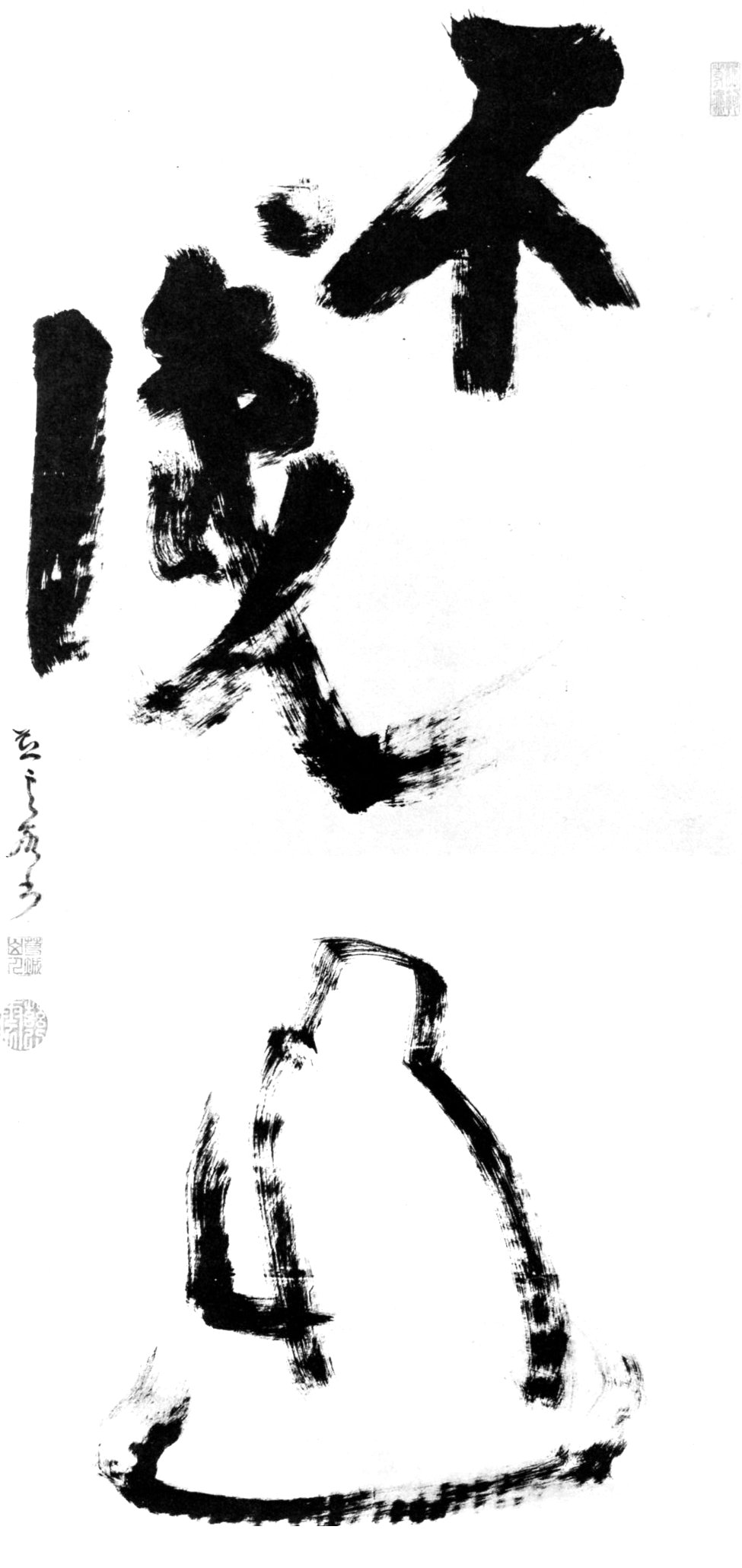
That’s an ink painting by Jiun Onko, an 18th century Buddhist priest. I wrote about it at length here. In this context, though, my point is simple…that’s an illustration.

Not only is it an illustration, but it’s a kind of illustration that is by no means marginal to the mainstream illustrative tradition. As you can see if you look at the below.
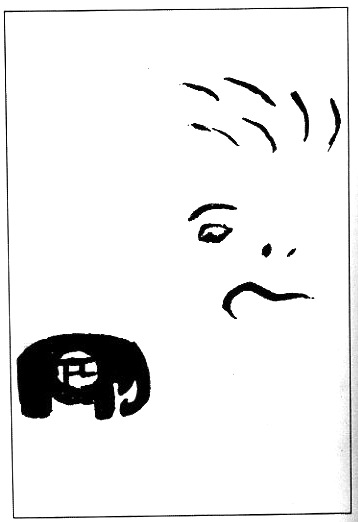
That’s Ooops! by Toulouse Lautrec, an artist who was consciously influenced by Japanese ink paintings…and whose drawings and posters, in turn, certainly seem to have been a forerunner of Toth’s style, even if they weren’t a direct influence.

So, if these are illustrations, then what does that do to the binaries Seneca has constructed?

First of all, it clearly calls into question the connection Seneca is making between illustration and realism. More than that, though, it upends the argument about the rationale for iconographic cartoons. Seneca is arguing that illustrative work is realistic and beautiful, but that cartoonists have to abandon that to make their pictures more readable. For Seneca, minimalism is chosen for ease of reading.

But if you look at the Jiun Onko and Toulouse-Lautrec drawings, it’s pretty clear that this is not a sufficient explanation. Jiun Onko, in particular, is more relentlessly iconographic than Schulz or Bushmiller; he provides less information. Indeed, he almost turns his image into a Japanese letter, or character. In that sense, his drawing is there to be “read” as Seneca suggests — but not in the interest of the sequential ease of information transmission. Rather, the image makes a connection between words, pictures, and reality — it’s an image which demands the reader/viewer/supplicant actively participate in constructing all three. Thus, the choice of an icon here is not utilitarian, but aesthetically meaningful. To draw iconically is not a default failure to incorporate the illustrative tradition. It’s an integral part of that tradition.

Drawings such as Toulouse-Lautrec’s and Jiun Onko’s also strongly call into question Seneca’s effort to make Schulz/Toth equivalent to mind/body. Look at this example of iconic artwork.
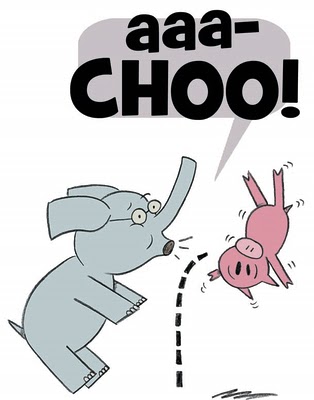
That’s a drawing by the wonderful children’s author and illustrator Mo Willems from Pigs Make Me Sneeze! Willems, as you see here, often includes dashed motion lines as part of his iconic, legible style. And what do you think my son often does when I’m reading him the book and he sees those lines?

It’s not hard to figure out; he traces them with his finger. If you look at the Toth panel up at the top there, though, nobody is going to trace that with your finger, because why would you? On the other hand, the Jiun Ito drawing or the Toulouse-Lautrec — you could see running your hand across those curves, in part because you can see the artist’s hand running across those curves. The same is true with a lot of early Peanuts; because the illustration is pared back and the linework is so instantly visible, you have the feeling of interacting directly with the hand of the creator.

On the other hand, slick illustrational work tends to place the viewer as an onlooker, rather than pulling you in for interaction. Take a drawing like Frazetta’s Cat Girl:
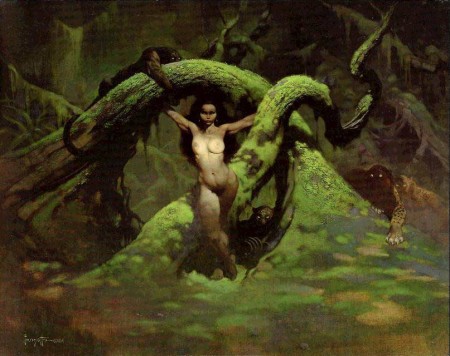
You are placed as voyeur; the flesh is on display. The image is a window, the surface the line between two separate worlds rather than the place where the creator and the viewer meet. In this sense, realism can be seen not as body, but rather as body exiled to mind, while the more iconic illustrational style can be seen as mind manifested, or embodied.

The point here isn’t that Schulz and Bushmiller are better artists than Toth, or that iconic is better than realism in illustration or cartoons. Realism can be great; I like Vermeer excessively, as just one for instance. But…well, here’s Seneca’s conclusion.

What’s illustrative is how much of this environment Toth sees, the amount of visual information packed into the panel borders, the panoramic shape of the frame itself. Toth gets to his place of realness, of beauty, by piling it on, adding subtraction to subtraction to abstraction until his minimal world holds as much as the real. As much shadow, as much light, as much texture, as much scope. It’s just arranged more subtly, seen more poetically, changed into something both familiar and strikingly different. It’s art, to make it simple.

Obviously, I disagree that illustration must mean a great deal of information. I also question the parallel made in the phrase “his place of realness, of beauty”, as if realness and beauty are one and the same thing. But the real (as it were) disagreement is that Seneca equates art with muchness. What’s great about Toth is that there is “as much shadow, as much light, as much texture, as much scope” as in reality. Moreover, this muchness is arranged even more muchly than in the world — “more subtly…more poetically…both familiar and strikingly different.” Toth’s art is about getting the whole world and magically turning less into more.

Surely, though, art’s beauty is as much about curtailment as replication; as much about emptying creation as filling it. The minimal is not beautiful because it manages to get all the essential and arrange it better; it is beautiful because of its absences. What makes that Toth illustration art is not that it gives us the big world sensitively arranged, nor that it fools the eye by packing in more than can possibly be there. Rather, the art is that it doesn’t fool the eye. Instead, the blocky shapes, the distant silhouettes, encourage us to participate in pulling something out of everything — the pleasurable act of creation, which is also the act of subtraction.

So now, having disagreed with everything Seneca said, I should, in theory, conclude by lambasting him for his too narrow vision; for relating comics only to comics, and so being confused about the nature of comics, of illustration, and of art. I’m not going to do that though because — well, I’ve just been praising subtraction, haven’t I? Seneca takes a small bit of the world, turns it over, cuts it down, and ends up with a panel of flatter, more circumscribed reality. The pleasure or art in his piece is not dependent on that flatter world including the whole of the real world. Rather, the beauty is in watching and engaging with the mind that moves within the arbitrary parameters. As I suspect Seneca would agree, the point is not just what you manage to include within the lines you draw, but how you draw them.

How To Draw and Paint Anatomy (ImagineFX Presents Series)

Various artists: Ron Lemen, Marshall Vandruff, Justin Gerard, Warren Louw and more.

One of my favorite things in the whole world is figure drawing.  The human form comes in so many wonderful variations: shapes and sizes, proportions, movements, gender differences and similarities, muscle types, ages.  I love to focus on the form and try (and inevitably fail, because human form is like understanding oceans, ever shifting) to reach understanding.

Comics as a medium embraces many aspects of figure drawing, sometimes well and sometimes (stock cape depictions of women, I’m looking at YOU) poorly.  As someone who draws comics for pleasure, I especially enjoy exploring the craft of figure drawing.

The challenge of comics, in part, is to draw a wide variety of people (including different body types, depending on the comic) in many poses, including action poses, from many angles and foreshortenings.  Plenty of traditional artists use references, either live models (if they’re wealthy or good at bribing friends with baked goods) or photographs.  Alphonse Mucha, for instance, had a stunning collection of reference photographs, including the Divine Sarah, for his paintings and prints.  Even I could make a pretty nice drawing out of this photo (half the work has already been done, really, what with the pose and the costume and the pre-existing anatomy).  Drafting a work from a reference is an important skill, and I am not knocking that skill!  It took me years to be able to do that well, and I’m quite proud of it.  However.

Most of us, unlike Alphonse, do not have a cadre of wasp-waist women who are willing to sit in such poses.  And even if we do have them, it wouldn’t do us much good if we were trying to draw an intersex swordsman in mid leap, decapitating someone with a katana.  (Yes, a recent drawing problem I wrestled with.)

One must be able to draw from the imagination in order to draw certain scenes.  Or have a friend in Hollywood with a Peter Pan flying harness and a willing Wuxia actor, I suppose.

Which brings me to my ever-reaching, ever-striving attempts to understand and embrace human anatomy in all its variations and forms.  The difference in approach is much like working from the inside (such as the spine) to the outside (skin), rather than from the outside (skin/clothes in a reference photo) to the inside.

There are many ways to go about the inside-to-outside approach, such as taking cadaver classes, studying Bridgeman, working with bones, and studying sculpture.

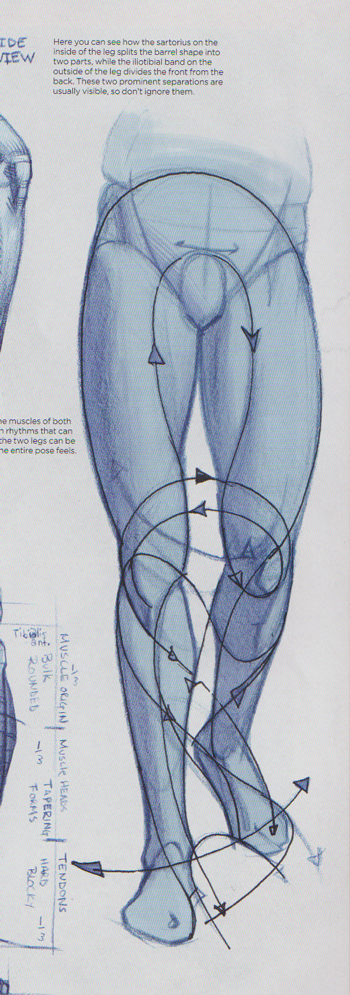
The How to Draw and Paint Anatomy piece that I’m reviewing includes a couple of methods.  The first main method is Industrial Design, which is probably to familiar to many artists but which is given a great treatment here.  The basic approach is to divide the figure into shapes and how those shapes function together.  You’ve probably seen some how-tos that say something like: use a circle for the head, use a box for the chest, use a circle for the hips, and so on.  That comes from the industrial design method.  I’ve used this method in variations for many years, and one of my most successful self-taught drawing projects was redrawing an entire ladies underwear catalog in such shapes, page after page.  (Undies=easy to see the body.)  One of the problems I’ve run into is that it can be difficult to get a good feeling of flow.  Making separate shapes is all well and good, but if they’re put together poorly, you kind of get this static feeling.  The figure might appear three dimensional, but it also appears stiff, even with a dynamic pose.

That’s where Ron Lemen’s series especially shines.  His approach to this method goes all the way back to its roots with Frank O’Reilly.  The first part of his series begins with the history of the method, basic how to steps, and some examples.  What I like about the way Lemen approaches the industrial design method is that he uses a lot of gestural flow and interconnects the working parts of the body that so they work as a functioning, smooth, dynamic flow.  Instead of blocky shapes that are frozen, the bodies begin to show movement.

Here’s a nice example from his section on drawing legs:

See how the muscles are balanced and connected?  There’s some lovely movement there, even though as poses go, it is quite static (just standing).

Lemen begins with the whole shape and then takes a deeper look at each of the main body segments: torso, legs, arms, hands, head.  Each section contains illustrations and suggestions for crafting workable poses from various angles and various movements.  Lemen discusses body types (including natural female anatomy, heavy set men, and so on) and how that impacts the shifting of weight, unlike many of the drawing manuals I have read where the best you can hope for is to stick some melons on the chest and call it done (pro tip: breasts, not actually ball shaped!  Who knew?).  I was enchanted to discover that Lemen realizes that breasts are more comma shaped.  Each of the sections also covers the figure in movement–what happens to the torso, for instance, when the body bends to one side?  The outer line of the curve is smooth, and the inner line of the curve becomes wrinkled.

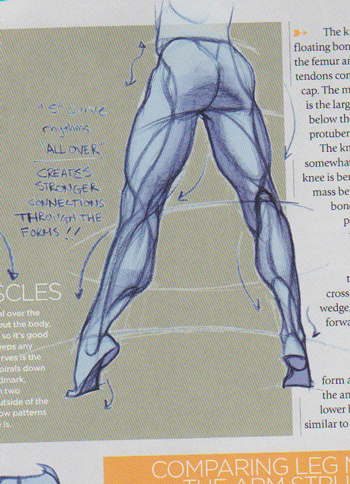
Here’s another example from the legs section:

Again, you can see the connection from the bottom of the feet all the way up to the buttocks.  There is a distinct flow of lines and balance, as the weight is on the ball of the foot and the thigh muscles are tensed.

It’s a great series of articles.  The other aspect that I particularly find useful in this work is that it is not merely a magazine/book.  It comes with a DVD, and on the DVD are multiple files.  Lemen has includes various poses, so that an artist can manipulate, copy, play with, practice from, or study at larger or smaller sizes.  And the creme de la creme, a series of videos.

To me, the video series included in the work is well worth the entrance fee.  The videos are quite simple, but for someone like me, who learns kinesthetically and visually, it is priceless.  They show a plain shot of an artist’s arm and their large drawing board.  Beginning with blank paper and no references, the artist draws, free hand, a variety of lovely poses in the industrial arts style.  (Some of the poses are later shown in the book.)  There is not any time consuming erasing, it’s almost entirely free hand with dark pencil and the drawings do not take a long time (usually about three minutes or so per pose, even the complex ones!).  I found it utterly fascinating, because it is only by watching the actual process that I truly understand where the artist begins with each piece and how the lines become connected and what follows what.

There are over twenty minutes worth of such drawings on the DVD.  I’ve watched some of them more than once, and each time I learn something new.  (If you have access to a good art school and a great set of life drawing courses, you may not find this useful.   Me, I don’t, so.)

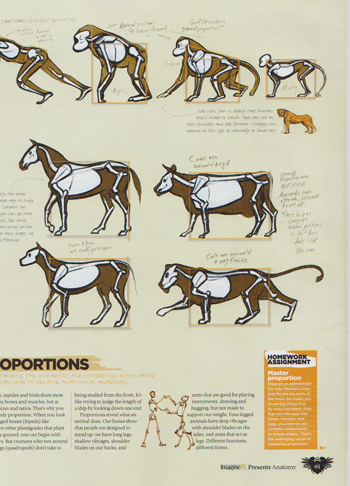
The second half of the book is taken up with Marshall Vandruff’s comparative anatomy series, which is completely different from Lemen’s, but utterly fun.  In it, Vandruff begins with several main body types: human, big cat, horse, and great ape.

(I apologize for the cut-off part in this scan.  I’ll replace it when I’m back to my scanner.)

He compares the bones, joints, and proportions of various types to create a working knowledge of animal anatomy (including human anatomy).  I found myself comparing my foot and my dog’s back foot, bending the joints and pointing my toes, trying to understand how both of us worked.  Ever since reading his articles (and boring my poor, long suffering Pookie), I’ve had a much better understanding of ankles.  My drawings of feet are connected to the legs more properly and no one is wandering around on what would have to be broken ankles.

Like Lemen, this series start with a broad overview and then tackles major muscle/anatomy groups in turn.  Necks, torsos, heads, legs, feet, and so on.  One of the fun parts is the homework assignments, which suggest, among other things, morphing an animal into a human and back again.  Great practice for comic artists doing supernatural works, or for any artist who wants to get a more distinct character feel to their people.   The examples of a woman with more catlike features compared to a man with bearish features was fascinating, even though both at the end had proper human anatomy, the feeling was utterly different.

Unfortunately my me, there are no videos of the artist drawing such pieces off the cuff.  But there are plenty of additional sketches on the DVD.

This work ends with a couple more short workshops and a fun practical Artist Q&A section, where pro artists answer anatomy questions.

It’s hard to say whether this a book or a magazine.  It’s produced by the folks at ImagineFX, the magazine, and I bought it in the magazine section at my Borders.  It does have compilations from earlier ImagineFX issues, but is not itself an issue.  It’s not bound like a book, but a magazine.  I’m hoping it’s still on the stands, because it appears to be out of stock already at its mother store.  I think it’s well worth hunting down, if you’re working on the craft of anatomy.

Random Thoughts on SPX ’10

Last Saturday, I visited the Small Press Expo in Bethesda, Maryland with three of my friends. We spent nearly all our time wandering around the main convention floor, buying stuff, and occasionally chatting with the exhibitors. Here are some quick thoughts on SPX, in no particular order:

I can’t move!

I hope next year’s Expo rents a second convention room or moves to a larger venue. I’m not sure if they underestimated the crowds or if money is just tight, but the convention floor was far more crowded than it needed to be.

But I’ll give them credit for putting Kate Beaton near a door: she was far and away the most popular cartoonists there (she even put Jaime Hernandez to shame), and the line for her signature formed outside the doorway rather than clogging up the convention room.

There are girls! Reading comics!

And women too. Out of all the (nerd) conventions that I’ve been to, SPX had the largest percentage of both female attendees and exhibitors. This is a very rough estimate, but I’d say close to 50% of the attendees on Saturday afternoon were women.

One of my friends at SPX had previously accompanied me to the Baltimore Comic-con. She found SPX to be much more female-friendly. At the Comic-con, she complained that some of the vendors had stared at her like she was some alien creature. When I asked about it, she told me that what made her feel comfortable at SPX was not the number of female attendees, but the female exhibitors and vendors. In other words, if you want to sell comics to women, you need women who sell comics.

It’s all in the presentation, or lack thereof.

Most of the exhibitors seemed content to put a few books on the table, maybe a print or two, and then wait for the crowds to form. This works fine if the exhibitor is already popular, like Kate Beaton or Jaime Hernandez, but it doesn’t work so well for unknown artists. One of my friends was completely unfamiliar with comics, so she had no idea which artists she might like or what kind of content she was interested in buying. In other words, she’s the ideal consumer for an unknown artist, but they have to make an effort to get her attention. To be fair, some of the exhibitors were more than willing to engage with attendees and explain what their books were about, but others seemed either shy or bored. And in that moment when a potential customer is walking by their table, they need to do more than just sit there and wait for the money to flow in.

She wanted more free samples or excerpts from comics, not just so she could look at the art, but so she’d have a better idea what the comic was about and how well it read. Again, to be fair, a few of the webcomic exhibitors were handing out samples.

Another friend sent me her take on the exhibitors in an email:

“I think the thing I liked most (as someone who isn’t exactly a diehard indie comics fan) was the booths that were selling comics and misc. merchandise based off of the artist’s characters.  It was kind of like a comicon meets esty vibe – really neat to see what people came up with.  Some of it I thought ‘wow, I could totally make that myself’ (monster scarves) but the wooden puzzle guy and many of the poster/print options were truly impressive.

I was also pretty amazed by the mix of levels of, for lack of a better word, professionalism from booth to booth.  You could tell some of the folks there are fully supporting themselves on small press comics; others seemed to be using it as a way to show off their artwork – but they didn’t seem all that concerned about heavily promoting the comics part.  Then there was a booth or two where it seemed like the artist was using SPX as a way to promote his/her hobby.
I don’t think you were with me at the time, but I saw one booth with really neat stuff – an alphabet of imagined animals, pseudo-victorian faux scientific language, etc. The guy at the booth did the standard 10-second ‘this is what I do’ that everyone was doing.  He mentioned the alphabet thing was on his blog – so I asked if he had a card.  Apparently he had forgotten to bring any.  He offered me one of the little pamphlets he was selling [more on that below], mentioned suggested donation was $1.  I figured fine, I’ll pay $1 to find out about his stuff, and handed him a $5.  He didn’t have change.  The guy next to him didn’t either, so he gave me the brochure for free.  Very nice and everything, but the highly professional government worker over-achiever in me was *completely* horrified by the idea that someone would show up to exhibit at a convention and be that unprepared.
Also overheard two chicks at a booth chatting about their friend (the artist) who helped them get it set up, stayed a few minutes, then said ‘I got into webcomics so I wouldn’t have to talk to people” and vanished.’

Overall I very much enjoyed it, mostly for the novelty and the ability to nerd out a bit without feeling like the only girl in the room! :P”

Giving money directly to the artist gives you a warm, fuzzy feeling.

On the other hand, I always feel vaguely guilty when I walk by a table and the artist is just sitting there while no one buys their stuff. It’s a sad scene … until I remember that most of their junk is ridiculously over-priced.

Miriam Libicki seems to be doing well.

But she no longer follows the blog (sorry, Noah).

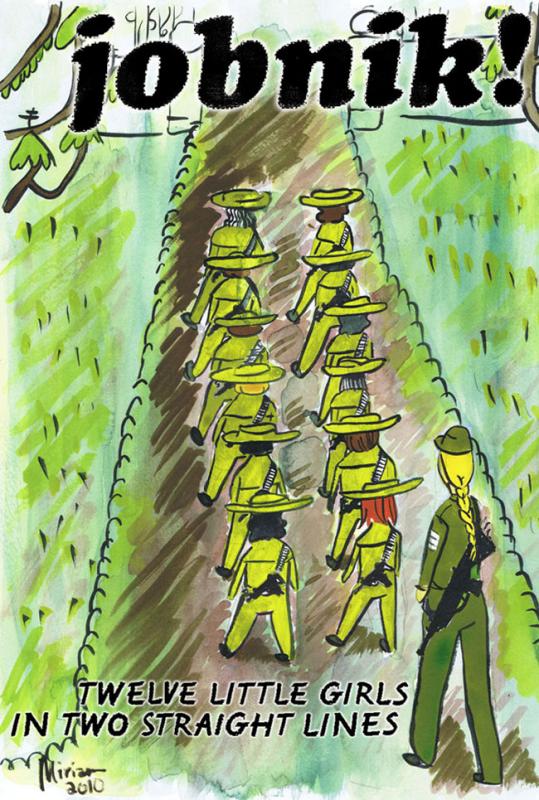
For those of you new to the Hooded Utilitarian, Miriam used to blog on the site back in its Blogspot days, but she’s far better known as a cartoonist and creator of Jobnik!, an autobiographical account of her time in the Israeli Army.

I bought one of her kitchen magnets and the latest issue of Jobnik!.

I love the cover. I haven’t had a chance to read the comic yet, so I can’t offer a review, but the prior issues were quite good. If you’re interested, it’s available for purchase on her website.

Consumerism, hurray!

What I bought:

Parker: The Hunter, written by Richard Stark and adapted into a comic by Darwyn Cooke. It’s not really all that “indie” (and IDW is hardly a small press) but I like detective stories, I like Cooke’s art, and it was being sold by the Comic Book Legal Defense Fund. Support free speech and all that.

Prison Pit, by Johnny Ryan. Violence and crude humor. ‘Nuff said.

Afrodisiac, by Jim Rugg and Brian Maruca. I love blaxsploitation as much as the next suburban white dude, and this book has gotten positive reviews from most of the critics I follow.

Masterpiece Comics, by R.Sikoryak. It’s an odd but potentially funny idea where classic writers are filtered through the tropes of classic comics.

Locas: The Maggie and Hopey Stories, by Jaime Hernandez. I haven’t read all of Love and Rockets yet, but the Locas storyline is what hooked me on the series (sorry, Gilbert).

Blazing Combat, by Archie Goodwin and assorted artists. Proof that I am susceptible to advertising. They kept running the banner ads for this book on tcj.com, and eventually I succumbed. Though I’ve also been looking for a war comic to review, and this fits the bill.

Pang: The Wandering Shaolin Monk, vol. 1, by Ben Costa. An engaging, cartoony style and a kung fu storyline. But what sold me was that the publisher is named Iron Crotch University Press. Well played, Ben.

What my friends bought:

Trickster, edited by Matt Dembicki with assorted artists. Its a collection of Native American folklore (about Trickster gods, naturally) with each tale illustrated by a different artist. Here’s a blog about the book for the curious.

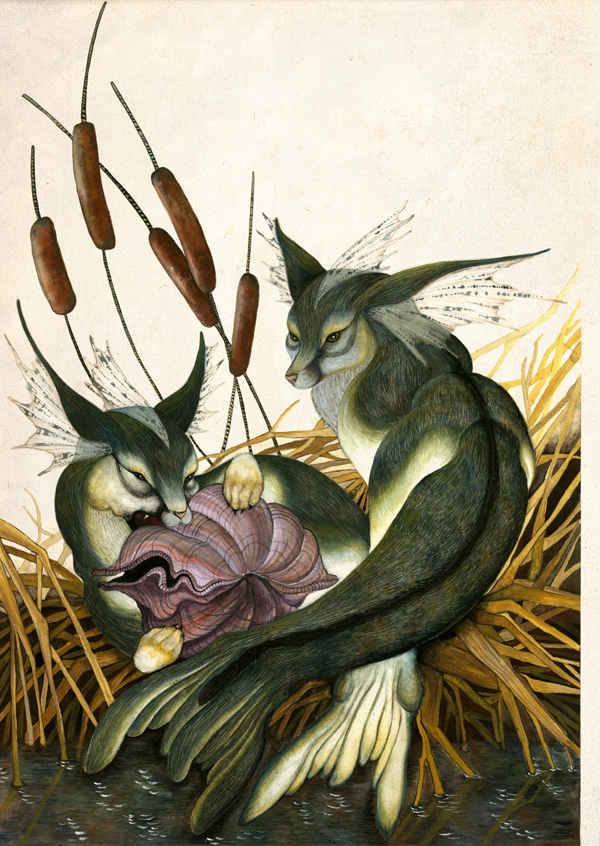
A print by Emma Rochon, featuring mer-foxy things.

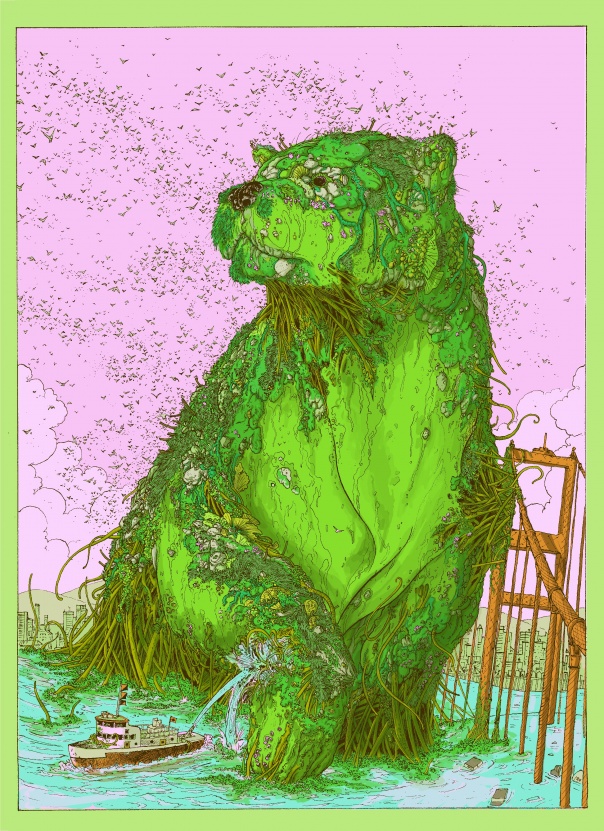
Two prints by Ulises Farinas, including bear-zilla,

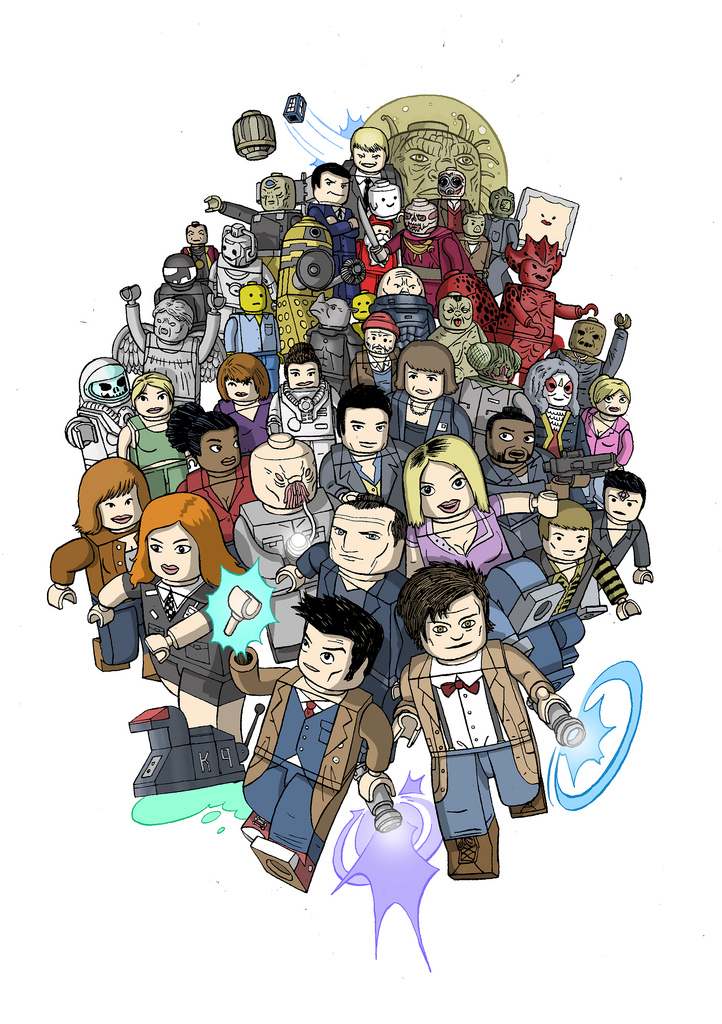
and Lego Doctor Who, which efficiently combines two nerdy obsessions.

A large print (couldn’t find an image of it) by Sara L. Turner, author of the webcomic Ghosts of Pineville.

And a pamphlet by Nate Marsh, creator of The Obscure Animal Compendium.


Yoshiharu Tsuge’s Red Flowers

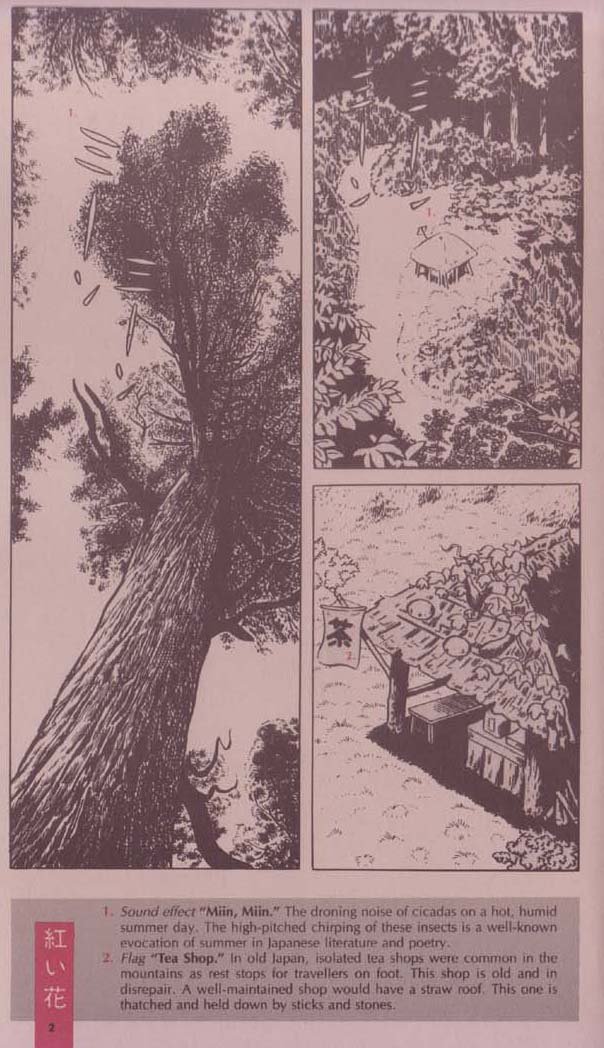
Red Flowers. Sayako Kikuchi is lying in the shade of her tea shop. It is a warm summer day and far too hot to count the meager takings from the morning. There is the sound of cicadas in the background and we gaze up at this incessant activity with the girl. The tree before us is as firm and immovable as nature itself. The tea shop is cradled in its grasp, nestling in a womb-like clearing with tendrils and fruit running through its thatched roof.

Continue reading