DWYCK: Ishoku

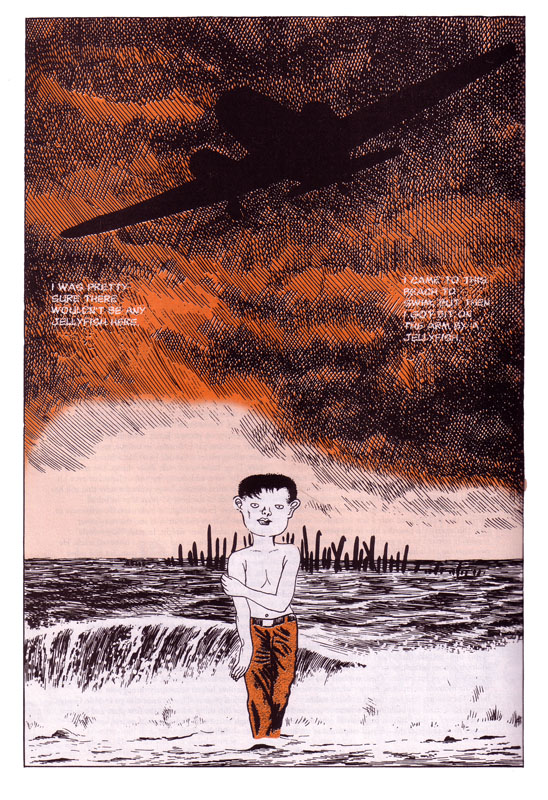
The opening page of "Screw-Style"

This is a slightly edited and translated version of a piece on the great mangaka Yoshiharu Tsuge that I wrote for the Danish comics magazine Strip! and my website Rackham back in 2004. Considering his importance to Japanese comics, Tsuge remains sadly underrepresented in translation. Plus his name has come up in discussions here at HU several times, so I figured an introduction to his work would be an interesting addition to the mix here.

A boy emerges from the sea in the shadow of a C-47. He presses his right arm against his side where a deadly jellyfish has torn apart one of his veins. Whenever he releases the pressure, blood trickles to the cold ground, which he treads like a sleepwalker, searching for a doctor to help him. He passes a forest of shirts, is trampled by the silhouettes of a marching band, wanders along railway tracks bordered by empty signs. A rusty locomotive runs backward, steered by a boy wearing a cat’s mask. The protagonist hears the faint tingle of a chime in the wind, reminding him of summer. With an old lady who may be his mother, he eats phallic sticks of kintaro candy topped by small, disgruntled faces.

In a bombed-out bunker, he finds a female gynecologist dressed in a kimono and sporting a head mirror. She speaks in white as empty as the signs along the tracks and they play doctor against the backdrop of a Midway-like naval battle. A wrench, seen earlier in the hands of a suit who “almost knew what he meant”, suddenly reappears in the hands of the woman who uses it to fit his torn vein with a safety valve. Thus saved, he sails away in a motorboat with the parting words “And so, whenever I tighten the screw, my arm grows numb.”
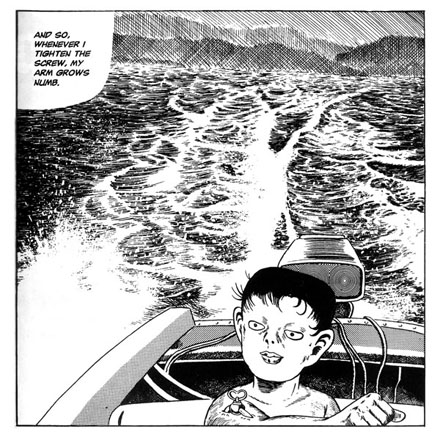
This happens in Yoshiharu Tsuge’s most famous manga, the 22-page ”Nejishiki” (”Screw-Style”) from 1968. Like most of his comics, it was published in the legendary alternative comics magazine Garo. It is regarded as a central work in Japanese comics history and its creator has gone from cult-figure to eccentric celebrity in Japan. Born in 1937, he retired from cartooning in 1987, leaving behind a modest but highly significant body of work: around 150 short stories produced over three decades or so.

These are comics of such strange originality that he is often given the sobriquet “ishoku” (‘unique’); it has contributed crucially to the understanding in Japan of comics as a personal and artistic means of expression. Only a few of his comics have been translated into Western languages, but the ones available still enable us to assess the contours of an oeuvre that one might imprecisely but poignantly compare to that of Robert Crumb in America.

“Screw-Style” reportedly records a nightmare Tsuge had one day while sleeping on his tenement rooftop. Characteristically for his generation of cartoonists, perhaps most notably his one-time teacher Shigeru Mizuki (b. 1922), he integrates cartoon characters, whose appearance often changes from panel to panel, into backgrounds that vary from the loosely defined to the carefully rendered, often photo-referenced. The story is a surreal tour de force, strong in its critique of civilization and deeply pessimistic, with the central metaphor being a open wound exposed to a denaturalized, filthy industrial environment darkened by ash clouds and haunted by the shadow of war. It exemplifies Tsuge’s preoccupation with the pollution of the soul, shown through bodily metaphor: the protagonist’s only salvation lies in fusion with a metallic object—the safety valve that numbs his arm.
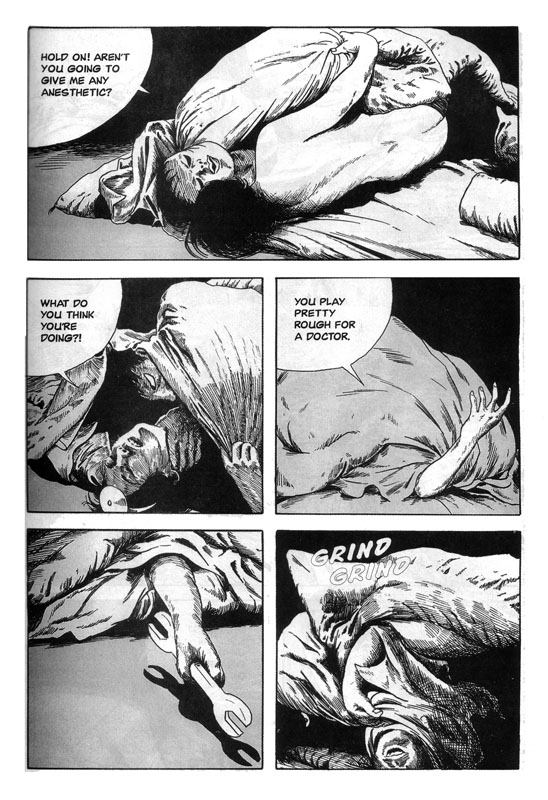
From "Screw-Style"

Making his debut as a cartoonist in 1954, Tsuge spent the next couple of decades producing genre comics for the large rental comics market, which in the postwar decades functioned as a different and very substantial alternative to the Tokyo-based mainstream publishers who would eventually eliminate it and evolve into the manga industry we know today. From the beginning, his comics operated within the more realistic tradition nurtured in the rental market. These comics were dubbed gekiga by Yoshihiru Tatsumi (b. 1935), which translates roughly into ‘dramatic pictures’, marking a contrast with the ‘whimsical pictures’ of manga as published by the commercial industry and shaped significantly by its great creative dynamo, the “God of Manga” Osamu Tezuka (1926-1989).

“Screw-Style” however marked a shift towards the allegorical and the surreal. This has led to a frequent distinction between his “surreal” and “realistic” modes, both of which he continued practicing. But this seems an artificial categorization: his mature (1960s onward) work invariably hews closely to lived life, but simultaneously imbues it with allegory or poetry. His unique blend of these different levels of representation is central to his fame as the originator of so-called watakushi manga, or ”I-comics”—the manga version of literature’s shishôsetsu, the ’I-novel’. It is related to what we understand as ’autobiography’, but considerably broader in scope.

In the sense that it derives quite significantly from its author’s internal life to create a deeply-felt critique of his Japan, ”Screw-Style” is bona fide watakushi manga. In fact, Tsuge’s life and work generally seem so interconnected that his comics, as well as his illustrated travel diaries and other published writings, provide an access point for the public to a more or less consciously constructed mythological narrative of his life. Its foundation is his Tokyo childhood during the war and its aftermath, and in contrast to the post-war optimism of much of his generation, engendered as it was by the country’s reconstruction and modernization, he is strongly pessimistic, at times borderline nihilistic.
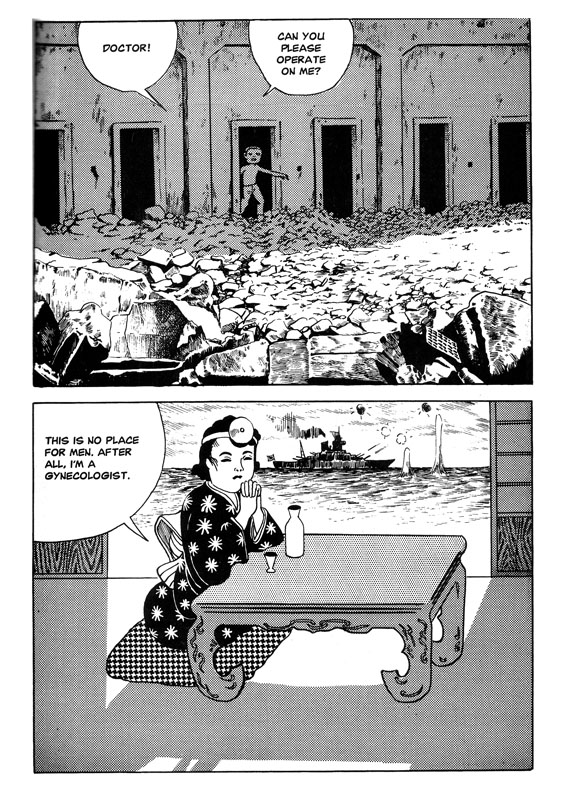
From "Screw-Style"

In comics one might compare his contemporary Keiji Nakazawa (b. 1939), who as a child experienced firsthand the bombing of Hiroshima and its consequences and told his story in his masterpiece Hadashi no Gen (Barefoot Gen; original serialization 1973-1974—later continued). Though strongly indignant, Gen is a deeply humanistic work. Tsuge, on the other hand, eschews this optimisim and instead charts the equally pervasive meaninglessness and alienation of post-war Japan, as well as the subsequent boom decades of the urbanized, high-tech 60s and 70s.

The Tsuge myth also includes the story of an absentee father and of a rebellious youth spent in abject poverty and haunted by bouts of depression. Dreams of escape pervade it: when he was 14, he was arrested by the coast guard for stowing away on a ship bound for America; when he was 20, he attempted suicide after a failed romantic relationship.
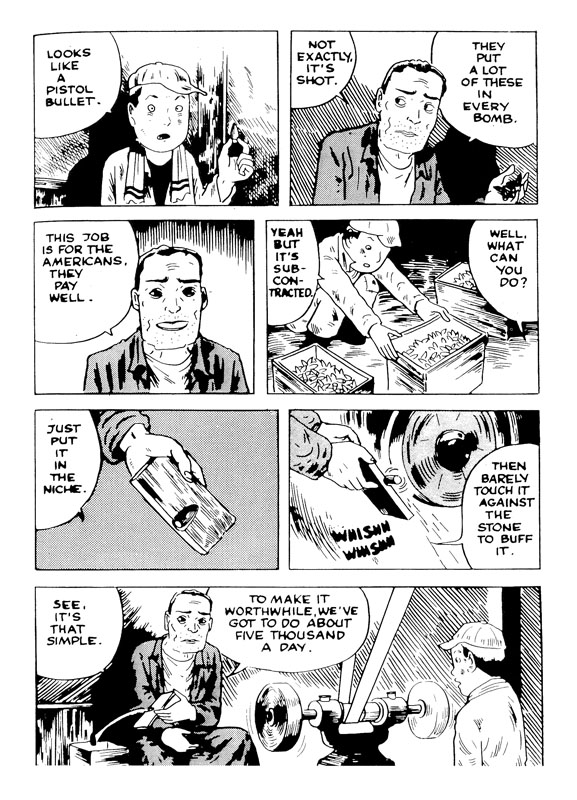
His 24-page story from 1973, ”Oba denki mekki Kôgyôsho” (“Oba’s Electroplate Factory”) is directly based on his brother’s experiences working at a factory as a child, having left school after the primary years. We witness the appalling work conditions and the inevitable cadmium poisoning suffered by the workers. One older worker literally excretes his life through a hole in floor of his shed while his children look on.
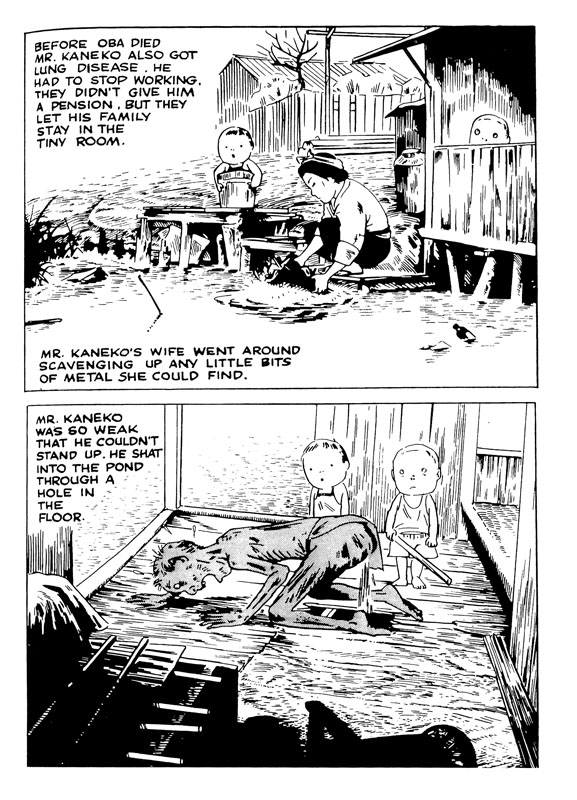
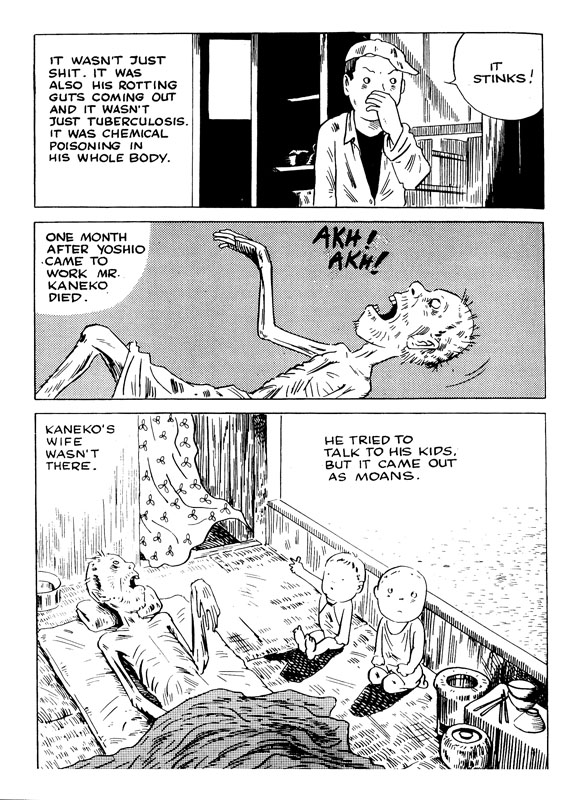
In contrast to the people around him, the young protagonist—who is portrayed with a mixture of sarcasm and genuine affection—is characterized by indomitable optimism. This despite the severe burns he suffers one day from acid used at the factory to sharpen shrapnel for American bombs. Even his eventual abandonment at the hands of the female supervisor, when she finally leaves the factory along with its only other surviving worker, does not faze him.
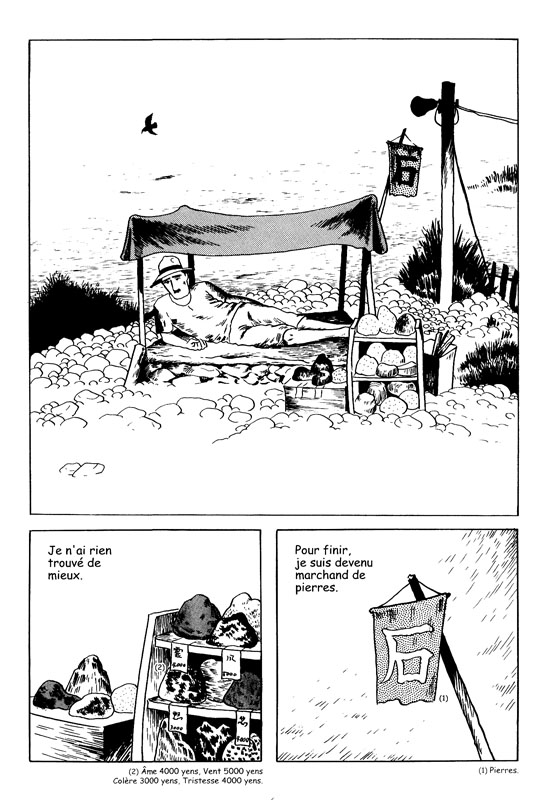
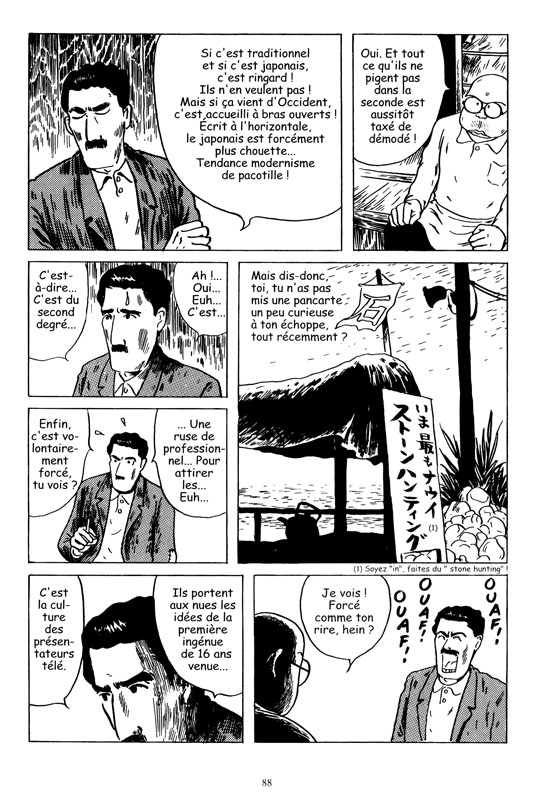
Among Tsuge’s most finely realized self-portraits in comics is the 200-page graphic novel Munô no Hito (’The Man Without Qualities’, with a possible nod to Robert Musil?). It was serialized in the magazine Comic Baku from 1984-1985 in 6 separate episodes and narrates the life of a man incapable of providing for his family. He dreams of making things work, and his dreams as rendered on the paper are beautiful, but reality ruthlessly confounds him. He simply cannot succeed. He is unable to take responsibility and continually rejects his only real source of income, comics, as a possibility. Instead he attempts unsuccessfully to make his way as a dealer, initially of second-hand cameras, then of rocks found along the banks of the nearby river. This “business” encapsulates the hopelessness of his industry and is—as his increasingly dejected wife never hesitates to tell him—emblematic of his life as a whole.

Tsuge renders this life in fragments, chapter by chapter. Each episode is self-contained, but when read together they form a beautifully structured narrative. The presentation, whether between chapters or within them, is not linear and a clear chronology never emerges. It opens at the nadir of the story, a moment of almost total hopelessness. The man and his wife are utterly estranged—Tsuge never show us her face, and in a heartbreaking scene she passes him on the street as if he were a stranger. The night closes in, the shrieks of the crows sound to him like “Looooser! Looooser!”, and he is drawn to leap into oblivion. His only lifeline is his young son, who every night comes down to his rockseller’s stall on the riverbank and takes him home before dark.
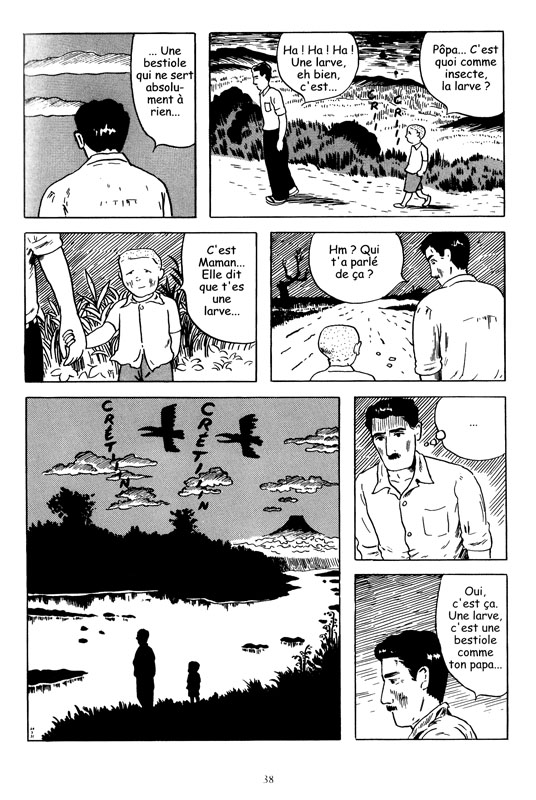
In later chapters we return to earlier times and come better to understand the disintegration of the small family. We meet them in happier times, when moments of warmth, tenderness and fun still occurred, despite the boy already exhibiting disturbing signs of neurotic behavior. We see the wife’s face, but already sense that her esteem for her husband is on the wane. Awareness of where it is all going make these passages painful reading.
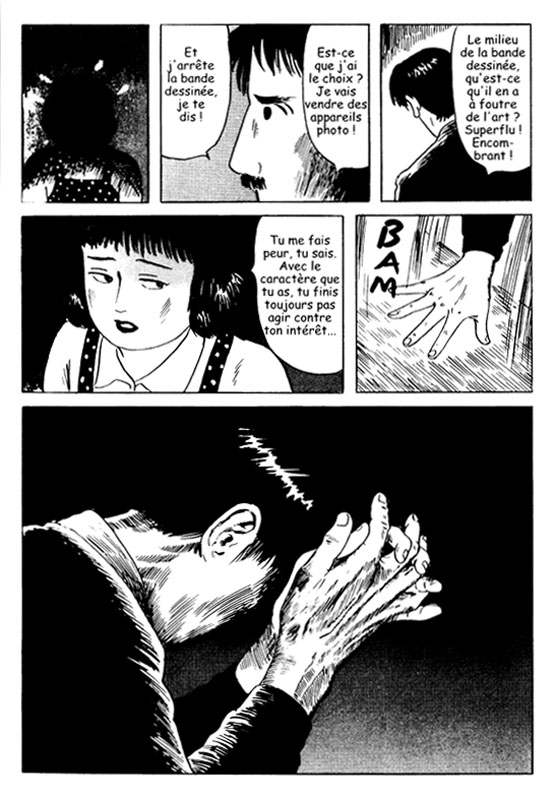
Tsuge here renders the curse of poverty as intensely as in his earlier stories, but he is less emphatic in his social critique. The central tragedy is internal, self-inflicted—the story is a subtle, grinding portrayal of depression as both a mental state and a physical condition. It never delivers a conclusive diagnosis, being more self-contemplation than self-criticism. It describes a person in crisis by means of stark realism joined to flights of dreamy allegory, and typically for Tsuge, its poetic tenor is borne of equal parts irreverence and empathy. A fairly long, rather flowery exegesis on Buddhist notions of equilibrium and salvation between the protagonist and an acquaintance is rudely interrupted by a drawn-out fart from the latter’s sleeping wife.
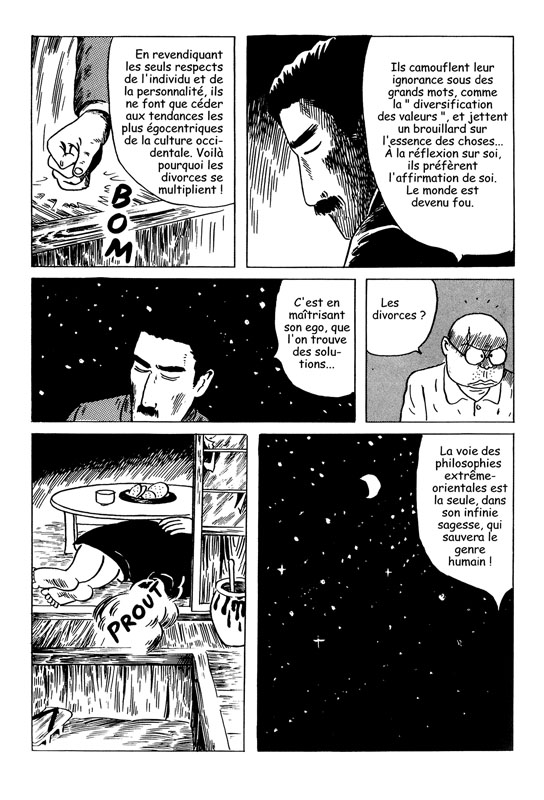
And finally, parable of an alcoholic, flea-ridden mendicant who breathes his last breath reciting an enigmatic poem, his body covered in his own dried-up excrement, becomes the metaphorical shot in the dark that lifts the story from where it started, letting it transcend precariously its own circularity.

Tsuge’s work is animated by this combination of prosaic entropy and contemplative longing. His pessimism is tempered by fleeting moments of possible beauty. Sometimes the feeling is one of nostalgia, as if borne by a sense of loss, but ultimately his position seems to be that beauty, though acutely present, is unfathomable.
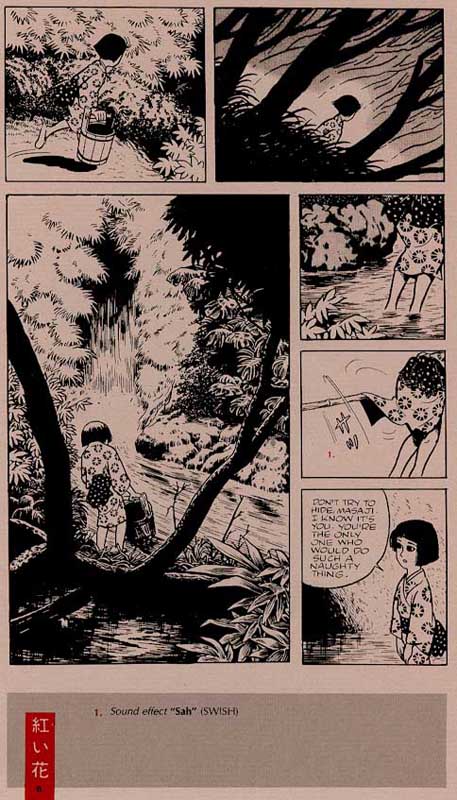
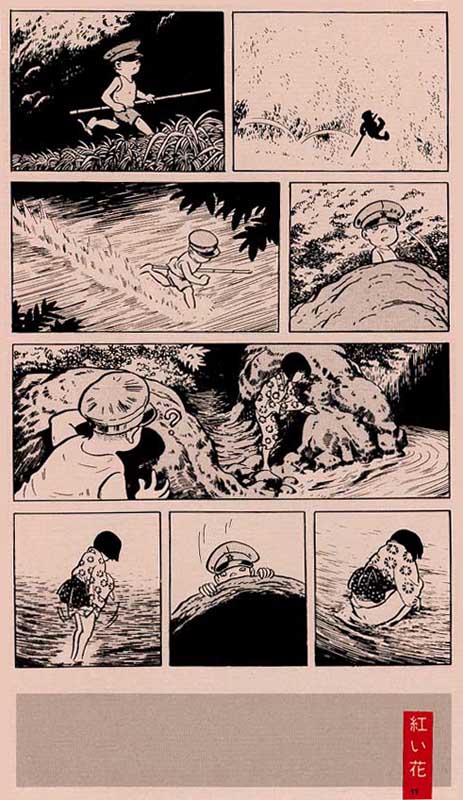
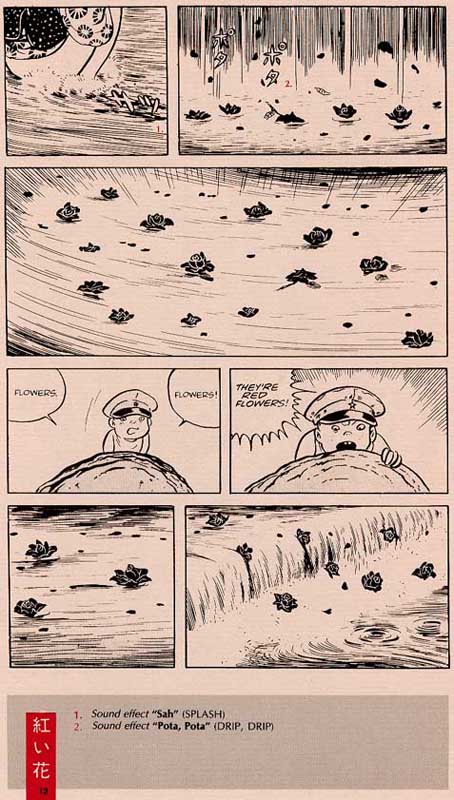
A particularly fine evocation of this is the 15-page 1967 story ”Akai hana” (”Red Flowers”). The protagonist is a young girl who has dropped out of school to manage her family’s tea house in a beautifully lush corner of the land, visited only by a lucky few. A man from the big city—apparently a wistful stand-in for Tsuge himself—is there to fish and comes to observe the unfolding relationship between the girl and a little boy two years her junior. He teases her because of her emerging pubic hair and voyeuristically observes her first menstruation. She lets the blood run into the river where it appears to transform into beautiful, red flowers before it disappears into a maelstrom.

With its vibrant depiction of the surrounding environment, its nostalgic but ultimately optimistic tone, and its loving portrayal of its characters, “Red Flowers” seems a distillation of the beauty present in all of Tsuge’s work, even the bleakest. As always, sex is an incontrovertible presence; as in “Screw-Style”, it is the catalyst that resolves the story. In contrast to that dark masterpiece, however, it is here the heart of a poetic celebration of change as a human condition. Tsuge drew these two stories within a year of each other and they combine to reveal the promise of his art.
Tsuge in translation

”Red Flowers” (”Akai hana”, 1967), in Raw vol. 1 #7. New York: Raw Books, 1985.

”Oba’s Electroplate Factory” (”Oba denki mekki Kôgyôsho”, 1973), in Raw vol. 2 #2. New York: Penguin Books, 1990.

”Screw-Style” (”Nejishiki”, 1968), in The Comics Journal #250. Seattle: Fantagraphics, 2003.

L’Homme sans talent (Munô no Hito, 1984-85). Angoulême: Ego comme X, 2004.

Links

List of works (Japanese language)
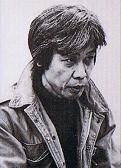
Great 1987 interview with Tsuge (French language)

Béatrice Marechal on Tsuge from The Comics Journal 2005 Special Edition.

Domingos on Tsuge and “Nejishiki”.

Gilles Laborderie on Munô no Hito for Indy Magazine.

Images from Tsuge’s early comics.
__________
Update by Noah: Ng Suat Tong just posted another lengthy essay on Tsuge.
Utilitarian Review 9/11/10

On HU

Erica Friedman started off the week by interviewing Comic Fusion’s Stacey Korn about Wonder Woman Day.

We then had a series of posts on comics and architecture, of all things.

Alex Buchet began with the first of a multi-part look running through the month on a comics and architecture exhibit at the French national museum of architecture.

Ng Suat Tong followed up with a look at the role of architecture in Josh Simmons’ House.

Caroline Small wrote about Morris Lapidus, postmodern curves, and the boxy modernism of comics.

I wrote about Alan Davis’ The Nail and why superheroes hate the Amish.

And I disputed R. C. Harvey’s assertion that criticism and art are about making you happy.

Twilight, Shojo, Genre and Gender

Melinda Beasi’s post from last month on Twilight and the contempt for female fans has sparked a bunch of discussion this week.

David Welsh explains why he agrees with Melinda and Melinda adds some thoughts about why it’s wrong to group all shojo titles together. Brigid Alverson argues that the issue is that genre isn’t that good, not that women are held in contempt. And finally Erin Ptah says she dislikes Twilight for lots of reasons that have nothing to do with female fans.

Murder, Misogyny, Multimedia

I’ve got an article about murder ballads up on Madeloud.

And to celebrate, I’ve uploaded a murder ballad playlist including all the songs I mention in the article. Revel in bloodshed!

Utilitarians Everywhere

At Splice Today I review the boring George Clooney vehicle The American.

Shortly thereafter, though, I began to have suspicions. So, as I do when such suspicions occur, I leaned over to my wife and whispered low, “He’s going to be redeemed, isn’t he?”

She looked at me over her glasses with mingled disgust and horror. “If he gets redeemed,” she said sternly, “I’m going to be upset.”

At Madeloud I review Wovenhand’s latest record.

Other Links

I enjoyed this essay by Rachel Manija about why it’s okay to write negative criticism.

And R.C. Harvey has a fun article about Wonder Woman’s costume changes over the years. I love the eagle cartoon.

I don’t know anything about Ke$ha, but this is really funny.

Oh, and Caroline Small is going to be on the critic’s panel at SPX today at 3:00 PM eastern time. If you’re attending the convention, go say hi to her!

Dyspeptic Ouroboros: Critics Are Not Here to Make You Happy

In response to last month’s comics criticism roundtable, R. C. Harvey has a post up on the main site in which he lays out his philosophy of criticism.

But, seriously, a critic does what he does for what is a very shallow reason.
When I first set out to make a living in the world, I did it by teaching English in high school. Years later, one of my former students wrote and asked me why I chose teaching English as a profession. I thought about it and realized that I had no messianic purpose. I liked literature and I liked talking about it with others who liked literature and liked talking about it. I taught literature because that was a way of creating others who could talk about it in ways that were congenial with my own passion. It was a way of creating a conversation I enjoyed.

Harvey adds, “The other thing that criticism does, apart from gratifying the passions of the critic, is to enhance appreciation of the art being critiqued. In fact, I suggest that enhancing appreciation is the only legitimate function of criticism (beyond a critic’s self-indulgence).”

Logically enough, he then goes on to argue that the purpose of art, like that of criticism, is essentially to increase enjoyment.

The function of art, to pursue this topic into tedium, is to enhance enjoyment of life. A wise man once said, “The more things you like, the happier you’ll be.” Makes sense to me. Art—drawing, painting, music, and so forth—provide an assortment of things that one can choose from to like, thereby fostering one’s chances at being happy.

Harvey’s argument, then, as far as I understand it, is, first, that critics write for reasons which are shallow — because they happen to like things. Critics who claim to be writing for a higher (or lower?) purpose — such as, for example, to influence people, are fooling themselves. Or as Harvey puts it:

It would also be nice, and highly beneficial to mankind and civilization as a whole, if everyone would do exactly as I tell them—if cartoonists reformed and perfected their practices in accordance with my prescriptions, if other so-called critics started talking about comics as a visual art form as well as a narrative one, and if the Grumpy Old Pachyderm became the GOP of “Yes.” But—well, I, like most critics, may be self-absorbed, but I’m not delusional. Not yet.

The only legitimate purpose of criticism, then, according to Harvey, is to enhance appreciation of art. The purpose of art, in turn, is to make people happy. Thus, for comics critics, the goals are, (1) don’t delude yourself into thinking you have a deep and weighty purpose, and (2) make people happy.

_______________________

I’m going to take the second point first. Harvey presents this dictum (make people happy) as a common sense, non-weighty point (as he says, “Makes sense to me.”) I don’t think it’s either of those things, though. On the contrary, the rule-of-thumb that the goal of art and/or of life is to make people happy, and that making people happy can be tied to quantitative measures ( “The more things you like, the happier you’ll be.”) comes out of a very specific philosophical tradition: utilitarianism.

Utilitarianism is usually described as “the greatest good for the greatest number,” and while it may seem common-sensical, it’s implications lead to all sorts of crazy places. For example, if you take the logic of utilitarianism seriously, you could end up suggesting that starving parents eat their children. After all, the children would die anyway; if the parents eat them, the parents at least will live. It’s a common sense solution, right?

That scenario is, of course, a thumbnail paraphrase of Swift’s “A Modest Proposal.” Swift’s essay is art, in the sense that it is imaginative. It’s also criticism, or at least a critique. And what it’s critiquing is, in part, utilitarianism.

So…is Swift attempting to make us happy with his essay? Or is he attempting to make us — particularly if “us” means utilitarian thinkers of his time — unhappy? Does he want us to laugh at his cleverness, or does he want us to recoil in horror at the logic he puts forward, in the hopes that, by making us unhappy with the world, we may act to change it? No doubt there’s some of both in there — but surely it’s an oversimplification to say that Swift’s purpose, or his effect, is geared primarily, or solely towards making people happy.

And, in fact, art can have many goals other than happiness. Art can glorify god. It can be part of an effort to create community. It can criticize society in an attempt to change it. It can advance particular political interests. It can be intended as a moral lesson. It can try to sell us crap. And so forth.

Caro made some of these objections in comments, and Harvey responded

Art wouldn’t work to do all the things you say it does, Caro, if it didn’t also, and probably primarily, enhance our enjoyment of life. We expect it to do that, and in that expectation, we attend to art even when it is chiefly selling us something or promoting a political position.

The problem here is the problem with all monolithic definitions of complex phenomena — it’s reductive. A gospel song which explicitly tells you to turn away from enjoyment of life and embrace a glorious hereafter — is that meant to enhance our enjoyment of life? You could say “yes”, I suppose, and argue that the gospel singers are deluded about what they’re doing, or that believing in a hereafter actually enhances our enjoyment of life…but why go through all those tergiversations? Why, in short, does the “enjoyment” have to be the base, the real thing, while everything else is a secondary superstructure built on top of it? If someone says their art is intended to glorify god, or to pursue truth, or to change minds…why are those reasons less valid or legitimate or more self-indulgent? Why do they have to be transferred to a paradigm of “enjoyment” if they are to win Harvey’s imprimatur?

Or, to put it another way, whose enjoyment is enhanced, in short, by a definition of art which makes enjoyment the highest purpose? Is the enjoyment of devout Christians enhanced? The enjoyment of starving Irish peasants? Or is what’s at stake here the enjoyment of those of us who have come out modernity’s backside, for whom art is a commodity and commodity is a fetish?

“A wise man once said, “The more things you like, the happier you’ll be.” Who is this wise man? It’s not the Buddha, who would presumably argue that the fewer things you like the happier you’ll be. It’s not Moses, who told his people they’d be happier if they engaged in elaborate dietary rituals which certainly limited the number of things they could like. It’s not Kant, who believed true happiness was tied to not liking things. It’s not Marx, certainly…and not even, actually, Adam Smith, who believed fairly strongly that acquisition was not a simple game of numbers, but needed to be moderated by moral considerations. Indeed, it doesn’t, even on a commonsense level, seem to be the case that the more things you like the happier you are. Liking things can be fun, yes…but surely, liking and liking and liking in an acquisitive orgy of increase can, at times, get in the way of more important things. Like, for example, love.

I’m not saying here that Harvey is always wrong, or that it’s illegitimate to write criticism the goal of which is appreciation, or to create art the goal of which is happiness. My point is, rather, that these aren’t the only ways to approach art and criticism, and certainly not the only legitimate ways to do so. Aesthetics is about enjoyment in part, but it’s also about love, and faith, and even perhaps loathing and despair. To make it solely, or primarily, about enjoyment, I would argue, robs it of its enjoyment — turns it into a utilitarian and rather ugly machine.

So, again I ask, why does Harvey make this argument? Is he enhancing our enjoyment of life by presenting criticism as shallow and art as about happiness? Perhaps in part. But surely he also is doing exactly what he disavows; pushing an agenda, with at least some hope that it will affect or convince his readers. Humility can be a tyranny, too. “Shallowness” for Harvey is not just descriptive, but proscriptive —a stricture enforced by the waiting censure of “self-indulgence” and the accusation of “delusion.” It’s worth remembering, though, that another name for the self can be the soul, and that what one person sees as delusion, another may see as art.

The Amish Plot Against the Superheroes

I’ve been reading The War of the Lamb, the last book written by John Howard Yoder. Yoder was the most important theologian of pacifism in the last century or so, I think. Appropriately enough for a pacifist theologian, he was a Mennonite.

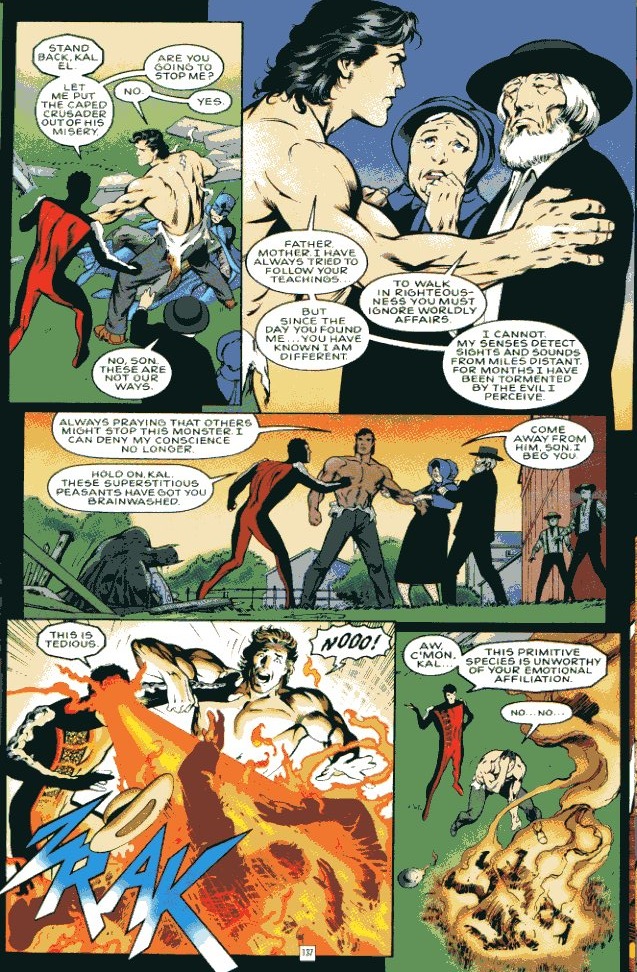
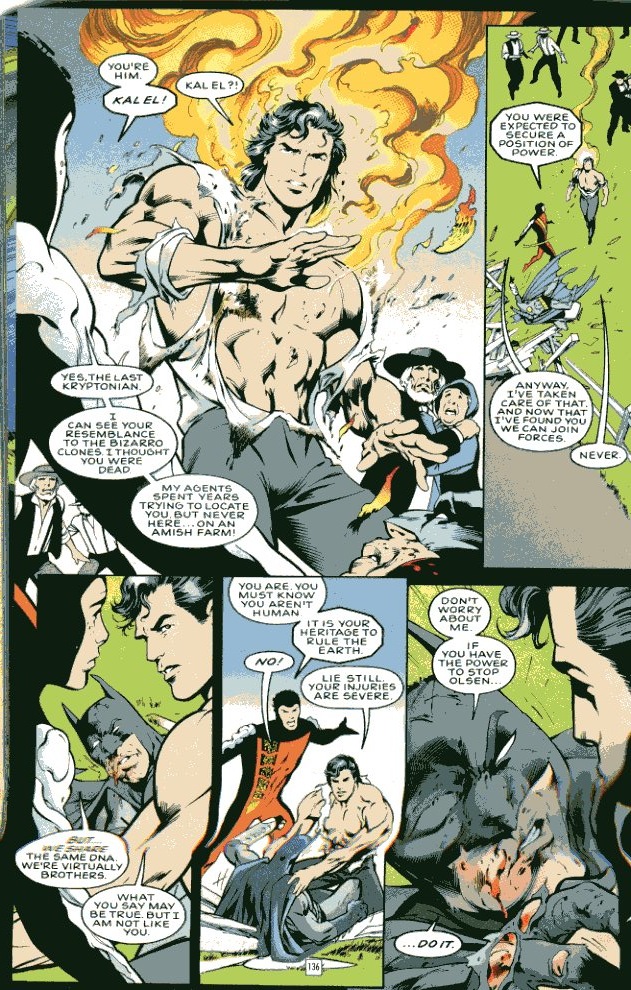
And, of course, the subject of Mennonite’s made me think again (mostly to my sorrow) of writer and illustrator Alan Davis’ 1998 JLA alternate reality exercise The Nail. For those fortunate enough to have missed the series, it’s high concept is that John and Martha Kent ran over a nail on day that Superman’s rocket ship landed on earth. As a result, the Kent’s didn’t find the ship. Instead (as we learn towards the end of the book) an Amish family found it. Since the Amish won’t interact with the rest of the world and since they are (like most Mennonite sects) pacifist, the fact that this family discovered Supes meant that he never became a superhero; he just stayed on the farm. Without his iconic presence, superheroes (and especially aliens) are distrusted, Lex Luthor becomes mayor, no one is tough enough to stand up to Kryptonian technology…etc., etc. In short, things go to the bad, and it’s all because of the stupid Amish.

Most superhero comics are stupid, and The Nail is no exception. Still, there is something of the idiot savant about it. Davis was looking for a way to neutralize Superman and, by extension, all of superdom. What is the opposite of the superhero? The obvious answer is, a supervillain. Too obvious — and, incidentally, untrue. Superheroes and supervillains are part of the same world, the same milieu. Superman being a supervillain doesn’t remove or negate him; it just puts him front and center in a different role (Earth 3! And god help me that I know that….but anyway….)

So, supervillain is no good. But…what if you make him a pacifist? Then he’s ineffectual, irrelevant — he’s nothing. Which is to say, it’s not supervillainy that’s the opposite of superheroics — it’s pacifism.

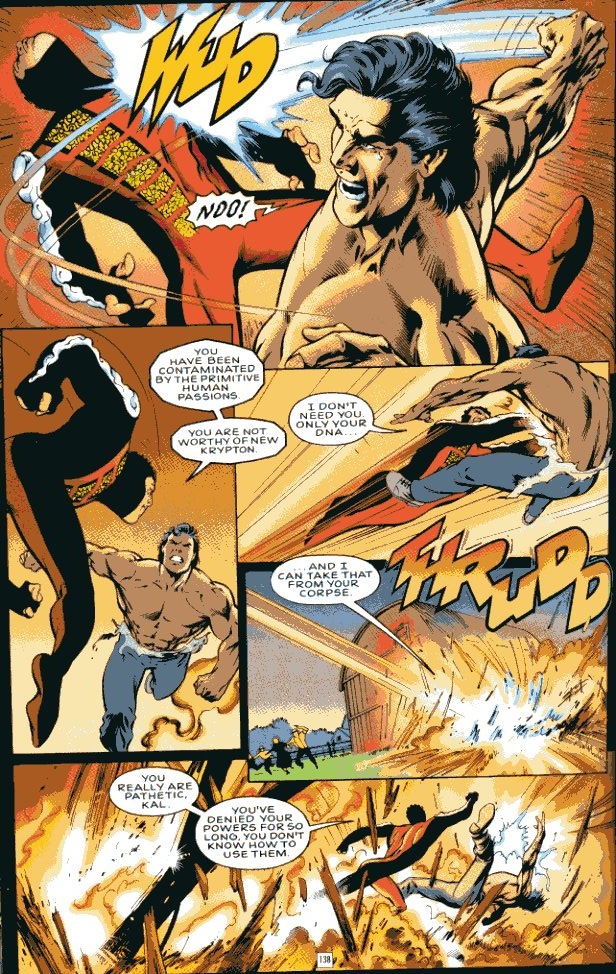
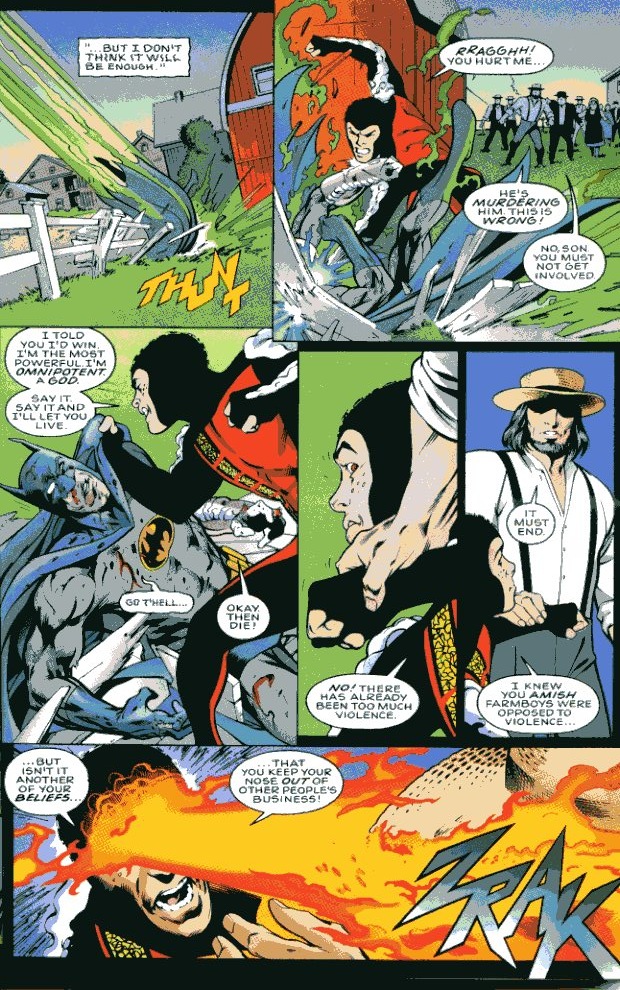
The book in its final pages, then, glorifies superheroness not primarily through derring-do, but rather through a thumbnail repudiation of non-violence. This repudiation is sealed by the gratuitous and gruesome obliteration of Superman’s Amish parents, who barely get a panel or two to express their misguided philosophy before Davis reduces them to ash. That’s what you get for keeping Superman down, you religious weirdos!

Yes, that’s Jimmy Olsen as the supervillain. Don’t ask.

Anyway, following this sequence in which Supes sees his (Amish) parents killed, and then attacks the evil Jimmy superOlsen, the Supes and Jimmy battle. Unfortunately, Supes (being Amish and not good at fighting) can’t beat him. Luckily, though, Olsen spontaneously disintegrates because his powers are unstable (again, not worth explaining why.) In the aftermath, Superman decides to become a standard issue superhero, and the implication is that his innate awesomeness will defuse the anti-alien hysteria that has swept the world.

So…parents killed, check; vengeance inflicted, check; dedicate life to superheroics to honor parents, check. Except that, from the point of both the drama and the plot, Superman’s repudiation of nonviolence is completely superfluous, and even, arguably, detrimental. Supes could have just as easily handled Olsen through nonviolent means — getting in his way, or holding on to him. Since Olsen essentially disintegrated on his own, the outcome would have been the same — except that Supes would have actually kept faith with his parents rather than betraying their beliefs for nothing. Similarly, if the world is terrified of malevolent aliens, the sudden revelation of an even more powerful violent alien in their midst seems unlikely to calm things down. On the other hand, had Supes revealed himself to the world as a superpowerful alien who embraced nonviolence and noninterference in the affairs of the world…well, it seems like that might have been a more effective statement.

The logic of the story Davis has constructed, in other word — with Superman as Amish — seems to lead naturally to a parable about the triumph of nonviolence. After all, if the greatest hero in the world is a pacifist, it makes sense that you’d end up with a story in which pacifism is heroic. Unless, of course, you see pacifism and heroism as mutually exclusive, in which case the heroism comes, not from the pacifist witness, but from repudiating your entire past in order to embrace violence in the name of your dead parents who would, undoubtedly, be appalled.

Davis’ story also resonates oddly with broader arguments about pacifism. The usual dig against pacifism is that it is foofy pie-in-the-sky nonsense. As an ideal, it’s all well and good, but in the real world, violence is sometimes necessary. Davis’ story makes this argument by, in part, going out of its way to make the Amish impractical to the point of callousness. Not only do they advocate non-intervention, but they argue that their son shouldn’t help Batman in any way, even though he’s being beaten to death literally on their doorstep. This is surely a bastardization of Amish beliefs; the Amish, after all, can vote; they can interact with outsiders. The depiction here is a caricature, intended to make their position seem ridiculous…and unrealistic.

But the irony is that the world where Superman stays in his Amish community and doesn’t interfere in the outside world is actually more realistic. Because, you know, Superman doesn’t interfere in the world. Because there isn’t a Superman. Nobody has to resort to violence to defeat supervillains, because there aren’t supervillains. The DC Universe is unrealistically violent. The opposite of the superhero is the Amish not just because the superhero is violent and the Amish are not, but because the superhero doesn’t exist, and the Amish do. What happens at the end of The Nail is not an eruption of realism into the Amish fantasy of nonviolence. It’s an eruption of fantasy violence into the Amish’s realistic pacifist community. Perhaps that’s why the Amish parents have to be so summarily dispatched; if they were allowed to stick around, they’re solidity would have made Davis’ entire farrago of nonsense dissolve into mist.

In The War of the Lamb, John Howard Yoder talks a little about heroism, specifically in terms of Martin Luther King and Che Guevara. Both men, he points out, were killed; both have, as a result, been viewed as martyrs. Yoder points out that following King’s assassination:

] Many leaped to the conclusion that nonviolent alternatives had thereby been refuted. At the same time, all over Latin America, the fact that Che Guevera had been gunned down in the Bolivian mountains did not mean that guerrilla violence had failed. Why not?

The inconguity is even more striking when we remember that King…had expected to be martyred. This was true both in the general sense of the knowledge that nonviolence will be costly, undergirded by the Christian readiness to ‘share in the sufferings of Christ’ and in the more precise sense that King gave voice to ominous premonitions in the weeks and days just before his death. Che’s defeat, on the other hand, was not in the Marxist scenario. On the general level, for the Marxist the victory of the revolution is assured by the laws, as sure as those of mechanics of dialectical materialism. In the narrow sense as well, Guevara, just before he was captured and killed, was still expecting to win as head of the violent insurgency in Bolivia.

Is there not some flaw in the logic here? Of a man who predicted his death, who explained why he accepted it, whose work did not perish with his death, the critics argue that his view is refuted by that death. Of the other man, who premised victory and whose campaign did collapse with his death, his faithful proclaim his resurrection…. The Marxist believe that their hero’s death is powerful on some other level than his military defeat. Whatever that reasoning may be called, it is not standard Marxist pragmatism, but some kind of apocalyptic myth.

The Nail suggests that, for “apocalyptic myth,” we might substitute “genre fairy tale.” The narratives that justify violence are, predominantly, not about realism, but about revenge or excitement or masculinity — which is to say, they’re pulp. Perhaps, The Nail suggests, nonviolence isn’t wrong because its unrealistic, but rather because it gets in the way of the really quite embarrassingly stupid stories we like to tell ourselves.
____________________
For more on superheroes and pacifism, here’s my essay about Spider-Dove.

Too Much is Never Enough: Morris Lapidus’ Postmodern Curves

HU’s been preoccupied with architecture this week. In yesterday’s post, Suat noted that “the building shorn of its façade has long been favored by cartoonists in search of a structure which best encapsulates the comics reading experience in a physically possible form: the rooms and walls acting like panels and borders…” But it’s worth noting that the gridded interior which resonates most efficiently with the conventional comics form is a historically situated architectural shape: the rectangular multi-story urban dwelling, industrial tenement house or modernist skyscraper.

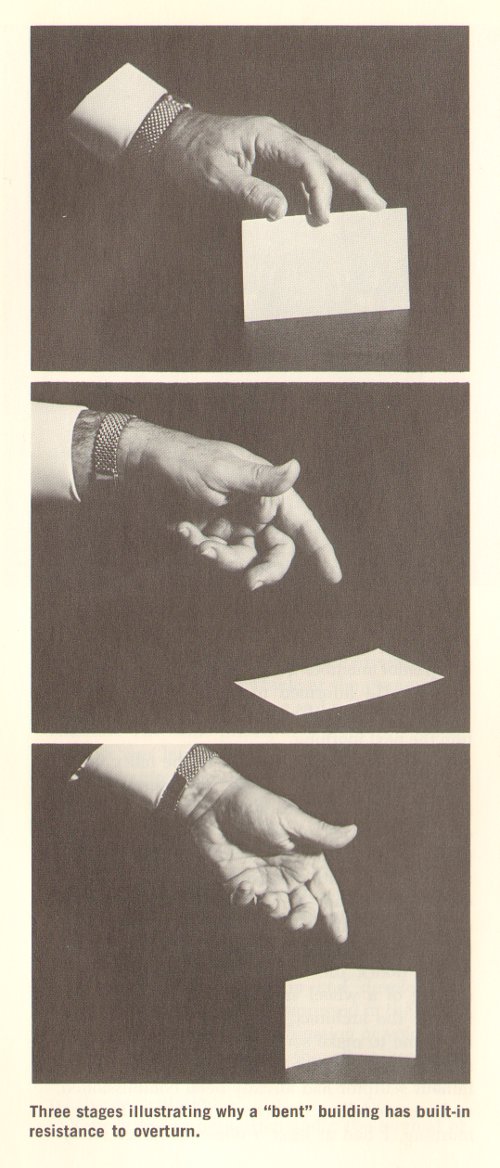
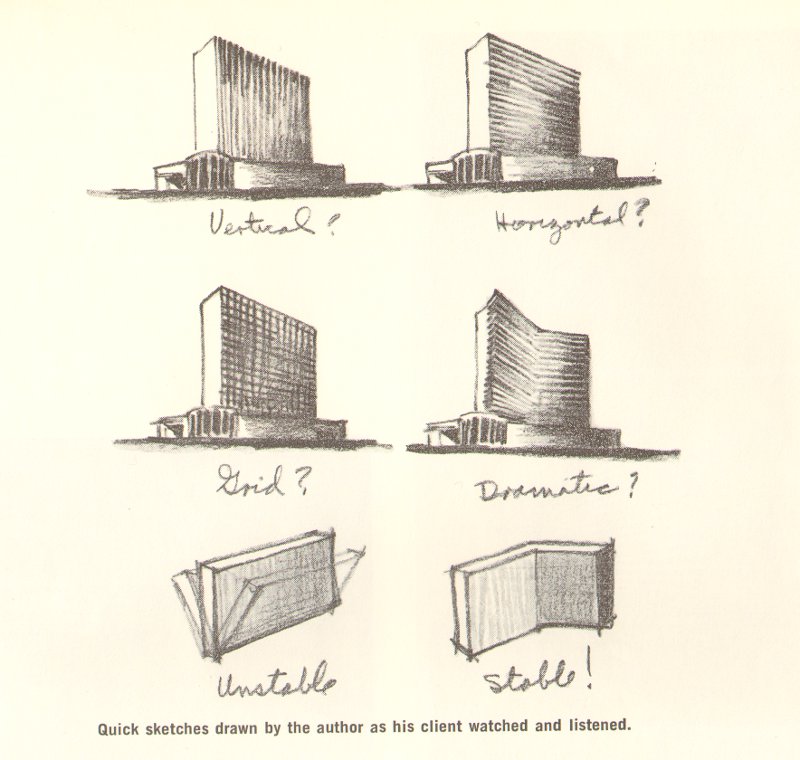
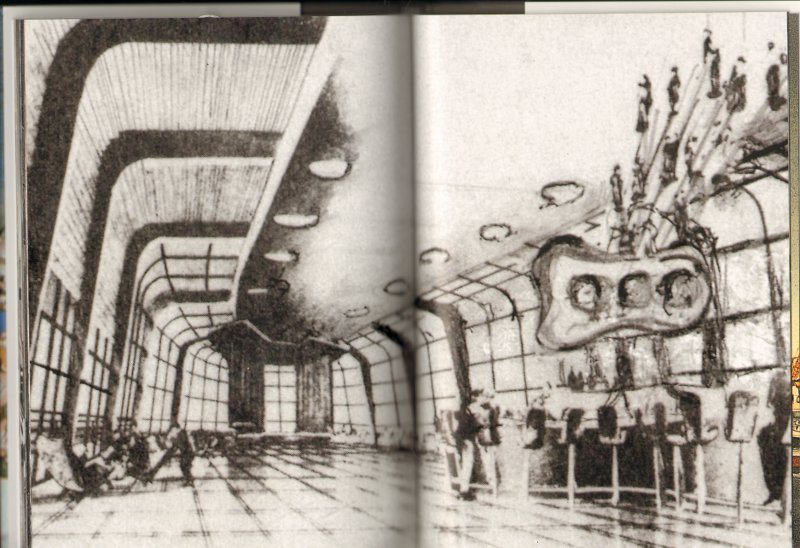
When architect Morris Lapidus was designing the 50-story Americana hotel in New York City in 1960, he needed to save his client the half-a-million dollars it would take to stabilize the high building against wind pressure. Lapidus’ solution was to bend the building so it would stand by itself, without support. First he illustrated the concept for his client using a calling card:

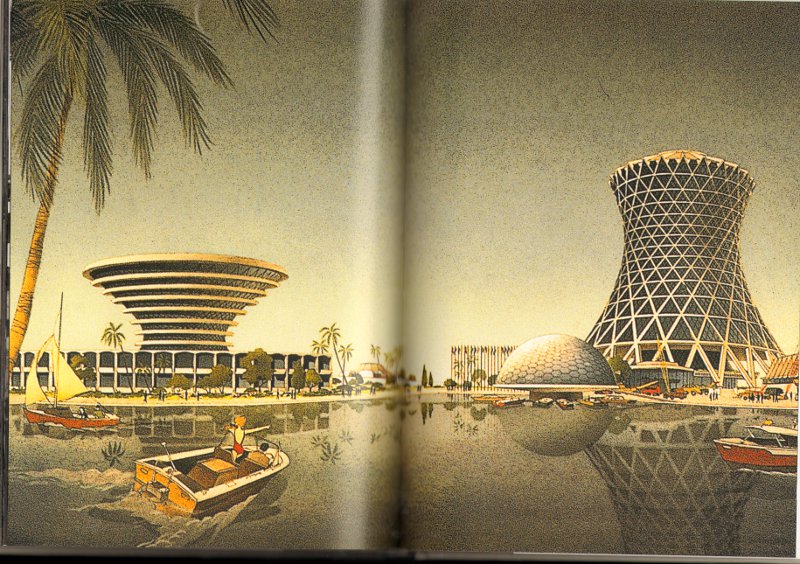
And then through illustrative drawings:

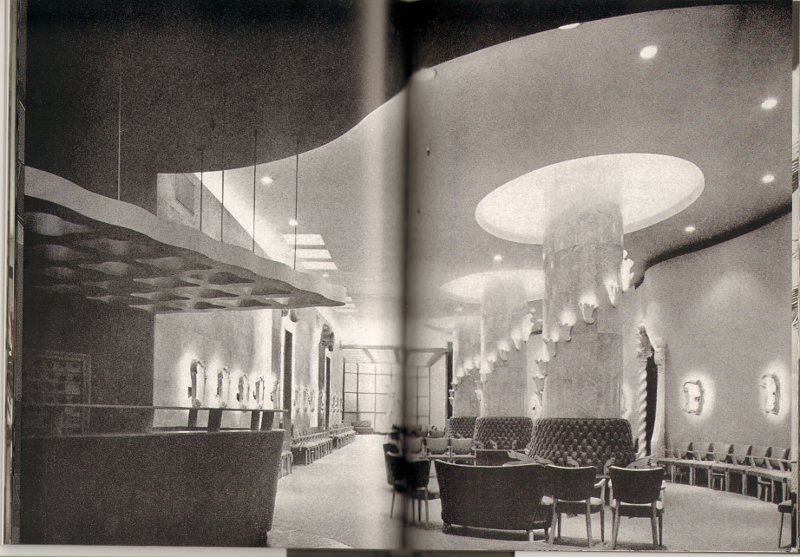
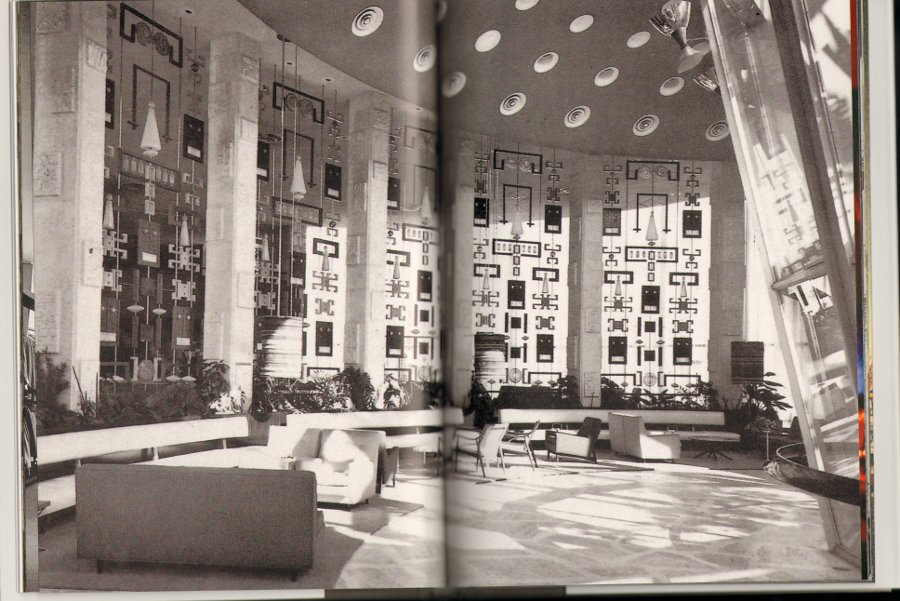
Basically, Morris Lapidus knew the limitations of a straight line. In the 1930s, living in New York and working as a merchandiser, he was already getting customers’ attention through curvilinear ornamental devices that an editor at Pencilpoint magazine described as “bean poles, cheese holes, and woggles.” [Woggles were amoeba-like shapes.] By the early-50s, during his rise to prominence in Miami Beach as the go-to architect for luxurious exotica, these features had become a signature style.

Lapidus himself defended the curves as natural — ”People don’t move in straight lines like an army — they meander. So, my plans meander” — but his protégé, Deborah Desilets, captures the more subjective experience of eschewing linearity: ”Mr. Lapidus knows how to give emotions physical form,” she said. ”His space swirls you; it prompts you to move; it’s an interactive architecture.”

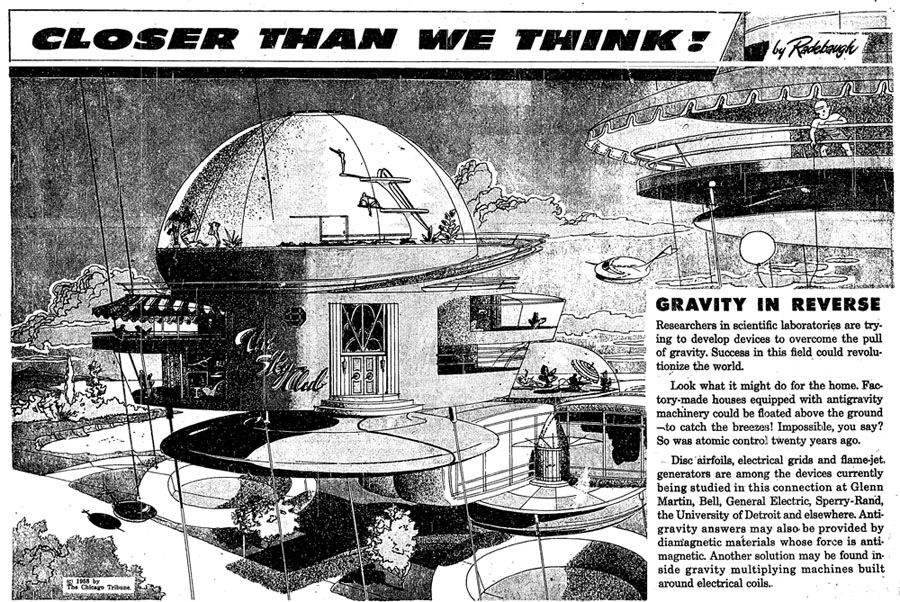
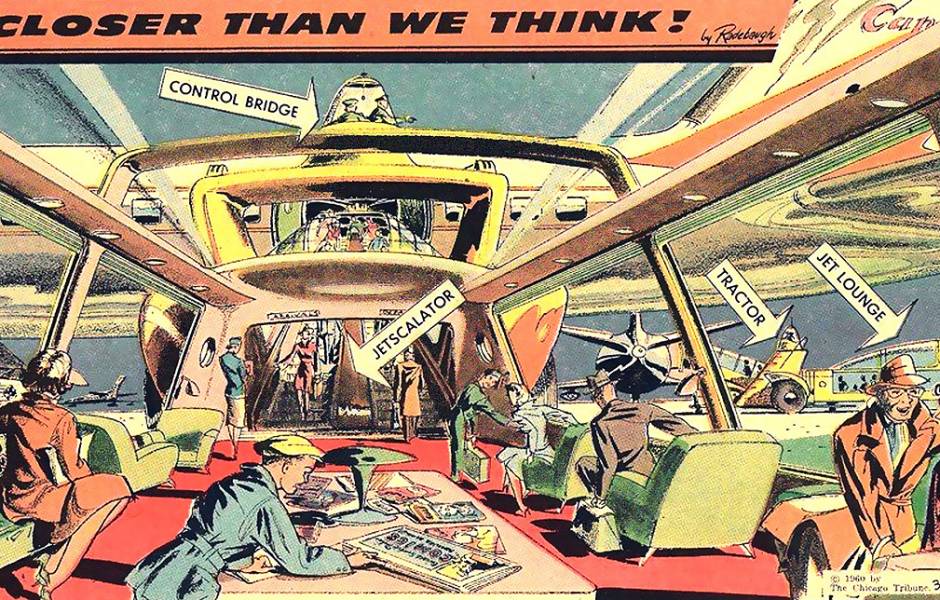
Around the same time as Lapidus was swirling the glitterati through his Miami hotels, The Chicago Tribune was publishing a single-panel “comic strip” by Arthur Radebaugh called “Closer than We Think”, which traded on the same curvilinear futurist aesthetic.

Although explicitly futuristic, both Lapidus and Radebaugh stand in marked contrast to the stark modernism of the International Style and European futurism of the early to mid-century. Theirs is a decadent, utopian futurism, apolitical, indulgent, ultimately more pop psychology and marketing than technology and science. Contrast with the futurism of Metropolis or Marinetti: these spaces are futuristic environments for an affluent bourgeoisie, professional men and women, with an expectation of technological luxury (an expectation not unrelated to our current economic malaise). This is a characteristically American futurism, indicative of “The American Century” and redolant with the capitalist fantasies that propelled America’s mid-century economy as well as American’s mid-century style.

And that’s where Deborah Desilets has a point: those decadent curves really are more immersive, emotional, and interactive than their more starkly linear cousins. This is the fantasy formation that makes it possible for marketing to mask commodification. Decadent futurism feels so postmodern not just because it foregrounds non-linearity as the avant garde would have it, but because it puts that non-linearity in the service of a fluid, imaginative fantasy — an unanchored, forward-looking fantasy of possibilities rather than the nostalgic one of history and memory that’s more characteristic of modernism. It’s that futuristic fantasy that is characteristically postmodern, in contrast with modernism’s fascinations with history, autobiography, and the contours of the past.

Not that a curvy, luxurious, decadent aesthetic is inherently bad or even inherently capitalist; in pre-modernist art, it was certainly put to far more bohemian ends. And non-linearity certainly isn’t associated with capitalist success in literature — it’s remained avant-garde despite 30 years of experiments with it. But in visual culture, decadence has lost those bohemian connotations and become pretty thoroughly bourgeois. That narrowing of signification needs to be challenged.

By the most fully postmodern standards, comics with a few exceptions tend to be quite linear: narrative storytelling through panels, even at its most flexible, is essentially a medium of vectors and lines. Sometimes in comics conversations and criticism there’s a sense that the form of comics – that sequential narrative storytelling through panels – is somehow transhistorical, that it can be endlessly manipulated internally to speak to and resonate with many and any aesthetic paradigms. But that isn’t true for any other artistic form, so it’s probably not true for comics either. Sequential narrative-through-panels is an architecture, and architecture is as historically situated as anything else.

Review: Josh Simmons’ House

In an interview given in conjunction with Archi et BD, la Ville Dessinée (see Alex Buchet’s post), Jean-Marc Thévenet suggests there is in many comics “a psychological pressure suffered by a hero who is more often than not dominated by the environment in which they live.”  This is, perhaps, the most common manifestation of architecture in American comics.

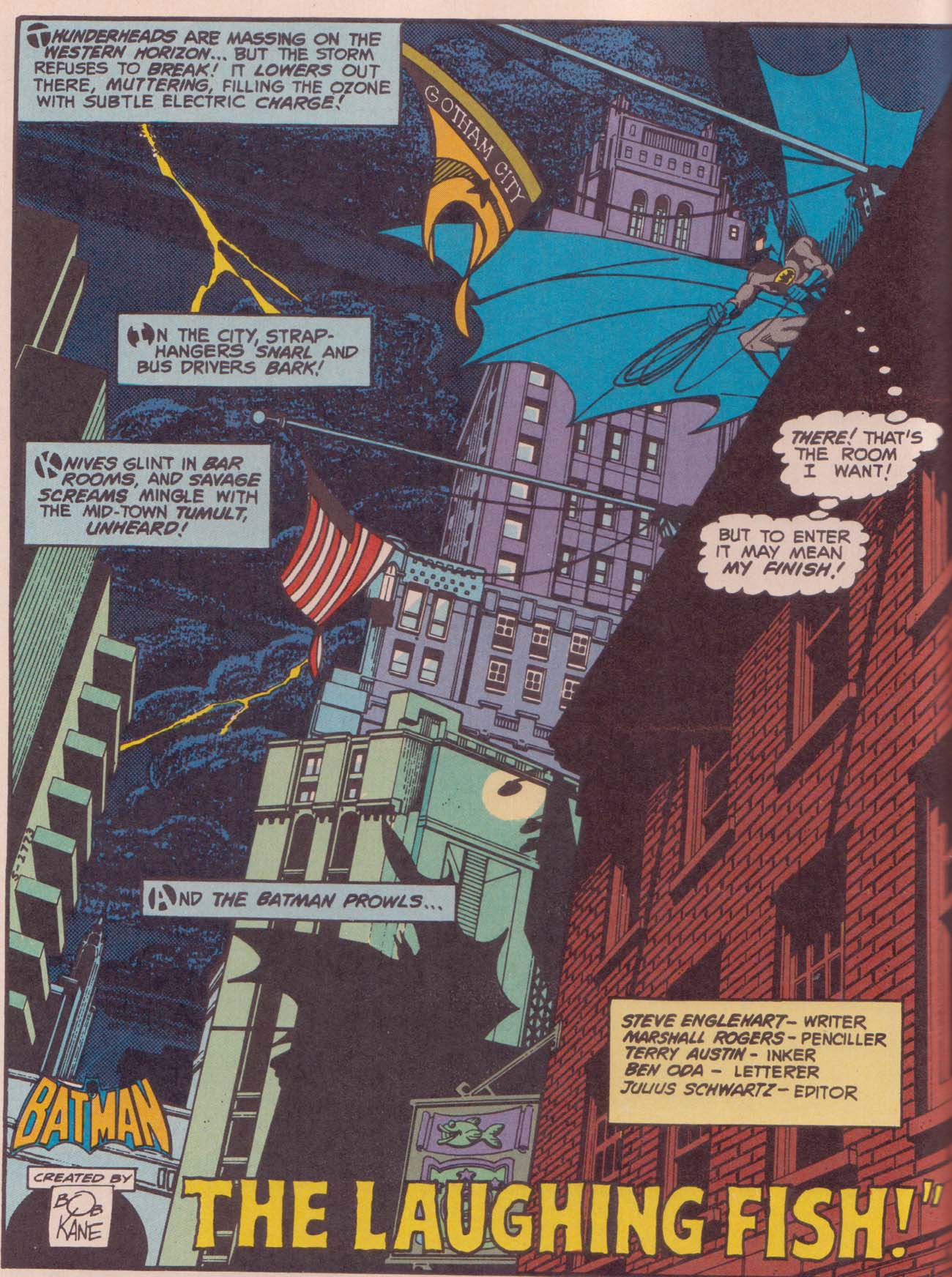
At a more popular and utilitarian level, we have Marshall Rogers’ delineation of the ornamented skyscrapers, alleyways, fire escapes and bricks that make up the borders of Batman’s Gotham, casting the caped crusader into realistic space, Rogers’ occasionally clumsy anatomy and staging notwithstanding.

Continue reading

Overthinking Things 9/5/10

In discussions of the “perfect comic shop,” in between delusions of comfy chairs and pink comic boxes to appeal to girls, the one thing that really stands out so often is the lack of  basic, barely minimal, much less decent, customer service. To make it worse, there’s dissatisfaction on both sides of the checkout counter.

I count myself incredibly lucky to know the owners of the Comic Store that blows the grading curve – Bill Meccia and Stacy Korn of Comic Fusion on Main Street in Flemington NJ.

Comic Fusion does not have great big comfy chairs and wide aisles – it’s a retail store on a main street of a little town. It has crowded shelves and walls, as you might expect from a comic book/collectibles store. But what Comic Fusion has that no other store has, are Bill and Stacy. Stacy is just about the nicest person you’ll ever meet.  She has been my “human relations” mentor for many years. If I can have a pleasant chat about nothing with a total stranger, it’s only because I learned how from Stacy. She’s a comics geek who likes people more than things, if such a thing can be believed.

When you walk into Comic Fusion, you are greeted by an old-school tinkling bell on the door, and a cheerful “Hello!” If you need help – they HELP you. No one is treated as anything less than a friend. And twice a year, Comic Fusion throws open its doors to men, women, children, random families walking by, artists, fans and people of all ages during their Free Comic Book Day and Wonder Woman Day events.

“I know what Free Comics Book Day is,” I hear you say. “What is…Wonder Woman Day?” Well, to answer all our questions, I’ve invited Stacy Korn herself to tell you.

According to Stacy, she and Bill started out with a Internet Store in 2003. After a few years they had so much inventory that they decided to open up a store front. Stacy is pleased to report that they get a lot of local families coming in with their kids – she thinks it is “very cool to be a part of parents sharing their love of comics with their kids.”

She’s just back from Baltimore Comic-Con and took a moment out of her schedule to answer a few questions for us.

What is Wonder Woman Day?

Wonder Woman Day was started by Best Selling Author Andy Mangels (who is a big Wonder Woman fan and wanted to celebrate the Wonder of Wonder Woman) in Portland OR, five years ago. One of our customers saw advertising for the event and asked if we would be interested in doing something similar. I had been looking for a way to help out our local Domestic Violence Shelter, SAFE in Hunterdon, and this seemed like a perfect fit!

How did it evolve into Super Hero Weekend?

Excalibur Comics in Oregon does Wonder Woman Day as a one-day event on a Sunday. Our town is pretty sleepy on Sundays, so I wanted to open the event up on Saturday as well. I also noticed that the few sketches that were not Wonder Woman got pretty decent bids [in the silent auction fundraiser]. I still wanted to honor Wonder Woman, but at the end of the day, the object is to raise as much money as possible for the shelter, so I opened the event up to include other Super Heroes. By doing Super Hero Weekend there is less confusion with our sister store in Portland, but by featuring Wonder Woman Day we still share the event with them.

What festivities are planned for the event?

We like having fun at Comic Fusion so we have folks dressed as Super Heroes for people to take pictures with, awesome Artists doing sketches for donations, a raffle with some great prizes. The main focus is spectacular artwork from people in the comic book industry for our Silent Auction.

We already have donations of great sketches from Legendary Sergio Aragones, the always Awesome Michael Golden, my personal Hero, David Mack, and Rising Star Charles Wilson III, just to name a few.

I am so touched by the generousity of all these artists. We also will be getting sketches from Superstar Adam Huges, Sketch Card Star Allison Sohn, Sports Card Star James Fiorentino, the Undead and Unbelieveable Ken Haeser and the list goes on! The Guest List is pending, but I am pretty sure we will have some incredible talent at the store.

What are your thoughts on Wonder Woman’s new costume?

To be honest, costumes come and go. Every writer and artist wants to put their stamp on the character. What is important to me is how Wonder Woman is portrayed. She is a strong, compassionate, intelligent woman. Writer Greg Rucka once told me that she is the strongest of the Big Three (Superman, Batman and Wonder Woman). She will do things her counterparts can’t or won’t. I agree with him completely! And if you haven’t read his run on Wonder Woman run out and get it! Awesome from beginning to end. He totally “gets” Wonder Woman.

Any message you’d like to share with readers about anything?

In hard economic times domestic violence goes up and charity funding goes down. You can help break this cycle and get a cool sketch in the process. A lot of the artists that donate will be future Super Stars! You can pick up a cool sketch at a affordable price, AND help out a worthy cause, AND have a great time! If you can’t make the event in person, bidding will begin online October 1st. Check out www.ComicFusion.com and click the Wonder Woman Picture to go the Wonder Woman Day page and see the artwork. Check us out on Facebook at Comic Fusion Fans and click the events page to go to the Super Hero Weekend Event. If you are local, some down to the store and enjoy the event. Any way you choose, you can still help out and get a great sketch!

I’m going to be predictable here and end this with the obvious – if there are any Superheros at this event, my vote goes to Stacy and Bill. They make every day at Comic Fusion Superhero Day.