Utilitarian Review 9/4/10

On HU

We started the week off with a guest post by James Romberger, who discussed the reasons for and the wrongness of the fact that artists often don’t get credited adequately in comics collaborations.

Melinda Beasi guest-posted about Twilight and the way some women try to distance themselves from fandoms that are too femme.

Richard Cook explained why The Girl With the Dragon Tattoo is lame.

Caroline Small reviewed comics and animation by Lilli Carré.

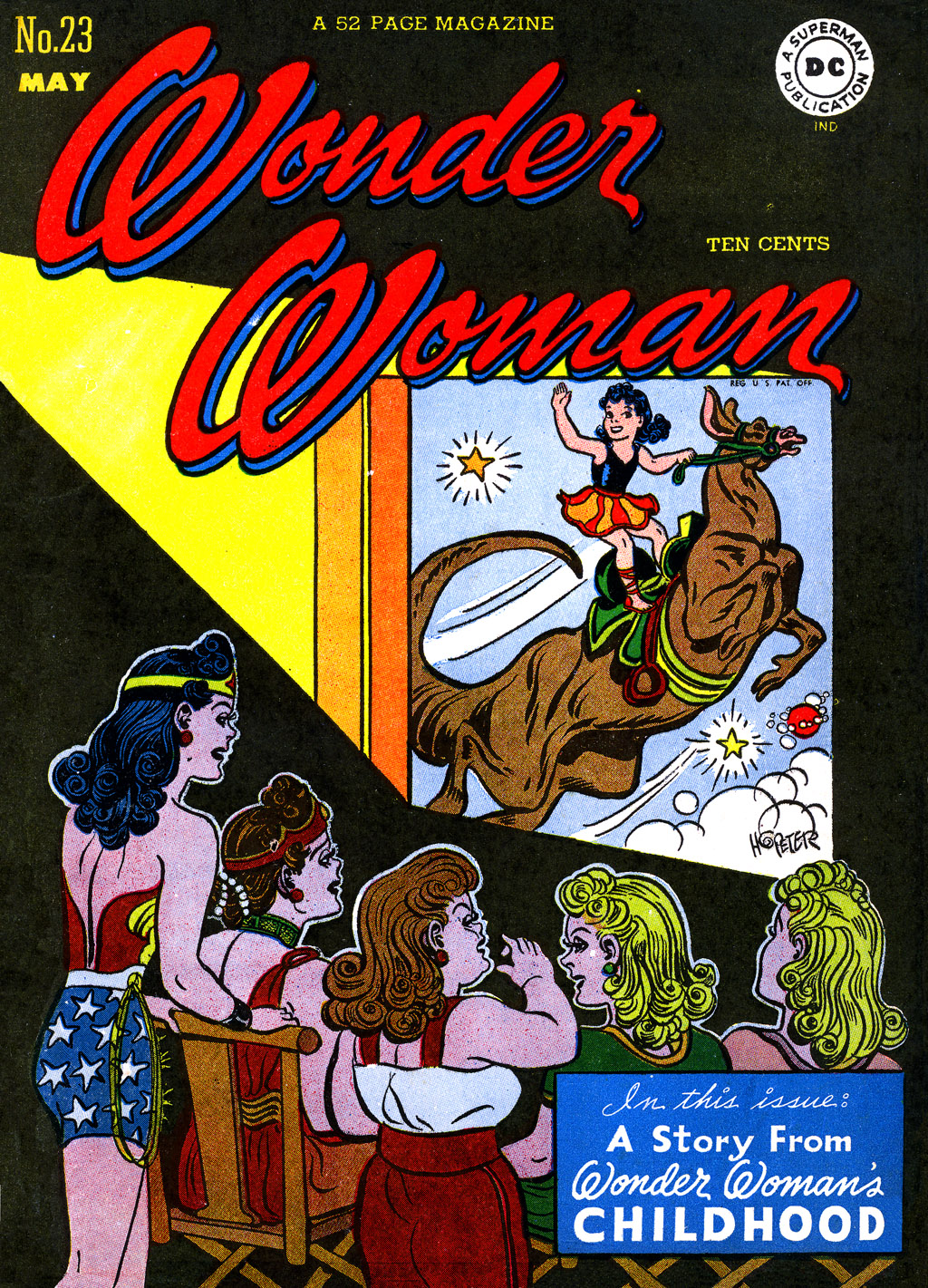
I talked about the eroticization of young Wonder Woman in Marston and Peters’ Wonder Woman #23.

I talked about class in Twilight.

And this week’s download is for Easy Lounging Hippies, featuring the Byrds, the Hollies, John Denver, and Italian soundtrack music, as well as other things.

Utilitarians Everywhere

At Comixology I talk about race and blackface in the work of R. Crumb.

In that sense, Crumb’s image for the song could almost be seen as parody; a vicious sneer at Joplin’s blackface pretensions, caricaturing her as both a wannabe black mammy and as the whining white entitled brat looking to the exploited other for entirely undeserved comfort. As I said, it could almost be seen as that — if Crumb hadn’t thrown in another entirely gratuitous blackface caricature in the bottom center panel, just to show that, you know, he really is exactly that much of a shithead.

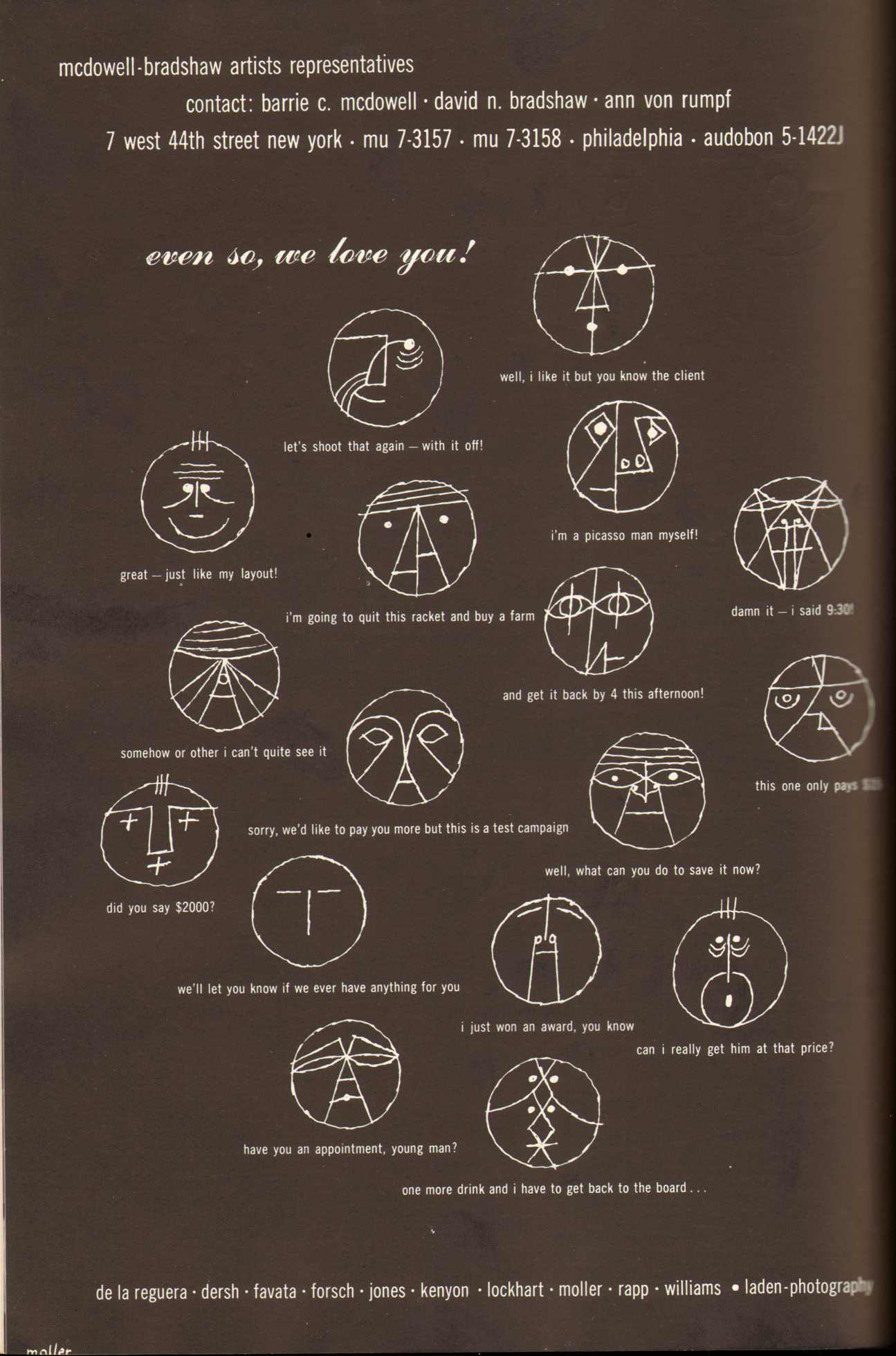
At Splice Today, I talk about Raymond Williams and the apotheosis of advertising.

Williams notes “Advertising was developed to sell goods, in a particular kind of economy,” but, “Publicity has been developed to sell persons, in a particular kind of culture.” The two are related, the second an outgrowth of the first, and while advertising has (arguably) experienced some setbacks recently, publicity has gone from hulking behemoth to master of the universe. Once professionals organized advertising campaigns. Now those same campaigns are conducted by you and me and everybody all the time with our personal web pages and MySpace pages and YouTube videos and self-Googling. The media consumers have taken the means of media production, and they’ve used it to create a virtual world where identity and consumption are more indistinguishable than ever before.

Also at Splice, I talk about the disappointment that is Fumi Yoshinaga’s Ooku, volume 4.

For cultural goods, the analogue of planned obsolescence is called, as most everyone knows, “jumping the shark.” The phrase—which itself has jumped the shark—used to describe the moment when any serialized entertainment gratuitously abandons its dignity and begins to suck with an almighty suckage. Think of the episode of The Cosby Show where Cliff gives birth to a hoagie and a bottle of orange soda. Or don’t think of it. I’m trying not to.

At Madeloud, I reviewed the mediocre new album by Plants and Animals.

Other Links

Anne Ishii has a really funny interview with Johnny Ryan about the manga Detroit Rock City.

Tom Crippen has an excellent review of Alan Moore’s new Cthulhu mash-up project.

Via Dirk, Dan Raeburn’s classic comics crit zine, The Imp is now available online.

Tucker Stone and David Brothers continue their very entertaining look at the Black Panther.

Shaenon Garrity has a really superb essay about Cathy Guisewite’s comic strip Cathy.

And this is a fascinating essay about Netflix. I think there are some lessons there about digital for comics companies — not that anyone’s likely to pay any particular attention…..

Bite Marx

Since Melinda Beasi wrote about Twilight here earlier this week, I thought I’d follow up with this essay, which ran in an edited form at the Chicago Reader.
________________
Twilight fans always make a fuss about Team Edward versus Team Jacob, but they might as well be plumping for Team Effete Aristocrat versus Team Colorful Earthy Ethnic Stereotype.

As with all things Twilight, the tropes work not because of their subtlety, but because of the absolute ham-fisted earnestness with which they are deployed. Eclipse is the book where the Edward/Bella/Jacob triangle attains an apotheosis of melodramatic angst-ridden preposterousness. As such, it’s also arguably the book where the bone-headed stereotyping is most thoroughly exploited. What sets the tween heart racing is not that Bella has two boyfriends, but that she has two romance narratives to choose from — narratives of differing but equally venerable pedigree.

In this corner, there’s Edward Cullen. Edward is extravagantly cultured, and ridiculously wealthy. He composes classical ballads, writes in an immaculate hand, and buys his sister a Porche as an offhand gift. Like a real product of the upper crust, he lives with his brothers and sisters, who are all also paired up as husbands and wives. His family is, moreover, obsessed with blood, and has amorphous connections to Italy. He’s foreign, exciting, steeped in ancient traditions, and deeply, ludicrously white. He’s the noble prince come to whisk Bella out of her life and into a deliciously decadent life of luxury and romance. Meyer name-drops Darcy and Heathcliff and Romeo, but Edward has at least as much in common with Prince Charming.

And in this corner, there’s Jacob Black. Jacob is the opposite of upper-class. An Indian living on reservation land, he transforms simultaneously into a werewolf and a laundry list of invidious racial stereotypes. He’s literally hot-blooded — werewolves have higher than normal temperatures, just as vampires have lower than normal ones. Jacob also has massive self-control issues; whenever he gets angry or upset, he starts to shake violently and then turns into a giant deadly wolf. He’s also hairy, frequently bare-chested, and…good with tools! He also eats a prodigious amount — as opposed to the uber-cultured Edward, who doesn’t eat at all.

If Edward is the aristocrat who treats Bella like a delicate queen, Jake is the swarthy, sweaty working-class hero who won’t take no for an answer. Edward will barely allow himself to kiss Bella; Jake, on the other hand, literally overpowers her when he wants a smooch and she’s reluctant. With Edward, Bella always has to be careful; with Jake she gets to be a little bit wild — riding motorcycles, cliff diving, and generally getting in touch with her inner wolf/teen delinquent. If Edward’s the prince whisking away the scullery maid a la Cinderella, Jake is the virile commoner dragging the frigid aristocrat down into the sensual muck a la Titanic.

Romance as a genre has always been just about as obsessed with class as it has been with gender. Differences in social standing are both great drivers of plot (“I’ll never allow you to marry that piece of trash!”) and sexy in their own right. The boy next door (played in Twilight by Bella’s poor, ordinary, never-had-a-chance classmate Mike Newton) is dull — there’s nothing romantic about winding up with the person everybody expects you to wind up with. But a prince to pull you up to the castle or a gardener to drag you down in the muck — that’s an exotic tale to set the heart racing and the bodices ripping.

Meyer’s genius (if you want to call it that) is to have figured out a way to repurpose the same old clichés for an era in which not even tweens want to admit to fetishizing either those on the top of the social scale or those on the bottom. Edward is enchantingly attractive not because he has gobs of money and cultural capital, but rather because he’s an immortal mysterious vampire whose body goes all sparkly in the sun. Jacob is excitingly exotic not because Indians make better lovers, but because he’s an impulsive superstrong werewolf. And the two don’ t want to kill each other because of class or racial animosities (which would obviously be really distasteful), but because vampires don’t like werewolves. When Jacob calls Edward “bloodsucker,” it’s a literal description, not a Marxist critique. When Edward calls Jacob “dog,” it’s because he grows fur and runs around on all fours not — despite all appearances — because it’s a racial slur.

Ultimately, of course, the dog lies down with the bloodsucker; the alabaster prince and the dusky gardener both love Bella so much that they set aside their differences to defend her. Social harmony descends on a world which never had any class antagonisms to begin with. A triumph of tolerance and goodwill? Well, maybe not. Certainly, to see the same old idiocies revived and venerated under a thin PC patina is irritating. How many generations are girls going to be waiting for their prince, anyway? And when exactly are we going to stop shamelessly exploiting the minorities just so that we can tell ourselves how sexy they look down there on the dung heap where we have so summarily deposited them?

But, on the other paw…there is something to be said for that thin patina. If there are stupid fantasies to be disseminated, maybe it’s better to have them be clearly labeled as fantasies. Edward’s not a prince; he’s a vampire. Jacob’s not out of control because he’s an Indian, but because he’s a werewolf. That’s no doubt splitting hairs (as it were) — but those are hairs that I’d as soon see split as not. If there’s one thing that romance consistently tells us, after all, it’s that differences matter.

Bound to Blog: Wonder Woman #23

Wonder Woman #22 was probably the worst one of Marston/Peter’s run…so bad, in fact, that I wondered whether significant parts of it might not have been ghosted.

Issue #23 is much better. It’s not one of the series high points — and notably, like 22, it has three short stories rather than one long epic, a change which I presume must be related to Marston’s sickness (he actually died of cancer in May 1947, which is this issue’s cover date.) Still, whether Marston was writing shorter stories on his death bed, or whether these are leftover scripts that he had lying about unpublished (and they can’t be too old, because they’re post-war) the result is perfectly acceptable, if not great.
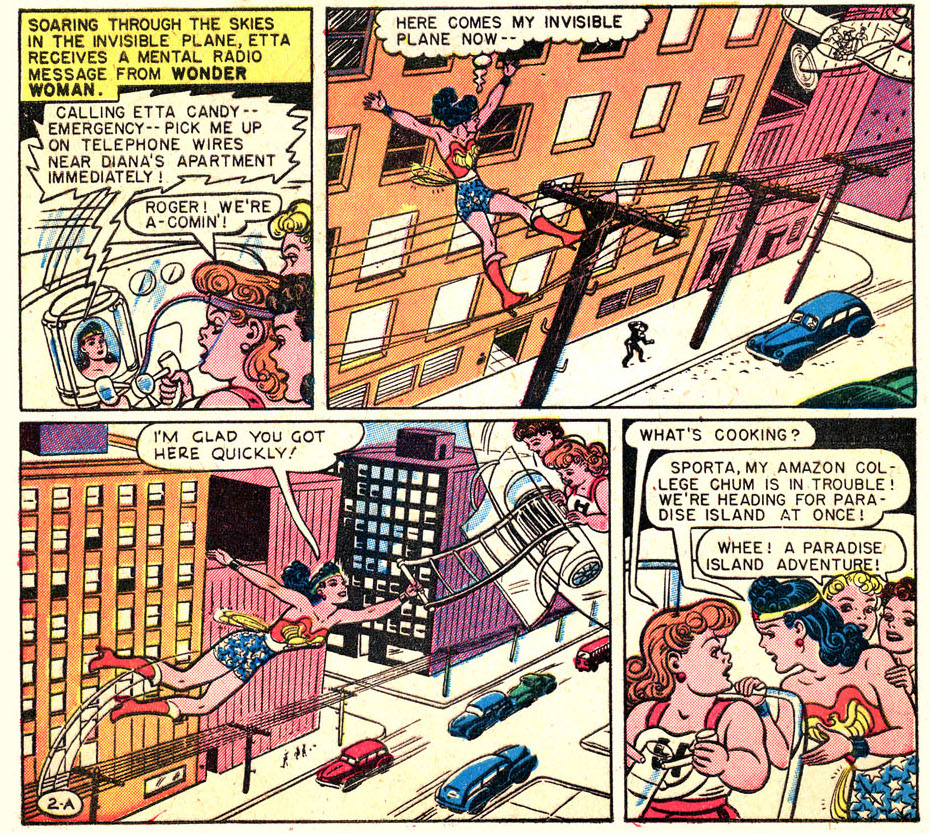
As the Holiday girl there in the lower right indicates, the first story is a paradise island adventure. All the more welcome since Harry Peter seems to be in fine form; that picture of WW sitting on the telephone wires waiting for her robot plane with the buildings slanting down vertiginously in the background is pretty fantastic.

Anyway in this story Amazons are disappearing from paradise island’s beach. This gives Hippolyta a chance to watch as her viewfinder presents her with a Perils of Pauline moment:
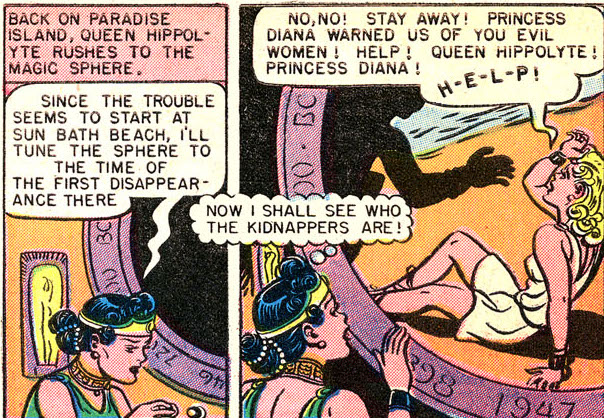
Anyway, the viewfinder breaks inopportunely, shattered by a bolt from Odin, whose Valkyries are flying down to Paradise Island to kidnap Amazons. Why you ask? Well….
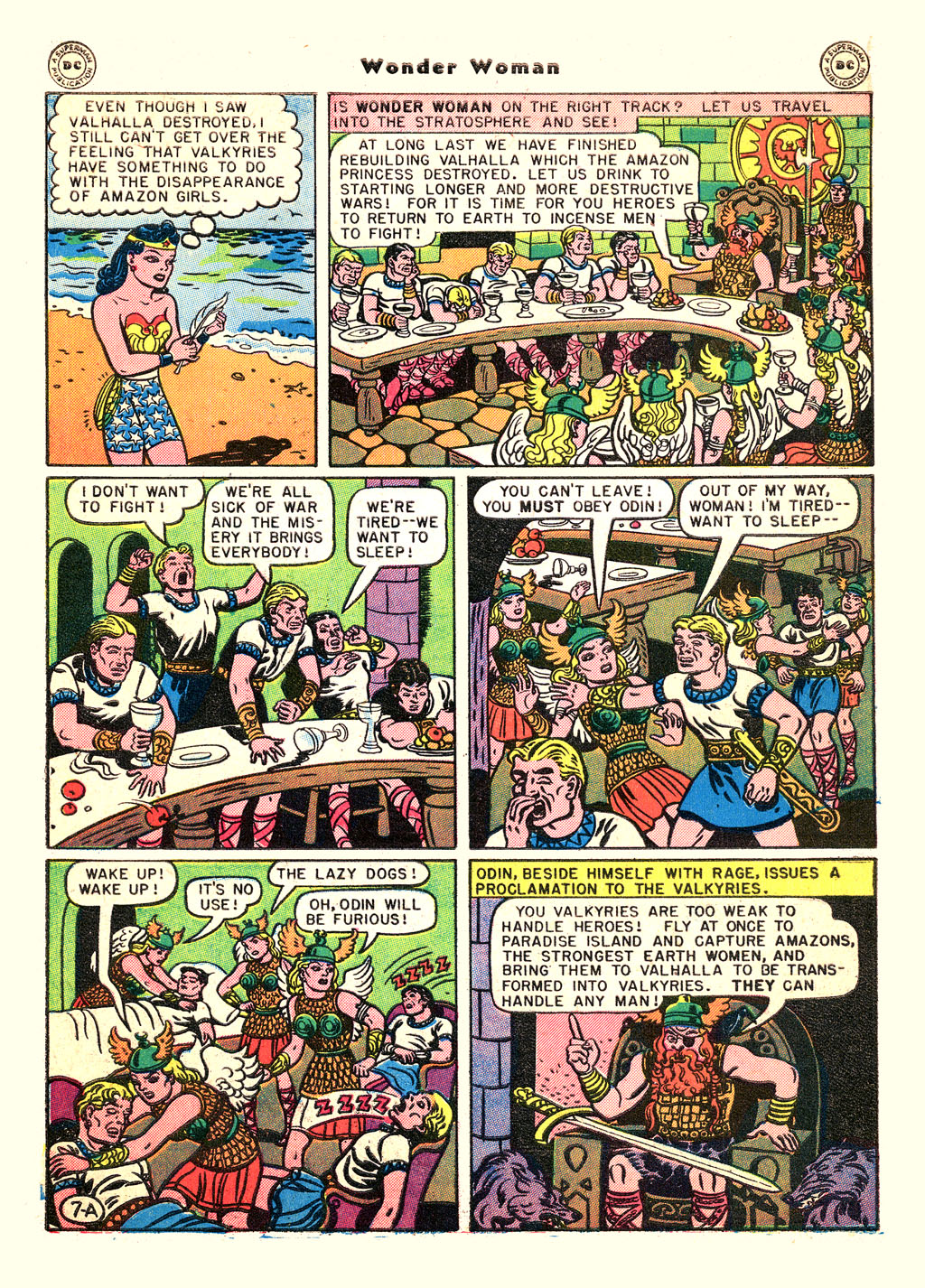
Odin has captured heroes (i.e. veterans) and wants them to go to earth to incense others to fight. But the heroes are tuckered out; all they want to do is sleep. Since his Valkyries can’t get the men to fight, Odin tells them to kidnap Amazons so *they* can get the heroes to go to war again.

As usual with Marston, the gender politics are delightfully convoluted. Obviously, the main instigator of warfare is the sadistic male patriarch, Odin. But the male “heroes” are shown throughout as being soft, manipulable, and not especially violent — they need a strong female hand if they’re going to be effective fighters. So in some sense it’s really women who are the embodiment of military virtues.
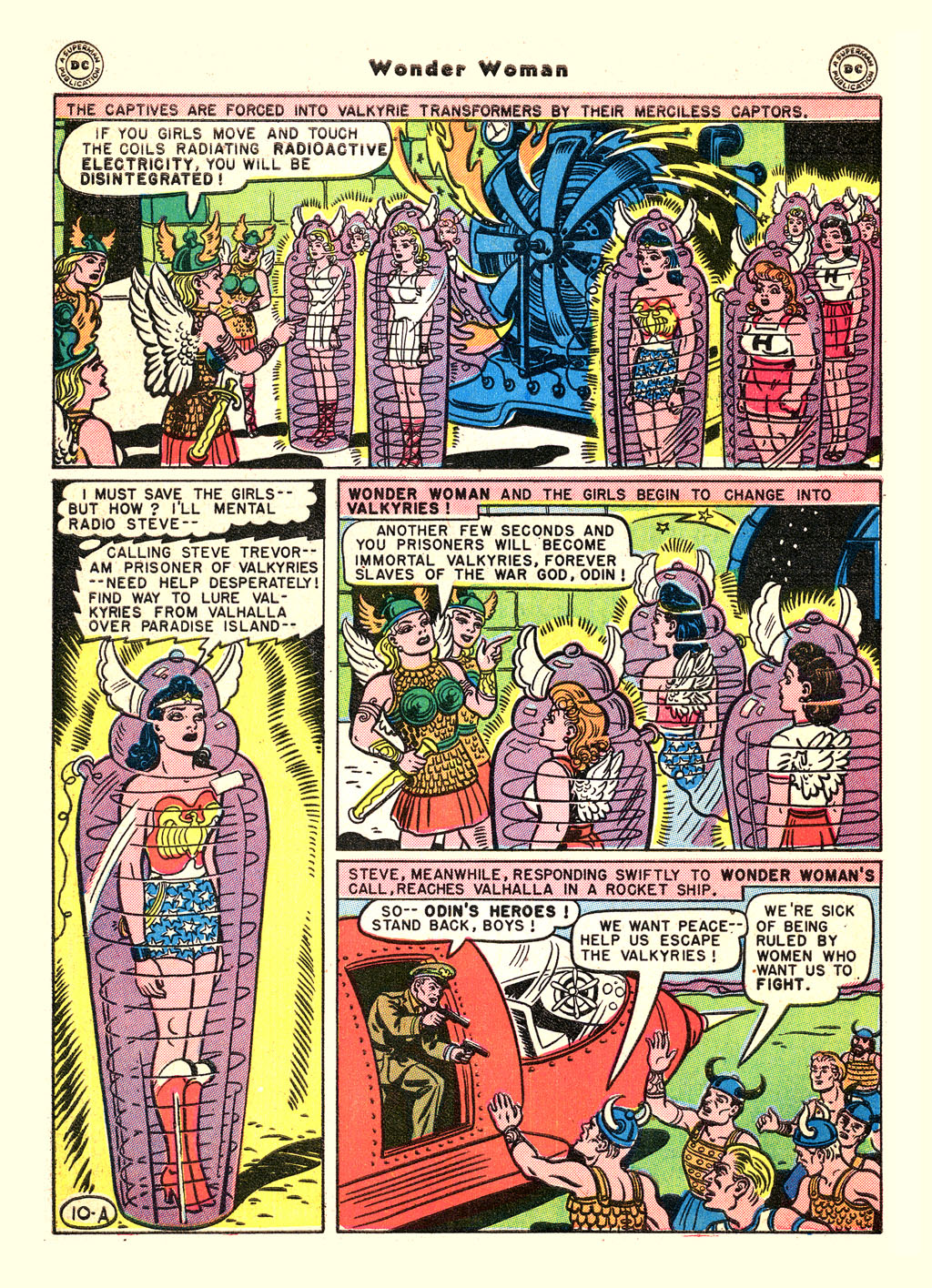
The funniest panel here is the bottom one, where the male heroes claim to be sick of being ruled by women “who want us to fight” — the implication being that they’re perfectly happy to be ruled by women who don’t want them to fight.

The rest of the page is interesting as well, though; the Valkyries have encased WW and Amazons and Holiday Girls in energy to trap them and turn them into Valkyries themselves. The purple energy happens in this case to look like the outline of Russian dolls…and of course, standing stock still in their various outfits, the transforming women look more than a little like dolls themselves (with special wing attachments!) I talked about the connection between Wonder Woman and doll stories before. In this case, the Valkyries eroticized dominance/appreciation of the Amazons is both about enjoying femininity *and* enjoying martial virtues. In fact, there’s barely an *and* there; for Marston, the more effectively militant you are, the more feminine you are (at least if you’re a woman.)
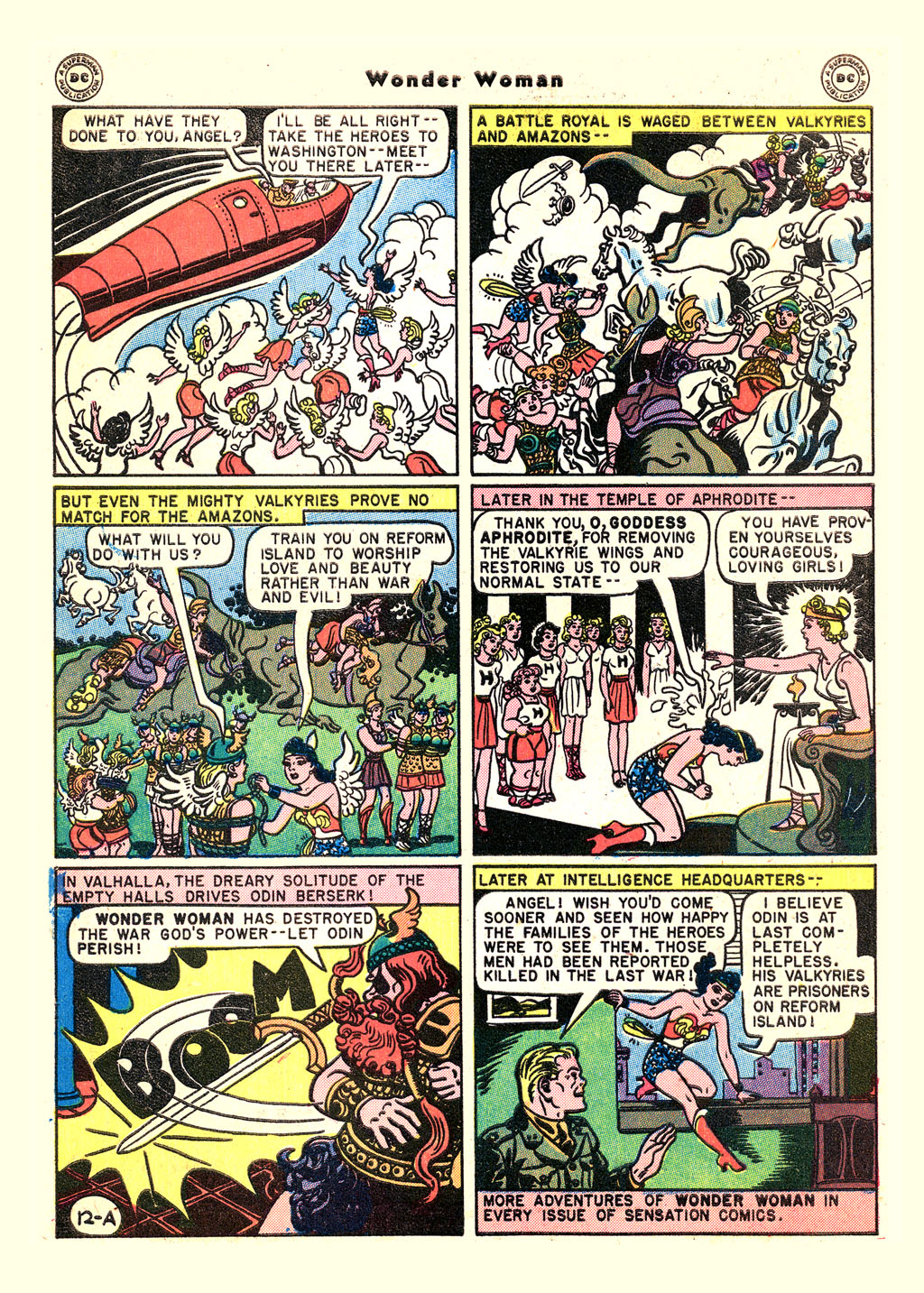
Which is why, in the middle right pane abovel, Aphrodite emphasizes that WW and the Holiday Girls are “courageous, loving girls” — the point being that courage and loving femininity go together. The natural conclusion is shown in the bottom left panel, where Odin, the supposed wargod, just gives up and offs himself (throwing down his phallic sword) when WW robs him of his Valkyries.

That page is pretty great in other ways as well, with winged Holiday girls and winged Amazons flying about with sky kangas and that magnificently phallic spaceship that Steve is piloting. I especially like the way the spaceship in the upper left panel mirrors the motion of the sky kanga in the upper right — as if the ubermaleness is just an image of, or subsumed within, the undulating sea of femininity. Maleness seems part of the harmonious whole of femininity rather than an opposition to it.

I also love that middle left panel; the scribbly sky-kangas and the valkyries being tied up here and tied up there, with scale all off-kilter so everybody looks like paper doll cutouts. This is definitely one of Peter’s most Henry Darger moments.

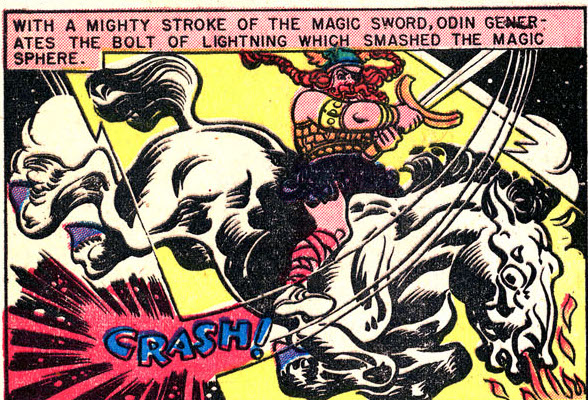
And as long as I’m gushing about Peter — check out this horse.
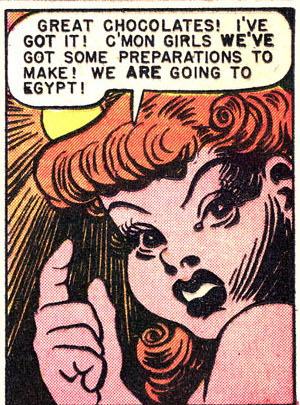
Or this bizarre backlit Etta as femme fatale from the second story.
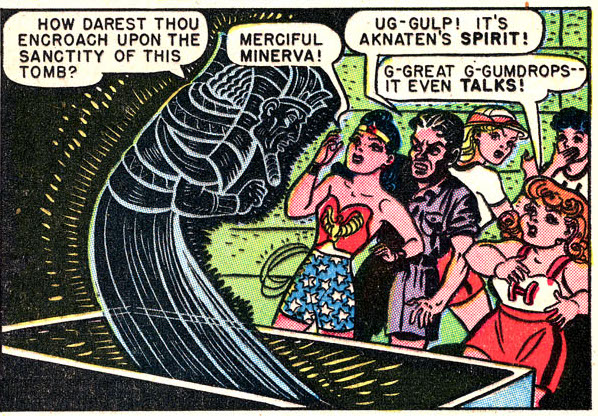
This weird Egyptian ghost rising from the tomb is pretty fantastic too….
And how about this ancient Egyptian headgear?
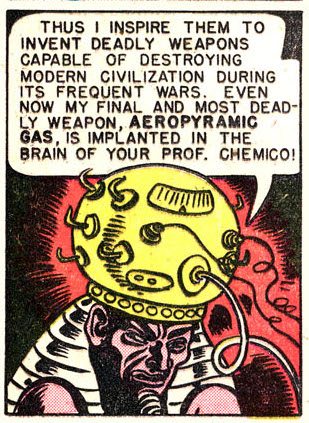
Storywise there’s not a whole lot going on here; Marston makes some noises about the evil dangers of superweapons and generally suggests he doesn’t want the world to go to war again. It’s fine…but the art is definitely the main thing here.

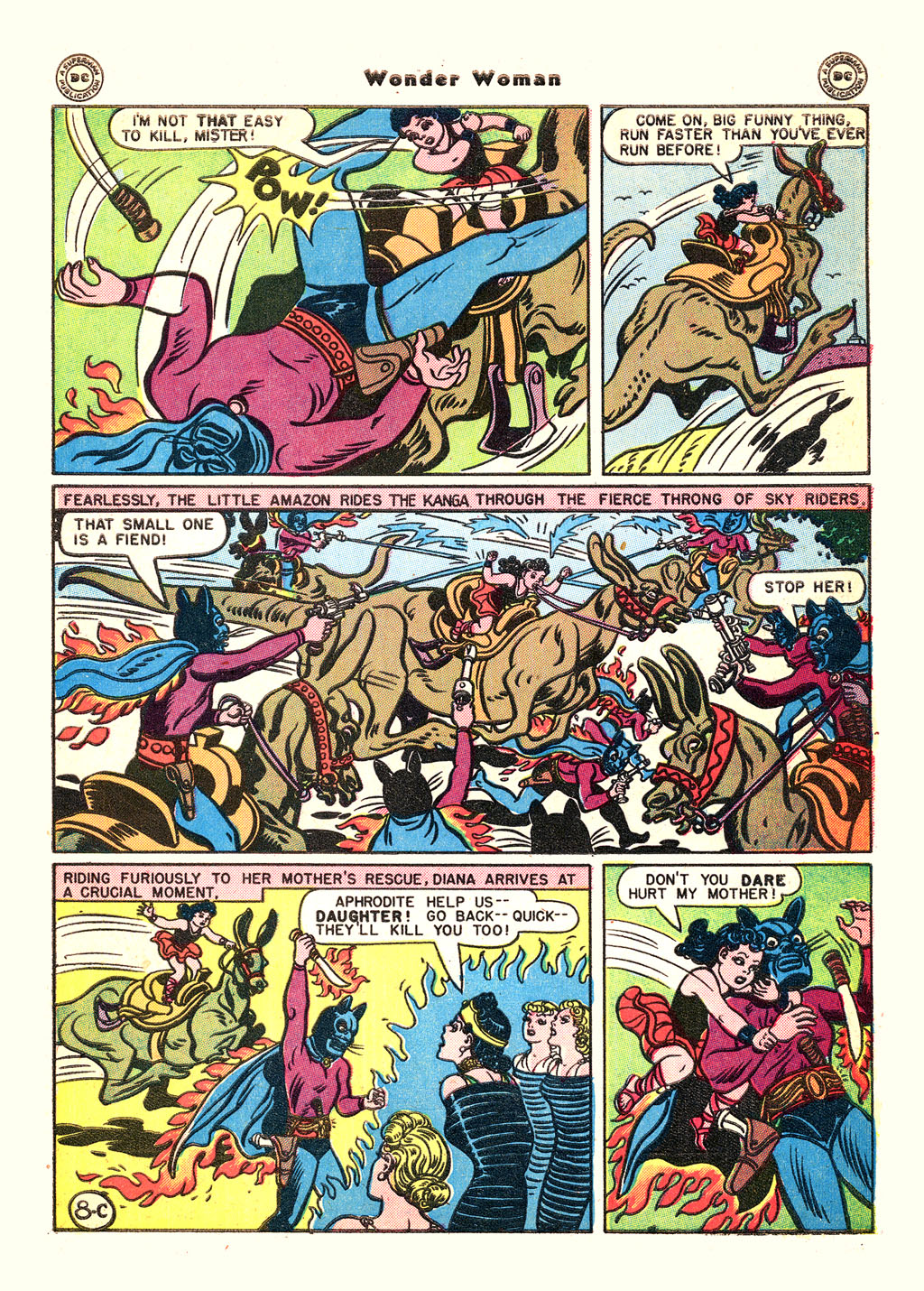
The third story is the most interesting of the lot. It’s a tale from WW’s childhood, explaining the origin of the giant sky kanga’s. Also, incidentally, it lets us know that before there were sky kangas, the Amazons rode on giant bunnies. What is the origin of the giant bunnies? That, alas remains a mystery….
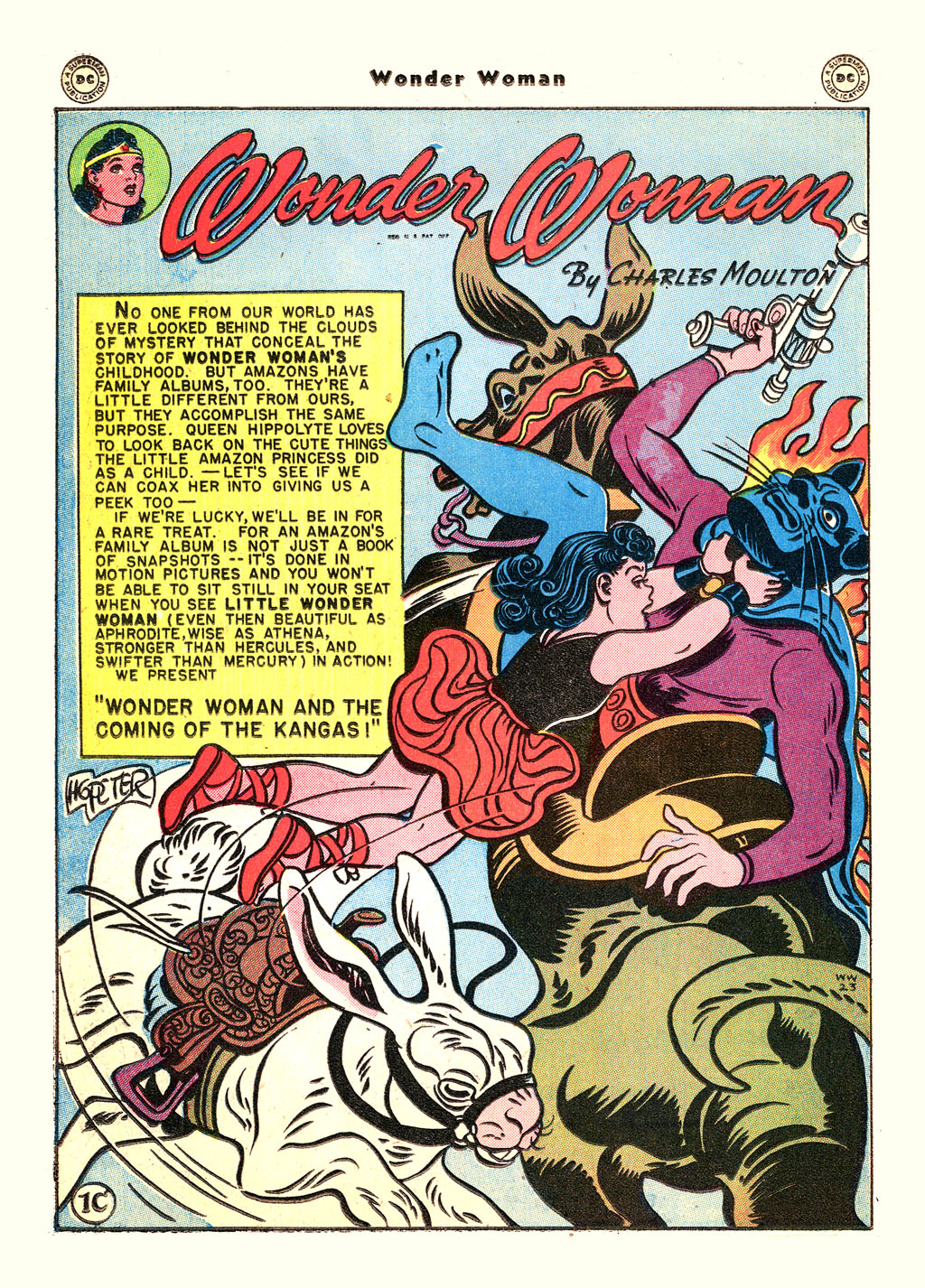
As always, Peter’s animal drawings are something special. The lines of the giant bunny and the giant kanga flow sensuously; the whole page is filled with sensuous curves. And the sensuousness adamently includes the prepubescent Wonder Woman herself; her short frilly flared red dress placed in the center of the composition.

In Between Women: Friendship, Desire, and Marriage in Victorian England, Sharon Marcus argues that the eroticization of female children was a common iconographic trope of Victorian fashion illustration, as well as of Victorian society more broadly.

Victorian culture represented girls as epistemological paradoxes, so innocent that they could be intensively eroticized without raising comment. But unlike images and stories that eroticized girls for a mixed audience of men and women, fashion imagery displayed girls in erotic dynamics with adult women for the delctation of a female audience. In The History of Sexuality, Foucault argued that the intensification of family ties in the nineteenth century also sexualized them, and fashion plates show that in the process all cross-generational ties were eroticized, including those between adult women and girls…. Designed to be objects of an appreciative female gaze inside and outside the image, girls in fashion plates also embody a desire to look at and touch a woman, a desire figured as both self-abasing and self-important.
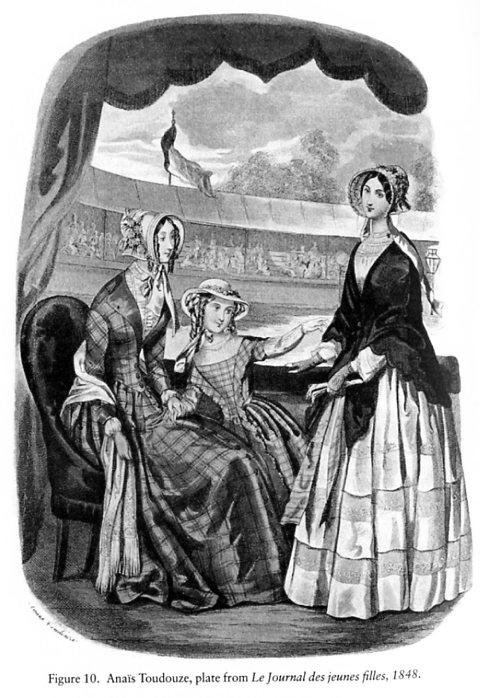
Marston reproduces this dynamic even more self-consciously than the fashion plates:
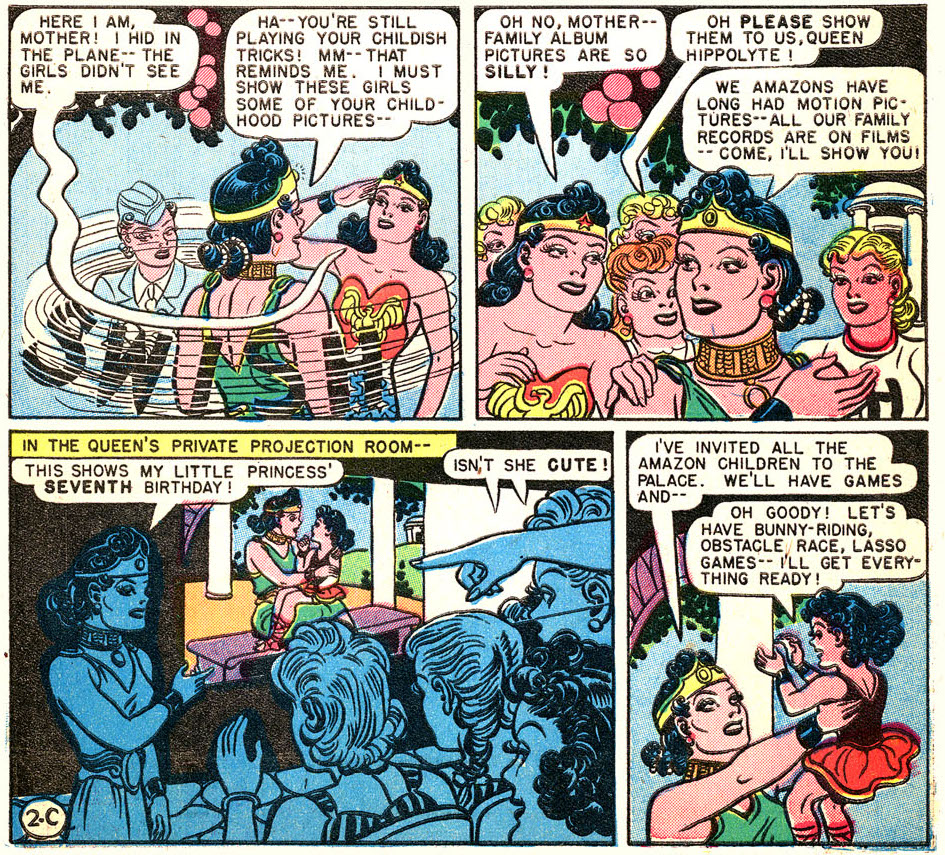
WW’s “childish tricks” (involving, essentially, disrobing at super-speed before her mother), lead Hippolyta to remember her daughter’s actual childhood. The eroticized affection between mother and daughter is then displayed (via film) for the delectation of an all-female audience.

In her discussion of the Victorians, Marcus follows her look at fashion illustration with an analysis of debates about corporal punishment in women’s magazines of the period. Said debates involved numerous women writing to the magazines to describe, in detail, their own experiences with corporal punishment — descriptions which dwelt on the removal of clothes, the physical sensations of whipping and being whipped, and other immodest details. All of this, according to one magazine editor “aroused…intense, not to say passionate interest.”

Here’s one letter which Marcus quotes.

I put out my hands, which she fastened together with a cord by the wrists. Then making me lie down across the foot of the bed, face downwards, she very quietly and deliberately, putting her left hand around my waist, gave me a shower of smart slaps with her open right hand…. Raising the birch, I could hear it whiz in the air, and oh, how terrible it felt as it came down, and as its repeated strokes came swish, swish, swish on me!

Marcus notes that “Corporal punishment is where pornography, usually considered a masculine affair, intersects with fashion magazines targeted at women.” She adds that “flagellation scenarios represented, interpellated, and excited women as well as men, and that the power differences inherent in scenes of discipline and punishment were erotically charged in any gender configuration.”

So here’s some scenes of the young WW being disciplined as little girls ought.
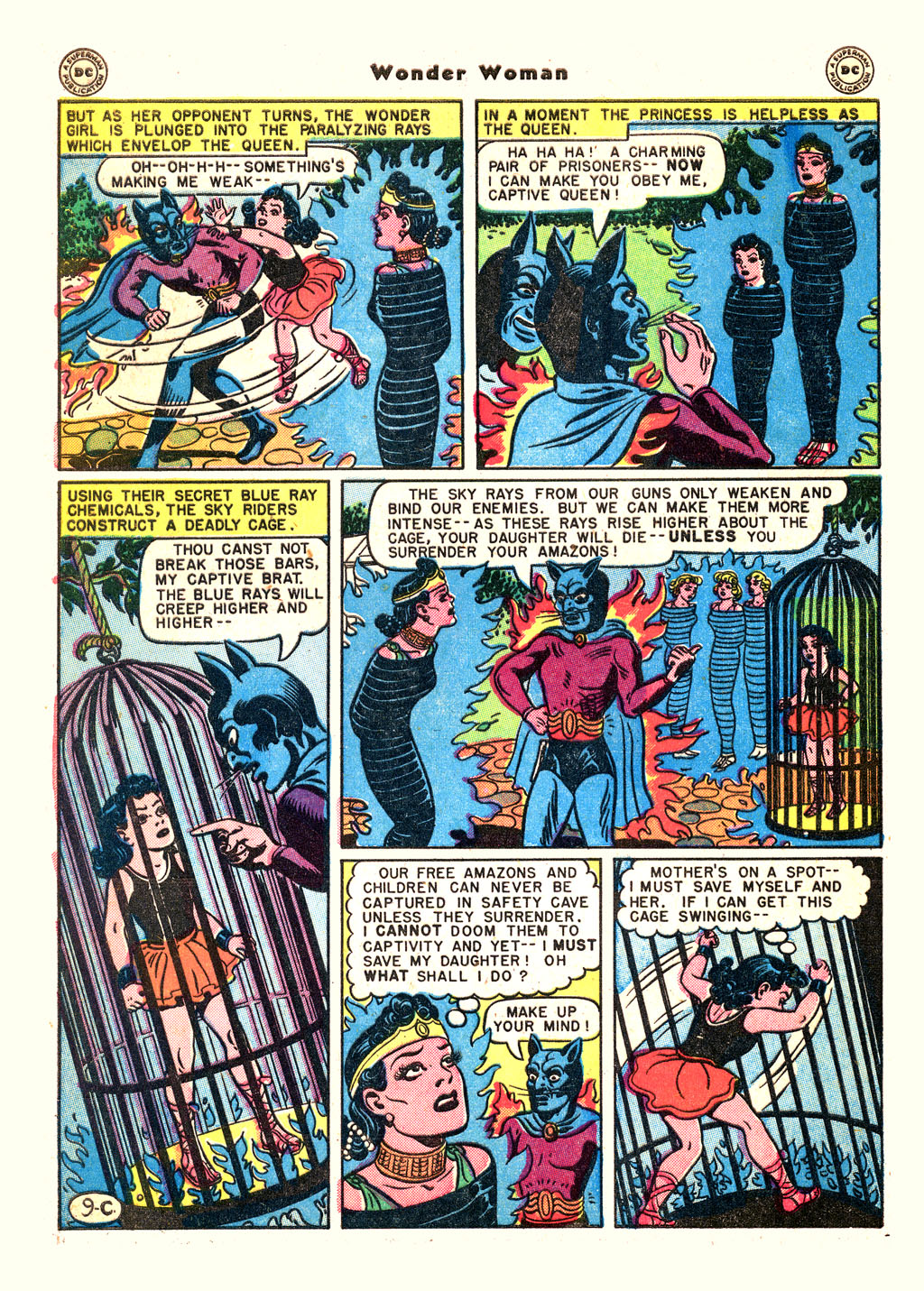
That upper right panel, in particular, eroticizes the adult mother and the child daughter in exactly the same way; both are bound side by side, with Peter’s stylized drawing and the wrappings deemphasizing the age difference; they look like different sized dolls rather than like mother and daughter.

Peter emphasizes the connection, and the parallel fetishization, of mother and daughter in other ways as well:
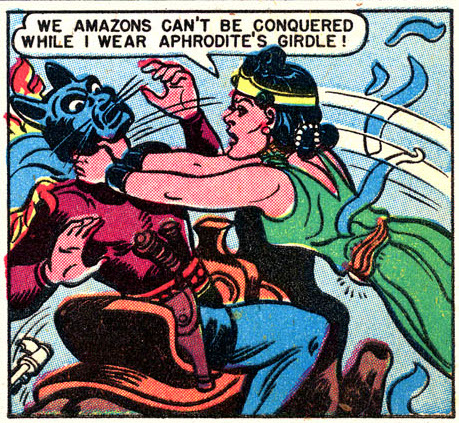
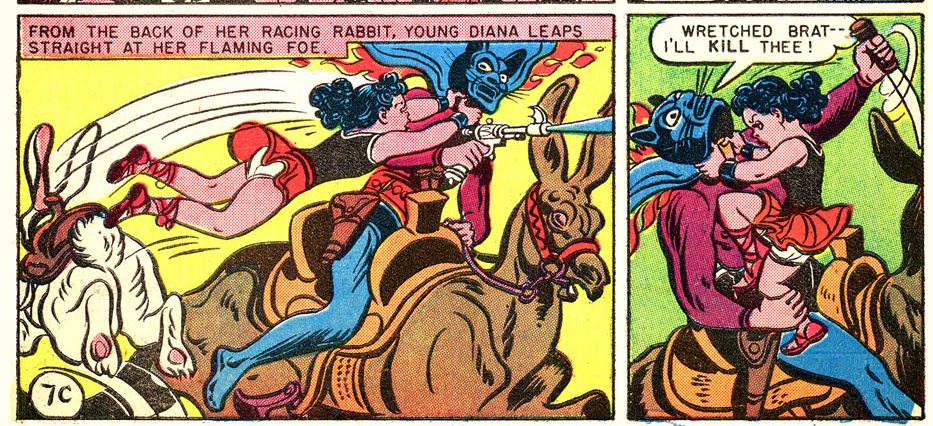
Mother and daughter both attack in the same way; leaping up to grab the antagonist by the neck. And in both cases, the attack is, I’d argue, fetishized; Hippolyta’s straight posed stiffness emphasizes the curves of her dress and of her breast. In the second sequence, Peter shows us, in both panels, WW’s underwear beneath that short miniskirt.

In addition, of course, any display of female power is eroticized for Marston, as is any display of female disempowerment. As with the corporal punishment fantasies Marcus describes, the woman empowered and the woman disempowered are both subjects of the fantasy. So it’s as exciting to see WW in the cage as to see her breaking out of it:
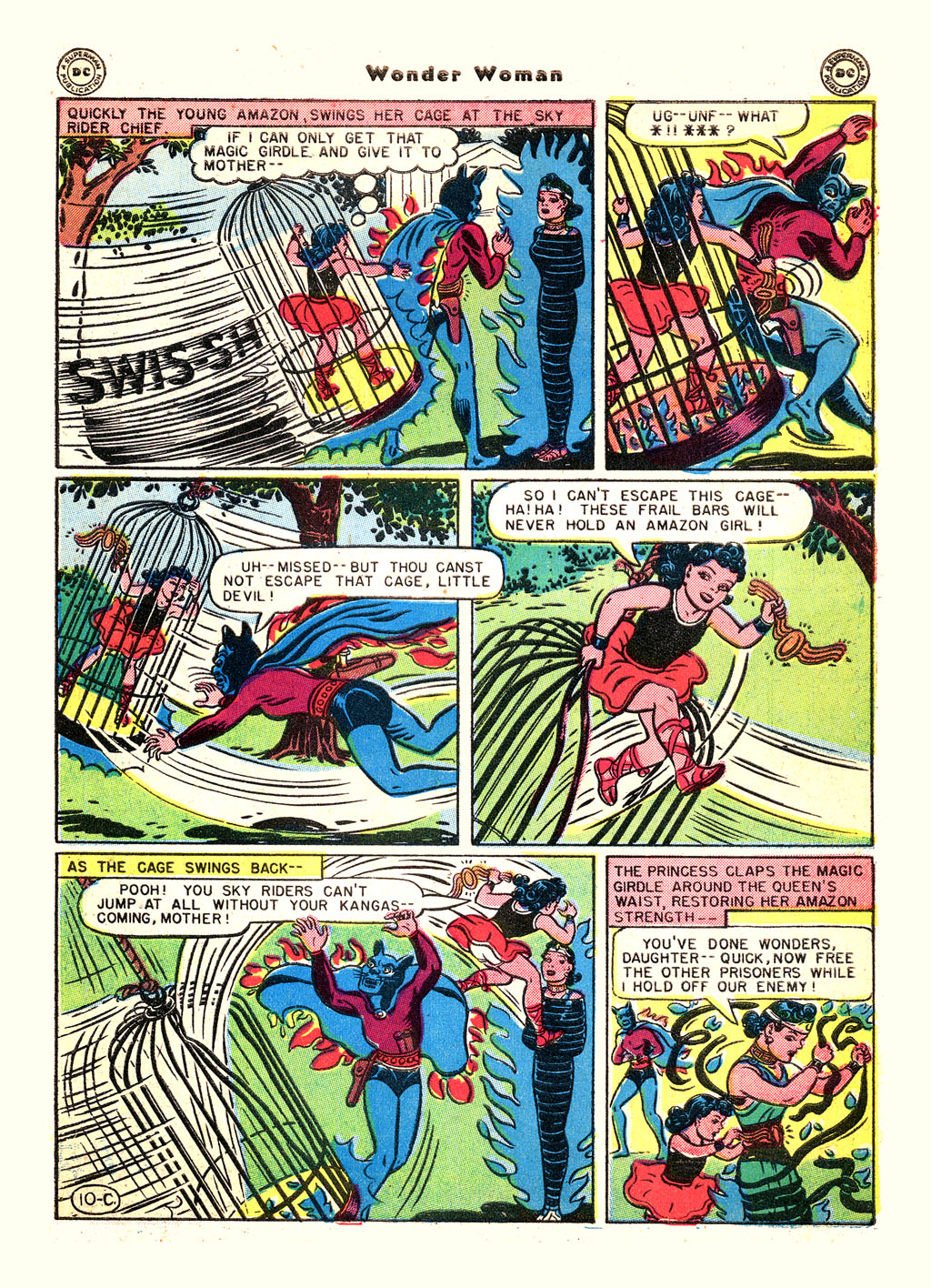
Note in the bottom left panel that we see her underwear again…and that her crotch is level with her mother’s face. The energized swoops of motion lines; the violent rescue of the damsel in distress — this is a typical erotic fantasy, not any the less so because it involves daughter/mother rather than hero/heroine.
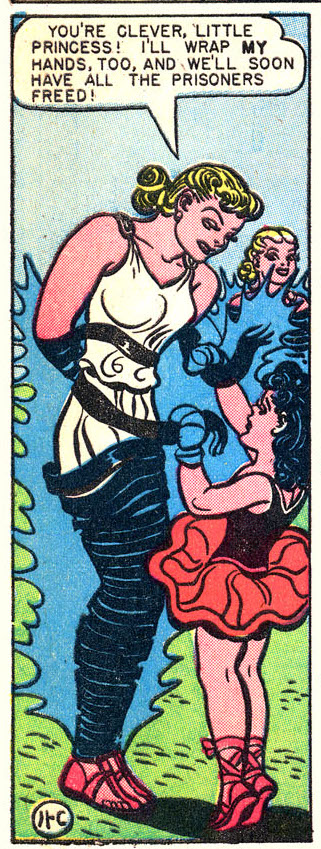
You see it again here; the Amazon being unwrapped is decidedly butch; her shoulder-width emphasized by the narrowing of her lower body caused by the wrapping. Young WW, with her dress flaring up as always, is decidedly femme. But in this case the femme is rescuing the butch, rather than the other way around — a role reversal which I’m certain Marston appreciated.

And speaking of role reversals:
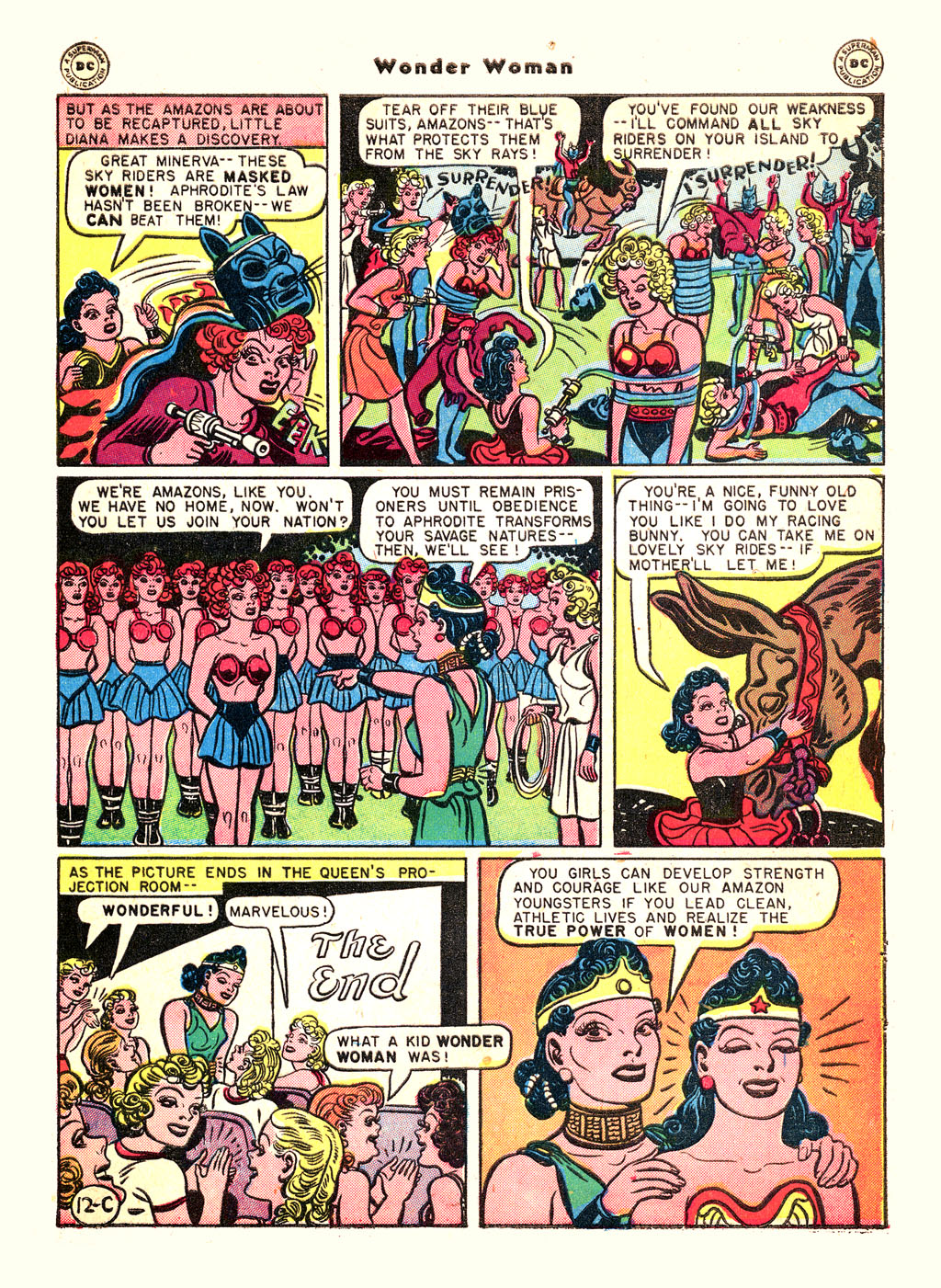
The sky riders who the Amazons initially assumed were men are, as it turns out, masked women. Thus Aphrodite’s law preventing men from setting foot on Paradise Island is not broken. Or, to put it another way, men are not the defilers of Aphrodite’s virgin soil — women are. Inevitably, the sky raiders are stripped to their underwear and bound under the watching eyes of the Amazon. In defeat, the powerful men are feminized — though, since this is Marston, the feminization is actually their triumph, as they will now (eventually) become reeducated and made Amazons (better than any man!)

Marcus notes that the Victorians created eroticized images of and narratives about women for women. The fashion plates allowed women to experience powers and pleasures around control and consumption of female bodies that were, in other areas, reserved for men. In a somewhat analagous way, it’s worth pointing out that the eroticization of children in WW is meant to be consumed primarily, not by adults, but by children. The hints of adult pleasure, power, dominance, and submission, leavened with childish adventure and playfulness — the very things that made Frederic Wertham choke up his soup — were, I’d guess, exactly the features which appealed to children of every gender.

Plus, of course, sky kangas.
Doubly Good

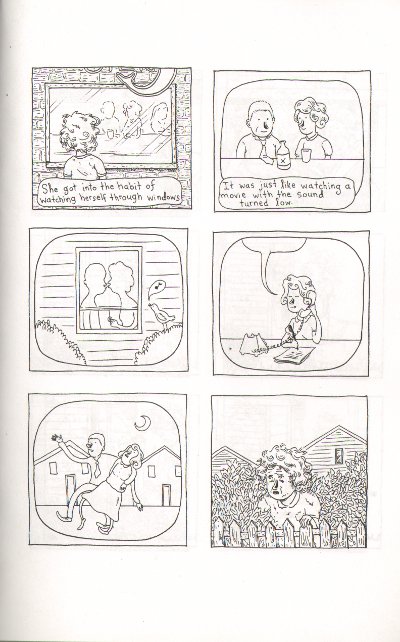
There’s a moment in Lilli Carré’s minicomic “The Thing about Madeline” where you really get that you’re reading a real story and not another installment in the Saga of the Mundane. It’s a little later than the point where that story actually begins: not where Madeline meets her doppelganger/self for the first time – that’s just a plot twist – but when Madeline the First gets “into the habit of watching herself through windows”:

Robert Stanley Martin correctly identified this moment as the place where the story’s main narrative idea slips from metaphor into dramatic irony, as the doppelganger is able to find the happiness in her life that Madeline could not. His review is so spot on I’m just going to link to it rather than trying to cover those aspects of the narrative myself.

But those panels also mark the place where the visuals take over doing that metaphorical work that the narrative leaves behind: the images of double Madeline continue to manifest the theme of alienation from oneself and one’s life while the plot (and facial expressions) hold up the ironic narrative.

What’s particularly beautiful and satisfying about this is not just that the visuals effortlessly carry significations that would become increasingly labored in prose. It’s also that the comic itself is now doubled right along with Madeline: the themes of alienation and happiness continue side-by-side formally in the same way that Alienated Madeline and her Happy Doppelganger populate the narrative. What this allows, then, is two separate story arcs: a literal one about Madeline and the Doppelganger, and a sustained metaphorical one about the relationship between alienation and happiness. Toward the end of the book, when Happy Madeline is visited by her own Alienated Doppelganger, the scenes from the beginning are recast – on a second read or in retrospect, it’s possible to see Happy Doppelganger and Happy Madeline as the same “character.” In that reading, self-alienation is always lurking and, as Robert points out, the easy moralizing criticisms of Alienated Madeline are much harder to make. The powers of circumstance and perspective get attention in a way they could not if the story had stayed more personal, eschewing that metaphorical strand.

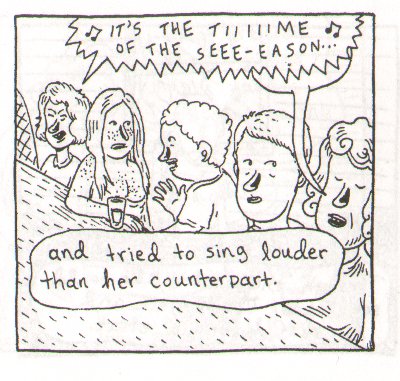
Carré’s work always balances very deftly on the line between ironic detachment and literary self-awareness, both traditional dramatic irony as well as the more formalist kind. Her characters often have these very distinctive noses that are a mashup of Mary Poppins and Raggedy Ann, and they alone are sufficient to make her drawing style immediately recognizable. In the case of The Thing about Madeline, this stylistic quirk works as support for the formal edifice: they mark the characters as “drawn,” and the effect of this signature is to anchor those characters to the visual plane of the comic. They restrict the universality of the characters and contribute to our sense of detachment from them.

That signature nose is absent from Carré’s most recent animated film, Head Garden, one of the selections for the 2010 SPX Animation Showcase.

Head Garden from Lilli Carré on Vimeo.

Instead, the face carries the metaphor, more directly. The facial features are less “cartoony” and more influenced by “art” faces like the ones discussed here and in comments. For me, the loss of this creative “signature” lets the animation breathe and allows the critical, slighly neurotic self-awareness of ironic detachment to mutate into the genuine double entendre that marks the best literary characterizations. The physical marker of style is less overt, but there is no loss of metaphorical sophistication (relatively at least; the animation’s metaphors are less ambitious than the mini-comic’s). The characters have become less “self-conscious”, although less well-developed in this less narrative piece, and I think because of this, the seams between the form and its significance are better hidden. I don’t think that’s just an effect of the film as opposed to comics. Identification with these characters is less detached even in still frames, despite the much more distant narrative characterization.

It seems to be a one-off, though; Nine Ways to Disappear maintains the signature style, as do Carré’s previous animations. (The nose is put to exceptional effect in What Hits the Moon; watch the way it sustains the character’s identity as her face ages around it.) But I think the comparison illustrates some of the limitations of too much “handwriting”: after awhile, it begins to feel like deliberate self-citation. Unless the handwriting is used in some meaningful way, it can interfere with other effects. Head Garden is still discernably Lilli Carré, but in the absence of that distinctively marked facial feature, her graceful but slightly awkward lines — like the talented too-tall girl in ballet class — get to take center stage. I hope to see a sustained story from her in the style of Head Garden sometime soon.

=========================================================

This review is based on the black-and-white mini-comic version of The Thing about Madeline. More information on the SPX Animation Showcase is available here.

Not a Superhero Comic, But It is Plenty Violent

The Girl With the Dragon Tattoo

Written by Stieg Larsson
Translated by Reg Keeland

Every mainstream reviewer seems to love this novel. It’s an international bestseller that’s spawned two sequels and has already been made into a movie. All this despite the fact that the author is dead and Swedish. My reaction, however, was “meh.” Other than the Swedish names that I can’t pronounce, there’s nothing in this book that sets it apart from any typical crime thriller.

Don’t get me wrong, it’s not a terrible novel. The mystery at the heart of the story is well-crafted, and I didn’t notice any glaring plot holes. The pacing is brisk, except for a few lengthy discussions of Swedish finance. The translation from the original Swedish produced a few awkward lines, but nothing memorably ridiculous.

 But much of the novel’s appeal depends on whether the reader identifies with the main character, Mikael Blomkvist. As shameless Mary Sues go, Blomkvist could give Superman a run for his money. Blomkvist is a middle-aged, left-leaning journalist and magazine editor, just like Stieg Larsson. He also happens to be one of those courageous and brilliant journalists who’s dedicated to THE TRUTH. And he’s irresistible to the ladies without even trying (I’m not joking about that last part, he gets as much play as James Bond per film). Perhaps if I were a middle-aged Swedish journalist, I might find Blomkvist appealing. As it is, he’s somebody else’s empowerment fantasy, and I just feel left out.

Although Blomkvist is the protagonist, the titular girl with the dragon tattoo is Lisbeth Salander, an anti-social hacker who helps Blomkvist solve the big mystery. The inspiration for Salander is rather odd. According to a longtime friend, Larsson admitted that as a teenager he failed to intervene when he witnessed a woman being gang-raped. So the character of Salander was supposed to be his attempt at redemption, and the writer’s redemption came from the character’s rape-revenge narrative. (Spoiler Alert!) Midway into the novel Salander is orally and anally raped by her legal guardian. Salander eventually gets a fitting revenge, but the novel never spends much time on her reactions or development. Despite his desire for redemption, Larsson is always more interested in the trials and tribulations of his thinly drawn author-avatar. The plot focuses on Blomkvist and the big mystery, Salander becomes his sidekick and eventually his lover, and the rape-revenge storyline ends up being much more exploitative than Larsson probably intended.

The entire novel, in fact, seems like an effort to have a sexy violence cake and eat it too. On the surface, the novel takes the uncontroversial stance that raping women is bad. But this is still a crime thriller, and the genre requires a certain amount of depravity. The numerous instances of sexualized violence are not simply elements of the story, they’re the driving force behind the plot and the novel’s most notable feature (besides the unpronounceable Swedish names). I’d go so far as to say that the sexualized violence is one of the novel’s main selling points. The forbidden thrill of sexual violence can be secretly and safely indulged so long as it’s coupled to the condemnation of the same sexual violence.

But I’d be lying if I said the sexualized violence actually offended me. Mostly, I was just bored. This novel is not some glorious, genre-busting breakthrough. It’s nothing more and nothing less than competent pulp, Scandinavian style.

Utilitarian Review 8/28/10

TCJ.com Kerfuffle

This week on the TCJ.com mainpage Caroline Small, Ng Suat Tong and I participated in a roundtable on the Best American Comics Criticism anthology edited by Ben Schwartz. Jeet Heer, Brian Doherty, and Ben Schwartz himself also participated. In comments other critics joined in, including Rob Clough, Ken Parille, Robert Stanley Martin, and Kent Worcester. So check it out if you haven’t already.

Oh, and there’s a comment thread on the roundtable here as well which includes a discussion of French language and Japanese comics criticism.

On HU

Domingos Isabelinho discussed Dominique Goblet’s and Nikita Fossoul’s Chronographie.

Kinukitty talked about European fashion magazines, Dave Mustaine, and Makoto Tateno’s Yokan Premonition.

In a guest post, teacher and artist Sean Michael Robinson explained that it’s a good thing for art teachers when students are into anime and manga.

JR Brown wrote an extensive article about the history of the pretty boy in Japanese art.

I reviewed Issue #22 of the Marston/Peter run on Wonder Woman.

Vom Marlowe talked about gender issues in the young adult prose series Percy Jackson and the Olympians.

And a music download of Beatlesesque pop.

Utilitarians Everywhere

Caroline Small is going to be on the Critic’s Roundtable panel at SPX, along with many other illustrious folks. (Via Robot6.)

Critics’ Panel: How We Judge
3:00 | Brookside Conference Room
The accessibility of online publishing alongside traditional media has enabled a diversity of critical voices who are addressing the broad spectrum of comics being published today. A diverse group of critics will discuss the disparate bases for their own critical opinions, and the extent to which they regard different kinds of work in different ways. Join moderator Bill Kartalopoulos for a discussion with Johanna Draper Carlson (Comics Worth Reading), Gary Groth (The Comics Journal), Tim Hodler (Comics Comics), Chris Mautner (Robot 6), Joe McCulloch (Jog the Blog/Comics Comics), Ken Parille (Blog Flume), and Caroline Small (The Hooded Utilitarian).

At the Chicago Reader I review JimCollins’ Bring on the Books for Everybody.

In The Gift of Death, Derrida concludes that literature is an empty, parasitic untheology, constantly seeking forgiveness for its meaninglessness. Ever the tenured radical, he sees this revelation as an affront to the academic establishment. But cultural studies is a more callow establishment than Derrida anticipated, and members like Collins don’t have a problem with emptiness. On the contrary, Collins is “delighted” just to find that literary fiction “forms part of the cultural mixes” that modern cultural consumers “assemble with such gusto to articulate who they are, and what is crucially important to them.” The content of their identities and concerns is utterly beside the point. Are they Nazis? Misogynists? Drooling idiots? As long as they embrace it with gusto, who cares? The point of literature is to make a statement regardless of what’s said. By the same token, Collins is aware that, say, The Oprah Show is witheringly stupid and the movie version of The English Patient is an apologia for imperialism—but he can’t bring himself to take the next step, which would be admitting that some of the detritus of popular culture deserves to be scorned.

On Splice Today I talk about the new film The Last Exorcism in light of the criticism of James Baldwin.

For Baldwin, the bed floating, the fluid spitting, and special-effects gouting, were all part of a willful disavowal. The little girl with the deep voice uttering curses is an innocent possessed by the devil…but Baldwin argues that the upper-middle-class milieu in which she sits and writhes is anything but innocent, and that the movie is therefore an example of (in various senses) bad faith. Baldwin notes that at the end of the film, the “demon-racked little girl murderess kisses the Holy Father, and she remembers nothing.” This convenient amnesia is, for Baldwin, emblematic of America’s penchant for forgetting what they have done, to whom, and for what ends.

At Madeloud I have some recommendations for sexadelic lounge music. Groovy!

Other Links

R. Fiore was inspired by our Popeye roundtable to write a really entertaining appraisal of the Fleischer Popeye cartoons.

Might as well be a comic: Percy Jackson and the Olympians

So a couple of weeks ago, I had a nasty cold, and I mainlined all of the Percy Jackson books via Audible.  Yes, all five of them.
For those who don’t know, the Percy Jackson series is a childrens/YA popcorn action-adventure-fantasy series about demigods (children of a mortal and an Olympic deity).  Percy is short for Perseus, naturally, and yes, he battles a titan while riding a Pegasus, but  Sir Laurence Olivier is not involved (alas?).

These are not deep books.  They’re silly and fast paced and filled with summer-blockbuster like explosions and sword fights and classic monsters.  I listened to them all, so I was entertained.  I mean audiobooks ain’t cheap, and the reader, Jesse Bernstein, is kind of terrible.  But they have lots of funny moments and Percy is a really likable, regular sort of kid with the kinds of traits I most enjoy reading about (he’s kind, he has some faults, he gets discouraged but bucks up).  However….

When I was in the last book of the series I finally lost patience with some of the recurring themes that troubled me in earlier books.  As longterm readers probably know, I’m a chick.  As longterm readers might not know, I was a classics major so I could  (and did) do things like read all of Homer in Greek.  (The catalog of ships, by the way, is even more borrrrrrring in the original.  Blah blah blah whatever, I do not care how many warriors came from your little town.)  Which is to say, I’ve got a pretty good grasp on some of the original sources that Riordan had to draw on (mostly he used Pseudo-Apollonius, apparently).  Anyway.

I’m going to say upfront that these books have a ton of cool stuff.  There’s a hilarious pegasus named BlackJack who insists on calling Percy “Boss”, for instance.  He lands on Percy’s stepdad’s Toyota at the beach one day and leaves hoofmarks on the Prius, which cracked me up.  Blackjack is always dragging Percy off to help various sea creatures, which leads Percy to help this strange sea-cow-creature that Percy names Bessie.  (It turns out to be a boy cow sea monster, but hey.  It’s still a cool name!)

When they run into the Circe of legend, you know, the witch who turned Odysseus and company into pigs?  She turns the guys into pigs all right.  Guinea pigs.  They all go Reeet Reeet Reeeeeet in the way of guinea pigs in classrooms everywhere.

But, as I said, by the time I reached the last book, I lost patience with the repeating themes.  This series has some massive problems, and I was strongly reminded of Noah’s theory about the backlash against Twilight.  That it isn’t the poor plot (there’s worse plots) or prose or whatever, but that these books are the embodiment of young teen girls, and our culture kind of hates teen girls with a passion.  Hence the Twilight hatred.

And I think that the Percy series suffers from a lot of that kind of hatred, as well as several other truly depressing choices, and so I thought I would inflict my thoughts on them upon you all.

The basic premise of the story, as I said, is that the Olympian gods are alive and well, and they continue to go around, mating with mortals (as one does), and having kids, who are demigods.  The gods sometimes acknowledge these kids and sometimes not.  Monsters in the world, like Cyclops or Harpies or whatnot, sniff out these demigod kids and attack them.  There’s a camp, run by Dionysos and Chiron, who send out satyrs to find these children and bring them to Camp Halfblood for the summer, so they can train in their special powers and learn how not to get eaten by monsters and so that their parents can, if they wish, recognize them.  The Camp has a cabin for each of the major Olympian gods, and it’s on the East Coast in America, because that’s where the heart of Western Civilization now resides (sorry Greece, you’re just not good enough anymore).

The main character is Percy, from Perseus, Jackson and he’s a son of Poseidon.  Through each book we get a chance to meet other children of the gods, and the gods themselves.  Percy’s girlfriend is a daughter of Athena, his early mentor Luke is a son of Hermes, and his nemesis Clarisse is a daughter of Ares, and so on.  Rivalries between the gods tend to result in rivalries between the kids (Poseidon and Athena never got on) and each kid embodies their parent’s prowess or skills or whatever.  Some gods, like Artemis, don’t bear children but go about things differently (she has a hunting pack of maidens that she adopts).  It’s a straightfoward but pretty cool idea.
Except the execution is telling.  And not in a good way.

Artemis, for instance, is a big problem.  She’s portrayed in the book as a pre-teen, a girl who is about ten or twelve.  She’s a maiden, which, you know, fine.  That’s cool.  But Riordan also portrays her as hating boys like she was in an old-fashioned French lesbian separatist novel.  That’s wrong.  Canonically wrong.  The classic  Artemis vs Aphrodite fight is over a guy, Euripides’s Hippolytus.  Hippolytus is Artemis’s favorite hunting buddy.  (It’s also got my favorite line, by the way, which is Forgiveness is for mortals, vengence is divine. )  The reason, by the way, that Aphrodite smacks down Hippolytus is that he is too chaste, too sworn to Artemis.  The followers of Artemis are not singularly female, and this is a pretty classic, well-known work (one of Euripides’ best).

When the Ancient Greeks are more even handed about gender politics, it makes me go hhhhhm, is all I’m sayin’.

Overall, Artemis and her hunters are portrayed as forces for good.  Sexist jerks, yes, but forces for good.  Except, and I admit to finding this troubling, they’re portrayed as good based on traditionally male ideas of good, that is to say bravery in a fight, prowess with weapons and tracking, and since they do not age, they’re often described in ways that do not display their female sex traits (breats, hips, etc).  They’re very much girls, not women.

Which is fine, so far as it goes.  I like positive portrayals of girls.  But.  The next step in the aging line (for most or many females) is to turn into a sexually active young woman.  Which brings us to Aphrodite and Hera.

Aphrodite is portrayed as might-as-well be evil.  She’s shallow.  She’s caught canoodling with Ares (again).  She tricks people and causes problems for Percy’s lovelife.  She appears to have no good traits besides having Angelina’s boobies.  Her children are portrayed in the same way: they run away from fights, screaming about their hair.  They worry about their nails.  They obsess about appearances and generally are jerks.  Except for Celina, who is portrayed as their leader.

I thought, OK, you know, that does balance it some, since one of the themes in the book is that the demigods are better than their parents, are the good side to any power.  But then we hit the last book of the series (where I lost my patience and hurled the ipod at the wall.) Because Celina is the spy who has been betraying them the whole time and it is her betrayal that gets her own boyfriend killed as well as a whole bunch of other people!

Moving right alone, we hit Hera, who has no children at camp, because she’s the goddess of marriage and family.  She’s portrayed as beautiful, which instantly clued me in to the fact that she’s evil.  Sure, she doesn’t side with the villains, but she’s a villainous jerk all the same.

Lots of people don’t like Hera or Aphrodite, and you know, I’m OK with that.  I get it, and I see it, and I can appreciate it, if there’s appropriate balance with other good characters.  Like, say, Demeter and Persephone.  I mean, Demeter.  She’s the goddess of the famous Eleusinian Mysteries, which only lasted two thousand years and were the most important mysteries of all.  Secret worship!  Big party!  Lots of awesome throwing of phallic shaped pig cookies into pits!  Great fodder for a story, right?  Lots of opportunties to balance the nasty old Aphrodite with a warm, mother figure who controlled that little minor thing called the harvest.

But in this series, Demeter is a nagging mother in law who wants people to eat cereal, and her kids are known for the flowers in their cabins.  And that’s it.  That’s all she gets.  Her daughter Persephone, the wife of Hades, is no better.  She’s portrayed as annoyed that her husband slept around and bored with her mom’s cereal obsession and again, that’s it.  Again, Riordan had choices to make, and he chose a more one-sided view of goddesses than even the Greeks.

We do have one goddess to balance the tide, and that’s Athena.  She’s portrayed as wise, and interesting, and smart, and good.  She’s also sexless.  Her children are children of the mind, born from her head in the way that she was born, and her daughter, Annabeth, Percy’s girlfriend, eventually gets a makeover, but it looks wrong on her.  Because Annabeth wouldn’t wear makeup.  Which is fine, so far as it goes, except that the not-wearing makeup has become a sign of Annabeth’s goodness.  The makeover person is Circe, and she’s hosting a spa for lady visitors and turning guy visitors into guinea pigs who go reet.  And you know what?  ENOUGH.

There are only two choices for women in these books.  1.  You can be a psuedo boy: like to fight, stay youthful without secondary sex characteristics, enjoy battle or science.  That’s the ‘good’ choice.  2. You can be a woman: grow breasts and hips, enjoy broad friendships and romantic relationships, wear makeup.  That’s the ‘bad’ choice, and eventually you will betray someone, steal, nag, lie, fuck around, trick people.

I think those are some remarkably crappy choices.  But you probably shouldn’t listen to me, since I’m currently wearing MAC’s Amplified Cream Lipstick in Blankety.

(I had some other issues with these books, but I’ve decided to cover the parenting problems in another essay, since this one is already ridiculously long.)