Super Wonder Frontier (OOCWVG)

This is the latest in a series of posts about post-Marston iterations of Wonder Woman. For those of you waiting for me to continue my blogging through the original Wonder Woman series; my apologies for the delay. I promise I will get back to it next week.
________________________________

I dumped on Darwyn Cooke’s mediocre New Frontier yesterday, and I’ll stand by that. I do like his art, though; nice color palette, and he combines the cartoony TV show style with a tactile realism that’s really charming. I like the way Superman and Flash’s costumes are a little baggy, for example.

I also quite like his Wonder Woman drawings. He very cleverly finds lots of excuses to get her out of the swimsuit, and he also draws her in a zaftig cheesecake pin-up style that’s hard to resist. This panel is positively luscious.

Darwyn Cooke Wonder Woman

Cooke’s obviously quite plugged into Marston’s lesbian fantasy dreaming there, with tongue all the way in cheek (if that is the metaphor I want.) His characterization of WW is fairly enjoyable too; there’s one sequence where he has her free a bunch of Vietnamese women from their captors, allows them to butcher the villains, and then leads them in celebration. It’s true that this is a rather tasteless effort to gin up meaningfulness by piggybacking on Important World Tragedy –but if you can get past that, you have to admit that it’s a pretty entertaining twist on Marston’s bondage fetish. I also enjoyed seeing WW all bloodthirsty and cheerful about it, rather than earnest and dour as she is so often portrayed. Instead, it’s Superman who has to be all boring; he’s the stuffed shirt appalled at the butchery, while WW gets to be the loose canon (“I’m over here winning the hearts and minds of the disenfranchised,” she tells him confidentially).

There is a problem, though. WW does get to be the wise free spirit, a la Wolverine. But she gets to be so only in relation to that stuffed-shirt, Superman. WW hardly has a scene in the whole comic that doesn’t also feature Superman, and her function is essentially to serve as a muse for his conflict/self-actualization. Yes, she is supposed to have come to some sort of understanding about American policy herself, I guess…but Cooke cuts her off, literally in mid-sentence, before she can articulate it. But that’s okay, because her own thinking isn’t really all that important. She’s beautiful and smart and thoughtful and adventurous and daring…and all of that is in the service of getting Superman to realize that he’s the symbolic icon of wonderfulness who must lead America to greatness. That scene in south asia is thematically staged for Superman’s benefit. So, I think, is the lesbian daydream in the image above. We see WW and her Amazon sisters frolicking…and then one of them gasps “It’s a man!” and we see Superman fly in, and Diana tells him “Come fly with me, Kal,” and if that isn’t enough of a come on, she then goes on to tell him how wonderful his values are. Yay! Later she gives him a kiss and that inspires him to assume the leadership role that he’s fated for because he’s…Superman!

This is hardly the first time this has happened, of course. In these massive crossover alternate universe things, WW is always getting relegated to the helpmate/soulmate/lead you to your destiny role in support of Superman and/or Batman. It happens in DKII, and seems to more or less be a theme in Kingdom Come as well (I’ve only skimmed that.) Darwyn Cooke uses it himself in other stories. League of One is kind of the exception which proves the rule; there, WW takes up all the oxygen, and everyone else (especially Superman) is just a nonentity revolving around her psychodrama. Basically, it just seems very hard for people to figure out a way to have Supes and WW exist in the same space without treating one of them as an appendage.

Which makes sense, since, basically, they’re the same character. I mean, of course, all superheroes are based on Superman to some degree, but Wonder Woman was deliberately designed not just to riff on the superhero idea, but to actually function, narratively and psychologically the way Superman does. Marston said this himself; he was basically creating a female Superman. Now, making Superman female meant a number of very specific things to Marston (more bondage for example), and WW is different than Superman in a lot of ways. But she’s the same in that her point is really to be a paragon; the quintessence of heroism. She’s not like the Flash who’s just superfast, or Batman who’s just smart and resourceful, or even Green Lantern, who has a defined power. She’s everything to everybody. She’s superfast, she’s got superstrength, she’s superwise, and she’s just the best at everything she does. That’s the character; that’s what her stories are about.

So when you put her in a story with Superman…well, one of them has to lose focus. If it was Marston, of course, that one would be Superman, and it would be all about how men, even superman, have to submit to women, and love their submission, and so forth. But, alas, Marston’s dead, and what we get instead is the much more conventional idea that women (even wonder women) are mostly there to serve as supportive figures in male psychodrama.

It’s too bad, too, because, as I said, I think Cooke likes the character, and has some good ideas for her, and overall could probably write a decent story about her if he wasn’t so desperate to use her to shore up Superman’s ego (or Batman’s, I guess.) I shudder to read Trinity, though. I can see that being quite, quite bad.

Update: Richard points out in comments that Darwyn Cooke did not, in fact, have anything to do with the Trinity series. So maybe I should check it out after all. Or, then again, probably not.

Kids Comics Roundtable: Jules Feiffer’s Clifford

You’ll find four of the strips below. Clifford was Feiffer’s first strip, and he did it for Will Eisner’s studio; the series ran on the back page of the Spirit section. Wikipedia says Feiffer was born in 1929, and I vaguely recall Clifford as running from 1949 to 1950, so Feiffer was the age of a college student when he did the strip. Fantagraphics collected the whole run as the first volume of its Collected Feiffer.

The previous Kids Comics Roundtable installment (Noah on telling kids what to like) was here, and you can see a roundup of my previous Golden Age scans here.
If you want to see these a bit larger, click on them and then click in the new screen where it says “Full Size.” It’s good enough to read them by. 
Jan. 22, 1950         
Clifford 4


Feb. 5, 1950

Clifford 2

Feb. 19, 1950
Clifford 1

March 5, 1950

Clifford 3

Partially Congealed Pundit:Christopher Columbus

Since it’s the 4th, I thought I’d do an American themed poem. Sort of. This is from 2003 or so, I think.

___________________

Christopher Columbus

If I was Christopher Columbus I wouldn’t be so boring. Because that is the name of a parrot and he just sits there on the island he is on. Maybe he was stranded there when he pooped on Bluebeard’s beard and that is why it is blue. Also he flew into things by accident. Like eyeballs so they had to get eyepatches. Trees and things were afraid and they ran off the island and even his poop was afraid of his later poop. So he sleeps a lot. My Dad would say he needs ambition and maybe some money.

Partially Congealed Pundit: Reply to Thoreau

I wrote this in the mid-90s, I think.

A Reply to Thoreau

Time is but the stream I go a-fishing in.

My mind is but the stream I go drowning in
and time is the bank of a stream
where fish eyes stare unmoving at the ravelling motion
of water catching at the banks of the stream.

I know mind is water, for it fills like breath
the body it carries till still.
And mute fish floating thoughtless before the flatness of death
know time from water, for their eyes remain still.

Oliphant Watch: Those damn bloggers

Andrew Sullivan, forehead creased by his duties as guardian of Iran, stole a laugh because of this Oliphant effort. And it’s not bad. The point is clear and the drawing has Oliphant’s usual superiority: the kid’s wide little butt and drooping shirt, the languid dog, the set of the kid’s foot. For once the little squidgett figure in the corner makes a comment that caps the joke instead of derailing it. On the other hand, we’ve all heard about how bloggers are trifling stay-at-homes pretending to mess into the great affairs of the world. Why unearth the joke again? My guess is that Sullivan is being a good sport after a round of gibes like the one found in the first sentence of this post.

Bound to Blog: Sensation Comics #2

Last week I blogged about the Marston/Peter Wonder Woman #11, which featured a cross-dressing villain named Hypnota among other things. In reading that issue, I wasn’t exactly sure what Marston thought about Hypnota in particular, or about cross-dressing in general. So I thought I’d take a brief break from going through all the issues of WW, and instead read another Marston cross-dressing villain story from a bit earlier, in one of his first Wonder Woman efforts, Sensation Comics #2.

Before I talk about that story, though, I wanted to mention another book I just finished: Graham Rawle’s Woman’s World. This is going to go on for a little bit, but we’ll get back to Wonder Woman, I promise.

I’ve talked about Rawle’s collage cartoons before. Woman’s World is collagy as well; Rawle wrote the text using words and phrases from women’s magazines published in the early 60s. It’s an impressive technical achievement in some ways. In other ways, you read it and you say, how could such an innovative process have resulted in such a staid narrative?

The narrative is particularly predictable when it comes to gender and cross-dressing. The story is narrated by Norma, and is mostly about her brother, Roy. Eventually Rawle reveals that Norma and Roy are the same person; the real Norma was killed as a child, the trauma caused her brother, Roy, to freak out, so that he started to wear women’s clothing and think that he was Norma part of the time. “Norma” is obsessed with women’s magazines and clothes, which gives Rawle the chance to use a lot of the cleaning product descriptions and advertising slogans and superficial cliches he found in all those women’s magazines he’s using to write his book.

So basically, Rawle presents us with a male-to-female cross-dresser who is (1) incredibly superficial and obsessed with surface femininity (Norma gets into big trouble because she just has to, has to, has to get a photograph of herself all dolled up and beautiful); and (2) completely insane. Sound familiar?

It sounds familiar to me anyway; both tropes are incredibly overused, to the point of rote idiocy, in popular representations of cross-dressers. The “they cross-dress, so they must be insane” schtick is used in just about every other major horror film, it seems — from Psycho, most obviously, down to Silence of the Lambs. The notion seems to be that before a guy would dress like a woman he’d have to have gone completely round the bend, to the extent of actually being a victim of multiple-personality disorder.

The “obsession with surface” thing is also really tired. Trans-activist Julia Serano has a great anecdote in her book “Whipping Girl” about being approached by some television show which wanted her to appear on a segment they were doing about male-to-female trans folks. The television people asked her if they could film Serano getting dressed to go out…putting on her make-up and dresses and that sort of thing. Unfortunately, Serano dresses the way a lot of women dress, which is to say, she doesn’t really wear make-up, often wears pants, and generally doesn’t get all dolled up to go off to her not especially glamorous job (she’s an academic biologist.) All of which she told the television producers, who, of course, decided not to film her, because they wanted yet another story about how obsessed trans people were with surface femininity and appearances and so on and so forth.

In short, when Graham Rawle thought to himself — “who would be obsessed with reading women’s magazines and learning how to be a woman and learning how to be feminine…um…I know! A cross-dressing man! And wouldn’t it be funny if she was really overblown and campy and not actually all that good at behaving like a real woman!” — again, when he thought all that, he was thinking just like those television producers. Which is to say, he wasn’t exactly thinking at all; he was just trying to be titillating and transgressive in the most banal and unthreatening way possible.

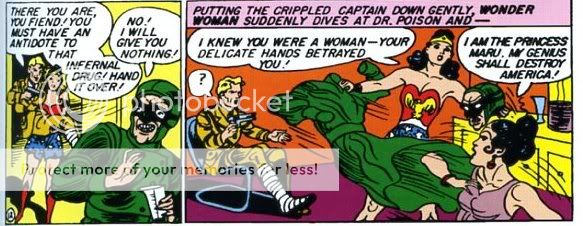
Okay, so…back to Wonder Woman and Sensation Comics #2. This story starts off with Nurse Diana Prince caring for a badly injured Steve Trevor. Steve is quickly kidnapped by a mysterious evil-doer named Dr. Poison. Lots of hijinks ensure, involving a chemical formula that makes soldiers interpret orders backwards and a bevy of courageous sorority girls— but the point is, at the end of the story, it is revealed that Dr. Poison…is a woman!
marston wonder woman

What’s interesting about this to me, in comparison to the Rawle story, is how thoroughly anti-climatic it is. There isn’t any effort to explain why she’s dressing up as a man. There isn’t any effort to ridicule her for dressing up as a man. There’s barely any effort to suggest that what she was doing was incongruous in any way.

Because Marston provides so little in the way of exegesis, it’s hard to know what he thinks, or what we’re supposed to think, about the cross-dressing. I can think of a bunch of possible ways to parse the scene — but, as I’ll discuss, none of them seem to fit perfectly.

1. Women who dress as men are ridiculous or incongruous, or going against nature in some way.

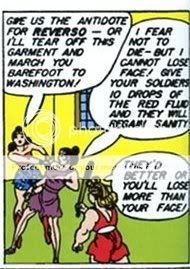
There’s a little evidence for this; WW makes a crack about Dr. Poison’s delicate hands, suggesting that a woman can’t perfectly imitate a man. The remark is somewhat undercut, though by Steve’s obvious and complete befuddlement. He couldn’t tell she was a woman, clearly. Moreover, I don’t think the reader can tell she’s a woman until WW reveals the truth. There isn’t any effort to tip us off; she doesn’t do or behave in a womanly manner at any point. It’s not even clear whether we’re supposed to see the cross-dressing as funny, exactly. It’s true that the scene after the unmasking has a farcical air about it…but the one thing that is more or less specifically mocked is Poison’s ethnicity, not her drag king status:
marston wonder woman

There’s certainly evidence, here and elsewhere that Marston had unpleasant racial opinions, but he’s more circumspect about cross-dressers.

2. Cross-dressing is evil and perverse, and so is the provenance of villains.

Richard Cook suggested this was what Marston was up to in a comment on the Wonder Woman #11 thread.

You say that Marston didn’t think that cross-dressing was wrong, but none of the “good” women (Diana, Etta, or the Holiday Girls) ever dressed as a man.* The cross-dressers, like Hypnota or the Blue Snowman, are invariably villainesses. The impression I get is that Marston believed there was something evil (and sexy) with a woman who wanted to be a man.

Vom Marlowe made a similar point in the same thread.

I wonder if the portrayal of cross-dressing is part of the skanky villain sex convention. This happens a lot in modern romance. You can portray non-vanilla stuff quite explicitly, but it has to be done by villains. The goal is titillation, for certain. The non-vanilla sex is not necessarily a way to show that the person is evil but sometimes it is. I wonder if this is something that Marston wanted to include, but didn’t think he could get away with doing for a good girl.

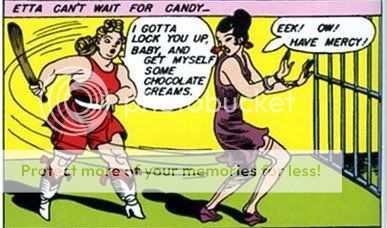
Again, this is feasible, but Marston never quite says it…and in other cases, he doesn’t seem to think there’s anything wrong with women taking on male roles:
marston wonder woman

That’s heroine Etta candy, looking far more butch and tough in this early story than she would later on. The butch-femme dynamic, complete with a barely sublimated oral tease, is awfully hard to miss. And then there’s this panel:
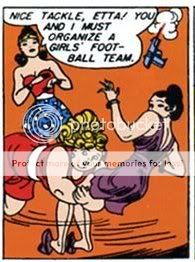
marston wonder woman

Unlike the last example, I don’t think this is a joke, per se; Etta is really the hero here, and Marston is, as far as I can tell from other issues, completely fine with women’s sports (and indeed, more than fine with them.) The image of Etta dressing up as a football player isn’t meant to be either ludicrous or evil, I don’t think. Given that, it’s hard to see why Poison dressing as a man would necessarily strike him as evil in itself.

3. Men are evil, so women have to dress as men to be evil.

Sort of dovetails with Marston’s philosophy, but doesn’t seem especially likely given (a) the number of female villains he uses in other instances and (b) this panel:
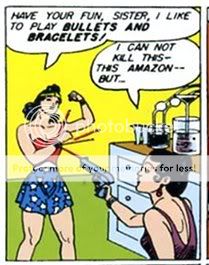
marston wonder woman

She seems to remain fairly evil even when femme, as far as I can tell.

4. Women are weak, so they need to pretend to be men to gain power.

This is why MTF cross-dressing is always pretty much seen as odder than FTM; culturally, it makes sense for a woman to want to be a man, because men are higher status in various ways. And you could see a later version of this story having Poison reveal that because of the sexism of Japanese culture, she needed to dress as a man to be taken seriously, and so on and so forth.

Again, though, it’s hard to imagine Marston making this argument. Marston thought women were stronger than men in just about every way. In this issue alone, he goes out of his way to make Steve weak and helpless (wheelchair bound), and has not only WW as the superior strong woman, but also Etta, who is (as we’ve seen) quite tough herself.

Ultimately, I think the fact that it’s difficult to pin Marston down here is maybe the most interesting aspect of his use of cross-dressing. I have no doubt (as Richard suggested above) that Marston found role-play and cross-dressing sexy and exciting. But beyond that, he doesn’t explicitly stigmatize it, and, moreoever, doesn’t even really seem to feel that it needs an explanation.

Rawle’s book, on the other hand, is basically nothing but explanation, first, of who would be shallow enough to live their life based on a woman’s magazine (answer: a cross-dresser) and second, of why a man would dress as a woman (answer: because he’s insane.) Explanations are a big part of how society decides who or what is abnormal. You don’t need to explain why men dress as men because that’s normal, but if a man dresses as a woman, you have to explain that, because it’s weird. Except that Marston doesn’t seem to think that it is, particularly.

Steven Grant in commments on one of my recent posts said this about Marston:

As for Marston’s proclivities, I haven’t seen it mentioned anywhere, but it’s hard not to suspect he liked being tied up and restrained, probably responded initially with shame, and egotistically concocted a bondage worldview that obviated any need for shame. So bondage – and the “freedom” that comes with it – becomes not his secret shame but everyone’s secret desire, and the path to emotional liberation. (As with the jargon of most cults, we can assume he believed anyone who didn’t like being restrained was simply repressed, and even more in need of “therapy.” His creation of the lie detector suggests that he had at least some fixation on the notion of secret shame, inventing a (specious. if well-promoted) device that would bring secret shame to light and, from his perspective, begin “correction” of it.

I don’t doubt that there’s something to this…but on the other hand, I think it’s worth noting that Marston’s investment and interest in perversions of various sorts doesn’t manifest solely as a desire to control or correct or diagnose. On the contrary, it often manifests as something that looks rather like tolerance. There are instances, at least, where Marston’s just not especially judgmental about other people’s desires — in part because he’s fetishizing those desires himself, no doubt. Still, speaking as a boring straight guy, it seems to me overall like it would be better to be obliquely fetishized by Marston than to be condescended to and clinicalized by Rawle.

_____________________

Just a couple other notes about this story formally; it’s pretty clear that both Marston and Peter are still kind of finding their feet. Peter’s linework is lovely as always: I really like the curves in this broken door, for example:

Still, you can see Peter struggling a bit with layout and panel composition. This image for example:
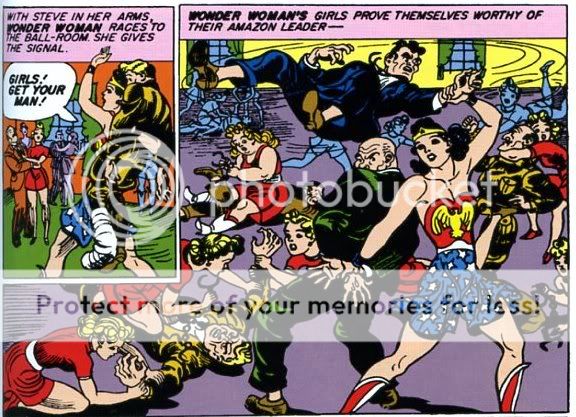
marston wonder woman

the dancing is great, and all the action is nice…but the inset panel is just weird, and looks like it was done at the last minute (look how that one girl is cropped off almost at random.) Partially as a result, the big panel looks crowded and messy, rather than formal and frozen in a way Peter would master shortly.

Marston’s also not quite where he would end up. The plot here involves sorority girls led by WW using their feminine whiles to trick and capture Poison’s guards. Marston, of course, believed that women used their feminine allure to overpower men and force them to submit. Marston never exactly abandons these ideas…but in future issues he tends not to represent them quite so schematically, I think. Certainly, WW does not, as a rule, beat the bad guys by dancing with them. Usually, she slugs them, or outthinks them, or some combination of those. I guess maybe he figured it would strain credulity if she danced her way to victory in every issue.

Free Rein on Fundamentals

I recently finished Les Daniels’ Wonder Woman: The Complete History, designed by Chip Kidd. I did enjoy it. The book is definitely tilted towards the earliest WW stories, with lots of info about William Moulton Marston and (to a lesser extent) Harry Peter — which is fine with me. Overall, I could have done with significantly less pictures of WW toys and ephemera, but that sort of thing isn’t nearly as irritating in this context as it was in Kidd’s Charles Schulz book. Schulz retained control over his creation till the end and beyond, and was always careful to keep the licensing schlock separate from the strip. In that context, Kidd’s insistence on mashing the two together came off as deliberate sacrilege. Whereas, like it or not, WW long ago left Marston’s control and became just another piece of corporate detritus. That’s not Kidd’s fault, and while I don’t necessarily need to see the process reverently documented, at this point I can’t work up a lot of bile about it either.

Anyway, as I said, Daniels includes a lot of interesting information about Marston. One of the most entertaining revelations is that Marston was a big, fat, duplicitous, self-promoting snake-oil salesman. I sort of knew this was the case already, but I hadn’t quite grasped the extent of his shillishness.

For example, in an earlier post I discussed Marston’s essay in The American Scholar. In that essay, he argues that WW was more popular than male heroes because boys want to be dominated by a strong woman. In support of his contention, he wrote as follows:

After five months the publishers ran a popularity contest between Wonder Woman and seven rival men heroes with startling results. Wonder Woman proved a forty to one favorite over her nearest male competitor, capturing more than 80 per cent of all the votes cast by thousands of juvenile comics fans….They were saying by their votes, “We love a girl who is stronger than men, who uses her strength to help others and who allures us with the love appeal of a true woman!

This all sounded fairly dubious to me for various reasons (couldn’t it have been female readers who swung the vote?) I somehow hadn’t considered the possibility, though, that the vote had just been rigged. Les Daniels sets me straight by reprinting what appears to be the poll that Marston was referring to.

Photobucket

First, of course, it’s only WW against 5 other heroes, not 7…which could have been an honest enough mistake. The point though, is that this is a survey page which was printed in Sensation Comics…where WW was the star feature. The other heroes featured were the back up stories in the book, I believe. WW is even shown bigger than all the other characters — and she’s drawn twice. Moreover, anyone taking this survey is likely to be a Wonder Woman fan already. Plus, the heroes she’s going up against are all second stringer, or fourth stringers (the Gay Ghost indeed.) Thus, the survey shows us that people who buy Sensation Comics liked WW, which doesn’t seem like much of a news flash.

Of course, this doesn’t mean that WW wasn’t popular with boys; her books sold a lot of copies, and Daniels thinks the majority of that audience was male. But using the survey to suggest that she was categorically more popular than major male heroes is, it seems to me, deliberately deceitful. Moulton’s building his pseudo-scientific theories on premeditated blarney.

Furthermore, from Daniels account at least, this balderdash appears to have been extremely effective. Marston’s professional standing as a psychiatrist, and his sheer willingness to deploy that standing in all sorts of ridiculous way, gave him leverage that it seems like virtually no other comic writer of his day had. Moulton’s editors treated him with kid gloves. He had final say on scripts. He had final say on artistic choices — in fact, he hired Harry Peter himself and paid Peter himself, a situation which I imagine was virtually unprecedented. Marston apparently was very involved in the artwork as well; his scripts supposedly included detailed directions for panel content and layout. I doubt he was quite Alan Moore, but it sounds like he was closer to that model than he was to Stan Lee.

Marston did have various tussles with censors and with editorial. I was first inspired to start blogging about WW when I heard about one of those tussles: Marston’s editors wanted to tone down the series by having him tie WW up with things other than chains. What the account I read didn’t quite say, though, is that Marston won that fight. The editor suggested less chains, Marston said no way, and so the chains stayed.

And this seems to have been repeated whenever there was a battle over content. For instance, Josette Frank of the Child Study Association was employed to make sure that the comics weren’t too…well, just too. She pointed out, quite logically, that Wonder Woman “does lay you open to considerable criticism…partly on the basis of the woman’s costumes (or lack of it) and partly on the basis of sadistic bits showing women chained, tortured, etc.” Marston responded by calling Frank “an avowed enemy of the Wonder Woman strip” and by claiming that the strip was not sadistic because “binding and chaining are the one harmless, painless way of subjecting the heroine to menace and making drama of it.” He went on:

confinement to WW and the Amazons is just a sporting game, an actual enjoyment of being subdued. This, my dear friend, is the one truly great contribution of my Wonder Woman strip to moral education of the young. The only hope for peace is to teach people who are full of pep and unbound force to enjoy being bound….Women are exciting for this one reason — it is the secret of women’s allure — women enjoy submission, being bound…because all this is a universal truth, a fundamentla subconscious feeling of normal humans, the children love it….I have devoted my entire life to working out psychological principles…[and should have] free rein on fundamentals.

And free rein is what he got. The combination of professional credentials, high sales, and a very friendly relationship with his editor meant that Frank (in a decidedly unfeminist outcome) was essentially dismissed as a repressed harridan who was seeing evil where there was none.

I’ve compared Marston to artists like Henry Darger and R. Crumb in the past; creators who elaborated their fetishes into individual visions. Reading Daniels, it becomes clear that, in many ways, Marston was a lot closer to artists like Darger and Crumb than he was to the hired hands who surrounded him in the comics industry. Not because he had more genius (though I think in most cases he did), but rather because he was really in control of his creation in a way that most of his peers probably didn’t even bother to dream about. Marston did get script ideas and input from others (especially family members), but he — not an editor, not a censor board — had the last word on what went into his comics. In fact, when (I think) Gardner Fox wrote a solo WW story for Justic Society, Marston rejected it and rewrote it himself.

As this suggests, Marston was devoted to his character. In 1945, he contracted polio and was confined to a wheelchair. He did take an assistant, Joyce Murchison, who became a co-writer on the title…but Marston continued to write, to plot, to approve art, and to maintain control of the series. in 1947 he was diagnosed with lung cancer. But he just kept on. According to his wife he “wrote a script the week before he died. Two days before the end he was editing pencils, in writing so faint we could scarcely read it, but catching errors we had passed up.”

In short, Marston had a level of control over Wonder Woman, and a level of devotion to her, that none of his successors on the title could hope to match. Robert Kannigher, as editor and writer on the title for years, certainly had great control over the character — but he didn’t hire the artists out of his own pocket, and he couldn’t prevent her from being used by other creators on other titles, the way Marston could. George Perez obviously had a lot of affection for the character, but he certainly wasn’t going to work on her on his death bed; on the contrary he quit of his own volition to work on more popular titles elsewhere.

Marston was impassioned. He wasn’t a corporate drone doing a 9 to 5; this was his dream, which he controlled, and to which he was willing to devote the last days of his life. Everybody else who has worked on Wonder Woman, on the other hand, has been doing work-for-hire, subject to a string of corporate whims, in the full knowledge that at some point they’ll get a better offer (more money, more creative freedom) and they’ll jump ship.

Work-for-hire isn’t necessarily everywhere and always worse than creator-controlled work, of course. Still, looking at Marston’s WW and comparing him to others’ work , it’s hard not to agree with Marston’s editor, Sheldon Mayer. When it came to writing Wonder Woman, Mayer said, “there was just one right guy, and he had the nerve to die. And he shouldn’t have done it. “
_________________

This post is part of a series discussing Wonder Woman, Marston, and other WW creative teams. You can read the rest of the series here.