Partially Concealed Pundit: Picture for Edra

This actually is a recent drawing.Edra Soto has an exhibition at the MCA. She asked a number of artists and friends to contribute drawings combining her face with the face of a gorilla. Most people followed the assignment, but, unfortunately, I can’t really draw, so I ended up with this:

Photobucket

Edra’s face is under there somewhere, truly.

Anyway, you can go to the MCA at the moment and see the original drawing, with many other more competent drawings of Edra as a gorilla and an amazing stage set constructed by Edra’s husband Dan if you happen to be in Chicago. Here’s Edra’s description of her show, open through June 28.

Soto’s installation, The Chacon-Soto Show, focuses on Iris Chacon, the charismatic Puerto Rican performer who starred in the 1970s variety television show El Show de Iris Chacon. Despite sexually provocative costumes and performances, the legendary diva became a popular family entertainer. Flamboyantly dressed and flanked by male backup singers and dancers, Chacon became a symbol of the liberated Puerto Rican woman. For this work, the artist analyzes issues of sexuality specific to Puerto Rican culture through the double filter of her adult understanding of US feminist issues and childhood memories of Chacon on television.

Bound to Blog: Wonder Woman #11

I’ve been poking away at the Les Daniels “Wonder Woman: The Complete History.” It’s quite interesting, as much for the tidbits of information (Harry Peter did cartoons for Judge!) as for the topics it elides (there’s no way around the fact that Marston had sexual relations and lived with two women (Elizabeth Marston and Olive Richard). But the two women…what was their relationship exactly? Did that have any influence on the many, arguably sensual, female-female relationships in Wonder Woman. Daniels doesn’t even ask the question.

Anyway, at one point (page 34) Daniels talks a bit about WW’s villains:

It seems that Wonder Woman’s foes should have been male (and certainly many were), yet a surprising number of her most interesting and energetic opponents were female. Some of Wonder Woman’s comments indicate that men were just too feeble to be worthy antagonists. Marston was apparently intrigued by the dramatic possibilities of depicting Princess Diana battling various vivacious vixens (they were invariably gorgeous), or perhaps he had calculated that such encounters would be most appealing to male readers.

I’m sure Marston did enjoy the woman-on-woman action just fine. But at the same time, I’m not sure there’s any sense in which Wonder Woman’s opponents “should have been male.” It’s true, as Daniels discusses, that Marston wanted women to rule over men. But that’s not quite the same thing as saying that all women are good and all men are evil. On the contrary, Marston has plenty of good men (Steve Trevor, most noticeably, who is certainly noble, if often kind of dumb) and plenty of evil women.

Moreover, the use of women villains can’t just be chalked up to prurience. In several cases, as Daniels notes, male villains are revealed to actually be cross-dressing women at the last moment. If you’re going for the sex element, surely it would be more effective to have your villainous hotty wear a bikini or a diaphanous gown (as, of course, Marston frequently does) rather than deck them out in drag-king attire.

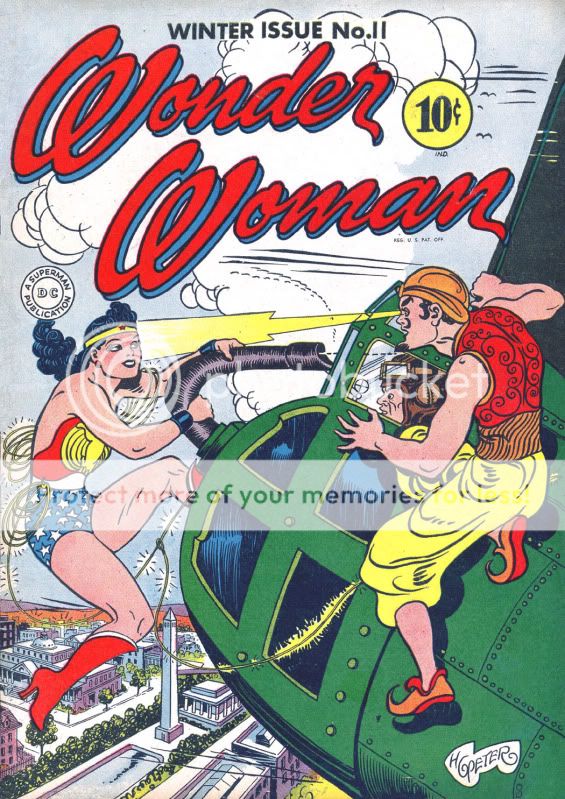
For example, as these things go, this just isn’t a very prurient cover:
marston wonder woman

The fellow decked out in the pseudo-orientalist get-up (very nicely rendered by Peter, I might add — love those art-nouveau curlicue patterns) is, we learn at the end of the book, actually a girl. Because Marston’s decided to dress the she as a he, we lose the opportunity for two sexy girls on the cover instead of one. Which is not the way to go for marketing purposes.

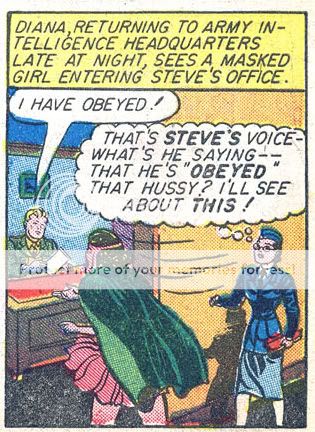
So if women-as-villain isn’t strictly for cheesecake purposes, what’s the deal? Daniels doesn’t really have an explanatory framework, because he’s stuck on Marston’s utopian claims about the goodness of women and the loving matriarchy. But if you actually read the Wonder Woman comics, it’s clear enough that, while Marston likes kind mistresses well enough, he also has a thing for cruel ones:
marston wonder woman

“Hussy” has definite sexual connotations; Diana sounds jealous that someone other than WW is forcing Steve to obey.

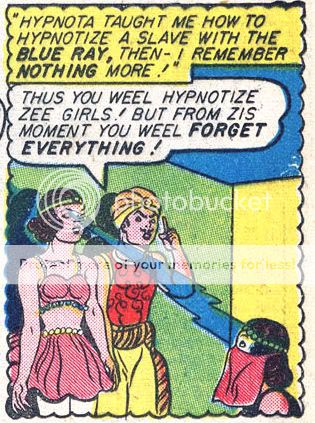
And similarly, this girl-on-girl hypnotism, with the kneeling veiled slave, surely has sexual connotations.
marston wonder woman

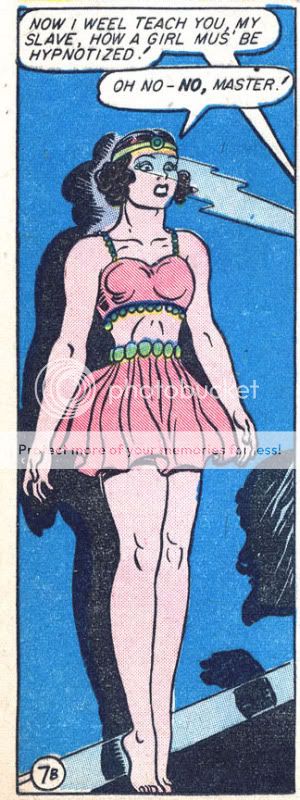
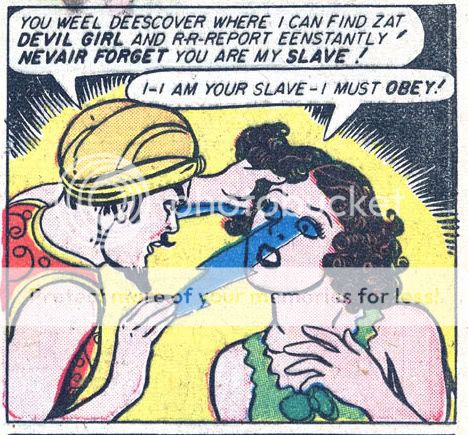
In short, Marston is fascinated by female power — as a force for good, sure, but also just in itself. The sexual payoff isn’t just in the opportunities for cheesecake (though certainly those are fun), but also in the enforced submission.

Which is to say, the fetish here is not attractive female bodies in disarray, but the hypnotism itself.
marston wonder woman

marston wonder woman

marston wonder woman

marston wonder woman

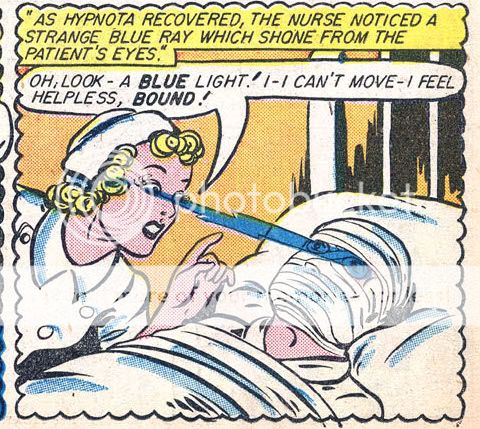
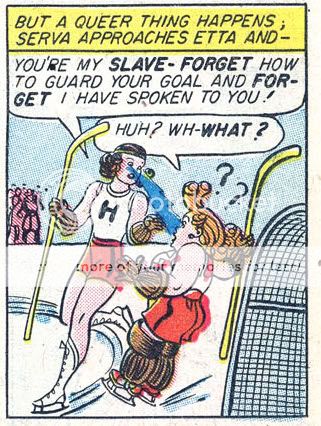
The first three are clear enough; hot girl in short skirt being controlled, hot girl in negligee being controlled, hot nurse being controlled (everyone likes nurses.) But — as someone with a bit of a button for eroticized mind-control I think I can say with some certainty that Marston got a thrill from that last one as well. The control and submission aren’t an excuse for the cheesecake; they’re the point in and of themselves. (Incidentally, WW comes onto the ice and saves the game (which was against a men’s team) for the Holiday college women.)

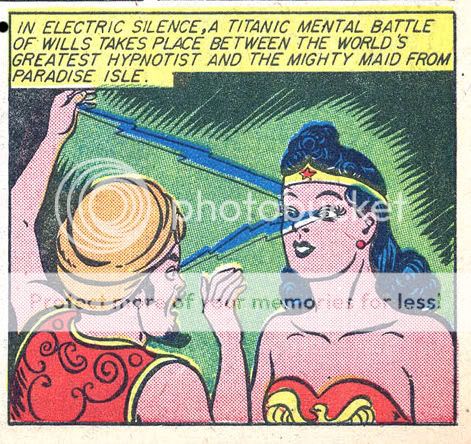
In other words, this is one place where Marston’s fetish and his feminism arguably part company; the use of control for evil purposes (or even for silly ones, as with Etta in the image above) is exciting. But this kind of control, thrilling as it may be, can’t really be described in terms of loving submission. The tension is most clear in those instances where it’s Wonder Woman who is placed in hypnotic thrall. As the Amazonian hope for a new tomorrow, WW generally makes others obey her with the use of her magic lasso (though that gets turned around a fair bit, too…but not to digress). But there’s obviously some payoff to be had by showing her will bent to the power of Hypnota. So how does Marston resolve things? Well, he vacillates:

On the one hand, we get to see WW all wide-eyed and receptive…..
marston wonder woman

But then she’s stronger than Hypnota….
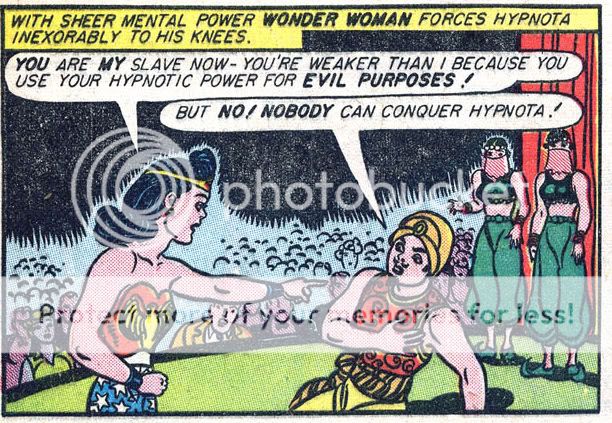
marston wonder woman

But then she gets tied up in the golden lasso and has to submit; though only reluctantly (does that make it less or more appealing?)
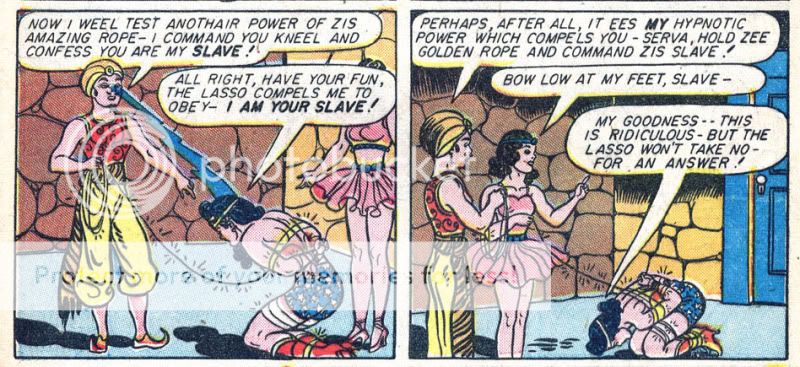
marston wonder woman

She breaks out of that and gets free…but later, we do finally see her being taken over by Hypnota:
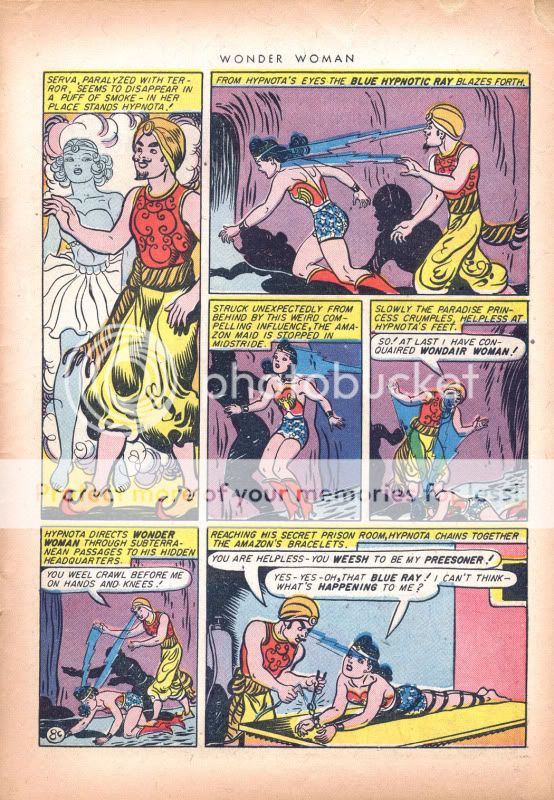
Photobucket

Though soon she’s back to being immune…and only pretending to be hypnotized….
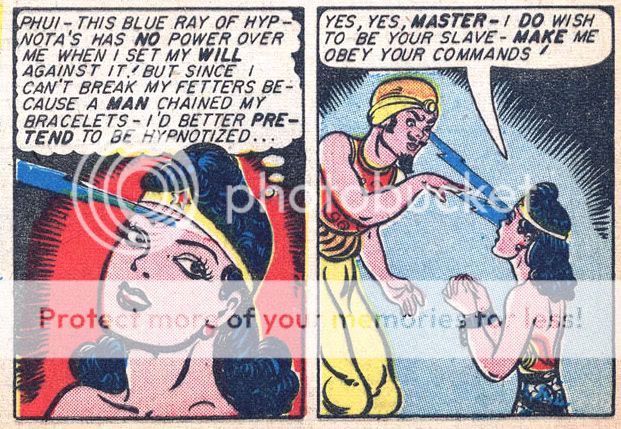
marston wonder woman

Marston, in short, goes to some trouble to have it both ways. WW is both too heroic to be a thrall to the evil hypnotist…and yet, we also get to see her being a thrall to the evil hypnotist. Everybody’s happy!

It’s also worth asking…what’s the deal with all cross-dressing? Again, I think Marston is probably just fascinated with the possibilities of gender switching and dress-up in themselves.
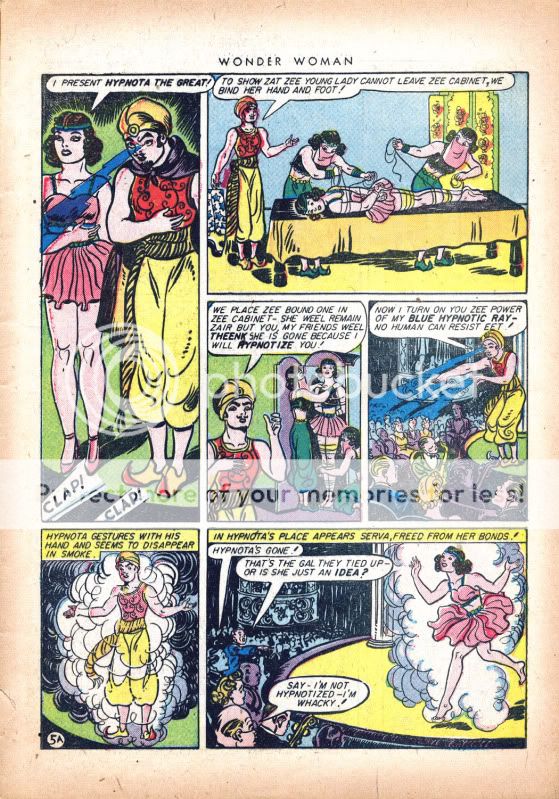
marston wonder woman

It’s a little hard to follow what exactly the trick here is supposed to be…but basically Hypnota and her identical twin are switching places back and forth. I can’t really see any reason to devote this much space to it, other than Marston’s enthusiasm for the surreptitious swapping of clothes and bodies and genders.

In some versions of masochism, gender swapping is used to as a way to undermine or invalidate patriarchy. For instance, in Jack Hill’s women in prison movie “The Big Doll House,” we find out at the end that the sadistic torturer is actually a woman…which essentially makes it possible to rape her. (I talk about this at much greater length in this essay. Turning a man into a woman, in that case, seems like a way to sneer at, and get back at, authority; the mother invalidates the father.

There’s maybe a touch of this in Marston’s story as well. Hypnota binds WW hands…which should rob WW of her strength, if Hypnota was a man. But, of course, Hypnota isn’t a man…so WW retains her strength, and (after some confusion) to break free.

Overall, though…I don’t know. In Marston, femininity isn’t ridiculed…quite the contrary. In some ways, Hypnota’s power, influencing others, seems like actually like a corruption of feminine influence — the dark side of WW’s magic lasso. From that perspective, you might see Hypnota’s cross-dressing as a sign that she’s using female power for evil male ends.

Again, though, I’m not quite sure that’s right. If cross-dressing were a sign of evil, then cross-dressing should itself be evil or wrong — and I don’t know that Marston thinks it is. Hypnota seems quite natural; as a man, she’s slender and boyish looking, perhaps, but not noticeably unattractive.

The truth is that, Marston can tend to see masculinity as wrong or deformed; men like Hercules and Dr. Psycho are caricatured and even ludicrous in their maleness. In some sense, Hypnota — who isn’t caricatured at all — is a better man than either of those real men. Women, for Marston, can and should do anything…and that includes being men.

Or being super-villains. After all, had Marston decided to make all his villains men, he would have robbed women of some of the best roles in the comic. It’s not necessarily especially feminist to paint all women as pure and virtuous and good. Why should men get to be the only ones who are powerful and bad? Marston seems to think it’s more fun for everyone, male and female alike, if women get to be villainesses, and villains too.

Partially Congealed Pundit: Evolution

I wrote this poem the year I first moved to Chicago for grad school…so that would be 1993, I guess. Anyway, I got here at the beginning of the summer, and I was in student housing with an older guy who was pleasant enough, but who before my arrival hadn’t kept the place very clean. As a result, as the summer went on, we experienced a truly horrific roach infestation, culminating one day in me waking up, looking up, and seeing one of the little critters creeping across the window. They’re semi-translucent with the sun behind them. Who knew?

I was also reading Darwin at the time, and also (embarrassingly enough) Zen and the Art of Motorcycle Maintenance. Putting all those things together into this dinky little poem took me over a year and probably an entire notebook’s worth of paper; I wrote and rewrote it like a hundred times. And I really liked it when it was done, and some other people liked it…but not any editors, unfortunately. So finally 16 years later I’m just publishing it myself. Here ya go.

Evolution

Animals turn into roaches —
landscape determines shape!
Ceilings close to clutch forests and fields,
and dodo and bison, raccoon, deer and sea gull
creep out of their shriveling skin
and creep into cracks in the walls.

And though they have lost the horizon’s broad touch,
they have no regrets. Narrowness, too, is a boon,
and landscape and shape both fit as before! Immune, now,
to waste and constriction of space and the bomb
they thank the city for half-eaten food
and accept without fear the descent of a shoe.

Beneath kitchen floors and inside sinks and toilets
they are cupped in the cradle of each evening breath,
and wait with the patience of shadows and corners
for the curve of dark to eclipse all room borders,
and for the wide dawn when the wise insect kiss
of antenna brushed against tongue and lips,
will wake sleepers to roaches on windows and eyes —
to sunlight shining through a landscape the shape
of boneless amber backs and boneless silver legs;
the movement of bodies pressed close together
as if to become one rustling creature
stretching to cover the world.

Bound to Blog: Wonder Woman #10

Wonder Woman #9 was a high point for both Marston’s script and Peter’s art. After that, #10 is a bit of a let-down. Not that it’s bad; it’s just, comparatively (and comparatively only) kind of tame. This issue the enemy is the Saturnians who (surprise!) keep lots of slaves and fly back and forth from their planet to ours tying people up and then letting them escape and being tied up themselves and…well, you ge the idea.

Here’s the cover:

wonder woman

That’s a pretty great drawing. In general, Peter’s best moment in this issue involve those trippy, computer-graphics-looking pathways made out of circles. The Saturnians have decided that the best way to invade earth is to build a giant bridge out of space debris stretching all the way between the two planets. I”m pretty sure that you’d have to run into some structural problems there…but of course, I don’t wear skintight green jumpsuits either. Just goes to show whose an advanced interplanetary genius and who isn’t I guess….

wonder woman

wonder woman

wonder woman

You’ve got to love that in that second one they appear to be moving those space-rocks with a toy crane.

Anyway, as I said, the intricacies of the plot aren’t especially revelatory this go round. There were a bunch of moments that made me laugh, though. First is this:

wonder woman

That cracked me up. Diana is worried about going swimming with the Holiday girls because if she’s wearing a swimsuit, they’ll recognize her as Wonder Woman! Obviously, that’s a pretty logical concern…but that’s just why it’s funny. I mean, she’s only wearing glasses; how hard would it be to recognize her anyway?

This got me too:

wonder woman

His name is Mephisto Saturno. Gee, I wonder if he’s a bad guy from the planet Saturn? I guess no one will recognize him as long as he doesn’t dress in a bathing suit though.

Looking at this panel, I was reminded of Man-Thing (if you can believe that). Me and Tucker Stone have been blogging our way through the first Man-Thing essential volume. Writer Steve Gerber names his villainous evil developer F.A. Schist, which I think is both dumb and irritating. Yet, I find Mephisto Saturno charming. I was trying to figure out why that would be; why does one goofy, over-determined name make me groan, while the other makes me giggle?

I think part of it has to do with the language itself; F.A. Schist is awkward; it’s actually even difficult to pronounce. Whereas Mephisto Saturno bounces right off the tongue; it’s almost like something out of a children’s book. Come to think of it, Marston has a real affinity for nonsense language in general. Wonder Woman #9 had goofy cave man speak, and this issue has a bunch of gibberish nonsense code (in the upper right panel)

wonder woman

I was going to say that this is one of the few Marston ticks that I can’t really link up to any of his fetishes…but now that I think about it, I wonder. I’ve just started Les Daniels book about WW, and it talked about some of Marston’s experiments with sorority girls. Apparently, he attended a sorority ritual known as the:

“baby party”, a strange sorority ritual in which freshman initiates “were required to dress like babies.” They were also bound, blindfoded and prodded with sticks, when they resisted, wrestling ensued. Four pages of charts documented the responses of the young scholars to these activities, with Marston concluding that “the strongest and most pleasant captivation emotions were experienced during a struggle with girls who were trying to escape from their captivity.”

Who experienced those pleasant emotions again? Anyway, the point is that baby talk as a prelude to some bondage play may well have pushed some of Marston’s buttons.

Back to F.A. Schist vs. Mephisto Saturno, though. Besides the fact that the second name is more fun to say than the first, it’s also just less heavy-handed. Calling a developer a fascist is the dumbest kind of knee-jerk clichéd liberal insult. It’s bone-headed and obvious. Whereas Mephisto Saturno is just silly. Marston does have a lot of political axes to grind, and he grinds them assiduously and openly…but not oppressively. Part of it is that his ideas are nutty enough that when he lays them out there, you (or at least I) tend to laugh rather than groan. Also, I think he’s actually just more subtle than Gerber is:

wonder woman

Steve’s thinking how great it would be if WW stayed homed and cooked for him…but I don’t think the reader is supposed to think that’s great. In fact, later in the comic, Steve gets punished for wanting to make WW his domestic by being turned into a (sexualized) domestic himself —and significantly, he’s prattling on about food here, too:

wonder woman

I’m not sure the point here is exactly that Steve shouldn’t have wished servility on WW, incidentally; rather, it seems more like Marston is asying that it’s sexy to have everyone, man or woman, in a position of servility.

Along those lines, I thought this page was interesting:

wonder woman

Despite the claims of someas we see here, Steve doesn’t always get rescued. On the contrary, in this scene, he and WW rescue each other. It’s true that overall, WW is more likely to rescue Steve throughout the series than vice versa…but he’s hardly entirely helpless.

In fact, the more I read WW, the more the Steve-WW relationship comes across as…I don’t know if subtle is the word exactly. Vaguely viable, maybe? I was just thinking about it in relation to the Wonder Woman animated film, which also has Steve mouth obnoxious misogynist canards at points, and treats him as a somewhat equal partner in kicking ass. But the animated film is shot through with anxiety; Steve and WW have lots of dramatic tension around Steve’s issues with letting WW go into danger and his need to in general force WW to admit that men are really okay too. Whereas, in this version, when Steve talks about keeping WW out of danger, it’s more an exasperated aside than a real argument. And then there’s this:

wonder woman

I guess that could be seen as a misogynist diss in some sense. But it really comes across more as friendly flirtation than as an actual effort to run WW down. Especially given this:

wonder woman

I think he’s bragging about her there; he’s saying. The point isn’t that she did all this amazing stuff, but she’s still a silly little woman, but that despite all of this amazing stuff she did and all the danger she was in, she wasn’t perturbed…and also wasn’t unfeminine. I think that’s really the point; Marston likes femininity, so pointing out WW’s femininity can be teasingly affectionate; it’s banter, not an insult. Whereas the animated DVD was a lot less comfortable with femininity, and so many of Steve’s chauvinistic comments came across not as teasing or as friendly banter, but as anxious and mean-spirited — if I remember correctly, there’s a moment of borderline workplace harassment.

It’s also worth pointing out this sequence:

Photobucket

That’s from WW #2, and it’s almost an exact reversal of the scenes we just looked at; in this case, WW is teasing Steve for behaving just like a man even though he’s been captured and endangered on another planet (Mars in this case.)

All right, to finish up with the boots:

wonder woman

Nobody’s going to notice her running around in a gaudy swimsuit…but not wearing boots! Everybody will point and stare at her then!

_______________

I just looked ahead, and after this mild downturn, #11 features a cross-dressing hypnotist. So I’m looking forward to that.