I dug out some scans of comic book covers, all from Fiction House comics. One lesson you can draw from the sampling is that, if you wanted to be an action-oriented woman on a Fiction House cover, it really helped to have some wildlife to beat up on. But another woman would also do, just no men. Inside the comic things might be a bit different, possibly because of plot requirements.
Category Archives: Series
Bound to Blog: Wonder Woman #6 (with Mary Sue tie-in)
For those who care about such things, this is both part of my ongoing series on the Marston/Peter Wonder Woman run and part of our ongoing roundtable on Mary Sue characters.
I wrote this over the weekend, incidentally, before I’d convinced myself that Mary Sues had some positive aspects. I could have rewritten, I guess, but…eh, why bother? Consistency is the hobgoblin of my little mind.
___________.
In this post I argued that the comic Legion of One, and much of contemporary Wonder Woman — and indeed, much of contemporary super-hero comics in general — are essentially Mary Sue stories. Mary Sues is usually used to refer to a non-canon, author-surrogate character of exceptional and irritating wonderfulness introduced into a fan-fiction story. I argued that, in contemporary comics, the canon itself is riddled with Mary Sueism, such that you get stories whose main point seems to be the reiteration of how great Wonder Woman is, or how mythical Superman is, or how everyone wants to be in the Justice League. Whole comics seem devoted to puffing the putative protagonists, as if the reader won’t believe that Captain Marvelous is really Marvelous unless he or she is reminded of that fact every fifth panel.
One could argue, I guess, that this is in general true of all super-heroes; after all, the whole point of Superman is for him to be super, the whole point of Wonder Woman is for her to be wonderful. That’s true to a certain extent, sure — but I think that in general, golden age and silver age comics tended to be less self-conscious about this sort of thing. I think this is especially true of the Marston run; certainly, Wonder Woman was always wonderful, and Marston liked that about her…but his plots tended to be as much or more about his own weird fetishes and his goofy imagination as about reiterating her greatness. If the plot called for it, he’d cheerfully have Wonder Woman be saved by Etta Candy, and damn WW’s supposed superiority. If his fetishes called for it, he’d happily have WW fail in her duty to be authoritative and be chastised for it by Aphrodite.
You can see the sort of thing I’m talking about in the first few pages of Wonder Woman #6. In the ostensible plot, WW is putting on a show to raise money for “restored countries” (presumably nations retaken from the Axis by the Allies.) She’s there to demonstrate just how great she is, to do spectacular feats, to wow the crowd. And yet, Marston just can’t keep his focus; his mind drifts…and suddenly, before you know it, we’re talking, not about WW’s greatness, but about the wonders of multi-ethnic restraint technology. Priscilla Rich, the socialite who organized the benefit, has a hobby, you see…she collects manacles from around the world! Or, as WW puts it “Priscilla’s hobby is collecting chains…mine is breaking them!”
This scene climaxes (as it were) with the sequence that first got me intrigued with the Marston/Peter run in the first place: WW in a gimp mask underwater, sneering at the weak jaws of French girls as she braeks free of the gimp mask with her teeth (Marston loves, loves, loves to have WW tied up in such a way that she can only escape by using her teeth. I leave you to draw your own conclusions.)
Basically, Marston’s fantasy uber-self is a trussed-up woman with phenomenal jaw strength. You can call that a Mary Sue in a sense…but it’s a Mary Sue so preposterously idiosyncratic that it really seems like she needs another name. Masoch Sue, perhaps.
So that’s that for that argument…or rather, I wish that were that. Because the fact is that, while Marston’s obsessive eccentricity usually does allow him to avoid most of the Mary Sue pitfalls, things don’t always work out quite so neatly. Specifically, in this issue, Marston does actually, and with some consistency, treat Wonder Woman and the Amazon race in general as something of a typical Mary Sue. As a result, this issue is (by Marston-Peter standards) relatively boring. It also, and I think not coincidentally, highlights some of the less pleasant implications of Marston’s gender politics.
As you can see from the cover at the top of the post, this issue involves WW in a fight against the Cheetah. The Cheetah, as it turns out, is actually Priscilla Darling (the socialite who likes to collect chains.) Said chain-collecting socialite is jealous of WW, and also owns a mirror — the combination, apparently, drives her insane, and she becomes…evil!
The rest of the issue is given over to the Cheetah’s sneaky plans to destroy WW. These are for the most part typical Marston fare; fairly entertaining, though not as crazed as he sometimes gets. The moment where she dresses up some captives as zebras is probably the highlight.
Overall, though, the Cheetah is a problematic villain in a couple of ways. First of all, she’s actuated entirely by jealousy; she’s a super-villain just because WW makes her feel inferior. From Marston’s perspective, this is supposed to be a cautionary tale about women’s self-esteem, I think — that is, women should feel good about themselves.
Which is okay I guess, but…the thing is the Cheetah really is inferior to Wonder Woman. In past issues, WW’s enemies have been gods like Ares, or evil geniuses like Dr. Psycho or the Baronness, or entire subterranean races. They were real threats. But the Cheetah’s just this socialite with multiple personality disorder. Yes, she uses lots of cowardly tricks, and she’s supposed to have agility because she’s dressed like a cheetah I guess, but…come on. She’s screwed; she’s the underdog. And if she’s the underdog…well, you feel bad for her, or at least I did. You sort of want her to win.
In other words, you have a classic Mary Sue set-up — WW is too good to root for. She’s got an unfair advantage; you feel like the author has his hands on the scale. It’s especially painful because WW seems to know, just by osmosis, that the Cheetah’s real problem isn’t that she’s evil, but that she’s just misunderstood.
I mean, in that two-panel sequence, the Cheetah is clearly a more appealing personality. She’s all crazed bluster and braggadocio, while Wonder Woman comes across as some kind of sanctimonious super social worker.
Things only get worse in the book’s final chapter, though. For obscure reasons, WW decides to stage a contest between her friend Paula’s slave girls who are being trained by Amazons on Paradise Island and the greatest women athletes of earth. The Amazon-trained women are, of course, stronger, faster, and more awesome, primarily because they wear chains.
So, inevitably, the sportswomen of earth get their butts kicked by the chain-wearing submissives.Paula, the slave-girls’ leader, even insists that her girls compete in the running events while wearing ankle chains.
The woman on the right in the picture above is the Cheetah in disguise. And, I have to say, she’s got a point. Running a race with ankle-chains on does seem like an effort to deliberately humiliate your competition; it’s a shitty thing to do. Moreover, while it’s not a trick of Wonder Woman’s diagetically, it does seem like a trick of Marston’s — the Amazons all seem like Mary Sues, boosted into wonderfulness by authorial favoritism.
What’s especially icky about all this, of course, is that the favoritism is explicitly linked to the women’s submissiveness. This isn’t exactly new, of course; Marston is always riffing on the virtues of submission as power, or power as submission. Often, Marston presents that submission/power as an alternative to low self-esteem and weakness — “you girls really can do anything! Don’t let me hear you say you can’t crush the seal-men! I know you can if you just learn to love giving and receiving bondage!” It’s ridiculous, but at least the overall arch is about depowered women gaining strength and control over their fate, at least in some sense. Here, though, the women who Marston is supposedly educating about the virtues of self-confidence are already world-class athletes. And as a result, you really start to wonder…do these women actually need a skanky perv, no matter how well-intentioned, lecturing them on the virtues of self-esteem? I mean, let’s say you’ve got an Olympic level runner there, someone who has been training for years; someone who has bucked the general prejudice against women’s athletics, which certainly existed back in the 1930s. How exactly is it liberating to pretend that she’d be better off as a runner and as a human being if she learned to love being chained?
Marston’s fetish and his feminsm often work together, as I argued in this essay. In this narrative, though, they don’t…and forced to choose, he unhesitatingly goes with the fetish. The bondage girls of his wet dreams beat the real-world athletes, and even humiliate them. And just to clinch things, he gives the only word of protest to the piece’s villain:
That’s the Cheetah in disguise again…and, again, she’s absolutely right (and I’m not just saying that because I love those Peter-drawn eyebrows.) The Amazons, or rather Marston through the Amazons, are being condescending assholes. You do sort of want to see them (or rather him) get a comeuppance. Let’s have the damn Mary Sues trip over their stupid chains, already.
Cheetah makes a go of it, but, of course, it doesn’t work out. She does get to tie up Hippolyta, but really, who doesn’t? Ultimately, WW wins. And as if that’s enough, with the help of the magic lasso, she makes the delinquent confess and beg, not for forgiveness, but for discipline — “keep me a prisoner here and train my cheetah self!”
In our Helter Skelter discussion I expressed some doubts about bad-girl, Courtney Love style feminism; the whole idea that being a jerk is an effective way to fight the power. This story, though, made me recosider. I still don’t think that being a jerk is necessarily a particularly useful strategy…but if the choice is between more or less futilely acting like an evil jerk and meekly acquiescing in your own disempowerment — well, one can see why the first option has some charm. Marston connived to make the Cheetah feel inferior, and so she got pissed right the fuck off. The getting pissed off is supposed to make her evil…but in fact, getting pissed off seems like a reasonable, and even, dare I say, a feminist response. Marston decides to discipline her because she’s not sufficiently restrained, and then he sanctimoniously suggests that restraint will make her stronger. In fact, though, power doesn’t necessarily always come from restraint — or, at least, it depends on who is doing the restraining. The Cheetah represents, it seems to me, an angry feminine — a feminine not bound by Marston’s particular obsessions, and not especially interested in his games. He doesn’t handle it well.
Bound to Blog: Wonder Woman #5
Thanks to Glaurung, I now know that Marston wrote WW up through issue #28. So, 24 more to go, starting with this one:
In a post a couple of days ago I mentioned that Marston doesn’t actually seem all that interested in magic, myth and imagination in themselves. It’s true, of course, that WW’s origin is informed by Greek mythology, and that the Amazons are essentially supposed to be ancient Greeks, worship Greek Gods, and so forth. But there’s little effort to mine those myths for mystery, or awe as Neil Gaiman does in Sandman, or as Marley does in Dokebi bride. Instead, Marston mixes magic and science together more or less indiscriminately in the interest of goofy fun and/or catering to his fetishes around mental control, hypnosis, and so forth.
Thus, issue #5 features a villain who is part scientist, part spiritualist, and all…god knows what, really.
Doctor Psycho is this little scientific genius with a beautifully ugly caricatured face who hates women because his fiance betrayed him and he ended up in jail and then he goes and hypnotizes her and uses her to conduct spiritual experiments and turns himself into an ectoplasmic doppelganger of George Washington who issues oracular pronouncements about the dangers of allowing women to contribute to the war effort. Also somewhere in there he makes his rival in love swallow radium. Oh, yeah, and he’s inspired by Martian emissaries from Ares who don’t want women to contribute to the war effort because then women will become too powerful and will dominate men.
What was I talking about, anyway?
Oh right. So, as I was saying, the point here is that Marston veers back and forth between science and magic — seamlessly isn’t the right word — more like with an unconscious, drunken stagger. In the page below, for example, we start at the top with our villain killing a victim with radiation poisoning, move right on to hypnosis (no explanation for how he learned how to do hypnosis, incidentally) and end up (below the cut) with ectoplasm spilling out all over the place — ectoplasm that Dr. Psycho can use to turn himself into a dead ringer for John L. Sullivan, we learn at the top of the following page.
One of the reasons this sort of crazed shifting of gears works so well is the art. Peter is a deceptively supple illustrator; his stiff poses tend to bely how fluid his lines are and how quickly he can switch modes. For instance, in this illustration, where Steve (as per usual) is getting pwned:
Steve’s body and face are, in typical Peter fashion, stiff and not especially expressive. But then you’ve got Dr. Psycho standing there with his enormous head and preposterous eyebrows, looking for all the world like he’s strolled in from an editorial cartoon. And, of course, there’s the very gestural curly smoke-ectoplasm just sitting there on Steve’s chest. It’s a preposterous image, with different levels of reality clunking against each other apparently unconsciously — it’s almost like an incongruous arrangement of clip art. Except that Peter’s style, his moving hand, really does pull everything together — the lines on Steve’s uniform, for example, have the same tactile motion as the ectoplasm splot. Peter creates a world where both scientific laws and magic seem equally hokey and equally vivid; where anything can become part of the clunky tableaux.
Here’s another example of what I’m talking about:
What’s that, you ask? Why it’s Wonder Woman and her scientific genius friend Paula riding a giant Amazon Sky Kanga to the moon in order to rescue the goddess Diana from the cruel grip of Ares. What else would it be? And, more importantly, why hasn’t DC taken this image and blown it up and released it as a wall-sized poster so I can fucking buy one? Because holy shit is that completely, insanely beautiful. The different weight lines making up the space-kangaroo’s hide are just so lovely — and the bizarre way Peter has the creature foreshortened makes it look truly cosmically sized, like it’s head is just disappearing into the distance. It reminds me of some of Winsor McCay’s animal drawings, though clumsier and less finished in a way that really sends me. (Also, I love that whip in the lower left; all one snaky, narrowing line.)
The full-page extravaganza has to be the Sky Kanga image that owns my heart…but it’s a close battle between that and the ones where we see the space kangaroo hanging out next to Grecian architecture. (Did you know the Greeks actually trained kangaroos? For space travel. God’s truth.)
There’s actually a pseudo-scientific explanation for why the Kangaroo is able to fly through space, incidentally; “upper space is not empty but dotted with thousands of gravity-marooned fragments from whirling planets” y’see. So it’s a scientific Grecian sky kanga, rather than a mystical Grecian sky-kanga. But the real point is clearly not any kind of effort at actual scientific verisimilitude (such as with Spiderman, or even Superman), nor mystical wonder, but trippy adventure nuttiness. I mentioned in my last post that Marston’s WW reminds me a lot of the Oz books…and it’s also reminiscent of the Doctor Doolittle stories — in fact, if I recall correctly, Doolittle flies to the moon on the back of a giant moth. I wonder if Marston was thinking of that?
Oh, okay, I can’t resist: more sky kanga porn:
I love how the kangaroo has seemingly grown to about twice the size to accommodate all the people who need to ride on it.
Again, last time I talked a bit about the way that children’s literature can dovetail with eroticism, and how that fits nicely into Marston’s fetishes. And there’s certainly plenty of bondage in this issue too, what with the hypnotism and the mersmerism and scenes of all of Ares’ female slaves on Mars, and Diana’s archers penchant for using arrows that tie you up rather than kill you and so forth. But I think it’s also worth pointing out that writing in a children’s literature tradition is just in general a good way to appeal to children, of whatever gender. Silliness and lots of action; kids like that. Marston gave it to them. Why wouldn’t these comics have been popular? I’m just remembering a Kyle Baker quote where in describing the Hawkman story he was working on, he said, “There’s also action on Dinosaur Island, because dinosaurs are always cool.” I feel like the giant Kangaroo has a similar rationale. Kangaroos jumping to the moon…that’s always cool. (Well, I think it is anyway.)
Along those lines, I was also thinking about the Steve Trevor romance, such as it is. A commenter (I can’t find the exact comment; my apologies) said recently that he really liked the Steve Trevor/Wonder Woman romance, because it seemed like they were really in love; he pointed especially to the fact that Steve always uses terms of endearment like “angel!” to refer to WW.
I have to say, I really don’t see this. For the most part, the romance between WW and Steve seems more notional than actual. Steve does refer to her with excessive endearments…but that just seems part of their general lack of communication. For instance, in the scenes below, Steve’s life has been threatened, and WW is worried…and Steve just keeps laughing and laughing like a jackass.
For an actual relationship, that’s deeply wrong; even if he isn’t worried about getting hurt himself, he should be worried about how WW feels.
And despite all the endearments, they never exactly seem all that intimate; even when she rescues him, the closest they get is holding hands at arms length. Not even a chaste kiss:
Compare the very next panels, in which WW rescues Dr. Psycho’s wife:
This woman who WW hardly knows gets significantly more cuddling than Steve does. This is typical, I think; WW has plenty of close, even sensual relationships, but they’re all with other women, not with Steve. Here she is with her Mom, for example:
I don’t think I’ve ever seen her share such casual intimacy with Steve. And, then, of course, she’s always getting tied to other women, like her buddy Paula…..
I’ve talked a little in other places about the importance of romance to genre literature for girls. And I think that that holds true. However…I think there is some sort of age cut off there. I mean, from my experience with my son’s classmates, even 4 and 5 year old girls are more interested in marriage and romance, in some sense, than their male peers. But that interest is pretty abstract — you know, they say, “I’m going to marry *that* boy!” but they don’t mean they actually want to marry that boy, or even hold his hand at this stage. As Eric B. said in comments to my much maligned Spider-Girl post
My daughter hates female superheroes that are directly derivative of male superheroes. She likes Wonder Woman ok when the story is decent (a dicey prospect), but prefers The Flash (Silver Age reprints) as her favorite. Perhaps it does make sense to market (and write) a title like “Spidergirl” to young girls…but will they be buying? I’m not so sure. Maybe some 8 year old girls want romance, but I think what they actually want is action, adventure, and humor…just like 8 year old boys. For these things, superhero comics are perfectly fine.
I think young girls do like a bit of romance…but they don’t want you to go overboard with it. Given that, it seems like the Steve/WW romance is just about right; it’s there, but it’s not especially obtrusive or fraught. WW isn’t constantly worrying about whether Steve likes her, or even whether he’s going to find out her secret identity, the way Clark Kent worries about Lois Lane. She doesn’t pine after Steve except in the most perfunctory way; she just saves him and he’s grateful and then she moves on to share intimate moments with her real friends — and just as is the case with most young girls, her most important friends tend to be other girls.
And, when there are close physical relationships with boys, they tend to be worked out through other means:
That’s Dr. Psycho coming at you, giant mug dead center, while Etta and the Holiday College gang chases him with paddles.
Again, it’s amazing how competent and generally tough Etta is, and how much she gets to do in these stories. Originally, looking at her, I wondered what the hell Marston was doing. This goofy, obese, monomaniacal buffoon — are we supposed to laugh at her? Identify with her? Or what? But the more I read it, the more it’s clear that the answer is, yes, both. How different is Etta, really, from Cookie Monster — certainly one of the most beloved creations for children? Kids love to eat and fight; Etta loves to eat and fight; ergo, kids would like Etta. She certainly gives Peter a chance to show he can do visual slapstick with the best of ’em:
I love those giant swoops, and you can feel that woman’s face hitting the floor. Or how about this:
I mean, who would you rather hang out with, poncy Steve with his oh-so-proper “oh, excuse me, I’ll accooooomodate you,” pole so far up your butt that you’ve got perfect posture even in a fist-fight — OR, with Etta, who beats up two guys at once while yodeling and apparently having the time of her life? It’s not much of a contest…which is why it’s Etta who gets to put WW’s lasso back on her hip while Steve is off somewhere in the background playing with his gun.
_________________
I did drift away from talking as much about the bondage in this post. So just in case you’re suffering withdrawal:
Hopefully that’ll hold you till next week.
Oliphant Watch: The Pig Busts In
This one makes sense, which is a letdown, of course. No pointing and giggling.
Bound for Glory
I’d posted a bit back about Alan Moore’s proposal for Glory. Basically I argued that for the most part Moore didn’t seem to understand what made the Marston/Peter run great; in his proposal he tended to take weird, absurd ideas (like the invisible plane), note that they were weird and absurd, and then go on to suggest changing them in ways that made them more conventional and boring (turning the invisible plane into a more mythologically appropriate, and therefore less goofy, transforming chariot thingee, for example.)
Well, my brother very kindly sent me the three issues of Glory that Moore actually wrote (numbered 0, 1, 2) — and I was pleasantly surprised. I think the actual book is a good bit better than the proposal.
Not that Moore has suddenly figured out the Marston/Peter run. There’s no particular evidence that he has. Rather, it’s that, despite some lip service to the WW history and mythos, he really largely manages to ignore Marston and get on with his own ideas. For instance, I noted that the most interesting part of the proposal seemed to be Moore’s ideas about Glory’s secret identity. WW did have a secret identity in the Marston run, of course, but it always seemed tacked on — there because super-heroes were supposed to have secret identities rather than because it was an integral part of Marston’s politics or fetishes. WW always seemed to be slumming as Diana Prince — presumably because she wanted to be near Steve Trevor…but since WW always hung out with Steve Trevor anyway, the motivation didn’t seem especially coherent.
For Moore, however, the secret identity expands and becomes essentially the entire point of the book (or of the couple of issue he wrote anyway). Glory wants to know what it’s like to be human — which isn’t an original trope, exactly. But the trick is that the person she chooses to become/inhabit, Gloria, is a waitress who’s a schizophrenic. She’s Gloria’s secret identity, and Glory is her fantasy. The tension between those two perspectives is funny and poignant and even a little disturbing, especially at the cliff-hanger ending (never resolved), where the gap between Glory and Gloria, or between imagination and reality, swallows both of them up.
In the proposal, Moore suggested that the comic should be “disingenuous” and “coy” in its portrayal of cheesecake, lesbian subtext, sex, and so forth. I felt that this was really a fundamental misunderstanding of Marston, and overall just not a good way to go. And, indeed, the moments where the series goes that direction are, in general, not of the best. In issue #0, for example, there’s a flashback/retelling of Glory’s history which includes a lot of badly-rendered gratuitous cheesecake which is irritating and dull. And then there’s the cameo by a female comic reader in a half-shirt who a skeevy old book-retailer keeps refers to as “child”, and who behaves more or less like a kid (deferential to old skeevy guy, eager for new book,…she’s an analogue to that comic-reading kid in Watchmen, actually), but who has the hard-bodied, half-shirted, butt-falling-out-of-her-bottoms look of a poorly-drawn pin-up.
On the other hand, the retro-bondage flashback story in issue #2 with cross-dressing, serious butch-femme play, and tongue-in-cheek parodically second-wave sneering at the bonds of matrimony was quite entertaining…though its knowing satire, its exploitation, and its clever plotting with the twist ending is world’s away from Marston/Peter (it reads much more like Moore’s own efforts for 2000 AD, actually, albeit with less explicit violence and more implicit sex.)
In any case, the point is, these are largely aberrations; the bulk of the series doesn’t go for coy or disingenuous or cheesecake especially. Instead, it treats sex and love in an above-board, respectful manner. Gloria the waitress sleeps with a marginal drifter character, and its sweet and sexy and cute (“I like his name and how he talks,” Glory thinks, “I like his bottom.”) Similarly, Hermione, Glory’s companion, has an unrequited crush on her…Moore threatened to mine that for titillation in the proposal, but in the actual comic it’s played almost entirely for bittersweet pathos. Maybe Moore wrote the proposal figuring that Liefield wanted coy cheesecake? In any case, there’s much less of it in the comic than he promised, which is all to the good.
Overall, I think the fact that this isn’t actually Wonder Woman helped Moore a good bit. Glory’s costume is no great shakes, but it’s not the dreaded swimsuit of Americana. She isn’t tricked out with bondage gear. She doesn’t have tons of baggage about, for example, the mission of peace (Moore basically has her going to man’s world initially because Hitler pisses Demeter off by being a jerk, and later just because she feels like it), or feminism (which Moore uses as an off-hand joke a couple of times, but doesn’t otherwise bother with.) There isn’t any need to make any homage to the idea that she’s an icon of any sort. Though he takes some things from the WW mythos, Glory ends up as much less WW than Supreme was Superman. Instead of fetish and feminism, Moore uses the title to talk about magic, imagination, and relationships — his obsessions, not Marston’s at all.
Maybe this is clearest in the retelling of Glory’s origin, illustrated by Melinda Gebbie. The first image of the story is this:
This reminded me of the Ms. cover image where WW is shown as a giant. Here, though, the sexualizing effects of manipulating body size are much more thought through and under control; the children’s book stylized whimsy, the girly outfit, the fashion pose, the skin, and the tiny figures showering her with adulation; she’s powerful, but also a sexual object in a whimsical way. I mean, Marston wasn’t exactly whimsical, I don’t think — more cracked. But this seems like a nice nod to his themes; a way to point to them without pretending to take them as seriously as the man himself did. It is coy, I guess, but almost nostalgically or poignantly so — especially as those very elliptically suggested themes of sexual power and submission don’t really play out in the following narrative at all. Instead, the story Moore tells is actually much more like a Neil Gaiman Sandman tale than like a Marston fever dream — it’s a reworking of the Persephone myth, with Demeter impregnated by a demon in the form of a silver rain about halfway thorugh. There’s no bondage or purple healing rays or caricatured masculine stereotypes anywhere in sight. Gebbie’s artwork does share some traits in common with Peter — a somewhat simplified cartoony style, some frilly filigree, a penchant for stiff poses creating frieze-like compositions. Her faces, though, are much more expressive, and her linework less so. The feel ends up being more conventional and sentimental, as in the image below:
I really like that panel, with the diamond patterns in the back and the demon thinking in Lichtenstein melodrama. We get love and mystery and magic. It’s nothing like Marston/Peter, the putative object of the tribute. But that doesn’t mean it’s bad.
This isn’t to say that Glory is overall comparable in quality to the Marston/Peter WW run. In the first place, other than Gebbie’s eight-page cameo, the art is typical mainstream crap; ugly stylistic nullity mottled in that horrible computer coloring. Moore tries for a couple of Winsor McCay effects and you just want to tell him to stop, man; nobody here has the skill for that. You’re just embarrassing everyone. Give it up.
Art problems aside, Moore’s authorial vision, in this title at least, isn’t nearly as weird, as funny, or, I’d argue, as thoughtful as Marston’s original. What with the flashbacks and the backstories and the diner drama and Glory running off to fight badness every so often…the characterization and plot are clever and fun, but they’re too diffuse to really seem urgent or to add up to all that much. As with Supreme, you get the sense that Moore (like Glory) is slumming; running along and entertaining himself without breaking too much of a sweat. The themes around imagination are things we’ve seen from him before…stories affecting the world, stories breaking into the world, etc. etc. In a couple of sequences, characters in the comic are reading comics, and then the comic within a comic turns around and breaks the fourth wall and talks to the character in the comic…and you think, yep, whatever, Alan — comics are a metaphor for existence. Can we move on now?
The thing is, since I don’t find these ideas that compelling in the first place, I’d just as soon see Moore treat them as toss offs; better that than Promethea, certainly. The air of improvisation doesn’t hurt the book;on the contrary, I like the breeziness of it, and there’s still enough depth to keep things engaging and even affecting. It’s not genius, but it is one of the few versions of WW that isn’t an aesthetic pratfall. Marston/Peter’s character is impossible to deal with, and so Moore, very reasonably, refuses to, and comes up with something else entirely.
_________
One complaint though; Moore puts an Etta Candy analogue in one of his flashback stories…and she’s thin and hot! What’s with that? Did Liefield decreed that there couldn’t be any fat women in his comics, no not even one?
Only One Can Wear the Pointy Ears
My good friend Bryan alerted me to the existence of this, a 1967 attempt at a Wonder Woman pilot commissioned by the producer of the Batman TV show.
Basically, Diana Prince gets berated by her mother for not having a man, then she runs through a revolving wall, emerging as Wonder Woman who (to paraphrase the voice-over by the regular Batman announcer) “knows she has the strength of Hercules; knows she has the speed of Mercury, and *thinks* she has the beauty of Aphrodite!”
It’s certainly something completely different. And I did laugh a couple of times at the sheer unexpected snideness of it.
Ultimately, though, it’s hard for me to get behind it enthusiastically. Part of what was so much fun about the Batman TV series is that the target of the humor was the establishment; Batman and Robin are basically policemen/boy scouts; in all their humorless do-gooding, they’ve got the law and the powers-that-be on their side. The show was a masterpiece of having your cake and eating it too; you get to sneer at the ridiculous dated morality (refusing to drive through red light; refusing to hit women, etc. etc.) while still rooting for that morality to win. Batman’s the show where even cops could laugh at crime-fighting and even hippies could cheer for the establishment.
This Wonder Woman pilot, though…it tries to make fun of Wonder Woman the way that the Batman TV show made fun of Batman…but it’s just not as easy to get the balance right. The main problem is just that Wonder Woman is a woman…and as such she can’t be assimilated to the establishment the way Batman can. Instead, because she’s a women, she’s automatically marginal in certain ways. As a result, making fun of her doesn’t feel edgy or clever — it feels hackney and tired and dumb…and, yeah, sexist too. Jokes about aging unmarried daughters who are desperate for men; jokes about women’s vanity; jokes about women being incompetent…where have I heard *that* before?
For WW humor, I much prefer Darwyn Cooke’s pissed-off 2nd wave feminist version, which makes fun of WW for being overly sensitive and clueless, but also ridicules men for being venal and predictable and generally getting their asses kicked. Gender roles and wars of the sexes can be funny, and often are. But even when it’s written with some wit, I just don’t find sexism all that humorous.
________________
And as I’ve been pointing out at the end of each of these, this is the latest in a series of posts on post-Marston takes on WW. The whole series is here.
Bound to Blog: Wonder Woman #4
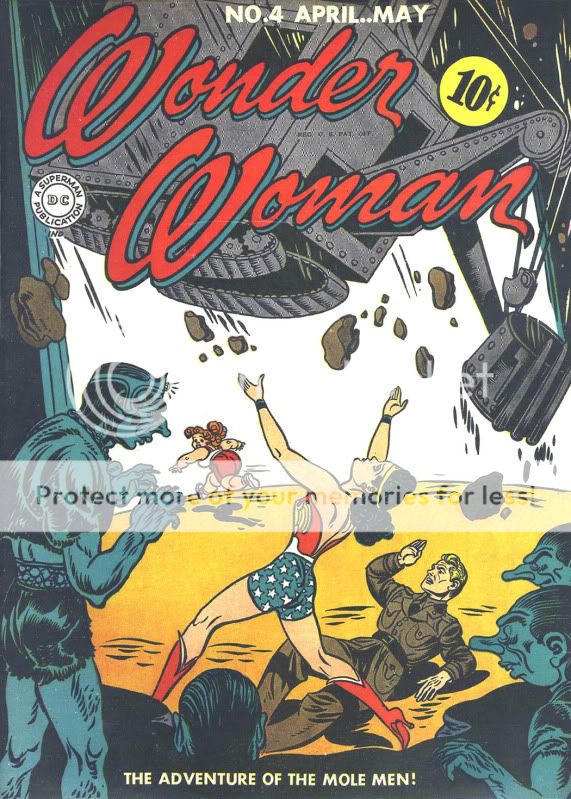
Not sure anyone but diehards are reading this at this point…but in case you’re new, I’m blogging my way through the entire original Marston/Peter run on Wonder Woman. We’re up to issue 4. And here’s the cover….
I’d sort of hoped to see the last of Baroness Paula Von Gunther last issue when she pulled a Bleak House and got her ugly mug replaced. I’m not that interested in her, and she’s always involved in espionage plots, which aren’t necessarily my favorite Marston efforts. No luck, though; she’s back for this entire issue apparently, being subjected to a series of tests by Aphrodite to prove that she’s sufficiently submissive or dominant or good or some combination of all three. And sure enough, the first story is pretty underwhelming. I mean, oh sure, you’ve got hot Chinese girls showing off their whip scars….
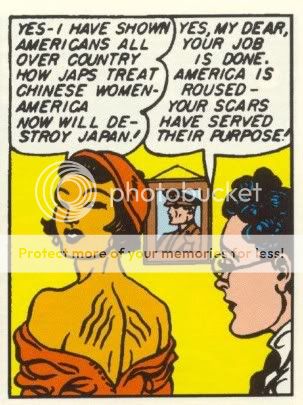
and hot Chinese girls showing off their whip scars
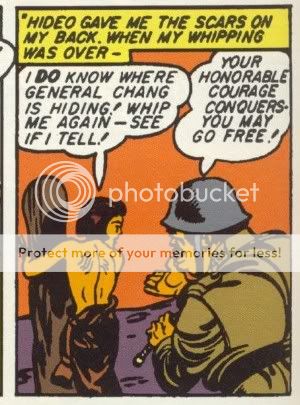
and then there’s the hot Chinese girls showing off their whip scars
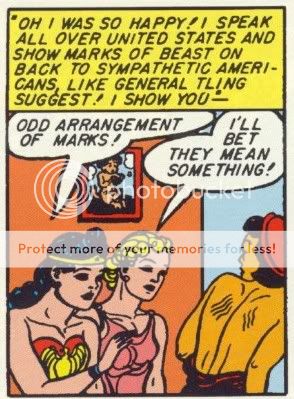
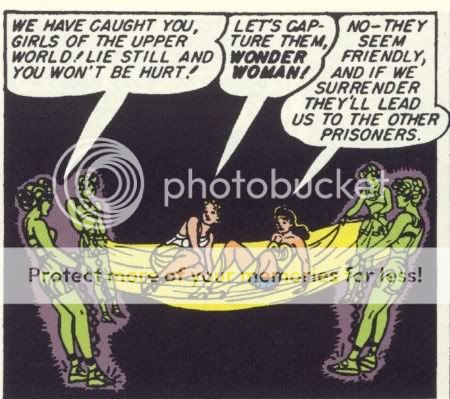
And there’s also hot Amazon on Amazon action with some poorly motivated competition involving catching each other with ropes, and then there’s the girls attached to weird rejuvenation machines (Paula invents one, everyone having apparently forgotten that WW invented one in issue #1). Also some really nasty Japanese caricatures. But most of it’s pretty familiar by now, and there aren’t any deer costumes or anything to push it over the edge into utter jaw-dropping WTF absurdity. Except maybe for the Japanese gnats that bite women and cause them to attack men.
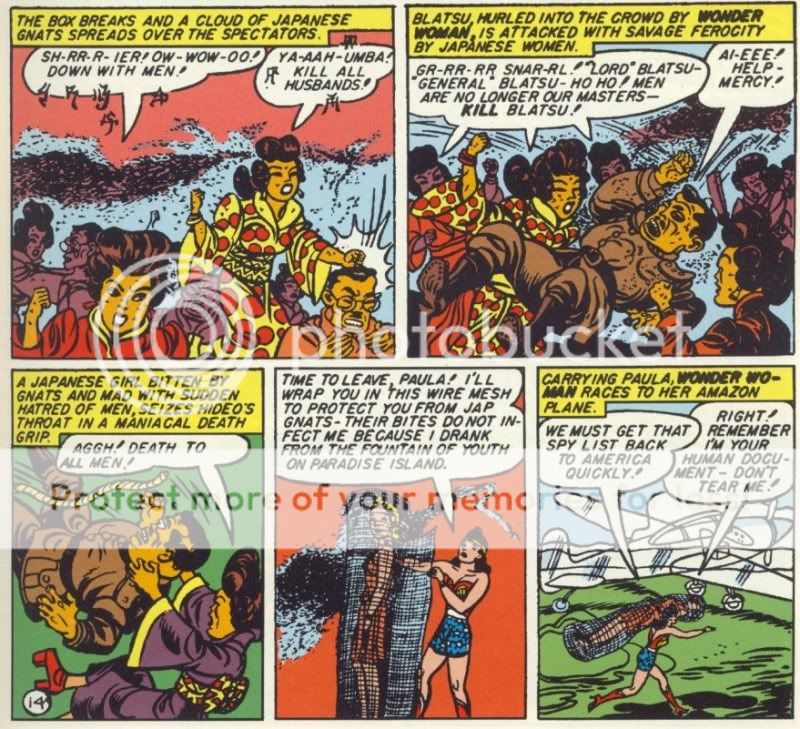
That’s pretty crazy. But even there….I don’t know, I was hoping for more than just a couple of panels of murderous women…and kind of hoping to see WW herself flip out. But doesn’t happen; she’s drunk from the fountain of youth on Paradise Island, you see, which apparently gives you immunity to rabid gnats. Those Amazons think of everything.
The next sotry, though, is more like it. Instead of espionage, we’ve got a mysterious race of mole men lurking under Holiday College. Of course, the Mole Men keep herds of chained and semi-willing female slaves tied up in their underground kingdom. Though the mole men are blind from their long time in the dark, they keep track of their slaves by covering them with special paint that emits ultraviolet rays which can penetrate the mole men’s sealed eyelids. Amidst a subterranean performance by the Holiday College band, WW and Paula free the female slaves, and then perform non-consensual surgery on all the mole men, restoring their sight. Now that they’re able to see the beauty that is women, they become all submissive, and beg their former slaves to take command of them. Happy endings all round.
In their own bizarre way, the WW comics are definitely part of a tradition of children’s fantasy literature. Underground kingdoms show up in many classics — Journey to the Center of the Earth obviously, but a a more likely precursor in terms of trippy oddness might be L. Frank Baum’s Dorothy and the Wizard in Oz. (not “of Oz”; this one involves them wandering in the underworld beneath Oz.) In one panel, Paula says as she drops and drops, “this is like a dream of falling,” which seems like it has to be a deliberate nod to Carroll. There are several other similar scenes as well….
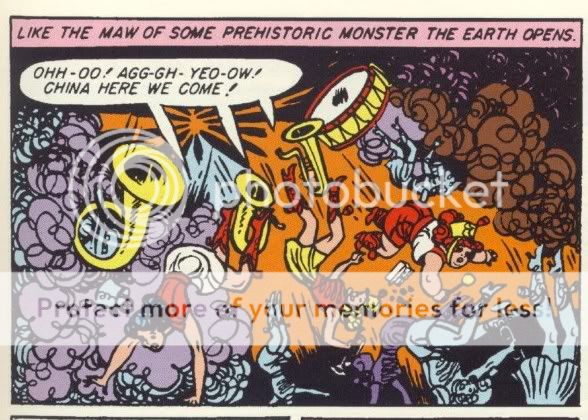
I love that drawing, especially; Parker’s scribbly curls of smoke setting off the elegantly controlled lines of the tuba and Peter’s characteristically stiff figure drawing. I like the way the smoke opening up in the off-center middle gives the sense of a great deal of space just out of vision; it’s almost like you’re seeing a small segment of an infinite universe of plummeting co-eds. There’s a touch of Winsor McCay, if McCay were, say, 10 years old. And horny.
Because, and to no surprise, Parker’s evocation of childish scribblies is matched by prepubescent eroticism. Dropping through space, the girls unconsciously assume the position; bent over, butt high, or even just legs pointing straight up, face obscured. The helplessness of falling is definitely fetishized, even more so here:
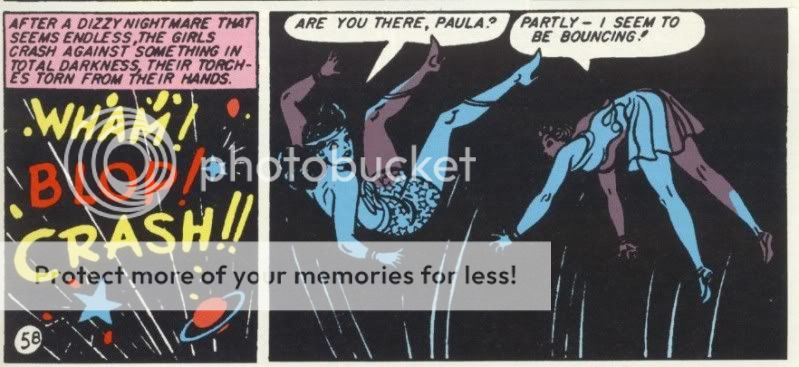
Cartoony cartoony sound effects give way to bouncing about helplessly in the dark, with Paula unconsciously pointing her posterior towards the camera. (They’re bouncing on a taut fabric held held by numerous women — kind of the adventure version of a sleepover pillow fight.)
I guess one could say that Marston and Peter are perverting the Alice story…but it might be closer to the truth to say that they’re explicating a perversion that was already there. Lewis Carroll had his own sexual interests (though they were probably less kinky than Marston’s) and you don’t have to read “Lost Girls” to pick up tinges of polymorphous pleasures in Alice. Falling into holes, “Eat Me!”, “Drink Me!”, flesh stretching and twisting and elongating…. I know, at least, when I was a kid, I found John Teniel’s illustrations of Alice growing and telescoping to be oddly suggestive. Same with the various weird bodies described in “Dorothy and the Wizard in Oz” — in fact, truth to tell, I don’t remember a ton from that book except the sense of bizarrely sublimated bodies wandering through a subterranean landscape.
There’s at least some literature on the link between the fantasy genre and masochistic fantasy. A bit back I read a 1923 essay by Anna Freud called “Beating Fantasies and Daydreams”; she was talking about a 15-year old girl who had early masturbatory beating fantasies which were elaborated into an extensive fantasy life with a whole cast of characters, a complex history, multiple scenarios that she’d go back into and tweak or revise or rethink. She called the stories “nice stories” because they weren’t explicitly sexual, but she came to see them as springing from that original primal beating fantasy; as being inherently masochistic. (And a quick search of the web reveals that the girl was not in fact an anonymous girl, as she claimed, but rather Anna Freud herself.)
I think masochism generates, and thrives on stories; on pretending or adopting different power relations — let’s pretend you control me, or that you are going to hurt me. Those stories are often as much the object of fetishization as the masochistic acts themselves (which is what I was getting at in this post.). Certainly for Marston’s narratives seem to be both fantasies and fantasies, as it were, and I suspect that this is the reason that WW’s origin story isn’t as elegant a some other heroes, like Superman, Spiderman, Batman, etc. Tom suggests it’s because Marston had trouble imagining powerful women but I think it’s more likely that Marston had a stake in complicated stories — stories particularly with lots of characters, lots of relationships, and lots of power reversals. (And I think the “lots of relationships” part, at least, is actually often typical of genre literature aimed at girls, as opposed to more solitary-hero literature aimed at boys. But I digress….)
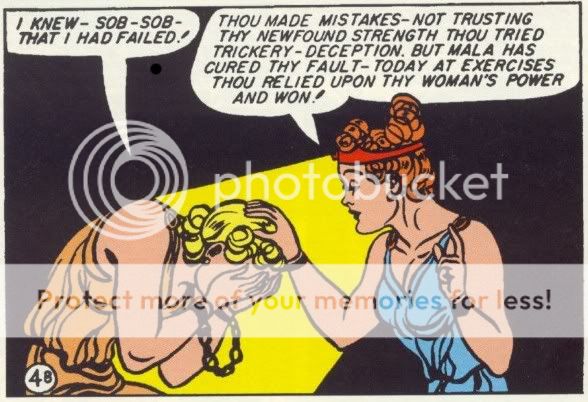
You can see some of what I mean when I say “the narrative is a fetish” by looking at how Marston uses it didactically. That is, Marston actually spends a lot of time essentially providing instructions about being a strong/good woman. Women must always trust their strength:
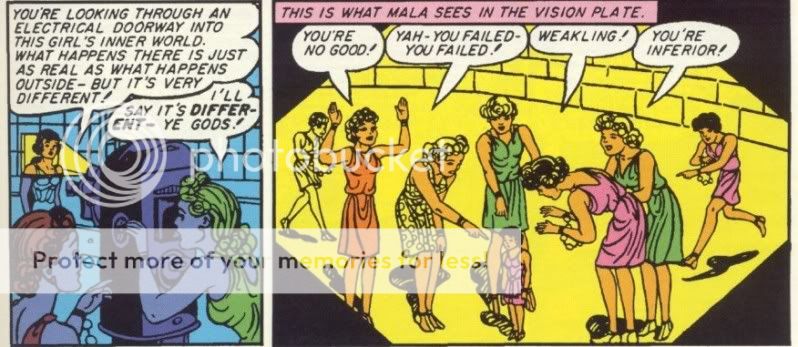
They must have a strong self-image (and you can find out whether they do by using a machine which reveals their subconscious thoughts…because involuntary confession is healthy…and stimulating!)
(This is from the third story, where we also get to see the subconscious image of themselves that men have, incidentally. Here’s one representative example:
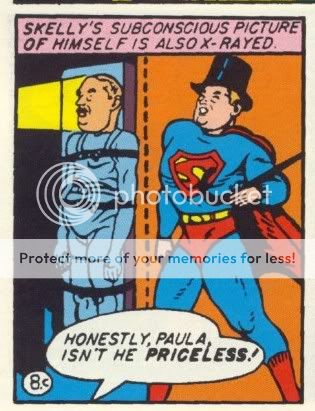
Hey! Is that Mort Weisinger?)
Sorry about the detour. Back to instructions for healthy young women: they should carry themselves like queens not slaves.
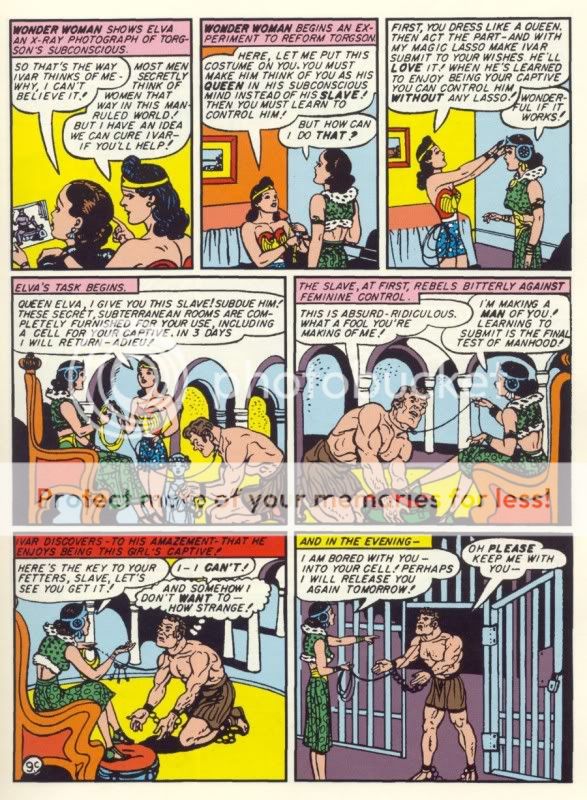
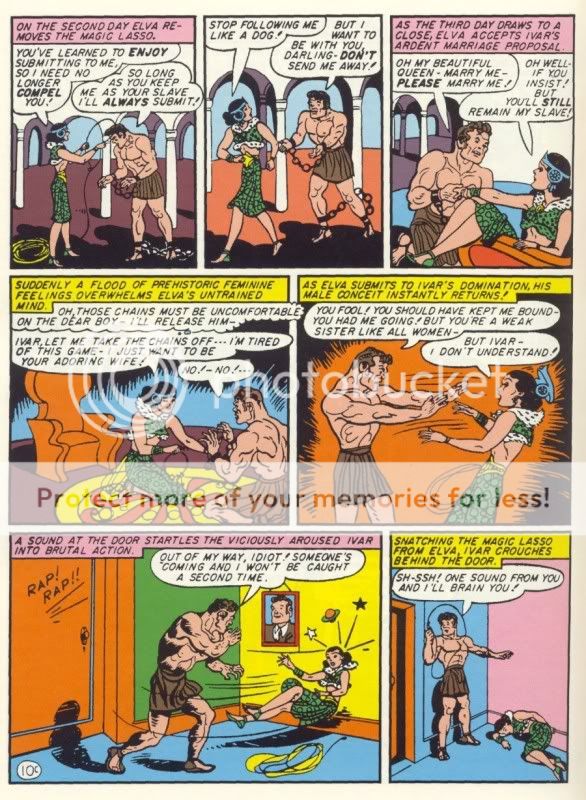
And they must never, ever abandon the scenario or…disaster!
Similarly, you must never deny responsibility or turn away from authority; woman need to accept their mothering, reforming role even if it means burning their images into the brains of unprepossessing middle-aged idiots
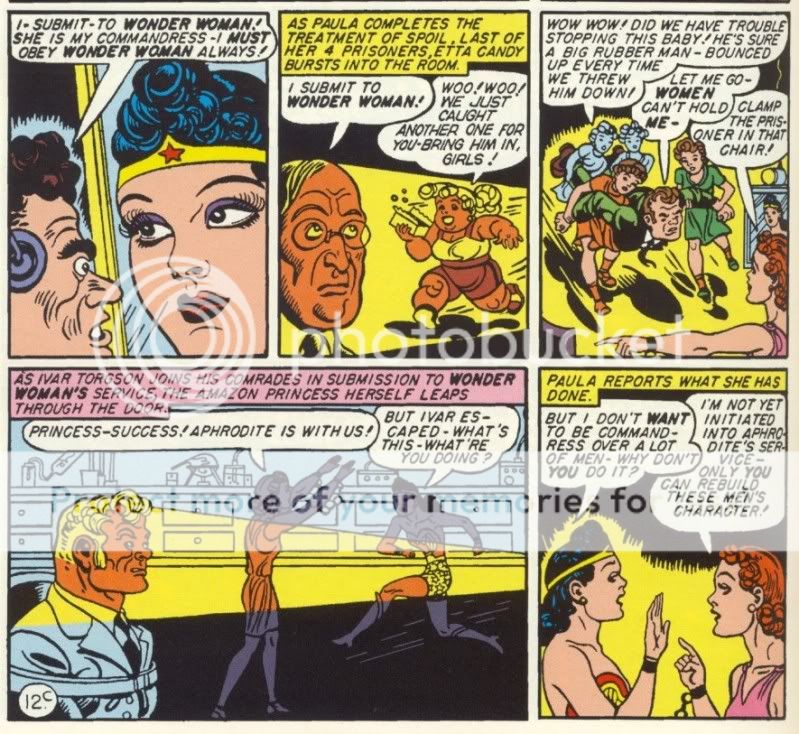
Or even if it means arbitrarily deciding to keep folks in non-consensual slavery
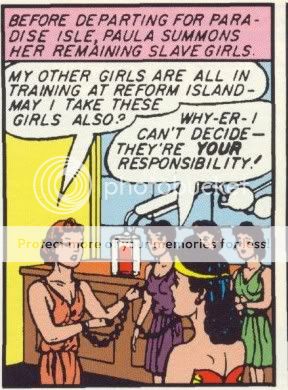
because if you shirk authority, Aphrodite will reprimand you:
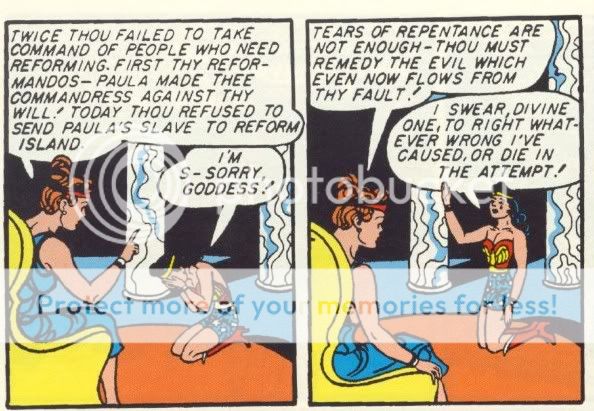
(I think I’ve mentioned before how much I like Peter’s use of scale. WW is here drawn way smaller than perspective calls for, which emphasizes her vulnerability and submission. He does that sort of thing all the time.)
The point here is that the instructions are all basically narrative in nature; they’re about telling stories correctly, or participating in role-playing in the correct way. And, of course, these instructions are themselves part of the story; correction and instruction is itself part of masochistic fetishization. This is part of the reason that Marston’s moralizing instructions never feel tacked on or like gratuitous pandering to the condescending uplift view of the role of children’s literature. The instructions for living he provides are integrated, idiosyncratic, and charged; they’re clearly as much the point for him as are the fight scenes, or the bondage scenes.
It’s also why when it’s on, WW has a a fetishistic frisson between form and content which is like little else in comics. I’ve compared the series to Henry Darger before, and I think looking to outsider art makes a lot of sense; there’s an obsessive pleasure in the craft — the storytelling and I think the art as well — which is echoed in the obsessive pleasure in the content in such a way that the two are almost inseparable, reinforcing each other in a kind of cascade.
To go back to the mole man story…details are piled on details in a way that seems almost random and certainly excessive (as fetishes tend to be excessive.) Thus, the mechanics of mole-men/slave relations and interactions are explained in loving and really ridiculous detail: in the deep dark, women’s eyes adjust to the dark quickly, but men’s don’t, and so the men go blind, like the mole men. But the mole men can nonetheless see the slaves, even though mole men eyes are sealed shut from disuse. How can they see the slaves you ask? Well, because they slather the slaves in a special glowing paint which gives off ultra-violet radiation, penetrating the mole-men’s lids and allowing them to whip their slaves. And that’s just the exposition for one page…never mind the static earth electricity or the horrible dancing trap or the escape plot involving the Holiday Girls breaking into song, or…well, you get the idea.
These narrative tergiversations, though, all circle around and lock into Marston’s (and probably Peter’s) obsessions; you can almost hear the series of sighs as they elaborate and close, elaborate and close. The glowing paint, for example, creates the narrative necessity (or excuse) for some of Peter’s most striking visuals; panel after panel of women glowing like beacons in the dark, with Peter picturing their radiance through quick, thick obsessive lines merging into inky cocoons — mysterious and contained, transcendent and controlled, otherworldly in bizarre lurid green and purple. (Again I ask, who did the colors for these books?)
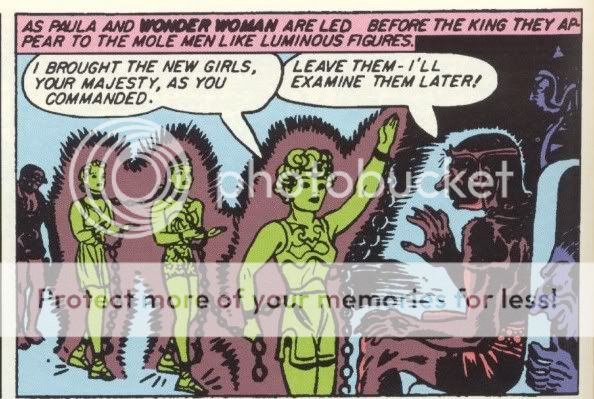
The emphasis on sight, blindness, and invisibility is another Marston obsession, and here you can really see how it locks in with his bondage and masochistic and narrative preoccupations:
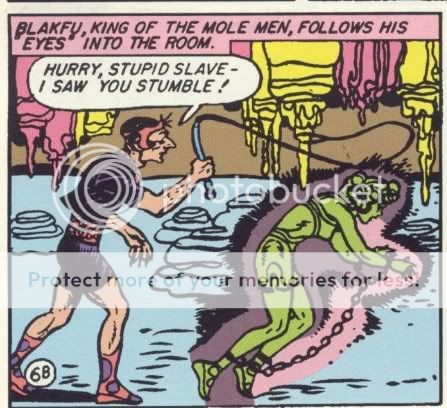
Again, that’s such a great drawing by Peter, with those lovely scribbly lines defining the floor and the regimented series of stalactites obtruding into the foreground to give the sense of contained, claustrophobic space, both oppressive and womb-like. On one level, the mole man is the master; he’s whipping her. But on another level, she is the only thing he can see. Her submission and denigration (being slathered in paint (and yes, I’m sure Marston thought that was kinky in itself) so she can be better punished) makes her the center of his vision. He’s blind because he’s a man, and so a fool…but there’s also the sense that he’s blind contractually, as part of the negotiation whereby the top in a B&D relationship pretends to be in control. Not that this is necessarily a metaphor or a coded symbol of any of these things in particular, but rather that all of the tropes — control, blindness, single-focus, debasement, the promise of a fantastic and unduplicatable intimacy, the sense of a shared dark space, the narrative explanation and negotiation — are pleasurable in themselves, and then get combined and recombined in a kind of fractal fetish.
All of which means that Marston’s statements about power always have at least as much to do with rubbing the fetish as they do with actual analysis or advocacy. Thus, when he makes feminist statements — I don’t think they’re totally useless to a feminist cause, but they are compromised, in that the goal of his feminism is always more about the men’s desires than women’s. As a for instance — why *should* Wonder Woman have to take control of the lives of a bunch of middle-aged male idiots? Her tomboyish response of, hey! forget this! I’ve got better things to do! seems entirely reasonable and even admirable, and when Aphrodite scolds her for it, it seems unjust and transparently done on Marston’s behalf. Similarly, at the end of the Mole-Men episode, when the mole men regain their site and beg their former slaves to rule over them, you’d really like the slaves to say, “hell no! fuck off!” Especially since, if the female slaves were actually the ones with the power (as it intimated in various ways) it makes sense that the male slaves will now be, in some sense, the topping bottoms. Having women rule is about allowing the men to become self-actualized — or allowing Marston to get his rocks off.
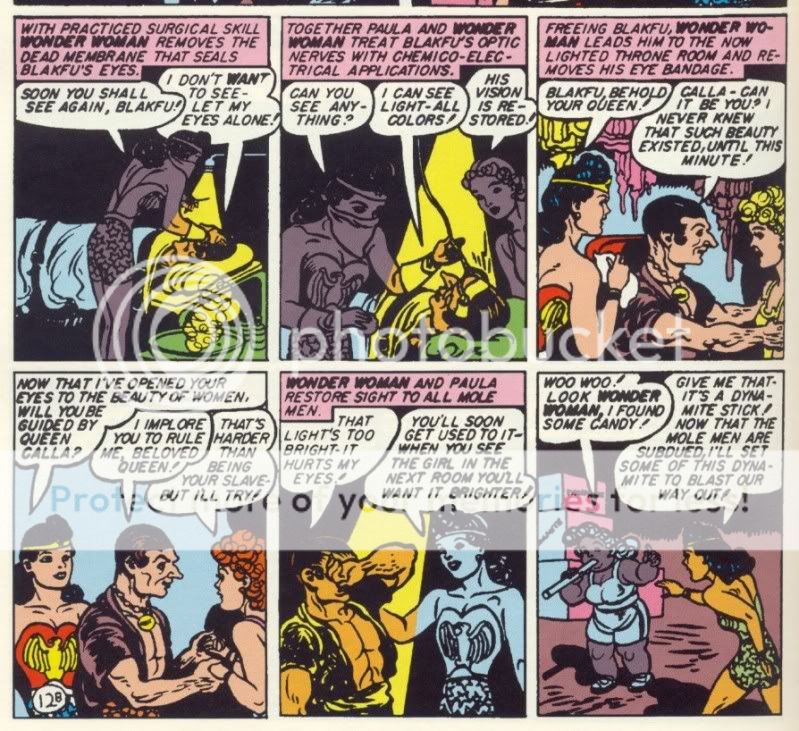
And yeah, that last panel is Etta Candy so blinded by oral desire and subterranean dimness that she starts sucking on a stick of dynamite. I was sort of hoping she’d get a mole-man of her own, but no such luck. Maybe next issue.