Diana Sue

In comments a couple days back I was encouraged to check out Bluefall’s series on Wonder Woman When Wondy Was Awesome. I didn’t read the whole thing, I must admit, but I poked about a bit here and there, and did read through her post on the book League of One, which I read and reviewed earlier myself here.

Bluefall’s certainly an entertaining writer and an attentive reader. She makes a strong (though to me, not convincing) case for League of One being something other than a complete piece of crap. For example, she has a nice point about WW’s attentiveness to relationships:

Diana’s plans, on the other hand, rely entirely on the League’s greatest strength, on her assumption that her friends will look out for each other. She’s able to defeat J’onn and Kyle because they trust her; she gets Clark out of the picture by forcing him to rescue their friends. She’s able to launch the League into space in the first place because she knows they’ll be okay. He plan succeeds because she sees things in terms of relationships and reactions, rather than individual physical traits.

For me, unfortunately, this is largely vitiated by the fact that all the relationships in the book are both unbelievable and vapid; it’s not especially impressive to be able to parse interpersonal dynamics when all your interpersonal dynamics basically consist of bland corporate boy scouts declaring allegiance to one another (except for Batman, who, you know, is dark because he uses reverse psychology.) Not even bluefall’s quixotic insistence on referring to them all by their first names can convince me that these badly painted figurines have any inner lives not imposed by front office dictat. Still, I guess the book should get points for the earnestness with which it attempts to move the corpses about in a lifelike manner.

What I mainly took away from reading these posts is that bluefall really likes Wonder Woman (or “Diana”.) That’s a big part of how she reacts to WW comics, it looks like. That is, she knows she likes WW, and she judges the comics to some extent on how well they live up to her image of what Wonder Woman should be. For instance, in talking about John Byrne’s run, she commented that she liked the way that Byrne made Diana as powerful as she should be relative to other characters in the DC universe.

I think this is maybe part of the reason some of my posts have rubbed some WW fans the wrong way. Because, the thing is, I really couldn’t give a pile of kangaroo-horse poop (to cite a creature indigenous to Paradise Island in Marston’s run) about whether WW is as powerful as she should be, or about whether she’s as noble as she should be, or whether she behaves in character, or out of character, or is depowered and dressed in white, or whatever. I love the original Marston/Peter run, which I think is one of the few truly idiosyncratic works of art to come out of the super-hero genre. And it’s fun to see other creators try (and largely fail) to deal with the bizarre thing Marston and Peter created. But I don’t care if creators get her “right” except insofar as they tell a story that seems worth reading. If you can tell a good story making WW able to push planets around, that’s fine; if you can tell a good story making her only slightly stronger than Etta Candy, that’s fine too (Marston probably did both of those things at some point.) If you want to make her impulsive and eager to hit people and that works, cool; if you want to make her preach peace and love and you can get that to work, more power to you (I suspect Marston did both of those things as well.) I don’t like most of the WW stories I’ve read by folks other than Marston because they’re boring and dumb, not because WW isn’t sufficiently noble or iconic or whatever. In short, I’m not a fan in the usual sense; at least not of the character.

I don’t necessarily have anything against fans…or even against fan fiction, which is where this kind of investment in a character abstracted from a particular story tends to lead. I haven’t read a ton of fan fiction, but there is some of it I like quite a bit. Some of it I really don’t want to look at, but that’s just personal preference, not an aesthetic line in the sand.

Still, I think super-hero comics do run into a problem with the fan-base…that problem being that there isn’t in fact a canon. The WW bluefall likes isn’t the Marston/Peter WW, which is old and embarrassing and weird. It’s not really the Silver Age WW either, which was embarrassing in different ways; nor is it really the modern day WW, who, after all, bluefall tends to judge against an ideal, and often to find wanting (the swimsuit, for example, would be ditched if bluefall had her way.) And I think that’s all fairly typical; the ideal WW that fans enthuse about is…an ideal; it’s not an actual character or version of the character, but rather some platonic vision of the way the character would be if the perfect writer wrote her, or, I guess, if she were real.

The thing is, when you unmoor the character from any actual creative team, you drift into one of two problems. On the one hand, you end up with stories written by folks who don’t care about the character and don’t really have any idea what to do with her…and WW has certainly had that happen to her over the years. On the other hand, though, you can also end up with stories that are just devoted to showing how wonderful the character is…and WW has had her share of those, too. In fact, that seems to be the whole point of “League of One”; it’s aggrandizing fan scruff for WW fans who want to be assured that WW is just the awesomest there is. See, she beats the whole Justice League! And she beats a big bad dragon because she’s so much purer than everyone, even Superman! She’s so good and brave and awesome, just like WW should be! (Bluefall does object slightly because the script intimates that Superman could actually beat WW in a fair fight, which bluefall feels is wrong because, I guess, nobody can beat WW, damn it. But since WW beats Superman by trickery anyway, bluefall is willing to let it pass.)

In short, with no agreed upon canon,there’s a strong tendency for the character to drift towards that bane of fan-fiction, the Mary Sue. Wikipedia has a good definition:

Mary Sue, sometimes shortened simply to Sue, is a pejorative term used to describe a fictional character who plays a major role in the plot and is particularly characterized by overly idealized and hackneyed mannerisms, lacking noteworthy flaws, and primarily functioning as wish-fulfillment fantasies for their authors or readers. Perhaps the single underlying feature of all characters described as “Mary Sues” is that they are too ostentatious for the audience’s taste, or that the author seems to favor the character too highly. The author may seem to push how exceptional and wonderful the “Mary Sue” character is on his or her audience, sometimes leading the audience to dislike or even resent the character fairly quickly; such a character could be described as an “author’s pet”.

Mary Sues are, as I said, usually created by fans…but everyone writing WW is pretty much just a fan at this point, the original creators being long, long gone and their concept in most respects abandoned. In any case, there’s a self-conscious reiteration of, well, wonderfulness in League of One that is extremely tiresome, and which is a consistent though less discussed aspect of super-hero decadence. At its core, League of One isn’t all that different from Marvel Zombies. The second is characterized by desperate desecration, the first by desperate consecration. But both are more interested in the act of burnishing/befouling the icon than they are with telling a story. (Which, come to think of it, is what I said about All Star Superman, now that I think about it. And, of course, I was right then too!)
______________________

Incidentally, this post is part of a series on WW’s post-Marston iterations. The entire series is called Only One Can Wear the Venus Girdle and you can see all the relevant posts here.

Oliphant Watch: Obama and Castro

Looking at this, you’d think it was Cuba that had the embargo on the US, not the other way around. But what a deft way of drawing Obama: the moment is so winning. We see again Oliphant’s gift for fantasy based on characters from the news. (Previous Oliphant installment here.)

UPDATE: Matthew, my leg man in Oliphanting, points me to the latest: 1) Cheney the torturer and 2) the epicene cowboys of Texas secession. And, yeah, those are two freaky cartoons.

The Cheney cartoon takes a big, simple point (Cheney’s a nasty guy who defends torture), lobs in some clutter to put you off balance (the long legend on Cheney’s apron, the Prussian gentleman standing by in his helmet), then sneaks in for the kill with a final touch that is tiny, unobtrusive, complicated and inexplicable. Who is that little guy on a bicycle? Why is he tearing off for the distance? Why does the bike have training wheels and why do the training wheels look so much like legs and feet? Why does the man’s head look like three knuckles? Why is he so blase about torture and, finally, why are we hearing from him? Traditionally, an editorial cartoon will show someone in the news saying something that the cartoonist has put in the person’s mouth, and then there may be some little figure piping up with the cartoonist’s personal wry commentary on the situation. Here we have a third party, a man with a three-knuckled head and a special bike, and he’s popping up to say what he thinks too. Damn, it’s weird, and yet it takes up so little space. It’s a dab of condensed insanity.

Matthew says maybe the little guy is Obama: thus the training wheels and, I guess, the three-knuckled head (big ears). My guess, if it’s anyone we know, is Bush. Bush was always working out and Oliphant drew him with big ears. Oh, the hell with it.

All right, the epicene cowboys of secession. Here’s how I figure Oliphant’s logic chain: Texas wants its federal money like anyone else, so therefore this secession talk is bullshit; the secession talk takes place at tea party rallies or in front of crowds who might turn up at tea party rallies; the British drink tea and are very courtly about asking each other if they want one lump or two; therefore, to express the posturing hollowness of the secession talk, one portrays the Texans as mincing little Percys with tea cups in their hands.

One gets the horrible feeling that Oliphant actually thought his way toward this conclusion. The deranged vision didn’t come to him in a flash; he put on his thinking cap and worked with lunatic clarity to reach his goal.

UPDATE 2: Now Sam and the sharks, again because Matthew brought it up. Clear point, a bit simple but intelligible, and nothing actively weird in the drawing to throw you off.

Matthew mentions how well O draws the sharks, and it’s true. He also draws a lot of them. This brings up a big point about Oliphant. He is so much better at drawing than most of his colleagues that his facility gets him into visual trouble. In the old days, when he was at the top of his game, he created images with a density of detail and complexity of composition that allowed them to take over the reader’s eye. Now he doesn’t manage his detail, he just lets it roll out from his pen, and composition be damned.

The problem isn’t too bad in this latest. But Uncle Sam does get a bit lost among all those sharks; the overall situation takes a few extra seconds to register because Sam, who is its center, has to be tracked down by the reader’s eye. The Cheney cartoon suffers a lot more; even without the little mystery man on the bicycle, the picture is a mess of one thing after another.

Wonder Woman Is Not a Tease

In this post I talked about Alan Moore’s proposal for Glory and compared it to the original Marston run. In particular I quibbled with Moore’s comment that the original WW was “coy but suggestive.”

A couple folks in comments argued that the original WW was in fact coy. Eric B. says

while they ARE certainly about bondage and the sexual thrill of S & M, they never explicitly give us that, but rather come up with a number of ways to show “sexual bondage” without actually showing them.

Guy Smiley adds

It’s hero-jeopardy in an action adventure. That’s coy compared to, “I want to tie you up, Wonder Woman, because it’s a hot, yummy turn-on for you, me and the old weirdo who writes us! Grrrrowl!”

Both of these comments miss the point, I think. The books are explicit. Marston is a bondage fetishist and he’s serving up bondage. If you asked Marston whether he would rather get off by looking at pictures of people who are naked and not tied up, or people who are clothed and tied up, I am quite quite sure he would tell you clothed and tied up, every time. If you asked Marsten whether he would rather show look at pictures of people clothed and tied up or pictures of people naked and having sex, I’m willing to bet he would say he would rather look at pictures of people who are clothed and tied up. If you asked him whether he would rather look at people who are naked and tied up or read an elaborate narrative about bondage and dominence which narratively requires the characters to be clothed — well, narrative fantasy is really, really important to masochists. I think WW is Marston’s erotic fantasy…not something like his erotic fantasy, not pointing to or suggesting an erotic fantasy, but his erotic fantasy, period. There’s no feeling of something held back in the WW comics; no sense that the real sensual pleasures are being deferred to heighten tension or for censorship reasons. The obsessive reiteration of a fetish isn’t coy or disingenuous. It’s a really different mindset to say with Moore, in the one case, “I’m going to cutely suggest situations which I find sexually stimulating, but hold something back” and, in the other, with Marston, to say, “I’m going to fill a book by obsessively repeating the situations– the very ones — that I find sexually stimulating.”

I think my commenters and Moore, are somewhat thrown off by the fact that they don’t share the fetish. As it happens, I don’t share the fetish either — but Marston is clear both in his other statements and in the book itself about what his intentions are.

I guess you could say, well, *Marston* may not be coy, but the reader will perceive it as coy or suggestive. I still don’t see it, though. “Coy” is about being in control — which is certainly an important aspect of Moore’s art. Obsession is about not being in control; about submitting. Marston’s WW feels obsessive in its repetition, its outlandishness, its monomania, and its philosophical integration, it doesn’t feel like he’s placing this stuff out there to tantalize *you*. It feels like he’s caught up in it; like he can’t stop and doesn’t want to. In the way he blatantly, obsessively puts his fetishes out there, he’s much more like R. Crumb than he is like Moore’s Cobweb.

Update: In other-people-who-disagree-with-me news, Bluefall has an impassioned post about the coolness of truth and how I denigrated same when I said that WW’s lasso of truth was better when it was a lasso of control. I guess in response I’d say there are truths and truths, and that the psychotherapeutic new-agey self-actualizing that seems to carry the day in WW mythos doesn’t, to my mind, have the kind of power that Bluefall claims for it.

Also — and this was my point in the original post to a great extent — it seems like any self-knowledge worth its salt would be a self-knowledge that would allow you to figure out that, “Hey, wait a minute, I’m wearing a swimsuit and bondage gear…maybe I should put some clothes on.”

Relatedly, Bluefall seems outraged that people think that WW is a ridiculous character; she sneers at those who say “”this character fails” or “she shouldn’t be popular” like that’s actually going to make her fail or stop being popular,”

But…she can be a failure aesthetically even if some people like her…I mean, some people like anything, even Tom Petty. And moreover, she’s not especially popular. Sure, there’s a small fanbase, but it’s not big even by the standards of comic-book super-heroes. She’s got nowhere near the pop-culture cachet of Superman or Batman or Spiderman or Hulk or even the Flash.

To the vast majority of people, WW isn’t even on the radar. If she is on the radar, she’s a joke. And those people are right. The character is preposterous — gloriously so, I would argue, but still. I guess that may be an uncomfortable truth to face for some…but embrace it! It will set you free, or tie you up, or something.

No Girdle for Glory (OOCWVG #11)

Through Dirk I found this link to Alan Moore’s proposal for Glory, Rob Liefield’s Wonder Woman knock off. Since I’ve been doing an on again off again series on latter day interpretations of Wonder Woman, I was curious to read Moore’s ideas and see how he stacked up against Marston’s original stories.

There’s no doubt that Moore’s a smart guy, and he certainly keys into some of the things about Marston’s work that I like. For instance, Moore describes Steve Trevor as “one of the most truly pathetic love interests in comics” — and argues that this is a strength, not a weakness. Has anybody played Steve for mascochistic laughs after Marston? I don’t think I’ve seen it (certainly not the most recent animated movie where Steve’s an action hero and teaches WW to love (blech.)

Some of Moore’s other readings of the material don’t strike me quite, quite right though. In general, he does tend to pick out things about the original work that are fun or weird or entertaining — and then he suggests updated analogues that are almost but not quite as fun, weird, or entertaining.

–He mentions Etta Candy and the Holiday Girls as “sickening Nancy Drews” and points out that they could be used for humorous effect or (suitably aged) for a poignant touch. And it’s true — the Holiday Girls are completely bizarre. (Though they started in the 40s with Marston, not in the 60s as Moore suggests.) But the *most* bizarre thing about the Holiday girls was that Marston played them straight. Etta wasn’t there for laughs (or not only for laughs); she was actually frequently the hero, often tougher and more competent than WW, and always tougher and more competent than Steve. I don’t see any indication that Moore noticed that.

–Moore talks about the Invisible Plane, calling it “exactly the sort of lovely, pointless idea that I think we should encourage.” But then he goes on to suggest it be updated to create something which “fits more” with Glory’s mythological background. He decides on a Diamond Chariot, an intelligent crystal growth which can “reform itself according to any configurations that Glory programs into it.” Which is fine… but probably the most entertaining thing about the plane in the first place was its utter incongruity and awkwardness. Why do the Greek mythos Amazons have an invisible WW II plane lying around? Why is it invisible, anyway? Where on earth (literally) is she keeping it? Moore rationalizes the trope — but rationalizing isn’t necessarily making it better.

–Moore has got some fun villain ideas (the bondagey Venus Fly Trap, for example) but nothing nearly as weird as Marston’s female-gorilla-turned-into-a-woman, or the cross-dressing transgendered wizard character. (Though perhaps Moore would have come up with something nuttier if he’d gotten to actually write the thing.)

As far as the bigger picture stuff goes, the same thing applies: Moore does understand where Marston is coming from…but only up to a point. He says that “Dr. Charles Moulton was a barely suppressed psycho-sexual lunatic who [wrote] Wonder Woman with one hand in his pocket…” and points out how bizarre it was to have all this bondage stuff in a comic that was supposedly “designed by experts especially for the young and impressionable female reader.”

However, what Moore doesn’t seem to quite grok is that Marston knew this as well as anyone. Better than anyone, probably. You can go online and find quote after quote with Marston talking about how much he likes seeing strong women bound, how much he likes to submit…and how all of this relates to his feminism. (The top of this recent post includes a few examples of Marston holding forth.) In other words, Marston isn’t some weird idiot savant who didn’t know what he was doing. He put the bondage in there because it tied in (as it were) in very specific ways with what he thought about gender relations and with his (perverted, but real) vision of feminism.

So Moore goes on to say that this weird supposedly-for-young-girls-but-actually-stroke-material vibe is “one of the only really interesting and unique things about the [Wonder Woman] comic book…we’d do well to create a similar coy but suggestive edifice for the new Glory”

I think there are a number of problems with that comment. First, to say that the bondage/feminism is “one of the only” interesting things about Marston’s run is really confused — that’s the only thing in Marston’s run, practically speaking! That’s what it’s about! That’s the whole kit and kaboodle! Marston examines it obsessively, from every level, and very self-consciously.

The point here is in that second bit, where Moore says that “we’d do well to create a similar coy but suggestive edifice for the new Glory.” Okay…but Marston wasn’t about being “coy but suggestive.” He was about expounding a feminist/utopian philosophy which he was invested in for erotic as well as philosophical reasons. Moore gets the exploitation, but misses the rest of it — and so what he comes up with is “coy but suggestive”, with some bondage elements and eroticism and a semi-closeted lesbian admirer/companion for Glory. In other words, he wants to do somewhat subtle PG-13 exploitation — which is fine, and could be very entertaining…but I’d argue (and have argued recently) that Marston was doing something different. Among other things that “something” involved his compromised, bizarre, but genuine commitment to a female readership — somthing that Moore’s proposal explicitly doesn’t have (Moore says he wants to “prime the story with plenty of open spaces for the readers’ filthy, disgusting thirteen year-old mind to inhabit” — and I don’t think the mind he’s thinking of belongs to a girl.)

None of which is to say that Glory wouldn’t have been fun to read. There are even a couple of points where Moore’s series might have improved on the original: Moore, for example, actually seems interested in Glory’s secret identity, and was eager to write stories about it, whereas Marston (at least as far as I’ve seen) seems to have included Diana Prince because, well, super-heroes have secret identities, and it’s not too much trouble to put her in a couple of panels per story.

Overall, though I seriously doubt that Glory would have been as loopy, as funny, or anywhere near as good as those old Marston comics. It’s not too hard to be more self-aware than Siegel and Shuster and Mort Weisinger, and craft a series of Supreme stories that are able to encompass the joy of the originals and add some more thoughtful reflections as well. Trying to do the same thing with Wonder Woman, though…well, it’s not at all clear to me that Moore is more self-aware than Marston, and it’s entirely clear to me that his grasp of the material is less thoughtful and less original. Moore has done some things I like probably as much as the old WW comics…but Supreme wasn’t one of those things, and reading this proposal, it’s very hard for me to see how Glory could have been either. (It might have been the best take on WW short of Marston, I suppose…but I’ve been arguing at some length that second best Wonder Woman is not an especially high bar.)

And you know what? Even if Moore did somehow manage to write as well as Marston, Harry Peter’s art would kick ass on any lame-ass nineties super-hero hack who Liefield dragged in. (There’s a faint suggestion in the proposal that Moore was thinking of bringing in Melinda Gebbie to do some work on the title; I suspect [Update: on the basis of no actual evidence, I should add] that she’s the “Peters stylist” he alludes to. And she would be better than a standard super-hero artist…but she’s nowhere near as good as Peter himself.)

____________________

I was hoping to talk about Promethea here as well, but this post is long enough already, so I’ll probably save that for tomorrow…or possibly next week, depending on how things go….

Update: A follow up post is here

Bound to Blog: Wonder Woman #3

So it occurred to me as I started to work on blogging my way through the third Marston Wonder Woman that I wasn’t really sure when to stop. That is, what was the last issue of WW that Marston wrote? I know he died in 1947…but I haven’t been able to find anyone to tell me the number of his final issue. The problem is compounded by the fact that I think DC kept labeling the books as Marston-penned for some time after his death. So…anyone out there know which was his final effort?
_____________

Anyway, while fruitlessly trying to determine when I could lay this burden down, I did find some juicy Marston quotes:

“The only hope for peace is to teach people who are full of pep and unbound force to enjoy being bound … Only when the control of self by others is more pleasant than the unbound assertion of self in human relationships can we hope for a stable, peaceful human society. … Giving to others, being controlled by them, submitting to other people cannot possibly be enjoyable without a strong erotic element”.

“Tell me anybody’s preference in story strips and I’ll tell you his subconscious desires…Superman and the army of male comics characters who resemble him satisfy the simple desire to be stronger and more powerful than anybody else. Wonder Woman satisfies the subconscious, elaborately disguised desire of males to be mastered by a woman who loves them.”

“I am one of those odd, perhaps unfortunate men who derive an extreme erotic pleasure from the mere thought of a beautiful girl chained or bound…Have you the same interest in bonds and fetters that I have?”

That last one was apparently from a letter Marston wrote to William Gaines. To which Gaines replied (and this is a direct quote) — “Oy.”

I also found out that Marston apparently hand-picked Harry G. Peter over the objections of his editor, Sheldon Mayer. Marston liked Peter’s mix of innocence and sensuality, it sounds like. Mayer felt Peter was too old-fashioned. Score another one for Marston.
_______________

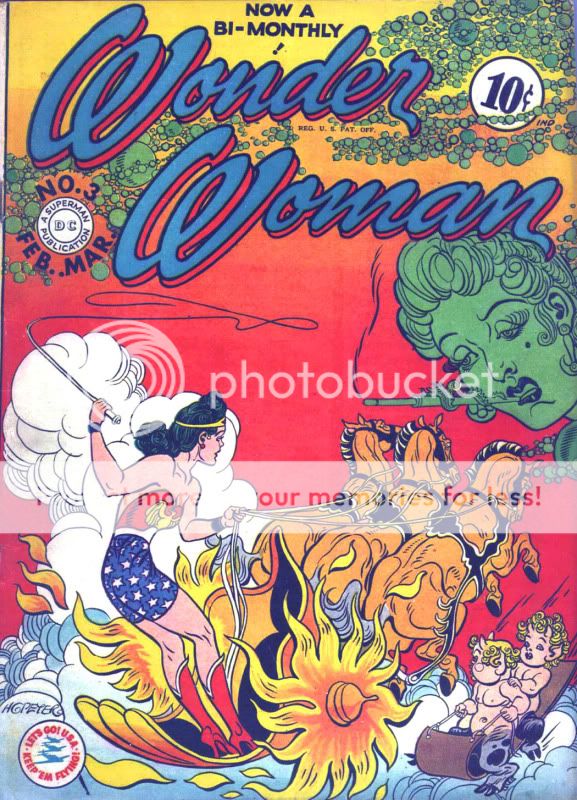
Enough shilly-shallying. Let’s see that cover to #3:
Photobucket

I think that’s the best cover so far, actually. Completely insane juxtaposition of fantasy chariot and big honking disembodied head. And the colors! Saturated orange sky, gaudy green bubbles — Wonder Woman’s ridiculous red and blue suit is rendered relatively sedate in comparison. (Who did the color on these books, I wonder? Does anyone know?) That giant curvy eyebrow on the floating face is worth the price of admission alone, I think. Or the dragon-entwined cigarette holder; or the sledding cherubs, Or the incredibly expressive, frilly lines making up the horse’s leg.

Did I mention that I love Peter?

Also, notice that WW apparently went to bi-monthly with this issue. The book must have been selling well. Coming out six times a year, that means Peter must have been banging out about a page a day for just this title alone, plus what I presume was a comparable amount of work for Sensation Comics. So…two pages a day? That’s a pretty serious workload.

As far as the plot goes, this issue is devoted to a battle against, and the ultimate conversion of Nazi agent Baroness Paula von Gunther. Wikipedia informs me that the Baroness was knocking around for a while before this issue, showing up on several occasions in Sensation Comics, and on one occasion plotting to monopolize the American milk supply so that U.S. citizens would have weak bones and be unable to defeat Hitler’s stronger-boned armies. She also showed up in a fairly unmemorable adventure in Wonder Woman #1, where she appears to have been drowned. But (as is the way with the super-villains) it didn’t take, and she’s back now.

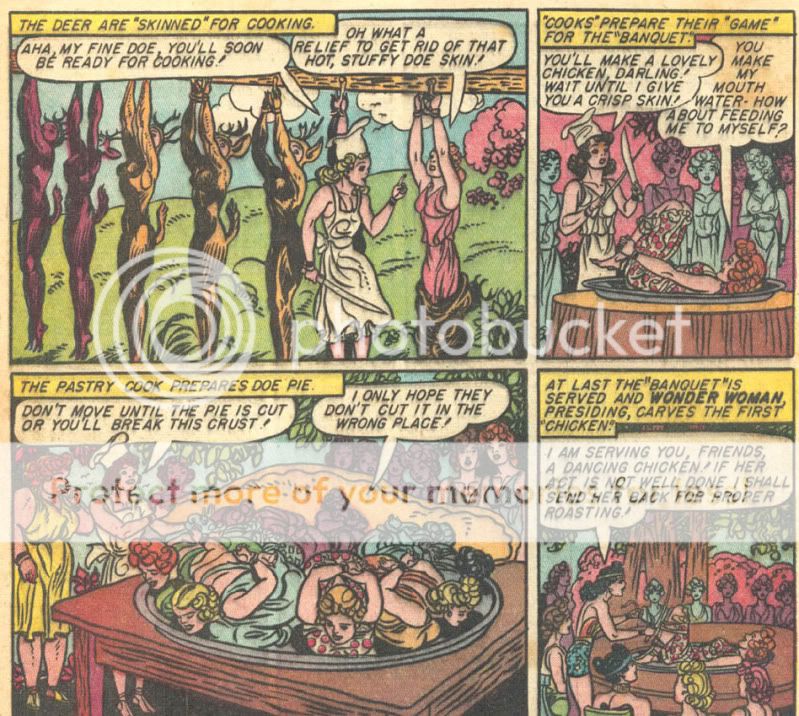
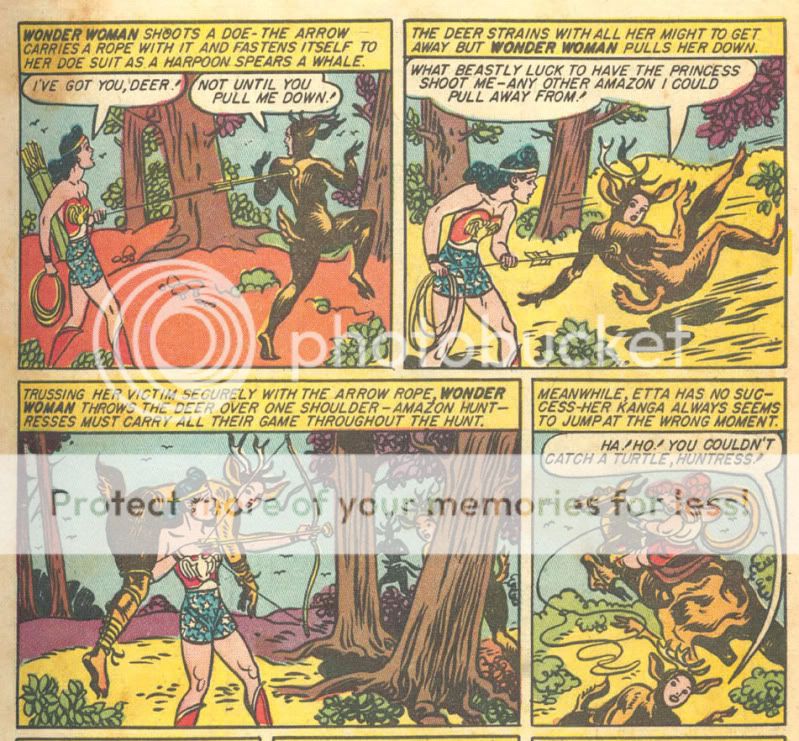
The first chapter is easily the best. Paradise Island seems always to fire Marston’s, um, imagination. This was a Christmas issue, I think…but of course, the Amazons don’t celebrate Christmas, because they’re pagans. Instead, they celebrate a solstice festival called Diana’s Day. Diana’s Day rituals include gift giving…and, to no one’s surprise, also masquerade and bondage. Oh, yes, and dressing up as deer to be hunted, hog-tied, and ritually fake-eaten.
Photobucket

“You make my mouth water. How about feeding me to myself?” Not really much to add to that.

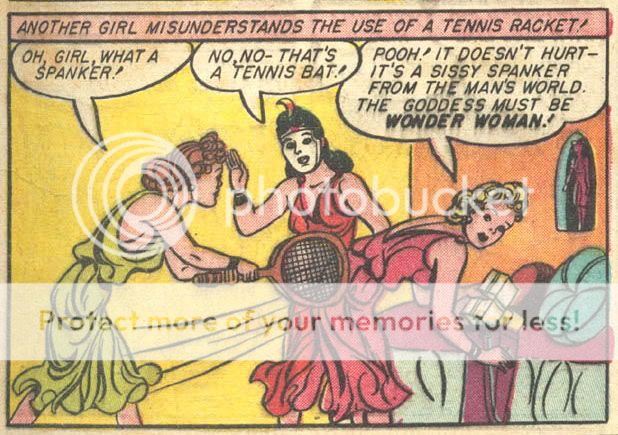
One of the things this chapter really brought home to me was the extent to which Paradise Island functions as a kind of gay utopia; defined by some clueless straight guy as “an imaginary future in which gender, sexuality, and identity are fluid and in which pleasure is unregulated by either external or internal censors. It’s a place where taboos dissolve and sublimation vanishes; every relationship is erotic, every action sensual.” Paradise Island is literally paradise; it’s prelapsarian. The knowledge of good and evil, of shame, is suspended. The women on Paradise Island don’t behave like grown women; they behave like polymorphously perverse children. They love gifts; they throw themselves bodily into play and pretend; they have no particular inhibitions.
Photobucket

Photobucket

They’re innocents — but innocence here is charged with eroticism. They haven’t fallen, so they don’t perceive sex as sin, which means that anything goes (or is, at least, implied, this being an all-ages title.)

In particular, not having fallen means that the incest taboo is repealed. Radical feminist Shulamith Firestone (writing some time after Marston) argued that without the incest taboo

adults might return within a few generations to a more natural “polymorphously perverse” sexuality, the concentration on genital sex and orgasmic pleasure giving way to total physical/emotional relationships that included that. Relations with children would include as much genital sex as the child was capable of…. Adult/child and homosexual sex taboos would disappear, as well as nonsexual friendships…. All close relationships would include the physical, our concept of exclusive physical partnerships (monogamy) disappearing from our psychic structure as well as the construct of a Partner Ideal.

For Firestone, getting rid of the patriarchal law would eliminate hierarchy; prejudice and authority would dissolve in a warm polymorphous rush. Marston’s vision is analagous, even if he doesn’t exactly see the law disappearing. Rather, he wants the law of the father replaced with the law of the mother; force replaced with “loving obedience” (a term I’m pretty sure I’ve seen him use a couple of times.) Aphrodite’s rule (and by extension Hippolyta’s rule) over Paradise Island is a mother’s rule. But more than that, *all* the relationships on Paradise Island are essentially eroticized mother/daughter relationships. Wonder Woman sitting in a compromising position on Hippolyta’s lap is the blueprint for how all the Amazon’s relate to each other; maternal sentiment bleeding over into eroticism.
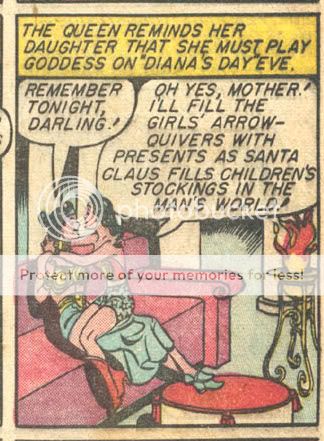
Photobucket

Everybody gets to be lovingly obedient and to enforce loving obedience. It’s all daughters playing at being mothers playing at being daughters, sending each other to their rooms — or, you know, to their bonds. Or whatever.

The charged mother worship here is analagous to that in Tabico’s awesomely squicky story “Adaptation”, in which an alien female insect implants mind-controlling larvae in human hosts, precipitating an escalating mother-love apocalypse of incestuous, cross-species prelapsarian obedience and abjection. (The story is both extremely X-rated and viscerally disgusting…we’re talking sex with bugs here, people. Explicit sex with bugs. So, don’t say I didn’t warn you.)

Update: Tabico’s not a widely known author, but I explain at length why you should care about her (or why I do, anyway) at the end of this essay.

And, as in Tabico’s story, when mother love dissolves the Law — you don’t have the law. Babies don’t worry about good vs. evil; they think about what feels right and what they need. Tabico is rooting for the insects…and while Marston isn’t exactly rooting for the Nazis, I think it’s safe to say that he isn’t exactly unsympathetic to the Baroness either.

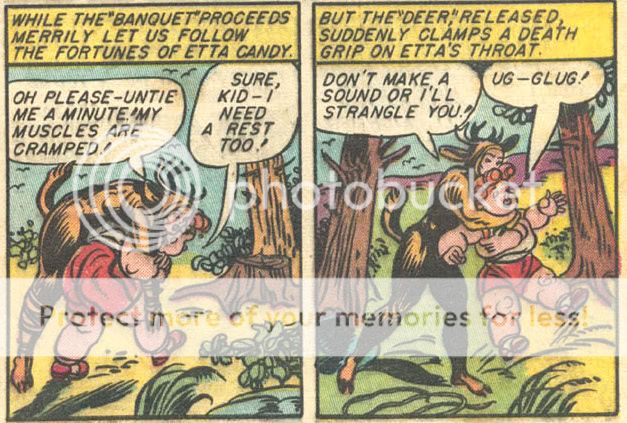
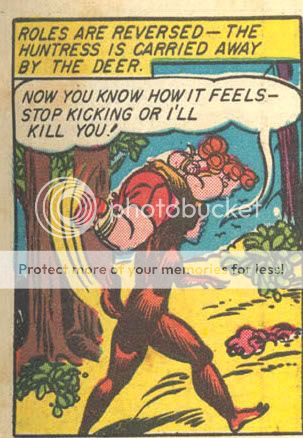
In fact, in terms of the erotic economy of this first story, the Baroness and her minions serve exactly the same funciton as the Amazons themselves. According to the plot, the Baroness has sent one of her slaves, Keela, to Paradise Island to cause mischief. Keela infiltrates the Amazons, ties up Etta Candy (who’s visiting for Diana’s Day) and steals Hippolyta’s girdle, which makes its wearer invulnerable. This allows her to wrestle with and defeat Wonder Woman.

The point here is that Keela acts basically exactly like the Amazons she is supposedly infiltrating. That is, she plays the same bondage games in much the same way:
Photobucket

Photobucket

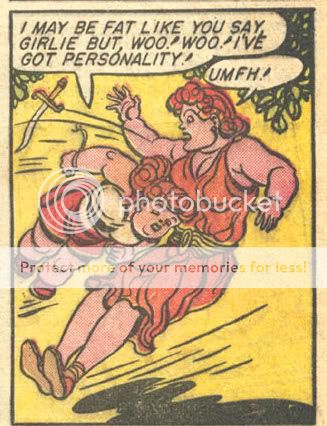
In theory, of course, the Amazons are “just playing” while Keela is in earnest. But surely, the extra earnestness is just a way to increase the erotic charge — and a way, moreover, to put Wonder Woman in a position of submission as well as in a position of dominance. The theft of the girdle gives Keel the power of the mother, who overpowers WW. And then, inevitably, Etta and WW come right back and overpower and control her.
Photobucket

Etta’s fat, as she says, but she gets to participate in the orally erotic mother/daughter back and forth too…as does even Paul von Gunther herself, who the Amazons capture and imprison at the end of the story…only to let her escape immediately. One suspects that they did it on purpose; the play’s the thing, after all, and a mother tied up is no fun unless she can come right back and tie you up as well.

In any case, in the second story in the comic, the Baroness is free…which gives WW the chance to interrogate her slaves using a Brain Detector (a magically more efficient version of the lie detector machines Marston helped develop.) You’d think WW would just use her lasso to command them to tell her what they know…but obviously the machine is fun too…pretty girls hooked up to wires and forced to confess…oh, yes, that’s quite nice….
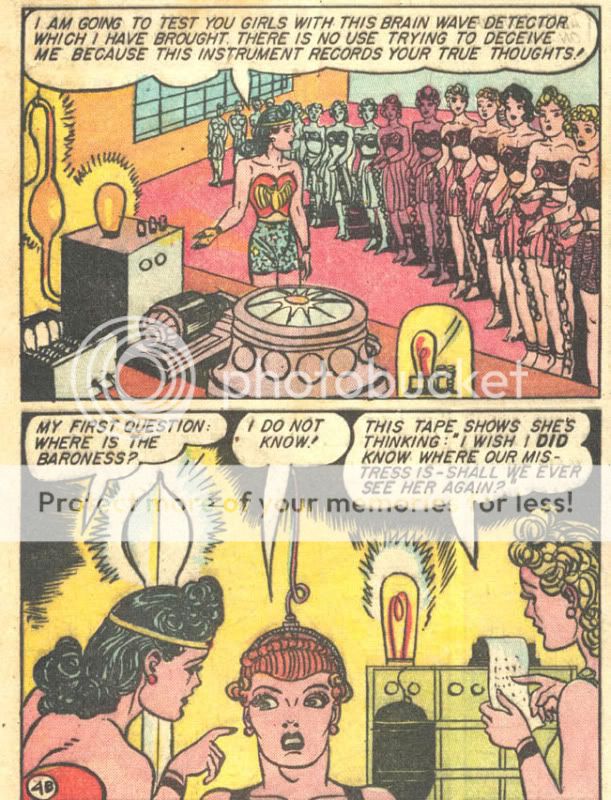
Photobucket

Ahem.

Oh, by the by, the Baroness’ slaves not only do everything she commands, but they also refuse to be taken out of their chains because they just love being dominated so much. (The Amazons, of course, also wear their bracelets as a symbol of subservience. But they are subservient to a good mother, you see, while the Baroness’ slaves are subservient to a bad mother. It’s much different. No, really.)

Anyway, there’s also a bunch of hoo ha with the Baroness turning various things invisible with some kind of ray (Marston had a thing for invisibility too…and no, I don’t know what was up with that.) Eventually we learn that the Baroness has corrupted Steve Trevor and turned him into a slave as well, which is very broadminded of her, since she seems to generally prefer female thralls.

(One of the ways that WW figures out that Steve is not quite right, incidentally, is that he starts to make eyes at Diana Prince and totally ignores Wonder Woman. I just wanted to point out in passing that the whole love triangle thing with Steve-Diana-WW has never yet seemed anything but tacked on. Diana never actually seems put out, WW and Steve seem completely an item; the whole Diana identity seems more like a way to further humiliate/mock Steve than an actual excuse for melodrama. Don’t get me wrong; it’s kind of fun as an excuse to mock Steve…it just seems very much a leftover from somebody else’s concept. Basically, I think the double-identity thing is a very natural metaphor for masculine identity, but doesn’t really have as much resonance for female identity. Or, at least, it probably could have resonance in a story about women, but Marston wasn’t sufficiently interested in it, it doesn’t seem, to move it away from the Clark Kent/Superman roots in any very interesting way.)

So, to free Steve, WW lets herself be captured by the Baroness to try to figure out how she puts the whammy on her slaves. And she discovers that she does it the good, old-fashioned motherly way — with imprinting.
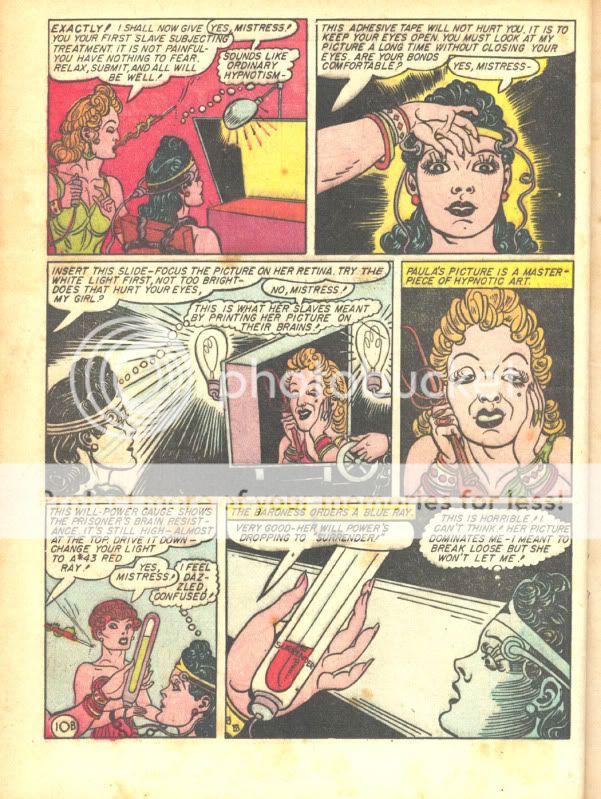
Photobucket

Evil hypnotic art. That’s probably how Wertham saw comics, I guess.

Meanwhile, Steve gets all masculine on Etta:
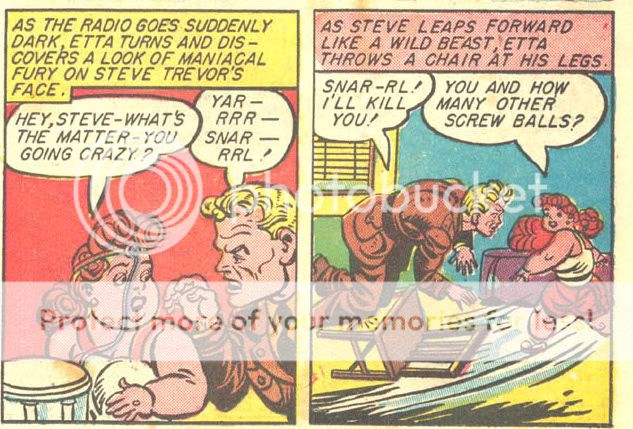
Photobucket

But Etta, through the imporbable exigencies of plot, has WW’s magic lasso, and so comes out on top, forcing Steve to take her to his leader:
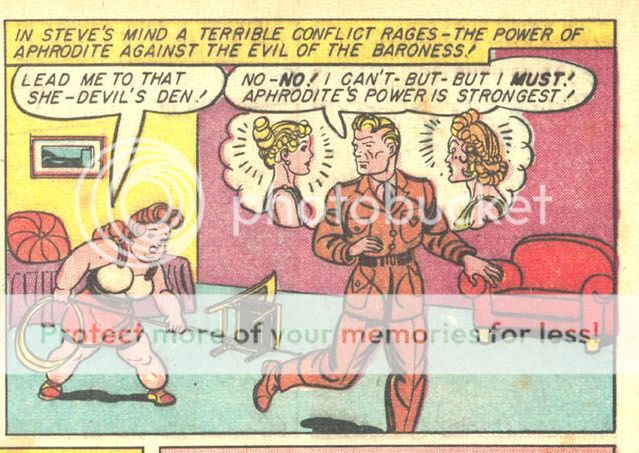
Photobucket

I love that picture, with the dueling mother-heads. It’s so manga…and Etta over to the side is even kind of hyper-deformed. Did Tezuka ever see this stuff? Probably not…though you’d think he’d appreciate it, what with all the bizarre gender goings on.

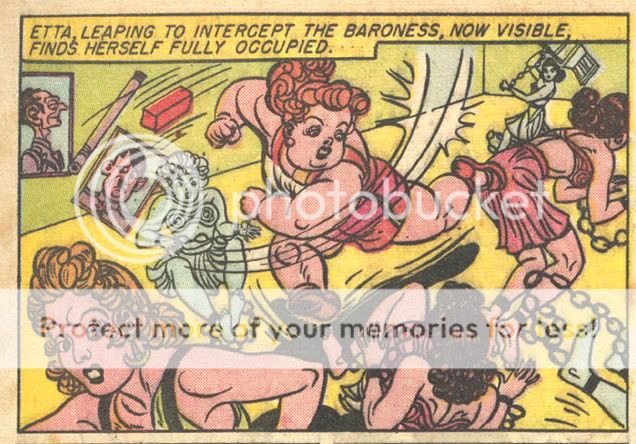
Seeing WW bowed and broken by the mind control snaps Steve out of his trance…though Etta actually does most of the fighting.
Photobucket

So the purveyor of perverted mother love is defeated…though again, one wonders why her particular brand of perverted mother love is necessarily evil, while everybody else’s perverted mother love seems perfectly okay. When the Baroness is shipped back to Paradise Island, we get several more eyefulls of her devoted slaves, and…well, let’s say there’s a certain amount of cognitive dissonance:
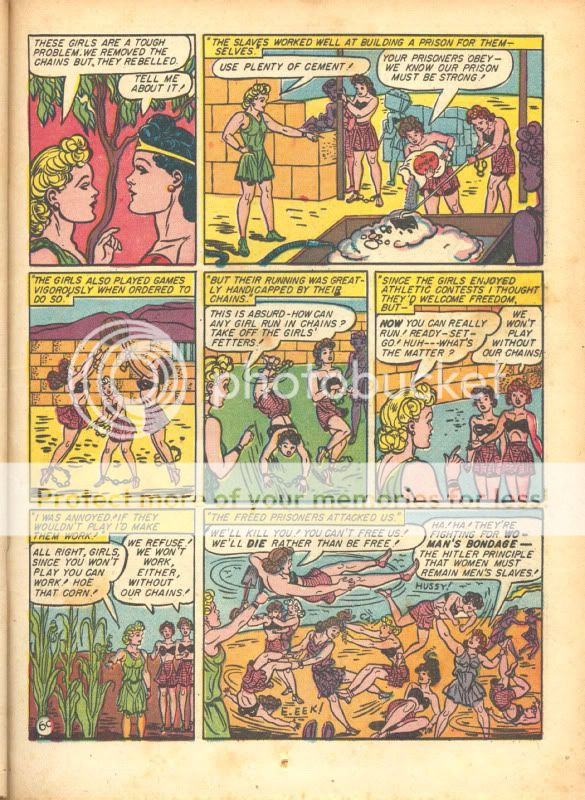
Photobucket

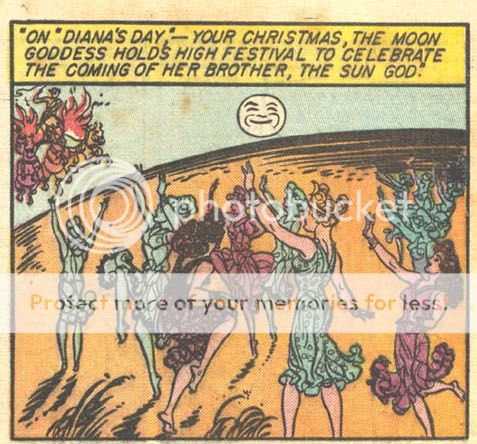
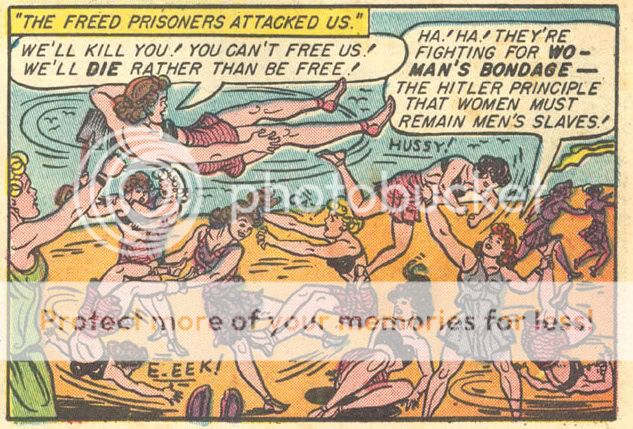
The slaves love building their prison and wearing their chains; they won’t even take them off to play sports. When the chains are removed, they become violent, demanding that they be reinstated. In the final panel, one of the Amazon’s says that the slaves are fighitng for “women’s bondage — the Hitler principle that women must remain men’s slaves!” Oookay…but if it’s an evil principle, why are y’all so enthusiastic about fetishizing it? The girls are all dressed in short, short skirts and bikini tops; they seem happy, and even willing to, as Marston put it, exercise vigorously. And that last panel, which is supposed to show their violence, looks, more like a dance or (with the typical girl fight shouts of “eek!” and “hussy!”) like a pillow fight. Indeed, with the careful choreography, the colorful, frilly, fabric, and bare skin, it’s not that different from Peter’s drawing of the Diana day rituals — maybe slightly more energetic, but certainly not dangerous or even mildly disturbing, in the way that, say, Steve’s animalistic attack on Etta is.
Photobucket

That girl in the center there, for example, has she been thrown to the ground, or is her hair teased up for some kind of windswept photo-shoot look?
Photobucket

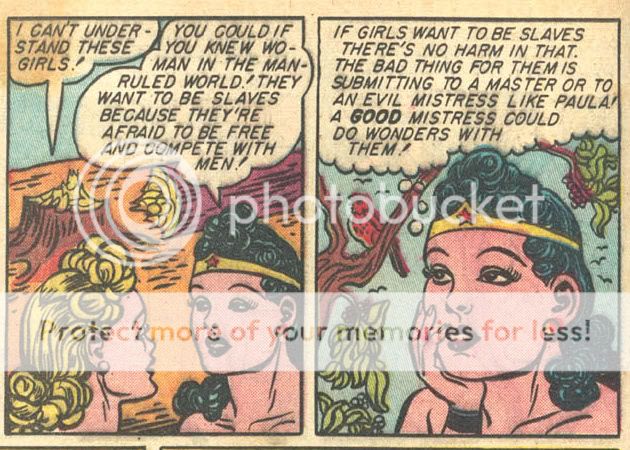
And, indeed, despite all the Hitler principle talk, Marston quickly backtracks. In one panel WW is arguing that the love of slavery is all about women’s false consciousness…and in the next, she’s proscribing, not feminism or equality, but a more benevolent slavery to a good woman (not to a bad woman or to a master.)
Photobucket

So, of course, to release the prisoners into better living through submission, WW and her sidekick Mala set up some B&D roleplaying, the upshot of which is that the slaves transfer their allegiance to Mala. Mala at first says she doesn’t want slaves…but then she says, well, okay, she’ll have strong, independent slaves, who don’t wear their chains while they’re exercising. Let’s all go swimming, girls!

And, hey, you know what? Good for Marston, really. False consciousness arguments are pretty dreary, not to mention condescending. The whole Tom Frank these-folks-don’t-know-what’s-good-for-them-let’s-educate-them argument…I mean, obviously, propaganda matters, and people are often dumb and women don’t necessarily make good choices any more than men do. But I think it’s generally worth acknowledging that when people acquiesce in oppression or discrimination, they generally have some motivation that can’t be reduced outright to stupidity. It’s not wrong to want someone to take care of you…though obviously you’d want to be careful about the person. Marston’s feminist diagnosis isn’t coherent — it’s a contradictory mess of false consciousness, legitimate emotional goals, fetishization, and pro-lesbian radicalism. That doesn’t make it precisely wrong, though.

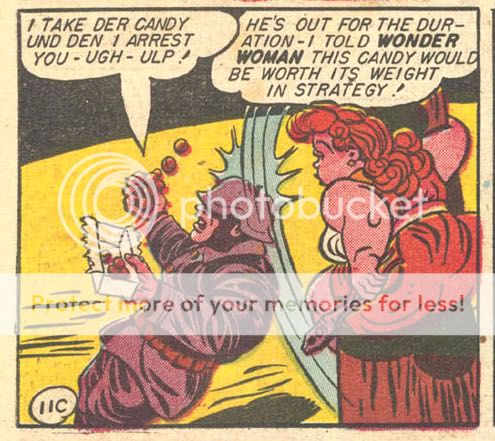
Alas, it’s at about this point that the comic starts to go off the rails. Marston is fine when he’s dealing with metaphorical adult-child women and their weird mother bonds. When he tries to write about real mothers and their children, though, we exchange eroticism for sentimentality, which doesn’t tend to work out so well. Right before she was shipped off to paradise island, the Baroness tries to run over a child named Kibby Maxwell who says things like “keen!” and whose name, as I mentioned is “Kibby.” So you can see why the Baroness wants to kill him…but Marston doesn’t see the logic, and instead decides that Paula hates all children because the Nazi’s took her own daughter. Soon enough we’re rescuing children from the evil Nazis, a plotline which even the sight of Etta Candy beating German soldiers with a box of chocolates can’t really redeem.

Update: …though I guess she’s actually just distracting him with the candy on second look, isn’t she?
Photobucket

Reunited with her little cherub, Paula becomes all good and sacrificial, plus in the last story we see more of game, insufferable little Kibby. As the emotional content heads for maudlin melodrama, Marston’s plotline shifts towards conventional; instead of crazed stag-masquerades and bizarre invisible rays, we’re stuck with by-the-numbers rescues from burning buildings, tragic facial scarring, and tiresome (though mercifully very brief) courtroom drama. Marston had worked with prisoners and was actually very involved in prison reform, but, unfortunately, that particular interest doesn’t seem to have the same imaginative kick as his bondage obsessions.

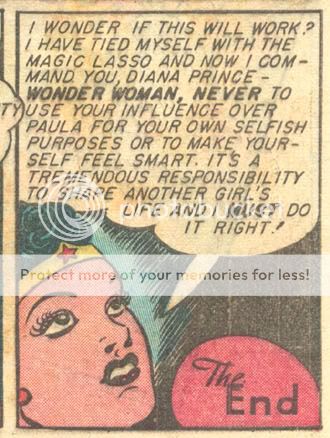
The story only really regains its energy on the final page, when (not coincidentally) Marston moves back to Paradise Island and its humid atmosphere of eroticized power dynamics. Paula, in return for all of Wonder Woman’s kindnesses, offers herself as WW’s slave. The last panel shows WW tying herself up in her own lasso and commanding herself “never to use your influence over Paula for your own selfish purposes or to make yourself feel smart” — in other words, to be a good mistress/mother.
Photobucket

It’s a neat moment for several reasons:

First, we’ve actually seen Wonder Woman use her lasso for selfish purposes; in WW #1 she playfully ties up an Amazon doctor and makes her stand on her head. It’s hard to know how much continuity there’s supposed to be here, really, but even in the phrasing (“make yourself smart”) you get the sense of WW as a tomboyish girl who likes a bit of mischief (no, not that kind of mischief…get your mind out of the gutter) …but who has also been affected by the responsibility she’s confronted with, and is trying to do the right thing (and “trying” is the operative word; she’s not certain that giving herself commands will actually work, which is quite true to most people’s experience of parenthood, I think.)

Second, the trope of WW tying herself up in her own lasso is one that actually has gotten a good bit of play down through the years, and it’s worth pointing out that this is the only time I’ve seen it done that it isn’t just offensively stupid. It helps a lot that for Marston the lasso is about dominance and submission, while for most later writers (like Jimenez or whoever wrote League of One) it’s about truth. Tying yourself up in a lasso of truth is an exercise in self-knowledge, which makes it basically about staring at your navel in order to be all pure and wonderful…which is fine if you’re the Buddha, but is tedious, incongruous, and arguably insulting to actual mystics if you then immediately go back to kicking the snot out of your enemies. Tying yourself up in a lasso of submission, though, is about self-control…which is actually something that it makes sense for a warrior to (a) want and (b) struggle with. In fact, now that I think of it, the whole idea of a lasso of control is much, much more logical for an action hero than is a lasso of truth. I wonder if a lasso of control was seen over time as not sufficiently feminine? The lasso of truth makes WW pure instead of powerful; instead of being super-forceful, she’s super-good, which jibes more easily with stereotypical feminine behavior and is (not coincidentally) a hell of a lot less fun.

I mean, if she’d had her original lasso of control, she could have just wrapped Maxwell Lord up and told him *not to do it again*. No dilemma, no angst, no incessant whining. Then she could have, I don’t know, told Supes and Bats to dress up as stags and join her for some fun Diana’s day rituals. Wouldn’t that have been more fulfilling for everybody?

(And just in case you’re wondering, no, I haven’t read that Maxwell Lord storyline, in large part because it sounds insufferable. I’d much rather continue working my way through Marston, thank you very much.)

Bound to Blog: Wonder Woman #2

As I said last week at about this time, I’m trying to blog through all the issues of the Marston/Peter run on Wonder Woman. I’m hoping to post about one issue every Thursday and this is the second.

And yeah, I know this is Wednesday. I jumped the gun; maybe I’ll do it Wednesday or Thursday, depending? We’ll see, I guess.
______________

Photobucket

So I do love that cover, but it’s nothing compared to the initial splash page:

Photobucket

Thank you sir, may I have another?

It’s probably wrong for me to admit this, but I’ve danced around it before, and I might as well just come out and say it — I often find Peters’ soft-core efforts quite sexy. There’s something about the unabashed flowery femme of the designs and the stiffness of the figures that I definitely find appealing. He must have too, surely; WW is usually seen as all about Marston’s sexual obsessions, which I’m sure it was, but Peter must have had a fair bit to do with the goings on as well. In this drawing, for example — was it Marston who suggested that the big, tough Greek warriors should be wearing such frilly kilts? And the armor he’s got with all the filigree — and the colors! Ares (standing in the background yucking it up) really looks like he’s wearing a red dress. Peter has decided to make the God of War a transvestite. I don’t know…maybe it could all be Marston turning in incredibly detailed scripts a la Alan Moore…but I’m skeptical.

Anyway, unlike the last effort, this is essentially a single story — which means it’s virtually as long as a mini-series, clocking in at more than 60 pages. Even with a short story about Clara Barton and a prose piece, that’s a hell of a lot of pages…was this thing monthly? No, it says “Fall” on the cover, so I guess it must have been quarterly. Though Peter was also drawing WW’s adventures in Sensation Comics at the same time…it’s a lot of drawing, anyway you look at it.

So what is the plot of this gigundus story? Well, Ares is pissed because WW keeps catching Nazi spies. This pisses off Ares because, as he says in that little inset panel above, “If America wins, war on Earth will end!” So Ares sets out to capture Wonder Woman, throw her in chains, make her his slave…you know the drill. He does this by arranging for the capture of Steve Trevor’s astral form. (How this works is a little unclear…but onward!) Steve is then taken to Mars, because Mars is where you live if you’re the God of War. WW leaves her body in the care of Etta Candy:

Photobucket

With those “woo-woos” WW whooshes up to Mars, where, after wearing a lot of chains and engaging in a series of healthy tests of strength, with some light spanking thrown in for good measure, she frees Steve and travels back to earth. Enraged, Ares sends a series of minions to recapture her: the Earl of Greed, the Duke of Deception, and the Count of Conquest. After many trials (by baseball, among other things) WW defeats them all, even Ares — ending war on earth! Okay, not quite; I guess he’s still got minions around or something. There will be more issues, in any case; they promise.

Since we’ve raised the weighty and altogether unfortunate profile of Etta Candy — it’s really worth pointing out what a completely bizarre character she is. It’s not just the “woo-woos!” and the fact that practically every speech bubble she’s given has to mention at least once how much she likes candy. That would just make her the comic relief. But what’s really strange is how important she is to the plot. As we saw above, Etta tended WW’s body while our hero was off on Mars. Etta’s far more than just a passive helper, though. In the battle with the Duke of Deception, for example, the Duke creates a fake Wonder Woman duplicate body (no, I don’t know why. Don’t ask silly questions.) Wonder Woman manages to capture the fake body…and then puts Etta’s mind in the duplicate body.

Photobucket

And in the final battle against Ares, when WW is tied up and helpless, she sends a mental radio message to Etta who somehow goes astral, brings acid (astral acid?) and frees WW.

In other words, plot-wise Etta isn’t really comic relief; she’s the indispensable assistant — even the cavalry. It’s *her*, not Steve Trevor, who gets to save Wonder Woman. Wonder Woman seems to treat her more or less as an equal, and Etta seems to see herself that way as well — Etta certainly, and bizarrely, doesn’t seem to see WW as someone to envy or aspire to — when her brain is placed in that slender, perfect body, all Etta can think about is how much she wants to go back to eating candy.

Obviously, it’s a bit of a leap to see Etta Candy as some kind of feminist icon. But…I don’t know. Compared to some of her later iterations (sex kitten cameo on the animated movie; loyal sidekick and romantic interest for Steve in the Perez run), fat, self-confident, and (perhaps mystifyingly, but still) competent doesn’t seem too bad.

Certainly, she seems to have it all over Steve.

Photobucket

As you can see, in the last page of the first section, when they’ve escaped from Mars, it’s Etta who actually gets to share an embrace with WW. In the next panel, Steve expresses a very natural confusion about what the hell happened to a slave girl who helped them escape from Mars — and WW positively condescends to him. “You *would* think of her!” Silly man; you’ve only got one thing in your pretty little heads! But don’t worry, Steve, your little friend trotted back to her consensual B&D relationship with, ahem, the Count of Conquest! Now you silly little thing, let me tie you up and explain to you that you must never, never leave the house without an escort. You just have to have a firm hand with these men or the little dears will get themselves into trouble. Now let’s just settle things between us women, Etta. Could you fly to Mars with a bottle of acid, sneak into the dungeon of the God of War, and burn through my chains please? By tomorrow? And don’t tell Steve…he worries so!

You may be wondering why on earth Wonder Woman needed to get Etta out to Mars anyway; why not just break her chains herself?

The answer is that Wonder Woman allowed her bracelets to be chained together by a man, which robs her of her powers:

Photobucket

Oooookay. But…what about this?

Photobucket

There’s Wonder Woman from earlier in the same issue. Looks to me like her wrists are changed together, right? And she’s looking pretty super there (incidentally, note that Peter appears to have gratuitously drawn in visible nipples on the woman WW is defeating. He does that occasionally.)

Of course, Marston isn’t a stickler for continuity. Still, what’s different between *this* binding and the other one?

The answer seems to be that in the instance where she lost her powers, WW was bound by a dark, handsome Italian.

Photobucket

As the Count of Conquest’s minion explains:

Photobucket

WW, in other word, is being punished for the weakness of allowing a man to hold sway over her (though she certainly never seems to be that interested in the guy…but I guess Marston holds his women to a high standard in these matters.) When she tearfully regrets failing Steve, the suggestion is that she’s been unfaithful. This is emphasized by the fact that she’s embarrassed to explain to Steve exactly what happened….

Photobucket

Again, though, what’s interesting is that the particular drama of unfaithfulness which is being suggested is one in which WW takes what is essentially the male role; she falls for the dark, seductive femme fatale, betraying the helpless, noble woman at home.

I’d be remiss if I didn’t point out that there’s an actual feminine femme fatale in the book as well — and by all appearances she is also bent on seducing Wonder Woman — or at least in luring her onto a cruise ship and engaging in…well, no surprises, really.

Photobucket

Photobucket

Leading her around with her hands secretly tied under her coat, huh? You have to wonder if Marston was trying that one at home. (Bonus points for fetishizing the exotic minority…and for implying that said exotic minority wears her colorful, diaphanous, scanty ethnic attire whereso’er she goes.)

Oh, and last time I promised cross-gender body swapping. Here you go:

Photobucket

That’s Deception sneaking around in the body of a slave girl. Real women wear chains; real men wear tutus.

_____________

So I thought I was done, and then I keep thinking of more things I wanted to say. Stupid brain.

In terms of WW’s apparent need to avoid submission to, or even perhaps romantic relationships with men — there’s definitely something going on with a kind of butch tomboyishness, and perhaps a hint of a (cross-gendered) Peter Pan as well. There was a bit of that in the first issue as well; when Diana says she wants to leave Paradise Island to follow Steve, her mother says that that will mean giving up her “birthright” of immortality. That is, there’s a suggestion (thought it doesn’t seem to be much worked through) that Paradise Island is, like NeverNeverLand, a kind of metaphor for childhood, and that WW is a kind of magical and eternal child (she is made out of clay after all.) Again, in the second issue, we see WW has a real weakness for contests of strength:

Photobucket

She’s like a kid, unable to resist the opportunity to prove that she’s the strongest.

There’s probably something of that in all early super heroes…Superman certainly is a kid’s fantasy. It’s just that that’s really remained a part of Superman to some degree, but the corresponding meme for Wonder Woman has gotten a little lost, I think. Wonder Woman is a pretty sober character now; she’s more about standing up for women or peace or whatever, and maybe less about just beating the tar out of the boys at baseball. Which seems kind of too bad.

Photobucket

All right, that’s it…except, man, look at this Hitler caricature.

Photobucket

That is one gloriously saggy-faced ubermensch. And in the second panel, Marston has him so nuts he’s chewing the carpet. Literally. That cracked me up.

More Oliphant Weirdness

The guy still baffles me. Here we have him commenting on the queen and Mrs. Obama. It’s a fun strip, but it’s based on the idea that the queen herself was affronted by Mrs. O’s friendly hand on the shoulder. Whereas, in real life, the queen had no complaint and actually touched Mrs. O first; Buckingham Palace even issued a statement to let everyone know things were okay.

Yet the Oliphant cartoon is quite neat, not a commentary on reality but a fun sitcom spinoff from it.

UPDATE: In Comments, Matthew points me to a couple of other recent weirdies by the man, and I’ll throw in another here. Coincidentally, I just saw a post by the liberal blogger Hilzoy that gets at the Oliphant experience. Her topic was battered wives, so I’m hijacking her words to make a much more lighthearted point:

There are things that are comprehensible parts of the world, even if they’re rare, like having your car stolen; and then there are things that are unexpected in a completely different sense, like having your car turn into an elephant before your eyes: things that make you wonder whether you’re completely crazy.

Reading Oliphant, this experience is actually quite salutary. Frustrating as it is to see his brain twitch, you are left in a slightly different world than you inhabited before looking at the cartoon. Of course, the effect is overwhelmed when he does something borderline racist or anti-semitic, such as showing Israel doing the goosestep. (Yet the way he draws the shark/Star of David is brilliant.)