How Do Comics Visualize Racist Speech?

strangefruit

 
My copy of Joel Christian Gill’s new graphic novel arrived in the mail last week shortly after I read Frank Bramlett’s post on the way editorial comics depict Michael Sam, the openly gay, black football player who was recently drafted by the NFL’s St. Louis Rams. Of particular interest to Frank was how few of the comics he found rely on metaphor to convey meaning and instead invoke more literal representations of Sam to comment upon the significance (or insignificance) of his social identity. As the post makes clear, scrutinizing the visual and verbal shorthand that comics use to illustrate abstract ideas like race or sexual orientation can reveal a great deal about how society negotiates changing attitudes, institutions, and avenues of power.

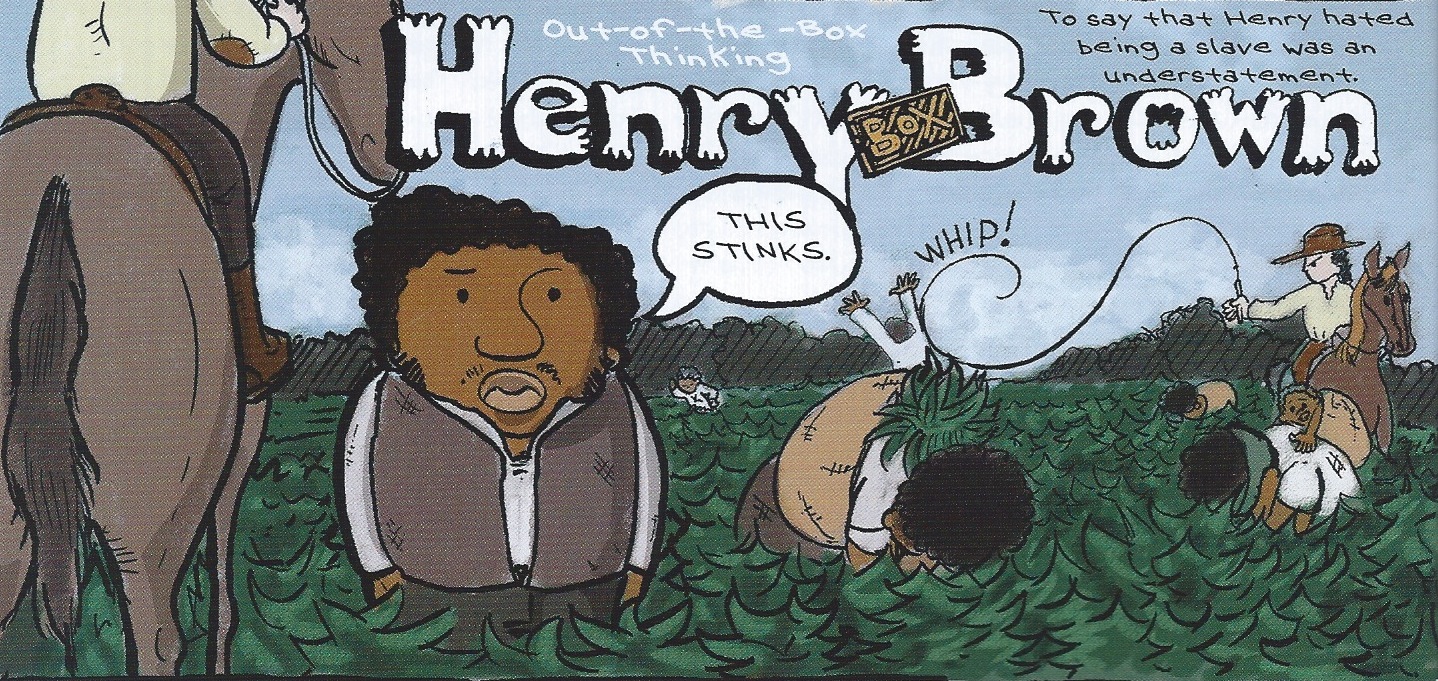
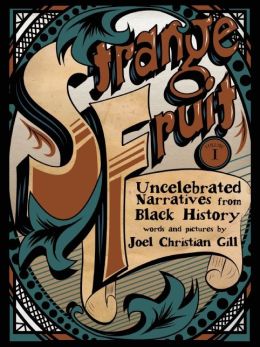
Gill’s collection, Strange Fruit: Uncelebrated Narrative from Black History, provides us with another opportunity to raise questions about the figurative modes of expression that today’s comics creators use to represent race and racism. Readers of the short stories in Strange Fruit quickly learn to appreciate the playful succinctness of Gill’s iconographic language. He knows when to use humor and sight gags to advance the story. (On the experience of enslavement, Henry “Box” Brown remarks: “This stinks.”) But Gill knows when more serious cultural cues are needed too, as in the two-page spread where Brown’s body, shown curled inside a wooden box, silently tumbles from slavery to freedom.
 

gill 5

 
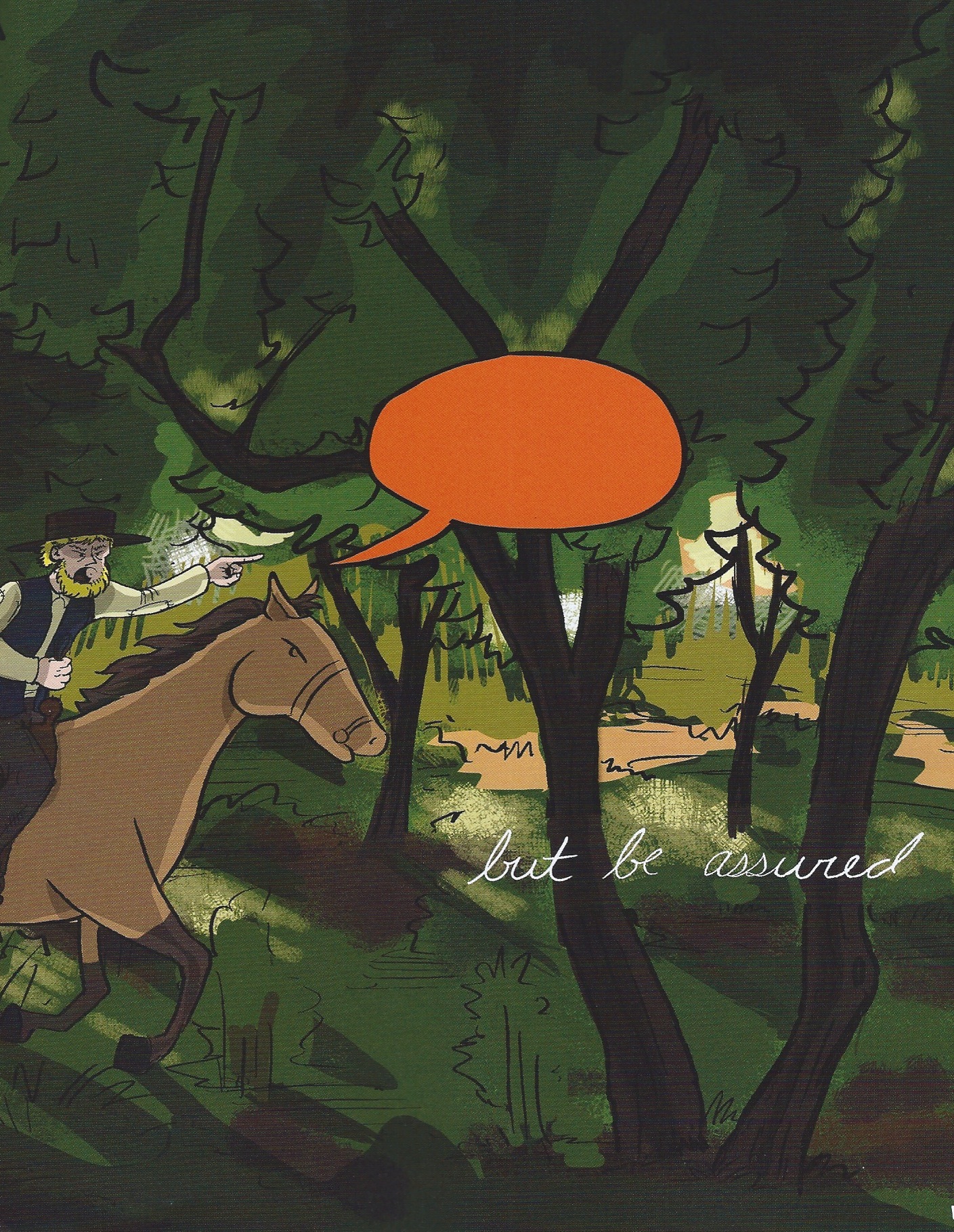
Yet in the graphic novel’s accounts of lesser known African American figures and infamous historical events, Gill’s depiction of race hatred also caught my attention. When angry whites confront African Americans in these stories, their speech is represented as orange or red word balloons that contain no printed text. It isn’t difficult to imagine what is being said in these exchanges. But perhaps that is the point.
 

gill 7

 
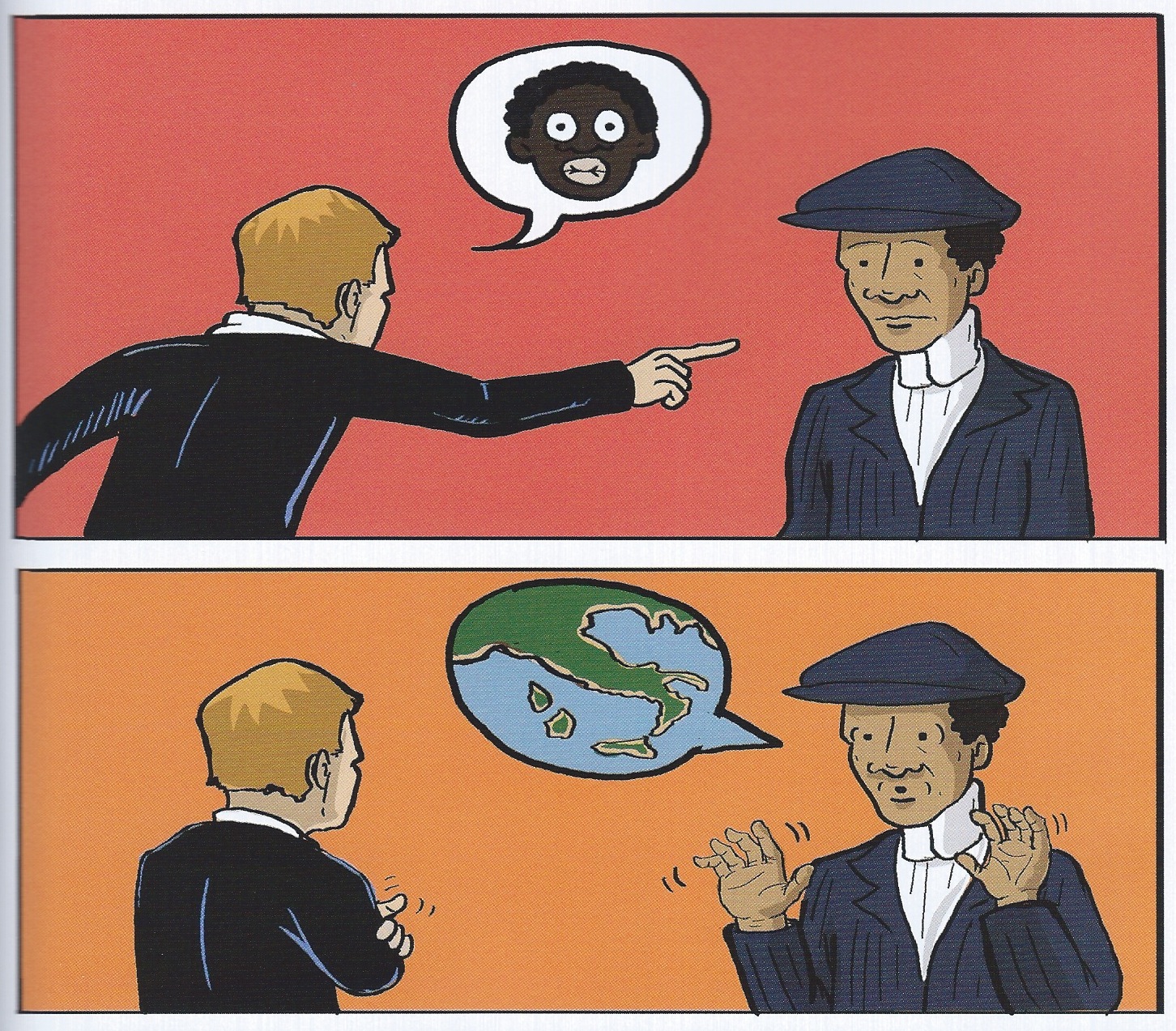
In other instances, the verbal threats and insults of whites are condensed into a single image of a black caricatured face with wide saucer eyes and swollen lips. The panel below is from a stunning story called “The Shame” about the denigration and forcible eviction of the black residents from Malaga Island off the coast of Maine in 1912. In the exchange, a former Malaga resident is attempting to “pass” and conceal his black identity.
 

gill 4

 
Exactly what is being said here? Can the sentiments expressed in the top panel alone ever fully be translated into printed text? Gill’s arrangement of the well-known visual racial caricature seems to go beyond words to convey a culturally and historically situated discursive practice. The pictographic balloon draws our attention to the constructedness of an image meant to articulate a host of ideas about black inferiority. (The accused responds with a fiction of his own by attributing his physical features to an Italian lineage.) I also think it’s fitting that this exchange appears in a story that takes place during the early 20th century when caricatures dominated visual representations of blacks and other ethnic groups. In his efforts to retrieve the neglected history of African Americans, Gill arguably makes those early cartoonists complicit in his critique of racism as well.

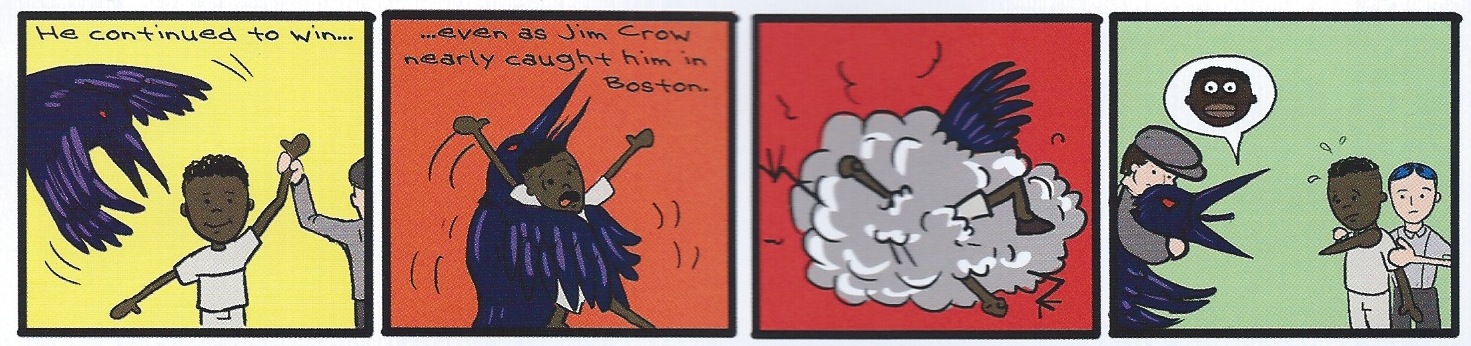
Strange Fruit goes a step further in completely depersonalizing white supremacist ideology by representing angry white people literally as (jim) crows. In stories like “The Noyes Academy” about the destruction of the nation’s first integrated school or “The Black Cyclone” about one of the fastest black cyclists in the world, outraged whites are transformed into belligerent red-eyed birds that chase and poke their wings into black faces. They speak only in blank word balloons, pictograms, and the occasional “caw!”
 

gill 6

 
Relying on these kinds of visual metaphors is not without risk, but I believe that Gill’s comic succeeds in redirecting the reader’s attention to the voices that matter most to him, that of Henry “Box” Brown, Harry “Bucky” Lew, Richard Potter, Theophilus Thompson, Alexander Crummell, Marshall “Major” Taylor, Spottswood Rice, and Bass Reeves — men who despite their different circumstances, encountered racism’s vitriolic squawk in comparable ways. Black resistance and agency remain key elements in every incident chronicled in Strange Fruit, even for the stories that end in tragedy (these are the uncelebrated, after all). Let’s hope we’ll see more narratives of uncelebrated black women in volume two.

Last month, World War Z writer Max Brooks and artist Caanan White published, The Harlem Hellfighters, a graphic novel about an all-black infantry unit during World War I. It shares with Strange Fruit an interest in recovering details about African American life and culture that have been overlooked (and both are helpfully endorsed by Henry Louis Gates, Jr.). But in contrast to the more conventional heroic narrative and mimetic style of The Harlem Hellfighters, I think that Gill’s experimental choices result in stories that are not just aesthetically richer, but that also illustrate a wider range of interpretive possibilities for remembering the past.

The way in which Gill represents racist speech in Strange Fruit is just one example of these artistic choices. What do you think about his strategy? I’d be interested to hear if you’ve seen similar approaches in other comics too.

Here Come The Planes

(NOTE: This was first published a few years ago in the now-defunct web journal “The Fiddleback.” Noah was kind enough to let me repost it here.)


At first, it’s just Laurie Anderson’s voice, looped on an Eventide sampler. A pulmonic agressive ha repeats, calling out from 1981, exhaling middle-C. The ha continues through the duration of the song. Seven hundred one times at a pace of eighty-four beats per minute. For those of you keeping score at home, that’s a little bit over eight minutes. And yet this song, with its curious title, “O Superman,” and cold, borderline-cheesy lyrics and seemingly endless repetitions was, briefly, a monster hit. Up to #2 in the UK. One very bad recording of it on YouTube boasts that “this is what we all used to dance to back in the day.”

There are few other sonic elements introduced over the song’s eight-minute-plus length. There’s a handful of synthesized string lines and some organ. The faint sound of birds once or twice. And there’s Anderson’s vocals, a robot chorus announcing a new age.

Anderson’s work as a performance artist and musician relies heavily on distortions of her alto voice. She pitch-shifts it down two octaves, becoming a male “Voice of Authority,” or adds reverb and delay effects to punch home emotional beats. In both United States I-IV—the four hour stage show where “O Superman” debuted—and Big Science—the commercial album it appears on—Anderson sings through the vocoder, a kind of synthesizer that attaches your voice to notes you play through an instrument. You’ve heard it used by Peter Frampton on his biggest hits, or by Afrikaa Bombaata. The British also used it during World War II to send coded messages, breaking the sound up into multiple channels for spies to assemble later.


The opening lyrics of “O Superman” (“O Superman, O Judge, O Mom and Dad”) are a play on Le Cid’s aria “O Souverain, O Juge, O Pere.” In the opera, these words are uttered as a prayer of resignation, the hero putting his fate in God’s hands. In the Laurie Anderson song, the three O’s change meaning. First, she prays to Superman (Truth! Justice! The American Way!) but by the end she longs for Mom and Dad, and gives this longing voice in a series of vocoded ah’s: “Ah Ha Ha-Ah Ah-Ah-Ha.”

Despite Anderson dedicating the song to Le Cid’s composer, the two biggest influences it draws from are The Normal’s “Warm Leatherette” and the Philip Glass/Robert Wilson opera Einstein on the Beach. Indeed, “O Superman” can in some ways be read as a marriage of the two, of the uniting of brows both high and low, the repetition of minimalist opera lensed through the repetition of the dance floor.

Anderson is open about the debt she owes Einstein on the Beach. In interviews from the time, she cites the show as opening up possibilities for what a stage show could be, a process that lead to United States I-IV. O Superman’s repetitive “ha” references the sung counting during Einstein’s opening, and the keyboard lines not only sound Glassian, but the actual specific organ tone is one fans of the Philip Glass Ensemble will recognize.

The relationship between “Warm Leatherette” and “O Superman” is more tenuous. Certainly “O Superman” would not have garnered Anderson chart success and a seven-album deal with Warner Brothers without The Normal’s game-changing single from three years prior. Several sawtooth waves—chords, a siren gliss and a thwap-thwap rhythm—make up the entirety of Warm Leatherette’s music, while Daniel Miller, The Normal’s sole member, delivers ominous couplets about sex and car crashes. The song is essentially a musical setting of the JG Ballard novel, Crash, in which a car crash awakens the novel’s narrator to the sexual possibilities inherent in the automobile and its destruction.

It’s through “Warm Leatherette” that “O Superman” accesses JG Ballard’s apocalyptic vision of techno emptiness and Cold War nuclear anxiety. “Warm Leatherette” echoes Crash’s alienated space in which everything becomes simultaneously mechanized and eroticized. “O Superman,” meanwhile, creates a space of mechanization and alienation that also contains our human responses to this alienation: paranoia, loneliness, and a kind of heartbroken yearning. No character in a Ballard novel would ever beg to be held by Mommy, as Anderson does by the end of the song.


Coming as they do out of a theatrical tradition, Anderson’s songs, even at their most abstract, tell stories. “O Superman” is no different. Here, more or less, is its story:

You sit in your apartment in New York City at night. You are alone. Perhaps this apartment is on Canal Street, nearby the Holland Tunnel. It is 1981.

You sit in your apartment in a chair rescued off the street. The day you found it, you felt grateful that no one needed this chair anymore. This is the economy of New York furniture. People lug their unused belongings to the curb: The televisions and air conditioners with yellow paper taped to them, the word WORKS written in sharpie; the chairs that look fine, but might contain bedbugs; the couches that get waterlogged while you try to round up friends to lug them up the four flights of stairs to your apartment.

Concrete Island lies open on your lap, off to your right on a stack of milk crates rests a glass of cheap wine. Your violin leans against a nearby bookshelf, desiring your fingers and the bow.

Your phone rings. You decide that you will let the answering machine get it. People own analog answering machines, with real tapes that run and run and run out in the middle of their friends’ loquacious messages.

You hear your own voice first. “Hi. I’m not home right now. But if you want to leave a message, just start talking at the sound of the tone.”

A beep. And then. “Hello? This is your mother. Are you there? Are you coming home?” You hear need in her voice, along with a drop of reproach. Perhaps she didn’t approve of your moving to a hellhole like TriBeCa to be an artist. You do not pick up the phone. You do not tell her when you are coming home.

Another beep and then a voice you do not recognize. A man’s voice. “Hello? Is anyone home?” You do not answer it; you are not in the habit of speaking to strange men on the phone in the middle of the night. Instead of hanging up, however, he speaks more. “Well you don’t know me. But I know you. And I have a message to give to you.” Uh oh. Is this a crank caller? A stalker?

He speaks again. “Here come the planes. So you better get ready. Ready to go. You can come as you are. But pay as you go.”

You’ve had it with this man’s warnings and rhymes. You pick up the phone and say into it, “Okay, but who is this really?”

When the voice replies, what he says is terrifying. “This is the hand, the hand that takes.” He repeats it. He won’t stop saying it. You imagine just a mouth, the rest of the face shrouded in shadow, rendered in grayscale, like in an old movie.

And then he says: “Here come the planes. They’re American planes. Made in America. Smoking, or non-smoking?” He babbles on about the post office, about love, justice and force. And mom.

You hang up the phone. Confronted with this warning, with this mysterious stranger, the hand that takes, perhaps America itself, what can you do? You think about the first message. Your mother. She called you. She wants you to come home.

Sitting in your apartment, stranded in the night in New York, which despite the popultion density can feel like an island bereft of human company, you want your mother.

So hold me mom, you think to yourself, in your long arms.

You are so shaken from the phone call that the vision of your mother holding you gradually changes, becoming perverse and terrifying, but as it does so, you find yourself even more comforted.


*          *          *

Here come the planes. They’re American planes. Made in America.

In 1981—the year of O Superman’s commercial release—Ronald Reagan broke the air-traffic controllers’ strike and expanded the US military by the equivalent of $419,397,226.33 (adjusted for inflation).

In 2010, we’ve lost great amounts of our manufacturing sector, but one area remains triumphantly intact. We still make machines of war here in America. Boeing and Lockheed Martin are still based in the United States, the former in Chicago, the latter right outside Washington, D.C. Their plants also remain in this country, in places like Witchita, Kansas, Troy, Alabama and Columbine, Colorado. The Martin F-35 Lightening II—of which the United States intends to buy 2,443 for a price tag of over three hundred billion dollars—performed its first test run in Fort Worth, Texas.

In 2001, Mohammed Atta flew a Boeing 767—manufactured in Everett Washington— into the North Tower of the World Trade Center Building.


*          *          *

If you haven’t guessed by now, I might as well come clean: I was obsessed with Laurie Anderson in college. I tracked down out of print monographs of her work. I attempted to sneak her into just about every paper I wrote. Laurie Anderson thus joins a long line of serial obsessions on my part. She sits right between Eddie Izzard and Charles Mee if you’re ordering it chronolgoically.

I only knew one other person who loved Laurie Anderson. He discovered her via a twenty-six CD series titled New Wave Hits Of The Eighties that he bought off of late night television when he was in high school.

Despite all of this, four months after graduating from college, on the actual day when the American Planes Made In America finally showed up, I did not think about “O Superman.” On the actual day, U2’s borderline easy-listening track “Beautiful Day” took up unshakeable residence in my skull. It’s been said often enough to become a cliché, but the eleventh of September, 2001 really was gorgeous. The sky blue and cloudless, the temperature perfect for a walk from my then-girlfriend’s office on 56th and the West Side Highway to deep into the East Teens.

The blue sky loomed ominous, the way nights dark and stormy foreshadow murder in a potboiler. If we couldn’t trust the weather to tell us how to feel, or what would happen next, what could we trust? As we walked, desperate to put our backs to Times Square or any famous piece of Manhattan real estate, occasional planes flew overhead. When this happened, our faces blanched and our clutch on each other’s hands tightened as we ducked into the shadows of a skyscraper to watch the planes streak the blue dome above us.

And in my head, Bono wailed all the while. “It’s a beautiful day, don’t let it” Go away? Go to waste?

I discovered that I did not actually know the words to the song. As we stopped at a McDonald’s for food, bought water off a street vendor, and entered the East side, I became fixated on figuring them out, worrying the words like a loose tooth. Solving this annoyance seemed more important—or at least more manageable—than the attack itself, the questions about my DC-dwelling parents’ safety or where our nation was headed.


Unlike most Americans, I did not see what had happened to my city until many hours after the second tower fell. By then, our epic walk concluded, we sat on our friend Alison’s couch and watched the BBC. Again and again the plane flew into tower two, again and again the orange flower bloomed, again and again the towers collapsed and we jump cut to a POV shot of someone running from a wall of dust.

One of us said what became a constant refrain. It looks just like a movie. And indeed it did.

During the weeks to follow, we heard this idea everywhere. Just like a Bruckheimer film or I thought they were showing a disaster movie, until I realized it was on all the channels, or Just like Independence Day.

What we did not ask then is why. Why, at the height of our powers, had we imagined our own destruction so often that we had a ready-made database of images to compare this moment to?

Instead, we clicked our tongues in disapproval. This showed, we believed, the shallowness and alienation of our psyches. Now the time had come to end irony once and for all. We chose this interpretation instead of acknowledging how in tune with our deepest fears mass entertainment really was.

Through the nineties, when everything seemed so good that a blow job consumed media attention for years, it turned out that we both knew and feared that the clock would run out on our exceptional good fortune. The multiplex transformed into the only place to explore these premonitions of what was to come. The movies responded by doing what they do best. They thrilled us again and again, so we didn’t have to feel bad or, really, think much, about any of this.

We did not ask these kinds of questions in the aftermath because we did not have the leisure or distance or time to ask them. Instead, we asked other questions. Questions like, Who did this? And, Whose ass do we get to kick now? And—in certain circles of the left—Is it right that we kick their ass?

The first two questions we immediately answered with a nebulous body known as “the Arabs,” later refined to “Al Qaeda.” First thing we should’ve done, someone said to me at Thanksgiving dinner that year, is turn the Middle East into a parking lot. Even on that day, when we had no idea who had done this or why, we knew it must be “the Arabs.”

On her couch—which she invited us to stay on for as long as we want—Alison launched into a monologue about the Israeli-Palestinian conflict. She did not know that my girlfriend hailed from a Muslim country and I, although a Jew, am not a Zionist. The story culminated with her running into a Hasid on the street two hours after the second tower fell. “Hey man,” she recalls herself saying, “I’m with you and Israel all the way.”

She wanted to hug him, she said, but knowing the prohibitions against touching women, did not.

In that moment my mind wandered back to my girlfriend copping to a desire to bump up against Hasidic men on the subway and then claim to be menstruating. I did not mention this. Sitting next me, my girlfriend was silent. After crying until her pale skin turned a shade of red I did not think occurred in nature, she stared at the television, unblinking.


*          *          *


“O Superman” contains three moments of wordplay. The first comes right after Anderson mentions the planes, when she then asks, “Smoking or non-smoking?” Since we are not riding in these planes but are instead being warned about them from a mysterious voice, the phrase takes on a double meaning, becoming about corpses.

The second is when Anderson recites the Postal Creed: “Neither snow nor rain/Nor dead of night/Will stop these couriers/From the swift completion/Of their intended rounds”

Because if (once again) we are talking of airplanes, and talking of the death they bring, then the couriers become something different, and the package they are delivering is one you certainly don’t want. Nothing will stop them. A motto of American can-do becomes a motto of uncheckable military aggression.

Or, listening to the song today, dread of the unstoppable terrorist other.

Over the 2010 holidays, as the privacy (and genitals) of white people unaccustomed to legally sanctioned harassment were violated, America seemed to wake up to the absurdity of trying to stop terrorists with the pat down and the extra large zip-loc bag. If they can’t get on a plane, they’ll blow up a subway car. They are nothing if not tenacious. Neither scanner, nor banning of liquids, nor cavity search will stop them from the swift destruction of their intended targets.

The third moment of wordplay comes at the end as Anderson calls out to her mother. Like the question about smoking, the yearning for mommy’s arms gives way to a pun, of all things. “Arms,” of course, contains two meanings, one of which is enshrined in our Second Amendment.

And so, with a mournful, churchlike basso organ sound, Anderson’s mother turns from human into weapon. Her arms progress from “long” to “automatic” to “electronic” to “petrochemical” to “military” and back to “electronic.”

When Anderson sings “petrochemical,” if you turn the volume up very high and listen very closely, you will hear birds chirping.

In college, the merging of mom and machine struck me as a silly bit of early-80s “we are the robots” kitsch. I realize now how I wrong I was. I know now that the comfort found in waging war. I know that hurting others can feel like a familial embrace.

Did our desire for this comfort—the comfort of anger, the comfort of righteousness, the comfort of inflicting, rather than receiving pain—lead us so swiftly to retribution?

And what of other kinds of comfort?

I am at atheist. On 9/11, the only working phone I could find was in a Christian bookstore. I made two phone calls while the employees praise-Jesused behind me. The first was to my girlfriend to tell her I would walk to wherever she was, the second was to my mother. My father works for Congress, and was in who-knows-what federal office building that morning.

In the week that followed, everyone I knew in New York wanted to be held in some way, to be comforted. A friend called me to tell me she had been to church that morning. I laughed into the phone, finding it—and her—absurd. Like me, she was both a Jew and an Atheist. What possible business did she have in a church?

“I was walking down the street and I saw this woman outside a church, and, she just, she just looked at me, and I knew that that was where I needed to be.”


*          *          *

From the fall of 2001 until the Spring of 2010, I didn’t listen to “O Superman” or really anything by Laurie Anderson. It wasn’t until I left New York to drive across the country with my now-wife that I played it again. We were all gone to look for America. We were all sorts of cliches. We didn’t care.

As the curving asphalt ribbon of the Pacific Coast Highway unspooled before us, I click-wheeled over to the song. The instant I pressed play it started to rain and we sat in silence and listened to it. And it wasn’t until I got lost in the ha that I realized how long it had been since I had heard it. How did that happen? How did a totem that I carried with me, loved so hard, like it was a person, like it belonged to me, like I made it, how did I abandon this thing for so long?

Right before Anderson’s two-minute litany of different kinds of arms, I looked over at the driver’s seat, seeking approval. Now-wife displayed the face of a champion poker player. On the stereo, Anderson paraphrases the Tao Te Ching, singing, “‘Cause when love is gone, there’s always justice, and when justice is gone, there’s always force, and when force is gone, there’s always mom.” And then her voice breaks a little, and in a rare moment of humanity Anderson says, “Hi, mom.”

It felt like letting her read my diary from before we met. I wanted to be known better by this woman I would soon marry and move from New York with. I wanted to let her see the embarrassing parts that resist verbalization and need the true falsehoods of art. Part of me felt, in this moment, like all young men who like imposing their tastes on their loved ones—that somehow my self-worth was caught up in this moment in this purple Honda listening to this song.

Why had I stopped listening to O Superman? The answer seemed obvious now. After that sunny September day, her work became unbearable to me. The song contained too much of what I tried not to feel and not to recognize about the world and myself and the country in whose name horrible things were being done.

Instead, the song went into a cardboard box in a dusty attic closed off from my soul. Also in that box: a book of plays that lay, spine cracked on my windowsill collecting mysterious black and grey and green dust from September 12th through 15th. It sits on my bookshelf now, spine facing the wall, unopened, a guardian against destruction.


*          *          *

At the end of the song, Anderson repeats a vocodered melodic line from the beginning: “Ah Ha Ha-Ah Ah-Ah-Ha.” This time, however, she interrupts herself with a synthesized string line that once again feels like it could come out of the Philip Glass playbook.

This string figure references the vocoder melody off of the song “From The Air,” the track right before “O Superman” on Big Science.

“From the Air” is a song about a plane crashing into New York City.


Via crossfade, an honest-to-god tenor saxophone replaces the synth strings. The only instrument to appear in the song without some kind of treatment on it, it makes its realness known by being slightly out of key.

And then, at the very end, everything cuts out, giving way once again to the ever-present, omnipotent “Ha,” repeating itself solo for seventeen seconds.

If you turn the volume up very high and listen very closely, you will hear sirens in the background.


*          *          *


As the song ended, we feared for our lives. The storm transformed the Pacific Coast Highway into something treacherous, slick, unknowable. The next pulloff onto more trafficked streets lay tens of miles ahead of us. Did we have enough gas to make it? Would our stomachs give out amidst the twists and turns? And—most importantly—did my now-wife like the song?

“Huh. Wow.”

“It’s kinda brilliant, right?” I asked.

“Yeah. It’s also kinda unlistenable at the same time.”

Kinda brilliant, kinda unlistenable is about as close to a judgement of the aesthetic quality of “O, Superman” as I can offer.


An odd component of post-9/11 American life has been the failure of art to address the event itself. Many—including some of our greatest living artists—have tried.

Instead, we’ve had to turn back to before the smoking day to find art that resonates. Some claim that Radiohead’s Kid A is the best album ever made about 9/11, despite coming out years before. Immediately after the event, the pundits on television wanted so badly to believe in our President that they told us to reach back to Shakespeare’s Henry V to understand how a drunken spoiled brat could become a Good Christian King.

Why not, then, appropriate “O Superman”? Laurie Anderson herself remains unclear as to the inspiration of the song. She claimed in one interview that she wrote it in response to the Iran-Contra scandal, which broke over five years after the song’s improbable chart climb. Like JG Ballard claiming to have seen the flash over Hiroshima from Hong Kong, this memory is impossible, invented but right nonetheless.

Our claming of these artifacts as being “about 9/11” shows that—rather than changing everything—that day recapitulated and unleashed what lurked, buried underneath us like one of Lovecraft’s ancient Gods. As much as we said this was the day we’d never forget, it revealed how much we’d already forgotten.

 

Other Narrative-Sequential Art Forms

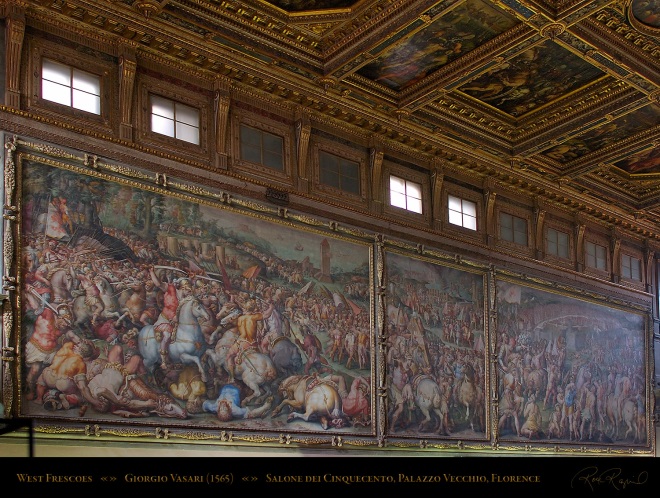
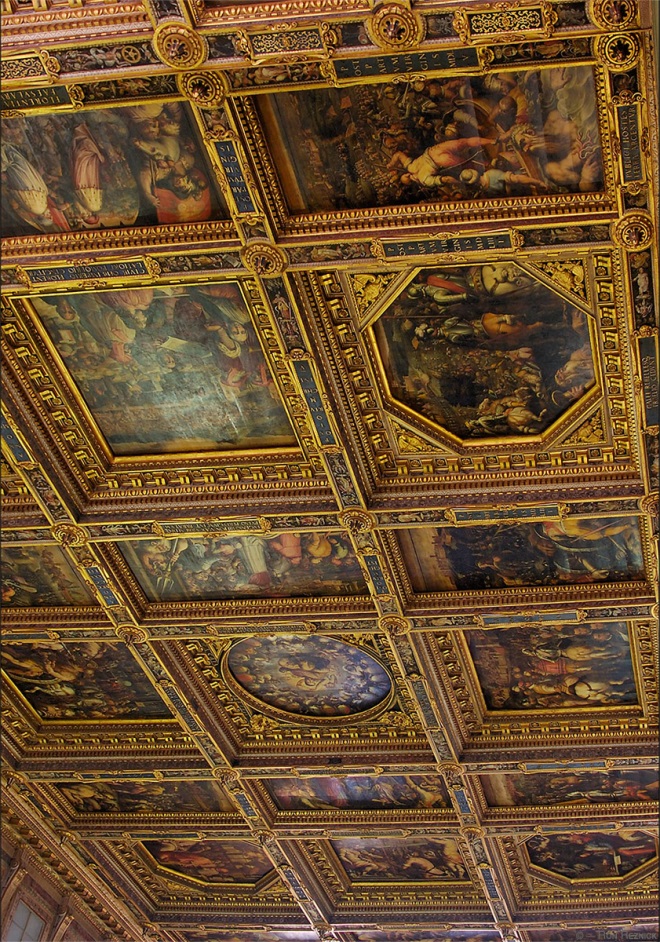
In the heart of the Palazzo Vecchio in Florence is the Salone dei Cinquecento (Hall of the 500), which, as the name implies, was designed to seat the 500 members of the Grand Council. In the 1560s, Giorgio Vasari was commissioned to create a series of frescoes on the walls and oil paintings on the ceiling of this hall.


Vasari_WestFrescoes_Hall_of500_5402

West Frescoes in Salone dei Cinquecento by Vasari 

(Photo by Ron Roznick)

The frescoes depict battles and military victories by Florence over Pisa and Siena (in chronological order, no less). These are massive pieces of art that are designed to impress visitors to the Hall, which functioned as the court of the Medicis. It is interesting that they are presented side by side with what look like extremely ornate panel borders. They are too large for the arrangement to be accidental, which means that Vasari (or his patrons) wanted these pieces to be close enough to create an effect larger than the sum of the parts.

It would be possible for a viewer to spend hours examining every detail in each fresco, but it is clear that the intended effect of the presentation is to impress visitors to the hall with both the military prowess and wealth of the city with the visual immediacy of how it has been successful in the past (and, by implication, could be in the future). It may only be because I read comics that this presentation reads as a three panel strip where the middle panel is less important than the two on the ends.


Ceiling_Hall_of500_5392

A portion of the ceiling of the Salone dei Cinquecento by Vasari 

(Photo by Ron Roznick)


The 39 oil paintings on the ceiling of the same hall represent great episodes from the life of Cosimo I and scenes from the history of Florence. The presentation of these paintings in a massive, ornate grid reminds this modern viewer (and reader of comics) of the carefully arranged panel grids of a comics page – especially since each of the paintings has its own descriptive caption. And there is even an implied order that these are meant to be viewed in; the circular painting in the center, for example, is The Apotheosis of Cosimo I de’ Medici which depicts his coronation by the personification of Florence.

Again, the intended effect is to produce awe at a government that had enough disposable income to commission such a piece. Keeping in mind that thirty feet of open space separates the ceiling and the viewer, the narrative aspect of the arrangement is less obvious on an initial viewing and only becomes evident with time to study the detail. But it is there.

(Better views of these pieces can be found at this site.)

These artworks take advantage of the basic artistic process that enables comics – the implied narrative- sequential connection that comes from placing two pieces of artwork near each other, regardless of whether those pieces are related or not.

The Salone dei Cinquecento is a good example of a narrative-sequential artwork outside of the comics tradition because it contains two distinct examples with very different approaches from the same creative team. It is easy to avoid referring to either work as “comics” because “comics” was not part of the artistic idiom at the time of creation. There are other examples, of course – narrative-sequential artwork is everywhere if you have a broad enough perspective.

And, to be honest, finding examples of narrative-sequential art from before the advent of comics-as-comics is almost too easy. What I find especially interesting are the 20th Century examples of non-comics narrative-sequential art, mostly because they arise outside of an explicitly comic-making tradition but are still contemporaneous with what we think of as modern comics.

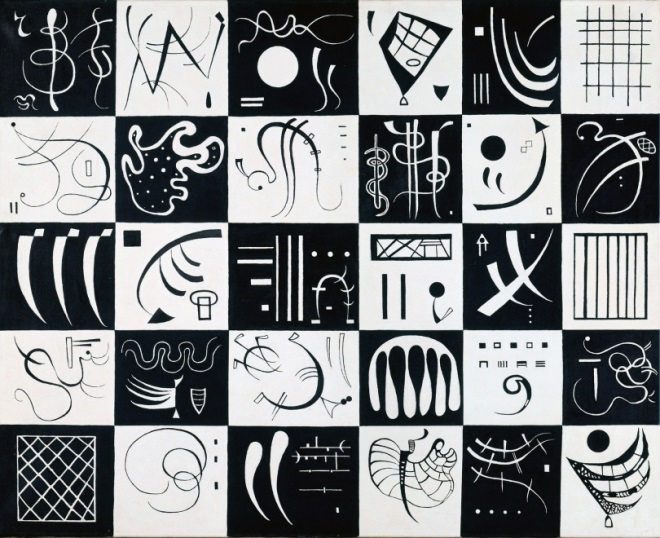
thirty by kandinsky

Wassily Kandinsky, “Thirty” (1937)

Kandinsky was living in Paris when he made Thirty, which means that he would have been aware of bandes desinees (BD) as a general cultural phenomenon. It is possible that he might have encountered it earlier in his travels around Europe, but it would have been impossible to miss it in Paris in the 30s. If he had wanted to make comics, there was ample opportunity for him to do so. He didn’t, but this was as close as he got.

Despite the fact that it is an explicitly abstract piece, Thirty still takes advantage of the implied relational connection that comes with arranging discrete pieces so close together. It is an extremely successful grid and provides an overt narrative framework for the viewer to build an interpretation around. If anything, this grid is closer to the effect generated by the ceiling of the Salone in Florence. It emphasizes the overall effect first and rewards subsequent scrutiny.

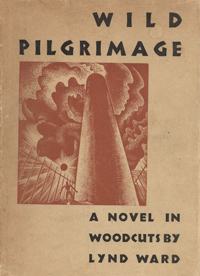
Wild Pilgrimage

Lynd Ward Wild Pilgrimage (1932)

There is little evidence that Ward was thinking in terms of comics when he produced his woodcut novels like Wild Pilgrimage. Comics were certainly around at the time, but they were largely regulated to the newspapers and comic books were still in their infancy.

Each page of Ward’s novel only has a single image and there are no captions, so these are comics-like at best. But these absolutely take advantage of the fact that images presented in sequence can be used to tell a story. As allegorical tales, Ward’s novels were tied to the worker’s movements of the times – a very different audience and purpose than American comics of the period.

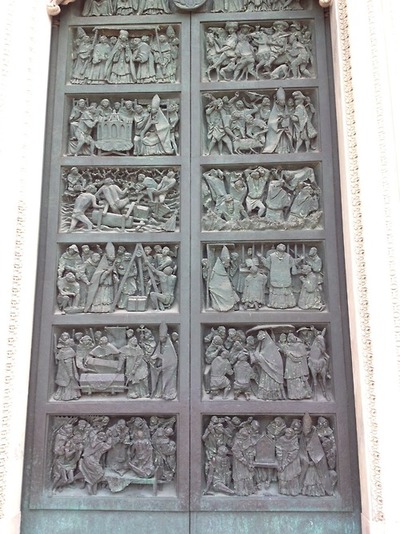
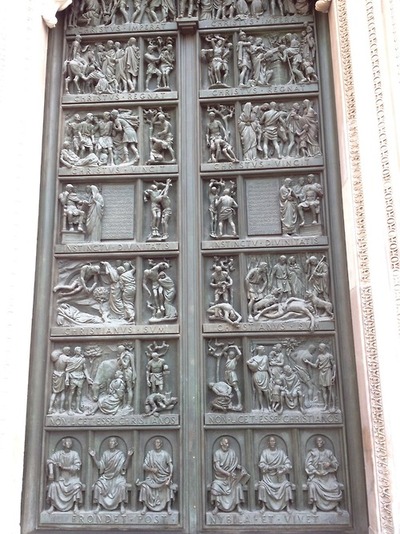
Milan Duomo 2Milan Duomo 1

Doors of the Milan Duomo (mid 20th Century)

Because I have taken Frank Santoro’s composition course, these doors remind me of the fixed grids that he teaches in his class. It absolutely makes sense that an artist attempting to produce a narrative in bronze would divide the available space into rectangles of equal size. It is a natural impulse and an obvious design solution. I have no idea who designed these doors or whether that person had a comics background. I’m happy to get more information if someone has it.

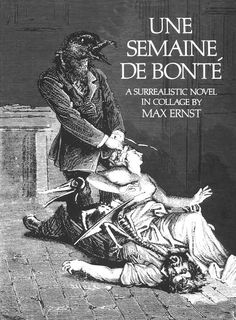
Une Semaine

Max Ernst, “Une Semaine de Bonte” (1934)

Like Kandinsky, Ernst was living in Paris when he worked on Une Semaine de Bonte, although he actually completed it in Milan. Like Kandinsky, Ernst would have been aware of the BD culture of the time – even if it was only a cursory cognizance.

Like Ward, Ernst’s novel takes advantage of the narrative aspects of art presented in sequential order to tell a story. Like Ward’s work, each page contains a single image and, unlike Ward’s work, these pages have captions more often than not. Despite the fact that they are contemporaries, there are very few other similarities between Ward and Ernst beyond the fact that they both arrived at the same solution (images in sequence) for the same purpose (to tell a story) from very different (non-comics) directions.

It’s tempting to categorize these kinds of explicitly narrative-sequential art as comics that don’t know that they’re comics. I think it’s safer to say that the idea of presenting artwork in sequence for narrative purpose is such an easy conceptual leap that it should not surprise anyone that it shows up so often in so many disparate places; diptychs, triptychs and other polyptychs have been acknowledged art formats in multiple cultures for centuries, if not longer.

Comics, specifically, are a refinement of the concept for a very specific purpose and medium. Rather than trying to shoehorn everything into the comics tradition because that’s the most obvious context for modern viewers, it would make more sense to think of it the other way around – comics are no more and no less than a distinct subset of the larger grouping of narrative art in sequence.

Having said that, it would not be a bad idea for contemporary comics creators to pay attention to these other examples of how past artists have used this technique to good effect. This is no different from telling creators to study how other artists have used color theory, figure drawing or one point perspective.


Superman: A Twentieth Century Messiah

(Editor’s Note: This was originally a paper for Chris Gavaler’s superhero class. We’re pleased to be able to reprint it here.)

Superman20Alex20Ross207

 
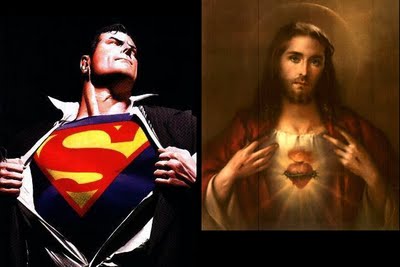
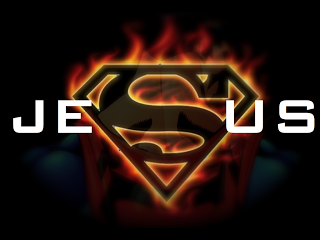
One may find it hard to look at the red underwear-clad Man of Steel as anything more than a super-powered illustration on the pages of Action Comics and the light of the big screen. However, when ignoring the tights and cape and analyzing Siegel and Shuster’s character closely, Superman can be seen as more than Jerry Siegel’s brainchild, but as the savior of the imagination of this young Jewish writer. Superman, or Clark Kent, first appeared in Action Comics No. 1 in June of 1938 right before World War II began in 1939, a time in which Jewish people needed a savior more than ever. In Superman Chronicles, vol. 1, a compilation of the earliest appearances of the Man of Steel, Siegel and Shuster introduce Superman, a modern messiah. Though the caped crusader’s stories are extremely dramatized and embellished when compared to his robed counterpart, the parallels of defending the oppressed, possessing unequalled power, and ultimately ushering in peace remain strong. Yet Siegel’s messiah surpasses his notion of the biblical messiah, Jesus Christ, through Superman’s conquering and avenging salvation of men. While both characters fulfill the messianic prophecies, Superman embodies the man of action that the oppressed Jews await. Here we see the pen of Joe Shuster and the mind of Jerry Siegel produce a fictional messiah comparable to Jesus of Nazareth in mission and grander than His spiritual salvation through physical action.

Jesus Christ and Superman both play the role of messiah, or leader and savior of a group of oppressed people. While salvation through Jesus is spiritual and salvation through Superman is physical, the mission of saving the oppressed remains constant. One of many messianic prophesies in The Holy Bible claims that the Jewish people “will cry to the Lord because of oppressors, and He will send them a Savior and a Champion, and He will deliver them” (New American Standard Bible, Isa. 19.20). Christians believe that this “champion” of the oppressed Jews came in the form of Jesus to deliver men from sin and to pave the way to heaven in His blood. In Action Comics No.1 when Clark Kent first dons his red and blue, Siegel introduces him as: “Superman! Champion of the oppressed. The physical marvel who had sworn to devote his existence to helping those in need!” (Siegel 4). Superman, like the prophesied messiah, is described as champion of the oppressed, but the deliverance he brings remains entirely physical and does not go beyond earthly oppression. In one of Superman’s earlier cases, he frees miners from the tyranny of a sadistic boss after which the newly enlightened boss, Blakely, asserts, “You can announce that henceforth my mine will be the safest in the country, and my workers the best treated…” to which Kent replies, “Congratulations on your new policy. May it be a permanent one! (If it isn’t, you can expect another visit from Superman!)” (Siegel 44). Superman caused Blakely to consider the abusive and dangerous conditions that he puts his workers through day in and day out, ultimately delivering them from their oppression. The Holy Bible proclaims: “God anointed Jesus of Nazareth with the Holy Spirit and with power. He went about doing good and healing all who were oppressed by the devil, for God was with Him” (English Standard Version, Acts 10.38). Though biblical Jesus did free the oppressed from the grasp of the devil and sin, the Jewish belief is that this deliverance is meant more tangibly in freedom from their worldly oppression, which Christ did not bring in their eyes. Though deliverances by Superman such as the salvation of Blakely’s mine workers in Action Comics No. 3 meet the Jewish stipulation obliging physical salvation, Christians believe that their spiritual deliverance is more than enough to call Him the champion of the oppressed. Whether physically super or spiritually godly, both men succeed in fulfilling this prophecy in their own way.

Though not quite as defining as the act of salvation, one of the most universal, unquestioned aspects of a messiah figure is the possession of unrivaled power and dominion. Powerful is an understatement when talking about “Superman, a man possessing the strength of a dozen Samsons!” (Siegel 84). He is a warrior and a powerful leader, capable of overthrowing corrupt rulers and strong-arming the evil. To the defenseless Jewish people in Europe, and even to these Jewish artists in the United States, these qualities made Superman the perfect messiah. Therefore, it is no coincidence that Siegel references Sampson’s strength, represented biblically when “a young lion came toward him roaring. Then the Spirit of the Lord rushed upon him, and although he had nothing in his hand, he tore the lion in pieces as one tears a young goat” (Judg. 14.5-6). Having already granted enormous physical power upon one of His servants, the Jewish people expected God to send a messiah with even greater physical power to lead them in battle against their oppressors. Again, Jesus’s power comes in a less tangible medium than His bulletproof analog. Superman, however, was granted this physical prowess by his Jewish “fathers,” continuing to directly allude to the story of Samson when “with incredibly agile movement, he twists aside, seizes Leo by the scruff of his neck… ‘Wanna play, huh?’… And carries the ferocious carnivore back to its cage as though it were a harmless kitten!” (Siegel 95). Instead of physical power to fight a lion, the gospel characterizes Jesus with the power and strength of character of God. He is called “Immanuel (which means, God with us)” (Matt. 1.23). As God on earth, Jesus is given “all authority in heaven and on earth” (Matt. 28.18). The bible seems to define power as spiritual authority rather than the physical strength of Superman Chronicles. Given that Jesus did not decide to use His authority to physically free the Jewish people from their Roman oppressors, instead choosing to defend men in spiritual warfare, it is not hard to see why some Jewish people of the time and in biblical times would prefer the tangible power shown by Superman. These passages do not only allude to Superman’s association with Old Testament prophecies, but they suggest that Siegel and Shuster considered these prophecies and stories during Superman’s conception, consciously creating a messiah figure.

Finally, the biblical Jesus and comic book Superman differ greatest in the nature of the peace reached through their actions. While both saviors usher in peace, the dichotomy of the spiritual repercussions of Jesus’s actions and the physical actions of Superman continues to appear. The Old Testament verse promises that the messiah “shall judge between the nations, and shall decide disputes for many peoples…nation shall not lift up sword against nation, neither shall they learn war anymore” (Isa 2.4). In biblical times, people believed that this promised peace between the Romans and the Jews, among other nations, and this would give them their salvation and deliverance. Though Superman uses a vast amount of violence, he is constantly fighting for peace. In one of the Man of Steel’s most broad—and possibly his most destructive—rescues, he attempts to save the slums when he discovers that “‘the government rebuilds destroyed areas with modern cheap-rental apartments, eh?’ Building after building crashes before his attack! ‘Then here’s a job for it! – When I finish, this town will be rid of its filthy, crime-festering slums!” (Siegel 109). This passage acts as the perfect image of the messiah figure riding into battle to create peace among his people through completely active, violent, and destructive means. While Superman, or rather his writer Jerry Siegel, seems to prefer this method of justice, comic book readers can discover examples of peace through diplomacy. In Action Comics No. 2, he even settles a war between nations by bringing the opposing war-lords together and explaining: “‘Gentlemen, it’s obvious you’ve been fighting only to promote the sale of munitions! – Why not shake hands and make up?’ And so, due to the conciliatory efforts of Superman, the war is halted” (Siegel 30). Shuster draws Superman as a logical, supportive mentor, helping men to choose peace themselves rather than forcing it upon them. In the same way Jesus, King of the Jews, sought to bring His people to spiritual and eternal peace through His defeat of death in the form of resurrection. He points back to the prophecy in Isaiah by reassuring His disciples that “I [Jesus] have said these things to you, that in me you may have peace. In the world you will have tribulation. But take heart; I have overcome the world” (John 16.33). This promise does not assure that God’s people will live life on Earth in utter peace and harmony, at least by the society’s definition, but rather looks to the peace granted by admission to the eternal paradise of heaven. However, Jesus does additionally promise peace on Earth in the form of the Holy Spirit, referred to the Spirit directly as “Peace” in reciting: “Peace I leave with you; my peace I give to you. Not as the world gives do I give you” (John 14.27). Though this peace is more physical than that spoken of in the passage above, it remains a spiritual peace in that it perpetuates as an inner peace despite the trials and tribulations of life. The peace brought by Superman does not deal with the spiritual or how people deal with situations, but focuses entirely on eliminating as many tribulations as possible; therefore, Superman’s goal of peace is yet to be realized. Regardless of the completion of his goal, the physical and spiritual missions perpetuated by Superman and God-as-man yield sufficient peace to bestow both heroes with the title of a messianic peace-bringer.

While Siegel found inspiration for the last son of Krypton in the only begotten Son of God, the two differ in one very distinct way: Jesus is the spiritual savior of eternal life while Superman is the physical savior of life on earth. In their defense of the weak, their strength in battle, and their strides towards peace, it is fitting to call Superman the Messiah of the twentieth century, at least in the fictional comic book world. With Nazi Germany attempting to enslave and oppress the Jewish people, the physical salvation of Superman would understandably sound more appealing to some than a spiritual salvation, just as it may have to the Jews of biblical times under the heel of the Roman empire. Just as the Christian messiah reshaped the religion of those Jews who accepted His teachings, “Superman is destined to reshape the destiny of a world!” (Siegel 16)… at least in the comic books and in the minds of his avid readers.


Works Cited

The Holy Bible, English Standard Version. Wheaton, IL: Crossway, 2010. Print.

Holy Bible: Updated New American Standard Bible. Anaheim, CA: Foundation Publications, 2007. Print.

Siegel, Jerry and Joe Shuster. Superman Chronicles. V1. New York, NY: DC, 2006, Print.

JesusSuper0011

(Tyler Wenger is an upcoming sophomore at Washington and Lee University from Franklin, TN. He is a pre-med student planning on majoring in Neuroscience and he has been both a Christian and a die-hard Superman fan for his entire life.)

Unnaturally Green: The Superhero in Wicked

Editor’s Note: This essay was originally written for Chris Gavaler’s superhero class. We’re pleased to be able to reprint it here.
 

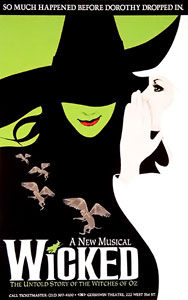
Wicked-poster

 
The Wonderful Wizard of Oz by L. Frank Baum, published in 1900, has captivated American culture and spawned numerous book, film, and stage adaptations which play with the original narrative. The novel Wicked: The Life and Times of the Wicked Witch of the West by Gregory Maguire was brought to the stage and became one of the most famous musicals of all time. Wicked: The Untold Story of the Witches of Oz by Steven Schwartz premiered on Broadway in 2003, and a national tour directed by Joe Mantello recently visited Altria Theater in Richmond, VA for performances in April and May of 2014. This twist on the traditional Ozian tale presents the Wicked Witch of the West as the hero, using her powers to fight an oppressive regime. Her narrative mimics many plot elements in Gladiator, a novel by Philip Wylie; Superman Chronicles, a comicbook collection by Jerry Siegel; and Zorro, a film directed by Fred Niblo. All three of these draw from the superhero genre, borrowing a set of standard tropes identified by Blythe and Sweet in “Superhero: The Six Step Progression,” Coogan in Superhero: The Secret Origins of a Genre, and Reynolds in Super Heroes: A Modern Mythology. Wicked warps The Wonderful Wizard of Oz into a superhero story. Elphaba’s powers, origins, dual identities, mission, and outsider status all mark her as a bona fide superhero, in the same hallowed ranks as Superman and Zorro.

Blythe and Sweet, Coogan, and Reynolds all agree that “a superhero by definition has super powers” (Blythe and Sweet). Elphaba meets this essential requirement, possessing powers on par with Hugo Danner, Superman, and Zorro. She is born with the ability to read the Grimmerie, “The Ancient Book of Thamaturgy and Enchantments” with ease, while her sorcery tutor, Madame Morrible, required “years of constant study” to “read a spell or two” (Schwartz 1.13). Elphaba gives herself the power of flight with a “levitation spell” on a broom shortly after she obtains the book (Schwartz 1.14). Even without the Grimmerie, Elphaba is a powerful sorceress, capable of telekinesis and mind control; Morrible recognizes Elphaba’s unusual powers: “Many years I’ve waited for a gift like yours to appear” (Wicked,Schwartz 1.2). Blythe and Sweet also stipulate that a superhero’s powers must be “limited” to allow a “possibility for conflict” (Blythe and Sweet). Hugo Danner, a superhuman, may have “inklings of invulnerability,” but can be killed “by the largest shells” (Wylie 20, 77). Superman has nearly identical powers to Hugo, but can be disabled by an electric shock and “can’t survive fire” (Siegel 192). Zorro is a master swordsman and clever freedom fighter, but he is mortal and can be killed like any normal man (Niblo). Elphaba discovers her limitations too, finding that her “spells are irreversible,” making her unable to reverse her spell that painfully implanted wings in Chistery’s shoulders (Schwartz 1.13). When she first discovers her powers, she claims she is “unlimited,” but later, she revises her tune, saying: “Just look at me—I’m limited” (Schwartz 1.2, 2.8). Like other superheroes, Elphaba has limited powers that elevate her above the common man.

Elphaba’s origins—her acquisition of powers and her upbringing—draw heavily from standard plot elements present in Gladiator, Superman Chronicles, and Zorro. Elphaba’s father gives her mother a “drink of green elixir” before their sexual encounter. Neither of her parents shares her unusual pigment or her powers, so the beverage is the implied source of her abilities (Schwartz 1.1). In a virtually identical scene, Hugo obtains his powers from a serum of “alkaline radicals” injected into his mother after his father, Abednego, drugs her with “opiate” in “a bottle of blackberry cordial” (Wylie 3, 9). Reynolds discusses upbringing in his definition, stating that the hero “often reaches maturity without having a relationship with his parents” (16). Elphaba’s father is the Wizard of Oz, but her mother is married to the Governor of Munchkinland (Schwartz 2.14, 1.2). Because of this, Elphaba never knows her true father, and is raised by her stepfather. Superman is also brought up by foster parents, since his biological parents die on “the doomed planet” of Krypton (Siegel 195). His foster parents die before he takes on his superheroic cause, leaving him without parents when he reaches adulthood (Siegel 196). Elphaba’s mother dies giving birth to her younger sister, Nessarose, and she has no relationship with her stepfather, who blames her for her mother’s death, openly despises her, and only sent her to school to look after her sister: “Elphaba, take care of your sister. And try not to talk so much” (Schwartz 1.7,2). Similarly, Zorro’s father ridicules his apparently weak, idiotic son, unaware that Diego Vega is Zorro (Niblo). Hugo is a “foreign person” to his father, and they never become friends; even trying “to open a conversation” with his father is a hopeless cause (Wylie 20, 121). All three characters deal with an absent father figure. The way Elphaba obtains her powers and her lack of good parenting show similarities to other superhero narratives, demonstrating that her origins fall within the well-established tropes of the genre.

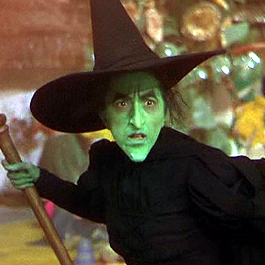
All three definitions agree that a superhero must have a dual identity, an “everyday persona” coupled with a “superpowered self” (Blythe and Sweet). Reynolds states that the “extraordinary nature of the hero will be contrasted with the mundane nature of the alter ego” (16). Elphaba assumes the identity of the Wicked Witch of the West, much like Diego Vega becomes Zorro and Clark Kent becomes Superman. Coogan claims that a superhero identity “comprises the codename and the costume,” with the codename representing the hero’s “inner character” and the costume being an “iconic representation” of that inner character (32, 33). As an example, Coogan argues that Superman’s codename identifies him as “a super man who represents the best humanity can hope to achieve” and his costume emblazons the first letter of his codename on his chest (33). Elphaba adopts a superhero identity described by Madame Morrible: “Her green skin is but an outward manifestorium of her twisted nature! This distortion! This repulsion! This Wicked Witch!” (Schwartz 1.14). Elphaba’s codename fits her, because her primary power is sorcery, and “she is evil” in the eyes of the people of Oz (Schwartz 1.14). The language Morrible uses in reference to Elphaba’s “unnaturally green” skin is almost identical to Coogan’s description of the superhero costume: her skin represents the power and supposed evil inside her (Schwartz 1.1). She loses her glasses when she becomes the Wicked Witch, much like Clark Kent puts them away when he dons his Superman attire (Schwartz, Siegel). However, unlike Superman and Zorro, Elphaba does not switch back and forth between her identities. She permanently transforms into her superhero identity at the end of the first act, saying: “Something has changed within me” (Schwartz 1.14). Elphaba has the superhero’s dual identities, and her codename and costume match Coogan’s idea that they are outward manifestations of inward character.

Elphaba transforms into the Wicked Witch to accomplish a superheroic mission identical in principle to those of Superman and Zorro. Coogan argues that “the superhero’s mission is prosocial and selfless” (31). Hugo Danner’s mission is not prosocial and selfless, and Coogan notes he “gains personally from his powers,” but Elphaba, Superman, and Zorro all fit Coogan’s idea of the hero working for society’s benefit (31). Elphaba recognizes that “something bad is happening to the animals” as they are being stripped of their rights to speak (Schwartz 1.4). Though she is not an animal, she pursues justice for them when she meets the Wizard. She opens her case to the Wizard by saying, “We’re not just here for ourselves,” showing her altruistic motivations (Schwartz 1.13). She adopts her identity to fight the Wizard, who enforces the “reporting of subversive Animal activity,” once she realizes he will not defend them and that she must (Schwartz 1.14). Most of her heroic actions occur off stage, but in a conversation with Elphaba, Nessarose reports: “You [Elphaba] fly around Oz, trying to rescue animals you’ve never even met” (Schwartz 2.2). She performs superheroic deeds on stage as well. She uses a spell to give crippled Nessarose the ability to walk, she saves Boq from death by turning him into a tin man, and frees flying monkeys held captive by the Wizard (Schwartz 2.2,3). Elphaba could fit the description pinned to both Zorro and Superman–a “champion of the oppressed” (Niblo, Siegel 196). Zorro states that he fights for “justice for all,” and says, “to rid our country of a menace is a noble deed”, clearly identifying his driving motivations (Niblo). Similarly, Superman uses his powers in a “one-man battle against evil and injustice” (Siegel 84). Elphaba’s mission is exactly the same, fighting the injustice in Oz, serving as a champion of the oppressed animals.

The superhero’s mission makes them an outsider, viewed as evil by the general populace because “the superhero transgresses man’s petty laws” (Blythe and Sweet). Reynolds states that “the hero is marked out from society” (16). They often fight the establishment, because “the hero’s devotion to justice overrides even his devotion to the law” (Reynolds 16). Superman is called “the devil himself,” Zorro is called a “graveyard ghost,” and Elphaba is called “the wickedest witch there ever was” and “the enemy of all of us here in Oz” (Siegel 11, Niblo, Schwartz 1.1). Superman works above the law. His most drastic vigilante action involves reducing a ghetto to “desolate shambles” so that its reconstruction will guarantee “splendid housing conditions” (Siegel 110). From then on, police seek to “apprehend Superman” (Siegel 110). Zorro fights the government which is oppressing the poor, and a contingent of governor’s troops set out to capture him (Niblo). Elphaba first attempts to work within the law, appealing to the Wizard on behalf of the animals (Schwartz 1.13). When the Wizard refuses to comply, she says, “I’m through with playing by the rules of someone else’s game,” and becomes the Wicked Witch, a vigilante fighting for the animals and defying the Wizard, the ruling authority in Oz (Schwartz 1.14). She is outcast because society views her deeds as an evil: “Wickedness must be punished. Kill the witch!” (Schwartz 2.7). Elphaba’s defiance of law and order makes her an outsider who is hunted and viewed as wicked, much like Superman and Zorro.

Elphaba’s superpowers, origins, dual identities, altruistic mission, and outsider status all fit the well-established tropes of the superhero genre. Though the musical is not advertised as a superhero story, it contains all the necessary ingredients for one. Elphaba meets the superhero definitions of Blythe and Sweet, Reynold, and Coogan. She also draws story elements from Gladiator, Superman, and Zorro. Elphaba’s mission ends when she sees Glinda the Good send the Wizard away; with Glinda’s rule, the animals will no longer be oppressed. Her mission accomplished, Elphaba leaves Oz with her love Fiyero, akin to Zorro’s retirement and marriage to Lolita once he causes the governor to abdicate (Schwartz 2.9, Niblo). While the musical ends with Elphaba and Fiyero walking off into the night, it is not entirely implausible to imagine her coming to Earth and teaming up with this world’s mightiest heroes. The Wicked Witch of the West could be the next member of the Avengers or the Justice League; with all her similarities to those supermen, she would fit right in.


Works Cited

Blythe, Hal, and Charlie Sweet. “Superhero: The Six Step Progression.” The Hero In Transition. Bowling Green: Popular, 1983. Print.

Coogan, Peter. Superhero: The Secret Origin of a Genre. Austin: MonkeyBrain Books, 2006. Print.

Reynolds, Richard. Super Heroes: A Modern Mythology. Jackson: Univ. Press of Mississippi, 1992. Print.

Schwartz, Steven. Wicked: The Untold Story of the Witches of Oz. 2003. Web. <http://wickedthemusicalscript.blogspot.com/>.

Siegel, Jerry and Joe Shuster. Superman Chronicles. V1. New York: DC, 2006, Print.

The Mark of Zorro. Fred Niblo. United Artists, 1920. Film.

Wicked: The Untold Story of the Witches of Oz. By Stephen Schwartz. Dir. Joe Mantello. Altria Theater, Richmond. 2 May 2014. Performance.

Wylie, Philip. Gladiator. New York: Alfred A. Knopf, 1930. Print.

wicked-witch

(Joy Putney is an engineering and biology major at Washington and Lee University. When she’s not doing mad science, she loves writing fantasy novels, playing the oboe, and fighting crime.?)

Tarzan of the Moral Imbeciles

tarzan sunday comic strip

 
My father’s parents never learned much English. Their newspaper included only one comic strip, Tarzan, translated into Slovak. Mutineers didn’t maroon them on the jungle shores of rural Pennsylvania, but like Tarzan’s parents, they settled in a strange land oceans from their ancestral homeland. Tarzan swung into newspapers on January 7, 1929, same day as Buck Rogers, and so another Minute Zero in superhero history. The strip expanded to a Sunday full page in 1931, the year my father was born. Jerry Siegel was soon parodying it in his school newspaper with “Goober the Mighty,” the oldest and least promising of Superman’s siblings.

My grandparents were still new to the U.S. when All-Story Magazine published Edgar Rice Burroughs’ Tarzan of the Apes in 1912. It was an instant, imitation-spawning hit. Charles Stilson’s 1915 Polaris of the Snows swapped Africa and apes for Antarctica and polar bears, but it’s the same formula (especially since there are no polar bears in Antarctica and no “anthropoid apes” anywhere). Stilson wrote two more Polaris novels (and his own ending to Tarzan of the Apes since Burroughs’ marriage plot cliff-hanger annoyed him so much), but as the King of the Jungle expanded his reign to stage and film and radio, imitators stopped disguising their loin-clothed knock-offs: Bomba the Jungle Boy (1926), Morgo the Mighty (1930), Jan of the Jungle (1931), Bantan (1936), Ka-Zar (1936), Ki-Gor (1939).
 

polaris of the snows

 
Of course Tarzan was a knock-off too. He’s a lost worlder, the genre H. Rider Haggard kicked off in 1885 with King Solomon’s Mines and into which Doc Savage and Superman boldly followed. Burroughs also swapped out Rudyard Kipling’s India and wolves; his jungle isn’t that different from Mowgli’s. W. H. Hudson preferred Venezuela for his 1904 jungle girl Rimi in Green Mansions. DC adopted Rimi decades later, when the softcore jungles were already well-endowed with leopard-furred felines. Eisner and Iger’s Sheena beat Superman to comic books by a year, with literally dozens swinging behind her. Stan Lee tried Lorna the Jungle Queen in the 50s and in the 70s Shanna the She-Devil. She later married Ka-Zar, Marvel publisher Martin Goodman’s first pulp jungle man who re-premiered in Marvel Comics No. 1 beside Namor and the Human Torch. Stan Lee transplanted him to Polaris’ Antarctic lost world, swapping out ancient Romans for ancient dinosaurs.
 

ka-zar and x-men

 
My father and his friends debated who would win in a fight: Tarzan or Buck? Tarzan or the Phantom? Tarzan or Batman? If you don’t think a loin cloth counts as a superhero costume, remember the original Jungle King is also secretly the English aristocrat Lord Greystoke. If that’s not enough of an alter ego, reread chapter 27, “The Height of Civilization,” in which the former savage transforms into Monsieur Tarzan, a French-speaking socialite who on a gentleman wager can strip off his tux, wander naked into the wilds, and return two pages later with a lion across his shoulders.

Burroughs calls him a literal “superman,” the first time the eugenic term immigrated into pulps, evidence of its own genre expansion. Corn flake tycoon John Kellog founded the Race Betterment Foundation in 1906, and Indiana, with a boost from future president Woodrow Wislon, passed the nation’s first sterilization law a year later. In 1911, the American Breeder’s Association added immigration restrictions, racial segregation, anti-interracial marriage laws, and gas chamber “euthanasia” in the fight to stop unfit breeding, while the First International Eugenics Congress met at the University of London the following year to discuss the same agenda.

Burroughs did not attend, but he was a fan. One biographer describes him as “obsessed with his own genealogy” and “extremely proud of his nearly pure Anglo-Saxon lineage,” believing in the “extermination of all ‘moral imbeciles’ and their relatives.” The October issue of All-Story hit stands a few weeks after the Eugenics Congress convened. I doubt Winston Churchill ever touched an American pulp mag, but he and his fellow attendees agreed with Burroughs’ bewildering ideas about genetics. I always photocopy chapter 20, “Heredity,” for my class. Despite being reared by apes, the young Lord Greystoke knows how to bow in a courtly manner, “the hall-mark of his aristocratic birth, the natural outcropping of many generations of fine breeding, an hereditary instinct of graciousness which a lifetime of uncouth and savage training and environment could not eradicate.”

DNA wouldn’t be discovered for decades, so Eugenicists thought they could weed out everything from crime to promiscuity by stopping unfit parents from giving birth to unfit babies. One of those babies was my dad. His honky parents hailed from the degenerate regions of the Austrian-Hungarian Empire, what anti-immigration advocates called “beaten men from beaten races; representing the worst failures in the struggle for existence,” men with “none of the inherited instincts and tendencies which made it comparatively easy to deal with the immigration of the olden time.” That’s why Congress capped the immigration quota for Eastern Europeans at 2% of their 1890 U.S. population.  But my grandparents had already weaseled in.

Adolf Hitler was a private in the Austrian-Hungarian Army at the same time and in the same city as my grandfather, but rather than accept a second conscription, Stefan Gavaler bound over the Tatra Mountains to land in Carrolltown, PA. He died in the kind of mining accident Superman tries to prevent in Action Comics No. 3 (“Months ago, we know mine is unsafe—but when we tell boss’s foremen they say, ‘No like job, Stanislaw? Quit!’”). One of Stefan’s sons went on to marry the daughter of a corporate vice-president of good German stock and produce just the sort of Aryan-diluting mongrel Burroughs most feared: me.

Tarzan, however, marries well. After learning he’s not a half-ape but an undissipated carrier of high English blood, he foregoes both his kingdoms to pursue the eugenically fit daughter of an American professor to the woods of Wisconsin.  It takes a second book for Jane to marry him, and a third to produce a son. Burroughs wrote a sequel almost every year until 1939. Tarzan (the name means “white skin” in anthropoid ape language) could wrestle a gorilla into submission, but Adolf Hitler was too much for him. After Nazi Germany, Eugenics retreated into a lost world in the cultural jungle. Burroughs only published one more Tarzan novel before his death in 1950.

I think Disney was the first to send Tarzan to Czechoslovakia. A Slovak-dubbed version of the song “Son of Man” is on youtube. I can’t understand a word of it, but I’m happy it exists.
 

tarzan48

Editorial Cartoons: Is Michael Sam gay? or is he black?

A lot of media attention has been paid lately to the case of American football generally and the National Football League in particular. Recently, the NFL drafted its first openly gay man into its ranks, causing a great deal of celebration in some quarters and a high degree of consternation in others. As a fan of (American) football, I am interested in this story because of what it says about the social implications for individual players, team camaraderie, and the fans, too. I am thinking about this because I try to be mindful about and supportive of efforts to eliminate discrimination and promote equality regarding race and ethnicity; regarding sexual orientation; regarding gender; and regarding socioeconomic class.

Since I currently live in Sweden, I don’t see all the news (infotainment) about current events in the U.S., so what I have seen of the Michael Sam story I have found through websites that I visit on occasion. I saw stories on my BBC phone app; on Queerty.com and Advocate.com; and on other random links I saw on Facebook. What I did not see, though, in any instance, was editorial cartoons about this event, so I went hunting for them. Using a Google search, I found a few cartoons, some of which focused on Michael Sam’s race and others on his sexual orientation.

I include below some randomly chosen cartoons depicting some facet of the Michael Sam case. Does the cartoonist in each instance focus more on representations of race, more on representations of sexual orientation, or some combination of both?

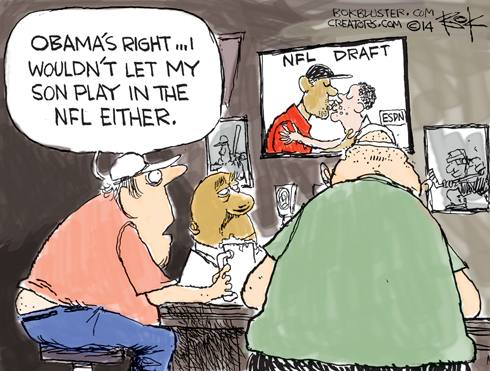
Bok (bokbluster.com/creators.com)

bokbluster.com

The first cartoon borrows President Obama’s earlier discourse regarding the NFL and the incidence of concussions and traumatic brain injury. Bok makes a connection between working class men, beer drinkers, and anti-gay prejudice. (Because of the perspective, we don’t see the butt crack, but we know it’s there and it is revealed.) The image on the television screen is of two men kissing. What is not clear is how the characters in the panel would react to the fact that it is apparently two men of different racial identities kissing. Since it is set in a ‘sports bar’ (pictures of hockey and baseball on the wall), readers might assume that it is a bold statement this man makes about not having a son play in the NFL.
 
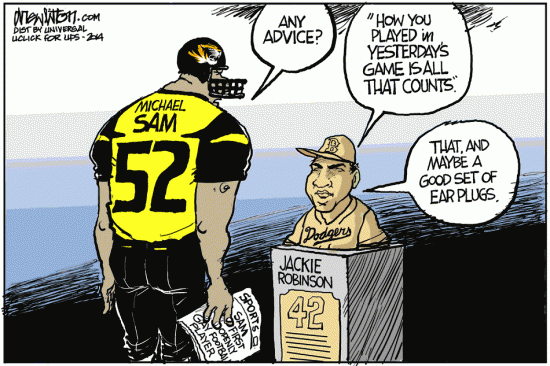
Drew Litton (http://www.drewlitton.com/)

drewlitton.com

 
This cartoon draws on the historical significance of racial integration in baseball (an interesting sports cross-over). Litton uses visual cues to communicate Michael Sam’s race, but he uses linguistic cues to communicate Sam’s sexual orientation (the newspaper in his hand). Robinson is pictured wearing his Dodgers uniform (the team he joined) but Sam is wearing his Missouri uniform (not yet having been drafted by the St. Louis Rams).
 
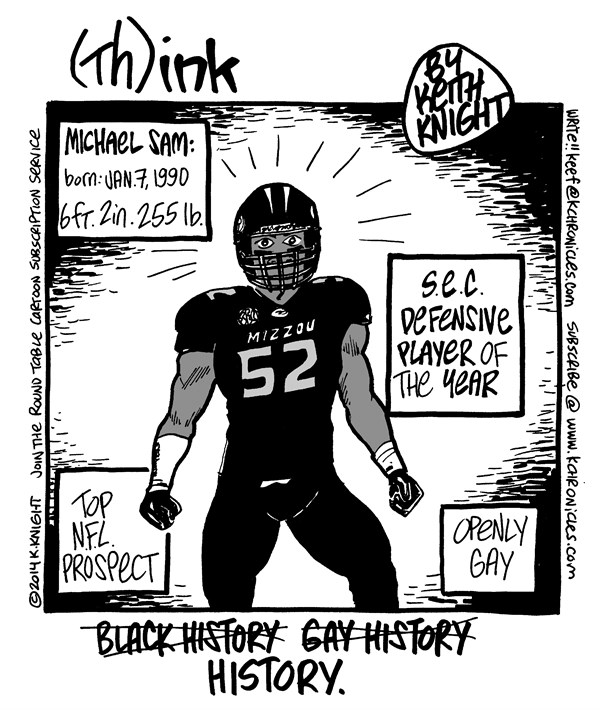
Keith Knight (www.cagle.com)

http://www.cagle.com/2014/02/michael-sam/

 
Knight’s technique relies much more on linguistic cues to communicate his thoughts about Michael Sam. It may be that Knight uses Sam’s stats rhetorically to establish the rationale for the caption, which shows the linguistic struggle over how to name the importance of this event. Knight decides that it is neither Black History nor Gay History but History.

In her 2009 article published in Visual Communication, Elisabeth El Refaie writes about visual literacies and the processes that readers use to understand political cartoons. Her essay is a pilot study exploring how readers make sense out of the visual and verbal elements in a panel. In her analysis, El Refaie explores five questions regarding the ‘multiliteracies’ required to understanding these cartoons: “How do readers: (a) establish the real-world referents of a cartoon; (b) impose a narrative on the cartoon image; (c) interpret the facial expressions of the depicted participants; (d) understanding text-image relations; and (e) establish metaphorical connections between the fictional scene of the cartoon and a political argument?” (p. 190).

What interests me about the range of cartoons shown above is how few of them rely on metaphorical representations to communicate their messages. Most of them are relatively literal scenes: representations of people having conversations about Michael Sam, or Michael Sam himself having a conversation about his future. Research on editorial and political cartoons discusses the tendency for artists to make their commentary using metaphor: combining two very different domains for the reader to interpret. (For more on cognitive metaphor in cartoons, see Bounegru & Forceville 2011; El Refaie 2003; among  others.)

In my very limited search for cartoons about Michael Sam, I found just a very small number that relied on metaphor to communicate the meaning. Here is an example:
 
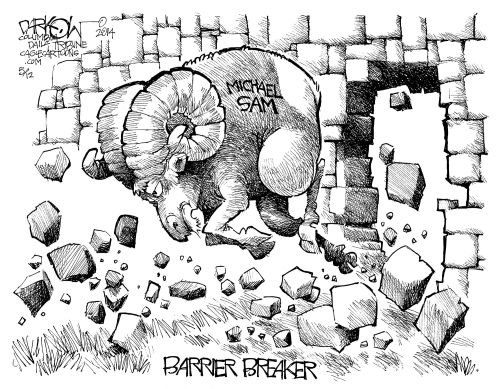
John Darkow (columbiatribune.com)

http://www.columbiatribune.com/opinion/darkow_cartoons/

 
Readers familiar with the story will know that Michael Sam was drafted by the St. Louis Rams. This cartoon by Darkow communicates a similar message to the cartoon by Keith Knight (above), that race and sexual orientation should somehow be subsumed in the general meaning of the cartoon and that the ‘simple’ fact of the draft should be highlighted. One major difference is that the Darkow comic relies on metaphor and the Knight comic is a more literal representation. In fact, ‘Barrier Breaker’ is drawn in such a way that it erases all mention of sexual orientation and it erases all mention of race. The metaphor of a ram breaking through a wall is clear to the reader only if the reader already knows the discourses that play a role in the Michael Sam case. (Under other circumstances we would need to consider underlying or implicit prejudicial messages: the jokes that could be told about a gay man joining a team called the Rams; the jokes that could be made about a black man being represented by a ram.)

It is no surprise, of course, that cartoonists would choose to highlight certain aspects over others. The intersections of race and of sexual orientation in this particular situation—professional sports in the U.S.—are a virtual minefield. Is it safer for cartoonists to create a more literal representation than it is to create a metaphorical representation? Is it simply too difficult to navigate the issues metaphorically? Understanding political cartoons is a complex act of reading that draws on multiple types of literacies and relies on a vast array of knowledge and cultural discourses. Likewise, creating cartoons demands that artists focus on some aspects of an issue or story and leave out other aspects.

I ask readers of Pencil Panel Page and Hooded Utilitarian to provide their own examples of cartoons regarding Michael Sam or regarding similar situations. How do race and sexual orientation function in the commentary of political cartoons?