Avengers Assemble! The American Novel Since 1950

We do seek out new Avengers!


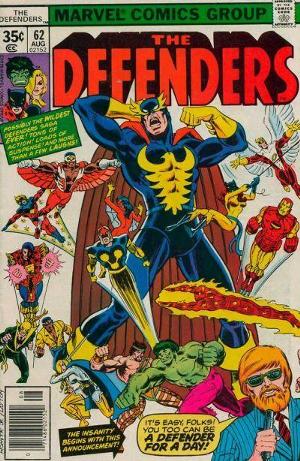
As a kid reading comics, I loved when superhero teams scrambled their rosters. For The Avengers No. 137, “We Do Seek Out New Avengers!,” Vision and the Scarlet Witch left on their honeymoon, Yellowjacket and Wasp rejoined, and Moondragon replaced the recently deceased Swordsman, leaving Hawkeye’s spot (he went off in a time machine to find the Black Knight) to be filled via an open call at Shea Stadium, where only the Beast showed up. Sounds easy, but when the Defenders televised a similar recruiting call three years later, the team was inundated with 23 would-be members, from canonical crushers Captain Marvel and Iron Man (cover appearance only) to inspired backpagers White Tiger and Prowler.

The Defenders No. 62 cover features team leader Nighthawk holding his apparently throbbing head and roaring at the impressionistically pint-sized heroes buzzing around him. Which is how I feel as I juggle the roster for a would-be course on the recent American novel. Even my open call “I Do Seek Out American Novelists!” attracts trouble, since that Canadian crusher Margaret Atwood showed up in the Shea Stadium of my brain (so does that mean I have to add “North” to the course title?). I already sent her Nobel-winning countrywoman Alice Munro home on a technicality (“Novel” not simply “Fiction”), which still leaves over twenty superpowered authors buzzing across my cover.


>300px-Defenders_Vol_1_62

Writer Steve Englehart and editor Marv Wolfman weighed a dozen factors when revising the Avengers in 1975. It must be hard tossing out fan favorites like Wanda and Vision, but see how they replaced them with another married couple? And notice how they improved gender distribution by swapping in Moondragon?  (Though, okay, the female count plummeted back to one when Wasp gets hospitalized in her return issue). Of course you still want some of the old standards, Thor and Iron Man, while leaving room for an unexpected choice like the newly blue-furred Beast. And what happens when you put all these costumes in the same room? How do they get along?

Syllabus-assembling makes the same demands: are these powerful books, a balanced range, what story do they tell when they stand shoulder-to-shoulder? By balanced, I mean are half by women? Are half not by white authors? It’s not political correctness but good storytelling. If a course representing the last sixty or so years of the American novel consists mostly of Caucasian men, the story is: white guys write the best stuff. That’s a stupid story, so I know four of my roughly eight slots are going to be filled by women, and four by non-WASPs. Though that doesn’t reduce the swarm of authors in Shea Stadium much.

The Englehart-Wolfman Avengers range from the team’s oldest character (Henry Pym was buzzing around in 1962) to the two-year-old Moondragon (plucked from the 1973 pages of Daredevil). When I taught a 21st century American lit course, I had about the same age range and so felt free to juggle the reading order by convenience and whim. But a span of sixtysome years requires a more disciplined time machine. Start in the 50s and bound forward decade by decade. That draws attention to gaps though, so suddenly distribution matters too. That’s one of many good reasons that Leslie Marmon Silko’s Ceremony made my first cut, as a rep of my underpopulated 70s favorites (I prefer that decade’s short stories).  It also means my overpopulated 80s is a problem, so DeLillo’s White Noise could be in trouble.

And what about genre types? In addition to two insect-sized humans, the 1975 Avengers include a mutant, an alien-trained telepath, a cyborg, and a god. So I should probably hit the key literary schools too. Pynchon is an easy pick for Metafiction, though Nabokov’s Pale Fire is even more fun. New Journalism’s “nonfiction novel” list is harder to prune: Capote, Mailer, Thompson, Didion, and of course my college’s beloved alum Wolfe. But if experimental memoirs are fair game, then I want Kingston’s Woman Warrior on my team (okay, maybe I do like the 70s). So maybe it’s better to swat away all things nonfiction?

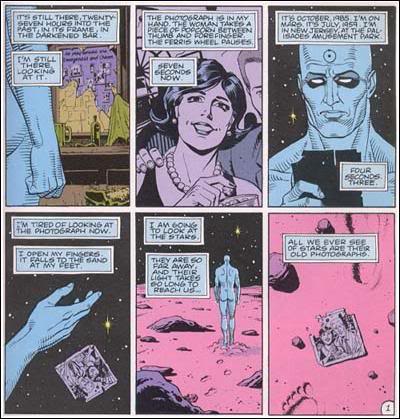
I called my 21st century fiction course Thrilling Tales and focused on the pleasant collision of traditional literary novels with the formerly lowbrow genres of scifi, fantasy and mystery. I could make the second half of the 20th century an Old Testament to that thesis. Atwood’s The Handmaid’s Tale is an alternate future, and Morrison’s Beloved a ghost story. Chabon won his Pulitzer for transforming superheroes into literary subject matter, and what’s The Crying of Lot 49 but a riff on thriller conventions? Egan’s genre-splicing A Visit from the Goon Squad could cap it all, and, for a truly blue-furred freak, I could shoehorn Alan Moore and Dave Gibbons’ Watchmen (I know, Moore’s British, but he was living in the States at the time of his very American collaboration, which, by the way, made Time’s ALL-TIME 100 Novels, thank you, Lev Grossman).

If you want to push the genre angle even further, swap out Flannery O’Connor for Patricia Highsmith. Or revise the subtitle to “Since World War 2” and open with Wright’s Native Son. Trade Pale Fire for Lolita and suddenly the course opens with a legion of supervillains: Bigger Thomas, Mr. Ripley, Humbert Humbert. Maybe I need to read Bret Easton Ellis’ American Psycho next? Baker’s The Fermata is a bound too far, though White Noise and its “Hitler Studies” is back in the running. I was thinking about Jones’ The Known World, but I just finished Whitehead’s Zone One, and all those zombies pair so well with the horrors of Beloved and the shadowy PTSD of Ceremony. Maybe the name of this course is American Monsters?

I was nine when I started reading The Avengers. My students are about nineteen, but they have something in common with my former Bronze Age self. Englehart and Wolfman mixed and matched their roster, knowing theirs was just the latest incarnation of a team other writers would continue to juggle for decades. But No. 137 was the first Avengers comic I ever saw. This wasn’t one version of an evolving team. This was THE Avengers. And for the students on my would-be class roster, this is the only American Novel Since 1950 course they will ever take.

And at the moment it looks something like this:

1955       Patricia Highsmith, The Talented Mr. Ripley

1966       Thomas Pynchon, The Crying of Lot 49

1977       Leslie Marmon Silko, Ceremony

1985       Margaret Atwood, The Handmaid’s Tale

1987       Toni Morrison, Beloved

1986       Alan Moore & Dave Gibbons, Watchmen

1999       Michael Chabon, The Adventures of Kavalier and Clay

2010       Jennifer Egan, A Visit from the Goon Squad

2011       Colson Whitehead, Zone One


Avengers 137

Most Overrated Musician/Band Ever

We’ve done a few of these for film; thought I’d try a different medium.

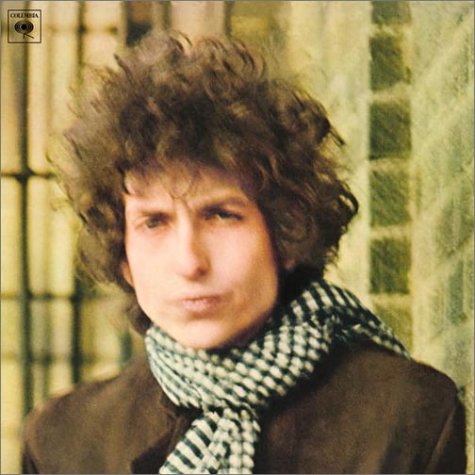
So for me I think the most overrated musician is clearly Bob Dylan. I like Dylan for the most part. He’s solidly pretty good. His pseudo-beat poet blather is moderately amusing, at least in small doses, and his mercurial genius schtick doesn’t get in the way of some nice retro-folk music. But I much prefer Joni Mitchell, or Neil Young, or Donovan, or Richard Thompson, or Johnny Cash, or really any number of performers who sing better/don’t have such stupid lyrics/aren’t widely considered to be Jesus.

What about you? What musical performer do you think is the most overrated?
 

blonde on blonde cover

Speak Softly and Carry a Warhead

This ran a while back on Splice Today.
_______

1011_politicalevilEvil is a force, possibly metaphysical, but certainly rhetorical. To identify evil is to change the world, first perceptually and then politically. We say “evil,” and bombs fall on the Middle East; we refuse to say “evil” and machetes fall across Rwanda. Evil, then, is not just a serpent in our hearts; it’s a statement of purpose.

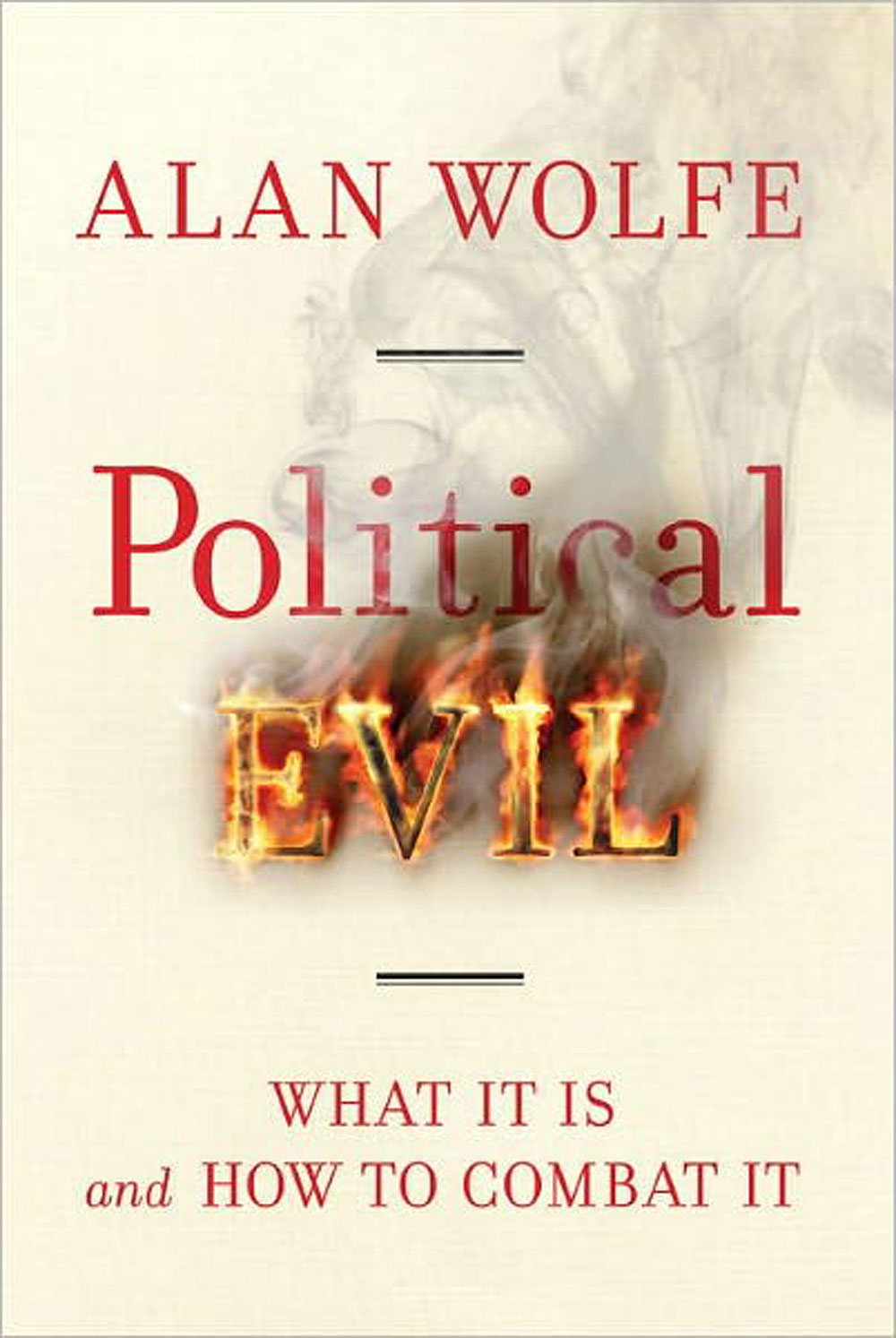
If evil is, in part, a rhetoric, then it is important to name it correctly. This is why Alan Wolfe’s new book, Political Evil: What It Is and How to Combat It, places the definition first in its subtitle. Wolfe’s argument is that we have become confused about evil, and especially about its political character. As a result, we name political evil incorrectly, and so fail to control it. What we need, he argues, is a more careful language, and a more thoughtful understanding of political evil if we are to confront it effectively.

Wolfe’s a long time wonk — an editor of the Nation and later of the New Republic — and his prescription is one that appeals powerfully to the wonky hind brain. To contain evil, his argument suggests, we need, not faith or forgiveness or spiritual transformation, but better monographs.

Be that as it may, Wolfe’s particular monograph is for the most part insightful and convincing. His main point, that political evil is so devastating because of its political character, seems inarguable. Hitler was so dangerous not because he was a hideous, hateful madman (of which there are certainly no shortage in the world) but because he was a politically talented hateful madman who was able to take advantage of a particularly volatile historical period. Wolfe’s conclusion is that, to stop political evil, it’s vital to pay attention not just to the evil, but to the politics as well. You must understand the difference between the nationalistic impetus which fueled ethnic cleansing between Serbs and Croats and the ethnic hatred which fueled genocidal carnage between Hutus and Tutsis. If you don’t understand those differences, you will be unable to stop political evil, and will very likely make things worse. As, Wolfe argues, we managed to do in both Yugoslavia and Rwanda.

Wolfe, then, advocates complexity and careful distinctions. In that vein, he lays out four kinds of political evil: “terrorism, ethnic cleansing, genocide, and a reliance on means such as torture to fight back against evil.” These forms of political evil, he argues, are those which have “grabbed the greatest amount of our attention.”

This does raise the question though — who exactly is this “our” whose attention has been grabbed? Nobody would deny (or certainly I wouldn’t) that terrorism, ethnic cleansing, genocide, and torture are all examples of political evil. But it seems like you could come up with some other examples as well that have played an important part in history if you wanted. What about, for example, imperialism? Apartheid, whether the American, South African, or (arguably) Israeli versions? What about war-mongering? Is it politically evil to build up a gigantic stockpile of weapons which could destroy the world twenty times over? For that matter, where does, say, China’s state-sponsored repression fit in Wolfe’s schema?

Wolfe does call China politically evil a number of times, and he doesn’t say his list is meant to be exhaustive. But it’s focus is telling. The evil that has grabbed the greatest amount of “our” attention is evil perpetrated against the West (terrorism) or by those outside the West (genocide in Rwanda, ethnic cleansing in Yugoslavia) or by the West as a direct reaction to evil committed against us (torture, or Israel’s actions against Gaza.) Wolfe even refers to the overreaction to terror by a specific name to separate it from the other acts of evil. He calls it counterevil — which, no doubt unintentionally, sounds suspiciously like it might mean “good”.

Wolfe unambiguously believes that counterevil is itself a form of evil. But the way in which his neologism turns on him is telling, I think. For while Wolfe is willing to condemn the US and Israel, it’s always for errors of judgment and understanding rather than for errors of the heart. There’s one particularly revealing passage in which he declares:

“Israel’s decision to clear out Arabs from areas of Palestine it was determined to incorporate within its new state ought to caution us against denouncing ethnic cleansing for the goals it seeks, since those goals are so widely shared.”

In other words, we can’t condemn the goals of ethnic cleansing because Israel engaged in ethnic cleansing, and while Israel’s methods may be damnable, its goals never are. And furthermore, in regards to ethnic nationalism, if everyone does it, it must be okay— an argument dear to many a 6-year-old, but not the more convincing for that.

At the end of the book, Wolfe turns, somewhat inevitably, to Niebuhr, advocating a principled, pragmatic opposition to evil tempered by humility.

“The appreciation of our inherent weakness, and its corresponding warning never to commit the sin of imagining oneself to possess all the power at God’s disposal, are routinely ignored by those who argue that one should refuse all engagement with terrorists, or that radical Islam inherited its totalitarian nature from Nazi Germany […] Underlying all these flawed attempts to respond to political evil is the conviction that human beings can know with certainty which side is always the good one and which one the bad.”

It is not a refutation of that point, but a confirmation of it, to suggest that Wolfe could as easily apply it to himself as to the others he cites. It is Wolfe, after all, who confidently lists the forms of political evil we should pay attention to, presenting them as naturally or clearly the most important, as if his Western, pundit’s perspective gives him a God’s eye view of the world’s sins. And it’s Wolfe who invokes that tireless shibboleth of punditry, “moral seriousness,” and drapes it, with beaming pride, across his call for greater humility.

Wolfe is determined that his book, despite its woeful litany of failed interventions and bungled international war crimes prosecutions, should not be used as an excuse for “throwing up our hands in hopeless resignation.” Such resignation, he says, “allows evil to continue and gives the bloodthirsty what they crave.” He advocates neither reckless interventionism nor isolationism, but rather a humble, thoughtful middle way. Maybe that will work. But personally I have a sinking feeling that political evil comes in more varieties than Wolfe is willing to admit, and that one of the ways it manifests on our shores is through the claim that we are modestly spreading peace by covering the earth with arms.

Liberal Fascism

573Earlier this week, Brannon Costello suggested (with a hat tip to Walter Benjamin) that fascism could be seen “as the aestheticization of political life, the process by which a state-sponsored fantasy of heroic struggle overwrites and replaces real social, economic, and political anxieties.”

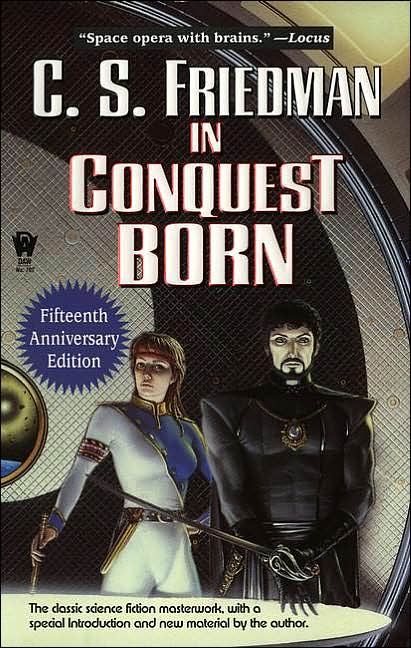
I was thinking about this definition in terms of C.S. Friedman’s novel “In Conquest Born.” The book is sci-fi space opera, but it functions in a lot of ways as a super-hero narrative. The main character, Zatar, is a Braxin, a warlike culture of distant human descendents who have been genetically manipulated to be superstrong and supertough. Zatar is strong and tough and cunning even by the strong, tough, cunning standards of Braxia, and much of the book is a series of vignettes designed to show just how damn awesome he is. He infiltrates the enemy Azeans and poisons a key figure; he goes on a one-person space ship and withstands high gravity pressures in a way no one has withstood high gravity pressure before, he machinates sneaky spy plots causing the death of his enemies, he wows women and has his way with them. He commits ultra-cool sneaky awesome genocide. And so forth.

Again, this fits pretty easily into superhero tropes — and/or supervillain tropes to the extent that they can be distinguished. What’s interesting, though, is that the superhero fascist undertones — the way in which aesthetics replaces politics — are here made thoroughly explicit. Braxia is fascist state. As I said, it’s a warrior empire; it just about worships war and battle. It’s organized along racial lines, too: the rulers (the Braxia) are a small minority of genetically enhanced humans. The regime is hyperbolically masculine; rape of women is legalized, and rule or subservience to women is seen as terrifying and evil.

The novel doesn’t exactly endorse the Braxian view of the world — it’s supposed to be a brutal, ugly culture. But that brutality and ugliness are in themselves an aesthetic attraction; a venue the main purpose of which is to set off Zatar’s charismatic brutality and ruthlessness all the more vividly, and therefore all the more sexily. There’s a sense in which the entire nasty race, complete with legalized rape and endless warfare, is there just so we can watch various brutal, hard warlike men and women fall to their knees (often literally) before Zatar’s bigger, badder warlike bits. The political/social trappings of a fascist state are all channeled into the aesthetic pleasure of the Mary Sue.

Zatar isn’t the only Mary Sue in “In Conquest Born.” Friedman has another; Zatar’s sworn enemy, Anzha, a member of the Azeans, a culture locked in an unending war with the Braxins. Anzha is a powerful telepath, and the part of the book that is not devoted to showcasing Zatar’s awesomeness is devoted to showcasing Anzha’s. The capstone of ridiculousness here is when Anzha, more or less at random, has to cross an ice planet and succeeds by telepathically bonding with intelligent extraterrestrial superwolves. “In Conquest Born” is from the 1980s, before fan-fic really took off, but that just shows that the tropes are of long-standing. And yes, after she succeeds, people kneel down to her too.

But despite that kneeling, Azea is a very different society from Braxin. It’s not a warrior culture. Women are equal to men. It arrives at decisions through a not-super-well-defined-but-still democratic process. It’s remarkably racially heterogeneous as well; the Anzha empire is based on equality, and many alien peoples are equal members. The society isn’t perfect by any means; Anzha faces discrimination because she doesn’t physically fit the genetic human Azea pattern, and the telepathic bureaucratic secret organization screws with her brain in unpleasant ways without her consent. But still, in its broad outlines and ideology, Anzha pursues a liberal policy of peace and inclusion, rather than a fascist policy of war and purity. Anzha, with her telepathy and her fierce love of war and killing all things Braxin (because Zatar poisoned her parents) could be seen as a Superman figure, a liberal, battling, anti-fascist fascist.

Siegel and Shuster didn’t monkey around with relativism; Superman may have been a kind of doppelganger of the Aryan Ubermensch, but that wasn’t meant to create an equivalent. Good was good, bad was bad; and if one was the mirror of the other, that emphasized the differences, not the similarities.

Friedman is less partisan. Ultimately, I think Anzha is supposed to be the force for good, not least because she wins in the end. But, again, the two characters work in almost exactly the same way — they’re both dark, heroic, angsty totems performing awesomeness in repetitive set pieces. Zatar replaces the fascist political system with the aesthetic iconicity of his coolness; Anzha replaces the liberal political system with the aesthetic iconicity of her coolness. And not just the political systems themselves, but the conflict between them, is turned into an individual matter of style, as Zatar and Anzha are enmeshed in a personal grudge feud/telepathic love thingee, which shakes the stars and keeps the pages turning, if you like that sort of thing.

You could see this as exposing the definition of fascism that we’re working with here as self-contradictory. Aestheticization of politics means that aesthetics overwrites politics — in which case the content of the politics doesn’t really matter. Fascism, liberalism — who cares? As long as you’ve got your anti-heroes, it’s trivial whether they run with wolves or commit genocide. It’s all the same marginally entertaining genre fiction, and it doesn’t need to mean anything more than that.

From a bleaker perspective, though, you could argue that the banality of the genre fiction, the emptiness of its political content, is a sign not of the irrelevance of fascism, but of its ubiquity as a kind of substrate in both mass culture and modernity. Those dreams of strong warriors to whom everyone kneels; they’re as native to Azea as to Braxin, it seems like. Victory of one over the other is a satisfying denoument, not for any ethical or political reason, but simply because the strong looks stronger when he, or she, subjugates the strong.If modernity overwrites all political systems with aesthetics, then fascism isn’t just one possible political system of our day, but the blueprint for them all.

Objective, Subjective, Narrative, Clock, and Real: What of Time in Comics?

Inspired by Frank Bramlett’s satisfyingly rich 1/23/14 PencilPanelPage post, “How do Comics Artists use Speech Balloons?” (which is the first in Frank’s promised and promising series on the representation of talk in comics), I, too, have decided to embark on a two- or three-part exploration of a discrete comics element utilizing a theoretical framework with some application to particular comics. My focus is time, and I will use this first part to sketch some of the concepts I will be drawing from, and invite readers to share their insights into how time works in comics that have caught their eye. Five weeks from now, part two will explore a few select panels and pages that—in my opinion—do interesting things with the representation of time.

Never yet having engaged in sustained exploration of the representation of time, it has nevertheless often been a component of what I explore when I think about comics. Sometimes it is simply the nifty nature of dual time possible in a panel; consider, for example, a graphic memoir like Fun Home, in which the speech balloons emerge from the drawn child while a narrative voiceover in the captions presents an adult “take” on the scene below. There is also the type of narrative time that gets built as a comics reader moves around a comic, returning to panels on previous pages, picking up threads that were dropped and resumed, or making connections between and amongst instances of action, events, characters (Scott McCloud does justice to this movement in Understanding Comics, of course, as he also brings the gutter into this consideration, reminding us that we continue playing out the scene via imagination each time we hit a gutter, and thus extend narrative time in interesting and highly subjective ways).

Thierry Groensteen’s exploration, in his System of Comics, of reader actions with non-contiguous panels and the work s/he does to connect disparate moments spread through a full-length comic, adds an additional dimension to this expansion of time (yes, and space, which is hard to decouple from time). Via what he terms a system of “arthrology” (the anatomical reference here is to joints and jointedness), the reader collects information from across the comic, interweaving (he uses the term “braiding”) elements large and small to make meaning, and though he does not discuss this primarily in terms of time, can we not see it as a novel challenge to the linear nature of narrative time? If we generally think of readers pulled from first page to last in a linear progression from start of text to end of text, it is both refreshing and liberating to think of the comics reader becoming adroit at stopping and starting time at will, hitting the pause button in a sense, and then rewinding and fast forwarding in a very individual search for meaning and alternate forms of continuity. This can be quite literal: think of the moments you held your finger on a page in anything by Chris Ware, and returned back to an earlier page to tease out a connection…then toggled between them to establish an artificially created, but viable, contiguity between panels that are (no longer) separated by page distance?

In “Duration in Comics,” an engaging article published in the Winter, 2012 (Volume 5, Number 2) issue of European Comic Art, Sebastien Conard and Tom Lambeens bring several concepts of narrative time to comics, attempting to find language to talk about the layering of multiple types of time in both single panels and works as a whole. Conard and Lambeens plumb philosophical concepts of time, such as Henri Bergson’s notion of duration, which refers not to clock time, but rather “…time as felt or experienced, not time as thought or measured.” (96) They consider other forms of subjective time, including Gilles Deleuze’s exploration of how memory alters time (and time memory) (97)—you can apply this both to a character or narrator’s memory as its shapes the showing and telling of events, experiences, etc. as well as to the reader’s memories and their impact on such things as “reading” time, i.e. how long it takes to make one’s way through a given work. Ultimately, Conard and Lambeens are interested in the multiplicity of time in comics—that there are often many different kinds of time operating both objectively (in the panels, pages and words of a comic), and subjectively (in the mind of a reader).

Can you offer a particularly deft representation or enactment of time in a comic, or do you have some thoughts – general or specific—on the topic of time in sequential narrative? I’ll be continuing this thread in part two, and will provide some provocative examples, but I’m eager to hear from others on the subject while I gather this evidence for you.
 

Watchmen1Medium

from Alan Moore and Dave Gibbons’ Watchmen

No Sequence

This first appeared on Comixology.
______

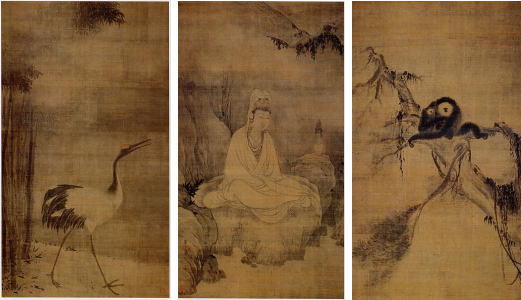
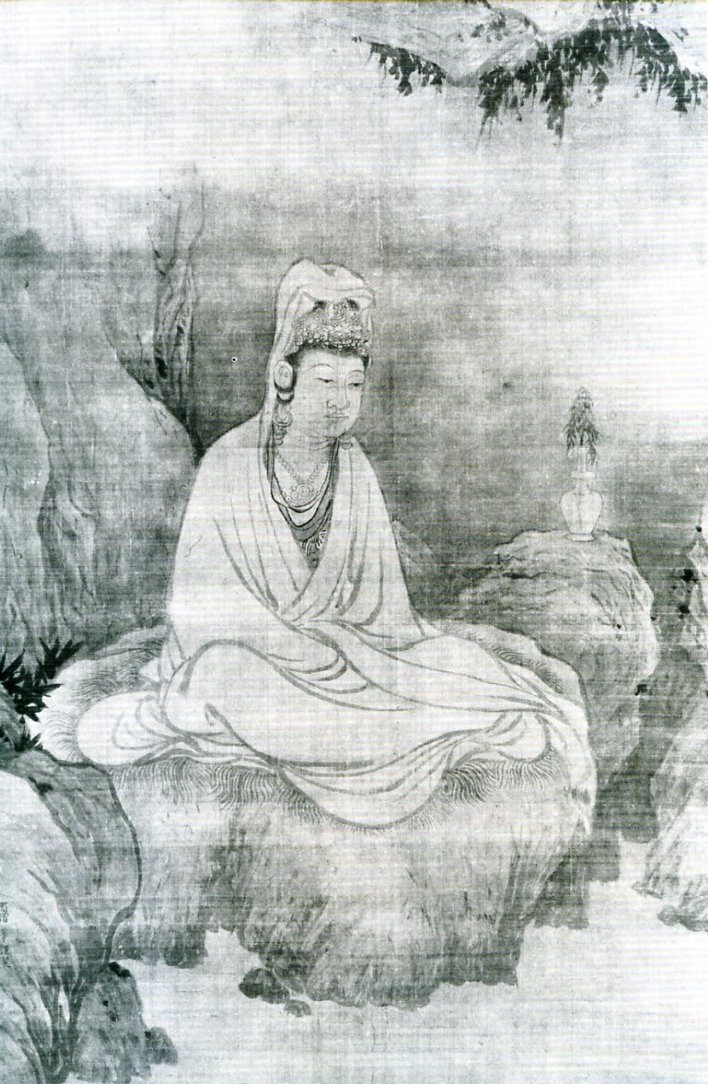
Guanyin,_Monkeys,_and_Crane

 
The triptych above was supposedly painted by Mu-ch’i, a Chinese monk, in the 1200s. The middle picture is of Kuan-yin, a much-revered bodhisattva, who had decided to remain on earth and help others to attain enlightenment rather than preceding on to a higher plane.  The other pictures, obviously, are of a monkey and a crane.

In the book, Zen Ink Paintings, Sylvan Barnet and William Burto suggest several possible reasons for the juxtaposition of bodhisattva and random fauna. On the one hand, they say, the crane may symbolize intellect, while the monkey (with its child) may symbolize love, the suggestion being that Kuan-yin is a fusion of the two — as, indeed the bodhisattva is generally seen as a fusion of both male and female.   Or, alternately, the authors say, the placement of the animals beside the bodhisattva may be a way to connect the human, the divine, and the animal in a single harmony.  Or, possibly, the crane may be meant to stand for extended life, thereby making fun of  the Taoist desire for immortality, while the monkey stands for family, satirizing the Confucian emphasis on household harmony.
 

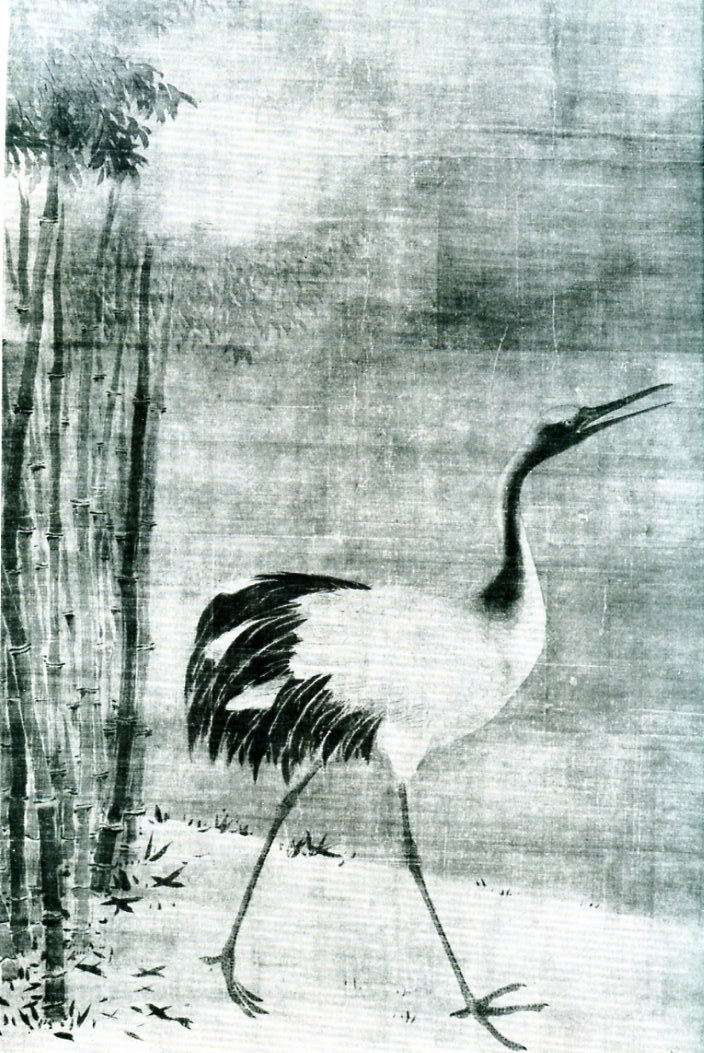
crane

 
My favorite interpretation, though, is based on these lines from a contemporary poem which Barnet and Burto quote:

An old monk arrayed in purple

Would be laughed at by monkeys and cranes.

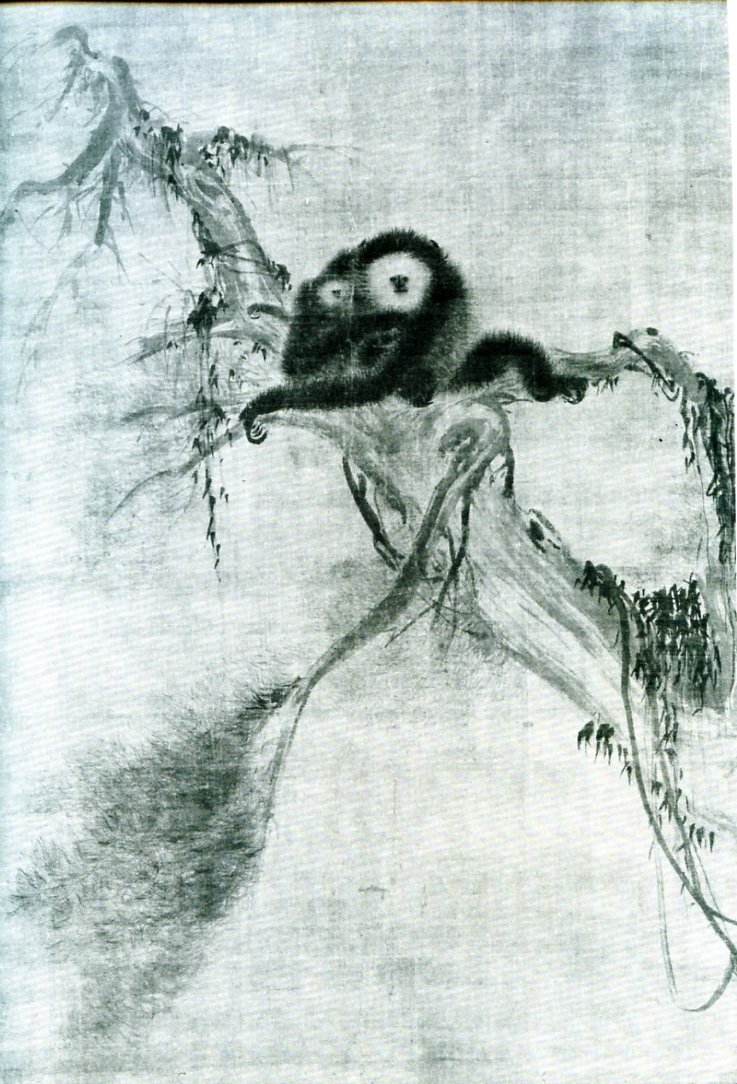
From this perspective, the crane and the monkey are there, not to make fun of Taoism or Confucianism, but to make fun of Kuan-yin.  Certainly, the crane, with its mouth open, can be seen to be laughing at the serenely oblivious bodhisattva. Moreover, the crane’s oval shape seems to mirror the bundled shape of Kuan-yin’s robes; it’s as if the artist is deliberately mimicking the central figure, turning Kuan-yin from a divine ideal into just a goofy waterbird. Something similar seems to be going on with the monkey too; curled up and staring out of the canvas, she mirrors and parodies the bodhisattva’s solemnity. The one monkey leg reaching out across the branch imitates Kuan-yin’s trailing robes; the long arm reaching crossways across the body seems like a mockery of Kuan-yin’s own crossed arms.  On the one hand, the bodhisattva is parodied for being like an animal; on the other, both side-pictures seem to be poking fun at him for his reserve and determined spirituality. The crane’s neck curves as if ready any moment to jerk with a squawk; the monkey’s soft fur almost quivers in the wind — and the bodhisattva just sits there.
 

monkey

 
If the crane and the monkey are teasing Kuan-yin, perhaps they’re also teasing someone else — specifically, you.   The monkey, after all, isn’t staring at Kuan-yin, but out of the picture; its position may mirror the bodhisattva’s, but it also in some sense looks like a mirror. The crane, too, could be a passing onlooker, staring at the bodhisattva’s picture with his or her mouth agape.  Kuan-yin’s calm here may be in contrast to these unenlightened viewers, who squat like monkeys or strut like cranes, curious but oblivious.  Or, perhaps, the joke isn’t that the audience is unworthy of enlightenment; but rather that they are already enlightened. Because they are as undignified as the monkey or the crane, those who contemplate the picture have their own plain, contingent place within it, like cranes or monkeys who happen to be nearby when the bodhisattva comes.

In an essay titled “Humour and Faith,” Reinhold Niebuhr said,

The intimate relation between humour and faith is derived from the fact that both deal with the inconguities of our existence….  When man surveys the world, he seems to be the very center of it, and his mind appears to the be the unifying power which makes sense out of the whole. But this same man, reduced to the limits of his animal existence, is a little animalcule, preserving a precarious moment of existence within the vastness of space and time.

The joke here, then, is on man, the little animacule, who can reflect on himself like Kuan-yin, and who sees in that reflection a monkey. For Niebuhr, as a Christian, this absence of meaning is finally resolved, at its limits, not by laughter, but by faith. As he says, “We laugh cheerfully at the incongruities on the surface of life, but if we have no other resource but humour to deal with those which reach below the surface, our laughter becomes an expression of our sense of the meaninglessness of life.”

You could see this as the point of this triptych as well, which starts on its outer edges with laughter and moves, at its center to a divinity which binds both animal nature and human watchers together in contemplation of the divine.

The caveat is that the “meaninglessness of life” doesn’t mean quite the same thing for the Protestant Niebuhr as it did for the Buddhist artist. Niebuhr can see laughter as directed at human beings, but when he thinks about laughter directed at divinity, he ends up talking about Jesus’ tormentors mocking Christ on the cross.  In this vision of Buddhism, though, laughing at creation doesn’t have the same connotations of blasphemy.

In this context, the best part of the joke here, and maybe the most Buddhist part as well, is that all of these speculations about the triptych— mine and Barnet and Burto’s — are quite likely, and precisely, nonsense.  Nobody really knows if the crane and the monkey and Kuan-yin form a triptych. The three may well have been assembled haphazardly long after the artist’s death.  The only meaning in the juxtaposition of images is the meaning you graft onto it yourself; the pictures make a story because you say they do. There’s no more sense there than the silent croak when the crane opens its mouth, or than Kuan-yin sitting as poised as a monkey on a branch.  The crane laughs at you because it knows it isn’t laughing at you, and the monkey mocks you because it knows it isn’t. Flanked by them both, Kuan-yin seems content to be ridiculed both by the animals’ presence and by their absence. Enlightenment’s a joke that isn’t, then is, then isn’t.
 

kuan-yin

“A Fantasy Solution to Real Problems” – Howard Chaykin and Superhero Fascism

I’ve been reading the conversation about fascism and superheroes here at HU with a lot of interest. As I argue in my piece on Howard Chaykin’s Blackhawk revival that recently appeared in ImageTexT, a defining feature of Chaykin’s career is his sustained, thoughtful engagement of the relationship between fascism and comic books — including, but not limited to, superhero comics. Chaykin is matter-of-fact in acknowledging that the allure of fascism is at the heart of heroic-fantasy genre comics. As I discuss in that essay, he notes that “[Blackhawk is] clearly an important book in the memories of men my age, who remember the Blackhawks as flying fascists on our side” (Conversations 112-13). He puts it even more bluntly in another interview: “[Blackhawk was] a protofascist comic book. It is Nazis fighting for us – these guys in leather outfits, you know” (Conversations). OK, the Blackhawks are low-hanging fruit — even Will Eisner described them as “fascistic,” and he had a hand in creating them — but a cursory examination of superhero comics from nearly any era reveals a plethora of characters, imagery, and stories that resonate broadly with the ideals and aesthetics associated with historical fascist movements in the twentieth century, whatever the ideals or intentions of the writers and artists of those comics.(Please note that, like Noah in his post, I am not necessarily saying superheroes = fascist.)

Chaykin’s comics that focus on fascism tend to place the authoritarian, might-makes-right aspects of fascist ideology within a larger project of fascist aesthetics — what Walter Benjamin characterized as the aestheticization of political life, the process by which a state-sponsored fantasy of heroic struggle overwrites and replaces real social, economic, and political anxieties. Much like Frankfurt School critics such as Theodor Adorno, Chaykin’s work draws connections between the effects of fascist aesthetics and the effects of contemporary popular culture — though I wouldn’t say that Chaykin and Adorno are exactly marching in lockstep when it comes to the value of pop culture — including and especially superhero comics. As he remarked to one interviewer, “We live in a world that has been so completely filtered through filters of unreality because the real world is so much more difficult to deal with than a fantasy version of it” (Conversations 177). For Chaykin, superhero comics are a prime vehicle for this kind of fantasy. Of the typical comic book reader, he remarks, “They feel completely impotent, they feel completely unable to make any effect on their own world, and it’s easier to turn it over to a superhero” (Conversations 170).
 

Costello_PG_Collection_Cover

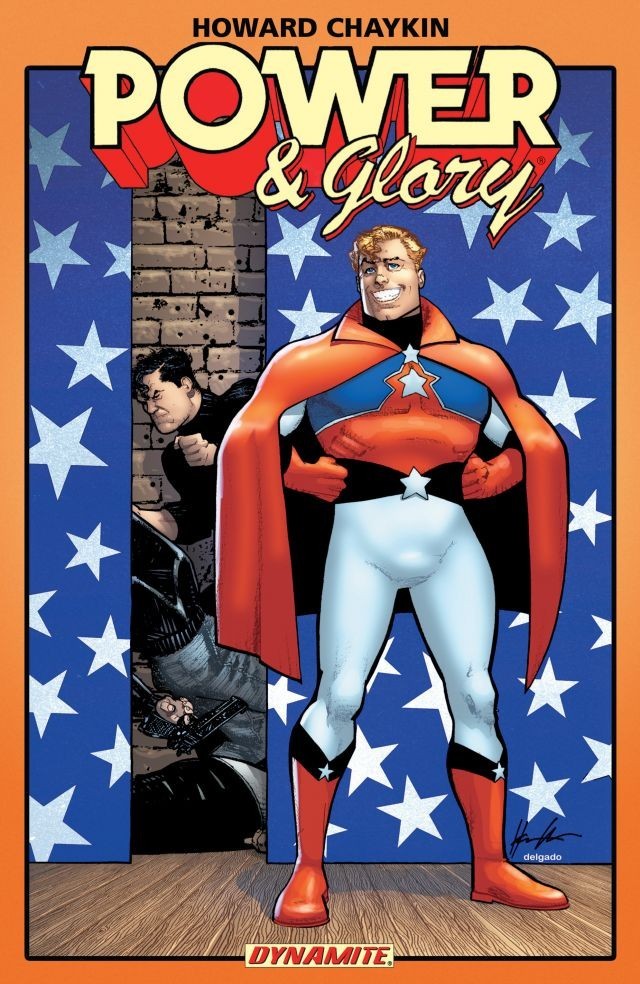
Blackhawk is maybe his best-realized take on the relationship between mass culture and fascist aesthetics, but that dynamic is at the heart of his most interesting superhero work, too. I wrote a bit about this topic in the context of Chaykin’s Batman comics here. His 1994 superhero satire Power & Glory (four-issues and a one-shot special) offers a slightly different spin on this theme, placing the ideal of the fascist superbody in the context of the critique of the pleasures and perils of mass culture that is at the heart of all his work (and that is the focus of my ongoing book project on Chaykin). Power & Glory is about what happens when the U.S. government decides to abandon its futile attempt to compete with China, Germany, and the rest of the world in the production of tangible consumer goods and to devote all its efforts to the one thing it’s always done well: the production of nationalist fantasy. To this end, government scientists create a new superhero called A-Pex to fill America’s hearts with pride through acts of (staged but spectacular) derring-do. Michael Gorski, the government operative assigned to be A-Pex’s handler, makes the connection between superheroes and fascism explicit when he complains to his bosses, “Face it — the real world isn’t a god damned comic book. But you had to make an ubermensch — a fantasy solution to real problems” (#3).

A-Pex proves initially to be a resounding success — his licensed image proliferates like a virus. But there’s trouble behind the scenes. Gorksi and Allan Powell, the man in the A-Pex suit, loathe each other. Gorski is another iteration of the familiar Chaykin protagonist — not just dark-haired, left-handed, and Jewish, as Chaykin likes to say (Conversations 21), but also self-righteous and a little romantic about his own ideals, if not totally above corruption. By contrast, Powell, blonde and blue-eyed, is an amoral, narcissistic sociopath who has volunteered to become A-Pex for very particular reasons having little to do with American greatness. Powell is terrified of contracting AIDS or any other STD; indeed, he has a downright horror of even being touched. (In the first issue we see him masturbating with gloved hands while two prostitutes frolic in front of him; when they attempt to draw him into the action, he panics — “Who knows where you’ve been?”) Powell is only attracted to the program because it renders him impervious to disease and bullets alike, safely protected by his “invulnerable body of throbbing pink steel” (Holiday Special). No matter how many times he is reassured of his invulnerability, his fears are so intense that Gorski ends up having to complete most of Powell’s missions from behind the scenes. (Chaykin has pointed to a documentary about puppeteering as an inspiration for the series, but you could make the case that there’s a riff on comics history here, with Gorski as a stand-in for Jewish creators from the superhero’s early days who struggled to maintain control — legal and financial but also maybe interpretive — over the Aryan overmen they created.)

It’s in the contrast between Powell’s hyper-masculine physique and his debilitating horror of infection that Chaykin develops his critique of the superhero’s superbody, an aspect of the genre that alarmed anti-fascist cultural watchdogs including Walter Ong, who disliked the way that the superhero genre combined a simple-minded nationalism with a celebration of the powerful male body — or, as Ong puts it, the “permanent orgy of muscularity” (39). Such super-men played an important role in the fascist aesthetics of Nazi Germany, of course. In his study Male Fantasies, Klaus Theweleit traces the veneration of the, steel-hard body of the soldier-male back to the proto-fascist Freikorps literature of the 1920s and 1930s. The writers of the Freikorps dealt with their anxiety over the dissolution of the body and the nation by valorizing the ideal of the armored soldier-male, repeatedly and insistently describing iron-hard, even mechanized bodies standing proud and erect against the floods, mires, and swamps (non-Aryans, communists, women) that threaten to engulf and penetrate them. As Theweleit writes, “The most urgent task of the man of steel is to pursue, to dam in, and to subdue any force that threatens to transform him back into the horrible disorganized jumble of flesh, hair, skin, bones, intestines, and feelings that calls itself human” (160). He does so by “defend[ing] himself with a kind of sustained erection of his whole body, of whole cities, of whole troop units” (244).

As a steel-hard superhero shill for American exceptionalism whose image is endlessly replicated across popular culture, from movies to video games to fish-stick packaging, Powell is a perfect vehicle for Chaykin’s satire of the anxieties and neuroses that underlie fantasies such as the ones Theweleit describes. Despite his incredible power, he flees in panic whenever he perceives any threat of contagion or contamination, whenever he confronts anything that would threaten the ideal of masculinity that he literally embodies — especially more fluid notions of gender and sexuality. In fact, this is what his superhero image is founded on: the event that gets him over with the American public is when he flips his lid upon discovering that a suspected drug courier is a transvestite, shrieking “No touching!! Who knows where she’s been?” and snapping his victim’s neck when he flails his arms in panic (#3). His reflexive violence is spun as the utmost heroism by the government and a compliant media, and a superstar is born.

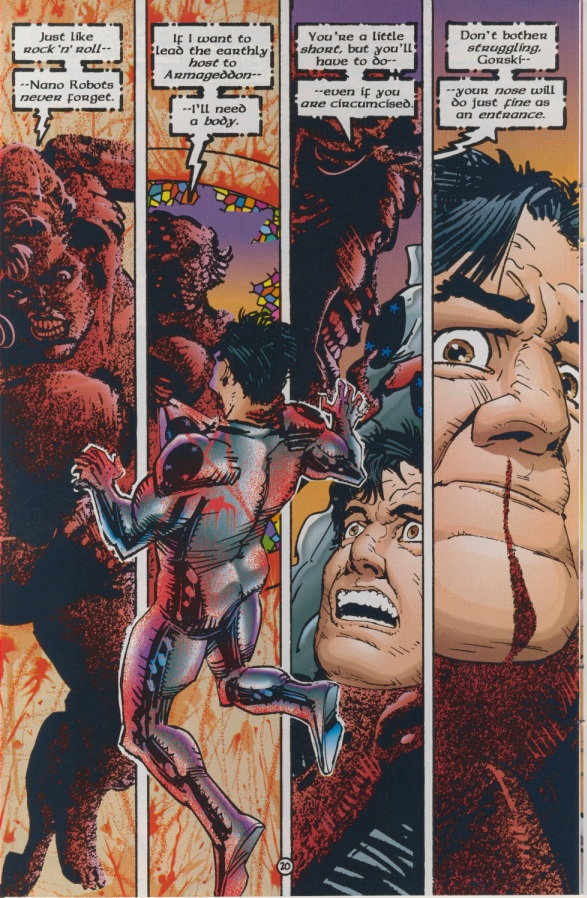
That tension between Powell’s invulnerability and his horror of contamination runs throughout the background of the main Power & Glory series, but it is central to the Power & Glory Holiday Special. In this final installment of the series, Powell and Gorski have severed their ties with the government and have separately ended up at work for a private corporation. Their new employer, PLEX/Biomatrix, is pioneering a new process to give ordinary people powers like Powell’s. P/B is promoting its brand through a lottery whose winner will receive a superbody for one week (after which point the nanobots that keep one’s body steel-hard will be turned off). But the lottery’s winner, an “infonet gospel guru” named Epiphany St. McMiracle, has other plans. Already infected with HIV by a philandering husband, St. McMiracle has decided to use her new powers to take the rest of the world down with her. Gorski and Powell think they’ve bested her at first, overloading the nanobots in her bloodstream until she explodes, spraying blood and tissue all over them, much to Powell’s dismay. But she quickly returns, this time as the embodiment of the fears that Theweleit described: a sentient, flowing mass of blood, capable of taking human form but also of extending its tendrils to wash over, penetrate, and absorb its victims. When St. McMiracle announces that she intends to slither up Gorski’s nose and make his body her own, Chaykin’s page layout drives home the radical nature of her threat. Chaykin divides the page into four narrow vertical panels, but in the second panel St. McMiracle grips Gorski by the front of his suit and thrusts him outward, toward the reader, violating the rigid borders of the other panels with his body and thus undermining the strict divisions on the page in the same way that she prepares to violate his body. The fact that she is planning literally to become a woman in a man’s body only underscores the way in which St. McMiracle threatens the fantasy of heroic masculinity that is so fundamental to the superhero ideal.
 

Costello_ChaykinFascism_1

 
It’s an interesting, potentially problematic moment for the series. On the one hand, Power and Glory is clearly a critique of the superbody ideal and holds Powell in contempt for his horror of being infected by women. Yet despite the series’ disdain for Powell, the villain here is literally a giant oozing blood woman who, ridiculous as it sounds, poses a real threat to the world within the context of the story. (Here I should probably stress that St. McMiracle and the prostitutes I mentioned earlier are not the only women in the series, which includes two female characters, Avis Catlett and Vanessa Cheng, who are well developed within the limitations of their supporting roles.) It’s the age-old tension inherent in parody, which inevitably reproduces the thing it wishes to mock.

It’s significant that Gorski and Powell don’t triumph over St. McMiracle through the virtue of their erect steeliness but through an alternative notion of the body that embraces the very truth that Theweleit claims the soldier-male stands against. At a crucial moment, Gorski recalls that the scientists who designed the nano-bots created a failsafe: the ‘bots will go inert at the eleven notes of “great gray gobs of greasy grimy gopher guts.” It’s an odd choice but thematically apt: the children’s song is all about humorously acknowledging and jokingly embracing the “disorganized jumble,” to use Theweleit’s phrase, of oozing, messy body parts.

The paradox of the book’s climax is that by singing the song and forcing St. McMiracle to discorporate while she holds him high above the ground, Gorski is forced to fall back on Powell and, implicitly, the superheroic fantasy he embodies. (Powell punches through a wall to catch him.) Thus, the Holiday Special ends on a curious note of reconciliation between two men who despise each other. Or maybe it’s just resignation. It’s tempting to read Gorski’s grudging rapprochement with Powell as reflecting Chaykin’s own resigned acceptance of the dominance of superhero narratives over the so-called mainstream comics marketplace. After all, Power & Glory came out in 1994, in the midst of the Image Boom. The Image books enjoyed massive commercial success based on speculation and a visual style that favored Awesomeness over draftsmanship or visual storytelling. At the time, Chaykin described them as “posing comics” and “trading-card comics” (Conversations 170). It was an ethos that couldn’t be further from that which informed the formally ambitious, narratively dense, deeply individual work that Chaykin produced throughout the 1980s. The fact that this work, while often critically acclaimed, didn’t lead to the kind of financial rewards that some of his peers enjoyed is part of what led Chaykin to shift his efforts away from comics and toward screenwriting throughout most of the 1990s.

The prospect of empty-headed, fascist-friendly superhero narratives taking over the marketplace where he spent most of his career to that point may have been frustrating to Chaykin. But Power & Glory — one of the very few comics that he produced as writer/artist in the 1990s — works as a way for Chaykin to redefine those narratives on his own terms. For Chaykin, what superhero comics are not about the insidious, sinister power of fascist fantasies; rather, they’re about the anxiety, weakness, and neurosis that underlie them.


Brannon Costello is Associate Professor of English at Louisiana State University, where he teaches and writes about southern literature and comics. He is currently at work on Lost in the Futurama: The Comics Art of Howard Chaykin for LSU Press.

Costello, Brannon, ed. Howard Chaykin: Conversations. Jackson: UP of Mississippi, 2011.

Ong, Walter. “The Comics and the Super State.” Arizona Quarterly 1.3 (1945): 34-48.

Theweleit, Klaus. Male Fantasies volume 1: Women, Floods, Bodies, History. Trans. Stephen Conway. Minneapolis: U of Minnesota P, 1987