Can We Have a Different Conversation?

I really don’t understand why people keep trying to tell Marvel and DC how to do business. These are wholly owned subsidiaries of major multi-national entertainment conglomerates with a poor track record of rewarding the contributions of the individual.

Marvel is owned by Disney – a company that has set industry best practices for selling product to little girls. Does anyone honestly believe that if Disney wanted Marvel to sell more product to that demographic that they would be unable to do so? Or is it more likely that Marvel represents Disney’s inroad into a male demographic?

DC just went through a major branding exercise, which is usually an expensive, complex multi-year process. Is it remotely possible that demographic targeting, genre diversity and price point optimization were not considered during the planning stages? Or is it more likely that DC specifically targeted the demographics that it wanted to target?

Not all comic book companies can be all things to all people. And it is increasingly obvious that Marvel and DC do not want to be anything but superhero publishers selling superhero comics to superhero readers through the supply chain that they have spent two plus decades optimizing to do so. And yes, this limits the amount of money they bring in from demographics outside what they consider to be their core target – straight white males.
But it’s not as if Marvel and DC are the only game in town.

It would be refreshing to see an article that started with “Marvel and DC are not producing the kinds of comics that appeal to other demographics” that went on to say “but there are other publishers that do and you should be supporting them” instead of presenting a carefully thought out argument about how Marvel and DC should completely change their business practices.
Corey Blake , for example, wrote an entire article that basically boils down to “Marvel should start acting more like Fantagraphics” without actually mentioning Fantagraphics – presumably because he still thinks that there are only two comic book publishers in existence instead of more than thirty.

If half of the energy spent tilting at the Big Two windmills was spent pointing out that there is already a pretty diverse selection of comics available for purchase, I think there would probably be more comics readers. But that wouldn’t be nearly as satisfying as bitching about the fact that homogenized corporate IP farms are not paying attention to other demographics, would it?

It’s easier to bemoan what could be than it is to celebrate what is because no real action is needed. “I tried to tell them what to do and they chose not to listen. What are you going to do?” Buy comics from someone else maybe?
A very common phrase that I have seen from some very smart people is “they’re leaving money on the table.” Presumably “they” are Marvel and DC, but “they” could very easily refer to anyone publishing comics that has not put together a comprehensive marketing campaign designed to combat the idea that comics is only superheroes aimed at straight white men.

Where most people see a problem on the part of Marvel and DC, I see opportunities for smaller, more agile publishers to sweep in and cater to these demographics who are clamoring for more diversity. After all, these comics already exist and I think it’s time to change the conversation.
 

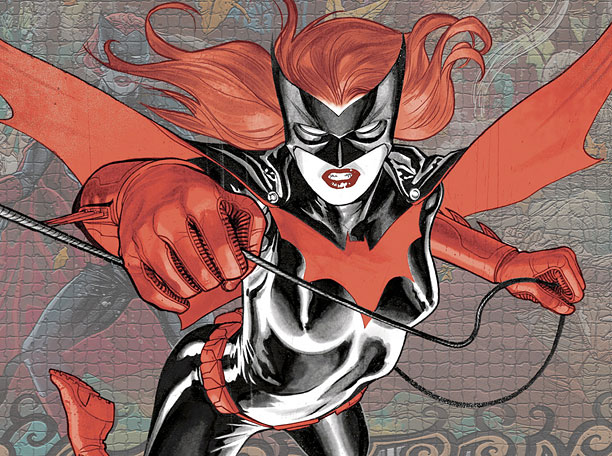
DC Comics Batwoman

J.H. Williams III and W. Haden Blackman, the writers of Batwoman, just left the title after DC editorial refused to allow the character to marry her female fiance.


Indie Comics vs. Context — Death Match

Heidi over at the Beat had a post at the end of last week in which she argued that indie comics are rarely examined in cultural context.

And yet, it does seem that indie comics and cartoonists are rarely examined in a larger contextual way. This is possibly because the content involves a lot of what some call introspection, and others emo shoegazing—even the greatest one—and maybe because this kind of analysis if of a secondary interest of most of those creating and consuming indie comics? And to be fair, a lot of indie comics are created by an ethnically homogenous groups of suburban white kids. When they stray too far away from writing what they know, as Craig Thompson did with Habibi, the results aren’t awesome. Even a work as great as Building Stories is a personal story—on a most simplistic level, it’s telling us that it’s better to have a happy marriage than lie in bed every night wondering if you should kill yourself.

I disagree with the vast majority of what Heidi says in that post…but I don’t know that a fisking would really be that productive. So, instead, I thought it might be fun to take her post as a challenge, and try to do a roundtable on indie comics in social context.

What “social context” means is a little unclear; Heidi seems to be particularly focused on issues of racism, sexism, and gender, since she’s responding specifically to the recent discussion of Jason Karns work (Heidi has all the links on her post.) I’d certainly be interested in hearing folks talk about those issues in relation to indie cartoonists, but I’d think other approaches would be useful as well. For instance, looking at comics in terms of their relationship to visual art traditions, or to literary traditions, or, for that matter, to comics traditions, seems like it would qualify. Talking about comics in relation to historical events could work too. I’m sure folks could think of other possibilities.

The term “indie comics” also seems like it’s somewhat up for grabs. We’re trying to avoid mainstream superhero titles, obviously, and genre works (manga or otherwise) seem like they should be out too. Heidi expressed interest in focusing on more recent cartoonists (i.e., not Crumb, Clowes, etc. etc.), though again that’s maybe more something to think about than a hard and fast rule.

So…anybody in? I think I’d aim for early October or thereabouts. If you’re interested, let me know in comments, and maybe mention who you might write about if you have an inkling, since I think that would be a nice way to spark discussion and generate ideas.
 

201309050337

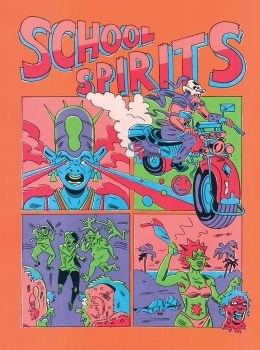
Anya Davidson’s School Spirits, which Heidi talks about at her post.
 

Jack B. on Johnny Ryan and The Appeal of Bullying

Jack B. just left this lengthy comment on an old thread. I thought I’d highlight it here.
_________

This discussion interested me enough that I thought I’d try to revive it, lo these many months later.

Johnny Ryan’s comment about the bully’s perspective being more interesting than the victim’s perspective has always struck me as really insightful, especially as it comes from a guy whose work can be so dumb. There’s something kind of precious and self-pitting about art with a sweet, sensitive narrator/protagonist, whether it’s Craig Thompson in Blankets or Holden Caufield, that you don’t get when the narrator is Humbert Humbert or Alex in A Clockwork Orange (although the latter two characters are self-pitying themselves). I also agree with Ryan that Lucy is a good character—her dual role as the cause of Charlie Brown’s problems and his psychiatrist was one of the wittiest things about Peanuts. Noah, even before his excellent interview with Ryan, made the point that the strip would have been a drag if it had focused only on Charlie Brown and his melancholy, as some alt-comics Peanuts fans seem to do.

Jacob Canfield’s problems with Ryan seem to involve the victim/bully dichotomy in areas beyond art, and I think I might side with Ryan in some of those areas, too. Like a lot of left-leaning internet commentators, Jacob seems to think that “macho” is a bad thing and that straight white men should be very conscious of their privilege. But speaking as the wussiest “beta male” you could possibly imagine and as an upper-middle-class white person with a fair amount of guilt, I’m not so sure that it’s good to be like me. My experience is that self-confidence and male strength, even on the part of straight white males, is looked on favorably by almost everyone, including blacks and women, outside of left-leaning internet circles. I’m pretty sure that most black, blue-collar workers would prefer working with a confident, macho white guy than with a sensitive Caucasian who enjoys discussing his white male privilege, for example. By the way, Jacob’s line, “It makes comics critics look like macho assholes” struck me as unintentionally funny—they might look like assholes, but I doubt that they’ve ever looked macho to anyone other than Jacob.

I definitely don’t want to go too far in aesthetically favoring an “alpha” perspective over a “beta” one, though. P.J. O’Rourke once said something to the effect that Jewish American humor is pro-loser while Irish American humor is pro-winner, and he called The National Lampoon a breakthrough in that it succeeded with the latter for the first time in American pop-culture history. I don’t know if there’s anything to his history or his ethnic breakdown, as plenty of Jewish comics from Groucho on have been more aggressive than self-deprecating, but I will say that I love early Woody Allen and can’t stand what I’ve read of The National Lampoon or O’Rourke (I think I’d hate him even without the stupid right-wing politics). So I’m definitely not in the fratboy camp when it comes to humor.

And of course, when it comes to real life, siding with bullies over victims is pretty horrible. I would imagine that one of Johnny Ryan’s main influences is Howard Stern, and Ryan drew this poster of the regulars from The Howard Stern Show: http://www.flickr.com/photos/18176432@N00/990828987/in/photostream/. Those who are not familiar with Stern—or, as I prefer to call him, “Fartman”—may wonder about some of the people depicted on the poster, such as “Gary the Retard” and “Wendy the Retard.” These are actual mentally retarded people that Fartman has had on his show to make fun of; mocking disabled and generally fucked-up people is a major aspect of the show (there used to be a gigantic Wikipedia article describing this aspect in excruciating detail, but it’s been truncated into a tiny one at http://en.wikipedia.org/wiki/Wack_Pack). I seem to be alone in this, but I find it extremely disturbing that a guy who has publically picked on mentally retarded people to their faces on the air as an adult has gained Fartman’s level of mainstream acceptance. Whenever a coworker mentions liking him, I actually feel kind of queasy, as if they’re admitting that beneath a veneer of adult civility, they’re much worse than the most vicious junior-high bully you could possibly imagine. Beyond that, I really believe that the relatives of “Gary the Retard” and “Wendy the Retard” should have the legal right to murder everyone, including Johnny Ryan, who has publically fucked with their loved ones. On the other hand, I’m a big Eminem fan, and he’s made plenty of shitty jokes about Christopher Reeve and other unfortunates, so maybe I’m just a big hypocrite.

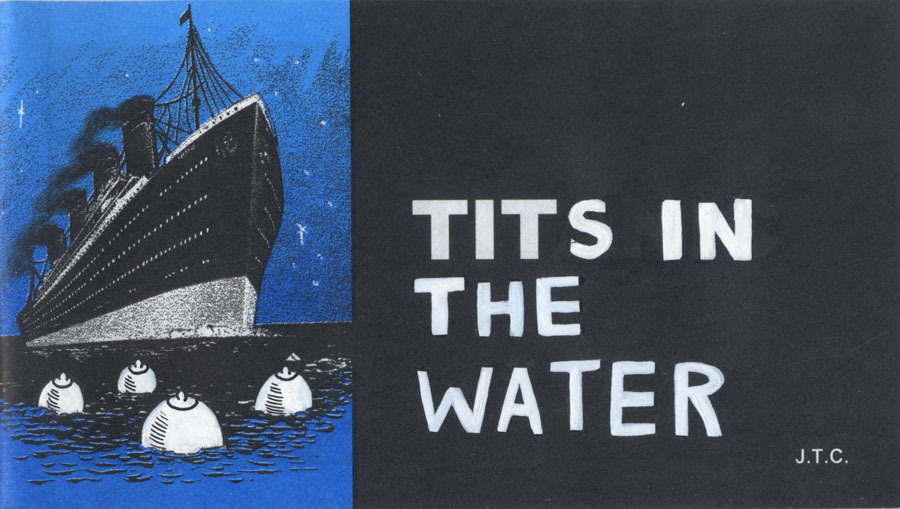
Some final thoughts on Ryan—maybe I shouldn’t have called for his murder, because I actually like his art a lot and find some of his comics extremely funny. I have to say, though, that I don’t think his overall batting average for comedy is so great. For example, I just looked through a bunch of his altered Chick tract covers (at http://www.vice.com/read/johnny-ryans-chick-tracts), and the vast majority of them didn’t make me laugh. However, looking through them was definitely worth it, as the ones that did make me laugh, like “The Letter” (http://www.vice.com/read/johnny-ryans-chick-tracts/115761), “The Contract” (http://www.vice.com/read/johnny-ryans-chick-tracts/115762), and one that suggests my favorite rapper will not go to Heaven (http://www.vice.com/read/johnny-ryans-chick-tracts/115796) made me laugh an awful lot. Batting average aside, he really hits a joke way out of the park every now and then.

Well, those are my thoughts. If no one finds this incredibly lengthy post worth replying to, I’m going to be extremely embarrassed.

 
255bd0c59a989cbe60888dd209d6aa93

Confessions of Electro Woman

Mad electro woman

“I know a woman whose internal electrical field escapes autonomously. Her basal low level charge kills small batteries: watches, pagers. Her moderate level charge creates worse havoc, even the death of computers. She has high charge levels, as well. The electrical system of at least two cars have not survived the rare but severe escapes of her internal charge.”

The above woman is my mother, writing about herself in third person. I found several print-outs of the passage while emptying filing cabinets in her condo this summer. She moved into assisted living after being diagnosed with moderate Alzheimer’s last spring. The paper was dated over a decade ago. It continues:

“Not too long ago she learned about her grant submitted to NIH (National Institutes of Health) to fund her Health Disparities research. Despite an excellent 172 priority score, the interim Director of the Institute had skipped over her grant and funded others with less meritorious scores. An appeal process is not part of the NIH Policies & Procedures.

“Hours later, the microwave fan came on autonomously. As she watched the power lights on her laptop, they cycled between battery and house power. The big computer turned itself off autonomously as she learned later. They had both been mortally damaged.

“She sat quietly in the light of candles she had made, as far as possible from electricity-powered items. Feeling drained, she went to bed.”

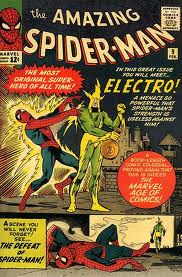
I had read this before and had heard my mother describe such electrical incidents multiple times. It would be familiar even if she hadn’t. It’s a standard comic book trope. When Stan Lee and Steve Ditko created the supervillain Electro for Amazing Spider-Man #9 (1964), they sent Max Dillon, an electric company lineman, up a utility pole to be struck by lightning while holding two lives wires. This transforms him into a human capacitor.

Spider-Man 9

My mother’s explanation is more vague and so perhaps more plausible. “If you have ever lived with a cat,” she writes, “then you know that sometimes something fires off its plum-pit sized brain, and it suddenly becomes manic, running crazily throughout the home, yowling.  Cats have been used in neurological research (unharmed) as their brain’s electrical wiring is remarkably similar to that of humans. Our brains operate autonomously to maintain the functions of our organ systems, breathing for example. As the human brain does so, electrical impulses skip along and bridge synaptic nerves via neuro-electrical transport systems not yet totally well-understood. Drugs have been developed from research in cats (and from other types of research) that modulate either uptake or release of neuro-transmitters, and thus are used to treat clinical depression and anxiety.”

Under “aspects of this woman which may or may not be relevant,” my mother includes: “deep, encompassing dyslexia; decades of treated clinical depression; creativity characterizes both her medical research and artistic pursuits; in an emergency, she is calm, focused, and solution-focused without conscious thinking.”

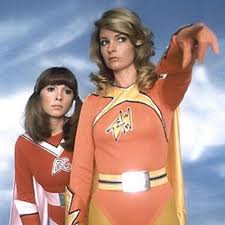
In other words, my mom thinks she’s a mutant. She was born with a dyslexia/creativity-related electrical capacity that was tapped and/or augmented by anti-depressant medication, resulting in uncontrolled and unpredictable short-circuiting discharges. I’m tempted to call her Electra Woman, from the 1976 Krofft Supershow, one of the few Saturday morning programs I didn’t watch as a kid (perhaps because it ran opposite The Shazam! / Isis Hour). But Electra Woman didn’t have superpowers; she just operated a multi-functional ElectraCom, just the sort of gadget my mother would have fried.

Electra Woman

“Last night on the way home from work,” she writes, “the car dome light stayed on all the way. I called my beloved engineer—not home. So I tried a new technique. Brute force with my shoe—on the handle which controls all car interior lights—worked quite well.

“There is an unrelenting curiosity about when the next electron-associated event will occur. There is no doubt that such will be the case.

“The only question is when.”

Although I’m skeptical of my mother’s mutant abilities, I did discover a final piece of evidence in her condo. The professional-grade shredder she had bought to destroy her decade-old and so now obsolete NIH research was dead. Her filing cabinets included reams and reams of health surveys, all of which had to be shredded to preserve the privacy of the responders. I drove to Staples to buy a new one.

“At this time I am working on too many innovative manuscripts. There is a skim of anger coating me because I am unable to clone myself. I grow concerned that if I were to concentratedly focus my electrons on an appropriate target—such as the car of a particular individual who could find me a way to funding for someone to help me with all these manuscripts (i.e. type in WORD which has never cooperated with me, or got to the library to find and copy the references I need, etc.) I think I could destroy all things electrical in his car. I wonder if I will be able to contain myself.”   

Electra Woman had Dyna Girl for a helper. My mother has me. I took over her bank accounts, found her an assisted living facility, put her condo up for sale, haggled with a buyer. I’m a great sidekick. I used to work in her lab summer between semesters, spinning blood samples in her centrifuges, logging data in her computers. There was never an accident, no power-bestowing explosion, nothing transformative. If I inherited any of her mutant genes, they are irredeemably dormant. My laptop works fine.

Warner Brothers shot a new Electra Woman pilot back in 2001, about when my mother lost her grant renewal and so her career as a medical researcher. It featured the washed-up superheroine drinking and smoking alone in her cluttered trailer–until a new Dyna Girl rescues her from her depression. The series wasn’t picked up, but I watched the unaired pilot on YouTube after a night of shredding. My mother told me the next day:

“It feels like a part of me has been ripped out.”

She is now contained in an assisted living studio, where med techs sort and deliver her anti-depressants and other pills every morning and evening. In the comic book version, a final fit of rage would uncap her well of superpowers, and she would rampage through the building and out into the streets to savage the city, until subdued by some friendly neighborhood do-gooder.

Instead she’s sitting in her one-room apartment with her cat, reading and smoking as the magic of her neuro-transmitters continues to peter out.

The Weak Mother Eats Its Young

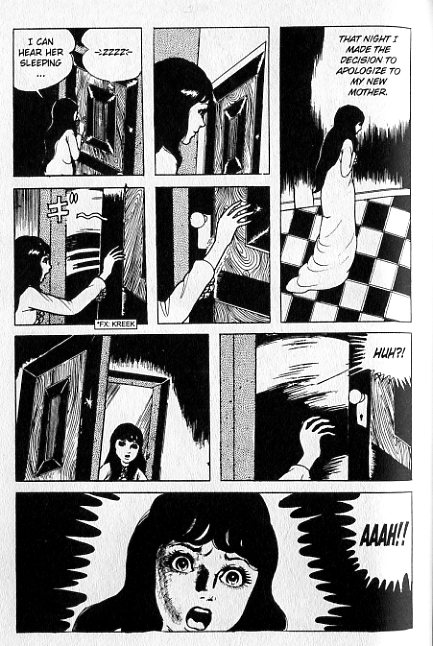
A couple weeks back I talked a bit about the tiresomeness of the strong female character trope. And I don’t disavow that: strong female characters, who all know kung-fu and never take no shit, remain tiresome. But Megumi, the main character in Kazuo Umezu’s one-volume manga “Butterfly Grave,” reminds you why, tiresome as they are, those strong female characters are generally seen as preferable to the alternative.

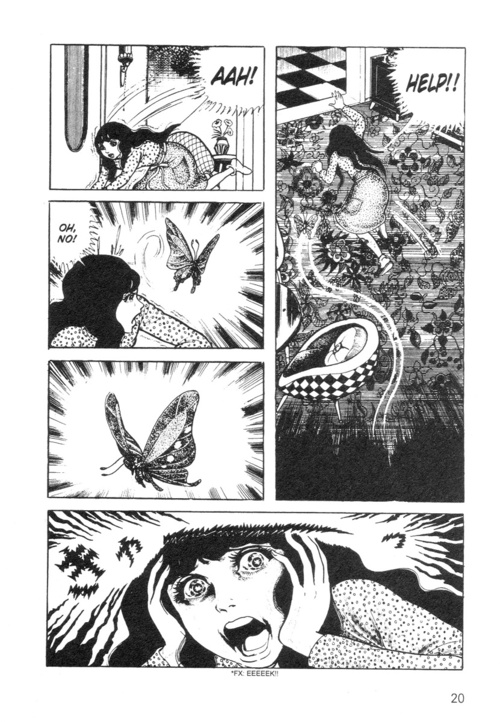
Megumi is the alternative. She is not strong. She is weak…and holy shit is her drippy, unrelenting weakness incredibly annoying. Virtually all she does, throughout the entire manga, is whine, cower in tower, and then, sometimes, for variation, whine some more. Her one character trait is an overwhelming phobia of butterflies, and when she is not shrieking and running from some fluttering assailant, she is trembling and helplessly agonizing internally about how terrible it is that she is always shrieking and running from the fluttering assailants. When even Umezu tires of that, he has her start seeing phantom black butterflies everywhere, resulting in more cowering, additional agonizing, and, if you’re me, a fair amount of fervent wishing that the horror manga would get on with the horror and kill her off in some gruesome fashion — preferably with collateral damage including her colorless father, her colorless boyfriend, the colorless kids at her school, and perhaps (if you’ll forgive me) the banally uninventive manga-ka who has inflicted all of them upon me.

tumblr_mc7o49iyCq1qg3b5co1_500

As this suggests, Megumi’s spinelessness, and consequent shapelessness, is more than just a personality trait; it’s a kind of miasma which infects the entire manga. Umezu’s Drifting Classroom, which focuses on the Bildungsroman of a male protagonist, has a grim, ineluctable structure, racing forward in an ever-rising body count towards an ever bleaker future. “Butterfly Grave”, on the other hand, vacillates in a sodden nowhere. There are events, and more events, but they never add up to anything or go anywhere. Megumi is scared by butterflies; Megumi is scared by the grotesque but harmless gardener; Megumi is scared by a dream in which her dead mother rises from the grave as a butterfly. The whole middle section of the manga is given over to little episodes where Megumi sees an ominous black butterfly, and then disaster strikes (a car loses its breaks; there’s an earthquake.) This seems to be building somewhere…but no. Umezu just abandons it. When Megumi’s fear of butterflies is eventually explained, her predictive powers aren’t so much rationalized as simply forgotten. The story — Megumi’s story — doesn’t matter, because she doesn’t really have a story. She just has the ritual repetition of terror and weakness.

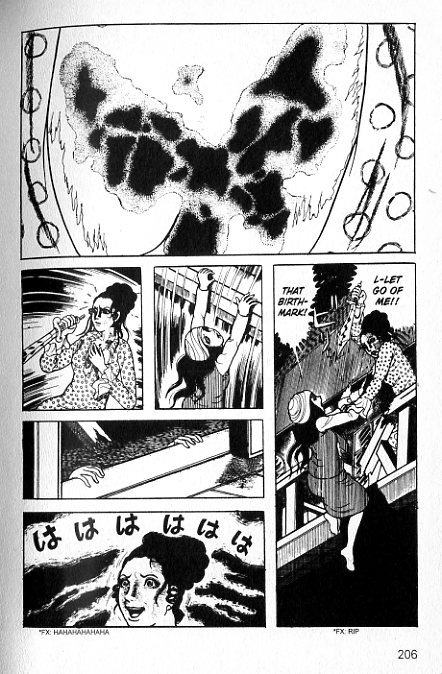
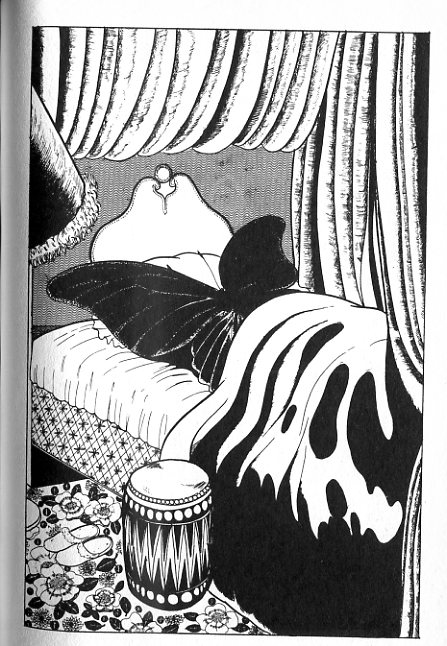
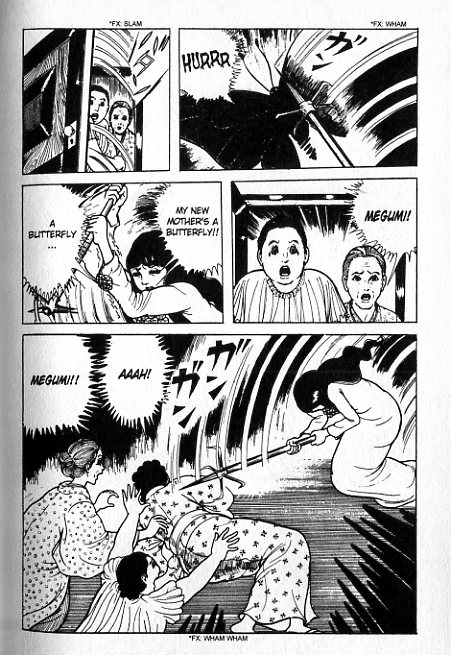
Nonetheless, and almost despite itself, the manga does heave lugubriously into a kind of plot. Megumi’s mother (given to unaccountable fits of terror like Megumi herself) died soon after Megumi was born, killed in a fall from the balcony of the house. Eventually, Megumi’s father decides to remarry a woman he has known for a long time…a woman who, as it turns out, is evil, evil, evil. It is she, the new second mother, who killed Megumi’s actual mother, pushing her off the balcony as she clutched Megumi to protect her. In the climactic scene, this murder is recreated; the evil mother tries to push Megumi off the balcony, revealing in the process a butterfly shaped birthmark. Thus Megumi’s fear of butterflies — it’s all a infantile psychological thingee, don’t you know.
 

zita008

 
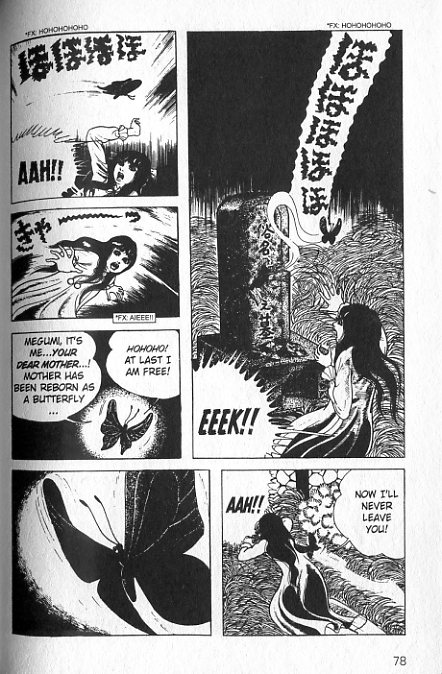
The explanation doesn’t make a whole lot of sense, but again narrative closure, or even coherence, isn’t really the point. On the contrary, narrative incoherence is the point. The butterfly “revelation” tends not to provide linear closure, but to turn the manga into a closed fuzzy circle — or perhaps a blurred shadow, like the birthmark itself. Megumi takes the place of her mother as victim. But the mother has also been insistently associated with the butterfly, as in this dream sequence.
 

butterfly009

 
Thus, mother and step-mother are butterflies, and mother and step-mother end up also being substitutes for each other. And if mother is Megumi, and mother is step-mother, then step-mother and Megumi are also the same…a point underlined when the step-mother, like the mother, and almost like Megumi, falls to her death from a height (a cliff face rather than a balcony, but still).

I’ve been reading several articles recently which reference the work of Nancy Chodorow, a feminist psychoanalyst who argues that female ego-formation is less complete or rigid than male ego-formation; that the boundaries of women’s selves are more permeable because daughters identify with mothers, and eventually with their own daughters/children. Whatever it’s application to real women, Chodorow’s ideas have an obvious application to “Butterfly Grave”, where Megumi both barely has a self and is transposed with multiple mothers, who in turn keep becoming dis-embodied and turned into soft, shadowy things, grotesque butterfly non-forms.
 

butterfly010

butterfly011

Throughout the manga, Megumi keeps asking herself “Why am I afraid of butterflies?” The answer, diegetically, is that she is afraid of her step-mother. The answer, thematically, is that she is afraid of her mother.

So why is she afraid of being her mother? Mothers are good things you’d think. Megumi’s mother sacrifices her life so her daughter won’t die in the fall from the balcony. This is initially described as an accident; Megumi crawled out into danger, and her mother rushed to save her.

The mother gives her life and saves Megumi…but if Megumi is the mother, or is to be the mother, then the sacrifice is also an imperative that she, Megumi, die — to be a mother is to give up the self. Thus, the mother is the victim of Megumi who causes her fall accidentally, and/or of the stepmother (who is also Megumi) who murders her. But the mother is also the murderer, the woman you will be who demands you give up your self. Mother murders daughter, daughter murders mother, in a perfect glob of girly-butterfly passive-aggressive doom.

butterfly012

In the manga, the step-mother hates Megumi’s mother because she wants her father — a neat Oedipal drama, if the step-mother is a stand-in for Megumi. But really there’s little energy invested in the het-plot, which seems mentioned only to show us how irrelevant it is. The real change in the step-mother’s behavior comes after Megumi’s attack on hert’s not love which leads to aggression, but loss of self — both in the sense that Megumi is not herself when she attacks, and in the sense that what provokes the attack is the step-mother not being herself, but an amorphous other, which is also Megumi.

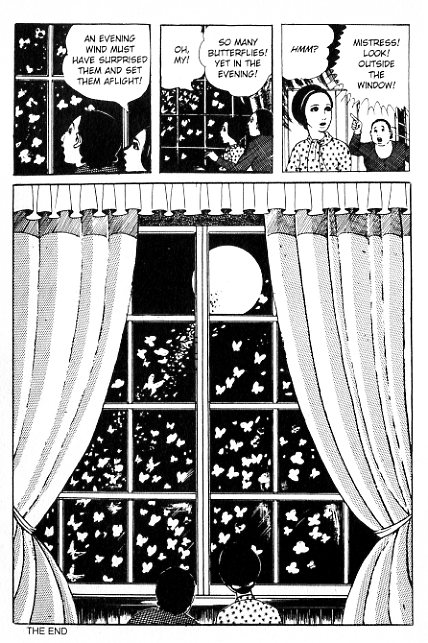
The manga ends happily; the step-mother has killed herself, Megumi isn’t freaked out by butterflies anymore, and — significantly — Megumi has her own daughter, who isn’t afraid of butterflies either. The last image is of the mother and daughter looking calmly out the window at a group of butterflies flying past; white rather than black, the blurred, shapeless shapes are domesticated and contained in the comforting grid of window panes, and the domestic arc of the curtains.

butterfly013

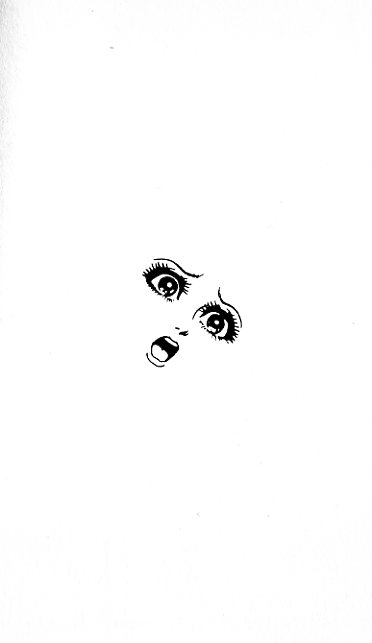
Or that seems to be the last image. In fact, on the overleaf is one final drawing — Megumi’s frightened face, screaming, disappearing into whiteness.

butterfly014

It’s not clear how this image fits into the story narratively. But thematically and visually, it links Megumi to the white butterflies, and simultaneously replaces domesticity with dread. Maternal peace suddenly becomes merely a continuation of Megumi’s monotonous terror. Megumi’s happy ending is her worst fear; she’s finally a mother, and so her self — which was never anything but her terror — fades to white. Instead of a strong female character, Umezu gives us woman as mother, which is also, in this vision, woman as void.

Film to Comics: Lessons from Daniel Clowes’ Justin M. Damiano

Justin M. Damiano was first published to limited notice in The Book of Other People (ed. Zadie Smith; full comic at link) in 2007. Its existence was jogged back into my memory by James Romberger’s recent review of The Daniel Clowes Reader where he calls it:

“…a classic that needs to be read by anyone who writes criticism on the internet.”

This wasn’t the way I remembered the story and I read it again to see if I had been blinded to its treasures on my first read through.

A number of critics have taken Justin Damiano to their bosoms, elevating the specific into a judgement of the whole or at least a comment on a significant number of online critics. At The Guardian, Peter Bradshaw suggests that:

“…mature, contemporary Damiano isn’t a cynic or a loser: he has transferred his idealism from the world of relationships to that of the cinema, and being an online critic, answerable only to himself, he is perhaps freer to express this pure, unapologetic idealism…Is Justin a sad sack for believing that this transcendence is to be found in the cinema rather than human relationships? Maybe – but not necessarily, and it isn’t clear that Clowes is inviting us to assume this.”

Another critic, Brian Warmoth, opines that:

“Clowes’ ability to distill the bitter side of humanity in menial activities and everyday labor or interests is extremely keen…It’s also about the rifts between critics and artists that can sometimes encompass shared ground.”

Part of this boils down to a presumption of antagonism—that artists are supposed to have a very low opinion of critics and criticism in general. It is easy to slip into this diagnosis unless one looks closely at the details of Clowes’ exposition, most of which holds very little water and specificity for critics. To suggest that Clowes was presenting a critique of critics in general here would be to do him a disservice and may even imply that he is a person of shallow intellect. Naturally the title of the anthology begs the question, “What other people?” It might be that the ultimate “other” for an artist is not his audience but his critics, but this wouldn’t be that much of a leap of the imagination for Clowes who has engaged in scathing criticism for years in the pages of his comics. Clowes isn’t so much an artist chastising critics but a practicing critic contemplating his own art.

Taking James’ premise as true, however, what exactly are the lessons we (as online critics, silent or otherwise) are supposed to glean from Justin M. Damiano?
Justin 00

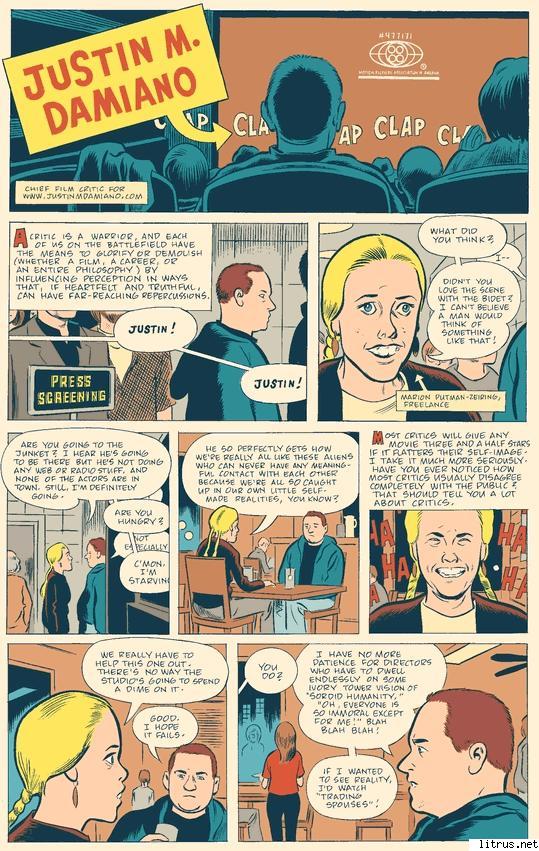
(1)  Critics have a overweening sense of self-worth.

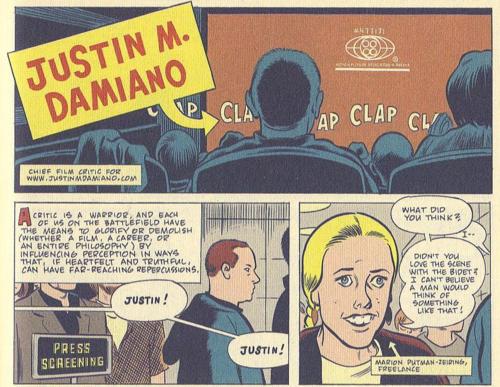
Translation for comics-kind: A comics critic is a (part time) warrior, and each of us on the battlefield have the means to glorify or destroy (whether a comic, a career, or an entire philosophy) by influencing perception in ways that, if heartfelt and truthful, can have far reaching repercussions.
Justin 01

This sounds insightful (and damning) until you start replacing the word “critic” with other words like, “artist”, “cartoonist”, “director”, “journalist”, “politician”, and “pop star”. Basically anybody with access to the wider media through talent, money, or both. In this day and age, this would mean a television program, a newspaper, a studio, and, yes, a popular blog. There is very little doubt though that the comics critic is the dung beetle of this august list of movers and shakers.

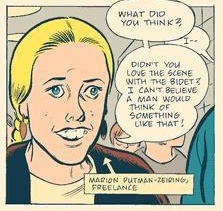
(2)  Critics enjoy toilet humor (or perhaps playful metaphors).
Justin 00a

Well, they sort of do, and they’ve also shown some fondness for bidets apparently. A clear reference to Duchamp and his porcelain urinal but also a self-referential finger pointed at Clowes himself—a very arch critic in many stories in Eightball and a florid user of metaphor.

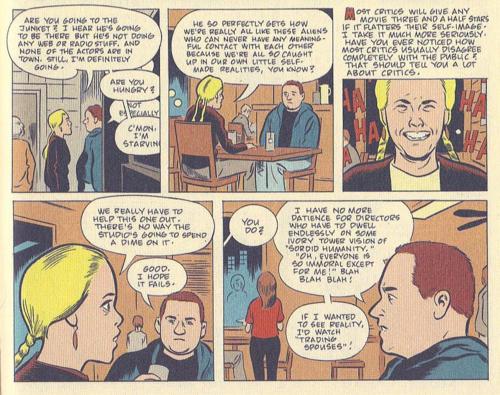
(3)  Critics are self-absorbed and insular.
Justin 02

“He so perfectly gets how we’re really all like these aliens who can never have any meaningful contact with each other because we’re all so caught up in our own little self-made realities, you know?”

There’s an interplay between panels 2 and 3 on this page.  The blonde girl, Marion, is the target of Justin’s irritable internal musings:

“Most critics will give any movie three and a half stars if it flatters their self-image…Have you noticed that most critics usually disagree completely with the public? That should tell you a lot about critics.” [emphasis mine]

That latter point is quite contrary to experience as a simple survey of the top 5 movies of the last two years will attest:

Top 5 movies by domestic gross 2013 with Rotten Tomatoes (RT) score
Iron Man 3 (RT 78%)
Despicable Me 2 (RT 76%)
Man of Steel (RT 56%)
Monsters University (RT 78%)
Fast and Furious 6 (RT 69%)

Top 5 movies by domestic gross 2012

Marvel’s The Avengers (RT 92%)
The Dark Knight Rises (RT 87%)
The Hunger Games (RT 84%)
Skyfall (RT 92%)
The Hobbit (RT 65%)

Of course Clowes doesn’t mean any old critic. He means critics like Justin M. Damiano who is shown throughout this page in an act of self-condemnation, hurling stones at others while he sits in his own ivory tower of arrogance and recalcitrant elitism—the stuck-up loner with delusions of grandeur; the keyboard warrior of  “modern alternative film criticism.” For all intents and purposes, this would include well over 50% of all comics critics.

But what exactly does “flatters their self-image” mean? One presumes that it means that critics tend to prefer movies which align with their own vision and experience of existence. Damiano suggests that critics should instead acquire a taste for other aspects of humanity as presented on film—those which run counter to their own beliefs. It should be stressed that we are specifically talking about “taste” and not action here, for Damiano is never shown acting on his preferences in art. Thus a critic with Randian principles should be able to develop empathy for the works of Vittorio De Sica. Similarly, a critic who abhors violence and misogyny should be able to appreciate and enjoy glorifications of the same. Since Marion is portrayed as a typical online critic, some might see this a proposition put forward by Clowes but this may not be the case. If Damiano is seen as a negative indicator (in some instances), it could also be taken as an admonishment of the critical community as a whole.

Marion’s comment that the film depicts human as “aliens who can never have any meaningful contact with each other” proves to be Damiano’s own “defect”—the very reason why he prefers “escapism” in film. The cinema becomes a brothel of whispered dreams and vicarious experience, a panacea for his lack of human contact. This explains his boredom when faced with Godard’s Le Mepris (a film about estrangement), a movie which probably mirrors all too accurately his own life. This isn’t so much Clowes needling critics so much as Clowes poking fun at himself, for his comics have consistently portrayed “sordid humanity” and immorality.

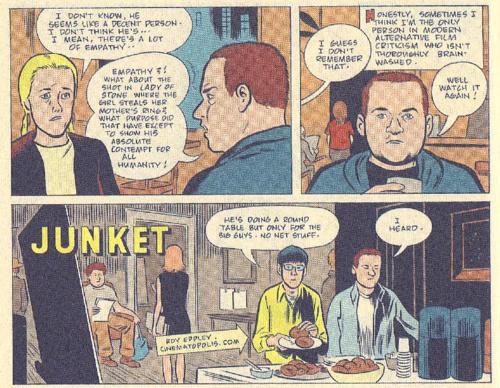
(4)  Critics are mercurial and careless – “Good I hope it fails.”

But are they significantly more so compared to the general public?

(5)  They don’t suffer fools gladly – “Well watch it again!”
Justin 03

(6)  They are frequently jealous of access.

See point 4.

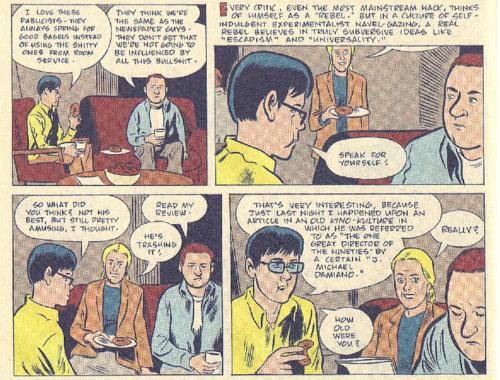
(7)  “Every critic, even the most most mainstream hack, thinks of himself as a “rebel.” But in a culture of self-indulgent experimentalist navel-gazing, a real rebel believes in truly subversive ideas like “escapism” and “universality.” 
Justin 04

This isn’t as straightforward as it sounds. Damiano suggests that every critic considers himself a “rebel,” which would make him a rebel himself. Rather than promoting “bidet” art, Justin has taken his beliefs one step further and is rebelling against rebellion—championing “escapism” and “universality.” In other words, the act of criticism is seen here not so much as an act of connoisseurship but a process of self-promotion and self-aggrandizement which has little relation to “taste” or the object beheld.

At this point, alternative comics criticism and film criticism diverge, at least in the American sphere. The gradual migration of superhero fans into alternative comics has led to a renewed interest in objects of times past and the assimilation of tropes and techniques associated with superhero comics and other forms of commercial art. Further, this might be an area where comics have a leg-up according to Justin Damiano’s injunction. The 5 nominees for Best Continuing Series at the 2013 Will Eisner Awards were Fatale, Hawkeye, The Manhattan Projects, Prophet, and Saga—all firmly lodged in the realm of  of “escapism.”


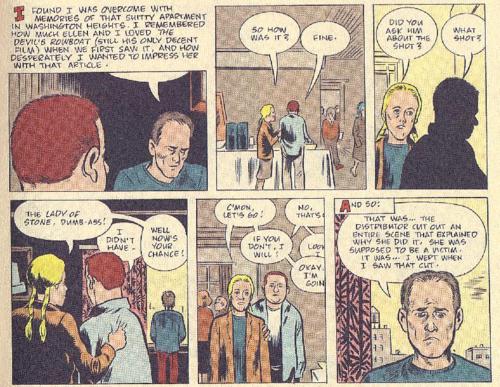
(8)  Criticism is autobiographical and self-revelatory.
Justin 06


“I remembered how much Ellen and I love The Devil’s Rowboat…and how desperately I wanted to impress her with that article.”

In the first panel of this page, Damiano’s thoughts completely obscure the words of the director who bears a vague resemblance to a balding Clowes (well, it could also be Gary Groth).  One might say that his own thoughts take precedence over the ideas of the director being interviewed; a point further emphasized by the revelation that a favorite scene of his from an earlier film of that director was quite unintentional (the result of a distributor cut).

This seems like a knock on critics but it actually suggests that criticism is as much an act of creativity as the production of a film or comic—a metatextual comment on the object being read. The real mark of bad criticism in my view is “objective” synopsis. I wouldn’t read criticism if it all read as if it was produced by a machine (or a marketing agent).


(9)  Critics are frequently loners with poor social skills.
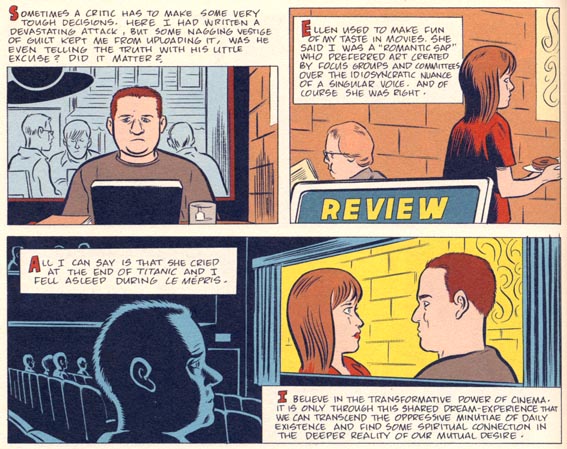
Justin 07

“I believe in the transformative power cinema. It is only through this shared dream-experience that we can transcend the oppressive minutiae of daily existence and find some spiritual connection in the deeper reality of our mutual desire.”

Justin is  looking at a pictorial representation of a cinema screen which is actually the fourth panel of the comics page. This is probably a reference to Clowes’ own migration to and from comics and film.

Clowes’ cynicism is so thoroughly ingrained into his comics that the somewhat ambiguous but treacly conviction stated here would quickly arouse the suspicions of his long time readers. One imagines that some people feel the same way about the films they see, but this seems like a specific interjection clarifying the state of mind of our protagonist, a point reasserted on the page following where he thinks:

“When Ellen finally left, she said she felt as though she didn’t even know me. She said I lived entirely inside my own head.”

The escapism which Justin seeks in the cinema (and art) has become a substitute for any real real connection. Any warmth in expression (the bottom panel bears his least contemptuous face) or speech is reserved for the figures he sees on the cinema screen. He has nothing but distaste for the people he interacts with in the pages of this comic.

It seems to me that whatever observations Clowes makes about critics are simply a side effect of using a film critic as the main character of his story. Any bitterness or acute observation is restricted to the first half of the story and forms the bedrock for his elaboration on the protagonist later in the tale. The further one delves into Justin M. Damiano, the less it reads like a standard exposè on the failing of critics, and the more it feels like a story about a man who just happens to be a film critic. In this way, it has many similarities to one of Clowes’ earlier works, “Caricature”, which constantly straddles the line between reality and illusion in its portrayal of a caricaturist—a competent loner working the crowd and his sexual proclivities.

But even more than in that work, Justin M. Damiano turns in on itself, becoming a moment of self-criticism and reflection; a careful dissection of his own comics. The “other” of the collection’s title (The Book of Other People) is not so much his critics or his audience—they remain anonymous and unknowable.  The “other” is the person that he can never hope to become.

 

Why Shelby Lynne Is Not Death Metal

leprosy+death_halifaxcollect.net

This ran a while back on Splice Today.
____________
I’ve been obsessed with death metal recently — Decapitated, Disincarnate, Dismember, Deicide, Demilich, and of course Death — best fucking band names in the world of music, and that’s just the ones that start with “D”. I love that listening to death metal on an ipod is like collecting every word in the dictionary that could possibly be considered morbid and gross and putting them together almost at random. And yes, I’m sure there’s a band named “Morbid Gross” out there somewhere, and their singer sounds like he’s gargling knives and the music is like being bashed upside the head with a decaying goat tied to a spinning helicopter rotor because — that’s what death metal is damn it! Just ask Carcass or Cancer or Cannibal Corpse or Kreator.

The other thing I’ve been listening to is the new Shelby Lynne album, Tears, Lies, and Alibis, which obviously has nothing to do with death metal at all. It has so little to do with death metal that it’s kind of fun to sit back and count the ways that it is not like everything else I’m listening to. You can hear the lyrics. They are sensitive songs about love and heartache rather than vile despicable ruminations on nuclear winter, incest, and stripping the flesh from the rotting Christ with your teeth. And, to get a little more meta, it’s always clear as clear can be why a death metal album is death metal, but it’s not at all clear what Shelby Lynne is supposed to be. Folk? Pop? Country?

Country’s where she’s usually filed I think, and that’s actually the best explanation of her genre incoherence. Because, if death metal revels in fiendish formal consistency, country has long been defined more by who’s doing the dancing than by what they’re dancing to. Music by rural whites for rural whites, country has borrowed variously from jazz, rockabilly, rock, pop, soul, blues, and whatever else happened to be around, just so long as it wasn’t too up to the minute. Death metal (or for that matter, bluegrass) is what it is; country is who is playing it and listening to it.

What this means is that fans of country — even more than fans of pop, perhaps — aren’t especially fans of a particular musical style. Listening to country means listening to an amalgamation. As a result, there’s a great deal of emphasis on personality. Death metal performers (and, for that matter, bluegrass performers) are relatively hidden, obscured behind their technical mastery and their unholy obeisance to the tropes of their genre. Country, though (or for that matter punk) is all about charisma — your stories, your voice, your sexiness, your humor. If death metal is anonymous assault, country is personal seduction.

Which maybe helps explain why I’m not so into this Shelby Lynne album. Not that I don’t like country — overall I probably like classic country more than death metal, truth be told. But…well, Lynne just isn’t that charismatic. She’s got all the technical bits down, no doubt — her voice is rich and full, with a touch of plainspokennness that comes across as sensuality. The songwriting is unimpeachable, from the Beatlesesque “Rains Came” with its woodwind accents ,to the swinging soul come-on of “Why Didn’t You Call Me,” to the earnest folkisms of “Family Tree.” It’s all done with professional polish and even moments of inventiveness. If it were death metal, I’d thrash my head to it happily.

But it’s not death metal — and as a result it’s roteness is kind of a problem. Country has no solid formal grounding to fall back on, so mere competence, or even hyper-competence, just isn’t good enough. George Strait or Leanne Womack or Lyle Lovett or K.D. Lang, to cite some artists comparable to Lynne, all manage, at various points, to be funny, or weird, or eccentric or heartfelt. I don’t necessarily adore everything any of those singers have done, but they do put their own stamp on their material. You’d have to go a long way to find someone who could put as much rueful pathos as George Strait does into the couplet “Oh she tells her friends I’m perfect and that I love that cat/But you know me better than that.” It’s hard to think of anyone who could sound as simultaneously ridiculous and heartbroken as Leann Womack does when she declares “I’m the fool in love with the fool who’s still in love with you.”

There’s no comparable moment like that on Shelby Lynne’s album. Yes, she has a great voice, but various people have great voices, and it’s hard to see how this album would be changed if one of them sang it instead of her. When you listen to a country album, you’re kind of always asking, “Who are you? And why should I love you? “ If Shelby Lynn were Morbid Angel or Malevolent Creation or Massacra the answers would be, in order, “no one” and “I will feed your corpse to the pit”. But she isn’t, and so the answers instead seem to be “I’m not sure,” and “because I’m a little bland.” Which is why I’m turning off Shelby now and going back to listen to Sodom or Slayer or Sepultura— or, hell, maybe even to Strait.