Autopsy and Jesus

This first appeared on Splice Today. It seemed like an appropriate post for Easter.
_________

Everybody loves pop music that sticks it to the man. Whether it’s Dylan nasaling about how the times they are a’changing, Johnny Rotten extolling anarchy, or PE fighting the power, somebody (usually Greil Marcus) can be counted on to gush about the apocalyptic awesomeness of shaking your butt on behalf of the downtrodden and dispossesed.

Don’t get me wrong; I love Dylan and Rotten and PE too, and I don’t wish Greil Marcus on any of them. But it’s hard to ignore the fact that, despite all their enthusiastic anarchy and change and power-fighting — or, more likely, because of it — they’re all extremely popular and critically validated. They’re charismatic rock stars swaggering for freedom and equality…which makes them icons of liberal capitalism, not opponents of it. If you want something that actually questions the values we hold dear, it seems like you need something a little less individual, a little less mediagenic, a little less virile — and maybe, possibly, a little more dead.

If you’re looking for death in popular music, the go-to genres are (obviously) death metal and (perhaps less obviously) bluegrass gospel. Two recent releases one from each genre, make the point quite clearly. Autopsy’s massive retrospective All Tomorrow’s Funerals, collecting all their EPs, starts with the new title track “All Tomorrow’s Funerals,” five minutes of zombie-demon vocals and dry-heaving spasms of drums and classic rock riffs, closing out with a doomed trudge to the grave. Doyle Lawson & Quicksilver’s Sing Me a Song About Jesus gets to the afterlife almost as quickly; the second song, “The Rich Man,” is a quick, cheerful bluegrass rave-up with patented fleet-fingered solos about how the rich on earth better do some serious thinking before they face the judgment.

It’s not just their mouldering fascinations which link death metal and bluegrass gospel, though. It’s their resolute unhipness. It’s one thing to be ready to die for love or to burn out rather than fade away — it’s another to just be really excited at the idea of corpses. It’s hard to read through Autopsy’s track list without giggling: “Mauled to Death,” “Feast of the Graveworm,” “Squeal Like a Pig,” “Dead Hole.” On the one hand, Autopsy is certainly in on the joke — but that doesn’t exactly mean they don’t take it seriously. “Destined to Fester” from the classic 1991 EP Retribution for the Dead is like Rush hit in the head with a brontosaurus, the prog outlines slowed down into giant dragging Sabbath-slabs, Getty Lee’s high-pitched wails turned into garbled grunts, the flashing guitars thumped into detuned monstrosities — misshapen, but still too geekily awesome for cool.

Similarly, the Lawson track “Little Star,” narrated by one of the wise men, is every bit as clunky as that conceit suggests. “Twinkle, twinkle little star/how we wonder what we are/they say beneath your diamond glow/there’s someone we should get to know.” The music shuffles along in the folksy, polished, Prairie-Home-Companion vein that Alison Krauss has made the sound of contemporary bluegrass. Between those earnest lyrics and the we-wish-we-were-AOR-but-we’re-not-sure-how-to-get-there backing, it’s a fairly embarrassing package; one of those things that you want to listen to, if at all, with the car windows rolled up.

Both Autopsy and Lawson are, in other words, and in their own way, morbidly corny, like plaid body bags. The technical virtuosity at the heart of both genres is the nail in the coffin, whether it’s the perfect surging acapella harmonies on Lawson’s “Going on Home” or the tight quick-march tempo changes on Autopsy’s “Keeper of Decay.” In either case, there’s a deliberate deindividuation, a determination to disappear into the demands of their respective idioms. “No, I won’t sell out for money/fancy home or big fine car,” Lawson sings. Or, as Autopsy puts it, “Face chewed to bits/On my body they feast/Swimming in the rancid sewage/Spreading their disease.” For both death and bluegrass, the faith uses and consumes you, not the other way around.

For death metal, Autopsy is surprisingly, gloriously eclectic — from the mauled classic rock of “Broken People” to the punky hardcore of “Fiend for Blood” to the doom of “Retribution for the Dead,” to weird masterpieces like “In the Grip of Winter,” which stagger about the metal landscape with a lurching so intense it almost qualifies as zombie funk. Doyle Lawson, too has been an innovator, reaching out to other gospel traditions, most notably during his time with the Country Gentlemen on the great 1978 album Calling My Children Home. But while both certainly have star power and genius, they’ve also both turned that genius in many ways towards erasing themselves in the name of their particular faith and/or community and/or morbid obsession. Musicians aren’t meritocratic heroes whose rebel yawp frees us from regimental squareness. They’re just indifferently-dressed corpses marching into the pit like the rest of us, listening to those demon grunts and high-lonesome hallelujahs which someone else will be singing when we’re gone.

&nbsp

Autopsy_2012_large

Comics Turning Into Art…Or Not

This appeared a while back at the Chicago Reader
 
Comics are part of visual art — sort of. There aren’t too many comics pages in permanent museum collections…but on the other hand gallery shows featuring comics artists are more and more common. The MCA’s “New Chicago Comics” helps to explain why comics don’t and do fit on museum walls. On the “don’t” side is the work of Jeff Brown and Paul Hornschemeirer, both artists whose focus is insistently narrative. Brown especially, with his crude drawings and layouts and cutesy punch lines, doesn’t benefit from the venue’s close focus. Works by Anders Nilsen and Lilli Carré, on the other hand, seem liberated by being lifted out of their original context. A Nilsen page showing six panels of a small pigeon cursing in darkness before it suddenly sees a cave full of blind birds is not diminished by the fact that you don’t know where the story goes. On the contrary, it leaves you, like the pigeon, trapped in a mysterious subterranean landscape, where there is wonder and life but no escape. Similarly, Lille Carré’s stencil-like drawing Splits, showing a stylized woman in a teapot almost touching her own duplicate, folds comics’ panel-to-panel repetition back on itself. It’s as if a character turned around, saw herself across the gutter, and was instantly transmuted into art. The MCA show provides an interesting contrast between some comics which can’t, and are perhaps not even interested in, making that turn, and some which can and do.
 

images


Funny vs. Facts: How can you make a joke in comics journalism?

What’s the funniest comic you’ve ever read? Was it true?

Editing a magazine of comics journalism presents some interesting challenges. Symbolia merges non-fiction reporting, illustration, and interactive elements. We’re trying a new kind of news, and it seems to be working. We’ve built a truly global audience for our work (only 55% of our subscribers are in the US), which is amazing.

But there’s still something that I’m struggling to do: break through the somber tones affecting most comics journalism today and publish something that is deeply, truly, gut-bustingly hilarious. Editorial cartoons don’t count. While they rely on fact, the use of caricature and, y’know, opinion, can obscure the integrity of the reportage.

Seriousness is something that plagues non-fiction comics in general. From Fun Home to Stitches to Palestine, things can get pretty grim. It could be because comics are still trying to “prove themselves” as a medium—but I sure hope not. We’re all over the “but comics aren’t for kids anymore” thing….right?

When I was developing Symbolia, when it was just a twinkle in my eye, I was continually asked two questions:

  1. But how will you make it funny?
  2. Well, is it true?

I’d like to think there’s room in the world for both. Give me the John Jeremiah Sullivan of comics journalism. Please. The funniest non-fiction comics work I’ve read in the past few years has been autobiographical, not reportage: Vanessa Davis’ Make Me a Woman and Drinking at the Movies by Julia Wertz. More David Sedaris than David Remnick.

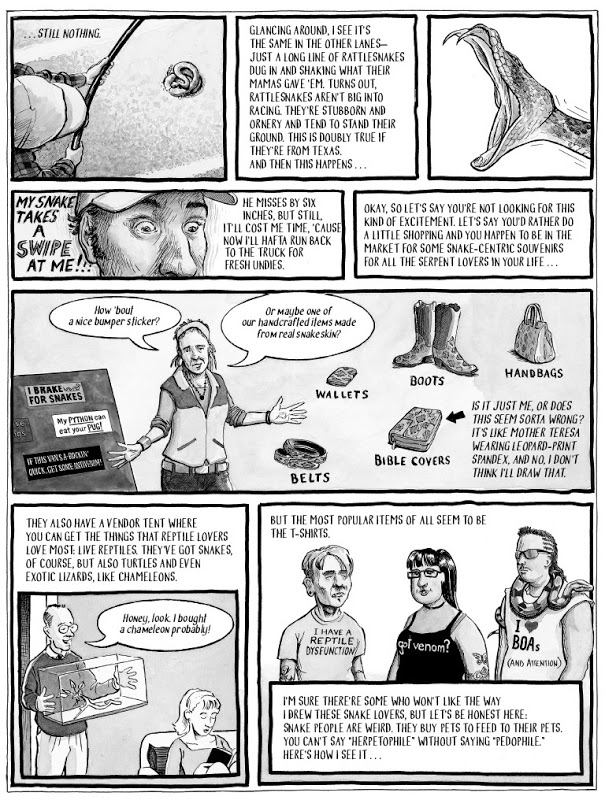
Matt Diffee’s reportage on snake handlers in the Cartoon Picayune is a refreshing break from the oh-so-serious comics journalism trope, but his breed of work is pretty rare. Andy Warner has also done some amazing work for us and we love the little easter eggs he peppers throughout each project.

page8

Matt Diffee for the Cartoon Picayune

What to do about it?

We’re closing production on Symbolia’s third issue now and one thing is painfully obvious: Comics journalism can be whimsical. It can be gut-wrenchingly honest. It can be evocative and convey real emotions. Comics can convey humor. Comics can convey truth. But can they do both?

I often feel, as an editor of a news product, that we have to prove the veracity of our work since it’s not “typical news.” That often means we fact-check the funny out.

That doesn’t mean that Symbolia is dry and dull and depressing. Joyce Rice, Symbolia’s cofounder, and I do all sorts of things to adapt: We have a really whimsical sense of design, we pair cultural reporting with stuff that goes a little deeper, investigation-wise, we add interactive treats to cultivate delight…but straight up humor is really, really hard.

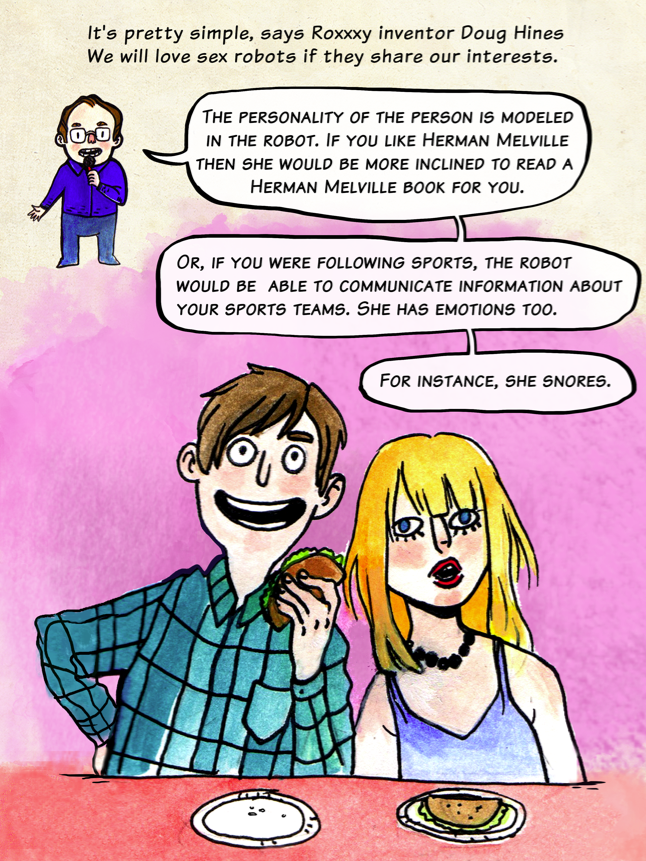
Audrey Quinn and Kat Fajardo for Symbolia

Audrey Quinn and Kat Fajardo for Symbolia

So, we’ve developed all of these coping mechanisms to add delight–but our jokes are few and far between. We’re publishing a story on sexbot AI in the next issue and I finally feel like we have something that is deeply humorous, though it pushes a few journalistic boundaries.

I figured I’d take this conundrum to the HU community and ask you to prove me wrong. I’m looking for deeply funny, deeply true examples of comics journalism. SO: Let’s take this to the comments. I want you to tell me I’m wrong. What’s out there? Is what I’m looking for even possible?  I’ll be diving in and out of the ensuring thread over the weekend and will pull the most interesting, most insightful comments up into this post.

Starter question: What is the single most hilarious work of non-fiction comics you’ve ever read? Why? GO!

All right, we got some great ideas–R. Crumb, Jessica Abel, Harvey Kurtzman, and more.

Time for my next question: When the cartooning is REALLY cartoony, can a comic still convey truth?

Marvels of Metafiction

bookcover

 
Google “jennifer egan” and seconds later the term “metafiction” will attach itself leech-like to the side of her postmodern head.

I know this because members of my university have made the possibly foolhardy decision to ask me to give a talk on the Pulitzer winning author for our 2013 Tom Wolfe Weekend Seminar. I’m to place A Visit from the Goon Squad into “the context of contemporary American culture” with “a discussion of Egan’s special skills as a writer,” keeping in mind she will be “sitting right there in front of you.”

I regularly tell my first year comp students that even if we could materialize authors in our classroom (usually during a discussion of Henry James’ mind-blowingly ambiguous The Turn of the Screw), their opinions would be completely irrelevant. Readers and only readers determine the meaning of a text. Except of course in this case. Because that will be the actual Jennifer Egan. In the front row. Listening. To me. Blathering. About her book.
 

Jennifer Egan

 
Poetic comeuppance aside, the author’s physical presence will be especially apt for a discussion of Goon Squad. Chapter one opens: “It began the usual way . . .” and before you’ve waded in a dozen pages you’re knee deep in self-referential story-telling, overt comments about symbols and plot arcs and collaborative writing. Ms. Egan is pulling off her metaphorical mask and yelling: Look at me!

So now, after stretching to pluck David Lodge’s The Art of Fiction from my office book shelf, let me flip to Chapter 46: “Metafiction is fiction about fiction: novel and stories that call attention to their fictional status and their own compositional procedures.”

Apart from a requisite nod to the 18th century’s Tristram Shandy, Lodge spends most of his time chatting with John Barth and Kurt Vonnegut. William Gass coined the term in 1970, after Barth demonstrated the style in his 1968 novel Lost in the Funhouse. Slaughterhouse Five was published a year later. Add Pynchon’s The Crying of Lot 49 (1966) and a couple of short stories by Robert Cover, and there’s your course syllabus for “Goon Squad: Founding Fathers of American Metafiction.”

Except, wait, here’s that inevitable moment, my weekly plot twist, where I veer to where I must always veer:

Superheroes!

No, no, no, NO. American metafiction did NOT begin in the late 60s. It was not a highbrow literary phenomenon. It was the lowest of the lowbrows, the pulpiest of the pulps, that ultimate literary stepchild, the comic book.

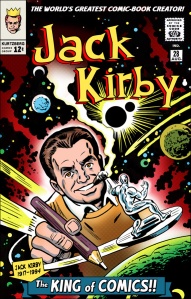
Stan Lee and Jack Kirby beat Pynchon by a half-decade. In Fantastic Four #2, on newsstands in 1961, Reed Richards convinces an alien race not to invade Earth by showing them drawing of monsters. “Those are some of Earth’s most powerful warriors!” he tells them, while thinking, “I pray he doesn’t suspect that they’re actually clipped from ‘Strange Tales’ and ‘Journey into Mystery!’” Two other Marvel titles sharing newsstand space with Fantastic Four.

Two issues later, the Human Torch chances onto a stash of old comics. “Say! Look at this old, beat-up comic mag! It’s from the 1940’s!!” It features the Golden Age Namor on the cover. “The Sub-Mariner! . . . He used to be the world’s most unusual character!” And guess who shows up two panels later?

In issue five, Johnny’s reading habits have expanded. Reed asks, “What are you reading, Johnny?”It’s The Incredible Hulk #1, out the same month. “A great new comic mag, Reed. Say! You know something—! I’ll be doggoned if this monster doesn’t remind me of The Thing!” Because he’s supposed to. Marvel created Hulk because of the Thing’s popularity.

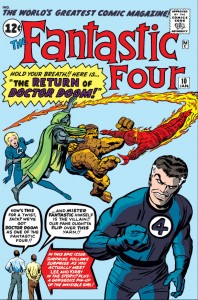
The cover of FF #9 asks: “What happens to comic magazine heroes when they can’t pay their bills and have no place to turn?” But #10 is even bolder: “In this epic issue surprise follows surprise as you actually meet Lee and Kirby in the story!!” The authors stare up at the action from the front row.

Stan: “How’s this for a twist, Jack? We’ve got Doctor Doom as one of the Fantastic Four!!”

Jack:  “And Mister Fantastic himself is the villain!! Our fans oughtta flip over this yarn!!”


Fantastic-Four-10

 
As promised, Dr. Doom uses the Marvel duo to lure Reed into a trap.

Johnny: “Phone call for you, Reed! It’s Lee and Kirby! They’d like you to go to their studio to work out a plot with ‘em!”

Reed: “Strange…we just finished discussing a new plot yesterday!”

Thing: “Tell ‘em if they don’t stop makin’ me even uglier than I am, I’m liable to go up there and wrap this two-ton weight around their skinny necks!”

Issue 11 goes further still. The team has to stand in line to get a copy of their own comic book, and then they go home to answer fan letters, shattering the last remains of the fourth wall. Mr. Lumpkin, their mailman, laments in the final panel: “Blankety blank fans and comic magazine heroes, and letters to the editor pages! Ohhh my achin’ back!”
 

Stan Lee

 
The trend dies a quiet death in the next issue when the Hulk shows up with no mention of that comic mag John had been reading. Marvel traded in metafiction for multi-title continuity. That brings us into 1962, still eight years before Barth coins the term.

And does all of this put Jennifer Egan into “the context of contemporary American culture”?

Um, no, not really.

So you’ll forgive me if I sign off now and finish reading Goon Squad.

‘Nuff said.
 

Jack Kirby

Charles Schulz vs. Thomas Hardy…Bonk!

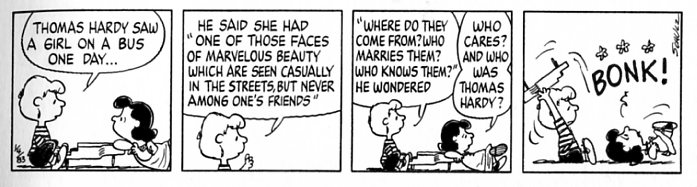
As regular readers know, over the last month and a half or so the blog has been engaged in a sporadic roundtable on the place of the literary in comics. I was recently reading the 1983-84 volume of Fantagraphics Peanuts collection, and came across a strip that seemed like it had interesting things to contribute to the discussion. Here it is:
 

Hardy_Peanuts

 
So what does this have to say about the literary in comics? Well, several things, I’d argue.

First, and perhaps most straightforwardly, the strip can be seen as an enthusiastic endorsement of literariness. Schroeder — the strip’s most ardent proponent of high art — quotes Thomas Hardy. The second panel is given over almost entirely to Hardy’s words, which take up so much weight and space that they almost overwhelm Schroeder’s earnestly declaiming face. Lucy — Schulz’s go-to philistine — expresses indifference and self-righteous ignorance — for which she is duly and gratifyingly punished by Schroeder, who pulls the piano (marker of the high art she’s rejected) out from under her. Bonk!

In terms of the debate we’ve been having on this blog, you could easily see this as a pointed refutation of Eddie Campbell’s rejection of literary standards and literary comparisons. Campbell’s argument that literariness is not relevant to comics seems to fit nicely with Lucy’s “Who cares?” — while Ng SuatTong’s ill-tempered riposte seems quite similar to Schroeder’s.

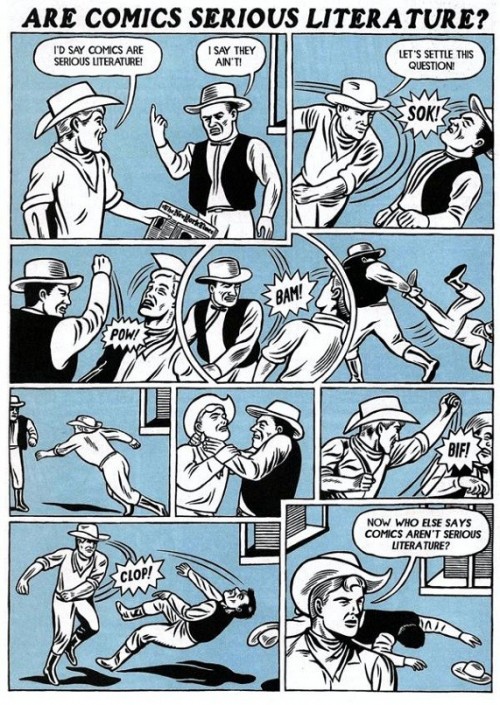
On second thought, though, Schulz’s attitude towards literariness can be seen as a little more ambiguous. It’s true that Schroeder, the advocate for high art, gets the last word. But the last word he gets is not precisely high art. On the contrary, it’s slapstick. The point of the strip, you could argue, isn’t the Hardy quote, which ends up essentially being little more than an elaborate set-up — it’s literariness there not for its high-art meaningfulness, but simply to signal “high art meaningfulness.” The real pleasure, or energy, of the strip, is in that last image, where Schroeder pulls out the piano — almost throwing it over his head and off panel, as if to toss aside the very possibility of including high art in a comic strip. From this perspective, the strip might be seen as being in the vein of Michael Kupperman’s “Are Comics Serious Literature?” (HT: Matthias.)
 

SeriousLiterature-500x705

 
The point isn’t so much to advocate for literature as it is to use comics to giggle at the idea of advocating for literature in comics — a position that Eddie Campbell would probably find congenial.

One last, perhaps less schematic,possibility is to think about the strip in terms of gender. It’s interesting in this context that, while Schroeder is generally the advocate for high art, he’s also generally uninterested in, or immune to, the appeal of romance — he’s one of the few characters in the strip who (as far as I’ve seen) never has an unrequited crush. Lucy, of course, has a crush on him, and it’s usually she who brings up images of marriage or love or domestic bliss, only to have Schroeder disgustedly reject them.

This strip is different, though. Hardy’s words are not just a default marker of high art; they’re in particular a paen to a woman’s (or a particular kind of woman’s) “marvelous beauty,” and a speculation — with more than a little longing — on who such beautiful people marry. It sounds more like something Charlie Brown would say about the little red-headed girl than like something Schroeder would say to Lucy.

Lucy’s lack of interest, then, can be seen as not (or not merely) philistine, but as tragic — Schroeder is finally, finally talking to her about love, and she can’t process it or understand it.

You could attribute this to her soullessness, I suppose — she is blind and doesn’t deserve love. But you could attribute it to Schroeder’s soullessness. Certainly there’s a cruelty in babbling about the beauty of random unobtainable women to someone who you know is head-over-heels in love with you. For that matter, the Hardy quote itself seems to exhibit some of his most maudlin and least appealing tendencies; it’s pretty easy to read it as a self-pitying lament for the fact that beautiful women are human beings, rather than simple objects to be collected by men who admire them in the street. The high-artist idealizes Woman and ignores the woman sitting in front of him. Lucy’s utter indifference could then read as a recognition that Hardy is indifferent to her — and Schroeder’s violence as a tragi-comic extension of Hardy’s violence. In this case, the literary is neither defended nor ridiculed, but is instead a kind of doppelganger — a shadow of meaning cast by the comic, the meaning of which is in turn cast by it.

Literature, then, appears for Schulz in this strip as an ideal, a butt, and a fraught double. As I’ve said on numerous occasions, I don’t really have any problem comparing comics and other forms (Charles Schulz is a greater artist than Thomas Hardy, damn it.) But I do feel like the anxiety around those comparisons, in every direction, sometimes ends up drowning out potentially more interesting conversations about how, and where, intentionally and despite themselves, comics and literature can meet.

Steve Ditko Oddity

gano022

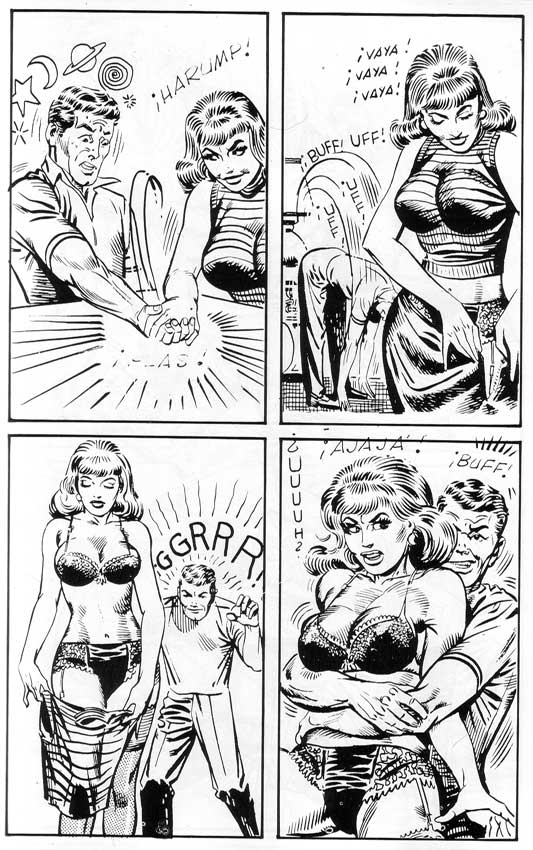
The above bit of ribaldry may disconcert certain comics fans. Its style of drawing evokes that of Steve Ditko, the creator of Spider-Man and of Dr Strange — wholesome comic-book superheroes for kids. Is there a secret side of Sturdy Steve we don’t know about?

Yes and no.

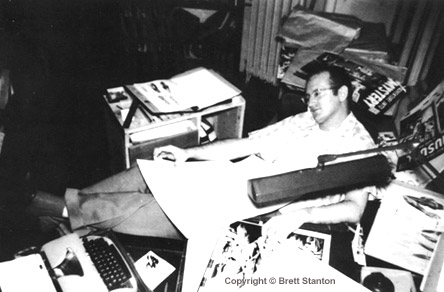
Ditko attended the School of Visual Arts in Manhattan, where he made friends with another budding cartoonist, Eric Stanton (1926– 1999). He and Ditko shared a studio on 8th Avenue from 1958 to 1966.
 

eric-stanton-in-studio2-gla

 
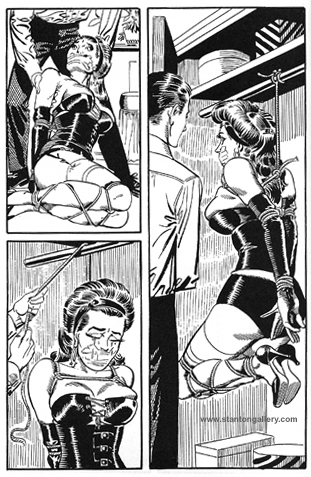
Stanton had a specialty, though — kinky sado-maso bondage comics– his “stantoons”. Legal dynamite in the ’50s, they look oddly innocent in our current porn-saturated times.
 

ditko_pic_brettstaton

Steve Ditko, at the same period

 
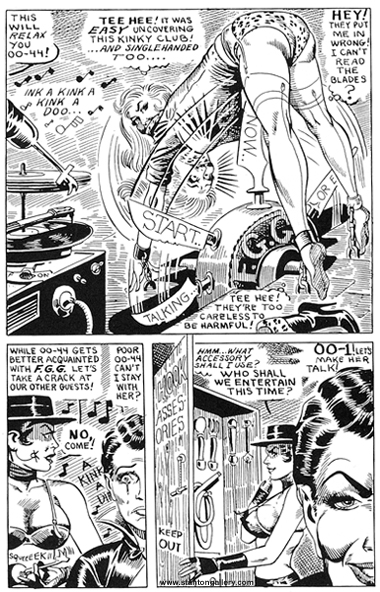
The two cartoonists had superficially similar styles, and were given to helping each other out with deadlines. So the above strip has, at the least, Ditko inks in the equation; the next one seems to have been laid out by him, as well.


Ditko never made a secret of his association with Stanton. With his reputation as a stern moralist, though, he seems open to a charge of hypocrisy.

But Ditko is a conservative of the Libertarian kind, and as such would have a keep-the-damn-government-out-of-the-bedroom attitude.
 

confidential-tv2
 
As for Stanton’s assists to Ditko, it’s long been rumored that he’d contributed to the first Spider-Man story. Stanton does claim to have come up with the idea of webs shooting from the character’s hands. When asked by Greg Theakston about the extent of his contribution to Spider-Man, Stanton replied:

“Almost nil…. I think I added the business about the webs coming out of his hands.”

He elsewhere makes the intriguing claim, though, that he helped Ditko out with “storyboards”.

By that word, did he mean storyboards in the usual sense — for TV or movies? New York was, and remains, a major center for the audiovisual industry, and certainly many cartoonists based in the area, such as Lou Fine and Bill Everett, produced storyboards for TV advertising. Ditko and Stanton might well have done a job or two for the screen.

Or did he use the term “storyboards” to mean comic book layouts? Ditko, at the time, was an astonishingly productive artist, not just for Marvel but also for Charlton and Warren comics. And he certainly wasn’t averse to artistic collaboration: he was sometimes inked by Dick Ayers or Mike Esposito, among others, and he himself often inked Jack Kirby ( a wonderfully quirky pairing.)

Here’s a casual claim by Stanton that seems plausible, in connection with a bondage comic:

“I made ‘Sweeter Gwen’ from John Willie’s ‘Gwendoline.’ I roughed out (penciled) 30 pages and took them over to Burtman and he said ‘great … but then I got another commission and I had to stop on ‘Sweeter Gwen.’ I asked Steve Ditko to ink it for me and we’d split the money 50% / 50%. So then we story boarded like we used to do for Spider-Man. We gave ideas to each other. We came up with a very beautiful story and we finished it and took it over….”

We’ll never know for sure. Stanton is dead, and Ditko is famously adamant in refusing to speak about his career.
 

kinky-hook-use4

 
Why did the pair break up? According to Stanton’s daughter Amber, her father announced to Ditko he was getting married. Ditko took this as a betrayal of Stanton’s principles… and the partnership, and friendship, were over.

One last sample, and you be the judge: how much is Stanton’s, and how much — if any– is Ditko’s?


(Nota Bene: the comics in this post were researched for reasons of scholarship ONLY.)

stantditko097

The Same Words

This first ran on Splice Today.
_________________

If you want a glimpse into the sorry state of America’s gun policy debate, look at Brian Doherty’s smugly incoherent pronouncements over at Reason.

Doherty’s main point is in his article’s title: tragedy, he insists, shouldn’t make policy. The shooting at the Dark Knight showing in Colorado is a random incident without any broader lessons to teach us about guns, or assault weapons, or America.  He declares:

Trying to “turn tragedy into politics” feels gross, because the deaths and the grief for the living are real and terrible and demand respect… If I weren’t a professional writer about the Second Amendment (in my 2008 book Gun Control on Trial) on record as believing in the right to bear arms, I wouldn’t dream of weighing in at all.

Or, to sum up, only people with credentials like Doherty should be allowed to draw conclusions from tragedy, and only as long as those conclusions are that we should dismiss the tragedy from theoretical consideration. Refusing to think about how the tragedy might involve our society or us is, apparently, the best way to show respect for those who have died.

In the real world outside the abstract libertarian compound, tragedies do very often lead to political thinking and political consequences. Sometimes, this has horrible results, as in our decade of foreign policy motivated by 9/11. Sometimes, though, it’s necessary and important. Surely it’s not disrespectful to suggest making sure nuclear reactors are earthquake proof after the disaster in Japan. To point out that people died because of inadequate safety features or (in, say New Orleans) because of poor policy response, isn’t callous. It’s acting as if we care about the dead, and about the living. Preventable deaths should be prevented. That’s not an insult to anyone’s memory; it’s simple human decency.

Not in Doherty’s world, though. On the contrary, he’s so myopically certain of his position that, without irony, he quotes himself blandly dismissing Gabby Giffords’ shooting.

Americans understand that even strange people should be able to own weapons, and not just for deer hunting. The very rare crimes of very unusual Americans should not dictate how everyone’s right to self-defense is managed, and even in the wake of tragedy that is fortunately unlikely to change.

Doherty apparently hasn’t noticed that putting “very” in front of “rare” and “unusual” is a rhetorical device somewhat undermined by the fact that such events are, at least, frequent enough that he’s got a canned spiel to pull out every time they happen. When, I wonder, will he notice this contradiction? The third time he reprints it? The fourth? The 10th?

Doherty is correct that it’s politically impossible to change gun laws at the moment, but I don’t think that’s because Americans have decided en masse that it’s a good idea for “strange people” to have unlimited access to semi-automatic weapons.  Rather, it’s because the NRA and the pro-gun lobby has bludgeoned politicians into submission—and, perhaps most importantly, because the Democrats abandoned the issue. Doherty himself notes that at the beginning of the 1990s, 78 percent of Americans supported stronger gun control laws. Then along came Bill Clinton. Without a political party to lead or make the case for stricter controls—without a party to, for example, point out that perhaps we could stop our regular cycle of tragedies if we made an effort—public opposition to guns has cratered. Doherty sees this as a sign of America’s growing wisdom, but it’s just as likely a result of a craven lack of leadership.

That leadership might reappear, though, if people begin to get weary of random yahoos loading up with firepower so they can kill children. That’s why Doherty has taken to the Internet again to wave around airy phrases like, “The endless and unmanageable mystery of the individual’s power and choice to do evil,” as if somehow an evil person’s power to do harm is completely unaffected by the availability of machine guns.

Doherty insists there is no connection between violence and gun possession. That assertion is debatable. James Fallows, for example, points out that after a terrible 1996 massacre in Tasmania, “Australia tightened up its gun laws, and there has been nothing remotely comparable in all the years.” In the U.S., on the other hand, we’ve apparently decided that it’s better to accept the occasional multiple shooting than it is to reexamine gun policy. That’s a political decision. Which is why Doherty is taking the occasion of the tragedy to make his polemical points, and why he will use the next tragedy to do the same, and the next, and the next, and the next, until, at some point, Americans get tired of hearing the same words spoken over yet another grave.