Django, Southside

8c00649r

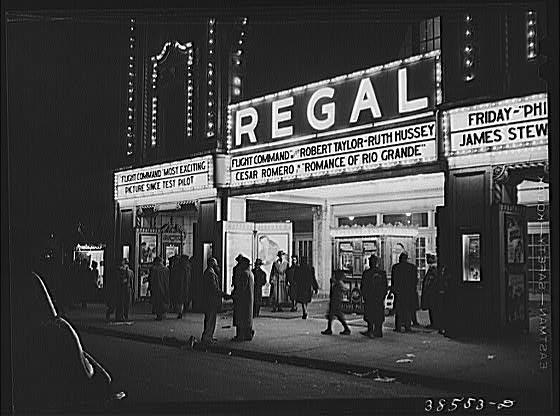
Movie theater, South Side of Chicago: photo by Russell Lee, April 1941, from this site.


So there’s been some discussion in comments on various bits of our Django Unchained roundtable about how African-American audiences have reacted to the film.

The obvious answer to this question is, of course, that different black folks have reacted differently to the film, just as different white folks have reacted differently to it. There’s no monolithic black community response any more than there’s a monolithic white community response.

With that said…I did see Django Unchained on the south side of Chicago, with an audience that was basically entirely black (I think I may have glimpsed one other white guy there, but that was pretty much it.) The reaction to the film was, as far as I could tell, pretty enthusiastic; the little old lady sitting next to me kept loudly finishing punch lines and seemed particularly stoked by Stephen’s ignominious end.

When I was leaving the theater, I did overhear an interesting conversation, in which two men were discussing the way that “we undermine ourselves,” (to quote loosely.) I assumed they were referring to the character of Stephen — the black slave who aids his white master and effectively becomes (as Charles Reece points out) the film’s main antagonist. The idea that blacks are at least partially responsible for their own oppression is a well-established discourse in the black community, of course, from Bill Cosby and Barack Obama on down.

Still, it made me a little queasy to hear it deployed in this context, inasmuch as Stephen really is not, as far as I could tell, an accurate representation of anything. Uncle Tom really is a caricature, and looking to Stephen for straightforward lessons on slavery or racial politics really seems like a bad idea.

Anyway…while writing this, I actually started to wonder how white audiences reacted to the film. So, anybody see the film with a primarily white audience? Was there discomfort? Enthusiasm? Or what?

Django vs. Lincoln

The entire roundtable on Django Unchained is here.
____________________
 

I made the odd choice to see both Django Unchained and Lincoln during the same evening, which made for an interesting resonance between the two films. On the one hand, you’ve got a grim-but-lightweight meditation on slavery and the awful-yet-exhilarating things people did to get out from under its thumb, and on the other, you’ve got a more serious treatment of the matter in Quentin Tarantino’s blaxploitation revenge thriller. I kid, of course, but it’s notable that while Lincoln is supposedly a serious, highbrow take on what had to be done to end slavery in the United States, Django is much more effective in evoking its horrors, putting a more personal face on the issue and really getting the viewer on the side of the oppressed. Or maybe that’s just my impression due to the juxtaposition of the two, along with my own personal tastes for the relative filmic styles of Tarantino and Steven Spielberg.

By the way, unlike some commentators around these parts, I don’t really have any antipathy toward Spielberg, and I generally like his movies; they’re slick, commercial productions that are almost always put together marvelously, clicking along like well-oiled machines that are constructed in such a way that their clever workings are exposed for all to see so we can be fascinated at their intricacies. This is fine when it comes to entertainments, but when applied to serious subjects, the self-satisfaction can become extremely irksome, with messages pounding viewers over the head with their obviousness, characters mawkishly affirming proper virtues to those around them almost up to the point of turning toward the camera to give some extra pointers to the folks at home, and the ever-present John Williams score swelling grandly to remind everyone of the gloriousness of what we’re seeing. It’s oppressive, a sensibility that, in seeking to highlight the magnificence of the events depicted, smothers them in “importance”, making sure nothing is misinterpreted.

That said, Lincoln certainly isn’t terrible, and while some of Spielberg’s schmaltzy impulses are on display, they can’t obscure a wonderful performance by Daniel Day-Lewis and some fascinating looks at all the behind-the-scenes maneuvering, dealmaking, and outright lying that had to be done in order to accomplish something worthwhile in the dirty business of United States politics. It’s not a movie for idealists, since even with all of the appeals to the rightness of the cause of outlawing slavery, the message seems to be that one has to sacrifice one’s ideals in order to accomplish anything of worth. The big moment in this regard comes when Thaddeus Stevens (as played by Tommy Lee Jones), a fiery abolitionist who had long spoken of a belief in the equality of all men, gives a speech in which he insists that he only supports equality in terms of the law, rather than in a moral sense, and it’s presented as a triumphant moment, with swelling music and triumphant reactions from his fellow supporters of the 13th Amendment. It’s a surprisingly cynical scene, but Spielberg has to include a moment in which Mary Todd Lincoln’s black servant lady leaves the chambers in tears, in case we get so carried away by the speech that we also adopt the belief that while slavery is evil, freed slaves really shouldn’t be allowed to vote (and not women either, since that also gets a mention in another on-the-nose moment).

Me, I much prefer Tarantino’s approach, which is to bury the disturbing historical attitudes and occurrences in layers of cool filmmaking, surrounding them with his usual visceral action, incendiary performances, gorgeous camerawork, and perfectly-selected music cues, making the horrors of slavery an intrinsic part of life in the brutal world he’s recreated/constructed here, an impossible-to-ignore inhumanity that makes for an upsettingly recurring gut-punch throughout. In a different setting, this would be an enjoyably violent crime/heist movie, but by centering it around slavery, Tarantino forces us to contemplate the disgusting ways in which people once openly treated one another, by making sure to treat the all-too-realistic brutality differently than he would the “normal” moments of violence that regularly turn up in his films. Instead, he turns scenes of whippings, men being forced to fight to the death, and dogs ripping a man apart into moments of horror, accentuating the bodily damage done (while obscuring the actual action, as if it is being glimpsed from the corner of one’s eye) and showing us people’s squeamish reactions. On the other hand, Tarantino makes a mockery of the racist attitudes people used to justify their actions, with Leonardo DiCaprio’s monologue about phrenology as the reason black people are inferior to whites coming off as the rantings of an insane tyrant and a gang of white supremacists who can’t manage to construct hoods that don’t render them blind seeming too stupid to live, revealing their philosophies as those of people struggling to hold on to power in a world that is quickly passing them by.
I guess it all comes down to highbrow vs. lowbrow, literature vs. pulp. Attempts to educate and edify viewers often come across as heavy-handed, which might be unavoidable, but I know I prefer a rousing entertainment that manages to include enough substance to make one think. Of course, the impulse to talk down to an audience must be hard to ignore, as was demonstrated to me by Django‘s equivalent to the aforementioned Thaddeus Stevens scene, in which Samuel L. Jackson’s “house negro” character complains vociferously when former slave Django gets to stay in his master’s house. His line about having to burn the sheets Django slept in elicited a huge laugh from the packed theater I watched the movie in, which was kind of disturbing. Maybe there is some value in making sure the “correct” message comes across, or maybe that’s just my politically-correct 21st-century mindset in action. Really, it’s best not to worry about the possible misinterpretations of the less-enlightened and trust audiences to understand. That’s what I like about Tarantino (and often find tiresome with Spielberg): he’s not afraid to be misunderstood (unless it comes to character motivation, apparently), and I don’t think he cares if people find his films offensive. Would that I could be so unworried about people’s opinions.


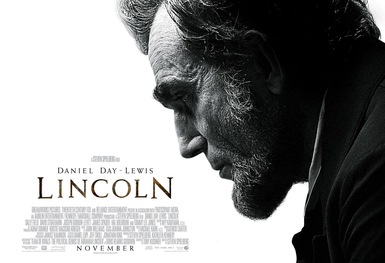
Lincoln-Movie-Poster-1536x2048_extra_big

AbEx vs. Comics: Which Is More American?

I’ve done a ton of post about Bart Beaty’s writing — but I think this will be the last. No promises though!

Anyway, I read Beaty’s book Frederic Wertham and the Critique of Mass Culture recently. In general I found his argument quite convincing — that argument being that,

(a) Wertham was not a monster, and that his good works — such as providing clinical services in Harlem and providing key evidence to support Brown v Board of Education — more than outweighed his negative impact on the comic industry, and

(b) that negative impact has been seriously overstated anyway, and has been used as an excuse to neglect other more important reasons for comics decline — like television.

Anyway, as I said, Beaty largely convinced me. I was interested, though, in one paragraph towards the end of the book in which he is actually criticizing Wertham. Beaty says he disagrees with Wertham about the divide between high culture and low culture, and about the clear superiority of high culture. He argues that the privileging of high culture has hurt America — and he adds that “it is high culture that has most aggressively championed the conservative culture of individualism — often through the figure of the artistic “genius”— against more inclusive and progressive social possibilities.”

To back up this claim, Beaty says this:

It is no coincidence that at the time of the comic book controversy the Central Intelligence Agency was funding international touring exhibitions of American modernist art that had been championed by conservative critics such as Clement Greenberg and Dwight MacDonald. Art, the product of a individual creative expression, existed in the postwar period in opposition to mass cultural kitsch, and the celebration of art acted as a hegemonic force in American culture. Wertham did not recognize this fact, and consequently his writings played into the burgeoning ideology of individualism that he otherwise rejected.

Sounds reasonable. Except…well, I just recently read Justin Hart’s Empire of Ideas, about US efforts to influence foreign public opinion. I’ve got a forthcoming review of Hart’s book, so I’m not going to discuss it at any length here, but I did want to highlight a passage about the State Department’s support for abstract expressionism. As you’ll see, Hart’s take is pretty different from Beaty’s.

Stefan then flashed up slides of paintings from a well-reviewed, but highly abstract, show of modern art the State Department had put together for an international tour. “Mr. Benton, what is this?” Stefan barked out. “I can’t tell you,” Benton replied. Stefan continued: “I am putting it just about a foot from your eyes. Do you know what it is?” After Benton repeated that he would not even “hazard a guess of what that picture is,” Stefan scolded him: “You paid $700 for it and you can’t identify it.” Stefan closed his examination of Benton by quoting from a letter he had solicited from one of his constituents, a mural painter from Shelby, Nebraska. The artist from Shelby called the exhibit the “product of a tight little group in New York,” neither “sane” nor “American in spirit.” When Stefan asked Benton whether the exhibit depicted “America as it is,” Benton responded: “that was not the purpose of the art.”

Benton’s rejoinder entirely missed the most important point. The State Department, playing its role in supplementing private cultural exchanges and conversations, put together an art show to counteract what policymakers perceived as the contemptuous attitude of foreigners toward American culture. In so doing, they emphasized certain aspects of American art (abstract expressionism), while largely ignoring others (folk art and mural painting). Benton and his staff made a calculated, strategic judgment about how best to capitalize on American culture to
enhance the nation’s image, but this was an inherently political activity, subject to endless debate about who should speak for America and what they should say. In this particular case, Stefan had the last word when the House voted to slash all funds for public diplomacy from the State Department budget.”

For Beaty, high art was a conservative hegemonic discourse, supported by the US government, which contributed to the dominant American discourse of individualism. But Hart calls virtually all those assumptions into question. The US government did support AbEx — but it did so not to impose hegemony on the US, but rather to impress other nations. Moreover, it was attacked for so doing by conservatives, who successfully (hegemonically?) torpedoed future efforts in this direction. The reason they did so was precisely because of the discourse of individualism — to them, in fact, “individualism” of this sort seemed insane and foreign — or, if you will, un-American. The conservatives probably, Hart suggests, would have preferred folk art (though probably not mass culture art like comics.)

This doesn’t mean that Beaty is wrong, of course. Power and ideology are complicated things; there could easily have been contexts in which AbEx proponents were hegemonic, just as there are perspectives from which a classic liberal like Dwight MacDonald could be seen as conservative.

My point though is that, as I’ve mentioned before, I think Beaty — and comicdom in general, to the extent that there is such a thing — can overlook the extent to which relationship between comics and high art is not antagonistic, but parallel — or, rather, perhaps, the extent to which is it antagonistic because it is parallel.

That is, Beaty is certainly correct that AbEx enthusiastically promoted the ideal of individualism and the unique genius. But I think he misses the extent to which it promoted that ideology not out of untrammeled hegemonic power, but rather as a reaction to it’s own unstable and nervous position — an unstable and nervous position not that far divorced from comics’ own. The cult of individualism in AbEx is a way to justify the painting’s worth..and that justification was needed precisely because a lot of Americans viewed AbEx with a lot of suspicion. That suspicion was different in specifics than the suspicion directed at comics (i.e., arty farty nonsense vs. a danger to children) but I think you could argue that in many respects it was similar in structure and in effect.

If this is the case, Wertham’s assault on comics wasn’t because he failed to see the hegemonic power of high art. It was because he knew well that high art was not hegemonic. He was championing high art because he felt that it needed champions — and one way to so champion it was to point out its distance from bad art (just as comic strip creators distanced themselves from comic books.)

This discussion also, maybe, calls into question some of Beaty’s discussion of individualism. I actually agree that the cult of the genius is deployed against more inclusive social responsibilities in art. But it’s useful to realize that those more inclusive social responsibilities vary widely depending on where you’re looking. They could mean helping the poor and creating a more equitable society. But they could also mean — as just one for instance — a loud and intolerant xenophobia. Or they could mean denouncing homosexuals, which Wertham certainly did. Getting rid of the high/low binary doesn’t necessarily lead to progressive results, and it certainly wouldn’t necessarily lead to artists, high or low, throwing off hegemony, and/or hegemonies. Individualism shouldn’t be trusted, but social responsibility has its downsides as well.
 

lm1024

Painting attributed to Irv Novick

I’m OK, You’re Not There

jim_carrey_in_yes_man-1600x900

 
Self-help is about helping yourself to great whopping heaps of stuff . Money, wives, prestige, adoration, a perfect body to house your pristine ego — it’s all yours for the asking if you’ll just turn your frown inside out, let a smile be your bludgeon, and follow our twelve simple steps!

Or, if twelve steps seem too complicated, you can always go see Yes Man and learn how to do it in one. Carl (Jim Carey) is a sad, sad, and lonely guy; his wife Stephanie (Molly Sims) ditched him after six months, and he has responded by going fetal. He is stuck in a boring dead-end job at a bank, won’t answer his phone, barely leaves his house, and spends most nights at home watching rented DVDs by himself, too bored (we learn) to even masturbate. Finally, he admits he has a problem, and goes to a self-help revival meeting of the “Yes-Men” led by one Terrence Bundley (Terrence Stamp). Terrence claims that “when you say yes…you embrace the possible!” Armed with this singular, and indeed, single, philosophy, Carey heads off determined to say yes every time the opportunity presents itself . Soon he’s giving rides to homeless people, learning Korean, sucking up to his apocalyptically nerdy boss, approving dicey loans, and — most satisfyingly — canoodling with the yummy Alison (Zooey Deschanel) who looks (and indeed, in real life, actually is) about two decades younger than him. Who wouldn’t say yes to that?

Indeed, the whole Yes Man concept is charged with a kind of lobotomized libidinousness. Saying “yes” to everything allows Carl to absolve himself of all personal responsibility. By replacing his conscience with an arbitrary shibboleth, Carl escapes from Adam’s curse. He no longer knows good from evil; he now literally knows only what he says. Liberated from moral choice, he is invested with an irresistible prelapsarian glamour. He charms his immediate supervisor, Norm (Rhys Darby) by attending his Harry Potter costume parties; he charms his best friend’s fiancée by agreeing to host her bridal shower; he charms a jumper back from the ledge by leading the onlookers in a rousing singalong. Moroever, Carl’s newfound charisma has a definite erotic edge. Women in bars and in bridal stores swoon and giggle when he flirts, his toothless septuagenarian landlady neighbor gives him a surprisingly skillful blowjob; Alison falls seamlessly in love with him. Even his ex-wife wants to get back in his bed.

Of course, there are some downsides to the yes-man program. If you never say no, people are going to take advantage of you — and, indeed, Carl’s home is virtually taken over by the parasitic Rooney (Danny Masterton.) More importantly, abdicating personal responsibility isn’t much different than abandoning personhood altogether; Carl sets no boundaries on his self, and therefore, his self basically disappears. His appeal is that he is all things to all people — a nerd to Norm; a daring adventurer to Alison; a drinking buddy to his friend Peter (Bradley Cooper); and so forth. The effect is magical, but it’s neither trustworthy nor exactly human; and when Alison figures out what’s going on, she’s repulsed. “How do I know if anything you did was really true?” she asks him in horror before dumping his bony ass.

It is at this point that the movie really reveals its diabolical genius. Losing Alison makes Carl realize that saying “yes” is not in itself a sufficient philosophy. There’s something else…something missing. But what is it? Confused, he seeks out guru Terence again, who obligingly explains that he must continue to say yes…but only when he actually, really want to! “Yes” is simply a step along the way to the goal of a new, exciting, and fully functional self.

But what kind of functional self is this, anyway? Both Peter and Alison mock the “say yes because you really want to” philosophy as an over-obvious tautology — you need a guru to tell you that? When you start to think about it, though, the philosophy is far from obvious. In fact, it’s the opposite of obvious. It’s flat-out stupid. In the first place, there are some things you simply can’t afford to say yes to, no matter how much you want to — Carl and Alison have mysteriously bottomless reserves of cash with which to indulge their consumer flights of fancy, but that’s hardly true for everyone. And in the second place — well, you don’t have to be a Kantian to realize that even the more complicated Yes Man philosophy presents certain moral problems. Even if you really, really want to do so, there are many things you just shouldn’t say yes to — unprotected sex with a stranger, for example, or murdering your boss, or invading Iraq. It is possible to deeply desire to do things that are harmful to others. Because you’re not the only one in the world, you have an obligation not to fuck your neighbors over just because you feel like it.

Of course, Yes Man pretends that it is about reaching out; helping homeless people, organizing bridal showers for friends, being truthful with your lover. Saying “yes” is supposed to be a way to open yourself to life. In fact, though, the opposite is the case: it is not the universe which fills Carl, but Carl who fills the universe. There he is saving the jumper; there he is match-making; there he is on television at a football game; there he is climbing the corporate ladder, there he is romancing a woman who, by all normal standards, is a good bit out of his league. His inner drama, his healing, is the focus of the narrative, and everyone revolves around it. Carl starts out as a failed narcissist; he ends as a successful one.

This is perhaps most clear in the scene in which Carl’s ex-wife asks him to come to her house. She has just broken up with her lover, and is horribly distraught. Weeping, she comes on to Carl, asking him to stay the night. Trapped by his “yes” pledge, he almost agrees — but then he says “no”. Undoubtedly this is the right thing to do for both of them…but Carl doesn’t explain this, or try to comfort her, or show any especial sympathy for a woman who he claims to have loved. Instead, his voice, when he utters the crucial negative, is both triumphal and somewhat sneering. She made him suffer, and now he doesn’t need her.

Carl’s new self-confidence, his new self-identity, is, in other words, built on the most puerile kind of revenge fantasy. He gets to humiliate the woman who broke his heart. And, of course, the best part is that, once he’s free of her, she ceases to matter. We never see her again — she’s out of his life and now he can concentrate on what’s best for him and him alone. Her pain and sadness aren’t real, because nobody is real; they’re all just small cogs in the blandly improbable wish fulfillment that Carey and company have concocted. In this daydream, all that truly exists is Carl, the self he’s helped, and his own oblivious, ravenous chant — “yes, no, yes, no, yes, no” — spoken not to communicate with others, but to efface them.

Quentin Tarantino’s Slave on the Road; or, Josiah Henson Unchained

The entire Django Unchained roundtable is here.
_____________
 

Antebellum fugitive slaves were criminals according to the laws of their day. Their labor, their bodies, and any future that they might imagine belonged to the estates of the people who held the bill of sale. And so when enslaved black men and women wrote the stories of their escape in order to advocate for abolition, they took special care in persuading readers not only that the laws they had broken were unjust, but also that they had the moral strength to manage the freedom they had “stolen.” This is why when a Maryland slave named Josiah Henson, having been deceived by the master who vowed to manumit him, raised an axe above the head of his owner’s sleeping son, Henson stopped short of landing the fatal blow. In The Life of Josiah Henson, Formerly a Slave, Now an Inhabitant of Canada (1849), he explains:

It was self-defence, — it was preventing others from murdering me, — it was justifiable, it was even praiseworthy. But now, all at once, the truth burst upon me that it was a crime. […] I was about to lose the fruit of all my efforts at self-improvement, the character I had acquired, and the peace of mind which had never deserted me. […] I shrunk back, laid down the axe, crept up on deck again, and thanked God, as I have done every day since, that I had not committed murder. (42-43)

Scenes such as this constitute a fairly common trope in the slave narrative genre, one that literary critic Raymond Hedin described as the slave on the road. These moments, however accurately conveyed, were deployed in abolitionist narratives to refute the notion that without constant supervision, black people would succumb to so-called baser instincts that could turn “a pleasant-tempered fellow, into a savage, morose, dangerous slave” (Henson 41). Fugitive slaves responded by calling attention to the times in which they were out of the watchful eyes of their masters, or in a situation in which a white person was particularly vulnerable – in these instances, the enslaved would demonstrate their self-control and virtuous character by adhering to a higher standard of behavior. Henson, the man whom Harriet Beecher Stowe once tried to credit as one of the inspirations for Uncle Tom’s Cabin, presented himself as a man who held to an especially strict moral code. Nevertheless, it is unlikely that Henson would have been able to free himself or his family if he hadn’t eventually broken the law.

I thought about Josiah Henson when I watched the opening scene of Quentin Tarantino’s film, Django Unchained. The white bounty hunter, Dr. King Schultz, has forcibly purchased (rescued?) Django after a shoot out with the Speck brothers, the two slave traders transporting him. With one of the brothers killed and another trapped under his horse, Schultz turns to the small group of enslaved black men that had been chained to Django just minutes before and tosses them the keys to their leg irons:

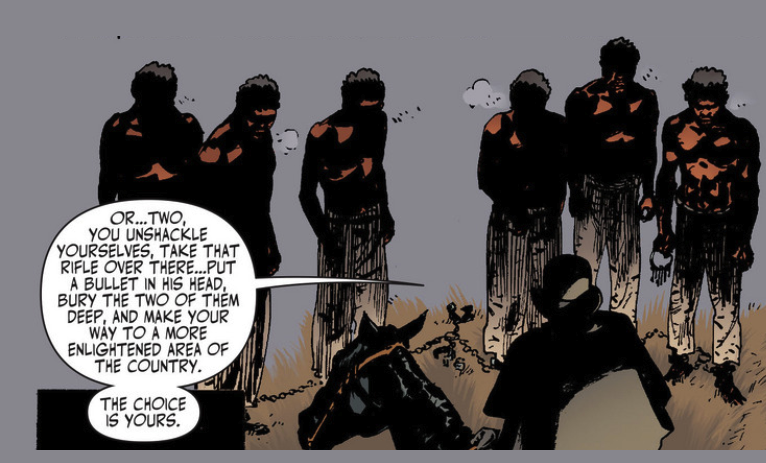
SCHULTZ: “So as I see it, when it comes to the subject of what to do next, you gentlemen have two choices. One, once I’m gone, you lift that beast off the remaining Speck, then carry him to the nearest town. Which would be at least thirty-seven miles back the way you came. Or…two, you unshackle yourselves, take that rifle over there…put a bullet in his head, bury the two of them deep, and make your way to a more enlightened area of the country. The choice is yours.”

Hearing this, the slave trader under the horse curses the approaching group of newly freed men and then begs for his life as they stand over him in silence. When the rifle shot sounds, a sudden spray of blood and flesh explodes from his head and the scene ends.

“The choice is yours.” With the bounty hunter’s words, Tarantino’s film enters into a larger conversation about race, representation, and the negotiations of moral responsibility that has as much to do with affirming Henson’s decision to set aside his axe as it does with celebrating a kind of vengeful catharsis that is without consequence. The film reminds us that in the slave’s narrative, honor was also a bounty to be hunted; the accounts of Frederick Douglass, Harriet Jacobs, Henry Bibb, and others were strategic and deliberative “fictions of factual representation,” as scholar William Andrews put it, even if they were not as brutally self-serving as Django.

In other words, Django Unchained may be a Blaxploitation Western film (by way of Oscar Michaeux as Brian persuasively argues), but it is also reimagines the slave on the road narrative in a way that favors a highly individualistic sense of honor and responsiveness over collective survival. “Each man to his own Canada,” to quote Raven Quickskill, Ishamel Reed’s fugitive slave-poet. I actually found the postmodern satire in Django Unchained to be as satisfyingly irreverent as Reed’s novels, yet Schultz’s “two choices” – made explicit here and implied repeatedly throughout the film – pose a more interesting question for me about exactly what need Tarantino’s revenge fantasy is meant to satisfy.

(Of this opening scene, it is worth noting that Vertigo’s comic book adaptation of Django Unchained does not end in the same fashion. It closes with the group of black men in deliberation, unlocked chains at their feet, while the Speck brother’s wide blue eyes await their decision. Much of the film’s bloodshed is minimized in the first issue of the serial that is based on Tarantino’s original screenplay with art by R.M. Guéra and Jason Latour. Whether or not the rest of the story will take the same visual risks as a comic like Kyle Baker’s Nat Turner remains to be seen.)

django_comic1

But we can only go so far with an apples-to-apples comparison of Django and Nat Turner, or Josiah Henson for that matter. Django expresses qualms during his work with Schultz about killing a man in front of his child, while in a different context he maintains his grim disguise when one of Calvin Candie’s “Mandingo” fighters is torn apart by dogs. In the early scenes if Django appears to act recklessly or in anger, his white partner’s arrest warrants are there to protect him from the repercussions of these emotions. Still Django never forgets that he is on the road – or that his humanity is commodified by the color of his skin – and in return for his resolve, he and Broomhilda live to see her master’s house burn to the ground.  Of course, it may sound too good to be true (and one of the more useful reviews of the film assures us that it is) and what happens after the credits roll is unclear to say the least. But as with the cultural analysis of texts like William Styron’s The Confessions of Nat Turner or Alice Walker’s The Color Purple, I am curious about what Django’s choices reveal about us and the moment in which we live.

I wonder, for instance, what to make of the fact that this controversial, and now Oscar-nominated, blockbuster film comes at the close of President Obama’s first term in office. Once praised for his even-tempered composure and open-mindedness, Barack Obama’s cool disposition has been relentlessly scrutinized for the past four years, notably during his intense presidential campaign in 2008, in the aftermath of the BP oil spill (“One time, go off!” pleaded Spike Lee), and more recently during his debates with Mitt Romney in 2012. Progressives cringe as members of Congress and the press pool cut him off or when an attention-seeking politician jabs a finger in his face – “Have you thought about getting angrier?” Keith Olbermann once asked. But as Ta-Nehisi Coates astutely notes,
 

 …Politicized rage has marked the opposition to Obama. But the rules of our racial politics require that Obama never respond in like fashion. So frightening is the prospect of black rage given voice and power that when Obama was a freshman senator, he was asked, on national television, to denounce the rage of Harry Belafonte. This fear continued with demands that he keep his distance from Louis Farrakhan and culminated with Reverend Wright and a presidency that must never betray any sign of rage toward its white opposition. Thus the myth of “twice as good” that makes Barack Obama possible also smothers him. It holds that African Americans—­enslaved, tortured, raped, discriminated against, and subjected to the most lethal homegrown terrorist movement in American history—feel no anger toward their tormentors.

 
Every insult and public outrage is now accompanied by pleas for President Obama to get angrier, drop the Spock routine and act on his emotion; in other words, to make a different choice. Not to overstate the similarities (and I’m sure I’m not the only one to make this connection), but Tarantino’s film seems crafted to elicit the same urge from his audience as Django’s makes his labyrinthine journey into “Candieland.” When Broomhilda’s bill of sale has been transferred and Django stands at the brink of a precarious future that, however fragile, is his own – it is the bounty hunter who decides what comes next. Schultz, after repeatedly advising caution to keep Django in control, is the one who ultimately determines that the collective cost of allowing the slave master to live is too high. Authorized, then, by this impetuous act and driven by the fear of losing his wife, Django steps onto the road and becomes the “dangerous slave” whose Canada is a plantation house splattered with blood.

I enjoyed the film. Though as I watched, I must admit that I found myself wishing that Django had been the one to confront Candie first. None of the carnage that follows means much without his agency in that moment. The fact that he doesn’t pull the trigger says a lot, I think, about the choices that continue to guide our understanding of race, power, and moral responsibility on the road today.

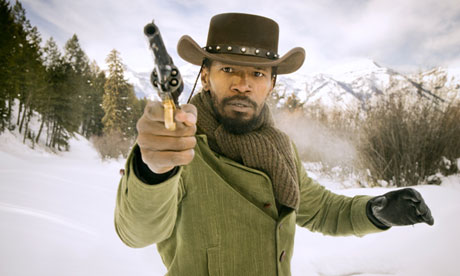
Jamie Fox in Django Unchained

Monthly Stumblings # 19: Fred

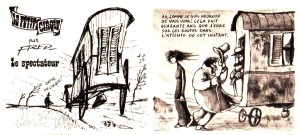
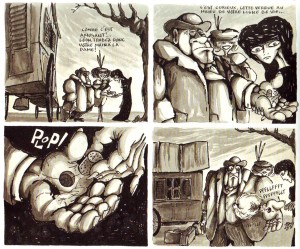
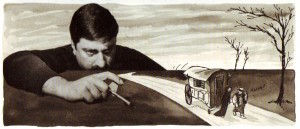
Le petit cirque (the little circus) by Fred.

Fred is the nom de plume and the nom the pinceau of Frédéric Othon Theodore Aristidès. You may have heard about him because of Pilote magazine and his most famous series, “Philemon” (or Philemon if we are talking about the albums). Before that though, Fred had a career behind him as a single-panel gag cartoonist and an absurdist comics artist in the pages of several magazines (the Mad inspired Hara-Kiri especially). It was in said mag that Fred published (from issue # 38, April 1964, until issue # 64, June 1966) his masterpiece “Le petit cirque” (or Le petit cirque if we’re talking about the 1973, 1997 and 2012 album editions). The series, in short episodes of two pages each (with the exception of the first three pages), was also reprinted in Pilote magazine (it appeared in twenty eight issues from # 701, April 1973, until # 741, January 1974).

In 2012 an important retrospective of Fred’s work, Le petit cirque included, was shown at the Angoulême comics convention in France (at the Hôtel Saint-Simon, to be exact). To celebrate the occasion Dargaud published a new remastered edition of Le petit cirque directly shot from the existing original art (which means that pages # 8, 9, 26, 27, 36, 37 – three episodes – didn’t receive the same treatment as the rest of the book; there’s no discernible difference between those pages and all the others though; the editors didn’t explain why this is so). Now I’m waiting for a new edition of Le journal de Jules Renard Lu Par Fred (Jules Renard’s journal read by Fred) with the original page layouts recovered. I hope that someone at Flammarion reads my appeal.

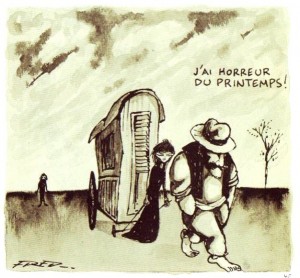
1

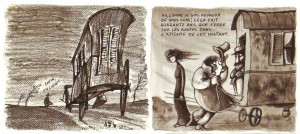
Panel from page 53 of the 1997 edition of Le petit cirque by Fred.

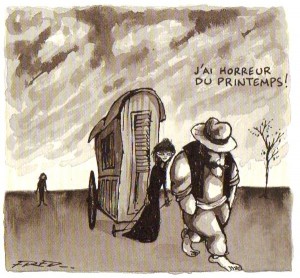
2

The same panel as above from page 51 of the 2012 edition.

Fred himself said, remembering the series’ first album edition in 1973:

I was pleasantly surprised that time! When we took the pages out of the portfolio to print the album, we realized that the original art had yellowed. Time yellows everything, even the mementos hidden in the bottom of a suitcase. Gray had become sepia which added a melancholia of sorts. I love those atmospheres.

As we can see above the 1997 edition reproduced the sepia tones. The lines are far from crisp though and many wash details were lost to resurface in the 2012 edition only. The latter’s matte paper retains some of the beige flavor that pleased Fred. Since Le petit cirque is a comics masterpiece I would say that this edition is one of last year’s most important comics related events. Unfortunately it passed virtually unnoticed.

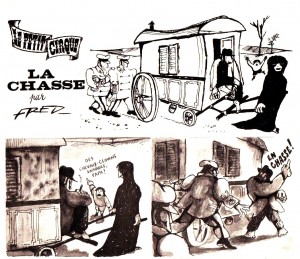
3

The first two tiers of the first page of the series as it appeared in Hara-Kiri # 38, April 1964.

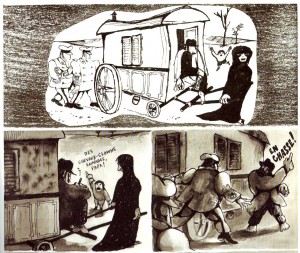
4

The same tiers published in the albums (in this case, the 2012 edition). As we can see the logo and the episode titles, when they existed, disappeared.

5

The first two panels of episode two (three in the albums) as published originally in Hara-Kiri # 39, May 1964.

6

The same panels as published in the 2012 album edition. The logo and episode title were removed, a paper and pencil texture was added (notice the glue smears captured by the photogravure).

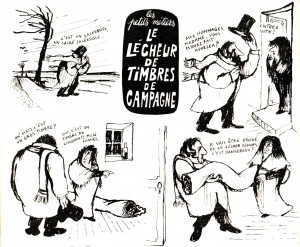
We can find the prehistory of Le petit cirque in a couple of circus related cartoon gags, but we can also find it in a series of strange, imaginative professions created by Fred for Hara-Kiri: the knitter of savage balls; the bearded seller of cotton candy (barbe à papa); the representative of holes; the countryside licker of stamps; the celery grinder; the mirror fixer… In one of his “little jobs” Fred created the human time bomb. That’s where the little circus really started: it was destined to be the album’s second episode.

7

The little jobs: the countryside licker of stamps. Notice the Fredian twiggy tree and the wind.  Hara-Kiri # 23, December 1962.

8

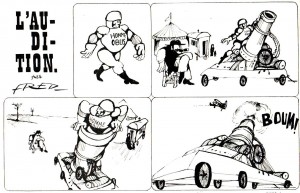
The first half of “L’audition”‘s first page (the audition) with the human cannonball (the human time bomb appears in the page’s second half), Hara-Kiri # 37, March 1964. The little circus before the little circus: it is right there in the second panel.

But we may find the true origins of the little circus not only in time, but also in space, in what Fred calls Constantinople (aka Istanbul). Both of Fred’s parents were Greek living in Turkey when WWI raged on and the war between the two countries was declared in 1919. They both emigrated to meet each other in Paris where Fred was born in 1931.

Fred, again:

It was the first time that I did something solid and everything happened naturally, the ideas, the emotions. Maybe because it’s the story of people without roots, like my parents. After leaving Constantinople they traveled a lot too and it was my father who inspired me to create Léopold. […] The Carmen of Le petit cirque is dark-haired and thin while my mother had brown hair and was rather plumpish, but she inspired me nonetheless.

9

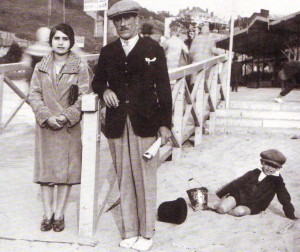
The family that inspired Le petit cirque: from left to right: Eleni (Carmen), Yanis (Léopold), and little Fred (who, in the album, has no name); Trouville, 1930s.

Fred’s iconography is very personal and explains the strange poetical power of Le petit cirque: the wind, the leafless trees, the circus, the peasants, the authorities, the mirror, the landscape, the city, etc… Apart from that what’s great about Le petit cirque is its rhetorical complexity.

10

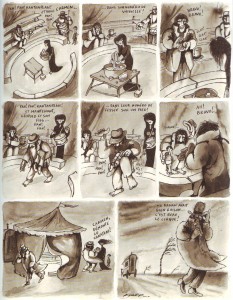
Le petit cirque, page 11 of the 2012 edition.

The above page gives the readers one of the keys to read Le petit cirque: the rhetorical reversal of the situations (the daily life of a patriarchal Mediterranean family is shown as circus acts). Another key is what I called, in Monthly Stumblings # 16, the interpenetration rhetorical mode: two distant spaces meet in a third space where both may co-exist at the same time (more about that later). The last panel shows Fred’s leafless trees with the wind blowing strongly from left to right expelling both the reader – the author too in a nostalgic statement about his childhood? – and the character out of the page (the sudden change of point of view from panel five to panel six shows that it’s time to leave already). The overall atmosphere is scrawny and uncomfortable. The vanishing point in the last panel focus Carmen pulling the circus caravan (Fred explained the metaphor: “the caravan symbolizes the family and the head of the family is the wife”; needless to say that this doesn’t convince me at all…). Notice how the horizon line gets lower and lower until we see a towering caravan getting out of reach. On pages 58 and 59 outraged peasants want to argue with Léopold and Carmen, but are overwhelmed when they find out that the caravan, despite its modest exterior appearance, is in reality a palace (not unlike Snoopy’s doghouse). This, of course, is an hyperbole showing Fred’s huge respect for his creatures.

11

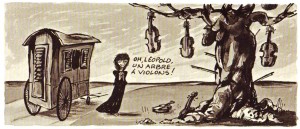
Carmen discovers the violin tree in page 36 of the 2012 edition.

The violin tree is just one of the interpenetrations that I mentioned above. Others link circus people with animals (a clown is a rooster, etc…). The violin tree is the hope and the means to fulfill one’s dreams. The problem is that Léopold, after picking one of the violins from the tree, breaks a string interrupting the process: the family is doomed never to improve their situation no matter how hard they try.

12

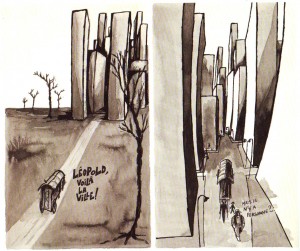
The first two panels of page 18 of Le petit cirque‘s 2012 edition. To the circus family the city is a menacing, blocky, empty space. Fritz Lang’s expressionist Metropolis isn’t far; an hyperbole, again.

13

Le petit cirque: second and third tiers of page 48 of the 2012 edition.

In the image above Carmen deflates an overblown bourgeois. The stereotype is a bit blunt, to say the least, but there’s an interesting catch in the sequence: the relation between iconic and verbal expression. Fred puts an idea usually uttered in words (“she deflated him”) into drawings. Something that isn’t that usual in comics. The same thing happens in the rooster/clown interpenetration mentioned above: the clown is visually a clown; we only know that it is in reality a rooster because of what the characters say about him.

I could go on doing close readings of all the episodes of Le petit cirque (like the one in which Léopold and Carmen offer a wheelchair to their son and break his leg in order for him to enjoy his present – which he does, of course), but the above is enough, I guess…

In conclusion: the circus family wanders aimlessly in an inhospitable landscape, is harassed and hated by almost everybody else and they suffer setback after setback, but they continue their journey because they have to, winning a few small victories along the way… We only get to the sense of it all though after decoding the logic of the book which is the nonlinear, oblique logic of dreams.

14

Fred sets his little creatures in motion; second tier of Le petit cirque’s 2012’s edition’s last page. Another narrative device: self-referentiality.

Snowball’s Chance in Hell: Django Unchained

The entire Django Unchained roundtable is here.
__________________
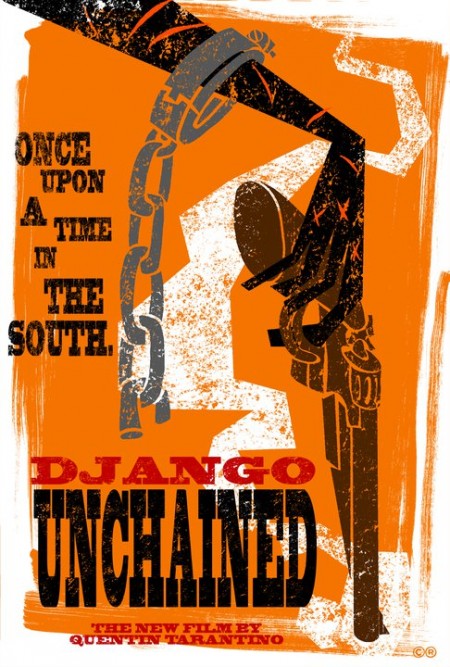
Django Unchained poster

Along with Inglourious BasterdsDjango Unchained forms something of a diptych for Tarantino insofar as both are revenge fantasies set in two of history’s greatest atrocities: the Holocaust and American chattel slavery. In the interview he gave at the screening I saw last week, he certainly thinks of them that way. But before either film could begin to be written, one crucial difference in their respective historical situations delimited the possibilities of fantasy: one can fantasize about the end of the Holocaust by killing the highest members of the Nazi party, whereas there is no easily imagined personalized end to slavery through a few targeted acts of vengeance. Thus, the use of explosives against the Nazis seems a tactical act, a logical means of warfare. The use of bombs against slavery would border on what we call terrorism these days, or “irrationally” violent outbursts against a society (targeting civilians who can’t do anything to change the way things are, or think of the portrayal of the Watts riots, for example: why did they destroy property?). Slavery was a deeply structural violence, an ontological domination of a people that didn’t obtain in the instance of the Holocaust. Any heroic narrative set in the slave-built Southern economy is going to have a major hurdle to overcome: there is no real end in sight, the villain remains like the renewable heads of a hydra, nor is there a place to go where the hero’s limited victory will be recognized, much less celebrated (excepting the audience who might applaud at the film’s end). As Frantz Fanon famously wrote in Black Skin, White Masks:

The Jewishness of the Jew, however, can go unnoticed. He is not integrally what he is. We can but hope and wait. His acts and behavior are the determining factor. He is a white man, and apart from some debatable features, he can pass undetected. […] Of course the Jews have been tormented — what am I saying? They have been hunted, exterminated, and cremated, but these are just minor episodes in the family history. The Jew is not liked as soon as he has been detected. But with me things take on a new face. I’m not given a second chance. I am overdetermined from the outside. I am a slave not to the “idea” others have of me, but to my appearance.

I arrive slowly in the world; sudden emergences are no longer my habit. I crawl along. The white gaze, the only valid one, is already dissecting me. I am fixed. Once their microtones are sharpened, the Whites objectively cut sections of my reality. I have been betrayed. I sense, I see in this white gaze that it’s the arrival not of a new man, but of a new type of man, a new species. A Negro, in fact! [p. 95]

That provides an alternative to the film’s plantation owner Calvin Candie’s theory as to why slaves don’t rise up and kill their masters. He posits phrenology, that the black skull is built to encase a servile brain. (Odd how the guy doesn’t know words like ‘panache’ while being up to date on phrenology, but I digress ….) Instead of racist science: the slaves had little chance of escape — only a minority could get to border countries and the free states would return them without proof of freedman status (even freedmen had trouble fighting against a legal challenge to their status). More fundamentally and universally, there was little possibility for or hope of fundamentally destroying the system of white power that, as Fanon described, defined them on every level of “civil” society (including free states and the minds of many, if not most, abolitionists). Blackness was placed on the outside, no place, as mere alterity to whiteness. It was not purely coincidence that liberalism, the philosophy of liberty, developed alongside chattel slavery. Slavery gave dialectical meaning to liberty by providing the liberals with something to negate (e.g., the American colonies would not be the slaves to the English any longer). (I highly recommend Domenico Losurdo’s Liberalism: A Counter-History, which provides a mountain of evidence for liberalism’s primary theorists either outwardly supporting or giving backhanded defense to slavery on such grounds.) In Frank B. Wilderson’s terms, blacks experienced a structural suffering that is not analogous to the social oppression so many other groups have been under throughout history. For hundreds of years, they were denied ontological status, relegated to non-being. blackness constituted as a comparison to whiteness — i.e., what it meant not to be white or a subject and, by extension, what it meant not to be free.

Any imagined heroic solution cutting through the Gordian knot of cultural accretion that was slavery would’ve had to involve a consensus towards revolutionary-styled destruction, a restructuring of fundamental principles, namely a zero-sum ending to the civil war that begins 2 years after the film’s beginning. That Django’s final solution to Candie’s plantation wasn’t actually applied to the Confederacy itself resulted in another century of racial oppression that reverberated up through the 1960s reaction to the Democrat-driven Civil Rights Bill as the Southern states became Republican (the Democrats no longer being the anti-Black party). Thus, the moral contradiction at the heart of Django Unchained‘s narrative: by providing a fantasy of Django’s triumph and cathartic escape from the slave system, it supports the lie of Candie’s scientistic racial theory. That is, besides servility and cowardice, why didn’t the other slaves rise up the way Django does? Instead, I suggest a super-slave could no more put an end to slavery by destroying a personal target than Superman can punch out poverty. Success would be determined by the upswell of violence inspired by the hero’s symbolic actions against the corrupt system. Structural suffering isn’t something that can be solved or coherently fantasized about solving within the heroic-revenge generic story arc without turning the hero into a terrorist, which tends not to be most people’s ideal (unless a fan of Georges Sorel, like maybe Frank Miller). Unfortunately, Tarantino tries.
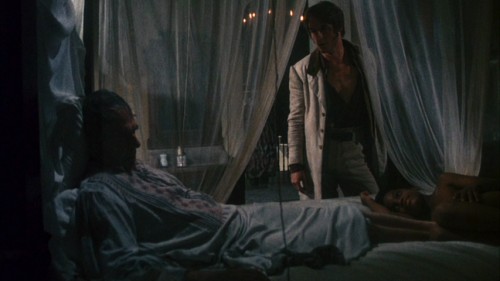
James Mason in Mandingo

But first, what the film does right: I’m not sure any image in Django Unchained is any more perfectly ridiculous and depraved concerning reified blackness than James Mason’s rheumatic plantation owner placing his feet on a slave boy’s stomach in Mandingo with the superstitious belief that the pain will be absorbed from white to black. Nevertheless, there’s plenty of chains, whipping, dog mauling, infantilization, banal use of epithets and cannibalistic black-on-black violence to convey the slave economy’s dehumanizing processes. Together, these images provide the movie’s answer to an ensemble of questions that Wilderson refers to as descriptive: “what does it mean to suffer?” [p. 126] The ensemble addresses the ontology of black as slave, the structural condition of black suffering as fungibility and accumulation. True, like a superhero, Django is never in much danger of experiencing realistic trauma, but neither was Clint Eastwood’s Man with No Name. This is a fantasy, after all, and a comedic one to boot, so the audience doesn’t expect an onscreen castration of the titular hero no matter how close the knife gets. It also isn’t that important if Mandingo fighting actually occurred. As a phantasmagoric image of the black body as cannibalized remainder, black subjectivity having been commodified as pure exchange value, it remains effective. A bored son of privilege not requiring the economic appreciation of a good black buck, Candie uses the Mandingo slaves as a leisurely expression of his absolute sovereignty. Like a rich kid wrecking his BMW, he can always get another:

The relation between pleasure and the possession of slave property, in both the figurative and literal sense, can be explained in part by the fungibility of the slave — that is, the joy made possible by virtue of the replaceabilty and interchangeability endemic to the commodity — and by the extensive capacities of property — that is, the augmentation of the master subject through his embodiment in external objects and persons. Put differently, the fungibility of the commodity makes the captive body an abstract and empty vessel vulnerable to the projection of others’ feelings, ideas, desires, and values; and, as property, the dispossessed body of the enslaved is the surrogate for the master’s body since it guarantees his disembodied universality and acts as the sign of his power and dominion. [p. 21, Saidiya Hartman]

So despite its being a comedic fantasy, Django Unchained‘s horrific imagery conveys both bodily and ontological suffering under slavery. In fact, it takes a similar approach to blaxploitational horror (e.g., Ganja & HessBlacula), identifying the spectactor with what is typically the Monster/Other in Hollywood films to estrange normative positions: here, it’s Django, a black man as Slave, and Dr. King Schultz, a German traveler as Foreigner/Alien. (Mandingo, for example, is a tragedy about the plantation owning family and the Germans were almost completely alien in Inglourious Basterds, namely the enemy.) Tarantino is careful to acknowledge their differing ontological positions: Schultz doesn’t approve of slavery, but he’s still willing to use Django’s slave status to get what he wants, regardless of the latter’s desire. To paraphrase Fanon, whiteness can change with ideas, blackness is overdetermined by appearance.

It isn’t until later, after having been given his freedom, that Django reveals his goal to his erstwhile master, that is, to free his wife, Broomhilda (who we’ll soon learn is the property of the aforementioned Candie). At this point in the story, the two heroes’ relationship is, in the final analysis, characterized by an economic quid-pro-quo arrangement, not the developing friendship, which still needs the recognition of Django’s subjectivity. So Schultz will help rescue Broomhilda if Django will help out with the bounty hunting during a busy season just as he was freed for helping to locate the Brittle Brothers. The friendship becomes primary when Schultz gives up the majority of bounty he’s earned over the past year to pay for Broomhilda’s freedom. Although done under duress — Candie’s threat of bashing in her head with a hammer — the doctor clearly doesn’t think twice about the exchange: only the money is truly replaceable. With Schultz, a nonracist foreigner, we can see how the temptation of white power was entangled with the supposedly amorality of capitalist exchange. He resists the former by accepting failure at the latter.

The moral setup is actually more complicated than Schultz’s development, though (which would’ve made the movie little more than another black tale about white awakening). On the way to the Candieland plantation, posing as a wealthy dilettante wanting to invest in Mandingo fighting with Django as his black slaver cum counselor, Schultz witnesses the way Candie deals with slaves who have lost their value. A fighter named D’Artagnan (after The Three Musketeers‘ protagonist) tried to escape because he felt too worn down to fight any more. Schultz loses his nerve, breaks character to save the slave from the dogs by offering to reimburse Candie. To repair the damage to their pretense, Django doesn’t flinch, saying this “pickaninny” ain’t worth buying, that Candie could do whatever he wants with his “property.” As Django explains, Schulz just ain’t as used to Americans. The foreigner looks as if he’s trying not to vomit, while the former slave returns a steely-eyed stare back at Candie as the hounds tear the decrepit fighter apart. This scene is pivotal as it shows just how desensitized to the spectacle of slavery Django is (his ability through habituation to suppress a horror too great for the white outsider) and how far he’s willing to go to get his wife back: D’Artagnan’s life for hers. Similarly, throughout the trip, as part of his act, he’s shown to be harsher on the slaves in chains than any of the real slavers in order to keep Candie “intrigued.” For the time being, he’s committed himself to the system of slavery, going beyond what it demands of him, in order to save the one person he truly loves. In his willingness to go through hell, Schultz compares him to the German myth of Siegfried. In other words, he must treat all slaves as fungible to rescue Broomhilda. Only she is seen as an irreplaceable subject.
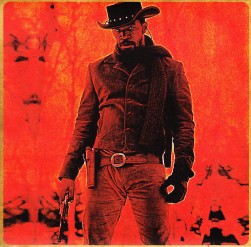
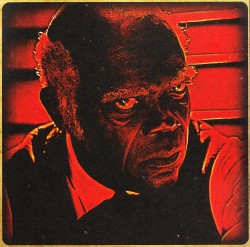
Jamie Foxx as DjangoSamuel Jackson as Stephen

In the next scene, arriving at Candieland, we’re introduced to Django’s mirrored antagonist, the “Uncle Tom” character of Stephen, which is where the film’s main problems lie. As Django had previously explained, the house negro is the lowest of the low, with the only thing lower being the black slaver. However, there’s one role he omitted: the white slaver as the representative of slavery itself. The reason Django remains sympathetic even after sentencing another black man to a brutal death is because of the enculturation to abject horror that’s forced on any survivor of such totalizing oppression. It wasn’t as if slaves could appeal to OSHA about the unjust treatment of one of their fellow slaves. Whistleblowing during slavery had no meaning, since the law enforced injustice. The “whistleblower” risked his own life for no possibility of justice. Thus, one had to learn to live with the violence. This habituation to depravity is what allows Django to stay focused on his goal. He can’t rescue every slave he comes across any more than all the slaves could’ve just fled to Canada to live a just life, equal to whites, because the manifold problems of slavery are structural, not just personal. If he had let Schultz save D’Artagnan, then it would’ve been more likely that Broomhilda’s life was being traded for a slave he had never met. This is not some utilitarian “greatest good” rationale being arrived at by the slave, but a forced choice being made for him by the white power structure in which he can do little more than survive. A lesson from Hitchcock’s Lifeboat: if one can’t save everyone in a lifeboat, then be willing to push some off the side and get used to the sounds of drowning. That, and it’s better to not save a spot for complete strangers.

Why, then, if the audience can still sympathize with a flawed hero who has to do some bad things because of an immoral system that doesn’t permit him a rational, disinterested reflection on the universal good, are we presented with Stephen, a potentially complex character, in such a simplistic, caricatured villain role? He’s revealed not as another slave who’s doing what he can to survive, any possibility of self-assertion narrowly circumscribed under the gaze of white power, but rather the maniacal evil genius behind the entire Candie clan. Consider: (1) He’s the first person shown to torture Broomhilda and it’s Candie who stops it. (2) Candie doesn’t figure out the con Django and Schultz are pulling, but Stephen does. He reveals it while sipping brandy in the library, holding the snifter like a Bond villain, and calling his “master” by his first name, Calvin. (3) After Candie’s death, it’s Stephen who gets all his master’s henchmen to stop firing while he negotiates Django’s surrender. Billy Crash has a gun pointed at Broomhilda’s head, but he doesn’t fire after Django throws down his gun because Stephen said she would live. Why would Crash care what one slave promised another? (4) Furthermore, he doesn’t castrate Django, because Stephen has convinced Lara Lee (Calvin’s sister) and the rest of the gang that breaking rocks at the mines is a much worse fate. (5) And, finally, if Stephen’s total control isn’t obvious enough, after everyone else has been killed, this antebellum Wormtongue throws down his cane and stands up straight to reveal his lameness an act. Whereas Django had to play tougher than he was, Stephen played weaker. They’re inverted images of each other: the former lied to protect someone from power, the latter to gain power (or, more sympathetically, to protect himself from power).

The reason for the appearance of a mustache-twirling cliched role (despite some admittedly funny, witty lines and a great performance by Sam Jackson) is, as I suggested above, the heroic-revenge generic structure. It requires a personalized villain of sorts, not a structural evil with which even “good” citizens are complicit. And what’s more personalized than the evil doppelgänger? For once, genre constraints have gotten the better of Tarantino. Thus, the film is an abysmal failure at addressing the other ensemble of questions Wilderson delineates, the prescriptive: “How does one become free of suffering? [Those] questions concerning the turning of the gratuitous violence that structures and positions the Black against not just the police but civil society writ large.” [p. 126] By giving the story a revenge motive, Tarantino reduced the suffering to a personal level, a subjective violence that one person might do to another — kill the oppressor, stop the oppression. This is a “failure,” because it applies a subjective resolution to a structural problem that was fundamentally the negation of subjectivity; “abysmal” because it achieved the biggest cathartic thrill with the killing of a black slave instead of any number of plantation owners in the film. If Tarantino had to make it all about subjective revenge, then why ignore the most narratively plausible candidate, Old Man Carrucan, the malicious old bastard who had treated Broomhilda and Django so cruelly and then sold them to separate owners out of spite after they attempted to run away? But it’s not even Candie who has the last, big face off against Django; it’s Stephen. Django mows down every trace of whiteness in the final (majestically rendered) gunfight, saving the fate of “snowball” for the big finale. Evidently, the house negro is more evil than the master.

Tarantino has expressed in the past (on Charlie Rose) a keen interest in what I’d call the terrorist as symbolic hero, namely in his desire to do a biopic on the radical abolitionist John Brown, one of the director’s favorite historical Americans. With a self-described holy purpose, Brown sliced open the heads of pro-slavery activists along the Pottawatomie Creek, who hadn’t actually killed anyone themselves, was willing to go on a suicide mission at Harper’s Ferry in an attempt to inspire a mass uprising against slavery and, once caught, refused any possible chance to avoid hanging for a chance at martyrdom. As James McPherson tells it, “Democrats and conservatives denounced Brown as a lunatic and murderer” and the Republicans did their best to dissociate their abolitionism from Brown’s techniques. [p. 35] In other words, he was no more popularly recognized as a hero in the nineteenth century than terrorists are today. At least, among whites; blacks have mostly called him a hero (except pacifists like Martin Luther King, Jr.). Why not use this white abolitionist’s revolutionary violence as a model for Django’s own? It’s not like sympathetic terrorism as entertainment isn’t fairly popular these days: Che, Carlos, United Red Army, and, in a way, Homeland. Instead, each vengeful kill that Django makes is shown to be related to a personal act of violence against him or his. There is no killing of pro-slavery people who aren’t themselves shown to commit subjective violence. Each person acts as an individual and another reacts, ignoring the dangerous question of structural responsibility expressed by Malcolm X: “if you [whites] are for me — when I say me I mean us, our people — then you have to be willing to do as old John Brown did.” [p. 38]

Hartman’s Scenes of Subjection provides a plausible analysis of what’s going on here. She argues that in abolitionist literature, melodramas and eyewitness accounts from whites, there was an empathic tendency that attempted to make the horrors of slavery palpable to whites by projecting whiteness into the place of the black body in pain. This effectively erased the black person doing the suffering, making it a performance for white affect, and not unrelated to the way slaves had to perform for masters as if they accepted, even enjoyed, their subjugation. As she writes in the quote above, “the captive body [was] an abstract and empty vessel vulnerable to the projection of others’ feelings, ideas, desires, and values.” Thus, black suffering was narrated through the master’s discourse even for abolitionists. Let’s face it, other than avowed racists, what contemporary white people would fancy themselves as pro-slavery in a historical melodrama? Dreams of terrorism are probably more likely, despite the damn good chance that slavery sympathizer is what we would’ve been in such times. So, instead of a critical reflection of Django’s narrative, complicating his own generically derived existence as black performativity (cf. blaxploitation), Stephen is treated as little more than a blackface projection for white fantasy. As Tarantino has stated over and over in interviews, he clearly wants his audience to take sides, cheer at the ending — not, I conclude, reflect on the problematic that the house negro presents. Django is the oppressed that white folk would like to be in such a situation, fighting for freedom (just as they would now, of course), with Stephen’s freely working for subjugation the negation that gives such freedom meaning — as if chattel slavery and its concomitant subjugation of black identity were a choice made by the subjugated! This is, once again, Candie’s theory, only without the biological determinism. And when the film has audiences cheering Stephen’s downfall, one should recall the earlier scene of Mandingo fighting, in which one man’s death is reduced to spectacle for Candie and his guests.

~~~~~~~~~~~~~~~~~~~~~~~~~~~~~~~~~~~~~
Poster from here.
Fanon, Frantz (1952/2008), “The Lived Experience of the Black Man,” Chapter 5 in Black Skin, White Masks. Translated by Richard Philcox. [An older translation can be read here.]
Hartman, Saidiya V. (1997), “Innocent Amusements: The Stage of Sufferance,” Chapter 1 in Scenes of Subjection: Terror, Slavery, and Self-Making in Nineteenth-Century America.
McPherson, James M. (2007), “Escape and Revolt in Black and White,” Chapter 2 in This Mighty Scourge: Perspectives on the Civil War.
Wilderson III, Frank B. (2010), “The Ruse of Analogy” and “Cinematic Unrest: Bush Mama and the Black Liberation Army,” Chapters 1 and 4 in Red, White & Black: Cinema and the Structure of U.S. Antagonisms.