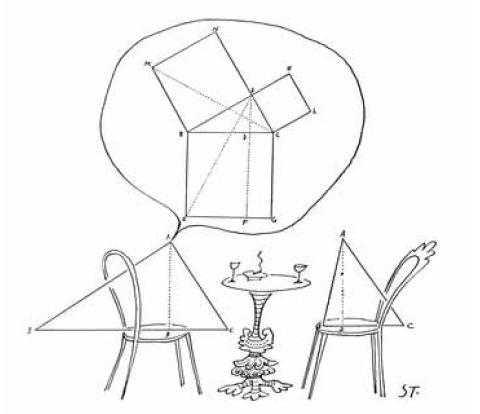
Whenever I hear the word “mash-up”, I reach for my revolver

Virality, here we come! Counting down the twenty-five worst mash-ups-cum-memes of all time:

25. Hitler’s rant in Downfall re-subtitled with a speech by Josef Stalin

24. The cast of Mama’s Family drawn as the cast of Growing Pains

23. The cast of Growing Pains drawn as the cast of Mama’s Family

22. IRS form 1040 Schedule A drawn as IRS form 1040 Schedule B

21. The domain of natural numbers drawn as the domain of irrational numbers

20. Crossover fan fiction between Grey’s Anatomy and Private Practice

19. Pride and Prejudice and Tax Accountants

18. Pride and Prejudice and Sensibility

17. Pride and Prejudice

16. Being and Time as if written by Immanuel Kant

15. Being and Time as if written by Martin Heidegger, but in a comedy French accent

14. Being and Time

13. Hamlet as if written by Francis Bacon/[alternate selection] Hamlet as if written by William Shakespeare

12. Fantastic Four, Thor, X-Men, Hulk, Spider-Man as if created by Stan Lee

11. Manga and other comics and comic strips as if created without an uncredited staff of quote-assistants-unquote

10. Damien Hirst

9. Modernism as if postmodernism

8. This list as if your mom

7. As if

6. Garfield without dialogue, Garfield, Jon, Odie, Jon’s supposed girlfriend, any other characters objects or places, panel borders, panels, lines, art, language, shapes, space, time, being, non-being, non-non-being, lasagne, Mondays or that one girl cat that was Garfield’s girlfriend

5. This space intentionally left blank

4. Humour in the form of lists, alleged humour in the form of lists, self-referential alleged humour in the form of lists, physician troll thyself,

3. humour in the form of flowcharts, 99% of webcomics, any blog that turns into a book deal, Boing Boing, Deviantart, Metafilter, 4chan, tumblr, Know your “meme”, TV Tropes,

2. actually, let’s just say the entire fucking internet

1. And, finally, ninja pirates who turn into gorilla werewolves riding skateboards with the robot head of zombie Abraham Lincoln and they’re also MODOKS mashed up with the cast of Lost dressed as the Beatles drawn as kittens dressed in oversized ALF suits rendered in LEGO if LEGO were an 8-bit Nintendo game in Victorian Steampunk times as a minimalist poster of a vintage paperback

Also, Cthulu is involved somehow.

…Oh no wait you guys #1 is the most quote AWESOME unquote idea ever AMIRITE

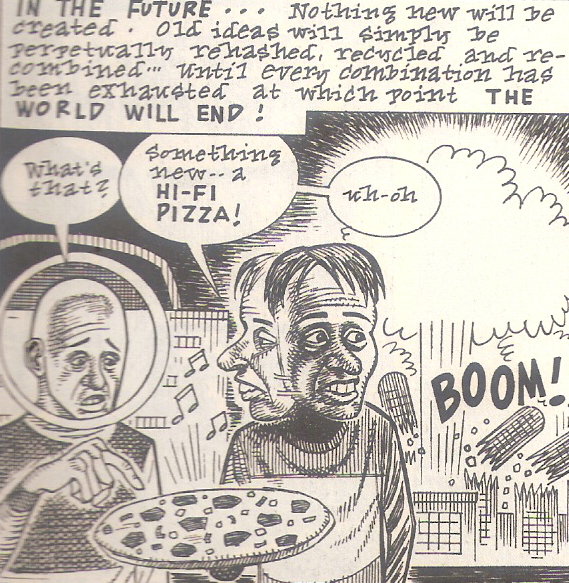
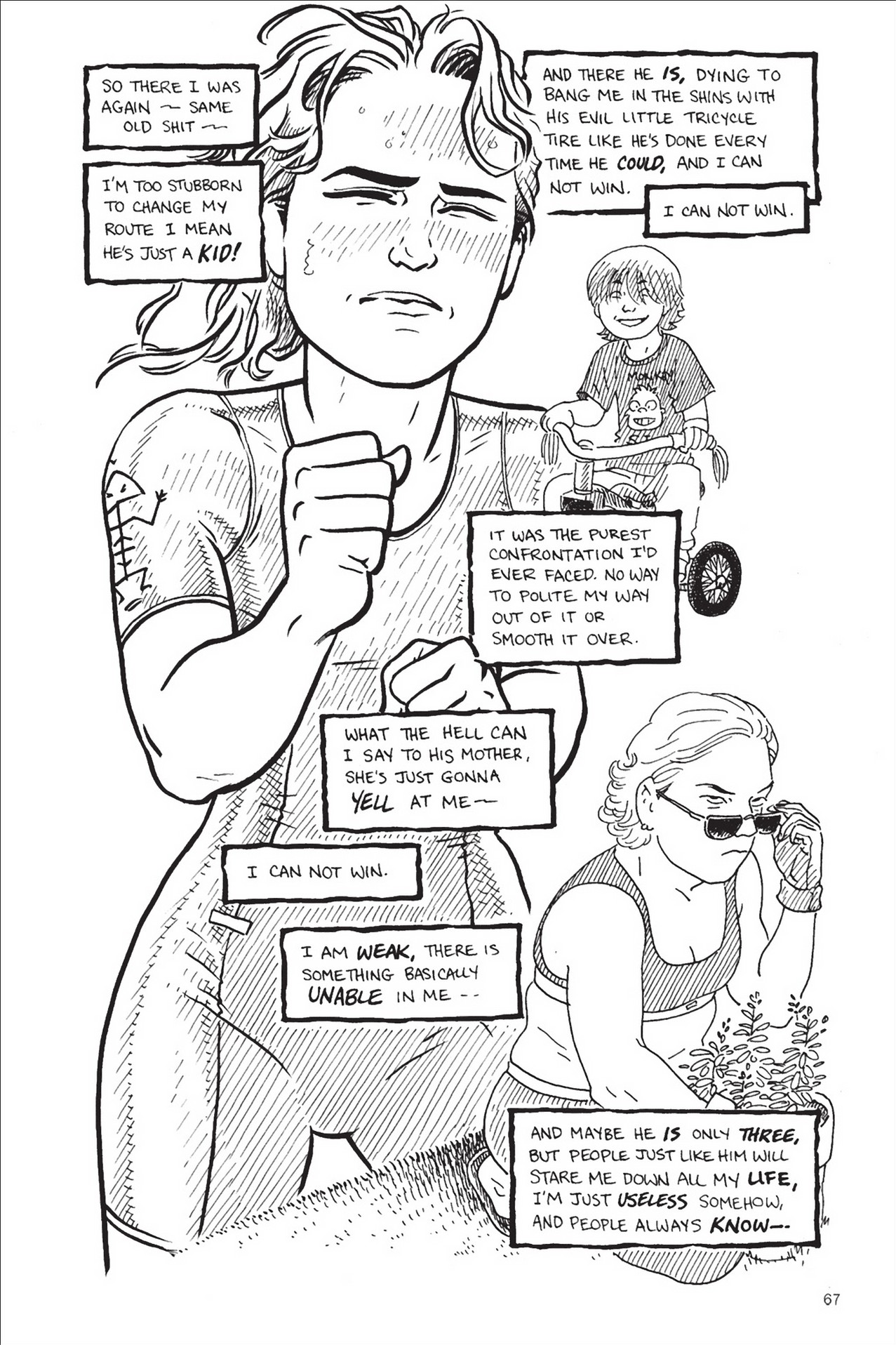
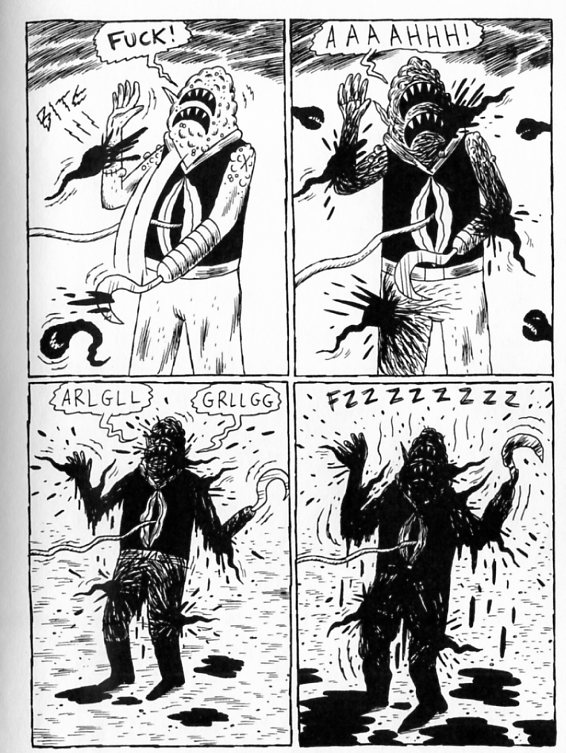
Image attribution: Dan Clowes, Eightball #4

Jaegerless

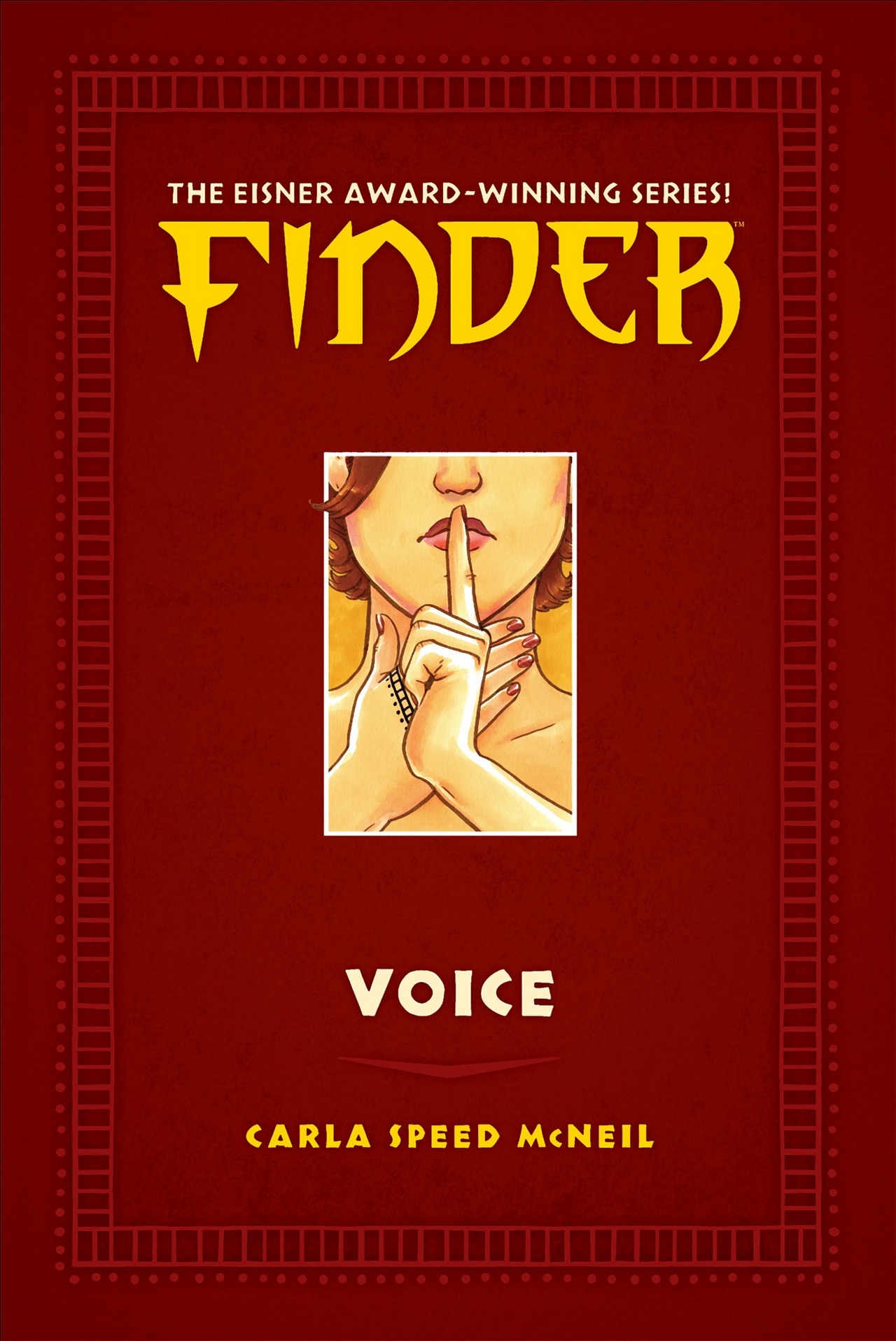
Back in July, Noah complained that the lead character of Finder, a man named Jaeger, was a “drearily familiar archetype — the tortured tough-but-tender loner with heart-of, whose masculine ability to withstand pain functions as an excuse to subject him to hyperbolic and repetitive sensual violence, just as his mysterious outsider status turns him into a perpetually sexy invader of the quiet homes.” Noah will be glad to hear that that Jaeger never actually appears in Finder: Voice. On the other hand, he’ll be less than thrilled to hear that Jaeger is the driving force behind the plot and the preoccupation of the lead character, Rachel Grosvenor.

Backing up a bit, Finder is a comic series set in a far-flung future where humanity survived a global calamity and built a new civilization that’s quite different from our own. Most of the action takes place in the domed city of Anvard. The city is populated by a dozen or so clans that maintain strict genetic purity, so strict that members of the same clan are often indistinguishable from one another. There is also a pseudo-Native American race called the Ascians, who occasionally settle in Anvard, where they’re treated as second-class residents. Early chapters in Finder focused on Jaeger, a half-Ascian and the titular character, who specialized in finding lost things or people. Jaeger is the typical tough guy who can’t commit – he maintains an on-again, off-again relationship with Emma Grosvenor. Emma’s daughter Rachel has an unrequited crush on him as well.

Emma and Rachel are members of the Llaverac Clan. Llaveracs are composed entirely of beautiful blondes, and even the men are genetically altered to appear as women. In Finder: Voice, we learn that social rank among the Llaveracs is determined in a clan-wide beauty pageant, and the young women who place high in the competition are guaranteed a title, a house, and great wealth. Rachel naturally wants to win the pageant, not just for herself but so she can provide a comfortable life for her mother and sisters.

But things quickly go south for Rachel when she’s mugged and loses a precious heirloom that’s necessary to compete in the pageant. Rachel spends much of the story looking for Jaeger, hoping that he can use his tracking skills to help her find the heirloom. But it’s also clear that Rachel still has a crush on Jaeger, and she dreams that the manly-man will sweep her off her feet and save her from her crappy life.

At first glance, it is tempting to dismiss this as another retrograde fantasy where the young woman is saved by the dashing rogue. Except the dashing rogue never shows up. Rachel effectively saves herself and wins second place in the pageant without Jaeger’s help. And she does this through a distinctly female method: gossip, or more precisely the threat of gossip. Rachel learns a secret about a Llevarac clan elder and threatens to spill the beans unless she’s allowed to participate in the pageant.

So one could read Finder: Voice as a subversion of a male hero/female victim paradigm. But there are several complications to that interpretation. Rachel is stalked by one of Jaeger’s enemies for a good chunk of the story. And different men save her from physical harm on a couple of occasions. And there’s an unexpected plot development where Rachel participates in a drunken orgy with a group of Ascians (who subsequently move into her house).

Finder: Voice can be read as a story of female empowerment, but power is still envisioned as masculine (Jaeger). Rachel achieves great success in a girly way – a beauty pageant –  but she still has to be saved from death by a group of friendly Ascian men. In other words, Rachel is not Wonder Woman or Buffy the Vampire Slayer. At the end of the story, she is still physically weak and uncertain about her future. And unlike the supernaturally tough Jaeger, Rachel is pathetically human.

 And that’s probably why I enjoyed Finder: Voice far more than the earlier stories with Jaeger. In those, the reader is expected to identify and sympathize with Jaeger. But he is not an interesting character, given that he’s a pile of hyper-masculine cliches. But Jaeger is interesting as a pile of hyper-masculine cliches. Rachel wants Jaeger as a lover, but she also wants to be like Jaeger. She wants to be amazingly strong, hyper-competent, and emotionally untouchable. She wants to be Jaeger/Batman/Wolverine. She wants to be all those things that men are supposed to be, and she fails, largely because Jaeger is a preposterous role model. No one is that tough, competent, or untouchable. Instead, Rachel has to settle for being a human and a woman. She has to play by the rules of the Llaverac Clan. She has to be pretty and elegant for the sake of her family’s financial well-being. And she has to rely on others, because she will never have the brute strength to deal with every threat. Rachel is a character who is keenly aware of her limitations and obligations, and her successes are less about overcoming all obstacles than about achieving as much as one can within her limits.

For me, that’s more compelling than another story about a tough loner with a heart of gold.

The Society of Saul Steinberg

Is the question of cartooning’s status as art of interest to the world outside of cartooning? It is, enough for The New Yorker to use it as the introductory hook of a recent book review:


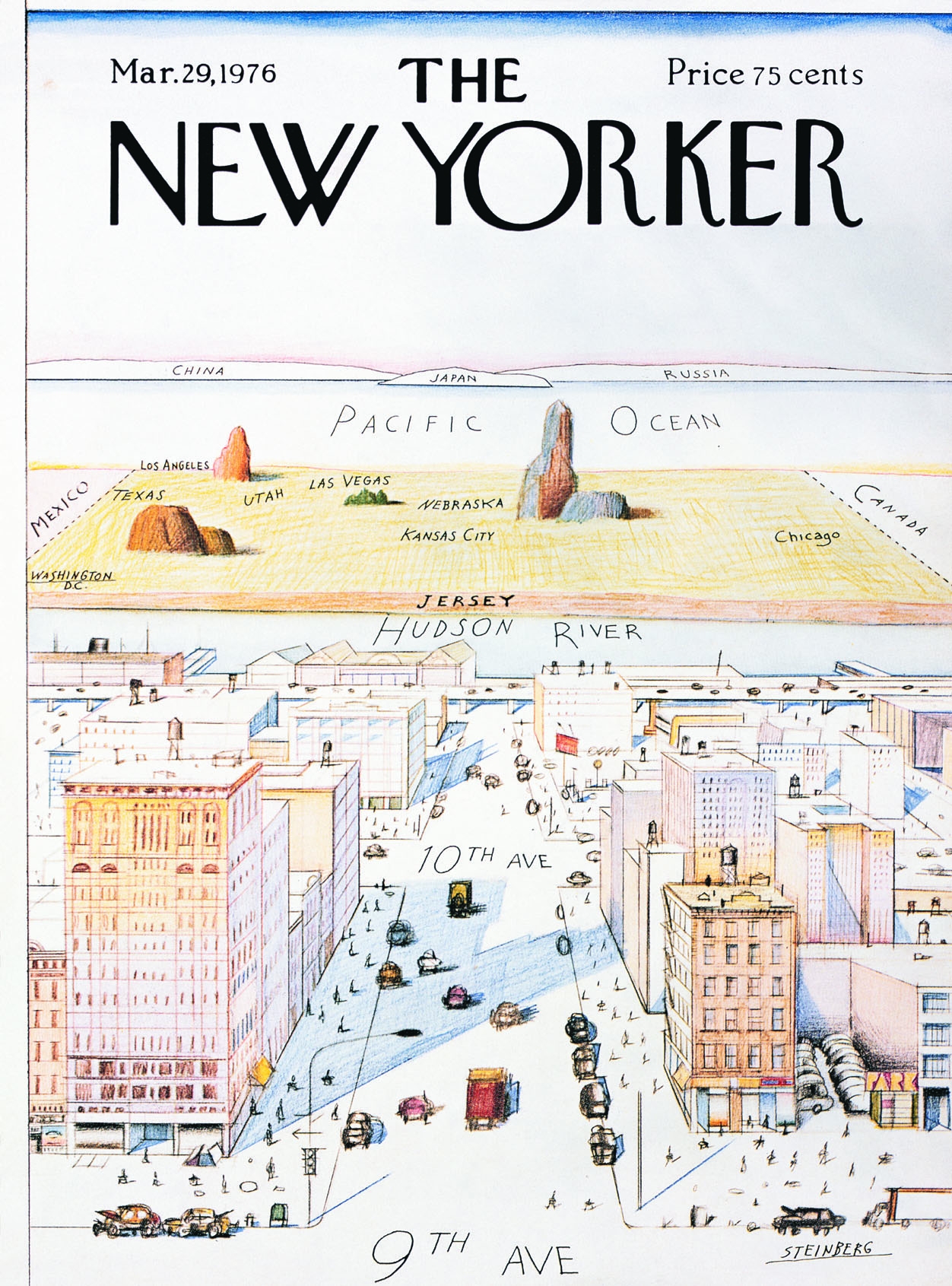
Was Saul Steinberg an artist? Deirdre Bair raises the question, which has vexed other writers, in ‘Saul Steinberg,’ (Nan A. Talese/Doubleday), a luxuriant and unsettling biography of ‘the man who did that poster’– ‘View of the World from Ninth Avenue,’ a hilariously foreshortened vista, across the Hudson River, of the United States.
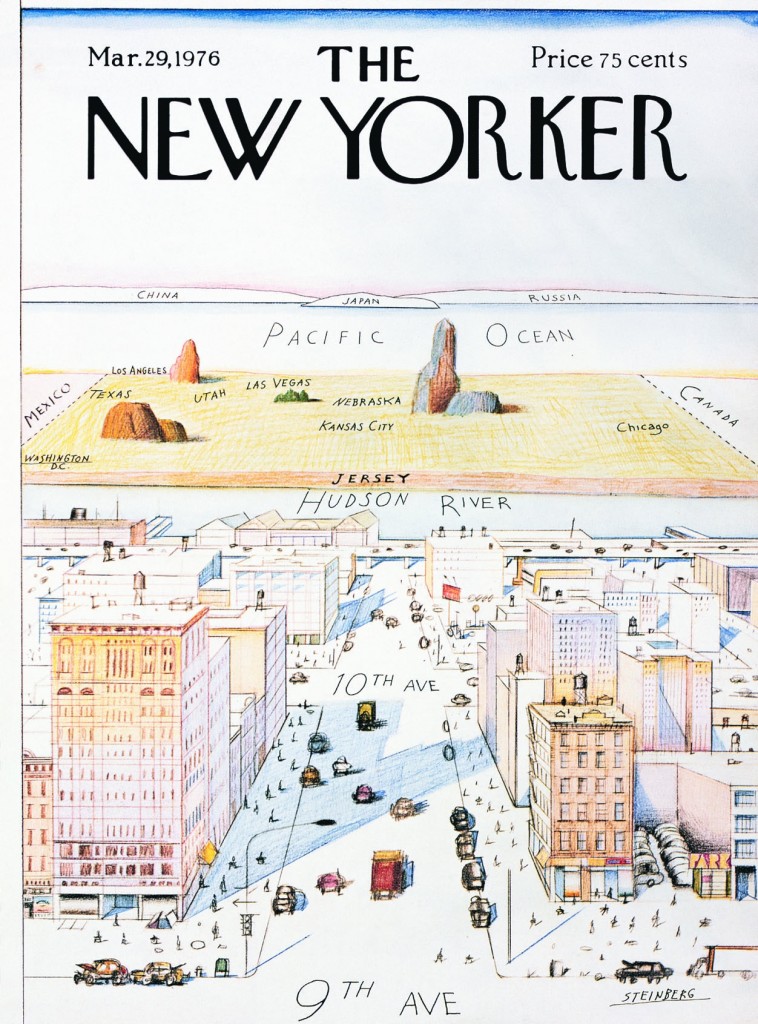


Steinberg needs little introduction for many New Yorker readers, but his most famous work, and perhaps The New Yorker’s most famous cover, is mentioned for safe measure by the end of the second sentence. Peter Schjeldahl continues, “Timelessly tantalizing, “View of the World” is surely art. It is also a cartoon. Steinberg was an artist if cartooning is an art–which it is, and so he was.”

One could glibly chalk up The New Yorker as one more for the side of “cartoons as art.” More interestingly is how uneasily The New Yorker develops this proclamation, and that it made it in the first place. The statement is immediately qualified (“He was just so original and virtuosic that a different term can feel called for,”) (“Steinberg’s self-description as ‘a writer who draws,’”) and the point largely dropped in favor of a detailing of his rapscallion upbringing, scandalous relationships, depressive tendencies, and the various intellectuals he amused at dinner parties.

Schjeldahl writes

Bair makes little effort to describe Steinberg’s art. This is understandable, given the multitude and the quick-silver elusiveness of his inventions. Ideas that are impressive on paper can sound banal when paraphrased, turning back into the cliche’s that inspired him–moribund truths, often in an existentialist mode, that he would jump-start to crackling life.

That this is also a fitting description of Bair and Schjeldahl’s tack in describing Steinberg’s life, which would be great fodder for writers like Daniel Boorstin or Bart Beatty. In his book Comics Versus Art, which I reviewed here, Beatty describes the application of certain tropes, including social alienation, loneliness and a romanticization of ‘the white man as an object of societal scorn,’ to trigger an association of genius or artistry, and to masculinize a commercialized/feminized field of production. Fittingly,

Through it all, Steinberg complained of feeling loveless and alone, subject to bolting awake ‘at 3:30 full of terrors, regrets– the usual suffering,’ he said… he knew his behavior estranged him from others, but he seemed to accept the backdrafts of guilt and shame as normal weather in the impregnable mental zone from which his art flowed.

Steinberg likely constructed his self-portrayal as a tormented genius. This is more than a fascinating subject, especially when so many humbler cartoonists (and artists) are only reconstructed after-the-fact by their fans. Also, the disaffected timbre of Steinberg’s work complements, rather than complicates, this play-acting. Steinberg went so far as to say that he and Picasso were the two greatest artists of the twentieth century. An examination of how his performances as artist-commentator and socialite informed each other would have been illuminating, and it’s frustrating to see attention to the latter crowd out the former. Schjeldahl writes “I had to remind myself, trudging through Bair’s catalogue of Steinberg’s sorrows and follies, that the abounding joys of his art are the biography’s reason for being.”

Concluding the article, “He played a role that, by the luck that constitutes genius, both came to him naturally and satisfied the cravings of his time… Any old narcissist can be afflicted, and afflict others, with a conviction of being godlike. But sometimes its as if the gods agreed.” This is the extent to which the article problematizes Bair’s approach.

Bair and Schjeldahl’s words on his art are strictly laudatory, and pay tribute to the status difficulties that plague cartooning and infuriated the artist. “A starchy bias against commercial illustration persists in art circles even today, despite the fact that, in the hands of a Steinberg, it can command an immediacy and a pith that often elude the more prestigious mediums.” Yet Steinberg alone is construed as a unique victim of this bias, and the Goethe-variety of status-games ensue, beginning with his belonging “in the family of Stendhal and Joyce:”

Vladimir Nabokov called Steinberg his favorite artist. S. J. Perelman ‘always made Saul weak with laughter,’ [his wife Hedda Sterne] said. Saul Bellow was a drinking buddy. Roland Barthes was a critical champion, deeming Steinberg an ‘inexhaustable’ master of rhetorical tropes. At different times, Steinberg knew Alexander Calder, Willem de Kooning (who gave him the circa-1938 drawing “Self-Portrait with Imaginary Brother), Mark Rothko, and Philip Guston, and he revelled in the company of the grandly garrulous art critic Harold Rosenberg. A visit to Picasso in the South of France, in 1958, resulted in a collaborative “exquisite corpse” drawing… he was collegial with his fellow New Yorker cartoonists Peter Arno and, especially, Charles Addams… He found meaning for his life only in work, and maintaining his morale for it dictated his conduct. Sex, alcohol, and compulsive travel, whether on the Queen Mary to Europe or by car along the back roads of America, were reliable tonics.

The second to last sentence is contradicted not only by the entire review, but by the sentence that follows it. Finally, “he made millions of dollars.”

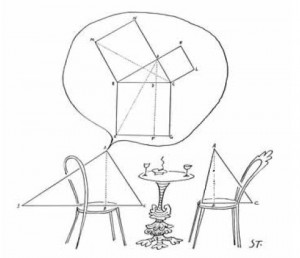
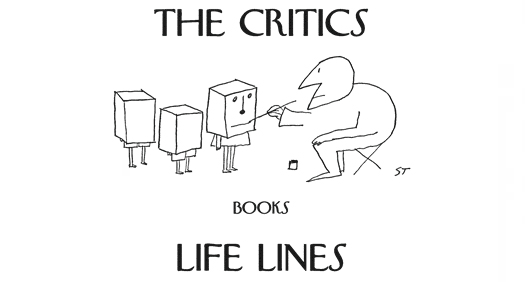
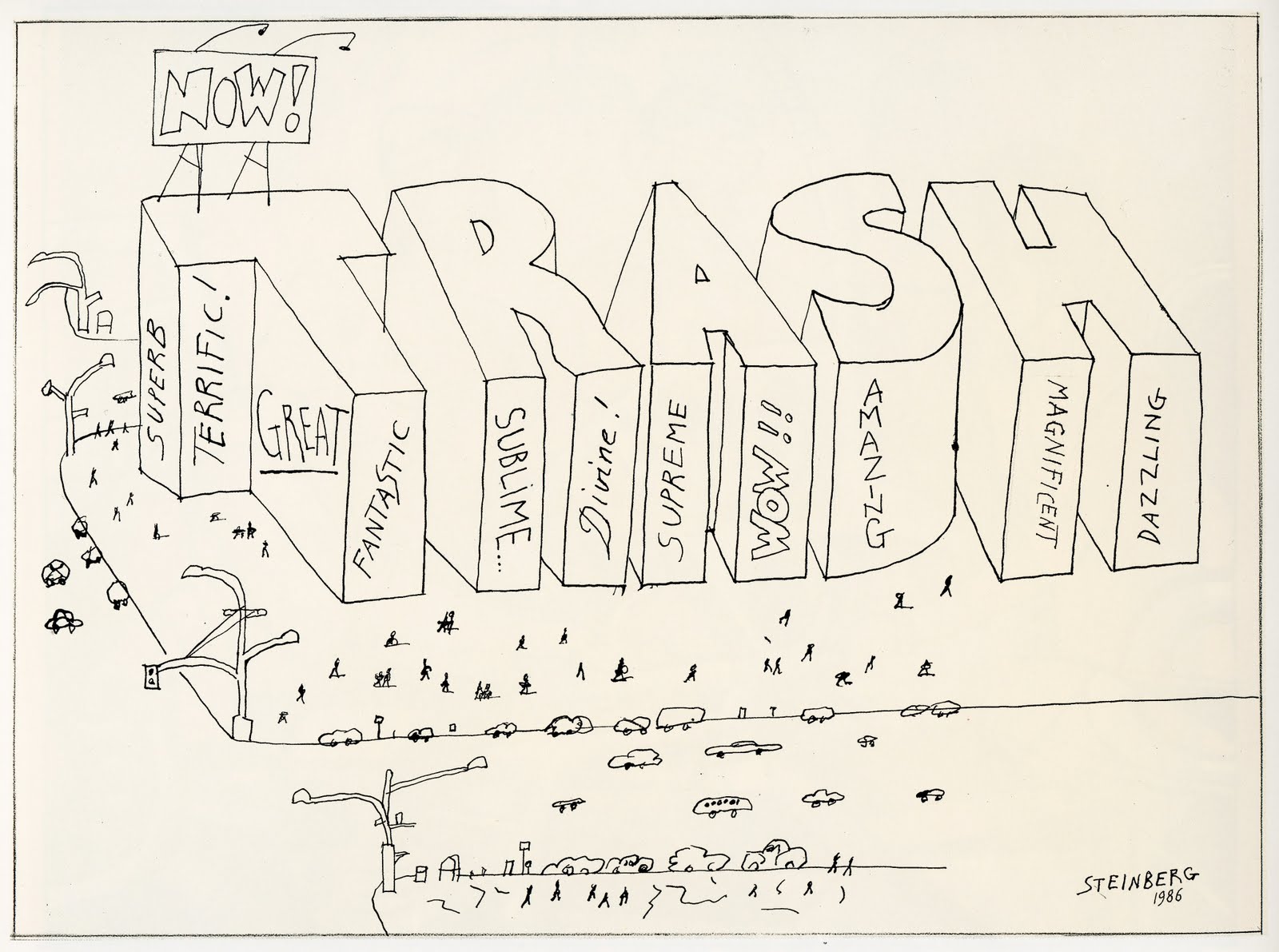
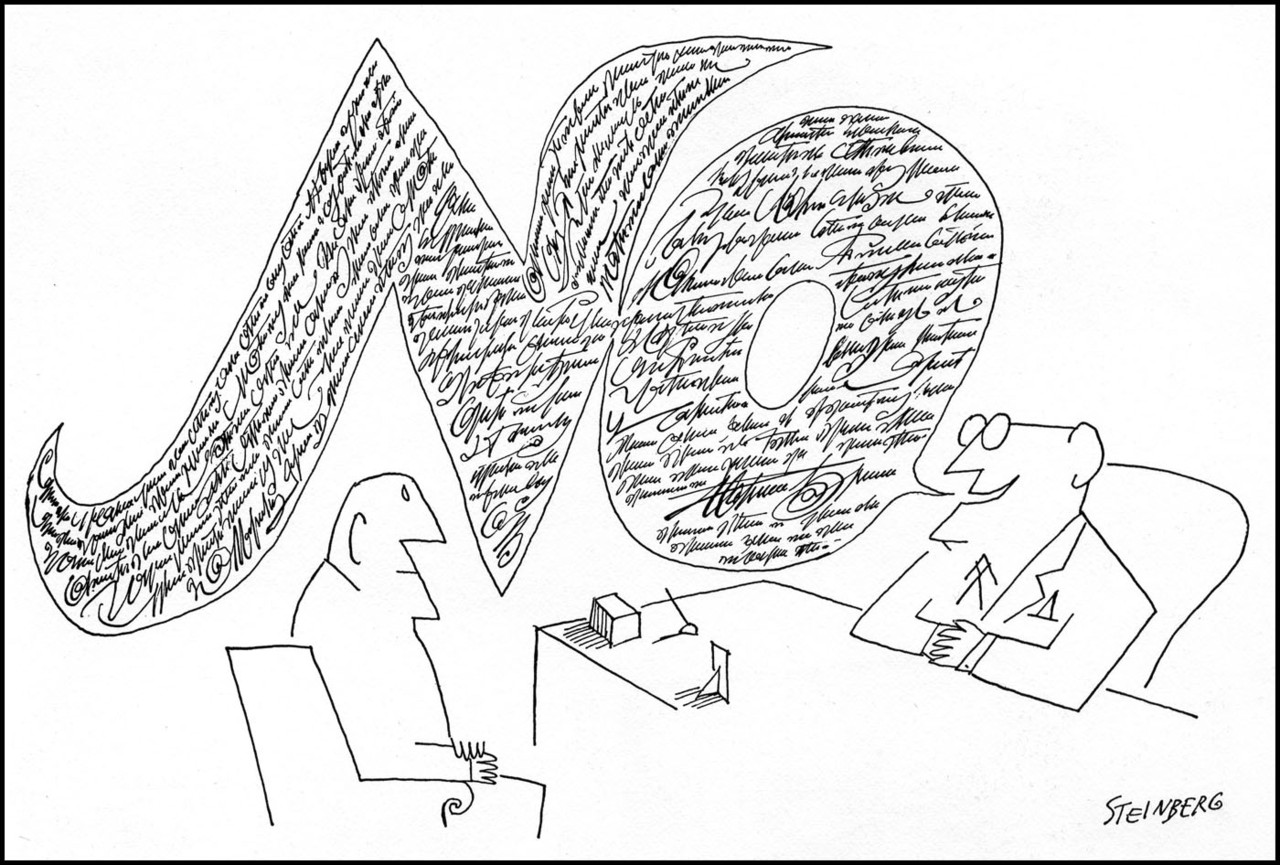
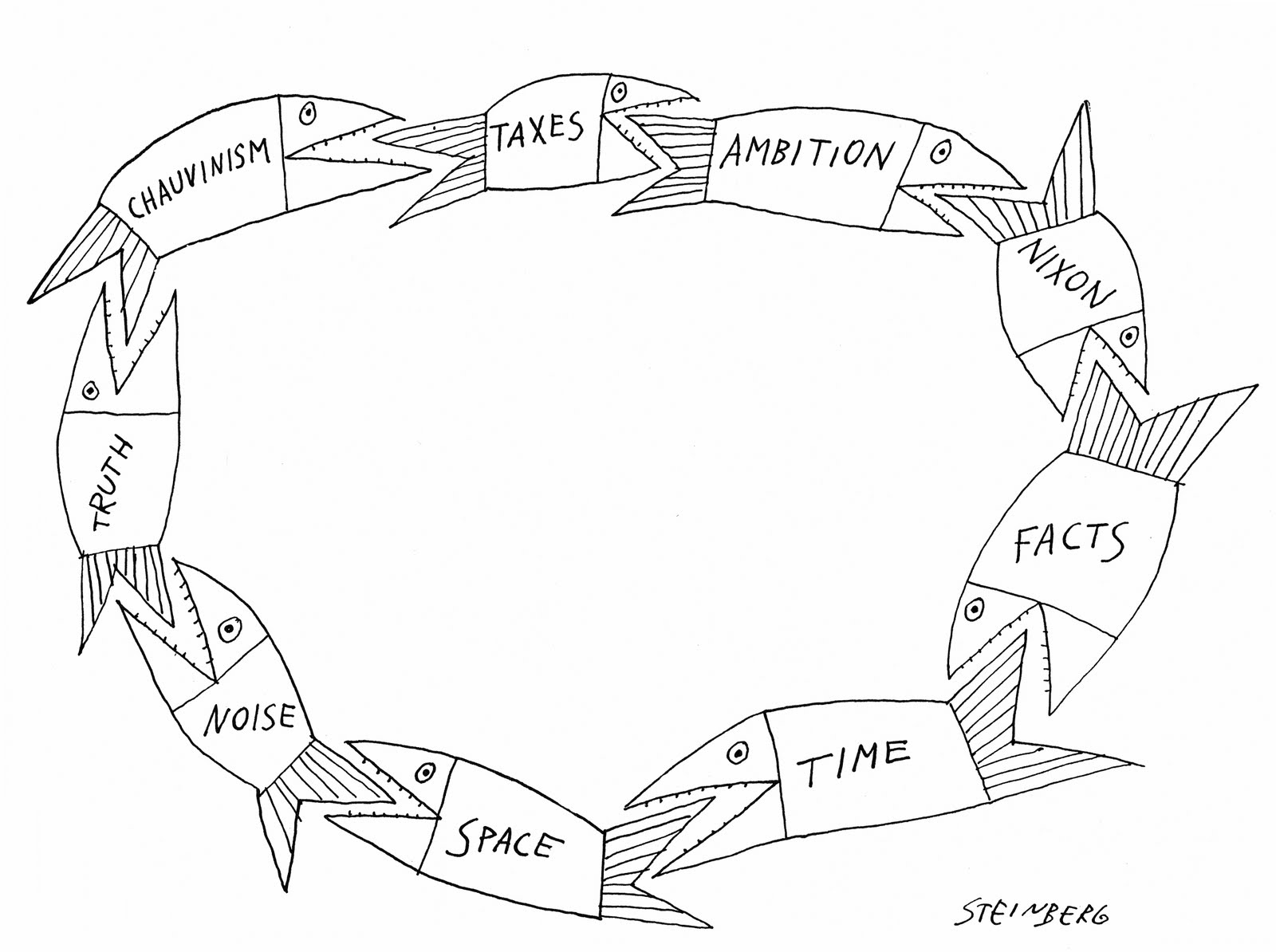
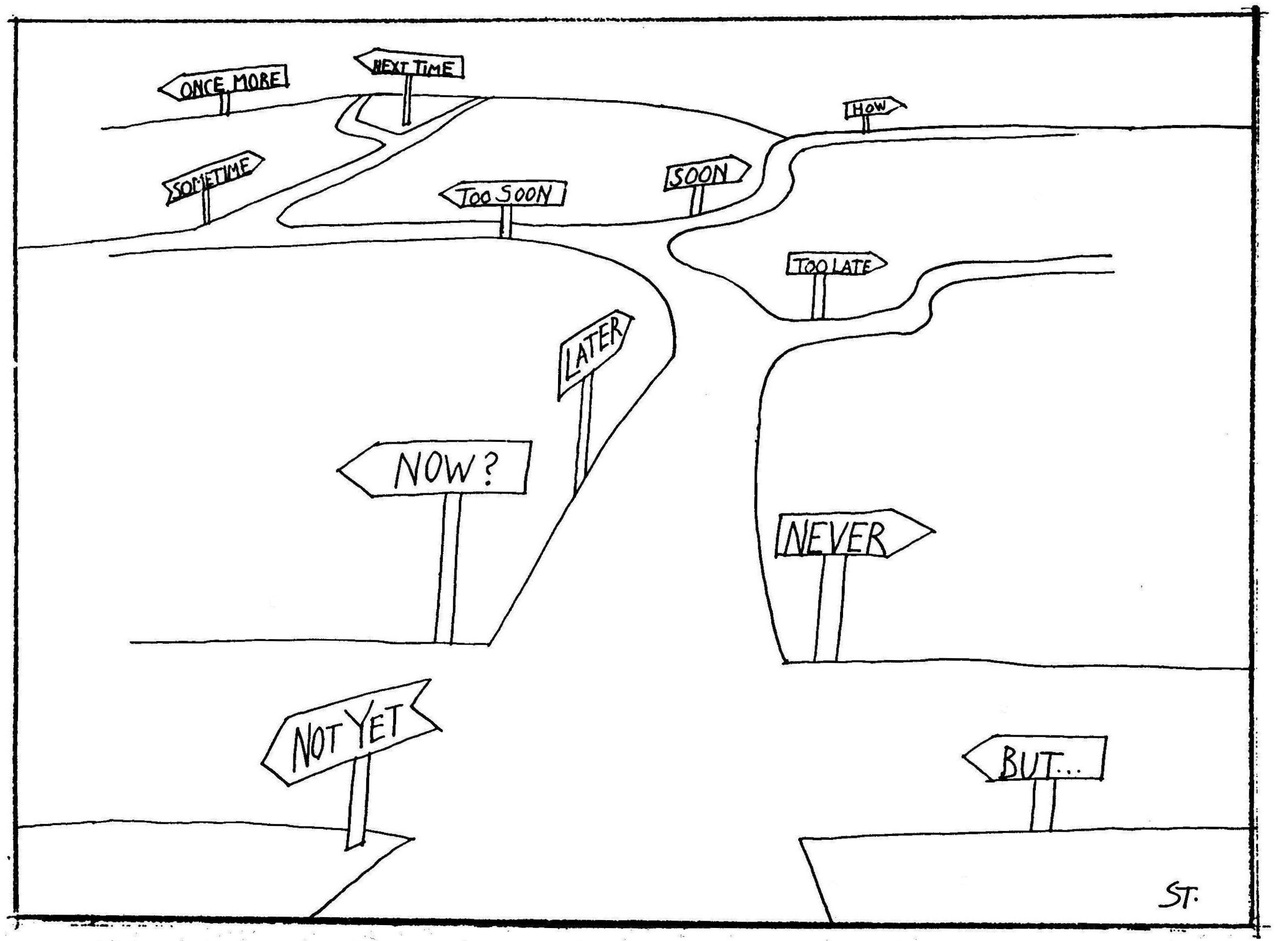
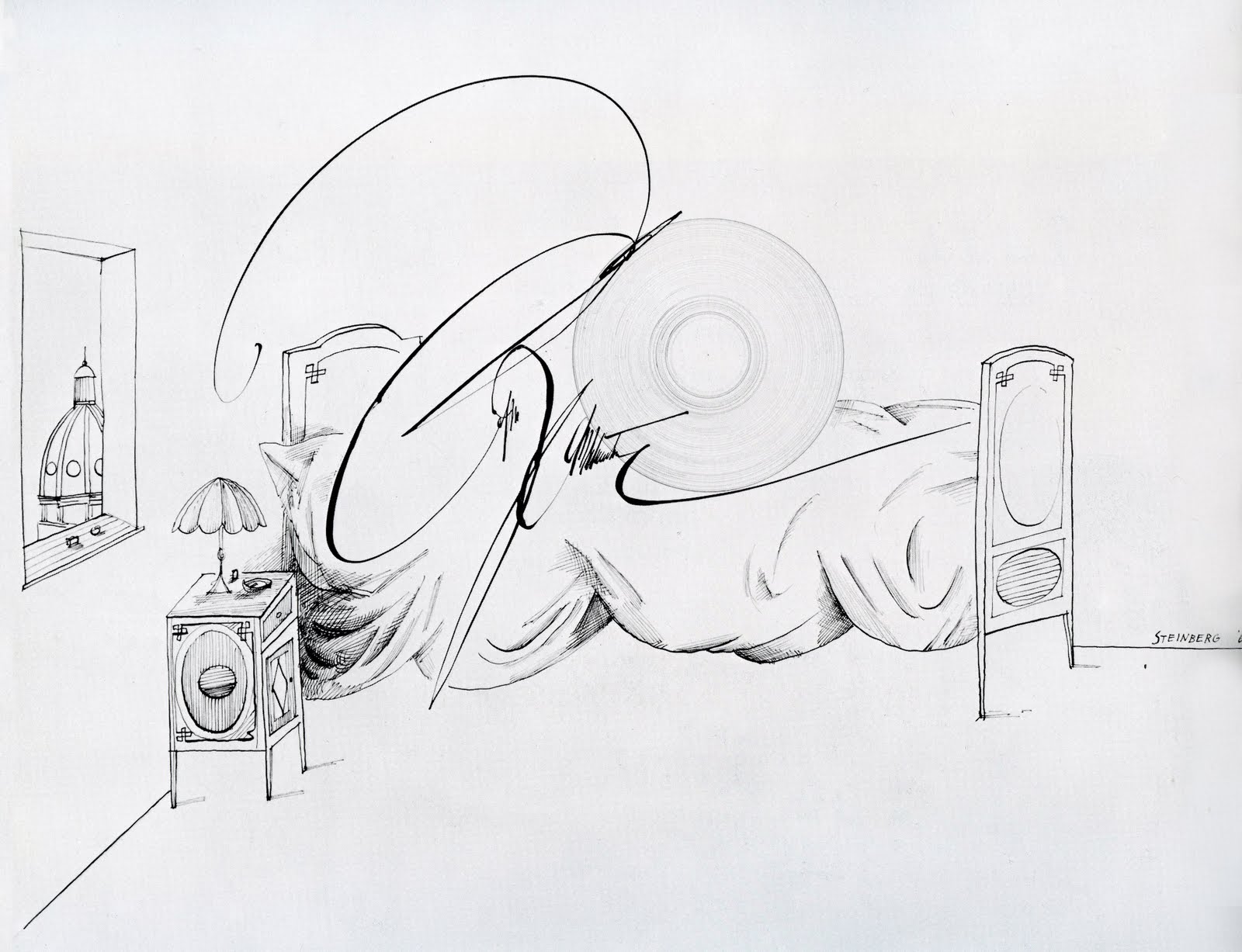
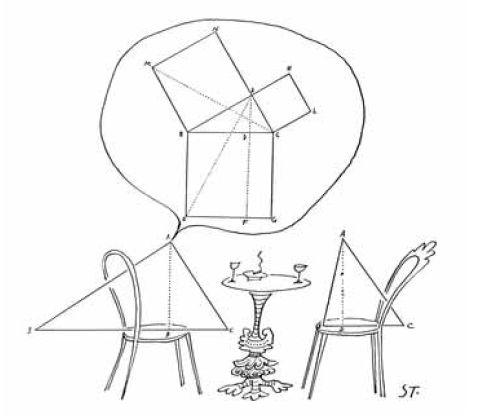
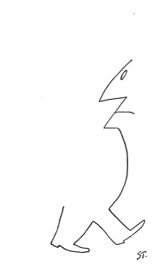
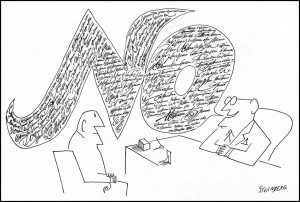
Considering that Steinberg’s cartoons are not analyzed, it would have been nice for the work itself to have been featured, even embedded in the text, as New Yorker cartoons often are. The only adorning images are a small cartoon by Steinberg, which appears above the title,
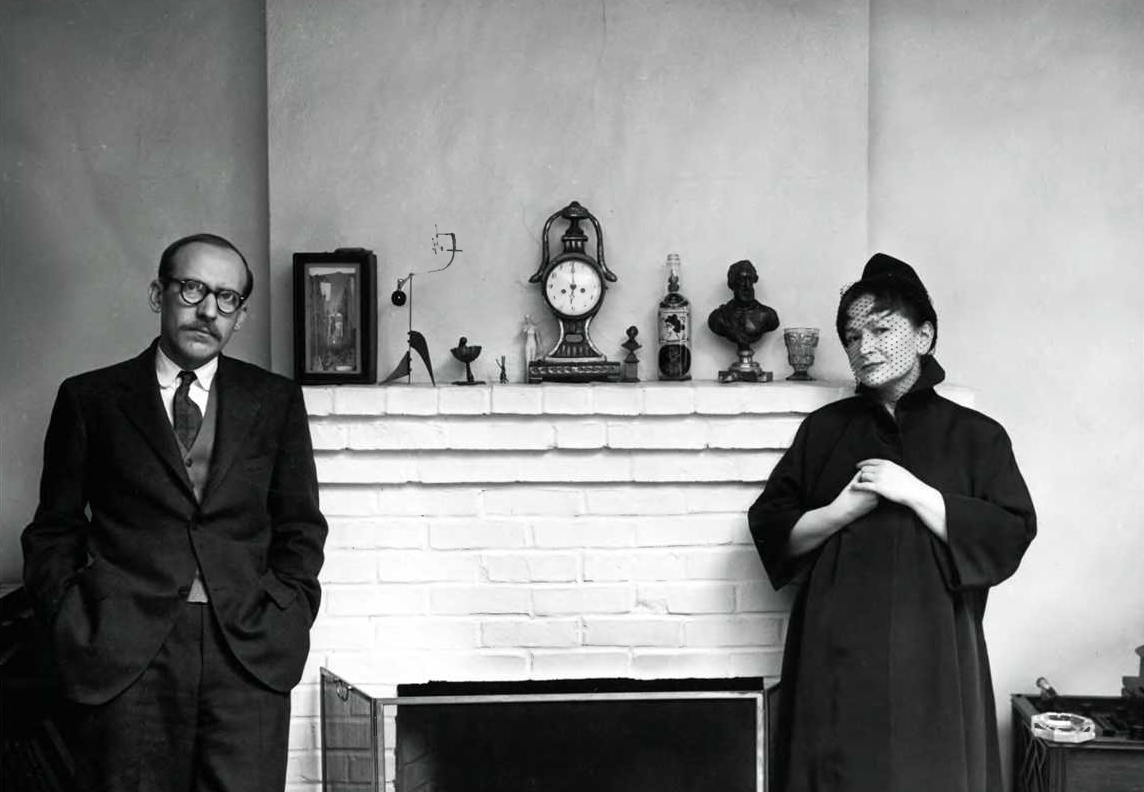
and an enormous photograph of Steinberg and his wife, Hedda Sterne, posing forcefully before an eclectically decorated fireplace.
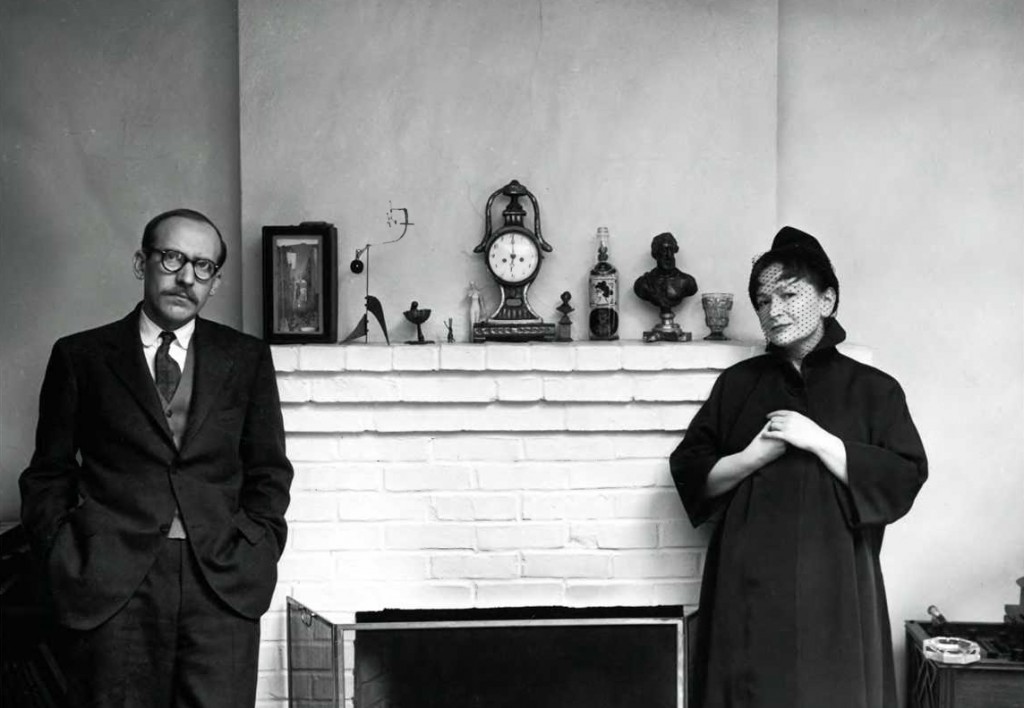

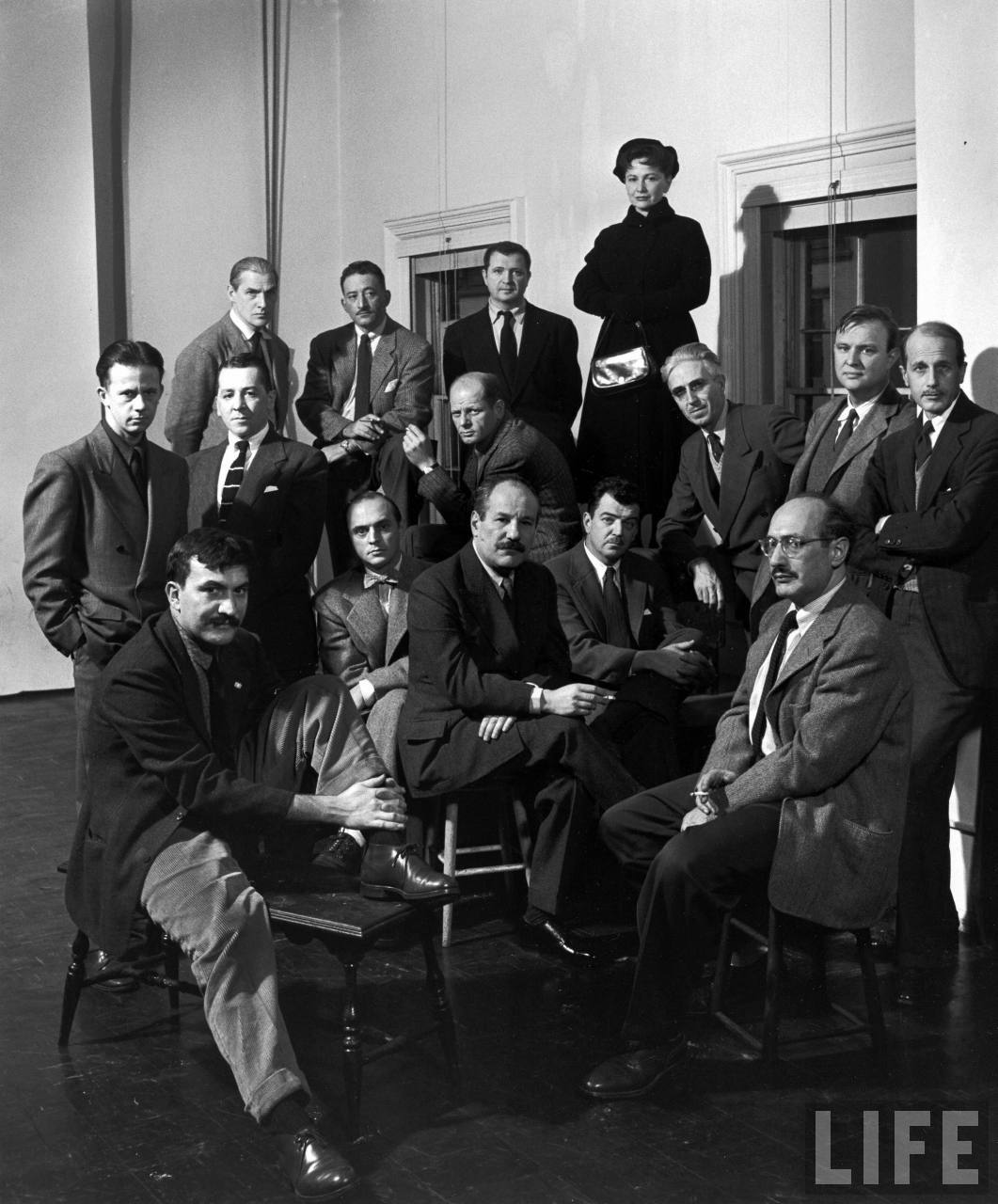
Sterne is the second in a line of four women who frame Schjeldahl’s examination of the artist. To those acquainted with the photo below, Sterne will seem familiar.
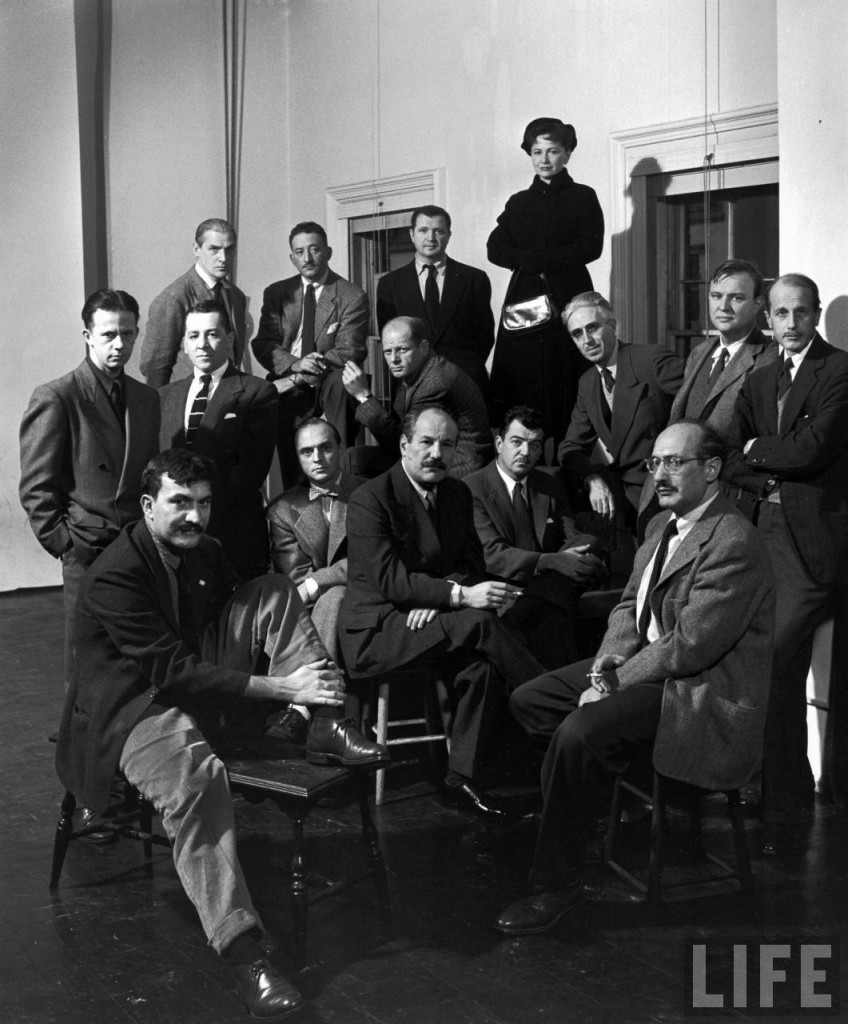

Inspiring their moniker by The Herald Tribune as ‘The Irascible Eighteen,’ this flagrantly self-promotional photo shoot collected many members of the young abstract expressionist movement in New York City, notably Jackson Pollock, Willem de Kooning, Mark Rothko, and Barrett Newman. Formed in protest of a juried competition at the Metropolitan Museum of Art, the group was less a collective than a competitive, and the incendiary dramatics was a part of their marketing. Sterne, the only woman in the photograph, stands on a chair, presiding over the men. As an artist, Sterne never became a household name, but her presence is largely responsible for the visual interest of the photograph, and its infamy has outlived almost all of the individual’s photographed. This often-emulated photograph has haunted the New York and international art world, providing a powerful visualization of the greater myth of ‘genius society’ that accompanies most constructions of individual geniuses.

In the review, Sterne’s im-memorability is chalked up to, “her shyly independent, often changing style, and, perhaps, to the toll of the sacrificial devotion that Steinberg required of her tenure as, in her words, a ‘long-suffering, uninterruptedly betrayed wife with a few honeymoons thrown in.’” Sterne’s presences does more than link Steinberg to a hallowed fragment of New York society and art history. Sterne’s failure and merit are justified in her service to Steinberg, as Steinberg’s talent and art-world victimhood are quietly justified in his service to The New Yorker.

It’s in poor taste to focus on the glass half empty, rude to lampoon a book without reading it, and pretty obnoxious to criticize a critique. This is not a review of Bair’s book, (one is due.) Yet it is worthwhile to examine how the book is covered by The New Yorker, a publication that owes much to Steinberg.  The tone of the review betrays that, in this magazine, Steinberg is already a hero. Rather than legitimately analyze his work, or penalize an account that fails to, Schjeldahl indulges in human-interest fluff and idolizing, and submits to the same biases that frustrated Steinberg during his lifetime. Steinberg obviously saw himself as exceptional, but if he really saw no true artistry in cartooning, his hunger for acceptance might have driven him out of it. Instead, he was a competitive and consistently brilliant cartoonist, with no noted artistic ambitions outside of cartooning.

Yet here, cartooning is a medium that is only transformed into art by ‘a Steinberg,’ and is deserving of the awkwardness a team captain gives his unathletic best friend when lining up for kickball.  At the end of the day, a cartoonist, Steinberg ensured his immortality with his behavior as much as with his work. The New Yorker pays tribute to a generic kind of legend, which it un-conscientiously prizes above the artist who helped develop the publication. Or, it believes that it must stoop to the basest stereotypes of genius to justify reading about a cartoonist in the first place. Yet it’s puerile to believe that a proper tribute to any artist could be found in biography. A criticism of one could be expected to set things straight.


Review: The Crackle of the Frost

Lorenzo Mattotti and Jorge Zentner’s The Crackle of the Frost begins with a separation.

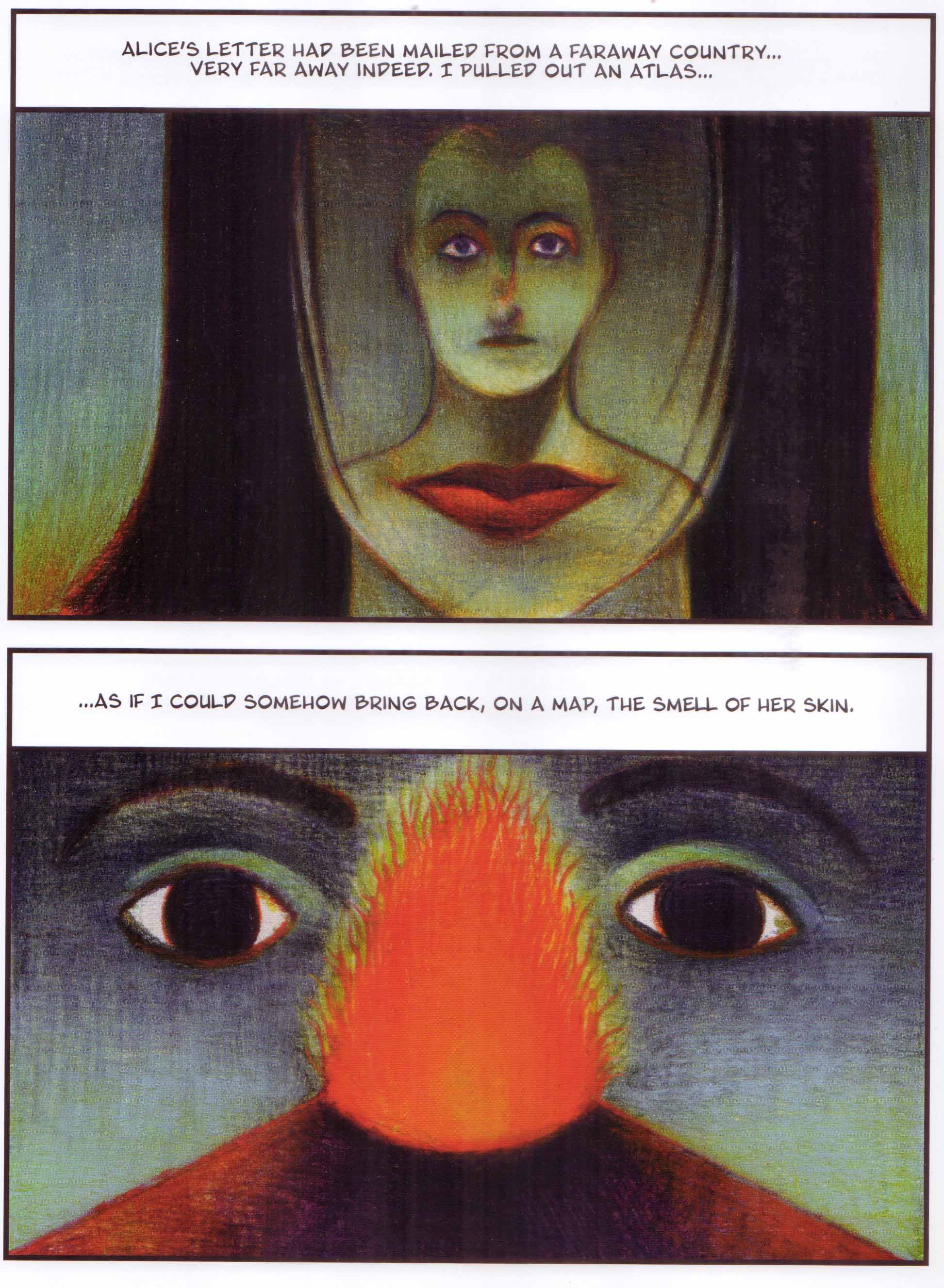
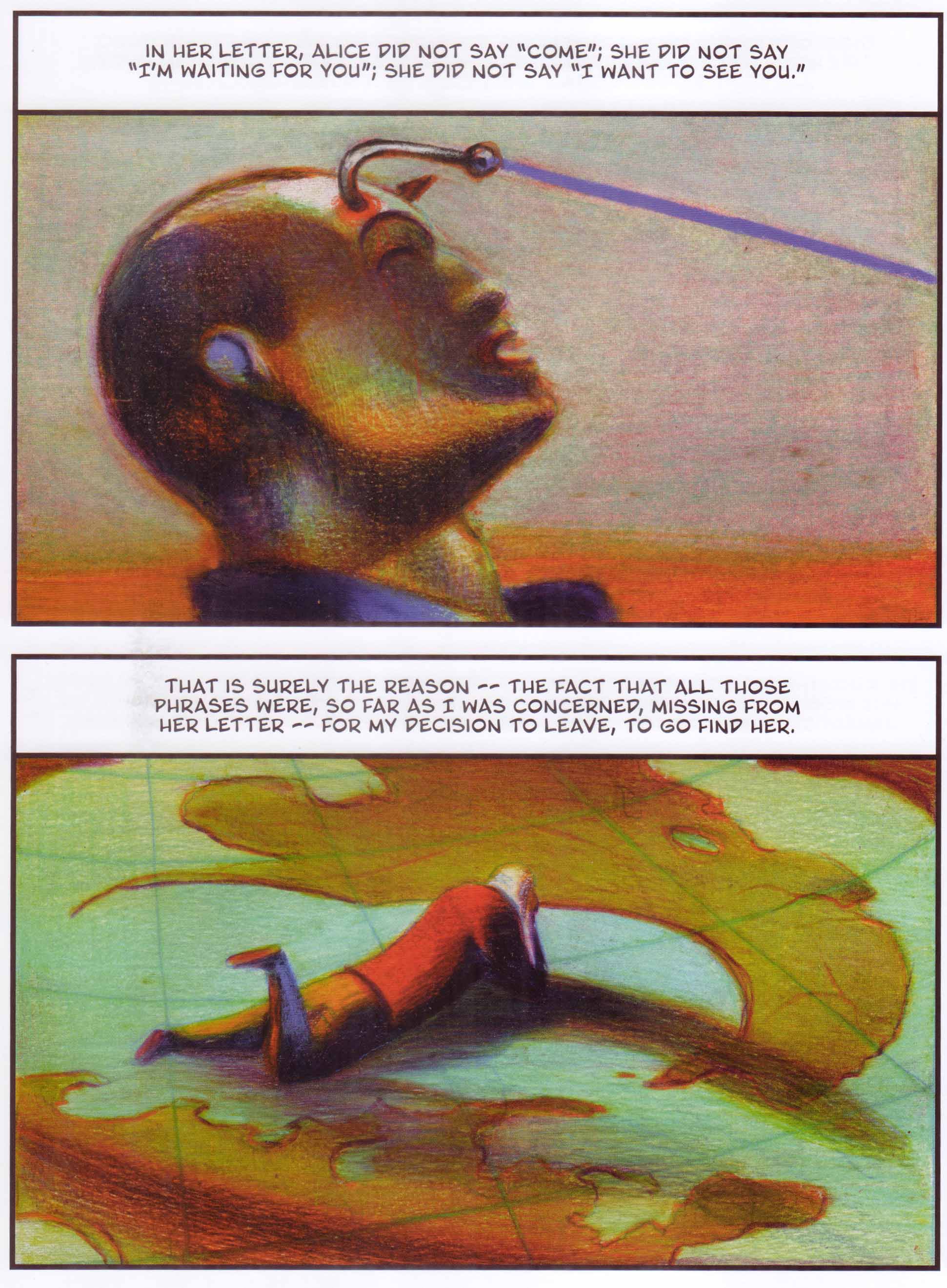
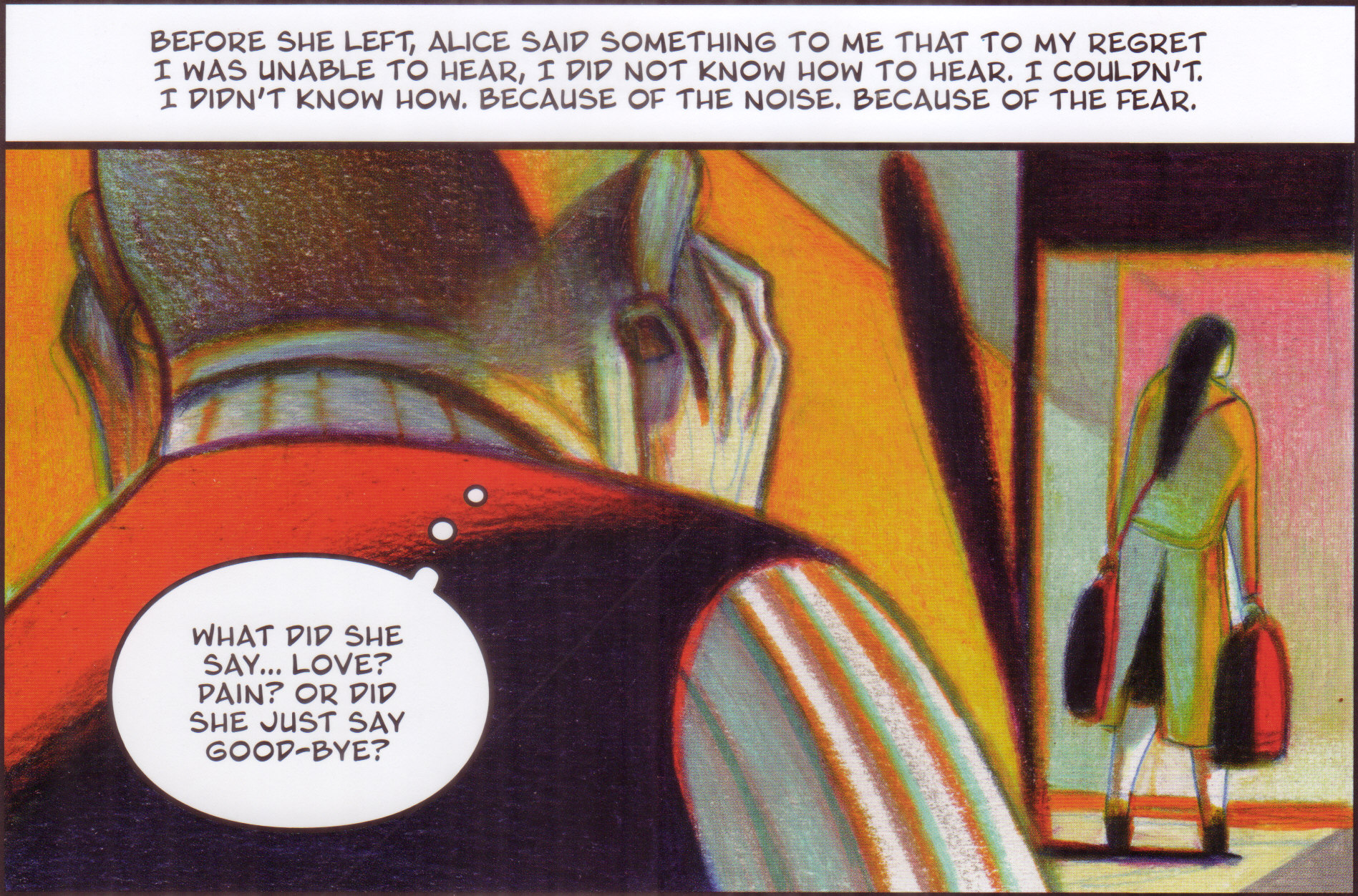
Over the course of three pages, the protagonist, Samuel Darko, recounts the circumstances under which he breaks from his partner, Alice. The disruption occurs the moment she announces that she wants to have a child with him; his seeming lack of commitment or existential terror announced by a flurry of pterosaur-like shadows and a roar in his ears. By the time he regains his senses, she has already left him. Darko receives a letter from her some time later—”mailed from a faraway country”—not quite asking for him, yet somehow enticing him in its self-possession, inspiring him to set out on a extended journey in search for her

The four panel sequence which relates this decision is a strange union of image and text, not merely illustrating but mystifying the process of description.

__

“Alice’s letter had been mailed from a faraway country…very far away indeed. I pulled out an Atlas…”

The “atlas” described in the first panel is displaced to the second panel of the following page with its billowing continents. Instead we see Darko’s face superimposed over his former lover’s nares. The protagonist’s distance from his lover is suggested by a hook of memory, plunged deep into his olfactory bulb (“…if I could somehow bring back, on a map, the smell of her skin.”)

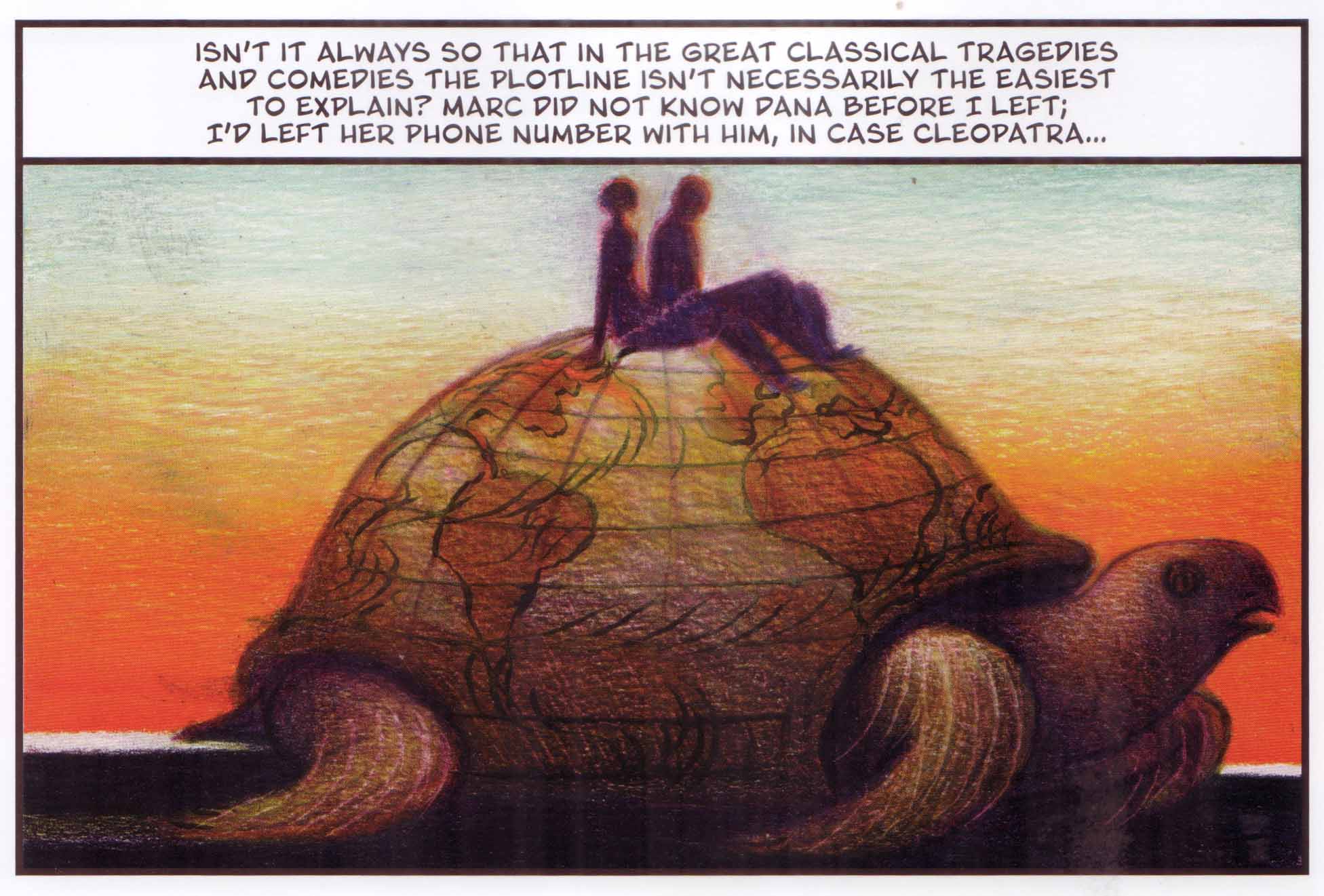
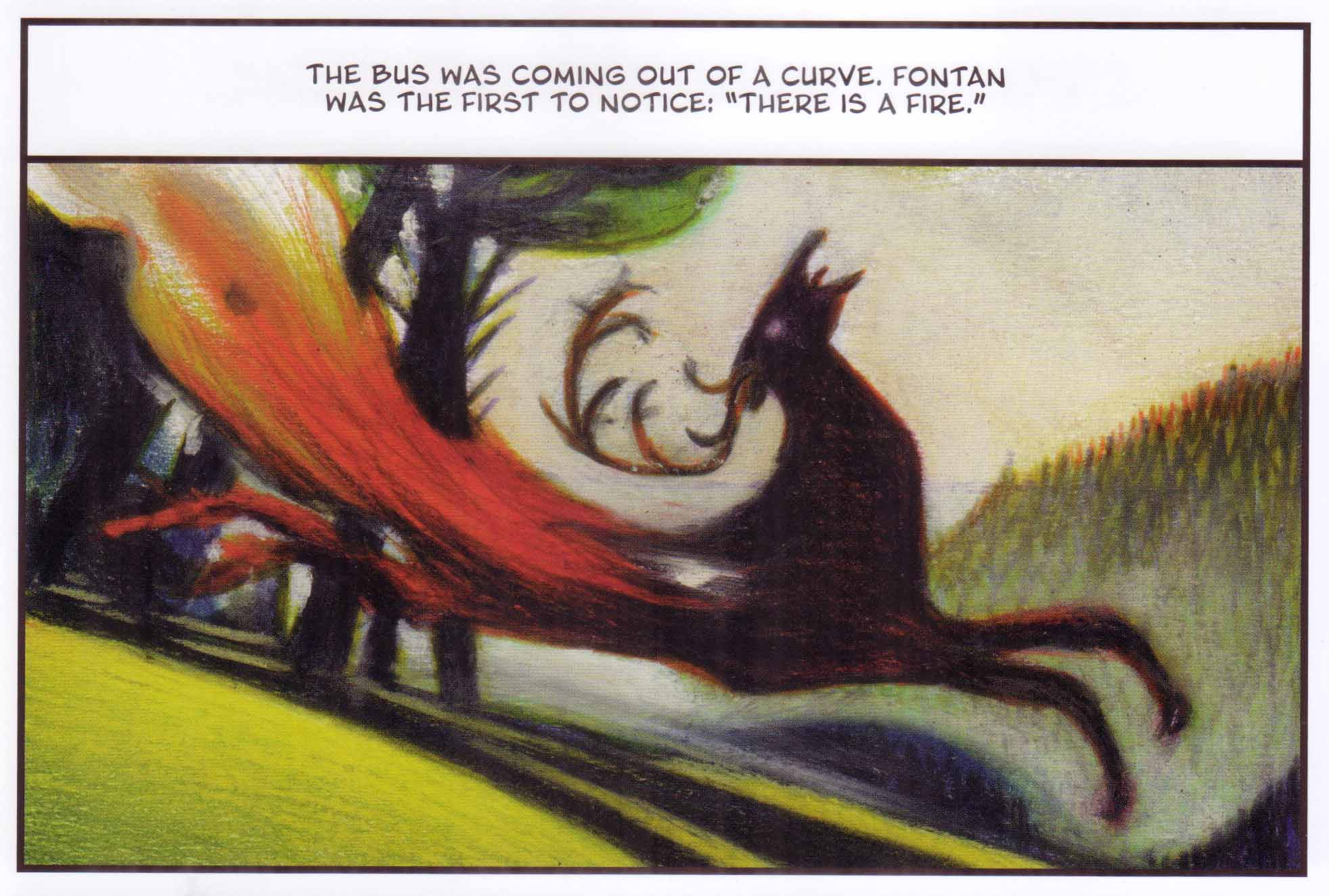
The strange flame scorching through his nostrils in the second panel creates a nebulous map of memory which recurs fitfully throughout the comic. There are the forest animals burnt to cinders on the first leg of his journey… 

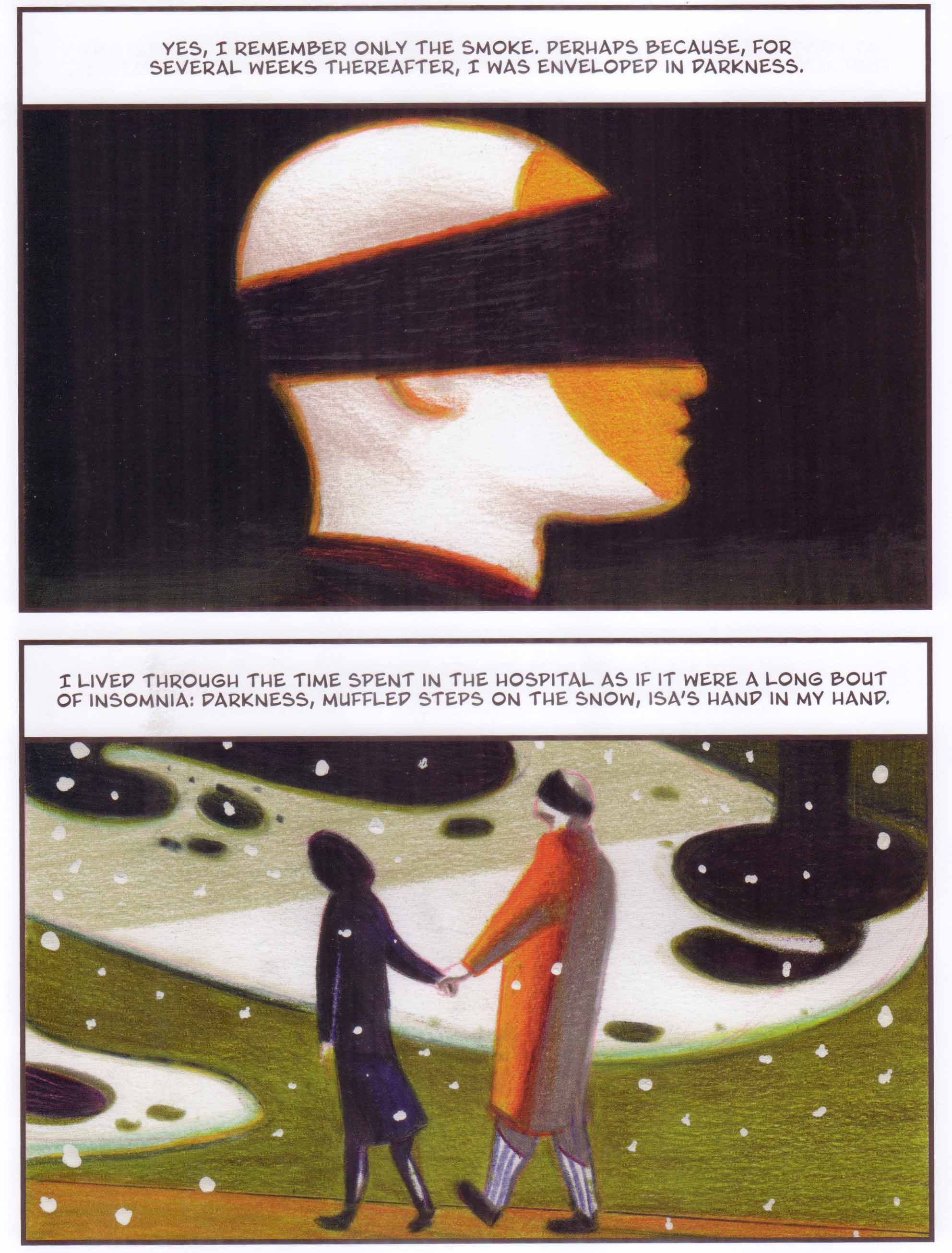
 …the black smoke from which soon cast him into darkness, closing his eyes and ears, leaving him with the disembodied hand of his nurse, Isa, and “the mystery of her hand in my hand.”

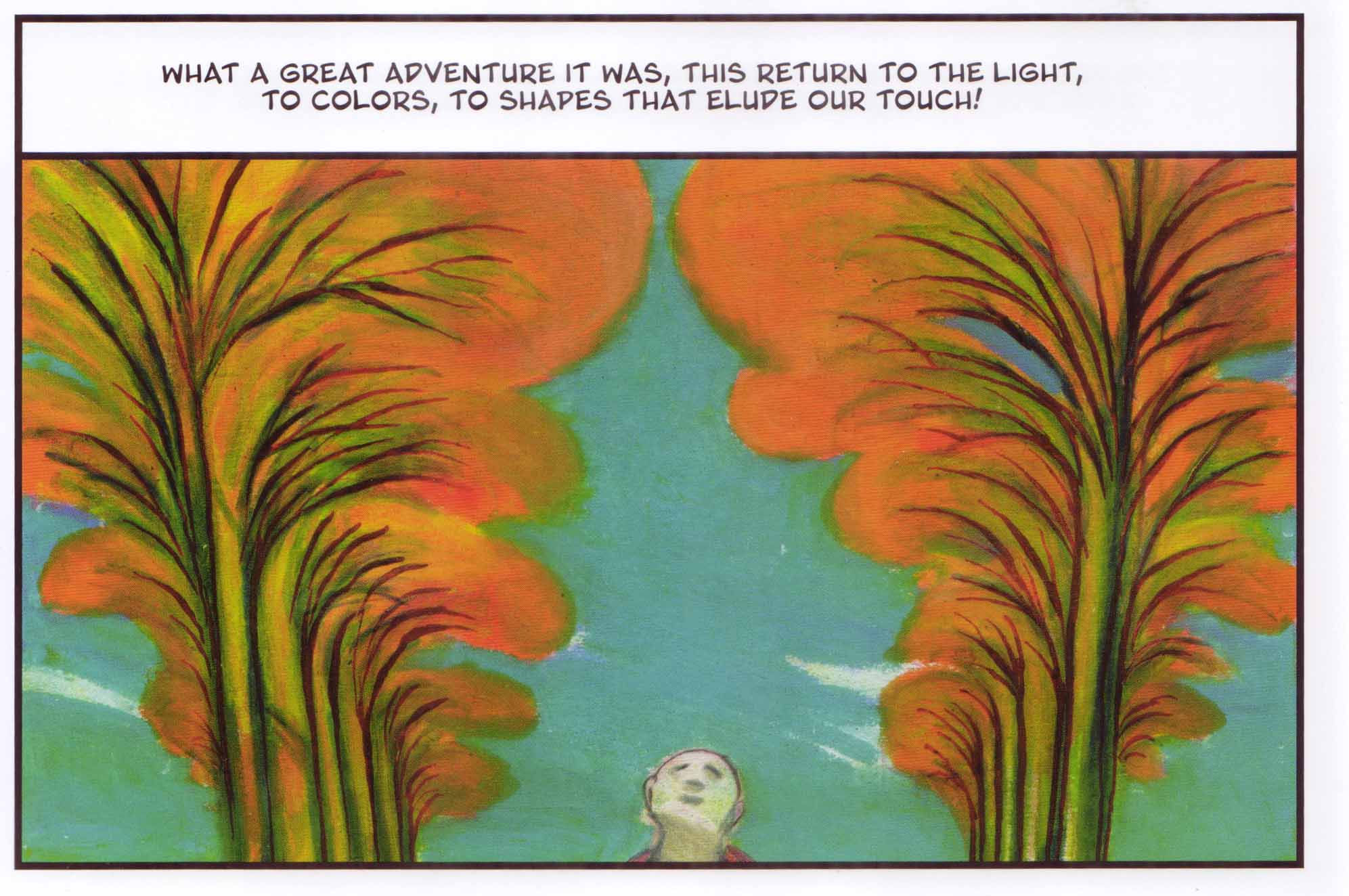
When his mask is removed and he is returned to a world filled with “shapes that elude our touch”, everything is a shade lighter, the shadows cast out by a flood of rhodopsin.

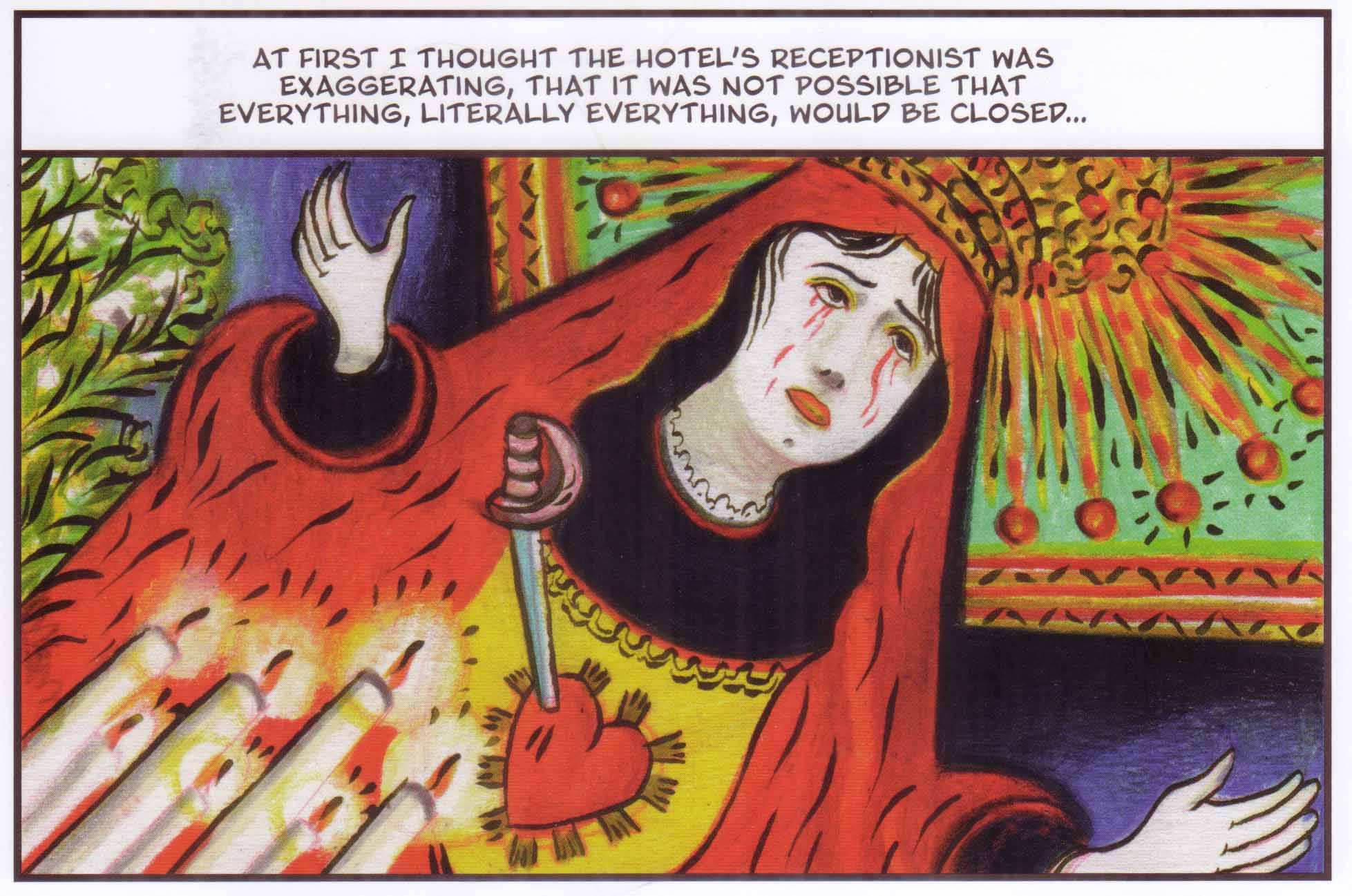
The flame of memory returns again in the form of a Virgin’s crown seen on the night of her festival…

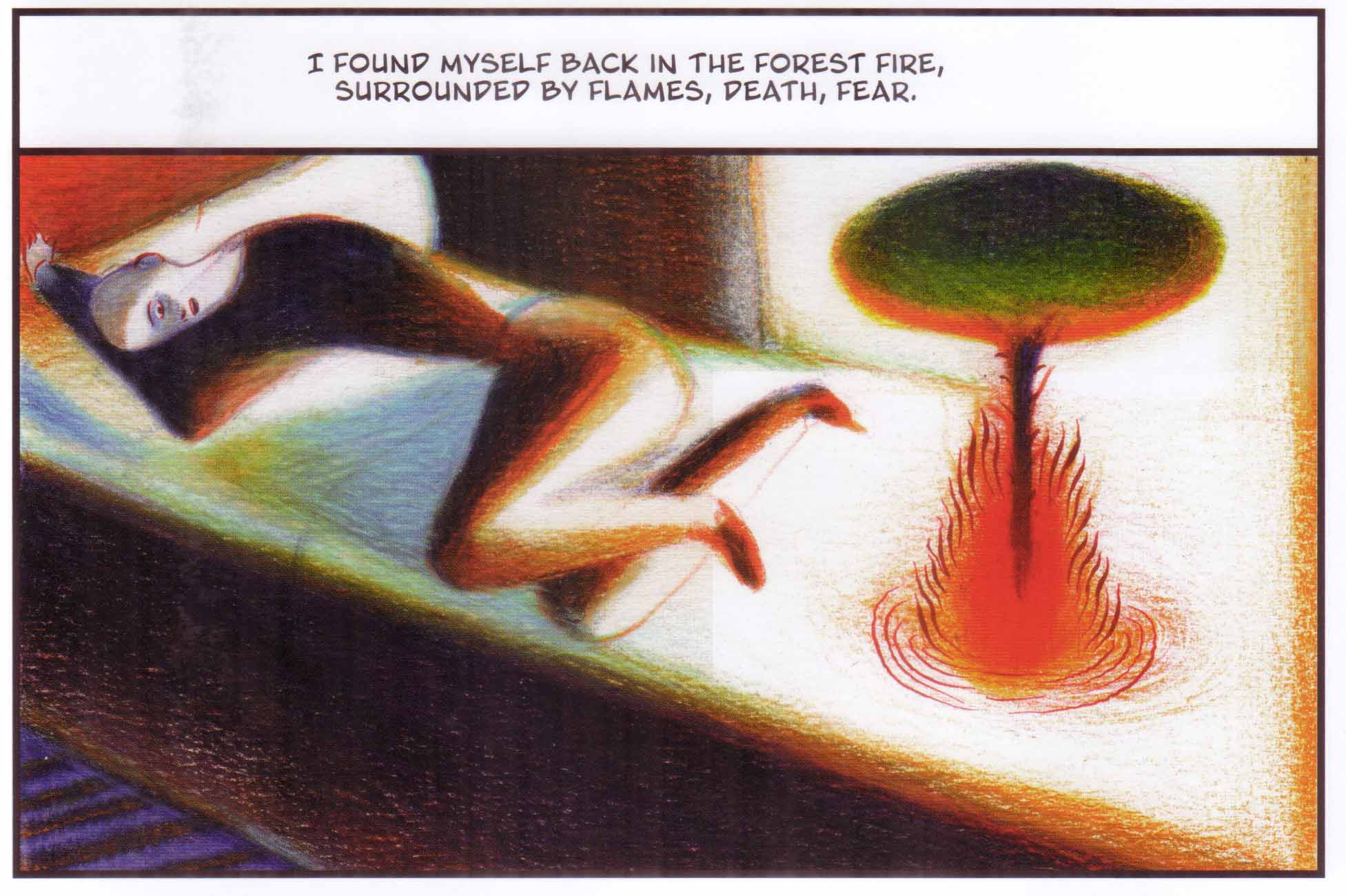
 …and then in the involuntary memory of a tree encased in fire—our protagonist’s senses clarified by hunger brought on by that feast day (all the restaurants in town are closed).

The narrative reinforces this symbolism and is interlaced with fables from another time: a Chinese emperor destroying his kingdom to keep it alive in myth and within his “…memory.”

“It alone cannot be vanquished.”

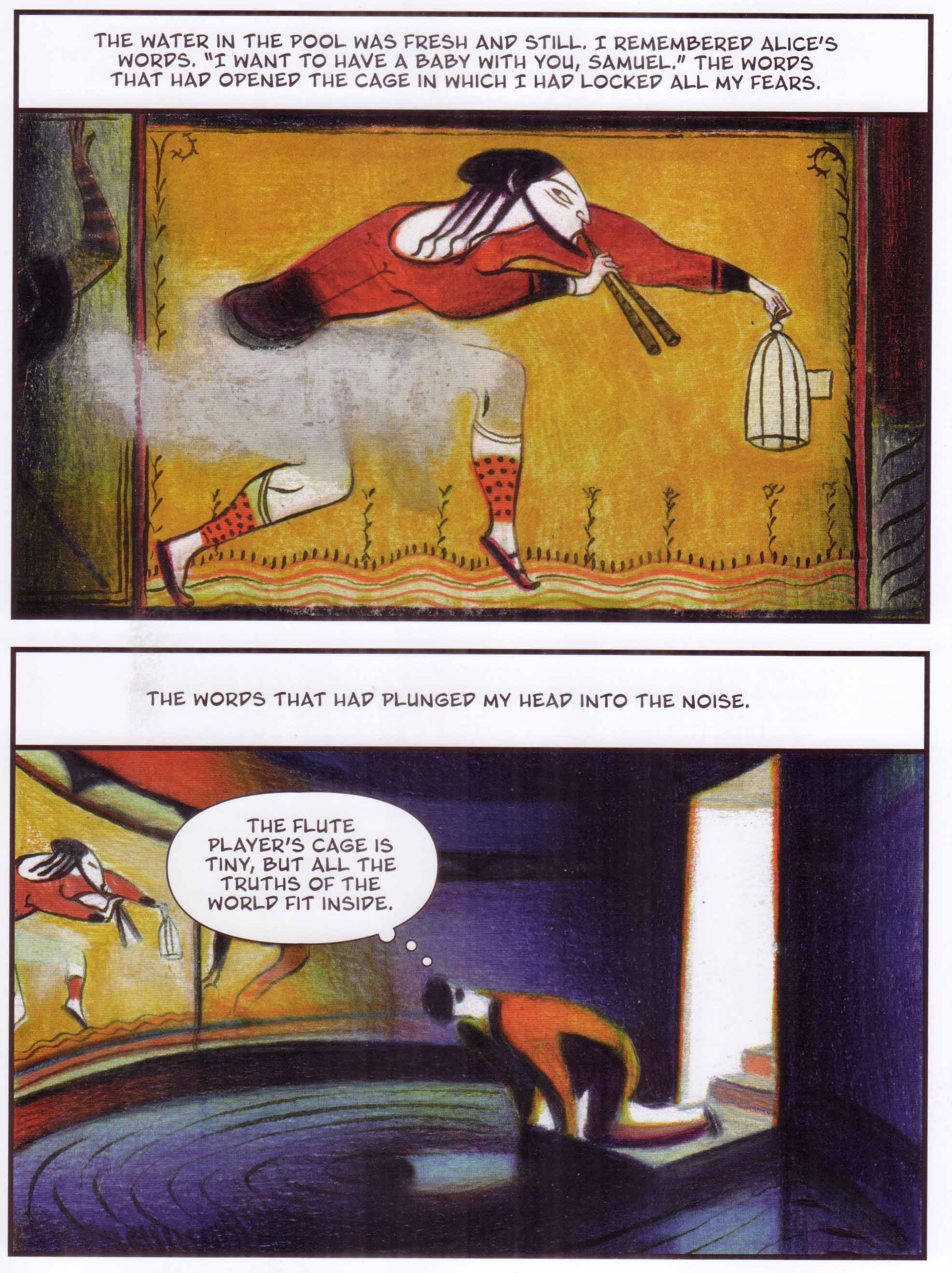
And later, the story of a flute player and his cage which contains “all the truth of the world.” The musician treads gently above the waves of a pool which will cure the protagonist’s eyes forever. 

The cage he bears before him so gingerly is a recurrent motif first seen at the start of Mattotti and Zentner’s tale where Darko is told that “loneliness can be a cage within which we keep our fears locked away,” the pastel hues forming lines on his shirt like a prisoner’s dress encasing and straitening him. 

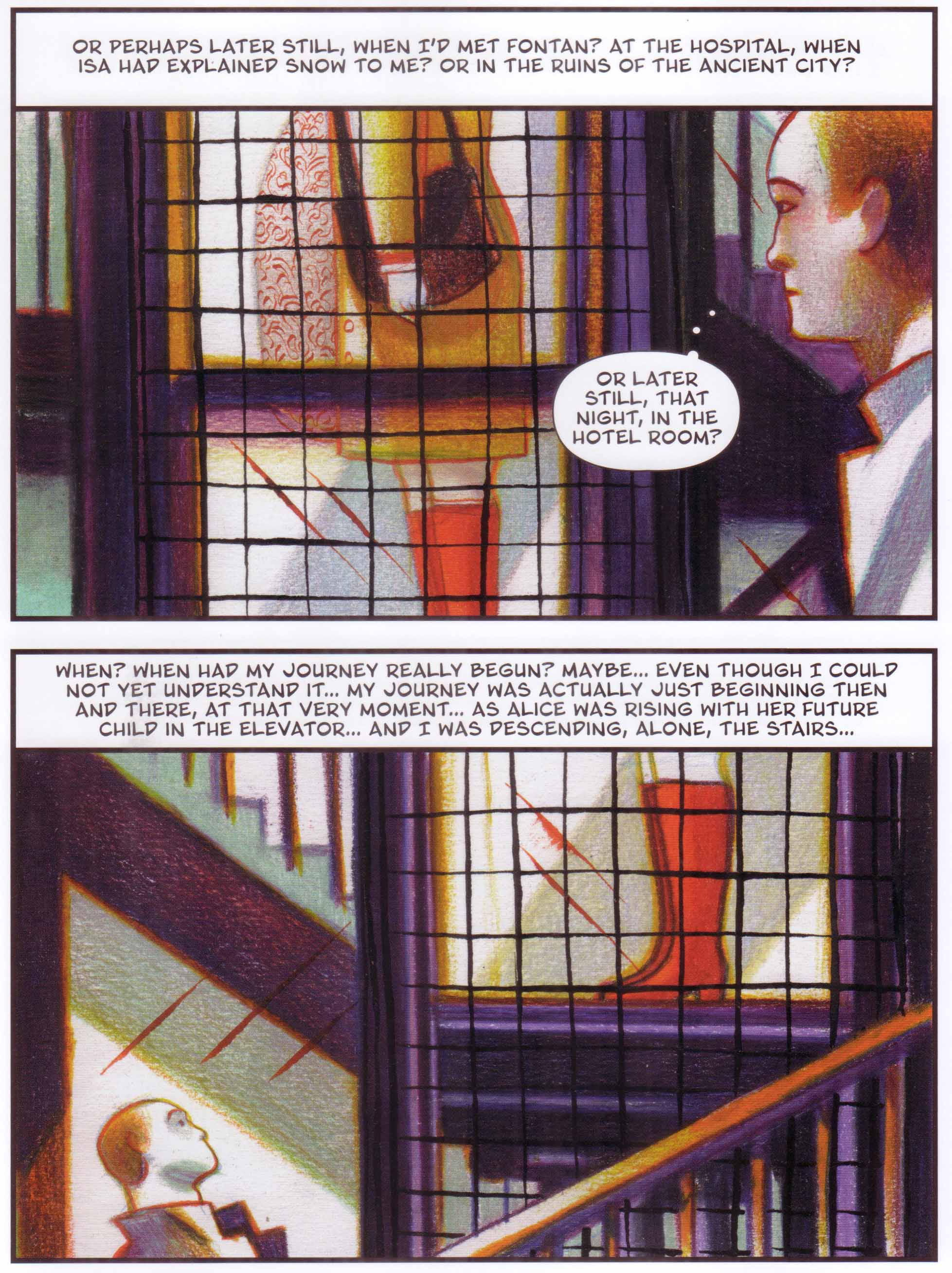
The cage is seen again in the walled city of the aforementioned Chinese emperor, and even further on, superimposing itself on Darko’s pregnant wife who is seen in profile as she ascends in a caged elevator; the protagonist silently wondering to himself just when his journey had begun, his life suffused with a multitude of starting points and hints of irretrievable knowledge. 

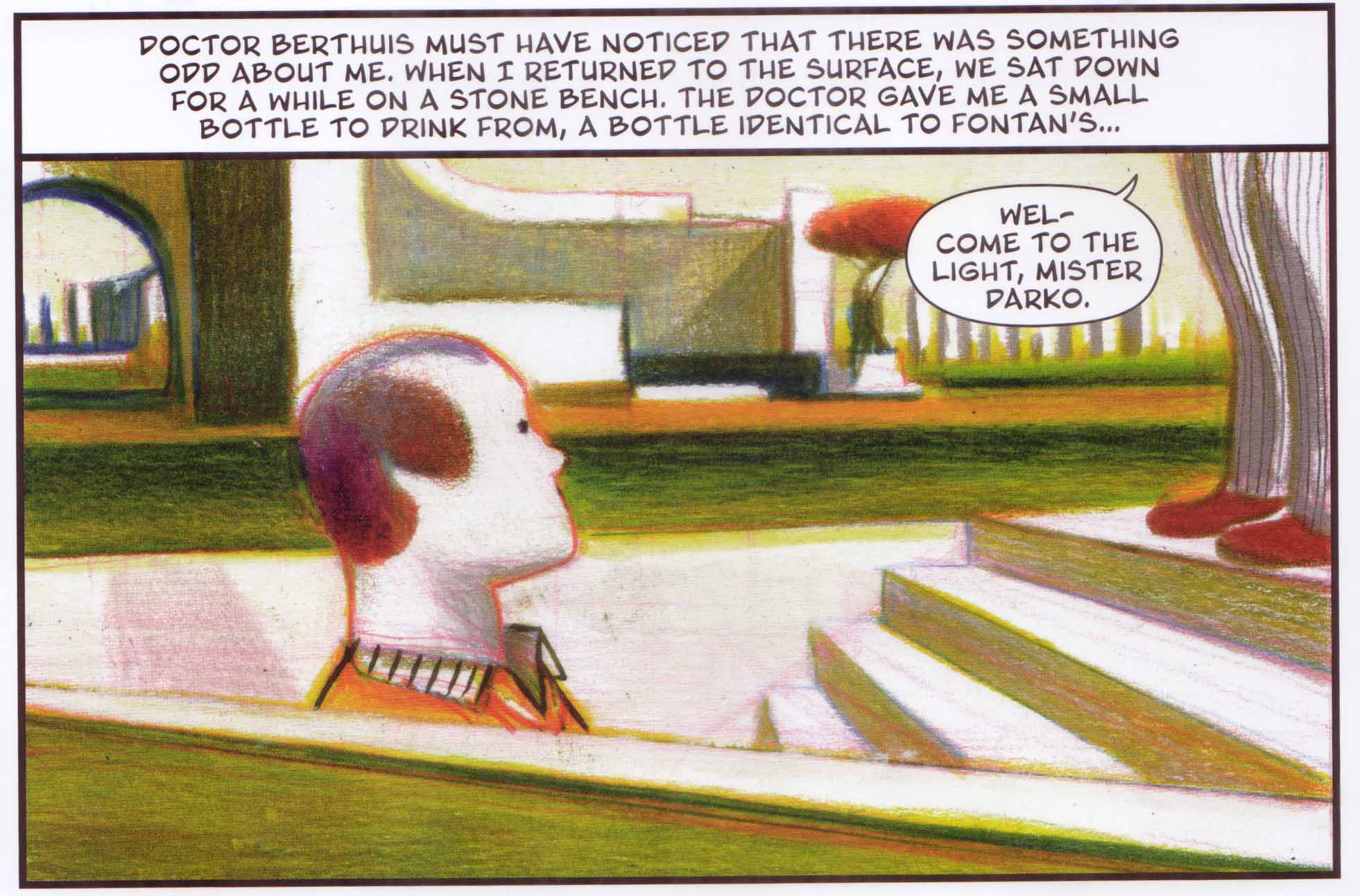
And even if the metaphorical aspects of the comic are announced a bit too brusquely about a third of the way through the book…

“Welcome, to the light, Mister Darko.”

 …it can be excused as one of the few times the authors allow a pat explanation seep out.
The scene in question has echoes of Debussy’s (after Maeterlinck) Symbolist opera, Pelléas and Mélisande, in particular Act 3 Scene 2, where Golaud leads Pelléas into the depths of a castle situated in a land of perpetual night, forcing him to glance into a cavern rich with the stench of death.
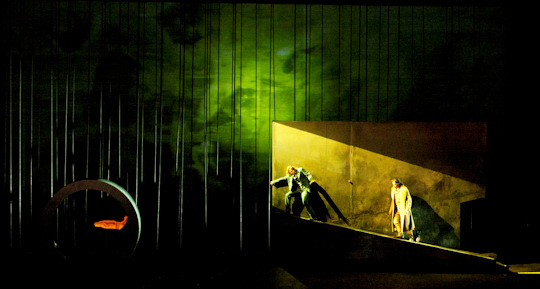
This before allowing him to emerge on to the ramparts—to the bright sun where “the scent of the wet grass and the roses is drifting up. It must be about noon…”

There is a counterpart to Darko’s impaired vision in the “Blind Men’s Well” described in Act 2 Scene 1 of that opera as well—a place where the stirrings and fate of the doomed lovers are first made plain.

Pelléas:  “Since the king is almost blind himself, people don’t come here any longer”

Mélisande:  “How solitary it is – there’s not a sound to be heard…I’m going to lie down on the marble. I want to see the bottom of the water.”

The opera consists of dream-like scenes of almost disconnected action, the unifying thread being Debussy’s music; its fellow in the comic being Mattotti’s masterful use of color. And if the an audience wonders whether Maeterlinck’s play concerns love and death, the cycle of creation and destruction, or simply “the presentiment of disaster at the moment of happiness and calm…”

“…the characters in his work do not act; they await action, and if we are not convinced of the certainty of that action, we would be distracted by the resignation.” (Joan Pataky Kosove)

…then the comic reader is allowed to wonder about all these things as well.

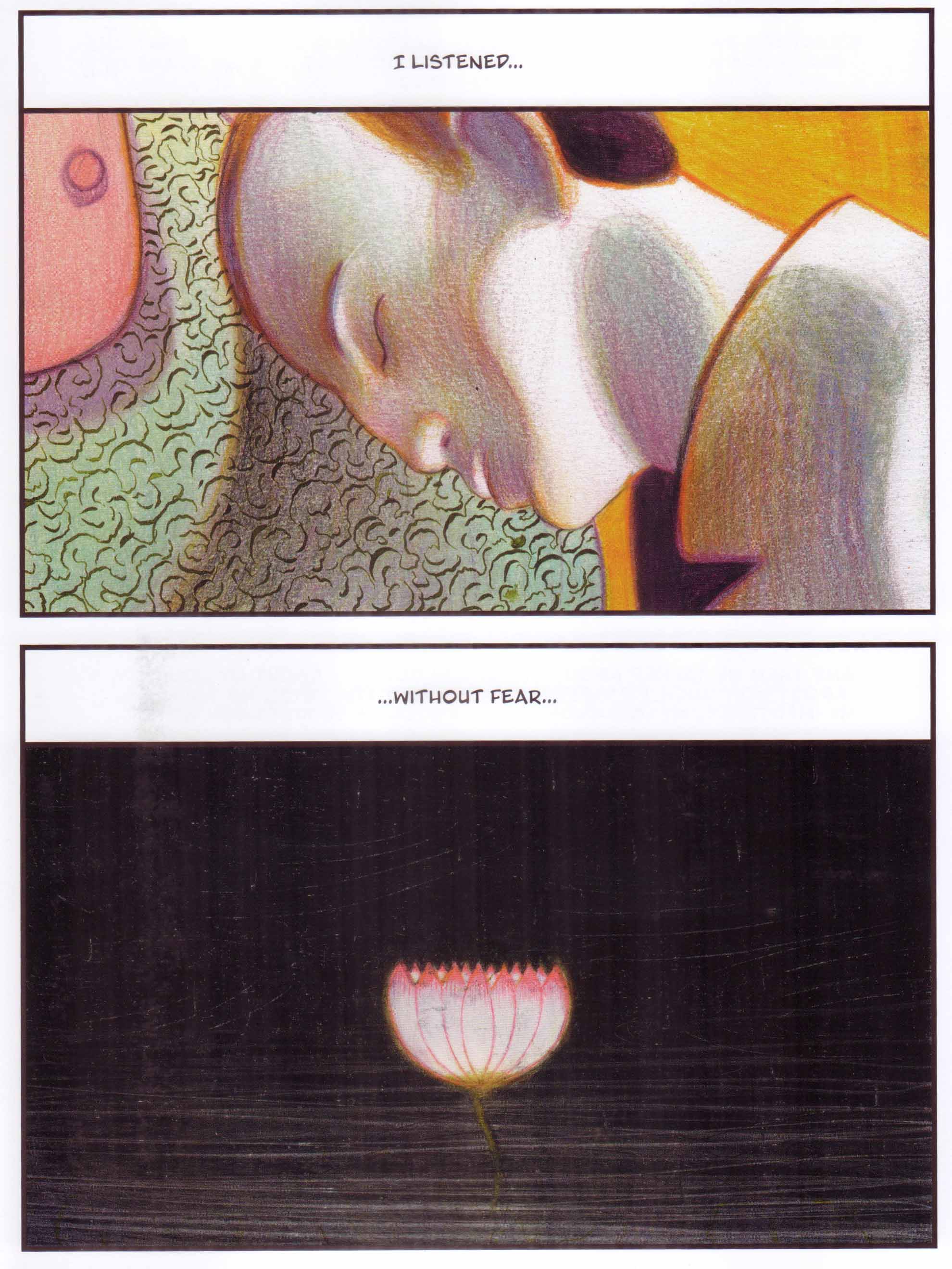
Darko’s fear is banished by an act of creation—a lotus-like flame emerging from the darkness like a Buddhistic totem symbolizing love and compassion. But his journey only ends when he meets another man—his father bent with age and sheathed in the same prisoner’s dress as his son, a reflection of himself; his memories reeled in once again by his sense of smell—of his “father’s nakedness”, his father’s “breathing”.

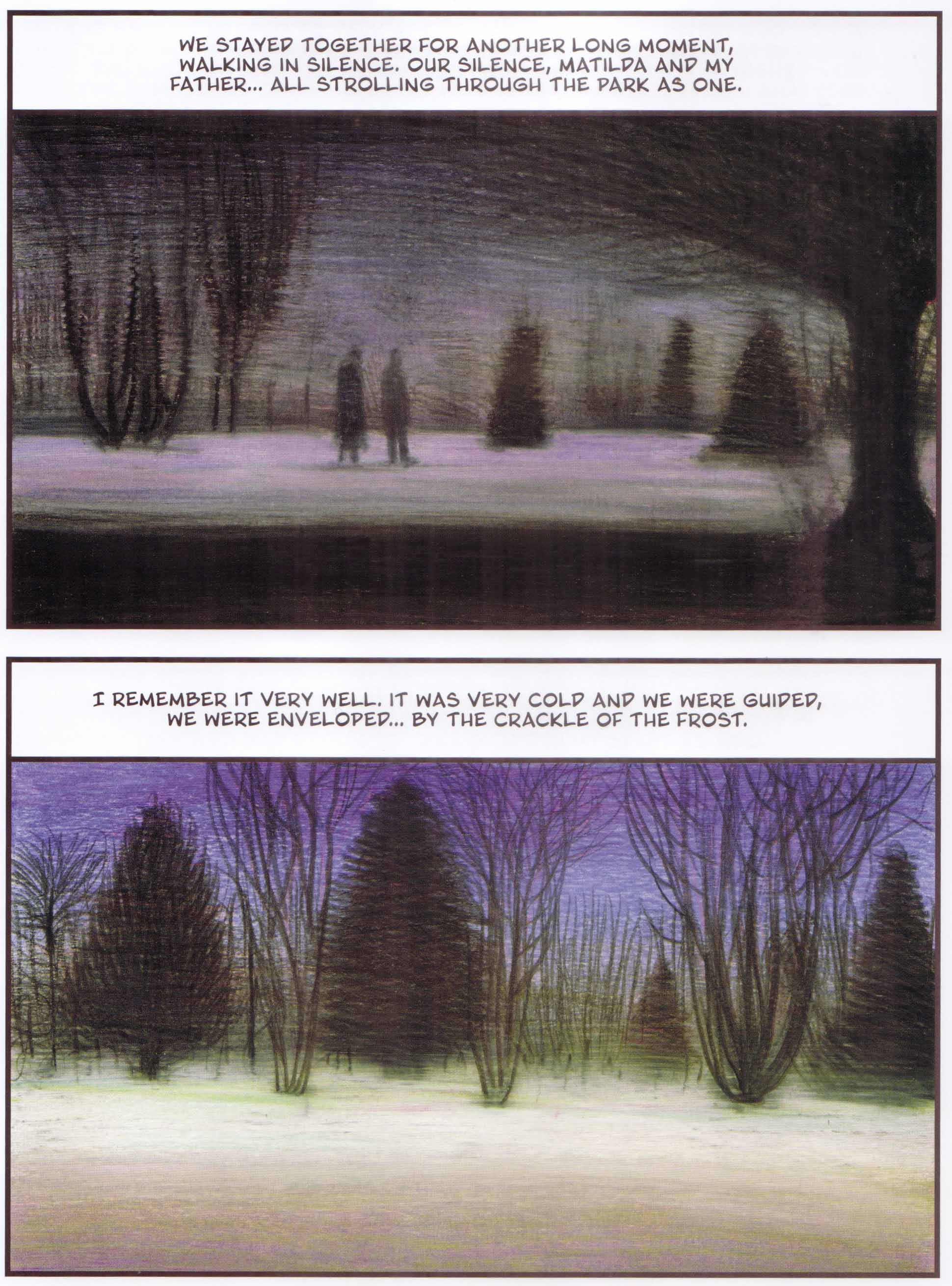
And there it ends, the questions as unanswerable as the mystery of life itself. In the hospital grounds, Darko spots a “bright light in the darkness”—another man “taking [his] worries for a walk among the trees” who can only talk about his as yet unborn daughter, Matlida;  the protagonist’s father joining them in his thoughts as they push through the breaking cold in search of intangible yet nascent rest.


Further Reading

Sarah Horrocks with a more traditional review The Crackle of the Frost.


Private Dick in the Hole

In a recent post on Philip Marlowe, Ta-Nehisi Coates argues that Chandler’s misogyny is (too) intimately tied to his vulnerability, or fear therof. Coates points to the way that Marlowe turns Carmen Sternwood out of his bed while sneering out lines like “It’s so hard for women—even nice women—to realize that their bodies are not irresistible.” Marlowe’s imperviousness to feminine wiles is connected both to his manliness and to his contempt for femininity.

Coates goes on to say this:

I think to understand misogyny one has to grapple with the conflict between male mythology and male biology. There is something deeply scary about the first time a young male experiences ans erection. All the excitement and hunger and throbbing that people is there. But with that comes a deep, physical longing. Whether or not that longing shall be satiated is not totally up to the male.

Erection is not a choice. It happens to men whether they like it or not. It happens to young boys in the morning whether they have dreamed about sex or not. It happens to them in the movies, in gym class, at breakfast, during sixth period Algebra. It happens in the presence of humans who they find attractive, and it happens in the presence of humans whom they claim are not attractive at all. It is provoked by memory, by perfume, by song, by laughter and by absolutely nothing at all. Erection is not merely sexual desire, but the physical manifestation of that desire.

Men hate women, therefore, because men are supposed to be in control, and their plumbing prevents that control.

I think this is perhaps a little too pat; biology-as-truth is, after all, its own mythology, and one that can (and is) also often put to misogynist ends. But putting that argument aside for the moment, I think Coates is in general correct that manliness is defined by control, and that that control is often structured in terms of control-over-biology, or the body, which is then itself always feminine, or threatening to drag one down into the feminine. Manliness is cleanliness is control is unbodiedness, so that the only real dick is the dick that is secure and private.

If Philip Marlowe read Johnny Ryan’s Prison Pit, you have to think that he would, therefore, be horrified not by its violence or its sadism, but by its messy embodiment — and, therefore, by its unmanliness.


Ryan’s work is, of course, generally thought of as a kind of reductio ad absurdum of frat boy masculinity. Prison Pit is a hyberbolic, endless series of incredibly gruesome, pointless, testosterone-fueled battles with muscles and bodily fluids spurting copiously in every direction. It is as male as male can be.

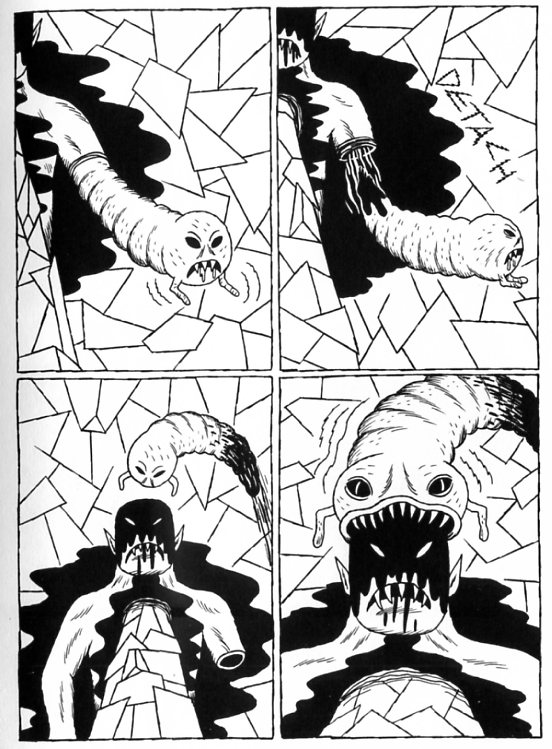
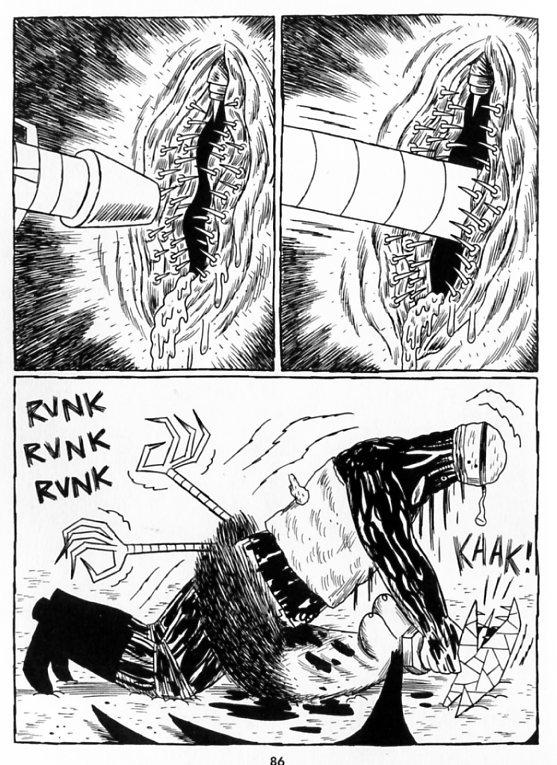
And yet…while Prison Pit is certainly built out of male genre tropes, its vision of masculinity and of masculine bodies is — well, not one that Raymond Chandler would call his own, anyway. That image above, for example, shows our protagonist as his disturbingly phallic left arm oozes up and off and devours his head. Far from being a private dick, that’s a very public and very perverse act of masturbation — and one that is hardly redolent of bodily control.

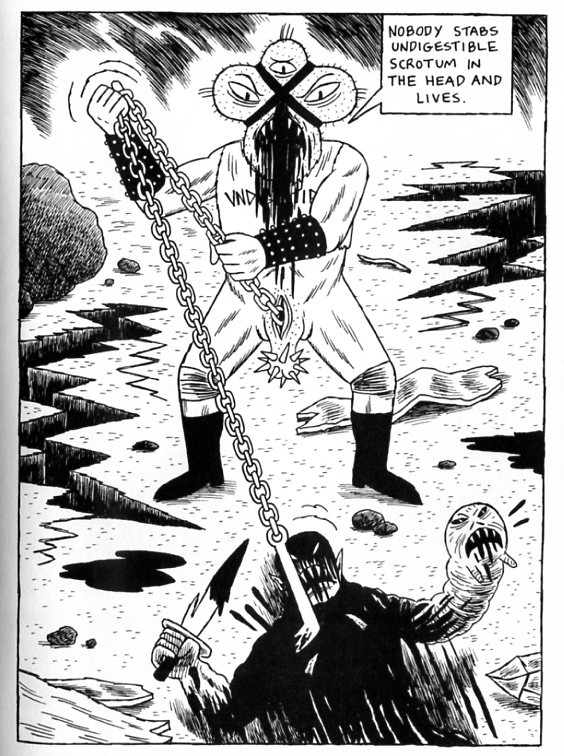
This sequence, while vivid, isn’t anomalous. Bodies in Prison Pit are always gloriously messy, both in the sense of excreting-bodily-fluids-and-coming-apart-in-hideous-ways and in the sense that they are gratuitously indeterminately gendered. Thus, the three-eyed monster named Indigestible Scrotum sports not only his(?) titular spiky scrotum, but also what appears to be a vagina dentata (or whatever you’d call that.)


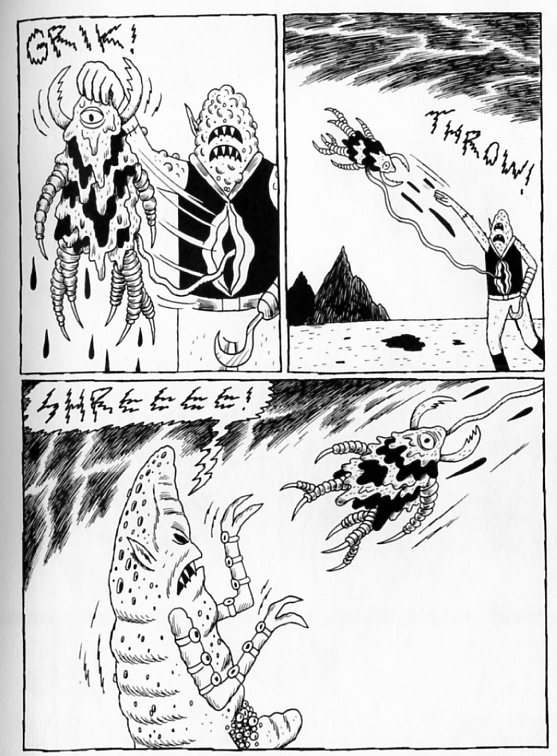
As this suggests, in Prison Pit, sexual organs are less markers of gender than potential offensive weaponry, whether you’re hurling monstrous abortions from your stomach cunt:


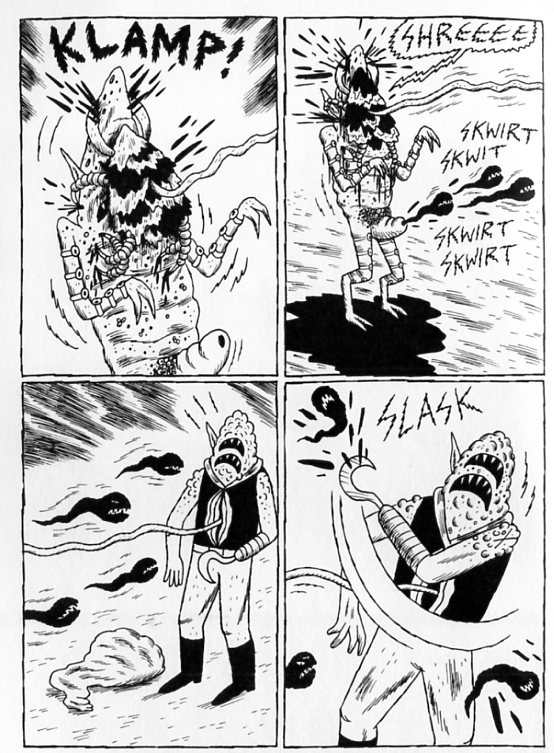
Or blasting monstrous sperm from your sperm-shooter


You could argue that turning sex to violence like this is just another manifestation of a denial of vulnerability, I guess…but, I mean, look at those images. Do those creatures look invulnerable? Or do they look like they’re insides and outsides are always already on the verge of switching places?


This is, perhaps, Marlowe’s hyperbolic anxiety come to life; sex as body-rot and degeneration; desire as a quick, brutal slide into chaos.

It’s telling, I think, that the one actual act of sex in the first four volumes is a multi-level rape. The protagonist has his body taken over by the slurge — that repulsive creature attached where his left arm used to be. The slurg-controlled body is then kidnapped by another (male? genderless? neuter?) antagonist, who fits him (it?) with a mind-control computer helmet and cyborg penis.


The mind-raped protagonist is then commanded to rape the Ladydactyl, a kind of monstrous feminine flying Pterodactyl.


The robot-on-atavistic-horror intercourse produces a giant sky cancer which tears the Ladydactyl apart. The protagonist finally regains his own brain, and declares, “That fucking sucked.” Which seems like a reasonable reaction. Rape here isn’t a way for man to exercise power over women. Rather for Ryan everybody, everywhere, is a sack of more or less constantly violated meat, to whom gender is epoxied (literally, in this sequence) as a means of more fully realizing the work of degradation.

In Prison Pit, Marlowe’s signal virtues of honor and continence are impossible. And, as a result, Marlowe’s signal failings — fear of bodies, fear of losing control, misogyny, homophobia — rise up and vomit bloody feces on themselves. Whether this underlines Chandler’s ethics or refutes them is perhaps an open question. But in any case, it’s enjoyable to imagine Philip Marlowe dropped into Ryan’s world, his private dick torn out by the roots to expose, quite publicly, the raw, red, gaping, and ambiguously gendered wound.

Love and Wildness

 
This first appeared on Splice Today.
___________________

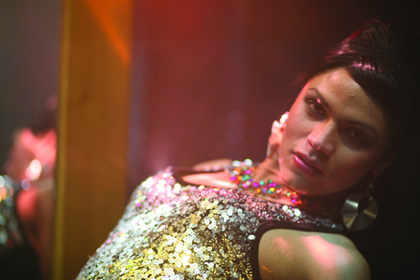
One of the most painful sequences in Wu Tsang’s documentary Wildness occurs at what, in other contexts, might be considered Tsang’s moment of greatest success.   The film is about Tsang’s connection with The Silver Platter, a bar that has catered to immigrant Hispanic MTF trans women for decades.  Tsang and several of his hipster queer art friends fall in love with the bar, and start to host a dance-party/performance series on Tuesday’s called “Wildness”.  The weekly event takes off, garnering press and citywide attention for the bar.   This culminated in a selection for “Best Tranny Bar” by the LA Weekly, in which journalist Sam Slovick crammed every invidious stereotype of trans women he could come up with into a couple of paragraphs.  He presented the bar’s patrons as sexually aggressive down-and-out streetwalkers, and the bar as a seamy site of titillation for jaded mainstream straights.

Tsang had tried to block the story even before he knew what was in it.  When it appeared, the “Wildness” crowd was horrified, and their protest campaign led the writer to a heartfelt apology.

But despite this unexpectedly positive resolution, the incident reverberates uneasily through Tsang’s film.  Slovick’s sexualized transexuals are a vicious stereotype…but, as stereotypes, they are also an echo of the way that Tsang treats the bar’s longtime patrons in his own film.  Tsang gives The Silver Platter its own narrative speaking voice in the documentary, which, he has said is intended to emphasize the story’s fictionality and subjectivity.  Perhaps it does that. But the way in which The Silver Platter speaks declaratively and omnisciently in Spanish (“How can I explain my legacy?  I’m a beacon guiding my young”) tends to make the bar, not a fiction, but a kind of totemic truth. Slovick’s debased sexualized animals are not so much negated as mirrored in Tsang’s image of noble, magical, Hispanic trannies, providing a young acolyte access to authentic traditions and spirituality.

Tsang and his friends are aware of these problems, and they work honorably to try to mitigate them.  For example, they establish a free legal clinic next to the bar for trans people. But even this effort ends up ambiguously compromised.  After one of the Silver Platter’s owners unexpectedly dies, the bar’s title is contested, and Tsang involves the legal clinic in the resulting dispute.  In doing so, he alienates the family that had long run the Silver Platter.  He ruefully admits, “I fucked up” — a scene of self-criticism that recalls Sam Slovick’s similarly bitter apology.  Wildness itself shuts down, and as Tsang and the organizers move on to other projects, the clinic folds. Later, Tsang patches things up with the owners, and they ask him to come back…but the Wildness crew declines.  Tsang says vaguely that the moment has passed, which appears to mean in part that the art school kids have all moved on to better gigs.

It’s certainly easy to see this as a story of exploitation: middle-class art school kids batten on a marginalized community, use said marginalized community as a launching pad for their own interests and careers, and then move on.  But things are a bit more complicated than that, I think.  In the first place, as I’ve mentioned, Tsang and many of his friends are themselves queer.  Tsang himself in interviews has said he identifies as “transfeminine” and “transguy.”  The bar’s longstanding commitment to helping, promoting, and embracing, trans people is, then, also a commitment to him.  The community is his community — which is in part because he’s made it his, but also because it has made him its.

In a telling scene, one of Tsang’s Wildness co-organizers acknowledges the danger that Wildness might threaten the safety of  the Silver Platter’s regular customers, but argues that it would be condescending to see himself as protecting a community that is welcoming them “with open arms.”  “Who am I supposed to protect them from?” he asks.  “Am I supposed to be protecting them from myself?”

The answer, of course, is yes…and no.  The queer hipsters do put The Silver Platter at risk in various ways, and they are surely obligated to be aware of that and try to minimize it as they can.  But, at the same time, relationships are about making yourself vulnerable.  It might be more useful to think of the link between Wildness and the Silver Platter not as exploitation or initiation, but as bittersweet romance.  Not always safe, not always entirely equal, not always even happy, but touched, like the film, with exhilaration and with love.

This Is Your Brain on Dystopia

This first appeared in The Comics Journal.
________________

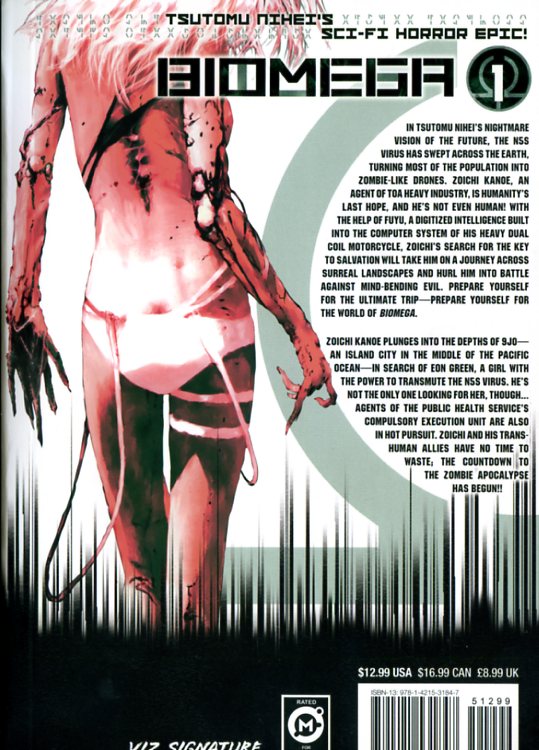
Biomega #1; Tsutomo Nihei; Viz; 220 pp., $12.99; B&W, Softcover; ISBN: 1-4215-3184-4 & Ikigami #4; Motoro Mase; Viz; 240 pp., $12,99; B&W, Softcover; ISBN: 978-1421526812

Futurist apocalyptic dystopic manga! Guns! Out-of-control state power! Evil vaccinations! Morally torn government functionaries! Artificial humans! Intelligent bears! Homicidal schoolteachers! Doesn’t that get the blood pumping?!

Maybe?

Biomega #1 — There’s a guy on a motorcycle and he works for a giant industrial conglomerate, which is good because they can make artificial humans just like him to fight the zombie apocalypse put in place by the evil government agency. You could read nutty John Bircher politics into that if you wanted, but luckily the aforementioned zombie virus has actually settled in and eaten this manga’s brain, so if there was an evil John Bircher about, he/she is now dribbling brain bits out of his dislocated jaw, making a huge-disgusting mess on the inside of his white hood, thank you very much — and ew. Hey, shoot him in the face why don’t you? That’s what we’re here to see. Also — we’ve got a zombie orbiting earth! That’s a new twist, huh? Look at the pretty apocalyptic art showing nothing of any particular consequence. I especially appreciate the sexy zombie ass-crack on the back cover, because apparently part of having your brain eaten when you’re a zombie and a hot woman is that you cease being able to pull your underwear up all the way.


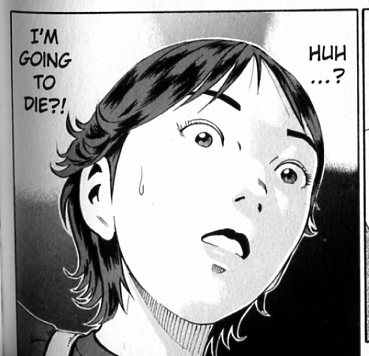
Ikigami #4 — So that was nonsense John Bircher paranoia; this is serious John Bircher paranoia. The future is not artificial humans killing zombies; it’s the evil government engaged in a vaccination conspiracy, so that one out of every 999 citizens die when they’re 25. Or is it that one out of every 25 citizens die when they’re 999? Anyway, they get 24-hours notice that they’re going to fall over so they can seize the day like Robin Williams … and hey, by coincidence, one of the guys who kicks it in this volume is a conscientious schoolteacher. For a moment there I thought we were going to get a moral about how educators suck and should all be killed, which I would support — but no, the teacher remains compassionate and caring even when he turns into a homicidal loony, and the double-twist ironic moral is that I really do believe that children are our future, teach them well, and let them lead the way. Let them show all the beauty they possess inside, already. Then the next one who gets it is a young mother whose husband cares too much about cars. But he gives up the car when he realizes his wife is going to die. It’s all about learning life-lessons while looking at soulful adequately drawn cartoony close-ups. Eventually I suppose the government functionary who tells people they are going to die will question the morality of his actions, thereby receiving a higher and higher percentage of the book’s aforementioned soulful close-ups. This is good, because soulful close-ups help you grow as a person.


I learned so much from these manga. Things like, “don’t trust the government.” “Melodrama must have recognizable characters, but straight action is drawn better.” And, most importantly, “The Japanese, too, are capable of derivative, fifth-drawer, dystopic science-fiction.” It really is a small world, after all.