Stab, Rinse, Repeat: The Pain and Pleasure of Slasher Movie Sequels

 
Is any other kind of movie as disposable as the slasher sequel? The Roman numerals at the end of their names even code them as factory product, fresh off the assembly line. They tend to be about 90 minutes long, rigidly formulaic, and instantly forgettable. With only a handful of exceptions, their (mostly young, mostly white) casts are interchangeable, and the same goes for their screenplays—“derivative” may be too gentle a word. Yet, thanks to a terminal case of morbid curiosity, I’ve watched dozens of ’em. Devoured ’em like popcorn. They’re not especially gratifying as art or entertainment; in fact, most are hacky, dull, and repetitive. But if you want to see how filmmakers wrestle with restrictive blueprints, low budgets, and fickle audiences… well, these movies have their pleasures.

The Friday the 13th movies, for example, are like Ozu dramas or Mondrian Compositions, these subtle variations on a theme. In this case, that theme is “Jason Voorhees kills everyone,” and part of each sequel’s pleasure lies in identifying those variations. How do you tell the same story over and over again without boring your audience? You tell it in 3D (Friday the 13th: Part III) and constantly thrust pitchforks and harpoon guns at the camera. Or you put it on a boat (Part VIII). Or you put it in outer space (Jason X). Honestly, the Friday the 13th movies could be titled like Friends episodes: The One Where He Has a Bag on His Head, The One Where Corey Feldman Kills Him, The One Where He Fights Carrie, etc., etc. Beyond these cosmetic differences, the films are near-identical, both in terms of plot structure and quality. (The latter metric staying at “not very high” for the duration of the series.)

Taken together, these films constitute a 19-hour saga as rhythmic and ritualized as its ki-ki-ki ma-ma-ma leitmotif. And taking them together, I just have to marvel at their collective contempt for spatial and narrative coherence, not to mention their shameless acts of self-cannibalism. Cat scares, roadside kills, disemboweled swimmers, bodies flung through windows: this is eternal recurrence localized entirely within rural New Jersey. On an individual level, however, each Friday the 13th entry instills a numbing sense of deja vu. My favorites are the most idiosyncratic ones: A New Beginning and Jason Goes to Hell, parts five and nine respectively. The former opens with a Fulci-esque graveyard scene, often gets distracted by the bizarre lives of its secondary characters, and has a twist ending Scooby-Doo would spit on. Jason Goes to Hell, the only Friday the 13th movie of the ’90s, is nothing but twists, retcons, and non sequiturs; it’s certainly not “good,” but at least it’s delirious.

Maybe it’s silly to prize delirium in a subgenre notorious for its homogeneity, but I get so tickled by slasher sequels that indulge in a little weirdness or, heaven forbid, warmth. Like the Nightmare on Elm Street movies, where reality is slippery and death is just a few seconds of shut-eye away. The series itself gets bad quickly, but its gory set pieces stay evocative: teenagers are fused with their motorcycles, reduced to pizza toppings, pulled into video games they can’t win, turned into comic book characters and then sliced to ribbons. It’s “high school sucks and parents don’t understand” blown up to tremendous, gory size. The only way out of this teenage nightmare? Solidarity. Indeed, the Nightmare movies are consistently the most teamwork-oriented of slashers, a refreshing shift from seeing kids picked off one by one until only the “final girl” survives. (This is that “warmth” I spoke of.) In the third and best Nightmare, subtitled Dream Warriors, a little sentimentality even blossoms up through the film’s blood-soaked carapace. This is no mere slasher movie; it’s a Reagan-era blend of afterschool special, action movie, and charnel house.

Of course, I’d be remiss to discuss the slasher cycle without a mention of Halloween’s myriad sequels. But I hesitate, because I kinda pity the series. Less consistent than the Friday the 13ths, less phantasmagorical than the Nightmares, the Michael Myers movies also have the misfortune of following John Carpenter’s original—the model for lean, low-budget horror. If this built-in redundancy sullies even the high-tension Halloween II, then heaven help something like The Curse of Michael Myers, which turns up four sequels later and stars a young Paul Rudd. At that point, the series still has its two mainstays—killing machine Michael and his personal Van Helsing, Dr. Loomis—but has long since squandered any momentum and is trudging through a morass of mythology. (Mythology that, like a sand castle at high tide, will be wiped away by Halloween H20.) Hence the pity: Halloween’s sequels exhibit glimmers of quality, but always retreat back into slasher tradition. As a result, they never carve out any unified identity beyond that deadpan William Shatner mask.

My favorite among the sequels, however, lacks even that. It’s the sui generis Halloween III: Season of the Witch, a conspiracy thriller that replaces Michael with the sinister Silver Shamrock mask company. Whereas Michael killed Haddonfield residents one by one, Silver Shamrock’s Samhain-loving CEO plots to kill all of America’s children in one fell swoop. It’s grim, yes, but laced with satire and as oddball as slasher sequels come. You couldn’t ask for a movie that undercuts viewer expectations more severely. Outside of Season of the Witch, the Halloween moment I treasure the most is the opening scene of #5, The Revenge of Michael Myers. Michael, we learn, has been hibernating ever since his last fake-out death a year earlier. Hibernating in a shack, that is, where he’s nursed by hermit. Once October 31st rolls around, he bolts up, kills the hermit, and walks back to Haddonfield. “Narrative logic?” laughs Halloween 5. “Fie!” Again, this may not be a “good” movie, but those first few minutes would leave even Luis Buñuel scratching his head.

The lesson here? Shoddy screenwriting can be a virtue as long as it makes a slasher movie stand out. Now that I’ve watched dozens of ’em, most of these movies have coalesced into a blur of knives and blood swirling in my head. I feel like I’m running in circles just trying to write about them. So anything memorable at all automatically becomes a strength. (Indelible performances, traces of visual style, and zippy pacing help too.) All of this explains why two franchises, Phantasm and Child’s Play, sop up most of my slasher love. Each has its dud entries, but both are unusually auteur-driven and blessed with spirited villains. Strip away their more macabre elements, and the Phantasm movies are a serialized Boys’ Own adventure; a Manichaean clash set against the desolate Pacific Northwest. There, evil is endemic… but still our heroes resist it, empowered by camaraderie and a sense of humor. The Phantasm movies envision a tiny light in the midst of vast darkness, making them a radical departure from their morally murky slasher brethren.

The Child’s Play movies, on the other hand, start out as conventional slashers. Their killer doll kills, is killed, and then lies dormant until the next sequel. The first three films lean heavily on two assets: 1) the fact that talking dolls are terrifying and 2) Brad Dourif’s bile-spitting vocal work as Chucky. But from there the series metamorphosed, culminating in the beautiful butterfly that is Seed of Chucky. The aggressively postmodern Seed doesn’t merely swallow its own tail—it gobbles it down in big, lusty bites. It turns slasher tropes inside out; it wallows in the a priori absurdity of a killer doll. Hell, it stages a full-scale 1950s melodrama in Jennifer Tilly’s attic. The movie’s vulgar, certainly, and its comedy is erratic, but it has chutzpah. How else could it so brazenly juxtapose old and new, revolution and tradition, pathos and cartoonish gore? As Seed of Chucky demonstrates, the “slasher movie” is only a template, a set of structuring ideas that tends to limit filmmakers’ imaginations but, on rare occasions, can also serve as a springboard for them. It’s a story syntax, a tool, and a resilient one at that; few others have been dissected and deconstructed so thoroughly yet lived to tell the tale. And, for better or worse, I suspect the slasher movie will always keep on rising from the dead.

Sequence Without Origin

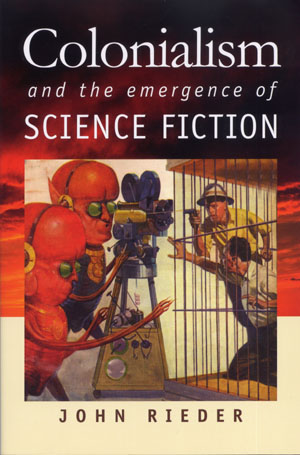
I’ve been reading John Rieder’s excellent book Colonialism and the Emergence of Science Fiction. There’s lots of fun discussion about nightmare invasion scenarios, lost worlds, time travel, constructed humans, and how imperialists love being imperialists, satirize being imperialists, and more or less constantly freak out about the possibility of being imperialized.


So maybe I’ll talk about all that at some point. In the meantime, though, Rieder also has some really interesting thoughts on genre. Specifically, he argues that a genre is best understood not through a strict formal definition, but rather as a group of texts that bear a “family resemblance.” The term is from Wittgenstein, and Rieder quotes a further explication by scholar Paul Kinkaid:

science fiction is not one thing. Rather, it is any number of things — a future setting, a marvelous device, an ideal society, an alien creature, a twist in time, an interstellar journey, a satirical perspective, a particular approach to the matter of story, whatever we are looking for when we look for science fiction, her more overt, here more subtle — which are braided together in an endless variety of combinations.”

Science-fiction is then a “web of resemblances.”

If sci-fi is a web of resemblances though, that has some surprising implications. Specifically, if the genre is the web, it can’t exist before the web. There can’t be a point of origin, because a point isn’t a web. For there to be family resemblances there has to be a family. Or as Rieder puts it:

The idea that a genre consists of a web of resemblances established by repetition across a large number of texts, and therefore that the emergence of science fiction involves a series of incremental effects that shake up and gradually, cumulatively, reconfigure the system of genres operating in the literary field of production, precludes the notion of science fiction’s ‘miraculous birth’ in a master text like Frankenstein or The Time Machine. A masterpiece might encapsulate an essence, if science fiction had one, and it certainly can epitomize motifs and strategies; but only intertextual repetition can accumulate into a family of resemblances.

This has some obvious implications for the much-bruted question, What Is a Comic? Like science fiction, definitions of comics (most notably Scott McCloud’s) generally focus on formal elements — a sequence of images, in McCloud’s case. As a result, McCloud includes in his definition things like hieroglyphs, while excluding single panel cartoons.

However, if comics are seen as a web of resemblances, then the effort to look for origins or predecessors or even formal tropes starts to look misguided. Instead, it’s more useful to focus on the center — on what things are accepted as comics, as I put it in a post some time back. Comics are not a formal template; they’re a genre that has taken shape since around the early twentieth century, and which can have, like science-fiction, any number of hallmarks — including (for example) sequences of images, superheroes, cartoony art, funny animals, autobiographical storylines, humor, adventure, serialized formats, word bubbles, panel borders….etc.

No doubt some comics folks flinched up there when I called comics a “genre”. And that does bring up a possible objection. Isn’t it wrong to think of comics as a genre, like science fiction? Shouldn’t they instead be compared to a medium, like prose or art or music? And if so, how useful is Rieder’s discussion of genre? Yes, genres may be webs of relations. But aren’t mediums defined formally? Art is always art; writing is always writing — shouldn’t, then, comics always be comics, whether created by the ancient Egyptians or on the internets?

I think the answer to those question is no, still pretty useful, not really and not really. Rieder does couch his formulation in terms of genre. But it works so well for comics that I think it forces you to either decide comics are a genre, or else to decide that the difference between medium and genre isn’t as great as it tends to seem. Egyptian hieroglyphs, after all, can either be writing, art, or comics, depending on which web of relationship you want to emphasize — and once you start thinking about webs of relationships, it’s in fact pretty clear that they aren’t that closely related to any current medium. Similarly, is a novel a genre? Is it a medium? It depends on how you look at it, surely — meaning, specifically, how you look at the web of relations of which it’s a part, and how those relationships are embedded in time and culture.

Comics straddles the line between genre and medium for various reasons — mostly having to do with the fact that (for reasons of commerce and credibility) it still hasn’t consolidated its cultural position the way science fiction has (as genre) or the way film has (as medium.) It’s betwixt and between, which makes the task of definition somewhat fraught and conflicted. But surely Rieder’s discussion leads to the conclusion that drawing these lines is always fraught and conflicted. A generic designation isn’t about dispassionately fitting a model, but about the more emotional task of finding and claiming one’s relations. The downside is that comics, as an origin and a form, doesn’t really exist; the upside, though, is that that leaves so many possibilities open for what comics can be.

Sing Me a Cartoon

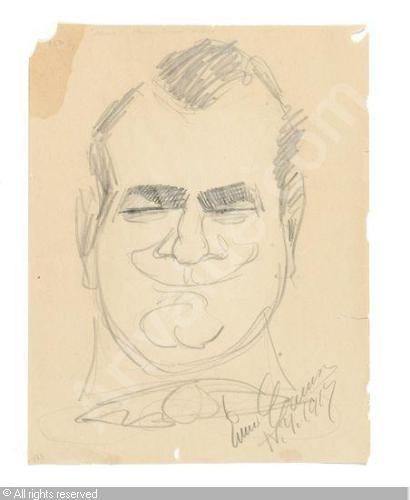
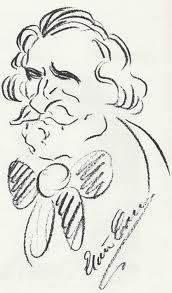
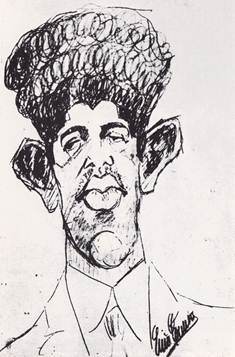
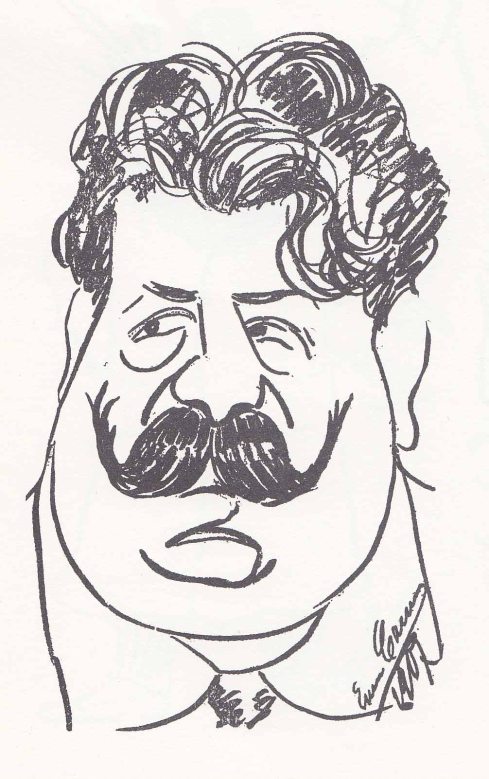
Enrico Caruso (1873–1921) was one of the most celebrated opera tenors in history. He was also a deft and witty caricaturist — not least of himself, as shown below:

Caruso was prolific and generous with his cartoons, often including them in letters to his fans. They show a wide variety of line styles, from delicate to bold.


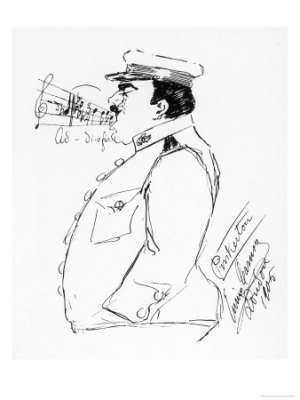
Many of them depict him in costume for one of his roles. Below, Caruso as Lieutenant Pinkerton in Puccini’s Madame Butterfly, which he sang in 1906:

As Federico Loewe in Franchetti‘s Germania:

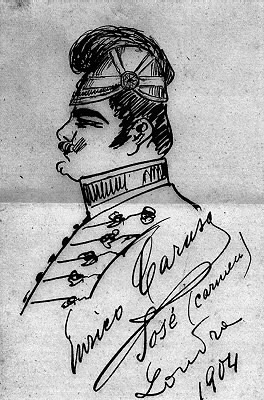
As Don José in Bizet‘s Carmen:


He also caricatured other luminaries of the music world. Giuseppe Verdi:

The Mexican tenor José Mojica:

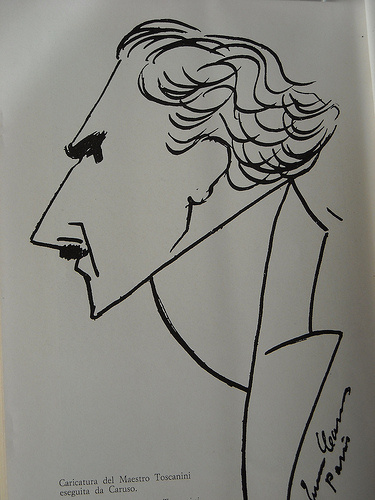
The conductor Arturo Toscanini, an important figure in Caruso’s life; it was in his 1900 production of Puccini’s La Boheme at the Scala in Milan that Caruso achieved stardom:

The soprano Amelita Galli-Curci, who co-starred with Caruso in Rigoletto:


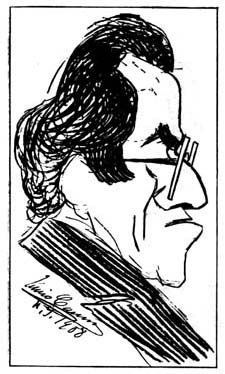
The composer and conductor Gustav Mahler, who was the director of New York’s Metropolitan Opera House when Caruso was engaged there; this portrait was drawn for The Musical Courier magazine.

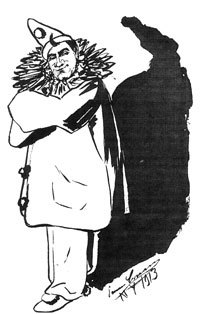
The composer Leoncavallo, author of I Pagliacci:

Caruso in the role of the clown Canio in I Pagliacci; Caruso’s recording of the opera’s song Vesti la Giubba (“On with the Motley”) was the first record to sell over a million copies:

A recording of Vesti la giubba may be found here.

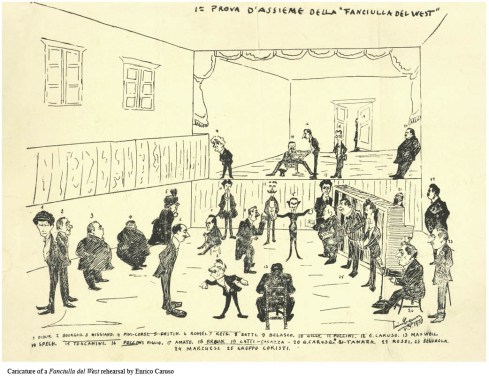
Below is a rare group drawing, depicting the rehearsal for Puccini’s La Fanciulla del West (“The Girl of the Golden West”), for which Caruso created the role of Dick Johnson in 1910:

Click on image to enlarge

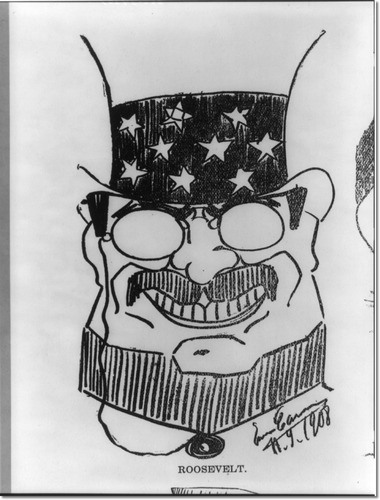
Caruso didn’t confine himself to music-realated subjects; here is his rendering of U.S. President Theodore Roosevelt, with whom he was acquainted:

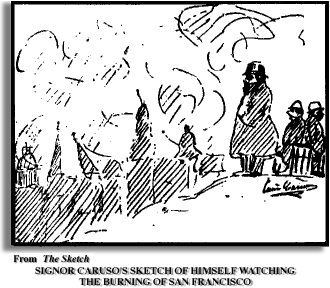
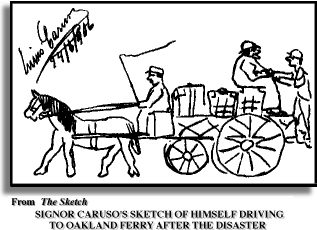
Roosevelt served the superstitious Caruso as a good-luck charm on a day of disaster.

In 1906, Caruso was performing Carmen in San Francisco when the great earthquake and fire destroyed the city. Caruso was found walking the streets, disoriented and weeping, clutching a signed photograph of the President to his chest. He ran into the actor John Barrymore, fresh from a brothel, who persuaded the tenor to sing to calm the panicked crowds.

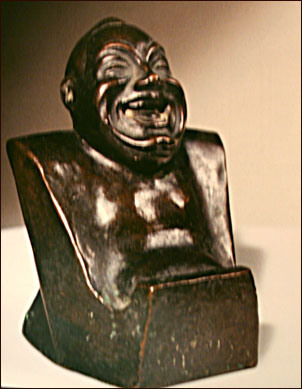
Caruso’s talent for caricature extended to sculpture, as seen in this bust of himself as a ‘laughing Buddha’, which he presented to Toscanini:

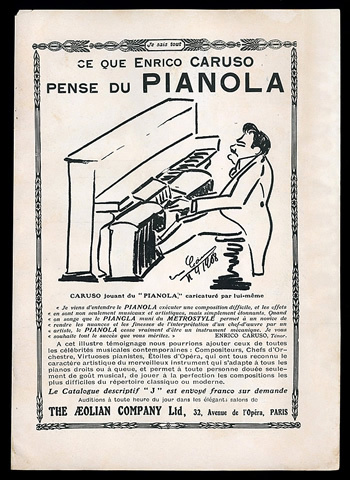
He was not above using his fame to swing lucrative endorsement deals, as we can see from the following advertisement for Pianola– illustrated by the singer:

But he also donated his talents for good causes: below, Caruso mans a quick-sketch booth for charity, drawing Mrs Albert Gallatin.

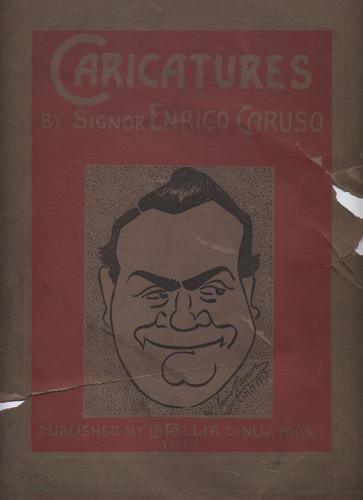
He published several books of his caricatures and cartoons; this one dates from 1914. I like the cover drawing below best of all his self-portraits:

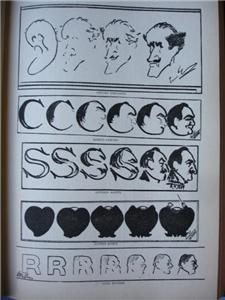
These ‘transformation’ drawings show a delightful playfulness:

Enrico Caruso’s cartoons all evince a spirit of light mockery without a hint of meanness; seeing them, I can believe that the great tenor would have made excellent company!

Frankenstein Babymen

“From the very first, children are at one in thinking that babies must be born through the bowel; they must make their appearance like lumps of faeces.” That’s Freud from his Introductory Lectures. I found the quote in an essay by John Rieder called ” Frankenstein’s Dream Patriarchal Fantasy and the Fecal Child in Mary Shelley’s Frankenstein and its Adaptations”. Like the title says, Rieder’s essay argues that the Frankenstein monster can be seen as a fecal child — literally, a piece of crap. Mary Shelley’s book is an elaboration and/or a critique of a patriarchal fantasy in which men dispense with women, creating fragrant, mottled life from their own blessedly demonic bowels.

Frankenstein doesn’t much like his shit baby — but that’s just another sign that he’s a weirdo. Most kids — boys and girls — like their poop. Or as Rieder explains:

When Jehovah looks at his handiwork he sees that it is good, and Freud tells us that children at the stage of development in question are far from feeling disgust at their own feces. On the contrary, they take pleasure in manipulating them and are apt to express pride and affection for these “children.”

Rieder goes on to suggest that it is normal for adults to express disgust at fecal creation — but is that really the case? Fecal children — those Frankenstein monsters — are, after all, readily analogized to that other marvel of sterile birth, artistic production. If Frankenstein’s monster is his poop, it is also his art — and who among us of whatever gender has not glowed proudly at our own glorious, smelly glob of suchness? Who has not grabbed friends and relations alike, hauled them to the glowing receptacle, lifted the lid and declaimed with pride, “Look what came out of me!”

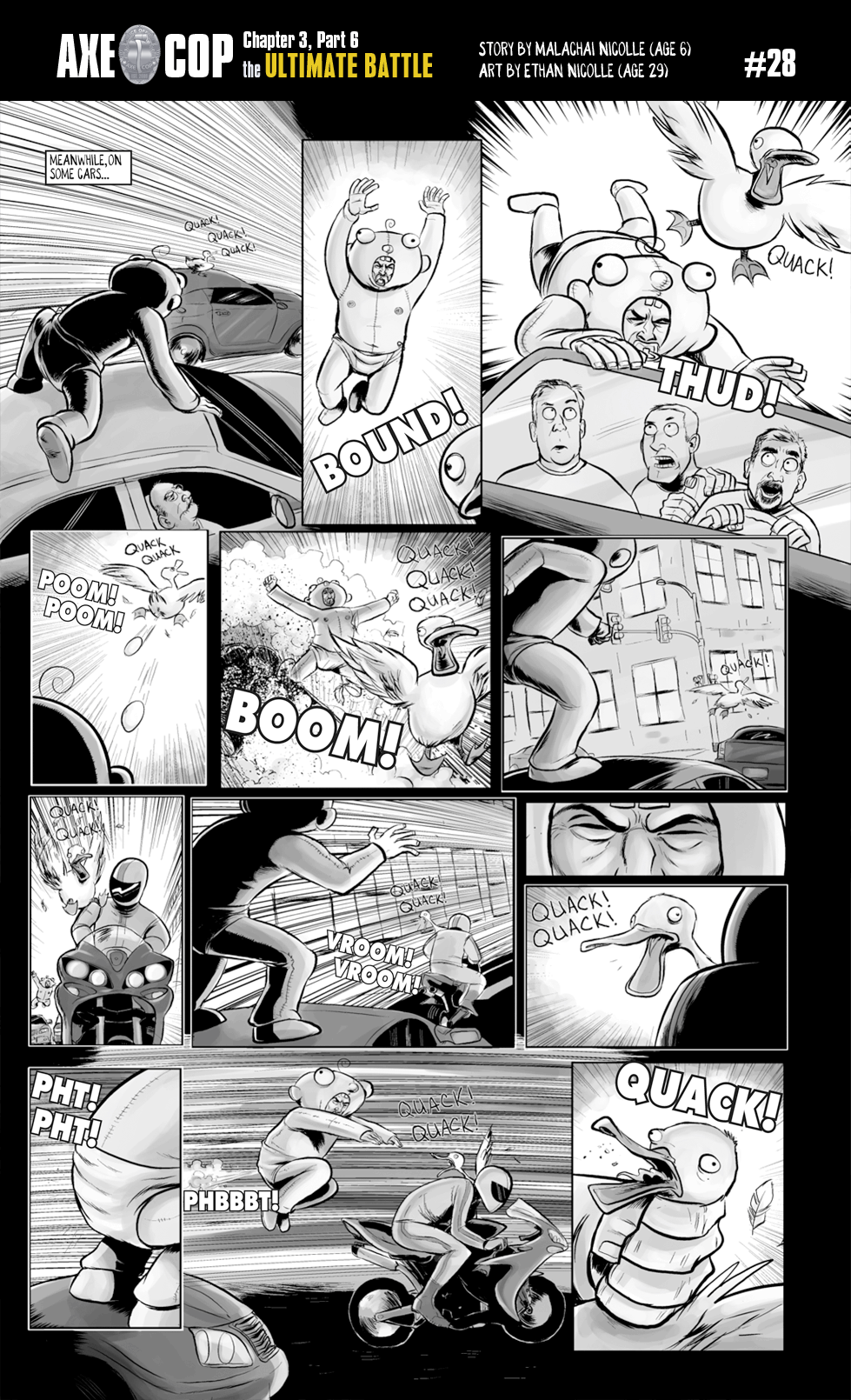
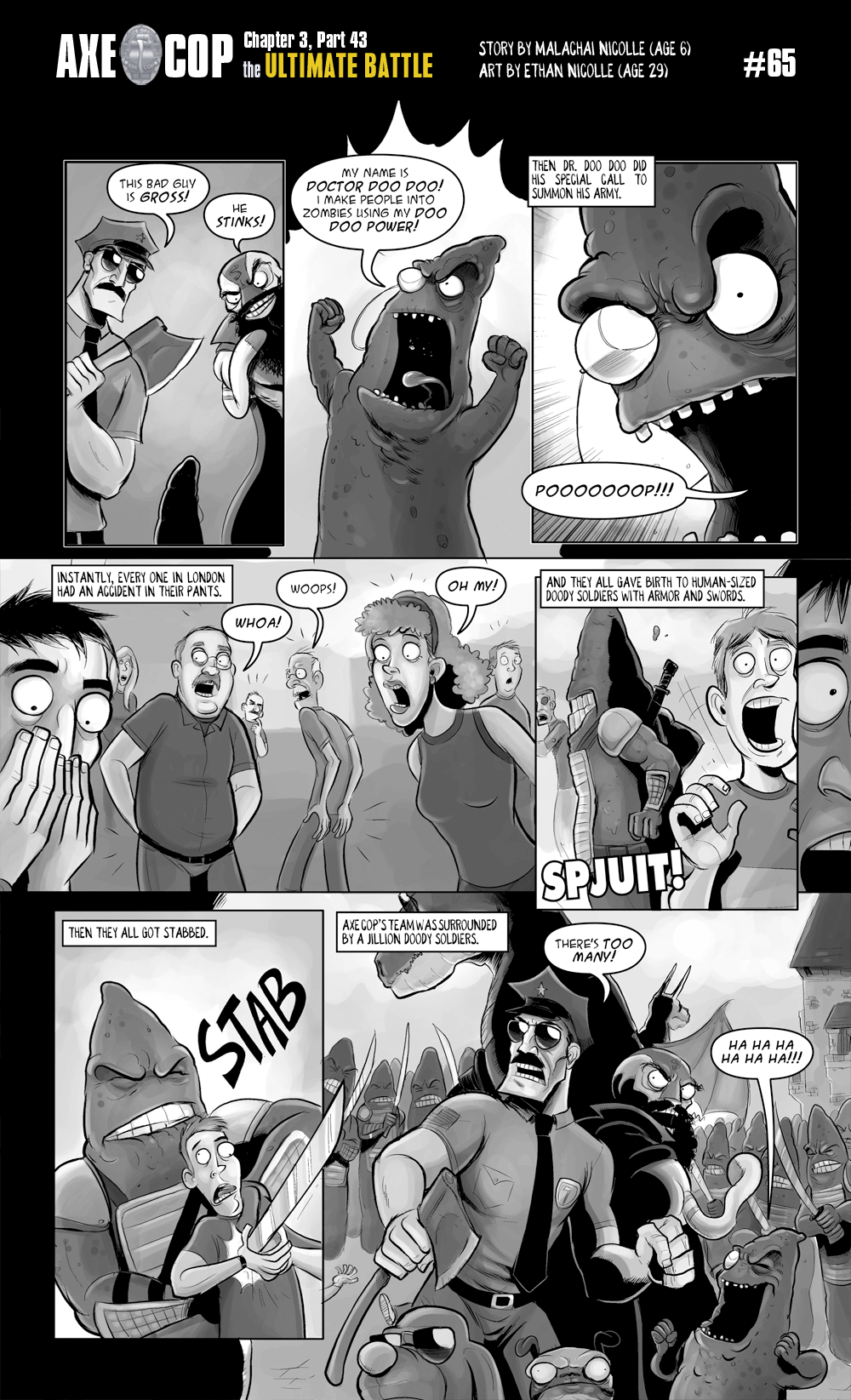
If you are looking for gratuitously giddy anal celebration, you cannot possibly do more gratuitous nor more giddy than the amazing Axe Cop adventure, “The Ultimate Battle,” reprinted in the first Axe Cop trade. Axe Cop is a web comic phenomena drawn by artist Ethan Nicolle and written by his (then) 5-year-old brother, Malachai (or Micah.) Like most kids, Micah is a lot less chary of indulging his fecal obsessions than his adult peers, and “The Ultimate Battle” could not be much more frank in its fascination with what comes out of our bottoms. One of the comics best set-pieces involves Babyman (and yes, that’s a grown man dressed in a baby outfit), who flies by passing gas, chasing a duck which shoots exploding eggs out of its rear.


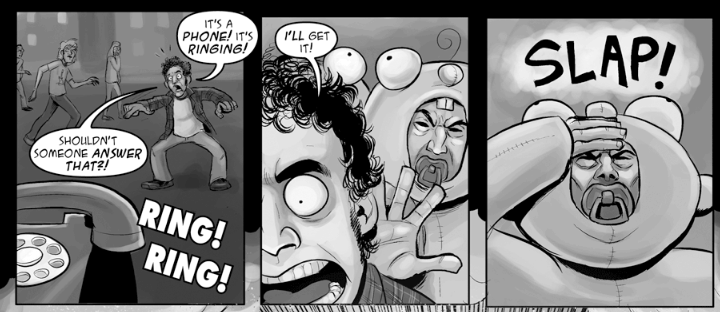
Later, Babyman and a young similarly dressed ally (Babyman Jr.?) chase a giant monster made of sentient candy who excretes tiny cars which grow into big cars and then when people try to drive away with them they explode. And, finally, a whole team of Babymen chase a giant egg with feet which poops out phones that ring and then people answer them and…well, you can probably figure out what happens next.


But if you think grown men dressed as babies dodging exploding poop is some bizarre Oedipal scatology…well, you ain’t seen nothing yet. The climax of the story involves the evil Dr. Doo Doo, a giant sentient piece of poop with a gaping mouth and a monocle. When he shouts “Poooooooh!” Micah says, “instantly everyone in London has an accident in their pants.”


The turds they poop turn into evil human-sized turds armed with swords, each of which quickly murders its progenitor, setting the stage for an ultimate battle between superheroes, ninja moon warriors, and good-guy zombies on the one hand and evil sentient poop on the other.

Obviously, an ultimate battle between superheroes, ninjas, zombies and poop stands on its own merits. But the diabolically summoned/involuntarily produced sentient turds which kill their father-mothers and take their places also works as a nice analog for Micah’s own precocious, volcanically natural artifice, which revels in conquering/befouling the world all the more joyously because he’s not even trying. Even Dr. Doo Doo’s poop command seems to mirror the collaboration between the brothers Ethan. Micah, says, “pooh!” and Ethan miraculously creates pooh by the buttload.
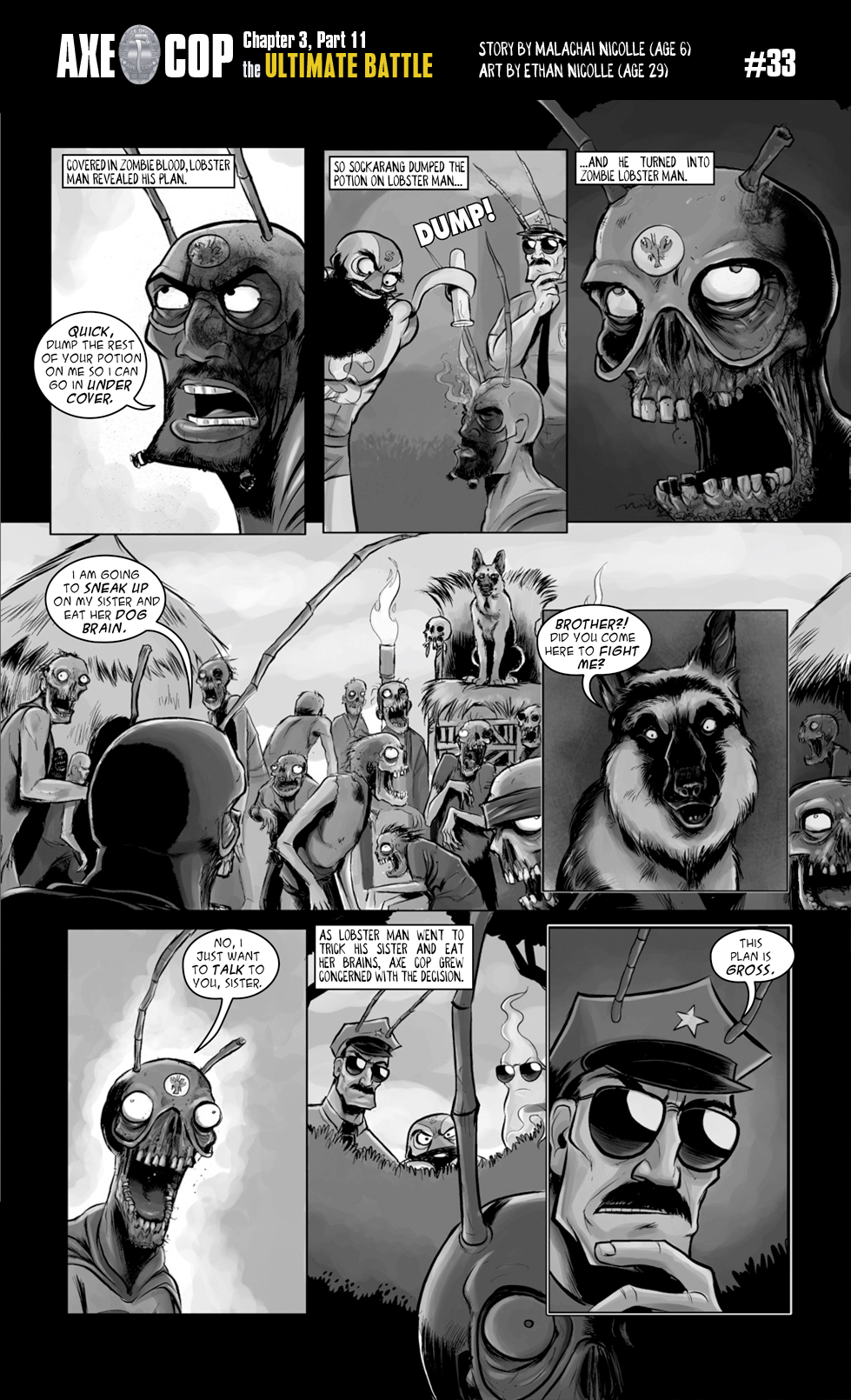
Not everything in Axe Cop is pooh-based — but everything does have that magical sense of being hauled out of the creators’ asses. People in Micah’s world are constantly transforming and morphing from good to bad or from dinosaurs to dragons or from unicorns to dinosaurs to dragons to cops or from weird hybrid thingees to other weird hybrid thingees. This trope reaches a quintessence of preposterousness in a sequence where Lobster Man (who we learn later used to be part dog) rubs his face in zombie blood so he can turn into a zombie. Then he gets his companions to dump good zombie potion on him so that he can go undercover with the zombies and eat his evil zombie sister’s dog brain.


In a world where creation is as easy as pooping, it makes sense that each self should excrete a new self like the phoenix springing newborn from its own bowels. Reality is a mushy mass to be formed and reformed, sculpted, smeared and flung in a gloriously manipulable mass.


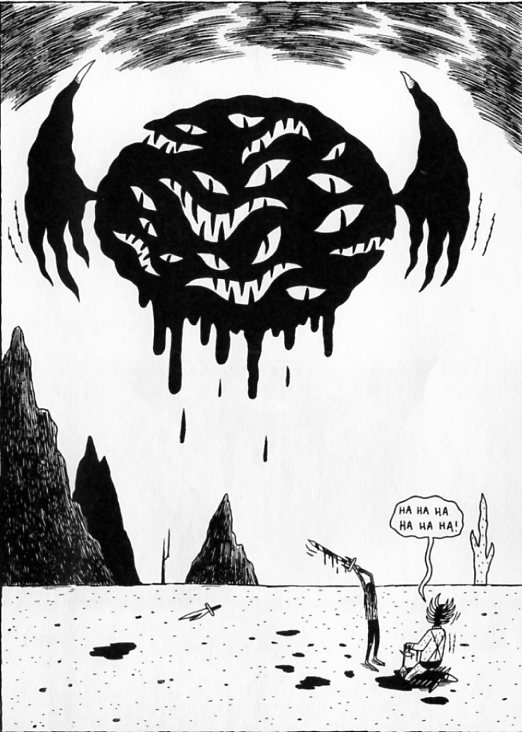
Which is why the artist that Micah reminds me most of is Johnny Ryan. Where Axe Cop’s drawing is cartoony and clean, though, Ryan (as the above image shows) embraces the messiness of his scatological obsessions, As I said in an earlier post:

In Prison Pit each body is a busted toilet whose stagnant water births some mangled abortion dragging its placenta over the edge of the porcelain to flop wetly on the cold tiles. Tentacles erupt from vaginas, vomit spews from sentient arms, and dripping things that should not be tear open their mothers in an orgy of violent polymorphous ichor. Black blood drips like ink off the mechanical penis of Ryan’s protagonist and then pools in scratchy pen lines, half-formed half-assed nightmares drawn on the back of a middle-schooler’s history notebook.


Aligning Johnny Ryan and Micah Nicolle complicates them both, I think. If Ryan is like Nicolle, then he’s not just a simple shock jock” — and if Nicolle is like Ryan, then he’s not, perhaps, quite as innocent as we like to imagine 5-year-olds as being. Frankenstein building that monster — like Mary Shelley writing that book — is both an exuberant wallowing in the glorious Godhead and an ugly stain upon the divine prerogative. If the creation of art makes us human, then we are our own foul progeny — monster Babymen sculpting monster Babymen, like diapered Frankensteins.

Spider-Dove

This first appeared on Comixology
______________

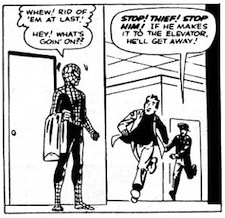
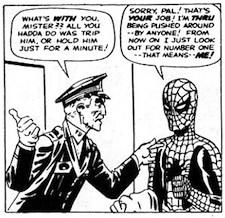
Spider-Man’s origin story, as most everybody knows, hinges on a moment of moral turpitude. In Amazing Fantasy #15 by Stan Lee and Steve Ditko, nerdy, put upon Peter Parker, having been bitten by that pesky radioactive spider, gains (dum ta da!) super powers, and starts a successful career as a professional wrestler. Basking in his newfound fame and bucks, Peter (in Spidey costume) is standing in some random corridor when he sees some random schmo fleeing from a cop. Cop yells to Peter to stop schmo, but Peter refuses ; schmo gets onto high-speed elevator and escapes.

The cop chews Peter out, “All you hadda do was trip him”! Peter, though, is unrepentant: “Sorry, Pal! That’s your job! I’m through being pushed around!” Peter walks off and then on the next page his uncle is murdered! And two pages later, Peter learns that the guy who shot his uncle is the same guy he allowed to escape! Oh, the irony! Peter has learned too late that “with great power there must also come — great responsibility!”

Anyway, back to that moment of moral turpitude. What exactly is Peter’s failure here? The cop says that Peter should have tripped the guy or stopped him somehow. He even threatens to arrest Peter for failing to help. But… arrest him for what? Do citizens really have a legal obligation to throw themselves in the way of fleeing criminals? Do cops even really want citizens to throw themselves in the way of fleeing criminals?

On the contrary, if you’re a cop chasing a perp, the last thing you want is for some civilian in goofy red tights to get in the way. What if the perp has a concealed weapon (and in this case, we know that the villain did have a gun by the next page)? What if the civilian tackles the perp and then gets shot? What if the civilian tackles the perp and somebody else gets shot? At the very, very least, from a police perspective, that’s an exponential increase in paperwork.

Of course, we know that Spidey could have taken down the baddy without anyone getting killed or even hurt. We know this in part because he’s got super powers. Mostly though, we know it because — Duh! — he’s a super-hero, or even just a hero. Heroes like Spider-man or Batman or Dirty Harry leap into action and save people. That’s what they do. And if they didn’t do that, there wouldn’t be much of a story, would there?

Indeed, Spiderman’s real sin here is not against morality or society, but against the tropes that keep the genre afloat. Super-heroes have to act. They’ve got to fight crime. If they don’t, you don’ t have a narrative. Super-heroes have “great responsibility,” but it’s always the responsibility to do something. You could conceivably have an origin story in which Wombat-Man decked a baddy, the gun went off, Cousin Joe got shot, and the hero decided “With great power comes great responsibility!” And so Wombat-Man decides never to mess with crime again, and instead uses his phenomenal digging powers solely to aid with infrastructure projects! Again, you could have such an origin – but what you’d end up with would not exactly be a super-hero comic.

In real life, of course, and as this suggests, the responsible, way to use your “great power” might conceivably in many circumstances be to sit on your ass and do nothing in particular. Certainly, if George W. Bush had done that in 2003, America and Iraq would both be a good bit better off today.

What I’m talking about here is essentially pacifism. Pacifism is about as massively discredited as a major philosophy can be. Pacifism is appeasement, or it’s treason, or, (more kindly) it’s a nice idea but not really practicable. You can’t just sit by and watch that guy escape, Spidey! Hit him! He’s got weapons of mass destruction!

I can’t say that I’m a pacifist myself, exactly. But I think that people can be way too quick to dismiss it, essentially because reality is rigged just like that Spidey origin story. For whatever reason, probably having to do with our reptile hind-brains and/or a steady consumption of revenge narratives, the negative consequences of inaction tend to seem to us infinitely more insupportable than the negative consequences of action. If we step aside and something bad happens, we say, “Oh no! I should have done more!” On the other hand, if you wade in and things get completely fucked up, you often feel like, “Well, at least I tried. And think how bad it would have been if we’d done nothing!”

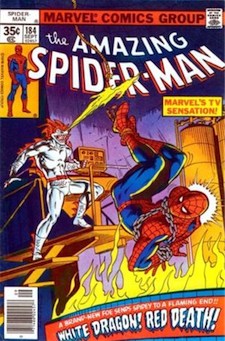
Which brings me to Amazing Spider-Man #184, published way back there in September 1978. My friendly neighborhood Internet tells me this was written by Marv Wolfman and drawn by Ross Andru. I must have read this when I was 8 or so; and I don’t think I even liked it all that much at the time. But I’ve remembered it all this time, in part because it is, rather bizarrely, one of the only super-hero comics I’ve ever seen that makes any effort to address either pacifism or the anti-pacifist assumptions at the core of super-hero comics. (The alternate-world Amish Superman in The Nail does not count. We will not speak of him again.)


Anyway, I haven’t seen ASM#184 in probably twenty years, but if memory (and a Web capsule summary) serves, the plot was a Bruce Lee rip off. Phil Chang is an awesome martial arts master, but he’s taken a vow of non-violence. Inevitably the evil Chinese gang wants him to join them. Their leader is the White Dragon, who is not only a martial artist extraordinaire, but also wears a white (natch) costume with a Chinese dragon style mask that looks staggeringly impractical, even by super-hero costume standards. Despite said mask, though, the Dragon is fully able to beat the tar out of the non-resisting Chang, and so he does – until Spidey comes to the rescue. Thank God someone is willing to fight, huh kiddies?!

That’s what you’d think the message would be anyway. In fact, though, Marv Wolfman’s script is surprisingly subtle. One exchange in particular has really stuck with me. I can’t quote exactly, alas, but to paraphrase, it went something like this:

Spidey: What in tarnation are you doing, anyway? The White Dragon is beating you to a pulp! He’s going to kill your family, you dope! Show me some of that kung-fu everyone’s been on about, won’t you? Are you a man or an amoeba? Come on, Phil! With great power comes great responsibility!

Phil: (and this I remember much better) There are failures in non-violence just as there are failures in violence.

I think that’s pretty profound. Yes, pacifism won’t necessarily solve all your problems. But then, fighting often doesn’t solve your problems either. Indeed, fighting can quite easily make things worse. You wouldn’t know that necessarily from reading super-hero comic books, of course — nor, perhaps, from public discourse in general. Which is why it might be worthwhile, sometimes, to remember that the power to right the world’s wrongs is given to neither man nor spider, and that we are all every bit as responsible for what we do as for what we don’t.
 

So what is pacifism? It is the uncompromising realization that we as humans are incapable of bringing about justice through violent retaliation. Hence, we relinquish all such acts to God in his sovereign and eschatological plan of judgment, justice, and mercy. Indeed, God have mercy on us.
—Mark Moore

Nice Guys, Finished

 
In his recent post on Audition, Bert Stabler points out that the film is essentially a rape-revenge genre story. And yet, something isn’t quite right. Normally, we should experience the humiliation (and the sadistic pleasure) of the rape first, and then experiencing the sadistic pleasure (and the humiliation) of the revenge. That is the the inevitable, brutal, giddy fulcrum of narrative works. Conflict/resolution; crime/justice; brutality/counter-brutality; rape-revenge. It is the engine of plot stripped down to a crude, pointed bone.

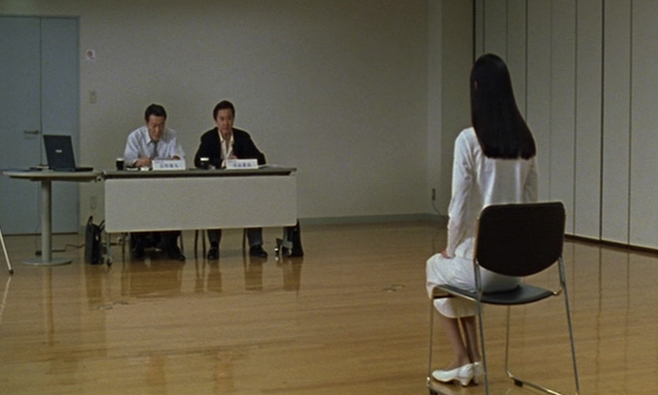
In Audition, as I said, this simple axis of event goes awry. The front half of the film is essentially a romantic-comedy buildup — evoking a different, and perhaps uncomfortably analogous narrative simplicity. Aoyama (Ryo Ishibashi) , a producer and widower devastated by the loss of his wife, decides, at the urging of his son, to find a girlfriend. A director friend offers to hold a false film audition so that Aoyama can pick/ask out the most appealing of the actresses. Aoyama chooses a striking young ballet dancer, Asami (Eihi Shiina), who reciprocates his interest.

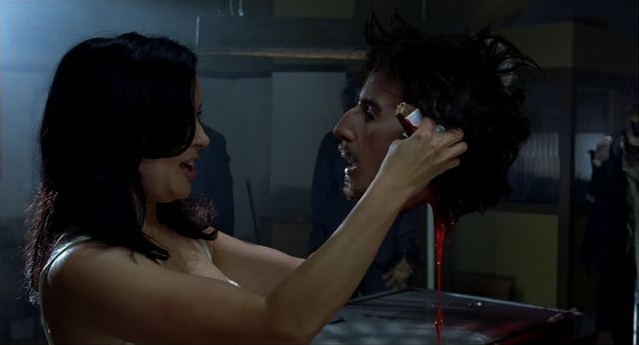
Only towards the film’s end does the rape start to coalesce, not as event but as disjointed image and memory. Our friendly middle-aged protagonist Aoyama learns (or imagines?) that his lover, Asami , was brutally tortured by her middle-aged dance instructor, and that she cut off his feet in revenge. Eventually, in what may be a dream, Asami cuts off Aoyama’s foot, linking him to her brutalizer. Essentially, rape and revenge occur simultaneously, or apparently simultaneously. The punishment calls forth the crime, or identifies the criminal. The narrative doesn’t drive the film so much as appear frozen and flickering at the end, a slowly strobing cascade of horror and violence playing ambiguously in the interstices of a supposedly more innocent life. Former audition and later exploitation merge; the film’s second half infects its first, and both intentionally implicate the director as manipulator of rape, revenge, and narrative. Indeed, with sequence broken, character starts to come apart as well, the filmmaker merges not just with Aoyama and his skeevy evaluation of female pulchritude, but with Asami and her gleeful vivisection. Scopophilia and sadism burst out of their narrative bonds to revel in frozen tableau — abjection freed from the facade of justice.

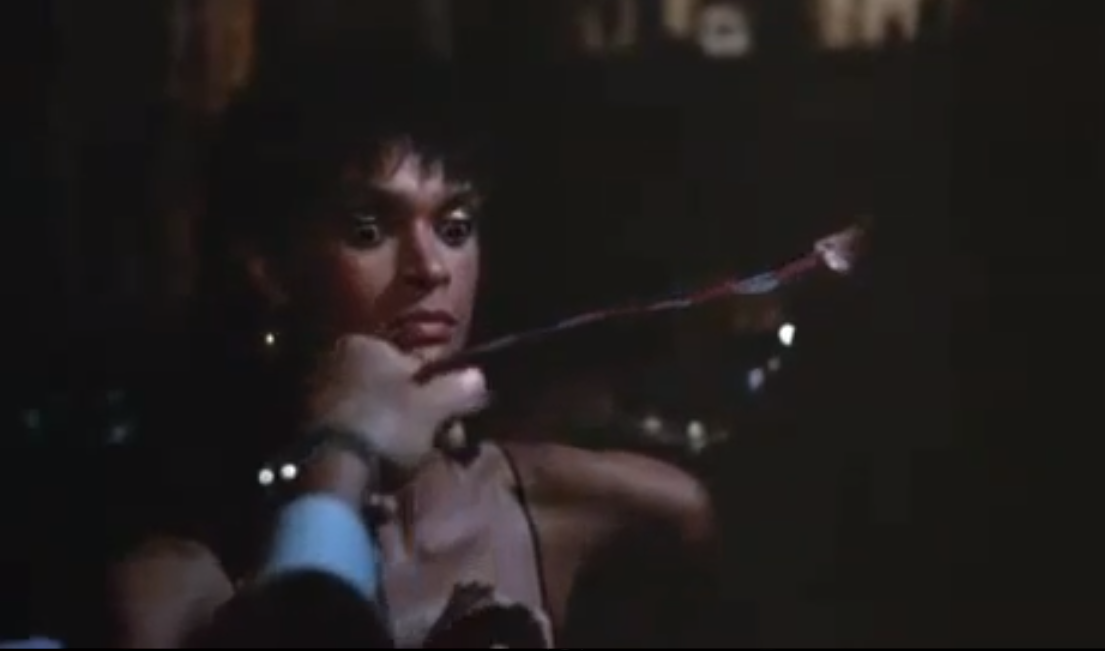
The 1984 Clint Eastwood film Tightrope has an oddly similar trajectory. Here too, a rape-revenge narrative wanders vaguely off its well-marked track. Police detective Wes Block (Eastwood) is, like Aoyama, a single dad (divorced, in his case) who loves his children (daughters, here)…but who also has an unpleasant side. Block frequents prostitutes, and seems to have a general inability to keep his dick in his pants. This complicates things considerably, since Block is pursuing a mysterious killer who rapes and murders prostitutes. The killer starts to follow Block and murder the prostitutes he sleeps with, and finally we learn that he (the killer) was once a cop himself.

Block and the killer, then, are insistently linked and doubled — and the film clearly flirts with the idea that it is Block himself who is the murderer. The murderer uses handcuffs on his victims; Block, too, has a thing for handcuffs in bed. The murderer likes to use ribbons for strangulation. Block…uses his tie.


When Block’s daughter (played by Eastwood’s real-life daughter) is raped by the killer, it becomes, paradoxically and queasily both the rape and the revenge — it is the trauma which punishes Block for the same trauma that he (the killer) has inflicted.

So, just as in Audition, the confusion of the rape/revenge is tied to a blurring or scrambling of characters. And also as in Audition, the complication or confusion of that narrative tends to create a fetishistic stillness. In Tightrope, this occurs not through dream-like images, but instead through repetitive focus on significant objects. The killer is identified again and again by a slow pan down to his shoes; his trademark red ribbons appear repetitively at different crime scenes; and of course because the killer is following the cop and the cop is following the killer, locations and characters repeat themselves with more ominous meaning (and music) as the film circles around and around itself in a slow twisting effort to catch its own tail.

Tightrope ultimately turns its back on its art film impulses and scurries back to the safety of being a Hollywood piece of shit, complete with dunderheaded final chase scene and Block heroically redeemed by fisticuffs and a good woman, not necessarily in that order. But before that happens, it, like Audition, exchanges the brutal rush of narrative for the immobile despair of, as Bert puts it, “endless defeat.” In these films, rape and trauma are not so much crimes that can be punished as stains that you stare at, day in and day out, till you can’t tell the nice guys from the sinners, nor violation from revenge.

HU Gangnam Style


The many faces of Psy in Gangnam Style. You can buy these as stickers. Collect them all!

First of all, here’s the video, if you haven’t seen it already. If you are sick of the song, you can also watch it without music.

Secondly, in my third-most-ever-favorited comment on metafilter, I talked about Psy’s Gangnam Style and race in America:

Gangnam Style isn’t the first viral smash Kpop song, or even the first viral smash Kpop song that sort-of sounds like LMFAO and was produced by Teddy Park of YG Entertainment (who has been working with the artists to adapt the same ultra-mega-popular song into a huge smash hit every six months like clockwork – here’s 2NE1’s I Am The Best and Big Bang’s Fantastic Baby, if you missed them the first time).

But of those three acts – each of which has already gotten a lot of U.S. attention, i.e. Pitchfork wrote about 2NE1, Will.i.am worked with them, MTV Iggy called them the best band in the world; Big Bang were crowned Best Worldwide Act at the MTV Europe VMAs and have been written up in US and European business magazines – Psy, a previous unknown (to the US), is the act the entire Western celebrity world has decided to back.


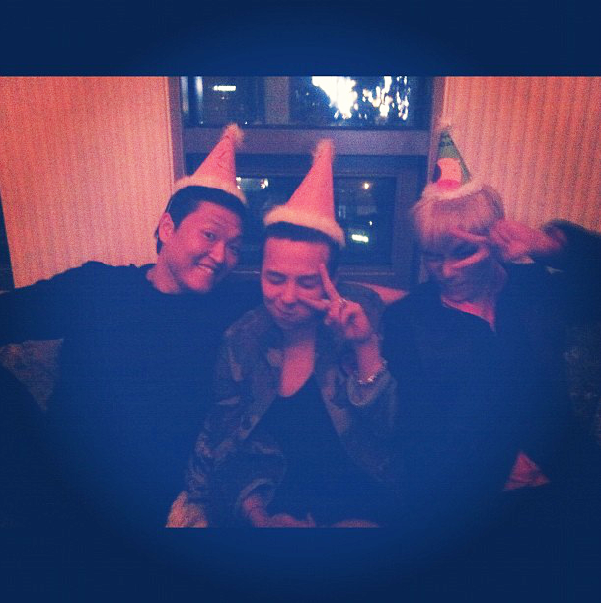
Psy and Bigbang’s G-Dragon, hanging out.

On metafilter, I speculated that while not precisely a conspiracy, the choice to throw US media and celebrity weight behind Psy and not another act was a tactical move:

Compared to those other songs, “Gangnam Style” is a lot more relatable to the average person – it’s a song about acting like you are rich, whether or not that’s really true, rather than a song about being actually rich and famous (although Psy is both of those things, in South Korea).

More than that, it’s relatable for the average American, who can comfortably put Psy in a couple pre-existing mental boxes: hilarious “not attractive” guys partying hard and getting the girl; funny Asian guys; funny viral videos built around dead-serious funny performances in public places; even subtle social commentary. Bringing Psy over here broadens people’s ideas of a viral pop song a little bit, since it’s in another language, but not too much, since, after all, Psy is singing about how he isn’t the rich person he dreams of being typical celebrity guy.


Psy x Justin Bieber. They share a manager in the US, Scooter Braun.

To expand on that a bit more – and please forgive me for retreading already well-tread ground – Psy’s Gangnam Style video isn’t just funny in ways that Americans recognize, e.g. the hot tub scene borrowed from Austin Powers. It’s also implicitly critical of “all flash no substance” celebrations of celebrity vanity/megalomania.

For instance, here are videos by B.A.P., f(x), Jo Kwon, Tasty, Girls Generation and After School proclaiming their own greatness – although this last one is a Japanese single released by a South Korean group, not properly a Kpop song. It is, however, a great example of the kind of stadium-ready pop South Korea has been making since the World Cup last summer, and again this summer in celebration of the Olympics – for which Psy has, natch, written the official theme song.


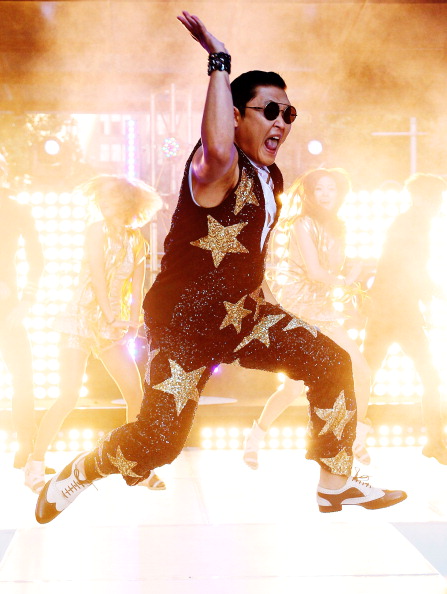
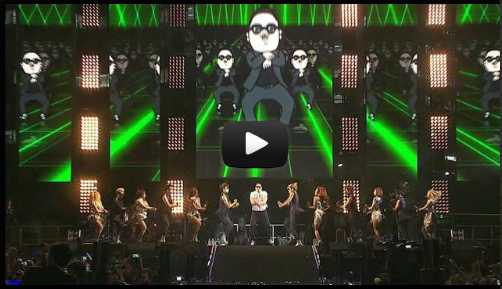
Psy performing at one of his famously crazy concerts, underneath (cartoon) images of himself.

The difference between those groups and Psy isn’t precisely hubris as Gangnam Style is, after translation into English, already plenty boastful. Rather, it’s a comment on artificiality: Psy’s video is set in the real world – albeit one full of celebrity cameos and action-movie stunt acting – while other groups save money by filming in constructed worlds made up of empty mansions, empty clubs and empty rooms; or else in the “real” Kpop world of stage lights and dressing rooms. And that’s if there is any nod to reality at all. In its purest form, Kpop features locations that aren’t just abstract and prone to disorienting lighting, but subject to no other logic but the logic of capitalist consumption – a predilection that’s been noted on this blog previously.


Psy live in Australia, in a concert still that looks like an action-movie poster.

Of course, there’s a lot of self-awareness in the artificiality of these videos… in addition to being generally more economical, they sometimes also double, Lady Gaga-like, as commentary on their own artificiality (one, two, three).


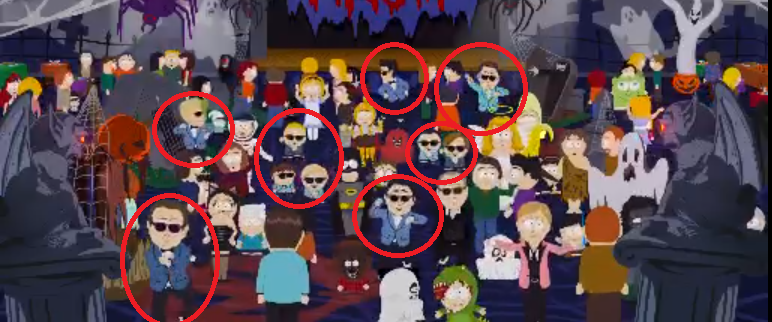
Images of Psy proliferating everywhere on the latest episode of South Park.

But to return to the topic at hand: The good-looking teen and twenties celebrities who populate Kpop music videos belong in their world, being in part “constructions” themselves – that is, the groups are definitely constructed; the personas are partially constructed; and the faces and bodies are meticulously constructed through a combination of professional makeup, professionally-guided diet and exercise, and plastic surgery. Psy, although also a nominal member of this set – and actually hailing from the swank Seoul district of Gangnam, Korea’s plastic surgery capital – does not look like he belongs with them, and therefore has to fight to be recognized as belonging to a glittering world in which only handsome people exist.


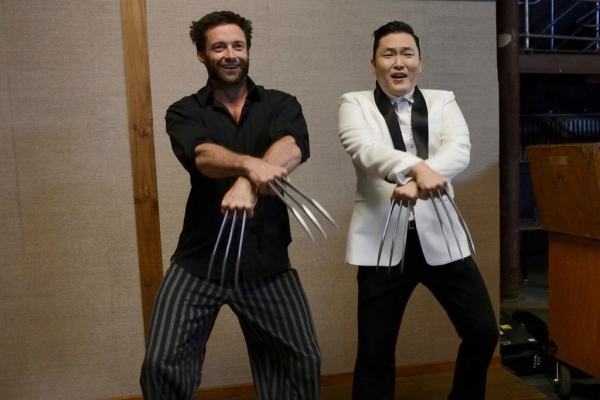
Speaking of handsome people: Psy with Hugh Jackman

Despite what the Atlantic would have you believe, however, Psy is far from alone in his satirical take-down-from-within-the-industry. Even apart from direct critiques – of superficiality, of sexist double standards, of government censorship, of materialism and gender roles – Gangnam Style actually comes in the middle of a move toward broadening the appeal of Kpop by setting it in real places. Like This and Ice, for instance, are two of this summer’s other attempts, proceeding Psy’s, at LMFAO-style outdoor flashmob videos.


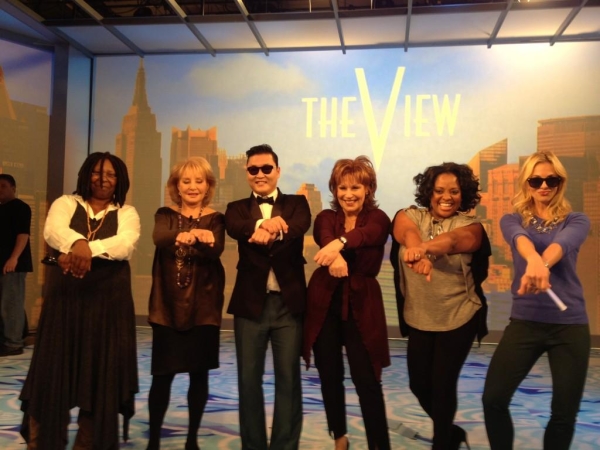
Psy leading an impromptu(?) flashmob on The View

With that said, there’s still plenty of artifice to go around. On metafilter I concluded that trying to viral-market any of the more obviously constructed groups in the US

would require a long explanation about what Kpop is and why those artists “really are” famous. This would require the U.S. public to buy into a world where the U.S. is not the center of all pop music production “that matters”. So yeah, I think there is quite a bit of commercial calculation behind the media push of [Gangnam Style]. Which doesn’t mean it’s not a great song worthy of being spread, just that there is a reason it was thing this song, and not some other one.


Psy presiding over many images of himself on the latest issue of Billboard

Do I still think this way about Psy’s smash hit? Yes and no. Here’s Ask a Korean, probably the first place you should go for answers to these kinds of questions, on the reasons for the song’s success overseas:

First, Korean pop music has been laying a solid groundwork for PSY to succeed. It is true that, thus far, efforts by Korea’s pop stars to break into the U.S. market resulted in a flop. Top stars like Wonder Girls, Girls’ Generation and 2NE1 never made a dent on America’s public consciousness. Nevertheless, the groundwork that these groups laid remains important. Because Korean pop music at least got on the radar screen of the insider players of American media market, PSY’s music was easily accepted by those insiders.

This is a crucial point that separates Korean pop music and pop music from other, non-Anglophonic countries. Through repeated contacts with American media, Korean pop music had a ready audience among American media insiders.

Check the original post for more, including a great graphic of a T-Pain-centric view of the universe.


Psy with ultimate Hollywood insider Steven Spielberg.

Though initially on the “why this song and not another?” train, I’ve since rethought my position. Maybe it’s true that Gangnam Style doesn’t threaten a US-centric view of the US’s place in the center of world the way that another, more nakedly imperial song would. On the other hand, this song is also popular in Istanbul!

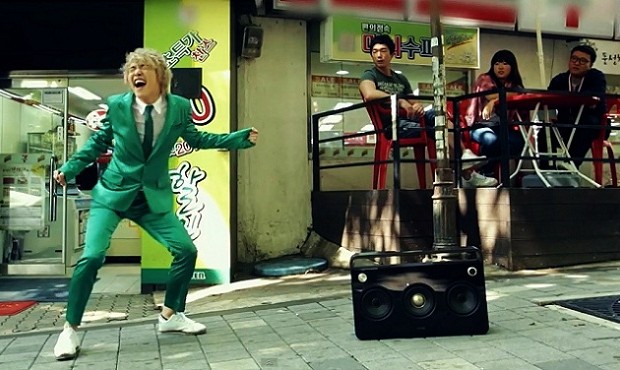
This has been on my mind since I was Turkey recently. Istanbul, at the crossroads of Europe and Asia, has pockets of hyper-capitalism inside a generally conservative culture – kind of similar to Korea? In any case, a gazillion Turkish parodies exist for Gangnam Style, including this one with found footage of old men dancing at weddings. “Uncool” guys acting “crazy” for the benefit of young, conventionally attractive women, whom they would like to impress, is a near-universal phenomenon, it would seem.


Another artist who is popular in Istanbul, Sardor Rahimhon. Lacking Psy’s discipline, he is occasionally photographed out of uniform.

And everyone loves a silly dance craze. This is anecdote, but it’s not just that this song is playing at cafes; from our hotel room in the old city, we saw a guy doing the horse-dance down the street…


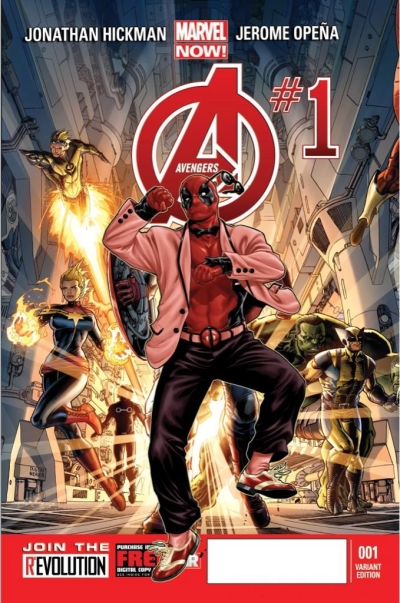
Deadpool doing the Gangnam Style horse dance on the latest issue of The Avengers.

I have kind of come around on Gangnam Style, then, and now think the silly – and yet instantly recognizable – dance on top of the ridiculous – and yet instantly recognizable – LMFAO-style beat is the main thing, along with the boost from American media/celebs who rightly saw the viral potential of the video and performer.

In the final analysis, then, the viral power of Gangnam Style comes from its being instantly recognized, widely liked, and easily reproduced. But where is Psy getting that cool-dorky look from anyway? Technically, from trot: Korea’s traditional pop music form which is currently experiencing something of a revival. Psy only looks trot, though: his music is pure 00s bombastic stadium rock, mixed to already sound like it is being played over loudspeakers at a large sporting event.

But what about that trot beat, eh? Another thing I will throw out for your consideration – if only because I haven’t seen it mentioned elsewhere – is Serbia’s entry in the 2010 Eurovision contest. Op, op, op! Ovo je Balkans! For more on this connection, read on…

Frank Kogan – Koganbot – has been writing about what he calls the Austral-Romanian Empire, a pop music spectrum that ranges from Tu Es Foutu and We No Speak Americano in the East (Australia/Oceania) to D-D-Down and Mr. Saxobeat in the West (Romania). To his list of Kpop singles that incorporate sounds from across the (Eastern) world music spectrum, I’d add Musiche by Crazyno (pronounced Cray-ZEE-no)… a guy dressed up like a Balkan entertainer/a trot performer/Psy…


Crazyno is from Australia! Perfect! But is he willing to wear that suit every day for the rest of his life?

The influence isn’t one-way, of course. Kazakhstan has their own Kpop-style boyband, for instance: Orda, also here. And meanwhile, a Kpop group that’s always had a strong European following is TVXQ, who right now have my current favorite take on the LMFAO Party Rock beat. Even knowing about this connection, however, it took going to Istanbul for me to notice exactly how much like typical Eastern European pop the video for Tallentalegra – by former TVXQ member Xia Junsu – is. You know the kind of thing I’m talking about, right? It’s a look that’s so well known (on women) that it was parodied by Hilary Duff in Iraq War black-comedy War, Inc.


Last celebrity cameo! Psy with Golden Girl Betty White

So there’s that. In other examples of trend-chasing, meanwhile, there’s the micro-trend of British-chart-sounding singles at YG Entertainment (Psy’s company): Dancing on My Own, I Love You, Don’t Hate Me, CraYon. For comparison/contrast, here is UK pop group Girls Aloud.

No corner of the globe is safe, however! If you want to find some Spanish guitar-y singles, you can find them as well: Wow, I Wish. Is Block B going for a similar audience, or a US audience, or in fact a worldwide audience with their Pirates of the Carribbean-sounding single Nallila Mambo (which you absolutely must watch)?

All of this is without even getting into Kpop’s first successful overseas expansion…to Japan. As my friend Sabina said, this is where the Italo producers went after Italodisco died in Europe. 4minute have multiple Japanese singles in this style. When people talk about Kpop, “Gee” and the Norwegian wave, they are generally talking a collaboration between Kpop songwriters and European dance producers. Many words have already been spilled on this particular connection, so I won’t spill any more – check Thomas Troelson’s wikipedia page for a general idea.

So it’s no surprise that Turkey is ready to embrace this pop amalgam, existing, already, at the crossroads of pop. Pop music television in Istanbul is a mishmash: they got stuff from the US and the UK, stuff from Eastern Europe, stuff from Russia, stuff from India…


Okay okay, this is the last celebrity cameo. Psy with Ban Ki Moon, current Secretary-General of the United Nations

Someone called the Kpop style the style of the mashup, but I don’t think that’s quite right. I think there are some unique things that no one else really does, or at least that are not a part of mainstream pop elsewhere. For example, I think that Kpop produced for an older domestic audience follows slightly different trends and is slightly less bombastic – or at least is bombastic in a more complex slash tortured slash melodramatic slash tragic way. But as this post is already a bit long, perhaps I’ll talk about that next time.

To bring this back to Psy, the market is nothing if not adaptable. It didn’t take underground-rapper-with-pop-ambitions E.via very long, for instance, to come out with a response song and video. She’s even using a cartoon image of herself to promote!

And speaking of cartoons, you have been wondering about that Deadpool-doing-the-horse-dance Avengers cover, right? Wonder no more: Deadpool VS Gangnam Style.