Car Ride Lacuna


Memory is merely one form of imagination.—Steven Millhauser

The trouble starts when I get onto the New Jersey Turnpike. That’s the moment my memory of Christmas 2007 begins to break down. The night before, the phone call from Mom—we’re talking your Dad to the emergency room—the mad scramble to pack my bags while my girlfriend calls rent-a-car companies, the phone calls to and from various relatives, learning words like gangrene and phrases like septic shock, all of that remains intact, crystalline. Ditto the moment two days later when Dad says he wants to leave Christian Science behind and I breathe a sigh of relief because he’s finally going to stop relying on prayer to heal him.

But the car ride from Brooklyn to DC is one of many moments—perhaps significant, who can tell—that I cannot remember. The ride down isn’t even a blur; it’s a snapshot:

            I’m in the passenger seat of a car, looking at the air vents and the dashboard and finally it’s just too much and I’m crying and trying not to cry. My girlfriend looks over at me. She wants to help, she wants to soothe, but she also needs to keep her eyes on the road.  It’s a brief moment, and soon I’m looking out the window at the New Jersey Turnpike with its low price gasoline and rest areas named after famous Jersians of the 19th Century and reeking factories.

The rest of it is gone. Removed, like my father’s leg.

I am terrified of this empty space in my mind.


If there’s one thing I hold onto with some sense of pride, it’s the flypaper of my memory. When it works, anything that zooms past it gets stuck.  How, then, to explain its failure as I tendril my way back into my recent past? Perhaps my memory has become corrupted. Abort/Retry/Ignore.

Memory— like many words in our polyglot bastard tongue— comes from many sources. Anglo-norman. Old French. Classical Latin. Eventually we arrive at an unprintable Ancient Greek word meaning baneful or fastidious.  This suggests that even in classical times, the Poindexters who remembered everything weren’t exactly popular.

Let me try this from memory:

            To be or not to be, that is the question

            Whether ‘tis nobler in the mind to suffer

            The slings and arrows of outrageous fortune

            Or to take arms against a sea of troubles

            And by opposing end them.

            To die, to sleep, no more and…

That’s as far as I can get, and I’m fairly sure some of the above is wrong. Perhaps I’m not as good at this whole remembering thing as I thought.  Maybe those facts, figures, Simpsons quotes and Monty Python routines that I love to trot out are similarly wrong.


Perhaps were I still a professional actor, I could remember the lines from Hamlet or what I did in our rented car on the New Jersey Turnpike. When you perform in front of school kids, they always want to know how long it took you to rehearse and how you memorize all those lines. I phone an acquaintance of mine, the actor James Urbaniak, to talk about his methods.


When Hamlet’s father’s ghost—also named Hamlet, sorry English students everywhere—appears to the distraught Prince, he charges him with three tasks.  The first is vengeance.  The second is not to harm his mother.  The third, often forgotten, is remember me.


Remember. What are we to make of the peculiar, troublesome “b” when memory shifts to the past tense?  Re-member, not re-memor. To reincorporate something into the group, the whole. To take the distinct particle and add it to the organism. To put back together something that has been broken. When Christ Jesus takes the ear his disciple has cut off of one of his tormenters and rejoins it to the man’s face, he has remembered the ear. A member is part of an organization, a collection, a body, whether that’s the physical body or the body politic.  It’s also a penis, of course.


Urbaniak’s method for memorization involves linking difficult lines to images. It’s very instinctive, he tells me, the first weird image, and frankly, those images can get very sexual and very scatological. The method comes from a television infomercial he happened to catch as a child about how to remember names.


Shouldn’t the opposite of remember be dismember, rather than forget? Perhaps dismember feels too much like a choice, the choosing to separate a person from a group, or a limb from a body.  Thinking of forgetting as an amputation makes it somehow moral. The Latin word amputare refers specifically to the chopping off of a thief’s hands. Our language, then, implies sin, a crime needing to be punished. The crime of joining the army. Or having diabetes. Or relying on God.


On the phone, James pulls out a script of Thom Pain (based on nothing) a one-man show he performed in New York. He finds a particularly abstruse line: Picture the readiness, the stillness, the virtuosity. He walks me through translating this into an image to help him remember. I might first imagine a picture frame.  “Picture.”  And in that picture is me. And I’m surrounded by books reading. Reading. And if I see that, I would remember that r-e-a-d was for “Readiness”. “Stillness”. So I’m frozen while reading. It’s a picture of me reading and I’m frozen, maybe I’m sitting on ice. Frozen would remind me of stillness. “Virtuosity.” And meanwhile someone is behind me playing the violin. He bursts into laughter, amazed at the workings of the mind and how we trick it into doing what we need it to do.


If you trace the path of the word “forget” it actually means to lose one’s hold. Your butterfingers mind slips on the handles of both the things you want to keep and the things you want to lose. Unlike dismember, forget is indiscriminate, is involuntary, is amoral.


Remember me the Ghost charges, the father asks of the dutiful, loving son. In keeping this oath, Hamlet will come to reach all the way back through memory’s roots, to trace “memory” past its ancient Greek banefulness to the delightful Sanskrit smri, the mother of both memory and witness. It means martyr.


After turning one line into an image, James then links it to the lines that surround it, forming a nonsense narrative that takes him through the script. Let’s say prior to the line about the readiness, I had another line that was to be or not to beI might picture two bees and then they’re shot, so they don’t exist anymore. So two bees and they’re not. And then their bodies fall on the frozen lake where I’m reading.

The most surprising aspect of James’ memorization trick is that he needs no help in remembering the images themselves. I’m able to conjure up these images very very quickly because I can see them as bizarre pictures. I see the bees on the ice and see the picture and boom, I’m there, as opposed to seeing a sequence of words. The memorization per se is just an early technical necessity. It has nothing to do with acting whatsoever. And then eventually with acting, you figure out why the character is saying these things. Memorization then is a purely technical first step. Real memory involves actions and motivations, the building blocks of character, including the fussy, discomfiting characters of ourselves.


Here’s how Hamlet responds to his charge to remember his father:

Yea, from the table of my memory

            I’ll wipe away all trivial fond records,

            All saws of books, all forms, all pressures past,

            That youth and observation copied there;

            And thy commandment all alone shall live

            Within the book and volume of my brain,

            Unmix’d with baser matter: yes, by heaven!

That passage isn’t from memory. I googled it. Google substitutes for memory, the way Facebook substitutes for The Director’s list. No one knows how these online replacements will impact on our memory. Perhaps in the future there will be no lacunae, and thus no creative bridging of these gaps, and thus no art. The Universe, after all, is mostly made up of empty space.


Hamlet promises his dead father that he will clear space in the attic of his brain by forgetting all the unnecessary information of his youth. He will sculpt himself into a First Corinthians kind of man. He will stop speaking as a child, understanding as a child, thinking as a child and, as St. Paul instructed, he will put away childish things. This is Hamlet’s ultimate act of love, to transform himself into a monument, which in English means anything that preserves a memory, but in Welsh means a graveyard.


Science teaches us that forgetting can be an act of self-defense, but art teaches us that memory is an act of love. I want so desperately to remember that car ride, to remember every minute spent in waiting rooms, every thought and word and deed of the weeks surrounding Christmas of that year. Yet I have to look at a calendar to recall what year it was. Time and the workings of the human mind wrap weights around all the locked safes and drop them into the uttermost parts of the sea.

When I was growing up, I learned in Sunday School the tenants of my family’s faith. I learned that these corporeal, finite, decaying bodies of ours did not exist. I learned that the real me was perfect. I learned that the real me was in Heaven, with the Father/Mother God. I learned that God is Love, God is perfect, God is all-powerful, all-seeing, all-knowing, all-acting, all-wise, and made us in His image. I learned that the limits of the self were an illusion, called Mortal Mind, that this Mortal Mind was responsible for illness, that treating the illusion through medicine reinforced its existence. I learned that if we studied hard enough, prayed hard enough, attuned ourselves to God, we could realize our real perfection and leave Mortal Mind behind, the way Jesus did when he ascended to heaven. Verily, verily, I say unto you, He that believeth on me, the works that I do shall he do also; and greater works than these shall he do; because I go unto my Father.

Perhaps this is why I cannot shake the belief that my inability to remember even trivial details is a failure. Not a failure of the mind, like the Director’s deleted words, or a failure of art like James stumbling to recall a memory palace of images, but a failure of love.
 

Pale in the 70s

This first appeared on Splice Today.
_____________

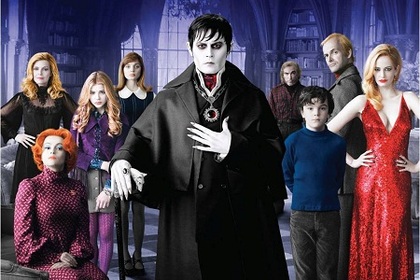
My wife and I took my eight-year-old son to see Dark Shadows this weekend, and thereby discovered that PG-13 covers a lot of territory.  The last Harry Potter films were PG-13, for example, and that meant kind of scary and some people die.  Dark Shadows, though, is PG-13 and that apparently meant not-nearly-elliptical-enough references to oral sex.  Which luckily my son is too young to get, but my wife and I got them and we were sitting there with our son and so were able to contemplate just how unfit we are to be parents.  Which is not a new revelation or anything, but it’s always painful to have it brought home to you like that.  Luckily there were no DCFS agents in the theater.

What there were in the theater instead were a lot of black people.  In fact, I’m pretty sure we were the only whites there.  In one sense, this is not particularly surprising — we saw the film on the south side of Chicago in an African-American neighborhood.  I’ve been to the theater a number of times, and the audience is always heavily black.

Still, it was a little weird in this case because, despite its name, Dark Shadows has a remarkably pale cast.  And I’m not just referring to the make-up Johnny Depp dons as the vampire Barnabus.  No, what I’m talking about is the fact that everyone in the cast was white.  And I do mean everyone.  Yes, of course, white people get all the speaking parts.  But unless I missed an extra hidden behind a gargoyle or obscured by the exploding canning factory, even the bit players here were impressive in their studious eschewal of diversity.  No blacks.  No Hispanics.  Not even any Asians, as far as I could tell.  Hollywood’s fictional 1970s Collinsport, Maine is white, white, and also white.  Unless you count some Curtis Mayfield on the soundtrack, I suppose.  Which I don’t.

Of course, you could argue that the actual Collinsport, Maine, in the 1970s would have been racially homogenous. And that’s true — Maine even today is 94% white, and a small seaport town like Collinsport would be a few percentage points higher than 94%, I’m sure.

Still…the vampire/witch/werewolf population of Maine is significantly less than 6%, and yet somehow the film found room to represent this minority group.  Moreover, while pervasive segregation (https://hoodedutilitarian.com/2012/01/sundown-towns/) has meant that parts of the country have no African-Americans living in them, there is no section of the country that has been untouched by African-American culture.  A good deal of Dark Shadows is devoted to the fish-out-of-its-coffin humor of the 18th-century-born-Barnabas struggling to deal with the brave new world of 1972.  His reaction to changing gender roles (women doctors!) is mined for laughs, as is hippie culture and changing musical tastes (Alice Cooper makes an enjoyable guest appearance.)  But the vast changes in style and consciousness caused by the Civil Rights movement are never addressed.  Surely Barnabas trying to parse Black Power — or even the Electric Company — would have been worth a laugh or two.  But nope.  It’s hard to imagine a 1970s without soul, even in Maine, but Dark Shadows pulls it off.

Of course, the African-American audience I watched with didn’t seem to be especially disturbed by the lack of diversity.  On the contrary, for the most part they seemed to enjoy the film, oral sex jokes and all.  No doubt they long ago accepted that Caucasians were going to dominate their Cineplexes. As my wife’s been known to say when challenged about her love of eighties hair metal, “If I only liked pop culture that wasn’t sexist, then there’d be no pop culture to like, would there?”  Still, after a couple of hours of ghosts, vampires, and witches, the creepiest moment of the afternoon was leaving the theater and realizing that, as far as the film was concerned, the people around me barely existed even as dark shadows.

Book of Friends

This first ran in the Comics Journal.
_____________________

I haven’t read a ton of manga, but it seems lately that every one I do read involves someone who is able to see ghosts and spirits. Dokebi Bride; xxxholic, and now this. I have to say, it somewhat undercuts the pathos that Midorikawa wants me to feel. She keeps insisting that her main character, Natsume, has led a life of loneliness because he can see Yokai and no one else can. But, come on. Everyone can see them. They probably have endorsement deals. “Do you know me? I died and now roam the earth in disembodied agony. But I still get turned away at inns for some reason. That’s why I carry….”

It’s not hard to imagine these particular ghosts in advertisements, actually, because they, and the manga they inhabit, are so thematically generic. Dokebi Bride uses its ghosts as a metaphor for grief and loss; xxxholic uses its ghosts as a metaphor for karma. The first is one of the most beautiful comics narratives I’ve ever read; the second is not especially good, but at least has the virtue of being somewhat ruthless.

Book of Friends, though, is ghost story as after-school special. Natsume is gentle and kind and good, and also gentle and kind. He finds a book that allows him to control spirits, and instead of using it to control spirits he decides to seek out all the ghosts and free them, because he is pure of heart and has the blandness of ten. Presumably his niceness is supposed to be endearing, but its achieved with so little effort that it just makes him vague. His moony sad memories float by in the requisite shojo drifting-panels-of-white-space-with-petals-falling and you say to yourself, yep, there are those petals, I am supposed to feel sad now. But who can give a crap about this nonentity and his drearily unfocused self-pity? Occasionally a ghost threatens to eat him or pull his tongue out, and you almost wish one of them would do it just to see if that might infuse him with some spunk. I mean, hideous trauma — it gave Batman character, right? But alas; no one ever really hurts Natsume, and if they did, you’d figure he’d go along just the same, turning every encounter into a parable about the meaning of friendship. Awww…the poor ghost was sad, and I helped her, and now the world is just a little bit brighter. I am shojo Michael Landon!

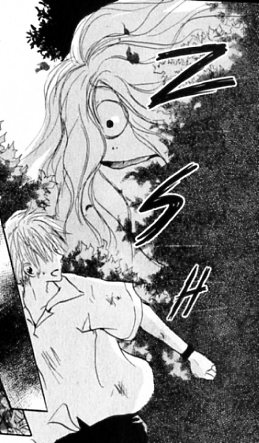
Not that it’s all bad. Though, as I already mentioned, the art is largely by-the-numbers, the Yokai themselves look great. Based visually on ghosts and demons from Japanese prints, they’re all one-eyed with gaping maws, or horned and neckless, with weird skinny limbs that don’t bend quite right.
 

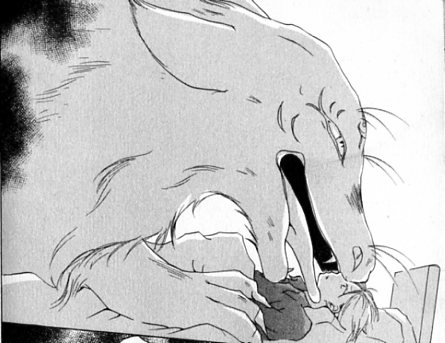
The inevitable cat familiar is lovely too — cute and majestic and ominous all at once.


Those two images are uncanny and weird; they use the distortion of scale to suggest Natsume’s powerlessness before a malleable world that he is prepared to casually devour him. If that was what the story was about, I’d want to keep following this series. But it isn’t, and I don’t.

The Country of Multi-Talented Women

I think I forgot to introduce myself last time, so I’ll do that now. Hi, I’m subdee, short for sub_divided. I’m still not sure what this column will be about, but I have a feeling it’s going to involve a lot of very popular, very commercial, but nevertheless very weird Japanese comics; and Kpop.

With that out of the way, I was reading this great analysis of Star Trek: The Next Generation over on Grantland.com when I came across this paragraph about Harry Potter:

One of the reasons J.K. Rowling’s books exerted such an appeal over every sentient creature on earth is that they resolved, indeed fused, a cultural contradiction. She took the aesthetic of old-fashioned English boarding-school life and placed it at the center of a narrative about political inclusiveness. You get to keep the scarves, the medieval dining hall, the verdant lawns, the sense of privilege (you’re a wizard, Harry), while not only losing the snobbery and racism but actually casting them as the villains of the series. It’s the Slytherins and Death Eaters who have it in for mudbloods, not Harry and his friends, Hogwarts’ true heirs. The result of this, I would argue, is an absolutely bonkers subliminal reconfiguration of basically the entire cultural heritage of England. It’s as if Rowling reboots a 1,000-year-old national tradition into something that’s (a) totally unearned but (b) also way better than the original. Of course it electrified people.

Have your cake and eat it too! How many pop cultural flashpoints does this apply to?

Twilight: they are dangerous immortal creatures of the night who want to eat you up (in all senses), but the good vampires practice self-control and abstinence before marriage, while only the bad ones give in to their base desires.

50 Shades of Grey: BDSM is hot, but people who are into BDSM are emotionally damaged. Never mind how damaged they are, though, because BDSM is hot! Also, the characters look a bit like Edward and Bella from Twilight. But you bought the book because it is popular, not because you wanted to read about all that.

The Girl With the Dragon Tattoo: violence against women is bad, and we will prove this by repeatedly exposing the heroine to violence. Also, she’ll sleep with the married, middle-aged writer-narrator, because he is supportive and nonjudgmental. This will never blow up for him, or anything like that (though it might strain his marriage a little bit).

Pretty much any comic that decries violence against women while also making it a major part of the narrative… (paging Frank Miller, Frank Miller to the table).

While these things are fun to list, they mostly don’t involve an “absolutely bonkers subliminal reconfiguration” of the literature of an entire Imperial power – rather, they are mostly mild-to-medium exploitation fare that decry sex acts while also pleasurably indulging in them. In fact, I feel that by bringing them up, I am diluting the purity of the original author’s idea, which he goes on to discuss in terms of Star Trek: TNG being a fantasy of a conservative, hierarchical society (Starfleet Academy) organized around the pursuit of liberal ideals like inclusiveness and multiculturalism.

I can think of a recent novel/anime/manga series that might fit, though: and that’s Sainkoku Monotagari.


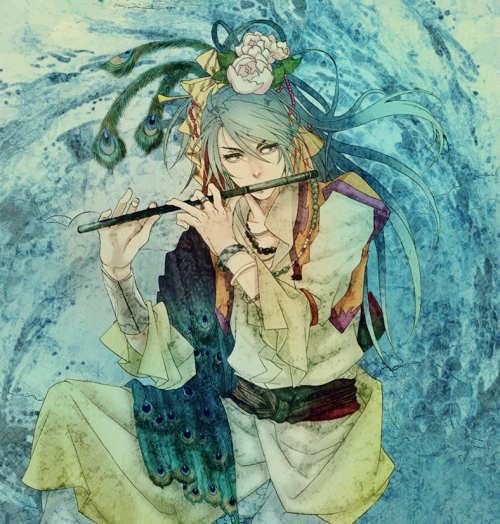
Clumsy girl + multiple hot guys with long flowing hair and robes = must be shoujo

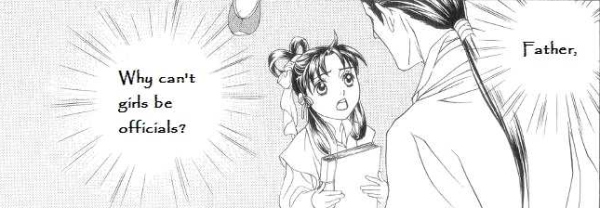
Saiunkoku Monotagi, “the story of the country of many-colored clouds,” is a light novel series centered on the adventures of a young would-be government official, who dreams of passing the imperial exam and loyally serving an Imperial China-esque country. The catch is, she is female, and therefore forbidden from sitting the exam.

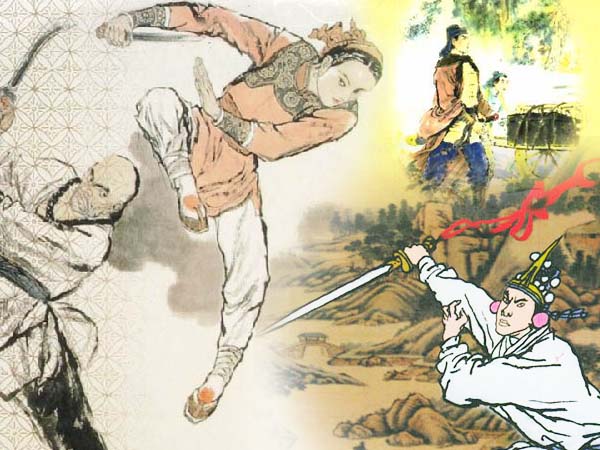
You see where I’m going with this, right? There’s a history of these Fantasy Imperial China stories in East Asia, but traditionally the women in these stories are either great marital arts masters (if wuxia) or supernatural creatures (if supernatural kung-fu). In the more “realistic” palace-drama stories, meanwhile, they are either married to/the daughters of male characters; or evil harridans who work behind the scenes, through the men with official positions. They don’t study hard and work diligently to accomplish great feats right out there in the open…


Yeah, why not!

Sainkoku isn’t the only story to look at history and imagine a better place for women, of course. It’s been compared to the 2003 K-drama Jewel in The Palace, about the Joseon Dynasty’s first female court physician, for instance. (And indeed the plot of Saiunkoku – first volume published in November of 2003 – shares many similarities with the plot of Dae Jang Geum.) Looking beyond historical dramas, there have been an even greater number of fantasy re-imaginings. Here’s an excerpt from the TV Tropes entry for Feminist Fantasy:

Another type of Feminist Fantasy is a feminist retelling of an old story, like a fairy tale or folktale. These are very popular nowadays, and seem to be the way this generation of Disney princesses is turning out—see Enchanted and Princess And The Frog. The former is completely self-aware and sends up the traditional Disney Princess archetype, and the latter is about a princess who wants to be a businesswoman and ends up with a guy along the way.

On the Princess and the Frog –> Enchanted continuum, Sainkoku falls in the middle, but closer to Princess and the Frog (straightforward pursuing-a-of-dream-that-does-not-involve-a-man) than to Enchanted (purposeful deconstruction of genre tropes).

Which genre tropes are we talking about, though? Reverse-harem tropes, where the female protagonist is inexplicably surrounded by hot men who compete for her attention? Shoujo tropes, where the protected, naïve main female character betters the lives everyone around her with the strength of her pure love? Palace Drama tropes, where factions cross and double-cross each other in a struggle for political power? Wuxia tropes, where supernaturally gifted swordsmen wander the countryside righting wrongs or at least testing their skills?

If you picked E, all of the above, you’d be right. Sainkoku is a palace-drama story dressed in shoujo reverse-harem clothing, with some wuxia and supernatural elements thrown in to keep the audience interested.


See this page for more on wuxia

In Japan, most fans are fans of the novel series, first, and of the anime series (released but now out of print in the US) and the manga series (currently publishing under the Viz – Shoujo Beat line) second. If they are really fans, they might also collect the mini-novels and calendars; read the spin-off novels focused on other characters; and listen to the drama CDs by the anime voice actors. SaiMono, in other words, is an institution with a wide reach… JK Rowling, incidentally, is currently at work on a spin-off novel about Sirius…

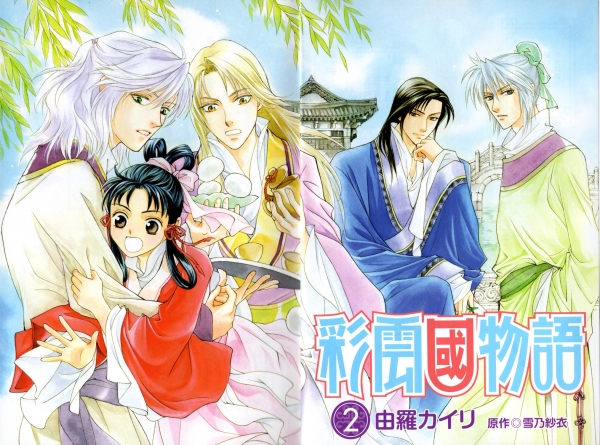
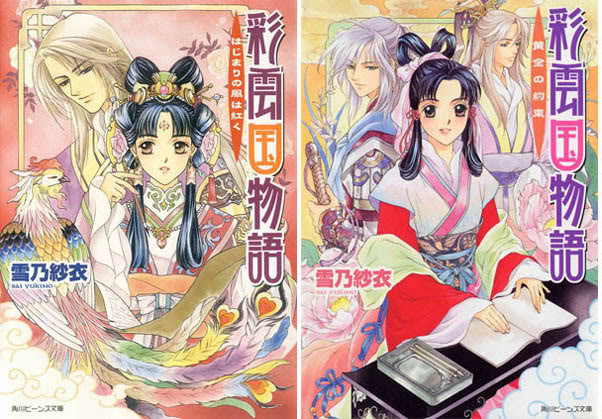
As far as who reads the books: SaiMono isn’t just a shoujo series targeted at young girls, it’s also one of the pinkest shoujo series ever. Check out these covers:


Surrounded by beautiful men, check, pink, check, flowers, check, long flowing robes and hair, check and check…

In fact, “pink” is more true of the anime series than of the novel series, whose covers actually become progressively less pink as time goes on. Still, it’s partially thanks to the breast-cancer-awareness levels of pinkification going on in the anime and early novel illustrations that my friend Charmian – notesonleaves – spent so long trying to convince us that Saiunkoku Monotagari is a strong dramatic story outside of the “reverse harem” and “anachronistic girl power” and “shoujo whitewashing of brutal history” trimmings. And she was right! Actually most of it is politicking and character development. To hear more, read on…

In Saiunkoku, the bad old days of civil war, famine, poverty and unpredictable politically-motivated assassination are within the living memory of most of the cast. Not only that, but these events – and dysfunctional family power struggles – have left most of them with PTSD, or personality disorders, or other remnants of trauma. In the middle of this group of very competent, but very damaged weirdos, Shuurei sticks out not because she is especially sheltered, but because she was able to depend on her family at all. The past playing itself out in the present, especially through barely-suppressed memories of past trauma, is another thing Saiunkoko Monogatari shares with Harry Potter, of course.

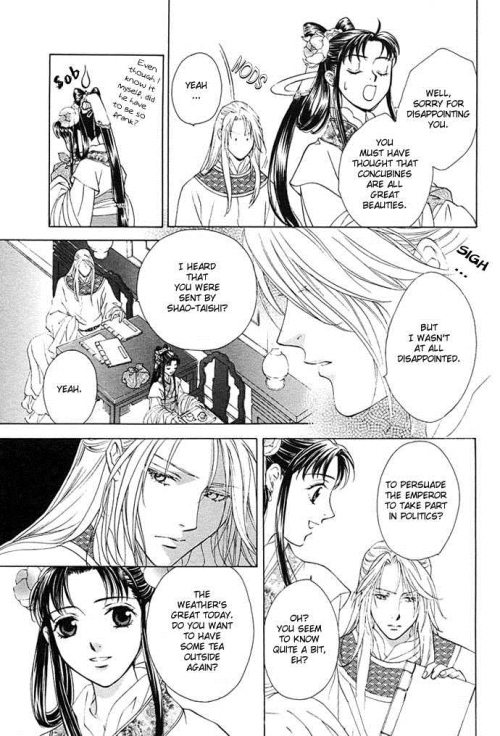
On that note, while the SaiMono-the-manga is mostly just a mechanism for delivering the story of the light novels, one place it really shines is the conveyance of subtle shifts of emotion – especially when it comes to Shuurei’s main love interest, the King –


Ryuuki, who became King by default after his older siblings all eliminated each other

It’s against this background that the story takes place, initially framing itself as the story of Shuurei pretending to be a member of the harem so she can get the thrice-shy Ryuuki, who is pretending to exclusively like men, to participate more in his own government.

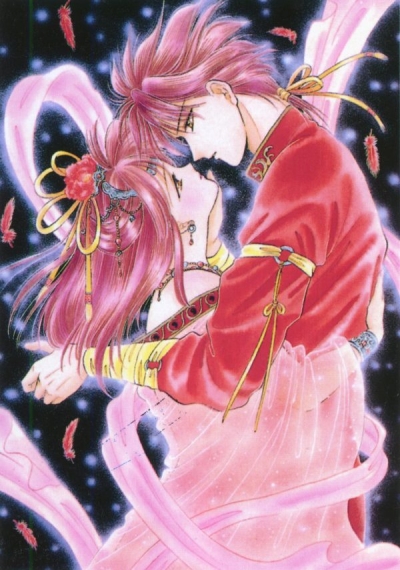
So since this story begins, literally, within a harem, let’s first talk about the reverse-harem angle. SaiMono owes a big debt to Fushigi Yuugi, the story of a modern girl sucked into a fantasy novel. Miaka finds herself at the center of a web of beautiful and damaged men, despite being, like Bella and Sailor Moon, a clumsy and gluttonous teenager without many traditional leadership qualities.


Fushigi Yuugi’s Miaka and Tamahome

Measured against this yardstick, Shuurei emerges largely as a refutation. She’s not clumsy or gluttonous: she’s good with money and skilled at a classical instrument (the ehru). Furthermore, Shuurei’s goals stand directly in contrast to Miaka’s goals: to serve her country impersonally and professionally as an official, relying on her own intelligence and skills rather than a man.

A traditional feminine failing possessed by the protagonists of these kinds of stories – because, let’s face it, they aren’t cute if they don’t have at least one – is not being able to cook, but the story explicitly makes Shuurei a great cook. Her father, a mild-mannered librarian with a hidden ruthless side, is the one who cutely can’t cook.

All is not refutation and subversion, however. Shoujo plots work better if their main characters are a bit naïve or idealistic, so they will work to change the system rather than accept their place within it. This is the case in Sainkoku, where Shuurei stands out among the traumatized cast as having been unusually sheltered. She’s helped, often secretly, by very many men throughout the narrative, including her father (secretly a SPOILER), her retainer (secretly a SPOILER SPOILER), her uncle (with SPOILER family connections); and the King, who wants to marry her but in the meantime will support her dream.

What’s interesting about all of these sheltering men, actually, is the way that SaiMono insists that the male urge to shelter young female relatives is at least partially pathological. Her father and the retainer, for instance, are secret – or maybe not-so-secret – psychos who are largely genial and apathetic in all things – until you threaten their loved ones (and isn’t that usually considered a feminine quality – the mother bear protecting her cubs?). The worst culprit in the arena of psychotic over protection, though, is Shuurei’s loving uncle Reishin, who is so determined to love and protect her from afar that he can’t even approach her, but only watch over her secretly. Even his friends think he’s a creep.

Within the story, the fact that Shuurei has been sheltered is actually a problem – it gets in the way of her being an official. The male cast are constantly watching her, and constantly telling each other not to interfere too much – to let her make her own mistakes and learn from them.

So SaiMono is a fix-it story, designed to rectify this one galling aspect of otherwise very enjoyable palace dramas: that there’s no space in them for strong female characters to pursue their (non-romantic) dreams. Not only is it a fix-it story, it’s one that sticks with its principles even against what the readership might like to see. For example, even the other characters, after a certain point, are rooting for Shuurei to end up with Ryuuki – but to do that would be to throw the story back into that other kind of narrative, of women working through men. She can’t marry him without giving up her dream, and he can’t make her do it without betraying her trust. The two premises of the story, that it’s a shoujo fantasy and that it’s a feminist fantasy, are at odds with each other. It’s not clear until the very last moment which one will win out.

A properly feminist story can’t have only one good female characters, of course: it also needs strong female role models. So SaiMono has a character who’s a princess with wuxia skills; another who’s a high-class courtesan owner of a brothel; another who’s a ninja; another who’s an inventor; and so on. The author appears to have put some thought into Sainkoku as a work of feminist fantasy, in other words.

That being the case, are the old bugaboos, the evil women with special powers, exorcised in this story? And are those who don’t think it’s appropriate for a woman to become an official recast as the villains, the way they are in Harry Potter? Sort of, but then again not really. There *is* an evil supernatural woman (although, on the other side of the ledger, also a good one). Shuurei is on the side of progress for women and inclusiveness in government, but also on the side of entrenched “major clans” over the wishes of the members of the petty nobility. Since there are a lot of factions, it’s hard to say who the “villain” is, apart from the people Shuurei has to win over.

That’s because SaiMono, despite initial premises, is committed to the idea that the world is complex. For instance, passing the exam doesn’t magically confer respect upon Shuurei, who continues to struggle with others’ perceptions that she is not capable. Similarly, it’s not enough for Ryuuki to suddenly decide that he wants to participate in the leadership of country: there are forces that have already moved to fill that role, and some of them are no less patriotic and well-meaning then him, and are much more competent.

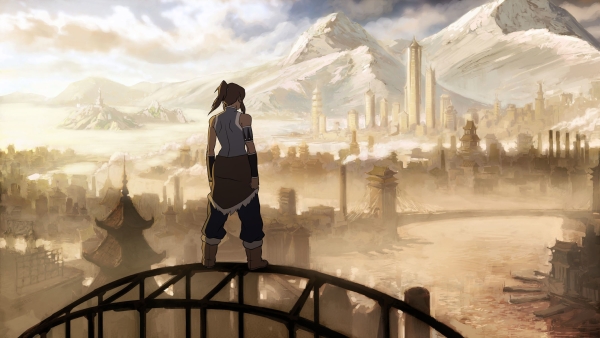
I mean, don’t get me wrong: SaiMono is still young adult fantasy entertainment. Even “complex” issues tend to have simple solutions, as when Shuurei fixes the fortunes of a poor province with no natural resources by establishing a university there. Still, simplified or not, these kinds of plots are what I was hoping to see in The Legend of Korra, another story about a young, sheltered female protagonist with the potential to do great things. Korra let me down when the writers supported her choice to become a vigilante, but SaiMono surprisingly held up.


Korra looking over Ba Sing Se, the capital city of the Earth Kingdom and a complicated place.

Sainkoku Monotagari is idiosyncratic in other ways besides just the commitment to a feminist message. For instance, the author has a favorite reoccurring character type: the seemingly-well-adjusted mild-mannered underachiever, who turns out, almost invariably, to be a scarily competent and ruthless person. In the world of SaiMono, younger siblings very often assume leadership within clans while their more-damaged overachiever older siblings play hooky. There’s also the fact that the series’ main love interest, the King, is bisexual – a surprising angle, and possibly the most subversive thing about the series. Although, sadly, this plot point doesn’t get a lot of play after Ryuuki decides that Shuurei is the love of his life and that he’ll take only one wife.

Returning to the original premise of this post: perhaps that opening quote doesn’t apply as well as I thought, as there is very little that’s “subliminal” about the feminist retelling of this series. It’s not only a clear attack on the idea of separate roles for women, but also pretty careful to include a wide variety of female role models. On top of that, though I’m not familiar enough with this to say for sure, I do sometimes get the idea that “subversion” is a wuxia genre trope to begin with… although then again Saiunkoku is more of a palace drama than a wuxia story…

A better case might be made for some of the other idiosyncrasies of the series: for instance, Sainkoku’s take on standardized test-taking (passing the test is when your problems begin, not where they end). Or how about the insistence that birth order and skills are less important to success than personality and temperament? What about all those “lazy” hidden genius characters who don’t work hard but succeed anyway, but then throw that success away? …Actually who am I kidding, that’s not a subversion, that’s the premise of lots of Japanese fiction. They are really entertaining, though.


Ran Ryuuren, eccentric genius #10 in an ongoing series

Since this article started with a discussion of Harry Potter, I’ll end with a short list of other ways in which it is superficially similar to JKR’s bonkers subliminal reconfiguration: first of all, an emphasis on wacky hijinx among a large ensemble cast; related to that, a strong sense of character and of individual characters having their own motivations and lives outside the main storyline; finally, the nominal “mystery” plot of each volume – which is however much less mysterious after all the politicking and hijinx are stripped away.

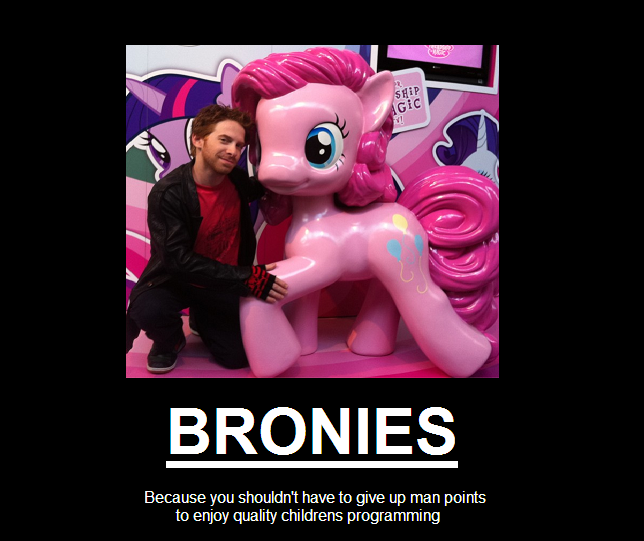
Finally, of course, it’s a massively popular series! Light novels series, anime, manga series, voice actor drama, tons of character goods and officially sanctioned side-stories and spin-off novels…. there’s a Saiunkoku machine. And no wonder. I feel like some bronies should be discovering Saiunkoku, which is another one of those sparkly pink woman’s stories purposefully built to include asskicking as well as dark, tragic pasts. Maybe if the anime weren’t out of print, or the characters didn’t have such damnably difficult to remember names (Shuurei vs Shuuei vs Seiran vs Seien vs Shouka vs Shoukun vs Shusui). If the anime ever gets put back into print, perhaps we’ll see.


Or, you know, young adult entertainment

The Descent: Between Promises and Genre

The Descent, a 2005 British film, directed by Neil Marshall, is a genuinely frightening experience.

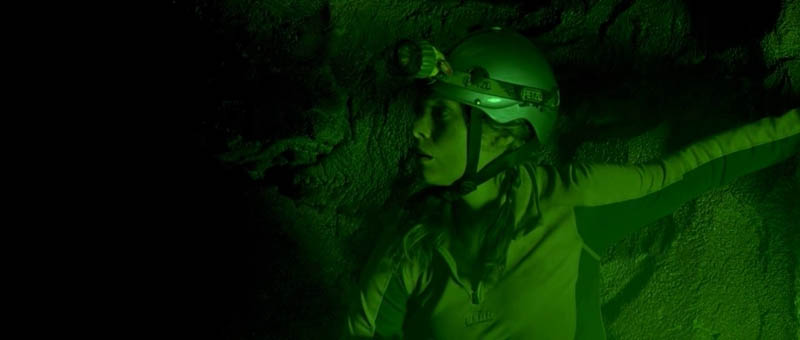
The plot is simple, a group of women get trapped in an uncharted cave, and discover a group of cannibalistic underground monsters while looking for an exit. The main conceit of the movie, its claim to originality, is the fact that horror happens underground, in a constrained and dimly lit space. What could have been a gimmick quickly proves visually and thematically fruitful, as the choice produces a slew of effects which enrich the horror tropes. Thematically, the film is close to Deliverance – a comparison made by several reviewers at the time – in that it foregrounds the connection between the environment and the monsters it generates. Or to put it differently, the environment is the real monster of the fim. Indeed, the beginning of the cave’s exploration, which merely presents caving as a trip towards frighteningly regressive regions, is the most convincing part of the film. The opening sequence, during which the heroine’s family dies in a brutal car accident, establishes a narrative contract in which anything can happen, even the sudden death of a cute child. Together with copious foreshadowing regarding the dangers of cave exploration and – less efficiently – with copious startling false alarms, the narrative strategy calls our attention to the threat inherent to the sport.

A most disturbing and effective sequence involves the group of women crawling through a narrow corridor, which eventually collapses.


Marshall shows us all the women going through the narrow passage until the heroine, Sarah, panics and causes the tunnel to collapse. Repetition is key here, and the tension increases with each woman, precisely because nothing alarming happens. The device conveys the feeling that the cave is threatening not because of what could happen but because of its very existence. The continuous presence of the environment is in itself a source of danger, even while the violent discontinuities of the horror genre have not appeared yet. Besides, in this case, the apparently unmotivated repetition of similar actions – it is even hard to tell who is crawling through the tunnel at a specific time – has a faux-naturalistic quality which may recall the tactics of the popular “discovered footage” films, and their attempts to imbue horror with a highly codified form of realism (cf. David Bordwell’s recent and insightful comment on the form).

Formally, the cave-setting also has interesting consequences in that it frequently functions as a form of cache or mask, as vast areas in the frame are entirely black, maintaining an ambiguous spatial relations to the locus of action. This distinctive effect – a pre-modern cinematic device naturalized by the setting here – not only produces unusual images, but it also works to open potential spaces for horror, potential startles. Genre connoisseurs expect startle effects and are acutely aware of the need to observe dead spaces. In The Descent, this is countered by the impossibility to see though these spaces.


The end of the film suffers, from the fact that the tension between naturalized scary effects and identifiable genre conventions is abandoned in favor of an overt formula. Plausibility issues also interfere, as the blind monsters have developed an acute sense of hearing but apparently no sense of touch. Several close escapes thus appear artificial and disruptive to the narrative contract, even though they may be thrilling self-contained moments. A scene during which a monster walks on a motionless Sarah without noticing her presence is a striking example. The ending of the film is not without pleasures, but these are referential pleasures, tied to knowledge of the codes and the history of the genre, a pre-condition to appreciating the minor deviations on display. Will there be a final girl? Will our point of focalization turn out to be the heroine after all? The issues at stake towards the end of the film are far removed from any involvement with the characters. Still, the gorgeous photography sustains the film even in its weakest moments.

My viewing experience, however, was shaped long before this final inflection by the opening sequence of the film. There are several possibilities open to horror film-makers, but an usual gambit is to open with a quiet, lustful act, with hints of the horror to come included in the mix: the auto-stopper in The Texas Chainsaw Massacre, the explanatory text in Cloverfield,  the hints of madness in The Brood, the sport and shower scene in Carrie, etc. The Descent initially seems to adopt this strategy of introducing harmless scares before the actual monsters enter. The film opens with a rafting scene, fraught with tension and the suggestion that rocks or water could severely harm one of the female protagonists – a fitting introduction for the speleological horror expected by most viewers at this point – which ends in satisfied displays of camaraderie.

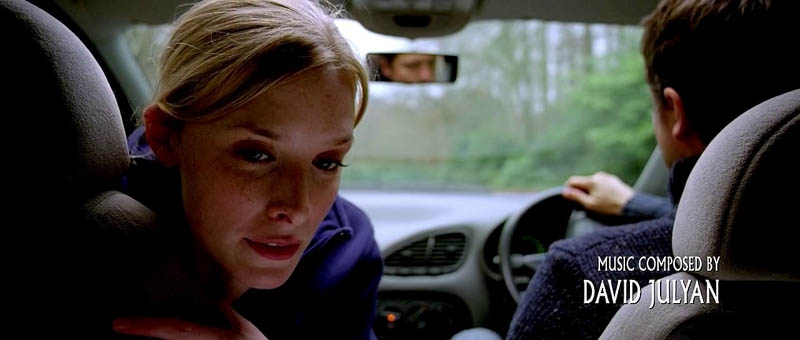
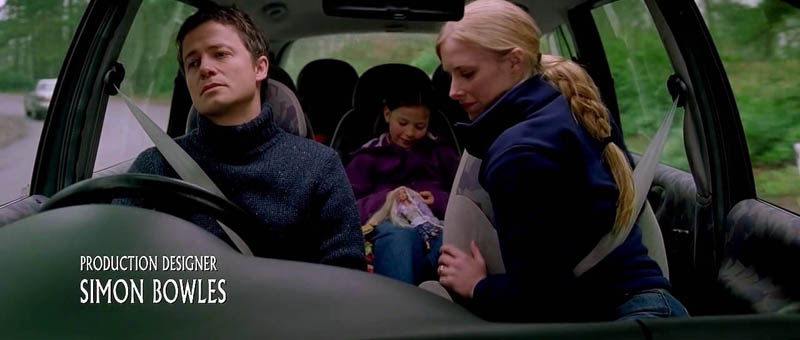
The thrill ends quickly, however, and Sarah, one of the girls, leaves a bit early to come home with her child and husband. This initially appears to be a bridging scene meant to accompany the credits, an introduction to a meaningful conversation or perhaps a naturalistic account of a change in location. The scene is a bit long, though, and after twenty seconds, you realize that the film is dedicating a portion of its running time to showing us an “intermediary space”, “un espace intermédaire”.


These empty places, in which you “leave the realm of the expected meanings” (Jean Cleber) are of course ubiquitous in our lives, but notably absent from the compressed narratives of mainstream cinema. You expect them in Duras’s films, but not in a fairly low-budget genre work. Foregrounding these spaces is the strategy used in Jarmusch’s Broken Flowers or Sofia Coppola’s Lost in Translation, and it serves to establish these two films as flamboyantly non-generic. This is also what Nicolas Winding Refn used so effectively in Drive, but then, Drive is a film about style and film-making more than a genre exercise. The very logic of genre and commercial cinema dictates that scenes must have a narrative or thematic significance. For a fleeting moment, The Descent seems to forego that logic and open itself to a whole realm of possibilities. If a genre is a set of possibles, a specific “vraisemblance” meant to frame our expectations (Jonathan Culler) then this aimless conversation challenges our notion of genre.

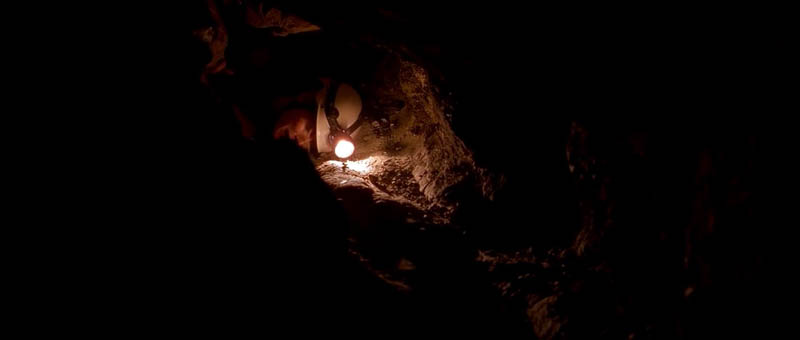
Then comes the tell-tale shot:


It lasts for eight seconds, after a series of much more classical close shots on the three protagonists. The unusual camera placement calls our attention back to the presence of a photographer and a director. This is a shot with a narrative purpose: it suggests the need for Marshall to establish a coherent sense of space, the need to organize the scene and to provide it with a form of order. The shot does not in itself appear clearly teleological, but it suggests very strongly that something is at stake, that the fleetingness of the scene has to give way to a usable set-up.

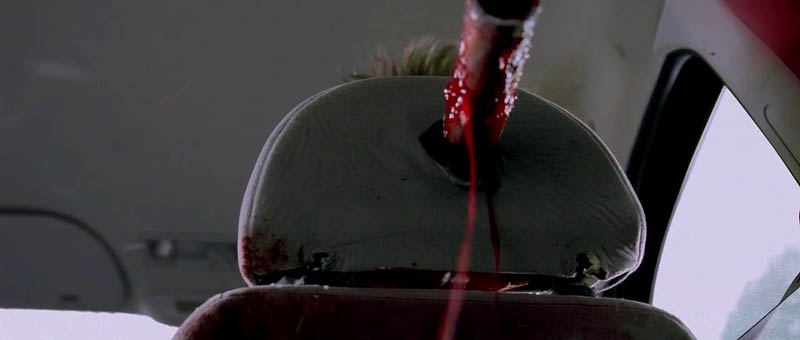
Indeed, that set-up is used only a few seconds later, when a gruesome car accident kills both Sarah’s husband and child, reframing our expectations once more towards a shock-based filmmaking. When a slow-motion shot shows us a metal tube perforating the husband’s head, any trace of generic ambiguity is gone. Shock and gore erase the fleeting moment of uncertainty to reassert generic conventions. These remain somewhat blurred for a while in the film as the formal qualities of the cave environment threaten to take over the narrative imperatives of the genre, but they never truly go away.


For a brief moment, The Descent offers a tantalizing glimpse of another film, a possible naturalistic character study centered on a family in dangerous places. That way only remains open for a few seconds in the film, but it leaves a lasting impression. Its openness points to richness of possible narratives which suggest that the characters are not mere cannon fodders, that they are not entirely constrained by the fairly rigid boundaries of a horror-driven tale. Simultaneously, it asserts the film-maker will to knowingly work in the genre, having examined other possibilities only to discard them.

The scene therefore works not only as a repetition for later sequences, but also as a miniature of the film’s structure: openness and promises violently brought back to the specific pleasures offered by genre conventions. The Descent may not be the most accomplished horror film in the Western canon. It is a smart and efficient movie, which puts forward its affection for the conventions it puts to use. It may, however, lead us to regret the many ways not taken, and the promises they held.

Gluey Tart: Kicking and Dreaming

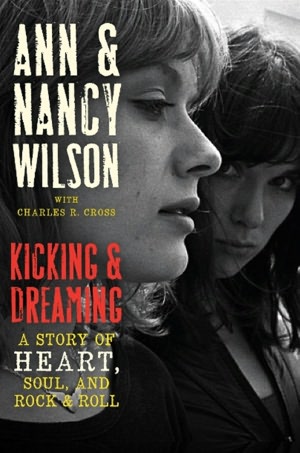
Kicking & Dreaming: A Story of Heart, Soul, and Rock & Roll, Ann Wilson, Nancy Wilson, and Charles R. Cross (It Books, September 2012)

As I work my way through the biographies of all my seventies and eighties rock heroes, I realize there’s no point in fighting my demographic destiny. I did expect this book to be dreadful, at least. Dreadful and tedious. Dreadful and tedious and full of repetitive boredom. Dreadful and tedious and full of repetitive boredom and clichés.  And of course it is not entirely free of dreadful, tedious, repetitive, boring clichés, but mostly it is “surprisingly readable,” title aside.

I have always wondered how Ann and Nancy Wilson managed to become kick-ass stadium rock stars in the age of Led Zeppelin and the Rolling Stones and Aerosmith and all those other very, very male bands. I always wanted to know how much of the early guitar sound was Nancy and how much of it was Roger Fisher.  And I always wanted to know how eighties and nineties Ann felt about being piled with huge hair and big, dark costumes, and shot mostly from the chin up in their videos in a viciously stupid attempt to keep us from noticing she had gained weight. (Answers: because they kicked ass; more Roger, in the songs I like best, but the acoustic stuff is Nancy; and humiliated and irritated, as one might expect.)

The book is told in snippets of narrative by Ann, by Nancy, by other members of Heart, by associates, friends, their mom, and Chris Cornell. This is a half-assed way to put a book together, but it does give Ann and Nancy their own voices. And they are charming. As fluttery, breathlessly dancing in a sun-dappled springtime meadow as you’d expect of anyone who wrote “Dreamboat Annie” and “Dog and Butterfly” and so on, but also as driving and relentless as you’d expect of someone who wrote “Crazy on You” and “Barracuda.”

That’s the dichotomy that made Heart brilliant, and frustrating. I can’t listen to any of their albums all the way through, and individual songs are often divided against themselves, the wild, hard-driving fervor never blending seamlessly with the frothy, acoustic effervescence. (I should point out that I speak of Dreamboat Annie through Bebe Le Strange; I don’t entirely acknowledge the existence of any of their other works.) But they have written some of my all-time favorite songs. I wonder if the hit and miss situation with so many Heart songs is because they were feeling out something that nobody had done yet.

A couple of million critics have written about this dichotomy as a balance of masculine and feminine, but that misses the point. It’s all feminine, and what gets called masculine is instead a side of femininity we don’t usually acknowledge. It was thrilling, back in the seventies, and it still is, more than thirty years later, even though we’ve gotten used to seeing women on a stadium stage. (“Straight On,” for instance, or “Magic Man” – these are pretty much perfect rock songs.) Which brings me back to wondering how they did it, when they did it. Or any time – but especially in the mid-seventies.

And they explain pretty well, considering that it’s really just one of those things. They start out by meticulously recounting their early lives, and in fact their entire family history. I found this touching, in part because I’m a huge fan of putting things in chronological order, but also because they love their family, and each other. I’m into that. They were a military family and moved all over the world during the girls’ childhood, making Ann and Nancy a solid, close unit. They were also musical from a young age. And they found the Beatles. Ann and Nancy see that as the crucial pinch of magic dust that launched them – or Ann, specifically – toward stardom. I’m less convinced; while all their friends were playing at being Beatle girlfriends, Ann and Nancy were pretending to be the Beatles, with guitars and everything. They already had whatever it was.

Next up: Who wrote what. I want to know who slept with whom or what as much as the next person, but I also want to know who wrote what, and under what circumstances. And the book has a lot about the music and about dealing with the music industry, which is always fascinating, in a degrading, evil kind of way. I’m curious about what inspired the songs, too, but that’s usually sort of discouraging. Magic Man, for instance, was a straight-up homage to Ann’s first and overwhelming love, Michael Fisher (brother of guitarist Roger Fisher and, for a few years, their manager). I’m somewhat uncomfortable with that overboard, overwrought song being about a specific man. That’s what happens when you listen in on someone’s creative process, though.

The book is also very much about Ann’s struggle with her weight – or, more accurately, the music industry’s struggle with Ann’s weight. She started gaining in the eighties and, eventually, she was fat. It doesn’t seem like such a horrible thing, but it just wasn’t allowed, in society or, especially, in the music industry. The shit everyone gave her over it destroyed her self-confidence, that blistering individualism that allowed her to get on the stage in the first place. (Well, that, and the music industry in general, and coke.) Have you seen any of those videos from the eighties and nineties? They have Ann’s hair so big she can barely stand beneath it, and her jackets and dark and broad of shoulder, excessive of lapel. She is shown in shadow, cloaked in smoke, or only in close-up, where the big hair and startling blush situation are supposed to fool the eye into thinking she’s smaller than she is. Or, perhaps, just short circuit the viewer’s thought process from an overload of confusion and perplexity. Either way, it’s pathetic. This is a beautiful and shockingly talented woman, and all the music industry could think to do with her was turn her into some kind of clown. That, and focus on Nancy.

This was more or less their approach to the music, as well. Most of Heart’s hits came after Bebe LeStrange, the 1980 album I consider their last acceptable one (although I haven’t checked in recently – I guess their albums from the last two years, Red Velvet Car and Fanatic, could be great – but I wouldn’t bet on it). Ann and Nancy tell the story of how the music industry repackaged them in the eighties, choosing hits they didn’t like and clothes they found ridiculous. I was pleased to find this out, because some of that shit is very, very bad, and knowing they realize this, at least to some extent, makes me feel much better about things. All the dirt about the music industry and its hangers on, by the way, is good stuff. It becomes very clear how bands go from brilliant to embarrassing in the space of one album. (Hint: Letting the music industry tell them what they need to do if they want to make it really big. Also, coke.)

I’d read a couple of popular feminist books recently, and I was surprised to find that the Heart biography was one, too. I don’t know why it surprised me, given their beginnings – perhaps because of songs like “All I Want to Do Is Make Love to You” (which it turns out Ann never liked, thank god; that song is the kind of shit you can’t wait to wipe off your shoe, and even then, you keep smelling it anyway). Ann feels strongly that she was judged by different standards than male rockers were judged by, and she suffered for it, and she resents the hell out of it. That isn’t tricky, as feminist arguments go, but sometimes simple is good. (I was glancing through the Amazon reviews, by the way, and noticed that Ron, an Indiana Republican who can’t spell, is unhappy about the book’s liberal leanings. Life must be frustrating for Ron.)

I got involved with this book, and not just because I spent at least a week reading it (its not exactly tight, and when you’re reading it in spurts of fifteen or twenty minutes a day, it seems endless). Also, I feel that now the Wilsons and I are so close, it’s cold of them to obviously leave out so much of the dirt – because the absence of certain things is palpable. (For instance, despite a decent number of generalized statements about drug use, there are surprisingly few actual anecdotes, making me suspicious. And in the later years, we learn about Nancy’s marriage to Cameron Crowe — and the demise thereof — but there’s almost nothing about what Ann was doing in her personal life over the last twenty years. What up, Ann?)  So, it was a bit of a slog, and a vague slog, at times, but that was all right. Ann and Nancy are likeable, and interesting, and they kick ass.

And I just saw that Rod Stewart has a biography out. God damn it.

The Horror! The Horror!

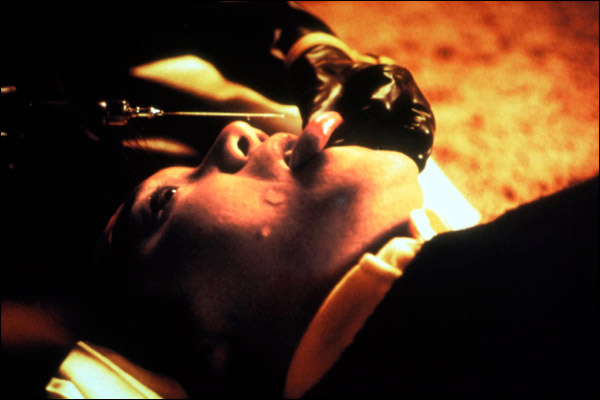
I recently watched Audition and Hostel, films famous for their viscerally graphic depictions of torture. I don’t think I flinched once during either of them; I didn’t look away, I wasn’t freaked out, I was unfazed and untrammeled. Needles through the eyes, feet hacked off, genitals severed — go ahead. Doesn’t bother me.

But I did watch one film recently that traumatized me so thoroughly that I almost couldn’t finish it. I covered my eyes; I stopped the playback; I walked away, ejected the disk, and promised myself I wasn’t going to finish it (though I eventually did.)

What was this terrifying, gruesome film you ask?


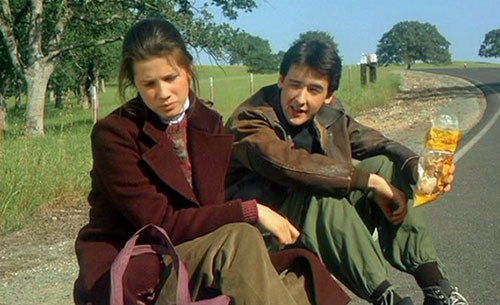
Would you believe Rob Reinter’s 1985 romantic comedy, The Sure Thing?

At least since I got through adolescence, I’ve always found sit-com style social embarrassment porn a lot more difficult to watch than anything having to do blood or horror. Watching Walter Gibson (John Cusack) squirm while his writing teacher reads out loud his roommate’s Penthouse Forum letter which he has mistakenly submitted for his composition assignment, or watching Alison (Daphne Zuniga) let herself be goaded into leaning out of a moving car topless — Eli Roth and Miike dream about attaining that level of sadistic ruthlessness.

Romantic comedies aren’t usually seen as sadistic of course. But The Sure Thing makes a good case that they are — or at least that this one is. Part of what’s so painful about watching it is the manifest contempt Reiner has for his characters. In “Say Anything”, Cameron Crowe presents his mismatched pair as lovable and natural — the female overachiever is cool and smart and funny and to be honored for her work ethic; the doofy kickboxing oddball is respected for his sweetness and his humor and his gallantry.

Reiner uses a similar smart girl/comic guy dynamic, but for him it’s an excuse for sneering rather than sympathy. Allison’s intelligence and focus are a constant cause for scorn; even her writing teacher tells her she needs to “live life to the fullest” — i.e., drink more beer and fuck more often. Walt, meanwhile, is given a completely standar-issue fascination with the stars to show that beneath the shallow, callous, frat boy alcoholic there lurk depths. Despite heroic efforts by Cusack and Zuniga, neither of their characters is remotely likable nor, for that matter, even provisionally believable. They fill the space labeled, “romantic lead here”, spouting more or less funny one-liners and/or engaging in cringe-worthy set-pieces, as the script moves them.

With the rise of reality television, I guess everybody now is more or less aware that people love to watch each other suffer extremes of humiliation. I don’t think folks usually connect those paroxysms of delightful social contempt with the pleasures of horror (or for that matter action) movie violence and revenge. But to me they don’t seem all that different — except, of course, that, compared to the gore and gouts of blood, the sit-com embarrassment is a lot more visceral.