The End of Hate

We’ve come to the end of our massive 5th anniversary festival of hate. An index of articles by author is here. We also have a handy index listing all the hated things themselves here.
___________________

A couple days ago, Jones (One of the Jones Boys), put up a post logically proving that it is impossible to have a worst comic ever. He argues that there are so many different ways for a comic to be bad that it is impossible to rate or weigh them. Or, as he puts it:

What I claim is that the ways a comic can be bad are irreducibly plural and literally incommensurable — there is no way to put all these different ways together so that you end up with a single dimension of badness (which, if you recall, is what we need in order to declare something the X-est Y, in this case the worst comic of all time).

I agree that this is a good argument for why there is no worst comic ever. The one flaw is that it uses the term “worst comic ever” in a way in which no one actually uses the term “worst comic ever.”

The point being…it’s hard for me to imagine that anyone participating in this roundtable, or anyone reading this roundtable, really believed when they picked a comic to discuss or read about that that comic was, in an objective or even in a subjective sense, the worst comic ever. Aesthetics isn’t math, and no one (except maybe Jones, in some of his more fey philosophical moods) thinks of it as math. When we talk about the “worst comic ever” we’re not actually talking about quantifying comics linearly. At most, I’d say, the ranking is a metaphor — and understood as such by virtually everyone who ranks any aesthetic object. Even in something like the HU Best Comics Poll, which was based on counting survey results, the organizer of the endeavor, Robert Stanley Martin point out that the ranking is “an interpretation”, not an algorithm — and that the list is therefore a conversation, not a solution.

Again, Jones focuses on the fact that there is no one — nor even two, nor ten, nor ten thousand — way(s) to evaluate comics. He presents this as evidence of the futility of naming the worst comic ever. But on the contrary, I think the impossibility and messiness of the task is precisely the reason that best of (and sometimes worst of) questions are fascinating — and illuminating. In choosing a best or worst, and in defending our choices, we reveal — and not just to others — what matters in art, and why. Of course those revelations are themselves often confused, vacillating, contradictory and vague — but that merely makes them a reflection of the aesthetics with which they’re engaged. Rather than thinking about ranking (or should we say criticism?) as a debased and innately functionless branch of logic, perhaps we could think of it as a genre itself — as useless, as frustrating, as stupid, as partial and as sublime as any other aesthetic effort to represent the world.
____________________

If the worst comic ever is a genre, one can perhaps ignore its possibility, and instead think about its tropes. In that context, and on the basis of this roundtable, I think subdee is dead on when she says, “Though there are exceptions, it seems to me that very often, to hate something you also have to love it.”

In life, real antipathy often has to wait upon love spurned — and that’s often the case in criticism as well. Thus, Bert Stabler writes about his early love and recent disillusionment with Chris Ware, while Jason Michelitch talks about his early love and recent disillusionment with Matt Wagner. Derik Badman and Richard Cook, on the other hand, write about realizing that that first shiny nostalgic love wasn’t so lovable after all. In other cases — for example, Ng Suat Tong, Susan Kirtley, Vom Marlowe, Matthias Wivel — love hovers in the background as a popular or critical imperative, transforming alienation or indifference into a more weaponized dislike.

Selecting the worst comic ever, then, seems to depend not only, as Jones argues, on all the myriad ways in which comics can be bad, but on all the myriad ways in which they can be good — and even more, perhaps, on the ways that it’s difficult to pull the two apart. The purpose or end of hate is love — and so, while this roundtable may be coming to a close, we can all rest easy knowing that as long as we love comics, there will be no end to hate.

__________________

Early on in the roundtable I mentioned that I didn’t think that hate was all that popular. Which just goes to show what I know. This last five weeks has seen far more traffic than we’ve ever gotten outside of the crazy couple months when the Victorian Wire post went viral. Perhaps the world really does love hate…but I suspect instead that the success is due to the genius, time, and care which all our contributors donated to help us celebrate our anniversary. Thanks so much to all those who posted, to those who commented, and to our readers as well. It’s been a great roundtable and a lovely five years.
_______

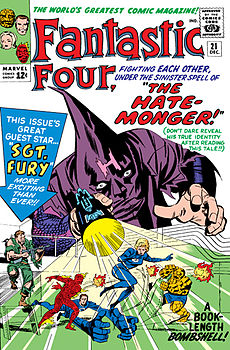
The cover is from Fantastic Four #21 by Jack Kirby (who, of course, is hated here.)

Hot For Teacher

This first appeared at Splice Today.
_____________

Student-teacher relations have been a source of sexual fantasy at least since the time of Socrates.  Across history, the young and the nubile meet the powerful and experienced in the fevered imaginations of both, as well as in a kajillion bad porn scripts.

Probably the most famous modern iteration of the archetype is Van Halen’s 1984 hit song “Hot for Teacher” and its accompanying music video. The latter infamously featured a teacher stripping to her underthings atop a desk and gyrating in front of a group of wildly cheering middle-school students.


Sex and kids is a sure-fire recipe for controversy, and inevitably the “Hot for Teacher” video inspired protest and condemnation from the usual quarters.  Looking back on it from a couple decades on, though, what’s most notable about it is its resolute unsexiness.  Part of that can perhaps be chalked up to changing styles and perhaps personal preference— the thin-as-a-rail, teased-out eighties models who play the part of eye candy seem more like weirdly dated manikins than like actual fetish objects.  When the camera lingers hungrily on the back of teacher’s skirt, the main impression you’re left with is, “Jeez; that woman has no ass.”

But there’s more to the lack of heat than just changing fashion.  Indeed, considering the subject matter, gyrating female bodies are really on camera for a remarkably limited period of time.  Instead, we get a lot of the Van Halen band doing a consciously campy Vegas dance routine beneath a glowing disco ball and numerous shots of Waldo, a bespectacled Clark Kent of a kid paralyzed with nerdiness.  And, of course, plenty of footage of Van Halen partying.  With kids.

The truth is that the video isn’t really about lusting after the teacher at all. Instead, it’s about lusting after a childhood in which you lusted after the teacher.  The whole short film is focused on adults imagining how cool they could have been in high school if they had known then what they know now — and, simultaneously, on kids imagining themselves as being adults. The Van Halen band members are portrayed both by the real Van Halen and by a group of kids dressed like the adults.  The video unabashedly blends both identities, with the adults sitting right beside their younger selves in class and the kids lip-syncing the lines in the voices of their grown-up doppelgangers.  The hot teacher is just an accessory; a convenient stand-in for the real passions, which are between male adults and their younger iterations.  The adults want the rebelliousness and goofy energy of youth; the kids want the sexual opportunities and confidence of grown-ups.  And both achieve their dream not by sleeping with the teacher, but by rocking out.

Unlike Van Halen, when Ke$ha’s sings about intergenerational sex she really sounds like she wants to have sex with someone other than herself.  Van Halen never even bothered to name the teacher they were hot for; Ke$ha does so right in the title of her 2010 bonus track “Mr. Watson.”  The song is addressed specifically to the object of affection, rather than, as with Van Halen, to a generalized audience of like-minded horn-dogs.  “Oh boy I just can’t wait for history class/ It’s my favorite hour of the day,” Ke$ha coos at the song’s opening.  She’s got the giddy, giggly energy of a high school crush — a far cry from David Lee Roth’s entirely impersonal concupiscence (“I wonder what the teacher is going to look like this year?”)

As this suggests, Ke$ha is much less coy about pretending to be an actual student than the Van Halen guys.  For Halen, the whole point of the song was the frisson between then and now. Ke$ha, on the other hand, comes on as if her wriggling butt is actually in one of those plastic chairs.  Instead of Eddie Van Halen’s swaggeringly virtuoso guitar solo, “Mr. Watson” is all bouncy bubble-gum choruses, chirrupy girl-group harmonies, and Ke$sha’s producer-sweetened, mewling vocals.

Part of the reason that Ke$ha’s song seems less distanced is perhaps that she’s playing an older student — someone of at least high school age. Or at least, I really hope that’s what she’s doing, because the song is significantly more explicit than Van Halen ever dared to be.  “I can’t put my finger on what’s so sexy/or why I want you in my bed/ (or on your desk)/is it your power or authority/or for the thrill of being bad?”   If Van Halen’s version of teacher-sex basically involved having the hot authority figure available as an opportunity for male bonding, Ke$sha’s version is a lot more direct in its desire to seize the rod of puissance. (“I want to get my hands in your khaki pants…mrow!”)

At first glance, Ke$sha’s song seems to serve equally as male or female fantasy (as she says, “I know it’s a fantasy of yours/ you know it’s a fantasy of mine!”)  And certainly, the kittenish yet sexually aggressive school girl complete with Catholic uniform is a male porn staple.  Still, the song vigorously objectifies Mr. Watson in a way that doesn’t necessarily cater to male tastes.  That khaki pants line, or Ke$ha declaring “Up on the chalkboard I just love your ass/ when you write notes it’s just shake, shake, shake” — you get the somewhat uncomfortable sense that she’s making fun of the guy.


And indeed, though he is named, and gets a specific ass and pants to call his own, at bottom (as it were) it’s not clear that Mr. Watson is any more real than Van Halen’s gyrating eighties manikins.  Ke$sha is explicitly lusting after and somewhat more subtly mocking a stereotype or an icon, not a person.  The excitement of the fantasy is, as she says, the ability to be girlish and innocent while simultaneously seizing sexual power.  The switch in gender and genre changes the exact mechanics, but the point isn’t that far removed from Van Halen’s.   Lusting after a fantasy teacher is a way to make the student more confident, more sexy, and more real.

“Teacher”, a 2009 single by weirdo indie art duo Ina Unt Ina takes a very different approach.  In the first place, it’s not a fantasy.  And, in the second place, it’s not heterosexual.

Two weeks to sixteen
leaning against the wall
kissing boys
but my eyes, my eyes are following you.

Why do I stare?
Why do I care?
Why do I stare?
Why do I care?

Teacher, teacher sexy creature.
I want to die and I don’t know why.

The music here is sparse electropop. The synth hook references girl groups, but without Ke$ha’s anthemic horniness.  Instead, the harmonies here are wistful and the cadences don’t really resolve. Instead the song drifts. The catchy melodies wash up against one another and the song at various points seems to almost stop before picking itself up and moving on again, as if it’s unsure when or where to end.

The point is fairly obvious; from a lesbian perspective, high school sexuality is less about seizing power and more about confusion, questioning, and a swooning loss of self.  Van Halen and Ke$ha know what they’re after, but Ina Unt Ina doesn’t even know why they’re after what they’re after.  “Early morning, on the roof, I’m secretly looking down/ watching you move, watching your hands, I’m secretly looking down.”   The distance between student and teacher which is so exhilaratingly easy to bridge for David Lee Roth or Ke$ha here becomes unbridgeable. Desire doesn’t pull Ina Unt Ina near; instead it pushes them out and up and away. The song finishes with the singers chanting “don’t know how to get close to you/don’t know how to get close to you.”  Desire is never consummated, and if the singers know themselves somewhat better at the end of the song than they did at the beginning, that knowledge only leads to more, and more poignant, uncertainty.

Again, this is obviously, and intentionally, a song about being gay.  Yet of these three songs, “Teacher” is easily the closest to my own experience of heterosexual high school crushes. Said crushes were not, as far as I remember, particularly empowering and/or triumphantly lascivious.  Instead, they were, for the most part, confusing and destabilizing.

Of course, Van Halen and Ke$ha aren’t going for realism.  They’re going for dreams of invulnerability; a kind of super-hero version of hyperbolic heterosexuality.  I get the appeal— both “Hot for Teacher” and “Mr. Watson” are great songs.  But I think we all learned in school that love is queerer than that.

Index of Hated Things

Charles Addams

Anything you can’t find on the rest of the list, probably

Peter Arno

Nate Atkinson

Autobiographical comics (all of them).

George Booth

Batgirl/Stephanie Brown Women in Refrigerators Story Arc

Betty and Veronica

Buffy: Season Eight

Roz Chast

Frank Cho, Liberty Meadows

The Collection of Sean Michael Robinson

Ctrl-Alt-Dlt.

Dragonlance #3.

Kazuke Ebine, Mahatma Gandhi

EC Comics in general.

EC War Comics in particular.

Will Eisner, The Spirit.

Gardner Fox/Carmine Infantino: Adam Strange/Justice League Team-Up

Neil Gaiman, Sandman

Neil Gaiman in general

Edward Gorey

Fletcher Hanks.

Jamie Hewlett, Tank Girl

Helen Hokinson

Geoff Johns, Blackest Night

Kim Dong Hwa’s Color Trilogy

Jack Kirby

Rich Koslowski, Three Fingers

Regis Loisel, Peter Pan

Jason Lutes

Milo Manara, Fatal Rendezvous

Robert Mankoff

Benjamin Marra, Gangster Rap Posse

Alan Moore/Brian Bolland, Killing Joke.

Alan Moore/David Lloyd, V for Vendetta

Alan Moore/Dave Gibbons, Watchmen

Thomas Nast

New Yorker Cartoons

Tsugumi Ohba/Takeshi Obata, Bakuman

Denny O’Neill/Neal Adams, Green Lantern/Green Arrow

Natsume Ono.

Alex Ross and Mark Waid, Kingdom Come

Johnny Ryan

Dave Sim and Gerhard, Cerebus

David Small, Stitches

Art Spiegelman, Maus

Spirou et Fantasio a New York

J. Michael Straczynzki, Midnight Nation

J. Michael Stracyznski in general

Osama Tezuka.

Craig Thompson, Goodbye Chunky Rice

Craig Thompson, Habibi

Matt Wagner, Batman/Grendel II

Western Civilization

Judd Winick, Pedro and Me

X-Men: Onslaught

Ai Yazawa, Nana #22

__________

Click here for the post author index.


The Collector


“Hate the collection, not the collector.”

It’s informal among the young, with no adult to guide or instruct. Myself, I clipped out pictures of the Space Shuttle, articles about satellites and astronomy, kept wine corks, and acorns of unusual size or beauty. But these gave way to more formalized assemblies—Star Wars figures, Transformers–other excuses for a child to amass plastic, aided by my youthful addiction to weekend garage sale scavenging with my father.

When toys lost their appeal my interests turned to print and all of its little reproductive miracles– at first baseball cards, that boyish gateway into non-functional collection, but later more esoteric items, including, in one frenzied weekend, a mania to obtain as many artist business cards as possible from a craft show I attended with my mother.

Comic books found me.

Comic book–such a strange name for such a potent, humorless object. Graceless pulp perfection, a newsprint narcotic, collectible crack cocaine. Numbered, serial, unrelenting, reaching simultaneously into the fictional past and some fictional distant future. The mania I had for them subsumed my own miseries, buried all of those real, flesh and blood problems in a fountain of faded black and Ben Day, in a river of rising action and explanatory narration and hastily-drawn explosions.

Mr. and Mrs. S___ were friend of my parents. Let us consider them now. The husband, Mr. S____, kept his twin passions of science fiction and comics ordered and concealed in long white boxes on the shelves of his closet, away from the judgmental eye of his wife Mrs. S___. Mrs. S___, meanwhile, had her own enthusiasms, that manifested themselves as an explosion of goose and goose-related paraphernalia. Goose paintings, goose-endowed wicker baskets, goose-embossed cut-glass decanters. Gooses everywhere.

It was Mr. S___ that gave me my first comic book, who introduced me to the monthly pleasures of the newsstand, just as my father had initiated me into the rituals of the baseball card years before. (It was a Star Wars comic, appropriately enough, some “reading copies,” as he was hoarding the pristine remainder for his retirement in the distant future, where they would doubtlessly be redeemable for a condo on the beach or health care, just like government bonds or platinum jewelry.)

O Comic Book. When I left home for college I somehow escaped your orbit, was distracted by Bands and Relationships and Suicide by Degree Program, all of the clutter that entered this thin life only to expand and choke you out until there was no room for you at all.

And I thought maybe that’s part of the process of growing up– like breast feeding, or being carried on your father’s back, one of the pleasures of childhood that we are asked to master and cast off, or to transform into a new, more socially-acceptable form.

Or so I thought until I actually entered the adult world, and found the same mentality everywhere. Wanna-be guitar players hoarded gear, writers hoarded books. Some special few hoarded their sexual conquests, collecting names and photos and various details in the same way they might have traded rookie cards and E.R.A. stats as children. My fellow teachers at the high school beat off the tedium of their lives with a bewildering assortment of afflictions—some under the thrall of Disney, their offices stuffed with various pieces of Mouse-related ephemera, others Christmas enthusiasts, still others obsessed with the paraphernalia of their own past, each trophy or jersey or photograph another bid for their younger, better selves to live on beyond the death of history.

And at twenty-five, as I took my first tentative steps towards being a cartoonist, I found that the collecting impulse in myself had returned, justified through my need for always more skills, more progress, more models that I could analyze, or copy outright. I had always been a stylistic mimic, even as a high school journalism student, able to produce copy on demand in a wide variety of voices. Now, as I built up my cartooning chops, the inclination toward pastiche returned, and every new book, every new comic, was another world to be strip-mined for technique. My collecting, I told myself in unsure moments, had utility.

This is the lie at the heart of every collection.

Jamie– Pez dispensers, Hardy Boys hardbacks, CDs and DVDs, Coke paraphernalia and bizarre furniture and costumes.

“I realized the other day that I’m never going to be able to live with you again, because you’ll never be able to afford a place that can fit all of my stuff.”

Michael C___ –CD’s, DVD’s, records, rock music criticism, books and other ephemera.

“I thought about getting rid of it. But the thought didn’t last long. What would I be without my collection?”

Some Guy Who Lived in West Palm Beach- data hoarder

“So, you have any other CDs I can burn? I’ve got a terabyte collection going now. What? Oh, yeah, you know, I listen to them when I paint.”
Woman Who Lives Down the Street From Me– cats, newspapers

“I don’t understand why they set limits to how many pets you’re supposed to have. There are no limits to love.”

It was five years of teaching for me, five long years of emotional exhaustion, of  a can of Coke every lunch, naps in the afternoon, waking up alone and scared and bewildered; grinding my teeth—and always surrounded by more stuff. Books—comics of all stripes, science fiction, YA novels, the objects of my childhood desires suddenly obtainable through the twin miracles of Internet shopping and a steady paycheck.

Until one day I was ready to be done.

It was only the job at first—the collecting continued on after the income passed, more bargain-oriented but not gone. Not until the end.

Arguments, the kind of arguments where no one wins, nothing is better, and there is no way out but death, or separation. And so they both came. Death of pet. Divorce. Foreclosure. Complete reorientation of goals and expectations and desires for life, a bewildering array of choices and chores and shifting ground and uncertainty.

Because they were the most precious to me, they had to be the first to go. Dissembling the shelves was the hardest part. I felt sick and strange and slow, the feeling familiar even as it crept up my sides and down back and into my stomach. It was the feeling of finality, of loss, that same feeling I felt when we sat there together on the dirty carpet and divided up the things on paper, our lives and everything we’d done a series of numbers in blue ballpoint ink on the back of a torn envelope with my name on the front, in her loopy script.

And, like that final argument, the pain was only eased by the leaving. When the man came and brought the dozen-odd boxes of books from the room I felt nothing but relief, a relief that came, in fact, from the first few gone. A handful of books, the acceptance of that loss, and it seemed the spell had been broken.

But like anything that’s been useful to us in the past, the feeling returned. I wasn’t collecting books anymore, or possessions—it was collecting work, collecting attention. Links to my articles and comics, discussion of them. The negative and the positive were remarkably alike, served that same function—something that reminded me that I existed, that I was alive.

Writing. My own drawings. My productivity.

The stack of publications I’ve created or appeared in. Posters I’ve drawn and designed, boxes of albums never sold. Love letters from people I’ve lost and forgotten, old spirals covered with notes and doodles and hundreds of songs half-finished and abandoned. The heavy box in the upper shelf of my closet, underneath that blanket I still need to give back to my ex, heavy with the first 300 pages of a graphic novel that no one will ever read, a book years in the making that I abandoned at the harsh words of a handful of friends.

Everything I’ve made, I cling to.

I need to bury you too.


__________
Click here for the Anniversary Index of Hate.

The Color of Hate

I am a generally happy person. A cockeyed optimist. A Pollyanna. Hell, you know, I’m from the Midwest. I like to like things, and I try very hard to do so. As a self-directed blogger with no editorial mandate to adhere to but my own, I skip merrily through the world of East Asian comics, content to linger over what pleases me. I rhapsodize over the books I enjoy and blow through the rest as quickly as possible—like a panicked sprint through the unexpected cloud of gnats on an otherwise peaceful summer stroll.

For a person like me, “hate” is a fairly nebulous concept, and not all that easily accepted or even understood. For me to hate something—to really loathe a thing—it needs to hit me where it hurts. I can’t vigorously hate a book or a comic or a Broadway musical, say, for simply being incompetent (*cough* Baseball Heaven *cough*). I must be truly, inconsolably offended in order to come even close to real hate.

That said, there are a number of comics I’ve disliked intensely over the years—mainly since I began reviewing things I wouldn’t necessarily choose for myself. Notable objects of my rage have included gender-regressive shoujo manga like Black Bird; creepy, campy BL like Tricky Prince; and the fat-shaming caricature that is Ugly Duckling’s Love Revolution. One of these titles even prompted an experiment to discover how often and how thoroughly I must trash a single series before the publisher would stop sending me new volumes (answer: to infinity). The thing is, when I go back and read my reviews of these books, each of which has incited rage, they seem kind of… weak. Despite my wrath, I could never truly commit to hating these comics, due to their lack of serious intent. Nobody thinks Tricky Prince is Serious Business, including Tricky Prince, and it’s hard to work up genuine, lasting hatred over something that was intended to be disposable from the start.

Then came the Color trilogy.

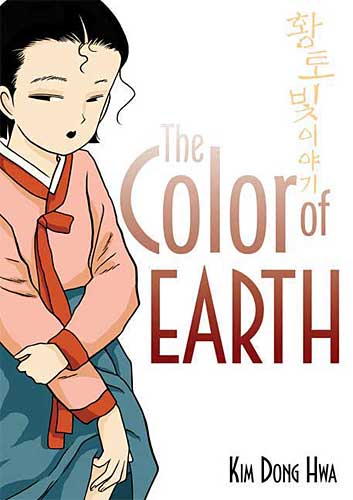
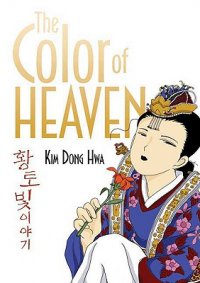
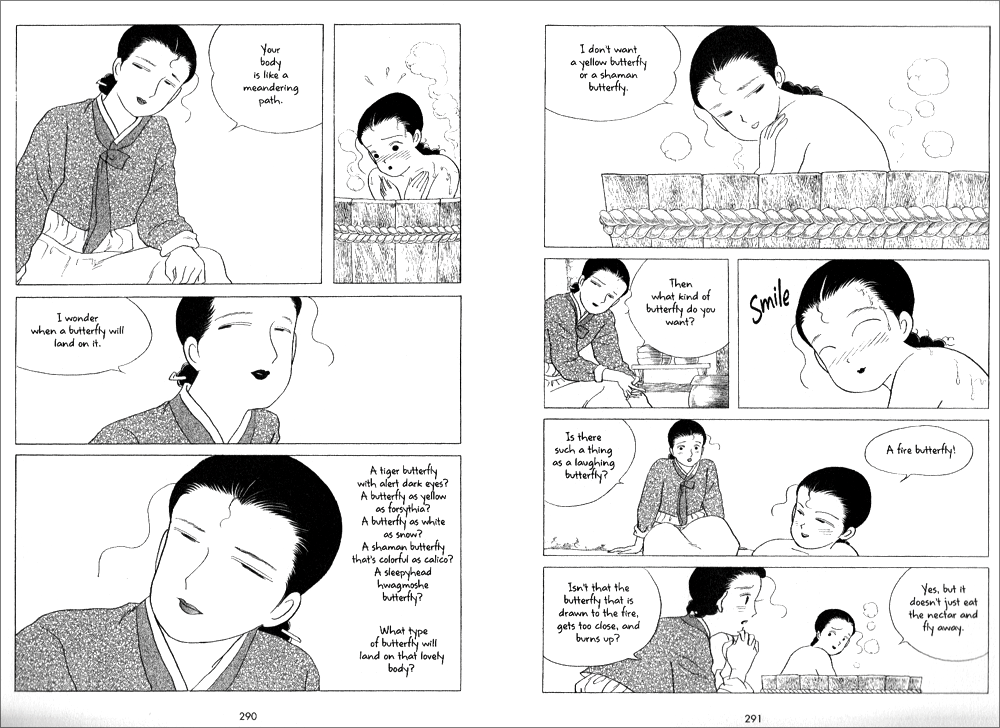
In 2010, I volunteered to host the first manhwa edition of the Manga Moveable Feast. A number of titles were suggested and put to a vote, including some personal favorites, like Byun Byung-Jun’s quirky short comic Run, Bong-Gu, Run!, Uhm JungHyum’s moody romance Forest of Gray City, and JiUn Yun’s sumptuous collection of ghost stories, Time and Again. Unsurprisingly, however, the vote ultimately came down to Kim Dong Hwa’s critically acclaimed manhwa trilogy, The Color of Earth, The Color of Water, and The Color of Heaven, published in English by the lovely folks at First Second. Though I was a big fan of Korean comics in general (and certainly knew of Kim’s series), I hadn’t read read more than a few excerpts myself, so I dug in with verve. And then the hate… oh the hate… it was like nothing I’d experienced as a comics reader before.

The Color trilogy is a coming-of-age story revolving around Ehwa, a young girl in pre-industrial Korea who is being raised by her mother—a widow who runs the local tavern. The story spans Ehwa’s life from the age of seven (when she is first made aware of the existence of penises, thanks to a boys’ pissing contest) through her wedding night (when she gets to know a very special penis on more intimate terms). I choose these parenthetical descriptions purposefully, because that’s what this series is really about: penises and the pursuit of same—that is, when it’s not too busy going on about the lusty beauty of a ripening young woman (yes, these words are chosen purposefully as well).

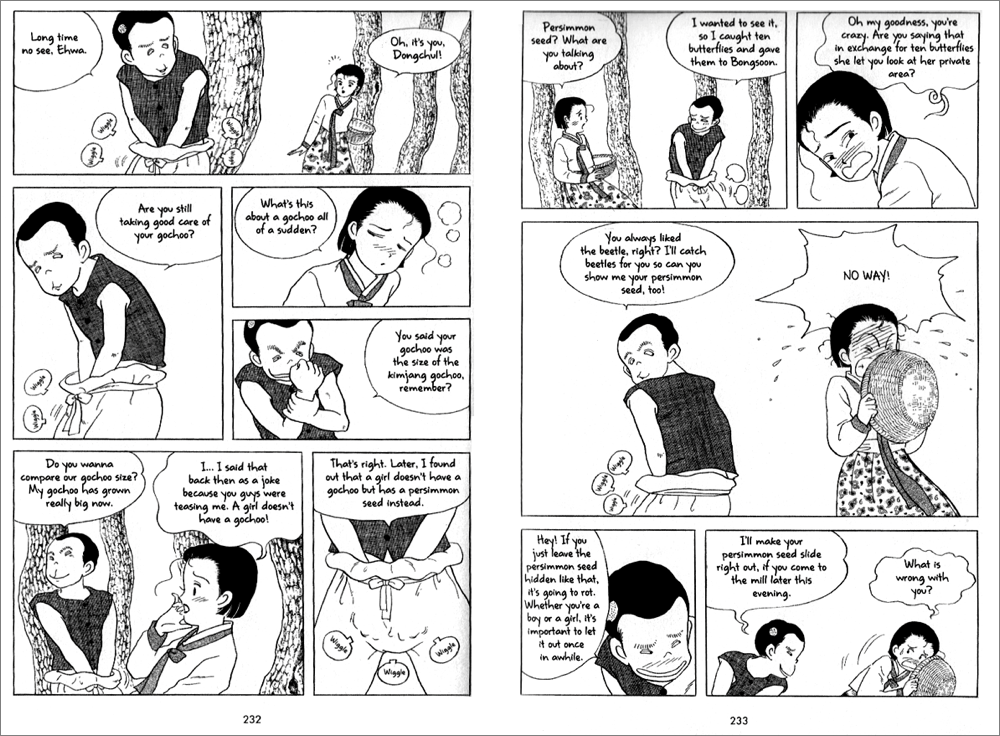
First, the penises. As I mentioned, the story opens with Ehwa, at seven, stumbling upon a pissing match between two local boys. The boys are deeply proud of their own “gachoo” (chili peppers, also a euphemism for “penis”) and they ask Ehwa to show them hers. This sends Ehwa into a tizzy, as she wonders if not having one indicates that she’s deformed. One of these boys is so consumed by his love affair with his own penis that he will later be portrayed as being unable to take his hands off of it.

(click image to enlarge)

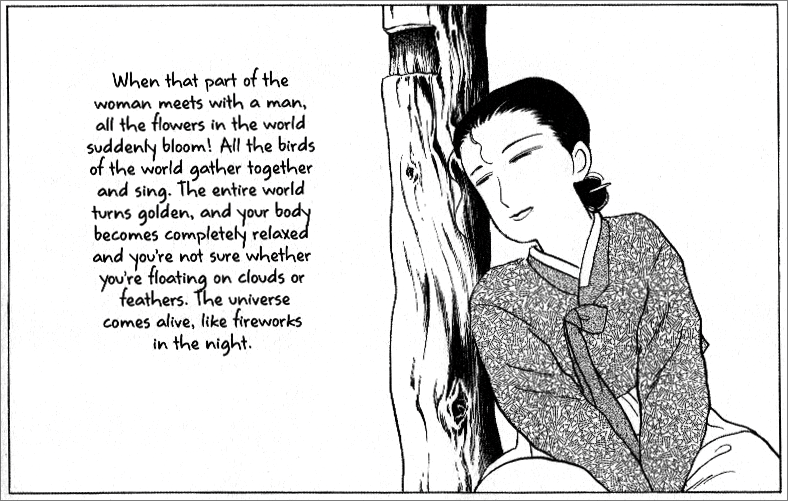
Hey, why should he? It’s a really awesome thing, that gachoo. As Ehwa’s mom explains to her later (after buying a whole lot of ginseng to cook with in order to boost the, uh, energy levels of her traveling suitor known only as “The Picture Man”) when a man’s gachoo comes into contact with a woman’s “persimmon seed” (seriously, this is the kind of language Kim uses throughout the series), something magical happens.

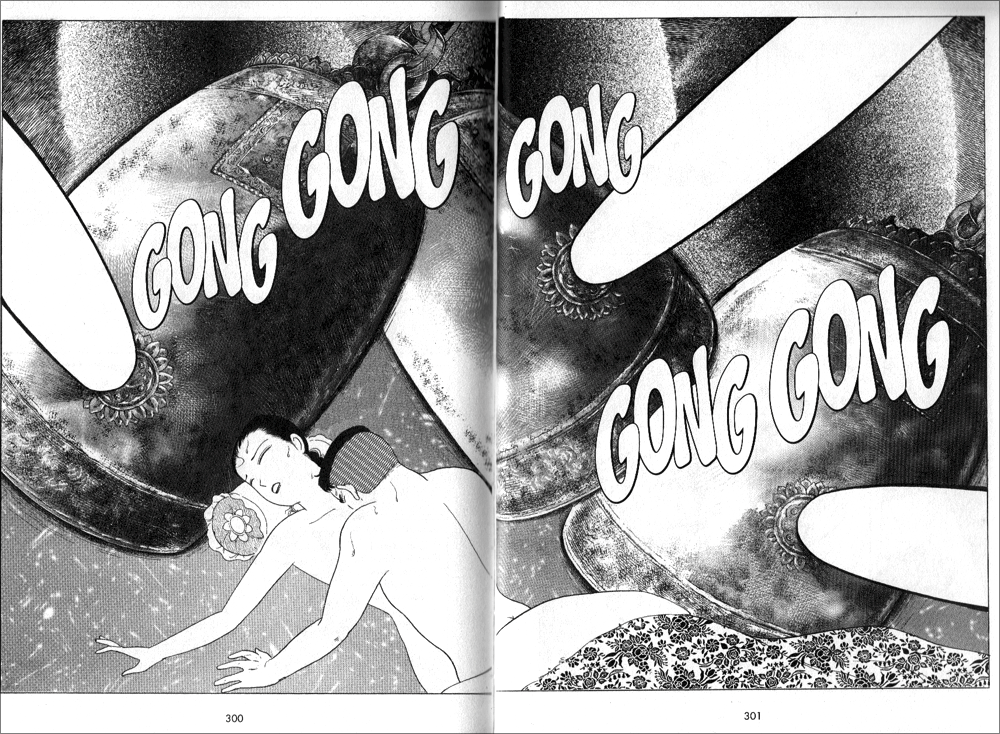
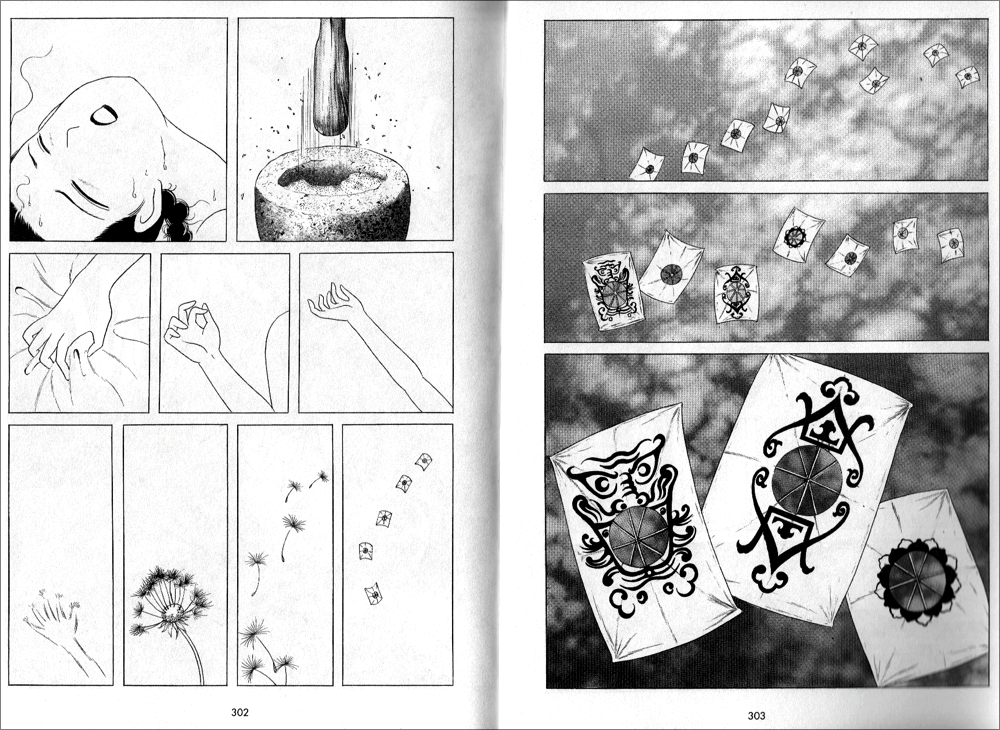
Fortunately, Ehwa gets to experience this magical, floaty, firework-y business for herself at the climax of the book (Get it? “Climax”??), as she’s losing her virginity to her new husband. Though in her case, fireworks and floating on clouds feels more like… a super-phallic bell choir? Mortar and pestle? Um… ?

(click images to enlarge)

Though I joke about this being the “climax” of the series, it actually is just a few pages from the end. Ehwa’s journey really does quite literally span the time between discovering penises and getting to be penetrated by one. The entire point of her existence as a character can be summed up this way.

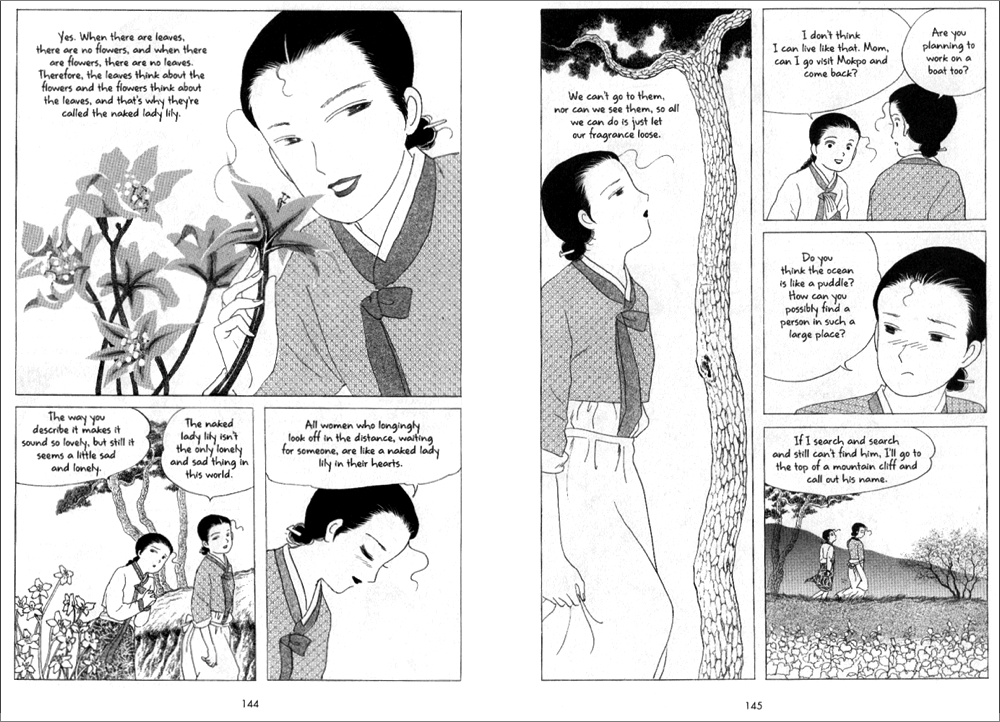
What happens in the middle is largely waiting. Waiting, waiting, waiting. Both Ehwa and her mother fall for wandering men—the kind who spend most of their time traveling for work or simply out of restlessness, but stop in for sex every few months or so. (I once described this type as “… a big, strapping man who values the freedom to wander, is good in a fight, a stallion in the bedroom, and offers questionable financial security. Another male fantasy?”) While this is undoubtedly appropriate to the period and to these women’s circumstances, Kim spends so much time lingering on the wistful beauty of the lonely woman, it begins to feel like a bit of a fetish.

(click image to enlarge)

Scenes like this are peppered throughout, along with long-winded discussions in which the lonely, waiting women, the wandering men, and generally everything else of consequence in the story are described as various types of local flora and fauna—to the point that it eventually becomes difficult to remember what or whom all the different flowers, insects, and trees stand for. More than anything else, however, Kim lavishes over the beautiful pain of Ehwa and her mother with genuinely lovely artwork and flowery language worthy of Anne Shirley’s Rollings Reliable Baking Powder story.

But while Kim’s obsession with the feminine loveliness of his characters’ longing reads as simply insulting, his fascination with Ehwa’s burgeoning womanhood borders on downright creepy. Kim is quoted as saying that “the process of a girl becoming a woman is one of the biggest mysteries and wonders of life.” And it’s clear from his portrayal of Ehwa that he considers that process to be entirely sexual. Ehwa has no interests outside of sexual attraction and whatever else is happening with her body—not the tiniest thing. In fact, despite being the only child of a single woman running a tavern all on her own, she doesn’t even seem to have chores to take her mind off her dramatic puberty. Growing up mentally, emotionally, or even just practically seems to be of little consequence to Ehwa or her mother (who remembers just as Ehwa is about to get married that maybe she should teach her how to cook). And while I feel vaguely ashamed for wishing that a female protagonist might take some interest in housekeeping, it at least would give her something to care about besides the long-cherished promise of touching a man’s gachoo.

But while personal interests, hobbies or even standard domestic pursuits appear to be superfluous to “the process of a girl becoming a woman,” the relevant items seem to be:

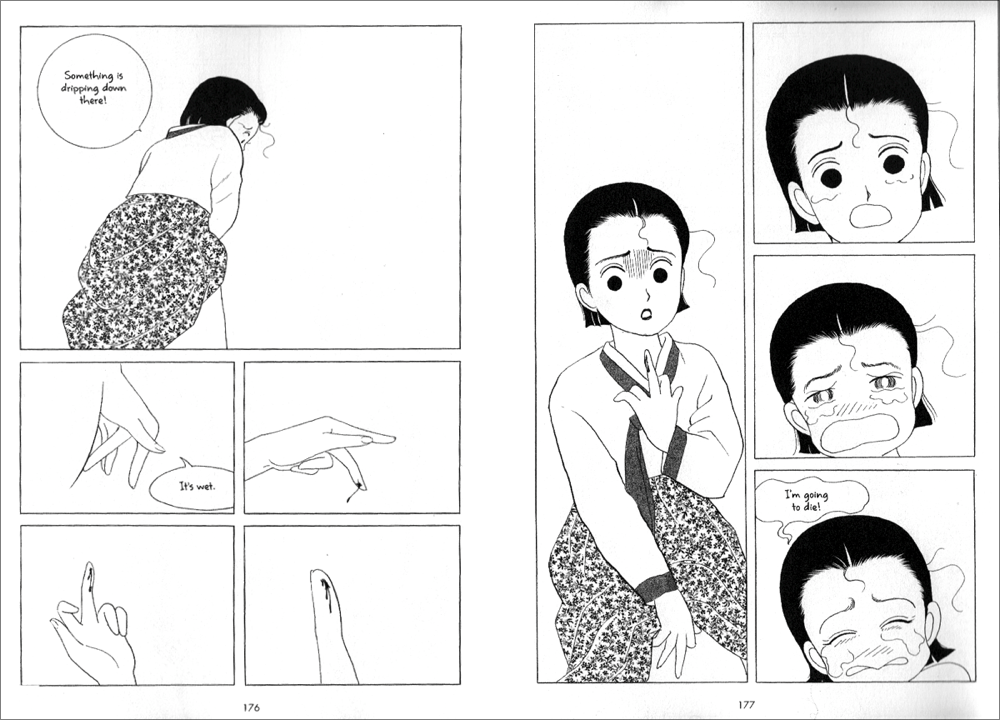
Getting her period.

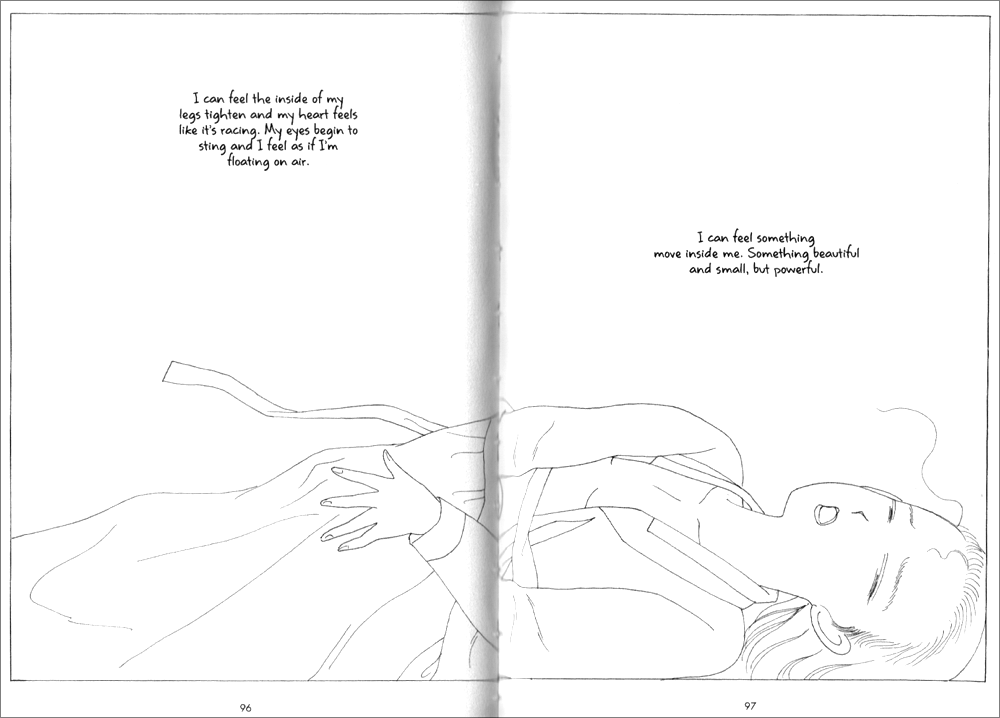
Learning to masturbate.

And attracting penises butterflies penises.

Yes, Kim Dong Hwa, these truly are the most important aspects of a young girl’s blossoming into womanhood. Thanks for noticing.

Of course, in the end, it’s not Kim’s romanticization of regressive gender roles that really bothers me here, or even his semi-creepy fetishization of womanly “blossoming” (seriously, everything’s got a flower metaphor in this series), not when you get right down to it. I’m a manga fan, after all. I’ve read Black Bird and Hot Gimmick. I survived the first omnibus of Love Hina. I’ve participated in a (not entirely scathing) column on boob manga. What makes me really hate the Color trilogy, is that it’s so widely praised and admired, by male and female readers alike. It is absolutely Serious Business, and that makes it rare fodder for my hatred.

In the books’ endnotes and in Kim’s official bios, he’s referred to repeatedly as a “feminist” writer. He is credited with possessing an “uncanny ability to write from a profoundly feminine perspective.” When, during the Manga Moveable Feast, Michelle Smith and I accused Kim of regarding his female characters’ limited life choices and oppressive environment with “loving nostalgia,” we were criticized in turn for expecting more progressive sexual politics from a period piece. The Color of Earth was published in 2003, yet even Tezuka never treated his (highly questionable) female characters with this kind of rosy condescension.

I tried very hard to like the Color trilogy, but even my most sincere, Pollyanna efforts failed me on this point. In the end, it may be one of the very few comics this midwestern optimist could ever truly hate.

__________
Click here for the Anniversary Index of Hate.

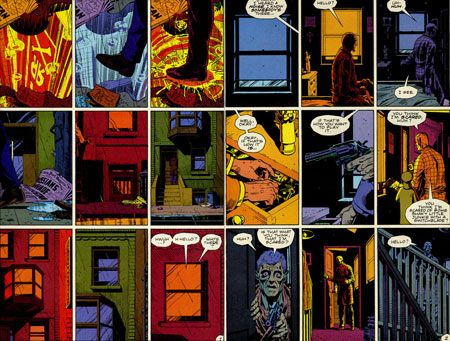
Why I Hate Watchmen

When Noah announced this hate-fest, I knew immediately that I’d write about Watchmen. What was less clear to me was why—what is it about this book that irks me so much? Why do I silently roll my eyes every time someone starts waxing poetic about Moore’s genius?

The truth is, I should adore Watchmen.

It’s a comic book-loving English major’s wet dream—multi-genre, intertextual, metafictional. So much of what people identify as masterful in Watchmen matches up nicely with the things that gives me incredible intellectual joy in other books, the kinds of thing I try to get my students excited about in class.

Plus, it has superheroes in it. Despite the entrance fee to the comics scholars club being a complete disdain for all things superhero, I really love a good superhero story well told.

So, Watchmen should be a perfect storm of all things that fill me with geeky, intellectual joy. The only problem? I really, really dislike this book. So much so, that I’ve never managed to read all of it, despite numerous tries.

My husband bought Watchmen for me the first year we were married. Comic books moved into my house along with my new husband. I was hooked, powerless to resist the heady combination of new love and Spidey angst. While I would eventually develop my own comic book preferences (I quickly began to favor alternative, autobiographical, talky, snarky books), my comic reading tastes have been forever shaped by the books my husband loves best — Marvel’s superheroes. He loves Spider-Man; so do I. He adores Avengers; so do I. He thinks Kirby is a genius; so do I. He finds the X-Men insufferable; so do I. So when he, and every fanboy I knew, said I should read Watchmen, I fully expected to love it.

But I didn’t. Not even a little. I figured it was me, that there was some context or history or secret code I just wasn’t getting that prevented me from liking the book. But each time I’ve tried — when students ask about it in class, when the film came out, to write this piece — I have the same reactions.

I find Watchmen dull, flat, and, above all, pretentious. And I say this as a person who regularly tries to get students to see how funny Melville’s “Bartelby, the Scrivener” can be.

First, it is ugly. So ugly. I get that aesthetic and artistic quality are in the eye of the beholder. I love Jeffrey Brown’s and James Kolchaka’s styles, and wouldn’t call them pretty at all. My students and I regularly have arguments about whether or not Charles Schulz could draw well. So, yeah, I get that we can enjoy comics drawn in a bunch of different styles. But, c’mon, people. You can’t really enjoy looking at this book. It’s visually crowded, the people are unattractive, the colors are weird. And yes, the visual style is working actively to help tell the story of the ugliness of the world. I get it. But it doesn’t make this book any more pleasant to look at it.

I could let the ugliness slide, though, if the characters were in any way interesting. I feel no connection to these characters. I don’t care enough about Dan Dreiberg/Nite Owl to trudge through his ornithological articles. Laurie Juspeczyk and Dr. Manhattan’s relationship fails to induce any sympathy. Rorschach and Ozymandias are just dicks. I don’t have to like characters to enjoy a story, but I do need to care something about the narrative arc they travel. And in Watchmen, there’s no single character whose life I care enough about to carry me through to the end.

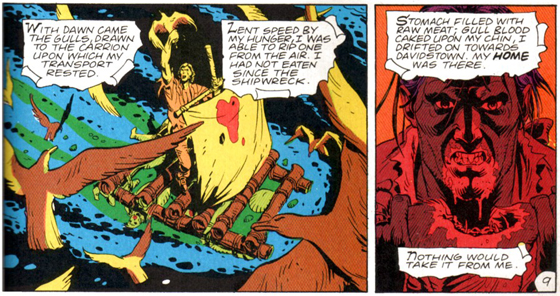
And don’t get me started on that fucking pirate comic. Good god, people!


Most of all, though, I find the books seeming raison d’être, a critique of the superhero concept, to be just plain annoying. I just don’t buy that superhero stories are necessarily fascistic, that enjoying a superhero story makes you necessarily suspect, that we should always be suspicious of do-gooders. The cynicism of the story, and, frankly, the cynicism of many of its fans, is just plain tiresome — not artful, not clever, not profound, just tiresome. Like the hipsters slouching in the corner, smoking American Spirits, harshing on the squares, I find Watchmen guilty of trying way too hard.

So, let’s make a deal: I promise to nod politely whenever you to start to gush about this book, as long as you don’t expect me to join in.
__________
Click here for the Anniversary Index of Hate.

I hate you because I love you: Shonen Jump boys’ club edition

Seconding other contributors that I don’t go out of my way to read comics I don’t like, so for this roundtable I had to reach back – way back – to when I’d read anything.

You know how it is: you read comics with your friends, and you’re all willing to spend more time on the things you don’t like – maybe because you haven’t worked out how to tell yet, within the first couple chapters, when a series is going to the dogs. Or maybe because you’re students or underemployed, with more time to spend on stuff that’s bad (in an interesting way) as well as on stuff that’s good. Or maybe because your friends are like me and mine, a bunch of fanfiction writers who are drawn to flawed art like wolves to wounded prey.


Not this kind of wolf, obviously

In any case, I don’t hate these flawed comics (or manga). Rather, I am fond of them: because they were good enough at the time, because even the bad ones were entertaining, and because I read them as a part of a community that didn’t expect perfection – and actually, probably, preferred some flaws in the first place.

So why read something you hate – I mean really, truly hate? Because you didn’t know you would hate it? Because other people – the in-crowd, the public – love it? Because the people who matter – your friends, critics you respect – love it? Or maybe because in another lifetime, you might have loved it too?

Though there are exceptions, it seems to me that very often, to hate something you also have to love it. A series you “hate” in this way is a series you would have loved, if it wasn’t for this one, specific, terrible thing that you hate. That’s the kind of hate I’ll be talking about in my article about Bakuman.

Bakuman is the second manga series by writer-artist pair Tsugumi Ohba and Takeshi Obata, who previously worked on Death Note together. Death Note was a mess by the end – and morally challenged from the beginning – but I have fond memories of it since it was the first manga series I got really into with other people on the internet.

There was so much bad faith moralizing in that series. A single sociopath high school student was going to make the world a better place by killing already-apprehended criminals, who were waiting in jail for their sentences to be decided, using a magic notebook. This would deter other criminals from committing crimes, leading to a better, crime-free world. Because it’s the countries that have a transparent, (semi-)functioning justice systems and active, (semi-)free cultures of journalism, that report on crime and imprison criminals according to the rules of law, that are the worst off, am I right?
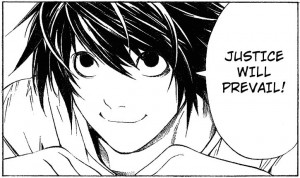

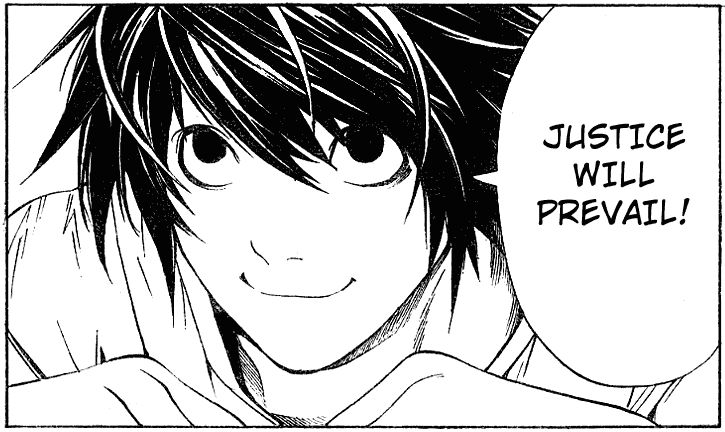
You tell ’em, L!

The thing is, while Death Note did a pretty good job of painting Light, the megalomaniacal serial killer high school honors student who lucks into the possession of an instrument of mass murder, in a negative light (because power corrupts and only the corrupt seek power), it didn’t really have many characters who were much better – who were morally upright and competent. When a character with brains and morals did show up, s/he was first brought down below even Light’s level (supporting torture, for instance), or else shown up by Light, and then killed. And more importantly, Death Note never really questioned whether Light’s “plan” to become “God” of the “new world” would work. If you are smart, you are better than the system, but when you exercise that superiority, you become a monster, the series suggests. The System eventually catches up with you and kills you, justice is served, the end.
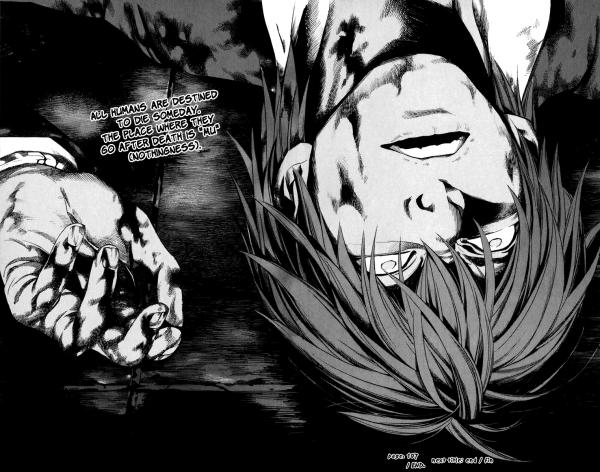

It’s not a spoiler because the series had to end this way.

But I don’t hate Death Note. In its own way, it’s an interesting morality story, or at least an interesting look into Ohba’s twisted mental landscape. It’s also a work of the zeitgeist, tackling – among other themes – Japan’s 2004 shift from trial by judge to trial by jury (see below) and whether torture can ever be justified. You can also, if you squint, see some questions about memory and identity, as Light becomes a very different person during the brief period when his memories of the Death Note are removed.
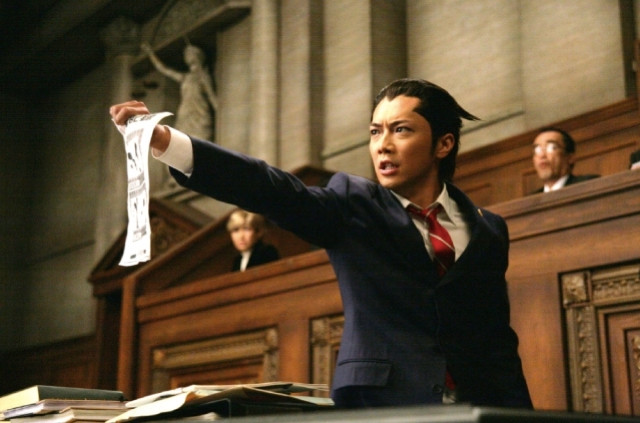

Japan’s shift to a lay jury system was also tackled by absurdist Nintendo DS series Phoenix Wright: Ace Attorney, now a live action movie directed by Takahashi Miike

We don’t know very much about Death Note author Ohba, other than that he – or she – is a bit OCD, draws him/herself as a woman on the album sleeves, and is rumored to be a well-known novelist when not moonlighting as a rookie manga author. Obata, meanwhile, is a very well-known artist, having previously illustrated Yumi Hotta’s critically acclaimed manga Hikaru no Go and worked as an assistant under Nobuhiro Watsuki on fan-favorite Rurouni Kenshin. Death Note’s success, as a comic and not a vehicle for Ohba’s wacky ideas or convoluted plots, is no doubt down to Obata, who reportedly handled most of the character designs and, especially in later volumes, the page layouts. In a comic where everyone either agrees with the hero or is hopelessly naïve – or is pursuing a private agenda – Obata’s distinctive character designs help to make every character unique and identifiable.
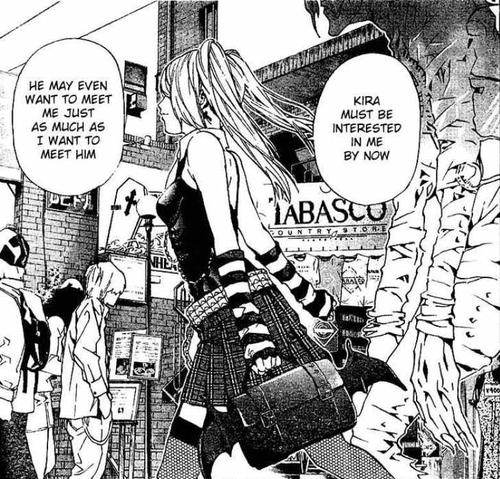

And he has great fashion sense, too

Flash forward to Bakuman. In an Ouroboros-like plot, this is a manga about making manga. The protagonists, childhood friends Moritaka Mashiro and Akito Takagi, are an artist-writer pair just like Obata and Ohba. They share a dream, of being published in Shonen Jump (the magazine that serialized Death Note and Bakuman), coming in #1 in the reader popularity polls, and having their comic adapted into an anime, at which point Moritaka’s childhood crush will be cast in the title role and they can finally be together.
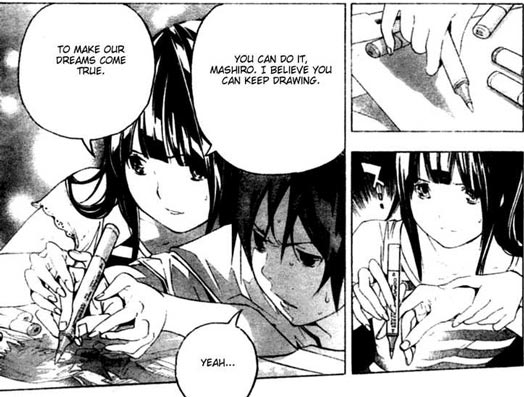

Moritaka and his future wife have a pure love. There are no Freudian implications here at all.

It’s exactly the kind of thing I really like. As in a lot of other exaggerated, but ultimately (mostly) non-fantastical shonen manga, you can learn something by reading Bakuman. In this case, you are not learning about bread, or wine, or shougi, or go, or American football; rather, you are learning how to become a famous mangaka for Shounen Jump. There’s a lot of actually very good behind the scenes analysis in Bakuman, covering topics like: how the popularity poll results are counted, how to submit work to a contest, what kind of work sells for what reasons, how to work with an incompetent editor, and how to hire and work with assistants. Just like in Hikaru no Go, you don’t get the sense that the protagonists are “ordinary” or that their rise to the top is easy. In Bakuman, Moritaka and Akito live and breathe manga. At one point Moritaka – still in middle school – is hospitalized for overwork, proving he is off to a good start in his professional career.
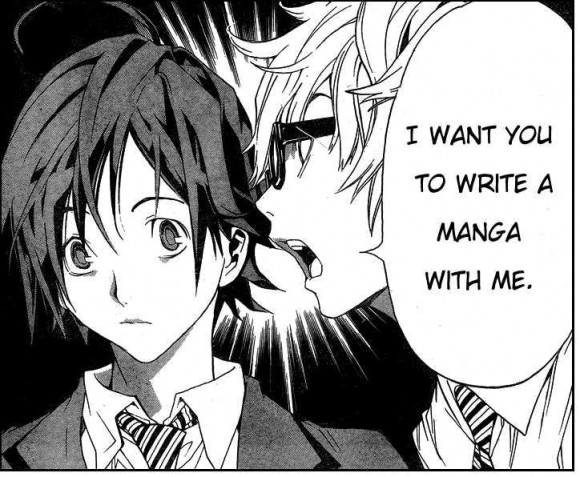

Adhering to the friendship! hard work! loyalty! Jump formula, with a few notable twists: two middle school boys in pursuit of their dreams

Just like in Death Note, the plot is fast-paced, with the first three volumes already covering three years. Ideas come fast and thick and in this case, have a natural outlet, as Moritaka-Akito work on countless series and toss out countless ideas that mostly all sound like they could be pretty good B-titles or short films. Other mangaka come on the scene, each with a separate and plausibly developed title. It’s a good showcase for Obata, who uses a different art style for each series-within-the-series, with his signature, realistic style reserved for the pair’s main series about an eccentric inventor, a hapless child, and a punishing female authority figure. There’s a bit of the “Theory of Mind” that was on display in Death Note – characters either agree with and support the main pair, or are irrational – but again, as in Death Note, the character designs are distinct and memorable, leading to an interesting and entertaining main cast.
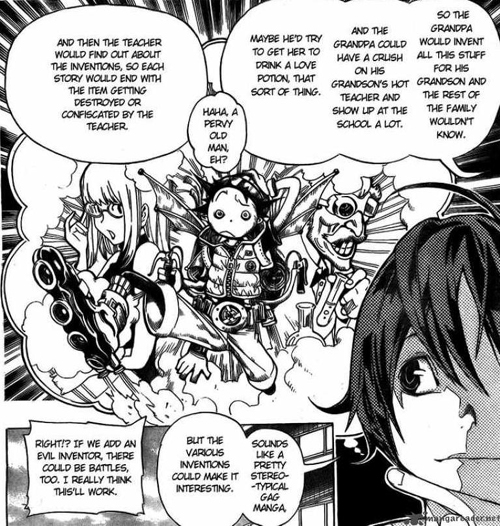

Obata uses his signature realistic style the most when drawing the protagonists’ own manga

It’s not Shakespeare, but it’s a perfectly serviceable diversion, especially if you like inside-baseball comics about the business of making comics. The main pair are also immensely appealing as a pair, the kind of BFFs who have each other’s backs in business as well as in romance, and can finish each other’s sentences. Who doesn’t want a partner like that?
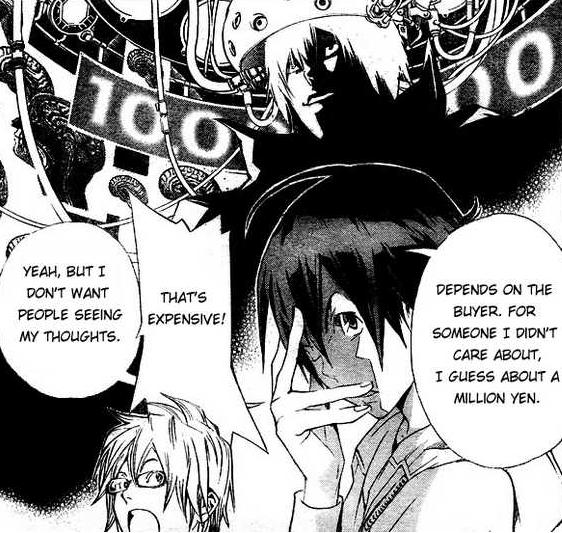

Brainstorming session

Then there’s the thing I hate: and that’s that Bakuman is really, really sexist.

You can sense the hand of an editor, somehow, in the introduction of the martial-arts-loving writer’s girlfriend, who karate-kicks him whenever he does or says something particularly outrageous. Subtle, no! But effective, yes! Women are, after all, 30% of Shounen Jump’s readership, so it wouldn’t make good business sense to insult them too much.
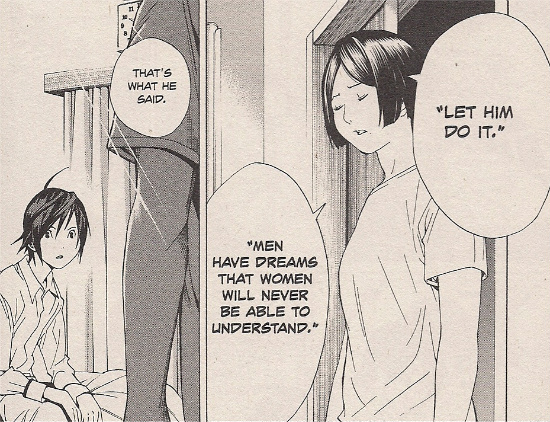

This is a panel from early on before, I suspect, an editor intervened to stem the damage. Or alternately, here’s Jog’s excellent analysis, including speculation that the sexism in this series is somewhat knowing.

It’s something, but it’s not enough. A partial list of Bakuman’s sexist and misogynist plot points might include:

–Marrying your girlfriend so she will shut up about the other girl who likes you (and whom you might like a little bit, too)

–Training a female mangaka in the art of catering to men: only in this way can her work be validated/successful

–General insistence that girls’ opinions don’t count, that only pretty girls matter, but that smart and pretty girls who don’t cater to men are actually “dumb” and unattractive

–To even out the balance, there is a plot arc involving the repulsiveness of a fat, slovenly, otaku male mangaka, who ignores his cute geek girl assistant to focus on a woman who is way out of his league. He gets what he deserves when both women reject him.

And on and on. While really bottom of the barrel guys have their characters dragged through the mud, too, there’s a clear, obvious line between the basic decency and grooming required of men, and the flawless beauty and sainthood required of women.
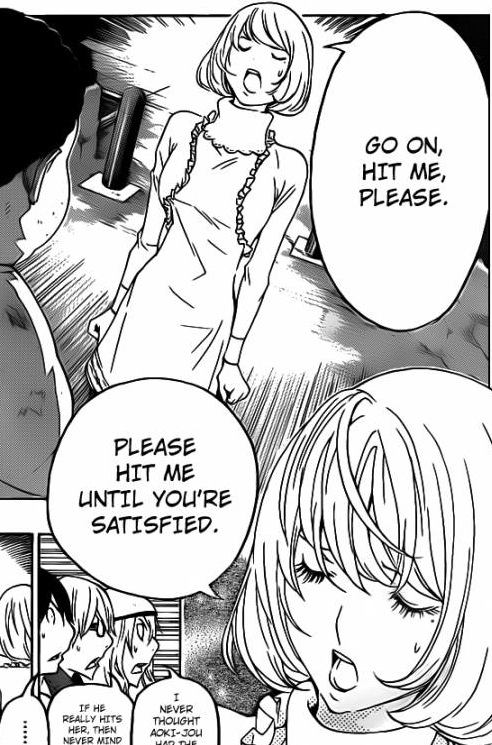

I’m just gonna like… leave this here.

The funny thing about this is, while a lot of shonen manga series are passively sexist, in that they don’t have any strong or interesting female characters, Bakuman, because it is actively sexist and misogynist, paradoxically includes a lot more strong female characters – very beautiful, very smart women we are supposed to dislike for their “bad personalities” unless and until they prove they are willing to abase themselves to men. Thus, Akito’s karate-loving girlfriend is eventually tamed, and puts Akito first in everything. Once he is engaged to her, she can’t question his feelings for other women, and she can’t have goals beyond the promotion of his career.
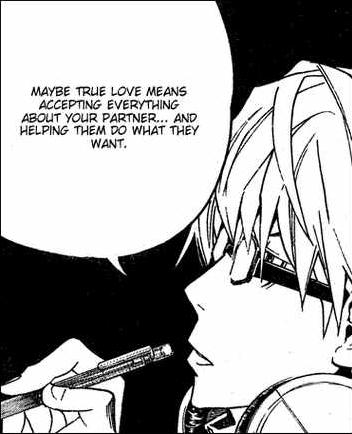

Perhaps true love means accepting me even when I am a jerk to you?

Or there is Moritaka’s future wife, a pure and distant paragon of virtue, who proves her goodness when she turns down an offer to undress to further her acting career. Or Aoki Ko, the female author of a respected shoujo series, who for some inexplicable reason submits herself to the boys’ club at Jump. She’s smart, pretty, and humble, but she can’t be any good until she learns how to pander to the male readers.
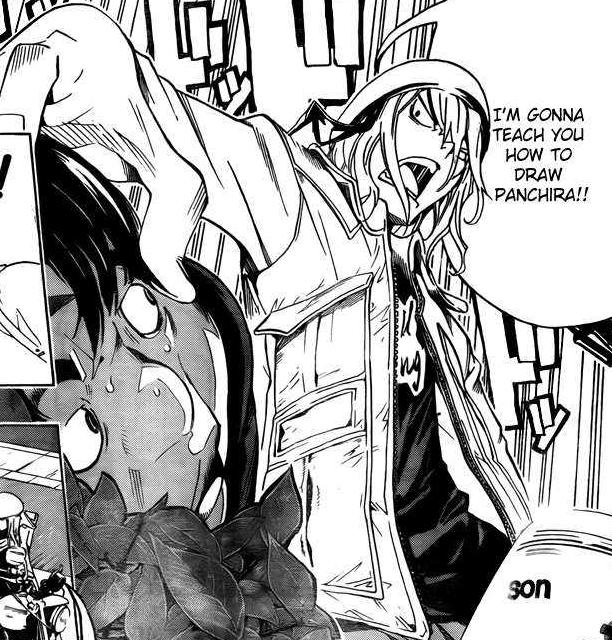

Although OTOH, the idea of being “trained” in the manly art of drawing panty shots is admittedly pretty funny.

The thing is, a bunch of these issues are real issues for women. When’s the last time you saw a boys’ comic address rampant sexism within the industry (and within the voice-acting industry, as well)? Or the struggles of women in a sexist society?

These issues are addressed in Bakuman, but not from a place of love and understanding. More from a place of contempt and loathing. I haven’t read until the end of the comic, so it’s possible that the series does turn itself around. But I doubt it! There are just too many clues that Ohba and/or Obata really mean it.

In the final analysis, Bakuman is one of those series I would really love, if it wasn’t for this one specific thing that I hate. I think that makes it a pretty good candidate for this week’s roundtable.

__________
Click here for the Anniversary Index of Hate.