Exit Sandman

This first appeared in the Chicago Reader.
_____________________
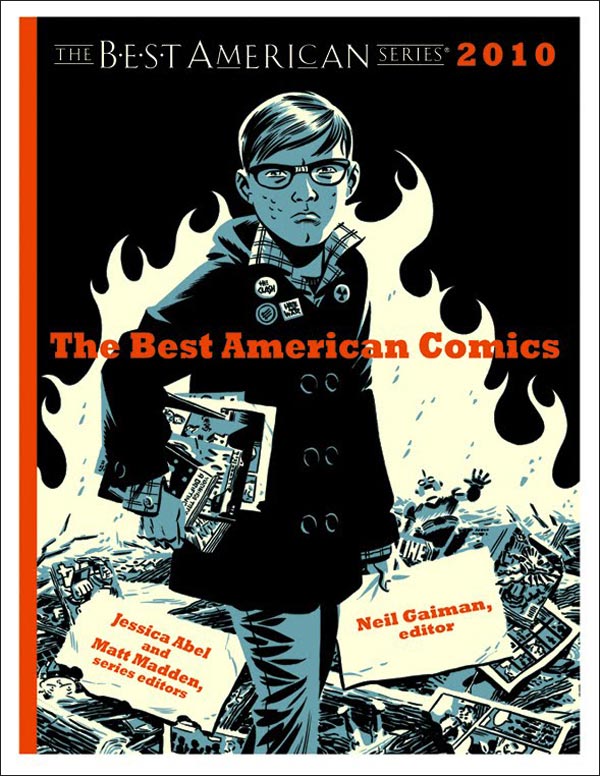
Neil Gaiman, who edited the 2010 installment of The Best American Comics, occupies a prominent but strange place in the history of the form. His Sandman series (1989-1996) was hugely popular and critically acclaimed. Although set in the traditional DC Comics universe—with walk-on parts for everyone from Hellblazer’s John Constantine and members of the Justice Society to obscure villains like Dr. Destiny—the book was original in tone and appeal. In place of steroidal underwear fetishists done up in primary colors Sandman offered pale, thin Dream, who wore somber contemporary or period garb and angsted rather than fought his way through unhurried, character-driven fantasy narratives, strewing portentous bons mots in his wake.

In short, Sandman was goth.

Superhero comics mostly appeal to guys who’ve been reading them since they were 12. Goth, as any Sisters of Mercy fan will tell you, often appeals to girls. Sandman offered enough pulp adventure to keep many young male readers—myself included—interested. But it reached beyond that fan base. As Best American Comics series editors Jessica Abel and Matt Madden note in their 2010 foreword, Sandman “single-handedly upped the ratio of women reading comics.”

Trouble is, Sandman only increased the number of female readers as long as those readers were reading Sandman. The book didn’t change the demographics of the industry as a whole. Though highly respected and popular, the series had remarkably little influence.

Certainly there were loads of Sandman spin-offs. DC has, following Gaiman, shown some interest in fantasy-oriented series—the currently ongoing Fables for example—and independent titles like Gloomcookie and Courtney Crumrin followed a goth-oriented, female-friendly path. But these efforts were marginal. Overall, post-1990s, the mainstream comics industry first drifted and then scampered towards massive, complicated stories mostly of interest to a male, continuity-porn-obsessed fanbase. Gaiman moved on to writing novels (notably, sophisticated fantasies like Neverwhere and Coraline), and the formula he created was largely ignored. Instead of creating goth comics for girls, American companies chose to stick with insular cluelessness and let the Japanese have the female audience. Manga comics, especially those aimed at girls, exploded in popularity here. And that, in case you were wondering, is no doubt why the Twilight comic adaptation isn’t drawn by homegrown artists like Jill Thompson or P. Craig Russell or Ted Naifeh but by Korean illustrator Young Kim, in a manga style.

Gaiman’s influence is weak even when it comes to Best American Comics 2010. One of the oddest things about the book is how little it has to do with its editor’s oeuvre.

I mean, yes, it’s possible to make connections between Sandman and some of the selections here. An excerpt from the lyrical The Lagoon, by Chicagoan Lilli Carré, plays on goth tropes and the meta-contemplation of storytelling in a Gaimanesque way. The dreamlike pacing, melodramatic romance, and kissing skeletons in Lauren Weinstein’s “I Heard Some Distance Music” might also be seen as at least elliptically referring to him. And the heavy-handed cleverness of a passage from David Mazzucchelli’s Asterios Polyp—a billboard advertising firmamint for diarrhea, for instance—points to one of the less appealing aspects of Sandman. A more positive echo can be found in the first selection in the book: an excerpt from Omega the Unknown by Jonathan Lethem, Farel Dalrymple, and Gary Panter that fuses superhero goofiness with literary smarts.

The American mangaesque style, arguably descended from Gaiman, is represented in a few places, such as an excerpt from Bryan Lee O’Malley’s Scott Pilgrim vs. the Universe. Still, there’s nothing in this anthology that you can look at and say, “This wouldn’t exist without Neil Gaiman.”

That’s OK though. Sandman had some serious problems, one of the most prominent being the inconsistent, generic, and even shoddy work of some of its pencilers. The visuals throughout this volume are much more distinctive and engaging. Theo Ellsworth’s “Norman Eight’s Left Arm,” from Sleeper Car, sets crude figures against detailed natural backgrounds to create a look that’s half clip art, half woodcut—a lovely complement to his surreal tale of woodland creatures, weeping gnomes, and gambling robots. John Pham channels Chris Ware to create an elaborate, fractured board-game-like layout for his tale of despair and neurosis among spindly, cosmically marooned characters in a Sublife excerpt called “Deep Space.” Comics canon standbys like R. Crumb and Ware himself are represented with visually pleasing selections. And sometimes when the art isn’t so great—as in Dave Lapp’s charmlessly clunky “Fly Trap” or Michael Cho’s bland, text-cluttered panels for “Trinity”—there’s at least a consistent visual style.

Even when he makes awful choices, you’ve got to admire Gaiman’s eclectic enthusiasm for a comics world that has so little to do with him. I cordially loathe Derf’s nostalgic hagiography of punk rock. Peter Kuper’s indifferently rendered anti-Bush commentary is as vacuous as it is predictable. And one earnest account of a national disaster per book is fine—either Katrina or 9/11, please, but both makes it look like you’re straining. Still, I found it pleasantly disorienting to see all of the above clumped together under a single editorial imprimatur.

Of course, not-something-you’d-expect-Neil-Gaiman-to-like doesn’t really constitute editorial vision. Gaiman actually cops to the lack of coherence in his introduction, saying that what he likes most about comics is that it’s “a democracy, the most level of playing fields.” Foolish inconsistency is the point—a celebration of “the biggest secret in comics: that anyone can do them.” And yet there remains a curious lacuna in Gaiman’s collection. Critic Stephanie Folse (aka Telophase) picked up on it immediately. After reading the collection she e-mailed me to say that it ironically “reinforced that . . . I don’t much like slice-of-life stories, autobiographical fiction, surreality, or political ranting in prose or comics. . . . Escapism all the way for me!”

Personally, I like surrealism, and can make my peace with slice-of-life, autobiography, and political ranting in at least some contexts. But I get Folse’s complaint. There are lots of different kinds of comics represented in this book, but intelligent, imaginative, escapist Gaiman-esque pulp for all genders isn’t here.

Maybe it’s the nature of the project. The Best American Comics series aims for a literary bookstore audience. Still, if you’re going to invite Neil Gaiman to be your editor, it seems like you might sneak in a few pieces for his fans, however scarce that kind of work is these days. Gaiman’s Dream wasn’t perfect, but he did have a dark, melancholy charm. It’s sad to see him abandoned so utterly that even his creator seems barely to remember him.
Like Language to the Slaughter

Some years ago I was asked about the benefits of working in the comics form, as opposed to writing a novel. Since the subject at hand was a graphic novel, that is, with a fair amount of words thrown in the mix, my argument soon devolved into the classic “language vs. image” duality. It went something like this:

Language is a form of communication we use to convey concrete, unambiguous information about the world. When we say “sheep,” we don’t mean “cow,” or “tree,” and we just have to assume or hope that the person we speak to knows what “sheep” means. That is the basics of language, great civilizations have been built on our mutual understanding of words like “sheep”. Of course, once we have more than one sheep, we need to specify whether it’s a ewe, a ram, or a lamb, so we invent those terms to separate one from the other. And we continue to divide the definitions into still more specific designations, until we all accept that a castrated ram is a “wether,” and the tastiest bit of a lamb is the “chop,” and so on and so forth.

It wasn’t until a thousand years ago that the Japanese language got a word for the colour green, for instance, and it was still considered just a tone of blue until the advance of Crayolas in the early 20th century. Among many examples, vegetables are still called ao-mono; blue things.

Images, on the other hand, are visual recordings of the world; let’s say I took a photo of a sheep. It might be my favourite sheep, we might even be intimate, but the image doesn’t say that. Now, somebody could look at the photo and project their own fear of sheep on it, not for a moment considering the luster of the pictured sheep’s wool, or the shine in its eyes. This person will just recall the trauma of the great sheep stampede of 2003, and the months spent in hospital after that. Damn sheep…! Sending an image out into the world unchecked can be a risky business, you never know how others will perceive it — and I think of the Muhammad cartoons as much as of any given person’s Facebook photos.

It is said that images are worth a thousand words, but nobody said which words those are. Hardly clear-cut textbook definitions, more likely a chattering, discursive debate with itself, weighing multiple views against each other without really deciding on either, but your sister might like this, and should we maybe go for coffee somewhere? Now, that may resemble how many people actually talk, but also the way many read images, or perceive reality for that matter.

So, images are intuitive, rather than specific; ambiguous rather than concrete; meandering rather than direct. They are a roundabout way of communicating, not like the above, bare-boned definition of language. Comparing the two on language’s terms isn’t really fair, images have entirely different strengths, speaking (as it were) to the viewer’s emotions, experience, and senses. More like music than like boring old text. At the same time, stylised images are used to bridge language gaps, such as in internationally standardised road signs.

And sure, it’s not like language doesn’t have its ambiguities and double meanings, such as in poetry where we try to describe abstract, inner-life concepts in real-life, hands-on terms. There’s a fuzzy zone where we read images and feel language; it exists, but for the sake of argument, let’s not go there in this context. There be dragons, and wolves in sheep’s clothing.

Since we’re doing the broad strokes here, I’d like to address the ways we talk about this thing we call “comics,” then. Comics as a form of communication has grown to be incredibly diverse in expression and intent. We don’t even need to go into the (perceived) mainstream just yet, when much more interesting things are happening in the “alternative” parts (ie, “everywhere else”). Gifted creators working in comic memoir, comic medicine, comic reportage, comic poetry, abstract comics, comic music, and other forms that kinda still need to be named. Mind you, in the previous sentence I’m using the word “comic(s)” due only to the sore lack of a better term.

Now, I’m perfectly fine with everything from newspaper dailies to graphic novels being lumped in one category, along with the Bayeux tapestry, IKEA manuals, altarpiece triptychs, early 20th century woodcut novels, Comic Life montages, cartography, and cave paintings. What I would like is to separate the goats from the sheep, so to speak. Not in a qualitative way, as canons tend to be loaded with bias. So is the word “comics,” however, even if we have gotten used to it not being all about smart, cute kids saying adorable things, or grown men falling in banana peels.

Shall I even go on to what comedians like to call themselves? At the core of it, “comics” is a nonsensical, nondescript term, used as if all film were called “talkies” still — but I’m not going to make a fuss about it like those people who recently complained about anachronistic computer interface icons. Because that was just silly, right? The world changes, and things in the world (such as desktop icons, or comics) change faster than our language can keep up.

What kind of broad statement can you even make about “comics”? That they’re sequential in nature – except when they’re not? That they are all printed? Please, that had whiskers on it in the last millennium! Certainly not that they’re comical, that is to a large extent reserved for short-form “strips”, like some webcomics and the newspaper strips of old. The body of “comics” has become so complex and huge that we need to find proper names for its organs and limbs. Take the “graphic novel”. No, please, take it. That poor, abused, disowned appendix of a term.

The graphic novel has been scolded for being a public relation stunt, invented to allow decent, grown-up people to read “comics”, and I couldn’t agree more. There was a time when nobody would be caught dead reading a comic, more or less because the form had been so deeply entangled with its name and the connotations of childhood silliness that went with it (When was that again, you say? Five minutes ago? Oh, how time flies), so comics was in grave need of a facelift. And it seemed to work, until some publicity smartass decided that the latest Punisher or Green Lantern collection qualified as a graphic novel, too. Then the old, trusty-as-they-are-filthy, mechanisms came into play and muddled the waters once again.

We can quibble about semantics for a paragraph if you like: “Yeah, but Watchmen was serialised at first, so it’s not a graphic novel!” So was Dickens’ works. Watchmen was always intended as a finite suite of chapters, not an ongoing smack-down soap opera. Almost like a novel or something. “Even Eddie Campbell disagrees with the graphic novel tag!” Yes, well, if I read his manifesto right, he really just doesn’t accept that “graphic novel” might become a qualitaty mark to raise the price tag, or indicate that graphic novels are “better comics”. They’re not, they’re just different than some other kinds of comics. It’s a matter of intent, rather than shape or binding.

End of quibble. You can see similar discussions happening over manga, or the budding scene of bandes desinees in the English language market. Geographical or cultural nomenclatures that somehow are miscontrued as genres, when they are actually as wide as, or are in fact expanding the art form we currently call, comics. We’re already burdened with the rather idiotic “OEL manga” “genre” which are just western comics influenced by Japanese comics. The fact that Western creators take inspiration from manga is perfectly legitimate, it was about time really. Again, it is the consolidation of either as a genre that raise a hackle or two — and the implication toward and among readers that there is a difference; “I don’t read comics, I only read manga.”

A few examples from day-to-day media consumption: Reading a positivist blog post about a female reader who didn’t think she would be into “comics,” but elaborates how captivated she became by Wonder Woman; any which kind of media going on at length about the success of “comic book movies,” meaning the multi-feature setup for Avengers Assemble, and Nolan’s Batman flicks; academic papers promising to delve into propaganda in comics, yet touching only upon Superman or Captain America kicking Hitler’s ass, or maybe, if the scholar is up to date, that horrible redneck vision that is Holy Terror.

The (US) mainstream, or what is considered as such, is centered around fan worship to the extent that “comics” seem to have become synonymous with “superheroes” and, by implication, anything not superheroes is deemed off-mainstream. But superheroes. Aren’t. Comics. They’re not even a genre, but tucked somewhere within the pulp genre, which, in its heyday, spread from dime novels to radio and cinema periodicals. Pulp settled into pop culture, and devolved into IPs, meaning in this case industrial properties; there is nothing intellectual going on in that department.

Yet I’d hazard that Chris Ware, David Mazzucchelli, Art Spiegelman, Craig Thompson, and Charles Burns really fit as neatly in the mainstream bracket as the the contemporary fantasies of superheroes. Of a different kind, or sphere, certainly, but I’m not going to question the financial or editorial savvy of Big Six publishers like Random House. That “comics” become interchangeable with a cultural meme is just further sign that the already bent and spent term has outstayed, outlived, and out-welcomed its welcome.

Looping back awkwardly to my attempts at definitions from the beginning; while our concept (or image) of “comics” may be well-rounded, diverse, and panoramic, the language we use to talk and even think about them is not a razor-edged vocabulary — rather, it has been dulled down to a blunt instrument by slipshod habits and flock mentality. I don’t claim originality, it’s hardly the first time the subject is brought up, and I don’t offer any solutions. Until somebody has a Eureka experience, and manages to have the new term stick.

Until then we’re stuck with lame old “comics,” but instead of backing away from neologisms like “graphic novel,” we should just embrace them as non-qualitative, metaphoric descriptions that may open up new meanings and interpretations. And qualifying our terminology about different expressions within the form doesn’t do any harm, either. Still, I do think we should get the comedians to call themselves “jokers.” Unless DC has that term trademarked for their Bat-franchise.

Voices from the Archive: Caroline Small on Ghost World

Caro’s been busy with real life things, so hasn’t been about here much. We miss her though, so I thought I’d reprint this comment about Ghost World. I think it’s from about the first thread she ever commented on.

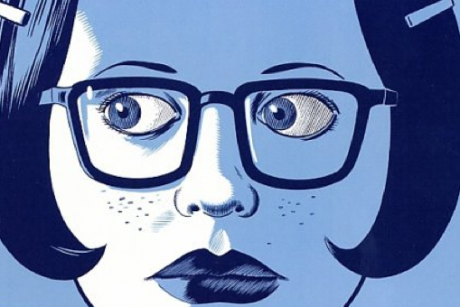
So I got home and read Ghost World through again, looking specifically for three things: disaffection –> emotional maturation/emotional resonance, the gaze of the adult male, and the unreliable Nabokovian narrator. (Google sends me to Comics Comics quoting Clowes referencing the latter in TCJ #233 in relation to David Boring so we do have evidence that he knows the phenomenon.)

A lot of people here have pointed out that dynamic between disaffection and really tumultuous emotional moments as what makes the book resonant for them. My recollection of Enid had been “archetypal disaffected grumpy teen.” I actually didn’t get that much at all this time, and I think it’s the way the conversation here has underlined the distinction between Barthian disaffection – which is really a kind of psychic paralysis that bears only a metaphorical relationship to “real” experience – and pop-cultural ironic distance, which is a pretty common subject position. I admit the latter is there, but it didn’t feel “disaffected” in that light. It’s more a cultivated disconnection –“this thing that matters to them? It so does not matter to me,” – and it felt entirely self-protective rather than truly detached. She didn’t feel like she was “searching for an identity” and coming up “nowhere.” She felt like she was fearing adulthood and coming up adult anyway.

I was looking for unreliability, and suddenly it was everywhere: is she really detached, or is she just pretending to be? Did that thing really even happen or is she just making it up? Her stories were always obviously, well, embellished, but this time, looking specifically for places where her narrative might be unreliable, suddenly they felt even more fictional. The trick seems to be that if it happens in dialogue with Becky, we’re probably supposed to think it happened. If Enid tells it, maybe it did, maybe it didn’t. The images give us clues what to hang onto and what to read as hyperbole … from there, Enid’s propensity to exaggerate and overdramatize seemed to be the thing she outgrows over the course of the story, not her ironic detachment or disaffection. She stopped protecting herself with stories, hanging on to the way when you’re a child you can fabricate imaginary events, escape into your imagination in a way that you can’t do as an adult.

But maybe it’s more unreliable than that. Maybe the scenes with Becky really aren’t the tell: Melorra by all conventions SHOULD be lying (“I’m in a commercial”, OMG Carrie’s face) but both are backed up by my previous logic, so maybe instead that Lynchian grotesque moment when you see the tumor actually is the moment where you’re supposed to say “oh, wow, all that stuff is unreliable.” Maybe there’s a level of unreality that we’re not even touching on.

Either works to some extent, and both are kind of fun, – but is not being sure whether the narrative is true or imagined really what it means to have an “unreliable narrator”? I guess it is, in a simple sense. But it’s more than a puzzle in the best literary fiction that uses the device: it’s a veil that can’t really be lifted to ever determine what’s true and what’s not . The unreliability stays in play and becomes a metaphor, often, for fiction itself, for how narrative and belief get tied together with merely some typographical characters on a page. Here it could become a metaphor for how narrative and belief get tied together with typography and image, but instead it’s really just a metaphor for adolescence itself. Whether or not Enid’s telling the truth about ANYTHING, the issue resolves when she grows up. You still end up with this basically sweet story about letting go of childhood (bracketing Noah’s reading for now), and the only real difference is at the level of close reading and whether Mark thinks I am making things up. (Pfft.) The jury’s still out on whether unreliability becomes a metaphor for the work that comics do in David Boring: it seems intuitively on tonight’s first ever quick read-through of that like it might.


Susie Bright and the Haters

If anyone could pen a mercilessly cheerful paen to the erotic potential of internet hating, it would be Susie Bright. She is the sexual up with people, the Herbert Hoover of orgies — one in every pot (or, I’m sure, with pot, if that’s your thing). She faced even giving birth with a sex toy in her hand, and insists it was good for her, Caesarian and all. Every experience is a sexual experience waiting to happen. Even, presumably, the exhaustion of contemplating turning every experience into a sexual experience waiting to happen.

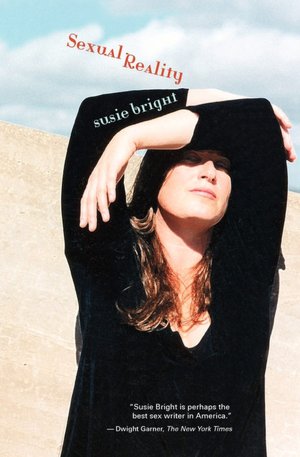
I’m reading Susie Bright’s Sexual Reality because I’m writing about William Marston, the creator of Wonder Woman, and a certified lesbophiliac (he had a card and everything. It’s in the Smithsonian Archive.) Anyway, Bright has a short essay on male lesbophilia which is about the most positive thing ever written on male lesbophilia. If there is a specialist sexual interest, chances are that there is a Susie Bright essay that is the most positive thing ever written about it. If space aliens land tomorrow and whisk us all away into humiliating sex slavery involving the surgical creation of artificial orifices, Susie Bright will have an article out on Thursday about the beauty of artificial orifices and the appendages what fit in them.

Anyway. The fact is that her article about male lesbophilia is quite good — she argues lesbophilia is about identifying with women rather than saving women or invading women’s spaces, which seems to fit Marston quite well. Someone needed to write the most positive article about male lesbophilia ever, after all, and why not Susie Bright? Same with alien orifices or dildos or incest or sex with dalmations or alien orifice incestuous sex with dildos and dalmations, for that matter. Bright’s smart and her prose is punchy; better her than Camille Paglia or Donna Haraway, that’s for sure.

It would just be nice, occasionally, if there were an acknowledgement that maybe, somewhere, somehow, there might possibly be a situation in which freely expressing sexuality might not be ideal in every way, for feminism or for women or for anybody. Does it really make sense to turn an essay on the Clarence Thomas hearing into a lament about women’s sexual repression? To turn a discussion of a date-rape gang-bang into an excited effusion about the awesome sexual agency of strippers? Surely there are some problems or some situations somewhere to which the answer is not, “Have more and better sex!”

Bright is, of course, strongly anti-censorship; it’s close to the first thing she tells us in her intro to Sexual Reality If you think that 2 Live Crew might be kind of sexist, you are, apparently, repressed and sexphobic. She concludes that same intro with an enthusiastic (of course!) embrace of the power of art. “If others didn’t write words to move me,” she says, “I don’t know if I would move. The best results of my work has been to be a muse, to inspire others to take a chance.”

I’m sure Bright sees these positions as continuous; you shouldn’t censor art, because art moves and inspires. But there’s another side to that, it seems to me. If art can move you to do great things, it can also, presumably, inspire you to actions which maybe aren’t all that great. If what we read and dream can affect us, then it can affect us, for ill as well as for good. And that certainly goes for sexual dreams as well as for every other kind. Pornography doesn’t have to be more evil than anything else…but everything else is pretty evil. Why not pornography too?
________________________

Googling around I found out that I was right; Susie Bright really is the person to write a sex-positive piece about haters. Here she is with a nicely appreciative piece about that supreme hater, Andrea Dworkin.

Bright makes me want to read Dworkin’s novels, actually. If I’m lucky, maybe I’ll hate them.

Comiks and Kreative Empowerment (CAKE)

Quoth Slavoj Zizek: “True art has nothing whatsoever to do with disgusting emotional exhibitionism.” The Slovenian philosopher-provocateur may have found much to dismiss at the Chicago Alternative Comics Expo (CAKE), where earnest expressions set off by poignant design choices were on proud display from wall to wall, presented with disarming and/or cloying plainspokenness. “And if 80 tables chocked full of the greatest comics being made today is not enough for you (jeesh, really?),” the press release exclaims, “our Slate of programming presents 14 events that range from conversation to presentation to demonstration to documentation.” Indeed, it was an enormous and well-programmed affair, and this urgently casual tone, while it reminds one of the new “aw, snap!” informality infiltrating internet commerce, is, I feel, forgivable.

Forgivable ultimately because, despite the forced lack of guile, there’s absolutely no misrepresentation. Chicago art-comics virtuosos were on hand, like Lille Carre, Grant Reynolds, Anya Davidson, Anders Nilsen, and Edie Fake, (a primary CAKE organizer), all of whom generate delicately crafted works that invest personal experiences with shimmering magical nostalgia. Local publication The Land Line, and the freeform comics-based collaborative (one might even say improvisational) endeavors Brain Frame and Trubble Club, were all broadcasting their effervescent brand of playful artistic interchange. And their compatriots from around the U.S. (and Canada, the CAKE promo reminds us, “woooooooooo”) echoed the same kind of jubilant communitarian introversion. From table to table, whether it was small publishers, identity-based projects, creative collectives, or individual creators (with plenty of gray areas in between), everyone was thoroughly congenial, sincerely happy to talk about their books, their art, or anything related to small-press comics or indie print culture. I made it to two panels– one on the Chicago comics scene, and one on queer comics anthologies, both of which were lighthearted, enthusiastic, and informative.

Zizek also said that “culture is the name of a belief which is no longer taken seriously.” While he rejects the notion that at any point there were more “authentic” forms of belief, it does seem reasonable to look at the massive production of “culture” today, especially in a grassroots milieu like comics, as the place where devotion can be focused, without the embarrassment of commitment (embarrassment being, for Zizek, the original source of culture). But the unfortunate formal shortcomings of some confessional artwork is compensated for in the collective act of goodwill required for a congregation of gifted reflective aesthetes to create a fun and memorable celebration of pleasant, occasionally provocative fantasies- right here in Chicago, an important center for independent comics and animation.
 
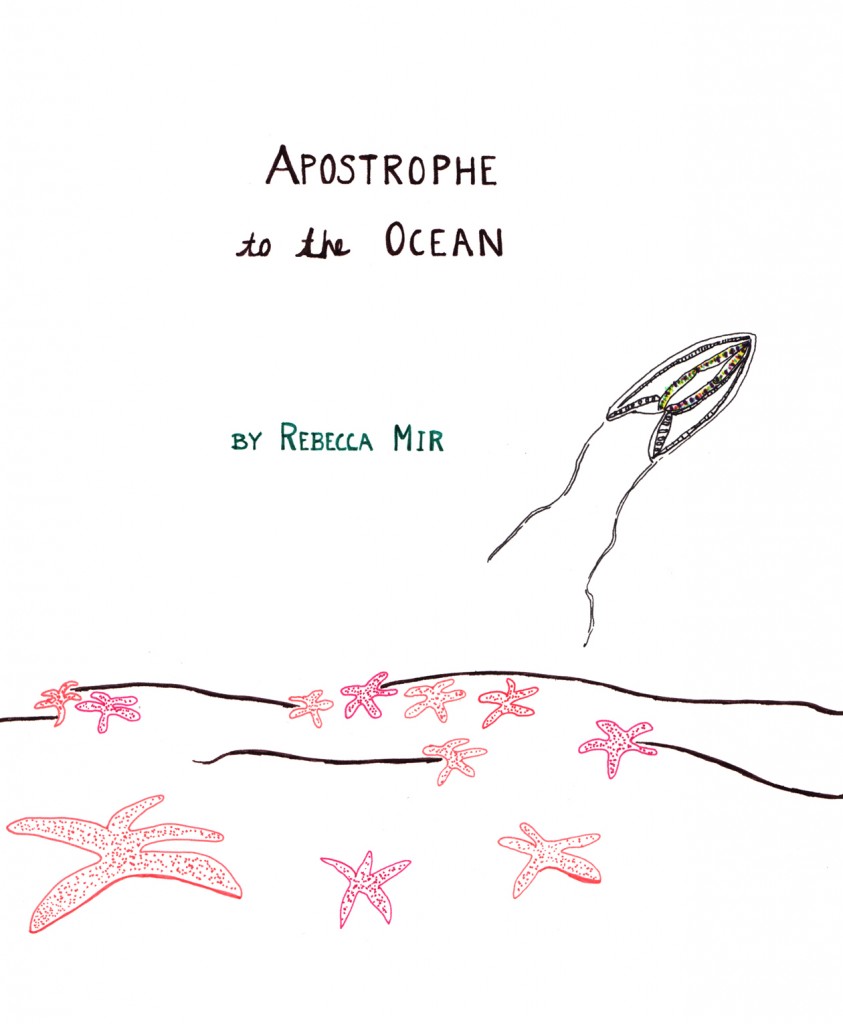
Illustration from Rebecca Mir’s Apostrophe in the Ocean, which debuted at CAKE.
 

Weirdness and Conscience in the Work of Craig Norton

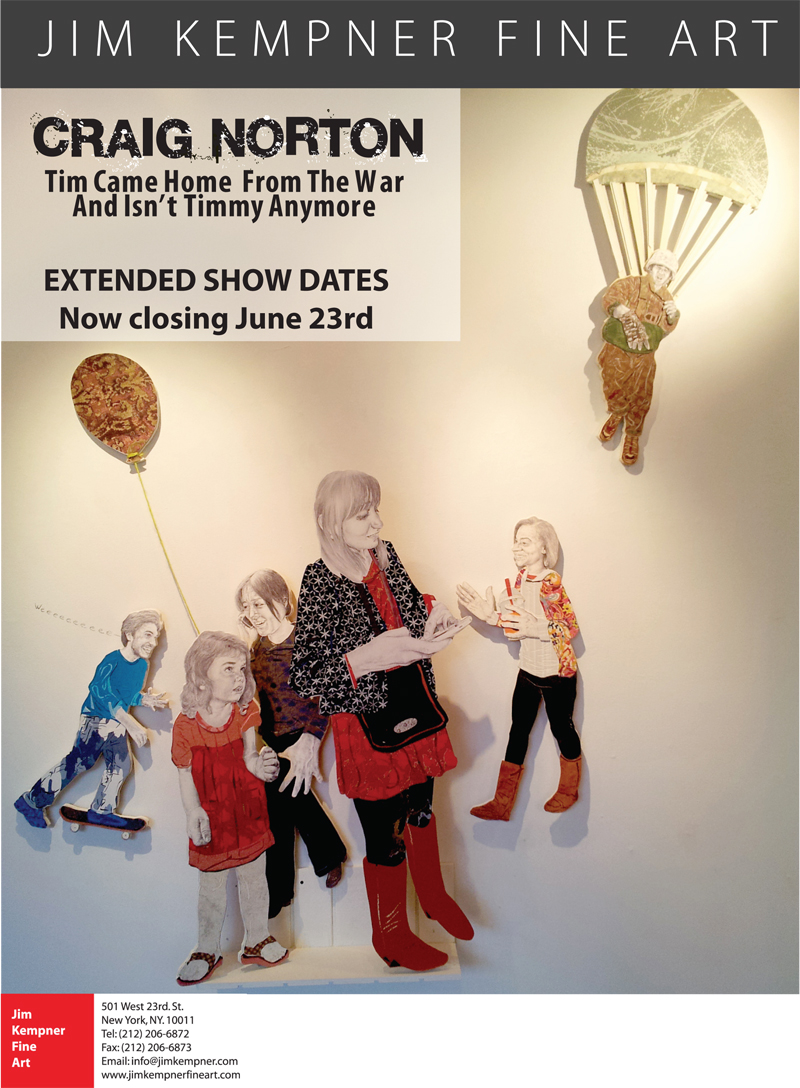
Craig Norton’s recent show is a different beast than what you’ll find in galleries around Chelsea and the New York art scene. Tim Came Home From the War and Isn’t Timmy Anymore, at Jim Kempner Gallery until June 23rd, is an emotional and explicit rendering of the schizophrenic divide between America at war and at home, and the egregious neglect of veterans. Norton is also a hyper-realistic and self-taught draftsman who makes narrative art. These factors are not the taboos they were fifty years ago, but they are no longer typical in contemporary art either. To compare, the famous Gagosian Gallery is showing a famous photographer’s gargantuan, historic prints of other famous people. I’m currently writing this piece next door, in a miniscule gallery called Family Business, where we are exhibiting a group show entirely comprised of sticks.

Conceptual strength and skillful execution are crucial to the success of any art work, past or present, even if the faces of these terms have changed. In Tim Came Home… concept and skill manifest in ways the wider public would expect them to—ironically, this quality makes him an outsider in today’s art world.  I hope Norton’s pop-out, transfixing murals can function as a gateway for casual viewers into contemporary art, and a call for artists to consider the perspective of those unversed in it.

Norton’s work rejects the idea that art is by nature morally and politically apathetic, ineffective, and/or isolated, ideas that philosophers, artists and critics have argued for centuries. Artists periodically challenge this claim, but perhaps no population rejects it more often than those outside of the art market, whose faith that art ‘matters’ may be the art world’s most regular misguided compliment, (and art has suffered for it through many censorships and its co-option by propaganda.) Along these lines, many still believe that art is a showcase of technical skill, and that virtuosity isn’t inherently absurd.   Norton caters to these ideas, but in doing so, his work also fulfills conservative expectations about ‘art’ that we have a good reason to question. Tim Came Home… is a riveting, provocative show, but it lets the art-world context essentially “talk behind its back,” rather than directly address the inherent weirdness of politicized art in the contemporary gallery.

Today's Enemy, Tomorrow's Friend

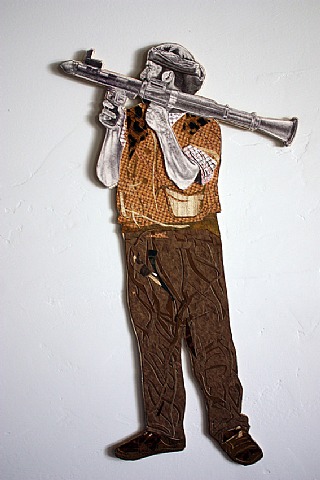
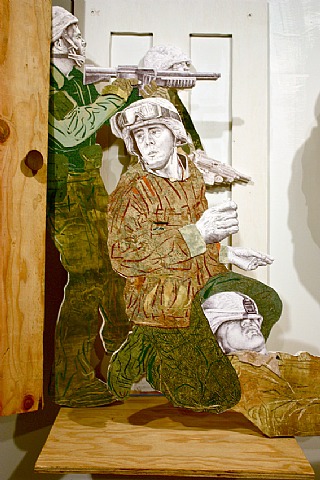
Norton’s work is not only political, but fascinatingly journalistic. Reminiscent of the Wall Street Journal portraits, Norton renders faces, hands and firearms out of tiny marks and stipples. Oftentimes the hands and faces are blown out of proportion, which distorts the figures into punchy homunculi, and brushes caricature without slipping into it. The clothing and bodies are made of boldly colorful wallpaper collages. He ‘draws’ folds with wood-relief style incisions. This mimicry of print illustration is bolstered by the fact that he designed the installation to tell a story. Instead of accompanying a news article, Tim Came Home… could be read as the article itself, or as a history museum exhibit where the story is told through the dioramas alone.

Detail from No Welcome Mat

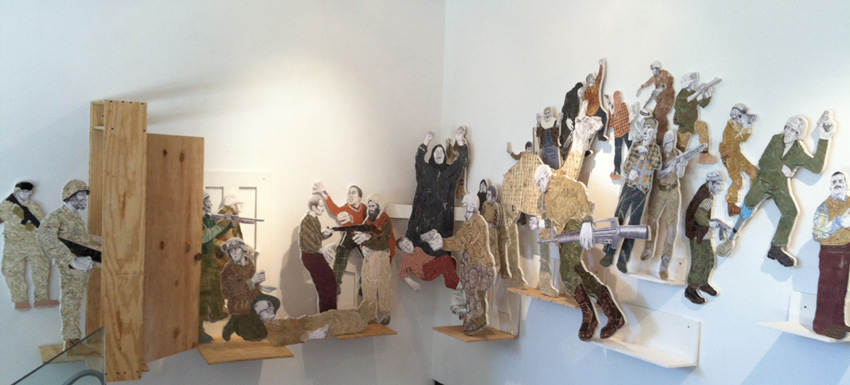
The effectiveness of the hanging contributed to the shows emotional resonance, but also to what is problematic about it. From a strictly “graphic narrative in the gallery” perspective, I was thrilled to see the show explore the layout’s control over the narrative. Tim Came Home… was hung two different ways, which created two different ‘stories.’

Initially, the viewer would walk into the gallery and encounter a crowd of happy, urban passerby. Viewers would then typically start over to the left, with No Welcome Mat.

No Welcome Mat


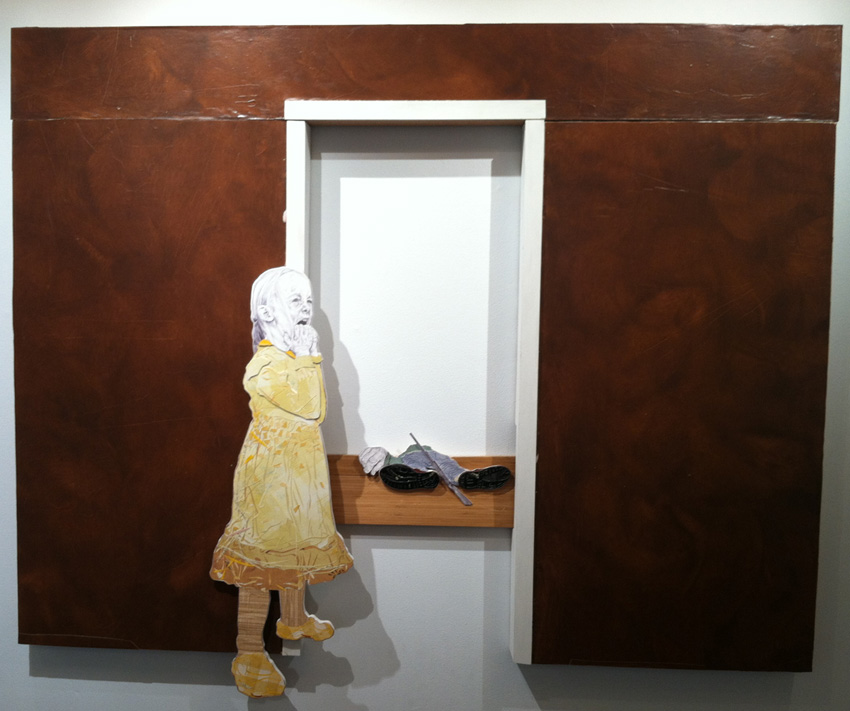
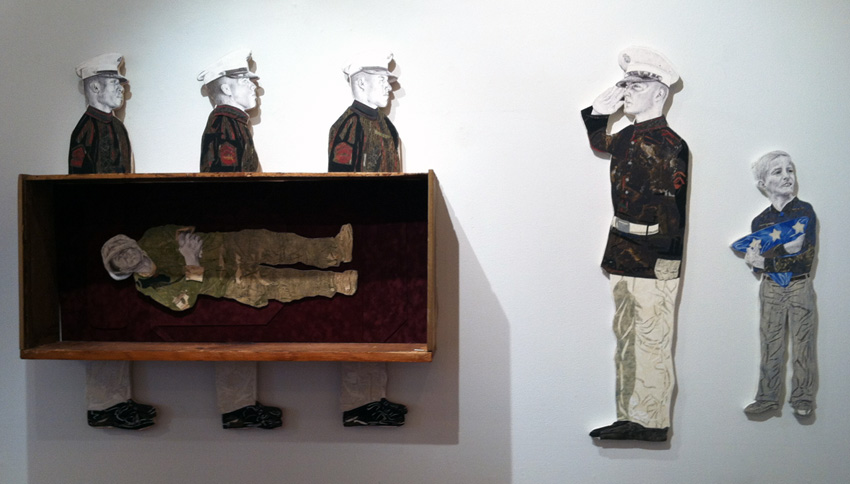
This crowd scene erupts into the first, with injured veterans parachuting down into the unworried crowd. Moving to the right, around the front desk, the second act focuses on the tragic integration of these two worlds. The first is a military funeral. The second is called My Daddy is A Decorated War Veteran, where a young girl claws at her face, before a crumpled man and a shotgun.

My Daddy Was A Decorated War Hero

The forceful disruption of the “side scrolling”, frieze-like perspective allows you to peer straight through the wall, to the scene behind the girl, and at an impossible angle inside the coffin. The effect is very moving.


Another Casual Casualty of War

 Unfortunately, gallery visitors sometimes didn’t notice the “second act” around the desk.  The Jim Kempner Gallery rehung the show so that visitors first emerge to see My Daddy Is… No Welcome Mat still begins the show, but the scene doesn’t bleed into the urban passerby. Instead, the warfare peters out into negative space, and a small pocket of the passerby lead back into My Daddy Is…. Around the desk, the two parts of the military burial flank the rest of the happy-go-lucky city-dwellers. Life goes on, and no one is the wiser—the second hanging, while a compromise of the original vision, is rhythmically more complex, less melodramatic, and damning.

various figures

Norton’s past work focused on the Civil Rights movement, and he was challenged about his right, as a white man, to depict moments as iconic as Martin Luther King Jr.’s arrest. Norton responds in his personal statement, “I make art about mankind. Lots of people care only about their own identity groups… and I’m not going to sit back and do nothing because the victims are different from me. It’s a human issue.” He goes on to say “Art is the way I bring about awareness and dialogue—and hopefully inspire change.”            

This statement plays into the editorial feel, where a piece documents and somewhat universalizes the particular. Norton doesn’t comment on the role or the effect of the gallery context on his plea. The gallery is treated like a culturally heralded space, where people seek meaning, information, and often go to look at pretty things. This is not untrue, but it ignores other currents too. At the risk of being grotesque, art is a luxury commodity, and fetishistic, which the neutrality of the gallery amplifies. The art world is also a complex and hierarchical social scene that partially takes place in the gallery, transforming openings and installations into sets to act inside of. A truly thorough contemplation of a work will consider the historical context and precedents of the piece. Norton’s work is a little strange in that it appears to be descended from editorial illustration more than anything.  This does not mean that Norton’s work doesn’t belong there, but that the conditions of its “immigration” are unusual and inextricable.

Is the art gallery a useful place to encounter Tim Came Home…? Ultimately, yes— it does raise awareness for an important social issue, even if the scenario is ironic. But is a private collection a useful place for this piece? How about an art museum? Is Norton’s work best designed for public spaces?  If Norton’s wish for awareness and dialogue attaches a use-value to his work, certain environments could be more successful than others, and Norton’s work would also violate ‘art for art’s sake.’ No big deal: art pour l’art has been rejected before, and chances are it’s a mental illusion, (people use art without admitting to it, and for reasons they can’t articulate.) Finally, Norton’s arresting photorealism individualizes the subjects, but it is also hypnotic, exciting the eye with spectacle of torment, violence, and artistic wizardry. Norton’s process receives a paragraph of the artist’s statement before the political component is even discussed.

I apologize: I won’t attempt to answer these questions in this review, but the questions themselves are illustrative. An artist doesn’t have to have a fully elaborated concept to start working. Here, the ideas and context don’t dovetail together to create an Eureka moment—instead, Tim Came Home highlights the mess of understandings about what art is and what it does. Which are, more than ever, important questions to ask.

All photographs are courtesy of the artist and Jim Kempner Gallery


Tim Came Home From the War and Isn’t Timmy Anymore

Jim Kempner Gallery, May 12th – June 23rd, 2012

Old Wine in New Wineskins: The House on the Borderland

Reprinted from text scans of The Comics Journal #234 (June 2001)

History appears to indicate that William Hope Hodgson was not a particularly lucky individual. Rejected hundreds of times during the course of his literary career and finally blown to bits in Belgium towards the close of World War I, he could not have hoped for more in death. As such, he has largely been forgotten: his books have long gone out of print and even his finest works have been edited to eliminate excessive sentimentality by his literary supporters. Poor precedents indeed for Richard Corben and Simon Revelstroke’s pioneering adaptation of one of his works.

Born in Essex, England, into a family with an Anglican clergyman at its head, it has oft been pointed out that Hodgson’s family was frequently transferred to various removed locations including that of Galway in Ireland where The House on the Borderland (1908) is set. At various times in his life a sailor, a body builder, a photographer and an author, Hodgson’s works include The Boats of the Glen Carrig (1907), Carnacki, The Ghostfinder (1913, originally published as short stories in various magazines), and The Night Land (1912).

That tower of the horror genre and bane of elitists everywhere, H. P. Lovecraft, is frequently quoted (in cover blurbs) in defense and praise of Hodgson’s most fatuous book. He called it “a classic of the first water” and “perhaps the greatest of all Mr. Hodgson’s works.” Further, with regard to its place in literary history, he considered the “wandering of the narrator’s spirit through limitless light-years of cosmic space and kalpas of eternity . . . something almost unique in standard literature.” Others, such as Clark Ashton Smith and C.S. Lewis, have followed suit with praise for the imaginative elements found in Hodgson’s other novels.

Reason enough, one might think, for an adapter to create an unsullied version of this seminal work. To no avail. On the contrary, Corben and Revelstroke have chosen to adapt Hodgson’s novel in a way that makes the editor’s decision to label such changes “an original framing sequence that taps a contemporary vein” nothing short of diabolically disingenuous.

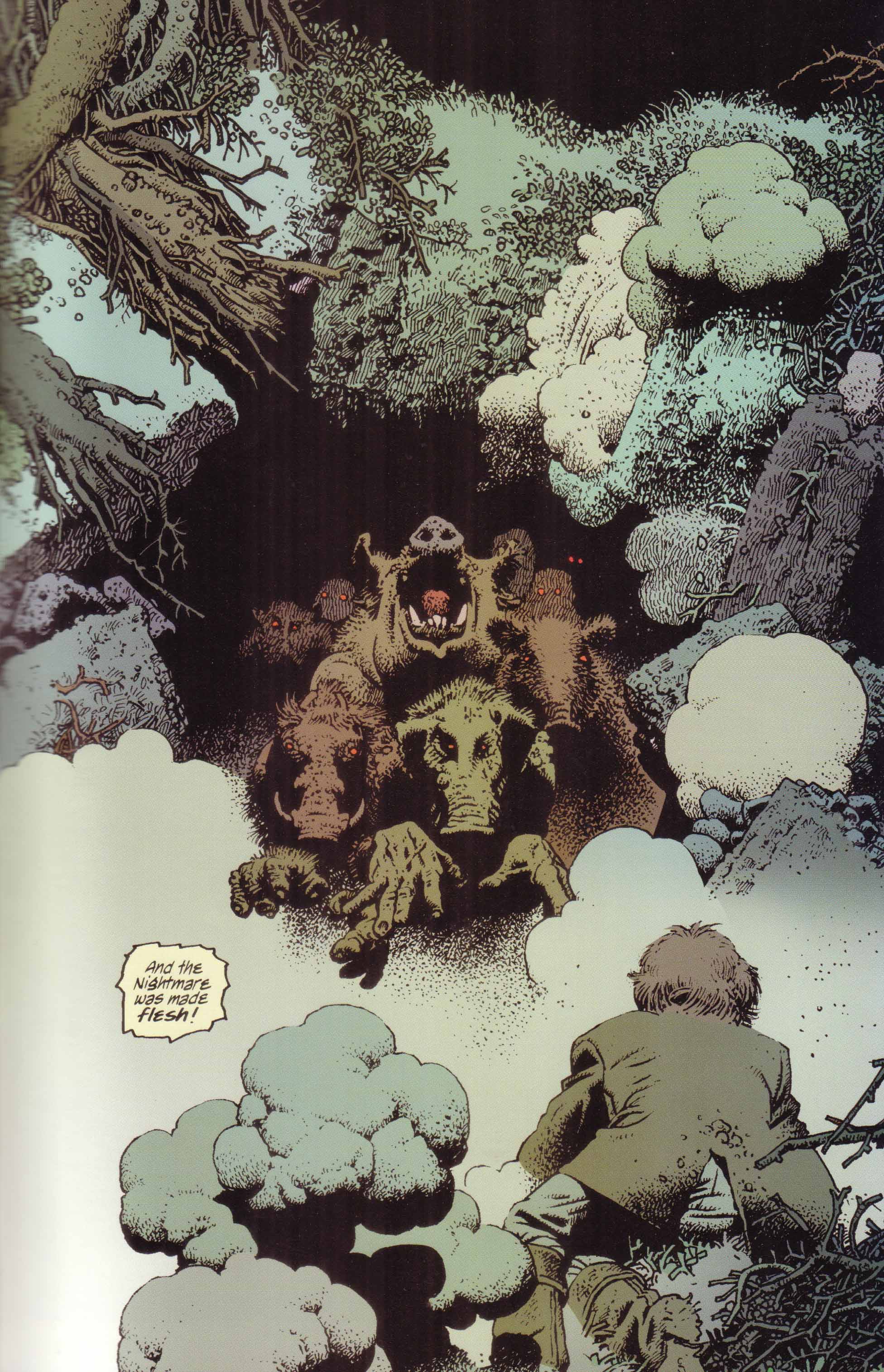
Here are the facts of the novel which do remain intact. While on a trip to West Ireland, Messrs. Tonnison and Berreggnog discover a manuscript detailing the final days in the life of a recluse and his sister, Mary, in a large house with a reputation among the local villagers of having been built by the devil. Almost from the outset, the narrator is plagued by feverish dream-like states compelling him to drift in disembodied fashion to arcane locales, sometimes encountering dangers in the form of swine-like creatures and at other times traveling through the millennia to witness apocalyptic visions of the end of life on earth itself. And that’s about it. Apart from these bare facts, very little else remains intact.

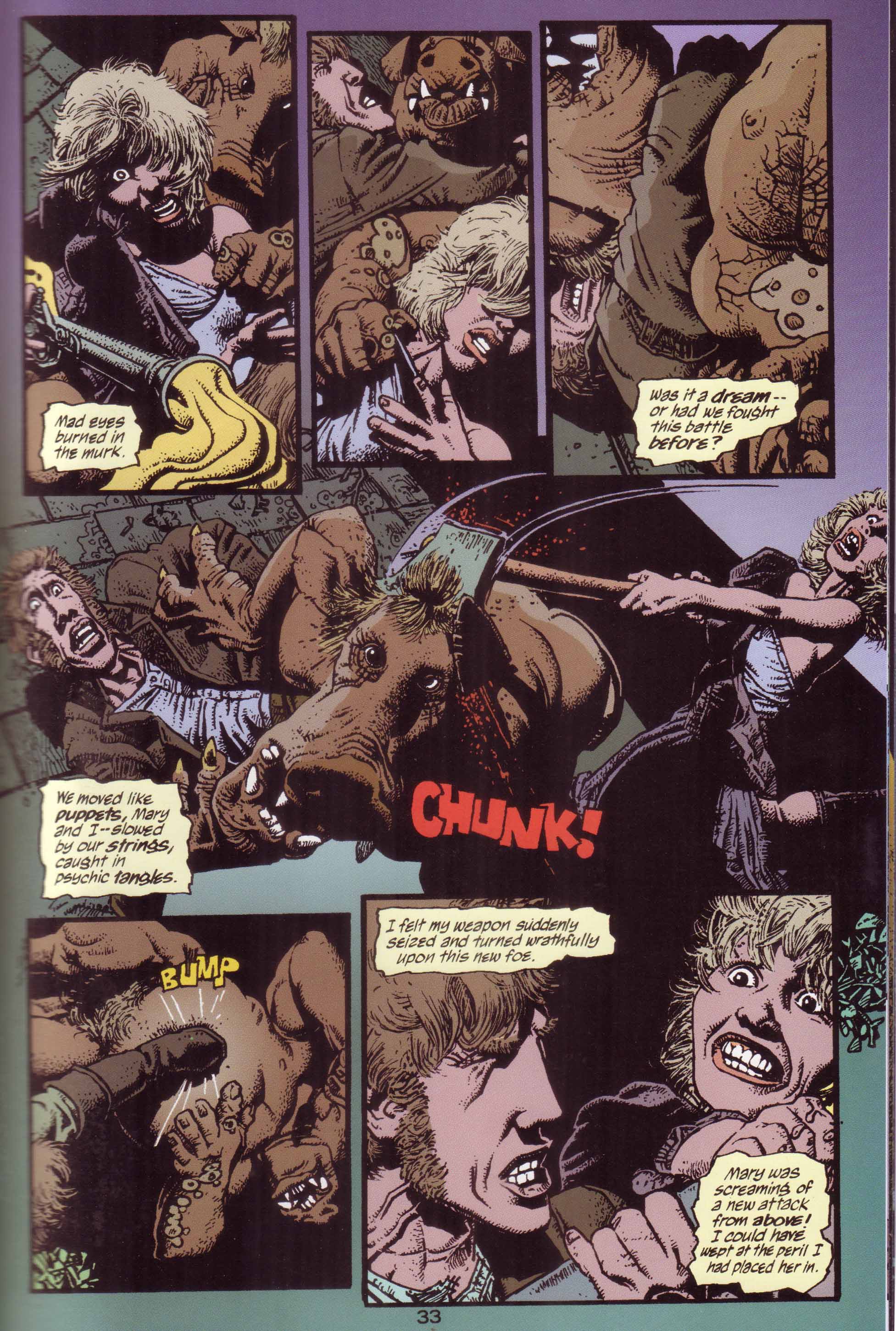
Some of Corben and Revelstroke’s changes are easily explained, though perhaps not as easily countenanced—their substitution of the original narrator’s almost placid defense of his house and sister against the swine creatures with a 20-page hammer and tongs affair involving a slew of blunt weapons and firearms, for instance. The former account is suspenseful and full of pent up energy while the latter simply revels in violence, not an unfamiliar predilection in Corben’s other works.

Less explicable is the authors’ decision to slice off thc entire first section of Hodgson’s manuscript which sees the protagonist floating across a plain of desolate loneliness into a valley of murderous gods in half-slumber. Hodgson’s writing here is energetic and effective and the protagonist’s first encounter with the swine creatures in this section of the book, a most useful cap to the almost signature dreamscapes he creates. One can only guess at the reasons why such a key sequence was excised. It does allow for delay in the introduction of the swine creatures which grow to dominate the book and it might have been felt that the portrayal of such unearthly elements so early on would not have served the rhythmic crescendos of the comic. Yet these are sorry excuses for such vandalism.

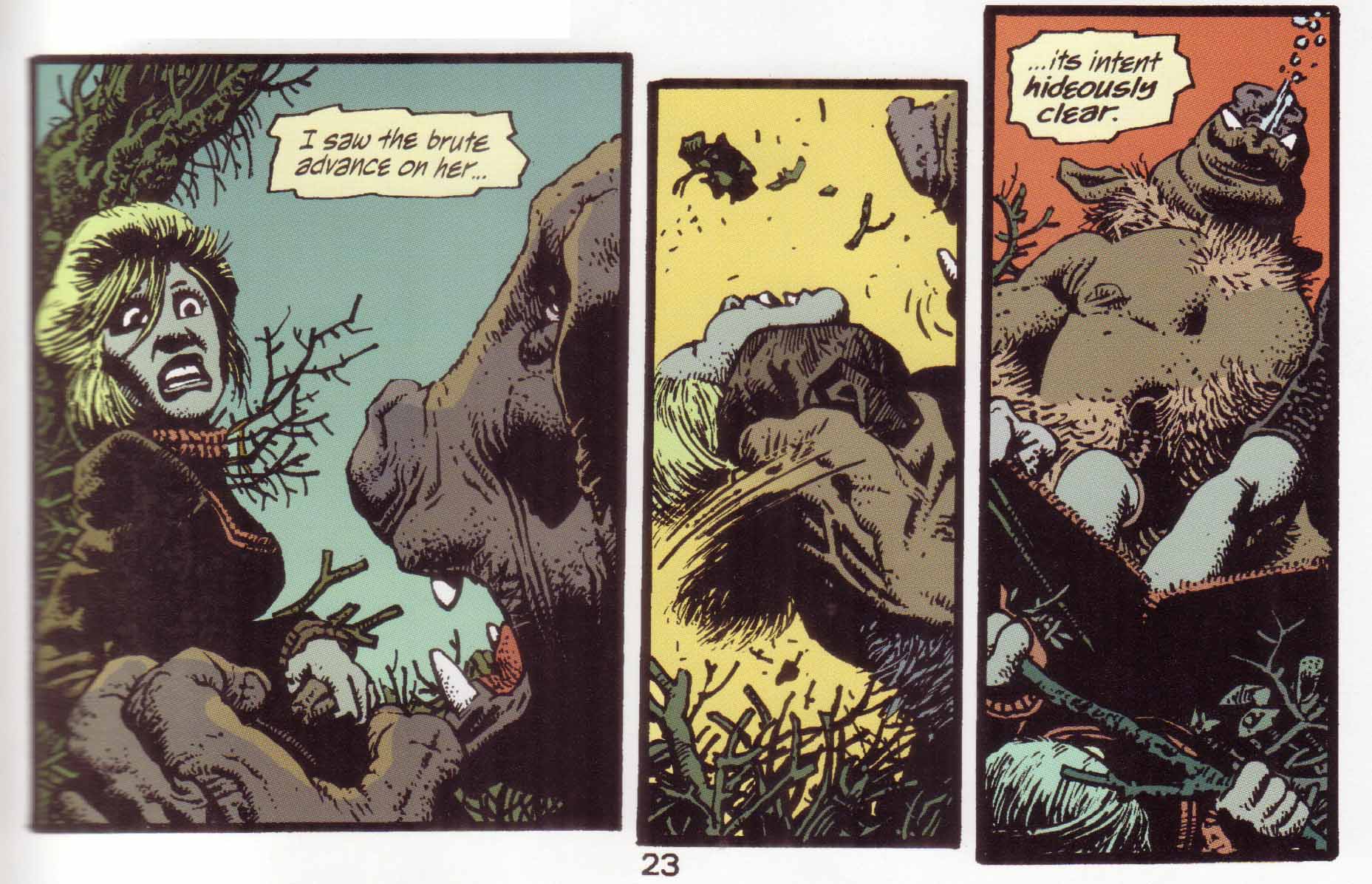
Equally dissatisfying is the comic’s tendency toward logic and cozy explanations, features with no place in Hodgson’s novel, which revels in its utter obscurity, failing at every turn to apprise the reader of its true meaning. As it happens, the comic comes close to a complete rewriting of the text stopping only to preserve some of the main points of the novel, while adding elements with a rampant disregard for its sexually innocent strains. In relation to this point and as their centerpiece, the authors present us with a mildly perverted 20th century interpretation of Hodgson’s work: the swine beasts who hardly even touch Mary in the original, are now doing the needful and have procured an “intent which is hideously clear” (the panel in question shows Mary two legs thrust in the air and spread wide in deference to those readers who have not divined this clarity.)

These elements do not reside in Hodgson’s book but are a kind of freeform interpolation on the part of the adapters, taking the mysterious seclusion of the siblings and extrapolating this to its ultimate late 20th century conclusion. I can only surmise that they felt free to do so since any thinking reader glancing through Revelstroke and Corben’s adaptation would realize that Hodgson would probably have been pilloried and sent to Reading Gaol if he had undertaken such an offensive stance.

These sexual shenanigans may have their origins in some of the vague plotting Hodgson resorts to two thirds through his novel. Here he introduces the hitherto unknown aspect of the protagonist’s former fiancee. Hodgson’s protagonist writes in an elliptical way about his former love and his sister’s increasing withdrawal and distance from himself, almost as if she were possessed of greater apprehensions about her own brother than the swine creatures lurking outside the house. These enigmatic relationships are twisted into a secret lust for his own sister in the adaptation; the swine creatures now symbolic of the protagonist’s own fears.

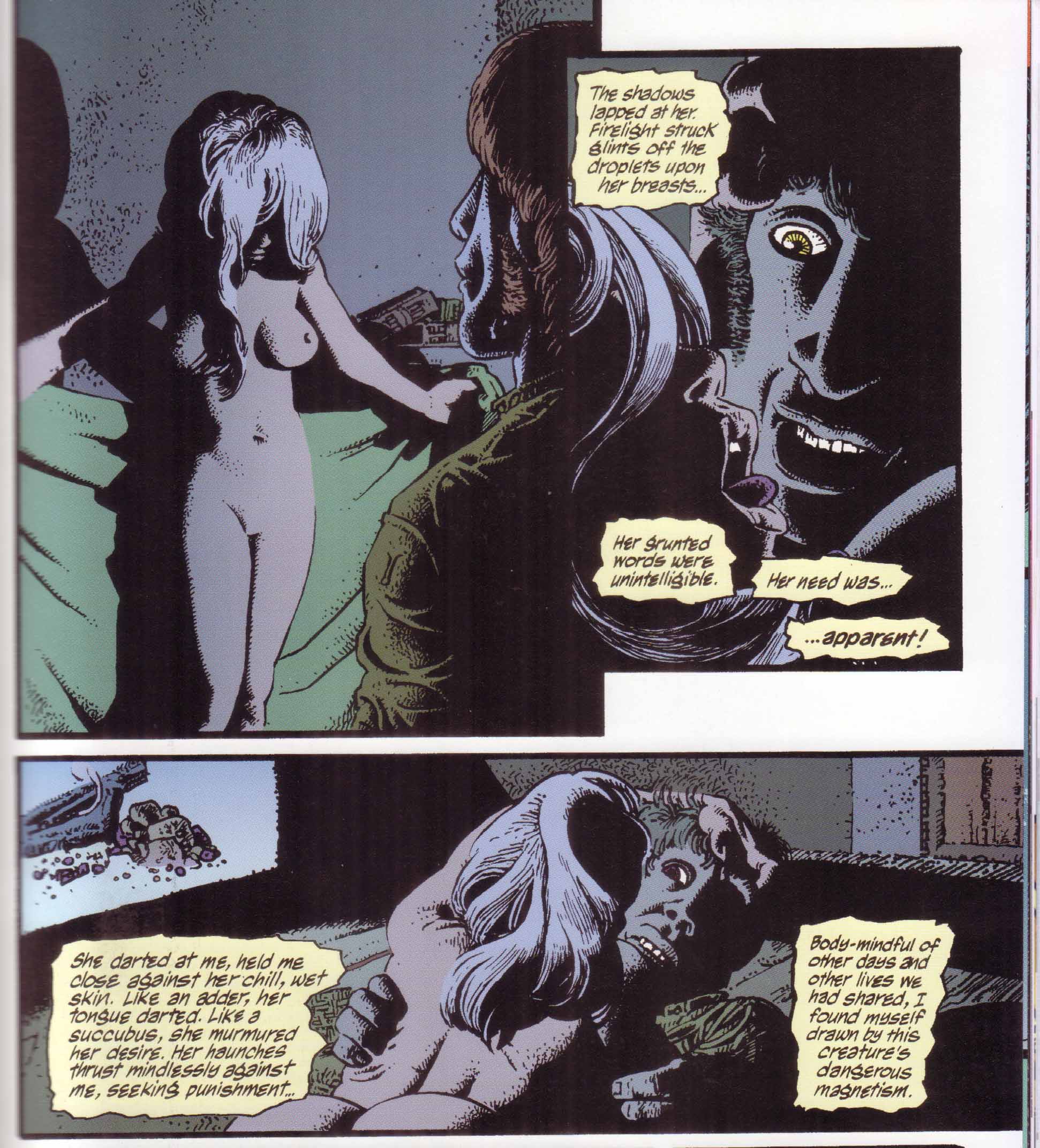
The creatures take on the role of his sister’s manhandlers and rapists, opening her up (by means of a feral bite) to the carnal delights of incest. Later in the comic, she strips brazenly for him and caresses him in a most vile yet delectable manner. These sexual feats bring Mary to the forefront of a story in which she is curiously absent — and in which she was certainly not the deranged, gun-toting, buxom Rambette of the comic.

It might be best to see the comic not as an adaptation in the purest sense of the word but a combination of adaptation and homage comparable to the wealth of fan and professional fiction that has sprouted up around the Cthulhu Mythos (and to a considerably lesser extent the prose-form House on the Borderland). Nowhere is this better seen than in the final section of the book where there are musings on the nature of fear, wherein the author of the manuscript becomes a makeshift replacement for Hodgson himself speaking of the “Outer Dark,” “Watcher[s]” (references to Hodgson’s The Night Land) and the guarding of portals between unknown nightmarish lands and our own.

It is interpretive in a way that echoes Alan Moore’s musing upon the source of the novel’s magical qualities in his introduction to the comic adaptation: the Jungian landscape of the house and the porcine quality of the men Hodgson may have come across in his travels during his youth. The borderland is seen as a place between “waking thought and the night-land of the unconscious.” In this sense, Corben and Revelstroke’s idea of the shifting nature of the house, at once a gateway, an asylum, and a state of mind, is not without justification.

It is also possible to surmise that the adapters have combined the ideas found in Hodgson’s short story, “The Hog” (a story from the Carnacki, The Ghost Finder cycle of stories), with those in The House on the Borderland producing a fusion of forms. Various themes in the adaptation may be seen to have their genesis in concepts articulated by Hodgson in “The Hog.”: the notion of being transformed into something less than human by contact with the swine beasts; the heightened terror of the protagonist in the basement cellar of the house (which mirror those of the hapless Bastion and the pit); the concept of the Hog as a “cloud of nebulosity,” an “Outer Monster” residing in an outer psychic circle—these ideas do not have as firm a basis in the original novel as they do in Hodgson’s short story. It will also be evident to readers of Hodgson that the explanations foisted on the strange events in the comic are more in keeping with “The Hog,” in particular the motif of unearthly intrusions and the ravenous feeding of those alien creatures on the fears of mankind. This may be compared with Carnacki’s thoughts towards the close of Hodgson’s short story:

“They plunder and destroy to satisfy lusts and hungers as other forms of existence plunder and destroy to satisfy their lusts and hungers. And the desires of these monsters is chiefly, if not always, for the psychic entity of the human.”

Clearly the adapters have taken the author of Borderland at his word, for Hodgson himself exhorts his readers to uncover the “inner story” according to personal “ability and desire.”

Of course, horror and science-fiction adaptations of this ilk are nothing new to Corben. There is the reasonably faithful adaptation of Harlan Ellison’s “A Boy and His Dog” in Vic and Blood for example. More relevant is Corben’s reworking of The Fall of the House of Usher, which demonstrates many of the idiosyncrasies which mar the comic Borderland: the bosomy lady phantoms; Madeline Usher traipsing about half-naked; and the fervid sex betwixt Lady Usher and Poe. The current adaptation of The House on the Borderland seems almost restrained by comparison. If anything, middle-age, Revelstroke and perhaps the sheer “respectability” of the Vertigo line have resulted in some of the reining in we find in the new work.

There is no doubt that the hard money at Vertigo has done wonders for the reproduction of Corben’s artwork. The slightly muddy printing of some of the Fantagor color books have been replaced by sharp, clear reproductions. What is missing and has been missing since the late 1980s has been Corben’s beautiful palette, which has been historically varied, rich, and at times subtle. The color work which Corben produced in the early 1980s and which probably reached its final flowering in some sections of his Children of Fire series has been described by the artist as “time consuming” and “highly evolved,” words which have no place in an age of quick fixes. Corben commented on his difficulties in an interview with Heavy Metal magazine in 1997:

“My style, although I have several styles, I used to do a fully-rendered, in-color style, but everything has to be done too fast now, so I’m doing a line style and then it is colored in. My attitude is different. When I started doing comics, I did them because I wanted to and if I made money, that was good. If I didn’t, well, I did them anyway. Now, I feel like I have to meet a financial quota.”

I mention this not as a criticism of Corben but of an industry which virtually compels its best artists to produce less than their finest efforts if they are to find a reasonable living within the industry. Even so, it must be said that The House on the Borderland represents something of a high point in Corben’s art. It also demonstrates that he is still holding firmly to many of the old values of naked big-breasted ladies, balding men, and free-wheeling literary license. It is, in the final analysis, entertaining and remains a good if not wholly truthful advertisement for Hodgson’s famous novel.