Jerusalem, Nothing Special

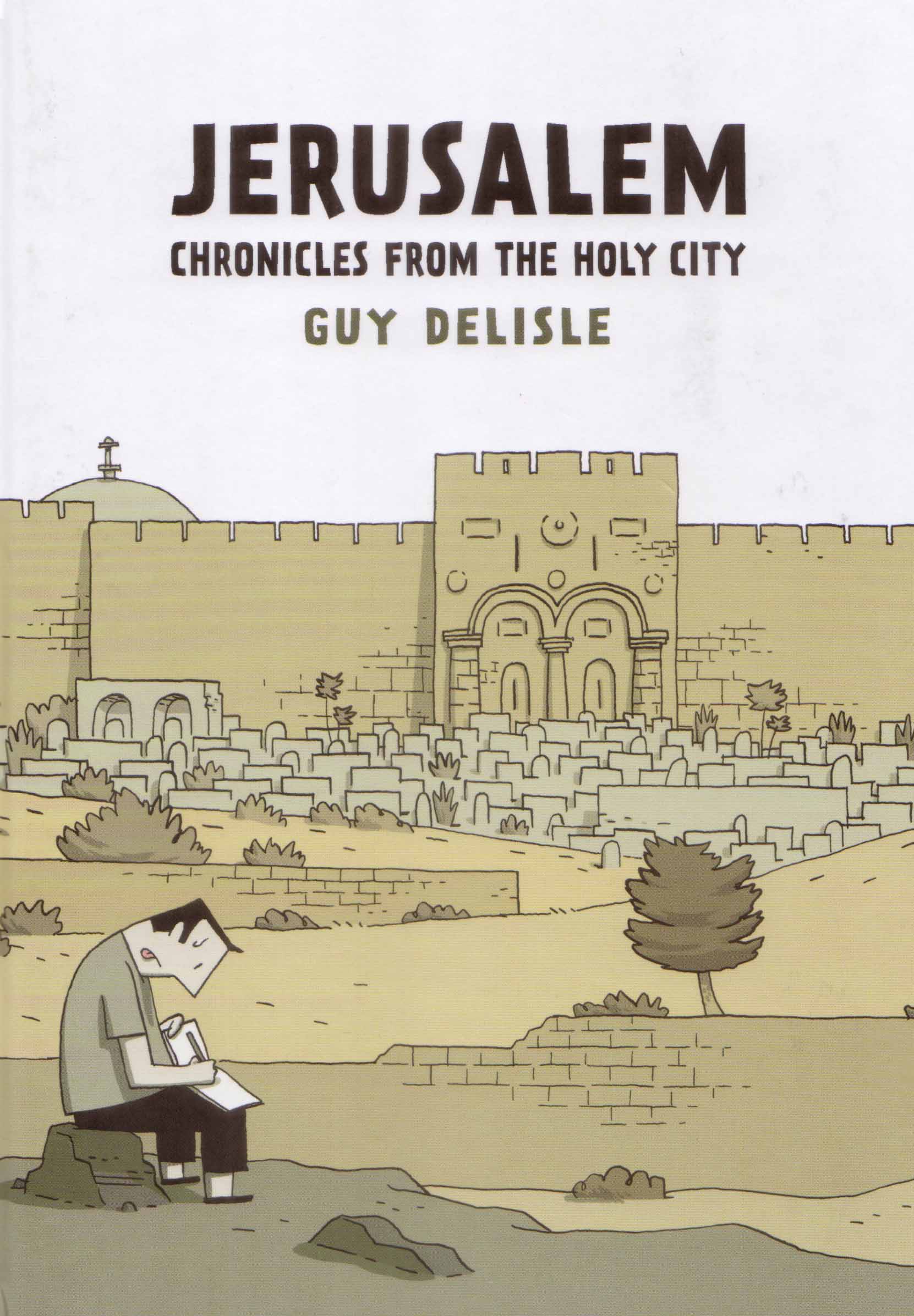
The cover to Guy Delisle’s Jerusalem shows him sitting at the edge of a Muslim cemetery on the Mount of Olives facing the Golden Gate, the gate through which the Messiah is expected to enter the Holy City. One could see this image as a conjunction of faiths and a metaphor for all that Delisle encounters: the Palestinians (Muslims and Christians) in their graves; the door closed to any true understanding of the situation; the cartoonist sketching furiously in the foreground; all of them awaiting salvation.

Delisle presents himself as a blank slate, as devoid of any information as the doodle with which he represents himself; a surprise considering his comic travelogues through Shenzhen, Burma, and Pyongyang. At one point he even seems perplexed that while Israel and many of its citizens view Jerusalem as the capital, most countries only accord Tel Aviv that honor and situate their embassies accordingly. It’s almost as if television, the internet, and the Arab-Israeli wars had never occurred. In many ways, he’s like the guy sitting next to you on your bus tour of Israel, the one who knows next to nothing about the place he is visiting. Unlike most tourists, he has months to rectify his ignorance. How one feels about this is a matter of perspective and depends on what we expect from a reading experience.

The intention one suspects is to allow both Delisle and his readers to set off on a journey of discovery together—no back tracking, no overarching narrative omniscience, no real meaning—the gentle meandering rhythms of expatriate life distilled to several semi-significant and ordinary moments in time. The idea here being that what best signifies any city (even Jerusalem) is not its monuments, its festivals, or its tragedies (though these are give some space) but its commonness; the quotidian lives of its citizens—the parties, the daycare hang-ups, the shawarma encounter, the transportation stories, and the amusing anecdotes about Arab women. In place of discernment, Delisle offers affirmation and comfort, a year in the life of a cartoonist house husband whose partner is working with Médecins Sans Frontières (MSF). What little information we get is conveyed at a slow pace and is quite disconnected, taking on the fabric of directly recorded experience with little heed to the editorial mindset. It is very much an unvarnished journal comic, certainly not a guided tour or an essay much less an encyclopedic account on specific areas of interest. The author’s prose style, cultivated through years of travel writing, is plainer than his drawings: short, unpoetic, and unexamined.
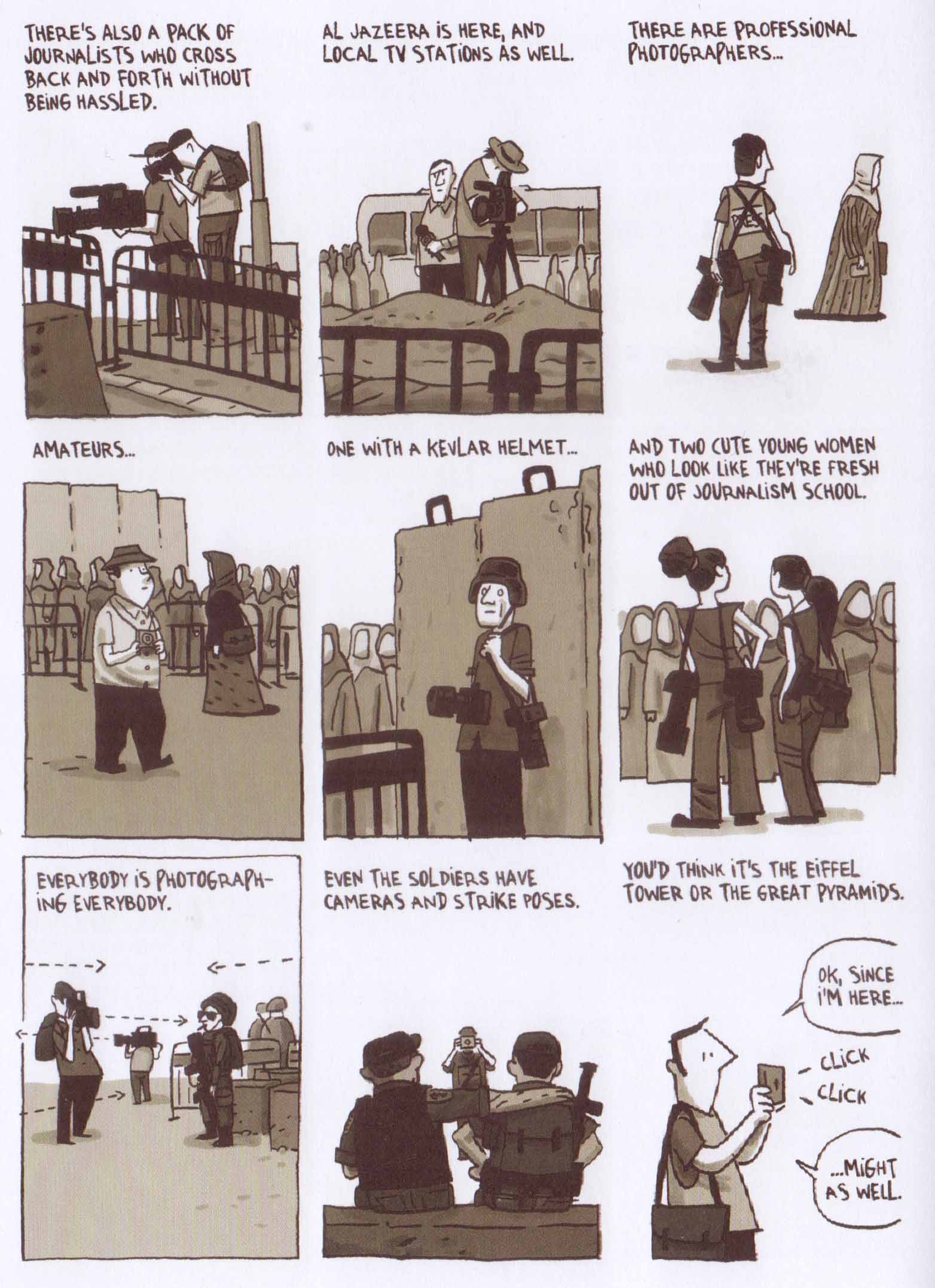
His first substantial political encounter comes 38 pages in (there are a number of minor instances before this) when he visits a border crossing  and the West Bank barrier with Machsomwatch, an Israeli women’s peace movement. At the crossing, the crowd is large and slow moving, the Israeli guards fully armed for war and happy to allow their pictures to be taken. Almost inevitably, there is a misunderstanding and then tear gas and stone throwing. In attendance, the television crews and Delisle; both hopping on the same media treadmill (their’s faster, his slower) we’ve seen re-enacted over the years; the artist’s eye paralyzed, the reader’s mind and emotions unengaged—the bulk of these experiences freely available all year around to the tourist looking to cross from an Arab country into Israel. It made me wonder why he didn’t visit the duty free shop while he was there (I guess there wasn’t one at the crossing).

To be sure, Delisle is not opposed to painting himself in a bad light. His reaction to the arrival of his cleaning lady is irritation as she tips his blog creating activities into disarray. He throws a small tantrum and makes a frustrated phone call to his wife.
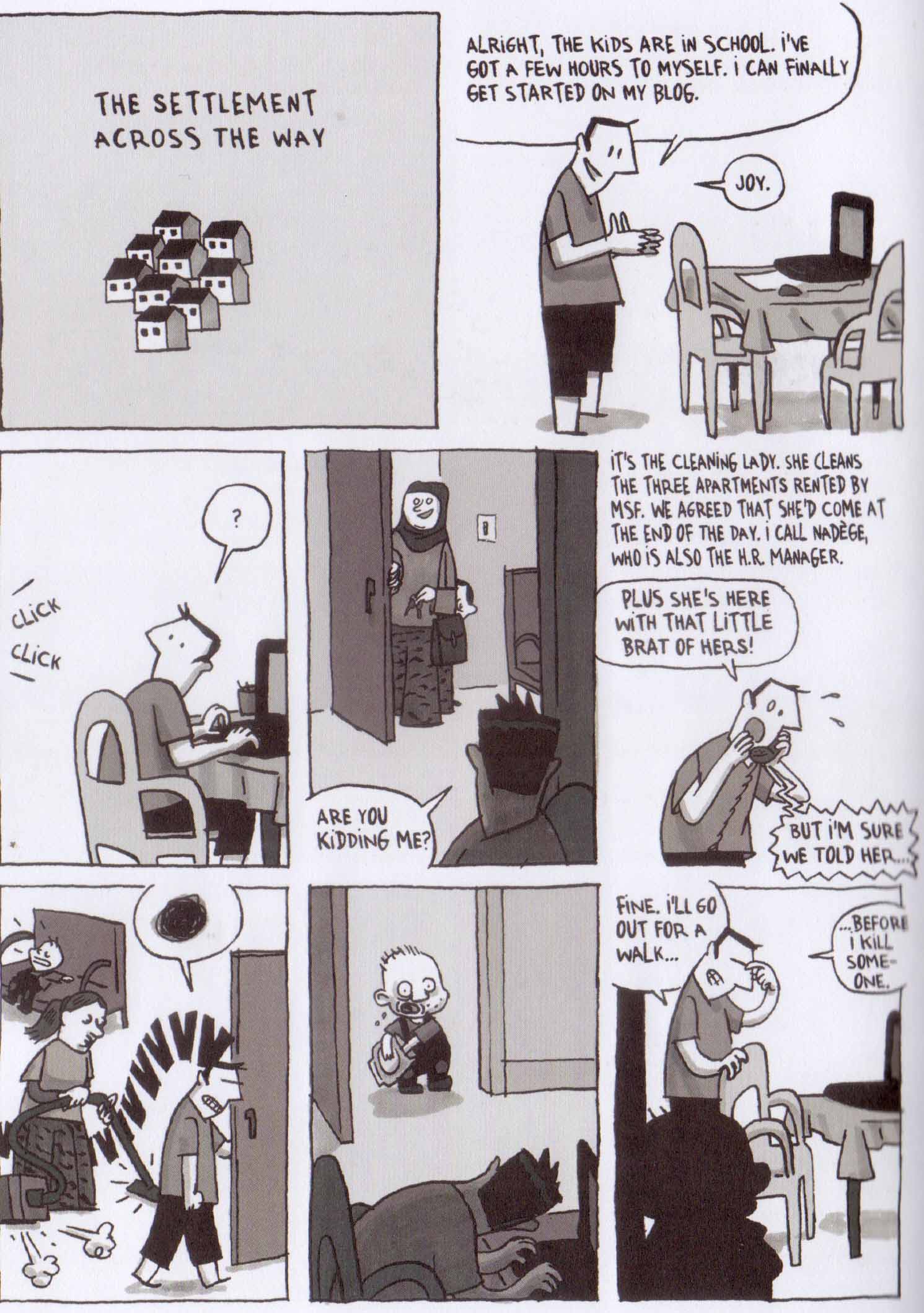
The comic under review is of course that “blog” or rather the result of that year of engagement; conveying all the daily grind of perpetual enforced communication in a tone strangely shy yet smug.

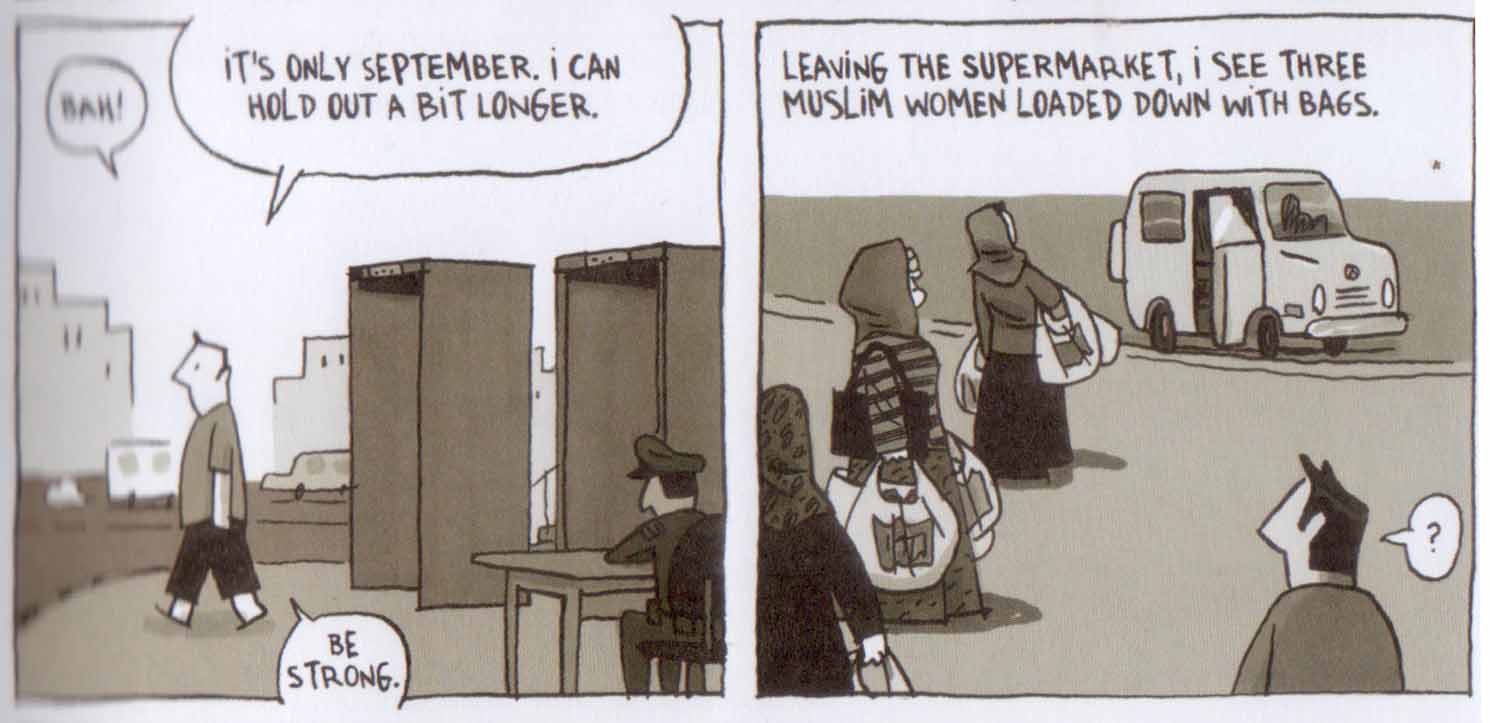
Jerusalem works best when Delisle’s art meshes with his subject matter in the kind of light social observation you find in his earlier comic, Aline et les autres. The denouement of his hunt for the perfect bowl of cereal ends to sort of interesting effect when he sees bag-laden “Muslim women” leaving the settlement supermarket he has chosen to boycott.
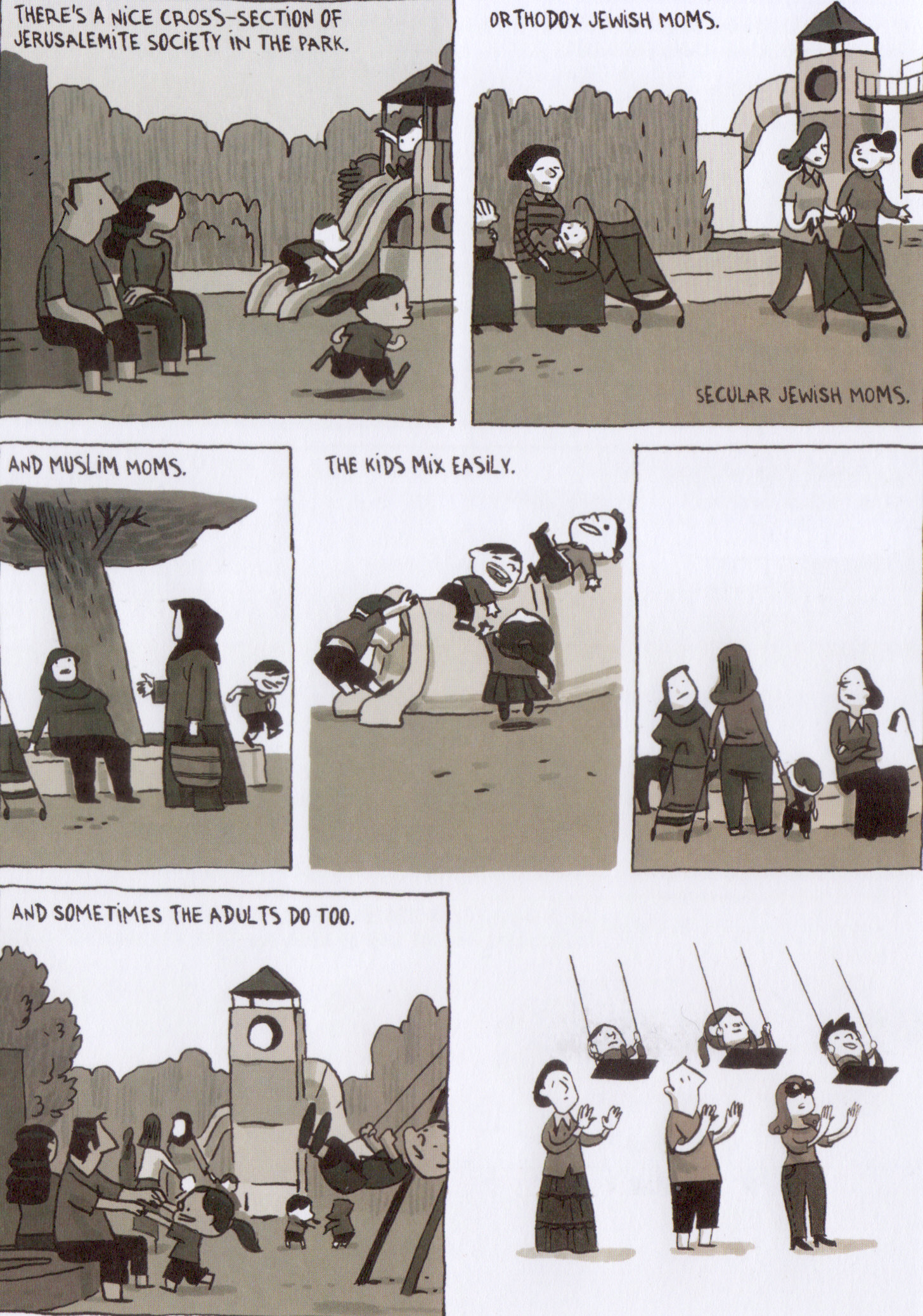
There’s a little homily in a playground about mothers, children, and racial harmony (I grant that the reader’s cynicism will need to be checked in at the point of purchase).
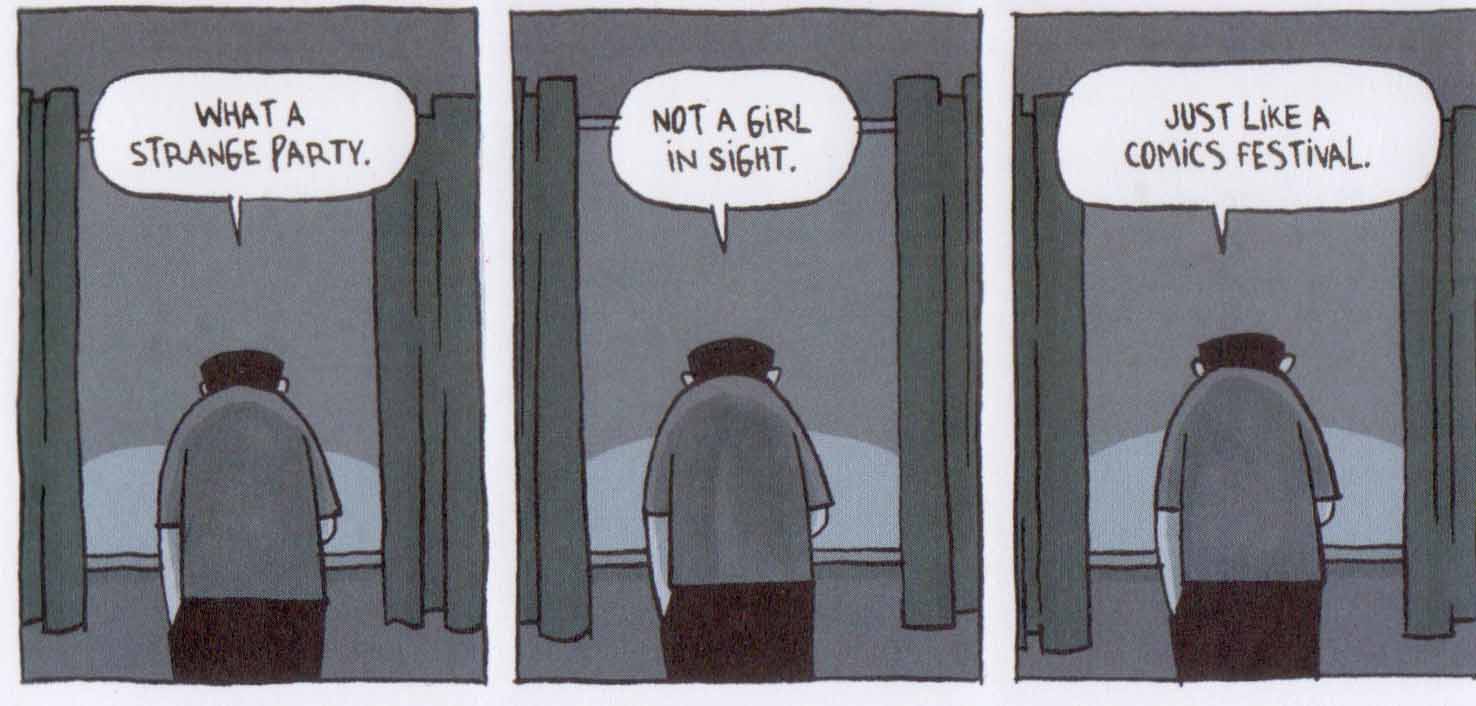
There’s the part where he compares an “all-male” Arab wedding to a comics festival…
…and also some girls in bikinis with a hookah.
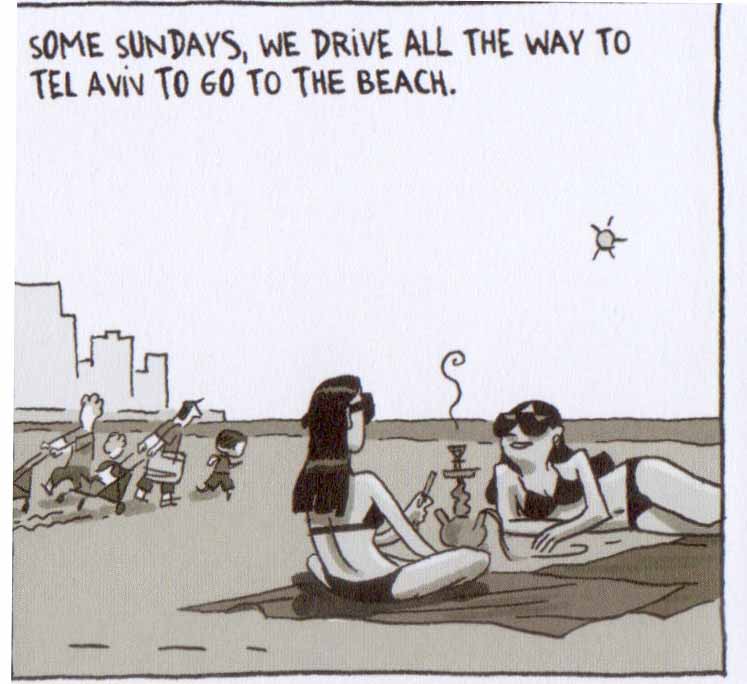
His embarrassment and exaggerated spinelessness can also be charming at times.
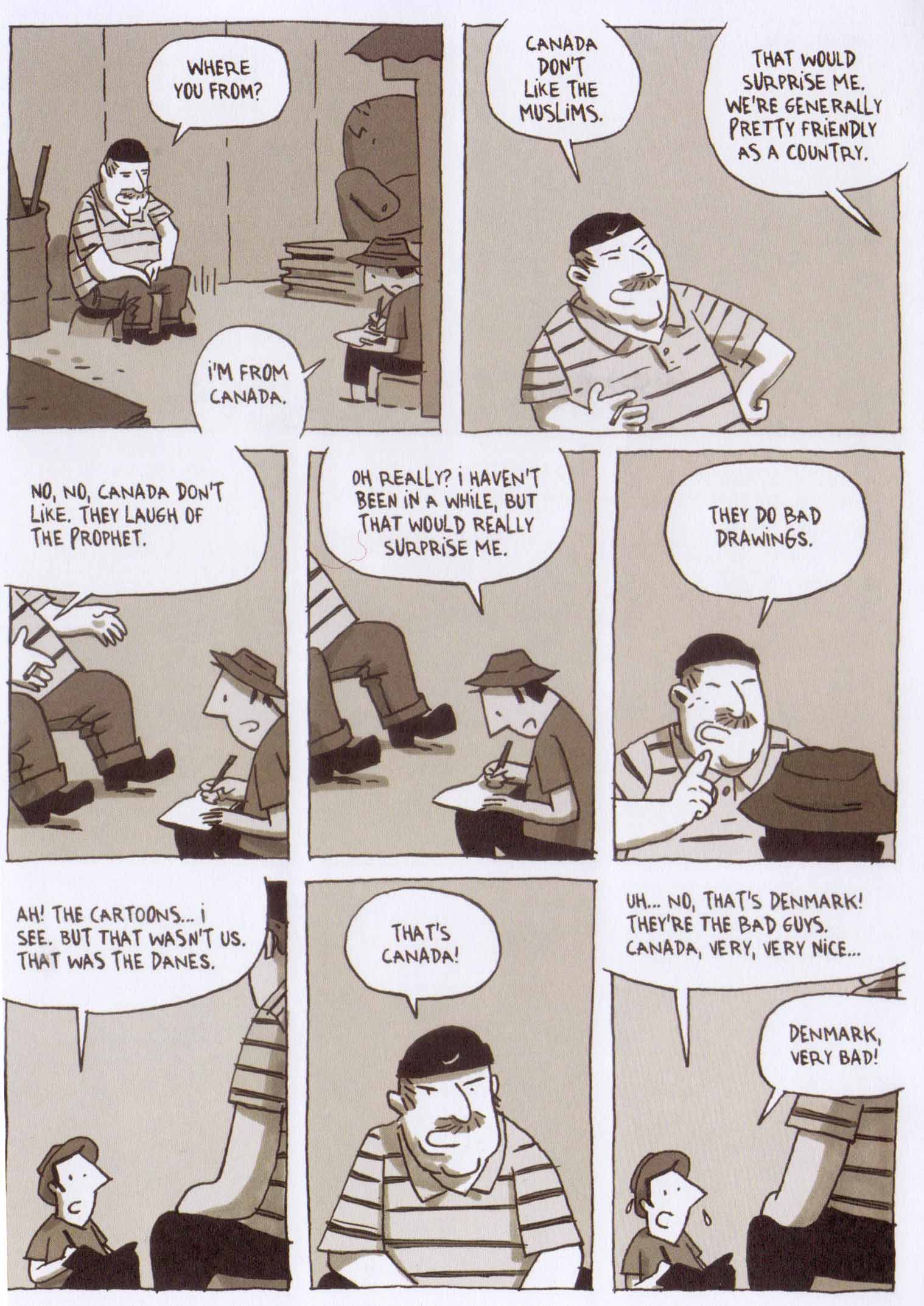
Most of it, however, reminds me of a photo album with commentary, the kind of ritual myth making experienced when a friend returns from his travels. A tale of gold-lined domes made on the backs of mercury poisoned death row prisoners is tucked in, as is his displeasure with a Zionistic Israeli tour guide (recognizable at least). And as with all such tales, there will be the travel disasters to punctuate the proceedings. In the case of Delisle, the multitude of El Al-related airport hassles and a lengthy sequence concerning the loss of some car keys down a lift shaft. Always amusing when the canapes are being served. The only problem being that Delisle isn’t your friend, and you’re not terribly interested in his family life and travel pics. Unless of course you are, in which case Jerusalem and his many other comics might be just what you’re looking for.

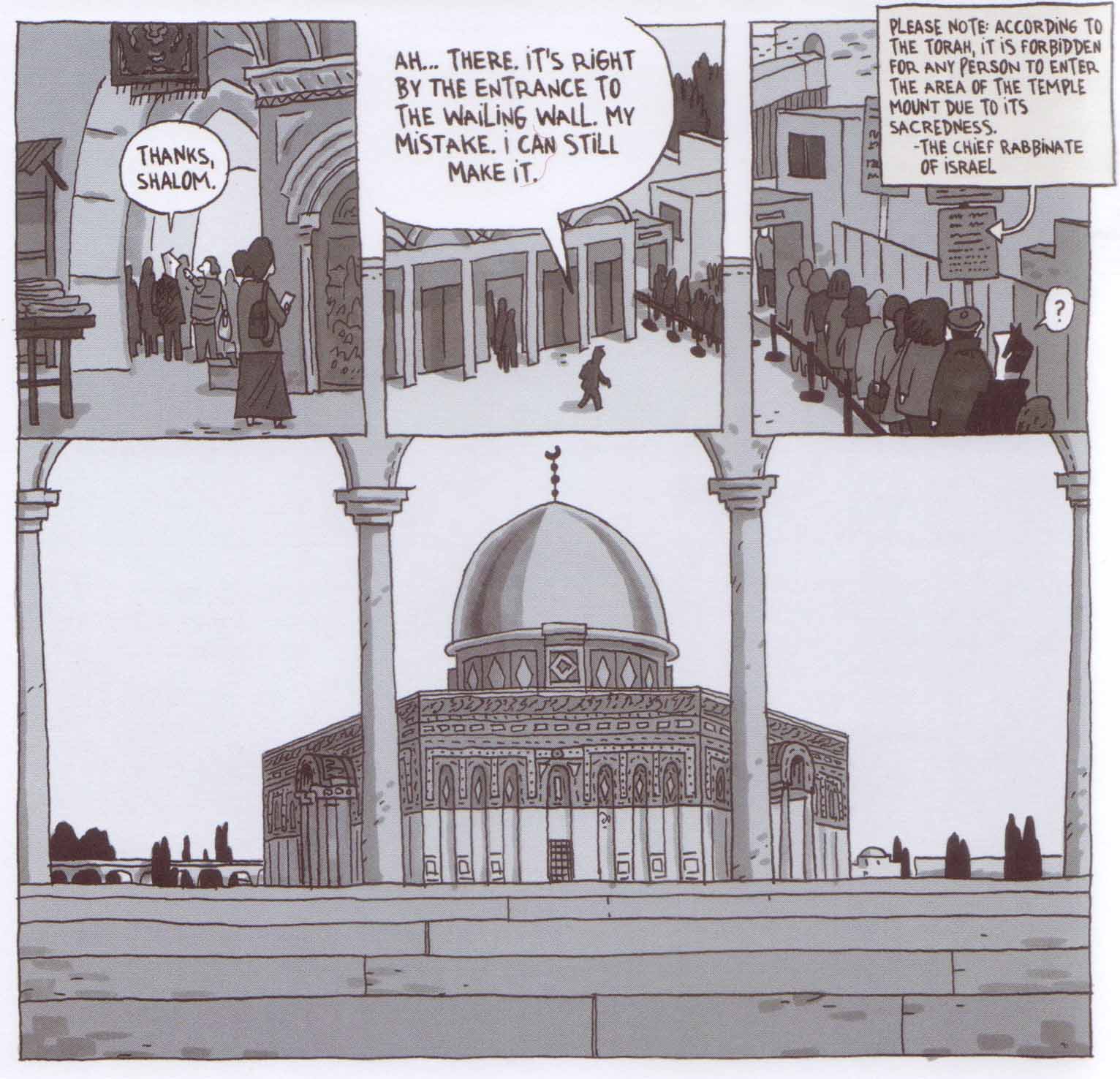
Even so, the reader is advised in advance that this is not a book to be read all at once, the banality of the insights here engendering feelings similar to those encountered when reading a large collection of cartoon dailies in one sitting. The off-days on the strip accumulate, its charms disappear, the limitations in drawing style are accentuated, the anonymity of the locales depicted become obvious, the jokes fall flat, life in all its disjointedness and directionless comes to the fore. Delisle has a dogged commitment to this aesthetic even taking time to relate how he fails to complete a visit to the three holy places of Jerusalem (the Church of the Holy Sepulchre, the Western Wall and the Temple Mount).
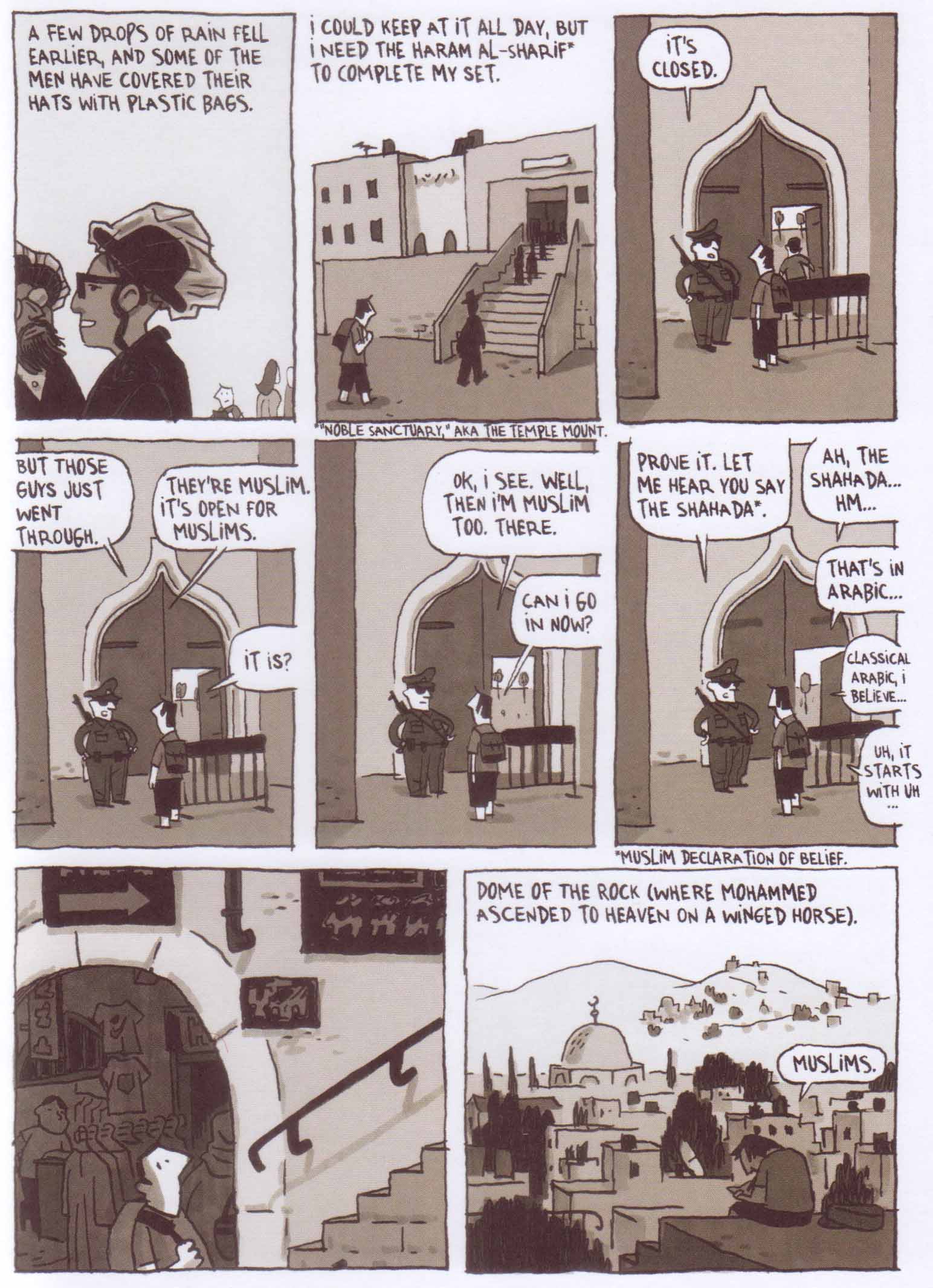
His ploy to get through by pretending to be a Muslim is not entirely without credit but there it stops. He neither speaks to these people at length nor inquires into the situation. The lack of curiosity is patent, the superficiality immense. There are short returns later in the comic but to little effect. The Holy Sepulchre is precisely what every oblivious tourist sees—the famous balcony ladder, the Orthodox-Catholic division of space in the church, the photo mad crowds (though strangely none of the religious fervor)—as short and indescript as a one line summary and just as educational.

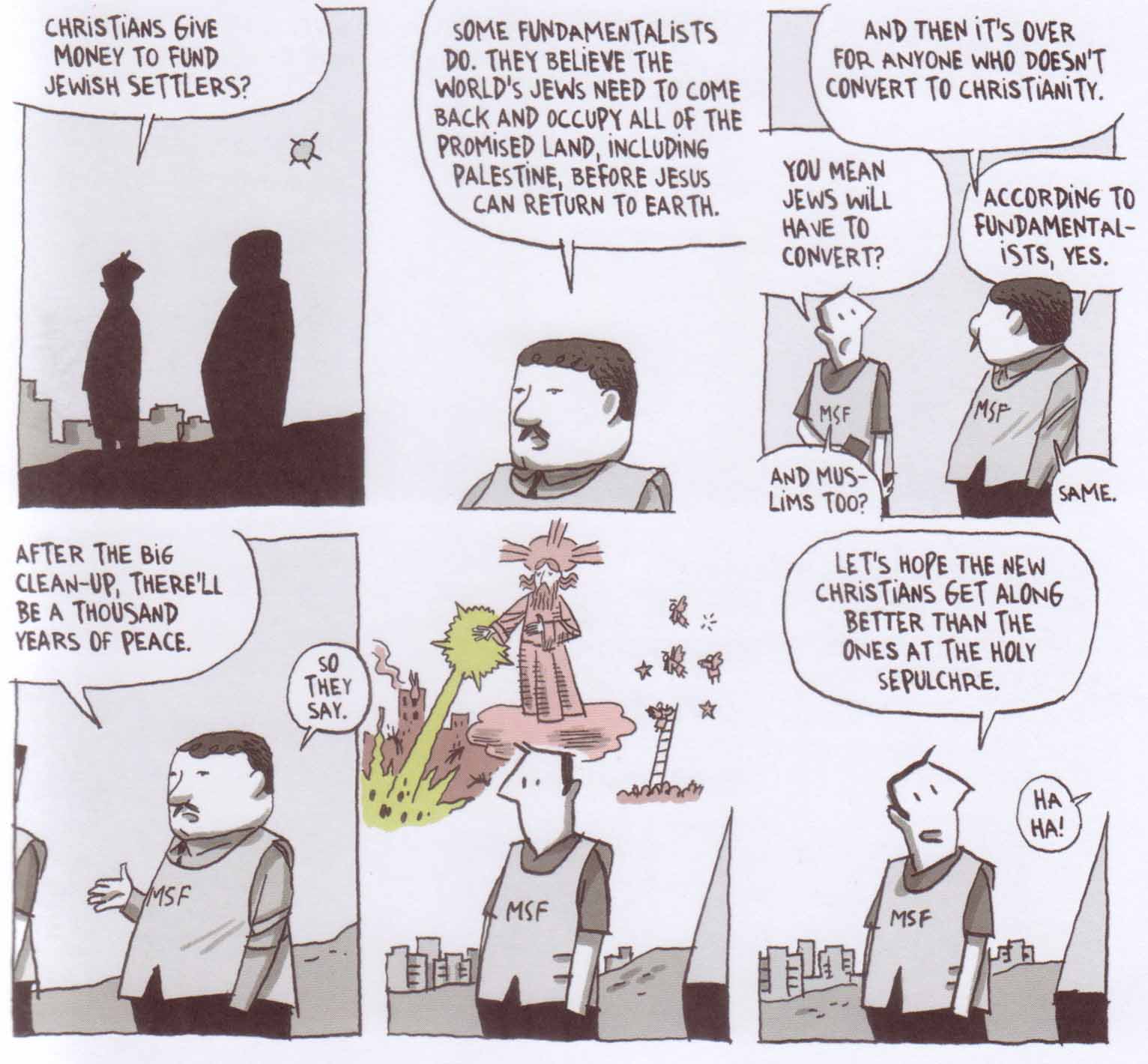
Not surprisingly, the religious naiveté on display beggars belief. Ten months into his trip and Delisle still has to be told what a Messianic Jew is (perhaps its an act of pretense to encourage conversation). And did it really take him that long to find out that merchants rent out crosses for pilgrims wishing to traverse the Via Dolorosa (there are sometimes stacks of them near the Holy Sepulchre)? Earlier in his comic, a sectarian fight in the church seen on television is a moment for hand wringing and a lame joke, not dissection or historical analysis:
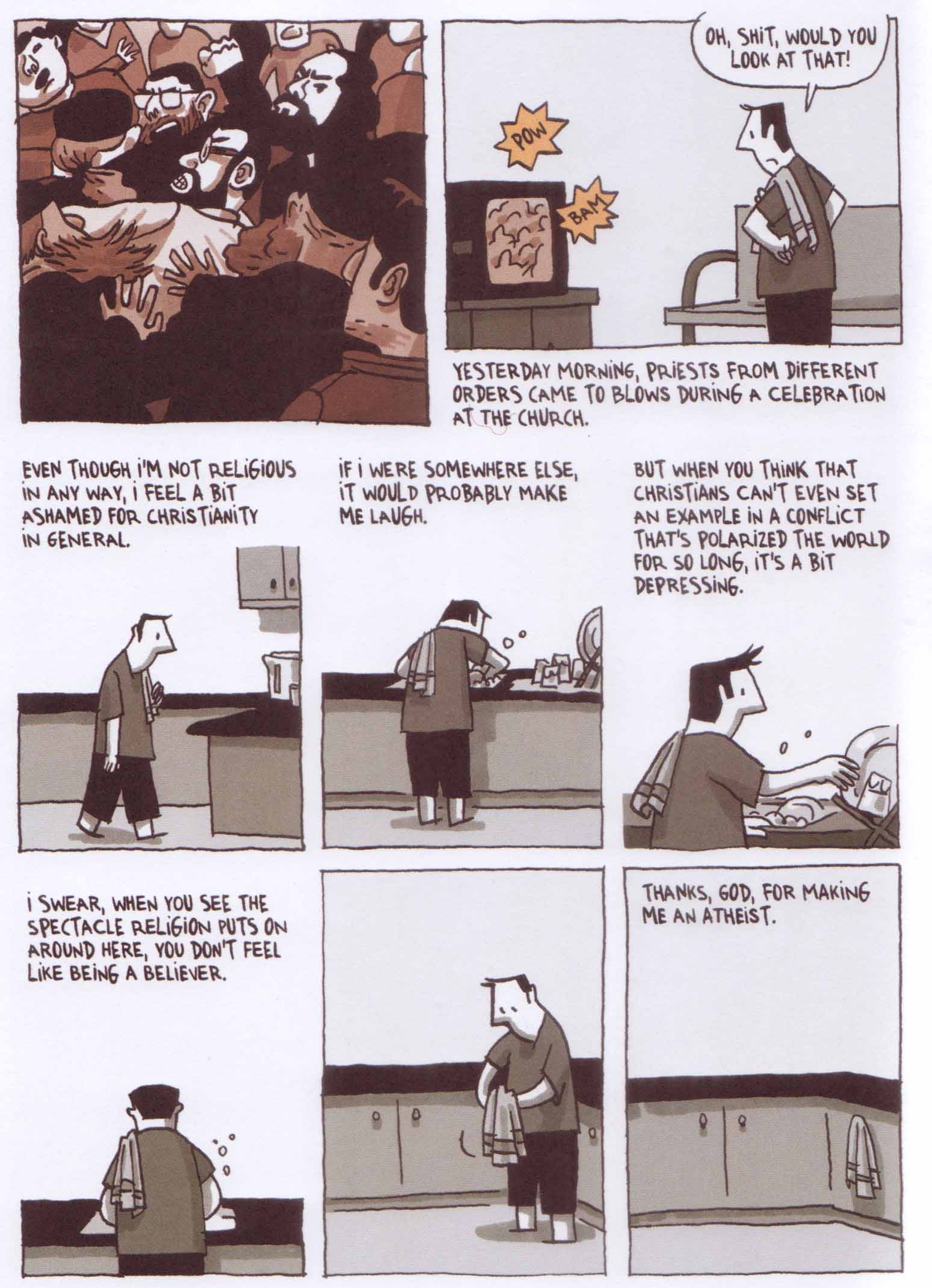
Perhaps Delisle isn’t talking about the same religion which sanctioned the sack of Jerusalem during the first Crusade. Could it be some other sect that has been living under the Status Quo for over a century and which continues to see brawls and property disputes on a yearly basis? Apart from this, there’s a frankly emaciated discussion with a member of the Franciscan order and a couple of prods at dispensational fundamentalists clearly meant as comic relief. Good for a polite guffaw provided one hasn’t heard the same joke done even once before.
There are occasional reprieves from this rampant shallowness. The author’s recurrent trips to Hebron are of some interest, in particular his guided tour with Breaking the Silence.
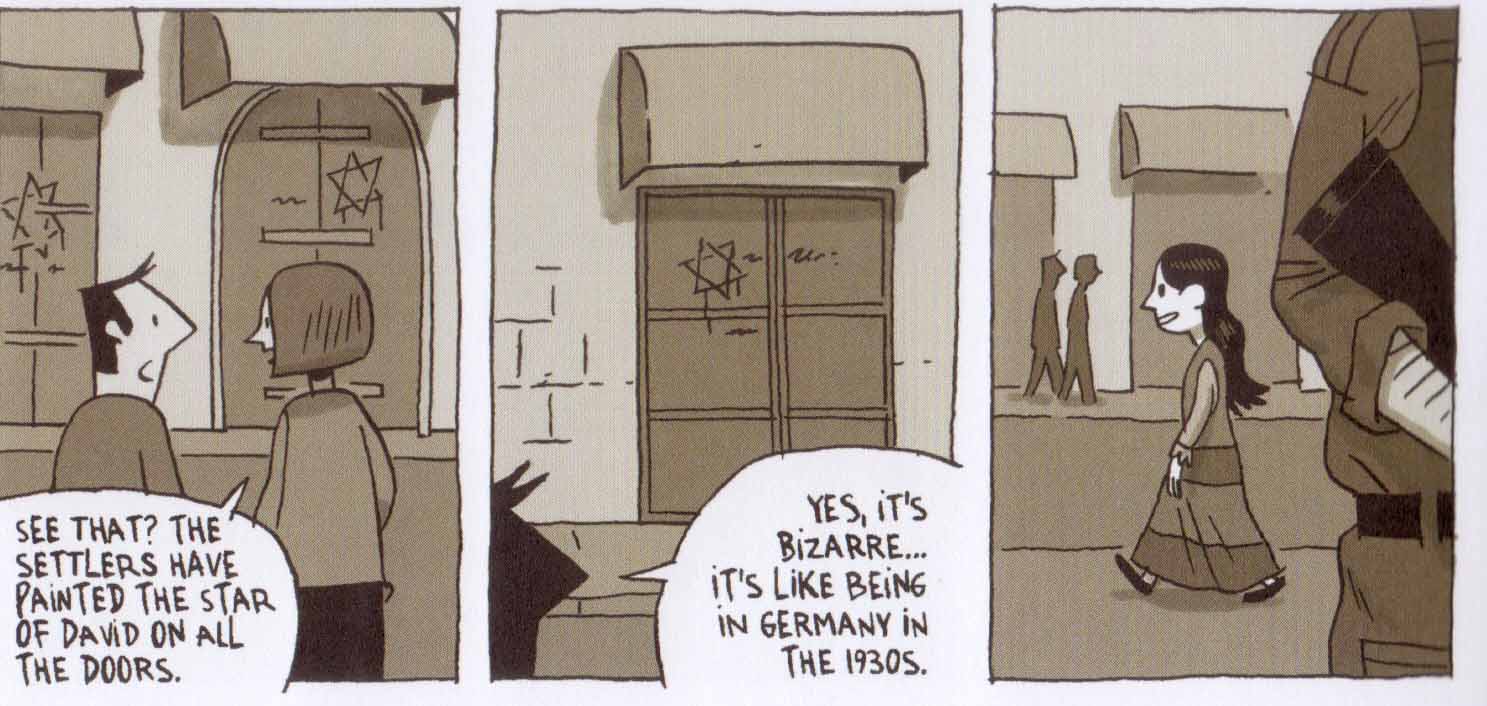
Delisle can be heavy-handed in his juxtapositions but, to his credit, never descends to the level of crass exploitation. The observations in Mea Shearim are also reasonably sharp considering the episode lasts only 4 pages. Most of these vignettes occur towards the tail end of the book and there’s little doubt that Delisle’s narrative improves as soon as he runs out of the usual things to say.

The rest of the long aimless middle section is almost too painful to relate. The return to the Temple Mount with a picture of the Dome of the Rock is of less interest than the most token tourist photo (the Al Aqsa mosque gets slightly better mileage).
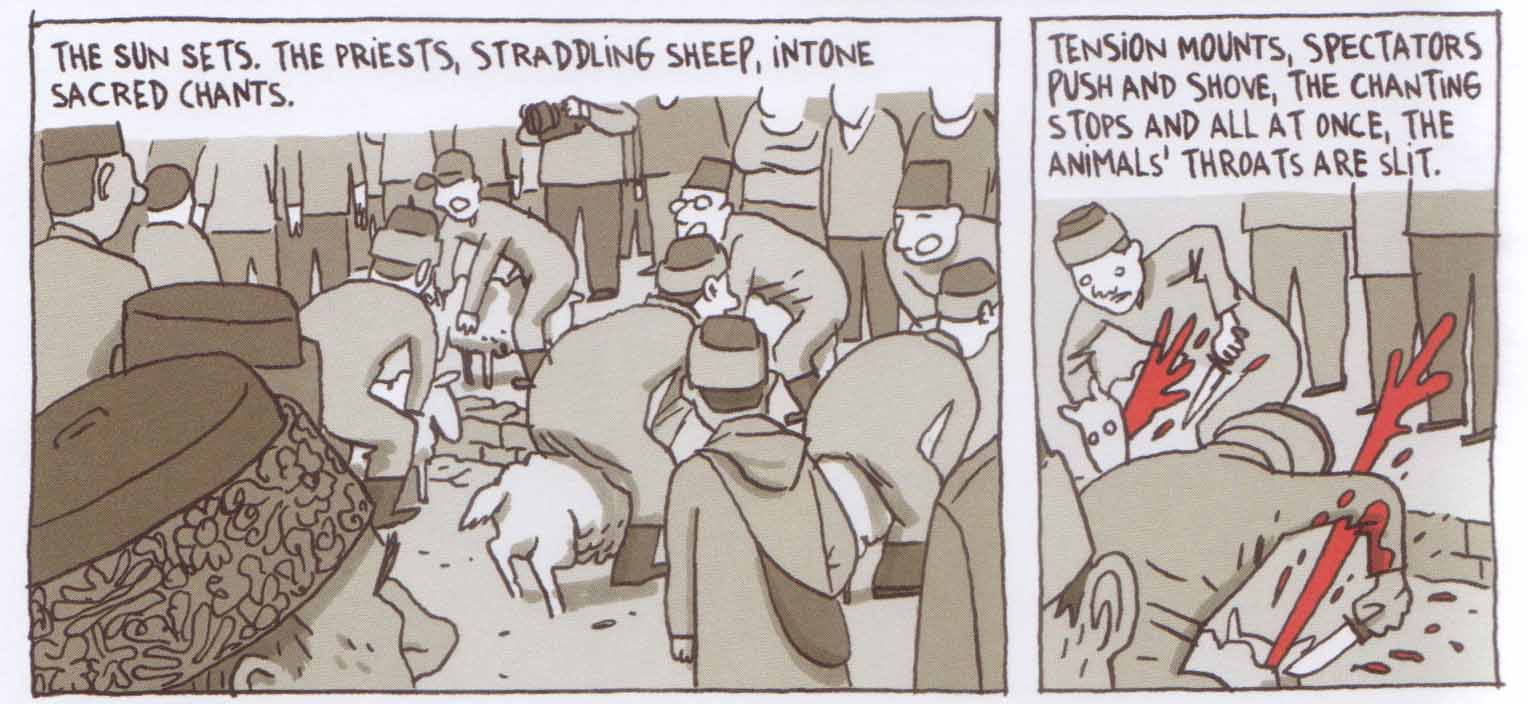
Delisle’s depiction of a Samaritan Easter (Passover) celebration on Mount Gerizim only makes us yearn for a proper photojournalistic account. The picture post card trail to Bethlehem, Massada, the Dead Sea, and Jordan is little better.
Delisle’s shtick is to tease out truth from the commonplace. He never does what you would never do in the same situation, hardly thinks an improper thought and almost never tells you anything which you don’t know yourself. Jerusalem is the playground viewed absentmindedly for a moment through your house window, as innocuous as people dying on a television screen—never close, never real, no scars, no blood, and never painful. Seldom does Delisle push pass this point. An instance of this occurs at the moment of departure when his housekeeper tells him that her house is about to be demolished. The episode is only two pages long but for once, it’s personal.
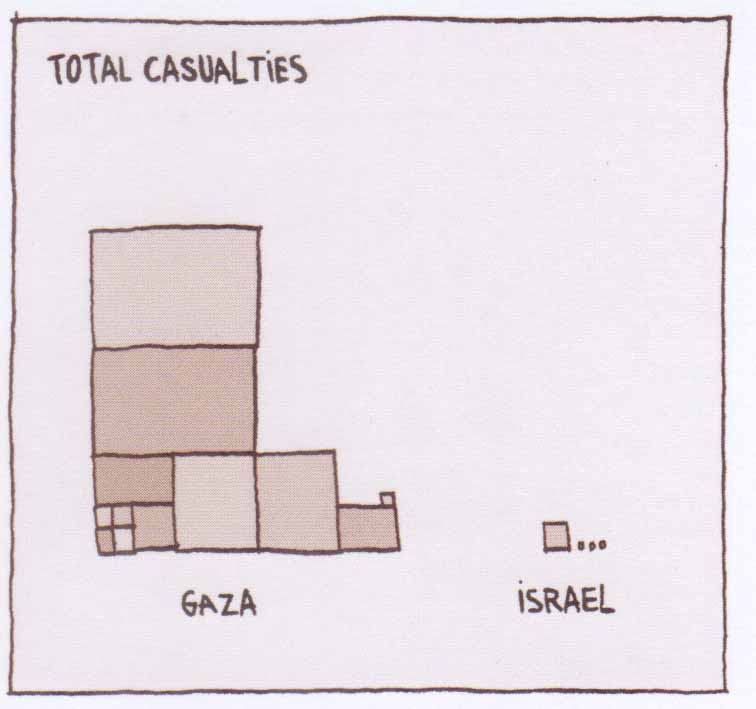
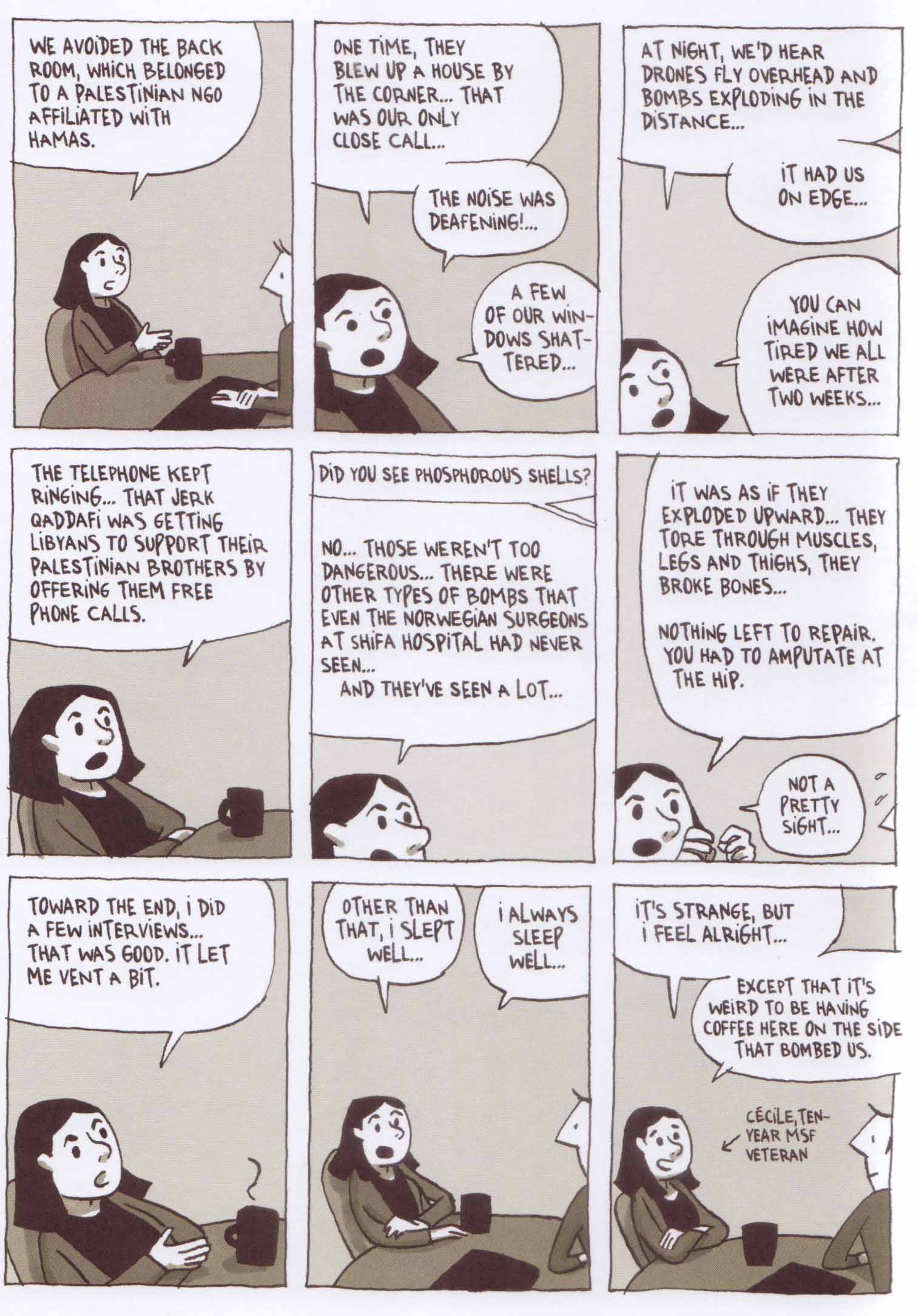
The graph which Delisle’s produces mid way through his depiction of a Gaza bombing campaign (a central event in his journal comic) is eerily representative of much his delivery. The prose apeing the art in a consistent blank drone with neither the vocabulary nor technique to elevate the text. His pedestrian interview with Cecile is as close to fine journalism as he gets, the 10 year veteran of MSF dissolving into an insignificant collection of lines and shade spouting words from the left border of each panel. Some will see this sequence as an attempt to let the words speak for themselves. In which case, I must ask, why comics?
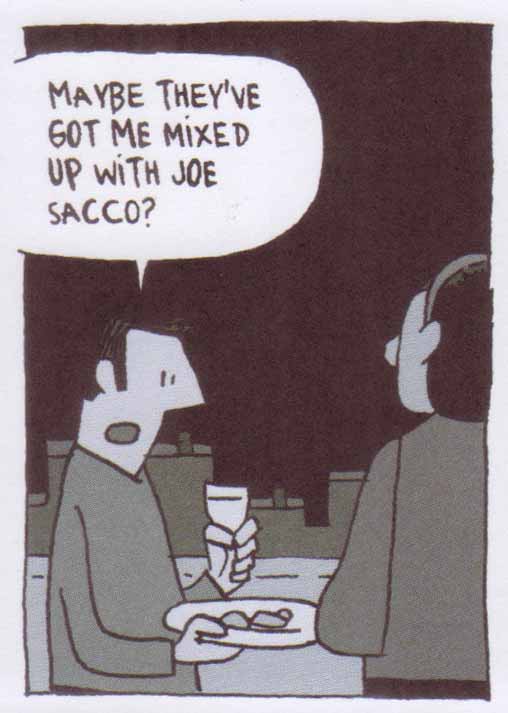
The narrative’s positioning in the arena of the trivial and everyday is no excuse for poor art. Consider the following amateur photography project by Still Yang. A simple set-up with a long zoom facing a bus stop situated in a Jewish orthodox community; the shots taken at the discretion of the photographer. The truth is that I found more humanity and insight in this simple project than much of Delisle’s comic. At the other end of the spectrum, there’s something like Simon Sebag Montefiore’s Jerusalem: The Biography—written in an entertaining style but with immense erudition and an all encompassing but popular intent. It begins with mythical history and ends on any morning at 4am in Jerusalem: the rabbi of the Western Wall at his prayers; Nusseibeh, the Custodian of the Holy Sepulchre knocking on those “ancient doors”; the Ansari Custodians of the Haram supervising the opening of the gates of the Dome of the Rock and al-Aqsa.

Guy Delisle’s Jerusalem has neither the concentration nor sweep of the art and ephemera which have preceded it. The cracks in the artist’s craft were hidden in his adaptation of Pyongyang, the rigidity, the stunted acumen, the plodding pace, the bland discursions all feeding and reinforcing received conceptions of an authoritarian North Korea. These flaws are laid bare in Jerusalem which is morally earnest but sadly leaden and inconsequential.
 

Further Reading

Noah Berlatsky on the vaunting tedium of Guy Delisle’s Jerusalem

David Leach’s review is my token “positive” inclusion if only because he goes into detail about what he likes. He praises Delisle’s use of the anecdotal story form and singles out the chapter on Ramallah for praise.

S. I. Rosenbaum on Delisle’s political and social obliviousness.
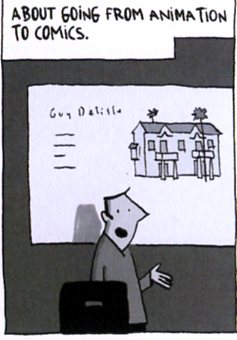
 

Public Readings of Comics

When I sit in my chair and and listen to the author speak, his or her voice carries me to a place of imagination. In many cases this experience helps put the listener into a frame of mind to absorb the work. Hearing the words with the author’s own inflection, tone and cadence has a transformative effect on the text.

In comics, the imagery is a literal part of the text. Image. Imagination.

The role that author readings fill in the experience of consuming prose is that of a facilitator. It serves to help guide the reader further into the author’s imagination. As they say, ninety percent of communication is through voice and facial response. Author public readings can enhance the audience’s relationship with the text.

In comics, one notices, the author’s imagery is already an aspect of the text.

What I find instead is redundancy and overstatement of the author’s worldview by placing the images upon the screen and also acting them out. Comics are, of course, a subgenre of the literary form drama. Drama, referring to plays, motion pictures: literature that is expressed through performance and acted out. While plays are acted out on the stage and motion pictures are acted out on the screen, comics are acted out on the page.

One would not attend a screening of a film and expect the director or screenwriter to be stand off to the side with a microphone, delivering all of the dialogue along with the actors. But this is what is done in comic author readings. There is an audience, a slide projector and the author not only telling the audience what is on the screen but actually reciting what is plainly spoken by the characters.

This sort of performance actually degrades the author’s own work by performing a redundancy. In trying to mimic the activities that their cousins, the print authors, undergo to create an intimacy with the audience, comics authors actually sabotage their own work. The result is a hollow imitation of both comics and prose.

The reason that these public readings enhance the experience for prose audiences is that they help guide the audience into a sense of an author’s imagination–an entirely new dimension to the work. The reason that public readings are corrosive to comics is that this extra dimension of immersion is actually competing for the audience’s attention against comics’ innate best attribute which is imagery itself.
_________
Image from Guy Delisle’s Jerusalem

A Peter that Never Existed

The Marston/Peter Wonder Woman roundtable index is here.
________________

I’m not a fan of the superhero genre in general, and, while I do own a volume of the Marston & Peter run of Wonder Woman (henceforth WW), I find I enjoy reading Noah’s posts on the series more than reading the series itself. That’s not a bad thing, I guess, good criticism should increase our enjoyment of a work, right? (And now I’ve set myself up for failure.) So why am I participating in this roundtable: there’s something about I love about Harry Peter’s style. But what does that even mean? What is style in a comic: how do we talk about it, and what is distinctive about Peter’s that appeals to me? That is what I am going to try to address. We’ll see how it goes, as this post is as much an investigative process for me as it is any kind of coherent result. Let’s consider it a kind of close reading.

What constitutes the (visual) style of a comic, and more specifically how can we address the individual’s style? There is surprisingly little written about this subject in regards to comics (or else, I’m just not finding it, suggestions in the comments please). Harvey, in his Art of the Comic Book, lists style as one of the four “distinct graphic threads”, yet punts on the issue saying its “storytelling role” is “too subtle for much elaboration here.” (9-10) McCloud addresses style in Understanding Comics in the form of his big triangle and his charts of panel transitions, but he tends to generalize his discussion into broader groups and effects (and the placement of artists on that triangle often seems pretty random). Wolk writes about style in a very broad way when comparing the “mainstream” to “art” comics, but his discussion tends to over-generalize to make his point. Groensteen offers a decent introduction to comics style in his La Bande Dessinée: Mode d’Emploi, pointing out the inclusion of elements other than just the drawing/inking/coloring in the style of comics and comparing a few different artist’s styles, but it’s an introductory book so he doesn’t go into a lot of detail.

Style in comics is more than just line, tone, color, composition, and the way the images are drawn (realistic, caricatural, detailed, minimal, etc.), it is also the page layout, the découpage (“narrative breakdown” is what Harvey calls it, but I feel that the French word is less specific to narrative comics–not to be confused with shellacking paper onto boxes). All these elements work together to give the comic its style (one could, depending on the work and its context, add other elements, but for the purposes of a comic book like WW, this should do). For a single author work it is easy to attribute all these factors to the stylistic of the author, but this attribution is more difficult for the corporate comics structure that Peter worked in for WW.

Page layout, découpage, and perhaps composition can be partially or wholly attributable to the writer. Some comics writers write detailed scripts breaking down the narrative into panels, pages, even describing specific images and compositions (I’m looking at you, Alan Moore). Without seeing a script it is hard to ascertain this level of credit. Similarly, many of these comics are inked by a different artist than the one who pencilled the images. How can we then attribute the visual style of line, tone, detail? The inker could faithfully or loosely follow the pencils; the inker can add or leave out details; the inker can exaggerate or tone down the penciller’s figures. (Probably the most prominent place to see this addressed in discussions concerns the various inkers of Kirby’s work, though I’ve found it relevant in looking at Toth’s work also.) Color can also be wholly or partially attributable to hands other than the artist. Most corporate comics are colored by someone else (nameless in the days of Peter’s work), and who picked the colors is not always clear. It seems to have been common that newspaper strip artists provided color guides, but I believe that would be unusual for comic books at the time of this work.

The Grand Comics Database credits Peter did his own inks on WW, though Nadel notes that he was “aided by a number of usually female assistant” (28). This calls into question how much of the pencilling and inking we can consider “his.” But for the purposes of this post, I must assume that Marston gets credit for the story and text as well as at least some credit for the découpage, and Peter gets credit for everything else except the coloring (maybe the lettering, but I’m not concerned about that). Much of this is supposition on my part as I have not seen one of Marston’s scripts, and I don’t know the historical details of who did what. These basic assumptions give me some limitations to work within. I’ll start at the broader level and move towards the specific. For better analytical purposes, I will be discussing both issue 28 (Mar/Apr 1948) and issue 3 (Feb/March 1943). Images will be cited as ISSUE: PAGE.PANEL where I am using the page numbers on the art itself (in both cases consisting of a number and a letter (for the parts of the issue)): so the fourth panel on page 2 of issue 28 is “28: 2A.4.”

Page Layout

At first there appears to be nothing unusual or stylistically distinct to note about Peter’s page layouts. Other than the splash pages, every page in Issue 3 has 3 horizontal strips, each divided into 2 or 3 panels (6-8 panels per page). With only 2 exceptions (3: 7B,9B) every page is based on the 9 panel conventional grid layout. Even the splash pages have the single small panel that is basically 1 panel from a 9 panel grid.

Issue 28, 5 years later, shows some development in Peter’s layouts. The splash pages are now just single images. All but two of the remaining pages have between 5 and 7 panels, still quite conventional. Most are still based on a 9 panel grid, but he varies some of the panels in size to fit the composition/content: tall panels for dramatic full body images or vertically-based action, wide panels for large groups or horizontally-based action. The pages are still primarily formed out of three horizontal strips of 1 to 3 panels each, but a number of pages are formed of two strips, most often in what Chavanne calls a “fragmented” layout. For instance on page 3A the top strip starts with one tall panel (a focus on full figures) followed by two stacked panels (horizontally-based action). (For an example see the full page image in the composition section below.)

This use of the fragmented layout is not unusual to contemporary readers, as it is, at this point, a convention. I didn’t think much of it either in the context of Peter’s work until I started looking at other comics I had on hand from the time period (or a bit later, I don’t have many comics from the late 40s). Tarzan No.2 drawn by Jesse Marsh, also dated March/April 1948, proves to be even more conventional with all but 2 pages having 6 panels (3 strips, two panels each). The first three comics (drawn by Lily Renée, Matt Baker, and Warren King) dated in 1949 from Romance Without Tears all have pages with 3 strips and 6-7 panels each. The first few stories in Krigstein: Comics from 1949 also show no use of the fragmented layout. Peter’s own Man o’ Metal comic (found in Nadel) includes a couple uses of the fragmented layout, though I notice that each time it’s used Peter has included little arrows to direct the reading path. This is an another indicator that this particular type of layout has not become convention. So perhaps Peter’s layouts, with the use of these fragmented layouts, are a little more unusual for the times than I thought, though I still don’t think we can consider them a distinctive stylistic element.

More subjectively, it’s hard to say that anything about the layouts are expressive. They are mostly invisible, in the sense that unless you really look at them, they go by unnoticed. They just serve the narrative neutrally, panels placed into the page to fit the content and keep the narrative continuing smoothly. Of course, dividing the page in these ways is also the simplest from a production standpoint, which is important when you’re trying to draw a lot of pages on a schedule.

Panel Composition

Like most comics (especially at the time), characters/figures are the primary focus of the compositions. I count 8 (issue 3) and 6 (issue 28) images that are (arguably) not focused on a character or group of characters, and only 3 and 1, respectively, of those have no figures at all (it’s the monkey changed into a “prehistoric tree fox,” in issue 28 in case you’re wondering). That said, Peter does not neglect the backgrounds (since the figures are the focus, I feel safe calling everything else the “background”). He creates and maintains a sense of the settings, only occasionally eschewing any background at all, usually in cases of crowded figure groups (28: 7A.2), close-ups, and panels with lots of text.

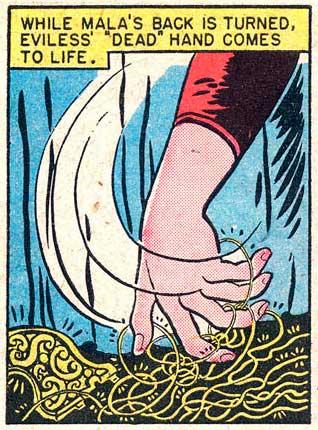
On the whole he uses, to apply filmic terminology, medium and long shots for his compositions. Most of the scenes show the characters at a consistent size (where we can see full or almost full figures) across panels. Peter rarely uses close-ups: a few heads tightly framed with word or thought balloons, and one notable close-up of Eviless’s hand as she surreptitiously steals WW’s lasso (28: 4A.1). This last unusual panel is fittingly also a key narrative turn in the story (without it we really wouldn’t have the rest of the plot). Issue 3 has two close-ups of textual content (a letter and a news story) but otherwise is similar.

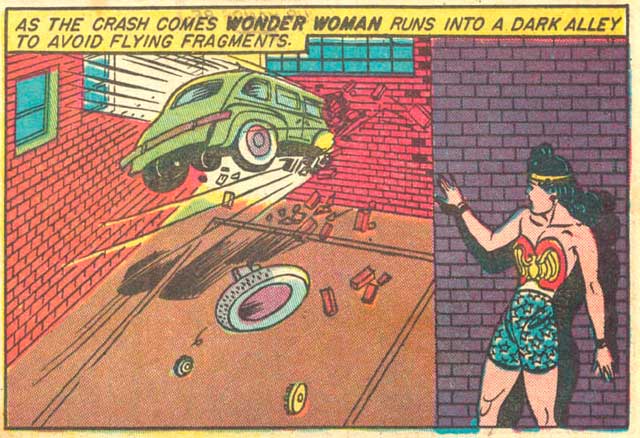
Dramatic angles (high or low) are almost never used in these two issues. The view of the characters stays at eye level and shifts only for action that almost requires a high or low angle (28: 10B-11B) or for longshots that show more of the setting.

Peter maintains a surprising sense of depth throughout issue 28. It’s not an extreme depth, we rarely see anything large and close cropped in the foreground, but all the non-close-up images at least retain some semblance of depth: groups of characters shown in deeper space or background elements placing the characters into space. The panels in Issue 3 are less deep as he used a lot of sharp, angular planes in the background that flatten the space (3: 8B.4 is a good example of an outdoor scene).

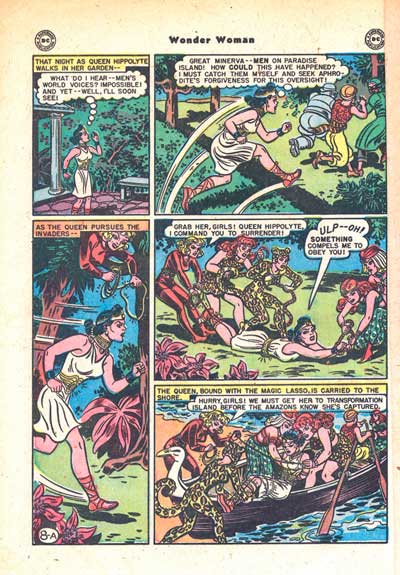
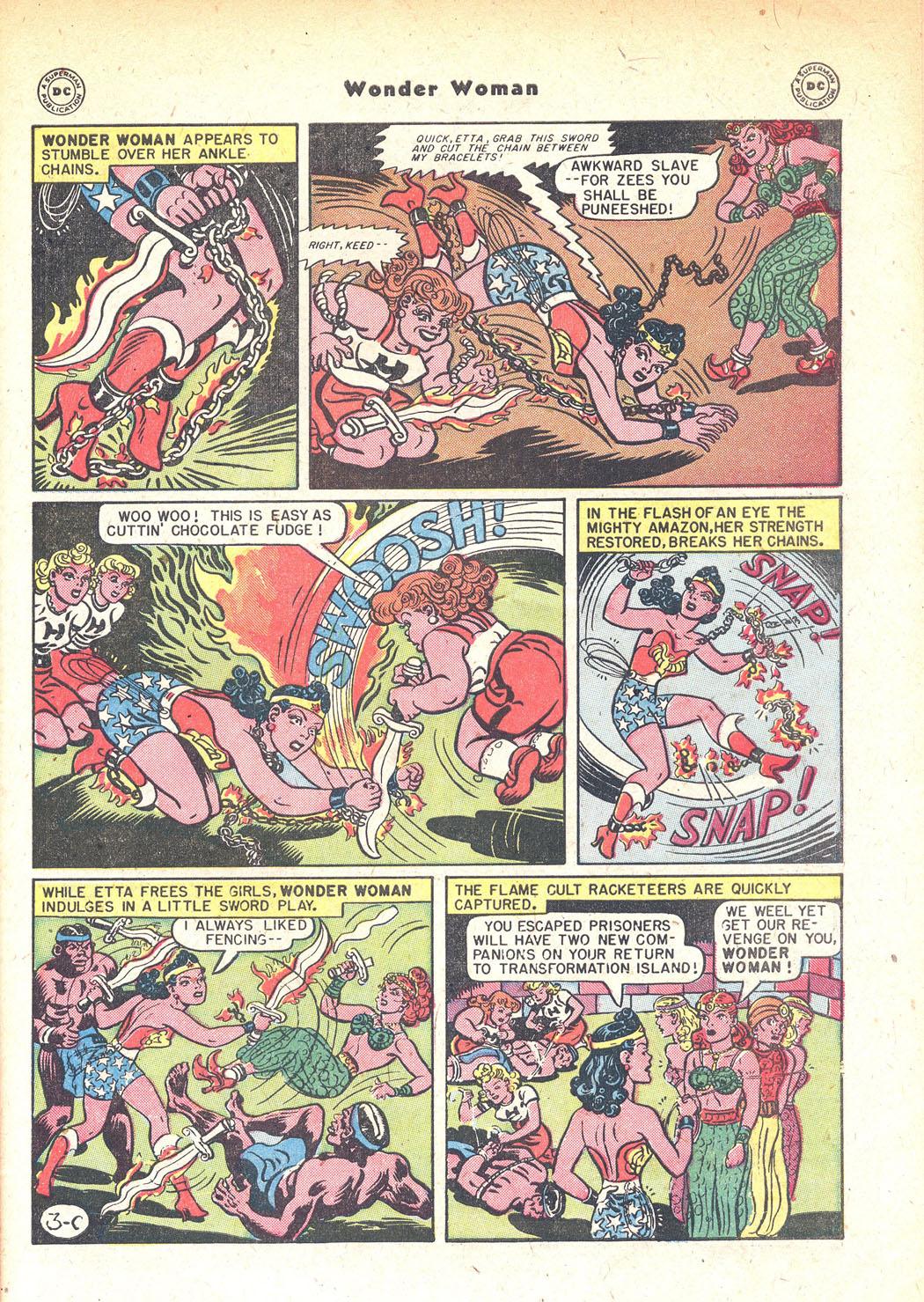
Many of the compositions in issue 28 have a strong forward (that is, to the right) motion. WW’s (and the other characters’) actions tend to direct her to the right (8A, 11A, 10B, 3C). An exception to this are the chaotic fight scenes that punctuate the story (6B-7B are a good example) where the chaos is emphasized by the composition losing that forward motion. I think this element is one of the highlight of Peter’s style and what makes his style effective for this type of action comic. Notice how everything moves forward/right in the following page with the except of the three central figures (panel 4) how are fighting against WW (also here is one of those fragmented layouts).

Figures

For many people the way figures are drawn is the key index of an comic artist’s style. Since comics are so figure-based it becomes natural that artists can be identified solely by their figure work. In common parlance the “style” of an artist is often used to mean the way their imagery is, or is not, in accordance with ideas of the “realistic.” The “photorealist” style of artists like Alex Raymond, Stan Drake, or Neal Adams as compared to a cartoon/caricatural style of Schulz, Barks, or Segar. This usage of “style” tends to come down to the way the figures (and objects) are shown to be close (or far) from “reality” as far as proportions, shape, and detail, as well as to the actual rendering of line and tone.

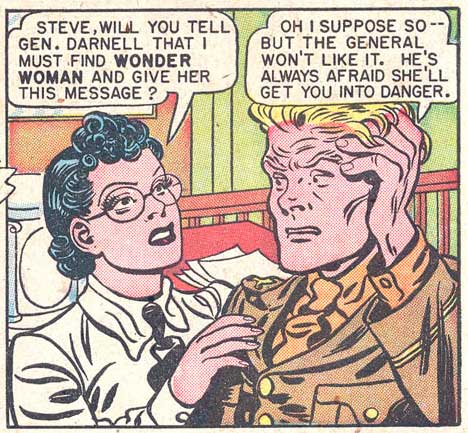
I’d rather not attempt to unpack these concepts here, except to note how Peter fits into these general conceptions. Peter’s figures are certainly naturalistic in many ways. They generally have “normal” proportions and move in natural ways (both the bodies and the faces) (a key exception here is Etta Candy, who is far more caricatural). Where the proportions are abnormal is where Peter starts to be distinguished. His characters are large in the shoulders and head, while hips, waist, and legs tend to be much narrower. He also draws men differently than woman, which is so befitting of this series one wonders how much it is a general aspect of his style and how much it is something he took on for the series. His male characters (which are very few in issue 28 and not much more plentiful in issue 3) have really outsized heads and shoulders, with angular, blocky faces with prominent cheeks, jaws, and foreheads. All of which often renders them bit grotesque. Steve Trevor is one weird looking dude (28: 10A.5, below). Peter’s women tend to be more glamour girl-ish, a gender distinction which is not unprecedented in comics. Cliff Sterritt’s Polly and Her Pals featured Polly as a stylish glamour girl while her parents were caricatured figures. The eyebrows on Peter’s woman are also quite pronounced and arced, in a way that is reminiscent of Caniff, while their eyes are often enlarged (more so in issue 28).

Peter’s figures have a strong sense of movement and dynamism to them in Issue 28. His generally curved line adds to this effect as does the way his figures curl in upon themselves. Even in action WW’s legs and arms are often bent in towards her body (leaping with legs bent in at the knee). One could almost read that as working in conjunction with Marston’s bondage themes. The characters’ actions are both freeing and restricted.

I note in comparing issues 3 and 28 that the figures in issue 3 are stiffer, a bit more awkward looking, while in issue 28 they are softer, more rounded. Another example of Peter’s evolving drawing style, though also potentially an effect of changing assistants. Personally, I find the earlier work more distinctive if considerably more rudimentary looking from a pure figure drawing point of view.

Line

Peter’s line work is one thing that really attracted me to his work when I first saw it. There was something vibrant about his lines and the way they curved and bled together that was so unusual in the early issues I read. Issue 28 is a disappointment in this regards. Peter’s inking seems to me really conventional for the issue, though it is technically competent. He has a pretty consistent line weight that tapers at the ends and thickens on the curve and to emphasis volume and shadow (a nib pen, clearly). His characters are drawn with a line that is mostly consistent to that used on the backgrounds. His blacks (most notable in this issue on the some of the villains’ clothing and on the bodies of the half-ape people) tend to be a little messy looking, a conglomeration of feathered strokes. He doesn’t make much use of pattern or texture, with the exception of costuming (stars, leopard spots, prison stripes), and the occasional banal brick pattern. The work does not show the flair that makes you really notice and appreciate him solely for the way he used a pen or brush.

Much of the above seems to work against the distinctive aspects of Peter’s style. In so many ways, his work in these issues seems so conventional for the context. Or perhaps I am missing some aspects by ignoring the color and the découpage or all the other aspects of comics I haven’t even addressed. On the whole Peter is not what you’d call an innovator: he’s not pushing the form, nor is his art particularly ostentatious.

The Idiographic

I steal this usage from Charles Hatfield’s Hand of Fire to label the distinctive aspects of an artist’s style, those that work as signs to identify that particular artist. We might say that it is a combination of all these factors (and more that I’ve surely missed) which work together as a kind of networked sign of “style,” but I think we can draw out certain aspects that veer away from the conventional aspects of the work and those indistinct aspects which were/are shared with many other artists. There is a certain amount of subjectivity to this endeavor. These are the parts of his work that I see as distinct.

The older issues of the series (like issue 3) have this scribbly, curly-cue line that is really distinctive, used in clouds and hair and foliage. The early issue also seems to be more curvy in general, where the folds in clothes, muscles and visible bone structure (knees, clavicles, shoulder blades), and flanks of animals all have a distinctive curve to them. That little bit of excess seems stripped out in issue 28. Is this just a result of Peter changing his style, becoming a little more conventional? Or is this a result of changing assistants (or adding assistants since those early issues)? It is a good reminder that style is variable over time.

I’m particularly enamored of the clouds and puffs of smoke or gas that pepper the series (3: 6D.7; 3: 12A.4):

Or these gowns with their thick, swirling curves (3: 6A.5-6):

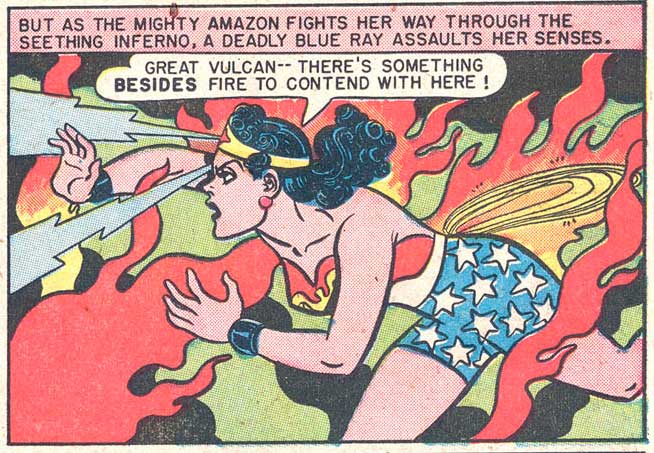
Another aspect that stands out is Peter’s drawings of the materially insubstantial–the flames and power rays–and the non-diegetic (I struggle here for the right term, the elements that are not actually there in the story world)–the motion lines and thought waves. Below is great example with the licks of flame and the “blue hypnotic ray” (28: 11B.4):

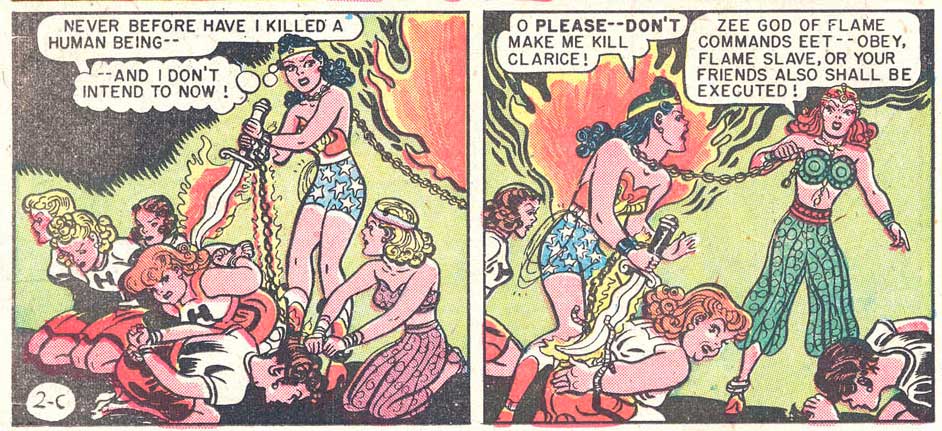
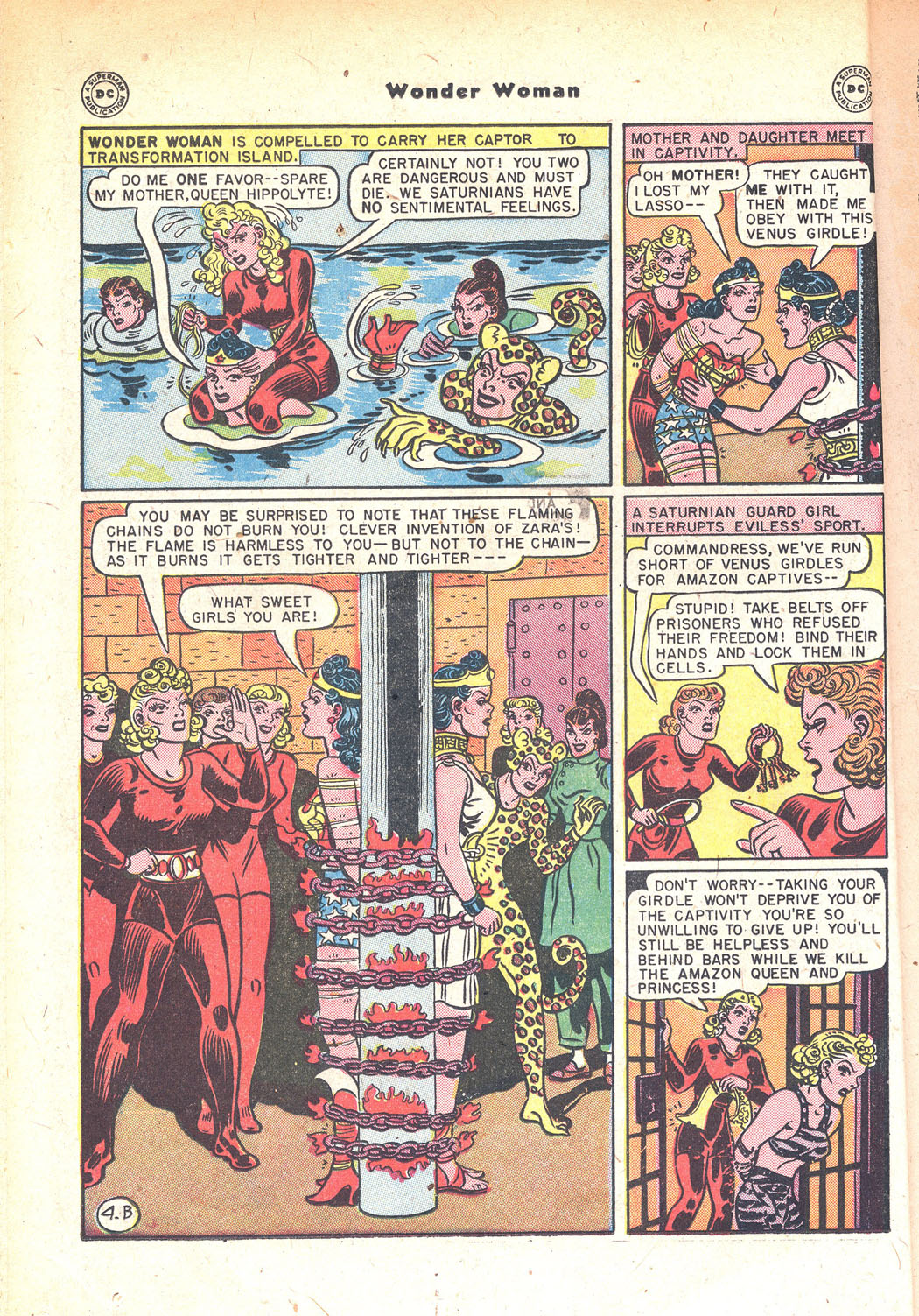
Or these panels (28: 2C.5-6) with the flames, the wavy black lines of smoke or shadow, and the little glow around the sword WW carries. The curly hair in those two panels are also very Peter to me.

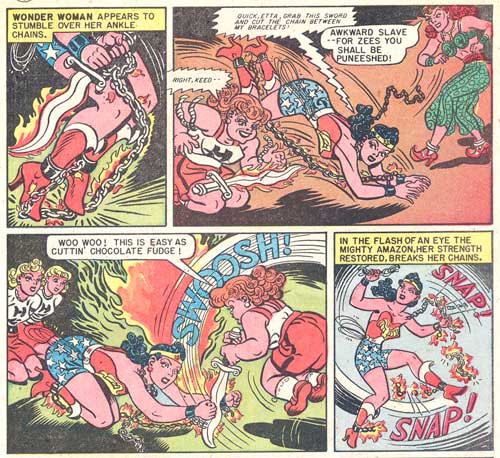
The next page (28: 3C.1-4) offers some great Peter motion lines that add such dynamism to the panels (and often counteract the stiff figures in bondage).

I don’t even know what this little pink puff is (some kind of Paradise Island foliage?), but I love it (3: 10A.2):


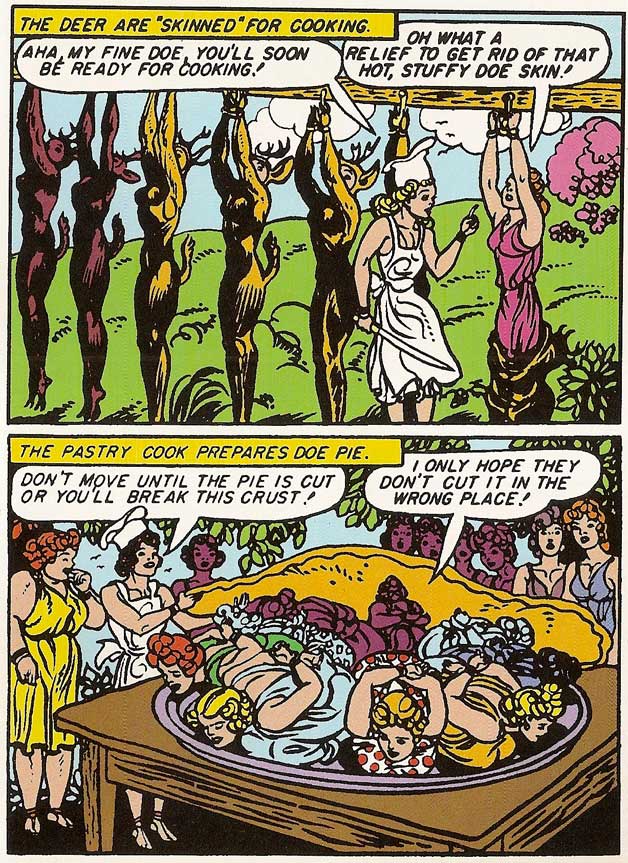
(see full panel below)

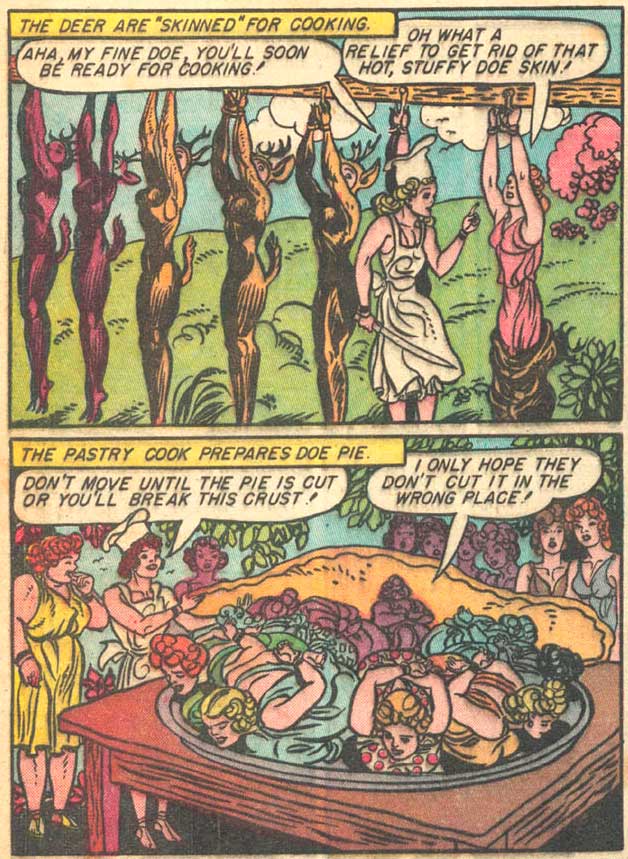
In comparing my “Archive Edition” volume with scans from the original comics (below: the top image is page 102 from the Archive volume, the second is the original), I can also see another factor that affects how one reads a style, the reproduction. The archive edition has a thicker line to it, which causes some of the tighter line work to bleed together. Some may cry foul at that, the scans and printing have changed the work, but I actually like Peter’s work that way (the updated colors are another story). The drawing takes on a bit of a woodcut flair to it because the black becomes more prominent and denser on the page. Am I perhaps then a fan of a Peter that never existed, a creation of modern reproductions, an artist in my own mind?


References

Benson, John, ed. Romance Without Tears. Fantagraphics, 2003.
Chavanne, Renaud. Composition de la Bande Dessinée. Éditions PLG, 2010.
Groensteen, Thierry. La Bande Dessinée: Mode d’Emploi. Les Impressions Nouvelles, 2007.
Hatfield, Charles. Hand of Fire: The Comics Art of Jack Kirby. U Mississippi, 2012.
Harvey, Robert C. Art of the Comic Book. U Mississippi, 1996.
Marsh, Jesse, and Gaylord DuBois. Edgar Rice Burroughs’ Tarzan: The Jesse Marsh Years. Dark Horse, 2009.
Marston, William and Harry Peter. Wonder Woman No. 3. DC Comics, 194
–. Wonder Woman No. 28. DC Comics, 1948.
–. Wonder Woman Archive Edition v.2. DC Comics, 2000.
McCloud, Scott. Understanding Comics. HarperPerennial, 1994.
Nadel, Dan, ed. Art in Time: Unknown Comic Book Adventures, 1940-1980. Abrams ComicArts, 2010.
Sadowski, Greg, ed. B. Krigstein Comics. Fantagraphics, 2004.
Wolk, Douglas. Reading Comics: How Graphic Novels Work and What They Mean. Da Capo Press, 2007.

Voices from the Archive: Gail Simone on Wonder Woman and Mary Sue

As I’ve mentioned, we have moved our archive from our blogspot address to here. I thought I’d make use of that to start a series highlighting some of the comments from back in the day. Voices from the Archive will be an occasional series; maybe once a week? We’ll see.

Anyway. Since we’re in the middle of a giant Wonder Woman roundtable, I thought I’d start out with some comments by Gail Simone in response to a post of mine in which I suggested that her version of Wonder Woman was a Mary Sue. Gail was extremely patient and forgiving, given the post in question. She left several comments.

Here’s most of her first.

This is a fun read. let me get that out first. I enjoyed it, in non-ironic fashion, honestly. But good lord, your premise is absolute and complete nonsense. I don’t like Mary Sues, I don’t believe in them, and I sure as hell don’t WRITE them. I find them intrusive, amateurish and insulting to the audience. The ‘evidence’ seems to be that:

a) I like the character, and

b) I like to show her in a positive light.

Well, dang, you caught me. She’s OBVIOUSLY a Mary Sue. Along with, oh, virtually every lead character ever written by anyone in a superhero comic. ;)

If I had a Mary Sue character, trust me on this, it wouldn’t be Wonder Woman, or Superman, or any of the other icons. I have absolutely no such connection.

Additionally, I found you REAAAAAAAAAAAALLLLLY stretching to make your point in this article, which is a little funny, given the smugness that it embraces. I always say, wrong is okay, smug is okay, wrong AND smug is a little weird. ;)

I’m glad you liked some of the book, but of course sorry if you were disappointed overall. Wonder Woman is very subjective, and your piece here reminds me a lot of what I read on message boards, wherein there’s some resentment that the book’s author doesn’t write the Wonder Woman that the poster holds in his or her own imagination. It’s understandable, I’ve been there myself many times.

And here’s a bit from a later comment.

As for Mary Sues, hmm. Well, while I can see your definition, I’m not certain that it is actually the prevailing one. And there’s no question that blatant Mary Sue-ism is mostly pretty hideous stuff to actually read, even when it ISN’T amateurish fan-fic.

But simply declaring a character to be a Mary Sue doesn’t make it so, as I’m sure you’ll agree. Whether or not you believe a Mary Sue is a bad thing (and I think your article betrays you here, because in it, you certainly imply uncharitable things about the practice), the evidence is far too scant to make the case. In this particular case, I find the basic argument to be fallacious on its own merits simply because the charge could be applied literally to almost every recent lead portrayal in a superhero comic. If the definition is that open-ended, so much so that it defies sub-categorization, then I’m sure you’ll agree that it loses all potency. And meaning, for that matter. If any such portrayal can qualify, then using the term at all has little meaning….

I do find it interesting that you seem to dismiss the Circle as mostly pure pulp, as I think that story has quite a lot of interesting subtext about maternity and womanhood, in an kind of blemished manner that the book normally doesn’t embrace. I hope you pick up the next volume, as it fits more with some of your complaints about this book, and I admit it was more of a personal “I love this kind of shit” story than The Circle was, all about d-list forgotten barbarians and the like.

I completely admit that I wrote it because I do love that shit, and your charge of ‘continuity porn,’ which really doesn’t apply to the Circle (most of the elements in that book are new characters with little reference to DC obscurities) apply in godawful force in volume II, The Ends of The Earth. I admit it, and if you had written this article about that volume, I’d have to sheepishly take the heat. :)

It was worth it. Diana and DC’s Beowulf make a surprisingly strong dynamic, and it was good fun all the way through to write. Hope this volume hasn’t turned you off to that one.

You can read more of Gail’s thoughts, my responses, and the original post here.

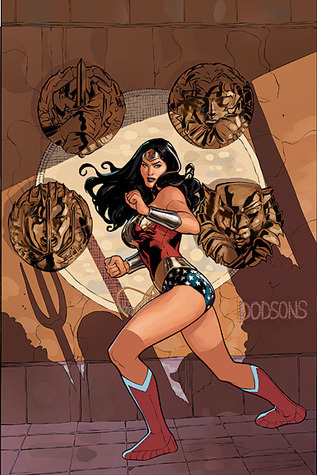
Terry Dodson and Rachel Dodson The Circle

A Fanboy Denied

My introduction to Wonder Woman was not the original Marston/Peters comics. I’m not sure what my first exposure to Wonder Woman was, and it almost seems like I became aware of the character through cultural absorption. As a kid, I saw a few snippets of the TV series with Lynda Carter, I read a few DC comics featuring Wonder Woman (but not her own title), I watched the Justice League cartoon, and played a few superhero video games. I don’t remember which piece of entertainment came first. What I do remember is that my fanboy brain had already constructed the “ideal” Wonder Woman long before I ever picked up a Wonder Woman comic. In other words, I was a Wonder Woman fan but not a Wonder Woman fan.

And therein lay the roots for so much of my dissatisfaction with the character. It would be easy to say that I dislike Wonder Woman comics because they suck. Well … most of them do kinda suck (the less said about the current run, the better), but I’ve put up with sucky comics in other circumstances (X-Men, I’m looking in your direction). But Wonder Woman comics always provoked a hostile reaction from me. Even the runs that were supposed to be good (according to the Internet hive-mind) failed to measure up to my standards. George Perez? Meh. Greg Rucka? Terrible. Gail Simone? Tiresome. They were never going to be as good as “my” Wonder Woman, so why bother?

I first read a collection of Marston stories about four years ago, well after I had formed my views on Wonder Woman. Needless to say, it was like nothing I had ever read in superhero comics. Bondage, cross-dressing, and lesbian subtext in a comic marketed to children!  It was idiosyncratic, to put it mildly.


It was obsessive, fetishistic, and outright insane, to put it less mildly. And it was fantastic! Most superhero comics aspire to little more than genre hackery, and many fail to measure up to even that lowly bar. But Marston’s Wonder Woman was a personal and ideological work. Regardless of what one thinks of Marston’s values, his comic stands out as a rare artistic achievement in mainstream comics, a fusion of radical feminism, patriotism, BDSM, and commercialism.

Regardless of its strengths, I should have hated this comic, considering how different it  was from my vision of Wonder Woman. Why is she getting tied up all the time? Why does she say ridiculous things like “Suffering Sappho?” What’s with the giant kangaroos? Etta Candy … what the fuck?

But I couldn’t find fault with Marston, as much as my ego wanted to, because his Wonder Woman was far better than mine (or any other version of Wonder Woman I had encountered). My Wonder Woman was nothing more than a grab-bag of traits: She’s strong (but not mannish)! She’s fierce (but not in a mean way)! She’s smart (but not nerdy)! She’s sexy (but not trampy)! I hadn’t created the perfect version of Wonder Woman, instead I’d assembled a highlight reel from every comic, TV series, or game featuring the character. And when I pasted these traits together they amounted to nothing more than another bland, inoffensive superhero. Marston’s Wonder Woman was born out of actual ideas. Those ideas were crazy (and occasionally creepy), but there was genuine thought and creativity behind his stories. Nothing I dreamed up has ever come close.

When I was younger, I tended to judge the quality of a work by how thoroughly it pandered to my tastes. If something hit the correct fanboy buttons in my brain, it was deemed good. Marston’s Wonder Woman failed the “fanboy test” in almost every way, but I came around to appreciating the work. And the more I appreciated Wonder Woman, the more I came to realize that my particular vision of the character (and comics in general) was fandom at its most banal. I won’t go so far as to say that reading Wonder Woman triggered an epiphany. Around the same time I was reading Marston I was also reading Moore, Ware, and a dozen other great comic creators. But Wonder Woman was one of the first comics that stifled my inner fanboy and forced me to reevaluate my standards for comics and other media.

I’m still not entirely immune to the siren call of slick genre product, but I have an easier time distinguishing mindless fun from great art. And I understand now that “good” doesn’t mean “identical to the tastes I had as a teenager.” So thank you for that, William Marston.

_____________
The entire roundtable on the Marston/Peter Wonder Woman is here.

Ben Saunders on William Marston and Sex

Ben Saunders had a great comment which I wanted to highlight in a post for Marston’s birthday. So here ’tis.

Thanks for your comment, Mike. To elaborate on Noah’s response: part of the difficulty, I think, is that Marston was an extraordinary sexual optimist who believed in the liberatory potential of desire. Although it is Freud who is usually associated with the logic of repression (“your neurozis iz a funktion of your represt longink for your muzzer!”), he was in fact far less optimistic about the idea that facing and overcoming repressions might lead to “health” than Marston. There’s a dark side, an almost cthonic element, to Freudian libido. Marston, on the other hand, seems much more cheery; “free yourself from your repressions, give in to your (real) desire to be dominated, and you will be happy.” It’s really a kind of sex-faith – to the point that the possibility of acknowledging a sexual element in all the non-sexual scenarios you suggest (child-parent, student-teacher, good citizen before the law) would not be seen by Marston as a distortion or corruption of those scenarios. Marston would probably say that the very need to insist that those scenes are non-sexual is itself a sign of our tendency to view sexual energy (falsely) as inevitably corrupting.

Of course, that’s exactly how a puritan culture DOES see sex – as dangerous, forbidden, shameful, corrupt, and having NO PLACE in any of the social interactions you have described. In some ways, it’s that puritanism that Marston is responding to – but he really doesn’t think he’s being subversive by insisting that sexual energy does play a role in all those interactions, because sexual energy is an unqualified good, in his vision.

I don’t actually agree with that, and would be hard put to point to one place in his writings where he flat out says it – it’s more an implication of the larger theories. But I think it’s a fair characterization of his thought, and it helps to explain why his comics seem weirdly sexy and sexless at the same time (to our perhaps jaded, puritan-in-reverse, pornotopic culture). His vision of sex is simply too sunny for us. To that extent, the observation that Marston was less cynical than us is probably right on – although I wouldn’t attribute a lack of cynicism to his culture at large, for all that their standards for sexual display were very different from our own.

The entire roundtable on Marston/Peter’s Wonder Woman is here.

Learning to Care at the Feet of Maurice Sendak

The deal went like this – Dad would read me a story, I would go to sleep. Nothing in that deal said I couldn’t be a little f$%*!er about which stories I wanted him to read. My favorite was Zorro, followed closely by Fury, the Wonder Horse, which I insisted on calling Furry, just to piss. him. off. I still laugh at that one.

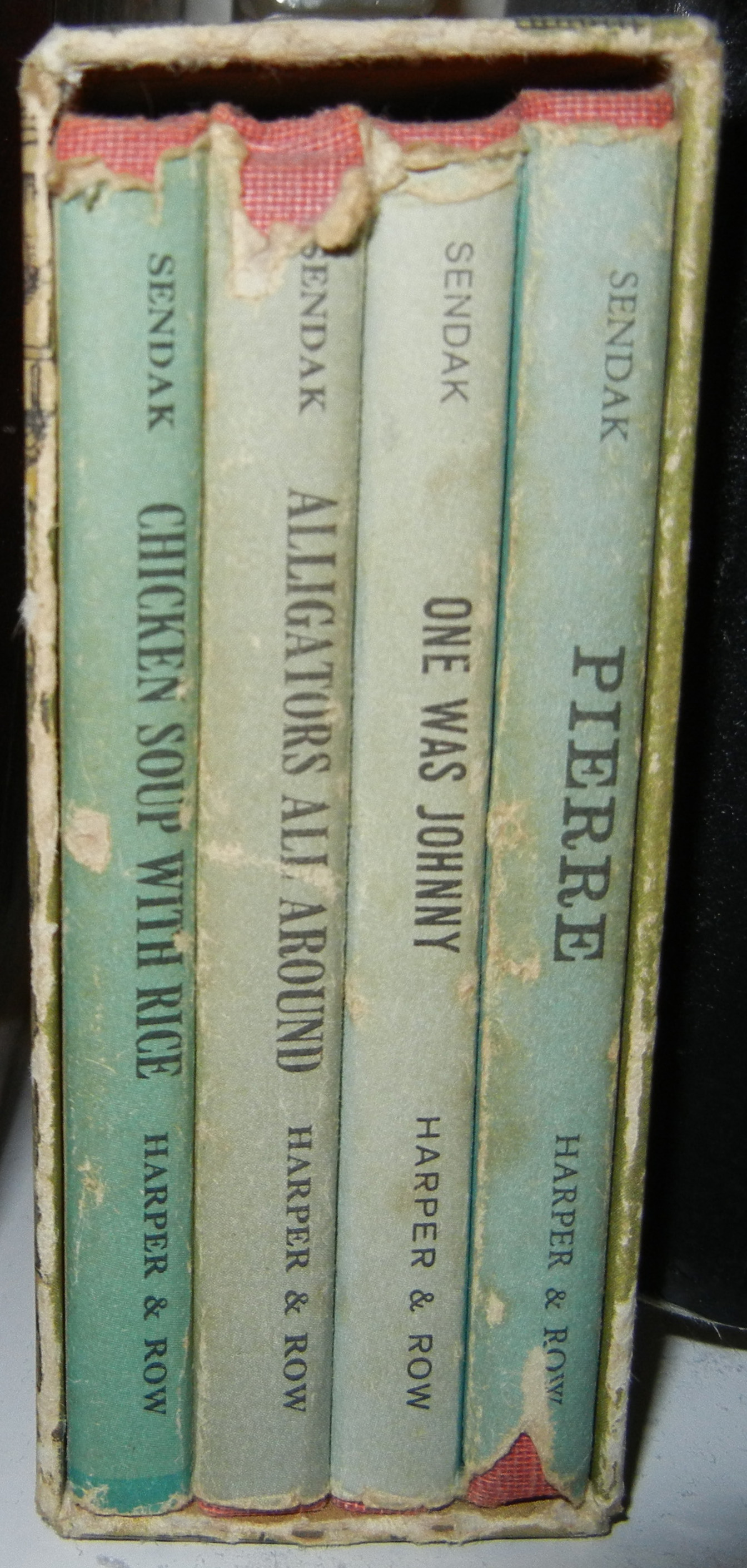
I also really liked a book called Pierre. I called it “Pierre: the boy who said ‘I don’t care,'” but its real name is Pierre: A Cautionary Tale in Five Chapters and a Prologue.

For it me, it was one of the smallest books in my collection of Golden Readers and picture books, part of the Nutshell Library, along with One Was Johnny, Alligators All Around,  and Chicken Soup with Rice.

I’m old enough to have been too old to care when Really Rosie came out as an animation in 1975, with songs based on the above books. It was no more than amusing, really. I recalled the books of my youth, of course, but that was like a million years ago, when I was a baby!! No way I was getting excited about baby stuff. Chicken Soup With Rice was still pretty cool, though.

When Really Rosie went Off-Broadway musical, I was in college and still, honestly, didn’t care. I mean, sure, it was cool, and a whole new generation would learn to love Sendak, but I had no money, wasn’t ever going to see it and besides, musicals were so….

It’s only natural that when I became an adult that baby stuff became interesting again. And of course, by that time I had lost that little Nutshell Library collection of books. Amazingly, after looking around, I found the very same 1962 edition I originally owned. So, clearly Sendak hadn’t yet become the household name he is now. This was still in the pre – Where the Wild Things Are days.  But that’s not the moral – the moral is, like Pierre, I learned to care.

If you read the social feeds this week, you’d think that Where the Wild Things Are was Sendak’s greatest work. Maybe it is, I don’t know…and I don’t care. When I think of his work, I think of alligators, crocodiles and lions that may or may not eat children if they don’t care enough for their surroundings.

One of the things I genuinely enjoyed about Sendak’s books was the cheerfully typical selfishness of the children that populated them. Whether they were singing paeans of joy to chicken soup with rice as they did bizarre and dangerous things, or running off from their bedrooms to become monsters, there was shockingly little consequence to their actions. The children riding the crocodile were not eaten, Pierre, although eaten, was fine in the end. Real and fake monsters are not the enemy of children that adults seems to think. The lion doesn’t eat Pierre because he is inherently dangerous – after all, he gives the boy fair warning.  He does it because Pierre clearly needs an object lesson in manners and his parents aren’t holding up their end of the deal.

My Dad had bought that Nutshell Library because when he was young, Sendak lived in the basement of the building he lived in.  Years before Sendak came out in a New York Times interview, my Dad told me that everyone referred to him as the “fag in the basement.” It was a tale told to me many decades after the fact, with a nostalgic smile, as if that was a cute, harmless nickname.

I sometimes imagine Sendak huddling in the basement, sensing the disdain with which he was regarded by the other tenants. I have no doubt that the children – those very same children Sendak wrote for, and are now beloved by as adults – were warned away from him, as if he were diseased.

Or maybe, Sendak didn’t really care.

Pierre, by Maurice Sendak, narrated by Tammy Grimes