Jeet Heer vs. The Watchmen

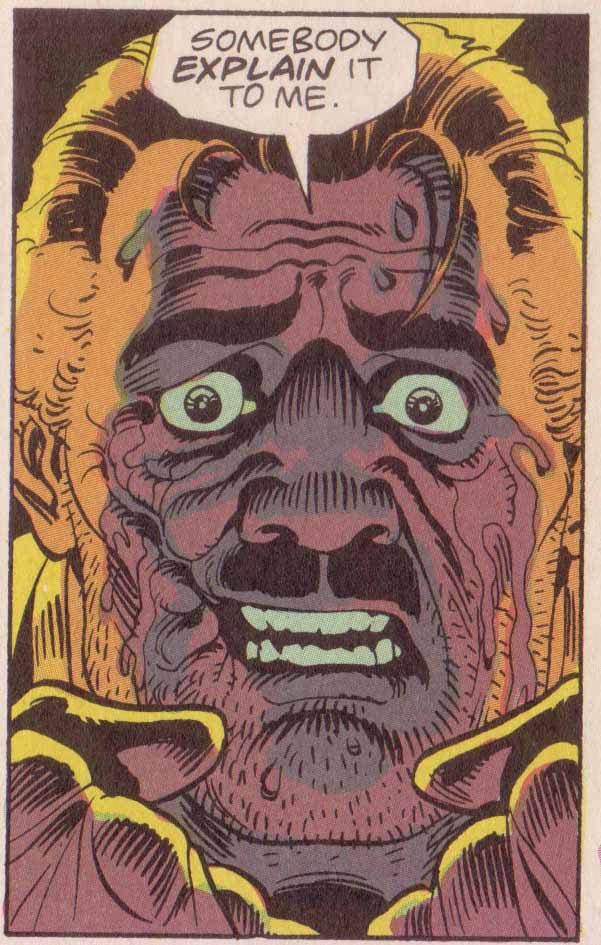
We’ve had a lengthy thread about the relative merits of Watchmen here. Lots of interesting contributions from Eric Berlatsky (my brother and an Alan Moore scholar); Marc-Oliver Frisch; Darryl Ayo Brathwaite (who wrote the original post); Chris Mautner, and just a ton of other people. For me personally, though, the highlight has been Jeet Heer’s negative take. As Ng Suat Tong said recently, Watchmen hasn’t attracted a lot of skeptical criticism. Anyway, I thought I’d reprint his thoughts here. (Noah B.)

Heer’s comments have been extensively rearranged and edited so that they can be read through with a minimum of difficulty. Please see the numbered links for the original comments. (Ng ST)

(1)  The idea that Watchmen, of all things, is the greatest graphic novel ever is so alien to my experience of art that I find it fascinating. I’ve actually read Watchmen a couple of times to figure out why some people love it so. And while I can recognize the craft and intelligence that went into it, I’m still left with a work that lacks any of the humanity, humor, and depth to be found in the works of Chris Ware, Dan Clowes, Jaime Hernandez, [and] Gilbert Hernandez.

(2)  [In] brief, the political critique of modern America to be found in Lint or The Death Ray seems to me much sharper than the politics of Watchmen. Both Lint and Andy are recognizable and plausible personality types whose character traits reflect dark aspects of the national psyche. That’s one example of many.

(3) [The] best argument that can be made on behalf of Watchmen [“is that superheroes and pulp narratives are a pretty important way in which we think about our geopolitics and our selves.” (Noah Berlatsky)]

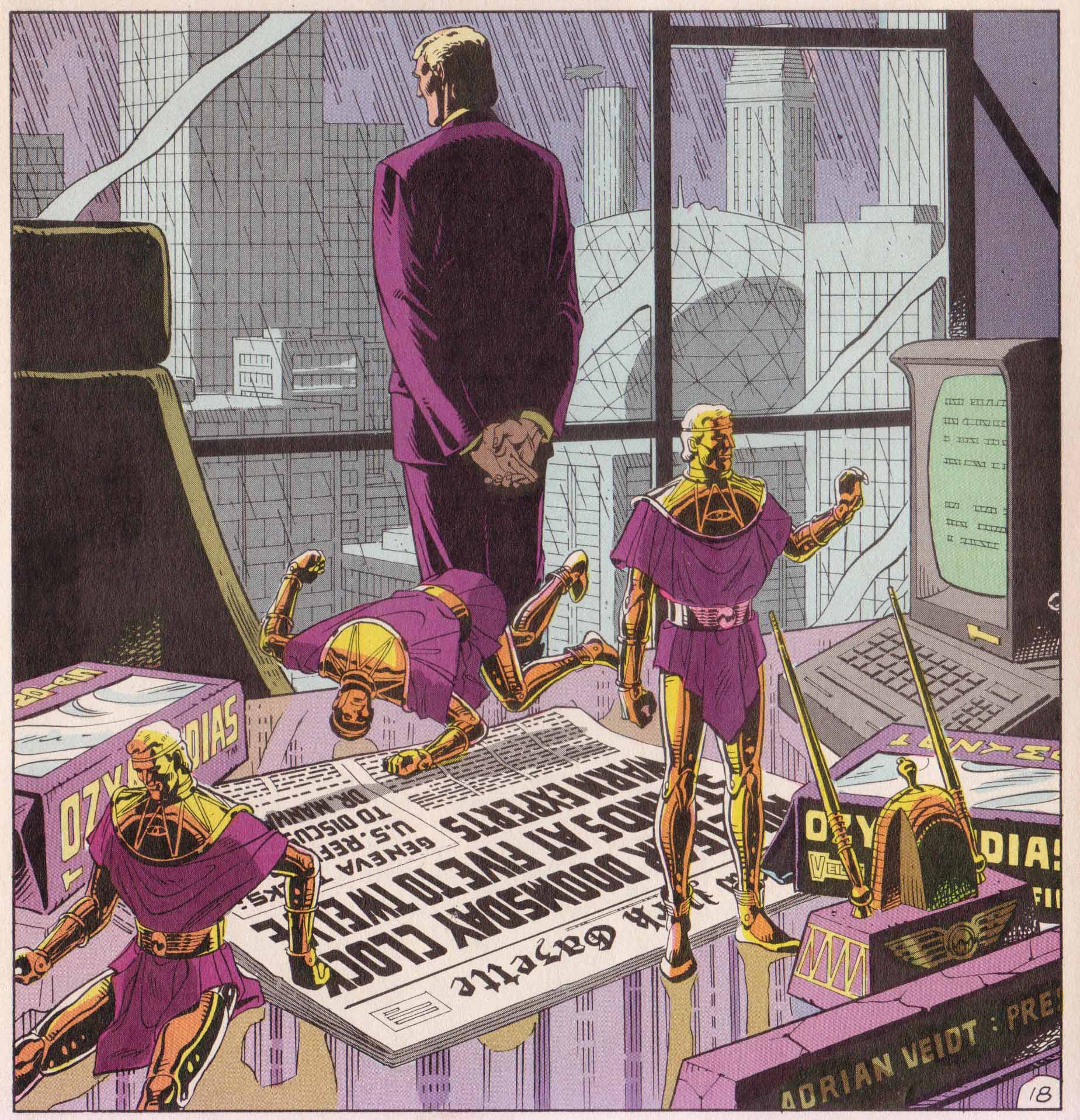
The problem is that politically the book accepts the geopolitical implications of superheroes on their own terms, so the only solution to nuclear Armageddon is the intervention of “the world’s smartest man” and the disappearance of the superhero god. For a professed anarchist, Moore has very little faith in grass-roots political activity. In the real world, the Cold War came to an end because of human agency: Gorbachev and other communists apparatchiks started to see that the regime was untenable, and were pushed for reform by dissidents while in the west Reagan had to start negotiating with the Soviets because of the peace movement. So the real heroes who saved humanity from nuclear war were figures like Solzhenitsyn, Sakharov, Lech Walesa, Gorbachev, E.P.Thompson, Helen Caldicott, etc. and the millons of ordinary people on both sides of the Iron Curtain who refused to accept the Cold War consensus. There are no counterparts to such figures in Watchmen: humanity’s fate is decided by superheroes (one of whom is willing to sacrifice millions of lives for his political agenda, another of whom is indifferent to humanity’s continued existence). There’s a despair for humanity at the heart of Watchmen which I reject both on political grounds but also because it seems callow and unearned. The darkness of Moore’s vision is ultimately closer to Lovecraft than to Kafka (think of the giant tentacled space monster Ozymandias concocts).

(4)  It’s true that both the United States and post-Soviet Russia have many flaws. But fortunately there are people in both countries who are working to make things better and challenging the authorities. This type of resistance is notably absent in Watchmen. V for Vendetta is an interesting book because it does show resistance to the ruling class, but that resistance takes the form of a superhero. We can take control of our destiny but only if the superhero shows us how (and if we’re a woman, he might have to torture us along the way). There is an interesting tension between Moore’s anarchism, his philosophical determinism, and his use of the superhero genre. In my charitable moods I like to think of this tension as fruitful rather than incoherent. It certainly helps make Watchmen a little bit less programmatic than it would otherwise be.

(5)   [If] we take the deaths in Watchmen seriously we should regard Ozymandias as a moral monster, a veritable Eichmann. Yet even after the extent of Ozymandias’ actions are revealed, he’s treated not as a moral monster but rather as a pulp figure, a superhero-who-turns-out-to-be-supervillian. His plot is so outlandish that we can’t treat it seriously and feel the full moral import of his actions. (6)  The thing is, in the context of the book Viedt is cool in the way that Rorschach is cool. Viedt has a secret hide-away, just like Superman! He’s the smartest man in the world and a gifted inventor, just like Lex Luthor! He’s always one step ahead of the game, just like the Kingpin or Dr. Doom! So as you read about his plot, Viedt doesn’t seem like Eichmann or Beria or Pol Pot. He seems like Dr. Doom or Magneto. So it’s hard to take his crime or moral culpability seriously. Or at least I can’t take it seriously. His murders don’t seem real. (By contrast, the killings in The Death Ray are chillingly believable).  (7)  If the squid is supposed to be idiotic and Ozymandias is an idiot and the ending a stupid anticlimax, then doesn’t that undercut the moral horror we should properly feel at the fact that within the narrative Ozymandias has killed millions of people in cold blood? We don’t think of Eichmann as an idiot who came up with an idiotic and anticlimactic scheme.

(8)  It seems to me that Eric, Noah, and Mike (among others) all fall into the same habit of reading Watchmen the way Moore intended the book to be read, as an anarchist critique of superheroes and authoritarianism. But it seems to me that like many other works of art Watchmen is latent with contradictory meanings that undermine the authorial intent. It’s a story where the superheroes act and ordinary people re-act (just [as] in Shakespeare the tragic hero acts while the secondary characters and ordinary people re-act). Because characters like the Comedian, Ozymandias, and Rorschach are the agents of change and action, they are the figures that engage the imagination. It’s no accident that DC is doing “Before Watchmen” about the early life of the heroes rather than “The Early Life of the token black and lesbian characters who die in Watchmen.”

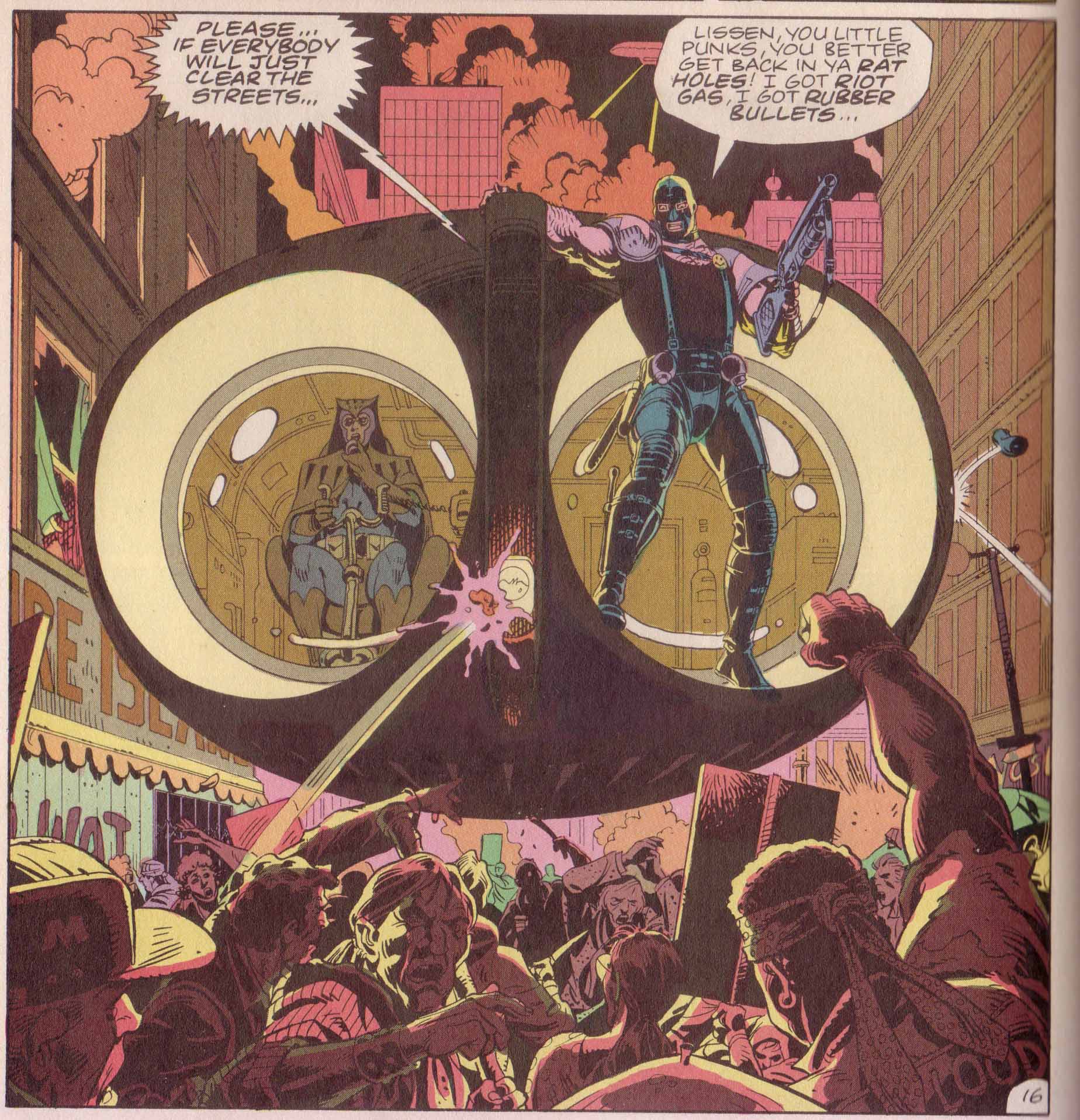
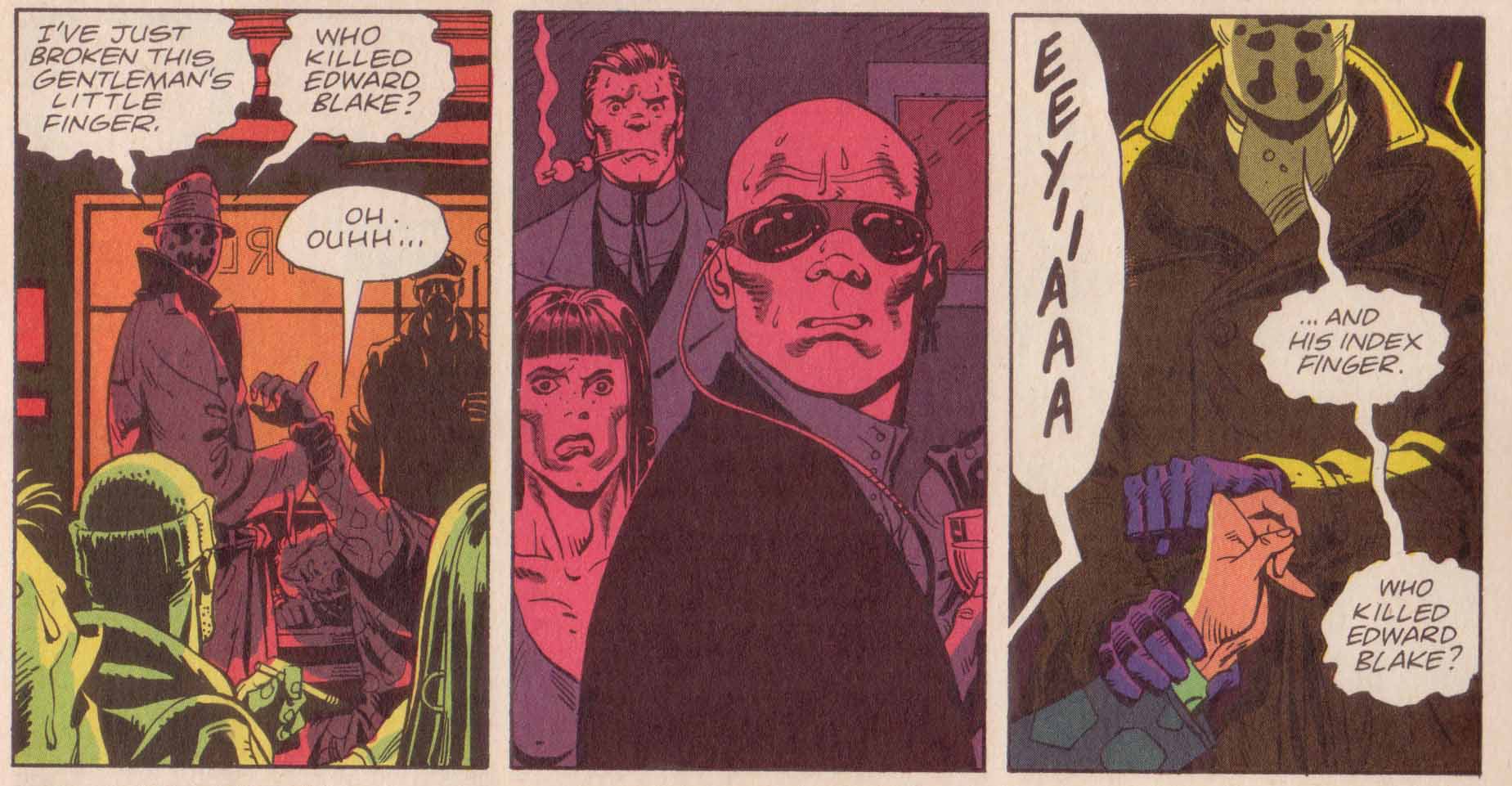
According to Mike Hunter, the fans who love Rorschach and identify with him are “dimwits” who have an “asinine” reaction. But in point of fact I think such readers understand the narrative logic of Watchmen better than the defenders on this site (Eric B., Noah, and Mike among others) do. These Rorschach loving readers understand that he’s presented as sympathetically as Peter Parker or Bruce Wayne — he’s someone who has been wronged and he’s ready to kick-ass. When you read a superhero story, your natural instinct is to identify with such a character, even if he’s a fascist loser. Moore’s authorial intent can’t overcome the logic of the genre, in part because Moore’s skills as a pastichist makes him do all the right genre moves to win over readers.

As for Rorschach being a complex character, the fact is that he takes the law into his own hands and beats people up. Am I [correct] in thinking that he also kills people? So he’s a thug — in real life he’d be horrifying but in the context of the book he’s sympathetic — because the book ultimately accepts the logic of the superhero genre. Also self-pity is a big part of the fascist mindset but Moore does not sufficiently distance us from Rorschach to make us critical of his self-pity — rather we share in it. Again, Clowes handles this better in The Death Ray.

(9)  [I was just looking at Katherine Wirick’s piece on Rorschach as a rape victim.] It’s a very smart piece. This is not meant as a knock on Wirick (who makes a convincing case for how Rorschach should be interpreted) but I’m wary of accounts of fascism that start with the victimization of fascists. To the extent that fascists are victims or losers, its because they’ve benefited from systems of privilege (capitalism, imperialism, patriarchy, imperialism, racism) which are being challenged.


Mike Hunter: “…there are plenty of examples of humble, noncostumed humans, who are shown as moral, caring, striving to do the right thing, for all their final fate. The cops and psychiatrist who as their last act moved to stop the fight of the lesbian couple. The way the salt-of-the-earth newsstand vendor, as death moved to overwhelm the city of New York, protectively embraced the black kid who’d been hanging out reading this pirate comic. As their bodies merged and dissolved, tears came to my eyes…”

(10)  Non-superheroes in Moore’s universe can try (unsuccessfully) to defend themselves but they can’t make their own history or challenge the power that be. (11) It’s fairly common in movies to spend a few moments with sympathetic figure — say a cop who is about to retire — who is then killed. This is done to establish some moral gravitas or emotional engagement on the cheap. In terms of narrative, these characters are created in order to be killed. That is what Moore is doing — being talented he does it well, but it’s still a relatively cheap effect.

In the real world, thankfully, ordinary people can and do stand up to tyranny, even if they are often defeated. (12)  [In] 1984 Winston Smith and Julia do resist the totalitarian state. They are ultimately defeated and brainwashed (in a horrifying way) but despite the defeat the book hinges on the idea that there will be some internal resistance. There’s no resistance in the world of the Watchmen, only futile attempts to save a few lives in the fallout from the actions of the superheroes — but no attempt to change the system whereby the superheroes dominate or the geopolitics the superheroes are embedded in and support.

(13)  Despite repeated attempts to enter into it sympathetically, I can’t accept the characters in Watchmen as human beings. Moore has them do all sorts of improbably things (like a woman falling in love with her rapist). They seem like puppets to me. There is also sorts of violence in Watchmen — rapes, murders, and even the killing of millions — but none of [this] effects me as I read the book because none of the characters are able to stake out the emotional claims that are necessary in order for us to care about the fate of fictional creations. It’s telling that many readers seem to fantasize about being Rorschach. If the violence Rorschach unleashes had any felt reality, those readers would be terrified of Rorschach and regard him as a psychopath.

(14)  That’s why I brought up Clowes. He has the ability to create characters that you can both empathize with but also see their flaws and limitations — no one wants to be Andy in The Death Ray, although despite how horrible he is he remains recognizably human. The middle-aged Andy is pretty much an asshole, albeit one gifted (as many Clowes characters are) in self-justification. But the young Andy was more sympathetically presented — he’s someone in flux, with good traits and bad. The story is about the process where the young Andy starts on the road that turns him into the middle-aged Andy. And Clowes sense of how characters are shaped and formed by their environment seems much more plausible that Moore, who has a crude pop-Freudian understanding of personality formation (i.e. trauma leads to violence). The same applies to Lint — the process by which Lint becomes who he is, the way he’s shaped by his memories and decisions as well as his lifelong traits, is very finely handled. By contrast, Roscharch is just a high-brow version of The Punisher or Wolverine — a psychopath you can root for!….I just don’t see the Moore of Watchmen as being anywhere near the writer Clowes is.

(15)  [As for] the rape of Sally Jupiter, just in terms of Watchmen itself, it’s a fairly minor lapse but becomes a bit more problematic because of the pervasiveness of sexualized violence towards women in Moore’s work. Again, I think there is a charitable interpretation that can be made: Moore is interested in creating genre-deconstruction and pastiche of genre material. The “damsel in distress” is a key figure in many genres and Moore is simply bringing to the fore the rape subtext that is latent in many narratives. But it’s possible to take a more critical stance towards Moore’s handling of rape as well.

(16)  [My] objection isn’t that Watchmen is a superhero comic. I have a high regard for the superhero comics of Kirby, Ditko, Eisner, Cole, and others. As I noted elsewhere Kirby offers a clue as to what bothers me about Watchmen. In all his comics Kirby created an open universe that could be imaginatively inhabited and colonized. Moore’s genre work, by contrast, seems not just closed by the airtight structures the author has created but even suffocating in the way they don’t allow the characters any freedom from the dictates of the plot and theme. A character like Maggie (in the Locas stories) or Andy (in The Death Ray) has the ability to surprise you even as they remain true to their nature. By contrast, Moore’s characters are merely pawns in the service of his agenda.

It seems to me that the critique [recently] leveled against Jaime Hernandez applies much more to Watchmen. Watchmen really is a giant Easter egg hunt. Moore is quite clever at packing his narrative with lots of little clues that readers can spend endless hours matching up in order to solve the puzzle. But I find this type of cleverness to be an arid and gimmicky exercise because the story is so utterly devoid of humanity, so utterly contrived and constructed.


____________

Okay, I think that’s it. Thanks to Jeet and all who participated. It was a fun discussion. (Noah B.)

Only One Can Wear the Venus Girdle, You Patriarchal Dipshit

I wrote a little about the Azzarello Amazons in the latest Wonder Woman series, or at least on the description of the them I heard second-hand. For those not in the know, Azzarello has the Amazons be lying, murdering, borderline rapists. I thought this was a pretty awful desecration of Marston.

There were a couple of interesting comments on the post. John argued:

What you’ve just described as a “misogynist horror fever dream” is about two pages of the arc so far — two pages depicting the Amazons as the source of disappeared ships on the Bermuda Triangle. They have sex — depicted as primarily consensual — with men, then kill them. They sell any male children they bear (to Hesphaestus, who as it turns out is not cruel to them.)

I read it as part of Azzarello’s generally nasty outlook on life and specifically nasty outlook on Greek myths. Because it’s of a piece with reimagining Hades as a creepy child with melted candlewax for a head, and Poseidon as a hideous fish-beast, etc, and portraying every single god shown so far as a monster or a dick, I didn’t read it as specifically anti-woman. It’s just Azzarello’s cynicism.

Charles Reece also weighed in, arguing among other things:

(1) I don’t see it as necessarily suggesting that’s the way things would be in reality (e.g., “a society of women living together must be perverted, violent, evil, and anti-men”), but as a possible way of getting to people to deal with fears that already exist. Such fiction doesn’t have to be Birth of a Nation. (2) It’s also a way of questioning whether the majority power is inherently wrapped up in the qualities of those holding the power, or if there’s something about hegemony that tends to erase the differences in groups once they’ve achieved that status. That is, are these women acting like men, or are they acting like a group with absolute power? I suspect that your reaction to White Man’s Burden would be that the film is a racist vision of blacks, rather than an attempt to get whites and blacks to see things from an inverted viewpoint (I’m not saying the movie is worth a shit, of course).

So now I’ve read a few issues of the series (5, 6, and 7, I believe). I thought I’d go back to this.

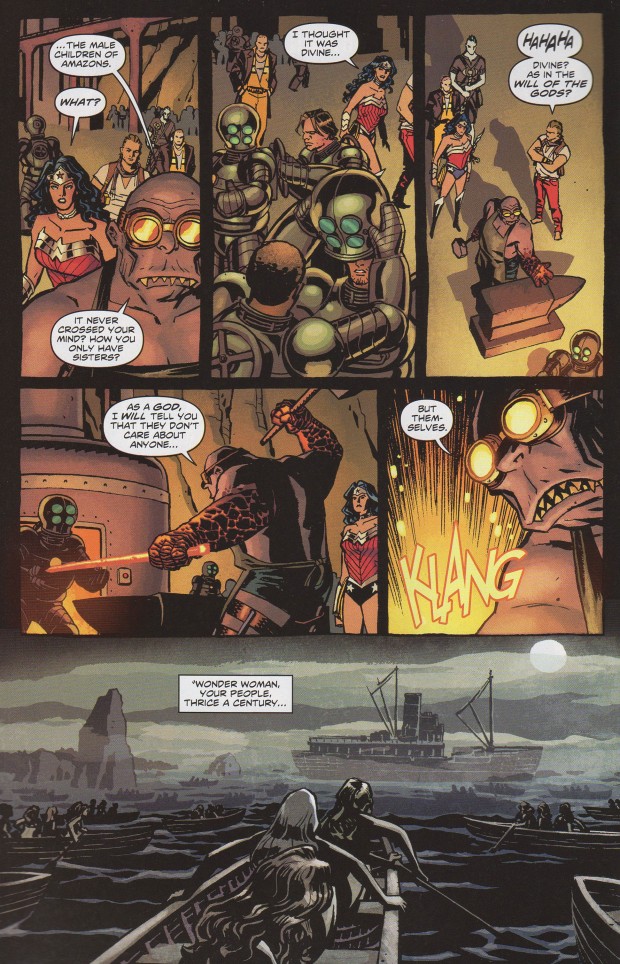
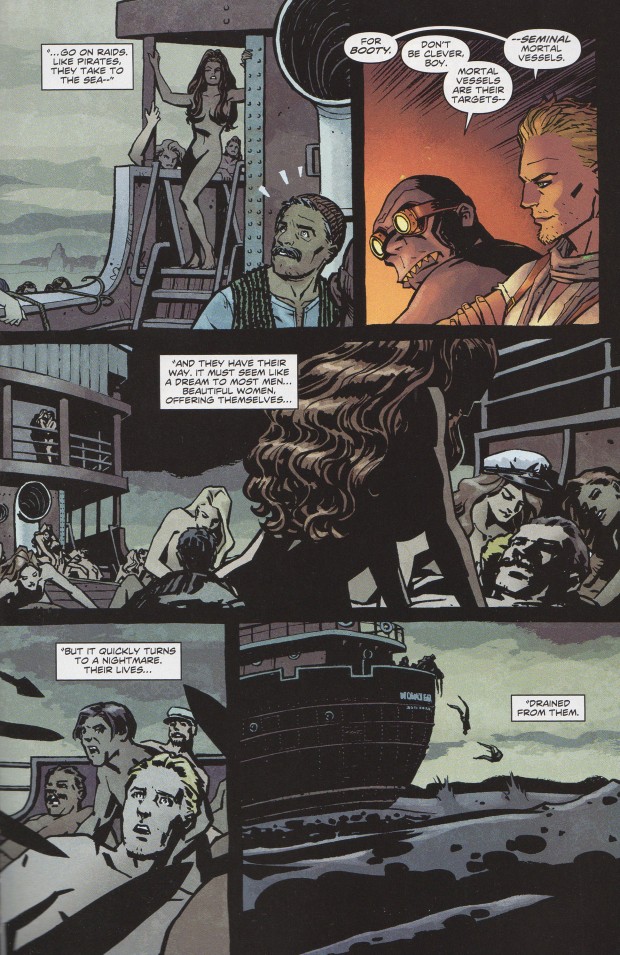
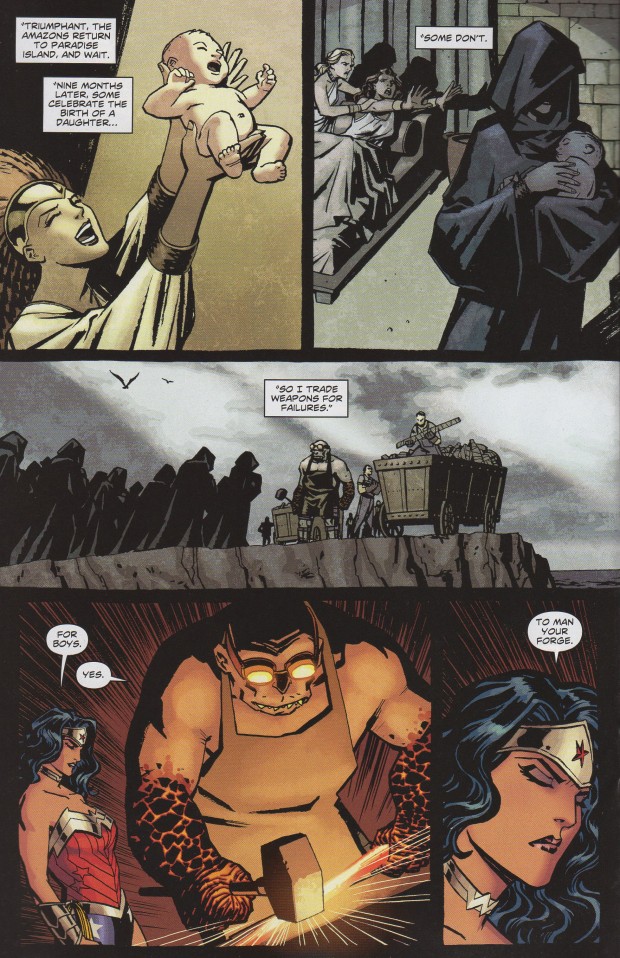
Here’s the sequence in question, narrated by Hephaestus, the god of forging things.


As Charles intimates, if you read through this, you see that Azzarello and Chiang aren’t just making evil Amazons. Rather, they’re using the evil Amazons to flip the history of gender oppression. Throughout history, women have overwhelmingly been the victims of sexual violence…and when men have suffered sexual violence it has also been overwhelmingly (not always, but overwhelmingly) at the hands of men. So here, instead, it is men who are sexually used, and women who do the using. Similarly, throughout history, it has been girl children who have been the victims of infanticide and exposure, and girl children who have been treated as unwanted byproducts. Here, though, in accord I believe with Greek legends, it is boys who are cast off.

Charles argues that this is a means of getting us to think about power dynamics; it’s showing us that the issue is not male/female, but group-in-power/group-out-of-power. If you give people power, they will become exploiters. That’s a universal truth, supposedly Azzarello is knocking the stuffing out of Marston/Peter’s women-veneration (a women-veneration that even Gloria Steinem found troubling, incidentally). Through that stuffing-knocking, he shows that hegemony is not fixed, but fungible.

This is, in short, another example of the ever-popular sci-fi metaphorical approach to issues of discrimination. Rather than looking at how race or class or gender effects the characters, you simply map these effects onto a different set of relationships. This creates new insights (everybody would be oppressors if they could!) while also adding the thrill of novelty (women perpetuating sexual violence! how cool is that?) Powerful messages and cheap thrills; what more could you want from your superhero comics?

I think, in response, it’s worth considering the opening of Shulamith Firestone’s radical feminist classic, The Dialectic of Sex.

Sex class is so deep as to be invisible. Or it may appear as a superficial inequality, one that can be solved by merely a few reforms, or perhaps by the full integration of women into the labor force. But the reaction of the common man, woman, and child — “That? Why you can’t change that! You must be out of your mind!” — is the closest to the truth. We are talking about something every bit as deep as that. This gut reaction — the assumption that, even when they don’t know it, feminists are talking about changing a fundamental biological condition — is an honest one.

In her conclusion, she says, “Nature produced the fundamental inequality — half the human race must bear and rear the children of all of them — which was later consolidated, institutionalized, in the interests of men.”

Firestone’s point is that the oppression of women is rooted deep in culture, based even upon biology — specifically on differences in relation to children and child-rearing. Firestone looks hopefully to new technologies of reproduction in the hope that they might change the relationship between men and women…and indeed, to some extent birth control has done that. But differences remain, and inequities remain — and those differences and inequities are not simply accidents, or random distributions of power which can be reshaped at a whim. They have long, long years of history behind them, and overturning them has taken equally long years of struggle.

Thus, simply reversing gendered oppression tends to make light of how deeply ingrained these issues of oppression are. The possibility of rape, for example, has a lot (not everything, but a lot) to do with our biological plumbing. Susan Brownmiller argues that “Man’s structural capacity to rape and woman’s corresponding structural vulnerability are as basic to the physiology of both our sexes as the primal act of sex itself.”

That’s perhaps extreme…but if you doubt that rape is not easily reversible, look again at those Azzarello/Chiang pages above. Charles would like the pages to show us that hegemony is not attached to particular bodies or histories; that power, rather than gender or past, is the ultimate truth. As I said, Azzarello and Chiang are reversing the tropes…but there are limits to how far they’re willing to go. Most notably, the men are not actually raped, because, presumably, Azzarello and Chiang can’t, or are reluctant to, figure out a way to violate men the way that men have historically and in great numbers violated women. Instead, they just assume that all the men in question would be happy to fuck random women at the drop of an anchor.

Moreover, look at the top two panels of the second page. In the first, we get to be in the position of the happy sailors, staring at some prime cheesecake (do the Amazons subscribe to Maxim, or are we supposed to believe that all women everywhere naturally adopt such poses?) In the second panel, we get a series of stupid jokes…because sexual assault is funny when women do it, get it? And, of course, on the remainder of the page the sex is significantly more explicit than the violence. Azzarello and Chiang are happy to show us women in the act, but the murder/castration is only suggested by some blades, and then by bodies falling into the water at a distance. The reader participates vicariously in the screwing, but gets to back off for the consequences.

Thus, the Amazons, even as they take the male position of oppressor, are still objects of a male narrative, and, indeed, of a male gaze. They are presented as sexual objects, and the bloodthirsty reversal is almost an afterthought…or, perhaps we should say, an excuse. Certainly, I don’t see any real commitment to thinking about power as a pragmatic, overarching truth. There’s no effort, for example, to use the switch to make men participate viscerally or emotionally in oppression, as you get in some rape-revenge narratives. Instead, I see pulp titillation, complete with snickering, coupled with dunderheaded pulp misogyny, which disavows the violence of the male fantasy by the simple expedient of blaming the whole thing on women. It feels fundamentally thoughtless and dishonest.

The rest of the context only tends to confirm this impression. Wonder Woman, who has newly discovered that Zeus is her father, wanders around obsessed with her patriarchal lineage. Other characters are constantly telling her how well she’ll fit in with the rest of the Gods — she’s her father’s daughter. She concocts an elaborate plan (with the unwitting help of her uncles) to humiliate her father’s wife, Hera — so much for Marston’s themes of feminist sisterhood. Admittedly, Wonder Woman does have a close female friendship…but it seems to be largely based on the fact that her friend is carrying a baby which is related to WW — again, the motivations seem to be all about patriarchs and their bloodlines.

I think all of this rather undercuts John’s claim that we’re just dealing with Azzarello’s cynicism. Azzarello is cynical…but it’s a cynicism of violence and male prerogative. What’s real in Azzarello’s world is power and patriarchy. Contra John, that’s an ideological position, not a neutral one; contra Charles, it has little to do with upending hegemony. Instead, it’s just the usual male genre bullshit, executed with just enough skill to be considered competent by the standards of contemporary mainstream comics. If it wasn’t about Wonder Woman, nobody would give a crap. As it is, Azzarello and Chiang are working on a character that someone else once actually invested some genius in, and so they get to bask in the wan glow of banal desecration. Good for them. No doubt Azzarello’s Comedian will be similarly daring. It’s a career, I guess.

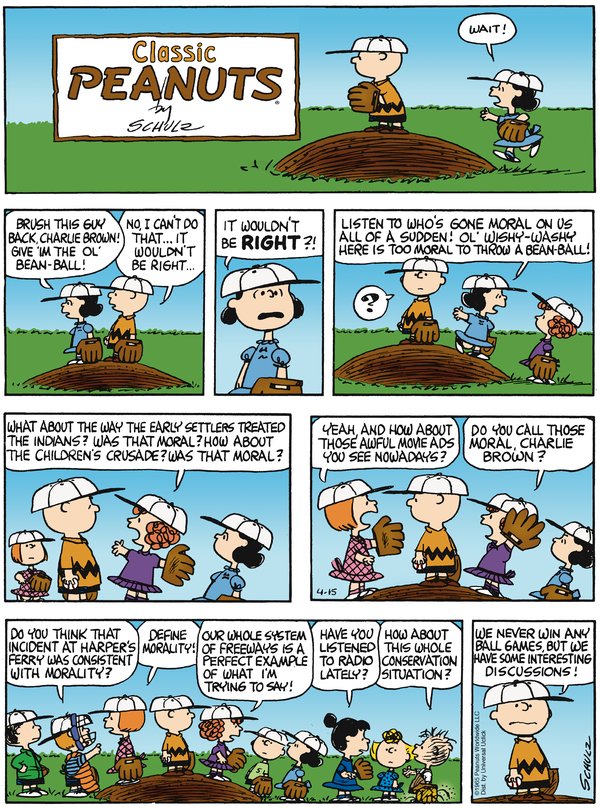
How About the Children’s Crusade? Was That Moral?

Every day I plant my seeds on twitter and see what trees will grow. When discussing the ongoing struggle against Time Warner and their child company DC Entertainment, particularly with regards to their campaign of exploitation against Alan Moore, I was chastised for framing the discussion in terms of black and white morality. Specifically, my argument is that all of the participants in the Watchmen project are in fact immoral.

I don’t see why people who are quick to condemn companies as entities shy away from judgement when talking about the men and women who carry out the offending actions. What DC is doing is wrong and the men and women who are working on these projects are wrong for working on the projects. I’ve heard it all about “they have families/mortgages, it’s not their fault” and blah blah blah. Personally, I make thirty thousand dollars per year. Darwyn Cooke is said to have received nearly half a million dollars for his Watchmen miniseries. So we can stop weeping for these poor starving artists who had no choice. Put your violins away.

Most people who know me flinch when I say: Watchmen is the greatest graphic novel of all time. Everybody protests, but my feeling is that they are protesting not the sentiment but rather that “greatest graphic novel of all time” is an answerable quantity. People want it to be unanswerable. Not coldly, flatly answered with “yes, there is a greatest–you read it already, years ago.”

This isn’t to say that better graphic novels aren’t possible in our medium’s future. Just that this book hasn’t been surpassed. Not surpassed in scope, intelligence, craft or cultural effect. Hasn’t been done yet.

Thimble Theatre is a better comic. It isn’t a graphic novel. Maus is important but it isn’t a graphic novel. No novel in comics form–no graphic novel–is greater than Watchmen. You have to deal with that. It isn’t an argument I am interested in having with people. As the greatest graphic novel yet created, it stands shoulder to shoulder with the other great testaments to the power of comics. Thimble Theatre, King Cat and so on. So then, some executives look at their legal documents and say: “yes. Let us add onto this story. That is a legitimate thing to do with a work of art. We shall commission a group of artists and writers to write so many spin-offs that the original work shall be dwarfed. Furthermore, as legal rights-holders we will insist that these new works are a part of the overall text that comprises Watchmen because we can.”

For actual decades, the devotees of this artform have struggled to see this medium treated as a legitimate field. One of the greatest arguments for graphic novels and comics in general as a legitimate creative artform has now been retrofitted as a hot summer crossover event. If art is to have any meaning to human culture then there should be some basic deference to the undisturbed value of the few works that have moved us forward as a people.
 

The Real Action

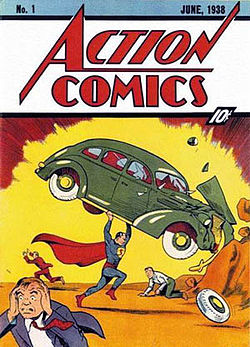
Has anyone “really” read Action #1?

This question — on the face if it, a rather strange one — was raised by cartoonist and scholar Don Simpson, comic book artist and art historian, on the COMIXSCHOLARS-L list serve maintained at the University of Florida just a few days ago. (And if you haven’t signed up for the list yet, what are you waiting for? After all, the only requirement for membership is an intellectual interest in comic-art.) The context for Don’s question was a thread devoted to what is nowadays an increasingly contentious issue for lovers of all kinds of literature: the shift from print to digital culture. More specifically, we were discussing the aesthetic and formal consequences of that shift, debating the losses and gains, and considering the question of when and whether the transformation in the material instantiation of comics (from print to screen) constitutes a fundamental transformation of the comic art form itself. (I say “we,” but the truth is I was mostly lurking, while letting others handle the heavy lifting; my usual mode.)

The terms of the debate may seem rarified, but the stakes were high. For example, if a given comic was originally designed for the medium of print, and you have “only” read it in an electronic format on a screen, is there a sense in which it might be said you have not “really read” it at all? (And I apologize now for the proliferation of scare-quotes in that sentence; I’m just trying to avoid leading the witness. As I hope will become clear, my purpose is not to diminish the glories of the digital archive, nor to romanticize the encounter with print, but to insist nevertheless that the differences between these two modes of transmission are worth thinking about.)

The challenge of this question will be familiar to anyone who has ever debated film with a true cinephile; it’s a variant on the insistence that if you didn’t see a movie in a real-live public movie theatre, then you didn’t really see it. It is hard not to respond to such challenges defensively; after all, they question the validity of our experiences, implying that our encounter with the artwork in question was in some way impoverished, and hence less than fully legitimate. Very quickly, such conversations can degenerate into debates about the relative merits of the opposed technologies of transmission, and the larger, more abstract questions — “what does it mean to have ‘seen a movie’?” or “what does it mean to have ‘read a comic’?” — get sidelined.

But Don hit upon a provocative way of re-framing the debate. Instead of contrasting print with digital comics, he pointed out that there is obviously a difference between reading a copy of Action #1 from 1938, and reading a facsimile or reprint. But while the majority of people have not had and will never have the first experience, Don felt that “one would be hard pressed to argue that of the thousands if not millions who have read some kind of facsimile edition of greater or poorer quality are somehow missing out on some ontological dimension of great import.”

Partly because I just like playing devil’s advocate, but more because I was inspired by Don’s initial observation — that hardly anyone alive today can be said to have “really” read Action #1 — I fired off a response to the list suggesting that there were some important and even fundamental (if not necessarily ontological) dimensions worthy of our consideration when comparing the experiences of these different readers. Good ol’ Noah Berlatsky read it, and invited me to resubmit my thoughts here; and so, for what it’s worth, I offer up the ruminations that Don’s provocation inspired in me, only slightly tweaked for public consumption.
__________________

Whether you can afford to read an insanely priced original copy of Action #1 (and that oxymoronic phrase, “original copy,” already suggests that we are in philosophically paradoxical territory), or whether you have read a facsimile of the entire book, or whether (like most of us) you have only read the Superman story, sans commercials and accompanying adventure strips, in a modern reprint collection such as the DC Archive Edition — or (indeed) whether you have read Action #1 in some version online — it was clearly a very different experience to read Action #1 in the late Spring or early Summer of 1938.

That difference is obviously partly a function of history — which is why it wouldn’t be the same thing to read the “original” comic today, even if you happen to be one of those members of the 1% who can afford to buy that particular thrill. But for most of us, the different reading experience is not simply or only a matter of temporal distance. The text that we have read is likely to be significantly materially different from that of the “original”: if we have read a print version, then we are talking about different paper stock; different standards of line reproduction; different color quality; different weight and heft, whether we are reading a hardcover or paperback; different surrounding contexts (most likely other Superman stories, rather than the generic mix of adventure tales that first accompanied the Man of Steel on the newsstands). If we are reading an electronic version, our experience will be still further transformed; we may have gained the ability to expand single panels to many times their usual size with the swipe of a finger, for example, even as we will have inevitably lost the phenomenological dimensions of the encounter with print.

I’m not sure that any one of these reading experiences could be said to be more authentic or legitimate in some absolute sense than any other. But on the other hand, I do think that when we write about comics critically, and especially when we teach them (something I am privileged to do as part of the University of Oregon’s Undergraduate Minor in Comics and Cartoon Studies), we are obligated to at least think about the experiential difference that these material differences make.

When I teach the first year of Superman stories from Action, using the (wonderfully practical and reasonably priced) Superman Chronicles Volume One collection from DC, I want students to understand that while my choice of text has put some interesting old comics in their hands, their reading experience will nevertheless be radically different from that of Siegel and Shuster’s first audiences. I therefore also ask them to read some excerpts from Gerard Jones’s Men of Tomorrow, so they can start to get a sense of those lost historical contexts. (Some of these are harder to invoke than others. For example, imagining the world before TV may be difficult for many of my students, as it is for me; sadly, however, it is easier for my students to identify with the experience of living through a profound economic depression.) I try to recreate some pop-cultural contexts, too, by lecturing about and providing examples of some of Superman’s literary and comic-strip precursors — things that were just part of Jerry and Joe’s consciousness but which are obviously obscure to most contemporary teenagers (newspaper adventures strips such as Alex Raymond’s Flash Gordon, SF pulps, excerpts from Philip Wylie’s crappy novel, and so on).

But we also have an archive of Golden Age comics at the UO (left to us by Gardner Fox himself — and yes, it was a good day when I discovered that resource!). This archive includes copies of Action and Superman from as early as 1940 (as well as examples of early Flash Comics, Adventure Comics, and other cool stuff), and the last time I taught my course on the “Modern American Superhero” I built an assignment around it. The students were required at some point in the term to go to Special Collections, where the books are housed, and order up a 1940s superhero comic — I didn’t even specify a title — and then asked to write about the different experience of reading the “original” comic versus reading the modern reprints they have been assigned.

These essays were a treat to read. For a start, the students tended to write with more sensory and tactile awareness than was the norm in their other papers. They would find themselves describing the feel of the paper, even the smell of the paper, and the different quality of the colors as they appeared on newsprint. (Which is to say, they responded with enhanced aesthetic awareness, from the get go.) Almost without exception, they seemed compelled to talk about the strange advertisements and curious government-sanctioned messages they encountered interleaved between the stories. (Which is to say, they responded with a heightened sense of political and cultural transformation.) And many of them then went on to draw illuminating contrasts between the superhero strip that headlined the book they had chosen, and the accompanying adventure strips that made up the anthology in their hands. (Which is to say, they came away with a more acute sense of the generic contexts in which superhero comics were first established.) Some talked about the comics as paradoxical “time machines” that provided them with a glimpse of a lost historical reality even as they paraded a cavalcade of fantasies that never were.

Again, I would not mean to suggest that these students were having something closer to the “original aesthetic experience” of a person who read superhero comics in the 1940s — or to suggest that the experience of such a person should be regarded as more “authentic” than that of a contemporary reader. This discussion is not (or need not) lead to the reassertion of some metaphysics of presence by the backdoor. My point is simply that the students were having a different experience from that of reading a reprint or a digital scan. Moreover, this experience is one that, from a pedagogical and scholarly point of view, might be thought of as educational and productive — an experience that deepened their knowledge and appreciation of the history of the comics form, and the processes of comics reading.

It was also a privileged experience — no question. (I hadn’t read many golden age books before I discovered this archive, either.) And (to bring us back to the question of whether it matters whether you have read an “original” comic if you have “only” read it online), it is by no means obvious to me that many salient aspects of this experience could be reproduced digitally — even if we were to scan the “original” books in their entirety.

If I may be allowed to invoke a parallel from my own education: when I was trained as a scholar of Renaissance Literature, I was required to spend some time setting type by hand for an old-school letter press, working from a piece of manuscript written in Elizabethan secretary hand. The project was not scrupulous in its historical verisimilitude; the press itself dated from the 18th century rather than the 16th, for example, although the systems were still close enough for the purposes of my teachers. I blush now to recall how petulant and dismissive I was about this assignment at the time; it seemed only a short step away from dressing up for an SCA gathering, and I couldn’t imagine what I would learn from it. But actually this forced encounter with an older printing technology actually taught me a huge amount, very quickly, and in a way that stuck. I learned in a practical way about the differences between early modern printed books and modern mass-market paperbacks. I learned how errors occurred, and how difficult it was to correct those errors even once they had been noticed. I felt first hand the temptation to set verse as prose, for reasons of expedience, and to tamper with authorial spelling and syntax rather than undo and re-set a whole page of type to correct a mistake I had noticed too late. I came to understand in a phenomenological way the differences involved when reading, say, a modern edition of Othello versus the (radically different) print versions that we have from early 17th century. In short, it was an experience that made me a stronger reader of Shakespeare (and other early modern writers), from a scholarly point of view — much better placed to interpret and contest contemporary editorial choices.

So: at the risk of repeating myself — to ask students to be aware of the differences that both material and cultural contexts make in the reception of texts is not necessarily to argue for the privileged “authenticity” of a particular instantiation of the text. It is not to elevate the experience of print over the experience of digital texts on the grounds of a mystified or fetishistic understanding of the “original” book. It is simply to insist that how and when and in what form you encounter something makes a difference; and to insist further than once you become aware of those differences, your whole response to that artwork can change.

As comics scholars today, we live in a true “golden age” of reprints from quality publishers such as IDW and Fantagraphics — while the digital archives of sites such as comicbookplus.com have made available an incredible range of rare materials: comics I had only read about or seen cover images for; comics I never knew existed. Faced with such an embarrassment of four-color riches, it is easy to forget (or repress) the potential difference that the material instantiation of those comics makes to the reading experience. But Donald Simpson’s observation that, in an important way, very few of could be said to have “really read” Action #1 reminded me of those differences (even though I think Don was ultimately making a different point).

It’s a counter-intuitive observation that raises issues that, for me, are more epistemological than ontological; it goes less to the question of “What is a comic?” and more to the question of “What is reading?” What do we mean when we say we have read something? Again, the question may seem rarified and abstract, but the stakes remain high (I personally believe the world would be a better place if more people asked how it is they think they “know” stuff, after all).

To put it another way; while most of the time it’s probably not that big a deal, there are circumstances in which it might be considered a problem that most people who would claim to have read Action #1 have in fact “really” “only” looked at a modern reprint of the Superman story that Action #1 contained. Not to say that this itself would not be a worthwhile thing to have done; in fact, if you have done it, then if nothing else you have already met the minimum requirement for one of my classes. But the kind of reading I am trying to encourage is finally a little more imaginatively and historically engaged than that.

For the record, and lest I be misunderstood, it may be worth reiterating that I have no problem with digital comics, and am not speaking against them. I read quite a few and when print versions are unavailable or prohibitively expensive I require my students to read PDFs on their computers.

But I think that as comics scholars and critics, we need to remember that the experience of reading a comic digitally is not the same as reading it in print; and that the experience of reading a reprint is not the same as encountering an “original” comic; and further, that reading a printed comic is not the same as actually being lucky enough to look at original production art (something else I try to make possible for students by bringing in examples of original comic art, and organizing exhibitions of the stuff). Good critical work on comics must remain conscious of these differences. This is not an elitist position or a metaphysically dubious one. It is merely a scholarly one.

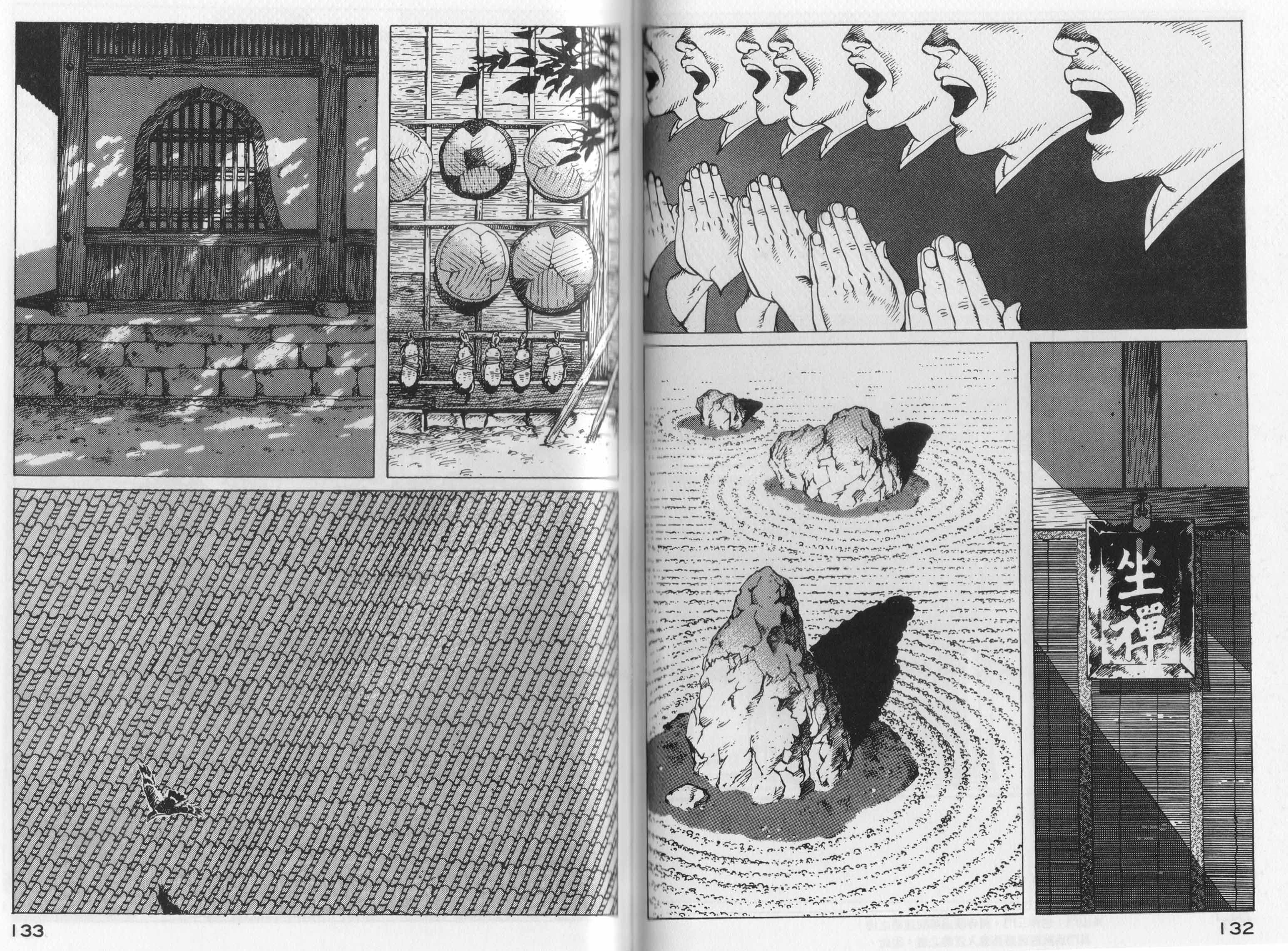
Old Wine in New Wineskins: Hisashi Sakaguchi’s Ikkyu

Appropriated from text scans of The Comics Journal #241 (April 2002). As such typos and grammatical mistakes will be numerous.

Images read from right to left. English translations of Ikkyu’s poetry taken from Stephen Berg’s Crow with No Mouth, Jon Carter Covell’s Zen’s Core: Ikkyus Freedom and John Stevens’ Zen Masters.


One pause between each crow’s

Reckless shriek Ikkyu Ikkyu Ikkyu

As a child, and already showing traces of his life-long distaste for all things hypocritical, Ikkyu Sojun was noted for his precocious intelligence and worldly wisdom. As a monk, wandering the cities and countryside of medieval Japan, he was known both as an ascetic and a libertine, a paradox which has dearly fed his reputation during modern times. He was a poet capable of the profundity of a work such as Skeletons (Gaikotsu; his most famous work concerning a philosophical discussion about Zen and life with a group of skeletons) and the uninhibited passions displayed in his more earthly verse (“A beautiful woman’s hot vagina’s full of love; I’ve given up trying to put out the fire of my body”).

He was a monk who deprived himself of various amenities and honors throughout his life, and yet drank to excess and felt no shame in having a tumble in bed with a comely woman. At the age of 77, he met and fell in love with the Lady Shin, a blind 25-year old minstrel; elevating her by his words and poetry to hitherto unknown heights in the history of Zen. He is considered by many to be Japan’s greatest Zen master.

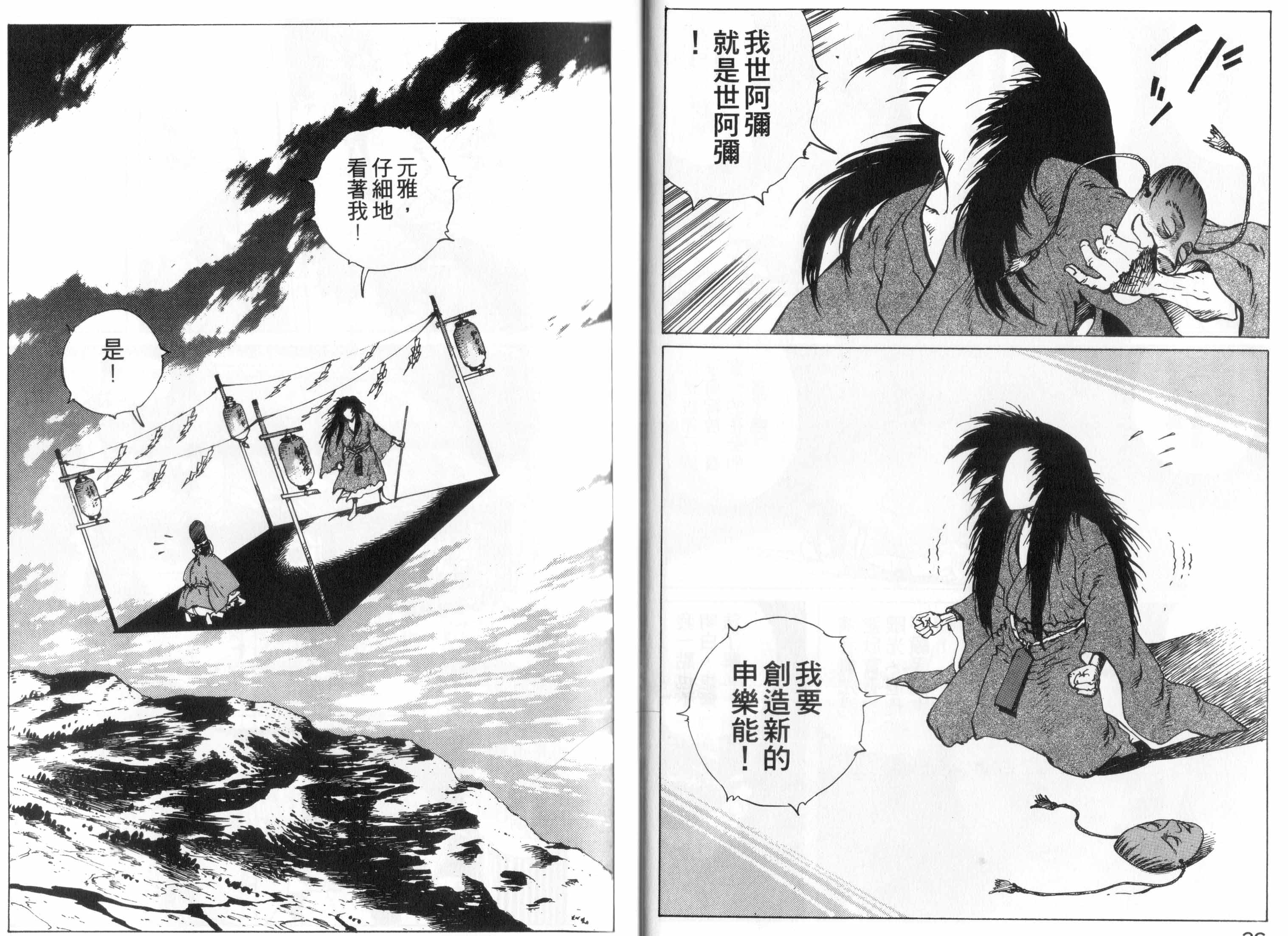
The name, Ikkyu (which literally means “one pause”), indicates the space between conception and death and thus “this lifetime.” In his 1000-page graphic novel, Hisashi Sakaguchi melds history, legend and spectacle with more subtle matters: religious devotion and the moral and spiritual dilemmas in the creation of art. This amalgamation of fact and fiction is important since the life of Japan’s most famous Zen master has been clouded by tradition and time.

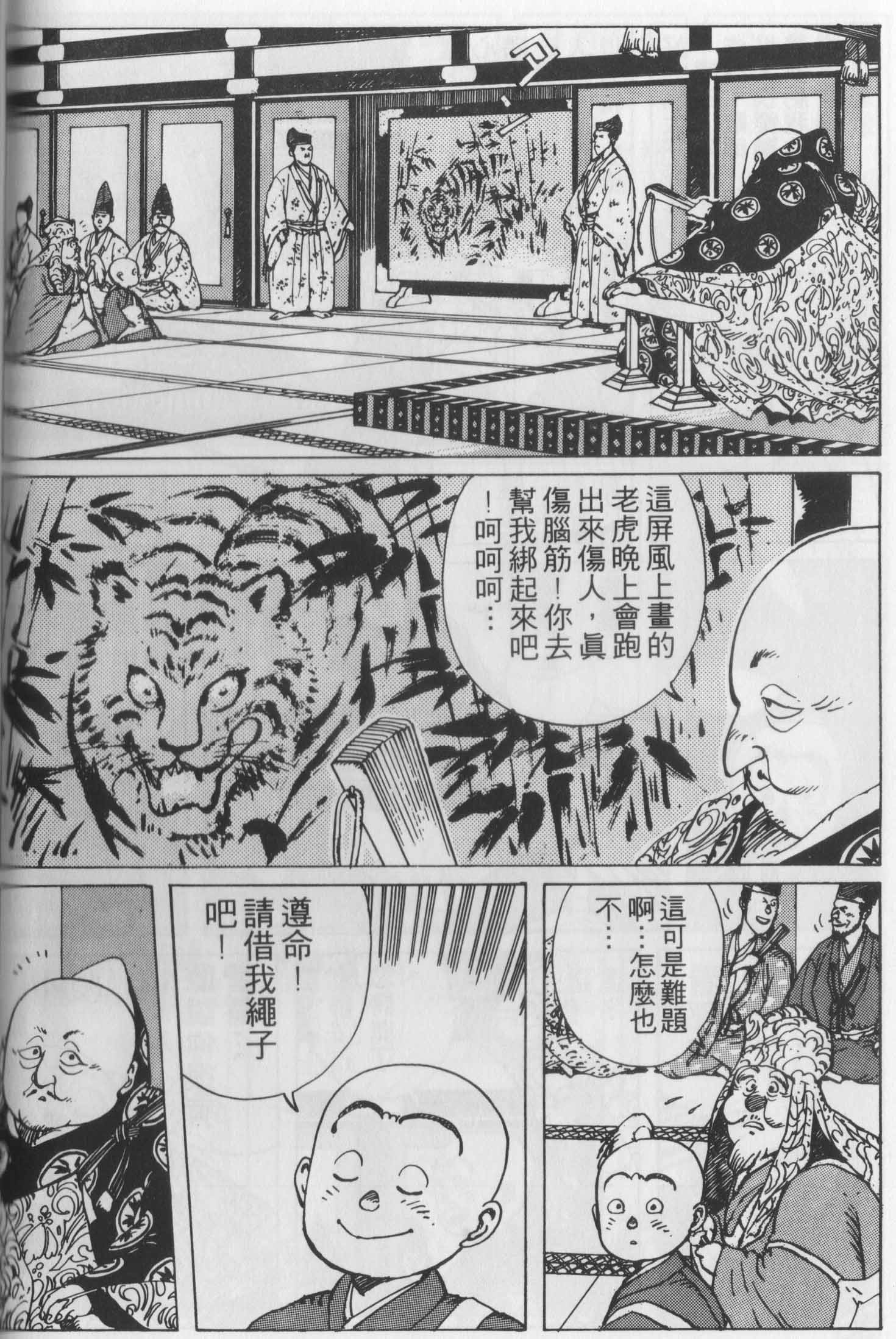
Some of the most famous stories concerning Ikkyu have arisen from various anecdotes about his childhood in Ankoku-ji, a Zen Buddhist temple. For brevity’s sake, these have been combined into single tales by Sakaguchi. One notable episode occurs in the courts of the shogun Ashikaga Yoshimitsu, who asks the young Ikkyu to bind a tiger depicted in a screen painting. In response to this, Ikkyu asks for some rope and when given these implements promptly requests that the shogun drive the tiger from the painting for his feat to be accomplished.

This oft-related tale is united with another story (not usually involving Yoshimitsu) in which Ikkyu is presented with a dish of fish and vegetables which he readily begins to devour. When rebuked for consuming the fish, Ikkyu responds that his mouth is like the Kamakura Highway upon which all beasts travel freely. Angered by his comment, the shogun draws his sword and, pointing it at Ikkyu, inquires how its blade would go down. Ikkyu replies that the sword is not permitted passage down his mouth since he cannot allow dangerous items to pass through his mouth (this being the very orifice by which he asks Buddha for peace and safety).

This fabled meeting is of some importance, as tradition has it that Ikkyu was the first-born son of the emperor Go Komatsu and his favorite concubine (said to be a daughter of the southern senior imperial lineage). By the time of Ikkyu’s birth, the Ashikaga shoguns had manipulated the situation such that the Northern junior imperial line was in the ascendant and a child with blood from the defeated Southern line was no longer politically acceptable. As such, Ikkyu’s mother was removed from the imperial palace and gave birth to Ikkyu in the confines of a private residence. Ikkyu’s bitterness concerning this abandonment is a theme that recurs throughout his poetry even in later life.

*          *          *

The first part of Sakaguchi’s tale is played out against the backdrop of the Muromachi period, an era characterized by the reopening of trade with China, a flourishing of the arts, and the erection of various architectural masterpieces, including the famous Kinaku-ji (Golden Pavilion). Sakaguchi takes care to ground his work in the rich historical framework of the times, creating a web of connections between Ikkyu and some of Noh’s pre eminent practitioners. Zen permeates the characters’ lives; their personalities reflecting the author’s thoughts concerning the preservation of a certain honor and truth, as characters become mired in disputes over artistic and religious integrity.

The interweaving of Zen with the cultural and the political lives of the Japanese elite is not an invention on Sakaguchi’s part. The organization of the main Zen monastic complexes into the Five Mountains (gozan) administrative system towards the beginning of the Muromachi period allowed a significant extension of Zen’s cultural influence. Two other eminent Five Mountains monks, Zekkai Chushin and Gido Shushin, were also important political advisors and tutors to the shoguns of their time (including Yoshimitsu).

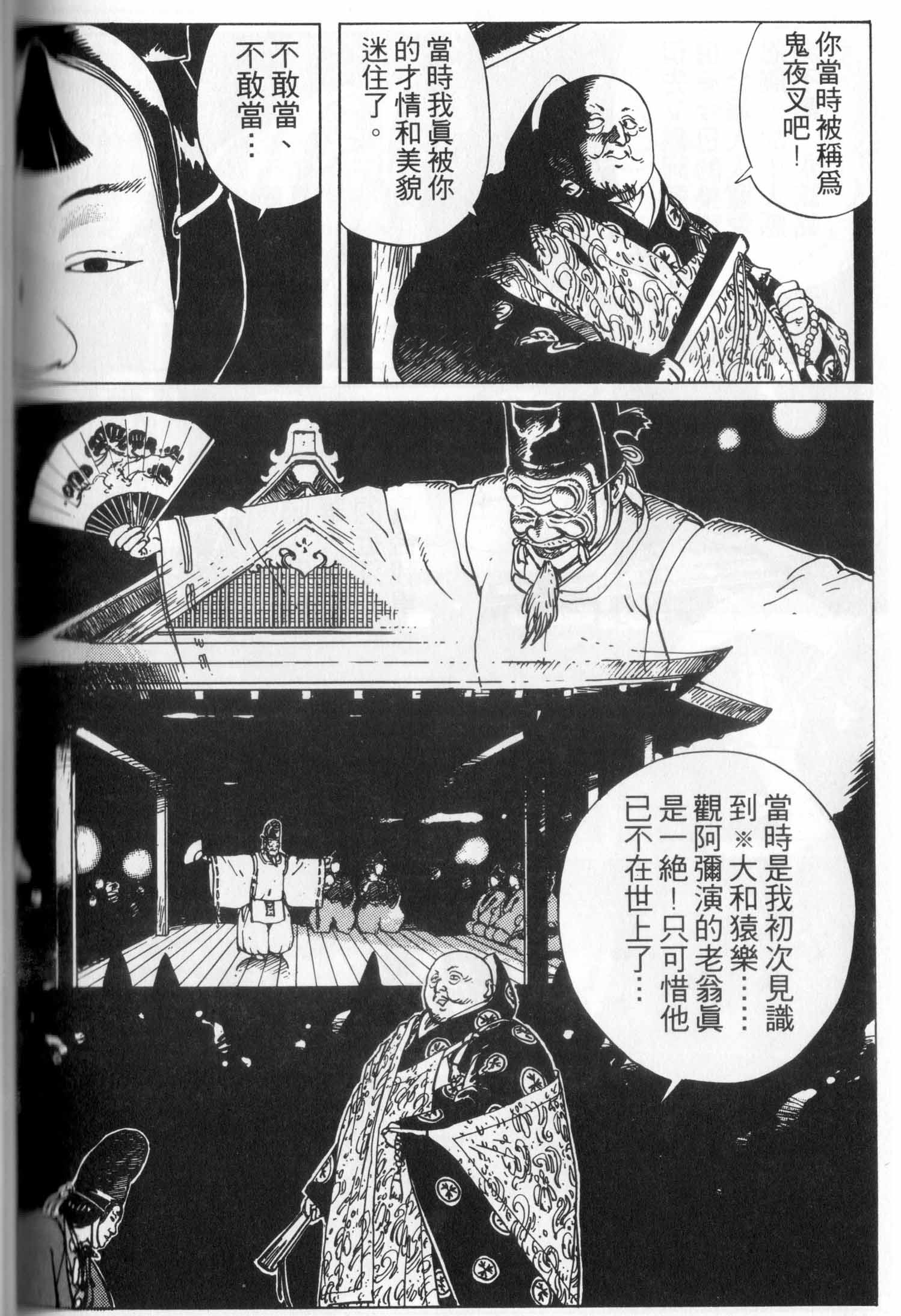
With specific relevance to the manga, the Muromachi period has been noted for a flowering of Noh theatre. Zeami Motokiyo (1363-1443), classical Noh’s finest playwright, lived during this period and his triumphs and misfortunes are intertwined with those of Ikkyu in Sakaguchi’s series.

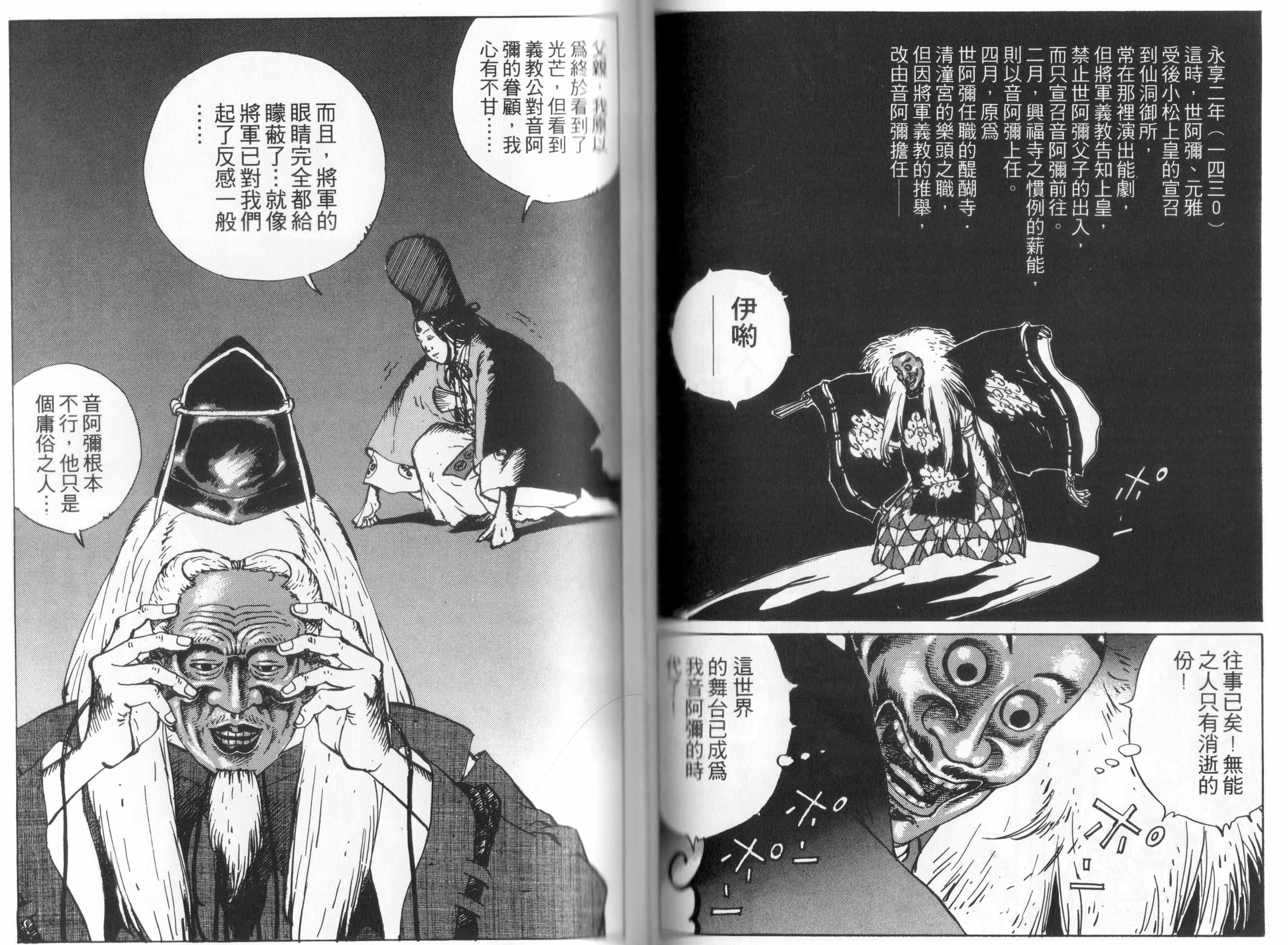
In the manga, Zeami and his son Motomasa are always depicted wearing their Noh masks, whether onstage or in conversation with their peers or patrons — their lives becoming a stage upon which art and politics are discussed. Zeami is usually seen wearing the mask depicting an old man. The main exception to this occurs when he is reminiscing upon the past and his first performances in front of Yoshimitsu where he is seen wearing the mask of a young man.

This narrative device goes beyond a utilitarian depiction of advancing age. Thomas Blenman Hare (writing in Zeami’s Style) states that in Zeami’s list of six typical plays in the Aged Mode, “in all but one of these, the old man is actually a god in disguise; only one of Zeami’s ‘old men’ is actually a man.” Hare, quoting an old Zeami manuscript, indicates that the Aged Mode “produces an air of divinity and utter tranquility,” words which perfectly describe Zeami’s final state in the closing volume of Ikkyu.

On’ami (Zeami’s nephew and Motomasa’s nemesis in the manga) on the other hand is invariably seen wearing the mask of a demon (oni). It has been suggested that he preferred such plays and excelled at them where Zeami slowly began to renounce such roles. Hare writes that Zeami had “come to reject entirely the role of the true demon-hearted demon” in later life, and with regards demon Noh, he quotes the famous playwright and actor as writing, “This is unknown in our school of Noh.”

Noh presents itself as a perfect mirror for the unspoken mysteries upon which Ikkyu’s life turns. The two cornerstones of Noh are monomane (“an imitation of things”) and yugen (meaning “mystery and depth”), aspects which reflect the very real political intrigues of the manga and the half-hidden wonders in which Ikkyu periodically partakes. There is even reason to believe that Sakaguchi’s work as a whole is partially constructed on the principles of Noh, with the story of the main character (the shite, in this case the Ashikaga shogun and, at other times, Zeami) being clarified and deepened by the philosophical and personal interrogations of the waki (the secondary character, in many instances a traveling priest which fits the description of Ikkyu).

The parallels Sakaguchi suggests are not extravagant. Critics point to the Zen influence in Zeami’s Kakyo, which the author describs as “a summary in six chapters and twelve articles of what I myself have learned about the art.” He is also said to have had encounters with a number of prominent Zen priests during his lifetime. Better documented is Ikkyu’s relationship (recounted in the manga) with the Noh actor Komparu Zenchiku, Zeami’s son-in-law and one of Noh’s great aestheticians. Ikkyu wrote at least two poems in praise of Zenchiku during his lifetime and there is correspondence demonstrating a close relationship between Zeami and his son-in-law. In this way, the separate paths traveled by Ikkyu and Zeami — delineated with exquisite care by Sakaguchi in his manga — are brought to a partial resolution in the person of Zenchiku when he encounters and debates an arrogant yet visibly confused On’ami in the closing volume of the manga.


Filled with shame I can barely hold my tongue.

Zen words are overwhelmed and demonic forces emerge victorious.

These monks are supposed to lecture on Zen,

But all theye do is boast of family history.

Ikkyu left Ankoku-ji (following a short period at Mibu temple) in 1410. Disgusted by the political machinations of the masters of the Gozan monasteries of Kyoto, he left behind the verses above depicting his frustrations with the corruption and unctuousness of his fellow monks; feelings which he would carry with him throughout his life, for Ikkyu is known for his disdain of Five Mountains Zen.

Soon after leaving Ankoku-ji, he begins to train under a new master, Ken’o, who he meets after meditating on his life while staring at a lotus flower. This occurs a few pages after Zeami is seen doing the same while contemplating his own treatise on Noh [1]. Ikkyu first chances upon Ken’o as he is distributing food offerings to the children of a shanty town. He later finds him at a ramshackle hut (defiantly called a temple) outside Kyoto. Life under Ken’o proves to be one of ceaseless toil compared to the comforts of Ankoku-ji. Apart from the spartan lifestyle, he is mysteriously chided for getting up in the middle of the night to meditate. When seeking solitude for the same in the countryside, Ikkyu is disturbed by some mischievous children, which he takes as a distant rebuke by his master for committing the same “error.”

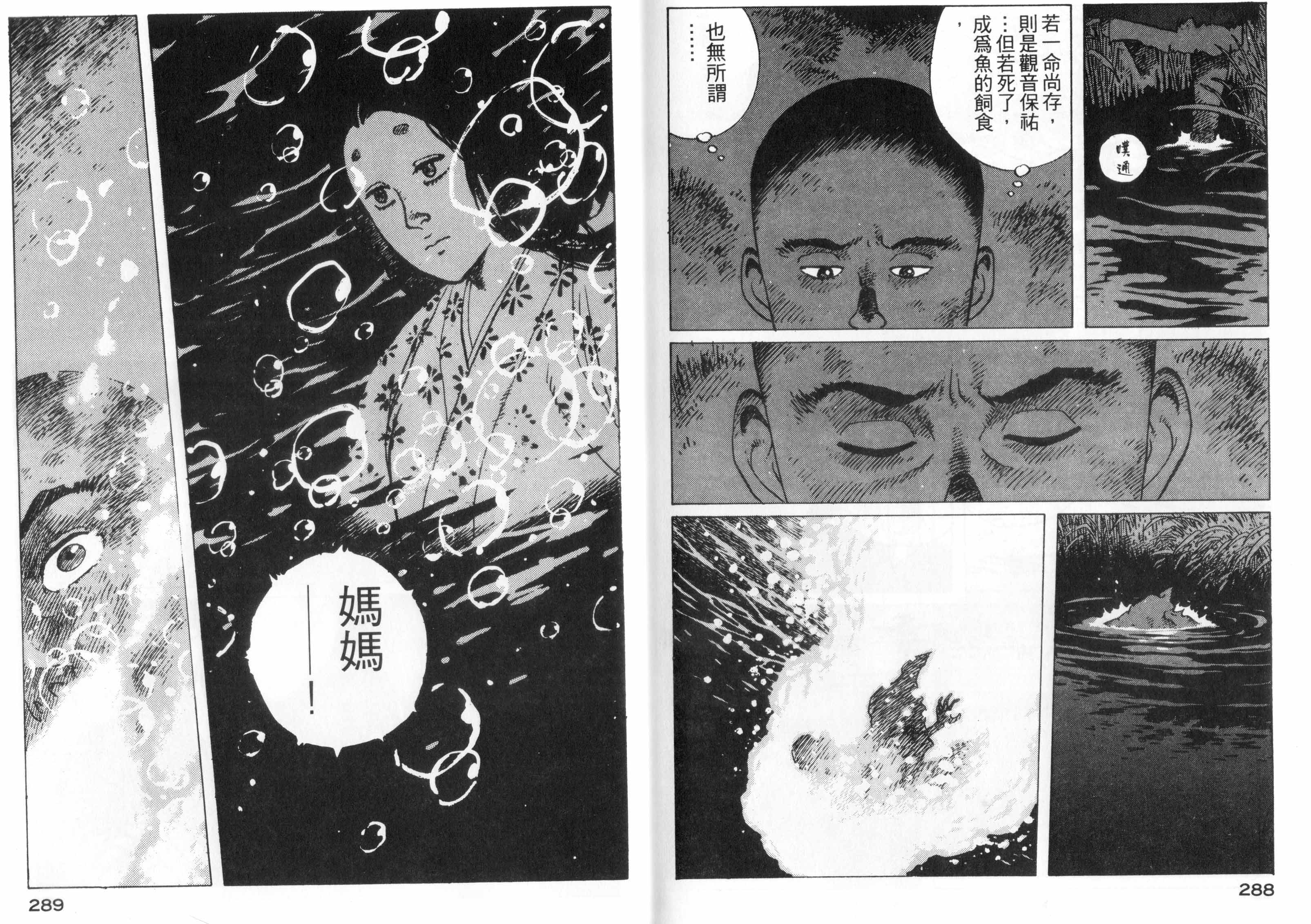
Upon returning from this period of solitude, he is roundly beaten by his master who, noticing the mud on his robe, realizes that his pupil has been disobeying his orders. It is only at Ken’o’s deathbed that Ikkyu discovers the reasons for his frequent beatings. Ken’o explains that he has been disciplining his intemperate state of mind. Together with his master’s passing, this revelation causes Ikkyu to sink into a deep depression. Wandering aimlessly through the countryside, he soon resolves to put an end to his life by drowning himself in Lake Biwa. He decides against this on remembering his mother and the sorrow this would cause her.

The second volume of Ikkyu follows upon this aborted suicide and contains a detailed look at the young monk’s life under a new master, Kaso Sodon, who belonged to the harsh Daito tradition of Zen. Ikkyu endures a week-long wait at the gate of Kaso’s austere Lake Biwa retreat in order to prove his determination to become his disciple. The longest and most lyrical passages in this section of the manga are devoted to two significant moments of realization and enlightenment.

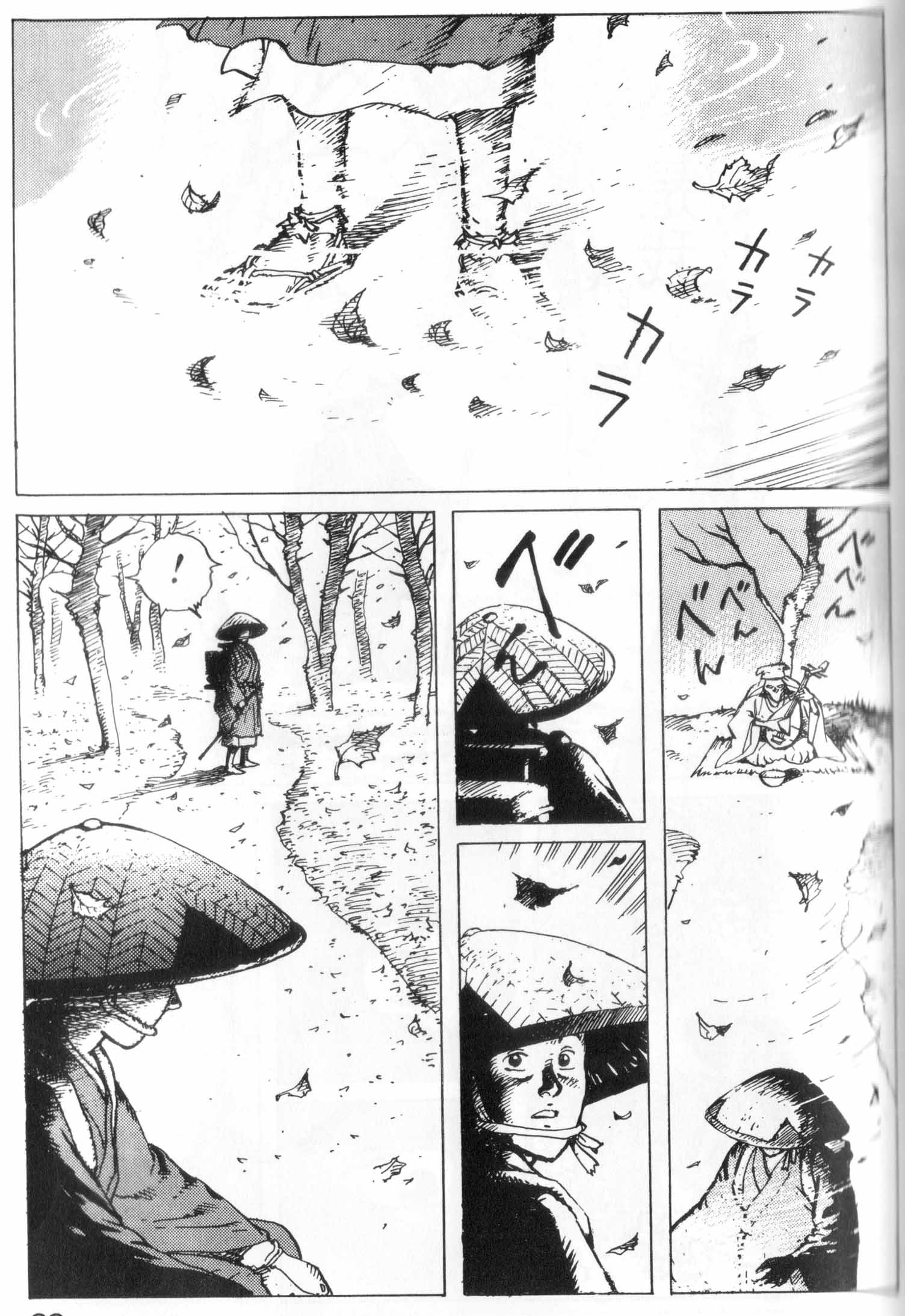
In the first instance, Ikkyu pierces a zen koan from the 15th case of the Gateless Gate (Mumonkan) involving an exchange between the monk Dongshan Shouchu and the Chinese Zen Master Yun-men Wenyan. Ikkyu penetrates the zoan upon hearing a blind minstrel singing a song from the Heike Monogatari, namely the tale of Lady Giyo and the general, Taira no Kiyomori — a tale of betrayal and unfaithful affections which exposes and expunges his long-held recriminations against his father, the emperor, for abandoning his mother amidst similar court intrigues. Upon presenting his solution to the koan to Kaso, Ikkyu is finally presented with the name by which he is known to this day (he was previously known as Shuken).

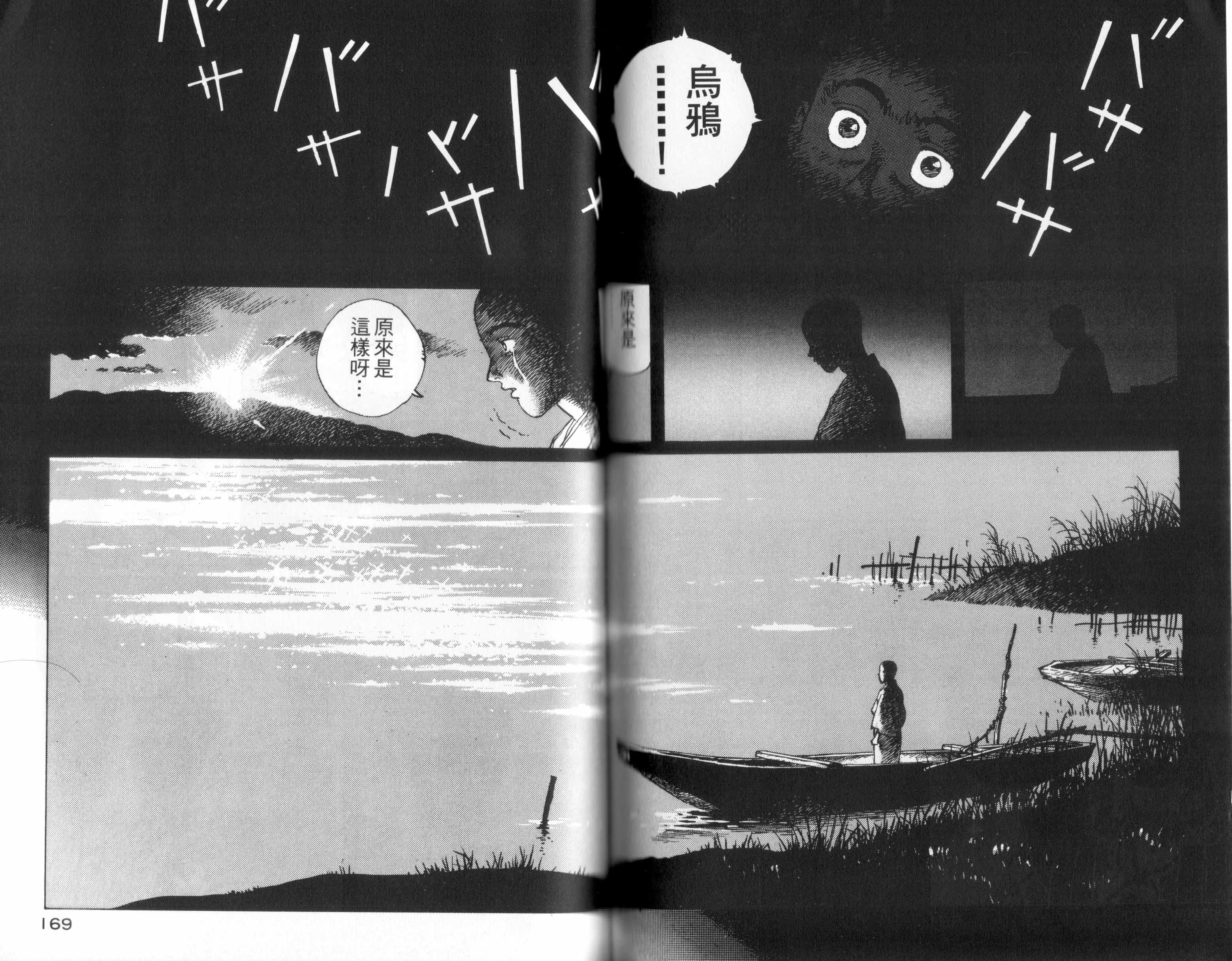
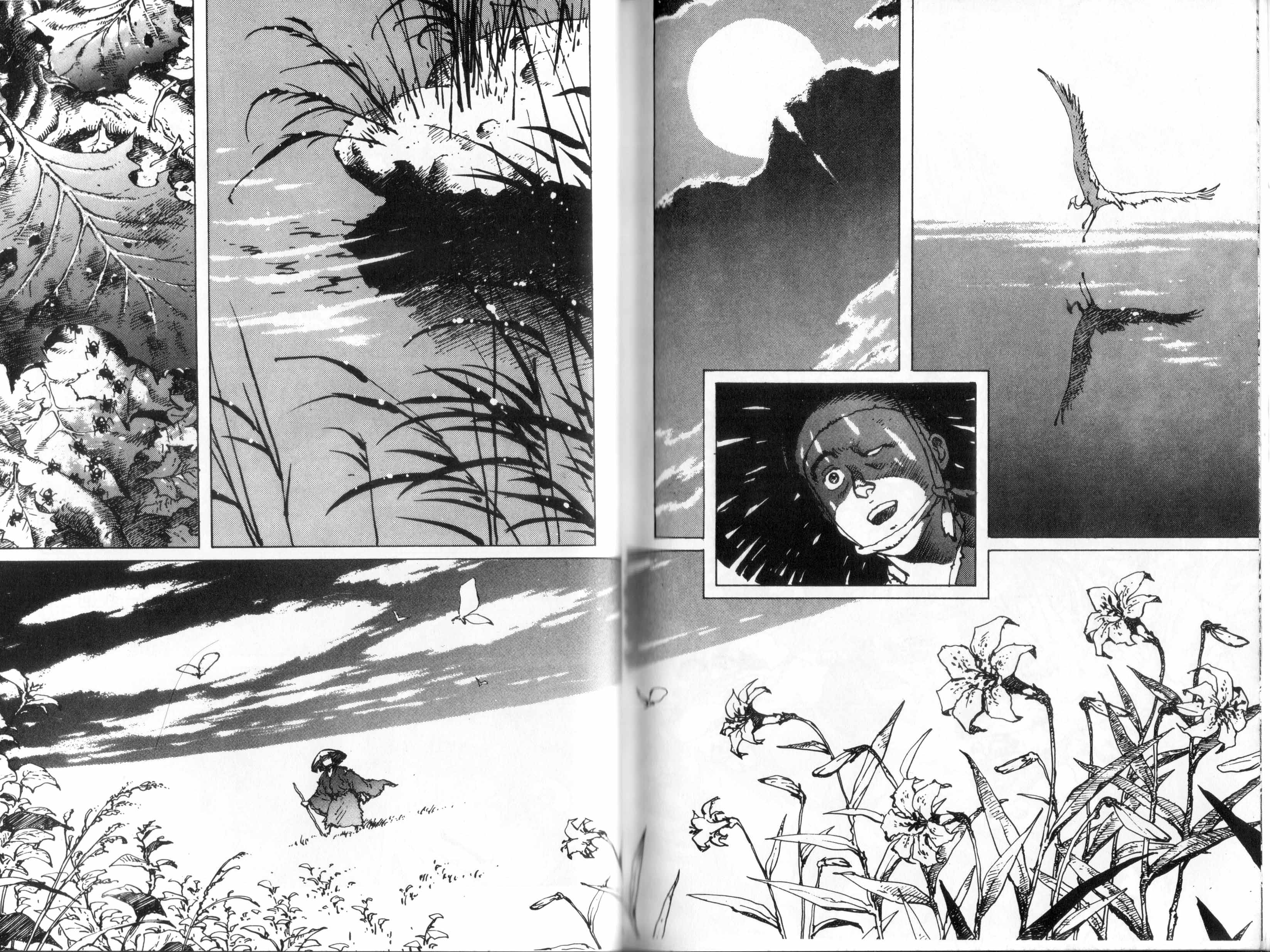
Ten dumb years I wanted things to be different furious proud I still feel it one summer midnight in my little boat on Lake Biwa caaaawweeeee father when I was a boy you left now I forgive you

The other key moment in Ikkyu’s life under Kaso is found while he is meditating in a boat by Lake Biwa. In contrast to his first satori — which is depicted as a sublime moment of tranquility and self-awareness — this second important spiritual juncture is depicted as a cry heard through dense dark night, single and distinct and stretched across two pages.

Sakaguchi’s interpretation of this moment unfolds through a conversation with his master and reflects the feelings he expressed in a poem written in response to this moment of enlightenment:

For ten years I was in turmoil,

Seething and angry, but now my time has come!

The crow laughs, an Arhat emerges from the filth,

And in the sunlight of Chao-yang, a jade beauty sings

The crow’s cry chases away all memories his bitterness over his mother’s (the jade beauty) expulsion from the royal court, leaving him free to feel at one with his surroundings.

Life is like a dream and goes with the speed of lightning.

It is like a dew-drop in the morning;

it soon falls and is broken …


“Here are shown the struggles and the sins of mortals, and the audience, even while they sit for pleasure, will begin to think about Buddha and the coming world on Oni-No or the Noh of Spirits” – from the Kadensho or Secret Book of Noh.

The third volume of Sakaguchi’s manga segues into the rivalry between Motomasa and On’ami (presented to us in the mask of a demon and who the audience of the time sees as Zeami’s heir). This drama carries implications beyond mere questions of succession.

On’ami’s fortunes began to rise (as Zeami and Motomasa’s declined) during the reign of the shogun Yoshinori (one of Yoshimitsu’s sons). By 1429, both father and son were excluded from further appearances at the Sento Imperial Palace, and in 1430 the musical directorship at Kiyotaki shrine was taken from Motomasa and given to On’ami.

In the manga, this dispute mirrors Ikkyu’s exclusion from the mainstream of Zen thinking and provides a secular reflection of Ikkyu’s own conflict with Kaso’s chief disciple, Yoso, over their master’s legacy. Their conflict encompassed corruption, ambition, women, sexuality, and other contentious ideas concerning Zen. Discussions of carnal and romantic love would seem out of place in a story concerning a monk but they are central to any understanding of Ikkyu and his interpretation of Zen.

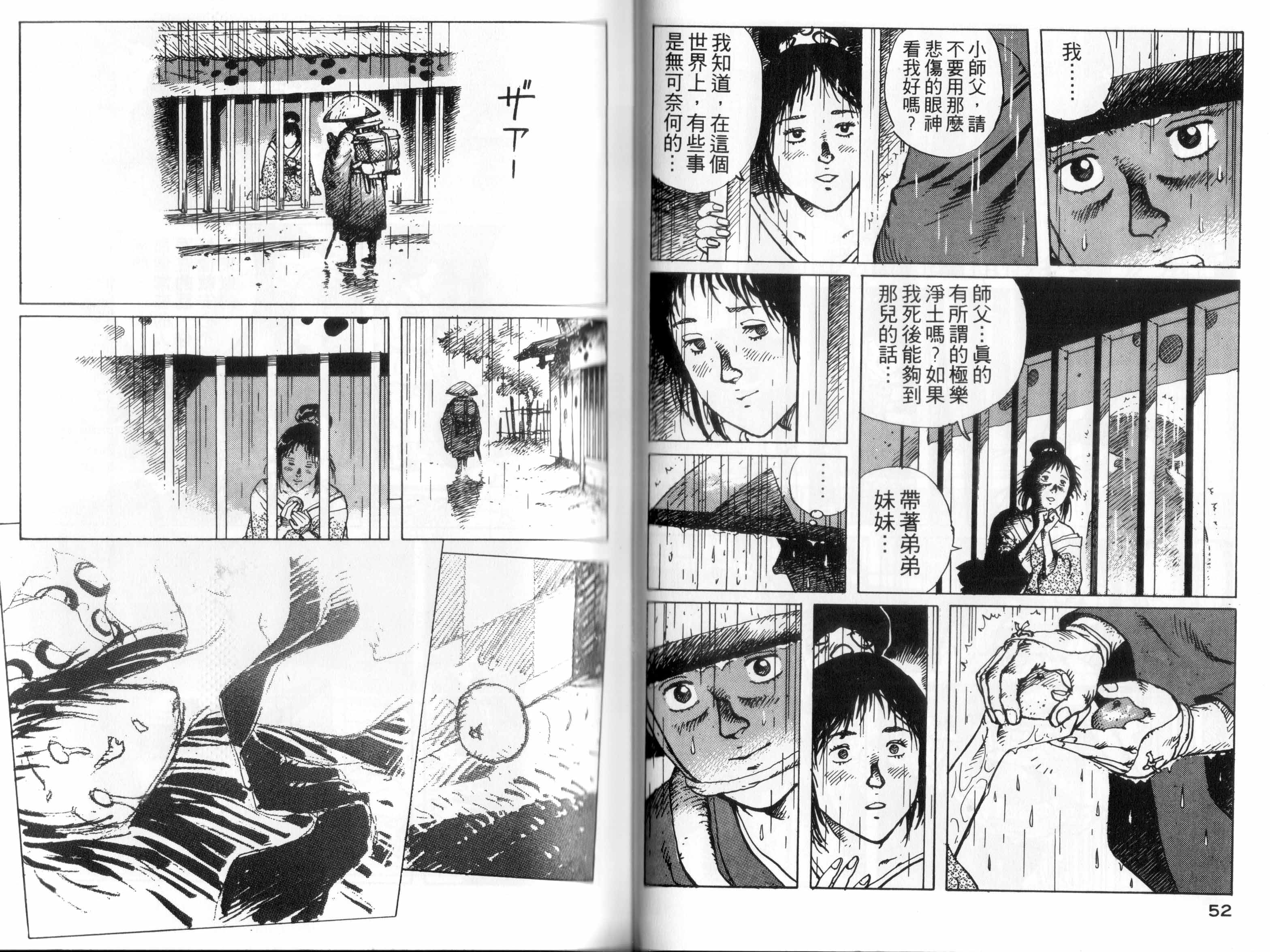
Each of Ikkyu’s encounters with women in the manga contains stepping stones to further enlightenment, each meeting offering both temptation and sustenance. There is a moving episode involving a young prostitute whom he befriends while she is quietly offering herself in the window of a brothel, selling her body to feed her family. In another instance, he meets and is sexually tempted by a girl who helps him after he has been beaten up in an encounter with a spiritually corrupt monk. Another encounter with a dying prostitute prompts a moment of deep introspection.

All this is played out in the light of Yoso’s somewhat abusive and pecuniary attitude towards women. Over the course of his rise to prominence as chief abbot of Daitoku-ji temple, Yoso is seen propounding on the unclean nature of women and their inability to achieve enlightenment.

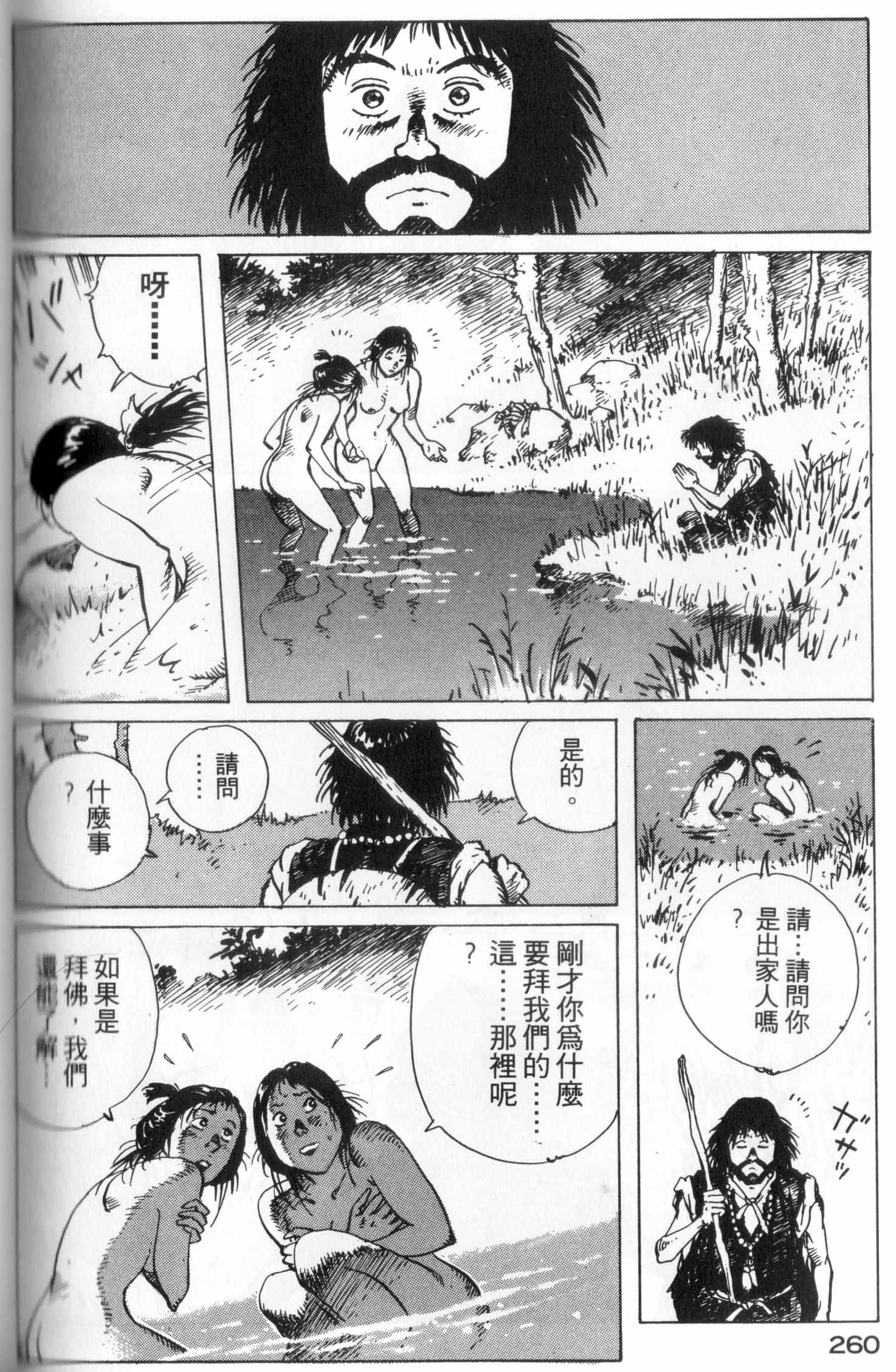
Ikkyu was of the opposite opinion. Sakaguchi illustrates this by recounting his encounter with some nude women bathing in a pond. On chancing upon the stunned women, Ikkyu bows reverently towards their genitalia and proceeds along his way. When pressed for the reasons for his actions, he gently chides the popular views earlier recited by Yoso and further suggest that women represent a great and unparalleled treasure, as all humans — however great or lowly — proceed from them.

In his short biography of Ikkyu, John Stevens relates the story that furnishes the source material for this scene, providing a more direct response by Ikkyu with regards this eccentric view of women:

Woman are the source from which every being has come.

including the Buddha and Bodhidharma.

Jon Carter Covell (Zen’s Core: Ikkyus’ Freedom) in explaining Ikkyu’s relation to the “red thread” of passion puts it thus:

“If, from childbirth, man is already entangled with the feminine, his violent denial of it later shows a lack of enlightenment.”

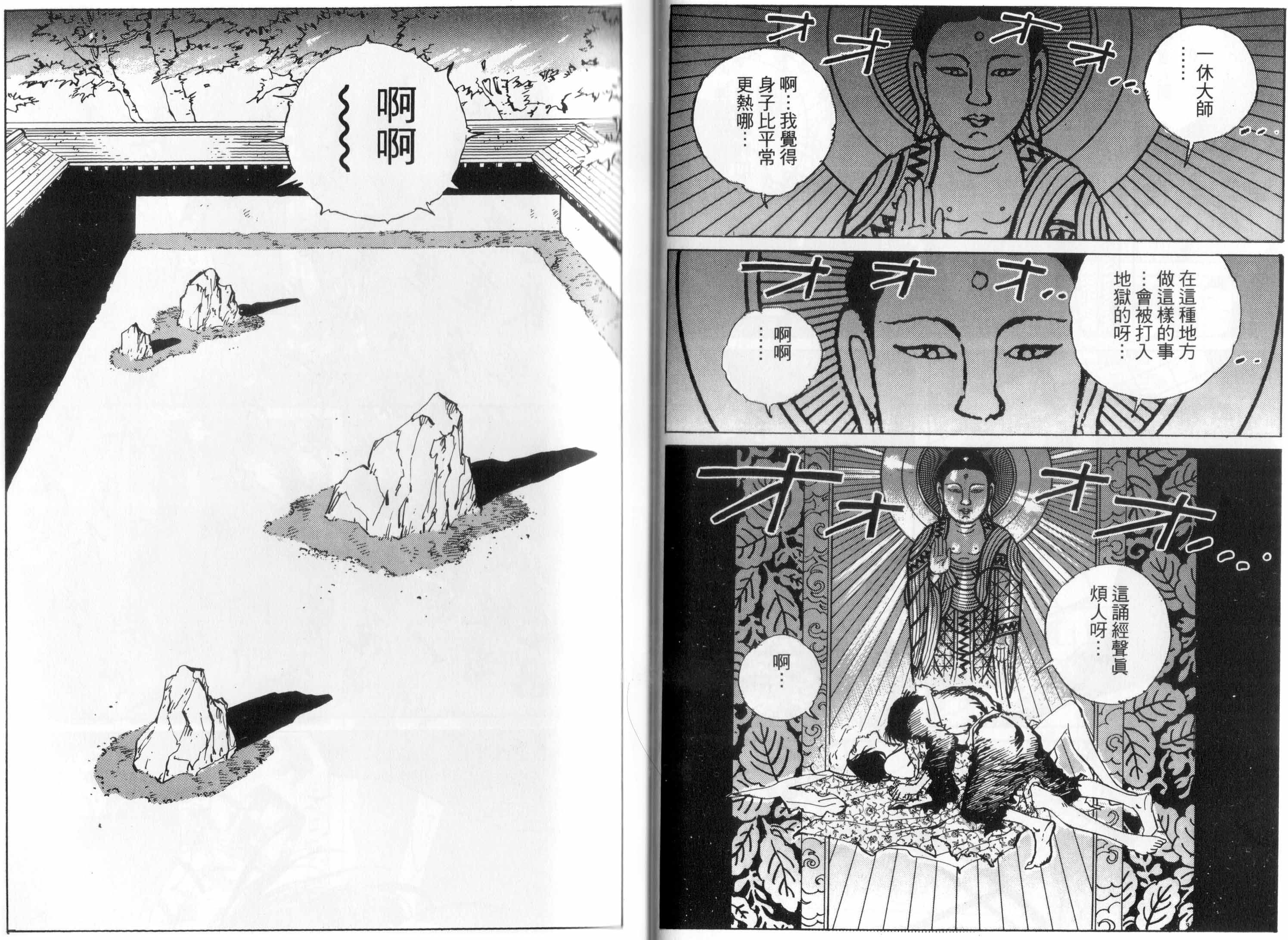
Sakaguchi further elaborates upon this important element in Ikkyus’ beliefs in his poetic verbal duel with a famous courtesan. Their relationship is consummated in an abandoned house a stone’s throw from where his fellow monks are accumulating earthly offerings as a form of veneration and worship. Juxtaposed against the chanting of the monks from the temple, their sounds of sexual ecstasy resound across a Zen garden.

Covell suggests that “sex had almost become a religious ‘rite’ to him”. With respect to his experiences with prostitutes, Ikkyu once opined:

When as a rakan I “rose above the dust,”

I was still not in the (real) Buddha Land;

But once I entered a brothel, tremendous wisdom occurred.

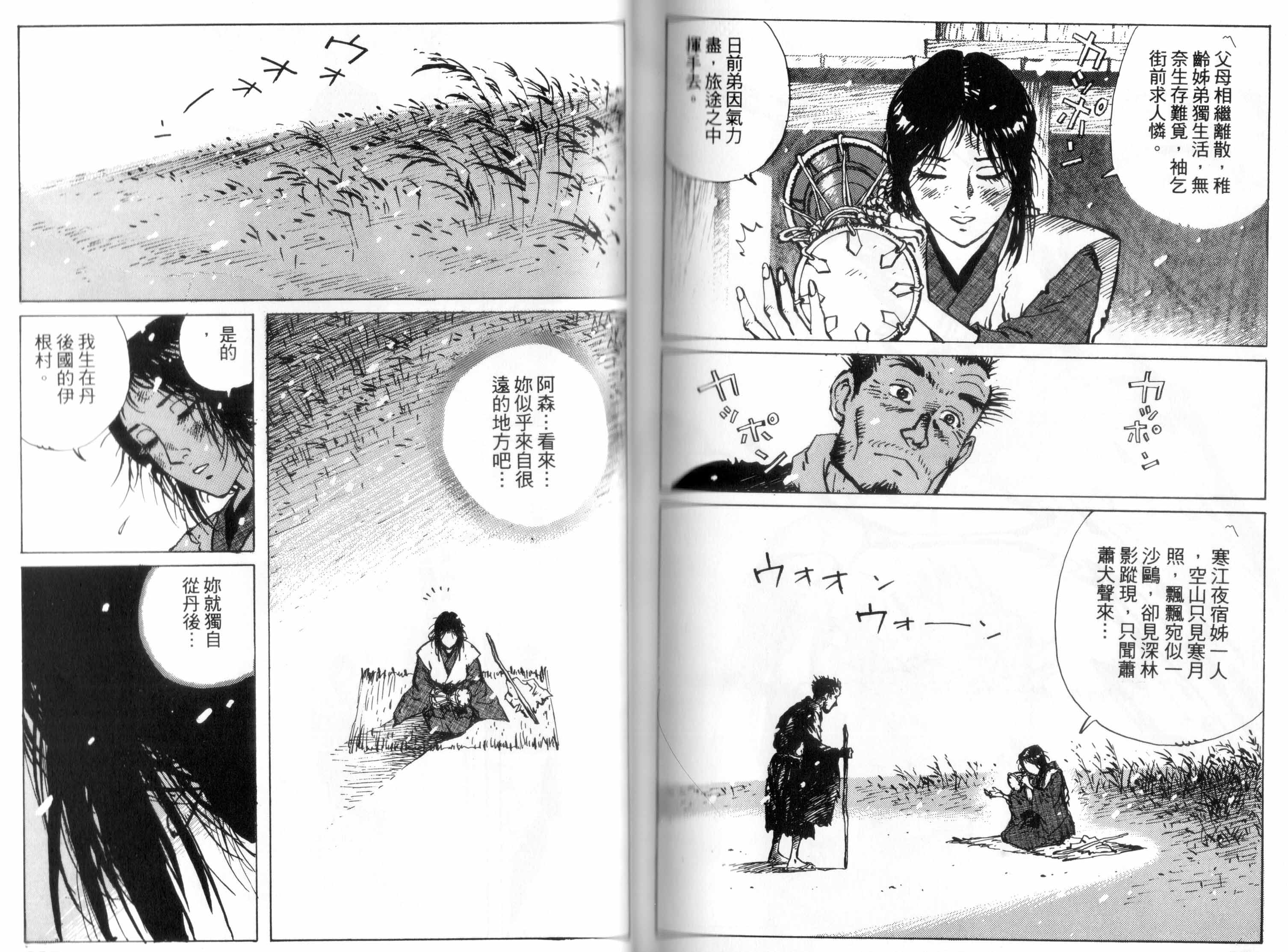
Of all the women Ikkyu encounters, Sakaguchi devotes the greatest space to Lady Shin, the object of his passion in the final years of his life. When Shin is first seen by Ikkyu in the manga, she is seen kneeling while playing a small hand-drum in homage to a famous double portrait commissioned by Ikkyu himself (now found in the Masaki Museum in Osaka).

It was a love both romantic and carnal. In “Watching the Beauty Shin in the Midst of Her Siesta”, he writes:

The most elegant beauty of her generation.

Her love songs for a banquet are the newest.

She sings so naively, it pierces my heart; a dimple appears in her cheek.

Shin is like a begonia in the “Heavenly Treasure” period.

In “If My Hands Were Like Shin’s,” he writes with unabashed frankness, “When my ‘jeweled stalk’ is weak, she makes it sprout.” In the manga, the moment in which Shin finally expresses her love for Ikkyu is presented almost as a moment of enlightenment, the pacing of this sequence adopting a tone similar to that of his second satori.

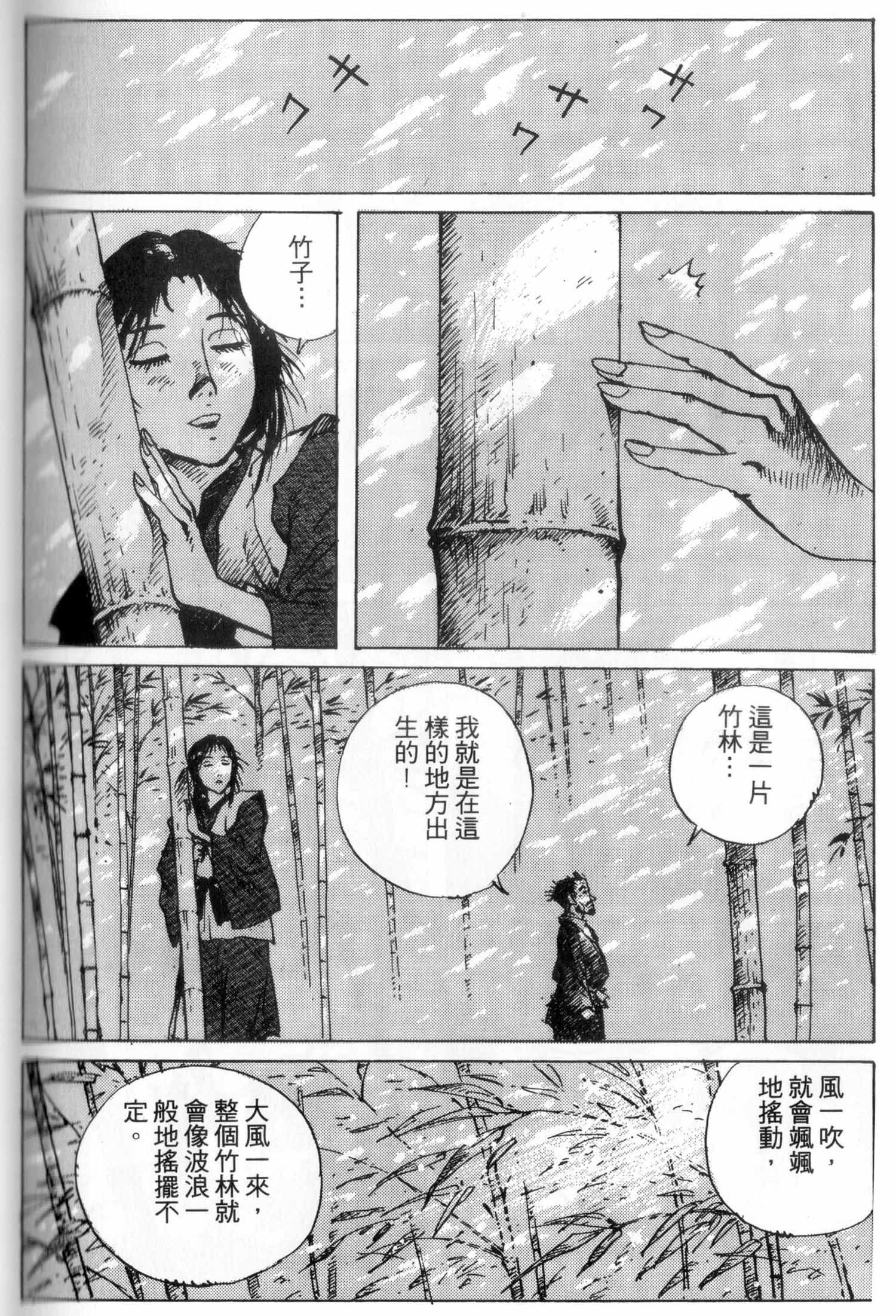
The couple are seen in the midst of a bamboo grove with the wind rustling through the branches as if in physical and pictorial demonstration of the concept of furyu (meaning “wind flow”), an aesthetic ideal which permeates Ikkyu’s art and a term which he used to praise those persons with whom he was most intimate.

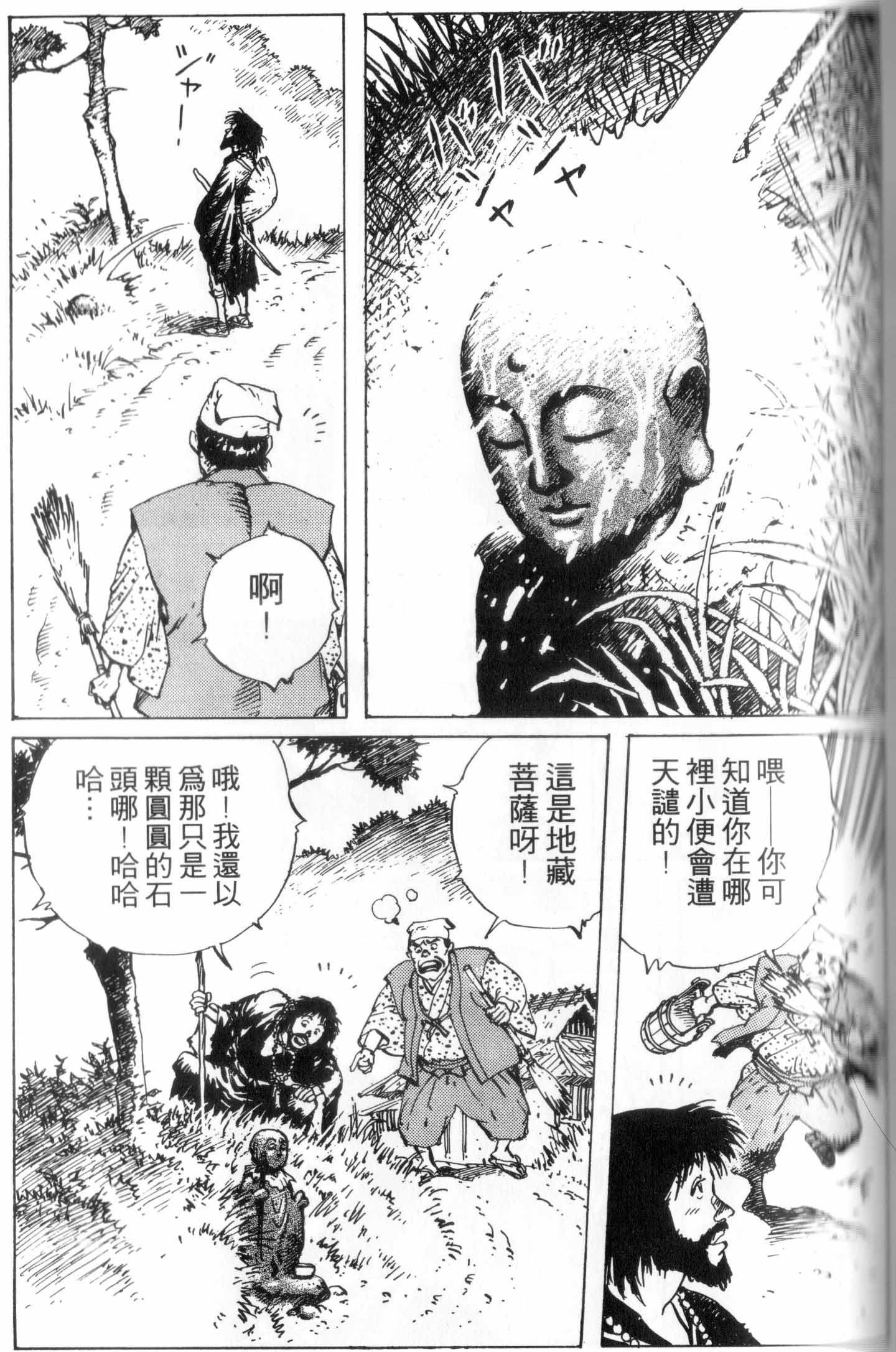
Ikkyu’s non-conformist ways extended beyond his unapologetic enjoyment of sex, meat, and wine. Sakaguchi joyfully depicts a host of his exasperating ways, from urinating on a roadside stone Buddha to burning a revered wooden Buddha figurine in order to keep the Buddha in his heart” warm. 

Ikkyu is seen taking food offerings from gravesites (a pointless gesture in his view) and, in instructing a deeply religious samurai who is stumped by a few words from some Buddhist scripture, suggests using the name of his favorite food in place of the words he cannot read. It is this freedom and irreverence that has endeared him to late twentieth century readers.

*          *          *

 Born in 1946, Hisashi Sakaguchi was a one time assistant to Osamu Tezuka and was known for his work on animation projects such as Astro Boy and The Jungle Emperor. He died soon after completing Ikkyu, his masterwork. His other manga include a science fiction story called Version (available in English) and the much-praised but slightly melodramatic Flowers of Stone (sometimes called Partisan), which concerns the partisan action in Yugoslavia during World War II. The latter book is of particular interest being an early example of Sakaguchi’s attention to historical detail both in dress and architecture.

In Ikkyu, Sakaguchi navigates a meandering path through childhood tales of wisdom, initiations into homosexuality, political and cultural intrigues, and sexual and romantic love. The work presents itself as pure narrative, but is also held together by a number of unifying threads.

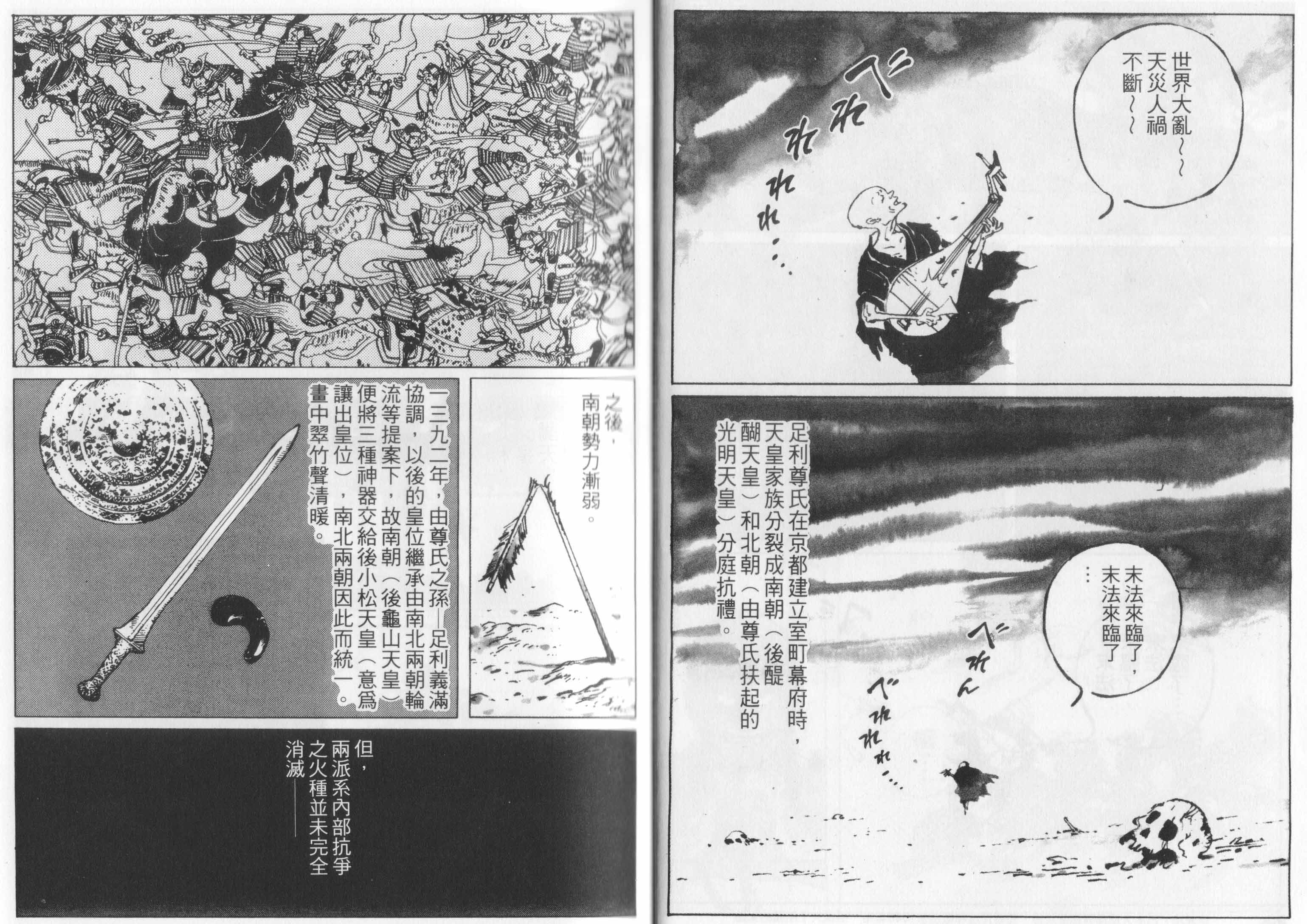
One motif that repeats itself throughout the novel can be seen in its early pages, where a drunk and irreverent Ikkyu is juxtaposed with wartime massacres. An ambiguous integration is forged between these horrors and the songs and chants of wandering monks.


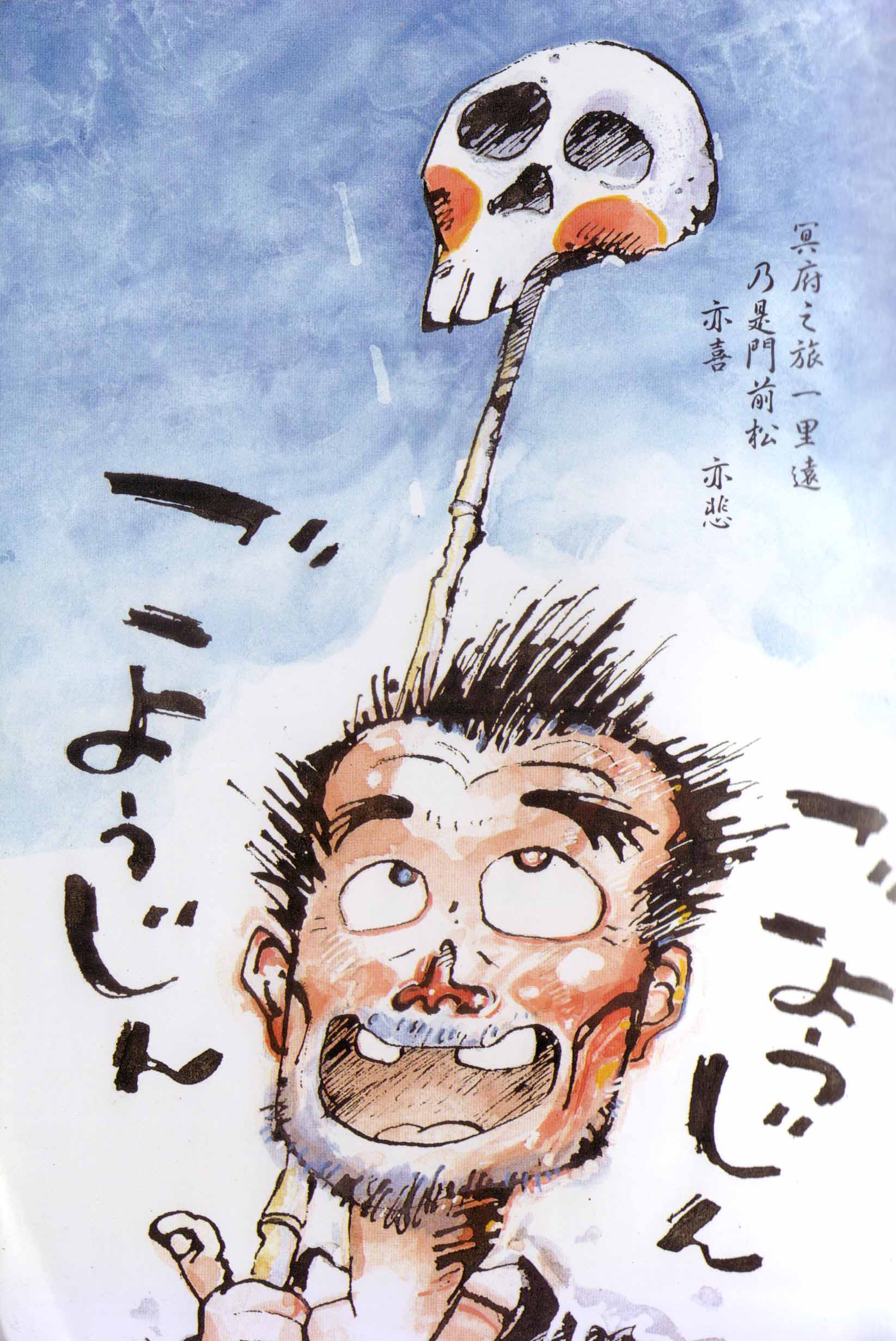
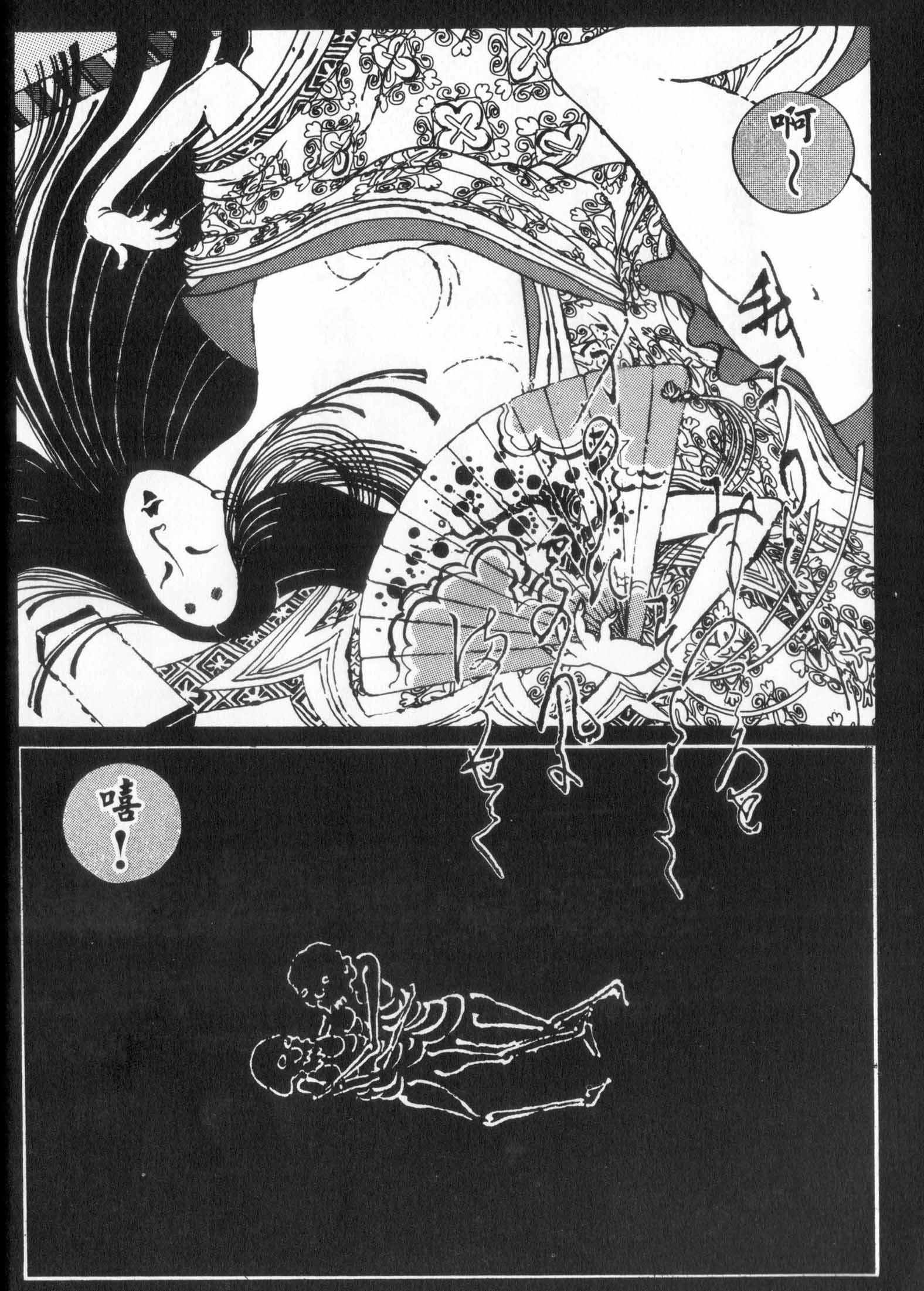
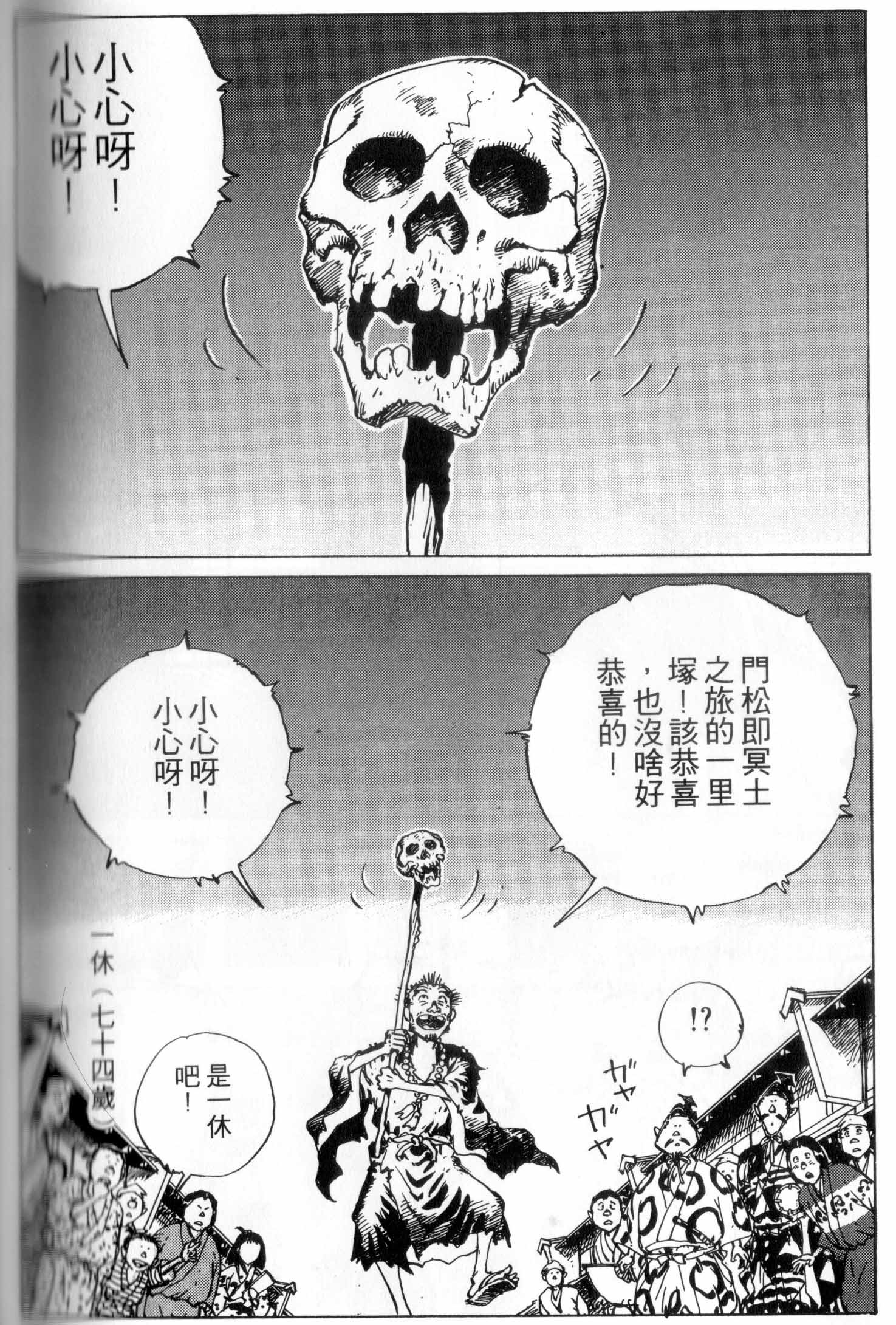
One of Ikkyu’s responses to the seemingly endless cycle of famines and natural disasters during his lifetime was to write one of Japan’s most famous books on the subject of death, Skeletons. It was written in the vernacular (as opposed to his usual classical Chinese poetry) in order to appeal to the common man, the better to instruct him on mortality and Zen. Ikkyu is seen drawing Skeletons in the fourth volume of the manga and is later seen in a dramatization of a famous print in which he is seen carrying a pole with a human skull at its tip. 

The landscape of corpses and skeletons which populate Sakaguchi’s novel are both a reflection of the seeds of Ikkyu’s famous work and a dramatic depiction of the very real situation of uncleared and unburied bodies which lined the streets of Kyoto.

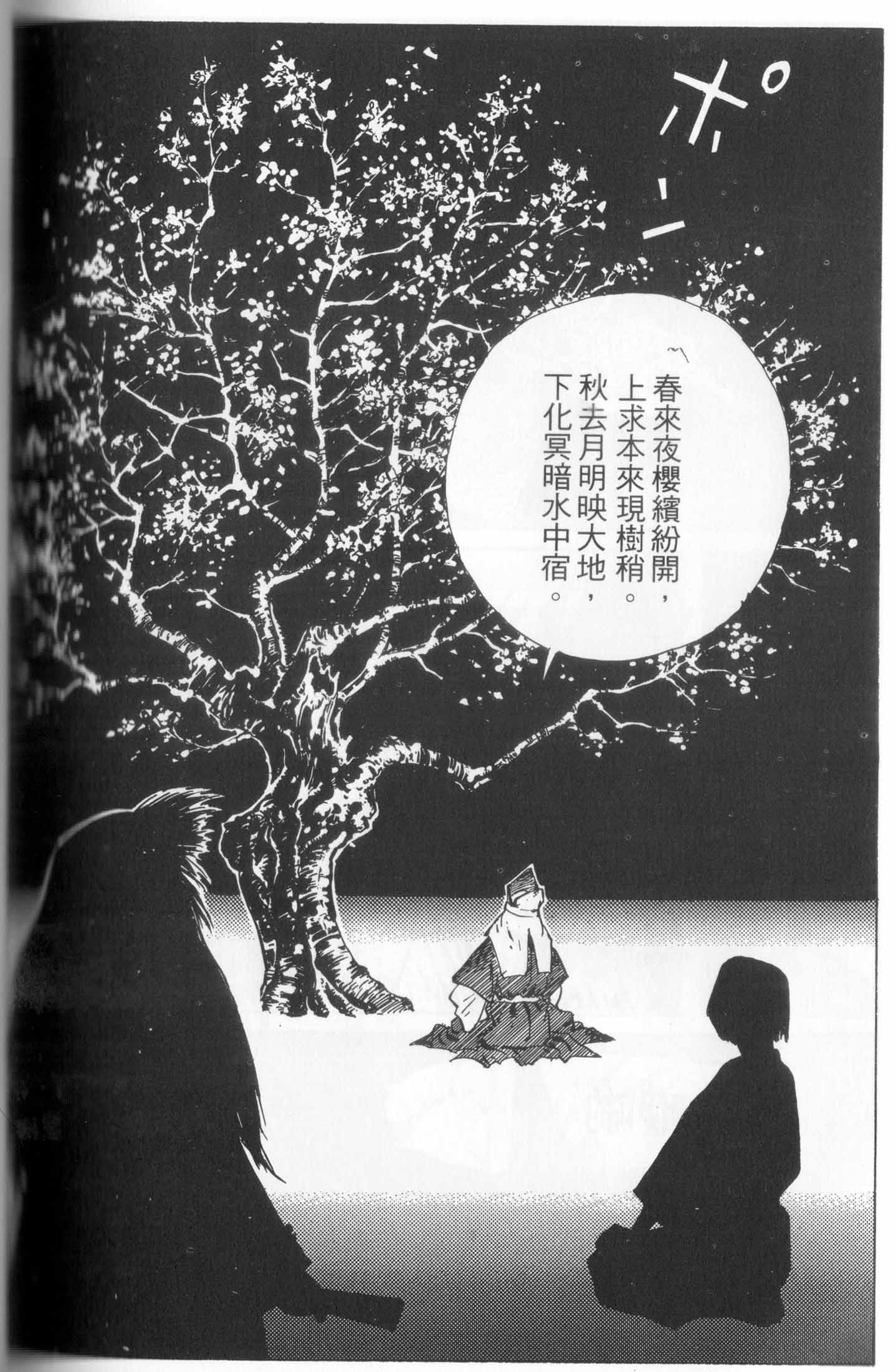
There are also dear parallels drawn between Noh and the narrative of the manga. By signposting significant periods in Ikkyu’s life with short “performances” of Noh, Sakaguchi allows us to seek parallels between the demarcations in the manga and the prescribed arrangement of plays in a day of Noh performances.

Such a performance begins with a Shugen, or congratulatory piece, followed by the Shura (battle-piece), the Kazura or Onna-mono (“wig-pieces or pieces for females”), an Oni-No, a fifth piece “which has some bearing upon the moral duties of man,” and ends with another Shugen, “to congratulate and call down blessings on the lords present, the actors themselves, and the place.”

Another way of understanding the thrust of Sakaguchi’s presentation can be found in Covell’s book, which illuminates Ikkyu’s life in relation to “The Ox-Herding Series” (the ox representing the “Buddha-mind … for which the ego searches”). The series follows an ox-herd on a metaphorical journey from the initial sighting of the “ox” (painting one in the series) to satori (painting eight in the series, represented as white space within an empty circle) in which the seeker understands the “oneness of all phenomena.”

Painting nine concerns “life after satori,” where the enlightened man begins to fully appreciate all the beauty that surrounds him, which “means not only the beauty of flowers but also the beauty of women.” The tenth and final stage is called “Returning to the Marketplace” or Entering the city with Bliss-bestowing Hands” and shows a child encountering Hotei, the rotund god of good luck, who “by his transforming presence brings to all the awakening of their own Buddha-natures.”

Covell quotes Kuo-an’s commentary on the tenth picture stating,

“He is found in company with wine-bibbers and butchers; he and they are all converted into Buddhas.”

Sakaguchi’s understanding of Ikkyu’s life preserves this core of truth; the essence of Ikkyu’s teachings. In the manga, Sakaguchi deemphasizes Ikkyu’s elevation (at the age of 80) to the position of chief abbot of Daitoku-ji by the emperor Go Tsuchimikado, and the massive undertaking of the reconstruction of the temple that had burned down over the course of the Onin War. Instead, it is the very human aspects of the crazy Zen man which are of most interest to the artist.

The manga is faithful to his relationships with the common man and his distinct influence on Japanese culture. In his lifetime, Ikkyu encountered warriors, generals, artists, prostitutes, inn keepers, merchants, thieves, and kings, altering each in his own unmistakable fashion. Ikkyu’s student and Japan’s first tea master, Murata Shuko, would develop — some say in direct collaboration with his master — a new approach to the tea ceremony, one which incorporated a heightened understanding and awareness of Zen. Shuko would also design Zen gardens on which “the love letters which sing of wind and rain, snow and moon,” could be observed; gardens which revel in the wabi aesthetic propounded by Ikkyu. Two other pupils, the renga poets Sogi and Socho, would later develop haiku poetry. It would not be unreasonable to suggest that Sakaguchi must have counted himself a slightly removed student of the master. Dense with historical fact and passionate artistry, Sakaguchi’s forthright and yet mystical work is possessed by the essence of the man and is a testament to his intelligence, spirituality, and artistic vision.

*          *          *

[1] In the first volume of Ikkyu, Zeami is depicted working on the seventh and final chapter of his seminal and most famous work on the theatre, Fushikaden; a book that has been described as partly a meditation on the teachings of his illustrious father, Kannami. In the chapter in question, Zeami dwells on the aesthetic ideals of Noh, which Hare explains “depends on its existence on the creation of what Zeami terms ‘the flower,’ an effect which is achieved through technical skill and intellectual understanding.”


Pagan Death Cult

A version of this essay appeared in The Chicago Reader. This is part of a weeklong Metal Apocalypse.
________________
To most civilian bystanders, there could hardly be two less simpatico white pop genres than metal and folk. On the one hand you’ve got fascist Vikings grunting gutterally about blood, Satan, and Leatherface; on the other you’ve got tree-smooching hippies warbling about peace, love, and gently blissed-out mammals. Short of some scene of hideous pillage, it’s pretty difficult to imagine any intercourse between them. “Welcome, corpse-painted stranger! A flower for your gard….eeeeearrrrgh!”

And yet, intercourse there has always been. Led Zeppelin was as much a folk band as a metal one, and that tradition is carried on by horror-movie-at-the-Renaissance-Faire outfits like folk metal band Finntroll. Genre designations are, of course, notoriously slipshod, and it’s true that a joke horror outfit like, say, Venom doesn’t have a whole lot to do with the earnest protest music of, say, Pete Seeger. But if by folk you mean acoustic music with medieval English roots, and if by metal you mean thrash, death, doom, and especially black, then there’s a lot of common ground. It’s no accident that Forest is the name of both a black metal band and a 60s British folk outfit, for about both thundering metal orcs and tinkling elvish folk lingers the spirit of Tolkein and the distinctive scent of weed. If folk and metal are opposites, it’s not because they have nothing to do with each other, but because they’re mirror images — different takes on the same pagan Northern-European obsessions.

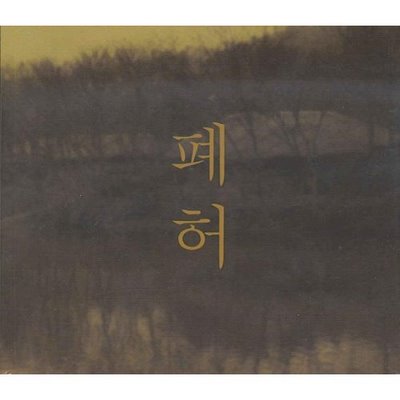
The two latest offerings on that unholy altar are the best releases of the summer: Karen Dalton’s Green Rocky Road and Pyha’s The Haunted House. Both document almost-lost recordings created in virtual isolation by eccentric quasi-legends. Dalton was an almost-famous Village folkie from the ’60s. Her musical legacy for the most part consists of ingratiating, bluesy guitar tracks in which she sings like an improbably docile Billie Holiday. This disc of recently unearthed home recordings from 1962, mostly on banjo, is the first record of a starker musical personae. Pyha is even more obscure. A native of South Korea, he recorded The Haunted House , his sole black metal opus, by himself in 2001 when he was 14 years old. Circulated on CD-R in Korea, it fell into the hands of the metal aficionados at tUMULT, who managed to track down the perpetrator. It had its official release, with extra tracks, in July.

Sonically, the two records couldn’t be more different. Rocky Road is so bare-bones it makes Alan Lomax’s field recordings sound polished. Even to call the two-track record “produced” seems a stretch. “Katie Cruel” is interrupted by a telephone ringing; part of the beginning of “Nottingham Town” is erased. Even without such cock-ups, Dalton’s voice and banjo-playing are incredibly harsh; each phrase and plunk seems to come scraping out of some abandoned hollow.

The Haunted House, on the other hand, is a dense, claustrophobic landslide of sound. The record’s signature noise is burst out static; the sound of recording technology dying in agony. Slabs of sound lurch into each other like lumbering tectonic zombies. In “Tale From The Haunted House Part 1” the background hiss and wail just…stops, to be replaced by whispering over a ghostly synthesized chorus, which in turn cuts back to giant distorted screaming and a mid-tempo drum beat that goes on and on, mindlessly repeating. Throughout the record, each of black metal’s requisite layers of sound (guitars, drums, synths, shrieks) seem manually lifted and dropped, one on the other. This sense of grinding effort reaches its peak on “Song of Oldman,” where the buzzing static actually seems to overwhelm the mics, cutting in and out in random, painful bursts, while the wailing, almost human synths distort into a horrible scraping noise, like a metal bar being dragged across your teeth.

Yet, for all their differences, Green Rocky Road’s empty space and The Haunted House’s dense maelstrom meet on the same bleak wasteland; bleached skulls calling hopelessly to each other in dry, mutually incomprehensible tongues. Given too much space or not enough, the songs and, indeed, the singers seem lost, abandoned, dead. Tempos on both albums stutter and grind down almost to paralysis. Pyha’s music is leaden enough to almost qualify as doom — on “Tale From The Haunted House Part 3” the drum machine is positively stoned, thudding down just behind the beat so the track sounds like it’s slowing down all through its 4 1/2 minute length. Dalton’s album is similarly stupefied. The banjo line on “Whoopee Ti Yi Yo” turns the familiar lyrical melody into a wavering slog, unrecognizable until Dalton’s voice comes in, off the beat and even off-key. On the endless “Nottingham Town” her picking and singing have even less to do with each other; the banjo speeds up, stretches out, trips over itself, and plunks notes so far out of tune that you’d swear the tape speed was screwy. She sounds like the Shaggs on a serious downer.

Nottingham Town” is an eerie, traditional tune with intimations of loneliness and the grave, and Dalton’s broken attack intensifies the uncanny sense of isolation and despair. In contrast, the last track of The Haunted House, “Wanderer Death March”, is not unpredictable, but insescapable. Anchored to repetitive, buzzing cymbals, increasingly strained synth washes, and throat-shredding howls, the song is a soundtrack for armageddon — a slow camera pan across clashing armies being devoured alive by mechanical insects. It, and the rest of the record, are intended as an anti-war statement, but this isn’t any kind of hopeful, or even outraged protest. Instead, it’s a vivid, bitter surrender before the crushing power of violence. Pyha seems pulverized by hate and terror; Dalton collapses in aphasia — for both, in different ways, individuality and artifice seem to disintegrate in agonizing slow-motion, falling to dust as the apocalypse approaches.

Folk and metal — and, indeed, the cold northern European culture that they epitomize — share a particular fascination with death, and, as a result, a particular take on authenticity and art. Punk tends to equate realness and sloppy incompetence; jazz, and hip hop link cred to invention and élan; blues and gospel tie it to personal emotional expression. As a celebration of the performer’s skill (or lack therof) the music is about individuality, and so about life. In folk and metal, on the other hand, the demands of the form tend to obliterate personality. In the true mountain tradition, Dalton’s singing is without affect; when she says “they call me Katie Cruel” her lack of inflection lets you know beyond a doubt that she is as heartless as she claims. Similarly, Pyha is swallowed in his own effects — snippets of taped ephemera, muffled bellowing, some poor soul gasping its last in the midst of a crackling fire — his own voice is everywhere and nowhere, neutered in its multiplicity. To be authentic is, for both, Dalton and Pyha, to be depersonalized; to be real is to be nobody. You show your commitment to the material by letting it bury you. When there is individuality, it comes across as weakness, stuttering — a falling away from the perfection of oblivion. Folk and metal are about being crushed by death — about the cold joy in self-immolation which links Protestants, and Norsemen alike.

Neither the American Dalton nor the Korean Pyha actually come from Northern Europe, of course. But their distance is, itself, part of the point. The form is as implacable as it is imperial; death doesn’t care if you’re folk, volk or other. Whether you’re cavorting with the fairies in Stonehenge, torching churches in Norway, or wandering somewhat further afield, a dirge is a dirge for everyone. Dalton’s keening and Pyha’s buzz are part of the same sexless drone, swallowing hippie and Viking alike in the abject ecstasy of annihilation.

“Lightning Only Strikes Twice Once, Y’Know”: Phallic Mothers, Fetishism, and Replacement in the comics of Los Bros Hernandez (Part II)

In Part I, I discussed the Freudian model of fetishism, phallic mothers, and their importance to Gilbert Hernandez’s Poison River graphic novel. I’ll wait here if you want to go read that piece of mindbending wisdom. Waiting…waiting… Welcome back!
________________

What the preceding has to do with the Locas roundtable, or Jaime Hernandez’s work more generally, may seem a bit distant, but it all links, fairly directly, to the primary theme of the roundtable thus far: nostalgia. Jaime’s works function nostalgically, or seem to, and are frequently about nostalgia (however one wishes to define the term) and the traffic between past and present. Freud’s account of fetishism is, in fact, an account of nostalgia as well…nostalgia for the phallic mother…nostalgia for that originary moment before knowledge of sexual difference, and before the traumatic fear of castration.

The phallic mother represents a “perfect” time, a time of wholeness and unity in a number of ways. First, it is a time when mother and son are still joined together without the interference of the father. While the child may be aware of the competition with the father, he has not yet given up the notion that he will be forever joined to the mother and that their blissful union will be eternal. It is the threat of castration that frightens the child out of these utopian beliefs, at least for boys, but the attachment of desires to the fetish is an attempt to retain such a utopia, to hold onto this perfect past even after it is already gone. To fetishize a shoe (or an athletic support-belt) is to cling to the past with the mother, and to be “nostalgic” for it.

Second, the phallic mother represents a complete and ideal “whole” human being, who has both breasts and a penis, the complete and unified being the boy imagines his mother to be before the revelation of her (and the prospect of his own) castration. When the child learns of sexual difference, he learns that none of us are “whole.” We are one gender or the other, but never both, and so, it is “natural” to reminisce and to feel “nostalgic” for such an ideal wholeness even as one pursues a replacement for it in the field of romantic love.

Again, there is no reason why we must believe in the narratives Freud provides, but it does provide a useful heuristic for understanding Jaime Hernandez’s work as well and especially the stories collected in La Perla La Loca (which includes the graphic novel, Wigwam Bam and the stories which follow). Perhaps most central and helpful in looking at these stories is the central truth of these Freudian narratives, which is that “nostalgia” here is never nostalgia for something real, but is instead nostalgia for a fantasy of wholeness which never existed. Simply put, of course, the boy’s mother was never an androgynous whole with both a penis and breasts. This is, of course, merely a fantasy the boy has (or a fantasy Freud has and projects upon the boy in his story). Likewise, the mother was never castrated. Rather, she never had a penis from the beginning. Similarly, the boy never had a direct, unmediated, love affair with his mother uninterrupted by the father. Again, this is simply an Oedipal fantasy that serves to structure the boy’s psyche, but has no basis in reality. A fetish, then, is a replacement for something that was never there in the first place, a replacement for the female phallus that Peter Rio (in Poison River) searches out, but which was never present in his own mother. It is this model of replacing an absent original that is central to Jaime Hernandez’s work in general and Wigwam Bam in particular, and which helps explain the peculiar “emptiness” at the center of his nostalgic forays.

As evidence, it is perhaps worth recalling one instance of explicit sexual fetishism in Wigwam Bam, which occurs when Hopey spends a brief period couch-surfing with her friend, Jewel, in New York, after leaving another friend’s apartment. Jewel’s mother, Nan Tucker, has her own peculiar fetish, which rivals Peter Rio’s. While not fixated on a particular object, Nan pays a young woman, Crystal, to dress up as a much younger girl, and pretend to be her “baby,” allowing Nan to change her diaper, and role-play similar activities. In fact, as it turns out Nan organizes gatherings of famous TV sit-com mothers (of which she is one) who have identical fetishes and who bring their own “wards” with them. While conventional sex itself never seems to be in play in these relationships, and the girls are paid well to act their roles, the scenario certainly plays out in fetishistic fashion, particularly given the Freudian material cited in Part I.
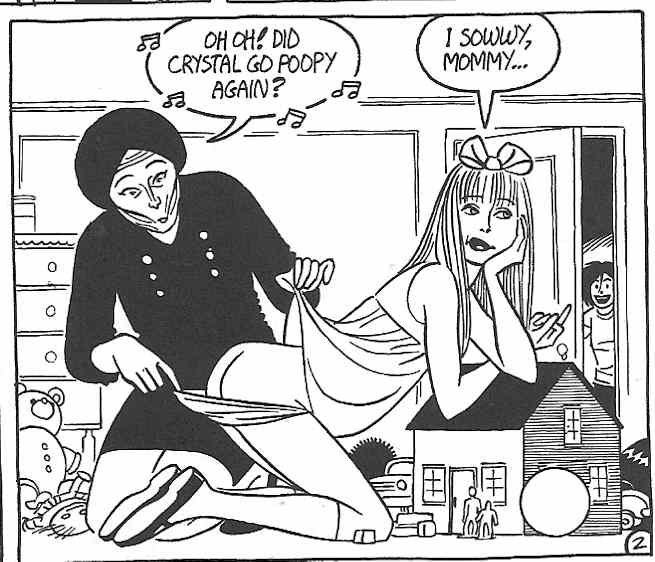
The TV moms’ fetishization of youth encapsulates a similar kind of “nostalgia” to the kind that Freud discusses, if somewhat in reverse. Nan nostalgically attempts to recapture her own youth, both as a young mother, and as a child, paying Crystal to “act out” the wholeness and unity of mother/child relations that are central to the Oedipal scenario (if, in Freud, usually from the point of view of the child). Given Nan’s vexed relationship with her own daughter (whom she competes with for Hopey’s affection), like Freud’s version of the fetish, Nan here is nostalgic for something that never existed. With Crystal, there is an ideal union with a daughter who will always be young and obedient (because paid to perform that role), as opposed to her real daughter who is now an adult and disgusted by her mother’s behavior. In fact, it is strongly implied that these women’s entire careers on television, as sit-com mothers, is already a replacement for their own failed relationships with their daughters, and the young women they hire serve as replacements for the replacements…second order fetishes that help them to convince themselves of the original’s existence (while also disavowing it).

Here, Jaime provides a broad satire and mockery of a nostalgia for innocence and childhood, which belies the notion that Locas itself represents a simplistic foray into such nostalgia. Instead, via the logic of fetishism, Locas suggests that any such nostalgia is a longing for an absence, whether it be the mother’s phallus which never existed, or a perfect mother/child relationship that can only be simulated in sit-coms or by hiring a child not one’s own.
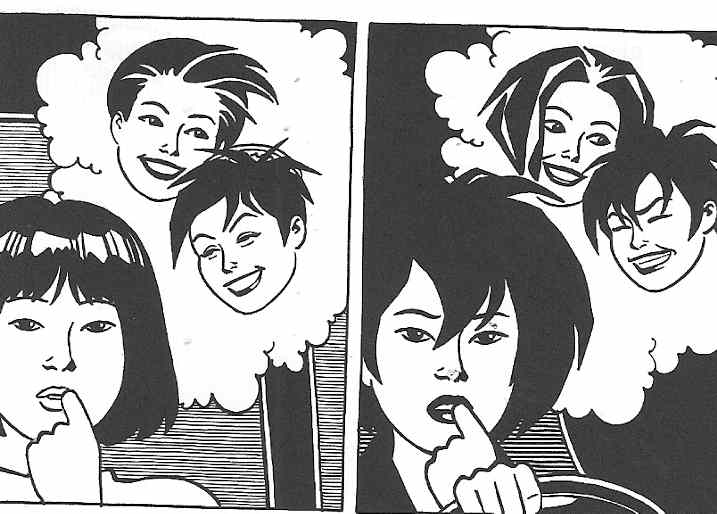
Nan Tucker’s nostalgia and desire for a perfect, originary moment of wholeness is not an isolated incident in Wigwam Bam, but is rather a synecdoche for its entire workings. As Douglas Wolk notes in his reading of WWB, perhaps the most clever formal trick deployed in its pages is the strategic absence of Locas’ most central character, Maggie Chascarillo (known also as “Perla” in the book in question). Apart from the first 14-page section of the 115 page graphic novel, Maggie does not appear in WWB and so the reader takes place in the grand search for her that is also enacted by its characters. In particular, Maggie’s childhood “punk” friends from Hoppers, spend the story looking for both Maggie and Hopey, who have traveled to New York (one in pursuit of the other). Izzy Ortiz, in particular, dealing with mental health issues of her own, becomes obsessed with the absence of Maggie and Hopey, cutting out the backs of milk cartons which picture Hopey in “Have You Seen Me” mode and taping them to her walls. Eventually, Izzy’s obsession with the missing Maggie and Hopey leads her to travel the country in search of the two friends, meeting up with a variety of Locas characters along the way.
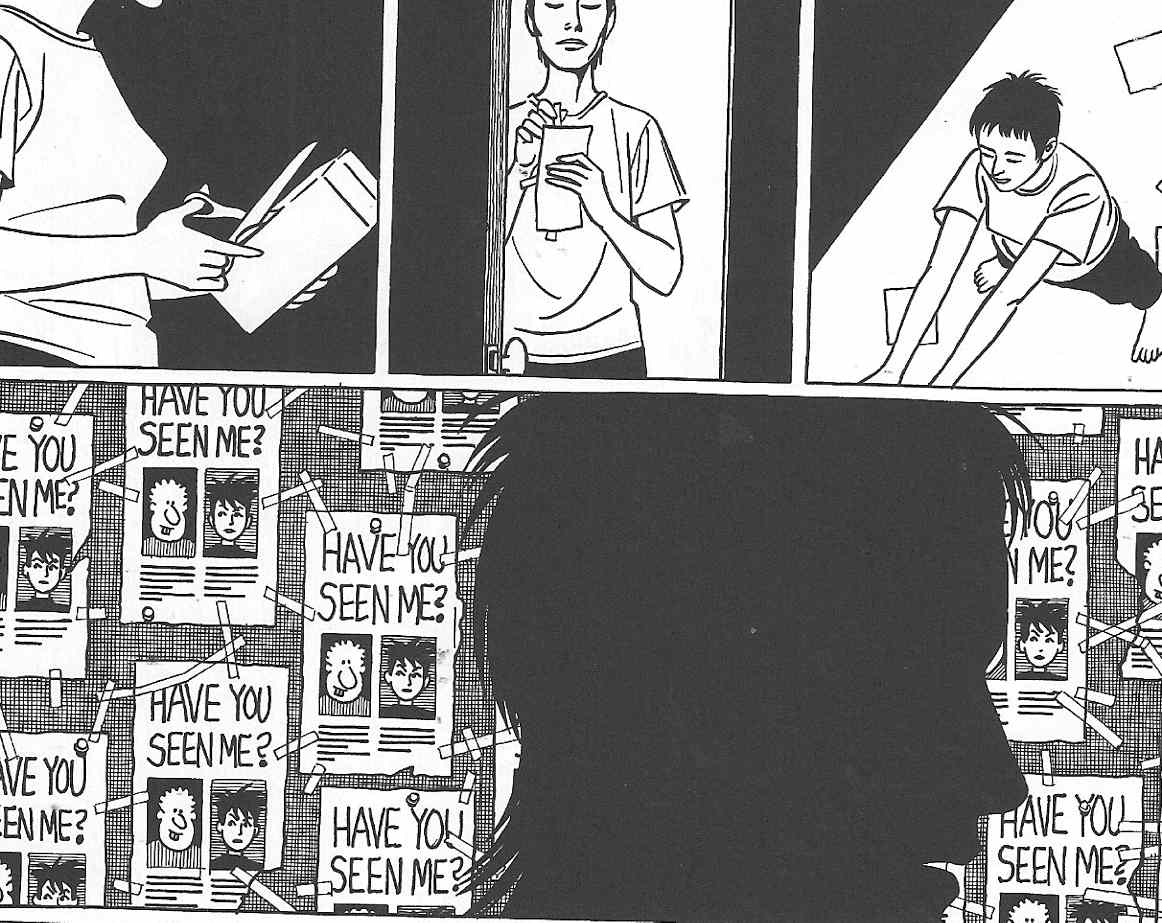
Here again, Izzy’s search is clearly an act of nostalgia. For Izzy (and Daffy, and their friends), the friendship (with benefits) of Maggie and Hopey represents a prelapsarian utopian paradise that is linked to the punk culture of which they were all a part. The punk community of their youth, or the women’s imagined vision of it, rejects dominant culture’s series of hierarchies and divisions, including those of race, gender, class, and sexuality. The punk community’s rejection of consumerist/corporate capitalism is well-established, but the concomitant image of an angry, loud, violent opposition is largely eschewed in Locas, in favor of an image of a community which is accepting, multi-racial, gender-equal, and open to non-heteronormative sexualities. Maggie and Hopey, in particular, represent both the rebelliousness of the Hoppers punks (particularly in Hopey’s case), but also its friendly, open, and forgiving face (particularly in Maggie’s case). Their lesbianism (or bisexuality) is open to interpretation but is never censured or rejected by their fellow punks, whether male or female (many of whom are also “queer.”) The blurring of gender divisions, and therefore heteronormativity, is, as discussed in Part I, part and parcel of a hearkening for the pre-Oedipal, a time before such divisions are known. The Maggie/Hopey relationship (or the memory of it) serves as a fetish for Izzy, who desperately tries to track them down and regain the utopian promise of Hoppers in its younger, punkier, days.
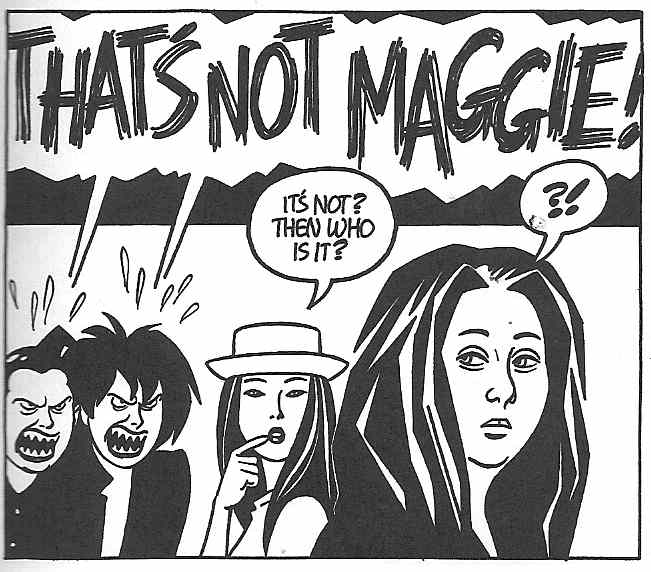
It should be no surprise, given these thematics, that among the individuals Izzy finds on her journey are both a Maggie lookalike (an explicit replacement) and a “phallic woman” from her own youth, a woman who has undergone a sex change to become a man. Likewise, it is not surprising that this “real” phallic woman fails to hold the attraction of the utopia Izzy has imagined. S/he is a failed replacement for Maggie/Hopey, just as Peter Rio’s strippers are failed replacements for his (phallic) mother.
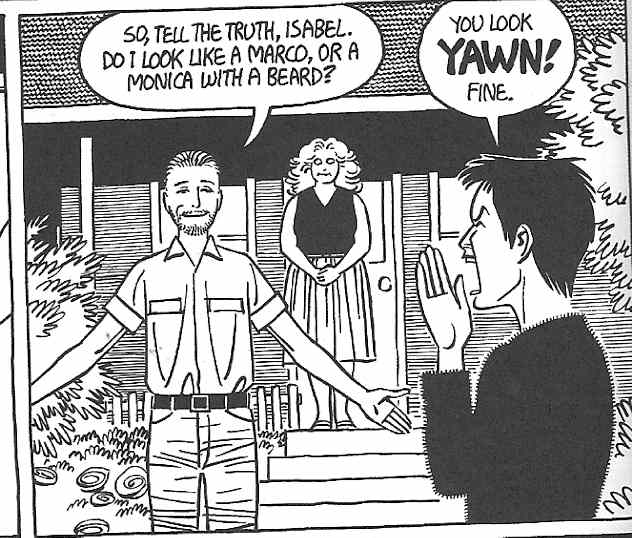
By the time Izzy finds Maggie and Hopey, of course, they are no longer “together” despite their earlier efforts to reunite. In fact, their brief blissful attempt to reignite their friendship and recover their youth is sabotaged by the racial difference that is rarely of explicit emphasis in the previous stories that take place in Hoppers. When Maggie is mocked at a party for being Mexican, she seeks solace in Hopey, who is less than sympathetic. When it becomes clear that Hopey, who is half Colombian, can “pass” for white, a racial divide opens between the two women that, perhaps, had previously existed, but which had gone unmentioned. Hopey’s casually homophobic reference to “art fags” (despite her own sexual orientation), further cements the ways in which the nostalgia for the “perfectly punk” Maggie/Hopey relationship is misplaced in “real world” New York, which, despite its cosmopolitanism, is rife with racism and homophobia.
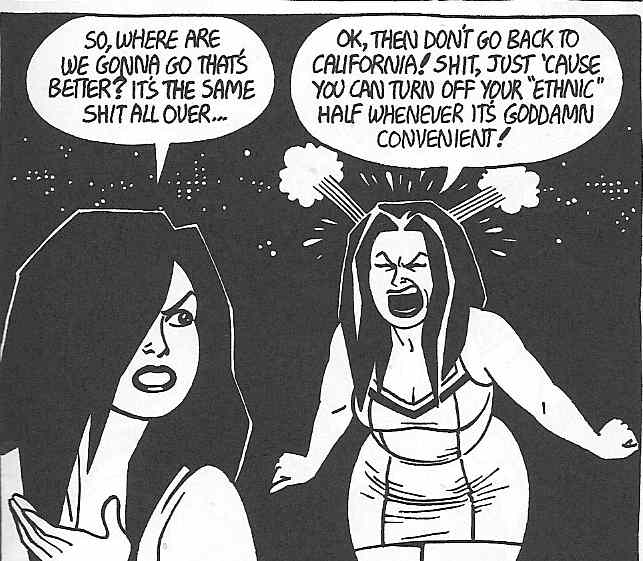
Indeed, later in the story, we learn that the Maggie/Hopey relationship is itself merely a replacement for, or copy of, Maggie’s first “punk” relationship, with her best friend Letty, who introduced her to punk music before dying in a car crash. In a telling diary entry, Maggie writes, “I hope Hopey never dies in a car crash. Lightning only strikes twice once, y’know” (115). Hopey is here explicitly framed as a “replacement” for Letty, a fetish which covers up an absence, while attempting to replace the “wholeness” of the Maggie/Letty relationship, though Maggie worries that the replacement itself cannot be replaced.
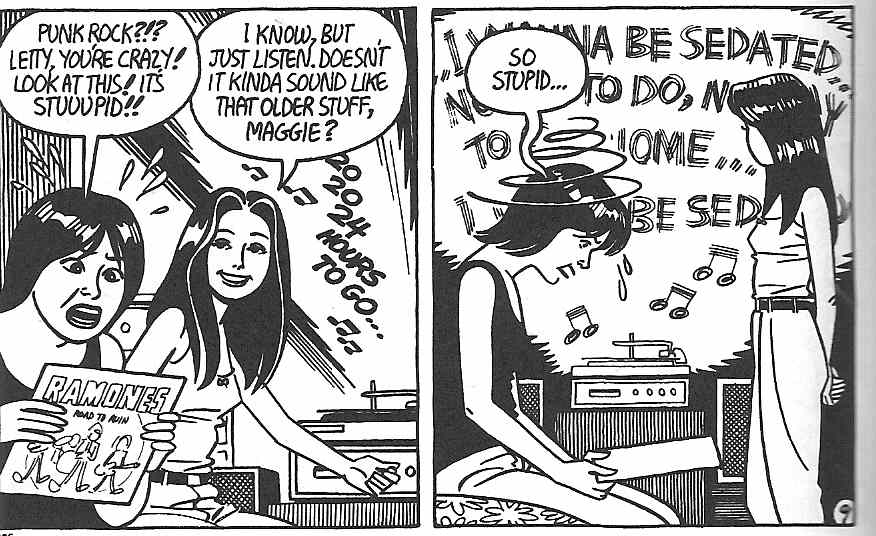
Within this context, Ray D, Maggie’s next serious relationship (one which “culminates” in the recent Love Bunglers arc), serves as a replacement for Hopey, who herself is a replacement for Letty. Within a Freudian logic, Letty can only be a replacement for the mother (or the mother’s phallus), and Maggie’s expulsion from the maternal family home to live with her Aunt Vicki in Hoppers as a youth might substantiate such a reading. At the same time, the important point here is that regardless of the idealization of the Maggie/Letty relationship, it is clear that such idealization is a mirage, a hope for something which, like the mother’s phallus, never existed to begin with. The Hopey/Maggie relationship is, after all, similarly idealized, but is revealed to have many cracks in its façade.

Similarly, Ray D.’s relationship with Danita Lincoln is characterized as a replacement for his earlier affair with Maggie. In particular, Danita’s confidence in the level of Ray’s commitment vacillates. She worries both that she is merely a “sex object” for Ray and that he cares not for her as an individual, but as a Maggie substitute, even going so far as imagining Ray in her own bed, cuddling with his ex-girlfriend. Danita’s fears about her own “fetishization” (her transformation into a sex object and Maggie replacement) is played out in multiple scenarios. She serves as a nude model for Ray’s drawing/painting and as a stripper at the local club, Bumpers. Her friend Rocky suggests that Ray sees her only as an object, when looking at Ray’s drawing, as if he were one of the members of the strip-club audience. At that moment, Danita, who had initially been flattered by Ray’s appreciation, begins to wonder to what degree she is just a body, filling the space recently left empty by her predecessor. Likewise, where she once saw her stripping as an empowering experience of agency, she now begins to see herself through the eyes of her audience, as one of a procession of naked bodies on a stage, objects which occupy the same space, replacing each other at regular intervals.
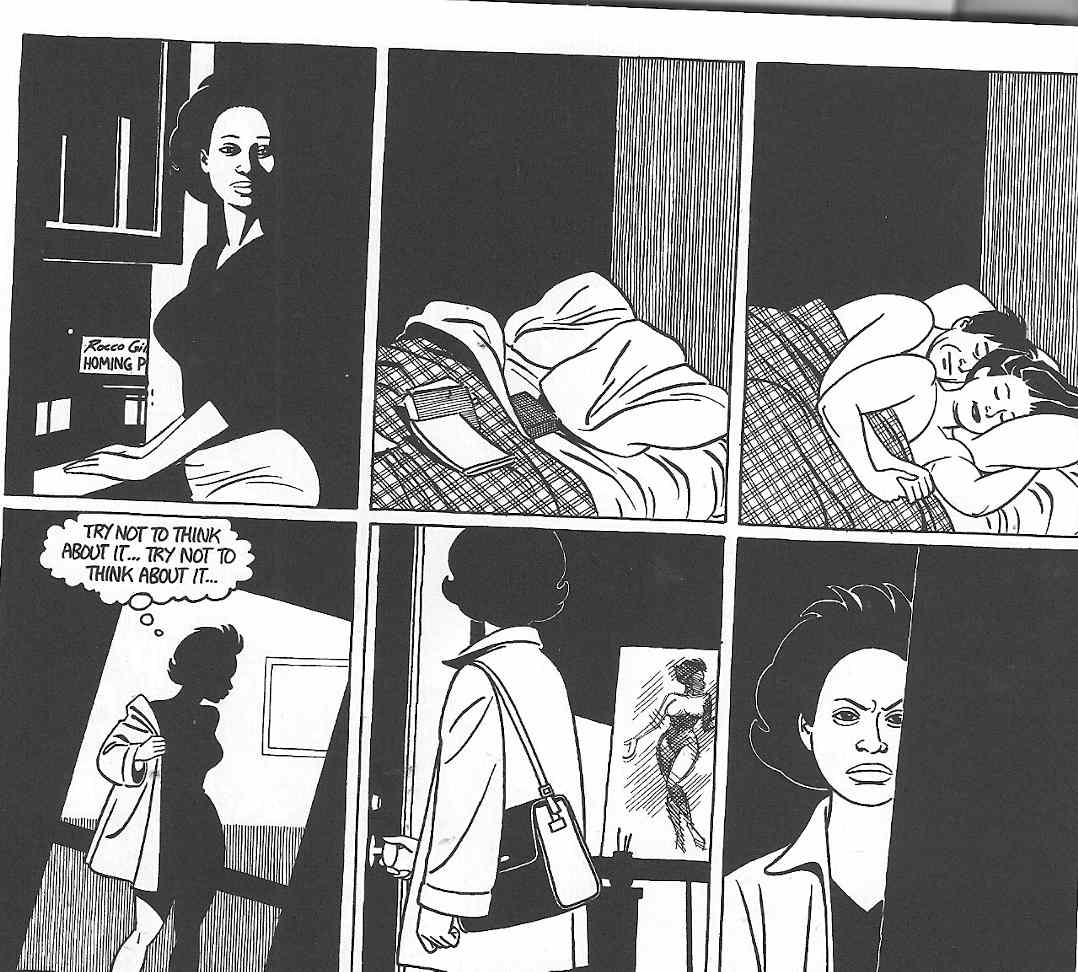
In this scene, Wigwam Bam examines itself as well. Ray too becomes a replacement of sorts, not only of Hopey in Maggie’s life, but also of someone “real,” Jaime Hernandez himself. When Rocky accuses Ray of objectifying Danita, it functions as Jaime Hernandez accusing himself of objectifying her, and his other female characters for good measure, for it is he who really draws naked pictures of women, both for his own pleasure and that of his mostly male audience. Again, as in the case of his brother, Gilbert, the fetishizing and objectification of women is here brought up against a moment of self-examination and an acknowledgment that from Danita’s point-of-view, she cannot merely be a body for the pleasure of the male gaze or a simple replacement for the superior/utopian relationship that preceded it, even if that relationship never really existed in its ideal form. Danita’s self-conscious worry is, indeed, a sign of her subjectivity. Her vulnerability and determination make her in some ways similar to Maggie, but far from identical to her. Her assertion of her own subjectivity is a tacit critique of the practice of fetishizing people, of transforming subjects into (replacement) objects for the purposes of sexual pleasure, and it comes as no surprise when she leaves Ray, a tacit rejection of her objectification at both his, and Jaime’s hands.

The encounter/conflict here between Danita-as-object/replacement/fetish and Danita-as-subject/original here sets up the ways in which WWB and its immediate sequels take things a step beyond the fetishism on display in Poison River. In Poison River, there is a focus on fetishism-as-utopian-fantasy and then disillusionment with that fantasy. That is, the fantasy of reunification with the phallic mother is revealed to be a fantasy and the book closes on a note of disillusionment where everything is corrupted, gender divisions are enforced, and a bloodbath ensues. In the Perla La Loca stories, simple disillusionment is not enough, however, and Jaime pushes the narrative forward into a more “realistic” engagement with utopian premises.

As Danita’s introspection suggests, while “fetishism” may, in some ways, envision a utopia wherein gender divisions, racial divisions, and divisions on the basis of sexual orientation do not obtain, they do so on the basis of a backward-looking fantasy to the pre-Oedipal. In such a fantasy, no individual in the present is fully acknowledged or accepted for their own sake, since they are always inevitably viewed as a replacement for someone else. As we have seen, Hopey functions as a replacement for Letty (and Ray for Hopey), while there are also a seemingly neverending series of Maggie replacements as well. In addition to Danita, Marcia/Marco, and the Maggie lookalike, we learn in “We Want the World and We Want It Bald,” for instance, that Hopey’s brother Joey’s girlfriend, Janet, is also a Maggie replacement, and plays a role in the sexual fantasies/fetishes that Joey inflicts upon her. In all of these cases, however, if one reads the stories “realistically,” as opposed to merely as an instantiation of Freudian theory, the danger arises of reading individuals as merely replacements for one another, as “fetish objects” as opposed to as autonomous subjects.
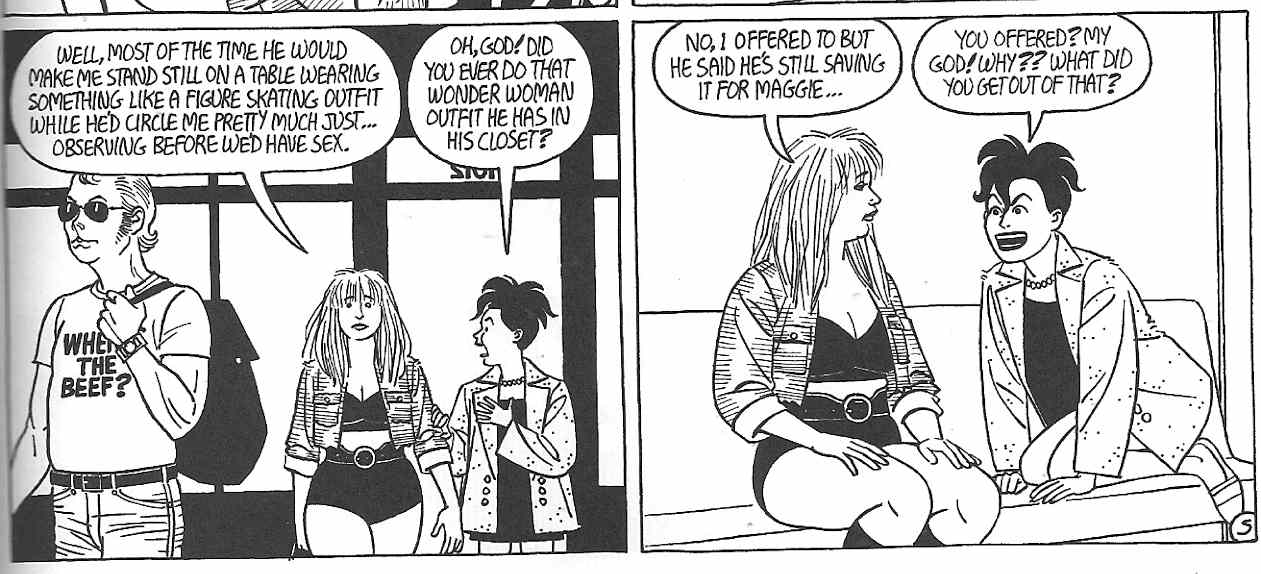
In fact, Jaime uses the pervasive theme of replacements and fetishes in order to probe and reject the tendency we all have to use people in our lives as “objects” for our own pleasure (fetish objects), as opposed to as subjects with autonomy. Danita may function as a replacement for Maggie for Ray (though this is somewhat questionable), but for herself she has autonomy. Likewise, Hopey wonders what Janet “gets out of” her fetishized relationship with Joey, when she seems to serve merely as a stand-in (again) for Maggie. Even Maggie herself is in danger of falling victim to a kind of objectification if we are content to view her simply as a “symbol” of phallic motherhood (a figure that remains an idealized symbol of wholeness, unity, innocence, and purity), and not as a complex, fallible individual.

This theme of objectification plays into Locas’ parallel exploration of the problems of capitalist culture to which punk is configured as an alternative. As Marx notes in The Communist Manifesto, capitalism reduces all relationships to “the money relation” (659), wherein individuals view other individuals not as human beings (subjects), but as a means to their own acquisition of wealth (objects), a weigh station on the way to the acquisition of capital. It is for this reason that Marx can articulate the existence in society of “commodity fetishism,” in which people put outsized importance upon specific commodities. If money is the only value in society, it should be no surprise that “pleasure” can only come from them. If one combines Freudian and Marxist logic, then, to fetishize a commodity (or object) is both to imagine a world wherein there are no divisions (and therefore no exploitations) and to value a world wherein those exploitations are inscribed upon the very object being fetishized. As a “replacement” for the phallic mother, the fetish object symbolizes a perfect “whole” world devoid of divisive qualities, while, as a commodity, it carries the trace and history of endemic class exploitation. The contradiction brings to our attention the limits of thinking through the logic of Freudian fetishism. While, symbolically, the “objectification/fetishism” may represent a challenge to the race, class, and gender divisions in a society, in social practice, to treat an individual as an object/fetish is to treat them, á la Kant, as a means to an end, as opposed to as an end in themselves.

All of this is clear in Danita’s rejection of her role as Maggie’s replacement, as well as in her eventual rejection of her role as a stripper. The stripper role is complex in the story, as Danita clearly feels like it gives her agency and power, but even though this is the case, it also positions her as the object of the male gaze, a position she is increasingly uncomfortable in occupying. In either case, however, it is interesting that, despite her role as the object of the gaze (as nude model for both Ray and the reader, and as stripper for both Bumpers and the reader), she never relinquishes her subjectivity, insisting that while she may be the object in the eyes of the “other,” she nevertheless remains a “subject” to herself.

Increasingly, the notion that all individuals are both subjects and objects becomes thematized in Locas, not merely for Danita, but for others as well. Maggie, in particular, occupies a similar position, when, in Chester Square she is turned into an accidental prostitute. Stranded without money and without means of transportation, Maggie twice “sells herself” sexually, becoming an “object” in the capitalist economy, and tacitly rejecting her role as symbol of the classless Marxist/punk utopia.

If punk culture rejects the ways in which the dominant culture puts everything up “for sale,” then it undoubtedly rejects the notions that individual subjects can be seen simply as “objects.” Prostitution, on the other hand, is, in many ways, the ultimate symbol for capitalism. In prostitution, almost literally, “everything is for sale,” as it is in capitalist society more generally. Despite the logic of the prostitution=capitalism analogy, however, Jaime rejects the most extreme of its ramifications in “Chester Square.”
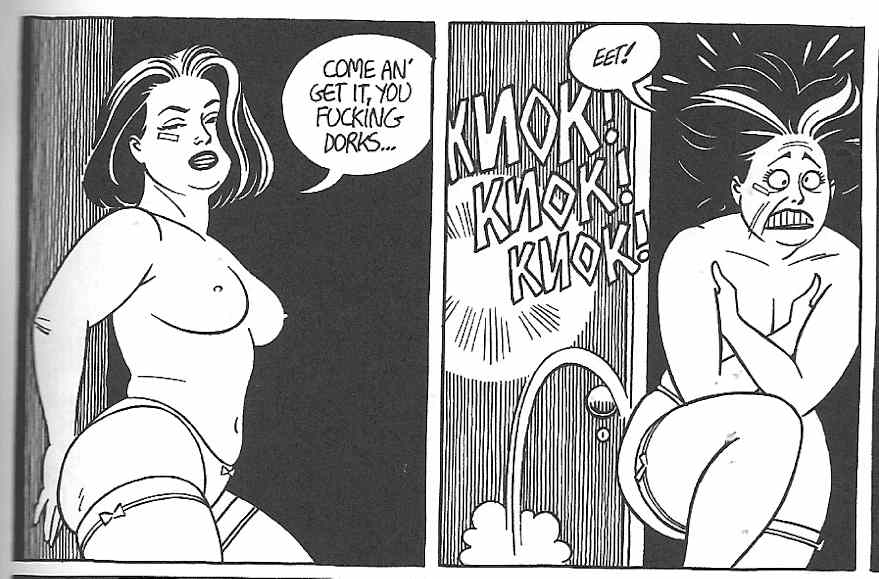
In the pair of panels pictured here, we see a clash of “Maggie as object” and “Maggie as subject.” In the first panel, she imagines herself as the prostitute she eventually (if momentarily) becomes, “posing” as a sex kitten who invites her own “use” by the men just outside the door. It’s clear though that this self-fetishization is simply a pose, or fantasy, when she is surprised by the knock at the door. Her humorously exaggerated response reveals other facets of her personality, beyond just as an object for sexual use. The juxtaposition of the two panels reveals two women juxtaposed, one of aggressive sexuality and the other of an exaggerated modesty. The fact that the two women are actually one at two different moments in time reveals a complex individual, who, when beyond closed doors, displays contradictory and complicated impulses.

Of course, Maggie is not, here, exactly “behind closed doors.” Rather, her naked body (like Danita’s) is on display for the reader, and in the first panel, she looks at us, inviting us to “use her” as we will sexually. The second panel, however, deflates the pornographic quality of the first, reminding us that behind every “objectified” woman is also a subject and behind every prostitute who is transformed into a commodity is a woman who may be embarrassed, humiliated, or even, simply, modest in her “real” life.

Maggie’s impulse toward subjectivity (again, like Danita’s) and her resistance to her own commodification, makes her reject the man, Enero, who in subsequent pages mistakes her for a prostitute, even though she was willing to sleep with him for free. Ironically, however, when she invites the security guard in for a sexual encounter that is not supposed to be a monetary transaction, he makes the same mistake, leaving her money on the nightstand. Though mortified, the money allows Maggie to escape the Square, taking a bus to her Aunt Vicki’s, where she eventually tells her friend Gina about the incident, noting that “I really didn’t feel bad about doing it. Like it was no big deal” (153). Though she eventually backtracks on this claim, calling herself a “whore…trollop, floozy, harlot, doxy, cocette, chippie” (153), it is clear that while Maggie (and the reader) might expect her commodification, or objectification, to rob her of her subjectivity, in fact, she leaves the encounter in much the same way that she entered into it, as a complex woman who is not defined by this single act. In fact, she only begins to see herself as a “whore” when she tells someone else about it, viewing herself not from the inside (as subject), but from the outside, through Gina’s eyes. Doing so allows Maggie to view herself as she initially views the prostitute, Ruby, who she is, for a time, mistaken for, not as a human being, but as a commodity.

The episode, then, like Danita’s posing and stripping, refuses a simple subject/object dichotomy, where there is an “original” subject of fantasy (the phallic mother), and a series of objects that replace her (fetishes). Instead, the replacements themselves are subjects, who may be objectified by society, or the individuals they interact with, but who cannot be reduced to such a function. Concomitantly, the book suggests that the ideals of acceptance of differences of race, gender, and sexual orientation are not proposed simply as symbols of a mythological or utopian punk past, but are instead cast forward as a goal for society that we must attempt to achieve in the present. When Maggie and Hopey reunite at the close of La Perla La Loca (or at the close of the original run of Love and Rockets), they do so only after they separate over issues of racial discrimination and homophobia. That is, if they are to move forward and reunite, they must overcome such differences, rather than “pretend they never happened” as fetishism (in Freud’s account) attempts to pretend that castration never occurred.

Again, this is explicitly emphasized in the closing pages of “Bob Richardson,” wherein Maggie has a dream/fantasy that Hopey never left her for the East Coast tour with her punk band which provides the impetus for much of the action of Wigwam Bam. Like the fantasy of the phallic mother, Maggie’s dream is a fantasy of wholeness and unity that predates all of the divisions that infect their relationship in the weeks, months, and years to come. Instead, however, Maggie “wakes up,” to be “slapped in the face” by all of the people she’s hurt in the interim (or whom she believes she has disappointed). She can only move forward, here, by rejecting her “dream” of a perfect past untainted by her own errors and those made by those around her.
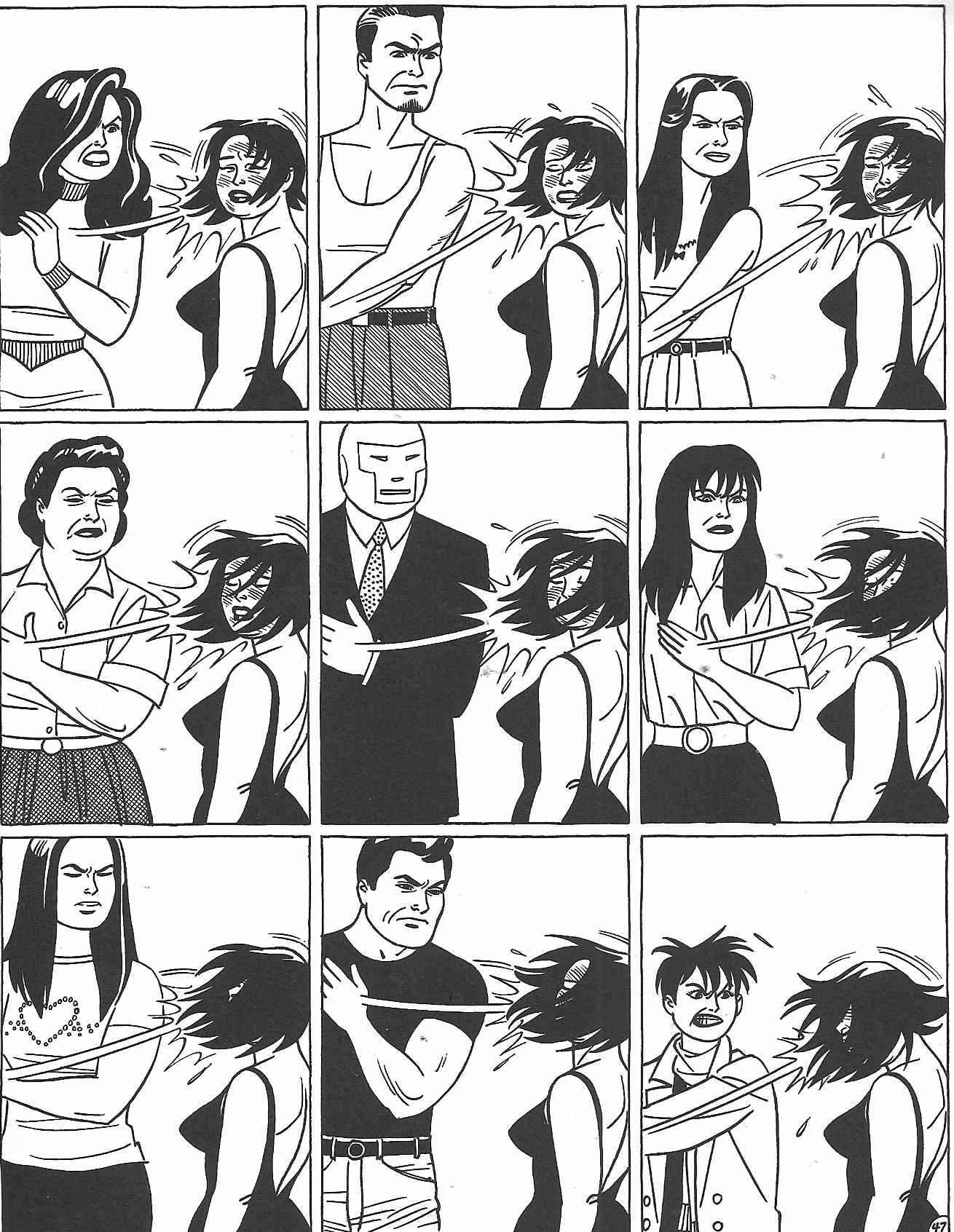
The rejection of fetishism-as-nostalgia is articulated clearly at the close of Wigwam Bam, wherein Nan Tucker hires thugs to brutally beat both Crystal and Hopey as a warning to cover up the beating (and possible death) of one of the other fetishized play-acting “babies.” There, a fixation on a supposedly utopian “childhood” is explicitly coded as “dangerous,” resulting in a rude awakening to the realities of a world wherein self-interest trumps all. Though Nan and the sit-com mothers fantasize about a perfect union with their fetish “children,” in the end such a fantasy cannot stand up to naked self-interest, as they are willing to sacrifice (and brutalize) the fantasy to protect themselves. Wigwam Bam is not, however, the end of the story, and the brutality of exploitation and cover-up we see there (and also in Poison River) tell only part of Jaime’s story.

In the aftermath of the disillusionment of Wigwam Bam, Maggie, Hopey and their surrounding cast of characters consistently reject the notion that “living in the now” must simply mean the objectification and commodification of others, and the abandonment of a more utopian community which, it turns out, was always a fantasy to begin with. Instead, they search for a way to love and accept others’ subjectivities even after the corruption and commodification endemic to capitalist society. Even after Maggie is commodified as a prostitute, she moves forward in an attempt to make a better world for herself and her friends. Likewise, when Maggie is arrested at the close of “Bob Richardson,” Hopey abandons her self-interest in order to join her in the police car. Similarly, when Gina intuits her friend Xo’s need to win a wrestling match, she chooses to throw the match to her, despite the fact that she knows she will not get the reward for doing so that she wishes (159). Perhaps most tellingly, despite the abuse she has sustained at her hands, Maggie seeks out the regular Chester Square prostitute, Ruby, in order to make amends and to treat Ruby as a human being: a subject, not an object, despite her profession.
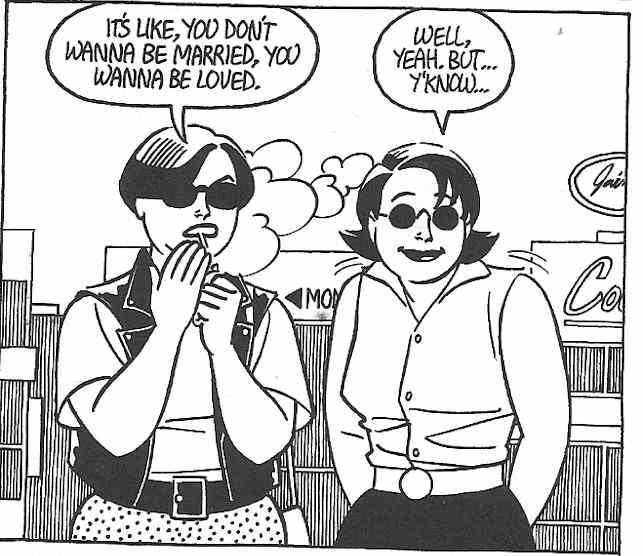
As Ruby herself articulates, then, the ultimate goal of the “love” of Love and Rockets is then a “love” of mutuality, openness, and intersubjectivity in the present, and in the real world, not a nostalgia for a utopian past that never existed in the first place. While there is certainly the notion in Locas that our present world is one of exploitation and objectification, there is also offered the possibility that even within that world, we need not see others merely as “means” for our own ends. When Hopey and Gina sacrifice themselves for the good of their friends, we are, perhaps, free to read those actions as self-interested, but it perhaps makes more sense to seem them as acts of love. Maggie’s variably successful efforts to make amends for her past behavior in the closing pages of “Bob Richardson,” both with Ruby and others, similarly indicates the importance of looking forward, not back.

Continually, then, as several of the other entries in the roundtable make clear, Jaime revisits the past in the ongoing Locas serial not to revisit a sentimentally idealized ür-time but to expose the ways in which the past was never like that. As in the Freudian account of fetishism, the phallic mother never existed, and so our attempts to return to her, or to an idealized past, are merely a series of self-deceptions. The recent storyline of Browntown, in particular, serves to remind us that the past is not a place free of exploitation, division, and oppression and is therefore not something to be nostalgic for, or to fetishize. Rather, as Jaime’s characters age inexorably along with us, we are reminded that if we want such a place to exist, we must work for it in the present, and hope for it in the future.
_____________
The Locas roundtable index is here.
_____________

More Works Cited
Hernandez, Jaime. La Perla La Loca. Seattle, Wa: Fantagraphics Books, 2007.

Marx, Karl and Friedrick Engels. “From The Communist Manifesto.” 1848, 1888. The Norton
Anthology of Theory and Criticism, Second Edition. Eds. Vincent Leitch, et. al. New York: W. W. Norton, Inc., 2001, 2010. 657-660.