Adding Incompetence to Insult

This originally appeared on Comixology.
______________

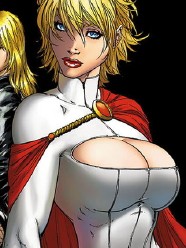
I’ve been following the When Fangirls Attack linkblog (Update: sadly largely defunct now.) recently. Among other things, it’s a good way to find out what moronic cheesecake schlock the big two have served up this week. I think there have been at least three prime slices of said cheesecake since I’ve been following the blog with some regularity, namely:
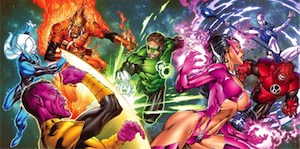

Cover of Blackest Night.
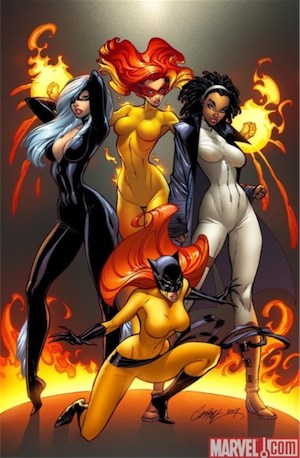


Cover of Marvel Divas
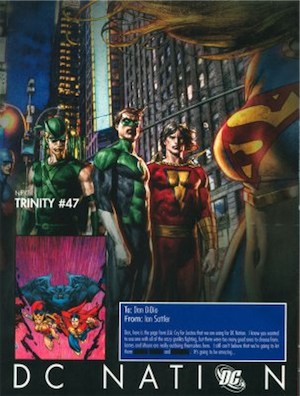


JLA: Cry for Justice

And, what the hell, here’s a blast from the past or two as well.


The thing is, I have no problem with cheesecake. I even like cheesecake. Anita the Swedish Nymphet? Japanese Vogue? Michael Manning’s fetish porn? Sure; I vote for all of those. Or for the classic pin-up art of Dan DeCarlo:
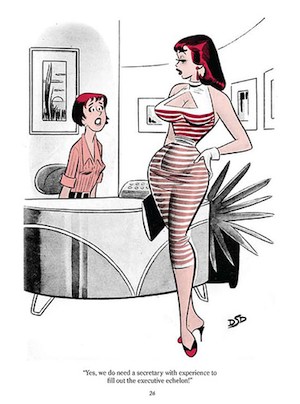
 
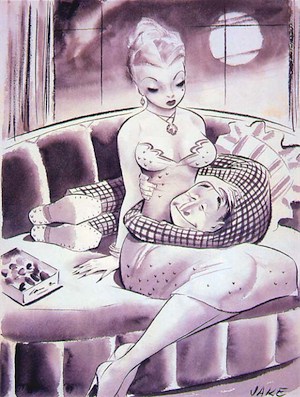
Or Jack Cole:


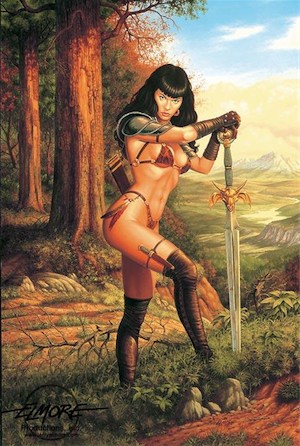
Or even Larry Elmore’s trashy fantasy illustration:


Yet, despite my general appreciation for the form (in various senses), I find super-heroine cheesecake irritating and often borderline offensive. Why is that?

I think there are a couple of reasons. In the first place, super-heroines are, you know, heroes. They’re supposed to have stuff to do, crime to fight, justice to uphold, and so forth. For Dan DeCarlo and Jack Cole, the woman are just there to stare at; they’re hot, hot hot. That’s the whole raison d’etre; there’s no effort to pretend that you care what these women think, or how they act, or whether they defeat the villain without falling out of their tops and being exposed to the vastness of space.

I guess there’s a school of thought which would argue that turning women into objects like this is bad. And (despite the strong demurral of a couple of my lesbian friends) I do think there’s something to that. But, on the other hand, if you’re going to have pictures of sexy women, and the pictures of sexy women are why you’re there, maybe it makes more sense to just admit that, and not disingenuously pretend that you’re interested in what’s going on in their heads. If you make it simply about visual stimulation, it’s simply about visual stimulation, and doesn’t have to have anything to do (or at least, not much to do) with real women. Once you start pretending that you’re talking about a smart, motivated, principled adventurer, on the other hand, you end up implying that said smart, motivated, principled, adventurer has an uncontrollable compulsion to dress like a space-tart on crack. Which is, it seems to me, insulting.

The second thing is that, if you must make your adventurer into a fetish object, it seems like the least you could do is make her tough. That outfit that Larry Elmore’s fantasy warrior is wearing above is clearly ridiculous, and not a whole lot more practical than Star Sapphire’s get-up. But, at the same time, Elmore’s warrior looks badass. She’s got a giant sword and she looks thoroughly pissed off. She’d cheerfully castrate you without a second thought. And that’s the way to go: if you’re going to do action-hero cheesecake, then bring on the masochism: get off both on how hot the action hero is, and on how thoroughly she can beat you black and blue. It’s feministsploitation; not feminism exactly, but a fetishization of feminism, and it makes some sense at least to the degree that the fetish clothing and the putative power of the character are coherently working together, both in that the power makes the character more sexy and in that that the clothing adds (not necessarily logically, but still) to the sense of the character’s potency.

This sometimes works for super-heroine cheesecake too (Frank Miller’s Catwoman is an example). But more often, you get images like those above, where Star Sapphire’s costume makes her look vulnerable, not tough…or the Marvel Divas cover, where everybody but Hellcat is making with the bedroom eyes, and the only threat is that Black Cat’s costume may pinch so tightly that she actually pops apart at the waist, causing everything from the torso up to go swooshing about like a deflating balloon.

Which brings us to the last and perhaps most important point. Super-heroine cheesecake is often offensive just because it’s so thoroughly incompetent. Star Sapphire’s costume, for example, goes right past sexy and on into ludicrous. For the Marvel Divas cover, the artist couldn’t even come up with more than one body type – and he can’t even draw the one he’s got. As I already intimated, Black Cat’s top and bottom look horribly mismatched; similarly, Hellcat seems to have borrowed her breasts from Giant Girl. All of them look like toys, not people. And that Justice League cover starring Supergirl’s chest…why would you even do that? How is it sexy to have a disembodied bosom flapping about your foreground? And as if that’s not bad enough, as Katie Moody says in comments on the Beat; the artist seems to have accidentally left out our heroine’s ribcage. Or maybe it’s deliberate; did Supergirl lose her skeletal structure during one of the post-Crisis reboots? I must admit I haven’t been following the continuity that closely….

In any case, the point is, you look at drawings by DeCarlo or Jack Cole or yes, even Larry Elmore and they get the proportions minimally right (Elmore’s barbarian’s breasts are big, but not that big); they select flattering clothes (DeCarlo’s dress with its va-va-voom horizontal stripes); they take the time to figure out fluid poses (Cole’s sophisticated lady arranged in classic curves upon the couch.) In short, the artists seem to care about women enough to have looked at one or two of them at some point.

Not that I’d argue that good art can’t be sexist; craft and talent aren’t everything, or even necessarily all that much, in these matters. But they are something. Even if you’re pandering, doing a professional job of it implies a certain minimal level of respect not only towards your audience, but towards your subject as well. You look at super-heroine cheesecake, and you get a sense of a boys’ locker-room cluelessness so intense that it is indistinguishable from disdain. Honest sensuality in these circumstances would be a relief. Sexism may be bad, but incompetent sexism is just intolerable.
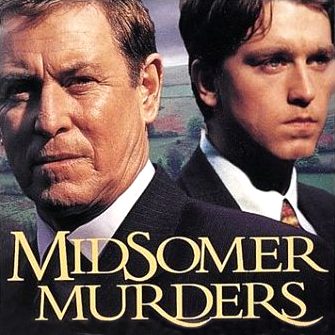
Who knew cottage gardens were such dangerous places? Midsomer Murders

So I’ve spent most of January and February plagued with some kind of….plague.  It’s horrible, but it does mean I get to catch up on all the TV I’ve missed in the past couple decades.  I blew through New Tricks earlier, then I watched Murder in Suburbia (not bad, really, and I liked Ash, though I usually guessed who dunnit in the first ten minutes) and then, for reasons known only to itself, Netflix suggested I might like a garden gnome musical and I had to have a soothing lie down*.

When I came back, I was armed with another friend’s suggestion: Midsomer Murders.  Supposed to be the best acting evah.  Which actually it really kind of is.  John Nettles, who plays the lead detective, can do more with his eyebrow than most actors can do when chewing the scenery and screaming.

The basic premise of the show is this: DCI Tom Barnaby is a police detective in Midsomer, a pretend county in England that’s filled with picturesque but extremely violent villages.  Barnaby always has a sergeant or factotum.  In the early series, it’s Sergeant Troy, a handsome young man with even fewer brains than Barnaby.  I quite like Troy, even if he is rather homophobic and kind of a jerk at times, he’s very kind and has a good heart.  Troy eventually grows up to be his own detective and after five or so years, we get another sergeant, Dan Scott, who is a city-slicker lower-class modern-thinking twatwaffle.  Er.  Not that I dislike him or anything.  Fortunately, Scott is eventually replaced by a much nicer, quite brilliant extremely kind, canny, and earnest Ben Jones, who started as a beat cop and got drafted by Barnaby.

So a crime will happen and then Barnaby will show up with his assistant and begin detecting.  In between detecting (and sometimes during), we’ll occasionally get glimpses of Barnaby’s wife, Joyce, and adult daughter, Cully.  Joyce is a gourmand who can’t cook and has a passionate love of acting and art.  She’s got a kind heart and often is volunteering in various causes to save the world.  Cully is an actress, but she has a bit more of her dad’s practical streak.

The charm of this show is in the setting and characters, the absurd cottage cozy murder plots, and in the fine wordplay.  This is not a show to watch if you’re looking for realism in your motivations and villainy.  It’s not about that.  It’s also not about accurate police procedures–during most shows, Barnaby shows up to talk to important witnesses, who nearly always are:

  • Conveniently called away on the phone, by a visitor or relative, or realize they’re late for an appointment.  If I was the copper, I’d say, “Look, this is murder.  You can be late to the annual orchid grower society meeting.  Answer my questions fully or I’ll haul you to the nick.”  Barnaby nearly always lets them go, and they’re often killed before their next appointment with him.
  • Extremely shifty, to even the most oblivious eye.  “What were you doing on Tuesday the thirteenth at 7 pm?” Suspect’s eyes dart around the room, “At home.  Alone.  Watching telly.”  Does Barnaby ever ask what they were watching, to see if he can catch them in a lie?  No, he does not.
  • Basically barking mad.  (Practically everyone on the show is.)  “I couldn’t have been murdering anyone!  I was preparing for the annual bell-ringing competition and nothing can get in the way of that!”
  • Standing in their living rooms, in pub common rooms, or in the center of a church aisle, surrounded by other interested listeners.  It’s not unusual for him to question several people, in a group, at the same time.  “What were you doing on Tuesday the thirteenth at 7 pm?” he’ll ask the husband.  “We were watching telly together.  We had a quiet night in, didn’t we, dear?” says the wife.   And her husband will nod.  Even though the wife was out shagging the vicar and the husband was practicing skeet shooting.  Or murdering someone.  Only at the end of the show does Barnaby ever notice that this might not be the Best Interrogation Technique Evah. And since he asks the questions in public places, there’s always convenient eavesdroppers who can tattle to the village gossip or the local murderous fiend.  Or who are the local murderous fiend.

It doesn’t do great things for Barnaby’s detecting, but it does up the body count, which is part of the fun.

Most of these shows have a pile of corpses at the end.  A murderer will thwap someone to death with a shovel over a thousand year blood feud and then have to kill six other people to cover it up.  Nobody’s ever a serial killer, although there are occasionally people who suffer fits of hereditary madness which drives them to various Foul Deeds.

So I’ve burbled on about how silly the detecting is, but let me give a glimpse of the charm of the show (because honestly, it does have plenty of charm!).

So as not to spoil lots and lots of episodes, we’ll start with the pilot, which should give everyone a decent feel of the show.  It begins with two aged spinsters who compete to see who can find a Super Special Sekrit Orchid (I told you-flowers are dangerous!) in the local woods.  Whichever one of them discovers the orchid proves it by marking it with a stake and then taking a photograph.  Spinster One, whose name I have already forgotten, bicycles out to the woods with her basket and camera and special stakes.  While out there, she finds the orchid, and while photographing it, discovers something shocking.

She races home, slams the door, makes two short phonecalls, and then dies.  Suspiciously.  Her friend and neighbor, Spinster Two, tells DCI Barnaby that it couldn’t have been an accident and that it was murder.  Dun, dun, dun.

So Barnaby heads off to investigate.

There’s a local landowner who’s marrying his ward, a batty sister-in-law, the ward’s troubled artist brother, and the undertaker and his mother.  The undertaker is My Very Favorite.  He dresses like a Victorian gentleman, right down to a coat with tails and a little black ribbon in his hair, and he serves deeply troubling tea cakes on a very fancy cart.  He’s gay as a spring morning and he and his mother have been blackmailing the entire village.

Of course, this eventually gets them brutally slaughtered, but since they show up looking exactly the same in another village ten seasons later, I’ve decided that they were sneaky enough to fake their own deaths and escape.  According to the show, it’s just that they’re cousins or something, but I know Deep In My Heart that they survive.

Ahem.

So anyway.

There’s quite a few different suspects.  The sister-in-law of the local lord, who thinks she shot her own sister with a rifle during some kind of pidgeon slaughtering party.  The local ineffectual country doctor whose wife is having an affair with the local lord’s estate manager (and he’s very pretty–I can see why she strayed).  The straying wife, who is worried about being caught.  The daughter of the doctor who is having a fling with the mad artist (who always wears a truly tragic pair of denim overalls and chews the scenery like he got a degree in emo artist.)  The waif like ward.  The waif like ward’s artist brother.  And some other people, who I forget.

While Barnaby wanders around interviewing people, you get to see lots of gorgeous scenery and cottage gardens and English shooting parties and quiet country lanes.  Barnaby does have a very thoughtful mien and a quiet way about him.  I suspect that dogs would curl up happily at his feet–good stillness.  Troy, the current sergeant, is like a young overexhuberant bull, brashing his way through undergrowth and making rash assumptions about whodunnit and generally being kind of a homophobic jerk.

Much of the mystery, as many of the mysteries in this show are, is concerned with who was having naughty fun times in the woods on a blanket with whom.

As soon as I’d figured out that this was the big mystery, I suggested to my mom that obviously it was the brother and sister, because the whole show had a Greek/Shakespearean tragedy feel to it, and what better tragedy than random incest?

And so it proved.

Barnaby eventually figures it all out by contacting the now-adult childrens’ nanny and things are revealed and the wedding gets called off and the two young lovers commit suicide in the wood via shotgun. You know, as people do.

There’s some clever clues, phone calls, obscure words, etc. in the grand tradition of cozies everywhere.  I’ve lost track of the number of times people get shot to death with arrows in Midsomer county, but it’s a lot.  There’s psychics and witchcraft, the second sight, new age weirdos, writers’ societies, art fraud, retellings of Hamlet, shoutouts to Dorothy Sayers, poisoning by mushroom, hemlock, and various other dodgy substances, as well as a couple of deaths via pitchfork.  Not to mention those being driven to suicide, mistaken identities, Meaningful Messages With Flowers on corpses, and so on.  There’s a great episode where the local theater troup puts on Amadeus and the plot of the play and the retelling of the mystery weave together–it includes a truly horrible guy committing accidental suicide via razor on stage during the dress rehearsal.

Tiny intense hobbies take up peoples’ worlds, as they do in real life, and those often form the basis of the plot.  Villains are just as likely to kill over who was prouder of their rose bushes as they are to get an inheritance.  Small town dances, choir rehearsal, bell ringing, book groups, local history library photo retrospectives, fly fishing, magic tricks, Masonic societies (including the silly aprons), and more.

If you’re tired of watching ultra-realistic grim urban crime about the destruction of society that reminds you too much of yesterday, give this a try.  My favorite so far is probably the revenge plot where the villain stakes a guy in a croquet circle and then catapaults the oenophile to death with vintage wines using a small siege engine (Season 8, Episode 6).

These are currently streaming on Netflix or Amazon Prime.


* Someone here suggested I continue What The Hell Did I Just Watch into a regular feature.  Maybe Netflix thought so, too.  If you all feel the need for a garden gnome musical review, I’ll take it under advisement, but I may also need suitable bribes.  Liquor.  Brownies.  Exotic drawing ink.  A large wall against which to thwap my head until the images leave it.  You know.  The usual.

The Horrors of Broadcast Television

This is a continuation of my post on “found footage” horror.

——————–

The River is a fascinating show. Not fascinating in the sense of being well-written, or suspenseful, or really any good at all. Rather, it’s fascinating because of how thoroughly shitty it is. Despite high production values and experienced producers, The River sucks at everything. It’s a rare accomplishment, even by the low standards of broadcast television.

Created by Oren Peli (Paranormal Activity), The River is a horror series about Lincoln Cole (Joe Anderson) and his mother, Tess (Leslie Hope), who are searching for Lincoln’s long-lost father, the famed explorer Dr. Emmett Cole (Bruce Greenwood). Emmett disappeared several years ago in the Amazon rainforest. The expedition is funded by TV producer Clark Quitely (Paul Blackthorne), who offers to provide a boat and a crew, but only if he gets to film everything that happens. So Lincoln and Tess become the stars of a reality TV series, along with a tidy group of stock characters. There’s the cute love interest for Lincoln, the ethnic engineer and his daughter, the evil mercenary, the sassy black cameraman, and the nerdy, Jewish cameraman. After leaving the Amazon River to float down an uncharted tributary, the group is soon beset by ghosts, magic, and sundry evil things.

What sets The River apart from other horror series is the found footage concept. Every shot comes from either the (in-story) cameramen or the stationary cameras mounted around the boat. Presumably, the footage somehow made it back to the U.S., where the suits at ABC broke it down into hour long chunks (with commercial breaks!) before airing it. It’s a silly premise, but no sillier than any haunted house or slasher movie. It’s a decent enough idea for delivering cheap thrills each week. But a decent idea doesn’t amount to much when the execution is garbage.

The first problem is the cast, or really the lack thereof. As any slasher fan knows, horror stories need big casts to kill off. And a horror TV series needs either a very large cast or plenty of guest stars to bump off, otherwise the story cannot generate any suspense. The audience instinctively knows that the core characters are not going to die early in the series, because if they died the story couldn’t go on. But The River has barely half-a-dozen characters, and with such a small cast it must conserve every character like they’re water in the desert. So only one person has died after three episodes (the Jewish cameraman of course, as he was just too Woody Allen-ish to survive in the jungle).

The horror is further undermined by the hokey family drama that passes for a sub-plot. Did Tess leave Emmett or did Emmett leave Tess? Was Tess having an affair with the sleazy TV producer? Will Lincoln ever forgive his dad? Does anyone care about this shit? Of course not! I don’t care about these characters and I don’t want to care about these characters. This is supposed to be terror in the Amazon, not Days of Our General Hospital.

At least with the producer of Paranormal Activity at the helm, The River should be a technically flawless example of found footage horror. I say “should,” because it’s actually a terrible example of the genre. As I discussed in the previous post, found footage copies the shaky camerawork, the crappy angles, and bad lighting of amateur video, which makes it easier for the audience to suspend disbelief and buy into the lie that the footage is real. The River occasionally uses these techniques, but then it ruins everything when it switches to perfect angles and soft lighting for those oh-so-dramatic moments. And the actors, despite being in the rainforest, always look clean and pretty. My disbelief is not suspended, because the show is too slick for its own good.

And then there’s the censorship. I understand that this is broadcast television, which is regulated by the FCC. I understand that a good portion of the American public is deeply offended by the female nipple and the word “fuck.” And I understand that it must be frustrating at times to work for a lousy network like ABC. But there’s something far more pathetic than a show where no one ever curses. It’s a show where characters regularly curse but the profanity is carefully bleeped out (even the mouths are shaded, just in a case an easily offended lip-reader is watching). Excuse my French, but what the fuck are they trying to prove? Presumably, they want the audience to believe that the characters are real and speak just like normal, foul-mouthed Americans. But the censorship wrecks the found footage conceit. The whole point of found footage is that it’s supposed to look like someone found a camcorder lying in a gutter. The content is raw and uncensored, creating the illusion of reality. As for The River, the only plausible assumption is that ABC “discovered” the video recordings of an expedition that encountered real magic, ghosts and other crazy shit. And naturally the suits at ABC bleeped out the profanity before sharing this earth-shattering footage with the public, because they’re insane.

Can anyone name a decent horror series on the broadcast networks? I loved The X-Files when I was a kid, but that was a long time ago, and many of the episodes have not aged well. Perhaps broadcast television – with its censorship and commercial breaks – is simply not a suitable medium for the content and storytelling techniques of the horror genre.

Can the Subaltern Draw?: Reframing Caste in Indian Graphic Novels

I have not yet been to India. Unlike Belgium, China, or Egypt — who’s respective comics’ scenes I feel comfortable writing about at length predominately because I’ve lived in those places with the time afforded to trace how the Ninth Art relates to their national histories — I am coming at the Indian landscape of comics with little more than the information provided by Internet strangers. I also know a paltry amount about the socio-economic issues historical and currently facing Indian people (save what is to be learned from a New Yorker article or two). To recap: I know who Nehru was the and the jackets he wore, I understand the concept of caste, I enjoy the writing of Amartya Sen, I’ve watched Krrish, and I weirdly had dinner with Salman Rushdie one time. As one might imagine, this admittedly makes me a very poor candidate to write at length about Indian Comics and history with any sort of authoritative voice. However, my lack of India credentials does make me the ideal candidate to consume the graphic novels recently released by New Delhi based publisher Navayana.

Navayana — translation: “New Vehicle” — was founded by S. Anand and Ravikumar with the explicit interest of being, “India’s first and only publishing house to exclusively focus on the issue of caste from an anticaste perspective.”  To that measure they have released an impressively diverse catalogue of books since 2003 addressing the issues of caste in India through critical essays, poetry collections, nonfiction novels, and, most recently, graphic novels. Today I will look at the two politically charged English-language graphic novels Navayana has published in the last year under the creative direction of S. Anand: Bhimayana (2011) and A Gardener in the Wasteland (2012). In particular, their relative successes at addressing issues of caste dating back to the 18th century for a global comics audience in the 21st century.

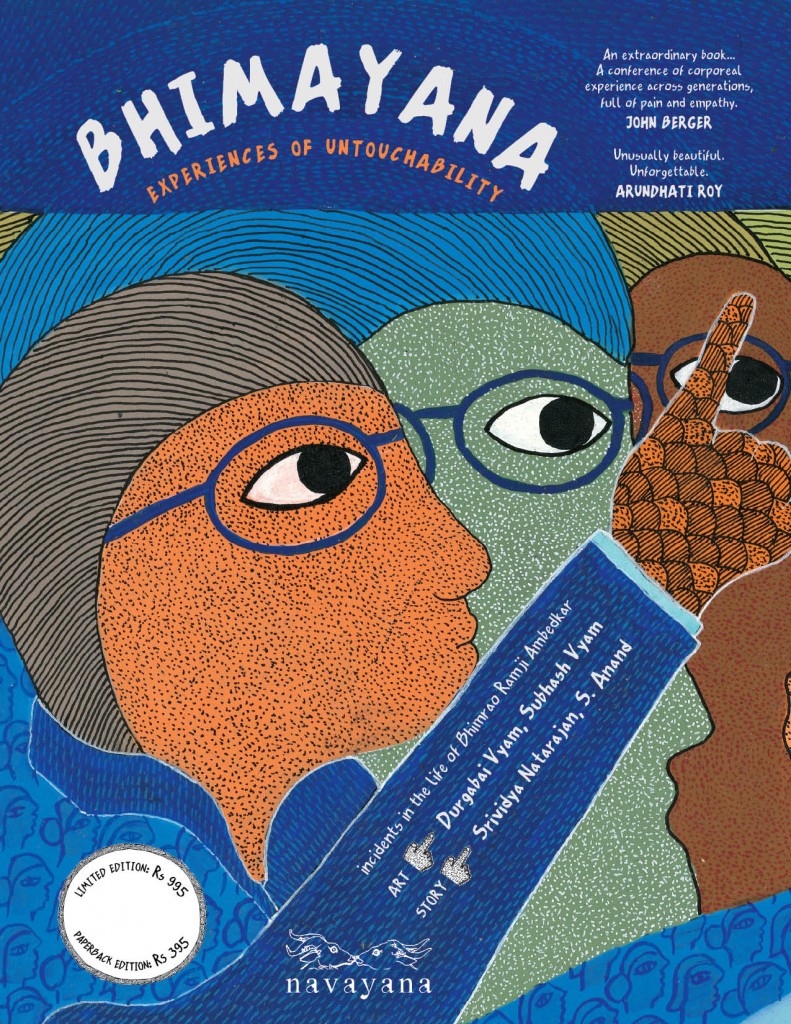
Before readers get into the innards of Bhimayana: Incidents in the life of Bhimrao Ramji Ambedkar, they must first process a helping of expectations-building praise from an impressive cadre of writers. Scattered along the jacket sleeve are pull quotes from John Berger (who also pens a fawning Forward), Arundhati Roy, and Joe Sacco. “Extraordinary” writes Berger, “Unusually beautiful” writes Roy, “Distinctive” writes Sacco, and from the flip of the first page these accolades have a context that makes sense. The story itself, as the title indicates, weaves together snapshots from the life of Bhimrao Ramji Ambedkar (1891-1956) — one of India’s fiercest opponents of the caste system who is best known for crafting the language of India’s human rights constitution. Bhimayana assumes the reader has no knowledge of Ambedkar at the onset and proceeds to provide an education of the events that shaped his life and how he in turn shaped the lives of many in India.

Born as a Dalit (the lowest of castes known as untouchables), Ambedkar faced a great deal of hardship in his youth before a generous Maharaja Sayaji Rao-sponsored fellowship afforded him the opportunity to study abroad at Columbia University and the London School of Economics. After returning to India with a Western education (problematic, I know!), Ambedkar devoted his life to an anticaste agenda which he realized through impassioned speeches, books, law briefs, a controversial series of debates with Ghandi, and a latter day conversion to Buddhism. But while the particulars of Ambedkar’s story are as inspirational as any other of his few civil rights leader contemporaries, they are not what makes Bhimayana ground-breaking. In most hands a story like this could come out as a boring and by-the-numbers graphic biography, but thankfully those are not the hands of married artists’ Durgabai Vyam and Subhash Vyam, who bring Ambedkar’s story to graphic novel.


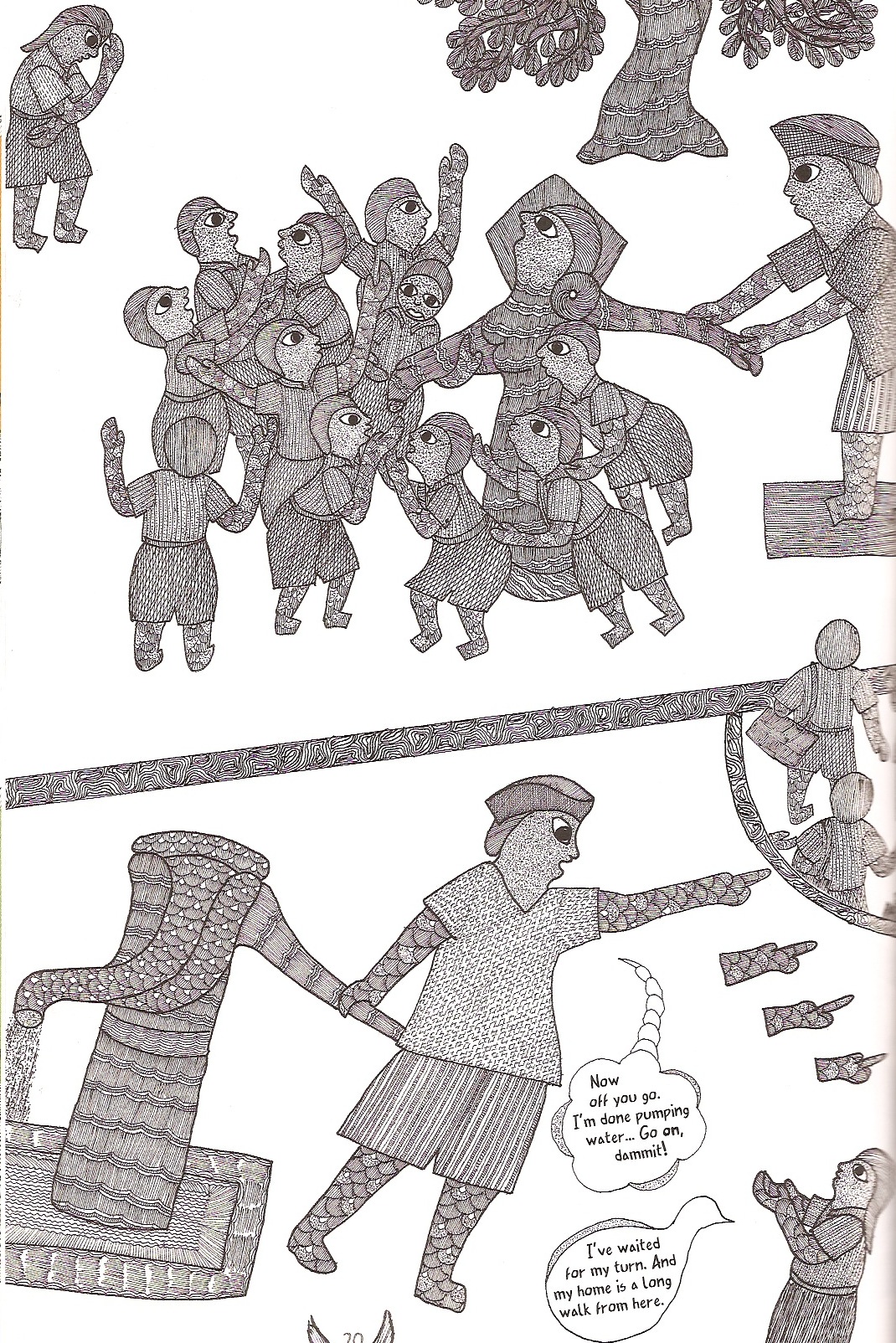
A young Ambedkar is denied the right to water as an untouchable.

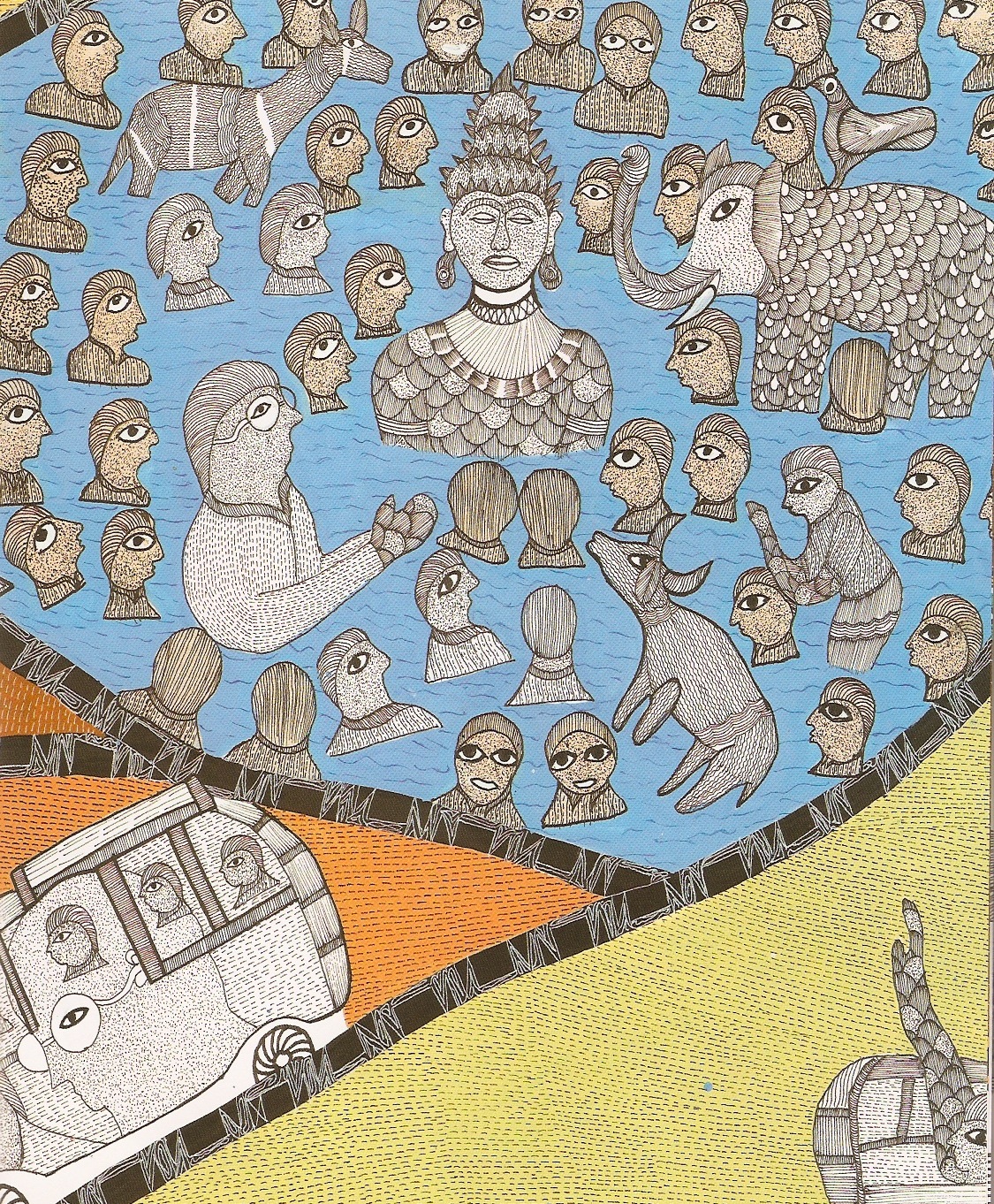
In a beautifully abstract way, the Vyams take a story scripted by S. Anand and Srividya Natarajan and strip it of many signifiers of Western sequential art through their own heavily detailed illustrations. For example, Ambedkar (the only constant character between vignettes) rather awesomely does not appear in a consistently drawn way throughout the book. As S. Anand recounts in Bhimayana‘s afterward — actually its “Digna” — while he dutifully provided the Vyams with a primer on graphic novel luminaries ranging from Eisner to Spiegelman to Tezuka to Satrapi, they rejected these influences: “We’d like to state one thing very clear from the outset. We shall not force our characters into boxes. It stifles them. We prefer to mount our work in open spaces. Our art is khulia (open) where there’s space for all to breathe” (p. 100). The result of this determined openness is a narrative that weaves different moments from Ambedkar’s life in a loose chronological order and produces a collection of pages that function both as a “graphic novel” and a distilled showcase of Pardhan Gond art.

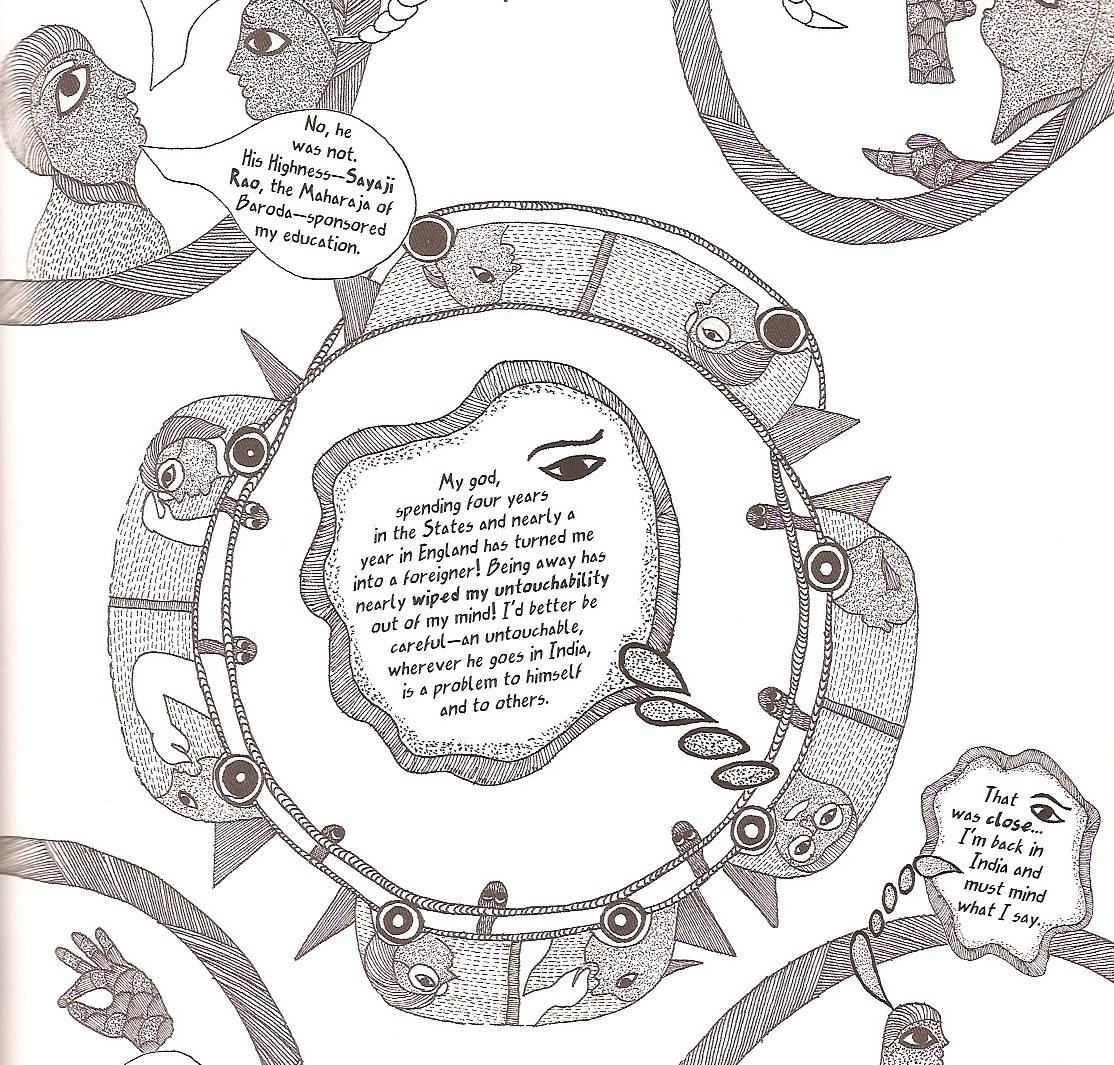
An example of how the Vvyams abstract notions like travel (this scene is of a re-caste affirming train conversation Ambedkar has after returning to India from the England) into a single page which serves as both a Pardhan Gond art painting and a narrative sequence.

While the larger Gond tribe of central India has a centuries long heritage of oral story telling, the Vyams are members of a more recent subset clan of artists called the Pardhan Gonds. The Pardhan Gond bards were formed in the early-1980s as artists that were dedicated to transmitting older Gond ritual performances into narrative visual art using everything from silkscreen prints to acrylic paintings to detailed ink drawings. Therefore, the most ingenious part of Bhimayana is Navayana’s idea to pair two talented Pardhan Gond artists — who were already creating a distinct form of “sequential art” — with the globally buzz-worthy format of “graphic novel”; effectively repackaging the forgotten and overshadowed legacy of a civil rights leader in India into something worth tweeting about. Case in point: I, resident of California, didn’t know who Ambedkar was before reading Bhimayana, and I surely wouldn’t have heard of Bhimayana if it weren’t a comic. And let’s say I had been curious enough to skim a biography of Ambedkar on Wikipedia, that medium wouldn’t have provided me with the ample space to connect with India particular issues like Ambedkar’s conversion to Buddhism through powerful artwork:

The clever conceit behind Bhimayana is a striking example of how Navayana lives up to its name of being a “new vehicle” for old ideas. Put differently, the book makes critically talking about caste sexy in the way that social justice topics rarely are. The salience of framing an issue for a global audience is one that Ambedkar himself seems to have understood very well throughout his struggle to challenge the caste system. After a 1923 decision by the Bombay Legislative Council to allow untouchables to use all public resources as basic as education and water — services that Ambedkar had been denied growing up as a Dalit — he gave a speech asserting the inalienable rights known in the Dalit movement as the “Declaration of Independence”:

“If we seek for another meeting in the past to equal this, we shall have to go to the history of France: the revolutionary French National Assembly convened in 1789 that set new principles for the organization of society. … People forget that if the rulers of France had not been treacherous to the Assembly, if the upper classes had resisted it, it would have had no need to use violence in the work of the revolution. We say to our opponent too: Please do not oppose us. Put away the orthodox scriptures. Follow justice.”

Just as Ambedkar frames an Indian human rights struggle in the context of a recognizable Western one, Navayana’s editor-in-chief S. Anand seems to understand the value in reframing intellectual human rights arguments in the medium of comic art. In this way S. Anand is like the protagonist of the story he wrote: using universal signifiers to address an India-specific issue. This point dredges up a deeper favorite question of mine: who exactly is the intended audience of Bhimayana? As with some of its more relatively famous contemporaries (par example Persepolis) reading Bhimayana can bring up a lingering fear that the book is seeking “First World” readers to make money from “Third World” problems. Ultimately, this line of questioning doesn’t hold enough weight against the beautiful education that Bhimayana provides to non-Indian readers like myself. Although, it should be noted that a similar thought might have been pondered by Navayana, who announced ahead of their 2012 Angoulême appearance that Bhimayana will see new editions in five Indian languages later this year.

This brings us to A Gardener in the Wasteland (2012), Navayana’s most recent stab at providing a forum for anticaste ideology in the world of comics. A Gardener digs back even further into the history of anticaste reformers to tell the story of Jotiba Phule (1827-1890) and his wife Savitri Phule (1831-1897). The Phules were fierce critics of caste-based exploitation by brahman’s (the highest caste in the Hindu system) under British rule and lifelong campaigners for women’s education in India who opened the countries’ first school for girls in 1948. A Gardener is written by Canadian-based Srividya Natarajan and is drawn by New Delhi-based artist Aparajita Ninan, with the text itself based predominately on Jotiba Phule’s 1873 work Slavery. Impressively, the female transglobal team bring Phule’s 1873 writing to life in a way that feels like a product that is relevant in 2012.

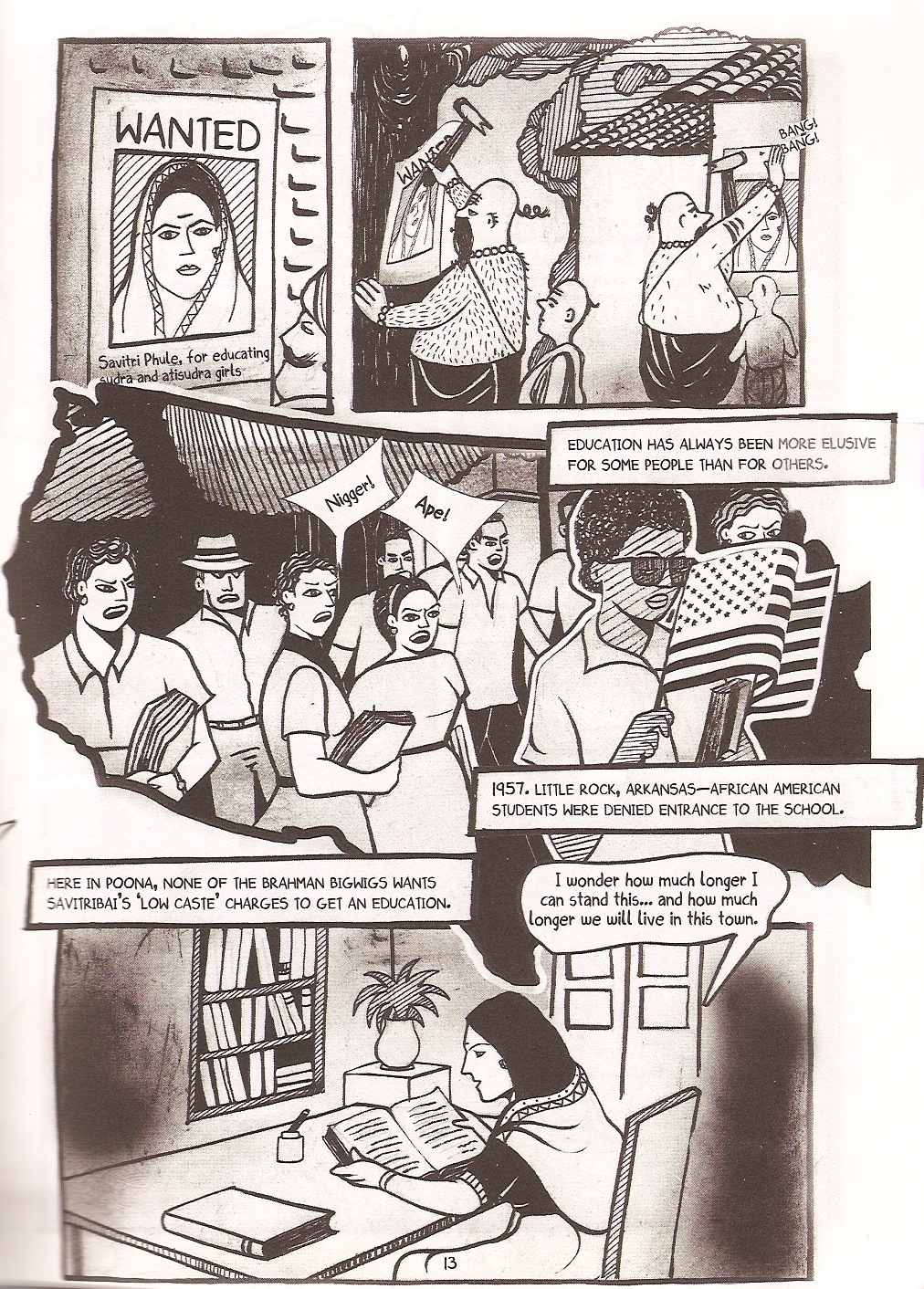
Throughout the book Natarajan and Ninan engage in the same sort of re-framing that is prevalent in Bhimayana, this time building on Phule’s comparisons of archaic notions of Caste hierarchy to slavery in the United States. Where Phule saw the way the brahman’s exploit those in lower castes as akin to slavery, Natarajan and Ninan extend the metaphor to compare the lives of the Phule’s to those of U.S. civil rights leaders. For example, the hardships Savitri Phule endures trying to educate women is met with an echo panel of segregation in the the South, in effect tying the histories of oppression to one another:

While the American history shorthand gets the point across efficiently, it is when re-framing moments like this that Natarajan and Ninan hinder their otherwise strong debut. At several points A Gardener in the Wasteland produces comparisons that feel overly heavy-handed, instead of letting the fascinating tale of the Phule’s fight against an established hierarchy subtly speak for itself. While it is easy to understand why the creators felt the need to draw somber parallels when telling such a reverential story, those parallels leave the book overly stuffed with asides that weaken the narrative flow for the benefit of readers like me. Put differently, I rather feel lost in the world of an artists’ imagination and grapple to find meaning than be spoon fed educational antidotes from my own frame of reference.


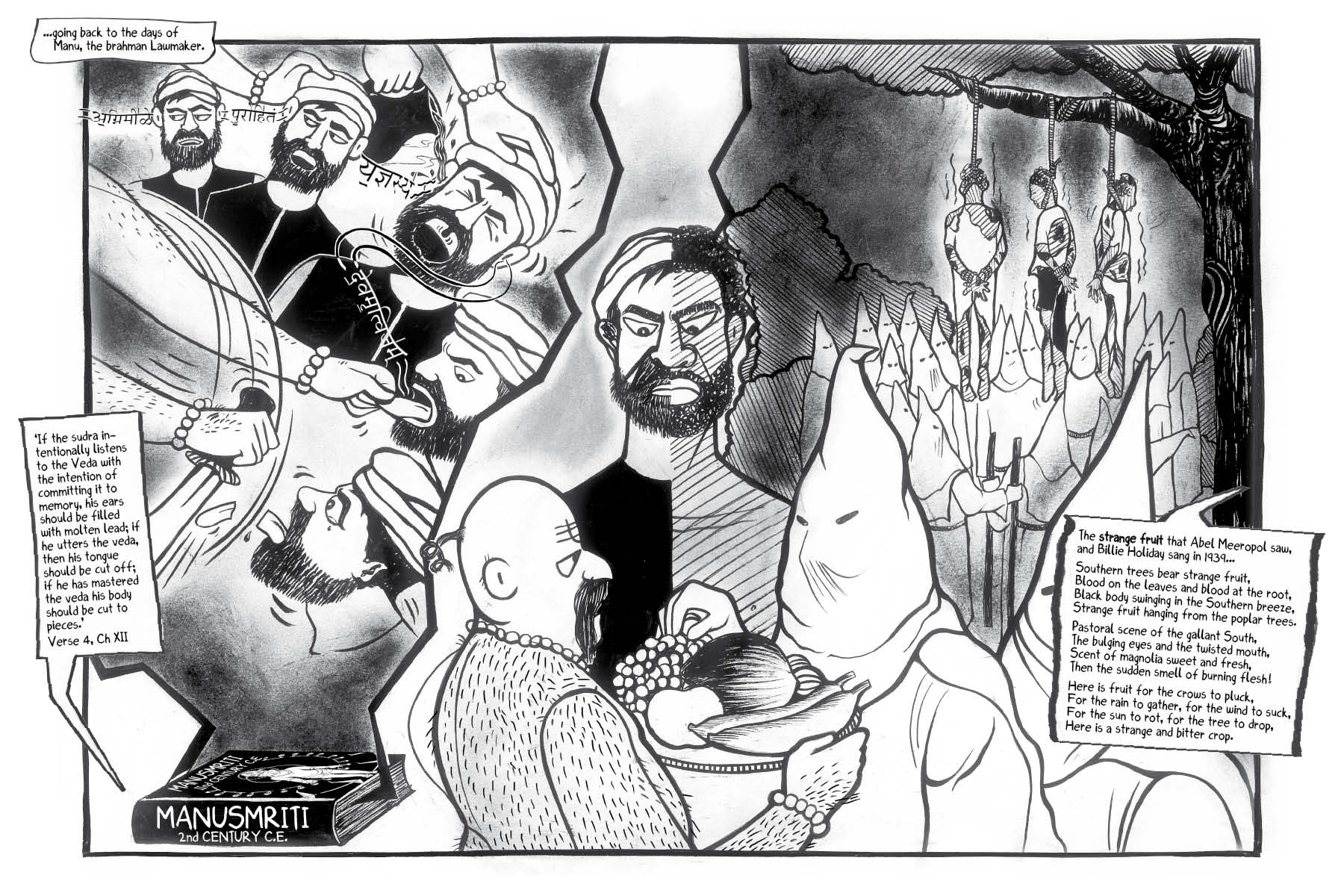
A spread which compares brahman lawmakers to the Klu Klux Klan

If A Gardener in the Wasteland feels like a mediated success, it is predominately mediated by the innovation on display in Bhimayana. While Bhimayana uses artwork to interpret a narrative loosely, A Gardener often skews towards using its strong art for straightforward exposition. The moments where A Gardener succeeds at becoming a “new vehicle” are when it forgoes panels and Westward analogies in favor of the cleverness found in the pages of Phule’s anticaste arguments. The best example of how A Gardener takes a risk with content to produce something unique is an extended midsection which walks readers through a socratic discussion between Jotiba Phule and his friend where Phule challenges many of the assumptions on which the brahman base their caste based view. In what has become the lynchpin of the book’s marketing campaign, A Gardener illustrates an argument that has Brahma (the father of the brahmans) menstruating out of his mouth. It is in the moments like this where Ninan is having clear fun with her art that make Phule’s 19th Century argument feel 21st century compatible.

The success of both of Navayana’s graphic novels is recasting biography of anticaste leaders as intriguing graphic novel. Bhimayana and A Gardener work towards this goal from different starting points, but they both end up as strong debuts in the global comics landscape. For a long-form comic to balance entertainment, technical skill, and Theory is not easy, which makes it somewhat remarkable that out of the gate Navayana has two comics that pull of such an act. Bhimayana and A Gardener in the Wasteland are worth receiving the spotlight not just because they are Indian, but because they are good.

Navayana books can be purchased from Scholars Without Borders.

Garth Ennis: Anti-Messiah, or just a very naughty boy?

At first glance, Garth Ennis’ writing on Preacher appears to be edgy and heterodox, at least for a Direct Market comic from DC. And not just in the superficial stuff that makes for a ‘Mature Readers’ label –swearing, ultraviolence, loyal canine sidekicks. No, it appears to be edgy – at least for its cultural context and intended readership – at a deeper level of content and theme. The Catholic Church is portrayed as venal and corrupt. There’s a savagely funny send-up of the idea of a messianic bloodline, as made famous in The Holy Blood and the Holy Grail (and even more famous in The Da Vinci Code).

Oh, and God is a narcissistic, selfish prick.

So, yeah, Preacher seems to be pretty ‘far out’. But a closer look reveals that Ennis’ morals are, in fact, deeply conventional. At its heart, the book is a sort of love story, and an effectively sweet one at that. And Ennis endorses in Preacher the same old-fashioned kind of masculinity that he valorises throughout most of his work, represented here with only a moderate dose of irony by John Wayne. A man, Ennis as much as out and tells us, should be strong, self-sufficient and upstanding. He should treat his lady right, do good by his friends, keep his word, and look after them critters what can’t look after themselves.

Excuse me while I ride off into the sunset.

There’s nothing wrong per se with this kind of conventionality, I think. Stated thus baldly, the book’s morality is prima facie unobjectionable.* And the book itself is easily my own favourite among the long-running series published by Vertigo.

(Suck it, Sandman and The Invisibles! And seriously don’t even bother, Y and Fables)

What is worrying, however, about Preacher — and it’s another theme that runs throughout Ennis’ work — is its conventional, even reactionary, sexual morality. Time and again, Ennis reveals that he is fundamentally uncomfortable about any sexual activity outside a very limited range. Time and again, he attributes to his villains sexual proclivities outside this range. Time and again, he uses sexual perversion as a shorthand for moral perversion.

Consider: the book’s secondary villain Herr Starr, who wants to give Margaret Thatcher a golden shower, and can eventually only reach sexual satisfaction through liberal application of a strap-on.

Or: Jesus DeSade, whose unbridled hedonism leads to pedophilia.

Or: T.C., whose unconstrained libido matches his moral and intellectual savagery.

Or: Miss Oatlash, the dominatrix and Nazi apologist. ZOMG! The uptight professional woman is secretly into BDSM – smile, you’ve just been Shyamalanned!

Or: Odin Quincannon, the evil businessman who…well, no, I won’t spoil that gag for those who haven’t read the book.

Or:

[CASSIDY SPOILER!!}


That the depths of Cassidy’s decline are marked when he’s coerced into giving his drug dealer a blowjob.


[END CASSIDY SPOILER!]

By contrast, there are only three occasions when the main good guys – viz. protagonist Jesse Custer and girlfriend Tulip ’Hare – engage in anything remotely kinky. First (chronologically at least — it occurs in a flashback), Jesse idly considers asking Tulip and her best friend Amy to join him in a threesome. He decides against it, not wanting to jeopardise his relationship with either of them—incidentally, this could well be the smartest thing Jesse does in the whole series.

Second, Tulip handcuffs Jesse to a bed, leading the poor sap to think that they’re going to get their kink on. But no such luck; it’s just revenge for one of Jesse’s misdeeds. Tulip just leaves him there while she goes out drinking with Amy.

Finally there is some suggestion, later in the series, that Jesse and Tulip do eventually use the handcuffs in the manner intended, viz. very mildly kinky sexual practices. So even when the good guys do get down and dirty, it’s about as vanilla as you could imagine.

Now, to be fair, Ennis rarely presents any of the villains’ sexual deviancies as evil in themselves (with the obvious exception of DeSade’s pedophilia). Their perversions are funny, not wicked. We’re supposed to laugh, not boo. And Ennis is under no obligation to proselytize for sexual adventurism.

But Preacher does deliberately set out to undermine some central parts of Christian morality — in particular the value of faith, and the doctrine that God deserves our worship. So it’s a bit of a let-down to find that Ennis’ views on sexuality are barely more liberal than that famous neologism, Rick ‘man-on-dog’ Santorum. And it’s even worse that Ennis perpetuates the myth that only bad guys like to get kinky.

Preacher may be a good comic but, when it comes to sexuality, it brings to mind what Homer Simpson once said about the bible: talk about a preachy book!


* but maybe not, uh, seconda facie. A while back, someone called ‘moose n squirrel’ accused Ennis of fascism, in a comment thread at Tim O’Neill’s whenwillthehurtingstop.blogspot.com. (Because I, evidently, suck and am stupid, I can’t find the post or comment now) Among the evidence was the fact that Ennis almost always presents weakness as contemptible, meriting either scorn or ridicule or both, while the good guys are almost always adept at chewing bubblegum and kicking ass. But it’s for good, of course, not for evil, so that’s A-OK. I find this a persuasive reading of Ennis, in Preacher as much as anywhere else. Those who favour a more charitable interpretation carry a heavy burden of proof, or so it seems to me at any rate.

Not that fascism would necessarily invalidate Ennis’ work, even if it is there. I like all kinds of comics with dubious ideological contents: e.g. Dave Sim, Harold Gray, Raymond ‘boo hoo nuclear holocaust somebody call a waaambulance’ Briggs etc.

The Flaw in Watchmen

In his post last week, James Romberger argued that the “offensive flaw” of Watchmen is its suggestion that a woman could forgive, and even love, her rapist.

Sally kissing the photo of the late Blake amplifies the flat note in what is otherwise one of the most carefully and sensitively composed comics ever done. In a medium predominantly directed to males, an often overtly misogynistic form oblivious to the consequences of sexual violence, this rare realistic depiction of rape in comics comes to represent a offense a woman could forgive, that she even might even come to love her rapist.

James is certainly correct that the trope of woman-falling-for-her-rapist — the conversion rape — is a standard of misogyny. As I’ve noted before, the ur-conversion rape is probably the notorious scene in Goldfinger where James Bond overpowers Pussy Galore and fucks her. Afterwards, Pussy Galore abandons her lesbianism and betrays her boss, risking her life and the lives of her whole lesbian posse for the love of Bond’s magic penis.

what’s especially offensive about this whole scenario is the extent to which Ms. Galore is so completely beside the point. The rape and transformation is never about her; in fact, we don’t ever get a sense of her as a character except that she’s tough and independent, and then, suddenly, not so much. She falls for Bond because he’s just so darn overwhelmingly attractive, and she abandons her (never quite stated) lesbianism as if she were doffing a hat. There’s no actual psychological progression attempted; it’s just, insert phallus, hello enlightenment. The whole point of the encounter is, in fact, to annihilate her as a character; in entering her, Bond replaces her will with his own, and she becomes simply his catspaw. It’s the crudest kind of male power fantasy, and one which is more than a little pitiable, suggesting as it does a desire to fuck a mannequin, rather than a real person.

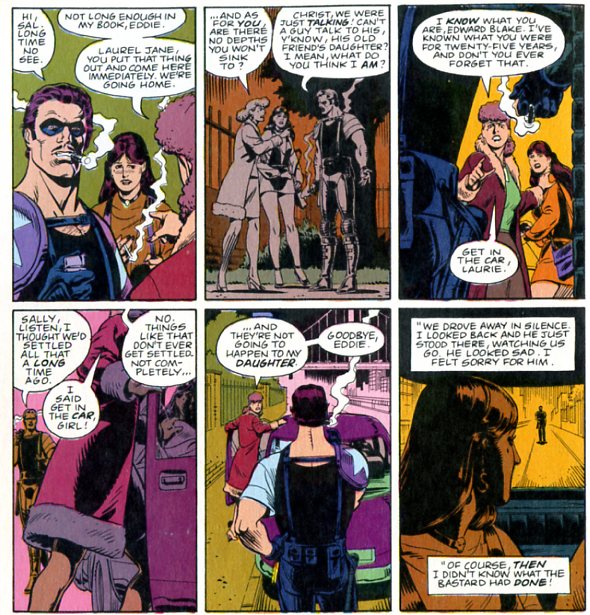
The Bond/Pussy Galore conversion rape is undoubtedly misogynist — but it’s also really, really different from the rape in Watchmen. In the first place, there’s nothing romantic or pleasurable about the sexual violence that Sally experiences. On the contrary, Blake’s assault is bloody and miserable. He himself is anything but cool; Gibbons portrays him pathetically pulling his pants up afterward, and then getting beaten to a pulp by the Hooded Justice.

Moreover, Sally is not converted by the rape. On the contrary, she never forgives Blake.

She hasn’t forgotten, she hasn’t decided what he did was okay. He’s a monster, she knows it, and she’s never going to let him have anything to do with her daughter.

Of course, the part that gets James, and that he feels is misogynist, is that Laurie is Blake’s daughter too. Sally did not forgive him, but she did love him.

James feels that that is problematic. In part, he seems to feel that it is problematic because it is unrealistic (“this rare realistic depiction of rape in comics comes to represent a offense a woman could forgive, that she even might even come to love her rapist.”)

But is Sally’s reaction unrealistic? Women do often love, or are intimately attached, to the people who abuse them, whether husbands or boyfriends. This is an uncomfortable truth, especially for a feminist vision that puts a premium on empowerment and autonomy. Sally Jupiter is certainly not perfectly self-actualized; there’s no question about that. But because she’s not perfectly self-actualized, does that mean she and her choices are necessarily wrong or misogynist?

In James’ reading, Sally’s love becomes the misogynist smoking-gun; the love is wrong. I don’t accept that. It’s not Sally who’s wrong. It’s Blake. It’s not the love that’s at fault; it’s the violence.

James says that:

Even more offensively, Snyder in his film made the fact of Laurie’s very existence through Sally’s forgiveness be the salvation of the world. This concept unfortunately lurks in the book…

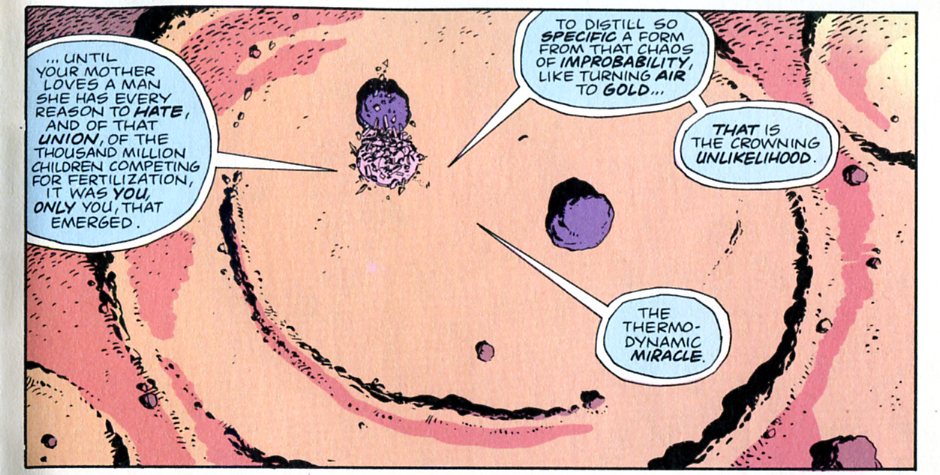
I’m relieved to discover that I’ve almost completely forgotten Snyder’s crappy film. In the book, though, Laurie’s existence is indeed seen as a miracle (though not necessarily as the salvation of the world, as my brother points out). As Dr. Manhattan puts it:

So yes, Sally’s love (though not, as I said, her forgiveness) is seen as transformative, and even beautiful. And it is seen as transformative and beautiful in large part because it produced Laurie, who Sally loves, and who Jon loves.

I think James in part sees Sally’s love as a flaw because he sees it as mitigating, or validating the rape. But I don’t think that’s the case. Just because something good comes from evil doesn’t make evil good. Paul Celan’s poetry is wonderful, but it doesn’t validate or recuperate the Holocaust. Or, as C.S. Lewis says in Voyage to Venus, talking about the fall from Eden:

“Of course good came of it. Is Maleldil a beast that we can stop his path, or a leaf that we can twist His shape? Whatever you do, He will make good of it. But not the good He had prepared for you if you had obeyed Him. That is lost for ever. The first King and first Mother of our world did the forbidden thing; and He brought good of it in the end. But what they did was not good; and what they lost we have not seen. And there were some to whom no good came nor ever will come.” He turned to the body of Weston. “You,” he said, “tell her all. What good came to you? Do you rejoice that Maleldil became a man? Tell her of your joys, and of what profit you had when you made Maleldil and death acquainted”…

The body that had been Weston’s threw up its head and opened its mouth and gave a long melancholy howl like a dog….”

That could be Blake at the end giving that howl, almost. Certainly, he dies ignominiously and alone, having lost even the comfort of his amorality. Laurie, as a living manifestation of her mother’s love, is a standing rebuke to Blake and his life. If Laurie is a miracle, then the Comedian’s cynicism and nihilism truly mean nothing. This is not to say that Moore and Gibbons, or even Laurie herself, entirely reject the Comedian’s evil or his violence. But it is to say that, to the extent that Watchmen does reject it, it’s because of, not despite, Sally and her choices.

I don’t mean to say that those choices are ideal. Sally herself doesn’t think her choices are ideal. But just because a woman fails to make ideal choices, and just because she does not respond to violence with hate (or at least not only with hate), doesn’t make her a failure. If feminism requires perfect women, there won’t be any feminism. Sally may be a flaw, but humans aren’t gems. Flaws don’t make them less precious.

Gluey Tart: Yakuza Café


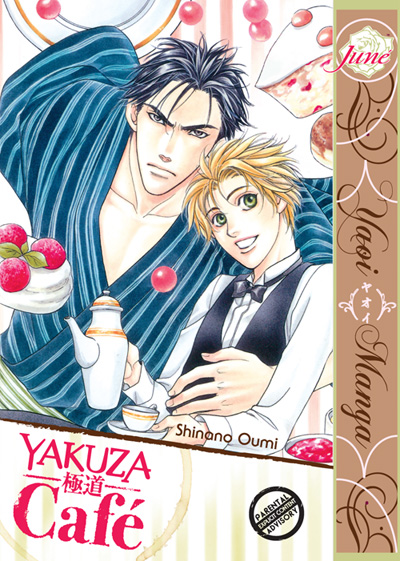
Shinano Oumi, 2011, June

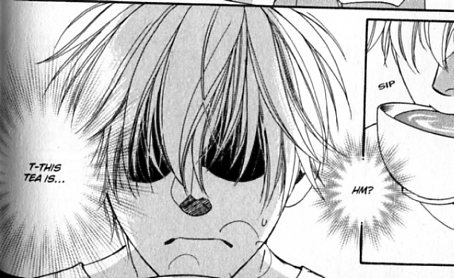
There are many – well, a couple of – things going on in Yakuza Café by Shinano Oumi. What I initially seized upon was that the Fuijisaki Clan Café, staffed by hulking former yakuza, serves nasty tea that stinks.

This book really resonated with me today because I had one of the worst cups of tea ever, this morning. I’m one of those possibly overly detail-oriented people who cares a lot about tea. I used to bring my own tea bags with me on trips because Lipton makes me frown. (I insist that this isn’t as annoying as carrying my own bottle of maple syrup, as someone I know does.) I haven’t carried for a long time, though, either because America is finally figuring out about tea or I’m just frequenting classier joints as I rake in the big bucks as a non-profit cog. It would be hard to say without conducting a study. Anyway, I went to one of my favorite places for breakfast this morning and noticed they were proudly advertising their new line of tea, which they proclaimed “tastes like couture.” I was somewhat skeptical because, while I’ve never in fact tasted couture, I did taste my flannel shirt this morning when it got sort of stuck in my mouth as I was trying to pull it on (pre-buttoned, obviously, because all that buttoning and unbuttoning stuff is fairly strenuous, and who has the time?), and it was pretty bland.

I attend a certain number of meetings and conferences for work, and the hotels and conference centers usually have fine tea. It’s often Tazo. I wonder why that is? I mean, Tzao is fine, but “the reincarnation of tea” (it is “blessed by a certified tea shaman” – and here I picture a filthy bicycle messenger who moved to Sante Fe to chase his or her bliss and became a healer of other former filthy bicycle messengers) always seems slightly incongruous in the bowels of a huge convention center, among busy go-getters walking and Blackberrying and/or iPadding at the same time and, occasionally, colliding into other Blackberrying and/or iPadding go-getters, which always makes me smile, for my heart is dark and twisted – or perhaps “matted” is a better word. I guess the Tazo marketing people have it going on, perhaps because Tazo is a division of Starbucks. Anyway, my question is why, with all the options available, a convention center can provide perfectly acceptable tea, while a restaurant – any restaurant – would serve tea that’s bland and lifeless but also sort of tastes like dishwater. And, apparently, couture.

When I got home, I thought I’d salvage the morning with a rollicking bit of absurdist manporn (well, first I took a long relaxing bath while I listened to Car Talk – I have delicate nerves). (Actually, first, I made myself a decent cup of tea. It was Metropolitan Monk’s Blend, although I considered a nice, plain-talking English breakfast, to cleanse the palate, or perhaps a good Earl Grey, in the spirit of getting back on the horse wot threw me and all that.) (And then I did some laundry; I keep forgetting, but it was on my mind today, possibly because of all this talk about clothing.) At some point in the day, at any rate, I sat down with Yakuza Café and a righteous expectation of some weird, funny, and lascivious escapism. (I obviously use “righteous” in the sense of “righteous weed, dude,” rather than its actual definition.)

I love yakuza yaoi. It’s one of the many tropes that never gets old for me. I especially like the really silly stuff, good-natured and sweet as a puff of cotton candy. I love the ridiculous plots about huge, disciplined tough guys falling for some adorable, smiley little fruit loop and behaving against character for the rest of the story. This one, for instance, is full of gangsters who cry at the drop of a hat. Copious, Ranma-style gushing tears. It’s just funny, sort of in a Benny Hill way. And there’s more of the fish-out-of-water humor with the café itself, which looks like the waiting area in an ad agency or something. Possibly a funeral home, since there’s calligraphy on the wall that reads “Mortality.” And, of course, the unfortunate tea.

There were a couple of sour notes, initially. It became clear almost immediately that this was going to be one of those “older man falls for true love when true love is a small child” things, which creeps me the hell out. It’s a common trope, but one I never get used to. Kind of a “you say romantic, I say someone call DCFS” kind of thing. Also, there’s the first sex scene. The little fruit loop touches the dragon tattoo covering the back of the man who fell in love with him when he was a child – hereafter to be known as Mikado, which is his name, and less awkward than TMWFILWHWHWAC. Whenever anyone touches the dragon (hyuck hyuck, she said “touches the dragon”), Mikado’s pent up emotions rage uncontrollably, so Mikado throws the fruit loop to the floor and has his beastly way with him. It is, in fact, a rape scene, since Mikado doesn’t ask and the fruit loop says no repeatedly, but in this, as in most of these yaoi rape scenes, the fruit loop doesn’t really mind too much. That one doesn’t bother me excessively; what perturbed me here was the initial unveiling of a penis (always a fraught moment, as they are often artistically sidestepped in some way that looks bizarre or troubling, like the classic “beam me up, Scotty, you big stud” bar of light). It’s the fruit loop’s penis, and it looks like one of those marzipan mushroom things. I’m pretty open minded, but that’s just not sexy.

Otherwise, though, I’m pretty good with this. The morning after the sex scene, Mikado tries to atone for his misdeed by cutting off his pinky. The fruit loop calls for help, resulting in what I see as a truly classic bit of dialogue: “Mikado-san’s trying to cut off his finger!” “Not again!” And a bit later, the evil marketer (there’s always an evil marketer) takes the fruit loop aside and says, “So you’ve encountered the dragon! You’re lucky to be alive.” That, my friends, is a good one.

There is a serious story at the end, providing Meaningful and Heart-Wrenching background for the evil marketer (by which I mean pat and overwrought, although it does involve flirting by way of full-back Buddha tattoos, which one admittedly doesn’t see every day), but we can overlook this, especially after we finally figure out who the hell it is we’re reading about (which took 15 pages for me). Let us spend no more time on it, and also waste no compassion on the marketer, for he is a marketer and doesn’t deserve it.