Tsushima

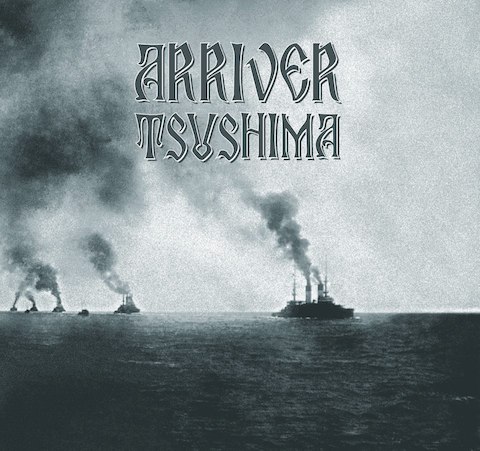
Even if rock’s triumphal-film-score concept-album crescendos are generally dedicated to narrating combat of the mythic mock medieval variety, rather than documented events, heroic ballads set against sweeping historical vistas have made a few appearances in rock-opera prog, such as Triumvirat’s Spartacus, and in the occasional power metal suite, like Iced Earth’s The Glorious Burden. But despite not knowing more than a few erratically memorable examples, I doubt that any prog or power “history album” quite compares to Arriver’s long-awaited epic, Tsushima.

Primarily from the viewpoint of the defeated Russian Admiral Rozhestvensky, the album tells the story of the Battle of Tsushima, a landmark 1905 naval encounter in the Russo-Japanese War. Wikipedia describes it as a turning point in modern warfare, as it was the first battle in which wireless electronic communication played a central role and the last in which one fleet surrendered to another. The album opens with “Winter Palace War Council,” a mournful accordion overture interrupted by a vicious staccato assault, in which, although “The Dowager Empress warned us/ Eastern entanglements shall fail,” the vocals growl defiantly states, “We will all die, but we will never surrender!” After balefully adopting the voice of Japan’s victorious Admiral Togo, in the menacing trudge “Togo, Son of a Samurai,” the story resumes in the Russian perspective with “Dogger Bank,” a high-speed stuttering Deicide-esque dirge conjuring the shadow of defeat to the distant conflict in the North Sea. “Our anchorage will be refused in every neutral port of call/ You may turn your backs on us,” the guttural snarl testifies, “but we alone are standing tall!”

In the album’s centerpiece, “Around the Cape,” a fierce, lumbering riff accompanies the background of total collapse, the defeated Russian fleet at Port Arthur and peasant revolts at the Tsar’s palace: “Crocodile hunting and French whores,” shouts the disembodied chorus in the face of their annihilation, “they only serve to slowly weaken our resolve.” A brief, precisely shifting thrash piece, “Dark Clouds Above the Fleet,” evokes mechanized perfection while prophesying the inevitable end: “Misery is all we know/ No solace found in place of sorrow/ Ignore your orders, lashing follows.’ In reverberating harmonic chords, and some actual Russian-language re-enactment, “Singapore” describes Rozhestvensky’s Ahab-like hubris in the face of the looming conflict. A massive swaggering rocker chopped into odd sections by tempo shifts, percussive artillery, bewildering time switches, and ornate finger-picking figures, “Tsushima Trilogy” churns like huge icy waves; in the suite’s last section “The Boiling Sea,” the Admiral exhorts his men to “never lower the flag,” until the battle ends in a whiteout of seasick feedback and the gasping sputter of a dying engine. The devastation is summarized in bleak harmonies over a rumbling funeral march in “Quadrology:” “21 vessels sunk by dawn/ 4000 Russian sailors drowned/ The Tsar’s last armada is lost and with it the war.”

While many loud rock bands deliver arrangements founded on the alternation of chugging riffs and blasts of fury, with Arriver the shifts are more elegant than startling, with dramatic grandeur favored over shock and awe. More classical than fanatical, their chords never simply evoke Satanic massacre or chivalric soundtrack. The uncomfortable relationship between punk and metal is foregrounded with a band such as Arriver– their sophisticated long-form arrangements don’t fail to sound like the French black metal band Deathspell Omega, but without any hint of histrionic horror or the perversion of nature. Or I might think of the melodic arpeggios, whiplash tempo changes, and layered chords of Between the Buried and Me, or the furious mathiness of Converge or Dillinger Escape Plan, but not of those bands’ crisply gated production values, which seem to only make use of death metal tropes in the service of reinventing angsty Gothy industrial music. Arriver’s old-school chops may even occasionally be reminiscent of Vader, but the former’s symphonic nuance is incompatible with the latter’s straight-ahead brutality. Arriver’s warm, tactile sound, both in performance and production, is most comparable with more melancholy exponents of the ‘90s post-hardcore indie-rock spectrum, like Bitch Magnet, …And You Will Know Us By the Trail of Dead, or Unwound. But, putting the sound aside, the music is convincingly metal.

Merely an agglomeration of tropes, there is no nugget that makes metal metal. But metal fans might concur that, as stridently humorless as metal may be, its lack of irony keeps it blissfully free of sincerity. Metal is not personal but completely internal, not interpersonal but utterly public, magical rather than political, and thus always, in its way, religious. The nature of history as a diverse collectivity of experiences may seem more suited to punk. Still, Tsushima rides the fence admirably, in its unselfconscious apprehension of a totality whose only unifying element is anguish, becoming perhaps less of a “history album” and more of a “war album.”

Simone Weil’s essay on the Iliad presents war not as a transcendent individual experience, but an unstoppable gluttonous inertia of force before which conquerors and victims are equally powerless. Weil defines “force” as “that x that turns anybody who is subjected to it into a thing.” “A man stands disarmed and naked with a spear pointing at him;” she says, “this person becomes a corpse before anybody or anything touches him.” As in Weil’s description of the Homeric epic, the chief tone of Tsushima is bitterness. “The dissonance introduced in the overture, “The Winter Palace,”introduces a dread that lingers throughout the action of the musical narrative”, grimly relating episodes in the admiral’s reflections upon the battle, before, during, and after, with the delusional yet fatalistic determination of Custer at Little Big Horn. “The cold brutality of the deeds of war is left undisguised;” rhapsodizes Weil, “neither victors nor vanquished are admired, scorned, or hated.” On a more modest scale, the same sentiment could be applied to Tsushima.

Glory in struggle, a subtext of all loud white music, is subtly tweaked in the fearful feedback, deformed rhythms, and ominous harmonies that counterpoint Tsushima’s thrashy gallops, surgical barrages, and martial marches, somehow mingling the mournful solemnity of patriotic Russian choral anthems with Fugazi’s insurgent insouciance to create a result that is neither reverent nor skeptical. Almost a straight-faced echo of the miniature Stonehenge proffered by Spinal Tap, the mightiest works and most sublime cataclysms of man are seen in their true ephemeral puniness. Rather than a bestowal of posthumous heroic laurels, the abject defeat of arrogant power seems to be the moral of the story, summed up in the chant that closes the album: “Day by day, like links in a chain, darkness spreads at the edge of the empire.” The torch of triumph and the flame of the fallen warrior must dispel in smoke for any hope to stay kindled.
_____________
Arriver’s website with info about the album is here.

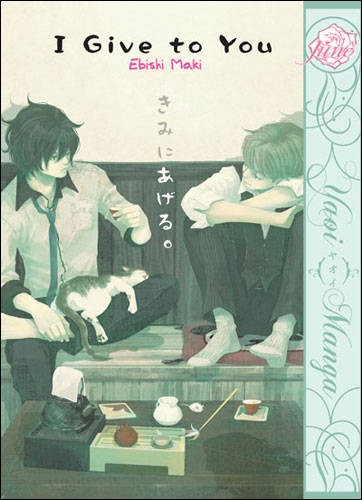
Gluey Tart: I Give to You


Ebishi Maki, 2011, June

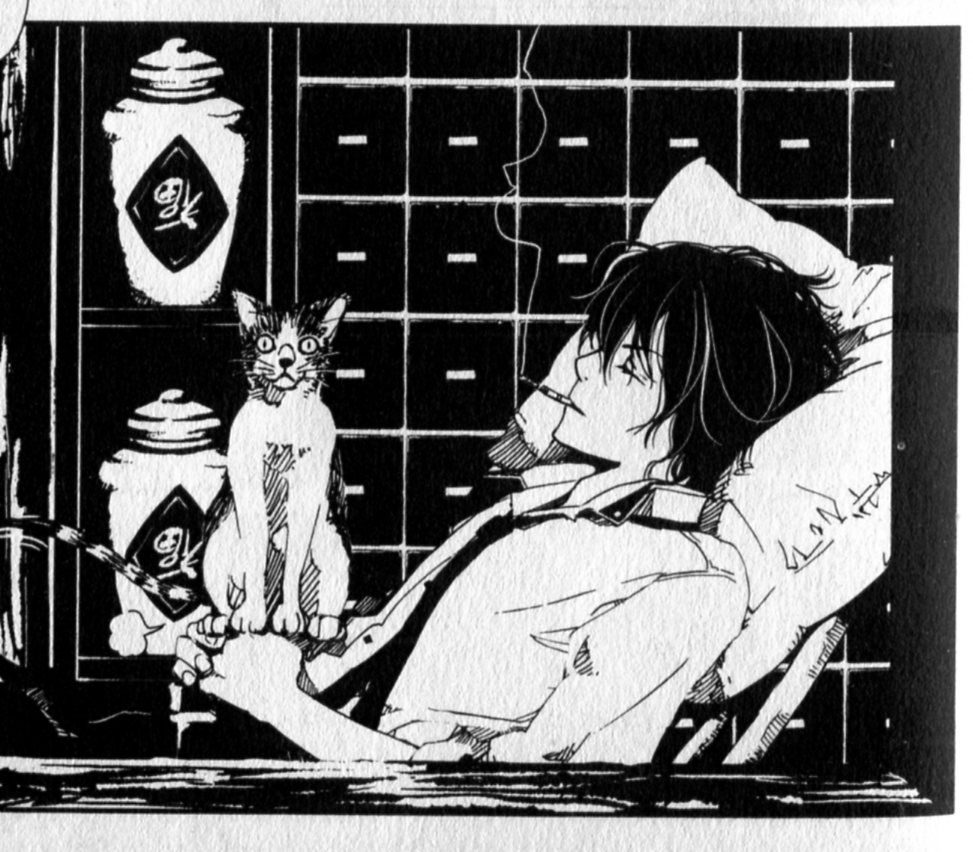
“The world is rejecting me.” Our main character mutters this to himself in the opening panel. When we meet him, he is recently dumped, homeless, and trudging through a pounding rainstorm. Brilliant. He winds up at an old-fashioned tea house, tended by a slouchy, chain-smoking hottie with a cat in his lap. That is, obviously, a fine scenario.

Initially, the dialogue suffers from some obvious translation problems. I assume it’s because Japanese can have a formal quality that doesn’t really exist in English, and the translator was trying to retain all the original references to “give” – creators sometimes like to bang us over the head repeatedly with their rhetorical hammer. Once we get past the iron-fisted enforcement of the leitmotif, we can concentrate on how cool and sort of mysterious the tea guy is and how much of a candy-assed, over-emoting weirdo the homeless, wet guy is.

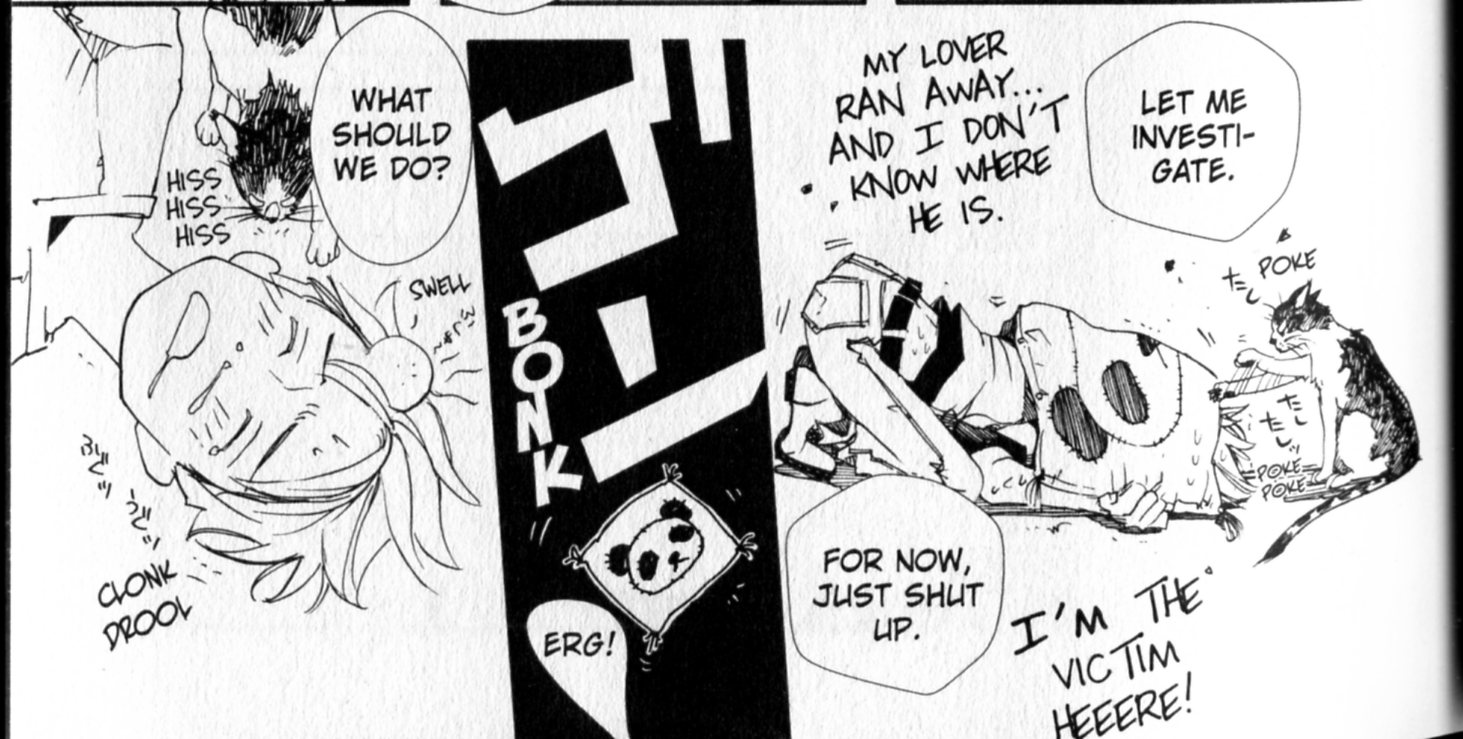
The wet guy was dumped by his boyfriend, who left him with a mountain of debt and nowhere to go – thus the wandering around in a typhoon thing. He immediately falls for tea guy, after a certain amount of clinically insane emoting, and tea guy seems amused and, of course, provisionally interested, because that’s how these things go. There are lots of cat reaction shots along the way to make it worth your while.

Wet guy is one of those characters whose innocent, inherently sunny disposition is supposed to be sweet and refreshing, and of course his idiocy leads him to deep human understandings. It doesn’t take much to please him, he’s loyal as a dog, and so on and so on. I find all this consistently annoying, but perhaps that’s because I’m uneasy with mindless optimism. Perhaps it’s a personal failing on my part.

(OK, spoilers ahead, if that sort of thing bothers you.)

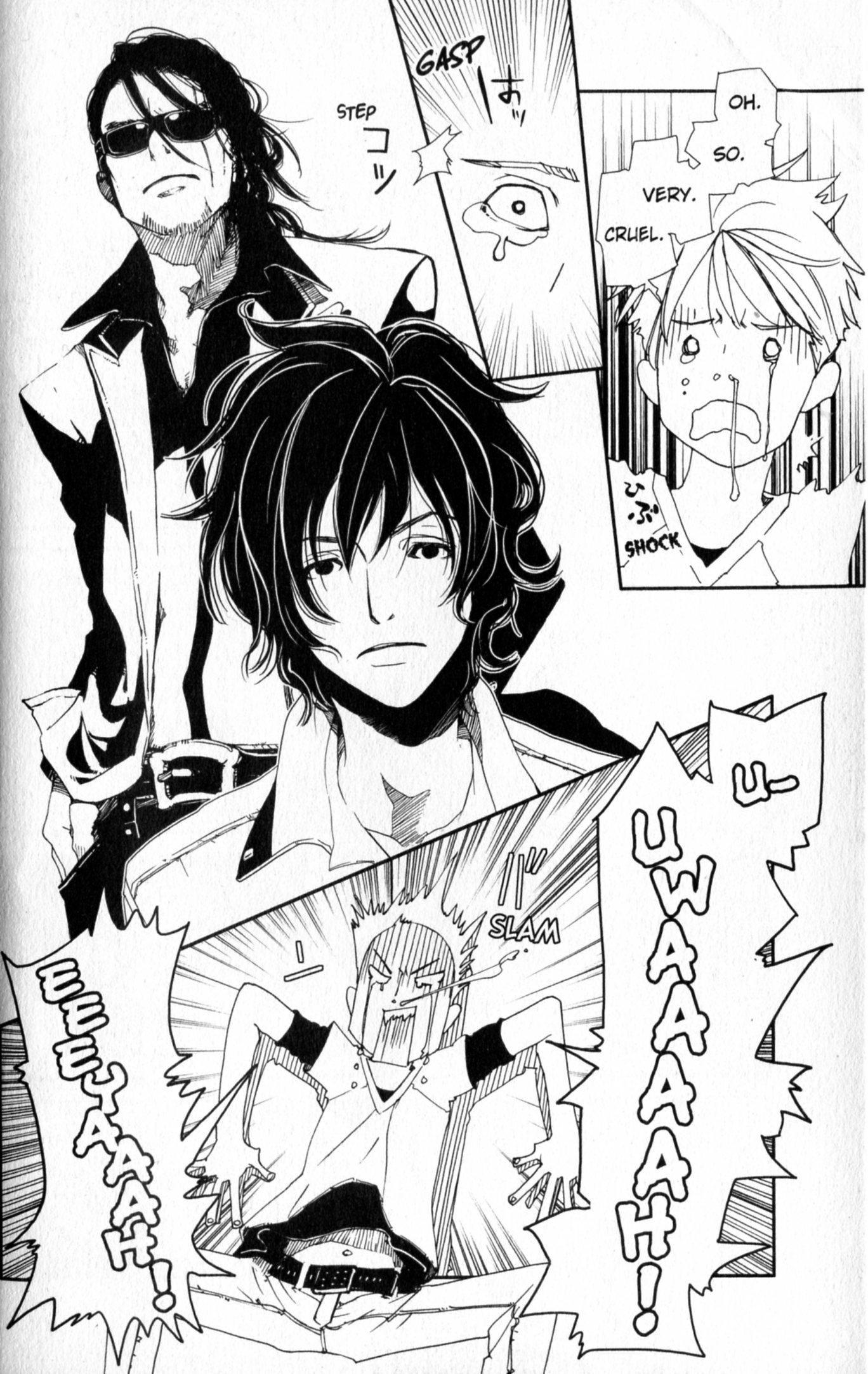
Tea guy is much more interesting. He’s from a yakuza family, and his retainer, Ritsu – a big, biker-looking guy who can get away with wearing sunglasses during the day, indoors – is several kinds of hot.

I would have much preferred putting Ritsu and tea guy together, but that was obviously not to be. Because wet guy has to crack the rock-hard edifice of tea guy’s pain and guilt with his simple, honest, healing idiocy. I know the drill. I never much took to wet guy, but tea guy has depth, and when we start getting his back story in the second half of the book, things get more interesting, emotionally.  There’s also a smattering of incidental kink at the end that I enjoyed. (It isn’t supposed to be incidental – it’s the whole reason tea guy is the way he is – but there’s only a couple of pages devoted to it, and it’s resolved cleanly and almost painlessly, so it feels incidental.)

The end is too pat in general, but that’s hard to get away from. You have a man who’s hiding from unscrupulous debt collectors and another man who disbanded a Yakuza organization, for heaven’s sake. You don’t just have individual meeting with gangster thugs, thanking them for their services and sending them home with a month’s salary. Yet, suddenly, all is well, and our main characters are setting off on a grand adventure, playful and in love. I want a happy ending as much as the next gal, but when a creator manages to capture some actual angst, you can’t help wishing they’d stick with it and ride it out.

That’s the thing with Yakuza stories, I guess. The have to be brutal or batshit crazy, and anything in-between is dangerous territory. Not that this book is a failure. There’s a flashback scene where a young tea guy is blowing bubbles. Another character asks if he isn’t too old for this, and tea guy says, “I like watching them. They ride the wind and fly to freedom.” That’s kind of how I feel about this book, if freedom can be interpreted as oblivion (meaning that I will have forgotten all about it by this time next week). A momentary pleasure is pleasure none the less.

The Not So Transgendered World of Osamu Tezuka’s Princess Knight

[Images read from right to left. Wikipedia synopsis of Osamu Tezuka’s Princess Knight (1953) here. It’s a fairy tale romance for kids folks!]


*               *               *

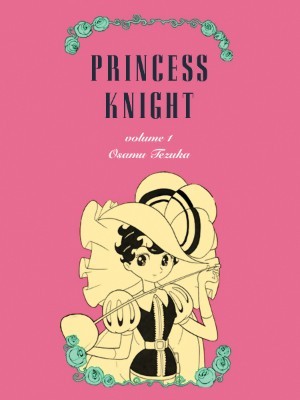
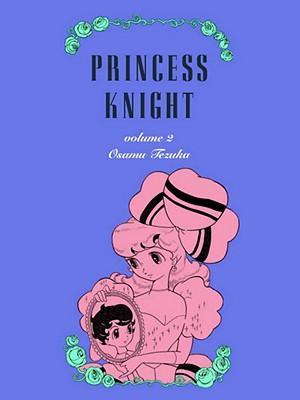
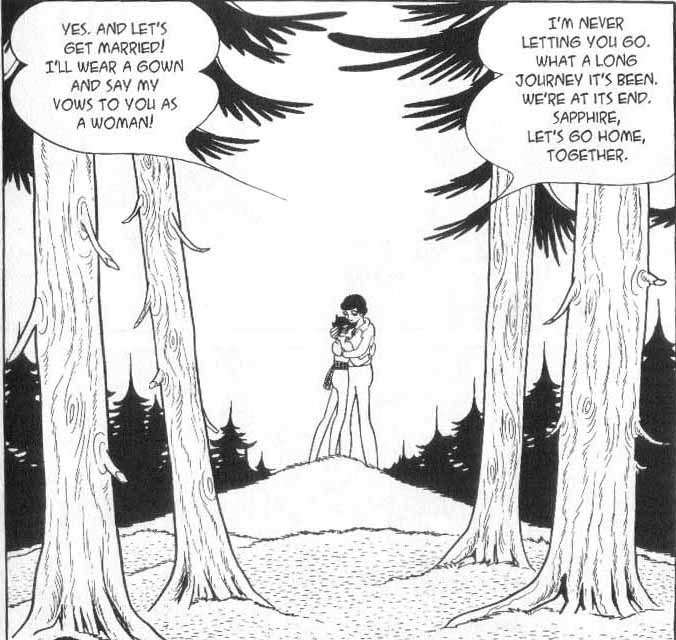
In the cloud strewn halls of heaven, the sexual fate of a  group of cherubic “souls” are decided through a lottery of colored hearts. The consumption of a blue heart produces a boy child while the consumption of a red heart produces a girl. When the nascent Princess Sapphire is accidentally fed hearts of two different colors, her sexual fate is thrown into doubt (the covers to the Vertical edition of Princess Knight cleverly highlight this dichotomy). In order to rectify this disastrous turn of events, the supreme deity dictates that her blue heart must be extracted if she is in fact born a girl.

To be sure, this game of hearts has little to do with any real determinacy when it comes to sexual orientation or desire. Rather it is a foreboding of the future course of Sapphire’s life, a premonition of years of chaste crossdressing. The heavenly mix-up is not a recipe for hermaphroditism but for an individual fully at ease in the world of masculine (sword fighting, horse riding, wall climbing) and feminine (pretty dresses, fixations on princes, cat fights) activities.

When Sapphire is born a girl, she remains comfortable with and desirous of her femininity. It is her political circumstances which dictate her need to adopt masculine ways and this she does with a degree of reluctance but with utmost decorum. Her sexual orientation is never in question. As with much children’s literature, this is a world where secondary sexual characteristics like breasts are clearly on display but genitalia never spoken of. Sapphire’s enemies are unable to discover her true sex because she doesn’t have a vagina (nor do Tezuka’s men have penises for that matter) — this constraint undoubtedly due to the age of Tezuka’s readership but also accidentally suggesting that sexual divisions are a cultural product and not predicated on sex organs (hormones not withstanding).

Sapphire is forced to be a prince in public due to the careless birth announcement of a lisping doctor. The swift rectification of this mistake is impossible due to an arcane law which, like most fairy tale legislation, doesn’t hold up to much scrutiny.

When we first see Sapphire as a young girl, we are swiftly apprised that she likes frilly things. Her transformation into a “prince” is a terrible inconvenience which she has come to accept over the years; an act of subterfuge which has caused such youthful bewilderment that she sometimes forgets to discard her heels in favor of more princely boots.

She is otherwise the consummate professional. Her mastery of disguise beggars that of Clark Kent and Diana Prince with their obfuscating spectacles and boring business suits. Her prince charming is blind to the wiles of his “flaxen” beauty the moment she discards her blonde wig and billowy ball gown. It’s either that or the magic of make-up, you never can tell.

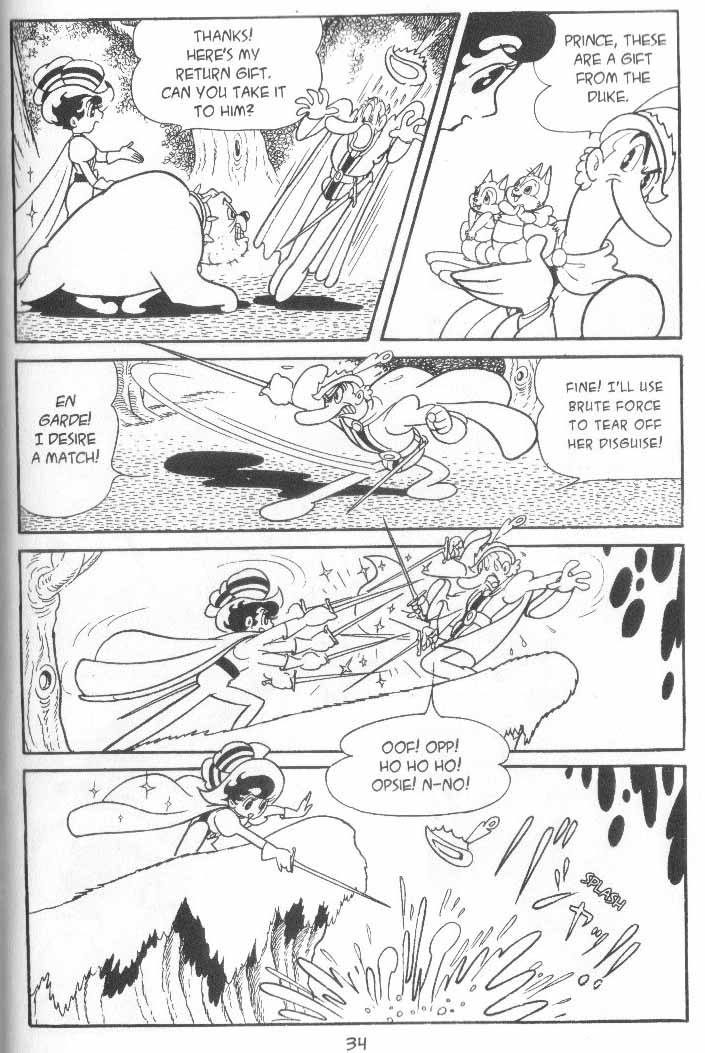
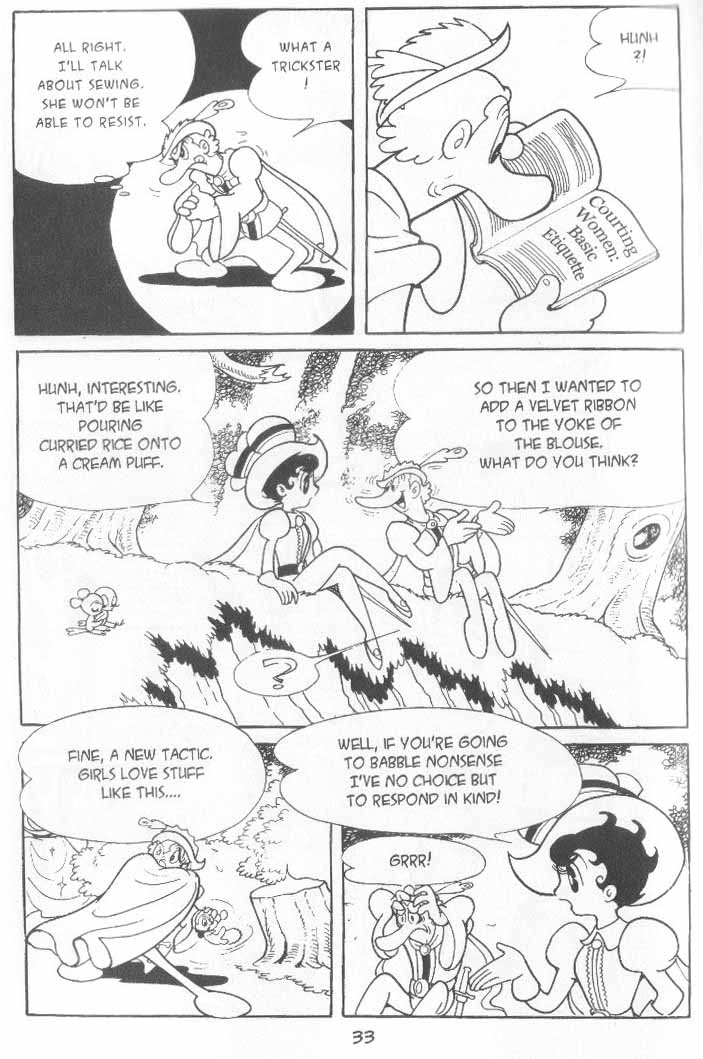
Early on in the story, Sapphire reacts violently to a series of entrapments by a deceitful courtier who attempts to expose her femininity through a woman’s “natural” passions for sewing and cuddly animals.

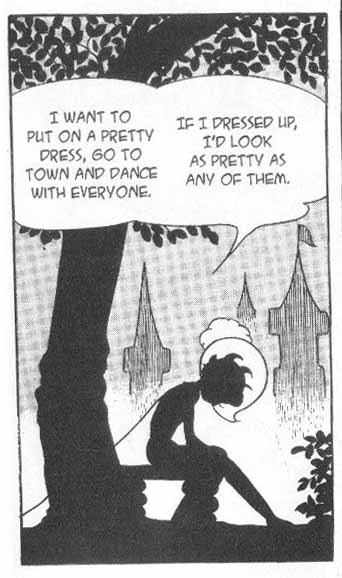
Yet it is the feminine calling of a beautiful gown that she secretly yearns for.

In many ways, Tezuka is less interested in gender identity (as a crossdressing protagonist would seem to imply) than in a kind of old school female empowerment. Unlike other fairy tale princesses, Sapphire drops a knife and not glass slippers. She is always “correctly” and heterosexually attracted to her prince charming and the aforementioned lavish dresses, yet fully capable of defeating her opponents in single combat — an antediluvian Lara Croft without the pneumatic breasts. The 6th century Ballad of Mu Lan had similar concerns but less reservations about the strength of women.

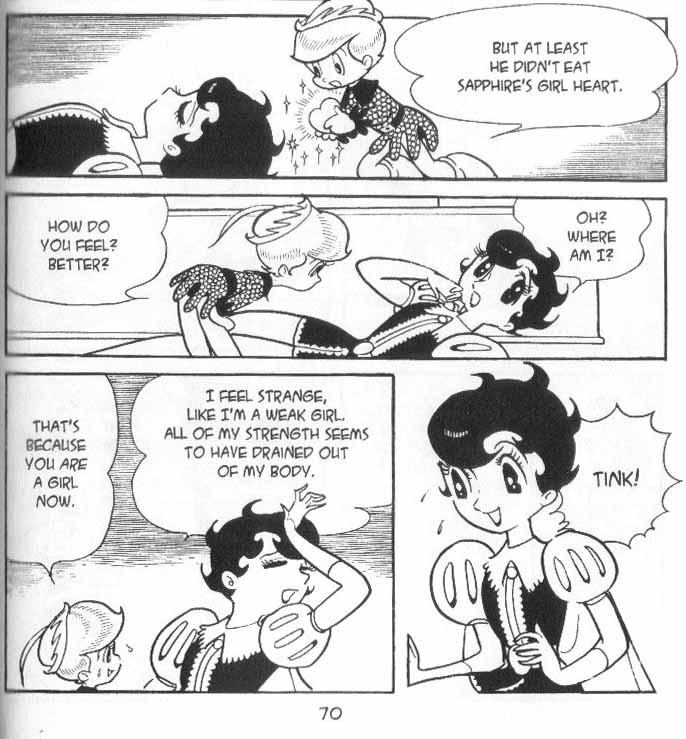
It is only in the second volume of this new translation that Tezuka begins let his guard down. When Sapphire’s female heart is extracted by the nefarious Madame Hell, she struts around in male fashion and rejects the advances of her prince lover.  A more conservative approach is adopted when her angel guardian reverses this magical surgery and replaces her male heart with a female one — she becomes a wilting flower…

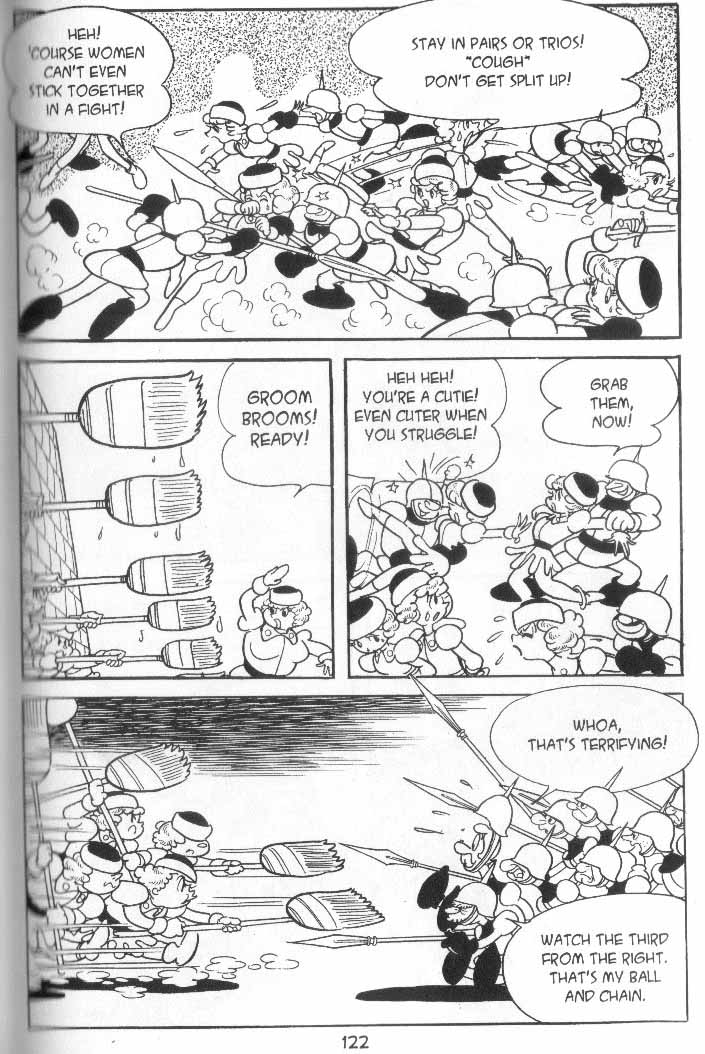
….a stance Tezuka swiftly dispenses with in light of his mildly feminist agenda. What’s an adventuring heroine to do if she can’t wield a sword? Even the emancipated ladies of the court use brooms to engage some invading soldiers.


Despite its long standing tradition of being the castrato of the comics world, North American comics have had an endless fascination with the transgendered lifestyle. Many of these are almost monkishly respectful while others posit rape as the first instinct of a male-female body swap (see Skin Tight Orbit; an erotic fantasy written by Elaine Lee). The latter device is a common trope in transgendered pornographic fiction.

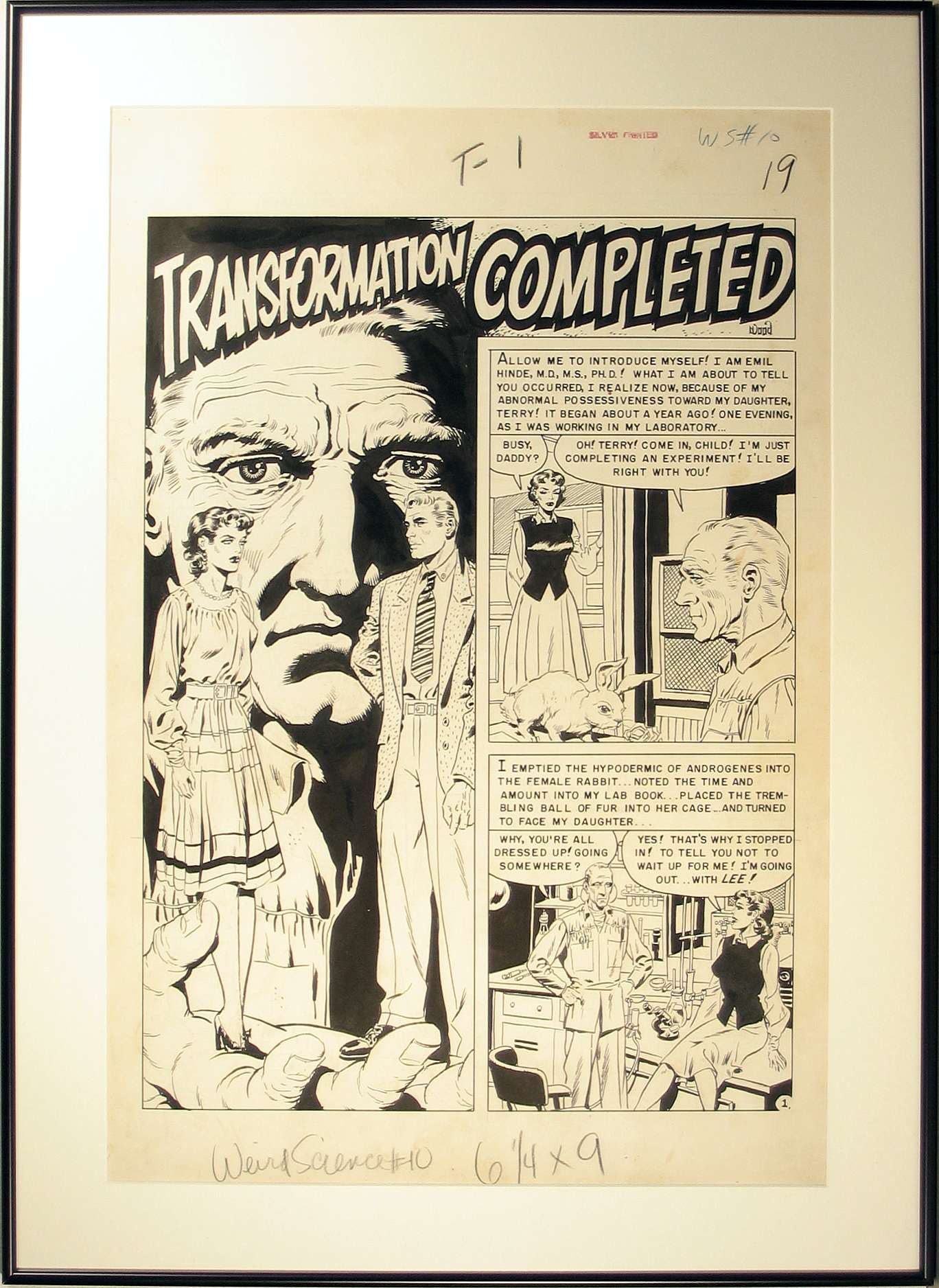
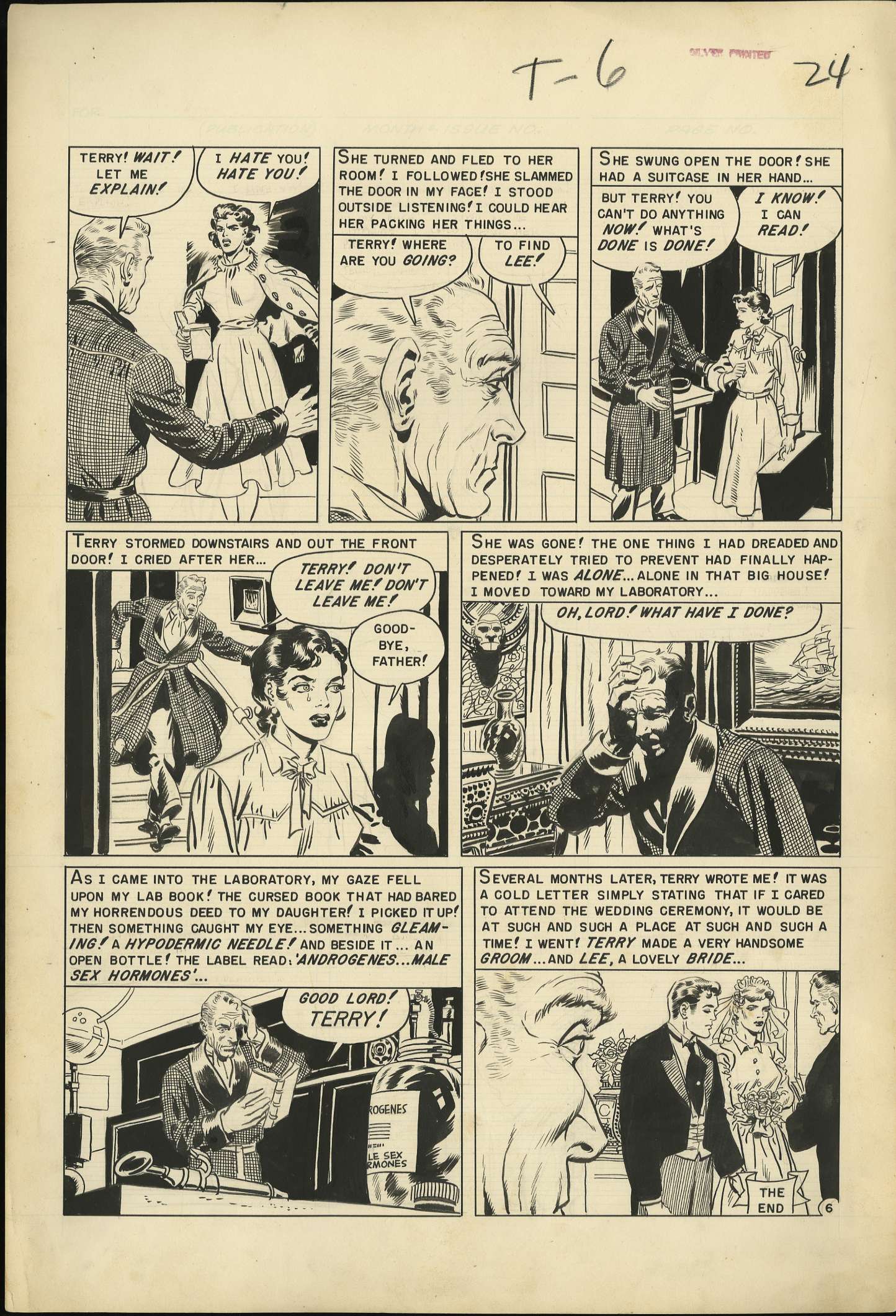
The transgendered stories surrounding Superman are perhaps the most entertaining from a historical perspective, but the canonical text in the genre must be Al Feldstein and Wally Wood’s “Transformation Completed” (Weird Science #10, 1951).

Here the unwitting fiancé of the female protagonist (androgynously named Terry) is transformed into a woman by her jealous father. Two constraints are at work here. Firstly, the bugbear of the homosexual lifestyle which can never be in a children’s comic and, secondly, the EC line’s own penchant for the “shock” ending. Both of these factors ensure that mere lesbianism will never be an option as far as the couple’s fortunes are concerned. On the final page of the story, Terry injects herself with her father’s gender change drug and becomes the groom to her newly female bride.

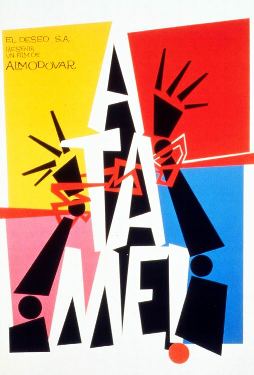
This kind of slow, forced feminization and simple gender reversal is a mainstay of transgendered literature (pornographic or otherwise), and satisfies both male-to-female and female-to-male desires and fantasies. We can see something similar at work in the operative female perfection achieved in Almodovar’s forced feminization horror-fantasy film, The Skin I Live In. Here the possibility of a lesbian romance is held up as the final shred of hope after years of sexual abuse at the hands of Antonio Banderas’ surgeon-torturer.

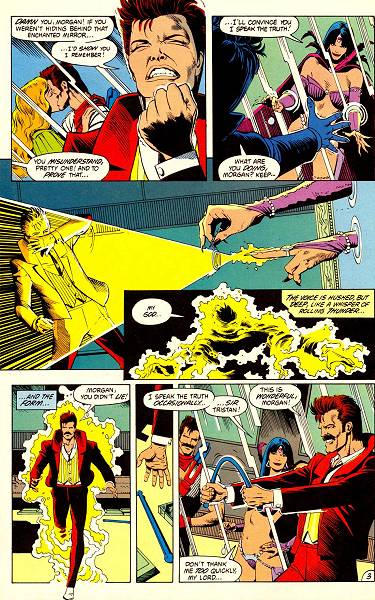
Needless to say, Tezuka will have no truck with any of this. The manga is question is for kids afterall. The taboo of abandoning the straight and narrow of the female lifestyle is suggested by no less than a minion of Satan (Madame Hell) and is rejected outright. [Sidenote: the female reincarnation of Tristan in Barr and Bolland’s Camelot 3000 is offered a similar bargain by Morgan le Fay but finally opts for lesbian love with her Isolde]

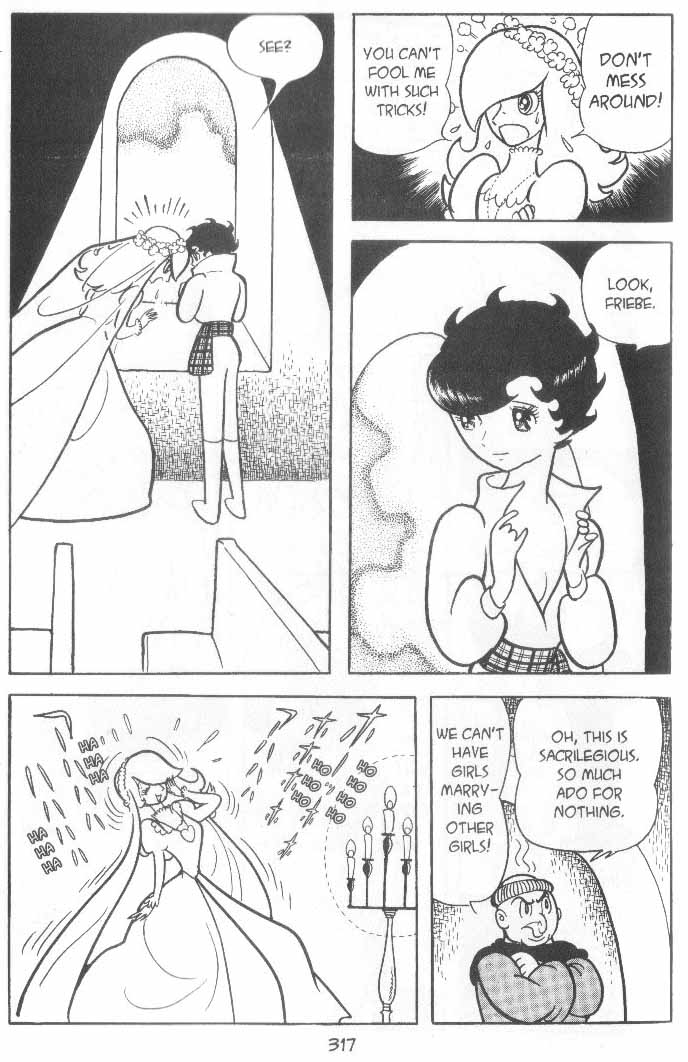
Readers prone to detect the lesbian frisson in the performances of the Takarazuka revue (said to be an influence on Princess Knight) will be left bereft by the heterosexual mores and desires of the protagonists in the manga. Sapphire’s potential bride (as seen in the penultimate chapter of the series) is left weeping at the altar once she is apprised of her groom’s substantial bosom; a Shakespearian moment further emphasized by the translator’s choice of priestly complaint (“Oh, this is sacrilegious, so much ado for nothing.”)

Considering its worthy progenitors in the field of literary transvestism, one might say that the most surprising aspect of Princess Knight is not its crossdressing heroine but the author’s need to contrive a celestial accident for a woman to be skilled at athletic and martial activities. What little “feminism” we see on the page soon gives way to escapades not dissimilar to what you might find in the adventures of Zorro, The Prisoner of Zenda, or a movie starring Douglas Fairbanks. One assumes that this presents an advance over the usual position of women in comics during the 50s and is to be commended.

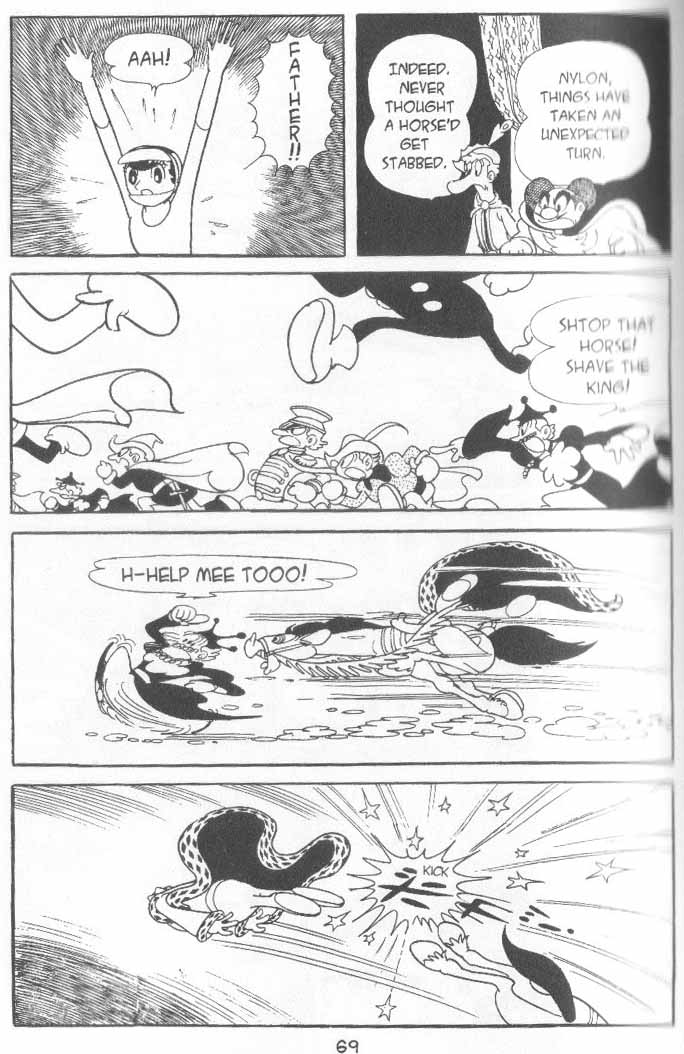
Nevertheless, this is a manga to be read more out of a sense of duty than anything else. Its historical importance as far as manga directed at girls is concerned is indisputable, but the romantic dilemmas on show are uninvolving. The tiresome and largely unimaginative plots will prove a chore for most. It is undoubtedly virtuous in intention but also averse to do away with childish things even if only for a moment — a product of its time with all the limitations that implies. Nowhere is this more clearly seen than in the death of Sapphire’s father which is not so much a terrible moment (see Bambi or Charlotte’s Web) but a simple plot development and an exercise in frantic cartooning.

There can be little doubt that Princess Knight remains a perfect example of that safe, asexual entertainment people have come to expect from comics.

Dick, Empowered

Over the last few months I’ve been doing an occasional series on the feminist limitations of an ideology of empowerment. My argument has been that a feminism obsessed with power is a feminism that is indistinguishable in crucial respects from patriarchy. It’s also a feminism that tends to reject parts of women’s experiences out of hand. Domesticity, children, family, peace, selflessness, love, and even sisterhood can be tossed by the wayside in the pursuit of an ideally actualized uberwoman valiantly and violently staking vampires or what have you. And as for those who are not ideally actualized — well, for them, empowerment feminism often offers little but contempt and dismissal.

I still believe all that. But…well. If anything could convince me otherwise, I think it’s Pedro Almodovar’s “Tie Me Up! Tie Me Down!”. Mostly because, after watching it, I would like to see a passel of empowered feminists kick the director’s sorry ass.

As I am not the first to notice, “Tie Me Up! Tie Me Down!” is an intentional, sneering, anti-feminist provocation. Ostensibly, it’s a romantic comedy featuring Antonio Banderas as the adorably amoral ingenue Ricky. Ricky is released from the mental hospital at the film’s beginning, and immediately goes off to kidnap former porn star and drug addict Marina (Victoria Abril). After hitting her in the jaw, he traps her in her apartment and tells her that she is going to fall in love with him and that they’ll then go off and have lots of babies. At first she is incredulous, but then he steals painkillers for her and gets beaten up for his efforts and she realizes that he really does love her…and so she falls for him and they have fantastic sex and then they ride off into the sunset to live happily ever after. Aww.

Like I’ve said, I’ve written a lot in this series about how a feminist text does not have to present women as perfectly empowered, and about how building your life around love is a really reasonable choice. So Marina is not perfectly empowered, and she chooses love. What’s wrong with that?

What’s wrong with that, I’d argue is that I don’t believe Marina is actually choosing love. That’s first of all because I don’t believe in the love. In a good romantic comedy, you need to become a little bit infatuated — or more than a little bit infatuated — with the leads. I don’t necessarily want to marry Cary Grant’s bumbling doofus, but he’s vulnerable and, contradictorily, witty enough that I can see why Katherine Hepburn would. Darcy is almost lovable just on the strength of his having the good sense to fall in love with Elizabeth, but if that weren’t enough, his competence and determination to help not her, but her whole family, certainly seals the deal. Even that bone-headed drama-queen Edward, so desperately trying to be cool and dangerous and so obviously a raging mass of hormones and stupidity trying incompetently to impress and care for the girl he loves — I can see the appeal.

But Ricky? What is there to like about Ricky? I know Edward is supposed to be all stalkery and abusive, but Ricky is actually, literally a stalker and abuser, tracking down a woman he barely knows (they had a one night stand at some point, apparently), hitting her, and threatening to kill her. He constantly engages in petty crimes, shaking down a drug dealer or stealing a car, and while I guess that’s supposed to make him dangerous and cool, in truth it just makes him seem like an untrustworthy thug. Even his tragic backstory (he lost his parents young or some such rot) seems like rote, tedious whining. His bland confidence that he’ll get what he wants; his noxious self-pity (he constantly chastises his kidnap victim for her selfishness and for not seeing how hard things are for him; his vapid cruelty — I mean, I know he’s Antonio Banderas with movie star good looks, but come on. He’s a charmless cad.

Lots of women (and lot of men, for that matter) do in fact date charmless cads — though even the most charmless cad doesn’t generally begin the relationship with battery and kidnapping. But, in any case, I don’t believe Marina is one of those women who dates charmless cads, because, just as I don’t believe in her love, I don’t believe in her. She’s not a real woman — or even a representation of a real woman. She’s got more in common with Pussy Galore than with Hepburn in Bringing Up Baby or Elizabeth in Pride and Prejudice or even with Bella. She’s an instrumental fantasy of compliance — which is why her sexual dalliance with a child’s bath toy is what passes for character development. She is there to experience a conversion rape, and the conversion rape is all she is.

Almodovar is perfectly aware of this; in fact, he smirks about it. I mentioned that Marina is a former porn actor. She left porn to star in a exploitation film directed by the great director Maximo Espejo(Franisco Rabal) — roughly translated as “maximum mirror”. Maximo is aging, wheelchair bound, and impotent — he has hired Marina, the film makes explicit (literally in a sequence where Maximo watches one of her old films) because he finds her sexually attractive. The movie doesn’t find this icky, though, Instead, we’re invited to see Maximo’s impotence as a tragedy of genius. His crude comments, directed at both Marina and her sister, are supposed to be cute, just like Ricky’s naive egocentrism and sexual brutality is supposed to be charming. For the last scene of his film, Maximo orders Marian to be tied up and dangled from a window…a motif prefiguring her “relatonship” with Ricky. Ricky, then, becomes, and none too subtly, the director’s avatar, dominating and fucking Marina as Maximo cannot. It’s all just a harmless fantasy, isn’t it? Who are we to deny a genius his stroke material?

Almodovar is gay, of course, so his exact investment in the fantasy is a little unclear. You’re supposed to see him in part as Maximo the mirror, the watcher enjoying or manipulating the tryst. But even if what we have is a coded gay parable about embracing your forbidden love by fucking Antonio Banderas, the fact remains (and is even underlined) that Marina as a woman, and Marina’s desires, are, for the film, utterly irrelevant. It’s not a question of Marina being empowered or disempowered, or even a question of Marina being a blank (as Melinda Beasi recently said of Bella in the Twilight graphic novels.) In fact, it’s not a question at all. The movie simply doesn’t give a crap about Marina. She’s a marker in someone else’s story — which is maybe why she only actually seems to come alive during the film’s much-ballyhooed sex scene. Laughing and animated, she turns over and over with her lover/cad, begging him not to let his penis fall out of her. It’s like Almodovar can only imagine her as interesting, or human, when she’s got a dick.

I did just say in that last paragraph that it’s not about being empowered or disempowered — but I think that’s probably a cop out. The film is, after all, a two-hour paen to the joys of stalking and domestic abuse. It’s a useful reminder to me, perhaps, that one reason men advocate disempowerment for women is that they get off on it. Feminists have every reason to distrust them.

To Make A Long Story . . . Long

People like long stories.  More than that, they seem to like stories that last a long time.

They also like short stories, and stories that take a short time, but people like massively long stories so much that sometimes they make the short stories into longer stories, which keep going, and going, and sequelling and sequelling, and rebooting and rebooting, and fanfictioning and publishing fanfictioning, ad infinitum.

As the rebooting and fanfictioning testify, it’s not necessarily the plots that people want to continue endlessly—or perhaps plots just aren’t sustainable over decades (centuries, in some cases) being discrete units, usually.  It’s the characters people want to live with, and the universes people want to live in.  They don’t just want to find out what happens next.  They want it to last.

Over time we have developed many, many ways in which to extend the life of universes and characters.  Those stories that are created with the intent to be lengthy, however, usually come in three main forms: the episodic narrative, the serial narrative, and—well, for lack of a better term—the episodic serial.

First, let’s get some definitions out of the way.  When talking about television, we use “episodic narrative” to refer to those programs in which entire plots are contained within an episode, and we use “serial narrative” to refer to those programs in which plots are comprised by multiple episodes, seasons, or the entire series.  Episodic narratives include I Love Lucy and M*A*S*H; serial narratives include The Wire and Deadwood. The main differentiation is continuity; you don’t have to see previous episodes of I Love Lucy to understand the plot of an episode; to fully understand an episode of The Wire, you need to see at least several episodes—and, for complete understanding, the entire series.

<“Episodic serial” refers to an amalgamation of the two; episodic serials may contain an A plot that is wrapped up by the end of the episode, with elements referring to the B plot, which lasts as long as the season or series.  Buffy the Vampire Slayer is a good example; some episodes contain the so-called “Monsters of the Week,” which are defeated by the episode’s end, but often bear some connection to the “Big Bad”—the villain Our Heroes spend the season fighting.  This means that you can watch an episode of Buffy and understand most of what is going on, but you wouldn’t get the whole picture unless you watch a whole season.

Although these days these terms are generally used to refer to television, we have always had all three forms throughout the history of narrative—though rather than three distinct forms, there has usually been a spectrum between serial and episodic.  Different societies and the media used to convey narrative have often favored one end of the spectrum or the other, often shifting fluidly from one end to the other and back again over time.  These shifts, rather than marked by changes in preferences or changing ideas regarding the quality of either form, seem mostly marked by the two factors that shift everything: money and technology.

Oral tradition contained all three forms, but the most prevalent fall on the episodic end of the spectrum.  This is most likely due to ease of memory.  Episodic narratives keep a constant universe and characters (and sometimes tone), but do not require memory of plot.  While serial narratives were (and are) common in oral tradition, it seems less likely that there were as many.  You can still add to an oral serial narrative, which is the beauty of it—you can make it last as long as you want.  However, you have to juggle lots of threads, if you want to write the next episode of The Iliad.  The next myth in which Zeus Gets Laid Again, not so much.  Without the technology of movable print, the narrative form that was easiest to recreate from memory was the one that was most common.

Movable type, invented in China in the eleventh century C.E., made works easier to reproduce, but it was still a pain.  As a result, many of the texts written after movable type and before the printing press are still episodic.  For both those using labor-intensive movable type, and those copying—rewriting, passing around, copying again, dictating, and rewriting again—works initially produced by hand, an episodic text would feel more manageable.  You don’t need every segment to make the story “work,” you could just distribute the segments you preferred, depending on your agenda, or only copy down the ones you thought worthwhile.  Again, it all comes down to ease.  In this case, it’s not that episodic narratives are easy to memorize, but they’re easier to produce.

With Gutenburg’s invention of the printing press, it was possible to get a long narrative, in its entirety, into someone’s hands with relative ease.  And thus marks a strange kind of bubble in the serial-episodic spectrum—because this is a strange kind of bubble in the history of Making Stories Last (A Long Time).

Works before the printing press, from The Iliad to The Canterbury Tales, were all stories produced and distributed over time.  Many of them could be added to—either by readers or the original authors.  The Tale of Genji, written over three hundred years before Canterbury Tales, and argued by some to be the first novel, was written by installments as the author distributed the stories at court; The Canterbury Tales were likely distributed a tale at a time.

While post-printing press romances or epics like Le Morte d’Arthur and two centuries later, Paradise Lost, are a lot more episodic than modern novels—or indeed, Enlightenment era novels—they were still published as single volumes.  Within, they were split into “books,” but they could all be read at once (if that’s even possible).  The intent was that they be sold at once.

So, while it can be argued that these works fall somewhere on the spectrum between serial and episodic, the works themselves mark a departure in the amount of time the consumer spends in the universe and with the characters.  A consumer may spend just as long inside the work, if she desires to do so; it certainly can be argued that these works are just as lengthy as many narratives produced before.  However, the consumer is not forced, as she once was, to wait (aka Make It Last).

The bubble burst with the invention of the steam press at the beginning of the nineteenth century.  The steam press allowed for quicker, cheaper printing, and the invention marked the newspaper boom.  Before this time, the printing press had certainly allowed for a democratization of knowledge, just like all our textbooks say.  Still, a book was a relatively large expenditure—and not the most practical one, as compared to say, a loaf of bread.  And in the past fifty years or so before the steam press, publishers were thinking up the genius scheme to “divide books for publication”—making one book three times as expensive, by splitting it into three volumes.

Newspapers, however, were cheap, and people who couldn’t afford books could often afford newspapers for a narrative fix.  Thereby, newspapers allowed for a revival of a time honored tradition: making you wait for your stories.  It began with episodic stories, probably due to the uncertainty in the early days of the newspaper boom—would this newspaper last?  Would people pick it up, and try a new one the next day, or would it earn a loyal following?  Could a serial narrative really work in this format?

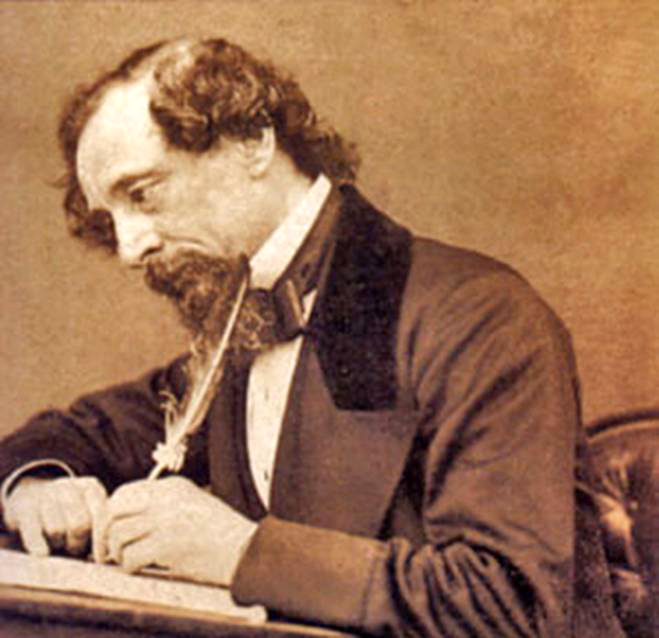
Dickens’ first novel, The Pickwick Papers, isn’t actually really a novel.  It’s a series of shorts about a group of characters, set in a particular universe.  When it proved to be popular, publishers decided they could make money off of it by compiling the stories and selling them as a book.  Probably a three volume set.

As Dickens and episodic narrative-constructing contemporaries gained in popularity, and some newspapers stabilized, the serial form took a firmer hold in the Victorian era.  Most scholars mark a turning point between Dickens’ episodically structured novels and his serially structured ones; the serially structured ones still have distinct installments, but they also have tighter plots that depend on continuity to drive the plot forward.  Many of the most famous Victorian novels were written in installments, for which the Victorian audience had to wait.  Only later were these novels bound and sold in volume form.

By the end of the nineteenth century, however, the serial novel was going out of fashion.  One reason may have been continued improvements to presses, which allowed novels to be cheaper and cheaper.  Perhaps publishers realized they could sell more novels by producing works in one of volume and just demanding that they be shorter (Henry James didn’t listen).  Perhaps people decided following a story in a newspaper was too difficult—and yet, while the evolution of modern novels spelled the end of serial novels, it didn’t spell the end of Making It Last.

Newspapers, after all, were still in production, and concurrently with the growth of the single volume novel we know and love today, came the rise of comic strips.  Comics had always existed, of course, in various forms; some scholars would argue they existed before the written word.  However, the nineteenth century newspaper boom caused the comic to take great leaps in terms of both commentary and story-telling, and by the turn of the century, we had the antecedents to what we know today as the Sunday funnies.  Eventually—sort of like Dickens’ stories—strips were combined into books and sold as volumes.

As the serial novel started dying out and comic books started rising up, another medium that is engineered to Make It Last was on the rise—radio.  Radio had both episodic and serial forms, and episodic serial forms, but when we traded it for television, narrative went mostly episodic.

The first television shows were televised plays, but once the technology evolved, and a lot of the middle class and up had them in their homes, people were getting Lassie, Leave It To Beaver, The Andy Griffith Show.  Continuity on these shows would have been impractical, because unlike a newspaper, people couldn’t just pick it up and put it down.  No one was going to stop their day every day at five to watch a program on television, producers thought, so most consumers couldn’t “follow along.”

Then, instead of television shows being produced live, they were recorded, and there could be reruns, and then reruns began to show in syndication.  This made a little more continuity possible, because people could catch up with stories in reruns during hiatuses—or even enjoy the show the whole way through after its initial run on television, even if producers weren’t exactly writing to that possibility.

Next came the VCR, and suddenly people could tape things off television.  We start getting shows like The X-Files and later, Buffy—no longer episodic.  Serial episodic.

With the invention of the DVD, though, there’s another paradigm shift.  Suddenly, it’s possible to do an eighty episode show on HBO that is just as reliant—some would argue more so—on continuity as some of Dickens’ later works.  These suckers basically almost work like eighty hour movies, because you can go buy the whole set for fifty bucks—and isn’t that kind of just like Guttenburg; before, things are doled out in these small pieces, and then whammo—I can get all of The Wire and I can buy Paradise Lost right off the shelves.

Of course, there are a lot more threads to this, because there are a lot more media than books and television, and a lot of things going on in those media in particular.  Why the serial narrative torch was mostly carried by comic books, and was completely dropped by serial novels, for a large part of the twentieth century is a mystery.  While—since their emergence—comic books have always dwelt on a myriad of subject matter, it’s also a mystery as to why the superhero genre became so popular in the United States, when it was less so, for instance, in Japan.  There are no doubt cultural reasons, as well as coincidences of timing and circumstance—and, as always—technology and money.

While comic books have always been popular in the United States, in Japan, manga emerged as a prevalent media outlet.  From that emerged anime, which was making serial narrative a long time before HBO.  As for American television, there have also been soap operas longer than there has been shows like The Wire, and soaps are for more reliant on serial structure.  The reason for soaps probably has to do with audience.  The target audience was a group that could be in the same time, same place every day, so they evolved on a different arc than much of the rest of narrative television.

Though shifts in preferences along the serial-episodic narrative spectrum seem motivated by money and technology, the undercurrent to all of it could be something deeper (or it could be the same thing, really).  It’s all about Making It Last versus Getting It Now.

With Gutenburg’s invention, humans all seemed pretty happy with Getting It Now, and yet the first thing they did with the steam press was Make It Last.  This was motivated by money, as I described—people who could not afford novels could afford newspapers.  And yet, many people who could afford novels were reading serial installments in the papers—and then going to the extra extravagance of buying the book after it was all done.

These days, we watch the whole show as it airs and then go buy it on DVD.  Maybe we do this because serial installments and daily programming are just the way it’s done.  The first thing we did with television, after all, was Make It Last, but again, as I said, that seemed to be motivated by marketing decisions, and what technology made possible.  After all, I, for one, don’t prefer watching television week to week.  I would always just rather watch a whole show on DVD; I’m a Get It Now sort of person.

However, the Victorian style serial novel died out.  Our novels became lean, and along with Hemingway, quite mean (in the sense of lacking excess; Hemingway is only sometimes unkind).  Now that it is so easy to get a longer story on DVD, does that mean our television shows will become leaner—more like novels, or like movies?

The internet is our newest technology, and what are people doing with it, but writing Facebook and Twitter novels?  Oh, sure, people are doing all sort of things with it—they’re serially blogging, and breaking things up into installments so that they’re easier to read day to day, and Twitter novels don’t seem to have much at all to do with money or how to rope in a consumer to buy a higher volume of products.  They seem to be about wanting to spread things out, Make It Last.

After all, despite the economic reasons behind Making It Last for the consumer, there are plenty of narrative points in its favor.  Victorian novels are famous for their length and wandering pace, but their method of distribution made it possible to lay out a hundred different threads.  With each installment, these threads could slowly be picked one at a time, or put down, tied together with another thread, or unraveled a bit at a time (or dropped completely, as sometimes happens).

There seems to be no room for that, in many modern novels.  There is very little room for people sitting around talking; there is very little room for mutants sitting in the mansion talking about how life sucks.  There is very little room for Xander to go on his own adventure while Buffy, Willow, and Giles try to save the world, thanks.  There may be room, in a blogged novel, to do these things.  (I’m still not sure about Twitter, though.  There doesn’t seem to be room for anything.  Even this parenthetical is probably too long.)

Of course, there’s no way to draw any absolute, causal conclusions about the kind of narrative people want.  They want all kinds; when they Get It Now, they want to Make It Last.  When they get episodic, they want serial.  All of these different elements are in such a mish-mash of what is possible with current media, that in the end, it always seems to me that writers and creators are always going to find a way to do something different with it.

And publishers and producers are always going to find a way to make money off it.

Gluey Tart: This Night’s Everything


Akira Minazuki, 2011, June

 
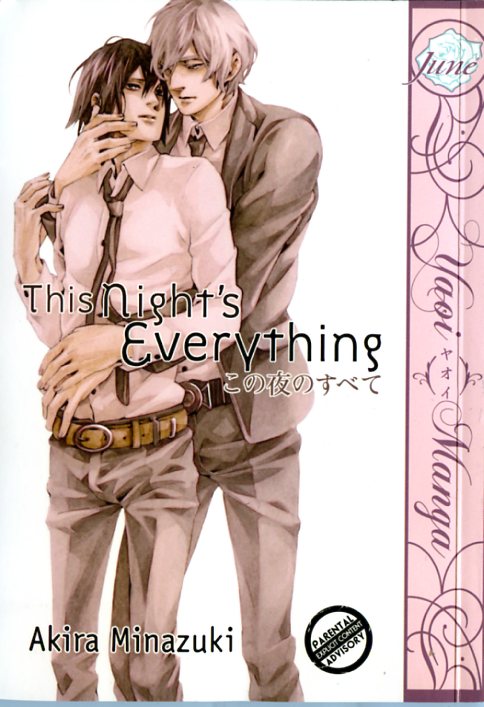
I love this cover. Love it. Minazuki’s style really does it for me because it’s sort of realistic (I said sort of), understated, and charmingly awkward. Not hugely awkward – charmingly. I insist. Minazuki also did Tonight’s Take-Out Night,” which I loved (you can tell because I still remember it, which rarely happens in a months-later kind of way). I’ve also seen a scanlation of another of her stories (about a shinigami) that I loved as well. So we’re four stars solid behind Akira Minazuki.

Her story lines aren’t quite typical, and her characterizations include the subtle details that allow you to jump fully into the story. What could be better than a death god, you might ask? I’ll tell you. Assassins. Assassins trump everything else, especially if they assassinate in sharp, mod-cut suits and use swords. Swords, people. (Some of you might remember my admitted fondness-shading-toward-obsession for assassins of the sword-wielding, brooding headcase variety, a.k.a. Aya in Weiss Kruez. Most of you have no idea what the hell Weiss Kruez is, of course, and while that makes me sad, I’ve come to accept it.)

There was some kind of war in the immediate prehistory of this book, which somehow included individuals fighting on their own with swords (or so it appears in the flashbacks), and some of those lone fighters were recruited to guard the Professor, about whom we know little except that he must have won, since he now runs this large organization of bodyguards and assassins who clear the Professor’s path or some such fascistic euphemism. Nanao has been with the group for ten years and hides his pain behind the refrigerator – I mean, behind a façade of good humor and easy charm.

And we have Aoi, whose name I can remember, although that’s only because I keep thinking it’s “Aioli.” I don’t like mayonnaise, though, even fancy French mayonnaise with garlic in it. Whipping oil and raw eggs together until they’re gelatinous and slimy strikes me as a deeply perverse thing to do. Also, Aoi is a lot of vowels. As an English speaker, all those vowels without the calming influence of a consonant seems to be asking for trouble. At any rate, Aoi shows up, a 19-year-old recruit who takes himself very, very seriously and gets paired with Nanao, who keeps getting his partners killed. Oops. Ha ha!

This starts out as a genre I think of as friendship porn. There is close camaraderie, there is banter, there is some thawing of the quiet, stoic, uptight, enigmatic dude (known in the business as the QSUED, he makes absurd proclamations like “How can hands that kill people show any concern?”) brought about by the largely unflagging cheer, flouting of rules and decorum, and casual flirting of the other guy (or the OG, who says things like, “A little resistance makes it hot, right?”). The OG makes it clear he likes the QSUED, even though he’s haughty and hard to deal with, and the QSUED makes it clear he is brooding and enigmatic and we aren’t going to find out what the hell he might or might not think. The key is that the QSUED would never let the OG take the liberties he does with the QSUED’s dignified person if he didn’t really care about the OG. At some point he graces the OG with a small, enigmatic smile, so you know that deep down, he does have feelings. AWWW!

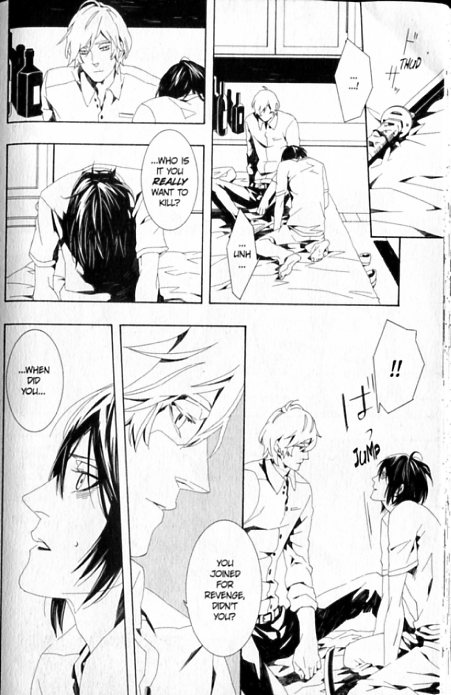
As is so often the case, this creator has some odd ideas about courtship. Nanao returns from an assassination, blood splashed across his face, eyes wild, and climbs on top of a horrified Aoi. Nanao explains that the killing gets him hot and Aoi just needs to help him get off. Perfectly reasonable, right? Aoi manages to slow things down by almost biting off the two fingers Nanao has stuck in his mouth, and soon Nanao figures out the Aoi is a virgin. He puts this together with a previous observation that Aoi’s sword is unnicked and determines that Aoi isn’t really a soldier, like he is, and wonders, “What kind of mistake got him tied up in this?”

Having decided that Aoi is essentially pure and untouched, Nanao decides to keep him that way. Years into their partnership, we find out that Nanao has delivered all the killing blows, sparing Aoi that loss of innocence. (I would call this splitting hairs, but it makes all the difference to Nanao.) Now, I don’t know about y’all, but I find all this very romantic.

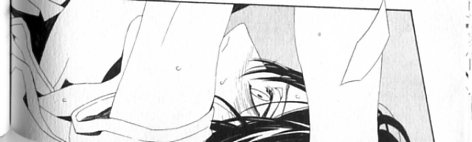
After years of being an assassin, Aoi eventually, as you might expect, has to kill someone. It is impressively bloody and dramatic, and Aoi completely falls apart. Now, again, I’m not entirely sure I’m sold on this aspect of the characterization, since this guy’s been helping Nanao take people down for years, and I’d think he might have gotten over the whole thing a little. But never mind. It’s fine because it finally gets our boys together in an emotionally and physically intimate way. I love the way all this is drawn, by the way. Nanao is giving Aoi his first blow job (or his first anything), and here’s Aoi:

Ohhhhh!!!!!! Angsty!!!!!! Now we finally get the sex scene we’ve building up to for about 87 pages (give or take a splash page). It’s angsty as well, but also tender. And hot. Totally worth the wait, if not for the actual sex, then for the morning after, when Aoi finally spills his secret.

Now this sets some shit in motion. Nanao goes off to take care of things for Aoi, and it’s a big-time sweep-him-off-his-feet gesture. It changes everything and sets their murky organization after Nanao’s head. Things happen, other things happen, Aoi gives in to the inevitable “love him need him gotta have him for my own” revelation we all saw coming from page one (especially if we happened to look at the cover), and the sailing off into the sunset of yaoi bliss thing is even handled in a sort of dangerous, edgy way that I found deeply pleasing. Possibly thrilling, in, you know, a kind of subdued way.

I very seldom get all directive on you, the reader (in part because I’m not entirely convinced there will be any readers), but in this case I’m telling you, seriously, check this out. Will you love it if you don’t love assassins? I can’t say because I don’t understand people who don’t love assassins and therefore have no idea what they might find pleasing. Mayonnaise, probably.

Bound to Blog: Wonder Woman Chronicles volume 1

I just finished DC’s Wonder Woman Chronicles volume 1, which collects Wonder Woman’s appearances in chronological order. This first volume collects Wonder Woman’s first appearance in All-Star Comics 8 (December 1941-January 1942) through Sensation Comics no. 9 in September 1942, and also includes Wonder Woman number 1.

I’ve already talked about several of these comics in the Bound to Blog series (for example, I talk about Wonder Woman #1 here, and Sensation Comics #1 here.) But there are a couple of things that struck me while reading the collection as a whole.

No Intro

There’s absolutely no introductory material at all, unless you count a small note in the table of contents that says, “The comics reprinted in this volume were produced in a time when racism played a larger role in society and popular culture, both consciously and unconsciously.” That is undeniably true

but still, it seems like there might be more to say. Who wrote these comics? Who drew them? How popular were they? What did people think of them? Why are we reprinting them?

Of course, the answer to the last question is basically, “because they are there,” and also, “Wonder Woman still has a fanbase, so if you stick her face on a cover, you can sell some copies, even if no one really thinks this material is particularly worthwhile — or, for that matter, thinks anything about it at all.”

Not that this is just about Wonder Woman. I’m sure DC’s other chronicles editions don’t have intros…the point is to make them as cheap as possible, I’m sure, in the hopes of selling to a not-especially-well-defined audience of WW fans, kids, and the curious or confused. But even the DC Wonder Woman Archive Edition (hard backed, more expensive, slightly more material) has an intro (by folk singer Judy Collins) that is more along the lines of an extended blurb than an actual effort to provide some context.

I’m sure some might say this is for the best — why have some professor get between the kids and their pop culture ephemera? The problem is that pop cultural ephemera is ephemera; if that’s what it is, why reprint it? And, indeed, DC’s various archival projects have tended to founder from lack of interest, being released at glacial speeds before instantly going out of print. Those boring professors, it turns out, are part of minimal cultural validation — and without that minimal validation, old pop cultural ephemera is largely irrelevant.

Steve Trevor, He-Man Convalescent

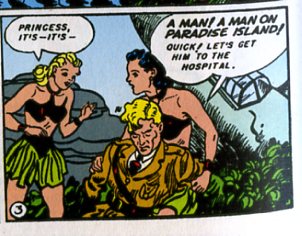
Steve Trevor appears on the very first page of Wonder Woman’s first story in All Star comics. In that debut appearance, he’s unconscious.

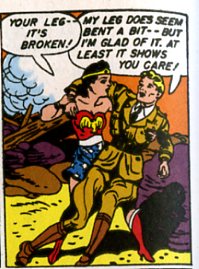
He then stays unconsious throughout the entire tale. He gets some moments of lucidity in flashback, but by the end of the story, he’s still conked out. It’s only in the 2nd WW tale (in Sensation Comics #1) that he comes to his senses. After that he’s in the hospital convalescing. He sneaks out when he learns of deadly danger to the country…but by the end of the comic, he’s back in bed again, with WW as Diana Prince (who changed places with his nurse…don’t ask) caring for him. Next issue he’s up and around, but by the end:

It’s only in Sensation Comics 3, the fourth WW story, that Steve Trevor escapes from the hospital, forcing Diana Prince to get a job not as his secretary, but as his boss’ secretary.

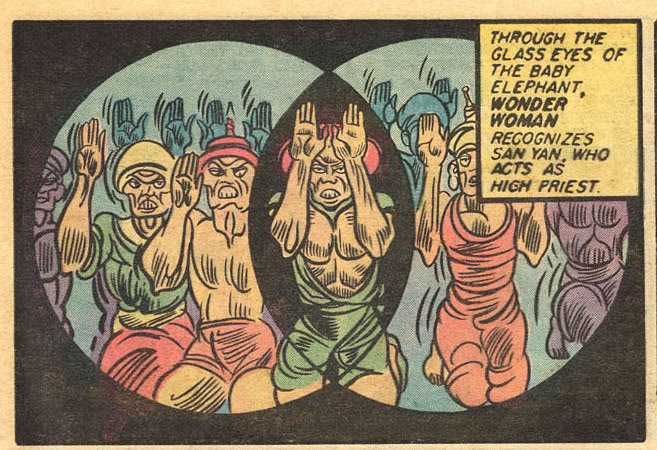
In other words, the ur-Steve Trevor, as Marston conceived of him, is not a fighter nor a love, but a hospital patient. The true Steve Trevor is the wounded — or, perhaps more accurately, infantilized — Steve Trevor.

In Women’s Fiction of the Second World War: Gender, Power, and Reistance, Gill Plain argues that:

War creates a situation in which the gender debate is subsumed by a meta-narrative of power. It represents a conflict that divorces and prioritises the division between activity and passivity from the founding binary opposition masculine/feminine. War almost represents itself as a constructive reinscription, or even a rejection of the age-old formulations of gender…. In the course of purusing the division between a non-gender-specific activity and passivity, woman is ‘decentered’… The woman has once again become invisible.

For Plain, then, war destabilizes gender by divorcing activity/passivity from gender — but in so doing, it erases women’s difference, and so erases women.

I think, though, Marston, radical feminist and dirty old coot, has found a way around this dilemma. He uses the destabilizing effect of war to create an emasculated hero — the wounded soldier, whose incapacity is the sign of his boldness and strength. But for Marston, the fact that passivity is disconnected from women does not result in ungendering. On the contrary, it becomes a masochistic fetish. Steve regresses, authority is upended…and patriarchy becomes matriarchy. Woman isn’t erased; she’s explicitly elevated as caregiver and (maternal) hero. Which is (in Marston) what men want:

That’s an awesomely, fluidly flaccid twisted leg Peter has drawn there — and Steve is, of course, explicitly getting off on his own castration. War for Marston isn’t a disaster so much as an opportunity for men to embrace their weakness…and let women take over.

Myself for a Rival

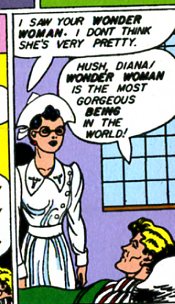
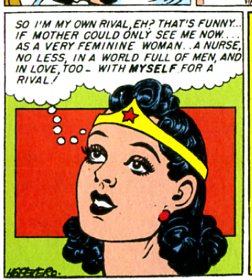
A number of the stories in this volume end with a panel like this

What’s interesting about this is that…that’s it. The trope is stated…and then dropped, over and over again. The love triangle is pointed at, but never really becomes central to the plot (the way it is with the Clark/Lois/Superman triangle, even in the early years to some extent.)

It seems like, for Marston, there’s a pleasure in the masquerade of changing identities, and a frisson in the unrequited melodrama…but very little interest in actually presenting either Diana or Wonder Woman as angst-ridden or, for that matter, weak. There’s almost a condescension about it, like she’s pretending she’s worried to make Stevie feel important, the little darling. As I’ve mentioned before, double identities in Wonder Woman feel more like play than agonized bifurcation, a polymorphous feminine role-play rather than an agonized Oedipal bifurcation. After Marston died, of course, Diana’s love vicissitudes move from marginal tease to major plot points. With Marston’s feminism removed, everybody seemed more comfortable with a passive object of desire, rather than with the all-powerful Mommy, stooping to love.