$%$#^% the Cinema!

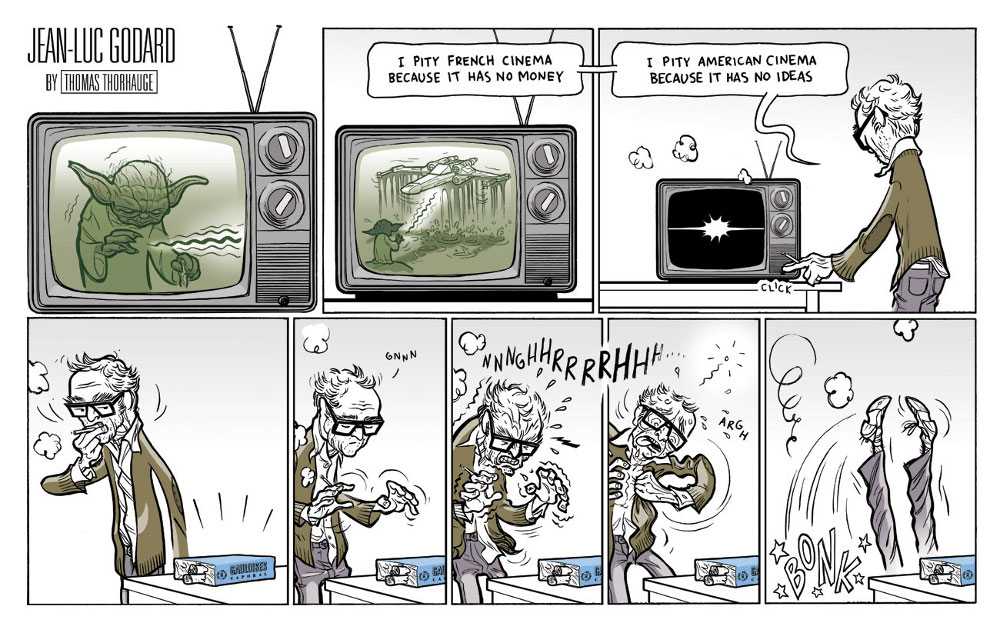
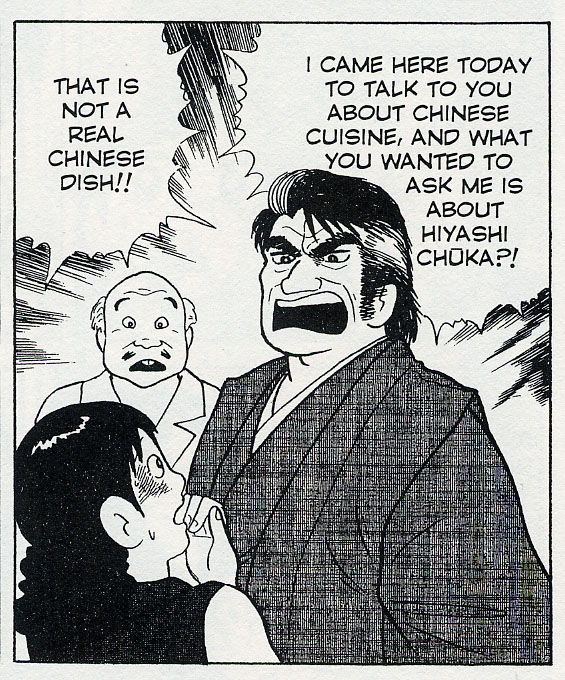
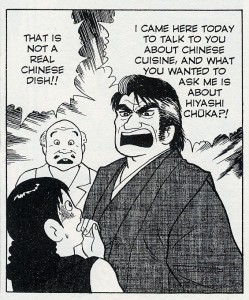
Thomas Thorhauge is a Danish cartoonist. He translated this cartoon into English for this roundtable; the original Danish version was part of his “True Story” strip, which ran last year in the weekly film section of Copenhagen daily Politiken. His concept was to illustrate authentic quotes from film personalities in whatever way he found interesting, funny or resonant.

Please note: the quote included is authentic.
___________
The index to the Godard roundtable is here.

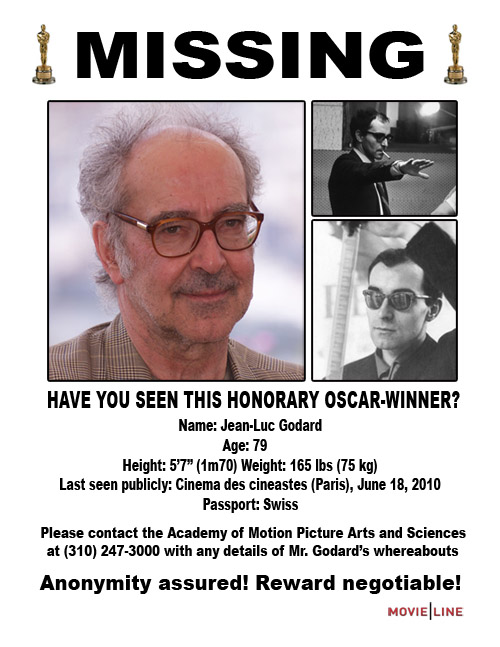
Bonne fête, M. Godard!

Jean-Luc Godard celebrated his 81st birthday on Saturday, December 3. Last year, for his 80th, he got a font. This year, the Internet rather quietly (and capitalistically) observed the occasion: Criterion’s Facebook feed sent me to their summary page. The New York Times reviewed Histoire(s) du Cinema, and alerted me to its US DVD release on this Tuesday (Dec 6). Theaters announced special screenings. Assorted cinephile bloggers wished him well, of course, with the expected “best Godard films” lists and links to clips, my favorite of which was this short film entitled “Meeting Woody Allen”, which I’d not known about previously.

Here at HU, he gets a roundtable. Bon Anniversaire!

Godard is, perhaps more than any other filmmaker besides his contemporary and friend Luis Buñuel, driven by ideas – ideas of what the cinema is and what it is for, ideas about society and subjectivity, ideas about love and art. For many movie lovers, his work is excessively abstract, even opaque; his characters, distant and cold; his dialogue stylized, melodramatic. But to be a fan of Godard is to recognize the idea of humanity in his abstracted depiction of it, and to feel so much passion for the idea that the abstraction can stand in for traditional characterization and plotting without any loss of affect.

Perhaps more than any other filmmaker besides David Lynch, Godard is masterful with metatext, with constructing layers of meaning, with crafting signification from juxtapositions and the interplay of images, themes and words. For me at least, Godard’s own historical moment is always one layer of this metatext – perhaps the most important layer – the ideas in his films are French ideas, ideas fomented in the aftermath of war and occupation and in the tensions of the Cold War and its propagandistic ideological context. The images in his films are refracted through a French glass. “Godard” is a tapestry woven from Sartre and Bazin and Balzac and Buñuel and Lacan and Levi-Strauss and Althusser and Barthes and Langlois and Flaubert and Malraux. Godard, personally reclusive, enigmatic, and even secretive, became in his work a precipitation of the 20th century’s arguably most vibrant intellectual-artistic movement.

More than any other director most people have ever heard of, Godard is himself an idea – an idea of Art, an idea of commitment to Art, an idea of purpose for Art. Like many other French directors, he is in love with the idiosyncratic expression of “l’humanité”, witty and eccentric. Throughout his oeuvre he turned the rabidly individualistic notion of the “auteur” on its head: although his vision is uncompromising and uniquely his, it is impersonal and philosophical, concerned with humanity as a collective, with common humanity, human society, the conflict between man and society — and the necessity of subjective eccentricity, of Art and of desire, as an antidote, a balm, a cry in the wilderness first of post-war existential trauma and then of late Capitalism. Unlike Truffaut or Hitchcock or Scorsese, Godard is neither a personality nor even a body of work; Godard is a figura for art itself.

The title of this roundtable, “Qu’est-ce que c’est Godard?”, is a loose reference to the final line of Godard’s first film, Breathless: “Qu’est-ce que c’est, ‘dégueulasse’?” The quote is always a source of confusion for English translators — there is no English translation that captures the rich ambiguity of the French “dégueulasse.” Translations always end up resolving the multiplicity of meaning in the scene. “Godard”, like “dégueulasse”, is ambiguous and multiple, idiomatic, and somewhat impossible to translate. Each translation says as much about the translator as it does about the original. So will it be with this roundtable. Jouissez sans entraves!

*A couple of people have commented on the use of “Bonne fête” to mean “happy birthday”. It’s apparently Canadian only and doesn’t sound quite right to Continental Francophones. But I’m American — I’m sure my accent is even worse than my word choice!

Roundtable Contributors

Visit the Roundtable Index for a running list as contributions are posted.

Love, Marriage, and Eulogies

This first ran on Splice Today.
______________________

My father-in-law died a little while back, and we drove the 10 hours to Appalachia for the funeral. He’d had brain cancer for about a year, and was unable to stand up or to recognize his daughter for months, so it wasn’t a surprise.

What was a surprise was that my mother-in-law asked me to deliver the eulogy. You might think she asked because I knew Fred well. And you’d be wrong. Fred wasn’t an especially easy person to know, and in the 10 years I’d been married to his daughter, we certainly hadn’t become close. I think he liked me well enough—my wife did me the favor of dating some real losers while she was in college (the guy who urinated in the salad bar at Denny’s is especially memorable), so I had a low bar to clear in impressing the in-laws. I probably did know the single most important thing about him, which is that he loved his grandson, my son, more than anything in the world. But even so, I was an odd choice for the eulogy, at least if what you wanted was someone who had a lot to say about the deceased.

So why me? Well, it’s not a mystery or anything. My wife’s family is a fairly taciturn lot; I, on the other hand, write for a living, and have to some extent inherited the irritating public pushiness of my Semitic ancestors. They picked me to do it because they figured I’d be willing. And maybe because they thought I could get through it without crying. And because I’m family.

They were right; I was willing, and I figured I could probably make it through without crying, and I’m family. So I parked my Jewish butt up at the front of the little Baptist church (which Fred would never have been caught in alive) and listened to the preachers sing the bluegrass songs that Fred loved, and make carneyesque demands that we all join the congregation, which he would have hated. And then I gave the eulogy, mostly composed of stories my wife and her mom had told me. I talked about how he would let our son drive the truck when he was two years old. He’d sit on Fred’s lap, and Fred would let him steer. And my wife and I would say, “Gah! Don’t do that!” And he’d completely ignore us. Which was one of his talents.

Of course, that story about the truck isn’t just my father-in-law’s anecdote; it’s my anecdote too. So while in one sense it’s true that I didn’t know him all that well, in another, I did know him because we shared the same stories and loved the same people. Or, to put it another way, I am married to his daughter.

Which is a thing about marriage that I think people tend to downplay. Marriage is often advertised as an expression of love between two people. Which it is, partly. But the expression of love is much less about declarations of devotion and much more about being part of each other’s lives. That’s why the gay marriage debate has rightly focused on topics like visitation rights in hospitals; marriage is much less about having kids, or having sex, or being in love than it is about being there. In a lot of ways, at least in my experience, it’s not love that leads to marriage so much as the other way around. It’s your life together that makes your love.

And in this case that love is my father-in-law. When my wife and I got married, he took a bunch of photos and cut my head off in every one, as if in some muted protest. When my son was born at home, he came up to help clean, and while my wife and I collapsed in the bedroom, he picked the newborn up and held onto him for hours, despite the desperate efforts of my mother-in-law to pry her grandson free. He was part of my life. One of the gifts my marriage gave me was the chance to tell him goodbye.

Eat, Drink, Read Manga

I am a foodie. You rolled your eyes just now, didn’t you? I don’t blame you. Everyone is claiming to be a “foodie” these days, from your brother-in-law who just discovered white truffle oil (Gordon Ramsay says that’s sooo last year….) to your Mom who found an ethnic restaurant in town with dishes whose names she can’t pronounce. (“Mom, it says ‘salad’.”)

I am not the kind of foodie that drifts from one trendy flavor to another (seriously, mangosteen is over) at all. I’m the kind of foodie who loves food. I mean, I just like to eat. Think less Ted Allen, more Homer Simpson.

It is often said offhandedly that there is “manga for everyone,” but until recently, that was largely not true in English. There was manga for everyone if by “everyone” you meant everyone 12-18 years old or so. Now that the manga bubble has burst, manga publishers, searching for an audience that actually has money to spend on books – and prefers books to downloads – have stumbled on the niche adult manga market. Which means we’re actually getting manga these days more suited to adult tastes. Today we’re talking four food and drink manga that can help train your mind and palate and give you an instant one-upsmanship with your non-manga-reading foodie friends. Welcome to Pretentious Gittery in Food and Drink the Manga Way.
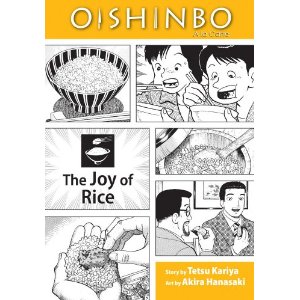
 

Oishinbo has the be the first course. Any rube can tell you that they taste the difference between regular California short-grain rice and Koshihikari rice grown and imported from Japan, but Oishinbo will help you to discuss the difference in the more pretentious terms. Was the storage area dry enough? Where was the water used for cooking from?

Wrapped in an equally entertaining and annoying tale about rival newspapers and rival father and son food experts, Oishinbo in Japan was begun in 1983, and is now up to 104 collected volumes. Written by Tetsu Kariya, with art by Akira Hanasaki, Oishinbo is not a cooking manga. It is a food manga. It is about the experience of eating food, and often covers the subtle differences that husbandry, farming, storage, shipping and preparation can have on that experience. In America, a few select chapters have been collected into an ala carte’ selection, focused around specific food areas. Sushi and Sashimi, Rice, Gyoza and Ramen, Sake, Traditional Japanese cuisine, Vegetables, Pub Food…each volume picks and chooses from chapters published over the last 30 years. By the end of the American volumes, you’re sorely tempted to go out and try ramen at your favorite local place, just to complain about the use of food coloring and MSG.
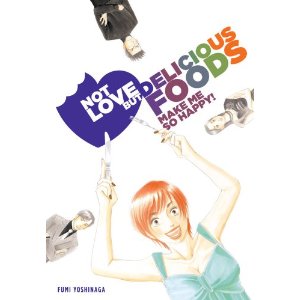
 

If you find the tone of one-upsmanship too harsh in Oishinbo, then try a more feminine touch with Not Love, But Delicious Foods Makes Me So Happy by Fumi Yoshinaga. Yoshinaga presents this foodalogue as an amusingly insulting candid autobiography of her life and the food she eats.  Where Hanasaki’s art has improved over the last 30 years, Yoshinaga’s art starts at levels far exceeding anything you’ll see in Oishinbo. The people are drawn both beautifully (and less so,) but the food is always gorgeous. Her relationships with the people in her life are organized by their ability to appreciate food. Of all the books on food and drink that I have read, this one most closely approximates my own foodie existence.  Yoshinaga’s take on food is approachable, but her focus on texture and mingling of flavors are both things that Americans particularly, are bad at and so, become an accessible first step into pretentious gittery.

The inevitable next step after reading Not Love is to hop on over to Yelp and start reviewing your favorite restaurants.  Don’t forget to discuss the Bolognese sauce at your favorite Italian restaurant as “authentic” even if you’ve never been to Italy, much less Bologna.


Now that you’ve taken your first steps into being a pretentious git about food, it’s time to get ready for the big guns of pretentious gittery – Wine.

Is there any area of food or drink that has such a well-established pedigree for encouraging pretentious gittery as wine? Perhaps, but even those who don’t know anything about food or drink shudder at the thought of being seated with a person who “knows a lot about wine.”
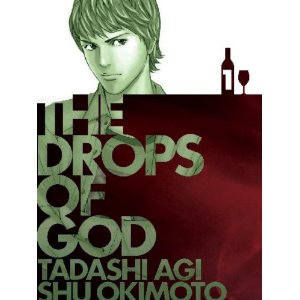
Tadashi Agi’s Drops of God has been so influential in forming, educating and influencing the Asian wine market that long before it was translated into English, this manga had articles written about it in the Wall St. Journal and the New York Times. In fact, so grown up and pretentious is this series, that the New York Times actually deigned to allow this manga on their “Graphic Novels Worthy of Being Gifts” List this year.

Once again wrapped in a story about a rivalry, and a quest for the greatest wines on earth, Drops of God allows the audience to learn the importance of decanting, about village wines, terroir and other things that no one else at the table cares about, really, as long as the wine tastes good. If your family member or friend actually does know a thing or two about wine, don’t expect to impress them with this manga. They already know this stuff and are unlikely to be moved by a comic book. More importantly, the manga itself addresses the pressure that wine snobbery places on everyday people and provides a brilliant tip to glean the credit while knowing nothing. If you’re not a wine drinker, this manga will be a hard read. Everyone eats food…not everyone drinks wine.  But if you’re starting to get into wine and can taste the difference between a  Merlot and a Cabernet, or a family member or friend is in that space, this is a good way to bump up pretension to expertise in a fun way.
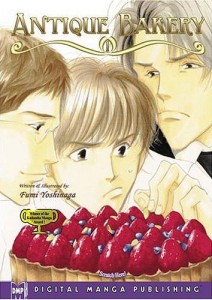
 

Last, after all of our food and drink, we turn to dessert, and back once again to Fumi Yoshinaga with Antique Bakery. Unlike the rest of the manga here, the pretentious gittery in Antique Bakery is not the actual story, it is merely decoration on the plate. Nonetheless, if you can’t stand to not be a git about the cream used in your choux à la crème (or, shu cream, if your pretentious gittery leans toward Japan, rather than France,) this manga makes a perfect ending to your meal.

The goal here today is not to bore your friends and family (although that outcome is probably inevitable) but to indulge your brain along with your tastebuds.

To end, I want to share with you a real story about pretentious gittery.

I was at someone’s house and they poured me a glass of wine that, they said, had a distinct scent of tobacco and traces of mushroom. I took a sip and said, “You’re right, it smells like an old man bar and tastes like a moldy basement.”

I may never become a good pretentious git about wine, but I’m great at being a pretentious git about manga. ^_^ These manga are perfect for the inner pretentious git in you.

 

Robert Binks: More Works by an Unassuming Master ( part 2 )


Welcome to part two of the second round of posts devoted to Robert Binks and his work. All our posts to date can be found here, and Mr. Binks’ illustrations for the poet Ogden Nash are gathered here. All the works in this post are © CBC/Bob Binks.

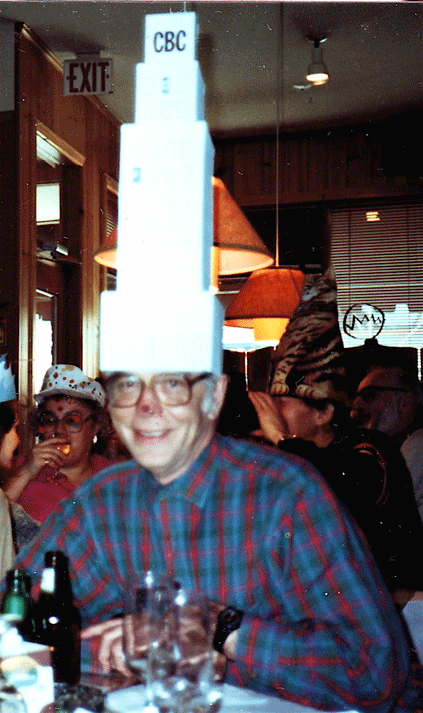
Let’s start with a look at Mr. Binks and hat design. He models the work himself, along with a clown nose for added high spirits:
  

“This hat celebrates a new CBC building to be erected,” Mr. Binks writes by email. The occasion was lunch in 1984 for CBC graphic designers.

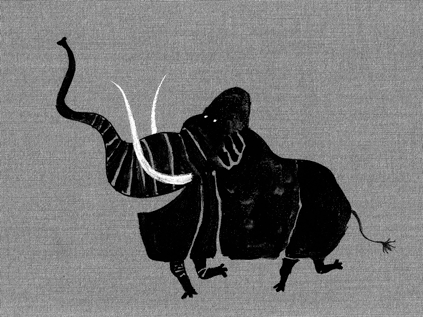
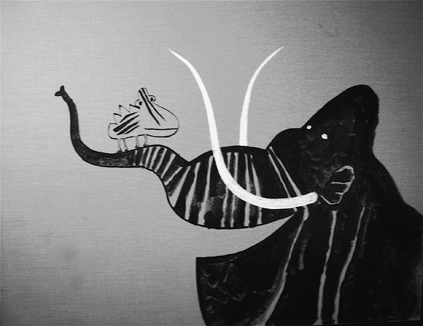
Now two illustrations Mr. Binks drew for broadcast around 1960, during the era of black-and-white television. They were part of a story called “The Frolicking Mastodon.”

“The drawings were done in India ink on beige window blind with added white paint,” Mr. Binks writes.

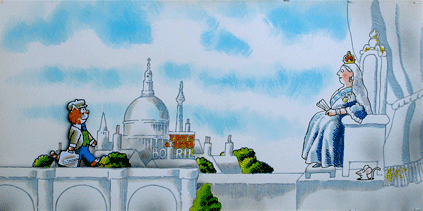
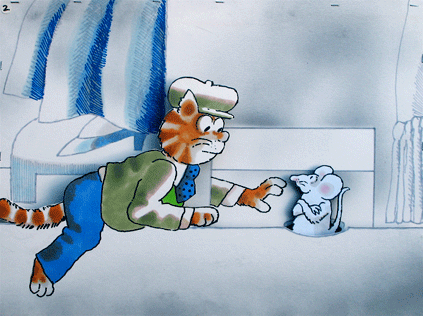
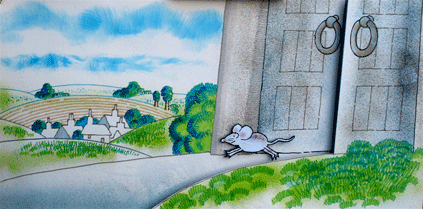
The next three works were done about 1980 as part of a story broadcast on the CBC children’s show Mr. Dressup. The story’s set-up is simple: Queen Victoria hires a cat to rid her palace of mice.

“In contrast to this world of high tech that we now live in, we created simple animated solutions by moving cut-out shapes,” Mr. Binks says. “The stagehand at the back of the graphic would move the magnetized cat cutout along a felt pen line that determines the action. The camera follows the action of the cat as it crosses the bridge along the path to visit Queen Victoria.”

“The stagehand moves the magnetized mouse up out of the hole.”

“Part of the castle door is on another level to allow the mouse to appear and travel down the path following a curved line.”

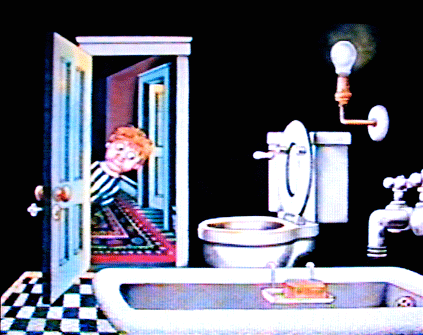
Next, three panels belonging to a feature created during the mid-1970s for the CBC television program Such Is Life. Their collective title is “Strange Beliefs of Children.”

Mr. Binks: “The animation was preshot by myself on an animation stand. This was a simple animation technique where I used paper cut-outs and I double framed each shot.”

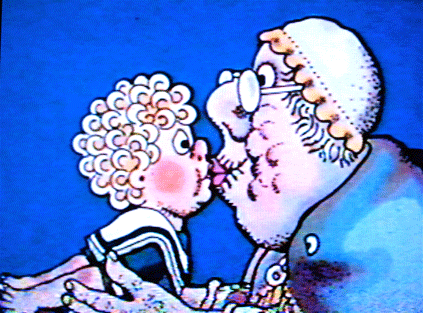
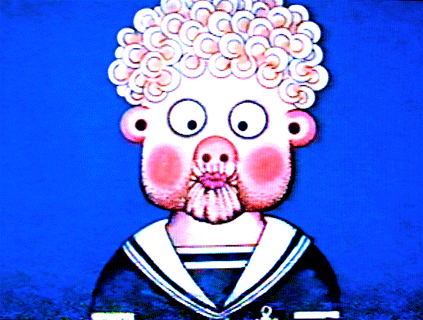
The first two center on the longstanding trepidation felt by little boys over contact with their grandmothers’ insistent, wrinkled mouths.


In the first shot, “the little boy was moved up to Grandma’s mouth by moving her long arms,” Mr. Binks writes. Then “a match dissolve changes the little boy’s normal lips to puckered lips. The eyes go from normal to crosseyed.” And that is what happens to the poor blighters. The CBC was on the case all those years ago.The next picture also addresses a widespread problem:

The boy is about to encounter something horrible. From the script: “There’s this thing which lives in the toilet and likes it and when you go in the night and flush the toilet it wakes the thing up. So you’d better hurry getting out of there — but this kid was too slow.”

Mr. Binks used a series of cutouts to show the boy flushing the toilet, then being seized and dragged into the toilet by a wormlike creature with a suction-cup head.

So this is what the CBC wants to show young people! Mr. Binks notes that his nephew, when small, was given a look at the sequence and suffered nightmares as a result. “As an adult he still has vivid memories and requested a copy,” Mr. Binks adds, which tells us something about the bizarre power of nostalgia.

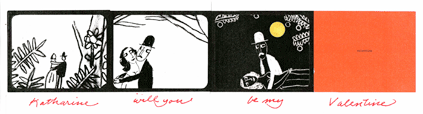
Finally, a foldout Valentine’s card Mr. Binks made around 1980. Its recipient, of course, was his wife, Katharine. It’s a lovely piece of work, even in the miniaturized form we must settle for here:

Next week: A dog and cows!