Robert Binks: More Works by an Unassuming Master ( part 1 )


Welcome to a second round of posts devoted to the artist Robert Binks. (The first series can be found here, and scans of his illustrations of poems by Ogden Nash are here.) During his half century as a professional cartoonist and illustrator, Robert Binks produced works of remarkable imagination, skill and charm. Now retired, he produces equally remarkable paintings and sculptures.  We’re very happy to be presenting more samples of his work.

For this series of posts the artist himself chose the pictures and their order. Works done by Mr. Binks while on staff to the Canadian Broadcasting Corp. are © CBC/Bob Binks. His private works are © Bob Binks.


******


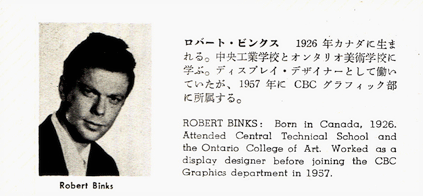
Robert Binks in his mid-30s, as presented in a Japanese graphic art magazine called Idea. The article appeared in 1961 and was about the graphic artists of the CBC, where Mr. Binks had been working for four years.

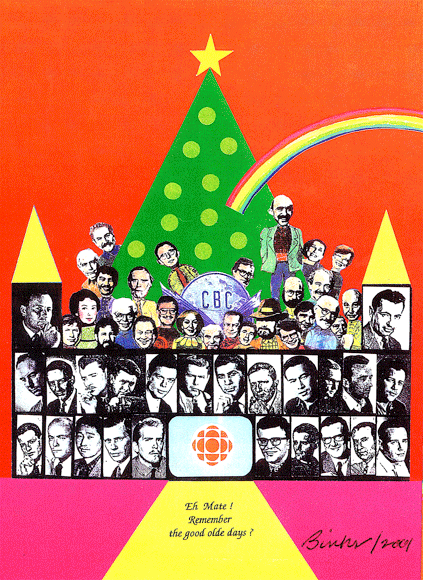
Below is a Christmas card, designed by Mr. Binks, that went out to active and retired CBC graphic designers in 2001. Mr. Binks himself had retired 10 years before, but he produced quite an extravaganza.


The photos are all of CBC designers. The black-and-white photos are from the issue of Idea mentioned above. You’ll see that Mr. Binks’ 1961 picture pops up just to the left of the CBC emblem. Of his CBC days, Mr. Binks recalls: “As designers we produced promotional slides, illustrated stories, title credits and animations. We were encouraged to be inventive and think outside the box.”

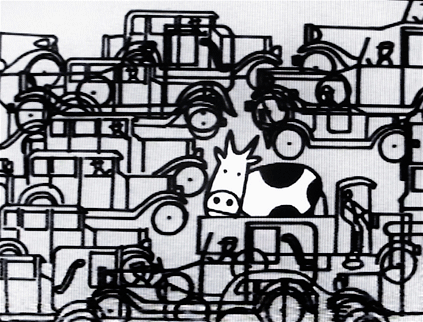
Now what can only be called a characteristic theme. Mr. Binks finds something funny about cows, especially cows that show up where they don’t belong.


The work above is from the project that got Mr. Binks started on the theme, an animation sequence for a program called All About Toronto. “In 1964 or so, back in the days of black-and-white television, I illustrated a story of a cow threatened by the bustle of the big city,” he wrote to me by email. “For this scene black line graphic cells were panned in opposite directions to create a busy traffic effect. To make the cow stand out visually, white cel paint was added.” (For more of Mr. Binks’ cow efforts, look at the posts here and here.)

I think the drawing is beautifully composed. The right-angled shapes and occasional rounded shapes and the patches of space and the busy parts — they’re all crowded together, but modulated and placed so that somehow they fit. The traffic’s busyness jumps at you, but there’s no jangle and your eye isn’t overwhelmed.

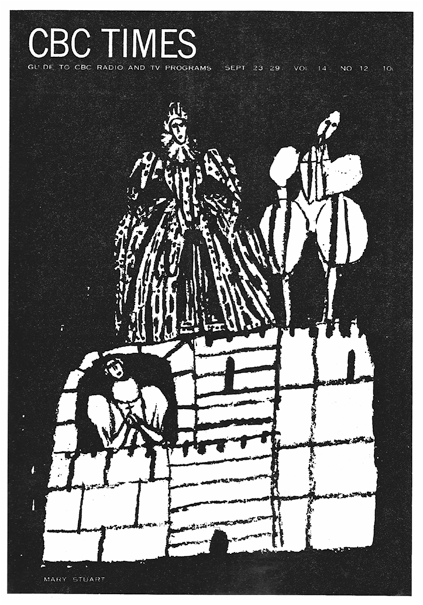
Below is a CBC Times cover depicting the CBC drama, Mary Stuart, Queen of Scots, circa 1961:


The late ’50s and early ’60s saw a lot of faux-naif treatments of high European art, or at least that’s my impression from album covers and theater programs of those days. This Mary Stuart is an especially nice example.

The picture is mocking but also wistful, a combination that I associate with such works. The figures here look like rag dolls locked into a high-vaulted drama that they don’t understand and that nobody else understands either. Mary Stuart emotes, hands clasped and head tilted. The Elizabethan gentleman sags and his head lists, as opposed to tilting. Elizabeth dangles. They’re all grouped around Loch Leven Castle, which is bone-white, and behind them is the black.

The drawing displays two traits that pop up in Mr. Binks’ work. There’s the patch of intricate patterning (Queen Elizabeth’s gown) and the block formed by repeated primary shapes (in this case, Loch Leven). Typically, the block seems to be pulling upward, as is the case here because of the way the shapes within the castle are arranged.

I think the arrangement of the castle’s shapes creates a grace note. The center pile of narrow rectangles abuts a pile of taller, bigger rectangles just to the right. The clash throws into relief the black gap between the two columns, and this gap acts as a line that runs straight up the castle to where Queen E’s foot is planted next to that of the listing gentleman.

To the left of the line, Loch Leven tilts away; to the right, the castle is a bit steadier. So the gap acts as a fault line, and the fault is elaborated on by the positioning of the two fgures. Queen E’s body tilts one way, the gentleman’s head and shoulders sag the other. Subliminally the two of them seem to be toppling away from each other. For what it’s worth, I find this effect underlines the sense of helplessness mentioned above. It’s part of the mocking undercurrent associated with presenting the high historical drama in a faux-childish way.

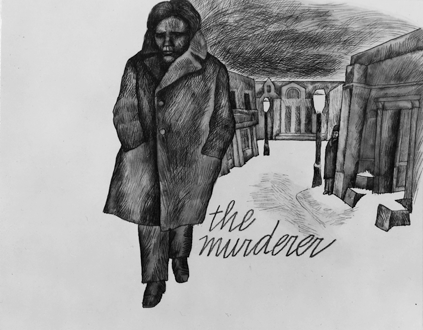
A promo slide graphic for a CBC drama, The Murderer, circa 1962:


The drawing is heavier than usual for Mr. Binks. “This graphic was done in an acrylic water color technique with India ink detail,” Mr. Binks wrote by email.  “I was trying for a heavy dramatic feeling.” The characteristically lopsided, playful composition of the buildings takes up much less space than it normally would in one of his pictures, and the foreground figure, looking haunted, is broader faced and more somber than is typical of a Binks figure. The touch that looks most like the artist’s usual work is the popping out of the background figure, who is presumably on the main character’s trail.

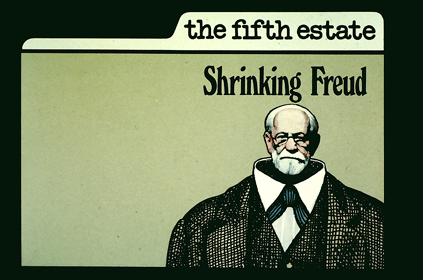
Next, from 1985, a background graphic used for The Fifth Estate, a public affairs program. On screen the host stood to one side of the image.


Shrinking Freud is an example of how Mr. Binks will sometimes play with the pride of place that normally goes to head or features. The eye falls inward from the giant collar and shoulders to find the miniature Freud head.

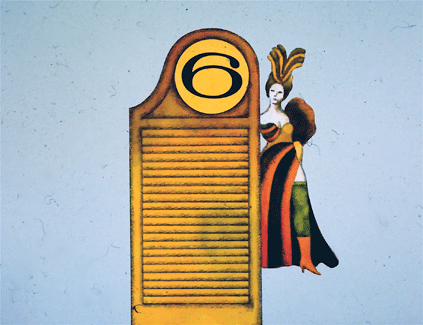
A subtler form of the trick is played by this station break graphic that Mr. Binks designed for Channel Six Toronto, a CBC television station, circa 1975. It shows a saloon door, a show girl and the station’s number. The 6 in its oval, planted atop a column, is like a face that turns out not to be a face; instead the only face in sight, also oval, turns out to be smaller off to one side:


The picture gives the viewer’s eye a strong anchor because the saloon door and show girl, standing side by side, form a vertical block that firms up the center of the picture. But at the same time that block is full of stylistic mismatches that somehow liven up the eye. They’re tricks similar to the head switcheroos mentioned above.

For example, the tight, horizontal rectangles in the door pull away from the big oval at its top, and the number itself is both prominent and a bit too high up for the eye to fall on it comfortably.

The number’s curves and the curves of the woman’s feathers are close together and therefore link up. But the number’s curves are horizontal and the feathers’ are vertical, so the two sets of curves pull against each other. And the feathers themselves push away from each, one set pointing left and the other right.

The symmetry of the feathers’ two arcs bounces against a lopsided echo further down, where a hulking set of curves (the woman’s dress) pushes off to the right.

As noted, these discordancies stimulate the eye instead of baffling it. But why that is I cannot say.

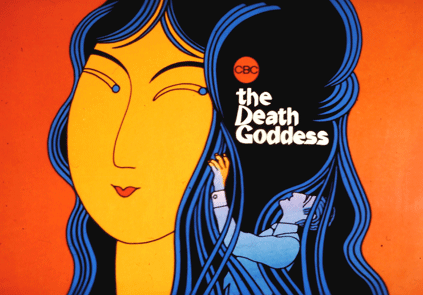
Circa 1982, a promotion graphic for a CBC drama, The Death Goddess. Mr. Binks writes “I used a photographic clear cel with black detail.”


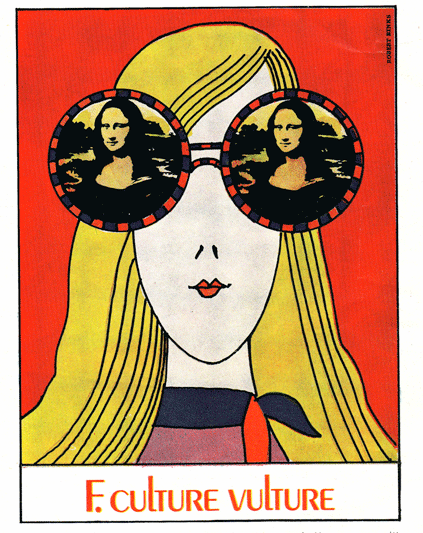
Here’s a non-CBC work. In the mid-1960s Mr. Binks freelanced this illustration for Chatelaine magazine. He describes the subject matter as “a young woman’s first solo trip to Europe.”


As with Shrinking Freud and the Channel 6 promo, there’s a disrupted face at the center of the drawing. Which is a heavy way of talking about a charming picture, but bear with me. Where the girl’s eyes should be, she disappears and one of the most famous faces in the world looks back, but miniaturized and doubled.

Finally, three of Mr. Binks’ post-retirement paintings, all displayed in his home. The right-hand painting and the accompanying cow sculpture were combined by Mr. Binks into a work called “Cowgratulations,” which can be seen in the post here.


Next week: a black-and-white mastodon and color animation sequences about a fairy tale cat and the frightening beliefs of childhood. Be there!

Life on Earth; Life on Bjork

I’m reprinting two related reviews; the first appeared on Madeloud; the second on Splice Today.
_______________________

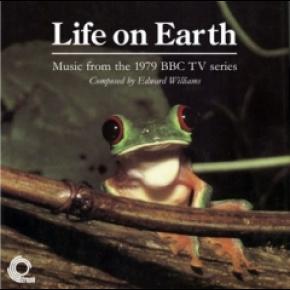
Edward Williams – Life on Earth: Music From the 1979 BBC TV Series

I actually cried when I missed an episode of the David Attenborough BBC mini-series Life on Earth.. I was in middle school at the time, and my family watched the show religiously every week, but I had a swim meet, and we’d just forgotten. Worse, it was the reptile episode. I loved reptiles.

It’s hard to believe I remember all that now, three decades later. I remember, too, that much as I loved the show, the end of each segment was thoroughly disturbing; you’d watch these wonderful, strange animals for an hour, learn about their habits and their lives, and then, at the end, David Attenborough would explain in his matter-of-fact, British voice, how man’s relentless expansion was inevitably going to kill them all.

And yeah, I remember the soundtrack too. Not the melodies or anything, but the broad outlines of the music; quiet, translucent, and fey; chamber music to contemplate extinction by. It’s bizarre how clearly the show comes back to me while listening to this newly released reissue of music from the series. The plangent woodwinds, the splashes of strings, the dischords that never resolve but just drift away — I can see the water dropping into the pond, or the butterfly coming out of its cocoon, or the hummingbird wings slowed down so that Attenborough could count the beats.

Obviously, I’m older at this point, and while the music seemed sui generis back then, it now fits into a recognizable context— which is to say, composer Edward Williams loves, loves, loves him some Debussy. But even so, there’s a strangeness and a humor here that’s hard to resist. The wonderfully named track “The Sex Life of Ferns” starts with a light percussive patter, as if all those spores are nervously shuffling their bits in anticipation; then, towards the end, there’s a lazily triumphant woodwind, and you can imagine various leafy greens rustling in a satisfied manner as the sun sinks low in the distance. “Big Mammals” has a slow, swaying lope with just a touch of Tarzan jungle drum, so you can almost see those big trunks swaying. And then there are the lovely albeit somewhat unfortunate Orientalisms on “Japanese Macaques.” It’s all so melancholically precious, or so preciously melancholy. I don’t know if Donovan ever saw Life on Earth, but if he did, he would have understood.

Perhaps my favorite track is the final one, taken from the last episode in the series, “Man.” I pretty much hated “Man” at the time; I wanted to see reptiles biting things and frogs jumping, and elephants trundling, so a bunch of people walking through cities was just not what I was parked on the couch for. Yet, despite my disinterest, Attenborough’s final words have remained with me for most of my life, and it was a jolt to hear his narration excerpted here. “The fact remains that man has an unprecedented control over the world and everything in it. And so, whether he likes it or not, what happens next is largely up to him.” The music for the finale is an odd duel between a inspiring fanfare and a mournful little solo violin theme. Eventually the fanfare seems to win out…but in the last second or two it trails off weirdly, as if embarrassed. It’s an appropriately uncanny moment. In this mini-series and album, life doesn’t so much dominate the planet as haunt it, passing across the surface of the earth like a shadow, or an oddly vivid memory.

_____________

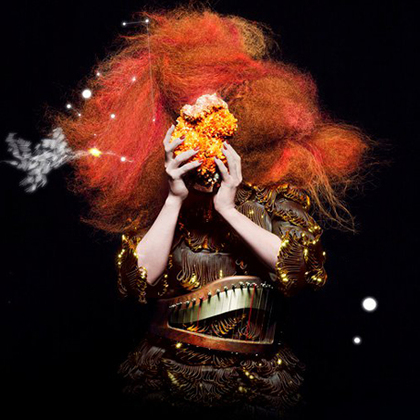
Bjork: Biophilia

Bjork is Bjork. Over the years she’s become one of those artists who is a genre unto herself. Though she’s got connections to the fey new folk movement and links to the fey end of New Age electronica and an affinity for other fey Icelandic post-rock romantics like Sigur Ros, the truth is that when you listen to any of them and Bjork, she becomes the meme and they become the iteration. Or, to put it another way, they all sound like Bjork more than Bjork sounds like them. You can compare her to whoever till your hair turns pixie polycolors, but Bjork is not post-rock folk electronica. She’s Bjork.

Which is why her latest effort, Biophilia, gave me a start. Not that it’s different from her past releases—if you’ve heard Vespertine(2001), or Medulla (2004), or Volta (2007), you’ve got a good idea what to expect from Biophilia. It’s just that all of a sudden, the Bjork sound didn’t sound like Bjork. It sounded like Edward Williams’ music for the David Attenborough mini-series Life on Earth.

What made me think of Williams’ quiet, Debussy-like score are no doubt Biophilia’s lyrics. You can get the gist from the song titles: “Moon,” “Crystalline” and “Solstice.” The album is post-rock folk electronica for the natural world. You listen to its plangent blips and murmurs and visualize plants opening or birds’ wings beating in motion so slow you can see each feather shudder. Nature, in Bjork and Williams, is figured as a series of disturbingly vivid tableau arranged for uncanny contemplation. At the beginning of “Hollow,” the echoey, arthymic keyboard sounds patter forward, then pause, then patter forward, then pause, like a small furry creature scuttling across the ground towards food. “Moon”‘s plucked lilt could be the background for a butterfly slowly coming out of its cocoon. “Thunderbolt” is even more explicit: “Staring at water’s edge/Cold frost on my twig/My mind in whirls/Wandering around desire/…Craving miracles.” Then at the end of the song, the electronics start burping like a series of frog calls. Suddenly Bjork isn’t Bjork. She’s library music for a nature special. How did that happen?

“Virus” seems like an attempt to explain the process. “Like a mushroom on a tree trunk/as the protein transmutates/as I knock on your skin/and I am in,” Bjork sings in her usual hoarse, soaring precious diva style as the music drips and clinks, water falling on chimes. Nature is both a smooth vision on the eye and an ominous visitor moving under the skin. Nothing is really itself. “My sweet adversary,” Bjork calls her lover/disease, as the distanced music and its surface prettiness turn her into an aestheticized transient shadow. If you watch nature, and nature is you, then you are both inside and outside, a ghost infection haunting yourself. At that point, you can hardly be surprised when you become something else, even if that something else is a 30-year-old BBC miniseries.

Or, for that matter, an up-to-the-minute pomo marketing endeavor. Biophilia is as detached from its identity as Bjork is from hers. It isn’t really an album so much as a nexus for related products, including a series of apps for every song and a range of multimedia live shows some of which, apparently, include National Geographic imagery. Still, as I lack the funds, the technology, and the interest to pursue the album through its metastasizing iterations, I’m happy that my brain has instead decided to attach the soundtrack to my own hazy memories of creepily perfect nature specials past. I hate to admit it, but Bjork as Bjork was beginning to get a little boring. Bjork as mushroom with David Attenborough narration, though, is a thought to cheer every phylum.

Obama Is No Khrushchev

Prosecuting former administrations for crimes divides us from our friends, encourages our enemies, and distracts us from the pressing and difficult business of governance. As one high-ranking government official said of a liberal reformer bent on raking up the crimes of the past, “He’s just handing the sword to others, helping the tigers harm us.”

As the poetic idiom suggests, the high-ranking government official was not Dick Cheney — it was Chairman Mao. And the liberal reformer in question was not Glenn Greenwald; it was Khrushchev.

I recently read William Taubman’s massive biography Khrushchev: The Man and His Era, and the book was on my mind as I paged through Glenn Greenwald’s new volume With Liberty and Justice for Some: How the Law Is Used to Destroy Equality and Protect the Powerful. The parallels are fairly obvious. Greenwald argues that American elites have effectively and deliberately placed themselves above the law. Illegal activity by the wealthy or powerful — Nixon Watergate crimes; Reagan Iran-contra crimes; Bush-era illegal wiretapping and torture; Wall Street malfeasance which led to the financial collapse — is not so much ignored as deliberately sanctified. Democrats, Republicans, and the press corps all agree that prosecuting the powerful would be divisive and hurt America. Therefore, as Obama has often said, “we need to look forward as opposed to looking backwards.”

Mao, obviously, felt the same way about Stalin. So, for that matter, did many in the Soviet hierarchy. These people weren’t idiots; they had good reason not to want to expose the extent of Stalin’s crimes. Communism had many enemies, both internal and external. For those enemies open discussion of the hideous mass killings of the Stalin era would be a propaganda coup. Moreover, Stalin’s heirs were all implicated in his atrocities. Mao in China was, of course, wading through shoals of decaying bodies, and was using Stalin’s personality cult as a blueprint for his own. The Russian elite was more directly involved; all had, at Stalin’s behest, consigned innocent people to death; all had failed to speak out to protect the innocent. Khrushchev, who succeeded Stalin, had certainly signed death lists.

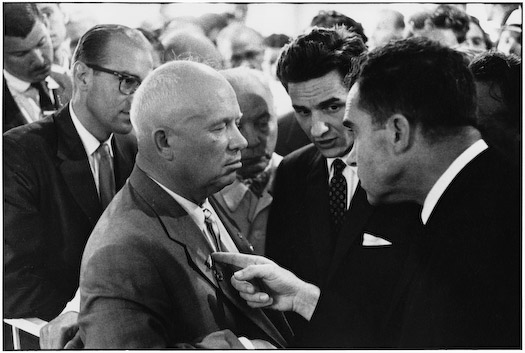
Yet, despite his own culpability, Khrushchev denounced his predecessor. Taubman in his biography calls this denunciation, delivered in a four hour speech, “the bravest and most reckless thing [Khrushchev] ever did.” It was certainly a braver thing, by many orders of magnitude, than any public act committed by Barack Obama, or by George W. Bush, or, for that matter by Clinton or even the sainted Reagan. We tend to think of Soviet rulers as absolute dictators who can govern with impunity, but the truth is that Khrushchev’s position at the top of the hierarchy was by no means entirely secure, and his decision to out Stalin’s crimes was a major political gamble. Taubman describes the reaction to Khrushchev’s speech, delivered in secret to the Twentieth Congress of the Soviet Communist Party in 1956.

Many in the audience were unreconstructed Stalinists; those who had denounced former colleagues and clambered over their corpses suddenly feared for their own heads. Others, who had secretly hated Stalin, couldn’t believe his successor was joining their ranks. As the KGB chief-to-be Vladimir Semichastny remembered it, the speech was at first met with “a deathly silence; you could hear a bug fly by.” When the noise started, it was a tense, muffled hum. Zakhar Glukhov, Khrushchev’s successor in Petrovo-Marinksky near Donetsk, felt “anxious and joyous at the same time” and marveled at how Khrushchev “could have brought himself to say such things before such an audience. ” Dimitri Goriunov, the chief editor of Komsomolskaya Pravda, took five nitroglycerin pills for a weak heart. “We didn’t look each other in the eye as we came down from the balcony,” recalled Aleksandr Yakovlev, then a minor functionary for the Central Committee Propaganda Department and later Gorbachev’s partner in perestroika, “whether from shame or shock or from the simple unexpectedness of it, I don’t know.” As the delegates left the hall, all Yakovlev heard them uttering was “Da-a, da-a, da-a” as if compressing all the intense, conflicting emotions they felt in the single, safe word, “yes.”

Of course, George W. Bush is not Stalin. Stalin caused the death of millions, and ordered I don’t know how many innocents tortured to death (thousands? tens of thousands?). Bush’s aggressive (and therefore, by international law, illegal) war in Iraq killed only in the low hundreds of thousands according to most estimates. Greenwald says the torture Bush authorized probably resulted in the deaths of at most 100 people. Similarly, the Obama administration and its Democratic allies have much less to lose by exposing their predecessors than did Stalin’s followers. As Greenwald points out, Democratic muckety-mucks like Nancy Pelosi and Jay Rockefeller were informed of Bush torture tactics and illegal wiretapping, which makes them complicit under the law. But they weren’t murderers like Khrushchev, and they haven’t just lived through a political bloodletting like the purges. If worse came to worse, they would only get jail time, not execution following a quick show trial.

These comparisons, though, do not necessarily redound to the credit of our political class. Khrushchev exposed Stalin-era crimes even though he had much more to lose by doing so than Obama has to lose in exposing Bush’s. Even in terms of national security, Khrushchev was in a significantly more precarious position. The U.S. has al-Qaeda to worry about; the Soviet Union had the U.S.— and, many, many other enemies, all much more credible as existential threats than Osama bin Laden could ever hope to be even in his most megalomaniacal wet dreams.

In fact, Khrushchev’s deStalinization damaged the Soviet Union in the short term, and arguably destroyed it in the long. The secret speech, which was at Khrushchev’s insistence duly publicized, sent shock waves through Soviet colonies in Eastern Europe. The Hungarian Revolution — which Khrushchev ruthlessly and bloodily crushed — was inspired in large part by the revelations of the true horror of Stalin’s reign. Khrushchev’s speech also alienated Mao, separating the USSR from one of its most important allies. Khrushchev’s anti-Stalinist rhetoric was used against him when he was forced from power in 1964, with one colleague declaring, “Instead of the Stalin cult, we have the cult of Khrushchev.” Even after Khrushchev himself was gone, his reforms continued to undermine the government and philosophy to which he had devoted his life. In the late 1980s, Khrushchev’s deStalinization became the blueprint for Gorbachev’s perestroika and glasnost, which ultimately caused the Soviet system itself to buckle.

So Obama and Mao aren’t wrong. Looking backwards can turn you into a pillar of salt. Exposing the crimes of the powerful really can delegitimize a government, and holding past rulers accountable really can have devastating consequences. To have faith in the rule of law, as Greenwald does and (vacillatingly, but nonetheless) as Khrushchev did, is to have faith in the system. It is to believe that democracy (or in Khrushchev’s case, socialism) is strong enough and vital enough to withstand the light of truth.

As it turned out, Soviet Communism wasn’t strong enough to withstand that light. Maybe our government isn’t either — in which case, the sooner we find that out, the better. Khrushchev’s deStalinization resulted in much misery for both himself and the country. But I don’t think anyone doubts it was the right thing to do.

Not that Khrushchev was a saint. On the contrary, he was a boorish, overbearing, often cruel man, with blood on his hands up to his elbows. But if we’re going to toss out the rule of law and model ourselves on tyrants, better him, by far, than Mao or Stalin.
__________________

This first ran on Splice Today.

Bandits and Opium Sellers

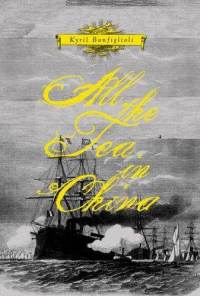
Kyril Bonfiglioli’s All the Tea in China and Peter Carey’s True History of the Kelly Gang are both rollicking adventure stories set in the past when men were men and skullduggery was a rip-roaring adventure rather than disreputable thuggishness.

Bonfiglioli’s hero is Karli Van Cleef, a Dutch Jew who swashes and buckles his way across the eighteenth century, peddling opium, eating prodigiously, and driven about equally by lust for gold and standard issue lust. Carey’s hero is the well-known Australian outlaw Ned Kelly, who has a heart of gold, the soul of a poet, and is persecuted, persecuted (as Karli, who is fond of repetition, might put it.)

Both books are built around the boys’-adventure-generating possibilities of imperialism. Karli can try his fortune thanks to the British empire and its gleeful trade in dangerous drugs (after trying opium himself and being brought to his senses only by a coffee enema, Karli tells his boy that the next time he requests opium, the boy is to hire a burly man to beat him until he falls unconscious. “This will be both cheaper and better for my health.”) Ned, on the other hand, is an Irish subaltern, hounded by the English police into banditry, violence, and murder.

The main difference between the novels is tone — All The Tea in China is a light humor novel; Bonfilioli has often been compared to P.G. Wodehouse. The True History of the Kelly Gang, on the other hand, is a serious work; it won the Booker prize in 2001, and its narration (by Ned Kelly himself) is self-consciously naif-profound in high modernist style — as you can see from the first paragraph.

I lost my father at 12 yr. of age and know what it is to be raised on lies and silence my dear daughter you are presently too young to understand a word I write but this history is for you and will contian no single lie may I burn in Hell if I speak false.

I think the conventional wisdom is that a serious book should have a more, thoughtful, serious take on serious issues. Not in this case, though. Carey’s prose is as graceful as his head is empty. He takes his epigraph from Faulkner, but his heart is with RL Stevenson. You’d think a Big Literary Novel about Ned Kelly might try to puncture the sentimental Robin Hood image, but you’d be wrong. Carey’s Kelly is wartless; a confused kid who only wants to do right for his family and his mum, led astray by both and, ultimately, by poverty and oppression. A multiple murderer, he remains always innocent, that naif prose, so simple and yet so clear, simultaneously absolving and elevating — lack of punctuation as the blood of the lamb.

Karli’s narration, on the other hand, is not only correctly punctuated, but is unfailingly cosmopolitan and witty. Much of it is devoted to describing at length his viands:

There was also a dish of hot buttered parsnips; they were very good. I ate them all, for Mr J. declared they spoiled his appetites for the meats. Then Batsay brought in a dish of things called “Poor Knighs of Windsor”: these were pieces of bread and jam fried. They do not sound good but they are. Mr. Jorrock’s Stilton cheese was even better than Mr. Creed’s; he pretended that it was “so werry frisky that he had to hold it down on the table as I scooped, lest it walk away.

For Carey, experience is an ongoing trauma; for Bonfiglioli, it is an ongoing appetite. Similarly, Carey’s imperialism is a tragedy; Bonfiglioli’s is more in the nature of a joke, as when the native Dutchman quips that Ireland is “an island off the coast of England, just as England is an island off the coast of Holland.”

It’s not that Bonfiglioli downplays the cost of oppression, exactly. One of the more shocking moments in the book occurs when Karli’s faithful child servant is dragged away by a lion…and Karli’s girlfriend, Blanche, tries to comfort him by reassuring him that she’ll wash his linen. It’s not that she’s a cruel person; it’s just that the boy is lower class, and for her that means he’s not really a human being. In Carey, oppression often seems to be a function of direct sadism. That happens in Bonfiglioli as well — but more often, hierarchies are perpetuated by a combination of thoughtlessness and self-absorption.

Karli is actually affected by his servant’s death. He sees him as human…perhaps in part because he is himself socially marginal in certain ways. As a Dutchman and a Jew, he’s not on the bottom rung of the class ladder the way Ned Kelly is, but he’s not exactly on the top either. From his anomalous perspective, the Chinese aren’t any more mysterious than the British — both, in fact, seem motivated mostly by naked self-interest and duplicity. The British sell the Chinese opium; the Chinese trade for the opium with stores of fresh water which turn out to be contaminated and undrinkable. Everyone fucks over everyone else to the best of their ability — which doesn’t make imperialism okay so much as it makes the Chinese (and other subalterns) able to get back a little of their own.

Carey’s earnestness and sentimentality means that Ned Kelly is defined by his victimhood; all his evil misdeeds, all his violence, is essentially blamed on his wounds. He’s a creature of his persecution. Bonfiglioli’s humor and cynicism, on the other hand, allows him to present the oppressed as genuinely wicked and amoral in their own right — which is a great relief. Ned Kelly dies a little inside every time he performs a dastardly act; Karli, on the other hand, is full of good cheer when he lies to the ship’s Captain about his religion in order to be accepted for passage. Being a Jew doesn’t make him a victim; it makes him a money-grubbing, intellectual sneak; an exotic daredevil who will deflower your women with his circumcised bits.

Of course, the flip side of this is that Bonfiglioli does make imperialism seem like rollicking good fun. Opium selling is obviously bad — but there are so many opportunities for riches! Kelly and Kiril encapsulate, perhaps, the difficulty in writing about oppression. Carey makes Kelly’s oppression so dire and all-consuming that it robs him of freedom of will — even his act of rebellion seems like a dour imposition from his masters. On the other hand, Bonfiglioli makes turning the oppressors tools against them seem like such a blast that it validates the system itself. Even the satirical moments (like the boy’s fate) seem like ratifying larks. It would be a shame to not have servants if that meant we couldn’t have jokes about them dying by lion.

So…witty heartlessness? Or lugubrious pathos? The Booker has already chosen the second, so I will take the first, thanks.

A Conversation about Habibi’s Orientalism with Craig Thompson

Around the time I was writing my critique of Orientalism in Craig Thompson’s Habibi a strange thing happened: I got to know Craig Thompson. Through a mutual acquaintance and a series of chance convention run-ins at San Diego Comic Con and the Alternative Press Expo in San Francisco, we became casual acquaintances. While writing up my honest reaction to Habibi I decided to burden our new friendship with the weight of criticism by calling to ask him a few clarifying questions. The result expanded the scheduled ten minutes of chat time in to a much longer conversation about Orientalism, feminism, cultural appropriation, the burden of relationships, and the thematic successes of Habibi. The only thing I’d like to add before presenting our conversation is something that should become evident to you while reading it: Craig Thompson is a supreme class act. Not only did he take time out of an extraordinarily busy schedule to directly confront my criticism of a book he spent over seven years making, but he did it with an amount of grace and humility that I didn’t know was possible.


Nadim Damluji: I want to start by talking about Orientalism, which it appears you were conscious of during the process of making Habibi. During the creation process, did you ever second guess your ability the distinguish between using Orientalism as a playground versus simply reproducing it?

Craig Thompson: I don’t want to repeat myself, but I keep saying that the book was a conscious mash up between the sacred medium of holy books like the Qu’ran and the Bible and the trashy medium of Comic Books. And I was keeping in sight this sort of unpretentious, self-deprecating, low-brow, motivation of comics.

As for the charge of Orientalism, I knew it was going to come up no matter what, so why not embrace it? More broadly, I’ve always liked genres that have a degree of exploitation to them like horror films. They play on these really crass and appealing elements that also exist in 1,0001 Nights or French Orientalist paintings. It was fun to think of Orientalism as a sensationalized genre like Cowboys and Indians, which is a very poor representation of the reality of the American West, but fun to think of as a fantastical genre. And at this point in history, most people who watch things in the Cowboys and Indians genre totally realize it paints an inaccurate image of what the West was like … well actually you know there are people who watch cowboy films and think that’s what it must have been like. In fact, I’m pretty sure George W. Bush is one of those guys whose political beliefs are shaped by those films.


ND: I’m familiar with French Orientalist paintings and it feels that you are expanding on the snapshots those painting provide — like the scenes of Habibi that take place in the Slave Market or in the Sultan’s Palace — but those images are very loaded with this implicit “White Man’s Burden” element. In other words, we need to save the Arab women from the Arab men, and that’s how the French imagined “the Orient.” Did you ever fear that you were carrying the baggage of the medium by imitating that style? Specifically, I’m curious to know how you set a limit for yourself when sexualizing Dodola to avoid reducing her to simply another exotic Arab woman in Western literature?

CT: I wanted to sexualize Dodola, because I wanted the reader to experience her through the lustful gaze of all men, and primarily the gaze of Zam. Hopefully the lust of Zam is transmitted in those drawings, and maybe at times the reader identifies with it or other times feels disgusted by it or ashamed by it, which mirrors the experience Zam was having. Throughout the book even the Orientalism is a commentary on exoticization. Which isn’t just about any specific culture or ethnicity, but a stereotype of what men do in general or what a lot of people do in romantic relationships. I’m examining American guilt and I’m examining male guilt. In male guilt there is so much of this energy of objectification and idolatry and eroticization. When I think of those French paintings I don’t see the “White Man’s Burden” of the French needing to save the beautiful Arabic women from their oppressors, I see the opposite: French men swarming in a perverted sort of way and trying to make fantasy reproductions of what those ladies look like under their hijab. I don’t think it paints the colonists in a positive manner, it makes them seem like these creepy little voyeurs.


ND: Especially because so many of those paintings were created without the painters actually going to the Middle East…

CT: Yes, exactly.

ND: Which makes those paintings problematic because those landscapes are imagined but purporting to portray reality. You’ve talked previously about trusting your subconscious in the creative process to guide you in navigating taboo. That makes for two distinct parts of Habibi: the subconscious imagined landscapes element that is the bedrock of Zam and Dodola’s love story, which you’ve noted was created aware of Orientalism, and then the research heavy elements of the book which deal more with the Qur’an. What I’m afraid of is that readers will take the more imagined and playful parts and give them the same level of plausibility as the clearly research heavy sections of your book. Now obviously you can’t be responsible for all your readers…

CT: That’s an understandable concern. For me it seems, on some level, a little silly that people keep talking about and examining Habibi as if it were some academic book, which it definitely isn’t. I keep labeling it as a “fairy tale” because that is definitely my intent. As much as an artist I want to strive to create comics as art or as literature, I’m still at my core just a cartoonist. Cartoonists want to make these exaggerated caricatured playful ridiculous irreverent drawings in some ways. I do feel reverent and respectful to elements of Islamic faith, but through the whole book there is a sense of play and self-awareness around the fact it’s still just a comic book. It’s super heroes in some ways. It’s Star Wars. But maybe the energy to focus on Habibi as an academic text is coming from outside the comics medium, where people are surprised to see more mature elements in a comic. In some ways the dialogue should also revolve back to the medium itself, which still has a satiric intent. I hesitate to say that, because I don’t want to say that Habibi is satiric towards any faith or religion. But comics are this sort of a self-deprecating medium inherently.


ND: I can speak to the academic tendency! For me, a lot of that has to do with the packaging. It’s this big tome and it’s by “Craig Thompson, author of Blankets,” and it feels a lot more “literary” just by virtue of packaging and the Pantheon label than more crass comics do. Do you ever feel a burden as one of a very few comics artist that is sold in Barnes & Nobles as well as local independent comic shops? You have those two worlds of fans that you have to appease and respond to.

CT: I feel privileged to be in that position. Since I’ve started my career in comics I always wanted to extend to a broader audience. I always felt that comics as a medium was untapped in terms of audience potential and that I was being held back by a lot of the retailers, distributors, and the attitude of fans in the industry. I definitely wanted to embrace this little fad in publishing of “graphic novels” because it feels like a window to extend comics to a bigger audience. I was excited to bring comics outside of the weird collector’s world. You know there’s been these different explosions in comic’s history of interest in the medium, but they’ve always seemed real tied up with the speculator culture. For me the bookstore is taking it back to the mass arts roots, like the Daily Newspaper, something that a common reader has access too and stumbles on and not just sequestered to a little cult Indie following the way an obscure punk record store would be. And I love buying a lot of those “tome” like products…


ND: Me too! When you’ve talked previously about about the goal for Blankets being 500-pages before you even had the story, I get that as a collector and fan of books in general.

CT: But I would like to create more modest projects too. Maybe naturally Habibi had to be this kind of book as a follow up to Blankets, because there was so much expectation of this as my “sophomore effort.” I don’t know, I think it also happened because of the emotional space I was in at that point in my life. I was being reclusive and in my Salinger phase. It would have been strange to emerge from that with something less.


ND: You’ve mentioned Joe Sacco as an influence. I don’t know if you understood it this way, but I found a lot of the Qur’anic elements to be a more Sacco-like project that had you looking at the footnotes of Suras and Haddith to pull out a really interesting research thread. Those are the parts of Habibi that I felt were most in your voice. I wonder if you ever had more of a desire to work in that vein as opposed to fiction? And jumping off that, our mutual friend Edward Said writes about the need for authors to “catalogue personal inventory” which in a very basic sense is a call for the author to put themselves in relation to the text in writing which creates a space for readers to know where the author is coming from. This is especially crucial in writing about the “East” from the “West,” which Sacco seems aware of by putting himself in his comics with obscured glasses; he is drawing in his subject position. Have you ever thought more about if post-Habibi you’d attempt a project more explicitly like that?

CT: You know what they say about dream analysis is that every character in your dream is a role that is played by yourself. You have to look at your dreams like “why am I stabbing myself with a butcher knife?” and you can’t judge any character because they are all representations of you. I feel similar about fiction. I can see parts of myself in pretty much every character in Habibi, even the ugly ones. For example there is one of the eunuchs that is creepy, more bad cop hijra, and I tried to draw that as a gross drag version of myself. I thought, what would I look like if I was a hijra and I focused it on my features. So there you have a character who is supposed to be a ridiculous hijra version of myself. Elsewhere I certainly saw myself in the fisherman, Noah. The Sultan, a lot of my female readers are disturbed and disgusted by him, but most of my male readers think he’s hilarious and identify him as a caricature of male sexuality in general. I can see that. I was playing that up for laughs for myself, like this is the way guys think a lot of the time.


ND: It’s really illuminating to hear that. The Sultan’s one of the more problematic characters for me so it’s interesting to hear you recast him in that light. With the fisherman, and the recurring focus on the Abraham story from both the Bible and Qur’an, it seems that Habibi is a way for you to explore sacrifice and the role it plays in our lives. It might be hard to articulate, but why was that such an important thread for you at the time you were making Habibi? I mean the role of sacrifice in relationships must have been important if you agreed that you were going to spend 7 years on a project dwelling on it.

CT: Well that definitely coming from a more Christian angle. That’s something I was thinking about while working on the book. Other than obviously the core Abraham story, sacrifice overall is a bigger theme in Christianity and the shame and guilt associated with having someone sacrifice their life for you. But, personally at the inception of Habibi I was processing being a caretaker in a relationship. I was in a long romantic relationship where I was also a caretaker and those are conflicting roles: to be a parent and a lover simultaneously, which is what Dodola is to Zam. I’m getting off track… I was thinking a lot about how much these sort of guilt feelings that shape my spirituality are purely about coming from a Christian background. As I talked with a lot of Muslim friends I didn’t find they shared that same core guilt and shame and sense of martyrdom in their faith. Of course, if you look at Islamaphobic observations of Islam people think of suicide bombers and jihad. So there it becomes an idea of sacrifice and martyrdom.


ND: As a Muslim myself, I feel the Qur’an is more about exploring love than extreme sacrifice. Although, there is Ramadan. Either way, I do really like that thread and how you weave it throughout Habibi. I want to switch gears to talk about Wanatolia and the decision to make it a timeless city, and how that factors into the end of the comic. I was hoping you could articulate how you had the decision for Dodola and Zam to return to Wanatolia and the reveal that it is modern in the western conception, even though at the heart of it is this palace which is backwards.

CT: In earlier drafts of the Sultan’s palace, I was mediating on the Bush administration and feeling like it was this sort of clueless world that existed outside of our own society. That was in the aftermath of 9/11 when you would see Bush off golfing somewhere. And certainly some Sultans during the Ottoman Empire have been critiqued historically for being clueless what was happening in society. That’s how the Ottoman Empire fell, the Sultans were living in a hedonistic cushion. By hedonistic I don’t mean they were sleeping with all their courtesans … it’s just the role of Americans and rich people in general that are totally oblivious of the state of the world. In terms of that clashing of the new and old world, that exists everywhere. If you travel to a developing country, you see people living in incredible poverty and living very simple lifestyles similar to 100 years ago brushing up against modernity and global trade. You can see how obviously our consumerist society is feasting off of poverty in their countries and how all our waste is there. Here we just consume and produce a lot of waste and then it sort of disappears and we don’t have to deal with it precisely because we are heaping it on to other people. And that’s a reality… I’m doing a fairy tale or parable version of that, but I don’t feel like it’s dramatically abstracted from the world we live in.


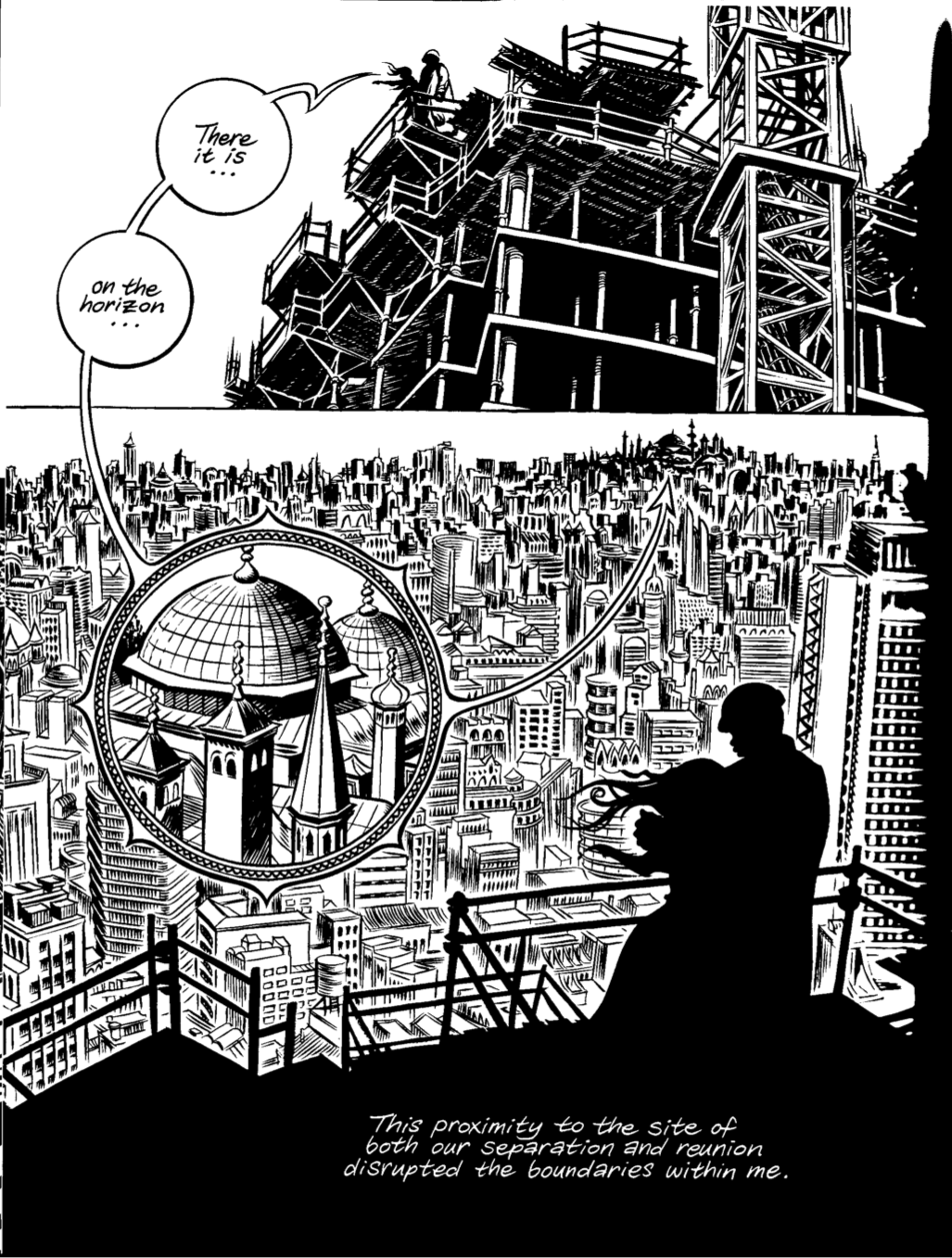
ND: For me the way it does feel abstracted is that there are no time markers and there are key fairytale elements. But then there’s that page in the book where you write “The proximity of the site of both our separation and reunion disrupted the boundaries within me” when Dodola and Zam see the Sultan’s palace from their new makeshift condo. The problem I had with this moment is the extent to which the backwardness of the “timeless palace,” as a place where they are both slaves, and the spot of their freedom, evidenced by that moment when Dodola takes off her hijab, are so close; I find it somewhat disrupting. And you don’t have to account for why me or any reader should feel disrupted by this revelation, but it is a shocking thing to have a modern city fueled by such tremendous backwardness that I don’t see justified in the text. Hearing the George Bush analogy at least helps put Wanatolia in a better context.
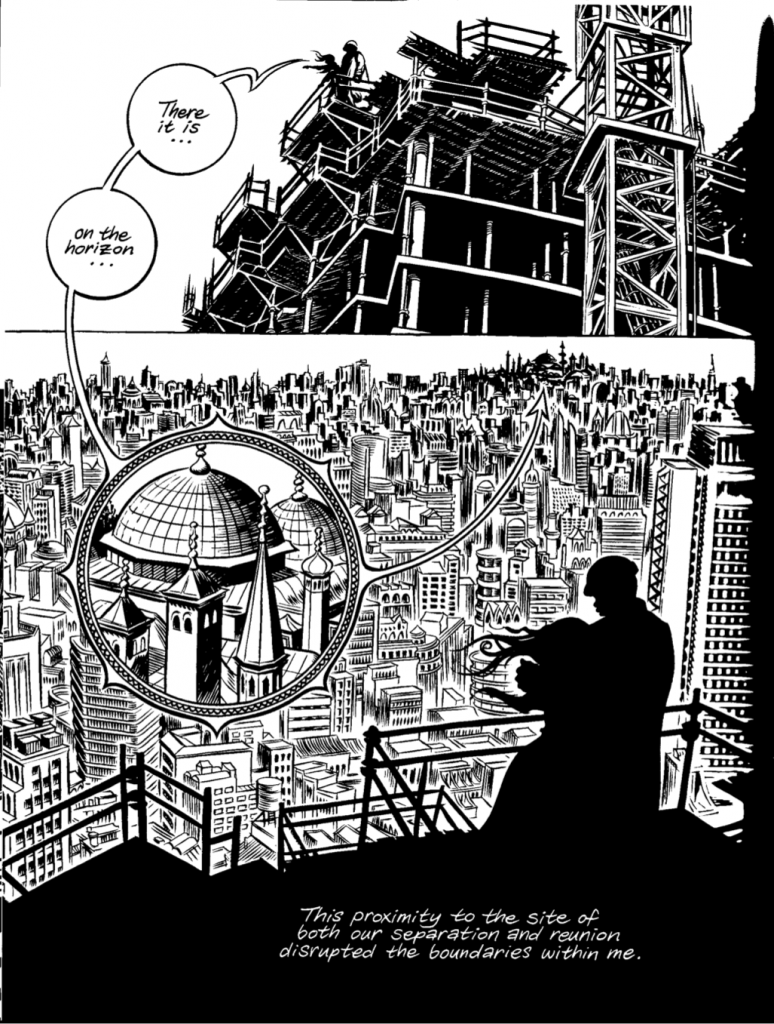
 

CT: Being in a city is about being in America basically. Having all these creature comforts and material comforts, but Dodola and Zam are coming from a place where they are also aware of suffering elsewhere. Which is sort of an adult experience, becoming more aware of the privileges you have compared to the rest of the world. It’s developing a sense of how you’re a passive participant in taking advantage of other cultures. And someone else has brought up the hijab thing to me, and for me the only real moment Dodola removes her hijab is when she does it to wrap up and clothe this little child at the end. For me that’s the only real moment and any other moment is incidental. If she has a hijab in one panel and off in the next, it mostly has to do with the comfortable space between her and Zam.


ND: The scene I’m specifically referring to is when she sees the “modern women” shopping in the city and there is a moment she takes it off then she gets accosted by lustful men a page later and she puts it back on…

CT: For me that scene is not “Oh! I realize I can be free like this women,” but more that she wants to fit in in this new context. She feels like an outsider, which I think the reader will perceive the other women that way because they seem to be from another world. And she does cover herself up because of this male gaze.


ND: This brings us back to how Dodola’s body functions primarily as a commodity, how even when the resources run out her body remains a marketable asset. I’m curious about if you ever felt aware of the baggage of her being sexed the whole time, even if that is purposefully through Zam’s perspective. If you ever felt wary of the contradiction between putting a feminist character into a societal position where there is perpetual forced sexualization of her body. I understand you as a “feminist” by putting Dodola out there in a way readers can sympathize with her, but then there’s an aspect of some readers maybe living out their own perverse sexual fantasies through the ways she’s treated. Do you see a danger in that?

CT: I don’t see a danger in it, but I definitely see a contradiction in it. So when you define me as a feminist, I’m OKAY with that, but there’s an irony in men claiming to be feminist to some degree. You can be sort of intellectually feminist, or claim to be, but there’s still a more primal animal instinct. You know, it’s the irony that some men who claim to be so intellectually feminist are the exact same people who are womanizers. Every time I meet another sensitive male it just bores me. And there’s nothing more painful than hearing a guy say he’s a lesbian trapped in a male body. So I’m exploring that contradiction: any man claiming he’s feminist is bullshitting, because your still animalisticly male. Again, I’m talking about heterosexual desires, but this crosses over to all sexual genders from transsexual people to homosexuals. That’s what I was exploring in my own life, that your sex drive is in conflict sometimes with ethical beliefs and you have to recognize both energies. If you put all the negative aspects of your sexuality in the shadow, then you’re probably going to fuck up and make some sort of mistake in your life, the way that politicians and televangelists do when we hear about their sexually deviancy. It’s the classic Catholic Priest scenario: if you don’t own up to your own shadow elements then they’ll emerge anyways and much more destructively.


ND: Without a doubt that sounds like a contradiction worth exploring. The problem for me is that for much of Habibi we go for long stretches of only seeing the shadow and then it becomes an issue of who’s casting that perverse shadow. When I hear you talk about it it makes a lot more sense holistically, but when I’m reading it as a stand-alone piece there is this disembodied voice of the author that makes it harder to accept those narrative choices. I guess that you exploring your own sexual contradictions gives readers a space to explore that to and maybe what I’m responding to is how uncomfortable that makes me as a reader feel…

CT: GOOD! That makes me happy I think. Maybe not happy, but it means the art has done its job if it makes the reader uncomfortable.


ND: When I heard about the project of Habibi I was expecting maybe a lighter fairy tale, but then as a reader you get confronted with slavery and rape and it’s all at the service of this endearing love story, but it’s pretty jarring throughout.

CT: And when I think of fairytales I think of those dark elements. It seems that all the great nursery rhymes, fairy tales, and children’s stories are full of those exact same dark twisted elements. It’s the tradition of the genre. And I’m not speaking of 1,001 Nights even, but Hansel and Gretel or Little Red Riding Hood.


ND: Well to pick up on that it seems that in order for you to call it a fairy tale it has to have a more happy ending. And you provide that by having Dodola and Zam reunited and creating a safe space for a new child, but did you ever have the impulse for it not be happy at the end? To just be brutal?

CT: Oh yeah. Definitely. I never wanted the book to have a cinematic Hollywood ending, and I wrote variations that were more cynical, but ultimately the end that was the most truthful was the far more optimistic one. That said, people see what that they want to see in the endings. With both Blankets and Habibi I’ve heard people say both that they were either super depressing or super hopeful. I find it very interesting when the reader imposes their own experience onto the endings.


ND: In Habibi there are these moments were you get a completely new character, like Noah the Fisherman, that feel part of their own complete story. Was that a product of the amount of time you were spending on Habibi and needing a new narrative voice to take a break?

CT: Noah was there from the very first draft. As I was working on the book a lot of people wanted me to remove him. They felt he was too much of a total aside and irreverent basically. But I really enjoyed writing him for my own sake and felt he was a necessary dash of levity in the midst of all the darkness and heaviness. For me he made me laugh a lot and there’s a lot of pleasure writing that character even though there’s an intense sadness to him. I did want the chapters to feel like their own graphic novels to some degree. I was very aware that Zam and Dodola would be apart for hundreds of pages, I wanted it to feel that way almost to the point you forgot about the other character at times. They only existed in this idealized memory. I like that in books where things wander for quite a while and you lose site of where you began.


ND: It’s definitely a powerful element that they go through so much change on their own and have to reconcile that when they are reunited. I’m interested in your fan’s reaction to Habibi and what readers have said to you about Dodola and Zam. Are they taking to them the same way they do a cute Chunky Rice?

CT: I think so actually! Yeah! Which is the greatest compliment as an author. I felt really attached to them and they felt like real people to me and that is the sort of response I’m hearing from readers.


ND: So if this book is coming from a place of post-9/11 guilt, which I interpret as Islamaphobia in the US, then do you think that Dodola and Zam were the direct product of that? 

CT: No no no! They are unrelated to it at all. They don’t even seem like they’re created. They just kind of arrived from the subconscious fully realized. And they predate anything else in the book. They’re of their own making. Laughs.


ND: So they came with their geography and their own history?

CT: I knew they were child slaves from the start, but I didn’t know what kind of world they inhabited. And my research of slavery and randomly reading books about slavery pointed me in the direction of the East African/Arab slave trade that predated the cross-Atlantic slave trade by 700 years. As I was reading some of those research books they eluded often to 1,001 Arabian Nights which drew me towards that, and while reading Nights I became aware of the Orientalism in the Richard Burton anthology. Around the same time I started studying Islamic Art. But I did attach myself fairly early on to the Arabian Nights landscape. Right away I could see it for both its strength and weaknesses, but I thought of it as a genre that would be fun to work in like Superheros, Science Fiction, or Noir.


ND: But is just such a loaded genre…

CT: Yeah! Bring it on, right!


ND: And I think that’s ultimately my response: it’s hard separating you as a creator who’s clearly very sympathetic and is so good at humanizing characters — which comes across so well in the Qur’anic parts — and the fact that you are swinging around in this playground that is so deeply tied up in a history of otherizing.

CT: And ultimately I like the conflict between those two elements.

___________
This is part of an ongoing roundtable on Habibi and Orientalism.

The Celebrated Rubber Chickens of Dingo Dizmal and Ms. Olive Rootbeer

I am not sure how I came to this. It may be that I should blame the friend of mine who first told me about litho prints of poetry off Etsy. Or maybe I should blame the person who insisted I go into librarianship and thus installed in me a fondness for searching into strange nooks and corners, looking for bookshaped objects. Or maybe I should just blame Noah. Yes, let’s do that. It’s Noah’s fault that I am here today, writing to you about rubber chicken comic book art. Yes.

Ha. Let us blame Noah.

See, several years ago, I wandered off to ALA’s national conference. If you’ve never been to ALA before, it’s a bit strange. You get a wonking great conference hall and fill it with booths and stock the booths full of free books.  Not just any books, but beautiful, well-made interesting books that have been newly published or just won awards.  And then you tell a bunch of book-junkies librarians that they can enter.

It is not unlike those Christmas store shopping rampages on Black Friday where people want Cabbage Patch Dolls.

Except that all the shoppers have about three advanced degrees and pretty much everyone is wearing glasses and sensible shoes.

In any case.  So there I was, a young librarian on her first ALA National Conference, and I went into the exhibit hall with shining eyes and a hopeful heart.  I was certain that I’d be able to find something for work, perhaps learn about some new non-fic, but I was also hoping to find a few new comics.  The brochure that I clutched tightly to my chest mentioned that several comics publishers would be there.

I worked my way slowly through the exhibit hall (I had to detour around a whole block of booths where I suspect an award winner of being), being accidentally elbowed by cheerful women who had stacks of books so high they had to peer around them.

And then I got to the comics section.  Hurray, I thought, I have arrived!

Now let me be clear.  The purpose of all this free loot is not to make a lot of random booklovers happy, the purpose is to get samples into the hands of the people who have the power to acquire the goods.  Free books at ALA are the grease in the wheels of publishing capitalism.  Because librarians don’t just buy books, we talk about them, a lot, to everyone.  The biggest marketing tool for books is word of mouth, and that can’t happen unless some first person, somewhere, acquires a copy.

While I was at ALA, I saw not just marketing people in the publishing booths, but also big name editors.  See, the other thing that greases the wheels of capitalism is knowledge about consumer desires.  So an editor can talk to a circulations manager, who might tell her that the line for the latest Siamese Kitten book is two months long.  Or that right now, SciFi books are being culled for lack of readers.  Or whatever.

In between the passing around of ARCs, there’s a lot of questions.  Some booths had surveys, some did things more informally, but everywhere it was like a mutual explosion of book pimping and lit glee.

I quite enjoyed it.

Until I got to the comics section, where suddenly I was expected to actually pay for anything.  Want a brochure?  Pay.  Want a sample?  Pay.  Want a keychain?  Pay.  Mug?  Pay.  Pay pay pay.

And I know that this stuff ain’t cheap, but that really wasn’t the point.  I didn’t mind paying.  In fact, several times I did try to pay, but the booth folks wouldn’t look up from their internal conversations.  (The ones at Viz were very nice, though.  I had a very nice talk with them–they recommended a bunch of new manga to me, that I ended up either trying or buying, as well as giving me a few free ones to try.  And I note, by the way, that Viz?  Is still in business.  Ahem.)

I did eventually get a brochure for a comics collective thing, but the stuff inside didn’t give me enough information about whether I’d want to buy it or not.  And I’m sorry, but I’m not splashing out twenty or thirty bucks on a brand new work that’s never been reviewed and which may or may not be any good.  I want to, well, at least check it out from the library first.  See it online.  View it off youtube. See a sample chapter.

I finally staggered out of the exhibit hall with three free cloth bags full of free books.  Or maybe it was four bags.  I forget.

What I do remember, besides Chicago’s inexplicable habit of naming every restaurant with single-syllable words (Toast, Fresh, something else) was Noah’s complete lack of surprise at the horrible way that comics was marketed.  He even looked gloomily at the few small flyers I’d managed to get and said that they’d probably have only gotten Jeff Brown to do the covers (one of them had).

But before I left, he gave me a bunch of small-press comics, mostly published the old way with a xerox machine.

That’s not nearly as nice as some of the beautifully produced advanced readers copies I’d gotten off the big guys, but it was plenty to give me a taste and let me know whether I’d want the whole entree.

And that’s all I needed.  Of course I enjoyed having free books (who wouldn’t?), but what I really wanted was new-to-me joys that I wouldn’t have discovered any other way.  Or to read, and love, and tell others about them so that they could have a joyful new book-crush and go out and buy the second volume and the third and so on and so forth, spreading out the happiness like some kind of literary artistic oil spill.  Or virus.  Yeast bowl?  Whatever.  You know what I mean.

But the publishers of comics mostly did not want to give me such joy, either because it had never worked for them or because they liked having a teeny tiny market of books practically nobody buys, I’m not sure.

The thing is though that I still wanted new comics like that.  Wanted to find new comics the way I’d come across a strange but pretty funny kids book that I’d never have bought.  I’d done my own work in small press comics, helping tone a manga some friends did, but beyond getting lots of recs for big press stuff everyone was discussing, I didn’t meet a lot of small press comic makers who were doing things I really wanted to read.

I’ve been keeping a sharp eye out, though.  During some discussion of how people can find small-press comics, I poked around Etsy (because of the aforementioned friend who buys her litho’d small press poems there).

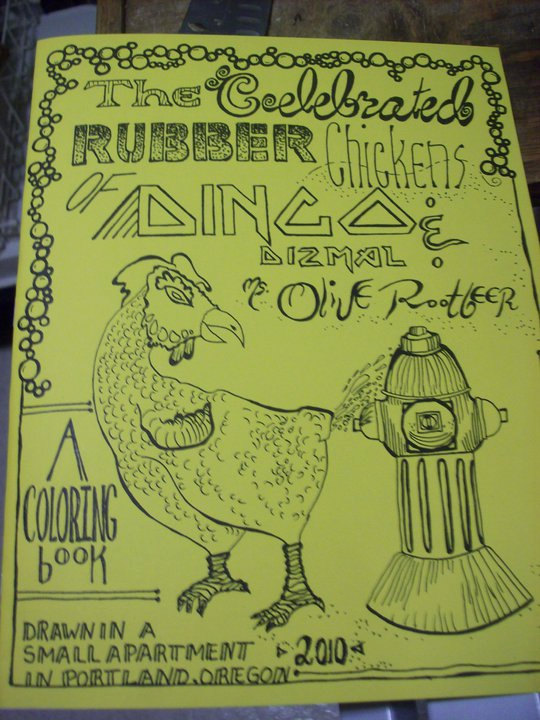
And I discovered The Celebrated Rubber Chickens of Dingo Dizmal and Ms. Olive Rootbeer. A Coloring Book.  2010.

It’s only sixteen pages long, so I’m only showing the cover, but it is awesome.  Yes, yes, it is about rubber chickens.

But they are awesome rubber chickens.

I don’t remember the last time I read a comic book and actually laughed.  Usually, it’s either a tired joke told in a dull way that leaves behind a feeling of sadness and ennui or it’s actually a volume of Peanuts and I’ve read it before.

This comic is both irreverent (as you can see, the chicken is peeing on the fire hydrant) and charming.  There are some strange artistic statements, like the gladiator with the rubber chicken shield or the pilgrim-hatted (and turkey looking) rubber chickens in a boat at what might be Plymouth Rock (but if so is labeled with the wrong year).

The illustrations are well-done.  Linework varies beautifully, as a good coloring book should, with a nice balance between blocked in shapes and spaces where there’s more detail.

And because it’s a coloring book, it’s interactive.  I don’t just get to read the rubber chickens, I get to muck about with them.  (I have decided, by the way, that my rubber chickens will be purple and you cannot stop me.  Their waddlez may be orange or blue or magenta, I have not yet decided.) It’s so utterly different from the longboxophobia of comicdom that I’m used to that it’s a relief.

Some of the images, such as the snail of life rubber chicken, don’t have words.  Other images, such as the sad looking guy and the mummified rubber chicken do, “If “Ramontep fucks up the mummification of another one of the pharoh’s chickens  ….it was commanded he be entombed with it.  Being constantly watched and never trained didn’t help.”  [sic]

My favorite, of course, is the fronticepiece where two rubber chickens, ridden by paladins, joust.

The thing is, I have no idea who Dingo Dizmal is.  No clue about Ms. Olive Rootbeer.  I do not now nor have I ever owned a rubber chicken.  I’d never seen this artwork before I stumbled upon it.  I’ve got no ties to the artist or the publisher (which was probably Kinkos).  I’m not sure what terms I even entered into the Etsy search box, besides maybe ‘comic’ and even that might be in the sense of comedic.

And yet I found it and I bought it and I read it.

This is exactly what I’d hoped for from that ALA booth.  It took me several years to find, granted, but in the end, I managed it. New, funny, smart, well-inked.

The Rubber Chickens of Dingo Dizmal and Ms. Olive Rootbeer, a Coloring Book, is only four dollars, with two additional for shipping and handling.  I commend it to your attention.

And now I really must find where I put my crayons….

Deep Red

This is the second part of my discussion of Italian giallo films. The first part can be found here.
_______________________

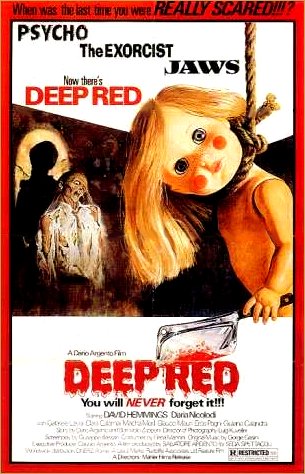
Deep Red a.k.a. Profondo Rosso (1975)
Directed by Dario Argento

Movie reviews usually begin with a summary of the plot. Which is a problem in this case, because the plot of Deep Red makes no fucking sense. It begins in Rome at a conference sponsored by the European Congress on Parapsychology. It may sound far-fetched, but it’s every bit as scientific as phrenology or evolutionary psychology. The marquee attraction is a German psychic named Helga Ulmann (Macha Meril) who entertains the crowd by reading their minds. But someone in the crowd is a murderer, and Helga stupidly announces this to the audience even though she fails to identify the killer. And so the killer tracks Helga home and chops her but good with a cleaver.


The first person to discover the body is English pianist Marcus Daly (David Hemmings). Marcus decides to solve the murder all on his own because he apparently has nothing better to do, and pianists are naturally gifted as criminal investigators (and since this is a giallo, the police are worse than useless). Marcus is helped by a reporter, Gianna (Daria Nicolodi), but is warned to drop the matter by his friend Carlo (Gabriele Lavia). Marcus enlists the aid of a parapsychologist, Dr. Giordani (Glauco Mauri), and uncovers a clue to the killer’s identity by reading a book on urban legends. The book conveniently (and implausibly) identifies a house once owned by the killer, which leads to several more fortuitous discoveries, eventually revealing that the killer is none other than Carlo’s crazy-ass mother, Martha (Clara Calamai). Back when Carlo was a little boy, Martha murdered her husband when he threatened to send her to an asylum. Martha tries to cover her tracks, first by killing Helga, then by stalking Marcus and killing everyone that he drags into his investigation, including the author of the urban legends book and Dr. Giordani.

If I were to judge the film on its merits as a mystery, it would be a failure. No amount of gore can cover up a preposterous plot and mediocre acting. And yet I liked this movie.

About two-thirds of the way into the story, Carlo attempts to kill Marcus so his mother’s actions will never come to light. Carlo even accuses Marcus of being responsible for all the deaths. If only he had minded his own business, no one except the psychic would have died. It sounds like the standard villain monologue, blame the hero for everything, etc., etc. … except everything Carlo says is true. Martha is crazy, but she only killed to hide her identity and cover up the earlier murder of her husband. Psychic Helga was doomed, but Martha killed the other victims only after Marcus got them involved with his amateur sleuthing. Is the viewer supposed to agree with Carlo and condemn Marcus? Not likely. Carlo suffers his own violent death just a few minutes later, which illustrates the primary appeal of the film. Marcus is an idiot, but he’s an idiot who moves the plot forward. And the plot provides a simple framework for the death scenes.


While the entire film is visually attractive, the death scenes are labors of love by Argento. They’re gratuitous, elaborately staged, and almost dream-like. When Dr. Giordani is killed, he isn’t just stabbed. There’s a robotic (?) puppet charging at him, and a shot from the killer’s POV as she grabs Giordani, and a close up of his mouth being jammed into several sharp corners, then a close up shot of the gleaming knife that tracks it’s motion, followed by the actual stabbing. And this mayhem is accompanied by a funky rock soundtrack courtesy of Goblin. Carlo’s death scene is even crazier. While escaping from the police he wanders into the street just as a garbage truck approaches. Any other director would simply have the truck hit Carlo, but Argento allows Carlo to barely evade being hit only to get caught by a hook that for reasons unknown is hanging from the back of the truck. So poor Carlo is dragged through the streets, and the truck makes every turn as sharply as possible so that Carlo will careen into the curb. His physical destruction is capped by a car running over his head.

The death scenes feel disconnected from the slow-paced mystery that contains them, as if a completely different movie takes over when the point-of-view shifts from Marcus to Martha.* But then Marcus is a drearily sane character who inhabits a sub-par crime thriller, while Martha is this delightfully insane monster who thinks she’s in a slasher film. Marcus lives in a world of clues and motives, Martha lives in a world where the violence is obsessive, unlimited, and always viewed from the best angle. Her blood is too red to be real, but who cares? It’s better than real.

Friday the 13th, Prom Night, Terror Train, Scream – countless slasher films have followed in Deep Red’s trail, combining the violence of grindhouse horror with the “whodunnit” mystery plot. And like Deep Red, most slasher films fail as mysteries. The first Friday the 13th, for example, resembles a giallo murder mystery, including shooting the murders from the killer’s POV to hide her identity. but the film doesn’t even introduce the villain until the final act, and since all the other characters (minus the heroine) are dead by that point, there’s no mystery as to who the killer is. Even the half-way clever Terror Train, which at least has a red herring or two, suffers in comparison to traditional mysteries such as Murder on the Orient Express.

It shouldn’t be impossible to produce a decent mystery that also happens to have gory deaths, but why would a mystery writer bother with extreme violence? It adds nothing to the plot and more than likely will become a distraction. And from a commercial perspective, it will almost certainly drive away a portion of the target audience. In contrast, slasher filmmakers lack the subtlety and restraint that mystery requires. The adolescent love of gore, a desire to scare the audience (or at least startle them), and an inexperience with the mystery genre collectively produce barely coherent plots that string together a few gruesome murders.

But in the hands of Argento, at least those murders will look good.

.

_________________________

* Carlo’s death scene is the one exception, because no other character is present to observe his demise.