The Paradox of the Comics Experience

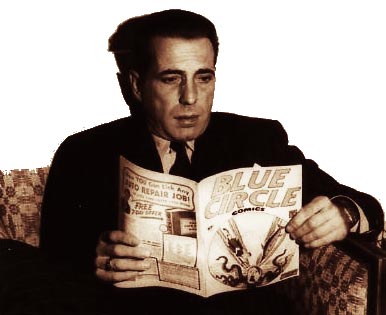
BogieComicIn a recent post on the definition of comics, I suggested that one of the important features that distinguishes comics from other pictorial art forms is that when we consume comics we are experiencing the work the way that we typically experience images — that is, comics are narratives where we look at (rather than merely read) the narrative. In particular, it follows that:

(P1) When reading a comic we experience the text the way we normally (i.e. outside of comics) experience images

This still seems, in some sense, right to me (and, of course, Will Eisner agreed “Text reads as image!”, Comics and Sequential Art, 1985).

In the discussion that followed, summarized and discussed in this follow-up post, Peter Sattler suggested that “Comics are what happens when textual reading habits are activated in a visual (image-centered) field.” In other words, Sattler’s view, although not on the face of it incompatible with my own, seems to be a mirror-image of it: On his account, comics are (or, at least, minimally involve) something like structured images, where we read (rather than merely look at) the images in question. Thus, we get:

(P2) When reading a comic we experience the images the way we normally (i.e. outside of comics) experience text.

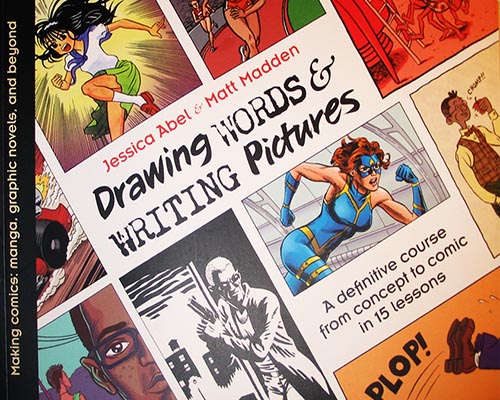
DrawingWritingNote that Jessica Abel and Matt Madden codified a version of both of these ideas (but from a production orientated, rather than a consumption orientated, perspective) in the title to their first how-to book on comics!

Reading a text (of whatever sort) seems both phenomenologically and structurally very different from looking at something, however: When reading, we are interested in largely conventional semantic relations between linguistic units and their referents, whereas with looking we are often interested either in the bare appearance of the thing being looked at, or in relations of resemblance and representation holding between depiction and thing being depicted (which are often somewhat, but rarely completely, conventional). In short, reading feels different from looking, and the mechanisms underlying reading are (so far as we understand these things) quite different from the mechanisms underlying looking at something. Thus:

(P3) Looking is phenomenologically very different from reading.

The paradox arises when we note the following fact, apparent to anyone who reads comics on a regular basis:

(P4) We experience the content of comics in a unified manner.

In other words, we don’t first decode the content of some parts of the work via reading, and then decode the content of other parts of the work via looking, and then incorporate these two very different sorts of content into a unified whole in some sort of conscious three-step process. Instead, the process is seamless and smooth, with no apparent difference felt between what is read and what is looked at.

But how can this be? How can our experience of comics be unified in this way if it is composed of two very different experiential modes – modes that are noticeably different in the way that they ‘feel’ to us? Shouldn’t we be able to detect the shift from looking to reading and back to looking when it happens? If so, then it looks like (P1) through (P4) above are jointly inconsistent (or, at the very least, seem to be in tension with one another). This is the paradox of the comics experience.

Now, we could just stop here, and admire the fine paradoxical pickle into which we seem to have gotten ourselves. A part of me would be fine with that – I have already written two books with the word “paradoxical” in the title, so I have no problem getting excited about new paradoxes. But maybe we don’t have a genuine paradox here.

ContinuityAdWe do have a puzzle, however – one we need to solve. It is clear that reading and looking are two distinct kinds of experience, with their own mechanisms, features, and feels. It is also clear that seasoned comics readers are able to employ both of these experiential modes simultaneously, and are able to switch from one to the other and back again seamlessly without even noticing they are doing it. What is not clear at all, however, is how this works (In other words, don’t waste your time or mine trying to convince me in the comments that we actually do this. It’s obvious we do. The point is we need an explanation of how we do it, and we don’t have one). Thus, what we need is an account of the various ways that comics generate meaning that explains how these very different modes combine to produce a single unified meaning.

Any such account will likely draw on psychology, linguistics, philosophy, and other fields that concentrate, in different ways, on how we turn perceptions and actions into meaning. Unfortunately, unlike some other disciplines, psychology, linguistics, and philosophy* have not paid much attention to comics. Maybe its time to change that.

So, in the PencilPanelPage tradition of ending with a question, I’ll end with this: How do reading and looking differ, and how are the combined in the experience of reading comics?

*I am not saying that there is no good research on comics in psychology, linguistics, or philosophy as applied to comics. After all, I am a philosopher who writes pretty prolifically on comics, and my pal and fellow PencilPanelPager Frank Bramlett is a linguist. But the few there are just ain’t enough.

Himalayan Quake

skye in himalayas

 
“Now take that frequency and see if you can amplify it,” Jiaying says.

Skye wants to obey her new mentor but is frightened of her own powers. “The last time I did something like this a lot of people got hurt.”

“You can’t hurt the mountain. And you’re not going to hurt me. Don’t be afraid.”

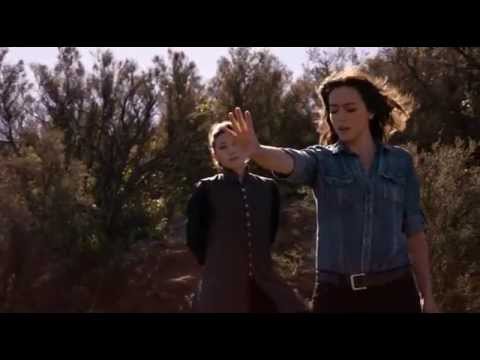
Skye braces herself, turns toward the snow-banked mountain range, and raises her hand in standard superhero style. Soon an orchestra of emotion-signifying strings rises from the soundtrack, and then a CGI avalanche tumbles scenically down the mountain side.

Skye gives a shocked smile. “I moved a mountain.”

“Remember that feeling. It’s not something to be afraid of.”

This is episode 2.17 of Agents of S.H.I.E.L.D., which aired April 14, eleven days before the Nepal earthquake. In Marvel Comics, Skye goes by the codename “Quake.” In the TV show, she’s just acquired her superpowers and has been whisked away to a secret mountain sanctuary to be trained by its semi-immortal leader. Jiaying never names the Himalayas, but that’s the main location of the Inhumans’ secret city in the comics, and in the show Skye was found as an infant in China. During the same episode, she discovers that Jiaying is her mother—played by Dichen Lachman, an actress of German, Australian, and Tibetan background. Lachman was born in Kathmandu, miles from the earthquake’ epicenter, which triggered an avalanche on Mount Everest, killing 19 people. The total death toll is over 7,000.

The coincidences are hard to comprehend. My wife and I watch S.H.I.E.L.D. with our son, and I remember her protesting from the other end of the couch that Skye’s avalanche could have hurt plenty of people. We’re usually a day or two behind streaming episodes, so this was still at least a week before the actual earthquake. We teach at Washington & Lee University, where a spring term roster of students was flying to Nepal for an interdisciplinary Economics and Religion course. I bumped into a wife of one of the professors in Kroger, and she said news of the quake broke just hours before their flight was to take off. She had been going too.

That’s as close as I get to the disaster.

This time last year, I was teaching my “Superheroes” course, and gave a guest lecture on colonialism and Orientalism in the superhero genre for Professor Melissa Kerin’s “Imaging Tibet” course. I showed image after racist image of European Americans visiting the magical realm, acquiring superhuman powers, and then returning home to battle evil. Batman Begins opens with Bruce Wayne scaling a Himalayan mountain side to arrive at Nanda Parbat, home of the League of Assassins, where Bruce would train with the semi-immortal Ra’s al Ghul to become Batman.

It wasn’t airing yet, but the current season of the Arrow TV show is centered around Nanda Parbat too. The TV Ra’s is played by a former Australian rugby player, and the equally European-looking actress playing his daughter speaks with what I think is supposed to be a British accent. Only the Ninja-like underlings look Asian. Nanda Parbat is a variation on Nanga Parbat, the western-most mountain of the Himalayas in Pakistan.

My wife, son and I sat on the same couch, watching Oliver Queen (“Green Arrow” in DC Comics) agree to become Ra’s al Ghul’s heir in exchange for Ra’s saving Oliver’s mortally wounded sister by dunking her in his magic fountain of semi-immortality.
 

Arrow thea in healing water

 
The ceremony involves a virginal white dress and antiquated pulley system of wood and rope. After vanishing under the bubbles, she catapults twelve feet through the air to land cat-like on the fountain ledge.

“Tibet is one wacky place,” I said, and my wife laughed.

That’s episode 3.20, which aired on Wednesday April 22nd, three days before the Saturday earthquake.  In the week after, Oliver would be brainwashed into a heartless mass-murderer plotting the destruction of his own city, and Skye would use her newly controllable powers to rescue a fellow Inhuman and a cyborg S.H.E.I.L.D. agent from Hydra’s Antarctic prison laboratory.

On April 29, NPR reported on the flood of people trying to leave Kathmandu, and The Guardian described the rise of tensions over the slow pace of aid.  The same day actor Ryan Phillippe told Howard Stern that he had an upcoming meeting with Marvel, hinting that he may be cast as Iron Fist in the new Netflix superhero show about another European American traveling to the Himalayas and gaining superpowers.
 

Acotilletta2--Iron_Fist_modern_green

 
The collective origin point for all the superhero exoticism is Shangri-La, the magical Himalayan city of the 1937 film and 1933 novel Lost Horizon. It features a semi-immortal High Lama who recruits a European American to be his heir and rule the secret mountain paradise.
 

lost horizon

 
Edward Said asks: “How does Orientalism transmit or reproduce itself from one epoch to another?”I answered last year in a PS: Political Science & Politics essay: “In the case of superheroes, it is through the unexamined repetition of fossilized conventions that encode the colonialist attitudes that helped to create the original character type and continue to define it in relation to imperial practices.” I continued the thought in the book manuscript of On the Origin of Superheroes I sent to my press for copyediting last month: “The 1930s is an Orientalist pit superheroes may never climb out of.”

My claims are already outdated. These TV shows aren’t just continuing superhero Orientalism—they’re digging the pit deeper. And they’ve been digging it while actual Nepalese rescue workers have been digging earthquake victims from actual pits.
 

902970-nepal-earthquake

The End of Comic Geeks?

This piece originated as a paper presented at the 2015 University of Florida Comics Conference. A slightly different form of this paper was incorporated into my lecture “Change the Cover: Superhero Comics, the Internet, and Female Fans,” delivered at Miami University as part of the Comics Scholars Group lecture series. While I have made some slight changes to the version of the paper that I gave at UF, I have decided against editing the paper to make it read like a written essay rather than an oral presentation. The accompanying slide presentation is available here.
_________

First, I’m very grateful to be here because this is my first time back in Gainesville since I graduated from UF, and being here, I realize that I really miss it and that UF has played a major role in making me the person I am today.

So this is not something I’m currently working on, but it is something I’ve been thinking about extensively, and I think it may provide material for a future book or article project. It does relate to my earlier work on comics and Internet culture and it’s sort of a sequel to the paper I gave at ICFA last month, about comics and female fan culture. And this paper is based more on my personal than my scholarly knowledge. It’s based less on my scholarly work than on my many years of experience in organized comics fandom. I acknowledge that my discussion here would benefit from incorporating theoretical perspectives from fan studies, and that’s a direction I do intend to explore if and when I turn this into a longer work.

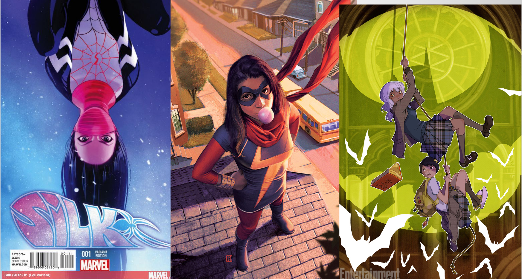
So as a general trend, what we might call geek culture or nerd culture or fandom has been steadily growing more inclusive. Whether we think of science fiction fandom or video gaming or comic books, each of these is a fan community that has traditionally been dominated by white men, but is gradually opening itself up to participation by women and minorities and LGBTQ people. In comics, for example, the comics industry has a notorious history of excluding women and younger readers, SLIDE 2 and there is a persistent and largely accurate stereotype of the comic book store as a man cave. SLIDE 3 But as I argued in my ICFA presentation, this is gradually changing. Titles like Raina Telgemeier’s Smile and Cece Bell’s El Deafo are dominating the bestseller lists SLIDE 4 and even Marvel and DC have sought to appeal to female and younger readers. SLIDE 5
 

Screen Shot 2015-05-04 at 8.37.10 PM

 
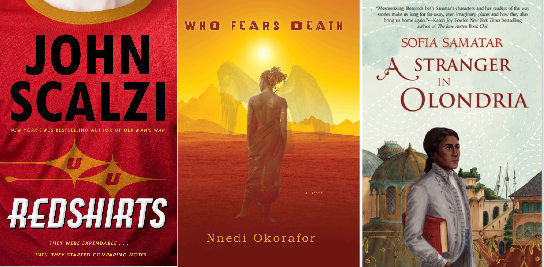
Now in other fan communities, the opening up of previously male-only spaces has triggered a backlash from the straight white men who used to dominate. The obvious example of this is Gamergate, where the inclusion of women in video gaming has led to an organized campaign of misogyny which has even crossed the line into domestic terrorism. SLIDE 6 A less well-known example is what’s been happening in science fiction fandom. In recent years, novels by liberal writers like John Scalzi and female and minority writers like Nnedi Okorafor and Sofia Samatar have dominated the major science fiction awards. SLIDE 7 When this started happening, certain mostly white male writers became extremely indignant that science fiction was becoming poiliticized, or rather that it was being politicized in a way they didn’t like. So they started an organized campaign known as Sad Puppies SLIDE 8 whose object was to get works by right-wing white male authors included on the ballot for the Hugo award, which is the only major science fiction and fantasy award where nominations are determined by fan voting. And this led in turn to the Rabid Puppies campaign, which was organized by notorious neo-Nazi Vox Day and which is explicitly racist, sexist and homophobic. SLIDE 9 And these campaigns succeeded partly thanks to assistance from Gamergate. On the 2015 Hugo ballot, the nominees in the short fiction categories consist entirely of works nominated by Sad Puppies and Rabid Puppies, and this has led to an enormous public outcry.
 

Screen Shot 2015-05-04 at 8.38.37 PM

 
So across various spheres of geek culture, the move to open up these traditionally white male spaces has led to a backlash from white men who are afraid of losing their dominant position. Another way to look at this is that geek identity is historically bound up with white male identity. Being a geek or a nerd or a fan has traditionally meant being a person like me, a bespectacled athletically inept socially awkward white guy. As Dan Golding writes in the context of video games, “videogamers … developed a limited, inwards-looking perception of the world that marked them as different from everyone else. This is the gamer, an identity based on difference and separateness. When playing games was an unusual activity, this identity was constructed in order to define and unite the group … It became deeply bound up in assumptions and performances of gender and sexuality. To be a gamer was to signal a great many things, not all of which are about the actual playing of videogames.” SLIDE 11

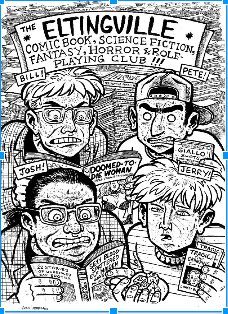
And to an extent this is also true of comic book identity. Matthew J. Pustz wrote that “In most cases, being a comic book fan is central to fans’ identity.” And as Pustz goes on to write, the ultimate example of this is fanboys, or “comic book readers who take what they read much too seriously.” Stereotypically, fanboys are bespectacled, acned overweight misfits who have an encyclopedic knowledge of ’60s Marvel comics but have never spoken to a woman. And this stereotype is often cited in comics themselves, such as Evan Dorkin’s Eltingville Club stories. SLIDE 12
 

Screen Shot 2015-05-04 at 8.41.15 PM

 
Now Golding goes on to discuss how gamer identity, as traditionally conceived, is under threat, because it’s too inflexible to survive the gaming industry’s increasing openness to female and minority and LGBTQ gamers. “When, over the last decade, the playing of videogames moved beyond the niche, the gamer identity remained fairly uniformly stagnant and immobile. Gamer identity was simply not fluid enough to apply to a broad spectrum of people. SLIDE 13 It could not meaningfully contain, for example, Candy Crush players, Proteus players, and Call of Duty players simultaneously. When videogames changed, the gamer identity did not stretch, and so it has been broken.” Thus, Golding’s article is called “The End of Gamers,” and he suggests that Gamergate is the last gasp of traditional gamer identity: that Gamergate is what happens when gamers as traditionally conceived realize that the concept of gamers no longer refers exclusively to them.

So the question I want to explore in this essay is whether this is also happening to comic book fans, and if so, what can we do about it. Is the category of “comic book fan” resilient enough to embrace people other than straight white males, or is comic fan identity going to be squeezed out of existence? My answer to that is twofold. On one hand, while comics fandom has not experienced anything quite as drastic as Gamergate or Sad Puppies, we have seen a certain backlash from misogynistic male fans who see comics as their exclusive property and who are resistant to the diversification of the medium. On the other hand, I believe that this sort of backlash has been a less significant phenomenon in comics fandom than in science fiction or video game fandom, and this is because being a comics fan has never been synonymous with being a stereotypical fanboy. For as long as I’ve been involved with it, comics fandom has always had at least some room for people other than straight white males. There has always been a significant segment of comics fandom that wanted to expand the reach of comics, and at least in my own circles, the stereotypical fanboy has been the exception rather than the rule. This is of course not exclusively true of comics fandom. Women have been prominently involved in gaming since before the dawn of the modern video game, as Jon Peterson’s Medium article “The First Female Gamers” brilliantly demonstrates, and science fiction fandom has an even longer tradition of female involvement. I focus on comics fandom here purely because this is the fandom with which I have the most personal experience, although I will speculate about some ways in which comics fandom may differ from other fandoms in terms of its openness to people outside its traditionally dominant demographic.

So in the first place, there clearly have been examples in which the diversification of the comics industry has led to a backlash from entitled fanboys. And these examples have mostly involved DC Comics because DC is the only major remaining company whose output is almost exclusively marketed toward fanboys, although that is starting to change slowly. Anyway, the most obvious recent example of fanboy backlash is what happened last month with the Batgirl #41 cover. SLIDE 14 I’m not going to describe this in depth because I assume most of you are familiar with it, but very briefly, DC announced a variant cover for Batgirl #41 which was an explicit reference to Batman: The Killing Joke, and which depicted Batgirl as a passive victim of the Joker. So there was a Twitter campaign to get DC to change the cover, and it succeeded because the artist of the cover, Rafael Albuquerque, asked DC to withdraw the cover, and DC agreed. Albuquerque wrote “For me, it was just a creepy cover that brought up something from the character’s past that I was able to interpret artistically. But it has become clear, that for others, it touched a very important nerve. I respect these opinions and, despite whether the discussion is right or wrong, no opinion should be discredited. My intention was never to hurt or upset anyone through my art. For that reason, I have recommended to DC that the variant cover be pulled. “ And then there was a competing campaign to get DC to keep the cover, and this campaign was supported by Gamergate. So this is evidence that some people at least see comics as the private property of men, and are violently resistant to the idea that comics should be sensitive about the depiction of violence against women.

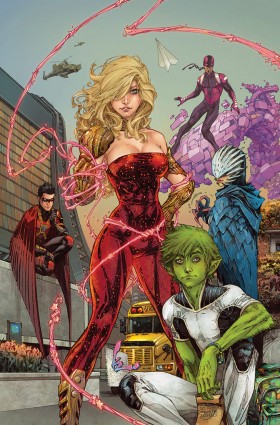
But I think we’re all pretty familiar with that incident, so I want to focus on another recent case of fanboy backlash, which is relevant to me personally because it involved an online community that I was a member of for many years. In April of last year, Janelle Asselin wrote an article for comicbookresources.com, commonly known as CBR, in which she criticized Kenneth Rocafort’s cover for Teen Titans #1. SLIDE 15 Specifically, Asselin complained that on this cover, Wonder Girl’s proportions are totally unrealistic – she’s a teenage girl but she clearly has breast implants. And she pointed out that this sort of depiction is explicitly problematic because this is a Teen Titans comic, and the various Teen Titans TV shows are widely popular among teenage girls and among children ages 2 to 11, SLIDE 16 and Rocafort’s cover is specifically designed to exclude those audiences.
 

teen-titans-1-c63fa

 
Now Asselin was hardly saying anything controversial here. It’s pretty obvious that this cover is not only terrible but also misogynistic. And yet just for pointing out this obvious fact, she was not only criticized but threatened with rape. At the same time that she published the article, she released a survey on sexual harassment in the comics industry, which is also a significant problem, and some unfortunate trolls discovered this survey and filled it in by posting rape threats against Asselin. According to CBR proprietor Jonah Weiland, “These same “fans” found her e-mail, home address and other personal information, and used it to harass and terrorize her, including an attempted hacking of her bank account.” And according to Jonah, many of the fans in question were regular participants on the comicbookresources.com message boards, SLIDE 17 this character is the mascot of the CBR forums, and the harassment of Janelle Asselin was emblematic of an atmosphere of “a negativity and nastiness that has existed on the CBR forums for too long.” So because of this incident, he completely deleted everything on the CBR forums and restarted them from scratch with a new and much stricter moderation policy.

Now this incident is personally relevant to me because I was a member of the CBR forums for many years. I started posting on the CBR forums sometime around 1997 or 1998 when I was 14 or 15 years old. So I’ve been involved with this community for more than half my life. I was the moderator of the CBR Classic Comics forum and I used to run the annual Citizen of the Month award. I’ve gradually stopped posting at CBR because I’ve been annoyed at the way the conversation there is dominated by fanboys, although I still communicate with many of my old CBR friends via Facebook. So the Janelle Asselin incident seems like evidence that at least as far as CBR is concerned, comics fan identity has come to be defined in a way that excludes women and that emphasizes toxic masculinity.

At the same time, my experience at CBR is also what makes me hopeful about the future of comics fan identity, and it’s what makes me believe in alternative and more productive ways of being a comics fan. I started posting at CBR in the late ‘90s when I was a young teenager, and it was actually because of CBR that I gained the ability to think of being a comics fan in terms other than being a fanboy. Before I discovered CBR, most of what I knew about comics came from Wizard magazine, which was basically instrumental in defining the fanboy identity. SLIDE 18 If you’re lucky enough to not remember Wizard, basically it was the comics version of Maxim, the Magazine for Men. It was a sexist, homophobic rag that ridiculed women and that completely ignored comics that didn’t involve superheroes. In 2001, Frank Miller tore up a copy of it at the Harvey Awards banquet. And once I was camping out with some people I knew from CBR and we used a copy of Wizard to start a campfire. SLIDE 19

Anyway, at CBR I came into contact with comics fans who were much older and wiser than me, and these people convinced me that this way of being a comics fan was unsustainable. As long as comics were marketed purely to fanboys, comics were going to lose readership and they were ultimately going to be irrelevant, and this would be a bad thing. I think some of the people who told me this were themselves parents and were afraid that their children wouldn’t be able to grow up with comics in the same way that they did. SLIDE 20 And this experience convinced me that it was important for comics to be inclusive, that comics couldn’t continue to appeal to the same fanboy audience. Thanks to CBR, I grew up with the notion that comics needs to abandon its traditional target demographic or die. I think this is fundamentally different from the Gamergate mentality, which is driven by fear that games are becoming too popular and that the gaming industry is abandoning its traditional target demographic.

Perhaps the difference here is that the popularity of games is currently at its peak. While there are nagging fears of the death of big-budget video games, the gaming industry currently enjoys a huge audience, and game developers can still make a profit by producing games marketed toward the exclusive “gamer” demographic. Therefore, game developers and players may not see the need to reach out to new audiences. I’m not sure if the same is true of science fiction fans and publishers, but my sense is that science fiction literature also has enough of an audience that the industry is not facing existential threats to its survival.Conversely, the popularity of comics, at least in America, peaked during the ‘40s and ‘50s and has been steadily in decline since. SLIDE 21 Among the comics fans I grew up with, there was this notion that comics is a declining art form and that traditional concepts of comics fan identity are a threat to the long-term survival of the medium.

So I got this idea that in order to save comics, it was necessary to abandon fanboyism as the sole model of comics fan identity and to embrace a broader and more inclusive model of what it means to be a comics fan. According to this model, to be a comics fan is to be a lover and evangelist of the medium of comics, and to help expand the audience of the medium. And that’s what I try to do when I teach comics in first-year writing courses.

So this is a model of comics fandom that involves a certain radical openness to new audiences. And this notion of comics fandom is not just based on my personal experience; we also see it in things like Free Comic Book Day or in Michael Chabon’s 2004 Eisner Awards keynote addres where he called on the industry to do a better job of appealing to children. And I believe that if comics fan identity is defined in this way rather than in terms of fanboy identity, then to return to the earlier quotation from Golding, comics fan identity can be “fluid enough to apply to a broad spectrum of people.”

The Hole Picture: Art, Religion, and Identity

“…all beings have a twofold face, a face of light and a black face. The luminous face, the face of day, is the only one that the common run of men perceive. Their black face, the one the mystic perceives, is their poverty The totality of their being is their daylight face and their night face”
-Henry Corbin

If, in the realm of human endeavour, there is one single activity which closely parallels or even mirrors the workings of identity, it has to be art. Art and the experiencing of art can define, describe, delimit, and categorize the personal in much the same way that identity does.

It should be no cause for wonder, then, that art and identity get conflated more often than not, with artist and spectator both viewing the engagement with art as integral to their personality.

Where this identification of art or culture with identity is a common occurence in the 21st century Occident, it has almost completely occluded a relationship that was previously of
immense significance- that between art and religion.

These days, inasmuch as identity, or the experience of the personal, is a prerequisite for the production of art, it should be unsurprising that much of contemporary spiritual or religious art lacks character. It is a risk of all art that genuinely and honestly seeks to express any sort of mystical experience; for the apex of the religious experience is a transpersonal one. It is exactly the direct transcendance of the limitations of selfhood which incapacitates the mystic to express that experience, for he lacks the personality to express it with. Like the captive shaman in Borges’ ‘La Escritura del Dios’ who discovers the secret name of God and the infinite power it would grant him, but who declines to use that power to escape his prison because the newly acquired infinite, cosmic vantage point makes him see the futility of his human desire to be free.

Perhaps art’s function has always been to express what is no longer there, to fix what moves onward in constant flux, to capture ghosts; thus to be, in a sense, non-being.

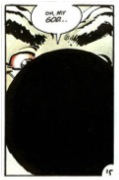
In that spirit, to propose how art can move beyond its (and our) own identity, i will offer an exegesis of the following panel from the comic-book The Dark Knight Returns by Miller,
Janson & Varley (DC Comics, 1986).
 

dark knight

 
It is a Batman comic, with all the connotations about ‘secret identities’ that are apposite to our subject. Like most comic-book periodicals promoting the corporate-owned product of superhero characters, this book moves a fixed set of characters along a chessboard grid. That this particular version acquired a modicum of mainstream fame in its time, due to the introduction of certain radical elements into the Batman mythos, is of little significance.
Its central achievement is that it understands the medium; constrained by its nature as corporate product and juvenile entertainment, it finds freedom in the technical aspects of
storytelling, in the dance of the draughtsman’s hand.

A tale of an aged Batman coming out of retirement to fight crime one last time, it metes out, on the narrative level, heavy-handed symbolism and clunky metaphors in an attempt to instill the juvenile concept with a measure of adult validity. There is the Joker, whose face-paint reveals rather than masks his identity; Two-Face, one side of his visage horribly disfigured, mirroring the Batman’s dual nature, Superman portrayed as a spineless slave
to political power. The mask, the masked, nature and morality, with these themes and more, the book plays a pleasing aesthetic game, but for all its visual rhyme and striking juxtapositions, as a narrative it does not delve very deep.

Yet despite this narrative superficiality, there are statements which only the comic-book image-maker is capable of making, and the comic-book storyteller through his technique must push the image-maker to the point where meaning (relevance to the plot’s progression, or symbolism pertinent to the story’s subject) becomes subsumed in the textures of the drawings – where the ink, as it were, is allowed to speak its own language; to comment, in blackness, on the proceedings in the narrative, creating a counter-narrative, the majestic current of a subterranean river traversing chthonic realms of obscure meaning.

There are statements which only the image-maker has the authority to make, and I hope to unearth some of these statements, and by this reversal of the artistic process, the extrication not just of meaning but of meaningfulness, the being-full-of-meaning, to show that the making of art is a ritual burial, a negation which leaves the disinterment , or resurrection, even, to the reader or spectator. It is a dying of the Self into the Other.
 

dark knight

 
Taking as context the surrounding images, the panel reads as a face emerging over the rim of a circular mirror which has just confronted the face with the result of cosmetic surgery restoring its disfigured left side. But this reading does not take into account the key to interpretation we are offered when reading on. There, we find what is in every sense a key moment to the book; a flashback scene showing the pivotal moment that (however shallowly) motivated multimillionaire Bruce Wayne to ‘fight crime’ as the Batman: the death of his parents at the hands of a street robber. The flashback, designed as a rigid four-by-four panel grid imbuing the scene with the staccato inevitability of fate or nightmare, stretches and stretches until coming to a slow halt in the relentless close-up focus on the robber’s gun getting tangled in Mrs. Wayne’s pearl necklace, showing the gunshot against her neck only through the increasing distance between the pearls of the necklace as it tears; a constellation of white orbs against a black background, which becomes the blackness of outer space, unmooring the young Bruce Wayne from all notions of home and safety. Suddenly this boy is cast into a deep interplanetary coldness; his universe stretches like the necklace; the gaps widen as the pearls scatter, the planets fall; time stops; and the void yawns wide.
On the narrative level that scene is simply the key to the Batman’s pathology. On the visual level, we have been presented a manual instructing us how to read these images. Time has stopped; the pearls are no longer connected; it is Judgement Day, and each picture must stand on its own.
 

dark knight

 
Thus, we come to the panel at hand, with all sense of human scale utterly blasted. An image of apocalyptic implications, with its opaque black globe encroaching upon a human face, leaving only one amazed, or frightened eye visible. A vast face peeking over the curving horizon of a blackened planet, like a sunrise witnessed from space.

And the word balloon says ‘oh, my god,’ -but who or what is it, that speaks?

The face has no mouth, no visible mouth at least, and the balloon’s tail points towards the black globe- black as the theatre of Lord Chamberlain’s men ( Shakespeare’s troupe),The Globe, after it had been reduced to ashes by fire- a blackened Globe, a full stop, an end to masks and costumes and assumed identities.

The blackness, unmasked, speaks. Let us pause to examine how this blackness manifests itself in a few other instances, to help give direction to our reading.

Batman’s costume is traditionally depicted as having a blue colour, we can assume to suggest night or darkness while still keeping the figure legible when drawn against a night sky or in darkness. But throughout The Dark Knight Returns, the night sky is painted in subtle hues of dark metallic blues and greys, with Batman outlined starkly against its gradients in pure black silhouette. Like the familiar trick of the picture that represents at once two faces and a vase, foreground and background here shift their significance between them:the sky becomes illustration, painted backdrop behind the iconic shape of Batman’s absolute blackness, but it might also be perceived that the perfect night sky has been pierced, revealing a more profound darkness behind it. An image not to look at, but through.

Let us return with this idea, the suggestion that there is a darkness underlying all surfaces,to our original picture, and examine it anew.
 

dark knight

 
It is, of course, a hole. A hole in a picture of a face. Or rather, it is the face of nothingness of that face, the individuality punctured, and it is this face of nothingness which exclaims, with the last vestiges of personality: ‘oh, my god.’

As Shaykh Lahiji writes in his commentary on Mahmud Shabestari´s Golshan-e Raz (the Rose Garden of Mystery): “Suddenly i saw that the black light was invading the entire universe. Heaven and earth and everything that was there had wholly become black light and, behold, I was totally absorbed in this light, losing consciousness.”

This black light (nur aswad), which in some traditions is seen as the hair of God invisibly permeating the universe (predating by several centuries the concept of Anti-matter of contemporary physics) is not to be mistaken for mere darkness, a simple absence of light.

It is very precisely not a matter of negativity, of emptiness or absence. In fact, in the light of what we have previously established, it is the Ink that speaks, that articulates the blackness. And this Ink, because it holds the promise of all forms, as writing, or drawing, can be said to represent an incomparable plenitude.

There are two curious and little known sayings of the prophet Muhammad: “All that is in the revealed books is in the Qur’an and all that is in the Qur’an is in the Fatihah [the Qur’an’s opening verse], and all that is in the Fatihah is in Bismi’ Llahi ‘r Rahmani ‘r-Rahim [the Fatihah’s opening line or Basmalah].” and “All that is in Bismi’ Llahi ‘r Rahmani ‘r-Rahim is in the letter Ba, which itself is contained in the point that is beneath it.”

Shayhk Ahmad Al-‘Alawi, who lived in Algeria at the beginning of the previous century, wrote a treatise on this subject, titled ‘The Book of The Uniqe Archetype which signalleth the way unto the full realization of Oneness in considering what is meant by the envelopment of the Heavenly Scriptures in the point of the Basmalah,’ and therein, to illustrate his point (and The Point), he quotes at length Abd al-Ghani an-Nabulusi, from the Diwan al Haqa’iq, about Ink:

“For it was before the letters, when no letter was;
And it remaineth, when no letter at all shall be.
Look well at each letter:thou seest it hath already perished
But for the face of the ink, that is, for the Face of His Essence,
Unto Whom All Glory and Majesty and Exaltation!”

It is a commonplace of the comic-book craft that a picture must not describe what the text is saying and vice-versa, but the obverse of that coin is that a text which means the same as the picture but describes it in a different way is a felicitous convergence and divergence at once; the two aspects of the medium maximizing each other’s potential.

Of our picture and text- our picture as text-both instances are true. Without exclamation mark, the phrase by itself is a quiet expression of baffled incredulity, a sigh perhaps, although its subtlety is undermined by the italicized emphasis of “god,” while the open-endedness of the sentence as indicated by the three dots articulates a bridge to the surrounding image.

But the words, too,form a picture, the ‘oh’ being both the sound and the form of the silent black void encroaching upon the face.”O” is the circumference of the Basmalah’s Point; the outward manifestation of the all-encompassing blackness of the Ink representing the Incomparable Plenitude of the Divine. The “O” therefore signifies the same as the italicized “god.”

The third word in the balloon(“My”) is there to act as a bridge between these two manifestations of the Divine, if only it can allow itself to surrender to the engulfing Black Light spreading over its image. Like a mirror, it is the conduit through which the Divine passes on Its way to Itself. In Its path, It completely obliterates “my” and “I” and all notions of Selfhood, for once the Self has seen the True Reality of its Absorption into the totality of the Ink, it ceases to be anything other than the Ink; It can only recognize, from then on, the Ink-ness as it were, of its existence. As the “my” falls away from the text, and the face is obliterated in the picture, God as text and God as meaning cross the divide of Selfhood to become the One which the illusion of “my” tried to oppose. Identity perishes. Blackness surrenders to the meaning of blackness. And that is the Face which ever remains.

 

Kickstarter: Threat or Menace?

Thing_early_benchmark_h1

 
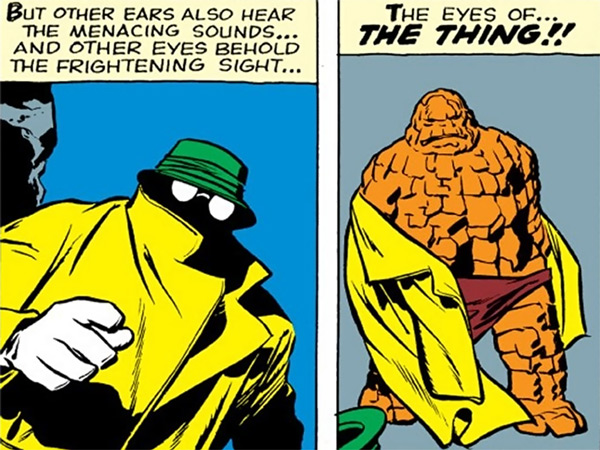
So, I think maybe I have an academic publisher for my next book. If the good lord is willing and the creek doesn’t rise, the book would focus on a topic much discussed on this blog — whether superheroes can meaningfully represent diversity, and especially blackness.

The problem is that academic presses don’t pay — and of course I’m not an academic, so I don’t get a salary to publish. If I’m writing a book, I’m not writing other things that people might actually pay me for.

So I’m considering doing a kickstarter or a patreon or some such to try to see if I can generate enough money to make writing the book worthwhile — or at least defray the extent to which it isn’t worthwhile. I’ve never done a crowdfunding thing before — and I don’t know that I’ve ever seen anyone try to do a crowdfunding effort to write an academic press book. Basically, I’m looking for feedback. Is this a horrible idea? Would anyone willingnly contribute to such a thing? What platform do you think would be best? How much should I ask for?

This is all fairly notional at the moment; everything may fall through. But I’m curious if people have thoughts/advice/mockery. Help?

The Louis Armstrong Fallacy

large_rsz_louis_armstrong_restored

 
This piece first appeared on Splice Today.
________

The election of Barack Obama means that there is no more racism in the United States. The fact that some women have been elected to the Senate means that sexism is no longer a major factor in American life. Beyoncé’ is a superstar, so that means that women of color are celebrated in our culture, not denigrated.

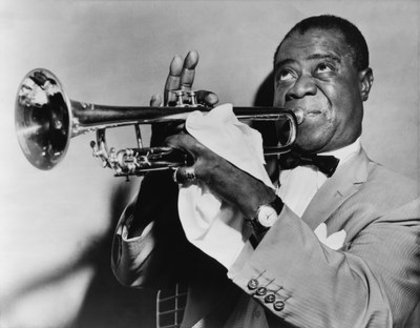
Those arguments may sound fairly ridiculous, but if you spend any time taking about discrimination online, you’re bound to stumble across them or their equivalents. I think of it as the Louis Armstrong fallacy: “Louis Armstrong was successful, therefore Jim Crow doesn’t exist.”

Louis Armstrong is clarifying both because he’s universally revered and because he lived, and succeeded, during a time that was, by any measure, extremely racist. Armstrong started his career during the height of what historians have called the “nadir of American race relations.” In 1901, the year he was born in New Orleans, 105 people were lynched, and the last post-Reconstruction African-American congressman gave up his seat; there would not be another for 28 years. In 1912, when Armstrong dropped out of the Fisk School for boys and joined a quartet singing in the streets, Woodrow Wilson, a racist white Southerner, was elected President — the next year he resegregated the Federal government. In 1917, when Armstrong was sixteen and playing in New Orleans’ brass bands, whites rioted in East St. Louis, IL, killing between 40 and 220 African-Americans. In 1926, when Armstrong’s recording “Heebie Jeebies” became a sensation, the Supreme Court in Wyatt v. Adair ruled that racial discrimination in housing was Constitutional.

From the executive branch to the judicial branch, from south to north, America in the early decades of the 20th century was not just racist, but actively, in many ways, becoming more racist than it had been since at least the end of the Civil War. And yet, nonetheless, Louis Armstrong went from success to success. Even in the Depression, when jazz greats like Sidney Bechet had to hang up their horns, Armstrong flourished, celebrated and beloved.

So how is that possible? How does a society of lynching and segregation manage to turn around and give one black man riches and fame? The answer is in part that no one gave Armstrong anything. No system of oppression is ever total; music was one of the relatively few avenues in which some few black Americans were able, through sheer talent and grinding work, to force their racist society to acknowledge their genius, if not their humanity. Armstrong was arguably the most talented American musician ever, in any genre, and still, he was quite aware that the accolades he received were grudging. “I don’t socialize with the top dogs of society after a dance or concert,” Ebony reported him as saying in 1964. “These same society people may go around the corner and lynch a Negro.” Though he was sometimes accused of being an Uncle Tom during the Civil Rights era because of his generally jovial demeanor and stage presence, Armstrong made no excuses for white America, and could be a harsh critic. During the 1957 struggle to integrate Little Rock Central High in Arkansas, Armstrong called Eisenhower “two-faced” and stated, ” “It’s getting almost so bad a colored man hasn’t got any country.”

To use Armstrong to exonerate America of racism is obscene in part because Armstrong’s success was accomplished in the teeth of racism — the grandson of slaves, he grew up poor, and was often harassed and arrested by the police. Through sheer talent, he overcame America’s best efforts to thwart him. But that doesn’t mean that racism didn’t exist, anymore than Jane Austen’s novels mean that women had the same access to education as men did in England in the 1800s. The fact that some people, through luck, skill, and genius, manage to thrive despite oppression is a testament to the human spirit of those whose humanity is often denied. But the oppressors shouldn’t get the credit when, despite their best efforts, in some small way, the oppression fails.

Hail America, Captain Hydra

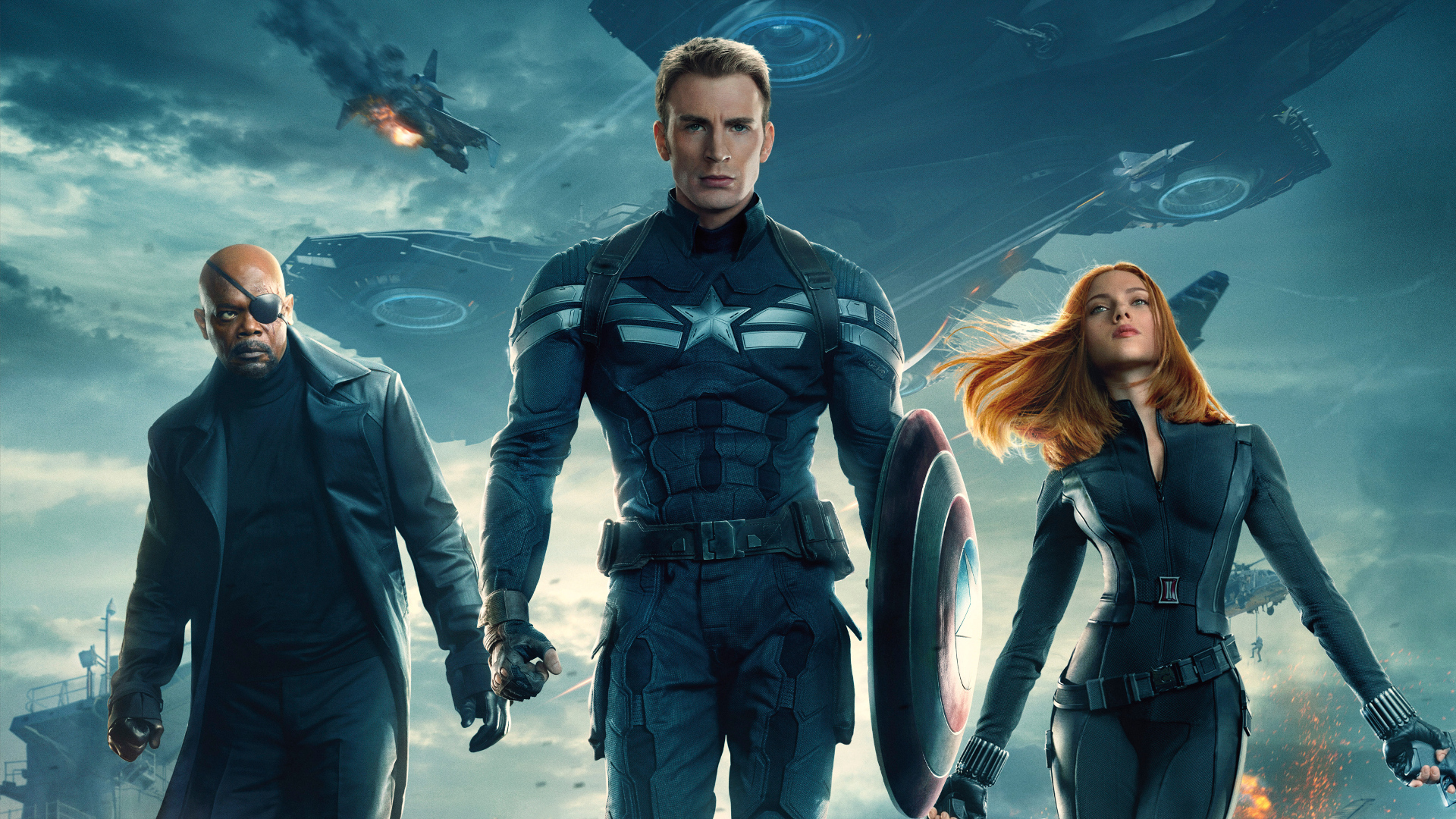
Captain America: Winter Soldier, like Dark Knight Rises before it, signals its intelligence through ambivalent allegory. In the Avengers, the supersecret SHIELD spy network is unambiguously good; the government defends our borders against a (literal) alien menace, as the spies man the ramparts. In Winter Solider, though, the spooks are the foe, as well as the heroes; America (and its security force) is its own worst enemy. Hydra lurks within SHIELD itself, working to promote terrorism in order to make the world ready and eager for totalitarian dictatorship. The terrorist other and the fascist state collude together to oppress and murder us all. End of moral.

It’s not a bad moral, as these things go. It is in fact the case that imperial excess and terrorist extremism thrive on each other; George W. and Osama, loving frenemies, birthed the big ball of hate and bile that consumed thousands of people here and hundreds of thousands overseas. Were we not gallumphing around the Middle East casually starving children and dropping the occasional bomb, who would climb into a plane and kill themselves in a futile orgy of innocent death? If terrorist whackos didn’t create a futile orgy of innocent death, what excuse would we have for picking a random, distant country and turning it into a nightmare wasteland? The pendulum of revenge needs psychopaths pushing on both sides, if it’s going to continue to reap.

Which is sort of what Winter Soldier is about, with its Hydra vs. SHIELD shenanigans…but then, not really. Because Hydra and SHIELD don’t furtively collaborate in bloodshed. Instead, Hydra is both halves of the evil dialectic; it’s both Osama, the terrorist, and George W., the totalitarian twit. Hydra creates chaos to impose imperial order. SHIELD, on the other hand, in the person of the noble Nick Fury (and of course, of Captain America), remains transcendently pure, battling anarchy and fascism in the name of an unexamined, supposedly non-ideological middle. Fury and Cap stand for decency — said decency underwritten by high-tech weaponry, martial bluster, and megaexplosions, of course. At the end Black Widow sneers at the appointed democratic representatives of the people, giving them the old, “You don’t want to know the truth” spiel, utterly without irony. We need kick ass heroes to do the dirty work of protecting us from the evil bastards who tell us they will protect us from the terrorists. America is the land of the violent, uncompromising, brutal middle.

Chris Evans as Captain America seems, then, like the perfect vacuity to paper over this empty aperture. Wooden, certain, noble, sexless, a blank, blond, slightly startled bolus of violence, pointed by the plot in more or less arbitrary directions, scattering bodies and explosions about him as he rolls like a muscle-bound marble about the screen. He is goodness sans ideology, justice sans brains, righteousness sans character. The world in its complexity is shoved into Hydra, which whispers “Hail nuance!” before it is battered into submission by the purity of himbo. America marches on, unsullied by thought, on the straight and narrow path to what we call justice for all.
 

nick-fury-captain-america-black-widow-winter-soldier-2014-movie-hd-1920x1080